
Home      Discussion      Topics      Dictionary      Almanac
Signup       Login
Dravidian languages

Dravidian languages

Overview
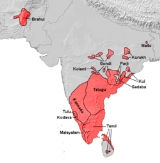
The Dravidian family of languages includes approximately 73 languages, spoken by around 200 million people. They are mainly spoken in southern India
South India
South India, also known as the Dravida in the Indian anthem, is the area encompassing India's states of Andhra Pradesh, Karnataka, Kerala and Tamil Nadu as well as the union territories of Lakshadweep and Pondicherry, occupying 19.31% of area...

 and parts of eastern and central India
India
India, officially the Republic of India , is a country in South Asia. It is the seventh-largest country by geographical area, the second-most populous country, and the most populous democracy in the world. Bounded by the Indian Ocean on the south, the Arabian Sea on the west, and the Bay of Bengal...

 as well as in northeastern Sri Lanka
Sri Lanka Tamils (native)
Sri Lankan Tamil people , or Ceylon Tamils, are an ethnic group native to the South Asian island state of Sri Lanka who predominantly speak Tamil. According to anthropological evidence, Sri Lankan Tamils have lived on the island since the 2nd century BCE...

, Pakistan
Pakistan
Pakistan , officially the Islamic Republic of Pakistan, is a country located at the crossroads of South Asia, the Middle East, and Central Asia...

, Nepal
Nepal
Nepal , officially the Federal Democratic Republic of Nepal, is a landlocked country in South Asia and the world's youngest republic. It is bordered to the north by the People's Republic of China, and to the south, east, and west by the Republic of India...

, Bangladesh
Bangladesh
, officially the People's Republic of Bangladesh is a country in South Asia. It is bordered by India on all sides except for a small border with Burma to the far southeast and by the Bay of Bengal to the south...

, Afghanistan
Afghanistan
The Islamic Republic of Afghanistan is a landlocked country in south central Asia. It is variously described as being located within Central Asia, South Asia, or the Middle East...

, Iran
Iran
Iran , officially the Islamic Republic of Iran is a country in Western Asia. The name Iran has been in use natively since the Sassanid period and came into international use from 1935, before which the country was known internationally as Persia...

, and overseas in other countries such as Malaysia
Malaysia
Malaysia is a country in Southeast Asia that consists of thirteen states and three Federal Territories, with a total landmass of . The capital city is Kuala Lumpur, while Putrajaya is the seat of the federal government. The population stands at over 28 million inhabitants...

 and Singapore
Singapore
Singapore , officially the Republic of Singapore, is an island city-state located at the southern tip of the Malay Peninsula, lying north of the equator, south of the Malaysian state of Johor and north of Indonesia's Riau Islands. At , Singapore is a microstate and the smallest nation in Southeast...

. Among them Telugu, Tamil
Tamil language
Tamil is a Dravidian language spoken predominantly by Tamil people of the Indian subcontinent. It has official status in India, Sri Lanka and Singapore. Tamil is also spoken by significant minorities in Malaysia, Mauritius and Réunion as well as emigrant communities around the world...

, Kannada and Malayalam are the members with the most speakers. It is often speculated that they are native to India
India
India, officially the Republic of India , is a country in South Asia. It is the seventh-largest country by geographical area, the second-most populous country, and the most populous democracy in the world. Bounded by the Indian Ocean on the south, the Arabian Sea on the west, and the Bay of Bengal...

.
Discussion
Ask a question about 'Dravidian languages'
Start a new discussion about 'Dravidian languages'
Answer questions from other users
Full Discussion Forum
 
Unanswered Questions
Encyclopedia
The Dravidian family of languages includes approximately 73 languages, spoken by around 200 million people. They are mainly spoken in southern India
South India
South India, also known as the Dravida in the Indian anthem, is the area encompassing India's states of Andhra Pradesh, Karnataka, Kerala and Tamil Nadu as well as the union territories of Lakshadweep and Pondicherry, occupying 19.31% of area...

 and parts of eastern and central India
India
India, officially the Republic of India , is a country in South Asia. It is the seventh-largest country by geographical area, the second-most populous country, and the most populous democracy in the world. Bounded by the Indian Ocean on the south, the Arabian Sea on the west, and the Bay of Bengal...

 as well as in northeastern Sri Lanka
Sri Lanka Tamils (native)
Sri Lankan Tamil people , or Ceylon Tamils, are an ethnic group native to the South Asian island state of Sri Lanka who predominantly speak Tamil. According to anthropological evidence, Sri Lankan Tamils have lived on the island since the 2nd century BCE...

, Pakistan
Pakistan
Pakistan , officially the Islamic Republic of Pakistan, is a country located at the crossroads of South Asia, the Middle East, and Central Asia...

, Nepal
Nepal
Nepal , officially the Federal Democratic Republic of Nepal, is a landlocked country in South Asia and the world's youngest republic. It is bordered to the north by the People's Republic of China, and to the south, east, and west by the Republic of India...

, Bangladesh
Bangladesh
, officially the People's Republic of Bangladesh is a country in South Asia. It is bordered by India on all sides except for a small border with Burma to the far southeast and by the Bay of Bengal to the south...

, Afghanistan
Afghanistan
The Islamic Republic of Afghanistan is a landlocked country in south central Asia. It is variously described as being located within Central Asia, South Asia, or the Middle East...

, Iran
Iran
Iran , officially the Islamic Republic of Iran is a country in Western Asia. The name Iran has been in use natively since the Sassanid period and came into international use from 1935, before which the country was known internationally as Persia...

, and overseas in other countries such as Malaysia
Malaysia
Malaysia is a country in Southeast Asia that consists of thirteen states and three Federal Territories, with a total landmass of . The capital city is Kuala Lumpur, while Putrajaya is the seat of the federal government. The population stands at over 28 million inhabitants...

 and Singapore
Singapore
Singapore , officially the Republic of Singapore, is an island city-state located at the southern tip of the Malay Peninsula, lying north of the equator, south of the Malaysian state of Johor and north of Indonesia's Riau Islands. At , Singapore is a microstate and the smallest nation in Southeast...

. Among them Telugu, Tamil
Tamil language
Tamil is a Dravidian language spoken predominantly by Tamil people of the Indian subcontinent. It has official status in India, Sri Lanka and Singapore. Tamil is also spoken by significant minorities in Malaysia, Mauritius and Réunion as well as emigrant communities around the world...

, Kannada and Malayalam are the members with the most speakers. It is often speculated that they are native to India
India
India, officially the Republic of India , is a country in South Asia. It is the seventh-largest country by geographical area, the second-most populous country, and the most populous democracy in the world. Bounded by the Indian Ocean on the south, the Arabian Sea on the west, and the Bay of Bengal...

. Dravidian languages are epigraphically attested since the 6th century BC.

Origins of the word Dravidian


The English word Dravidian was first employed by Robert Caldwell
Robert Caldwell
Bishop Robert Caldwell was an Evangelist Missionary and Orientalist of the British Colonial era. To aid his mission, he nativised Christianity by adopting a teleological approach to re-classify Indian languages inspired by scientific racial theories that was popular amongst the European...

 in his book of comparative Dravidian grammar based on the usage of the Sanskrit
Sanskrit
Sanskrit is a historical Indo-Aryan language, one of the liturgical languages of Hinduism and Buddhism, and one of the 22 official languages of India. It is also declared as a classical language by the government of India....

 word in the work Tantravārttika by (Zvelebil 1990:xx). As for the origin of the Sanskrit word itself there have been various theories proposed. Basically the theories are about the direction of derivation between and .

There is no definite philological and linguistic basis for asserting unilaterally that the name Dravida also forms the origin of the word Tamil
Tamil language
Tamil is a Dravidian language spoken predominantly by Tamil people of the Indian subcontinent. It has official status in India, Sri Lanka and Singapore. Tamil is also spoken by significant minorities in Malaysia, Mauritius and Réunion as well as emigrant communities around the world...

(Dravida -> Dramila -> Tamizha or Tamil). Zvelebil cites the forms such as dramila (in 's Sanskrit work Avanisundarīkathā) (found in Ceylonese chronicle Mahavamsa) and then goes on to say (ibid. page xxi): "The forms damiḷa/damila almost certainly provide a connection of " and "... < ...whereby the further development might have been * > * > - / damila- and further, with the intrusive, 'hypercorrect' (or perhaps analogical) -r-, into . The -m-/-v- alternation is a common enough phenomenon in Dravidian phonology" (Zvelebil 1990:xxi)
Zvelebil in his earlier treatise (Zvelebil 1975: p53) states: "It is obvious that the Sanskrit , Pali damila, and Prakrit are all etymologically connected with " and further remarks "The r in > is a hypercorrect insertion, cf. an analogical case of DED 1033 Ta. kamuku, Tu.kangu "areca nut": Skt. kramu(ka).".

Further, another eminent Dravidian linguist Bhadriraju Krishnamurti
Bhadriraju Krishnamurti
Bhadriraju Krishnamurti Bhadriraju Krishnamurti(భద్రిరాజు కృష్ణమూర్తి) Bhadriraju Krishnamurti(భద్రిరాజు కృష్ణమూర్తి) ( (IAST: ) (June 19, 1928 - ) is an eminent Telugu Dravidianist and the most respected Indian linguist of his generation belongs to the state of Andhra Pradesh...

 in his book Dravidian Languages (Krishnamurti 2003: p. 2, footnote 2) states:
"Joseph (1989: IJDL 18.2:134-42) gives extensive references to the use of the term , dramila first as the name of a people, then of a country. Sinhala inscriptions of BCE [Before Common Era] cite -, damela- denoting Tamil merchants. Early Buddhist and Jaina sources used - to refer to a people of south India (presumably Tamil); - was a southern non-Aryan country; -, , and - were used as variants to designate a country in the south (, Kādambarī, Daśakumāracarita-, fourth to seventh centuries CE) (1989: 134-8). It appears that - was older than - which could be its Sanskritization."

Based on what Krishnamurti states referring to a scholarly paper published in the International Journal of Dravidian Linguistics, the Sanskrit word itself is later than since the dates for the forms with -r- are centuries later than the dates for the forms without -r- (, -, damela- etc.). So it is clear that it is difficult to maintain Dravida -> Dramila -> Tamizha or Tamil.

The Monier-Williams Sanskrit Dictionary lists for the Sanskrit word dravia a meaning of "collective Name for 5 peoples, viz. the Āndhras, Karāakas, Gurjaras, Tailagas, and Mahārāras".

History


The origins of the Dravidian languages, as well as their subsequent development and the period of their differentiation are unclear, partially due to the lack of comparative linguistic
Comparative linguistics
Comparative linguistics is a branch of historical linguistics that is concerned with comparing languages to establish their historical relatedness....

 research into the Dravidian languages. The Dravidian languages have remained an isolated family to the present day and have defied all of the attempts to show a connection with the Indo-European tongues, Mitanni, Basque, Sumerian, or Korean. Rasmus K. Rask (1787-1832) considered Dravidian as belonging to the "Scythian" languages referring to Scythians as non-Semitic and non-Indo-European peoples and languages of Eastern Europe and Western Asia sometimes also termed "Hyperborean".

The most promising and plausible hypothesis is that of a linguistic relationship with the Uralic (Hungarian, Finnish) and Altaic (Turkish, Mongol) language groups. The theory that the Dravidian languages display similarities with the Uralic
Uralic languages
The Uralic languages constitute a language family of 39 languages spoken by approximately 25 million people. The healthiest Uralic languages in terms of the number of native speakers are Hungarian, Finnish, Estonian, Mari and Udmurt...

 language group, suggesting a prolonged period of contact in the past, is popular amongst Dravidian linguists and has been supported by a number of scholars, including Robert Caldwell
Robert Caldwell
Bishop Robert Caldwell was an Evangelist Missionary and Orientalist of the British Colonial era. To aid his mission, he nativised Christianity by adopting a teleological approach to re-classify Indian languages inspired by scientific racial theories that was popular amongst the European...

, Thomas Burrow
Thomas Burrow
Thomas Burrow was an Indologist and the Boden Professor of Sanskrit at the University of Oxford from 1944 to 1976. His work includes Dravidian Etymological Dictionary, The Problem of Shwa in Sanskrit and The Sanskrit Language....

, Kamil Zvelebil, and Mikhail Andronov This theory has, however, been rejected by some specialists in Uralic languages, and has in recent times also been criticised by other Dravidian linguists like Bhadriraju Krishnamurti
Bhadriraju Krishnamurti
Bhadriraju Krishnamurti Bhadriraju Krishnamurti(భద్రిరాజు కృష్ణమూర్తి) Bhadriraju Krishnamurti(భద్రిరాజు కృష్ణమూర్తి) ( (IAST: ) (June 19, 1928 - ) is an eminent Telugu Dravidianist and the most respected Indian linguist of his generation belongs to the state of Andhra Pradesh...

.

Although in modern times speakers of the various Dravidian languages have mainly occupied the southern portion of India, nothing definite is known about the ancient domain of the Dravidian parent speech. It is, however, a well-established and well-supported hypothesis that Dravidian speakers must have been widespread throughout India, including the northwest region before the arrival of Indo-European speakers.

Proto-Dravidian
Proto-Dravidian
-Hypothetical language:Proto-languages are, by definition, hypothetical languages reconstructed by linguists, and hence no proto-language has any historical record. So is the case with Proto-Dravidian...

 is thought to have differentiated into Proto-North Dravidian, Proto-Central Dravidian, Proto South-Central Dravidian and Proto-South Dravidian around 500 BC, although some linguists have argued that the degree of differentiation between the sub-families points to an earlier split.

The existence of the Dravidian language family was first suggested in 1816 by Alexander D. Campbell in his Grammar of the Teloogoo Language
Telugu language
Telugu is a Dravidian language native to the Indian subcontinent. It is the official language of Andhra Pradesh, one of the largest states of India. It is also one of the twenty-two scheduled languages of the Republic of India and was conferred the status of a Classical language by the Government...

, in which he and Francis W. Ellis argued that Tamil
Tamil language
Tamil is a Dravidian language spoken predominantly by Tamil people of the Indian subcontinent. It has official status in India, Sri Lanka and Singapore. Tamil is also spoken by significant minorities in Malaysia, Mauritius and Réunion as well as emigrant communities around the world...

 and Telugu
Telugu language
Telugu is a Dravidian language native to the Indian subcontinent. It is the official language of Andhra Pradesh, one of the largest states of India. It is also one of the twenty-two scheduled languages of the Republic of India and was conferred the status of a Classical language by the Government...

 were descended from a common, non-Indo-European ancestor. However, it was not until 1856 that Robert Caldwell
Robert Caldwell
Bishop Robert Caldwell was an Evangelist Missionary and Orientalist of the British Colonial era. To aid his mission, he nativised Christianity by adopting a teleological approach to re-classify Indian languages inspired by scientific racial theories that was popular amongst the European...

 published his Comparative grammar of the Dravidian or South-Indian family of languages, which considerably expanded the Dravidian umbrella and established it as one of the major language groups of the world. Caldwell coined the term "Dravidian" from the Sanskrit
Sanskrit
Sanskrit is a historical Indo-Aryan language, one of the liturgical languages of Hinduism and Buddhism, and one of the 22 official languages of India. It is also declared as a classical language by the government of India....

 drāvida, which was used in a 7th century text to refer to the Tamil language
Tamil language
Tamil is a Dravidian language spoken predominantly by Tamil people of the Indian subcontinent. It has official status in India, Sri Lanka and Singapore. Tamil is also spoken by significant minorities in Malaysia, Mauritius and Réunion as well as emigrant communities around the world...

 of the south of India. The publication of the Dravidian etymological dictionary by T. Burrow and M. B. Emeneau was a landmark event in Dravidian linguistics.

Recent studies of the distribution of alleles on the Y chromosome, microsatellite DNA, and mitochondrial DNA in India have cast overwhelmingly strong doubt on a biological Dravidian "race" distinct from non-Dravidians in the Indian subcontinent. The only distinct ethnic groups present in South Asia, according to genetic analysis, are the Naga
Naga people
The Nagas are a group of tribal people inhabiting the Indian state of Nagaland, parts of Manipur, Assam and Arunachal Pradesh and the northwestern hill tracks of Myanmar such as the Sagaing Division. The numerous Naga languages belong to the Tibeto-Burman languages group of the Sino-Tibetan...

, Bodo
Bodo people
The Bodos are an ethnic and linguistic community, early settlers of Assam in the North-East of India. According to the 1991 census, there were 1.2 million Bodos in Assam which makes for 5.3% of the total population in the state. Bodos belong to a larger ethnic group called the Bodo-Kachari...

, Tripura
Tripura
' is a state in North-East India, with an area of 4,051 sq. mi. or 10,491.69 km². Tripura has disputed borders and is surrounded by Bangladesh on the north, south, and west. The Indian states of Assam and Mizoram lie to the east. The capital is Agartala and the main languages spoken is Bengali...

, Balochi, Brahui
Brahui people
The Brahui people or Brohi people are a Dravidian ethnic group of about 2.2 million people with the majority found in Kalat, Pakistan, but also found in smaller numbers in neighboring Afghanistan, India, and Iran. They are closely linked to the Baloch with whom they have substantially intermingled...

, Burusho
Burusho
The Burusho or Brusho people live in the Hunza, Nagar, and Yasin valleys of northern Pakistan. There are also over 300 Burusho living in Srinagar, India . They are predominantly Muslims. Their language, Burushaski, has not been shown to be related to any other...

, Hazara, Kalash
Kalash
Kalash or Kalasha may refer to:*A people of northern Pakistan, the Kalash**their language, Kalasha-mun*A people of Nuristan in Afghanistan, the Kalasha of Nuristan**their language, Kalasha-ala...

 and Pathan peoples, all of which are found in the northwest and northeastern extremes of south Asia respectively.

Classification


Dravidian is a close-knit family. The languages are much more closely related than, say, the Indo-European languages
Indo-European languages
The Indo-European languages are a family of several hundred related languages and dialects, including most major languages of Europe, Iran, and northern India, and historically also predominant in Anatolia and Central Asia...

. There is a fair degree of agreement on how they are related to each other. The following classification divides Dravidian into three branches. Other classifications use four: Either dividing Central Dravidian into Central (Kolami-Parji) and South-Central (Telugu-Kui), or dividing Northern Dravidian into Northeast (Kurukh-Malto) and Northwest (Brahui). The latter view has been largely abandoned since it has been demonstrated that Brahui is not an ancient language of Pakistan, but arrived from the southeast less than a millennium ago. There are in addition as-yet unclassified Dravidian languages such as Allar.

The languages recognized as Official languages of India are in boldface.
The Brahui, Kurukh and Malto have myths about external origins. The Kurukh have traditionally claimed to be from the Deccan Peninsula, more specifically Karnataka. The same tradition has existed of the Brahui. They call themselves immigrants. Many scholars hold this same view of the Brahui such as L. H. Horace Perera and M. Ratnasabapathy.

Relationship to other language families


The Dravidian languages have not been shown to be related to any other language family. Comparisons have been made not just with the other language families of the Subcontinent (Indo-European
Indo-European languages
The Indo-European languages are a family of several hundred related languages and dialects, including most major languages of Europe, Iran, and northern India, and historically also predominant in Anatolia and Central Asia...

, Austro-Asiatic
Austro-Asiatic languages
The Austro-Asiatic languages are a large language family of Southeast Asia, and also scattered throughout India and Bangladesh. The name comes from the Latin word for "south" and the Greek name of Asia, hence "South Asia." Among these languages, only Vietnamese, Khmer, and Mon have a long...

, Tibeto-Burman
Tibeto-Burman languages
The Tibeto-Burman family of languages is spoken in various central, east, south and southeast Asian countries, including Burma , Tibet, northern Thailand, Vietnam, Laos, parts of central China , northern parts of Nepal, eastern parts of Bangladesh , Bhutan, northern parts of...

, and Nihali
Nihali language
Nihali, also known as Nahali or erroneously Kalto, is a language isolate spoken in west-central India by around 2,000 people out of an ethnic population of 5,000...

), but with all typologically similar language families of the Old World. Dravidian is one of the primary linguistic groups in the proposed Nostratic proposal, which would link most languages in North Africa, Europe and Western Asia into a family with its origins in the Fertile Crescent
Fertile Crescent
The Fertile Crescent is a region in the Near East, incorporating the Levant and Mesopotamia, and often incorrectly extended to Egypt. Mesopotamia is considered the cradle of civilization and saw the development of the earliest human civilizations and is the birthplace of writing and the wheel.The...

 sometime between the last Ice Age
Ice age
The general term "ice age" or, more precisely, "glacial age" denotes a geological period of long-term reduction in the temperature of the Earth's surface and atmosphere, resulting in an expansion of continental ice sheets, polar ice sheets and alpine glaciers. Within a long-term ice age, individual...

 and the emergence of proto-Indo-European
Proto-Indo-European language
The Proto-Indo-European language is the unattested, reconstructed common ancestor of the Indo-European languages, spoken by the Proto-Indo-Europeans. The existence of such a language has been accepted by linguists for over a century, and there have been many attempts at reconstruction...

 4-6 thousand years BCE. However, the general consensus is that such deep connections are not, or not yet, demonstrable.

On a less ambitious scale, several scholars have proposed linking Dravidian languages with the ancient Elamite language
Elamite language
Elamite is an extinct language spoken by the ancient Elamites. Elamite was an official language of the Persian Empire from the sixth to fourth centuries BC...

 of what is now south-western Iran. However, despite decades of research, this Elamo-Dravidian language family has not been demonstrated to the satisfaction of many historical linguists.

Nonetheless, while there are no readily detectable genealogical connections, there are strong areal features
Sprachbund
A Sprachbund , from the German word for “language union”, also known as a linguistic area, convergence area, diffusion area or language crossroads, is a group of languages that have become similar in some way because of geographical proximity and language contact. They may be genetically unrelated,...

 linking Dravidian with the Indo-Aryan languages
Indo-Aryan languages
The Indo-Aryan languages are a branch of the Indo-European language family.SIL International in a 2005 estimate counted a total of 209 varieties, the largest in terms of native speakers being Hindustani , Bengali , Punjabi , Marathi ,...

. Dravidian languages show extensive lexical (vocabulary) borrowing, but only a few traits of structural (either phonological or grammatical) borrowing, from Indo-Aryan, whereas the Indo-Aryan shows more structural features than lexical borrowings from the Dravidian languages. The Dravidian impact on the syntax of Indo-Aryan languages is considered far greater than the Indo-Aryan impact on Dravidian grammar. Some linguists explain this asymmetry by arguing that Middle Indo-Aryan languages were built on a Dravidian substratum
Substratum
In linguistics, a stratum or strate is a language that influences, or is influenced by another through contact. A substratum is a language which is influenced by another, while a superstratum is the language that exerts the influence...

.

Grammar


The most characteristic features of Dravidian languages are:
  • Dravidian languages are agglutinative
    Agglutination
    In linguistics, agglutination is the morphological process ofadding affixes to the base of a word. Languages that use agglutination widely are called agglutinative languages. These languages are often contrasted with fusional languages and isolating languages...

    .
  • Dravidian languages exhibit the inclusive and exclusive we feature.
  • The major word classes are nouns (substantives, numerals, pronouns), adjectives, verbs, and indeclinables (particles, enclitics, adverbs, interjections, onomatopoetic words, echo words).
  • Proto-Dravidian used only suffixes, never prefixes or infixes, in the construction of inflected forms. Hence, the roots of words always occurred at the beginning. Nouns, verbs, and indeclinable words constituted the original word classes.
  • There are two numbers and four different gender systems, the “original” probably having “male: non-male” in the singular and “person:non-person” in the plural.
  • In a sentence, however complex, only one finite verb occurs, normally at the end, preceded if necessary by a number of gerunds.
  • Word order follows certain basic rules but is relatively free.
  • The main (and probably original) dichotomy in tense is past:non-past. Present tense developed later and independently in each language or subgroup.
  • Verbs are intransitive, transitive, and causative; there are also active and passive forms.
  • All of the positive verb forms have their corresponding negative counterparts, negative verbs.

Historical Phonology


Vowels: Proto-Dravidian had ten vowels: a, ā, e, ē, u, ū, i, ī, o, ō. There was contrast between short and long vowels. There were no diphthongs. ai and au are treated as *ay and *av (or *aw) (Subrahmanyam 1983, Zvelebil 1990, Krishnamurti 2003).

Consonants: Proto-Dravidian is reconstructible with the following consonantal phonemes (Subrahmanyam 1983:p40, Zvelebil 1990, Krishnamurti 2003) :
Labial Dental Alveolar Retroflex Palatal Velar Glottal
Plosive p t c k
Nasal m n ñ
Flap r
Fricative
Lateral l
Approximant v y


Alveolar stop in many daughter languages developed into an alveolar trill . It still retains the stop sound in Kota and Toda (Subrahmanyam 1983). Malayalam still retains the original (alveolar) stop sound in gemination. (ibid). In Old Tamil it takes the enunciative vowel like the other stops. In other words, (or ) does not occur word-finally without the enunciative vowel (ibid).

Velar nasal occurs only before k in Proto-Dravidian as in many of its daughter languages. Therefore it is not considered a separate phoneme in Proto-Dravidian. However, it attained phonemic status in languages like Malayalam, Gondi, Konda and Pengo due to the simplification of the original sequence * to . (Subrahmanyam 1983)

The glottal fricative H has been proposed by Bhadriraju Krishnamurti
Bhadriraju Krishnamurti
Bhadriraju Krishnamurti Bhadriraju Krishnamurti(భద్రిరాజు కృష్ణమూర్తి) Bhadriraju Krishnamurti(భద్రిరాజు కృష్ణమూర్తి) ( (IAST: ) (June 19, 1928 - ) is an eminent Telugu Dravidianist and the most respected Indian linguist of his generation belongs to the state of Andhra Pradesh...

 to account for the Old Tamil Aytam (Āytam) and other Dravidian comparative phonological phenomena (Krishnamurti 2003).

Dravidian languages are noted for the lack of distinction between aspirated and unaspirated stops. While some Dravidian languages (especially Malayalam, Kannada and Telugu) have accepted large numbers of loan words from Sanskrit
Sanskrit
Sanskrit is a historical Indo-Aryan language, one of the liturgical languages of Hinduism and Buddhism, and one of the 22 official languages of India. It is also declared as a classical language by the government of India....

 and other Indo-European languages
Indo-European languages
The Indo-European languages are a family of several hundred related languages and dialects, including most major languages of Europe, Iran, and northern India, and historically also predominant in Anatolia and Central Asia...

 in addition to their already vast vocabulary, in which the orthography shows distinctions in voice and aspiration
Aspiration (phonetics)
In phonetics, aspiration is the strong burst of air that accompanies either the release or, in the case of preaspiration, the closure of some obstruents. To feel or see the difference between aspirated and unaspirated sounds, one can put a hand or a lit candle in front of one's mouth, and say tore ...

, the words are pronounced in Dravidian according to different rules of phonology and phonotactics: aspiration of plosives is generally absent, regardless of the spelling of the word. This is not a universal phenomenon and is generally avoided in formal or careful speech, especially when reciting.

For instance, Tamil, like Finnish
Finnish language
Finnish is the language spoken by the majority of the population in Finland and by ethnic Finns outside of Finland. It is one of the official languages of Finland and an official minority language in Sweden. In Sweden, both standard Finnish and Meänkieli, a Finnish dialect, are spoken...

, Korean
Korean language
Korean is the official language of North Korea and South Korea. It is also one of the two official languages in the Yanbian Korean Autonomous Prefecture in China. There are about 78 million Korean speakers. It was formerly written using Hanja, borrowed Chinese characters pronounced in the Korean...

, Ainu
Ainu language
Ainu is an Ainu language spoken by members of the Ainu ethnic group on the northern Japanese island of Hokkaidō....

, and most indigenous Australian languages, does not distinguish between voiced and unvoiced stops. In fact, the Tamil alphabet lacks symbols for voiced and aspirated stops.

Dravidian languages are also characterized by a three-way distinction between dental
Dental consonant
In linguistics, a dental consonant or dental is a consonant that is articulated with the tongue against the upper teeth, such as , , , and in some languages...

, alveolar
Alveolar consonant
Alveolar consonants are articulated with the tongue against or close to the superior alveolar ridge, which is called that because it contains the alveoli of the superior teeth...

, and retroflex places of articulation as well as large numbers of liquids
Liquid consonant
Liquid consonants, or liquids, are trills, taps, or approximant consonants that are not classified as semivowels because they do not correspond phonetically to specific vowels .The class of liquids can be divided into lateral liquids and rhotics...

.

Words starting with vowels


A substantial number of words also begin and end with vowels, which helps the languages' agglutinative property.

karanu (cry), elumbu (bone), adu (that), awade (there), idu (this), illai (no, absent)

adu-idil-illai (adu = that, idu = this, il= suffix form of "in", so => that-this-in-absent => that-in this-absent => that is absent in this)

Numerals


The numerals from 1 to 10 in various Dravidian languages.
Number Tamil
Tamil language
Tamil is a Dravidian language spoken predominantly by Tamil people of the Indian subcontinent. It has official status in India, Sri Lanka and Singapore. Tamil is also spoken by significant minorities in Malaysia, Mauritius and Réunion as well as emigrant communities around the world...

Kannada
Kannada language
Kannada is one of the major Dravidian languages of India, spoken predominantly in the state of Karnataka. Kannada, whose native speakers are called Kannadigas , number roughly 38 million, making it the 27th most spoken language in the world...

Telugu
Telugu language
Telugu is a Dravidian language native to the Indian subcontinent. It is the official language of Andhra Pradesh, one of the largest states of India. It is also one of the twenty-two scheduled languages of the Republic of India and was conferred the status of a Classical language by the Government...

Tulu
Tulu language
Tulu is a Dravidian language of India spoken by an estimated 3 to 5 million native speakers worldwide, known as Tuluvas. Most Tuluvas are natives of the districts of Dakshina Kannada and Udupi in the west of the state of Karnataka and Kasaragod district of Kerala which is collectively known as...

Malayalam
Malayalam language
Malayalam is one of the four major Dravidian languages of South India. It is one of the 22 scheduled languages of India with official language status in the state of Kerala and the union territories of Lakshadweep and Mahé. It is spoken by around 37 million people...

Kurukh
Kurukh language
Kurukh , also called Kurux, Kuṛux or Kuruḵẖ, is a Dravidian language spoken by the Oraon tribe, a tribal people of Bihar, Jharkhand, Orissa, Madhya Pradesh, Chhattisgarh, and West Bengal, India, as well as in northern Bangladesh. It is most closely related to Brahui and Malto...

Kolami
Kolami language
Kolami is a tribal Dravidian language used in Andhra Pradesh and Maharashtra states of India....

Brahui
Brahui language
Brahui or Brahvi is a language spoken by Brahui people. It is the only Dravidian language exclusively spoken out of India.Brahui is spoken in the southwest region of Pakistan and border regions of Afghanistan and Iran with Pakistan...

Proto-Dravidian
Proto-Dravidian
-Hypothetical language:Proto-languages are, by definition, hypothetical languages reconstructed by linguists, and hence no proto-language has any historical record. So is the case with Proto-Dravidian...

1 onru ondu onji onnu okkod *oru(1)
2 *iru(2)
3 nru ru mūji mūnnu mūnd *muC
4 nālu, nālku, nānku nālku nālugu nāl nālu kh čār (II) *nān
5 aintu aidu ayidu ayN añcu pancē (II) ayd 3 panč (II) *cayN
6 āru āru āru āji āru soyyē (II) ār 3 šaš (II) *caru
7 ēlu yēl sattē (II) 3 haft (II)
8 enimidi edma enumadī 3 hašt (II)
9 onpatu ombattu tommidi ormba onpatu tomdī 3 nōh (II)
10 pattu hattu padi patt pattu dassē (II) padī 3 dah (II) *pat(tu)
  1. This is the same as the word for another form of the number one in Tamil and Malayalam. This is used as an indefinite article meaning "a" and also when the number is an adjective followed by a noun (as in "one person") as opposed to when it is a noun (as in "How many are there?" "One").
  2. This is still found in compound words, and has taken on a meaning of "double" in Tamil and Malayalam. For example, irupatu (20, literally meaning "double-ten") or "irai" ("double") or Iruvar (meaning two people).
    • Words indicated (II) are borrowings from Indo-Iranian languages
      Indo-Iranian languages
      The Indo-Iranian language group constitutes the easternmost extant branch of the Indo-European family of languages. It consists of three language groups: the Indo-Aryan, Iranian and Nuristani. The term Aryan languages is occasionally still used to refer to the Indo-Iranian languages...

      .

Stability and Continuity of Dravidian


The Dravidian language family has been considered remarkably stable. Some aspects of its stability are:
  • Relative stability of root vowels seems to have been the rule (Zvelebil)
  • A tendency toward structural and systemic balance and stability is characteristic of the Dravidian group (Zvelebil, ibid)

Dravidian substratum influence on Sanskrit


Dravidian and Sanskrit have influenced each other in various ways from very early times, hence it is an interesting field for linguistic research.

Well-known Indologist and linguist (Zvelebil 1975: pp50-51): "... the period of the high water mark of Tamil classical literature was one in which the two great Sanskrit epics were already completed, but the Sanskrit classical poetry was barely emerging with ." More importantly he continues: "No stylistic feature or convention could have been borrowed by the Tamils (though of course there are borrowings of stories" (emphasis added). Zvelebil remarks:"Though the dominance of Sanskrit was exaggerated in some Brahmanic circles of Tamilnadu, and Tamil was given unduly underestimated by a few Sanskrit-oriented scholars, the Tamil and Sanskrit cultures were not generally in rivalry".

However more recent research has shown that Sanskrit has been influenced in certain more fundamental ways than Dravidian languages have been by it: It is by way of phonology and even more significantly here via grammatical constructs. This has been the case from the earliest language available (ca. 1200 B.C.) of Sanskrit: the Vedic speech.

Basically, Dravidian languages show extensive lexical (vocabulary) borrowing, but only a few traits of structural (either phonological or grammatical) borrowing, from the Indo-Aryan tongues. On the other hand, Indo-Aryan shows rather large-scale structural borrowing from Dravidian, but relatively few loanwords.

The Vedic language has retroflex consonants even though it is well known that the Indo European family and the Indo-Iranian subfamily to which Sanskrit belongs lack retroflex consonants (/, ) with about 88 words in the Veda having unconditioned retroflexes (Kuiper 1991, Witzel 1999). Some sample words are: (, ,, , , ) This is cited as a serious evidence of substrate influence from close contact of the Vedic speakers with speakers of a foreign language family rich in retroflex phonemes (Kuiper 1991, Witzel 1999). Obviously the Dravidian family would be a serious candidate here (ibid as well as Krishnamurti 2003: p36) since it is rich in retroflex phonemes reconstructible back to the Proto-Dravidian stage[See Subrahmanyam 1983:p40, Zvelebil 1990, Krishnamurti 2003].

A more serious influence on Vedic Sanskrit is the extensive grammatical influence attested by the usage of the quotative marker iti and the occurrence of gerunds of verbs, a grammatical feature not found even in the Avestan language, a sister language of the Vedic Sanskrit. As Krishnamurti states: "Besides, the Veda has used the gerund, not found in Avestan, with the same grammatical function as in Dravidian, as a non-finite verb for 'incomplete' action. Vedic language also attests the use of iti as a quotative clause complementizer. All these features are not a consequence of simple borrowing but they indicate substratum influence (Kuiper 1991: ch 2)".

The Brahui
Brahui
The name Brahui may refer to:*The Brahui language*The Brahui people...

 population of Balochistan
Balochistan (region)
Balochistan or Baluchistan is an arid region located in the Iranian Plateau in Southwest Asia and South Asia, between Pakistan, Iran, and Afghanistan. The area is named after the numerous Baloch tribes, an Iranian people, who moved into the area from the west around A.D. 1000...

 has been taken by some as the linguistic equivalent of a relict
Relict
The term relict is used to refer to surviving remnants of natural phenomena.* In biology a relict is an organism that at an earlier time was abundant in a large area but now occurs at only one or a few small areas....

 population
Population
In biology, a population is the collection of inter-breeding organisms of a particular species; in sociology, a collection of human beings. Individuals within a population share a factor may be reduced by statistical means, but such a generalization may be too vague to imply anything...

, perhaps indicating that Dravidian languages were formerly much more widespread and were supplanted by the incoming Indo-Aryan languages.

state that there is strong evidence that Dravidian influenced Indic
Indo-Aryan languages
The Indo-Aryan languages are a branch of the Indo-European language family.SIL International in a 2005 estimate counted a total of 209 varieties, the largest in terms of native speakers being Hindustani , Bengali , Punjabi , Marathi ,...

 through "shift", that is, native Dravidian speakers learning and adopting Indic languages. claims that the presence of the Brahui language
Brahui language
Brahui or Brahvi is a language spoken by Brahui people. It is the only Dravidian language exclusively spoken out of India.Brahui is spoken in the southwest region of Pakistan and border regions of Afghanistan and Iran with Pakistan...

, similarities between Elamite and Harappan script as well as similarities between Indo-Aryan and Dravidian indicate that these languages may have interacted prior to the spread of Indo-Aryans southwards and the resultant intermixing of languages. states that the most plausible explanation for the presence of Dravidian structural features in Old Indo-Aryan is that the majority of early Old Indo-Aryan speakers had a Dravidian mother tongue which they gradually abandoned. Even though the innovative traits in Indic could be explained by multiple internal explanations, early Dravidian influence is the only explanation that can account for all of the innovations at once – it becomes a question of explanatory parsimony
Occam's razor
Occam's razor , entia non sunt multiplicanda praeter necessitatem , is the principle that can be popularly stated as "when you have two competing theories that make exactly the same predictions, the simpler one is the better." The principle is attributed to 14th-century English...

; moreover, early Dravidian influence accounts for the several of the innovative traits in Indic better than any internal explanation that has been proposed.

The noted Indologist Zvelebil remarks: "Several scholars have demonstrated that pre-Indo-Aryan and pre-Dravidian bilingualism in India provided conditions for the far-reaching influence of Dravidian on the Indo-Aryan tongues in the spheres of phonology (e.g., the retroflex consonants, made with the tongue curled upward toward the palate), syntax (e.g., the frequent use of gerunds, which are nonfinite verb forms of nominal character, as in “by the falling of the rain”), and vocabulary (a number of Dravidian loanwords apparently appearing in the Rigveda itself)"

External links


See also


  • Susumu Kuno
    Susumu Kuno
    is a Japanese linguist and author. He is Professor Emeritus of Linguistics at Harvard University, where he received his Ph.D. degree in 1964 and spent his entire career. He received his A.B. and A.M. from Tokyo University where he received a thorough grounding in linguistics under the guidance of...

    , Professor Emeritus of Linguistics (Harvard University
    Harvard University
    Harvard University is a private university located in Cambridge, Massachusetts and a member of the Ivy League. Founded in 1636 by the colonial Massachusetts legislature, Harvard is the oldest institution of higher learning in the United States and currently comprises ten separate academic units...

    ), author of numerous books on Dravidian and other languages
  • Official languages of India
  • Nostratic languages
    Nostratic languages
    Nostratic is a proposed language family that includes many of the indigenous language families of Europe, Asia, Africa, and North America. The term "Nostratic" roughly translated means "our language"...