


Nihon Shoki

Encyclopedia
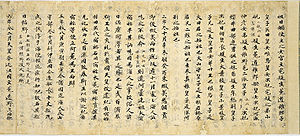
The , sometimes translated as The Chronicles of Japan, is the second oldest book of classical Japan
Japan
Japan is an island nation in East Asia. Located in the Pacific Ocean, it lies to the east of the Sea of Japan, China, North Korea, South Korea and Russia, stretching from the Sea of Okhotsk in the north to the East China Sea and Taiwan in the south...
ese history
History of Japan
The history of Japan encompasses the history of the islands of Japan and the Japanese people, spanning the ancient history of the region to the modern history of Japan as a nation state. Following the last ice age, around 12,000 BC, the rich ecosystem of the Japanese Archipelago fostered human...
. It is more elaborate and detailed than the Kojiki
Kojiki
is the oldest extant chronicle in Japan, dating from the early 8th century and composed by Ō no Yasumaro at the request of Empress Gemmei. The Kojiki is a collection of myths concerning the origin of the four home islands of Japan, and the Kami...
, the oldest, and has proven to be an important tool for historians and archaeologists as it includes the most complete extant historical record of ancient Japan (its beginning must be considered as largely mythological however ; its very first chapters, moreover, root in Chinese metaphysics). The Nihon Shoki was finished in 720 under the editorial supervision of Prince Toneri
Prince Toneri of Japan
was a Japanese imperial prince in the Nara period. He was a son of Emperor Temmu. He was given the posthumous name, , as the father of Emperor Junnin. In the beginning of the Nara period, he gained political power as a leader of imperial family together with Prince Nagaya...
and with the assistance of Ō no Yasumaro
O no Yasumaro
was a Japanese nobleman, bureaucrat, and chronicler. He may have been the son of , a participant in the Jinshin War of 672.He is most famous for compiling and editing, with the assistance of Hieda no Are, the Kojiki, the oldest extant Japanese history. Empress Genmei was a Japanese nobleman,...
. The book is also called the .
The Nihon Shoki begins with the creation myth (myth
Mythology
The term mythology can refer either to the study of myths, or to a body or collection of myths. As examples, comparative mythology is the study of connections between myths from different cultures, whereas Greek mythology is the body of myths from ancient Greece...
), explaining the origin of the world and the first seven generations of divine beings (starting with Kunitokotachi
Kunitokotachi
In Japanese mythology, is one of the two gods born from "something like a reed that arose from the soil" when the earth was chaotic. In the Nihon Shoki, he is named "Kuni-toko-tachi no mikoto" and is the first of the first three divinities born after heaven and earth were born out of chaos, and...
), and goes on with a number of myths as does the Kojiki
Kojiki
is the oldest extant chronicle in Japan, dating from the early 8th century and composed by Ō no Yasumaro at the request of Empress Gemmei. The Kojiki is a collection of myths concerning the origin of the four home islands of Japan, and the Kami...
, but continues its account through to events of the 8th century. It is believed to record accurately the latter reigns of Emperor Tenji
Emperor Tenji
, also known as Emperor Tenchi, was the 38th emperor of Japan, according to the traditional order of succession.Tenji's reign spanned the years from 661 through 671.-Traditional narrative:...
, Emperor Temmu
Emperor Temmu
was the 40th emperor of Japan, according to the traditional order of succession.Temmu's reign lasted from 672 until his death in 686.-Traditional narrative:...
and Empress Jitō
Empress Jito
was the 41st emperor of Japan, according to the traditional order of succession.Jitō's reign spanned the years from 686 through 697.In the history of Japan, Jitō was the third of eight women to take on the role of empress regnant. The two female monarchs before Jitō were Suiko and Kōgyoku/Saimei...
. The Nihon Shoki focuses on the merits of the virtuous rulers
Emperor of Japan
The Emperor of Japan is, according to the 1947 Constitution of Japan, "the symbol of the state and of the unity of the people." He is a ceremonial figurehead under a form of constitutional monarchy and is head of the Japanese Imperial Family with functions as head of state. He is also the highest...
as well as the errors of the bad rulers. It describes episodes from mythological
Japanese mythology
Japanese mythology is a system of beliefs that embraces Shinto and Buddhist traditions as well as agriculturally based folk religion. The Shinto pantheon comprises innumerable kami...
eras and diplomatic
Diplomacy
Diplomacy is the art and practice of conducting negotiations between representatives of groups or states...
contacts with other countries. The Nihon Shoki was written in classical Chinese
Classical Chinese
Classical Chinese or Literary Chinese is a traditional style of written Chinese based on the grammar and vocabulary of ancient Chinese, making it different from any modern spoken form of Chinese...
, as was common for official documents at that time. The Kojiki, on the other hand, is written in a combination of Chinese and phonetic transcription of Japanese (primarily for names and songs). The Nihon Shoki also contains numerous transliteration notes telling the reader how words were pronounced in Japanese. Collectively, the stories in this book and the Kojiki are referred to as the Kiki stories.
One of the stories that first appear in the Nihon Shoki is the tale of Urashima Tarō
Urashima Taro
is a Japanese legend about a fisherman who rescues a turtle and is rewarded for this with a visit to Ryūgū-jō, the palace of Ryūjin, the Dragon God, under the sea...
, which has been identified as the earliest example of a story involving time travel
Time travel
Time travel is the concept of moving between different points in time in a manner analogous to moving between different points in space. Time travel could hypothetically involve moving backward in time to a moment earlier than the starting point, or forward to the future of that point without the...
.
Chapters
- Chapter 01: (First chapter of myths) Kami no Yo no Kami no maki.
- Chapter 02: (Second chapter of myths) Kami no Yo no Shimo no maki.
- Chapter 03: (Emperor JimmuEmperor Jimmuwas the first Emperor of Japan, according to the traditional order of succession. He is also known as Kamuyamato Iwarebiko and personally as Wakamikenu no Mikoto or Sano no Mikoto....
) Kamuyamato Iwarebiko no Sumeramikoto. - Chapter 04:
- (Emperor SuizeiEmperor Suizei, sometimes romanized as Suisei and known as Kamu-nuna-kaha-mimi no mikoto; was the second emperor of Japan, according to the traditional order of succession....
) Kamu Nunakawamimi no Sumeramikoto. - (Emperor AnneiEmperor Annei; also known as shikitsuhikotamatemi no Mikoto; was the third emperor of Japan, according to the traditional order of succession.No firm dates can be assigned to this emperor's life, but he is conventionally considered to have reigned from 549 to 511 B.C....
) Shikitsuhiko Tamatemi no Sumeramikoto. - (Emperor ItokuEmperor Itoku; also known as Ooyamatohikosukitomo no Mikoto; was the fourth emperor of Japan according to the traditional order of succession.No firm dates can be assigned to this emperor's life, but he is conventionally considered to have reigned from 510 BC–476 BC He probably lived in the early 1st...
) Ōyamato Hikosukitomo no Sumeramikoto. - (Emperor KōshōEmperor Kosho; also known as Mimatsuhikokaeshine no Mikoto; was the fifth emperor of Japan, according to the traditional order of succession.No firm dates can be assigned to this emperor's life or reign, but he is conventionally considered to have reigned from 475 to 393 BC, but he may have lived in the early...
) Mimatsuhiko Sukitomo no Sumeramikoto. - (Emperor KoanEmperor Koan; also known as Yamatotarashihikokunioshihito no Mikoto; was the sixth emperor of Japan, according to the traditional order of succession.No firm dates can be assigned to this emperor's life or reign, but he is conventionally considered to have reigned from 392 BC through 291 BC, but he may have...
) Yamato Tarashihiko Kuni Oshihito no Sumeramikoto. - (Emperor KōreiEmperor Korei; also known as Ooyamatonekohikofutoni no Mikoto; was the seventh emperor of Japan, according to the traditional order of succession.No firm dates can be assigned to this emperor's life or reign, but he is conventionally considered to have reigned from 290 BC–215 BC, but he may have lived in the...
) Ōyamato Nekohiko Futoni no Sumeramikoto. - (Emperor KōgenEmperor Kogen, also known as Ooyamatonekohikokunikuru no Mikoto, was the eighth emperor of Japan, according to the traditional order of succession.No firm dates can be assigned to this emperor's life or reign, but he is conventionally considered to have reigned from 214 BC–158 BC.-Legendary narrative:Modern...
) Ōyamato Nekohiko Kunikuru no Sumeramikoto. - (Emperor KaikaEmperor Kaika; also known as Wakayamatonekohikooobi no Mikoto; is the ninth emperor of Japan, according to the traditional order of succession.No firm dates can be assigned to this emperor's life or reign, but he is conventionally considered to have reigned from 157 BC–98 BC, but he may have lived in the...
) Wakayamato Nekohiko Ōbibi no Sumeramikoto.
- (Emperor Suizei
- Chapter 05: (Emperor SujinEmperor Sujin; also known as Mimakiiribikoinie no Sumeramikoto or Hatsukunishirasu Sumeramikoto; was the tenth emperor of Japan, according to the traditional order of succession....
) Mimaki Iribiko Iniye no Sumeramikoto. - Chapter 06: (Emperor SuininEmperor Suinin; also known as Ikumeiribikoisachi no Mikoto; was the 11th emperor of Japan, according to the traditional order of succession.No firm dates can be assigned to this emperor's life or reign, but he is conventionally considered to have reigned from 29 BC–AD 70....
) Ikume Iribiko Isachi no Sumeramikoto. - Chapter 07:
- (Emperor KeikoEmperor Keiko; also known as Ootarashihikooshirowake no Sumeramikoto, was the 12th emperor of Japan, according to the traditional order of succession.No firm dates can be assigned to this emperor's life or reign, but he is conventionally considered to have reigned from 71–130.-Legendary narrative:Keikō is...
) Ōtarashihiko Oshirowake no Sumeramikoto. - (Emperor SeimuEmperor Seimu; also known as Wakatarashihiko no Sumeramikoto; was the 13th emperor of Japan, according to the traditional order of succession.No firm dates can be assigned to this emperor's life or reign, but he is conventionally considered to have reigned from 131–191....
) Waka Tarashihiko no Sumeramikoto.
- (Emperor Keiko
- Chapter 08: (Emperor ChūaiEmperor Chuai; also known as Tarashinakatsuhiko no Sumeramikoto; was the 14th emperor of Japan, according to the traditional order of succession.No firm dates can be assigned to this emperor's life or reign, but he is conventionally considered to have reigned from 192–200....
) Tarashi Nakatsuhiko no Sumeramikoto. - Chapter 09: (Empress Jingū) Okinaga Tarashihime no Mikoto.
- Chapter 10: (Emperor ŌjinEmperor Ojin, also known as Homutawake or , was the 15th emperor of Japan, according to the traditional order of succession.No firm dates can be assigned to this emperor's life or reign, but he is conventionally considered to have reigned from 270 to 310....
) Homuda no Sumeramikoto. - Chapter 11: (Emperor NintokuEmperor Nintokuwas the 16th emperor of Japan, according to the traditional order of succession.No firm dates can be assigned to this emperor's life or reign, but he is conventionally considered to have reigned from 313–399.-Legendary narrative:...
) Ōsasagi no Sumeramikoto. - Chapter 12:
- (Emperor RichūEmperor Richuwas the 17th emperor of Japan, according to the traditional order of succession.No firm dates can be assigned to this emperor's life or reign, but he is conventionally considered to have reigned from 400–405.-Legendary narrative :...
) Izahowake no Sumeramikoto. - (Emperor HanzeiEmperor Hanzei, also known as Emperor Hanshō, was the 18th emperor of Japan, according to the traditional order of succession.No firm dates can be assigned to this emperor's life or reign, but he is conventionally considered to have reigned from 406 to 410....
) Mitsuhawake no Sumeramikoto.
- (Emperor Richū
- Chapter 13:
- (Emperor IngyōEmperor Ingyowas the 19th emperor of Japan, according to the traditional order of succession.No firm dates can be assigned to this emperor's life or reign, but he is conventionally considered to have reigned from 411–453.-Legendary narrative:...
) Oasazuma Wakugo no Sukune no Sumeramikoto. - (Emperor AnkōEmperor Ankowas the 20th emperor of Japan, according to the traditional order of succession.No firm dates can be assigned to this emperor's life or reign, but he is conventionally considered to have reigned from 453–456.-Legendary narrative:...
) Anaho no Sumeramikoto.
- (Emperor Ingyō
- Chapter 14: (Emperor YūryakuEmperor Yuryakuwas the 21st emperor of Japan, according to the traditional order of succession.Yūryaku is remembered as a patron of sericulture.No firm dates can be assigned to this emperor's life or reign, but he is conventionally considered to have reigned from 456–479....
) Ōhatsuse no Waka Takeru no Sumeramikoto. - Chapter 15:
- (Emperor SeineiEmperor Seineiwas the 22nd emperor of Japan, according to the traditional order of succession.No firm dates can be assigned to this emperor's life or reign, but he is conventionally considered to have reigned from 480–484.-Legendary narrative:...
) Shiraka no Take Hirokuni Oshi Waka Yamato Neko no Sumeramikoto. - (Emperor KenzōEmperor Kenzo, also spelled Ghen-so-tennō, was the 23rd emperor of Japan, according to the traditional order of succession.No firm dates can be assigned to this emperor's life or reign, but he is conventionally considered to have reigned from 485–487....
) Woke no Sumeramikoto. - (Emperor NinkenEmperor Ninken, also known as Ninken-okimi, was the 24th emperor of Japan, according to the traditional order of succession.No firm dates can be assigned to this emperor's life or reign, but he is conventionally considered to have reigned from 488–498....
) Oke no Sumeramikoto.
- (Emperor Seinei
- Chapter 16: (Emperor BuretsuEmperor Buretsuwas the 25th emperor of Japan, according to the traditional order of succession.No firm dates can be assigned to this emperor's life or reign, but he is conventionally considered to have reigned from 498–506.-Legendary narrative:...
) Ohatsuse no Waka Sasagi no Sumeramikoto. - Chapter 17: (Emperor KeitaiEmperor Keitai, also known as Keitai-okimi, was the 26th emperor of Japan, according to the traditional order of succession.No firm dates can be assigned to this emperor's life or reign, but he is conventionally considered to have reigned from 507–531....
) Ōdo no Sumeramikoto. - Chapter 18:
- (Emperor AnkanEmperor Ankanwas the 27th emperor of Japan, according to the traditional order of succession.No firm dates can be assigned to this emperor's life or reign, but he is conventionally considered to have reigned from 531–536.-Legendary narrative:...
) Hirokuni Oshi Take Kanahi no Sumeramikoto. - (Emperor SenkaEmperor Senka, also known as Senkwa, was the 28th emperor of Japan, according to the traditional order of succession.No firm dates can be assigned to this emperor's life or reign, but he is conventionally considered to have reigned from 536–539.-Legendary narrative:...
) Take Ohirokuni Oshi Tate no Sumeramikoto.
- (Emperor Ankan
- Chapter 19: (Emperor KimmeiEmperor Kimmeiwas the 29th emperor of Japan, according to the traditional order of succession.His reign is said to have spanned the years from 539 through 571.-Traditional narrative:...
) Amekuni Oshiharaki Hironiwa no Sumeramikoto. - Chapter 20: (Emperor BidatsuEmperor Bidatsuwas the 30th emperor of Japan, according to the traditional order of succession.Bidastsu's reign spanned the years from 572 through 585.-Traditional narrative:Bidatsu was called in the Nihonshoki....
) Nunakakura no Futo Tamashiki no Sumeramikoto. - Chapter 21:
- (Emperor YōmeiEmperor Yomeiwas the 31st emperor of Japan, according to the traditional order of succession.Yōmei's reign spanned the years from 585 until his death in 587.-Traditional narrative:...
) Tachibana no Toyohi no Sumeramikoto. - (Emperor SushunEmperor Sushunwas the 32nd emperor of Japan, according to the traditional order of succession.Sushun's reign spanned the years from 587 through 592.-Traditional narrative:...
) Hatsusebe no Sumeramikoto.
- (Emperor Yōmei
- Chapter 22: (Empress SuikoEmpress Suikowas the 33rd emperor of Japan, according to the traditional order of succession.Suiko's reign spanned the years from 593 until her death in 628....
) Toyomike Kashikiya Hime no Sumeramikoto. - Chapter 23: (Emperor JomeiEmperor Jomeiwas the 34th emperor of Japan, according to the traditional order of succession.Jomei's reign spanned the years from 629 through 641.-Traditional narrative:Before Jomei's ascension to the Chrysanthemum Throne, his personal name was or...
) Okinaga Tarashi Hihironuka no Sumeramikoto. - Chapter 24: (Empress KōgyokuEmpress Kogyoku, also known as , was the 35th and 37th emperor of Japan, according to the traditional order of succession.Kōgyoku's reign spanned the years from 642-645. Her reign as Saimei encompassed 655-661...
) Ame Toyotakara Ikashi Hitarashi no Hime no Sumeramikoto. - Chapter 25: (Emperor KōtokuEmperor Kotokuwas the 36th emperor of Japan, according to the traditional order of succession.The years of his reign lasted from 645 through 654.-Traditional narrative:Before Kōtoku ascension to the Chrysanthemum Throne, his personal name was or...
) Ame Yorozu Toyohi no Sumeramikoto. - Chapter 26: (Empress Saimei) Ame Toyotakara Ikashi Hitarashi no Hime no Sumeramikoto.
- Chapter 27: (Emperor TenjiEmperor Tenji, also known as Emperor Tenchi, was the 38th emperor of Japan, according to the traditional order of succession.Tenji's reign spanned the years from 661 through 671.-Traditional narrative:...
) Ame Mikoto Hirakasuwake no Sumeramikoto. - Chapter 28: (Emperor TemmuEmperor Temmuwas the 40th emperor of Japan, according to the traditional order of succession.Temmu's reign lasted from 672 until his death in 686.-Traditional narrative:...
, first chapter) Ama no Nunakahara Oki no Mahito no Sumeramikoto, Kami no maki. - Chapter 29: (Emperor TemmuEmperor Temmuwas the 40th emperor of Japan, according to the traditional order of succession.Temmu's reign lasted from 672 until his death in 686.-Traditional narrative:...
, second chapter) Ama no Nunakahara Oki no Mahito no Sumeramikoto, Shimo no maki. - Chapter 30: (Empress JitōEmpress Jitowas the 41st emperor of Japan, according to the traditional order of succession.Jitō's reign spanned the years from 686 through 697.In the history of Japan, Jitō was the third of eight women to take on the role of empress regnant. The two female monarchs before Jitō were Suiko and Kōgyoku/Saimei...
) Takamanohara Hirono Hime no Sumeramikoto.
Process of compilation
Shoku NihongiShoku Nihongi
The is an imperially commissioned Japanese history text. Completed in 797, it is the second of the Six National Histories, coming directly after the Nihon Shoki and followed by Nihon Kōki. Fujiwara no Tsugutada and Sugano no Mamichi served as the primary editors...
notes that "先是一品舍人親王奉勅修日本紀。至是功成奏上。紀卅卷系圖一卷" in the part of May, 720. It means "Up to that time, Prince Toneri had been compiling Nihongi on the orders of the emperor; he completed it, submitting 30 volumes of history and one volume of genealogy". The volume of genealogy is no longer extant.
Contributors
The process of compilation is usually studied by stylistic analysis of each chapter. Although written in classical Chinese, some sections use styles characteristic of Japanese editors, while others seem to be written by native speakers of Chinese. According to recent studies, most of the chapters after #14 (Emperor Yūryaku chronicle) were contributed by native Chinese, except for Chapters 22 and 23 (the Suiko and Jomei chronicle). Also, as Chapter 13 ends with the phrase "see details of the incident in the chronicle of Ōhastuse (Yūryaku) Emperor" referring to the assassination of Emperor Ankō, it is assumed that this chapter was written after the compilation of subsequent chapters. Some believe Chapter 14 was the first to be completed.Exaggeration of reign lengths
Most scholars agree that the purported founding date of Japan (660 BCE) and the earliest emperors of Japan are legendary or mythical. This does not necessarily imply that the persons referred to did not exist, merely that there is insufficient material available for further verification and study.For those monarchs, and also for the Emperors Ōjin
Emperor Ojin
, also known as Homutawake or , was the 15th emperor of Japan, according to the traditional order of succession.No firm dates can be assigned to this emperor's life or reign, but he is conventionally considered to have reigned from 270 to 310....
and Nintoku
Emperor Nintoku
was the 16th emperor of Japan, according to the traditional order of succession.No firm dates can be assigned to this emperor's life or reign, but he is conventionally considered to have reigned from 313–399.-Legendary narrative:...
, the lengths of reign are likely to have been exaggerated in order to make the origins of the imperial family sufficiently ancient to satisfy numerological expectations. It is widely believed that the epoch
Epoch (reference date)
In the fields of chronology and periodization, an epoch is an instance in time chosen as the origin of a particular era. The "epoch" then serves as a reference point from which time is measured...
of 660 BCE was chosen because it is a "xīn-yǒu" year in the sexagenary cycle
Sexagenary cycle
The Chinese sexagenary cycle , also known as the Stems-and-Branches , is a cycle of sixty terms used for recording days or years. It appears, as a means of recording days, in the first Chinese written texts, the Shang dynasty oracle bones from the late second millennium BC. Its use to record years...
, which according to Taoist beliefs was an appropriate year for a revolution to take place. As Taoist theory also groups together 21 sexagenary cycles into one unit of time, it is assumed that the compilers of Nihon Shoki assigned the year 601 (a "xīn-yǒu" year in which Prince Shotoku's reformation took place) as a "modern revolution" year, and consequently recorded 660 BCE, 1260 years prior to that year, as the founding epoch.
Kesshi Hachidai ("eight undocumented monarchs")
For the eight emperors of Chapter 4, only the years of birth and reign, year of naming as Crown Prince, names of consorts, and locations of tomb are recorded. They are called the Kesshi Hachidai (欠史八代, "Eight generations lacking history") because no legends are associated with them. Recent studies support the view that these emperors were invented to push Jimmu's reign further back to the year 660 BCE. Nihon Shoki itself somewhat elevates the "tenth" emperor SujinEmperor Sujin
; also known as Mimakiiribikoinie no Sumeramikoto or Hatsukunishirasu Sumeramikoto; was the tenth emperor of Japan, according to the traditional order of succession....
, recording that he was called the Hatsu-Kuni-Shirasu (御肇国: first nation-ruling) emperor.
See also
- KokkiKokki, alternatively known as Kuni tsu Fumi and literally meaning "National Record", is a historical text purported to have been written in 620 by Shōtoku Taishi and Soga no Umako. It is recorded in the Nihon Shoki, but there are no known extant copies...
, 620 - TennōkiTennoki, alternatively known as Sumera Mikoto no Fumi, is a historical text purported to have been written in 620 by Shōtoku Taishi and Soga no Umako. It is recorded in the Nihon Shoki, but no extant copies are known to exist....
, 620 - TeikiTeikiThe is a historical text purported to have been compiled in 681. The text is no longer extant.-Background:According to the Nihon Shoki: On the seventeenth day, the emperor, residing in his place in the Daigokuden, commanded Prince Kawashima, Prince Osakabe [etc...] to record a definitive edition...
, 681 - Iki no Hakatoko no ShoIki no Hakatoko no Sho, literally "The Document of Iki no Hakatoko", is a historical Japanese record written by Iki no Hakatoko. Composed late in the 7th century, the record is primarily known for being used as a reference in the composition of Nihon Shoki as well as for being the oldest Japanese travel record...
, a historical record used as a reference in the compilation of Nihon Shoki - KojikiKojikiis the oldest extant chronicle in Japan, dating from the early 8th century and composed by Ō no Yasumaro at the request of Empress Gemmei. The Kojiki is a collection of myths concerning the origin of the four home islands of Japan, and the Kami...
, 712 - Takahashi UjibumiTakahashi Ujibumiis a historical clan record of the Takahashi clan. It served as an appeal for court arbitration between clan fighting.The author is unknown, but the contents suggest that it was composed prior to 789. The text only survives today in fragments quoted in other texts such as , , and .Both the...
, ca.789 - GukanshōGukanshois a historical and literary work about the history of Japan. Seven volumes in length, it was composed by Buddhist priest Jien of the Tendai sect c. 1220....
, c. 1220—historical argument, Buddhist perspective - Shaku NihongiShaku Nihongiis an annotated text of the Nihon Shoki. Compiled by Urabe Kanekata between 1274 and 1301, it is 28 volumes in length.-Contents:The 28 volumes are divided into seven sections:*volume 1: a commentary introducing the material of the text...
, 13th century—an annotated version for Nihon Shoki - Jinnō ShōtōkiJinno Shotokiis a Japanese historical book written by Kitabatake Chikafusa , a court noble in the Nanboku-chō period. The work sought both to clarify the genesis and potential consequences of a contemporary crisis in Japanese politics, and to dispel or at least ameliorate the prevailing disorder.The text...
. 1359—historical argument, Shinto perspective - Nihon Ōdai IchiranNihon Odai Ichiranis a 17th century chronicle of the serial reigns of Japanese emperors with brief notes about some of the noteworthy events or other happenings.According to the 1871 edition of the American Cyclopaedia, the translation of Nihon Ōdai Ichiran in 1834 was one of very few books about Japan; and it was...
, 1652—historical argument, neo-Confucian perspective - Tokushi YoronTokushi YoronThe is an Edo period historical analysis of Japanese history written in 1712 by Arai Hakuseki .Hakuseki's innovative effort to understand and explain the history of Japan differs significantly from previous chronologies which were created by other writers, such as* Gukanshō by Jien, whose work...
, 1712—historical argument, rationalist perspective
- Historiographical Institute of the University of Tokyo
- International Research Center for Japanese StudiesInternational Research Center for Japanese StudiesThe , or Nichibunken , is an inter-university research institute in Kyoto. Along with the National Institute of Japanese Literature, the National Museum of Japanese History, and the National Museum of Ethnology, it is one of the National Institutes for the Humanities...
- HistoriographyHistoriographyHistoriography refers either to the study of the history and methodology of history as a discipline, or to a body of historical work on a specialized topic...
- Philosophy of HistoryPhilosophy of historyThe term philosophy of history refers to the theoretical aspect of history, in two senses. It is customary to distinguish critical philosophy of history from speculative philosophy of history...
- William George AstonWilliam George AstonWilliam George Aston was a British diplomat, author and scholar-expert in the language and history of Japan and Korea.-Early life:...
- the first translator of the Nihongi into the English language
External links
Nihon Shoki TEXT (六国史全文) Downloadable lzh compressed file- Shinto Documents Online English Translations
- Nihon Shoki Online English Translations
- Manuscript scans at Waseda University LibraryWaseda University LibraryThe library of Waseda University is one of the largest libraries in Japan. It was established in 1882, and currently holds some 4.5 million volumes and 46,000 serials.-History:...
: http://archive.wul.waseda.ac.jp/kosho/ri05/ri05_01940/, http://archive.wul.waseda.ac.jp/kosho/ri05/ri05_00406/
- University of California Berkeley, Office of Resources for International and Area Studies (ORIAS): Yamato glossary/characters