

Mari language

Encyclopedia
The Mari language spoken by more than 600,000 people, belongs to the Uralic
language family. It is spoken primarily in the Mari Republic
(Mari: , Marii El, i.e., 'Mari land') of the Russian Federation as well as in the area along the Vyatka
river basin and eastwards to the Urals
. Mari speakers, known as the Mari are found also in the Tatarstan
, Udmurtia
, and Perm
regions.
Mari today has a unified standard form with two variants (Hill
and Meadow Western and Eastern, with the Eastern variant prevailing in everyday usage), using a modified version of the Cyrillic alphabet
, and is the titular and official language of its republic, alongside Russian
. The use of two "variants", as opposed to two "languages", has been hotly debated: Maris recognize the unity of the ethnic group, and the two forms are very close, but distinct enough to cause some problems with communication.
. The term Mari comes from the Maris' self-designation , which is thought to have been borrowed from the Indo-Aryan
term *mar- (< PIE *mer-) 'man.
, the percentage of Maris is just over 23%. At the end of the 1980s (per the 1989 census) Maris numbered 670,868, of whom 80% (542,160) claimed Mari as their first language and 18.8% did not speak Mari. In the Mari Republic, 11.6% claimed Mari was not their first language. In a survey by the Mari Research Institute more than 3/4 of Maris survey considered Mari language to be the most crucial marker of ethnic identity, followed by traditional culture (61%) and common historical past (22%), religion (16%), character and mentality (15%) and appearance (11%) (see Glukhov and Glukhov for details). A gradual downward trend towards assimilation to Russian has been noted for the Communist period: the 1926 census indicated more than 99% of Maris considered Mari their first language, declining to less than 81% in 1989. Some qualitative evidence of a reversal in recent years has been noted.
There was no state support for Mari language in Imperial Russia, and with the exception of some enthusiasts and numerous ecclesiastical texts by the Russian Orthodox Church
, there was almost no education in Mari language. After the October Revolution
, there was a period of support of all lesser national cultures in the Soviet Union
, but eventually Russification
returned. While the development of Mari literary language continued, still, only elementary-school education was available in Mari in the Soviet period, with this policy ending in village schools in the 1970–1980s. The period of glasnost
and perestroika
in the 1990s opened opportunities for a revival of efforts expand the use of Mari in education and the public sphere. In the 1990s, the Mari language, alongside Russian, was proclaimed in the republican constitution to be an official language of Mari El. By the beginning of the 21st century, Mari language and literature was taught in 226 schools. At the History and Philology Department of the Mari State University and the Krupskaya
Teachers' Training Institute (Yoshkar-Ola), more than half of the subjects are taught in Mari.
, spoken on the upper bank of the Volga River
, near Kozmodemyansk
, and Meadow Mari on the lowland bank in and around the republican capital, Yoshkar-Ola
. Today linguists distinguish four dialects: Hill (right-bank of the Volga and part of the left bank), Meadow (at the confluence of the Kokshaga and Volga rivers), Eastern (east of the Vyatka), and North-Western. Some Mari also speak Tatar language
.
.jpg)
, Mari is an agglutinating language. It lacks grammatical gender, and does not use articles.
Stress is not phonemic in Mari, but a dynamic stress system is exhibited phonetically, the stressed syllable being higher in pitch and amplitude and greater in length than an unstressed syllable. Generally, there is one prominent syllable per word and prominence may be found in any syllable of the word. Post- and prefixes behave as clitic
s, i.e., they do not have their own stress. For example, (house) гыч (out of) → [ˈpørt ɣɤt͡ʃ]; му́ро (song) дене (with) → [ˈmuro ðene].
As in other Uralic languages, Mari displays vowel harmony
, including harmony of both round/unround and front/back. If the stressed vowel in the word is rounded
, then the suffix will contain a rounded vowel: (herd) → (in the herd); if the stressed vowel is unrounded, then the suffix will contain an unrounded vowel: ки́д (hand) → ки́дыште (in the hand). If the stressed vowel is back, then the suffix will end in a back vowel: агу́р (whirlpool) → агу́рышто 'in the whirlpool' (Зорина, Крылова, Якимова 1990: 9).
cases
, of which 3 are locative case
s. The usage of these is restricted to inanimate objects.
Many cases, aside from their basic function, are used in other situations, such as in expressions of time.
The nominative case is used for subjects, predicatives and for other grammatical functions.
The genitive case is used for possessive constructions.
The dative is the indirect object's case.
The accusative is the direct object's case.
The comitative is used as when a subject or an object can be split up into parts, or in adverbials expressing the involvement of an object in an action.
The comparative is used to express the likeness to something.
The inessive used to state where something is.
The illative is used to state where something is going.
The lative is used to express into what something is going.
If a locative statement was to be made about an animate object, postpositions would be used.
Additionally, terms denoting family members have Vocative
forms. These are, however, not created with a specific paradigm, and only exist in a few pre-defined cases.
Hill Mari has these cases, plus the Caritative case, which is used to form adverbial
s stating without the involvement or influence of what an action happens.
to signify plural
ity. There are three particles, which are attached to the end of words with a hyphen, used to signify plural.
.
There are many other arrangements in the plural - the position of the plural particle is flexible. The arrangement here is one commonly used possibility.
happens with adjectives and adverbs. The comparative
is formed with the suffix -рак (-rak). The superlative
is formed by adding the word эн (en) in front.
follows three tenses
and three moods in Meadow Mari.
The present tense is used for present and future actions, for states of being and for habitual actions, among others.
The first preterite is used to express observed, recent actions.
The second preterite is used for actions which lie more distantly in the past.
Additional tenses can be formed through periphrasis
.
The indicative is used to express facts and positive beliefs. All intentions that a particular language does not categorize as another mood are classified as indicative. It can be formed in all persons, in all times.
The imperative expresses direct commands, requests, and prohibitions. It only exists in the present tense, and exists in all persons but the first person singular.
The desiderative is used to express desires. It can be formed for all persons, in the present tense and in the two periphrastic imperfect.
does. The negative verb is more versatile than the negative verb in Finnish (see Finnish grammar
), existing in more grammatical tenses and moods. It has its own form in the present indicative, imperative and desiderative, and in the first preterite indicative. Other negations are periphrastic.
The negation verb in its corresponding form is put in front of the negated verb in its second person singular (the stem-only form), much as it is in Finnish and Estonian
.
The verb улаш (ulaš) - to be - has its own negated forms.
forms - the standard infinitive, and the necessive infinitive, used when a person must do something. The person needing to do something is put in the dative in such a situation.
s in Meadow Mari:
s in Meadow Mari:
Uralic languages
The Uralic languages constitute a language family of some three dozen languages spoken by approximately 25 million people. The healthiest Uralic languages in terms of the number of native speakers are Hungarian, Finnish, Estonian, Mari and Udmurt...
language family. It is spoken primarily in the Mari Republic
Mari El
The Mari El Republic is a federal subject of Russia . Its capital is the city of Yoshkar-Ola. Population: -Geography:The republic is located in the eastern part of the East European Plain of Russia, along the Volga River. The swampy Mari Depression is located in the west of the republic...
(Mari: , Marii El, i.e., 'Mari land') of the Russian Federation as well as in the area along the Vyatka
Vyatka River
The Vyatka River is a river in Kirov Oblast and the Republic of Tatarstan in Russia, right tributary of the Kama River. It is 1,314 km in length. The area of its basin is 129,000 km²....
river basin and eastwards to the Urals
Ural Mountains
The Ural Mountains , or simply the Urals, are a mountain range that runs approximately from north to south through western Russia, from the coast of the Arctic Ocean to the Ural River and northwestern Kazakhstan. Their eastern side is usually considered the natural boundary between Europe and Asia...
. Mari speakers, known as the Mari are found also in the Tatarstan
Tatarstan
The Republic of Tatarstan is a federal subject of Russia located in the Volga Federal District. Its capital is the city of Kazan, which is one of Russia's largest and most prosperous cities. The republic borders with Kirov, Ulyanovsk, Samara, and Orenburg Oblasts, and with the Mari El, Udmurt,...
, Udmurtia
Udmurtia
The Udmurt Republic , or Udmurtia is a federal subject of Russia . Its capital is the city of Izhevsk. Population: -History:...
, and Perm
Perm
Perm is a city and the administrative center of Perm Krai, Russia, located on the banks of the Kama River, in the European part of Russia near the Ural Mountains. From 1940 to 1957 it was named Molotov ....
regions.
Mari today has a unified standard form with two variants (Hill
Hill Mari language
Hill Mari or Western Mari is a language spoken in the Gornomariysky, Yurinsky and Kilemarsky districts of Mari El, Russia. It is a Uralic language related to Meadow Mari...
and Meadow Western and Eastern, with the Eastern variant prevailing in everyday usage), using a modified version of the Cyrillic alphabet
Cyrillic alphabet
The Cyrillic script or azbuka is an alphabetic writing system developed in the First Bulgarian Empire during the 10th century AD at the Preslav Literary School...
, and is the titular and official language of its republic, alongside Russian
Russian language
Russian is a Slavic language used primarily in Russia, Belarus, Uzbekistan, Kazakhstan, Tajikistan and Kyrgyzstan. It is an unofficial but widely spoken language in Ukraine, Moldova, Latvia, Turkmenistan and Estonia and, to a lesser extent, the other countries that were once constituent republics...
. The use of two "variants", as opposed to two "languages", has been hotly debated: Maris recognize the unity of the ethnic group, and the two forms are very close, but distinct enough to cause some problems with communication.
Ethnonym and glottonym
The Mari language and people were known as "Cheremis" . In mediæval texts the variant forms Cheremis', Sarmys, Tsarmys are also found, as well as ; , Şarmăs) before the Russian RevolutionRussian Revolution of 1917
The Russian Revolution is the collective term for a series of revolutions in Russia in 1917, which destroyed the Tsarist autocracy and led to the creation of the Soviet Union. The Tsar was deposed and replaced by a provisional government in the first revolution of February 1917...
. The term Mari comes from the Maris' self-designation , which is thought to have been borrowed from the Indo-Aryan
Indo-Aryan languages
The Indo-Aryan languages constitutes a branch of the Indo-Iranian languages, itself a branch of the Indo-European language family...
term *mar- (< PIE *mer-) 'man.
Sociolinguistic situation
Most Maris live in rural areas with slightly more than a quarter living in cities. In the republican capital, Yoshkar-OlaYoshkar-Ola
Yoshkar-Ola is the capital city of the Mari El Republic, Russia. Population: Yoshkar-Ola means red city in Mari. The current name is the third to have been given to the city. The city was known as Tsaryovokokshaysk before 1919 and as Krasnokokshaysk between 1919 and 1927...
, the percentage of Maris is just over 23%. At the end of the 1980s (per the 1989 census) Maris numbered 670,868, of whom 80% (542,160) claimed Mari as their first language and 18.8% did not speak Mari. In the Mari Republic, 11.6% claimed Mari was not their first language. In a survey by the Mari Research Institute more than 3/4 of Maris survey considered Mari language to be the most crucial marker of ethnic identity, followed by traditional culture (61%) and common historical past (22%), religion (16%), character and mentality (15%) and appearance (11%) (see Glukhov and Glukhov for details). A gradual downward trend towards assimilation to Russian has been noted for the Communist period: the 1926 census indicated more than 99% of Maris considered Mari their first language, declining to less than 81% in 1989. Some qualitative evidence of a reversal in recent years has been noted.
There was no state support for Mari language in Imperial Russia, and with the exception of some enthusiasts and numerous ecclesiastical texts by the Russian Orthodox Church
Russian Orthodox Church
The Russian Orthodox Church or, alternatively, the Moscow Patriarchate The ROC is often said to be the largest of the Eastern Orthodox churches in the world; including all the autocephalous churches under its umbrella, its adherents number over 150 million worldwide—about half of the 300 million...
, there was almost no education in Mari language. After the October Revolution
October Revolution
The October Revolution , also known as the Great October Socialist Revolution , Red October, the October Uprising or the Bolshevik Revolution, was a political revolution and a part of the Russian Revolution of 1917...
, there was a period of support of all lesser national cultures in the Soviet Union
Soviet Union
The Soviet Union , officially the Union of Soviet Socialist Republics , was a constitutionally socialist state that existed in Eurasia between 1922 and 1991....
, but eventually Russification
Russification
Russification is an adoption of the Russian language or some other Russian attributes by non-Russian communities...
returned. While the development of Mari literary language continued, still, only elementary-school education was available in Mari in the Soviet period, with this policy ending in village schools in the 1970–1980s. The period of glasnost
Glasnost
Glasnost was the policy of maximal publicity, openness, and transparency in the activities of all government institutions in the Soviet Union, together with freedom of information, introduced by Mikhail Gorbachev in the second half of the 1980s...
and perestroika
Perestroika
Perestroika was a political movement within the Communist Party of the Soviet Union during 1980s, widely associated with the Soviet leader Mikhail Gorbachev...
in the 1990s opened opportunities for a revival of efforts expand the use of Mari in education and the public sphere. In the 1990s, the Mari language, alongside Russian, was proclaimed in the republican constitution to be an official language of Mari El. By the beginning of the 21st century, Mari language and literature was taught in 226 schools. At the History and Philology Department of the Mari State University and the Krupskaya
Nadezhda Konstantinovna Krupskaya
Nadezhda Konstantinovna "Nadya" Krupskaya was a Russian Bolshevik revolutionary and politician. She married the Russian revolutionary leader Vladimir Lenin in 1898. She was deputy minister of Education in 1929–1939, Doctor of Education....
Teachers' Training Institute (Yoshkar-Ola), more than half of the subjects are taught in Mari.
Dialects
Traditionally there are two macrodialects of Mari: Hill MariHill Mari language
Hill Mari or Western Mari is a language spoken in the Gornomariysky, Yurinsky and Kilemarsky districts of Mari El, Russia. It is a Uralic language related to Meadow Mari...
, spoken on the upper bank of the Volga River
Volga River
The Volga is the largest river in Europe in terms of length, discharge, and watershed. It flows through central Russia, and is widely viewed as the national river of Russia. Out of the twenty largest cities of Russia, eleven, including the capital Moscow, are situated in the Volga's drainage...
, near Kozmodemyansk
Kozmodemyansk
Kozmodemyansk is a town in the Mari El Republic, Russia, located at the confluence of the Vetluga and the Volga Rivers. It serves as the administrative center of Gornomariysky District, although it is not administratively a part of it...
, and Meadow Mari on the lowland bank in and around the republican capital, Yoshkar-Ola
Yoshkar-Ola
Yoshkar-Ola is the capital city of the Mari El Republic, Russia. Population: Yoshkar-Ola means red city in Mari. The current name is the third to have been given to the city. The city was known as Tsaryovokokshaysk before 1919 and as Krasnokokshaysk between 1919 and 1927...
. Today linguists distinguish four dialects: Hill (right-bank of the Volga and part of the left bank), Meadow (at the confluence of the Kokshaga and Volga rivers), Eastern (east of the Vyatka), and North-Western. Some Mari also speak Tatar language
Tatar language
The Tatar language , or more specifically Kazan Tatar, is a Turkic language spoken by the Tatars of historical Kazan Khanate, including modern Tatarstan and Bashkiria...
.
Orthography
Draft version of the Latin alphabet from 1930
| a | ä | в | g | d | z | ƶ | i | j | k |
| ʟ | ʟ̧ | m | n | ŋ | o | p | r | s | |
| t | u | ü | c | ş | ç | ә | ӛ Schwa with diaeresis Schwa with diaeresis is a letter of the Cyrillic alphabet. It is used only in the Khanty language.-Computing codes:... |
e | f |
| h | č | t’ | d’ |
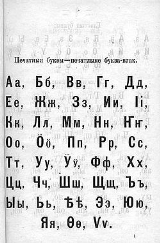
Meadow Mari alphabet
| А а | Б б | В в | Г г | Д д | Е е | Ё ё | Ж ж | З з | И и |
| Й й | К к | Л л | М м | Н н | О о | Ö ö | П п | Р р | |
| С с | Т т | У у | Ф ф | Х х | Ц ц | Ч ч | Ш ш | Щ щ | |
| Ъ ъ | Ы ы | Ь ь | Э э | Ю ю | Я я |
Hill Mari alphabet
| А а | Ä ä | Б б | В в | Г г | Д д | Е е | Ё ё | Ж ж | З з |
| И и | Й й | К к | Л л | М м | Н н | О о | Ö ö | П п | Р р |
| С с | Т т | У у | Ф ф | Х х | Ц ц | Ч ч | Ш ш | Щ щ | |
| Ъ ъ | Ы ы | Ь ь | Э э | Ю ю | Я я |
Grammar
Like other Uralic languagesUralic languages
The Uralic languages constitute a language family of some three dozen languages spoken by approximately 25 million people. The healthiest Uralic languages in terms of the number of native speakers are Hungarian, Finnish, Estonian, Mari and Udmurt...
, Mari is an agglutinating language. It lacks grammatical gender, and does not use articles.
Vowels
| Front Front vowel A front vowel is a type of vowel sound used in some spoken languages. The defining characteristic of a front vowel is that the tongue is positioned as far in front as possible in the mouth without creating a constriction that would be classified as a consonant. Front vowels are sometimes also... |
Central Central vowel A central vowel is a type of vowel sound used in some spoken languages. The defining characteristic of a central vowel is that the tongue is positioned halfway between a front vowel and a back vowel... |
Back Back vowel A back vowel is a type of vowel sound used in spoken languages. The defining characteristic of a back vowel is that the tongue is positioned as far back as possible in the mouth without creating a constriction that would be classified as a consonant. Back vowels are sometimes also called dark... |
|||
|---|---|---|---|---|---|
| unrounded | rounded Roundedness In phonetics, vowel roundedness refers to the amount of rounding in the lips during the articulation of a vowel. That is, it is vocalic labialization. When pronouncing a rounded vowel, the lips form a circular opening, while unrounded vowels are pronounced with the lips relaxed... |
unrounded | unrounded | rounded | |
| Close Close vowel A close vowel is a type of vowel sound used in many spoken languages. The defining characteristic of a close vowel is that the tongue is positioned as close as possible to the roof of the mouth without creating a constriction that would be classified as a consonant.This term is prescribed by the... |
/i/ и/i |
/y/ /ü |
/u/ у/u |
||
| Mid Mid vowel A mid vowel is a vowel sound used in some spoken languages. The defining characteristic of a mid vowel is that the tongue is positioned mid-way between an open vowel and a close vowel... |
/e/ е/e |
/ø/ /ö |
/ə/1 ӹ/ı |
/ɤ/ ы/ə |
/o/ о/o |
| Open Open vowel An open vowel is defined as a vowel sound in which the tongue is positioned as far as possible from the roof of the mouth. Open vowels are sometimes also called low vowels in reference to the low position of the tongue... |
/æ/1 ä/ä |
/ɑ/ а/a |
|||
- Only in Hill Mari
Word prosody and vowel harmony
Stress is not phonemic in Mari, but a dynamic stress system is exhibited phonetically, the stressed syllable being higher in pitch and amplitude and greater in length than an unstressed syllable. Generally, there is one prominent syllable per word and prominence may be found in any syllable of the word. Post- and prefixes behave as clitic
Clitic
In morphology and syntax, a clitic is a morpheme that is grammatically independent, but phonologically dependent on another word or phrase. It is pronounced like an affix, but works at the phrase level...
s, i.e., they do not have their own stress. For example, (house) гыч (out of) → [ˈpørt ɣɤt͡ʃ]; му́ро (song) дене (with) → [ˈmuro ðene].
As in other Uralic languages, Mari displays vowel harmony
Vowel harmony
Vowel harmony is a type of long-distance assimilatory phonological process involving vowels that occurs in some languages. In languages with vowel harmony, there are constraints on which vowels may be found near each other....
, including harmony of both round/unround and front/back. If the stressed vowel in the word is rounded
Roundedness
In phonetics, vowel roundedness refers to the amount of rounding in the lips during the articulation of a vowel. That is, it is vocalic labialization. When pronouncing a rounded vowel, the lips form a circular opening, while unrounded vowels are pronounced with the lips relaxed...
, then the suffix will contain a rounded vowel: (herd) → (in the herd); if the stressed vowel is unrounded, then the suffix will contain an unrounded vowel: ки́д (hand) → ки́дыште (in the hand). If the stressed vowel is back, then the suffix will end in a back vowel: агу́р (whirlpool) → агу́рышто 'in the whirlpool' (Зорина, Крылова, Якимова 1990: 9).
Consonants
Consonants are shown in Cyrillic, Latin, and the IPA:| Labial Labial consonant Labial consonants are consonants in which one or both lips are the active articulator. This precludes linguolabials, in which the tip of the tongue reaches for the posterior side of the upper lip and which are considered coronals... |
Dental | Alveolar Alveolar consonant Alveolar consonants are articulated with the tongue against or close to the superior alveolar ridge, which is called that because it contains the alveoli of the superior teeth... |
Post- alveolar Postalveolar consonant Postalveolar consonants are consonants articulated with the tongue near or touching the back of the alveolar ridge, further back in the mouth than the alveolar consonants, which are at the ridge itself, but not as far back as the hard palate... |
Palatal Palatal consonant Palatal consonants are consonants articulated with the body of the tongue raised against the hard palate... |
Velar Velar consonant Velars are consonants articulated with the back part of the tongue against the soft palate, the back part of the roof of the mouth, known also as the velum).... |
|||
|---|---|---|---|---|---|---|---|---|
| plain | palatalized Palatalization In linguistics, palatalization , also palatization, may refer to two different processes by which a sound, usually a consonant, comes to be produced with the tongue in a position in the mouth near the palate.... |
|||||||
| Nasal Nasal consonant A nasal consonant is a type of consonant produced with a lowered velum in the mouth, allowing air to escape freely through the nose. Examples of nasal consonants in English are and , in words such as nose and mouth.- Definition :... |
/m/ м/m |
/n/ н/n |
/ɲ/ н(ь)/n’2 |
/ŋ/ 4/ŋ |
||||
| Plosive | voiceless Voiceless In linguistics, voicelessness is the property of sounds being pronounced without the larynx vibrating. Phonologically, this is a type of phonation, which contrasts with other states of the larynx, but some object that the word "phonation" implies voicing, and that voicelessness is the lack of... |
/p/ п/p |
/t/ т/t |
/tʲ/1 т(ь)/t'2 |
/k/ к/k |
|||
| voiced Voice (phonetics) Voice or voicing is a term used in phonetics and phonology to characterize speech sounds, with sounds described as either voiceless or voiced. The term, however, is used to refer to two separate concepts. Voicing can refer to the articulatory process in which the vocal cords vibrate... |
(/b/ б/b)3 |
(/d/ д/d)3 |
(/ɡ/ г/g)3 |
|||||
| Affricate Affricate consonant Affricates are consonants that begin as stops but release as a fricative rather than directly into the following vowel.- Samples :... |
/ts/1 ц/c |
/tʃ/ ч/č |
||||||
| Fricative Fricative consonant Fricatives are consonants produced by forcing air through a narrow channel made by placing two articulators close together. These may be the lower lip against the upper teeth, in the case of ; the back of the tongue against the soft palate, in the case of German , the final consonant of Bach; or... |
voiceless | /f/1 ф/f |
/s/ с/s |
/ʃ/ ш/š |
/x/1 х/h |
|||
| voiced | /β/ б/b3 |
/ð/ д/d3 |
/z/ з/z |
/ʒ/ ж/ž |
/ɣ/ г/g3 |
|||
| Rhotic Rhotic consonant In phonetics, rhotic consonants, also called tremulants or "R-like" sounds, are liquid consonants that are traditionally represented orthographically by symbols derived from the Greek letter rho, including "R, r" from the Roman alphabet and "Р, p" from the Cyrillic alphabet... |
/r/ (or /ɾ/) р/r |
|||||||
| Approximant Approximant consonant Approximants are speech sounds that involve the articulators approaching each other but not narrowly enough or with enough articulatory precision to create turbulent airflow. Therefore, approximants fall between fricatives, which do produce a turbulent airstream, and vowels, which produce no... |
central | /j/ j |
||||||
| lateral Lateral consonant A lateral is an el-like consonant, in which airstream proceeds along the sides of the tongue, but is blocked by the tongue from going through the middle of the mouth.... |
/l/ л/l |
/ʎ/ л(ь)/l’2 |
||||||
- Only in Russian loanwords, in Hill Mari also onomatopoeia and Chuvashian loanwords.
- Palatalisation is marked in different ways. A у following a palatalised consonant is written as ю, an а following a palatalised consonant is written as я. If the vowel following a palatalised consonant is an е or an и, palatalisation is not marked at all. In other cases, the soft signSoft signThe soft sign , also known as yer, is a letter of the Cyrillic script. In Old Church Slavonic, it represented a short front vowel. As with its companion, the back yer, the vowel phoneme it designated was later partly dropped and partly merged with other vowels...
ь is used to mark palatalisation. - In Russian loanwords and after nasals, б/д/г are pronounced as bVoiced bilabial plosiveThe voiced bilabial plosive is a type of consonantal sound, used in some spoken languages. The symbol in the International Phonetic Alphabet that represents this sound is , and the equivalent X-SAMPA symbol is b. The voiced bilabial plosive occurs in English, and it is the sound denoted by the...
/dVoiced alveolar plosiveThe voiced alveolar plosive is a type of consonantal sound, used in some spoken languages. The symbol in the International Phonetic Alphabet that represents voiced dental, alveolar, and postalveolar plosives is , and the equivalent X-SAMPA symbol is d.-Features:Features of the voiced...
/gVoiced velar plosiveThe voiced velar plosive is a type of consonantal sound, used in some spoken languages. The symbol in the International Phonetic Alphabet that represents this sound is , and the equivalent X-SAMPA symbol is g. Strictly, the IPA symbol is the so-called "opentail G" , though the "looptail G" is...
. Some speakers pronounce them as such in general, due to Russian influence on the language. Word-finally and before a consonant, /β ð ɣ/ alternate with /p t k/. - The modified Cyrillic letter for the velar nasal (ŋ) combines the Cyrillic letter Н н with and Г г, where the rightmost post of Н is conflated with the vertical post of Г: . While Hill Mari has the sound too, the character is only used in Meadow Mari.
Case
Meadow Mari has 9 productiveProductivity (linguistics)
In linguistics, productivity is the degree to which native speakers use a particular grammatical process, especially in word formation. Since use to produce novel structures is the clearest proof of usage of a grammatical process, the evidence most often appealed to as establishing productivity is...
cases
Declension
In linguistics, declension is the inflection of nouns, pronouns, adjectives, and articles to indicate number , case , and gender...
, of which 3 are locative case
Locative case
Locative is a grammatical case which indicates a location. It corresponds vaguely to the English prepositions "in", "on", "at", and "by"...
s. The usage of these is restricted to inanimate objects.
Many cases, aside from their basic function, are used in other situations, such as in expressions of time.
- NominativeNominative caseThe nominative case is one of the grammatical cases of a noun or other part of speech, which generally marks the subject of a verb or the predicate noun or predicate adjective, as opposed to its object or other verb arguments...
The nominative case is used for subjects, predicatives and for other grammatical functions.
- GenitiveGenitive caseIn grammar, genitive is the grammatical case that marks a noun as modifying another noun...
The genitive case is used for possessive constructions.
- DativeDative caseThe dative case is a grammatical case generally used to indicate the noun to whom something is given, as in "George gave Jamie a drink"....
The dative is the indirect object's case.
- AccusativeAccusative caseThe accusative case of a noun is the grammatical case used to mark the direct object of a transitive verb. The same case is used in many languages for the objects of prepositions...
The accusative is the direct object's case.
- ComitativeComitative caseThe comitative case , also known as the associative case , is a grammatical case that denotes companionship, and is used where English would use "in company with" or "together with"...
The comitative is used as when a subject or an object can be split up into parts, or in adverbials expressing the involvement of an object in an action.
- ComparativeComparative caseThe comparative case is a grammatical case used in the Mari language to mark a likeness to something. It is marked with the suffix -ла For example, if something were to taste like fish , the form used would be колла - 'kolla').It is also used in regard to languages, when denoting the language a...
The comparative is used to express the likeness to something.
- InessiveInessive caseInessive case is a locative grammatical case. This case carries the basic meaning of "in": for example, "in the house" is "talo·ssa" in Finnish, "maja·s" in Estonian, "etxea·n" in Basque, "nam·e" in Lithuanian and "ház·ban" in Hungarian.In Finnish the inessive case is typically formed by adding...
The inessive used to state where something is.
- IllativeIllative caseIllative is, in the Finnish language, Estonian language and the Hungarian language, the third of the locative cases with the basic meaning of "into ". An example from Hungarian is "a házba"...
The illative is used to state where something is going.
- LativeLative caseLative is a case which indicates motion to a location. It corresponds to the English prepositions "to" and "into". The lative case belongs to the group of the general local cases together with the locative and separative case...
The lative is used to express into what something is going.
| Case Name | Suffix | Question Words | Example (animate) | Example (inanimate) |
|---|---|---|---|---|
| Nominative | - | кö, мо (who, what) | йоча (a child - subject) | ял (a village - subject) |
| Genitive | -(ы)н | кöн, мон (whose, what's) | йочан (of a child) | ялын (of a village) |
| Dative | -лан | кöлан, молан (to whom, to what/why) | йочалан (to a child) | яллан (to a village) |
| Accusative | -(ы)м | кöм, мом (whom, what) | йочам (a child - object) | ялым (a village - object) |
| Comitative | -ге | кöге, моге (with whom, with what) | йочаге (with a child) | ялге (with a village) |
| Comparative | -ла | кöла, мола (like who, like what) | йочала (like a child) | ялла (like a village) |
| Inessive | -(ы)ште/(ы)што/(ы)штӧ | кушто (where) | - | ялыште (in a village) |
| Illative | -(ы)шке/(ы)шко/(ы)шкӧ, -(ы)ш1 | кушко/куш (where to) | - | ялышке/ялыш (to a village) |
| Lative | -ш/еш/эш | кушан (where to) | - | ялеш (into a village) |
- The illative has a short form, equivalent to the long form in meaning.
If a locative statement was to be made about an animate object, postpositions would be used.
Additionally, terms denoting family members have Vocative
Vocative case
The vocative case is the case used for a noun identifying the person being addressed and/or occasionally the determiners of that noun. A vocative expression is an expression of direct address, wherein the identity of the party being spoken to is set forth expressly within a sentence...
forms. These are, however, not created with a specific paradigm, and only exist in a few pre-defined cases.
Hill Mari has these cases, plus the Caritative case, which is used to form adverbial
Adverbial
In grammar an adverbial is a word or a group of words that modifies or tells us something about the sentence or the verb. The word adverbial is also used as an adjective, meaning 'having the same function as an adverb'...
s stating without the involvement or influence of what an action happens.
Number
Mari, though an agglutinative language, does not have a separate morphemeMorpheme
In linguistics, a morpheme is the smallest semantically meaningful unit in a language. The field of study dedicated to morphemes is called morphology. A morpheme is not identical to a word, and the principal difference between the two is that a morpheme may or may not stand alone, whereas a word,...
to signify plural
Plural
In linguistics, plurality or [a] plural is a concept of quantity representing a value of more-than-one. Typically applied to nouns, a plural word or marker is used to distinguish a value other than the default quantity of a noun, which is typically one...
ity. There are three particles, which are attached to the end of words with a hyphen, used to signify plural.
- -влак (-vlak) - Standard plural form.
- -шамыч (-šaməč) - Alternative standard plural, used in many dialects. There is no difference in meaning between these two
- -мыт (mət) - Sociative plural. Used to signify a group of people - the members of a family, a person and his family and friends.
Possessive Suffixes
Every grammatical person in Mari has its own possessive suffixPossessive suffix
In linguistics, a possessive affix is a suffix or prefix attached to a noun to indicate its possessor, much in the manner of possessive adjectives. Possessive suffixes are found in some Uralic, Altaic, Semitic, and Indo-European languages...
.
| Person | Suffix | Example |
|---|---|---|
| - | - | шӱргӧ (face) |
| First Person Singular | -ем/эм | шӱргем (my face) |
| Second Person Singular | -ет/эт | шӱргет (your face) |
| Third Person Singular | -же/жо/жӧ/ше/шо/шӧ | шӱргыжӧ (his/her/its face) |
| First Person Plural | -на | шӱргына (our face) |
| Second Person Plural | -да | шӱргыда (your face) |
| Third Person Singular | -шт/ышт | шӱргышт (their face) |
Additional Suffixes
Additional particles, falling into none of the categories above, can be added to the very end of a word, giving it some additional meaning. For example, the suffix -ат (-at), means 'also' or 'too'.Arrangement of Suffixes
The arrangement of suffixes varies from case to case. While the case suffixes are after the possessive suffixes in the genitive and the accusative, the opposite is the case for the locative cases. In the dative, both arrangements are possible.| Case | Singular | Example | Plural |
|---|---|---|---|
| Nominative | P | пӧртем - 'my house (subject)' | пӧртем-влак - 'my houses (subject)' |
| Genitive | P --> C | пӧртемын - 'of my house' | пӧртем-влакын - 'of my houses' |
| Accusative | P --> C | пӧртемым - 'my house (object)' | пӧртем-влакым - 'my houses (object)' |
| Comitative | P --> C | пӧртемге - 'with my house' | пӧртем-влакге - 'with my houses' |
| Dative | P --> C, C --> P | пӧртемлан, пӧртланем 'to my houses' | пӧртем-влаклан 'to my houses' |
| Comparative | P --> C, C --> P | пӧртемла, пӧртлам - 'like my house' | пӧртем-влакла - 'like my houses' |
| Inessive | C --> P | пӧртыштем - 'in my house' | пӧрт-влакыштем - 'in my houses' |
| Illative | C --> P | пӧртышкем - 'into my house' | пӧрт-влакышкем - 'into my houses' |
| Lative | C --> P | пӧртешем - 'into my house' | пӧрт-влакешем - 'into my houses' |
There are many other arrangements in the plural - the position of the plural particle is flexible. The arrangement here is one commonly used possibility.
Comparison
ComparisonComparison (grammar)
Comparison, in grammar, is a property of adjectives and adverbs in most languages; it describes systems that distinguish the degree to which the modifier modifies its complement....
happens with adjectives and adverbs. The comparative
Comparative
In grammar, the comparative is the form of an adjective or adverb which denotes the degree or grade by which a person, thing, or other entity has a property or quality greater or less in extent than that of another, and is used in this context with a subordinating conjunction, such as than,...
is formed with the suffix -рак (-rak). The superlative
Superlative
In grammar, the superlative is the form of an adjective that indicates that the person or thing modified has the quality of the adjective to a degree greater than that of anything it is being compared to in a given context. English superlatives are typically formed with the suffix -est In...
is formed by adding the word эн (en) in front.
| Comparative | Superlative | |
|---|---|---|
| кугу - 'big' | кугурак - 'bigger' | эн кугу - 'biggest' |
Conjugation
Morphologically, conjugationGrammatical conjugation
In linguistics, conjugation is the creation of derived forms of a verb from its principal parts by inflection . Conjugation may be affected by person, number, gender, tense, aspect, mood, voice, or other grammatical categories...
follows three tenses
Grammatical tense
A tense is a grammatical category that locates a situation in time, to indicate when the situation takes place.Bernard Comrie, Aspect, 1976:6:...
and three moods in Meadow Mari.
Conjugation Classes
In Meadow Mari, words can conjugate according to two conjugation classes. These differ from each other in all forms but the infinitive and the third person plural of the imperative. Unfortunately, the infinitive is the form denoted in dictionaries and word lists. It is, thus, necessary to either mark verb infinitives by their conjugation class in word lists, or to include a form in which the conjugation class is visible - usually, the first person singular present, which ends in -ам (or -ям) for verbs in the first declination, and in -ем (or -эм) for second declination verbs.Tense
The three tenses of Mari verbs are:- PresentPresent tenseThe present tense is a grammatical tense that locates a situation or event in present time. This linguistic definition refers to a concept that indicates a feature of the meaning of a verb...
The present tense is used for present and future actions, for states of being and for habitual actions, among others.
- First PreteritePreteriteThe preterite is the grammatical tense expressing actions that took place or were completed in the past...
The first preterite is used to express observed, recent actions.
- Second PreteritePreteriteThe preterite is the grammatical tense expressing actions that took place or were completed in the past...
The second preterite is used for actions which lie more distantly in the past.
Additional tenses can be formed through periphrasis
Periphrasis
In linguistics, periphrasis is a device by which a grammatical category or grammatical relationship is expressed by a free morpheme , instead of being shown by inflection or derivation...
.
- First Periphrastic Imperfect
- Second Periphrastic Imperfect
- First Periphrastic Perfect
- Second Periphrastic Perfect
Mood
The moods are:- Indicative
The indicative is used to express facts and positive beliefs. All intentions that a particular language does not categorize as another mood are classified as indicative. It can be formed in all persons, in all times.
- ImperativeImperative moodThe imperative mood expresses commands or requests as a grammatical mood. These commands or requests urge the audience to act a certain way. It also may signal a prohibition, permission, or any other kind of exhortation.- Morphology :...
The imperative expresses direct commands, requests, and prohibitions. It only exists in the present tense, and exists in all persons but the first person singular.
- Desiderative
The desiderative is used to express desires. It can be formed for all persons, in the present tense and in the two periphrastic imperfect.
Negation
Negation in Mari uses a 'negative verb', much like FinnishFinnish language
Finnish is the language spoken by the majority of the population in Finland Primarily for use by restaurant menus and by ethnic Finns outside Finland. It is one of the two official languages of Finland and an official minority language in Sweden. In Sweden, both standard Finnish and Meänkieli, a...
does. The negative verb is more versatile than the negative verb in Finnish (see Finnish grammar
Finnish grammar
This article deals with the grammar of the Finnish language . For the ways in which the spoken language differs from the written language, see Colloquial Finnish...
), existing in more grammatical tenses and moods. It has its own form in the present indicative, imperative and desiderative, and in the first preterite indicative. Other negations are periphrastic.
The negation verb in its corresponding form is put in front of the negated verb in its second person singular (the stem-only form), much as it is in Finnish and Estonian
Estonian language
Estonian is the official language of Estonia, spoken by about 1.1 million people in Estonia and tens of thousands in various émigré communities...
.
| Person | Indicative Present | Imperative Present | Desiderative Present | Indicative First Preterite |
|---|---|---|---|---|
| First Person Singular | ом (om) | - | ынем (ənem) | шым (šəm) |
| Second Person Singular | от (ot) | ит (it) | ынет (ənet) | шыч (səč) |
| Third Person Singular | огеш (ogeš) / ок (ok) | ынже (ənže) | ынеж(е) (ənež(e)) | ыш (əš) |
| First Person Plural | огына (ogəna) / она (ona) | - | ынена (ənena) | ышна (əšna) |
| Second Person Plural | огыда (ogəda) / ода (oda) | ида (ida) | ынеда (əneda) | ышда (əšda) |
| Third Person Plural | огыт (ogət) | ынышт (ənəšt) | ынешт (ənešt) | ышт (əšt) |
The verb улаш (ulaš) - to be - has its own negated forms.
| Person | |
|---|---|
| First Person Singular - 'I am not' | омыл (oməl) |
| Second Person Singular - 'You are not' | отыл (otəl) |
| Third Person Singular - 'He/she/it is not' | огыл (ogəl) |
| First Person Plural - 'We are not' | огынал (ogənal) / онал (onal) |
| Second Person Plural - 'You are not' | огыдал (ogədal) / одал (odal) |
| Third Person Plural - 'They are not' | огытыл (ogətəl) |
Word Forms
In order to illustrate the conjugation in the respective moods and times, one verb of the first declination (лекташ - to go) and one verb of the second declination (мондаш - to forget) will be used.| Person | 1st Dec. pos. | 2nd Dec. pos. |
|---|---|---|
| 1st Singular | лектам (I go) | мондем (I forget) |
| 2nd Singular | лектат (You go) | мондет (You forget) |
| 3rd Singular | лектеш (He/she/it goes) | монда (He/she/it forgets) |
| 1st Plural | лектына (We go) | мондена (We forget) |
| 2nd Plural | лектыда (You go) | мондеда (You forget) |
| 3rd Plural | лектыт (They go) | мондат (They forget) |
| Person | 1st Dec. neg. | 2nd Dec. neg. |
|---|---|---|
| 1st Singular | ом лек2 (I don't go) | ом мондо1 (I don't forget) |
| 2nd Singular | от лек2 (You don't go) | от мондо1 (You don't forget) |
| 3rd Singular | огеш лек2 (He/she/it doesn't go) | огеш мондо1 (He/she/it doesn't forget) |
| 1st Plural | огына лек2 (We don't go) | огына мондо1 (We don't forget) |
| 2nd Plural | огыда лек2 (You don't go) | огыда мондо1 (You don't forget) |
| 3rd Plural | огыт лек2 (They don't go) | огыт мондо1 (They don't forget) |
- Bold letters are subject to Vowel harmonyVowel harmonyVowel harmony is a type of long-distance assimilatory phonological process involving vowels that occurs in some languages. In languages with vowel harmony, there are constraints on which vowels may be found near each other....
- they can be е/о/ӧ, depending on the preceding full vowel's properties. - First conjugation verb forms using the imperative second person singular as their stem are subject to the same stem changes the imperative is subject to - see imperative second person singular.
| Person | 1st Dec. pos. | 2nd Dec. pos. |
|---|---|---|
| 1st Singular | лектым3 (I went) | мондышым (I forgot) |
| 2nd Singular | лектыч3 (You went) | мондышыч (You forgot) |
| 3rd Singular | лекте1, 3 (He/she/it went) | мондыш (He/she/it forgot) |
| 1st Plural | лекна2 (We went) | мондышна (We forget) |
| 2nd Plural | лекда2 (You went) | мондышда (You forgot) |
| 3rd Plural | лектыч3 (They went) | мондышт (They forgot) |
- Bold letters are subject to Vowel harmonyVowel harmonyVowel harmony is a type of long-distance assimilatory phonological process involving vowels that occurs in some languages. In languages with vowel harmony, there are constraints on which vowels may be found near each other....
-- they can be е/о/ӧ, depending on the preceding full vowel's properties. - First conjugation verb forms using the imperative second person singular as their stem are subject to the same stem changes the imperative is subject to - see imperative second person singular.
- If the consonant prior to the ending can be palatalized – if it is a л(l) or an н(n) – it is palatalized in this position. Note that palatalization is not marked if the vowel following a consonant is an е.
колаш --> кольым, кольыч, кольо, колна, колда ,кольыч (to hear)
| Person | 1st Dec. neg. | 2nd Dec. neg. |
|---|---|---|
| 1st Singular | шым лек2 (I didn't go) | шым мондо1 (I didn't forget) |
| 2nd Singular | шыч лек2 (You didn't go) | шыч мондо1 (You didn't forget) |
| 3rd Singular | ыш лек2 (He/she/it didn't go) | ыш мондо1 (He/she/it didn't forget) |
| 1st Plural | ышна лек2 (We didn't go) | ышна мондо1 (We don't forget) |
| 2nd Plural | ышда лек2 (You didn't go) | ышда мондо1 (You didn't forget) |
| 3rd Plural | ышт лек2 (They didn't go) | ышт мондо1 (They didn't forget) |
- Bold letters are subject to Vowel harmonyVowel harmonyVowel harmony is a type of long-distance assimilatory phonological process involving vowels that occurs in some languages. In languages with vowel harmony, there are constraints on which vowels may be found near each other....
- they can be е/о/ӧ, depending on the preceding full vowel's properties. - First conjugation verb forms using the imperative second person singular as their stem are subject to the same stem changes the imperative is subject to - see imperative second person singular.
| Person | 1st Dec. pos. | 2nd Dec. pos. |
|---|---|---|
| 1st Singular | лектынам (I went) | монденам (I forgot) |
| 2nd Singular | лектынат (You went) | монденат (You forgot) |
| 3rd Singular | лектын (He/she/it went) | монден (He/she/it forgot) |
| 1st Plural | лектынна (We went) | монденна (We forget) |
| 2nd Plural | лектында (You went) | монденда (You forgot) |
| 3rd Plural | лектыныт (They went) | монденыт (They forgot) |
| Person | 1st Dec. neg. | 2nd Dec. neg. |
|---|---|---|
| 1st Singular | лектын омыл (I didn't go) | монден омыл (I didn't forget) |
| 2nd Singular | лектын отыл (You didn't go) | монден отыл (You didn't forget) |
| 3rd Singular | лектын огыл(He/she/it didn't go) | монден огыл(He/she/it didn't forget) |
| 1st Plural | лектын огынал (We didn't go) | монден огынал (We don't forget) |
| 2nd Plural | лектын огыдал (You didn't go) | монден огыдал (You didn't forget) |
| 3rd Plural | лектын огытыл (They didn't go) | монден огытыл (They didn't forget) |
| Person | 1st Dec. pos. | 2nd Dec. pos. |
|---|---|---|
| 1st Singular | - | - |
| 2nd Singular | лек3 (Go!) | мондо1 (Forget!) |
| 3rd Singular | лекше2 (He/She/It should go) | мондыжо1 (He/She/It should forget) |
| 1st Plural | лектына (Let's go) | мондена (Let's forget) |
| 2nd Plural | лекса2 (Go!) | мондыза (Forget!) |
| 3rd Plural | лекытшт (They should go) | мондышт (They should forget) |
- Bold letters are subject to Vowel harmonyVowel harmonyVowel harmony is a type of long-distance assimilatory phonological process involving vowels that occurs in some languages. In languages with vowel harmony, there are constraints on which vowels may be found near each other....
- they can be е/о/ӧ, depending on the preceding full vowel's properties. - First conjugation verb forms using the imperative second person singular as their stem are subject to the same stem changes the imperative is subject to.
- In the first conjugation, the imperative second person singular is formed by removing the "-аш" ending from the infinitive. Four consonant combinations are not allowed at the end of an imperative, and are thus simplified—one consonant is lost.
"кт" --> "к", "нч" --> "ч", "чк" --> "ч", "шк" --> "ш"
| Person | 1st Dec. neg. | 2nd Dec. neg. |
|---|---|---|
| 1st Singular | - | - |
| 2nd Singular | ит лек2 (Don't go!) | ит мондо1 (Don't forget!) |
| 3rd Singular | ынже лек2 (He/She/It shouldn't go) | ынже мондо1 (He/She/It shouldn't forget) |
| 1st Plural | огына лек2 (Let's not go) | огына мондо1 (Let's not forget) |
| 2nd Plural | ида лек2 (Don't go!) | ида мондо1 (Don't forget!) |
| 3rd Plural | ынышт лек2 (They shouldn't go) | ынышт мондо1 (They shouldn't forget) |
- Bold letters are subject to Vowel harmonyVowel harmonyVowel harmony is a type of long-distance assimilatory phonological process involving vowels that occurs in some languages. In languages with vowel harmony, there are constraints on which vowels may be found near each other....
- they can be е/о/ӧ, depending on the preceding full vowel's properties. - First conjugation verb forms using the imperative second person singular as their stem are subject to the same stem changes the imperative is subject to - see imperative second person singular.
| Person | 1st Dec. pos. | 2nd Dec. pos. |
|---|---|---|
| 1st Singular | лекнем2 (I want to go) | мондынем (I want to forget) |
| 2nd Singular | лекнет2 (You want to go) | мондынет (You want to forget) |
| 3rd Singular | лекнеже2 (He/she/it wants to go) | мондынеже (He/she/it wants to forget) |
| 1st Plural | лекнена2 (We want to go) | мондынена (We want to forget) |
| 2nd Plural | лекнеда2 (You want to go) | мондынеда (You want to forget) |
| 3rd Plural | лекнешт2 (They want to go) | мондынешт (They want to forget) |
- First conjugation verb forms using the imperative second person singular as their stem are subject to the same stem changes the imperative is subject to - see imperative second person singular.
| Person | 1st Dec. neg. | 2nd Dec. neg. |
|---|---|---|
| 1st Singular | ынем лек2 (I don't want to go) | ынем мондо1 (I don't want to forget) |
| 2nd Singular | ынет лек2 (You don't want to go) | ынет мондо1 (You don't want to forget) |
| 3rd Singular | ынеже лек2 (He/she/it doesn't want to go) | ынеже мондо1 (He/she/it doesn't want to forget) |
| 1st Plural | ынена лек2 (We don't want to go) | ынена мондо1 (We don't want to forget) |
| 2nd Plural | ынеда лек2 (You don't want to go) | ынеда мондо1 (You don't want to forget) |
| 3rd Plural | ынешт лек2 (They don't want to go) | ынешт мондо1 (They don't want to forget) |
- Bold letters are subject to Vowel harmonyVowel harmonyVowel harmony is a type of long-distance assimilatory phonological process involving vowels that occurs in some languages. In languages with vowel harmony, there are constraints on which vowels may be found near each other....
- they can be е/о/ӧ, depending on the preceding full vowel's properties. - First conjugation verb forms using the imperative second person singular as their stem are subject to the same stem changes the imperative is subject to - see imperative second person singular.
| Person | Present (positive) | Present (negative) | 1st preterite (positive) | 1st preterite (negative) | 2nd preterite (positive) | 2nd preterite (negative) |
|---|---|---|---|---|---|---|
| 1st Sing. | улам (I am) | омыл (I am not) | ыльым (I was) | шым лий (I was not) | улынам (I was) | лийын омыл (I was not) |
| 2nd Sing. | улат (You are) | отыл (You are not) | ыльыч (You were) | шыч лий (You were not) | улынат (You were) | лийын отыл (You were not) |
| 3rd Sing. | уло (улеш) (He/she/it is) | огыл (He/she/it is not) | ыле (He/she/it was) | ыш лий (He/she/it was not) | улмаш(ын) (He/she/it was) | лийын огыл (He/she/it was not) |
| 1st Pl. | улына (We are) | огынал (We are not) | ыльна (We were) | ышна лий (We were not) | улынна (We were) | лийын огынал (We were not) |
| 2nd Pl. | улыда (You are) | огыдал (You are not) | ыльда (You were) | ышда лий (You were not) | улында (You were) | лийын огыдал (You were not) |
| 3rd Pl. | улыт (They are) | огытыл (They are not) | ыльыч (They were) | ышт лий (They were not) | улыныт (They were) | лийын огытыл (They were not) |
Infinitive Forms
Verbs have two infinitiveInfinitive
In grammar, infinitive is the name for certain verb forms that exist in many languages. In the usual description of English, the infinitive of a verb is its basic form with or without the particle to: therefore, do and to do, be and to be, and so on are infinitives...
forms - the standard infinitive, and the necessive infinitive, used when a person must do something. The person needing to do something is put in the dative in such a situation.
Participles
There are four participleParticiple
In linguistics, a participle is a word that shares some characteristics of both verbs and adjectives. It can be used in compound verb tenses or voices , or as a modifier...
s in Meadow Mari:
- Active Participle
- Passive Participle
- Negative Participle
- Future Participle
Gerunds
There are five gerundGerund
In linguistics* As applied to English, it refers to the usage of a verb as a noun ....
s in Meadow Mari:
- Affirmative Instructive Gerund
- Negative Instructive Gerund
- Gerund for Prior Actions I
- Gerund for Prior Actions II
- Gerund for Simultaneous Actions
Some common words and phrases
Note that the accent mark, which denotes the place of stress, is not used in actual Mari orthography.- По́ро ке́че/Póro kéče - Good day
- Ку́гу та́у/Kúgu táu - Thank you (very much)
- ик, кок, кум, ныл, вич/ik, kok, kum, nəl, vič - one, two, three, four, five
- куд, шым, канда́ш, инде́ш, лу/kud, šəm, kandáš, indéš, lu - six, seven, eight, nine, ten
- мут/mut - word