

Okjeo

Encyclopedia
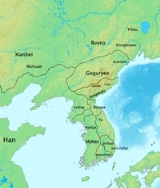
Okjeo was Korea
n tribal state which arose in the northern Korean peninsula
from perhaps 2nd century BCE to 5th century CE.
Dong-okjeo (Eastern Okjeo) occupied roughly the area of the Hamgyŏng
provinces of North Korea
, and Buk-okjeo (Northern Okjeo) occupied the Duman River
region.
Dong-okjeo was often simply called Okjeo, while Buk-okjeo was also sometimes referred to as Chiguru (置溝婁, 치구루) or Guru (구루), the latter name being also applied to Goguryeo. Okjeo bordered the other minor state of Dongye
on the south, and shared a similar fate.
 In its early history, Okjeo oscillated between domination by the Chinese commanderies and by Goguryeo. From the 3rd century BCE to 108 BCE, it was controlled by Gojoseon
due to the constant interference of its neighbors, Okjeo never grew into a fully centralized kingdom.
In the 1st or 2nd century CE, King Taejo of Goguryeo reduced Okjeo to a tributary, which delivered local products to Goguryeo. During the 244 Wei Invasion of Goguryeo, Goguryeo’s King Dongcheon
briefly retreated to North Okjeo, and in 285, the Buyeo
court also temporarily escaped to Okjeo under northern nomadic attacks.
In early 5th century, Okjeo was completely conquered by Gwanggaeto the Great of Goguryeo.
and Okjeo's language, food, clothing, architecture, and customs were similar to that of Goguryeo
. The Okjeo people practiced arranged marriage by which the child-bride lived with the child-groom's family until adulthood, and they interred the dead of a family in a single coffin.
Korea
Korea ) is an East Asian geographic region that is currently divided into two separate sovereign states — North Korea and South Korea. Located on the Korean Peninsula, Korea is bordered by the People's Republic of China to the northwest, Russia to the northeast, and is separated from Japan to the...
n tribal state which arose in the northern Korean peninsula
Korean Peninsula
The Korean Peninsula is a peninsula in East Asia. It extends southwards for about 684 miles from continental Asia into the Pacific Ocean and is surrounded by the Sea of Japan to the south, and the Yellow Sea to the west, the Korea Strait connecting the first two bodies of water.Until the end of...
from perhaps 2nd century BCE to 5th century CE.
Dong-okjeo (Eastern Okjeo) occupied roughly the area of the Hamgyŏng
Hamgyong
Hamgyŏng was one of the Eight Provinces of Korea during the Joseon Dynasty. Hamgyŏng was located in the northeast of Korea. The provincial capital was Hamhŭng.-History:...
provinces of North Korea
North Korea
The Democratic People’s Republic of Korea , , is a country in East Asia, occupying the northern half of the Korean Peninsula. Its capital and largest city is Pyongyang. The Korean Demilitarized Zone serves as the buffer zone between North Korea and South Korea...
, and Buk-okjeo (Northern Okjeo) occupied the Duman River
Tumen River
The Tumen River is a 521 km-long river that serves as part of the boundary between China, North Korea, and Russia, rising in Mount Baekdu and flowing into the Sea of Japan....
region.
Dong-okjeo was often simply called Okjeo, while Buk-okjeo was also sometimes referred to as Chiguru (置溝婁, 치구루) or Guru (구루), the latter name being also applied to Goguryeo. Okjeo bordered the other minor state of Dongye
Dongye
Dongye, which means the Eastern Ye, was a Korean chiefdom which occupied portions of the northeastern Korean peninsula from roughly 3rd-century BCE to around early 5th-century. It bordered Goguryeo and Okjeo to the north, Jinhan to the south, and China's Lelang Commandery to the west...
on the south, and shared a similar fate.
History
Gojoseon
Gojoseon was an ancient Korean kingdom. Go , meaning "ancient," distinguishes it from the later Joseon Dynasty; Joseon, as it is called in contemporaneous writings, is also romanized as Chosŏn....
due to the constant interference of its neighbors, Okjeo never grew into a fully centralized kingdom.
In the 1st or 2nd century CE, King Taejo of Goguryeo reduced Okjeo to a tributary, which delivered local products to Goguryeo. During the 244 Wei Invasion of Goguryeo, Goguryeo’s King Dongcheon
Dongcheon of Goguryeo
King Dongcheon of Goguryeo was the 11th monarch of Goguryeo, the northernmost of the Three Kingdoms of Korea.-Background:...
briefly retreated to North Okjeo, and in 285, the Buyeo
Buyeo (state)
Buyeo or Puyŏ , Fuyu in Chinese, was an ancient Korean kingdom located from today's Manchuria to northern North Korea, from around the 2nd century BC to 494. Its remnants were absorbed by the neighboring and brotherhood kingdom of Goguryeo in 494...
court also temporarily escaped to Okjeo under northern nomadic attacks.
In early 5th century, Okjeo was completely conquered by Gwanggaeto the Great of Goguryeo.
Language and culture
Our knowledge of Okjeo culture is fragmentary. As with the DongyeDongye
Dongye, which means the Eastern Ye, was a Korean chiefdom which occupied portions of the northeastern Korean peninsula from roughly 3rd-century BCE to around early 5th-century. It bordered Goguryeo and Okjeo to the north, Jinhan to the south, and China's Lelang Commandery to the west...
and Okjeo's language, food, clothing, architecture, and customs were similar to that of Goguryeo
Goguryeo
Goguryeo or Koguryŏ was an ancient Korean kingdom located in present day northern and central parts of the Korean Peninsula, southern Manchuria, and southern Russian Maritime province....
. The Okjeo people practiced arranged marriage by which the child-bride lived with the child-groom's family until adulthood, and they interred the dead of a family in a single coffin.