
All Topics  
Sino-Tibetan languages


   Email Print
   Bookmark   Link


Sino-Tibetan languages


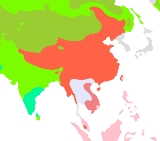
The Sino-Tibetan languages form a language family
Language family

A language family is a group of languages related Genetic from a common ancestor, called the proto-language of that family.As with Alpha taxonomy, the evidence of relationship is observable shared characteristics....
 composed of, at least, the Chinese
Chinese language

Chinese or the Sinitic language is a language family consisting of language mutually unintelligible to varying degrees. Originally the indigenous languages spoken by the Han Chinese in China, it forms one of the two branches of Sino-Tibetan languages of languages....
 and the Tibeto-Burman languages
Tibeto-Burman languages

The Tibeto-Burman family of languages is spoken in various Central Asia, East Asia, South Asia and southeast Asian countries, including Burma , Tibet, northern Thailand, Vietnam, Laos, parts of central China , northern parts of Nepal, eastern parts of Bangladesh , Bhutan, northern parts of Pakistan , and various regions of India ....
, including some 250 languages of East Asia
East Asia

East Asia is a subregion of Asia that can be defined in either Geography or cultural terms. Geography and geopolitically, it covers about 12,000,000 km?, or about 28 percent of the Asian continent, about 15 percent bigger than the area of Europe, though some categorize Tibet, Xinjiang, and Mongolia as Central Asia....
, Southeast Asia
Southeast Asia

Southeast Asia or Southeastern Asia is a subregion of Asia, consisting of the countries that are geographically south of China, east of India and north of Australia....
 and parts of South Asia
South Asia

South Asia, also known as Southern Asia, is the southern region of the Asian continent, which comprises the sub-Himalayan countries and, for some authorities , also includes the adjoining countries on the west and the east....
. They are second only to the Indo-European languages
Indo-European languages

The Indo-European languages are a Language family of several hundred related languages and dialects, including most major languages of Europe, the Iranian plateau , Central Asia and the Indian subcontinent ....
 in terms of the number of native speakers.

-Tibetan language family has been defined by as also including the Tai
Tai languages

The Tai languages are a subgroup of the Kradai languages language family. The Tai languages include the most widely spoken of the Tai-Kadai languages, including Thai language, the national language of Thailand, Lao language or Laotian, the national language of Laos, Myanmar's Shan language, and Zhuang language, a major language in southern C...
 and Karen languages
Karen languages

The Karen languages are tonal languages spoken by some three million Karen people. They are of unclear affiliation within the Tibeto-Burman languages....
. Some linguistic scholars also include the Hmong-Mien (Miao-Yao) languages and the Ket language
Ket language

The Ket language, formerly known as Yenisei Ostyak, a Siberian language long thought to be an language isolate, the sole surviving language of a Yeniseian languages, is spoken along the middle Yenisei Basin by the Ket people....
 of central Siberia
Siberia

Siberia , is the name given to the vast region constituting almost all of North Asia and for the most part currently serving as the massive central and eastern portion of the Russian Federation, having served in the same capacity previously for the Soviet Union from its beginning, and the Russian Empire beginning in the 16th century....
.


Discussion
Ask a question about 'Sino-Tibetan languages'
Start a new discussion about 'Sino-Tibetan languages'
Answer questions from other users
Full Discussion Forum


Encyclopedia


The Sino-Tibetan languages form a language family
Language family

A language family is a group of languages related Genetic from a common ancestor, called the proto-language of that family.As with Alpha taxonomy, the evidence of relationship is observable shared characteristics....
 composed of, at least, the Chinese
Chinese language

Chinese or the Sinitic language is a language family consisting of language mutually unintelligible to varying degrees. Originally the indigenous languages spoken by the Han Chinese in China, it forms one of the two branches of Sino-Tibetan languages of languages....
 and the Tibeto-Burman languages
Tibeto-Burman languages

The Tibeto-Burman family of languages is spoken in various Central Asia, East Asia, South Asia and southeast Asian countries, including Burma , Tibet, northern Thailand, Vietnam, Laos, parts of central China , northern parts of Nepal, eastern parts of Bangladesh , Bhutan, northern parts of Pakistan , and various regions of India ....
, including some 250 languages of East Asia
East Asia

East Asia is a subregion of Asia that can be defined in either Geography or cultural terms. Geography and geopolitically, it covers about 12,000,000 km?, or about 28 percent of the Asian continent, about 15 percent bigger than the area of Europe, though some categorize Tibet, Xinjiang, and Mongolia as Central Asia....
, Southeast Asia
Southeast Asia

Southeast Asia or Southeastern Asia is a subregion of Asia, consisting of the countries that are geographically south of China, east of India and north of Australia....
 and parts of South Asia
South Asia

South Asia, also known as Southern Asia, is the southern region of the Asian continent, which comprises the sub-Himalayan countries and, for some authorities , also includes the adjoining countries on the west and the east....
. They are second only to the Indo-European languages
Indo-European languages

The Indo-European languages are a Language family of several hundred related languages and dialects, including most major languages of Europe, the Iranian plateau , Central Asia and the Indian subcontinent ....
 in terms of the number of native speakers.

Validity

Sino-Tibetan language family has been defined by as also including the Tai
Tai languages

The Tai languages are a subgroup of the Kradai languages language family. The Tai languages include the most widely spoken of the Tai-Kadai languages, including Thai language, the national language of Thailand, Lao language or Laotian, the national language of Laos, Myanmar's Shan language, and Zhuang language, a major language in southern C...
 and Karen languages
Karen languages

The Karen languages are tonal languages spoken by some three million Karen people. They are of unclear affiliation within the Tibeto-Burman languages....
. Some linguistic scholars also include the Hmong-Mien (Miao-Yao) languages and the Ket language
Ket language

The Ket language, formerly known as Yenisei Ostyak, a Siberian language long thought to be an language isolate, the sole surviving language of a Yeniseian languages, is spoken along the middle Yenisei Basin by the Ket people....
 of central Siberia
Siberia

Siberia , is the name given to the vast region constituting almost all of North Asia and for the most part currently serving as the massive central and eastern portion of the Russian Federation, having served in the same capacity previously for the Soviet Union from its beginning, and the Russian Empire beginning in the 16th century....
. A few scholars, most prominently Christopher Beckwith
Christopher Beckwith

Christopher I. Beckwith is a professor of Central Eurasian Studies at Indiana University Bloomington in Bloomington, Indiana.He received his Doctor of Philosophy degree from Indiana University Bloomington in Uralic and Altaic Studies ....
 and Roy Andrew Miller
Roy Andrew Miller

Roy Andrew Miller is a linguistics notable for his advocacy of Korean language and Japanese language as members of the Altaic language group of languages....
, argue that Chinese is not related to Tibeto-Burman. They point to an absence of regular sound correspondences, an absence of reconstructable shared morphology, and evidence that much shared lexical material has been borrowed from Chinese
Chinese language

Chinese or the Sinitic language is a language family consisting of language mutually unintelligible to varying degrees. Originally the indigenous languages spoken by the Han Chinese in China, it forms one of the two branches of Sino-Tibetan languages of languages....
 into Tibeto-Burman. In opposition to this view, scholars in favor of the Sino-Tibetan hypothesis such as W. South Coblin, Graham Thurgood, James Matisoff
James Matisoff

James A. Matisoff is a professor emeritus of Linguistics at the University of California, Berkeley and noted authority on Tibeto-Burman languages and other languages of mainland Southeast Asia....
, and Gong Hwang-cherng have argued that there are regular correspondences in sounds as well as in grammar.

One of the chief difficulties of applying the comparative method
Comparative method

In linguistics, the comparative method is a technique for studying the development of languages. It requires the use of two or more languages. It is opposed to the method of internal reconstruction, which studies the internal development of a single language over time....
 to the Sino-Tibetan languages is the morphological
Morphology (linguistics)

Morphology is the identification, analysis and description of structure of words . While words are generally accepted as being the smallest units of syntax, it is clear that in most languages, words can be related to other words by rules....
 paucity in many of these languages, including modern Chinese and Tibetan.

In the past, Vietnamese
Vietnamese language

Vietnamese , formerly known under French colonization as Annamese , is the national language and official language language of Vietnam. It is the mother tongue of the Vietnamese people , who constitute 86% of Demographics of Vietnam, and of about three million overseas Vietnamese, most of whom live in the United States....
 and other Mon-Khmer languages
Mon-Khmer languages

The Mon-Khmer languages are the Autochthonous language language family of Southeast Asia. Together with the Munda languages of India, they are one of the two traditional primary branches of the Austroasiatic languages family....
 were classified under the Sino-Tibetan tree. Today their similarities to Chinese are credited to language contact
Language contact

Language contact occurs when speakers of distinct speech varieties interact. The study of language contact is called contact linguistics....
. However, what should be included in the family is yet to be settled. In the Western scholarly circle, the other tonal language families of East Asia, Kradai and Hmong-Mien
Hmong-Mien languages

The Hmong-Mien or Miao-Yao languages are a small language family of southern China and Southeast Asia. They are spoken in mountainous areas of southern China, including Guizhou, Hunan, Yunnan, Sichuan, Guangxi, and Hubei provinces, where its speakers have been relegated to being "hill people," while the Han Chinese have settled the more...
, are no longer classified under the Sino-Tibetan tree either, with the similarities attributed to borrowings and areal features, especially after Benedict's publication (1972). However, in the Chinese scholarly world, Kradai (actually Zhuang-Dong or Kam-Tai
Kam-Tai

The Kam-Tai languages, or Be-Kam-Tai, are a proposed primary branch of the Kradai languages, and include all major languages of that family....
, which excludes i.a. the Kra languages
Kra languages

Kra languages, or in Chinese Ge-Yang, are a branch of the Kradai languages spoken in southern China and in northern Vietnam. They have only recently been described in any detail....
) and Hmong-Mien are still commonly included in the Sino-Tibetan family.

History of the proposal

In 1823, Julius Klaproth
Julius Klaproth

Julius Heinrich Klaproth , German linguist, historian, ethnographer, author, Orientalist and explorer.Klaproth was born in Berlin in October of 1783, the son of the chemist Martin Heinrich Klaproth....
 suggested a modern-looking classification, the likes of which wouldn't be seen again for over a century. He noted that the Burmese, Tibetan, and Chinese all shared common basic vocabulary
Vocabulary

A person's vocabulary is the set of words they are familiar with in a language. A vocabulary usually grows and evolves with age, and serves as a useful and fundamental tool for communication and learning....
, but that Thai and Vietnamese were quite different.

However, large-scale linguistic classification of the time was largely based on race rather than the languages themselves. For example, in 1855 Max Müller
Max Müller

Friedrich Max M?ller , more commonly known as Max M?ller, was a German Confederation philologist and Orientalist, one of the founders of the western academic field of Indology and the discipline of comparative religion....
 divided Eurasian languages into four families: Semitic
Semitic

In linguistics and ethnology, Semitic was first used to refer to a language family of largely Middle Eastern origin, now called the Semitic languages....
, Aryan
Aryan

Aryan is an English language loanword. As the American Heritage Dictionary of the English Language states at the beginning of its definition, "[it] is one of the ironies of history that Aryan, a word nowadays referring to the blond-haired, blue-eyed physical ideal of Nazi Germany, originally referred to a people who looked vastly di...
 (Indo-European
Indo-European

Indo-European may refer to:* Indo-European languages* Indo-European people, peoples speaking an Indo-European language** Aryan race, a 19th-century term for Indo-European speakers...
), Chinese, and Turanian
Turan

Turan is the ancient Iranian languages name for Central Asia, literally meaning "the land of the Tur". As described below, the original Turanians are the...
 (everything else; e.g. Northern Turanian was Ural-Altaic). (Later writers would include Chinese within Turanian.) Competing with this idea, and eventually winning out, was "Indo-Chinese". Nathan Brown
Nathan Brown

Nathan Brown may refer to:* Nathan Brown , American religious leader* Nathan J. Brown , political scientist & academic* Nathan Brown , Australian rugby league player & coach...
 used the term in 1837 for all "Oriental" languages except for Altaic and Dravidian
Dravidian

Dravidian may refer to the following about southern South Asia:* Dravidian languages, a language family comprising about 21 languages including the four literary languages spoken mainly in South India and North-Eastern Sri Lanka...
 (but including Korean and Japanese, as well as the languages of the Pacific islands). There was continuing debate between racially and linguistically based theories.

John Logan
John Logan

John Logan or Johnny Logan may refer to:* John Logan , eighteenth century Scottish poet and minister at Leith* John A. Logan , American soldier and politician...
 added Karen to 'Tibeto-Burman' (as a branch of Turanian) in 1858. By this time the known Tibeto-Burman languages were recognized as such by at least some scholars. In his 1878 classification, Charles Forbes
Charles Forbes

Charles Forbes may refer to:*Charles Morton Forbes, Admiral of the British Home Fleet and Royal Navy in World War II*Charlie Forbes - Australian rules footballer who won Champion of the Colony in 1892...
 favored the name 'Indo-Chinese' over 'Turanian', and divided it into Tibeto-Burman (including Chinese), Karen, Tai, and 'Mon
Mon language

The Mon language is an Austroasiatic languages spoken by the Mon people, who live in Burma and Thailand. Mon, unlike most languages in the Southeast Asian region, is not tonal language....
-Annamese' branches. Indo-Chinese was reduced in scope by the exclusion of Mon-Khmer (Mon-Annam) by Ernst Kuhn in 1883, who divided it into Tibeto-Burman and Chinese-Siamese, thus removing Chinese from Tibeto-Burman. He was followed by this in the influential 1896 classification of August Conrady, who even had doubts about Karen. John Avery, in order to avoid the broad implications of 'Indo-Chinese', used 'Tibeto-Burman' for Kuhn's entire family. However, most linguists continued to used Kuhn's terminology. Vietnamese was generally included; Franz Finck in 1909 moved Karen to a third branch of Chinese-Siamese.

The term sino-tibétain (Sino-Tibetan) was coined as a synonym for Indo-Chinese by Jean Przyluski in 1924. He retained Conrady's two branches of Tibeto-Burman and 'Sino-Daic', with Miao-Yao included within Daic. The term was adopted by Alfred Kroeber for the UC Berkeley Sino-Tibetan Philology project, where Robert Shafer worked. Shafer quickly realized that Daic was not Sino-Tibetain, but out of respect to Henri Maspero
Henri Maspero

Henri Maspero was a France sinologist, today particularly remembered for his pioneering works on Taoism....
 in Paris he left comparative Daic material in the project's publications, though he never claimed a genealogical relationship (van Driem 2001:323). Shafer (1941) also rejected the division of the family into Sinitic and Tibeto-Burman branches, but instead placed Sinitic on the same level of other branches such as Bodic, Burmic, Baric
Bodo-Garo languages

The Bodo-Garo languages are a small family of Tibeto-Burman languages spoken in eastern India, consisting of two well defined branches:*the Bodo languages, Bodo language, Deori, Dimasa language, Tiwa, Reang, Kokborok , and Kachari language...
, and Karenic (as well as Daic) as working hypotheses. (For Shafer, the suffix -ic denoted a primary division of the family, whereas the -ish suffix denoted a sub-division of one of those.) Paul Benedict
Paul Benedict

'Paul Benedict' was an United States actor who made numerous appearances in television and movies beginning in the 1960s. He is probably best recognized for his roles as The Number Painter on the PBS children's show Sesame Street, and as the quirky England neighbor "List of The Jeffersons supporting characters" on the CBS sitcom The Jeff...
 had joined the Berkeley team in 1938, and in 1942 he published his own classification, where he overtly excluded Vietnamese (placing it in Mon-Khmer), Miao-Yao, and Daic ('Kadai', placing it in Austro-Tai), but otherwise retained the outlines of Conrady's Indo-Chinese classification, with the compromise of putting Karen in an intermediate position—Tibeto-Karen as a branch of Sino-Tibetan, and Tibeto-Burman as a branch of Tibeto-Karen. The disagreements over the inclusion of Thai, Vietnamese, and Miao-Yao were tied to the conception of tone as something so fundamental to language that tonal typology could be used as the basis for classification; the exclusionary position of Kuhn and Benedict would be vindicated when André-Georges Haudricourt
André-Georges Haudricourt

Andr?-Georges Haudricourt was a France anthropologist and linguistics.A.-G. Haudricourt spent his childhood in Picardie. He obtained his baccalaur?at in 1928 and a diploma from the Institut national agronomique in 1931....
 published on Vietnamese tonogenesis in 1954.

Hodgson had in 1849 noted a dichotomy between 'pronominalized' (inflecting
Synthetic language

A synthetic language, in linguistic typology, is a language with a high morpheme-per-word ratio. This linguistic classification is largely independent of morpheme-usage classifications , although there is a common tendency for agglutinative languages to exhibit synthetic properties....
) languages, stretching across the Himalayas from Himachal Pradesh
Himachal Pradesh

Himachal Pradesh is a state in the Punjab region in north-west India. Himachal Pradesh is spread over 21,629 square mile , and is bordered by the Indian states of Jammu and Kashmir on north, Punjab on west and south-west, Haryana and Uttar Pradesh on south, Uttarakhand on south-east and by Tibet on the east....
 to eastern Nepal
Nepal

Nepal , officially the Federal Democratic Republic of Nepal, is a landlocked country in South Asia and is the world's youngest republic. It is bordered to the north by the People's Republic of China, and to the south, east, and west by India....
, and 'non-pronominalized' (isolating
Isolating language

In morphology Linguistic typology , an isolating language is any language in which words are composed of a single morpheme. This is in contrast to a synthetic language which can have words composed of multiple morphemes....
) languages. Konow (1909) explained the pronominalized languages as due to a Munda
Munda languages

The Munda languages are a language family spoken by about nine million people in central and eastern India and Bangladesh. They constitute a branch of the Austroasiatic languages, generally placed in opposition to the Mon-Khmer languages of Southeast Asia, which means they are distantly related to Vietnamese language and Khmer language....
 substratum
Substratum

In linguistics, a stratum or strate refers to a language that influences, or is influenced by another through language contact. A substratum is a language which is influenced by another, while a superstratum is the language that exerts the influence....
, with the idea that Indo-Chinese languages were essentially isolating as well as tonal. Maspero later attributed the putative substratum to Indo-Aryan
Indo-Aryan

Indo-Aryan refers to:* Indo-Aryan languages* Indo-Aryan migration, a supposition that holds that the Indo-Aryans migrated to India.* Indigenous Aryans, a theory that holds that the Indo-Aryans are native to India....
. It was not until Benedict that the inflectional systems of these languages were recognized as (partially) native to the family, and subsequent work has reconstructed such a system for the proto-language
Proto-language

A proto-language is the common ancestor of the languages that form a language family. Occasionally, the German language term Ursprache is used instead....
.

Internal classification

Although many Chinese linguists continue to include the Miao-Yao and Kam-Tai families in Sino-Tibetan, this arrangement remains problematic. For example, there is disagreement over whether the entire Kradai family should be included, since the Chinese cognates that form the basis of the putative relationship are not found in all branches of the family, and have not been reconstructed for the family as a whole. In addition, 'Kam-Tai' itself no longer appears to be a valid node within Kradai. (See Kradai languages.)

In the Western (and sometimes Chinese) conception which excludes these families, Sino-Tibetan is commonly thought to consist of two primary branches, Sinitic and Tibeto-Burman, because the sound correspondences that have been worked out between several of the Tibeto-Burman families are not applicable to Chinese. However, as Jacques (2006) notes, comparative work has never been able to put forth evidence for common innovations to all the Tibeto-Burman languages (the Sino-Tibetan languages to the exclusion of Chinese), and that it no longer seems justified to treat Chinese as the first branching of the Sino-Tibetan family, as the morphological divide between Chinese and Tibeto-Burman has been bridged by recent reconstructions of Proto-Chinese.

Thus a conservative classification of Sino-Tibetan/Tibeto-Burman would posit several dozen small coordinate families and isolates
Language isolate

A language isolate, in the absolute sense, is a natural language with no demonstrable genealogical relationship with other living languages; that is, one that has not been demonstrated to descend from an ancestor common to any other language....
; attempts at subgrouping are either geographic conveniences or hypotheses for further research. Nonetheless, a few internal proposals such as Tibeto-Kanauri
Tibeto-Kanauri languages

The Tibeto-Kanauri or Bodish-Himalayish languages are a proposed intermediate level of classification of the Tibeto-Burman languages, centered on the Tibetan and Kanauri languages....
 ( Bodish-Himalayish), Sal
Sal languages

The Brahmaputran or Sal languages are a family of Tibeto-Burman languages spoken in eastern India and Burma.In the classification of Van Driem , the Brahmaputran branch of Tibeto-Burman includes the following families:...
 ( Brahmaputran), and Maha-Kiranti have wide support. See Tibeto-Burman for contrastive classifications.

Proposals

Shafer (1966-1974) took an agnostic position and did not promote any one branch of the family to primary status. Rather, Chinese (Sinitic) is placed on the same level as the other branches, and Shafer's Sino-Tibetan is a synonym of Tibeto-Burman. He retained Daic, despite severe doubts that it was related, at the insistence of colleagues.

Sino-Tibetan (= Tibeto-Burman)
  1. Sinitic
  2. Daic
  3. Bodic
  4. Burmic
  5. Baric
  6. Karenic


Besides excluding Daic, as all recent Western scholars have done, Benedict (1972) split off Chinese and introduced the terminological distinction between Sino-Tibetan and Tibeto-Burman, and created a similar distinction with Karen
Karen languages

The Karen languages are tonal languages spoken by some three million Karen people. They are of unclear affiliation within the Tibeto-Burman languages....
:

Sino-Tibetan
  1. Chinese
  2. Tibeto-Karen
    1. Karen
    2. Tibeto-Burman


Matisoff (19xx) abandoned the Tibeto-Karen hypothesis. Most later scholars, such as Bradley (1997) and La Polla (2003) have retained Matisoff's basic outline, though differing in the details of Tibeto-Burman:

Sino-Tibetan
  1. Chinese
  2. Tibeto-Burman


Sergei Starostin
Sergei Starostin

Dr. Sergei Anatolyevich Starostin was a Russian historical linguistics and scholar, best known for his work with hypothetical proto-languages, especially the controversial theory of Altaic languages and the formulation of the Dene-Caucasian languages hypothesis, which assumes that Northwest Caucasian, Northeast Caucasian, Yeniseian, Sino-T...
 (1996) promoted Kiranti
Kiranti languages

The Mahakiranti or Maha-Kiranti languages are a proposed intermediate level of classification of the Tibeto-Burman languages. They are the languages most closely related to the Kiranti languages proper, which are spoken by the ethnic Kirat ....
 to a primary branch, possibly with Sinitic:

Sino-Tibetan (version 1)
  1. Sino-Kiranti
  2. Tibeto-Burman


Sino-Tibetan (version 2)
  1. Chinese
  2. Kiranti
  3. Tibeto-Burman


Van Driem (2001) returned to Shafer's position. He calls the family Tibeto-Burman, which name he says has historical primacy. Even with several hypotheses that he has proposed for evaluation, it is more agnostic than Shafer.

Tibeto-Burman (= Sino-Tibetan)
  1. Brahmaputran
  2. Southern Tibeto-Burman (Lolo-Burmese
    Lolo-Burmese languages

    The Lolo-Burmese languages of Burma and southern China form a coherent branch of the Tibeto-Burman family.The position of Naxi within the family is unclear, and it is often left as a third branch besides Loloish and Burmish....
    , Karen
    Karen languages

    The Karen languages are tonal languages spoken by some three million Karen people. They are of unclear affiliation within the Tibeto-Burman languages....
    )
  3. Sino-Bodic (Sinitic
    Sinitic languages

    The Sinitic languages, often synonymous with the Chinese languages, are a language family frequently postulated as one of two primary branches of Sino-Tibetan....
    , Bodish-Himalayish
    Tibeto-Kanauri languages

    The Tibeto-Kanauri or Bodish-Himalayish languages are a proposed intermediate level of classification of the Tibeto-Burman languages, centered on the Tibetan and Kanauri languages....
    , Kirantic, Tamangic
    Tamang language

    Tamang is a term used to collectively refer to a dialect cluster spoken in parts of Nepal and Sikkim. It comprises Eastern Tamang, Northwestern Tamang, Southwestern Tamang, Eastern Gorkha Tamang, and Western Tamang....
    , plus several isolates)
  4. A number of other small families and isolates (Qiang
    Qiangic languages

    Qiangic or Kiangic, formerly known as Dzorgai, is a language group of the northeastern Tibeto-Burman of Sino-Tibetan languages, spoken mainly in Southwestern China, including Sichuan, Tibet, and Yunnan....
    , Nungish
    Nungish languages

    The Nung languages are a poorly described family of uncertain affiliation within the Tibeto-Burman languages. They include Drung, Rawang, Nung, Al?ng, and Ru?ru?, and are spoken in Yunnan and Burma....
    , Magar
    Magaric languages

    The 'Magaric languages', Magar language and Kham language, are a small proposed family of Tibeto-Burman languages spoken in Nepal. They are often classified as part of the Mahakiranti languages family, and Van Driem proposes that they are close relatives of Mahakiranti....
    , etc.)


The branches listed in the info box at the top of this article are those conservatively listed by van Driem, excluding tentative proposals such as Southern Tibeto-Burman and Sino-Bodic which have not been adequately demonstrated.

Sino-Bodic

Advocates of the Sino-Bodic hypothesis such as George van Driem
George van Driem

George "Sjors" van Driem is a Dutch linguist at Leiden University, where he holds the chair of Descriptive Linguistics. ...
 point to two main pieces of evidence establishing a special relationship between Sinitic and Bodic, and thus placing Chinese within the Tibeto-Burman family. First, there are a number of parallels between the morphology of Old Chinese and the modern Bodic languages. Second, there is an impressive body of lexical cognates between the Chinese and Bodic languages.

Opponents of the Sino-Bodic hypothesis present two rebuttals. First, they note that the existence of shared lexical material only serves to establish an absolute relationship between two linguistic groups, not their relative relationship to one another. While it is true that some of the cognate sets presented by supporters of the Sino-Bodic hypothesis are confined to Chinese and Bodic, many others are found in Tibeto-Burman languages generally and thus do not serve as evidence for a special relationship between Chinese and Bodic.

Second is the reconstruction of Proto-Tibeto-Burman produced by Benedict and refined by later scholars. This was largely based on data from literary Tibetan
Tibetan language

The Tibetan languages are a cluster of mutually unintelligible Tibeto-Burman languages spoken primarily by Tibetan peoples who live across a wide area of eastern Central Asia bordering South Asia, including the Tibetan Plateau and the northern Indian subcontinent in Baltistan, Ladakh, Nepal, Sikkim, and Bhutan....
, literary Burmese
Burmese language

The Burmese language is the official language of Burma. Although the government officially recognizes the language as Myanmar in English, most continue to refer to the language as Burmese....
, Mizo
Mizo

The Mizos are a group of people in northeastern India, primarily in the state of Mizoram, where they are a majority and minority community Chakma who constitute less than 10% percent of the state population....
 (Lushai), and Jingpho (Kachin), although Matisoff (2003) has used data from a very large number of languages. From the reconstructed forms, reflexes in each of these and many other Tibeto-Burman languages may be derived by the application of regular sound laws. If Chinese had an especially close relationship to Bodic, and therefore to literary Tibetan, any reconstruction that accounted properly for both Tibetan and languages outside of Bodic (such as Mizo and Jingpho) should be able to account for Chinese as well; however, Chinese forms cannot be derived from these reconstructions through regular sound laws – in other words, they claim that Tibeto-Burman has innovations that Sinitic lacks. Thus Sino-Bodic is not supported as a group distinct from Sino-Tibetan in this view. Van Driem disputes the evidence, and notes that other branches of Tibeto-Burman, such as Lepcha, cannot be derived from the proto-Tibeto-Burman reconstructed so far, yet are not excluded from Tibeto-Burman by these scholars.

Sino-Kiranti

Starostin (1996) proposed that both the Kiranti languages
Kiranti languages

The Mahakiranti or Maha-Kiranti languages are a proposed intermediate level of classification of the Tibeto-Burman languages. They are the languages most closely related to the Kiranti languages proper, which are spoken by the ethnic Kirat ....
 and Chinese are divergent form a "core" Tibeto-Burman of at least Bodish, Lolo-Burmese, Tamangic, Jinghpaw, Kuki-Chin and Karen (other families were not analysed) in a hypothesis called Sino-Kiranti. The proposal takes two forms: that Sinitic and Kiranti are themselves a valid node, so that Sino-Tibetan has two primary branches, Sino-Kiranti and Tibeto-Burman, or that the are not demonstrably close, so that Sino-Tibetan has three primary branches, Sinitic, Kirantic, and (core) Tibeto-Burman.

External classification

Besides the traditional families of Southeast Asia, a number of possible relationships have been suggested. One of these is the "Sino-Caucasian" hypothesis of Sergei Starostin
Sergei Starostin

Dr. Sergei Anatolyevich Starostin was a Russian historical linguistics and scholar, best known for his work with hypothetical proto-languages, especially the controversial theory of Altaic languages and the formulation of the Dene-Caucasian languages hypothesis, which assumes that Northwest Caucasian, Northeast Caucasian, Yeniseian, Sino-T...
, which posits the Yeniseian languages
Yeniseian languages

The Yeniseian language family is spoken in central Siberia....
 and North Caucasian languages
North Caucasian languages

North Caucasian languages is a blanket term for two language Language family spoken chiefly in the north Caucasus and Turkey: the Northwest Caucasian languages family and the Northeast Caucasian languages family ; the latter includes the former North-central Caucasian languages family....
 form a clade
Clade

A clade is a term used in modern alpha taxonomy, the scientific classification of living and fossil organisms, to describe a monophyletic group, defined as a group consisting of a single common ancestor and all its descendants.The term "monophyletic group" is used in this article in the conventional sense of "an a...
 with Sino-Tibetan. The Sino-Caucasian hypothesis has been expanded by others to "Dené-Caucasian
Dene-Caucasian languages

The Den?Caucasian language family is a proposed Superfamily containing at least the North Caucasian languages, Yeniseian languages, Burushaski language, Sino-Tibetan languages, and Na?Den? languages....
", which adds the Na-Dené languages
Na-Dené languages

Na-Dene is a Indigenous peoples of the Americas language family which includes at least the Athabaskan languages, Eyak, and Tlingit language languages....
 of North America (redundant now that Dene-Yeniseian has been demonstrated), Burushaski
Burushaski language

Burushaski is a language isolate . It is spoken by some 87,000 Burusho people in the Hunza Valley, Nagar Valley, Yasin Valley, and parts of the Gilgit Valley valleys in the Northern Areas in Pakistan....
, and occasionally Basque
Basque language

Basque is the language spoken by the Basque people who inhabit the Pyrenees in North-Central Spain and the adjoining region of South-Western France....
.

Sagart (2005) suggests that Sino-Tibetan is ultimately related to Austro-Tai. The evidence for all of these proposals is extremely tentative, as several of the constituent families (North Caucasian, Austro-Tai) have not been demonstrated to most linguists' satisfaction.

Peoples

Sino-Tibetan is not an ethnic group, but rather a linguistic construct. Therefore it makes little sense to speak of "Sino-Tibetan people" as a group apart from the languages they speak.

The most numerous of the Sino-Tibetan–speaking peoples are the Han Chinese
Han Chinese

Han Chinese are an ethnic group native to China and, by most modern definitions, the largest single ethnic group in the Earth.Han Chinese constitute about 92 percent of the population of the People's Republic of China , 98 percent of the population of the Republic of China , 75 percent of the population of Singapore, and about 19 percent...
 numbering 1300 million people. The Hui
Hui people

The Hui people are a Ethnic groups in China, typically distinguished by their practice of Islam. Hui is the abbreviation of the full name Huihui "??"....
 (10 million) also speak Chinese, but are ethnically distinct. Numerous Tibeto-Burman peoples are the Burmese
Bamar

The Bamar , are the dominant ethnic group of Burma, constituting approximately 68% of the population. However, there is some speculation that the government has slightly inflated this figure....
 (42 million), Yi (Lolo)
Yi people

The Yi people are a modern ethnic group in China, Vietnam, and Thailand. Numbering 8 million, they are the seventh largest of the Chinese nationalities officially recognized by the People's Republic of China....
 (7 million), Tibetans
Tibetan people

group = Tibetans|image = File:Bundesarchiv Bild 135-BB-046-03, Tibetexpedition, Tibeter.jpg|caption =|population = between 5 and 10 million...
 (6 million), Karen
Karen people

The Karen , self-titled Pwa Ka Nyaw Po or Kayan, and also known in Thailand as the Kariang or Yang, are an ethnic group in Burma and Thailand....
 (5 million), Bhutanese
Ngalop

The Ngalop comprise the largest ethnic group of Bhutan, and as they control the government and the culture, the are more often simply identified as the Bhutanese....
 (1.5 million), Manipuris (1.5 million), Naga
Naga people

More than four million Naga Scheduled tribe are found in Nagaland, parts of Manipur, Assam and Arunachal Pradesh in North-East India, and parts of Myanmar such as the Sagaing Division....
 (1.2 million), Tamang
Tamang

The Tamang are one of the several ethnic groups living in Nepal descended from Tibeto-Burman origins. The word Tamang may be derived from the Tibetan words "ta" and "mang", meaning horse and soldier respectively....
 (1.1 million), Chin
Chin people

Chin is one of the ethnic groups in Myanmar. The Chins are found mainly in western part of Myanmar and numbered circa 1.5 million. They also live in nearby Indian states of Nagaland, Mizoram and Manipur and Assam....
 (1.1 million), Newar
Newar

The Newa are the Indigenous peoples of Asia people of Nepal Kathmandu Valley. Newars are a linguistic community with Tibeto-Burman and Indo ethnictiy/race, bound together by a common language....
 (1 million), Bodo
Bodo people

The Bodos are an ethnic and linguistic community, early settlers of Assam in the North-East India of India. According to the 1991 census, there were 1.2 million Bodos in Assam which makes for 5.3% of the total population in the state....
 (1 million), Kachin
Jingpo

The Jingpo or Kachin people are an ethnic group who largely inhabit northern Burma . They also form one of the List of Chinese ethnic groups officially recognized by the People's Republic of China, where they numbered 132,143 people in the 2000 census....
 (1 million). The Hui people live predominantly in the Ningxia
Ningxia

Ningxia , full name Ningxia Hui Autonomous Region , is a Hui Chinese autonomous region of China of the People's Republic of China, located on the Northwestern China Loess Plateau, the Yellow River flows through a vast area of its land....
 autonomous region of China. The Burmese and Bhutanese peoples mostly live in Myanmar
Myanmar

Burma, officially the Union of Myanmar, is the largest country by geographical area in mainland Southeast Asia, or Indochina. The country is bordered by the People's Republic of China on the northeast, Laos on the east, Thailand on the southeast, Bangladesh on the west, India on the northwest, and the Bay of Bengal to the southwest with...
 (Burma) and Bhutan
Bhutan

The Kingdom of Bhutan is a landlocked nation in South Asia, located at the eastern end of the Himalaya Mountains and is bordered to the south, east and west by India and to the north by the Tibet Autonomous Region of the People's Republic of China....
. Rakhine, Kachin, Karen, Red Karen, and Chin peoples live in Rakhine
Rakhine State

Rakhine State is a administrative divisions of Burma of Burma. Situated the western coast, it is bordered by Chin State in the north, Magway Division, Bago Division and Ayeyarwady Division in the east, the Bay of Bengal to the west, and the Chittagong Division of Bangladesh to the northwest....
, Kachin
Kachin State

Kachin State , is the northernmost administrative divisions of Myanmar of Burma. It is bordered by China to the north and east; Shan State to the south; and Sagaing Division and India to the west....
, Kayin
Kayin State

Kayin State is a administrative divisions of Burma of Myanmar. The capital city is Pa-an....
, Kayah
Kayah State

Kayah State is a administrative divisions of Myanmar of Myanmar. Situated in eastern Myanmar, it is bounded on the north by Shan State, on the east by Thailand's Mae Hong Son Province, and on the south and west by Kayin State....
, and Chin
Chin State

Chin State is a Administrative divisions of Burma located in the western sector of Burma . Its capital is Hakha. The Chin State is home to Chin people,and Bamar ethnic groups....
 states of Myanmar. Tibetans live in the Tibet
Tibet

Tibet is a Tibetan Plateau in Asia, north of the Himalayas, and the home to the indigenous Tibetan people and its related ethnic groups. With an average elevation of 4,900 metres , it is the highest region on Earth and has in recent decades increasingly been referred to as the "Roof of the World"....
 autonomous region, Qinghai
Qinghai

is a provinces of China of the People's Republic of China, named after Qinghai Lake. It borders Gansu on the northeast, the Xinjiang on the northwest, Sichuan on the southeast, and Tibet Autonomous Region on the southwest....
, Western Sichuan
Sichuan

is a Province in western China proper with its capital in Chengdu. The current name of the province, ?? , is an abbreviation of ??? , or "Four circuit #Circuits in East Asia of rivers", which is itself abbreviated from ???? , or "Four circuits of rivers and gorges", named after the division of the existing circuit into four during the Song...
, Gansu
Gansu

or , is a political divisions of China located in the northwest of the People's Republic of China. It lies between Qinghai, Inner Mongolia, and the Loess Plateau, and borders Mongolia to the north and Xinjiang to the west....
 and Northern Yunnan
Yunnan

is a political divisions of China of the People's Republic of China, located in the far southwest of the country spanning approximately 394,000 square kilometers ....
 provinces in China and in Ladakh
Ladakh

Ladakh is a region in the Indian Indian state of Jammu and Kashmir between the Kunlun Mountains mountain range in the north and the main Great Himalayas to the south, inhabited by people of Indo-Aryans and Tibetan people descent....
 in India, while Manipuris, Mizo, Naga, Tripuri and Garo live in Manipur
Manipur

Manipur is a States and territories of India in northeastern India, with the city of Imphal as its capital. Manipur is bounded by the Indian states of Nagaland to the north, Mizoram to the south and Assam to the west; it also borders Myanmar to the east....
, Mizoram
Mizoram

Mizoram is one of the Seven Sister States in North-East India India. It shares land borders with the states of Tripura, Assam, Manipur, Bangladesh and the Chin State state of Burma....
, Nagaland
Nagaland

Nagaland is a hill States and territories of India located in the far North-East India part of India. It borders the state of Assam to the west, Arunachal Pradesh and part of Assam to the north, Burma to the east and Manipur to the south....
, Tripura
Tripura

is a States and territories of India in North-East India, with an area of 4,036 square mile or 10,453 km?. Tripura is surrounded by Bangladesh on the north, south, and west....
, and Meghalaya
Meghalaya

Meghalaya is a small States of India in north-eastern India. The word "Meghalaya" literally means "The Abode of Clouds" in Sanskrit and other Indic languages....
 states of India
India

India, officially the Republic of India , is a country in South Asia. It is the List of countries and outlying territories by total area country by geographical area, the List of countries by population country, and the most populous liberal democracy in the world....
. Bodo and Karbi live in Assam
Assam

Assam ) is a North-East India state of India with its capital at Dispur, in the outskirts of the city Guwahati. Located south of the eastern Himalayas, Assam comprises the Brahmaputra and the Barak River river valleys and the Karbi Anglong District and the North Cachar Hills with an area of 30,285 square miles ....
 (India), while Adi, Nishi, Monpa, and Apa Tani live in Arunachal Pradesh
Arunachal Pradesh

'Arunachal Pradesh' is the easternmost States and territories of India of India. Arunachal Pradesh borders with the state of Assam to the south and Nagaland to the southeast....
 (India).

  • Chinese speaking peoples:
    • Han Chinese
      Han Chinese

      Han Chinese are an ethnic group native to China and, by most modern definitions, the largest single ethnic group in the Earth.Han Chinese constitute about 92 percent of the population of the People's Republic of China , 98 percent of the population of the Republic of China , 75 percent of the population of Singapore, and about 19 percent...
      • Cantonese
        Cantonese people

        The Cantonese people , broadly speaking, are a subgroup of the Han Chinese originating from the present-day Guangdong province in North China and South China China....
      • Hakka
      • Hoklo
        Hoklo

        Hoklo can mean the following:* The Hoklo people, a geographically widespread ethnic-cultural group originating in southeast China , also called Hokkien....
    • Hui
      Hui people

      The Hui people are a Ethnic groups in China, typically distinguished by their practice of Islam. Hui is the abbreviation of the full name Huihui "??"....
      • Dungan
  • Tibeto-Burman speaking peoples:
    • Bamar
      Bamar

      The Bamar , are the dominant ethnic group of Burma, constituting approximately 68% of the population. However, there is some speculation that the government has slightly inflated this figure....
       (Burman)
      • Rakhine
        Rakhine people

        The Rakhine people , are an ethnic group of Myanmar, and form the majority along Rakhine State coastal regions. They possibly constitute 4% or more of Burma's population but no accurate census figures exist....
    • Kachin
      Jingpo

      The Jingpo or Kachin people are an ethnic group who largely inhabit northern Burma . They also form one of the List of Chinese ethnic groups officially recognized by the People's Republic of China, where they numbered 132,143 people in the 2000 census....
    • Kirant
    • Karen
      Karen people

      The Karen , self-titled Pwa Ka Nyaw Po or Kayan, and also known in Thailand as the Kariang or Yang, are an ethnic group in Burma and Thailand....
    • Red Karen
      Karenni

      Karenni, also known as Red Karen or Kayah, are a Sino-Tibetan peoples people, living mostly in Kayah State of Burma....
    • Chin
      Chin people

      Chin is one of the ethnic groups in Myanmar. The Chins are found mainly in western part of Myanmar and numbered circa 1.5 million. They also live in nearby Indian states of Nagaland, Mizoram and Manipur and Assam....
    • Tibetans
      Tibetan people

      group = Tibetans|image = File:Bundesarchiv Bild 135-BB-046-03, Tibetexpedition, Tibeter.jpg|caption =|population = between 5 and 10 million...
    • Yakthung
      Limbu

      Limbu may refer to:Limbu people*Limbu people a Mongoloid ethnic group in Asia, an indigenous ethnic group of Nepal.*Limbu language*Limbu script...
    • Bhutanese
      Ngalop

      The Ngalop comprise the largest ethnic group of Bhutan, and as they control the government and the culture, the are more often simply identified as the Bhutanese....
    • Manipuris
    • Mizo
      Mizo

      The Mizos are a group of people in northeastern India, primarily in the state of Mizoram, where they are a majority and minority community Chakma who constitute less than 10% percent of the state population....
    • Naga
      Naga people

      More than four million Naga Scheduled tribe are found in Nagaland, parts of Manipur, Assam and Arunachal Pradesh in North-East India, and parts of Myanmar such as the Sagaing Division....
    • Tripuri
      Tripuri

      The Tripuri people are the original inhabitants of the Kingdom of Tripura in North-East India and Bangladesh. The Tripuri people through the Royal family of the Debbarmas ruled the Kingdom of Tripura for more than 2000 years till the kingdom joined the Indian Union in 1949....
    • Gurung
      Gurung

      The Gurung is an ethnic group from the Central region of Nepal. They live primarily in West Nepal?s Gandaki Zone zone, specifically Lamjung district, Kaski district, Tanahu district, Gorkha district, Parbat district and Syangja district districts as well as the Manang district around the Annapurna mountain range....
    • Garo
      Garo (tribe)

      Category:Articles needing more viewpointsThe Garos are a tribe in Meghalaya, India, and Mymensingh District, Bangladesh, who call themselves Achik-mande or simply Achik or Mande....
    • Adi
      Adi people

      The Adi is a major collective tribe living in the Himalayan hills of Arunachal Pradesh , and they are found in the temperate and sub-tropical regions within the districts of East Siang, Upper Siang, and Dibang Valley....
    • Nishi
      Nishi (Tribe)

      The Nishi tribe principally inhabit the Indian state of Arunachal Pradesh. Known as the Nishi .They inhabit the Papum Pare, East Kameng and Lower Subansiri, Kurung Kume, parts of upper Subansiri districts of Arunachal Pradesh, as well as the Darrang District District and North Lakhimpur district of Assam....
    • Monpa
      Monpa

      The Monpa is currently an officially recognized List of Chinese ethnic groups in People's Republic of China, most of whom are in the Indian territory of Arunachal Pradesh, with a population of 50,000, centered in the districts of Tawang and West Kameng....
    • Apa Tani
    • Bodo
      Bodo people

      The Bodos are an ethnic and linguistic community, early settlers of Assam in the North-East India of India. According to the 1991 census, there were 1.2 million Bodos in Assam which makes for 5.3% of the total population in the state....
    • Karbi
      Karbi

      The Karbis, mentioned as the Mikir in the Constitution Order of the Government of India, are one of the major ethnic groups in North-east India and especially in the hill areas of Assam....
    • Newar
      Newar

      The Newa are the Indigenous peoples of Asia people of Nepal Kathmandu Valley. Newars are a linguistic community with Tibeto-Burman and Indo ethnictiy/race, bound together by a common language....
    • Tamang
      Tamang

      The Tamang are one of the several ethnic groups living in Nepal descended from Tibeto-Burman origins. The word Tamang may be derived from the Tibetan words "ta" and "mang", meaning horse and soldier respectively....
    • Magar
    • Yi
      Yi people

      The Yi people are a modern ethnic group in China, Vietnam, and Thailand. Numbering 8 million, they are the seventh largest of the Chinese nationalities officially recognized by the People's Republic of China....
    • Nakhi
      Nakhi

      The Nakhi are an List of Chinese ethnic groups inhabiting the foothills of the Himalayas in the northwestern part of Yunnan Provinces of China, as well as the southwestern part of Sichuan Provinces of China in China....
    • Qiang
    • Mosuo
      Mosuo

      The Mosuo are a small ethnic group living in Yunnan and Sichuan Provinces in People's Republic of China, close to the border with Tibet. Consisting of a population of 50,000, most of them are found near Lugu Lake, high in the Tibetan Himalayas ....
    • Sherpa
      Sherpa people

      The Sherpa are an ethnic group from the most mountainous region of Nepal, high in the Himalayas. Sherpas migrated from eastern Tibet to Nepal within the last 300-400 years....


Gallery


External links

  • James Matisoff, -
  • Guillaume Jacques,