


Tibeto-Burman languages

Encyclopedia
The Tibeto-Burman languages
are the non-Chinese members of the Sino-Tibetan language family, over 400 of which are spoken thoughout the highlands of southeast Asia, as well as lowland areas in Burma (Myanmar).
The group is named after its most widely spoken members, Burmese
(over 32 million speakers) and the Tibetan languages (over 8 million).
Most of the other languages are spoken by much smaller communities, and many of them have not been described in detail.
A widely cited taxonomy divides Sino-Tibetan into Sinitic and Tibeto-Burman branches, but other scholars deny that Tibeto-Burman comprises a monophyletic group.
Early in the following century, Brian Houghton Hodgson
collected a wealth of data on the non-literary languages of the Himalayas and northeast India, noting that many of these were related to Tibetan and Burmese.
Others identified related languages in the highlands of Southeast Asia and southwest China.
The name "Tibeto-Burman" was first applied to this group in 1856 by James Richardson Logan
, who added Karen in 1858.
Logan viewed the family as uniting the Gangetic and Lohitic branches of Max Müller
's Turanian, a huge family consisting of all the Eurasian languages except the Semitic
, Aryan
(Indo-European
) and Chinese languages. (Later writers would include Chinese within Turanian.)
The third volume of the Linguistic Survey of India
was devoted to the Tibeto-Burman languages of British India.
, Vietnamese
or Mon
, had been proposed by Julius Klaproth
in 1823 on the basis of shared vocabulary.
In the late 19th century, a link between Tibeto-Burman and Chinese was recognized by several authors, including Ernst Kuhn in 1883 and August Conrady
in 1896.
The Tai languages
were usually included, as they had vocabulary and typological features in common with Chinese.
Jean Przyluski introduced the term sino-tibétain (Sino-Tibetan) as the title of his chapter on the group in Meillet
and Cohen
's Les Langues du Monde in 1924.
The Tai languages have not been included in most Western accounts of Sino-Tibetan since the Second World War, though many Chinese linguists still include them.
The link to Chinese is now accepted by most linguists, with a few exceptions such as Roy Andrew Miller
and Christopher Beckwith
.
More recent controversy has centred on the proposed primary branching of Sino-Tibetan into Chinese and Tibeto-Burman subgroups.
In spite of the popularity of this classification, first proposed by Kuhn and Conrady, and also promoted by Paul Benedict
(1972) and later James Matisoff
, Tibeto-Burman has never been demonstrated to be a valid family in its own right:
George van Driem
proposes, as did Robert Shafer in 1966, that Chinese not have a privileged position within the family. He further argues that the larger family ought to be called Tibeto-Burman. He has not, however, been followed in this usage, and most linguists continue to use the term "Sino-Tibetan" regardless of the position they assume for Chinese within the family. Most treatments, moreover, continue to follow the Sinitic–Tibeto-Burman dichotomy of Benedict and Matisoff.
It is generally much easier to identify a language as Tibeto-Burman than to determine its precise relationship with other languages of the group.
The subgroupings that have been established with certainty number several dozen, ranging from well-studied groups of dozens of languages with millions of speakers to several isolate
s, some only newly discovered but in danger of extinction.
These subgroups are here surveyed on a geographical basis.
, spoken by three million people on both sides of the Burma–Thailand border.
They differ from all other Tibeto-Burman languages (except Bai) in having a subject–object–verb word order, attributed to contact with Tai–Kadai and Mon-Khmer languages.
The most widely spoken Tibeto-Burman language is Burmese
, the national language of Burma, with over 32 million speakers and a literary tradition dating from the 11th century.
It is one of the Lolo–Burmese languages, an intensively studied and well-defined group comprising approximately 100 languages spoken in Burma and the highlands of Thailand, Laos, Vietnam and southwest China.
Major languages include the Yi languages (or Lolo), with two million speakers in western Sichuan and northern Yunnan, the Akha
–Hani
languages, with two million speakers in southern Yunnan, eastern Burma, Laos and Vietnam, and Lisu
and Lahu
in Yunnan, northern Burma and northern Thailand.
All languages of the Loloish subgroup show significant Mon–Khmer influence.
The Tibeto-Burman languages of southwest China have been heavily influenced by Chinese over a long period, leaving their affiliations difficult to determine.
The grouping of the Bai language, with one million speakers in Yunnan, is particularly controversial, with some workers suggesting that it is a sister language to Chinese.
The Naxi language
of northern Yunnan is usually included within Lolo–Burmese, though other scholars prefer to leave it unclassified.
The hills of northwest Sichuan are home to the small Qiangic
and rGyal-rongic (or Jiarongic) groups of languages, which preserve many archaic features.
The most easterly Tibeto-Burman language is Tujia
, spoken in the Wuling Mountains
on the borders of Hunan, Hubei, Guizhou and Chongqing.
Two historical languages are believed to be Tibeto-Burman, but their precise affiliation is uncertain.
The Pyu language of central Burma in the first centuries CE is known from inscriptions using a variant of the Gupta script
.
The Tangut language
of the 12th century Western Xia dynasty of northern China is preserved in numerous texts written in the Chinese-inspired Tangut script
.
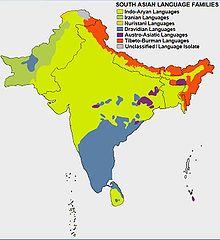 Over eight million people in the Tibetan Plateau
and neighbouring areas in Baltistan
, Ladakh
, Nepal
, Sikkim
and Bhutan
speak one of several related Tibetan languages.
There is an extensive literature in Classical Tibetan
dating from the 8th century.
The Tibetan languages are usually grouped with the smaller East Bodish languages
of Bhutan and Arunachal Pradesh
as the Bodish
group.
A wide variety of Tibeto-Burman languages are spoken on the southern slopes of the Himalayas.
Sizable groups that have been identified are the West Himalayish languages
of Himachal Pradesh
and western Nepal, the Tamangic languages
of western Nepal, including Tamang
with one million speakers, and the Kiranti languages
of eastern Nepal.
The remaining groups are small, with several isolates.
The Newari language (Nepal Bhasa) of central Nepal has a million speakers and a literature dating from the 12th century, and nearly a million people speak Magaric languages
, but the rest have small speech communities.
Other isolates and small groups in Nepal are Dura, Raji–Raute, Chepangic
and Dhimalish
.
Lepcha
is spoken from eastern Nepal to western Bhutan.
Most of the languages of Bhutan are Bodish, but it also has three small isolates, Black Mountain Monpa, Lhokpu
and Gongduk
and a larger community of speakers of Tshangla.
The languages of Arunachal Pradesh and adjacent areas of Tibet include the small Siangic
, Kho-Bwa
, Hrusish
, Midzuish
, Tani
and Digarish groups.
 The greatest variety of languages and subgroups is found in the highlands stretching from northern Burma to northeast India.
Northern Burma is home to the small Nungish
group, as well as the Kachin–Luic languages, including Jingpho
with nearly a million speakers.
The Brahmaputran or Sal languages
include at least the Bodo–Koch and Konyak languages
, spoken in an area stretching from northern Burma through the Indian states of Nagaland
, Meghalaya
and Tripura
, and are often considered to include the Kachin–Luic group.
The border highlands of Nagaland, Manipur
and western Burma are home to the small Ao
, Angami–Pochuri, Tangkhul
and Zeme
groups of languages, as well as the Karbi language
.
Meitei, the main language of Manipur with 1.4 million speakers, is sometimes linked with the 50 or so Kukish or Kuki-Chin languages spoken in Mizoram
and the Chin State
of Burma.
The Mru language
is spoken by a small group in the Chittagong Hills between Bangladesh and Burma.
Sino-Tibetan
The Tibeto-Burman family is then divided into seven primary branches:
I. Tibetan–Kanauri
( Bodish–Himalayish)
II. Bahing–Vayu
III. Abor–Miri–Dafla
IV. Kachin
V. Burmese–Lolo
VI. Bodo–Garo ( Barish)
VII. Kuki–Naga ( Kukish)
, a modification of Benedict that demoted Karen but kept the divergent position of Sinitic. Of the 7 branches within Tibeto-Burman, 2 branches (Baic and Karenic) have SVO
-order languages, while all the other 5 branches have SOV
-order languages.
Tibeto-Burman is then divided into several branches, some of them geographic conveniences rather than linguistic proposals:
Matisoff makes no claim that the families in the Kamarupan or Himalayish branches have a special relationship to one another other than a geographic one. They are intended rather as categories of convenience pending more detailed comparative work.
Matisoff also notes that the Jingpho–Nungish–Luish is central to the family in that in contains features of many of the other branches, and is also located around the center of the Tibeto-Burman-speaking area.
I. Western (= Bodic)
II. Sal
III. Central (perhaps a residual group, not actually related to each other. Lepcha
may also fit here.)
IV. North-Eastern
V. South-Eastern
(2001) acknowledges that the relationships of the "Kuki–Naga" languages (Kuki
, Mizo
, Meitei, etc.), both amongst each other and to the other Tibeto-Burman languages, remain unclear. However, rather than placing them in a geographic grouping, as Matisoff does, van Driem leaves them unclassified.
Van Driem proposes that Chinese owes its traditional privileged place in Sino-Tibetan to historical, typological, and cultural rather than linguistic criteria. For example, he notes that Lepcha is as difficult to reconcile with Tibeto-Burman reconstructions as Chinese is, but that no-one has proposed a "Lepcha–Tibetan" family with Lepcha as one of two primary branches. He compares the situation to the Indo-Hittite
hypothesis in Indo-European studies.
Van Driem's classification goes further than simply demoting Chinese to a branch of Tibeto-Burman: he proposes that the closest relatives of Chinese are Bodic languages such as Tibetan, a hypothesis called Sino-Bodic. Critics counter that Van Driem hasn't produced any evidence that Chinese and Bodic share innovations that set them apart as a group. (Note also that most other linguists who merge Chinese into Tibeto-Burman continue to call the resulting family Sino-Tibetan.)
Tibeto-Burman (Van Driem)
There are in addition poorly known languages, such as Ayi, which may be closely related to others but remain unclassified.
Tibeto-Burman languages
The Tibeto-Burman languages are the non-Chinese members of the Sino-Tibetan language family, over 400 of which are spoken thoughout the highlands of southeast Asia, as well as lowland areas in Burma ....
are the non-Chinese members of the Sino-Tibetan language family, over 400 of which are spoken thoughout the highlands of southeast Asia, as well as lowland areas in Burma (Myanmar).
The group is named after its most widely spoken members, Burmese
Burmese language
The Burmese language is the official language of Burma. Although the constitution officially recognizes it as the Myanmar language, most English speakers continue to refer to the language as Burmese. Burmese is the native language of the Bamar and related sub-ethnic groups of the Bamar, as well as...
(over 32 million speakers) and the Tibetan languages (over 8 million).
Most of the other languages are spoken by much smaller communities, and many of them have not been described in detail.
A widely cited taxonomy divides Sino-Tibetan into Sinitic and Tibeto-Burman branches, but other scholars deny that Tibeto-Burman comprises a monophyletic group.
History
During the 18th century, several scholars had noticed parallels between Tibetan and Burmese, both languages with extensive literary traditions.Early in the following century, Brian Houghton Hodgson
Brian Houghton Hodgson
Brian Houghton Hodgson was an early naturalist and ethnologist working in British India and Nepal where he was an English civil servant. He described many species, especially birds and mammals from the Himalayas, and several birds were named after him by others such as Edward Blyth...
collected a wealth of data on the non-literary languages of the Himalayas and northeast India, noting that many of these were related to Tibetan and Burmese.
Others identified related languages in the highlands of Southeast Asia and southwest China.
The name "Tibeto-Burman" was first applied to this group in 1856 by James Richardson Logan
James Richardson Logan
James Richardson Logan was the man who coined the name Indonesia. He was a prominent lawyer, an editor of the Penang Gazette and a former student of George Windsor Earl, an English ethnologist; in 1850 Earl published the term 'Indu-nesians' to describe the peoples of the region...
, who added Karen in 1858.
Logan viewed the family as uniting the Gangetic and Lohitic branches of Max Müller
Max Müller
Friedrich Max Müller , more regularly known as Max Müller, was a German philologist and Orientalist, one of the founders of the western academic field of Indian studies and the discipline of comparative religion...
's Turanian, a huge family consisting of all the Eurasian languages except the Semitic
Semitic
In linguistics and ethnology, Semitic was first used to refer to a language family of largely Middle Eastern origin, now called the Semitic languages...
, Aryan
Aryan
Aryan is an English language loanword derived from Sanskrit ārya and denoting variously*In scholarly usage:**Indo-Iranian languages *in dated usage:**the Indo-European languages more generally and their speakers...
(Indo-European
Indo-European
Indo-European may refer to:* Indo-European languages** Aryan race, a 19th century and early 20th century term for those peoples who are the native speakers of Indo-European languages...
) and Chinese languages. (Later writers would include Chinese within Turanian.)
The third volume of the Linguistic Survey of India
Linguistic Survey of India
The Linguistic Survey of India, often referred to as the LSI, is a comprehensive survey of the languages of British India, describing 364 languages and dialects. It was a project of the British Raj conducted between 1894 and 1928, under the direction of George A...
was devoted to the Tibeto-Burman languages of British India.
Sino-Tibetan
A larger family including Tibetan, Burmese and Chinese, but not ThaiThai language
Thai , also known as Central Thai and Siamese, is the national and official language of Thailand and the native language of the Thai people, Thailand's dominant ethnic group. Thai is a member of the Tai group of the Tai–Kadai language family. Historical linguists have been unable to definitively...
, Vietnamese
Vietnamese language
Vietnamese is the national and official language of Vietnam. It is the mother tongue of 86% of Vietnam's population, and of about three million overseas Vietnamese. It is also spoken as a second language by many ethnic minorities of Vietnam...
or Mon
Mon language
The Mon language is an Austroasiatic language spoken by the Mon, who live in Burma and Thailand. Mon, like the related language Cambodian—but unlike most languages in Mainland Southeast Asia—is not tonal. Mon is spoken by more than a million people today. In recent years, usage of Mon has...
, had been proposed by Julius Klaproth
Julius Klaproth
Julius Heinrich Klaproth , German linguist, historian, ethnographer, author, Orientalist and explorer. As a scholar, he is credited along with Jean-Pierre Abel-Rémusat, with being instrumental in turning East Asian Studies into scientific disciplines with critical methods.-Chronology:Klaproth was...
in 1823 on the basis of shared vocabulary.
In the late 19th century, a link between Tibeto-Burman and Chinese was recognized by several authors, including Ernst Kuhn in 1883 and August Conrady
August Conrady
August Conrady was a German Sinologist and linguist. From 1897 he was professor at the University of Leipzig....
in 1896.
The Tai languages
Tai languages
The Tai or Zhuang–Tai languages are a branch of the Tai–Kadai language family. The Tai languages include the most widely spoken of the Tai–Kadai languages, including standard Thai or Siamese, the national language of Thailand; Lao or Laotian, the national language of Laos; Burma's Shan language;...
were usually included, as they had vocabulary and typological features in common with Chinese.
Jean Przyluski introduced the term sino-tibétain (Sino-Tibetan) as the title of his chapter on the group in Meillet
Antoine Meillet
Paul Jules Antoine Meillet was one of the most important French linguists of the early 20th century. Meillet began his studies at the Sorbonne, where he was influenced by Michel Bréal, Ferdinand de Saussure, and the members of the Année Sociologique. In 1890 he was part of a research trip to the...
and Cohen
Marcel Cohen
Marcel Samuel Raphaël Cohen was a French linguist. He was an important scholar of Semitic languages and especially of Ethiopian languages. He studied the French language and contributed much to general linguistics.- Life :...
's Les Langues du Monde in 1924.
The Tai languages have not been included in most Western accounts of Sino-Tibetan since the Second World War, though many Chinese linguists still include them.
The link to Chinese is now accepted by most linguists, with a few exceptions such as Roy Andrew Miller
Roy Andrew Miller
Roy Andrew Miller is a linguist notable for his advocacy of Korean and Japanese as members of the Altaic group of languages....
and Christopher Beckwith
Christopher Beckwith
Christopher I. Beckwith is a professor of Central Eurasian Studies at Indiana University in Bloomington, Indiana.He received his Ph.D. degree from Indiana University in Uralic and Altaic Studies ....
.
More recent controversy has centred on the proposed primary branching of Sino-Tibetan into Chinese and Tibeto-Burman subgroups.
In spite of the popularity of this classification, first proposed by Kuhn and Conrady, and also promoted by Paul Benedict
Paul K. Benedict
Paul K. Benedict was an American linguist who specialized in languages of East and Southeast Asia. He is well-known for his 1942 proposal of the Austro-Tai language family and also his reconstruction of Proto-Sino-Tibetan and Proto-Tibeto-Burman.-References:...
(1972) and later James Matisoff
James Matisoff
James A. Matisoff is a professor emeritus of Linguistics at the University of California, Berkeley and noted authority on Tibeto-Burman languages and other languages of mainland Southeast Asia....
, Tibeto-Burman has never been demonstrated to be a valid family in its own right:
George van Driem
George van Driem
George van Driem, born 1957, is a linguist at , where he holds the chair of Historical Linguistics and directs the .-Background:George van Driem has conducted field research in the Himalayas since 1983...
proposes, as did Robert Shafer in 1966, that Chinese not have a privileged position within the family. He further argues that the larger family ought to be called Tibeto-Burman. He has not, however, been followed in this usage, and most linguists continue to use the term "Sino-Tibetan" regardless of the position they assume for Chinese within the family. Most treatments, moreover, continue to follow the Sinitic–Tibeto-Burman dichotomy of Benedict and Matisoff.
Survey
Most of the Tibeto-Burman languages are spoken in inaccessible mountain areas and many are unwritten, which has greatly hampered their study.It is generally much easier to identify a language as Tibeto-Burman than to determine its precise relationship with other languages of the group.
The subgroupings that have been established with certainty number several dozen, ranging from well-studied groups of dozens of languages with millions of speakers to several isolate
Language isolate
A language isolate, in the absolute sense, is a natural language with no demonstrable genealogical relationship with other languages; that is, one that has not been demonstrated to descend from an ancestor common with any other language. They are in effect language families consisting of a single...
s, some only newly discovered but in danger of extinction.
These subgroups are here surveyed on a geographical basis.
Southeast Asia and southwest China
The southernmost group are the Karen languagesKaren languages
The Karen languages are tonal languages spoken by some three million Karen people. They are of unclear affiliation within the Tibeto-Burman languages. The Karen languages are written using the Burmese script. The three main branches are Sgaw, Pwo, and Pa'o. Karenni and Kayan are related to the...
, spoken by three million people on both sides of the Burma–Thailand border.
They differ from all other Tibeto-Burman languages (except Bai) in having a subject–object–verb word order, attributed to contact with Tai–Kadai and Mon-Khmer languages.
The most widely spoken Tibeto-Burman language is Burmese
Burmese language
The Burmese language is the official language of Burma. Although the constitution officially recognizes it as the Myanmar language, most English speakers continue to refer to the language as Burmese. Burmese is the native language of the Bamar and related sub-ethnic groups of the Bamar, as well as...
, the national language of Burma, with over 32 million speakers and a literary tradition dating from the 11th century.
It is one of the Lolo–Burmese languages, an intensively studied and well-defined group comprising approximately 100 languages spoken in Burma and the highlands of Thailand, Laos, Vietnam and southwest China.
Major languages include the Yi languages (or Lolo), with two million speakers in western Sichuan and northern Yunnan, the Akha
Akha language
Akha is the language spoken by the Akha people. It is sometimes considered a dialect of the Hani language spoken in China, although most speakers live in eastern Burma....
–Hani
Hani language
The Hani language is a language of the Loloish branch of the Tibeto-Burman linguistic group spoken in China, Laos, Burma , and Vietnam by the Hani people.-Dialects:Hani proper has three dialects: Haya, Haohai, and Bika...
languages, with two million speakers in southern Yunnan, eastern Burma, Laos and Vietnam, and Lisu
Lisu language
Lisu is a tonal Tibeto-Burman language spoken in Yunnan , northern Burma , and Thailand and a small part of India. It is the language of the Lisu minority. Lisu has many dialects that originate from the country in which they live. Hua Lisu, Pai Lisu, and Lu Shi Lisu dialects are spoken in China...
and Lahu
Lahu language
Lahu is a Tibeto-Burman language spoken by the Lahu people of China, Thailand, Myanmar, and Laos. It is widely used in China, both by Lahu people, and by other ethnic minorities in Yunnan, who use it as a lingua franca. However, the language is not widely used nor taught in any schools in...
in Yunnan, northern Burma and northern Thailand.
All languages of the Loloish subgroup show significant Mon–Khmer influence.
The Tibeto-Burman languages of southwest China have been heavily influenced by Chinese over a long period, leaving their affiliations difficult to determine.
The grouping of the Bai language, with one million speakers in Yunnan, is particularly controversial, with some workers suggesting that it is a sister language to Chinese.
The Naxi language
Naxi language
Naxi is a Tibeto-Burman language or group of languages spoken by some 310,000 people concentrated in the Lijiang City Yulong Naxi Autonomous County of the province of Yunnan, China. Nakhi is also the name of the ethnic group that speaks it.- Classification :There are at least two Naxi languages...
of northern Yunnan is usually included within Lolo–Burmese, though other scholars prefer to leave it unclassified.
The hills of northwest Sichuan are home to the small Qiangic
Qiangic languages
Qiangic or Kiangic, formerly known as Dzorgai, is a language group of the northeastern Tibeto-Burman branch of the Sino-Tibetan language family, spoken mainly in Southwestern China, including Sichuan, Tibet, and Yunnan....
and rGyal-rongic (or Jiarongic) groups of languages, which preserve many archaic features.
The most easterly Tibeto-Burman language is Tujia
Tujia language
The Tujia language is a language spoken natively by the Tujia ethnicity in central China. It is unclassified within the Tibeto-Burman language family, due to pervasive influence from neighboring languages. There are two dialects, one Northern and one Southern. Both dialects are tonal languages...
, spoken in the Wuling Mountains
Wuling Mountains
The Wuling Mountains is a mountain range located in Central China, running from Chongqing Municipality and East Guizhou to West Hunan.The Wulingyuan Scenic Area in the east is a World Heritage Site, noted for its high mountains, strangely-shaped crags, clear waters, deep valleys, and mountain...
on the borders of Hunan, Hubei, Guizhou and Chongqing.
Two historical languages are believed to be Tibeto-Burman, but their precise affiliation is uncertain.
The Pyu language of central Burma in the first centuries CE is known from inscriptions using a variant of the Gupta script
Gupta script
The Gupta script was used for writing Sanskrit and is associated with the Gupta Empire of India which was a period of material prosperity and great religious and scientific developments. The Gupta script was descended from Brahmi and gave rise to the Nagari, Sharada and Siddham scripts...
.
The Tangut language
Tangut language
Tangut is an ancient northeastern Tibeto-Burman language once spoken in the Western Xia Dynasty, also known as the Tangut Empire. It is classified by some linguists as one of the Qiangic languages, which also include Qiang and rGyalrong, among others...
of the 12th century Western Xia dynasty of northern China is preserved in numerous texts written in the Chinese-inspired Tangut script
Tangut script
The Tangut script was a logographic writing system, used for writing the extinct Tangut language of the Western Xia Dynasty. According to the latest count, 5863 Tangut characters are known, excluding variants...
.
Tibet and south Asia
Tibetan Plateau
The Tibetan Plateau , also known as the Qinghai–Tibetan Plateau is a vast, elevated plateau in Central Asia covering most of the Tibet Autonomous Region and Qinghai, in addition to smaller portions of western Sichuan, southwestern Gansu, and northern Yunnan in Western China and Ladakh in...
and neighbouring areas in Baltistan
Baltistan
Baltistan , also known as بلتیول བལིུལ་ in the Balti language, is a region in northern Pakistan which forms Gilgit-Baltistan, bordering the Xinjiang Autonomous Region of China. In addition, a part of Baltistan also falls into Jammu and Kashmir of India. It is situated in the Karakoram mountains...
, Ladakh
Ladakh
Ladakh is a region of Jammu and Kashmir, the northernmost state of the Republic of India. It lies between the Kunlun mountain range in the north and the main Great Himalayas to the south, inhabited by people of Indo-Aryan and Tibetan descent...
, Nepal
Nepal
Nepal , officially the Federal Democratic Republic of Nepal, is a landlocked sovereign state located in South Asia. It is located in the Himalayas and bordered to the north by the People's Republic of China, and to the south, east, and west by the Republic of India...
, Sikkim
Sikkim
Sikkim is a landlocked Indian state nestled in the Himalayan mountains...
and Bhutan
Bhutan
Bhutan , officially the Kingdom of Bhutan, is a landlocked state in South Asia, located at the eastern end of the Himalayas and bordered to the south, east and west by the Republic of India and to the north by the People's Republic of China...
speak one of several related Tibetan languages.
There is an extensive literature in Classical Tibetan
Classical Tibetan
Classical Tibetan refers to the language of any text written in Tibetan after the Old Tibetan period and before the modern period, but in particular refers to the language of early canonical texts translated from other languages, especially Sanskrit...
dating from the 8th century.
The Tibetan languages are usually grouped with the smaller East Bodish languages
East Bodish languages
The East Bodish languages are those Bodish languages not covered by the name Tibetan, such as those spoken by the Monpa. They include:*Dakpa*Dzala*Bumthang *Tawang*Black Mountain Monpa .The most divergent is Dakpa...
of Bhutan and Arunachal Pradesh
Arunachal Pradesh
Arunachal Pradesh is a state of India, located in the far northeast. It borders the states of Assam and Nagaland to the south, and shares international borders with Burma in the east, Bhutan in the west, and the People's Republic of China in the north. The majority of the territory is claimed by...
as the Bodish
Bodish languages
The Bodish languages, named for the Tibetan ethnonym bod, are the Tibetan languages in a broad linguistic sense, regardless of whether the speakers are considered ethnically Tibetan. Different scholars divide Bodish differently, but the alternate term 'Tibetan' generally excludes East Bodish...
group.
A wide variety of Tibeto-Burman languages are spoken on the southern slopes of the Himalayas.
Sizable groups that have been identified are the West Himalayish languages
West Himalayish languages
The West Himalayish languages, also known as Almora and Kanauric, are a family of Tibeto-Burman languages centered on Kanauri, in Himachal Pradesh and across the border into Nepal.The languages include:...
of Himachal Pradesh
Himachal Pradesh
Himachal Pradesh is a state in Northern India. It is spread over , and is bordered by the Indian states of Jammu and Kashmir on the north, Punjab on the west and south-west, Haryana and Uttar Pradesh on the south, Uttarakhand on the south-east and by the Tibet Autonomous Region on the east...
and western Nepal, the Tamangic languages
Tamangic languages
The Tamangic languages or TGTM languages are a family of Tibeto-Burman languages spoken in the Himalayas of Nepal.The languages ar:*Tamang *Gurung...
of western Nepal, including Tamang
Tamang language
Tamang is a term used to collectively refer to a dialect cluster spoken in parts of Nepal and Sikkim. It comprises Eastern Tamang, Northwestern Tamang, Southwestern Tamang, Eastern Gorkha Tamang, and Western Tamang...
with one million speakers, and the Kiranti languages
Kiranti languages
The Mahakiranti or Maha-Kiranti languages are a proposed intermediate level of classification of the Tibeto-Burman languages. They are the languages most closely related to the Kiranti languages proper, which are spoken by the ethnic Kirat...
of eastern Nepal.
The remaining groups are small, with several isolates.
The Newari language (Nepal Bhasa) of central Nepal has a million speakers and a literature dating from the 12th century, and nearly a million people speak Magaric languages
Magaric languages
The Magaric languages, Magar and Kham, are a small proposed family of Tibeto-Burman languages spoken in Nepal. They are often classified as part of the Mahakiranti family, and Van Driem proposes that they are close relatives of Mahakiranti.Several neighboring languages with uncertain affiliation...
, but the rest have small speech communities.
Other isolates and small groups in Nepal are Dura, Raji–Raute, Chepangic
Chepangic languages
The Chepangic languages, Chepang and Bujhyal , are Tibeto-Burman languages of uncertain affiliation spoken in Nepal...
and Dhimalish
Dhimal languages
The Dhimal languages, Dhimal and Toto, are a small family of Tibeto-Burman languages spoken in eastern India and Nepal.-References:* * George van Driem Languages of the Himalayas: An Ethnolinguistic Handbook of the Greater Himalayan Region. Brill, Boston ....
.
Lepcha
Lepcha language
Lepcha language, or Róng language , is a Himalayish language spoken by the Lepcha people in Sikkim and parts of West Bengal, Nepal and Bhutan.-Population:...
is spoken from eastern Nepal to western Bhutan.
Most of the languages of Bhutan are Bodish, but it also has three small isolates, Black Mountain Monpa, Lhokpu
Lhokpu language
Lhokpu, also Lhobikha or Taba-Damey-Bikha, is one of the autochthonous languages of Bhutan spoken by the Lhop people. It is spoken in southwestern Bhutan along the border of Samtse and Chukha Districts. Van Driem leaves it unclassified as a separate branch within the Tibeto-Burman language...
and Gongduk
Gongduk language
Gongduk or Gongdu is an endangered Tibeto-Burman language spoken by about 1,000 people in a few inaccessible villages located near the Kuri Chhu river in the Gongdu Gewog of Mongar District in eastern Bhutan...
and a larger community of speakers of Tshangla.
The languages of Arunachal Pradesh and adjacent areas of Tibet include the small Siangic
Siangic languages
The Siangic languages are a small family of possibly Tibeto-Burman languages spoken in Arunachal Pradesh, northeast India . They are Koro and Milang, the latter previously classified as a divergent member of the Tani languages....
, Kho-Bwa
Kho-Bwa languages
The Kho-Bwa or Bugunish languages are a small family of Tibeto-Burman languages spoken in India. They are Khowa , Sulung , Lishpa, and Sherdukpen...
, Hrusish
Hruso languages
The Hruso languages are a small family of Tibeto-Burman languages of India. They are Hruso , Dhammai , and possibly also Levai , which may be a dialect of Hruso but which some scholars leave unclassified.-References:...
, Midzuish
Midzu languages
The Midzu or Southern Mishmi languages are a small family of Tibeto-Burman languages spoken by the Kaman people of Tibet .The languages are Kaman and Zakhring....
, Tani
Tani languages
Tani, Miric, Adi–Galo–Mishing–Nishi , or Abor–Miri–Dafla is a compact family of Tibeto-Burman languages situated at the eastern end of the Himalayas, in an area skirted on four sides by Tibet, Assam, Bhutan, and Burma....
and Digarish groups.
Northern Burma is home to the small Nungish
Nungish languages
The Nung languages are a poorly described family of uncertain affiliation within the Tibeto-Burman languages. They include:*Drung*Răwang*Nung*Ālóng*Ruòruò,and are spoken in Yunnan and Burma....
group, as well as the Kachin–Luic languages, including Jingpho
Jingpho language
The Jingpho language or Kachin language is a Tibeto-Burman language mainly spoken in Kachin State, Burma and Yunnan Province, China...
with nearly a million speakers.
The Brahmaputran or Sal languages
Sal languages
The Brahmaputran or Sal languages are a family of Tibeto-Burman languages spoken in eastern India and Burma.Burling proposed a grouping of the Bodo–Garo, Konyak and Jingpho languages, calling the proposed group Sal, after the words sal, san and jan for "sun" in various of these languages.The...
include at least the Bodo–Koch and Konyak languages
Konyak languages
The Konyak languages, or Northern Naga, are a small family of half a dozen Tibeto-Burman languages spoken by the Naga people in eastern India. They are not particularly closely related to other Naga languages...
, spoken in an area stretching from northern Burma through the Indian states of Nagaland
Nagaland
Nagaland is a state in the far north-eastern part of India. It borders the state of Assam to the west, Arunachal Pradesh and part of Assam to the north, Burma to the east and Manipur to the south. The state capital is Kohima, and the largest city is Dimapur...
, Meghalaya
Meghalaya
Meghalaya is a state in north-eastern India. The word "Meghalaya" literally means the Abode of Clouds in Sanskrit and other Indic languages. Meghalaya is a hilly strip in the eastern part of the country about 300 km long and 100 km wide, with a total area of about 8,700 sq mi . The...
and Tripura
Tripura
Tripura is a state in North-East India, with an area of . It is the third smallest state of India, according to area. Tripura is surrounded by Bangladesh on the north, south, and west. The Indian states of Assam and Mizoram lie to the east. The capital is Agartala and the main languages spoken are...
, and are often considered to include the Kachin–Luic group.
The border highlands of Nagaland, Manipur
Manipur
Manipur is a state in northeastern India, with the city of Imphal as its capital. Manipur is bounded by the Indian states of Nagaland to the north, Mizoram to the south and Assam to the west; it also borders Burma to the east. It covers an area of...
and western Burma are home to the small Ao
Ao languages
The Ao languages are a small family of Tibeto-Burman languages spoken by the Ao people of Nagaland in northeast India. Conventionally classified as "Naga", they are not clearly related to other Naga languages, and are conservatively classified as an independent branch of Tibeto-Burman, pending...
, Angami–Pochuri, Tangkhul
Tangkhul languages
The Tangkhul or Luhupa languages are a small family of Tibeto-Burman languages spoken in Nagaland in northeast India. Conventionally classified as "Naga", they are not clearly related to other Naga languages, and are conservatively classified as an independent branch of Tibeto-Burman, pending...
and Zeme
Zeme languages
The Zeme languages are a small family of Tibeto-Burman languages spoken in Nagaland in northeast India. Conventionally classified as "Naga", they are not clearly related to other Naga languages, and are conservatively classified as an independent branch of Tibeto-Burman, pending further...
groups of languages, as well as the Karbi language
Karbi language
The Karbí language, also known as Mikir or Arleng, is spoken by the Karbi people of Assam. It belongs to the Tibeto-Burman language family, but its position is unclear...
.
Meitei, the main language of Manipur with 1.4 million speakers, is sometimes linked with the 50 or so Kukish or Kuki-Chin languages spoken in Mizoram
Mizoram
Mizoram is one of the Seven Sister States in North Eastern India, sharing borders with the states of Tripura, Assam, Manipur and with the neighbouring countries of Bangladesh and Burma. Mizoram became the 23rd state of India on 20 February 1987. Its capital is Aizawl. Mizoram is located in the...
and the Chin State
Chin State
Chin State is a state located in western Burma . The Chin State is bordered by Rakhine State in the south, Bangladesh in south-west, Sagaing Division and Magway Division in the east, Indian state of Manipur in the north and Indian state of Mizoram in the west. The Chin ethnic group make up the...
of Burma.
The Mru language
Mru language
The Mru language is a part of Tibeto-Burman languages and one of the recognized languages of Bangladesh.It is spoken by a community of Mros inhabiting the Chittagong Hill Tracts of Bangladesh and also in Burma with a population of 21,963 in Bangladesh according to the 1991 census. The Mros are the...
is spoken by a small group in the Chittagong Hills between Bangladesh and Burma.
Classification
There have been two milestones in the classification of Sino-Tibetan and Tibeto-Burman languages, Shafer (1966) and Benedict (1972), which were actually produced in the 1930s and 1940s respectively.Shafer (1966–1974)
Shafer's tentative classification took an agnostic position and did not recognize Tibeto-Burman as a primary branch, but placed Chinese (Sinitic) is placed on the same level as the other branches. He retained Daic within the family, allegedly at the insistence of colleagues, despite his personal belief that they were not related.Sino-Tibetan
- I. SiniticSinitic languagesThe Sinitic languages, often called the Chinese languages or the Chinese language, are a language family frequently postulated as one of two primary branches of Sino-Tibetan...
- II. ?? Daic
- III. Bodic
- a. Bodish
- i. GurungTamangic languagesThe Tamangic languages or TGTM languages are a family of Tibeto-Burman languages spoken in the Himalayas of Nepal.The languages ar:*Tamang *Gurung...
- ii. Tshangla
- iii. Gyarong
- iv. Tibetan
- i. Gurung
- b. West HimalayishWest Himalayish languagesThe West Himalayish languages, also known as Almora and Kanauric, are a family of Tibeto-Burman languages centered on Kanauri, in Himachal Pradesh and across the border into Nepal.The languages include:...
- c. West Central (MagarMagaric languagesThe Magaric languages, Magar and Kham, are a small proposed family of Tibeto-Burman languages spoken in Nepal. They are often classified as part of the Mahakiranti family, and Van Driem proposes that they are close relatives of Mahakiranti.Several neighboring languages with uncertain affiliation...
, ChepangChepangic languagesThe Chepangic languages, Chepang and Bujhyal , are Tibeto-Burman languages of uncertain affiliation spoken in Nepal...
, HayuWayu languageWayu, Vayu, or Hayu is a language spoken by about 1740 people in the Janakpur Zone of Nepal.According to Van Driem , Shafer mistakenly classified Wayu as a Chepang language, and this has carried through to Ethnologue.-References:...
[misplaced]) - d. East HimalayishKiranti languagesThe Mahakiranti or Maha-Kiranti languages are a proposed intermediate level of classification of the Tibeto-Burman languages. They are the languages most closely related to the Kiranti languages proper, which are spoken by the ethnic Kirat...
- (also Newari, incertae sedis)
- a. Bodish
- IV. Burmic
- V. Baric
- VI. KarenicKaren languagesThe Karen languages are tonal languages spoken by some three million Karen people. They are of unclear affiliation within the Tibeto-Burman languages. The Karen languages are written using the Burmese script. The three main branches are Sgaw, Pwo, and Pa'o. Karenni and Kayan are related to the...
Benedict (1972)
A very influential, although also tentative, classification is that of Benedict (1972). This was a collaborative effort of Paul Benedict and Robert Shafer (completed around 1942–1943) that envisaged Chinese as the first family to branch off, followed by Karen.- Sino-Tibetan
- Chinese
- Tibeto-Karen
- Karen
- Tibeto-Burman
The Tibeto-Burman family is then divided into seven primary branches:
I. Tibetan–Kanauri
Tibeto-Kanauri languages
The Tibeto-Kanauri languages, also called Bodish–Himalayish and Western Tibeto-Burman, are a proposed intermediate level of classification of the Tibeto-Burman languages, centered on the Tibetan and Kanauri languages...
( Bodish–Himalayish)
- A. Bodish
- (Tibetan, Gyarung, TakpaEast Bodish languagesThe East Bodish languages are those Bodish languages not covered by the name Tibetan, such as those spoken by the Monpa. They include:*Dakpa*Dzala*Bumthang *Tawang*Black Mountain Monpa .The most divergent is Dakpa...
, Tsangla, Murmi & GurungTamangic languagesThe Tamangic languages or TGTM languages are a family of Tibeto-Burman languages spoken in the Himalayas of Nepal.The languages ar:*Tamang *Gurung...
)
- (Tibetan, Gyarung, Takpa
- B. Himalayish
- i. "major" HimalayishWest Himalayish languagesThe West Himalayish languages, also known as Almora and Kanauric, are a family of Tibeto-Burman languages centered on Kanauri, in Himachal Pradesh and across the border into Nepal.The languages include:...
- ii. "minor" HimalayishWest Himalayish languagesThe West Himalayish languages, also known as Almora and Kanauric, are a family of Tibeto-Burman languages centered on Kanauri, in Himachal Pradesh and across the border into Nepal.The languages include:...
- (Rangkas, Darmiya, Chaudangsi, Byangsi)
- (perhaps also DzorgaiQiangic languagesQiangic or Kiangic, formerly known as Dzorgai, is a language group of the northeastern Tibeto-Burman branch of the Sino-Tibetan language family, spoken mainly in Southwestern China, including Sichuan, Tibet, and Yunnan....
, LepchaLepcha languageLepcha language, or Róng language , is a Himalayish language spoken by the Lepcha people in Sikkim and parts of West Bengal, Nepal and Bhutan.-Population:...
, MagariMagaric languagesThe Magaric languages, Magar and Kham, are a small proposed family of Tibeto-Burman languages spoken in Nepal. They are often classified as part of the Mahakiranti family, and Van Driem proposes that they are close relatives of Mahakiranti.Several neighboring languages with uncertain affiliation...
)
- i. "major" Himalayish
II. Bahing–Vayu
Kiranti languages
The Mahakiranti or Maha-Kiranti languages are a proposed intermediate level of classification of the Tibeto-Burman languages. They are the languages most closely related to the Kiranti languages proper, which are spoken by the ethnic Kirat...
- A. Bahing (SunwarSunwar languageSunuwari is a Kiranti language spoken in Nepal by the Sunuwar people. It was first comprehensively attested by the Himalayan Languages Project.-External links:**...
, KhalingKhaling languageKhaling is a Kiranti language spoken in Khotang district, Nepal-References:*Hale, Austin, editor. 1973. Collected papers on Khaling, Kulunge, Darai, Newari, Chitwan Tharu. Nepal Studies in Linguistics, 1. Kirtipur: Summer Institute of Linguistics and Institute for Nepal and Asian Studies. vii, 87...
) - B. Khambu (Sampang, RungchenbungBantawa languageThe Bantawa language is an endangered language group. It is a Tibeto-Burman language, Eastern Kiranti languages family, spoken in the eastern Himalayan hills of eastern Nepal by Rai ethnic groups. Bantawa speaking Population estimates vary between 20,000-60,000, though 35,000 speakers may be a...
, YakhaYakha languageYakkha is a language spoken in parts of Nepal, Darjeeling district and Sikkim. The Yakkha-speaking villages are located to the East of the Arun river, in the southern part of the Sankhuwasabha district and in the northern part of the Dhankuta district of Nepal. About 14,000 people still speak the...
, and LimbuLimbu languageLimbu is a Tibeto-Burman language spoken in Nepal, Bhutan, Sikkim, Kashmir and Darjeeling district, West Bengal, India, by the Limbu community. Virtually all Limbus are bilingual in Nepali....
) - C. VayuWayu languageWayu, Vayu, or Hayu is a language spoken by about 1740 people in the Janakpur Zone of Nepal.According to Van Driem , Shafer mistakenly classified Wayu as a Chepang language, and this has carried through to Ethnologue.-References:...
–ChepangChepangic languagesThe Chepangic languages, Chepang and Bujhyal , are Tibeto-Burman languages of uncertain affiliation spoken in Nepal...
III. Abor–Miri–Dafla
Tani languages
Tani, Miric, Adi–Galo–Mishing–Nishi , or Abor–Miri–Dafla is a compact family of Tibeto-Burman languages situated at the eastern end of the Himalayas, in an area skirted on four sides by Tibet, Assam, Bhutan, and Burma....
IV. Kachin
Jingpho language
The Jingpho language or Kachin language is a Tibeto-Burman language mainly spoken in Kachin State, Burma and Yunnan Province, China...
V. Burmese–Lolo
- A. Burmese–MaruBurmish languagesThe Burmish languages are Burmese, including Standard Burmese and the Burmese dialects, and non-literary languages spoken across Burma and southern China such as Achang, Măru, Lăshi, Taungyo, and Atsi.-Languages:...
- B. Southern LoloLoloish languagesThe Loloish languages, also known as Ngwi or in China as Yi, are a family of fifty to a hundred languages of the Tibeto-Burman language family. They are most closely related to Burmese and its relatives. Both the Loloish and Burmish branches are well defined, as is their superior node, Lolo–Burmese...
- C. Northern LoloLoloish languagesThe Loloish languages, also known as Ngwi or in China as Yi, are a family of fifty to a hundred languages of the Tibeto-Burman language family. They are most closely related to Burmese and its relatives. Both the Loloish and Burmish branches are well defined, as is their superior node, Lolo–Burmese...
- D. Kanburi LawaUgong languageThe Ugong language is an endangered language of Western Thailand, spoken in isolated pockets in Kanchanaburi, Uthai Thani, and Suphanburi provinces. The ethnic group was first known to Westerners in the 1920s, when the language was already considered in severe decline...
- E. MosoNaxi languageNaxi is a Tibeto-Burman language or group of languages spoken by some 310,000 people concentrated in the Lijiang City Yulong Naxi Autonomous County of the province of Yunnan, China. Nakhi is also the name of the ethnic group that speaks it.- Classification :There are at least two Naxi languages...
- F. Hsi-fan (QiangicQiangic languagesQiangic or Kiangic, formerly known as Dzorgai, is a language group of the northeastern Tibeto-Burman branch of the Sino-Tibetan language family, spoken mainly in Southwestern China, including Sichuan, Tibet, and Yunnan....
and Jiarongic languages apart from Qiang and Gyarung themselves) - G. TangutTangut languageTangut is an ancient northeastern Tibeto-Burman language once spoken in the Western Xia Dynasty, also known as the Tangut Empire. It is classified by some linguists as one of the Qiangic languages, which also include Qiang and rGyalrong, among others...
VI. Bodo–Garo ( Barish)
VII. Kuki–Naga ( Kukish)
Matisoff
Perhaps the best known is that of James MatisoffJames Matisoff
James A. Matisoff is a professor emeritus of Linguistics at the University of California, Berkeley and noted authority on Tibeto-Burman languages and other languages of mainland Southeast Asia....
, a modification of Benedict that demoted Karen but kept the divergent position of Sinitic. Of the 7 branches within Tibeto-Burman, 2 branches (Baic and Karenic) have SVO
SVO
SVO is an acronym for several terms:* Mustang SVO, a car developed by Ford Motor Company* Saturn Valley Online, an EarthBound MMORPG.* Sheremetyevo International Airport in Moscow, Russia, IATA Airport Code...
-order languages, while all the other 5 branches have SOV
SOV
SOV is an acronym for several terms:in organizations*Same Old Vanderbilt, usually refers to Vanderbilt Commodores football by their fans due to lack of success over the years*Stade Olympique Voironnais, a French rugby union club...
-order languages.
- Sino-Tibetan
- Chinese
- Tibeto-Burman
Tibeto-Burman is then divided into several branches, some of them geographic conveniences rather than linguistic proposals:
- Kamarupan (geographic)
- Kuki-Chin–Naga (geographic)
- Abor–Miri–DaflaTani languagesTani, Miric, Adi–Galo–Mishing–Nishi , or Abor–Miri–Dafla is a compact family of Tibeto-Burman languages situated at the eastern end of the Himalayas, in an area skirted on four sides by Tibet, Assam, Bhutan, and Burma....
- Bodo–Garo
- HimalayishHimalayish languagesHimalayish is a geographic clustering of languages of the Tibeto-Burman family in the classification of James Matisoff that is used by Ethnologue. It is not a proposal for an actual genealogical relationship, but rather a convenient label until the necessary comparative work can be done.Major...
(geographic)- Maha-Kiranti (includes Nepal BhasaNepal BhasaNepal Bhasa is one of the major languages of Nepal, and is also spoken in India, particularly in Sikkim where it is one of the 11 official languages. Nepal Bhasa is the mother tongue of about 3% of the people in Nepal . It is spoken mainly by the Newars, who chiefly inhabit the towns of the...
, MagarMagar languageNot to be confused with the Magyar language, known in English as HungarianMagar मगर भाषा Magar bhasa is a language spoken in parts of Nepal and Sikkim in India by Magar people. It is divided into two groups: Eastern and Western, and further dialect divisions give distinct tribal identity...
, RaiRai (ethnic group)The Rai are one of Nepal's most ancient indigenous ethnolinguistic groups. They were Raya meaning king. Once someone was recognized as a ruler then Hindus awarded the title Raja, Rai, Raya, Malla etc. When the king Pritivi Narayan Shah couldn't defeat Kirant king , he somehow took them in...
) - Tibeto-KanauriTibeto-Kanauri languagesThe Tibeto-Kanauri languages, also called Bodish–Himalayish and Western Tibeto-Burman, are a proposed intermediate level of classification of the Tibeto-Burman languages, centered on the Tibetan and Kanauri languages...
(includes LepchaLepcha languageLepcha language, or Róng language , is a Himalayish language spoken by the Lepcha people in Sikkim and parts of West Bengal, Nepal and Bhutan.-Population:...
)
- Maha-Kiranti (includes Nepal Bhasa
- QiangicQiangic languagesQiangic or Kiangic, formerly known as Dzorgai, is a language group of the northeastern Tibeto-Burman branch of the Sino-Tibetan language family, spoken mainly in Southwestern China, including Sichuan, Tibet, and Yunnan....
- Jingpho–Nungish–Luish
- JingphoJingpho languageThe Jingpho language or Kachin language is a Tibeto-Burman language mainly spoken in Kachin State, Burma and Yunnan Province, China...
- NungishNungish languagesThe Nung languages are a poorly described family of uncertain affiliation within the Tibeto-Burman languages. They include:*Drung*Răwang*Nung*Ālóng*Ruòruò,and are spoken in Yunnan and Burma....
- LuishSak languagesSak is a Tibeto-Burman language of Burma and China. The various varieties are generally considered separate Sak or Luish languages, though the ISO coding is confused: Ethnologue lists the varieties of Kado as Settaw, Mawkhwin, and Nanza , then states that the Kadu, Kanan, Chakpa, and Phayeng...
- Jingpho
- Lolo–Burmese–NaxiNakhiThe Nakhi are an ethnic group inhabiting the foothills of the Himalayas in the northwestern part of Yunnan Province, as well as the southwestern part of Sichuan Province in China....
- KarenicKaren languagesThe Karen languages are tonal languages spoken by some three million Karen people. They are of unclear affiliation within the Tibeto-Burman languages. The Karen languages are written using the Burmese script. The three main branches are Sgaw, Pwo, and Pa'o. Karenni and Kayan are related to the...
- Baic
- TujiaTujia languageThe Tujia language is a language spoken natively by the Tujia ethnicity in central China. It is unclassified within the Tibeto-Burman language family, due to pervasive influence from neighboring languages. There are two dialects, one Northern and one Southern. Both dialects are tonal languages...
(unclassified)
Matisoff makes no claim that the families in the Kamarupan or Himalayish branches have a special relationship to one another other than a geographic one. They are intended rather as categories of convenience pending more detailed comparative work.
Matisoff also notes that the Jingpho–Nungish–Luish is central to the family in that in contains features of many of the other branches, and is also located around the center of the Tibeto-Burman-speaking area.
Bradley (1997)
Since Benedict (1972), many languages previously inadequately documented have received more attention with the publication of new grammars, dictionaries, and wordlists. This new research has greatly benefited comparative work, and Bradley (1997) incorporates much of the newer data.I. Western (= Bodic)
- A. Tibetan–KanauriTibeto-Kanauri languagesThe Tibeto-Kanauri languages, also called Bodish–Himalayish and Western Tibeto-Burman, are a proposed intermediate level of classification of the Tibeto-Burman languages, centered on the Tibetan and Kanauri languages...
- i. Tibetan
- ii. GurungTamangic languagesThe Tamangic languages or TGTM languages are a family of Tibeto-Burman languages spoken in the Himalayas of Nepal.The languages ar:*Tamang *Gurung...
- iii. East BodicEast Bodish languagesThe East Bodish languages are those Bodish languages not covered by the name Tibetan, such as those spoken by the Monpa. They include:*Dakpa*Dzala*Bumthang *Tawang*Black Mountain Monpa .The most divergent is Dakpa...
(incl. Tsangla) - iv. KanauriWest Himalayish languagesThe West Himalayish languages, also known as Almora and Kanauric, are a family of Tibeto-Burman languages centered on Kanauri, in Himachal Pradesh and across the border into Nepal.The languages include:...
- B. Himalayan
- i. Eastern (KirantiKiranti languagesThe Mahakiranti or Maha-Kiranti languages are a proposed intermediate level of classification of the Tibeto-Burman languages. They are the languages most closely related to the Kiranti languages proper, which are spoken by the ethnic Kirat...
) - ii. Western (Newari, ChepangChepangic languagesThe Chepangic languages, Chepang and Bujhyal , are Tibeto-Burman languages of uncertain affiliation spoken in Nepal...
, MagarMagaric languagesThe Magaric languages, Magar and Kham, are a small proposed family of Tibeto-Burman languages spoken in Nepal. They are often classified as part of the Mahakiranti family, and Van Driem proposes that they are close relatives of Mahakiranti.Several neighboring languages with uncertain affiliation...
, Thangmi, BaramBaram languageBaram is a small Tibeto-Burman language of Nepal. Speakers are shifting to Nepali....
)
- i. Eastern (Kiranti
II. Sal
Sal languages
The Brahmaputran or Sal languages are a family of Tibeto-Burman languages spoken in eastern India and Burma.Burling proposed a grouping of the Bodo–Garo, Konyak and Jingpho languages, calling the proposed group Sal, after the words sal, san and jan for "sun" in various of these languages.The...
- A. Baric (Bodo–Garo–Northern NagaKonyak languagesThe Konyak languages, or Northern Naga, are a small family of half a dozen Tibeto-Burman languages spoken by the Naga people in eastern India. They are not particularly closely related to other Naga languages...
) - B. JinghpawJingpho languageThe Jingpho language or Kachin language is a Tibeto-Burman language mainly spoken in Kachin State, Burma and Yunnan Province, China...
- C. LuishSak languagesSak is a Tibeto-Burman language of Burma and China. The various varieties are generally considered separate Sak or Luish languages, though the ISO coding is confused: Ethnologue lists the varieties of Kado as Settaw, Mawkhwin, and Nanza , then states that the Kadu, Kanan, Chakpa, and Phayeng...
(incl. Pyu) - D. Kuki-ChinKuki-Chin languagesThe Kukish languages, also known as Kuki-Chin and Mizo–Kuki/Chin, are a family of fifty Tibeto-Burman languages spoken in eastern India and Burma...
(incl. Meithei and KarbiKarbiThe Karbis, mentioned as the Mikir in the Constitution Order of the Government of India, are one of the major ethnic groups in North-east India and especially in the hill areas of Assam. They prefer to call themselves Karbi, and sometimes Arleng . The term Mikir is now not preferred and is...
)
III. Central (perhaps a residual group, not actually related to each other. Lepcha
Lepcha language
Lepcha language, or Róng language , is a Himalayish language spoken by the Lepcha people in Sikkim and parts of West Bengal, Nepal and Bhutan.-Population:...
may also fit here.)
- A. Adi–Galo–Mishing–Nishi
- B. MishmiMishmiThe Mishmi or Deng people of Tibet and Arunachal Pradesh are an ethnic group comprising mainly three tribes: Idu Mishmi ; Digaro Mishmi , and Miju Mishmi . The Mishmis occupy the north-eastern tip of the central Arunachal Pradesh/South Tibet in Upper and Lower Dibang Valley, Lohit and Anjaw...
(DigarishDigaro languagesThe Digaro or Northern Mishmi languages are a small family of Tibeto-Burman languages spoken by the Mishmi people of Tibet.The languages are Idu and Taraon ....
and KemanMidzu languagesThe Midzu or Southern Mishmi languages are a small family of Tibeto-Burman languages spoken by the Kaman people of Tibet .The languages are Kaman and Zakhring....
) - C. RawangNungish languagesThe Nung languages are a poorly described family of uncertain affiliation within the Tibeto-Burman languages. They include:*Drung*Răwang*Nung*Ālóng*Ruòruò,and are spoken in Yunnan and Burma....
IV. North-Eastern
- A. QiangicQiangic languagesQiangic or Kiangic, formerly known as Dzorgai, is a language group of the northeastern Tibeto-Burman branch of the Sino-Tibetan language family, spoken mainly in Southwestern China, including Sichuan, Tibet, and Yunnan....
- B. NaxiNaxi languageNaxi is a Tibeto-Burman language or group of languages spoken by some 310,000 people concentrated in the Lijiang City Yulong Naxi Autonomous County of the province of Yunnan, China. Nakhi is also the name of the ethnic group that speaks it.- Classification :There are at least two Naxi languages...
–Bai - C. TujiaTujia languageThe Tujia language is a language spoken natively by the Tujia ethnicity in central China. It is unclassified within the Tibeto-Burman language family, due to pervasive influence from neighboring languages. There are two dialects, one Northern and one Southern. Both dialects are tonal languages...
- D. TangutTangut languageTangut is an ancient northeastern Tibeto-Burman language once spoken in the Western Xia Dynasty, also known as the Tangut Empire. It is classified by some linguists as one of the Qiangic languages, which also include Qiang and rGyalrong, among others...
V. South-Eastern
- A. Burmese–Lolo (incl. MruMru languageThe Mru language is a part of Tibeto-Burman languages and one of the recognized languages of Bangladesh.It is spoken by a community of Mros inhabiting the Chittagong Hill Tracts of Bangladesh and also in Burma with a population of 21,963 in Bangladesh according to the 1991 census. The Mros are the...
) - B. KarenKaren languagesThe Karen languages are tonal languages spoken by some three million Karen people. They are of unclear affiliation within the Tibeto-Burman languages. The Karen languages are written using the Burmese script. The three main branches are Sgaw, Pwo, and Pa'o. Karenni and Kayan are related to the...
Van Driem (2001)
Like Matisoff, George van DriemGeorge van Driem
George van Driem, born 1957, is a linguist at , where he holds the chair of Historical Linguistics and directs the .-Background:George van Driem has conducted field research in the Himalayas since 1983...
(2001) acknowledges that the relationships of the "Kuki–Naga" languages (Kuki
Kuki
Kuki can refer to:* Kuki, Saitama, a city in Japan* one of the Kuki peoples who live in northeastern India * one of the Kukish languages spoken by the Kuki and related peoples...
, Mizo
Mizo language
The Mizo language is natively spoken by Mizo people in Mizoram, a state in the Indian Union; Chin State of Burma and in the Chittagong Hill Tracts of Bangladesh. The language is also known as Lushai , as Lusei people are the first clan who have an external exposure...
, Meitei, etc.), both amongst each other and to the other Tibeto-Burman languages, remain unclear. However, rather than placing them in a geographic grouping, as Matisoff does, van Driem leaves them unclassified.
Van Driem proposes that Chinese owes its traditional privileged place in Sino-Tibetan to historical, typological, and cultural rather than linguistic criteria. For example, he notes that Lepcha is as difficult to reconcile with Tibeto-Burman reconstructions as Chinese is, but that no-one has proposed a "Lepcha–Tibetan" family with Lepcha as one of two primary branches. He compares the situation to the Indo-Hittite
Indo-Hittite
In Indo-European linguistics, the term Indo-Hittite refers to Sturtevant's 1926 hypothesis that the Anatolian languages may have split off the Proto-Indo-European language considerably earlier than the separation of the remaining Indo-European languages...
hypothesis in Indo-European studies.
Van Driem's classification goes further than simply demoting Chinese to a branch of Tibeto-Burman: he proposes that the closest relatives of Chinese are Bodic languages such as Tibetan, a hypothesis called Sino-Bodic. Critics counter that Van Driem hasn't produced any evidence that Chinese and Bodic share innovations that set them apart as a group. (Note also that most other linguists who merge Chinese into Tibeto-Burman continue to call the resulting family Sino-Tibetan.)
Tibeto-Burman (Van Driem)
- Western (Baric, Brahmaputran or SalSal languagesThe Brahmaputran or Sal languages are a family of Tibeto-Burman languages spoken in eastern India and Burma.Burling proposed a grouping of the Bodo–Garo, Konyak and Jingpho languages, calling the proposed group Sal, after the words sal, san and jan for "sun" in various of these languages.The...
)- DhimalDhimal languagesThe Dhimal languages, Dhimal and Toto, are a small family of Tibeto-Burman languages spoken in eastern India and Nepal.-References:* * George van Driem Languages of the Himalayas: An Ethnolinguistic Handbook of the Greater Himalayan Region. Brill, Boston ....
- Bodo–Koch
- KonyakKonyak languagesThe Konyak languages, or Northern Naga, are a small family of half a dozen Tibeto-Burman languages spoken by the Naga people in eastern India. They are not particularly closely related to other Naga languages...
- Kachin–Luic
- Dhimal
- Eastern
- Northern (Sino-Bodic)
- North-western (Bodic): BodishBodish languagesThe Bodish languages, named for the Tibetan ethnonym bod, are the Tibetan languages in a broad linguistic sense, regardless of whether the speakers are considered ethnically Tibetan. Different scholars divide Bodish differently, but the alternate term 'Tibetan' generally excludes East Bodish...
, West HimalayishWest Himalayish languagesThe West Himalayish languages, also known as Almora and Kanauric, are a family of Tibeto-Burman languages centered on Kanauri, in Himachal Pradesh and across the border into Nepal.The languages include:...
, TamangicTamangic languagesThe Tamangic languages or TGTM languages are a family of Tibeto-Burman languages spoken in the Himalayas of Nepal.The languages ar:*Tamang *Gurung...
, KiranticKiranti languagesThe Mahakiranti or Maha-Kiranti languages are a proposed intermediate level of classification of the Tibeto-Burman languages. They are the languages most closely related to the Kiranti languages proper, which are spoken by the ethnic Kirat...
and several isolates - North-eastern (SiniticSinitic languagesThe Sinitic languages, often called the Chinese languages or the Chinese language, are a language family frequently postulated as one of two primary branches of Sino-Tibetan...
)
- North-western (Bodic): Bodish
- Southern
- South-western: Lolo–Burmese, Karenic
- South-eastern: QiangicQiangic languagesQiangic or Kiangic, formerly known as Dzorgai, is a language group of the northeastern Tibeto-Burman branch of the Sino-Tibetan language family, spoken mainly in Southwestern China, including Sichuan, Tibet, and Yunnan....
, Jiarongic
- Northern (Sino-Bodic)
- a number of other small families and isolates as primary branches (Nepal BhasaNepal BhasaNepal Bhasa is one of the major languages of Nepal, and is also spoken in India, particularly in Sikkim where it is one of the 11 official languages. Nepal Bhasa is the mother tongue of about 3% of the people in Nepal . It is spoken mainly by the Newars, who chiefly inhabit the towns of the...
, NungNungish languagesThe Nung languages are a poorly described family of uncertain affiliation within the Tibeto-Burman languages. They include:*Drung*Răwang*Nung*Ālóng*Ruòruò,and are spoken in Yunnan and Burma....
, MagarMagaric languagesThe Magaric languages, Magar and Kham, are a small proposed family of Tibeto-Burman languages spoken in Nepal. They are often classified as part of the Mahakiranti family, and Van Driem proposes that they are close relatives of Mahakiranti.Several neighboring languages with uncertain affiliation...
, etc.)
There are in addition poorly known languages, such as Ayi, which may be closely related to others but remain unclassified.