


Semitic languages

Encyclopedia
Semitic
In linguistics and ethnology, Semitic was first used to refer to a language family of largely Middle Eastern origin, now called the Semitic languages...
languages are a group of related language
Language
Language may refer either to the specifically human capacity for acquiring and using complex systems of communication, or to a specific instance of such a system of complex communication...
s whose living representatives are spoken by more than 270 million people across much of the Middle East
Middle East
The Middle East is a region that encompasses Western Asia and Northern Africa. It is often used as a synonym for Near East, in opposition to Far East...
, North Africa
North Africa
North Africa or Northern Africa is the northernmost region of the African continent, linked by the Sahara to Sub-Saharan Africa. Geopolitically, the United Nations definition of Northern Africa includes eight countries or territories; Algeria, Egypt, Libya, Morocco, South Sudan, Sudan, Tunisia, and...
and the Horn of Africa
Horn of Africa
The Horn of Africa is a peninsula in East Africa that juts hundreds of kilometers into the Arabian Sea and lies along the southern side of the Gulf of Aden. It is the easternmost projection of the African continent...
. They constitute a branch of the Afroasiatic language family.
The most widely spoken Semitic languages today are Arabic
Arabic language
Arabic is a name applied to the descendants of the Classical Arabic language of the 6th century AD, used most prominently in the Quran, the Islamic Holy Book...
(206 million native speakers), Amharic (27 million), Hebrew
Hebrew language
Hebrew is a Semitic language of the Afroasiatic language family. Culturally, is it considered by Jews and other religious groups as the language of the Jewish people, though other Jewish languages had originated among diaspora Jews, and the Hebrew language is also used by non-Jewish groups, such...
(about 7 million) Tigrinya
Tigrinya language
Tigrinya , also spelled Tigrigna, Tigrnia, Tigrina, Tigriña, less commonly Tigrinian, Tigrinyan, is a Semitic language spoken by the Tigrinya people in central Eritrea , where it is one of the two main languages of Eritrea, and in the Tigray Region of Ethiopia , where it...
(6.7 million), and Aramaic (about 2.2 million).
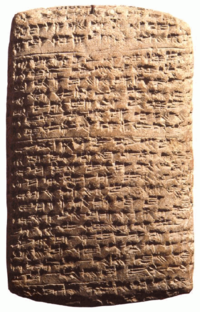
Semitic languages are attested in written form from a very early date, with texts in Eblaite
Eblaite language
Eblaite is an extinct Semitic language, which was spoken in the 3rd millennium BC in the ancient city of Ebla, at Tell Mardikh , between Aleppo and Hama, in western modern Syria....
and Akkadian
Akkadian language
Akkadian is an extinct Semitic language that was spoken in ancient Mesopotamia. The earliest attested Semitic language, it used the cuneiform writing system derived ultimately from ancient Sumerian, an unrelated language isolate...
appearing from around the middle of the third millennium BC, written in a script adapted from Sumerian
Sumerian language
Sumerian is the language of ancient Sumer, which was spoken in southern Mesopotamia since at least the 4th millennium BC. During the 3rd millennium BC, there developed a very intimate cultural symbiosis between the Sumerians and the Akkadians, which included widespread bilingualism...
cuneiform
Cuneiform script
Cuneiform script )) is one of the earliest known forms of written expression. Emerging in Sumer around the 30th century BC, with predecessors reaching into the late 4th millennium , cuneiform writing began as a system of pictographs...
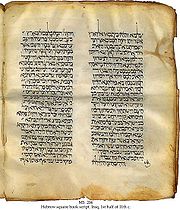
. However, most scripts used to write Semitic languages are abjad
Abjad
An abjad is a type of writing system in which each symbol always or usually stands for a consonant; the reader must supply the appropriate vowel....
s — a type of alphabet
Alphabet
An alphabet is a standard set of letters—basic written symbols or graphemes—each of which represents a phoneme in a spoken language, either as it exists now or as it was in the past. There are other systems, such as logographies, in which each character represents a word, morpheme, or semantic...
ic script that omits some or all of the vowels, which is feasible for these languages because the consonants in the Semitic languages are the primary carriers of meaning. Among them are the Ugaritic
Ugaritic alphabet
The Ugaritic script is a cuneiform abjad used from around 1400 BCE for Ugaritic, an extinct Northwest Semitic language, and discovered in Ugarit , Syria, in 1928. It has 30 letters...
, Phoenician
Phoenician alphabet
The Phoenician alphabet, called by convention the Proto-Canaanite alphabet for inscriptions older than around 1050 BC, was a non-pictographic consonantal alphabet, or abjad. It was used for the writing of Phoenician, a Northern Semitic language, used by the civilization of Phoenicia...
, Aramaic
Aramaic alphabet
The Aramaic alphabet is adapted from the Phoenician alphabet and became distinctive from it by the 8th century BC. The letters all represent consonants, some of which are matres lectionis, which also indicate long vowels....
, Hebrew
Hebrew alphabet
The Hebrew alphabet , known variously by scholars as the Jewish script, square script, block script, or more historically, the Assyrian script, is used in the writing of the Hebrew language, as well as other Jewish languages, most notably Yiddish, Ladino, and Judeo-Arabic. There have been two...
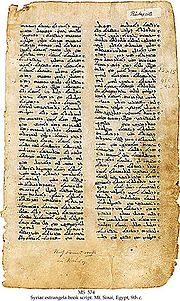
, Syriac
Syriac alphabet
The Syriac alphabet is a writing system primarily used to write the Syriac language from around the 2nd century BC . It is one of the Semitic abjads directly descending from the Aramaic alphabet and shares similarities with the Phoenician, Hebrew, Arabic, and the traditional Mongolian alphabets.-...
, Arabic
Arabic alphabet
The Arabic alphabet or Arabic abjad is the Arabic script as it is codified for writing the Arabic language. It is written from right to left, in a cursive style, and includes 28 letters. Because letters usually stand for consonants, it is classified as an abjad.-Consonants:The Arabic alphabet has...
, and South Arabian
South Arabian alphabet
The ancient Yemeni alphabet branched from the Proto-Sinaitic alphabet in about the 9th century BC. It was used for writing the Yemeni Old South Arabic languages of the Sabaean, Qatabanian, Hadramautic, Minaean, Himyarite, and proto-Ge'ez in Dʿmt...
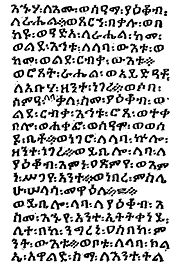
alphabets. The Ge'ez alphabet
Ge'ez alphabet
Ge'ez , also called Ethiopic, is a script used as an abugida for several languages of Ethiopia and Eritrea but originated in an abjad used to write Ge'ez, now the liturgical language of the Ethiopian and Eritrean Orthodox Church...
, used for writing the Semitic languages of Ethiopia
Ethiopia
Ethiopia , officially known as the Federal Democratic Republic of Ethiopia, is a country located in the Horn of Africa. It is the second-most populous nation in Africa, with over 82 million inhabitants, and the tenth-largest by area, occupying 1,100,000 km2...
and Eritrea
Eritrea
Eritrea , officially the State of Eritrea, is a country in the Horn of Africa. Eritrea derives it's name from the Greek word Erethria, meaning 'red land'. The capital is Asmara. It is bordered by Sudan in the west, Ethiopia in the south, and Djibouti in the southeast...
, is technically an abugida
Abugida
An abugida , also called an alphasyllabary, is a segmental writing system in which consonant–vowel sequences are written as a unit: each unit is based on a consonant letter, and vowel notation is obligatory but secondary...
— a modified abjad in which vowels are notated using diacritic
Diacritic
A diacritic is a glyph added to a letter, or basic glyph. The term derives from the Greek διακριτικός . Diacritic is both an adjective and a noun, whereas diacritical is only an adjective. Some diacritical marks, such as the acute and grave are often called accents...
marks added to the consonants. Maltese
Maltese language
Maltese is the national language of Malta, and a co-official language of the country alongside English,while also serving as an official language of the European Union, the only Semitic language so distinguished. Maltese is descended from Siculo-Arabic...
is the only Semitic language written in the Latin alphabet
Latin alphabet
The Latin alphabet, also called the Roman alphabet, is the most recognized alphabet used in the world today. It evolved from a western variety of the Greek alphabet called the Cumaean alphabet, which was adopted and modified by the Etruscans who ruled early Rome...
and the only official Semitic language of the European Union
European Union
The European Union is an economic and political union of 27 independent member states which are located primarily in Europe. The EU traces its origins from the European Coal and Steel Community and the European Economic Community , formed by six countries in 1958...
.
The Semitic languages are well-known for their nonconcatenative morphology
Nonconcatenative morphology
Nonconcatenative morphology, also called discontinuous morphology and introflection, is a form of word formation in which the root is modified and which does not involve stringing morphemes together...
. That is, word roots are not themselves syllables or words, but instead are isolated sets of consonants (usually three, making a so-called triliteral
Triliteral
The roots of verbs and most nouns in the Semitic languages are characterized as a sequence of consonants or "radicals"...
root). Words are composed out of roots not so much by adding prefixes or suffixes, but rather by filling in the vowels between the root consonants (although prefixes and suffixes are often added as well). For example, in Arabic
Arabic language
Arabic is a name applied to the descendants of the Classical Arabic language of the 6th century AD, used most prominently in the Quran, the Islamic Holy Book...
, the root meaning "write" has the form k – t – b. From this root, words are formed by filling in the vowels, e.g. kitāb "book", kutub "books", kātib "writer", kuttāb "writers", kataba "he wrote", yaktubu "he writes", etc.
Origins
Sahara pump theory
The Sahara pump theory is a hypothesis that explains how flora and fauna migrated between Eurasia and Africa via a Levantine land bridge. The theory observes that extended periods of abundant rainfall lasting many thousands of years in Africa are associated with a "wet Sahara" phase, during which...
, around the late Neolithic
Neolithic
The Neolithic Age, Era, or Period, or New Stone Age, was a period in the development of human technology, beginning about 9500 BC in some parts of the Middle East, and later in other parts of the world. It is traditionally considered as the last part of the Stone Age...
. Diakonoff sees Semitic originating between the Nile Delta and Canaan as the northernmost branch of Afroasiatic. Blench even wonders whether the highly divergent Gurage
Gurage
Gurage is an ethnic group in Ethiopia. According to the 2007 national census, its population is 1,867,377 people , of whom 792,659 are urban dwellers. This is 2.53% of the total population of Ethiopia, or 7.52% of the Southern Nations, Nationalities, and People's Region...
indicate an origin in Ethiopia (with the rest of Ethiopic Semitic a later back migration). However, an opposing theory is that Afroasiatic originated in the Middle East, and that Semitic is the only branch to have stayed put; this view is supported by apparent Sumerian
Sumerian language
Sumerian is the language of ancient Sumer, which was spoken in southern Mesopotamia since at least the 4th millennium BC. During the 3rd millennium BC, there developed a very intimate cultural symbiosis between the Sumerians and the Akkadians, which included widespread bilingualism...
and Caucasian
Languages of the Caucasus
The languages of the Caucasus are a large and extremely varied array of languages spoken by more than ten million people in and around the Caucasus Mountains, which lie between the Black Sea and the Caspian Sea....
loanword
Loanword
A loanword is a word borrowed from a donor language and incorporated into a recipient language. By contrast, a calque or loan translation is a related concept where the meaning or idiom is borrowed rather than the lexical item itself. The word loanword is itself a calque of the German Lehnwort,...
s in the African branches of Afroasiatic. A recent Bayesian
Bayesian probability
Bayesian probability is one of the different interpretations of the concept of probability and belongs to the category of evidential probabilities. The Bayesian interpretation of probability can be seen as an extension of logic that enables reasoning with propositions, whose truth or falsity is...
analysis of alternative Semitic histories supports the latter possibility and identifies an origin of Semitic languages in the Levant
Levant
The Levant or ) is the geographic region and culture zone of the "eastern Mediterranean littoral between Anatolia and Egypt" . The Levant includes most of modern Lebanon, Syria, Jordan, Israel, the Palestinian territories, and sometimes parts of Turkey and Iraq, and corresponds roughly to the...
around 3,750 BC with a single introduction from southern Arabia into Africa around 800 BC.
In one interpretation, Proto-Semitic
Proto-Semitic language
Proto-Semitic is the hypothetical proto-language ancestral to historical Semitic languages of the Middle East. Locations which have been proposed for its origination include northern Mesopotamia, the Arabian Peninsula, and the Levant with a 2009 study proposing that it may have originated around...
itself is assumed to have reached the Arabian Peninsula
Arabian Peninsula
The Arabian Peninsula is a land mass situated north-east of Africa. Also known as Arabia or the Arabian subcontinent, it is the world's largest peninsula and covers 3,237,500 km2...
by approximately the 4th millennium BC
4th millennium BC
The 4th millennium BC saw major changes in human culture. It marked the beginning of the Bronze Age and of writing.The city states of Sumer and the kingdom of Egypt were established and grew to prominence. Agriculture spread widely across Eurasia...
, from which Semitic daughter languages continued to spread outwards. When written records began in the mid 3rd millennium BC
3rd millennium BC
The 3rd millennium BC spans the Early to Middle Bronze Age.It represents a period of time in which imperialism, or the desire to conquer, grew to prominence, in the city states of the Middle East, but also throughout Eurasia, with Indo-European expansion to Anatolia, Europe and Central Asia. The...
, the Semitic-speaking Akkadians and Amorite
Amorite
Amorite refers to an ancient Semitic people who occupied large parts of Mesopotamia from the 21st Century BC...
s were entering Mesopotamia
Mesopotamia
Mesopotamia is a toponym for the area of the Tigris–Euphrates river system, largely corresponding to modern-day Iraq, northeastern Syria, southeastern Turkey and southwestern Iran.Widely considered to be the cradle of civilization, Bronze Age Mesopotamia included Sumer and the...
from the deserts to the west, and were probably already present in places such as Ebla
Ebla
Ebla Idlib Governorate, Syria) was an ancient city about southwest of Aleppo. It was an important city-state in two periods, first in the late third millennium BC, then again between 1800 and 1650 BC....
in Syria.
2nd millennium BC
By the beginning of the 2nd millennium BC2nd millennium BC
The 2nd millennium BC marks the transition from the Middle to the Late Bronze Age.Its first half is dominated by the Middle Kingdom of Egypt and Babylonia. The alphabet develops. Indo-Iranian migration onto the Iranian plateau and onto the Indian subcontinent propagates the use of the chariot...
, East Semitic languages dominated in Mesopotamia, while West Semitic languages were probably spoken from Syria to Yemen
Yemen
The Republic of Yemen , commonly known as Yemen , is a country located in the Middle East, occupying the southwestern to southern end of the Arabian Peninsula. It is bordered by Saudi Arabia to the north, the Red Sea to the west, and Oman to the east....
, although Old South Arabian is considered by most to be South Semitic and data are sparse. Akkadian
Akkadian language
Akkadian is an extinct Semitic language that was spoken in ancient Mesopotamia. The earliest attested Semitic language, it used the cuneiform writing system derived ultimately from ancient Sumerian, an unrelated language isolate...
had become the dominant literary language of the Fertile Crescent
Fertile Crescent
The Fertile Crescent, nicknamed "The Cradle of Civilization" for the fact the first civilizations started there, is a crescent-shaped region containing the comparatively moist and fertile land of otherwise arid and semi-arid Western Asia. The term was first used by University of Chicago...
, using the cuneiform script
Cuneiform script
Cuneiform script )) is one of the earliest known forms of written expression. Emerging in Sumer around the 30th century BC, with predecessors reaching into the late 4th millennium , cuneiform writing began as a system of pictographs...
which was adapted from the Sumer
Sumer
Sumer was a civilization and historical region in southern Mesopotamia, modern Iraq during the Chalcolithic and Early Bronze Age....
ians, while the sparsely attested Eblaite
Eblaite language
Eblaite is an extinct Semitic language, which was spoken in the 3rd millennium BC in the ancient city of Ebla, at Tell Mardikh , between Aleppo and Hama, in western modern Syria....
disappeared with the city, and Amorite
Amorite language
Amorite is an early Northwest Semitic language, spoken by the Amorite tribes prominent in early Near Eastern history. It is known exclusively from non-Akkadian proper names recorded by Akkadian scribes during periods of Amorite rule in Babylonia , notably from Mari, and to a lesser extent Alalakh,...
is attested only from proper names.
For the 2nd millennium, somewhat more data are available, thanks to the spread of an invention first used to capture the sounds of Semitic languages — the alphabet
Alphabet
An alphabet is a standard set of letters—basic written symbols or graphemes—each of which represents a phoneme in a spoken language, either as it exists now or as it was in the past. There are other systems, such as logographies, in which each character represents a word, morpheme, or semantic...
. Proto-Canaanite
Proto-Canaanite alphabet
Proto-Canaanite is the name given to the Proto-Sinaitic script when found in Canaan. the early Phoenician script before some cut-off date, typically 1050 BCE. The Phoenician, Hebrew, and other Canaanite dialects were largely indistinguishable before that time...
texts from around 1500 BC yield the first undisputed attestations of a West Semitic language (although earlier testimonies are possibly preserved in Middle Bronze Age alphabets
Middle Bronze Age alphabets
Proto-Sinaitic is a Middle Bronze Age script attested in a very small collection of inscriptions at Serabit el-Khadim in the Sinai Peninsula. Due to the extreme scarcity of Proto-Sinaitic signs, very little is known with certainty about the nature of the script...
), followed by the much more extensive Ugaritic
Ugaritic language
The following table shows Proto-Semitic phonemes and their correspondences among Ugaritic, Arabic and Tiberian Hebrew:-Grammar:Ugaritic is an inflected language, and as a Semitic language its grammatical features are highly similar to those found in Classical Arabic and Akkadian...
tablets of northern Syria from around 1300 BC. Incursions of nomadic Aramaeans
Aramaeans
The Aramaeans, also Arameans , were a Northwest Semitic semi-nomadic and pastoralist people who originated in what is now modern Syria during the Late Bronze Age and the Iron Age...
from the Syrian desert begin around this time. Akkadian continued to flourish, splitting into Babylonia
Babylonia
Babylonia was an ancient cultural region in central-southern Mesopotamia , with Babylon as its capital. Babylonia emerged as a major power when Hammurabi Babylonia was an ancient cultural region in central-southern Mesopotamia (present-day Iraq), with Babylon as its capital. Babylonia emerged as...
n and Assyria
Assyria
Assyria was a Semitic Akkadian kingdom, extant as a nation state from the mid–23rd century BC to 608 BC centred on the Upper Tigris river, in northern Mesopotamia , that came to rule regional empires a number of times through history. It was named for its original capital, the ancient city of Assur...
n dialects.
1st millennium BC
1st millennium BC
The 1st millennium BC encompasses the Iron Age and sees the rise of many successive empires, and spanned from 1000 BC to 1 BC.The Neo-Assyrian Empire, followed by the Achaemenids. In Greece, Classical Antiquity begins with the colonization of Magna Graecia and peaks with the rise of Hellenism. The...
, the alphabet spread much further, giving us a picture not just of Canaanite
Canaanite languages
The Canaanite languages are a subfamily of the Semitic languages, which were spoken by the ancient peoples of the Canaan region, including Canaanites, Israelites and Phoenicians...
but also of Aramaic
Aramaic language
Aramaic is a group of languages belonging to the Afroasiatic language phylum. The name of the language is based on the name of Aram, an ancient region in central Syria. Within this family, Aramaic belongs to the Semitic family, and more specifically, is a part of the Northwest Semitic subfamily,...
, Old South Arabian
South Arabian alphabet
The ancient Yemeni alphabet branched from the Proto-Sinaitic alphabet in about the 9th century BC. It was used for writing the Yemeni Old South Arabic languages of the Sabaean, Qatabanian, Hadramautic, Minaean, Himyarite, and proto-Ge'ez in Dʿmt...
, and early Ge'ez
Ge'ez language
Ge'ez is an ancient South Semitic language that developed in the northern region of Ethiopia and southern Eritrea in the Horn of Africa...
. During this period, the case system, once vigorous in Ugaritic
Ugaritic language
The following table shows Proto-Semitic phonemes and their correspondences among Ugaritic, Arabic and Tiberian Hebrew:-Grammar:Ugaritic is an inflected language, and as a Semitic language its grammatical features are highly similar to those found in Classical Arabic and Akkadian...
, seems to have started decaying in Northwest Semitic. Phoenician colonies spread their Canaanite language throughout much of the Mediterranean, while its close relative Hebrew
Hebrew language
Hebrew is a Semitic language of the Afroasiatic language family. Culturally, is it considered by Jews and other religious groups as the language of the Jewish people, though other Jewish languages had originated among diaspora Jews, and the Hebrew language is also used by non-Jewish groups, such...
became the vehicle of a religious literature, the Torah
Torah
Torah- A scroll containing the first five books of the BibleThe Torah , is name given by Jews to the first five books of the bible—Genesis , Exodus , Leviticus , Numbers and Deuteronomy Torah- A scroll containing the first five books of the BibleThe Torah , is name given by Jews to the first five...
and Tanakh
Tanakh
The Tanakh is a name used in Judaism for the canon of the Hebrew Bible. The Tanakh is also known as the Masoretic Text or the Miqra. The name is an acronym formed from the initial Hebrew letters of the Masoretic Text's three traditional subdivisions: The Torah , Nevi'im and Ketuvim —hence...
, that would have global ramifications. However, as an ironic result of the Assyria
Assyria
Assyria was a Semitic Akkadian kingdom, extant as a nation state from the mid–23rd century BC to 608 BC centred on the Upper Tigris river, in northern Mesopotamia , that came to rule regional empires a number of times through history. It was named for its original capital, the ancient city of Assur...
n Empire's conquests, Aramaic
Aramaic language
Aramaic is a group of languages belonging to the Afroasiatic language phylum. The name of the language is based on the name of Aram, an ancient region in central Syria. Within this family, Aramaic belongs to the Semitic family, and more specifically, is a part of the Northwest Semitic subfamily,...
became the lingua franca
Lingua franca
A lingua franca is a language systematically used to make communication possible between people not sharing a mother tongue, in particular when it is a third language, distinct from both mother tongues.-Characteristics:"Lingua franca" is a functionally defined term, independent of the linguistic...
of the Fertile Crescent, gradually pushing Akkadian, Hebrew, Phoenician, and several other languages to extinction (although Hebrew remained in use as a liturgical language
Sacred language
A sacred language, "holy language" , or liturgical language, is a language that is cultivated for religious reasons by people who speak another language in their daily life.-Concept:...
), and developing a substantial literature. Meanwhile, Ge'ez
Ge'ez language
Ge'ez is an ancient South Semitic language that developed in the northern region of Ethiopia and southern Eritrea in the Horn of Africa...
texts beginning in this era give the first direct record of Ethiopian Semitic
Ethiopian Semitic languages
Ethiopian Semitic is a language group, which together with Old South Arabian forms the Western branch of the South Semitic languages. The languages are spoken in both Ethiopia and Eritrea...
.
Common Era / AD
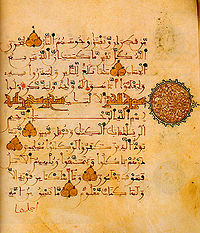
Syriac language
Syriac is a dialect of Middle Aramaic that was once spoken across much of the Fertile Crescent. Having first appeared as a script in the 1st century AD after being spoken as an unwritten language for five centuries, Classical Syriac became a major literary language throughout the Middle East from...
, a descendant of Aramaic
Aramaic language
Aramaic is a group of languages belonging to the Afroasiatic language phylum. The name of the language is based on the name of Aram, an ancient region in central Syria. Within this family, Aramaic belongs to the Semitic family, and more specifically, is a part of the Northwest Semitic subfamily,...
used in the northern Levant
Levant
The Levant or ) is the geographic region and culture zone of the "eastern Mediterranean littoral between Anatolia and Egypt" . The Levant includes most of modern Lebanon, Syria, Jordan, Israel, the Palestinian territories, and sometimes parts of Turkey and Iraq, and corresponds roughly to the...
and Mesopotamia
Mesopotamia
Mesopotamia is a toponym for the area of the Tigris–Euphrates river system, largely corresponding to modern-day Iraq, northeastern Syria, southeastern Turkey and southwestern Iran.Widely considered to be the cradle of civilization, Bronze Age Mesopotamia included Sumer and the...
, rose to importance as a literary language of early Christianity
Christianity
Christianity is a monotheistic religion based on the life and teachings of Jesus as presented in canonical gospels and other New Testament writings...
in the 3rd to 5th centuries and continued into the early Islam
Islam
Islam . The most common are and . : Arabic pronunciation varies regionally. The first vowel ranges from ~~. The second vowel ranges from ~~~...
ic era.
With the emergence of Islam
Islam
Islam . The most common are and . : Arabic pronunciation varies regionally. The first vowel ranges from ~~. The second vowel ranges from ~~~...
in the 7th century, the ascendancy of Aramaic was dealt a fatal blow by the Arab
Arab
Arab people, also known as Arabs , are a panethnicity primarily living in the Arab world, which is located in Western Asia and North Africa. They are identified as such on one or more of genealogical, linguistic, or cultural grounds, with tribal affiliations, and intra-tribal relationships playing...
conquests, which made another Semitic language — Arabic
Arabic language
Arabic is a name applied to the descendants of the Classical Arabic language of the 6th century AD, used most prominently in the Quran, the Islamic Holy Book...
— the official language of an empire stretching from Spain
Spain
Spain , officially the Kingdom of Spain languages]] under the European Charter for Regional or Minority Languages. In each of these, Spain's official name is as follows:;;;;;;), is a country and member state of the European Union located in southwestern Europe on the Iberian Peninsula...
to Central Asia
Central Asia
Central Asia is a core region of the Asian continent from the Caspian Sea in the west, China in the east, Afghanistan in the south, and Russia in the north...
.
With the patronage of the caliph
Caliph
The Caliph is the head of state in a Caliphate, and the title for the ruler of the Islamic Ummah, an Islamic community ruled by the Shari'ah. It is a transcribed version of the Arabic word which means "successor" or "representative"...
s and the prestige of its liturgical
Sacred language
A sacred language, "holy language" , or liturgical language, is a language that is cultivated for religious reasons by people who speak another language in their daily life.-Concept:...
status, it rapidly became one of the world's main literary languages. Its spread among the masses took much longer; however, as the native populations outside the Arabian Peninsula
Arabian Peninsula
The Arabian Peninsula is a land mass situated north-east of Africa. Also known as Arabia or the Arabian subcontinent, it is the world's largest peninsula and covers 3,237,500 km2...
gradually abandoned their languages in favor of Arabic. As Bedouin
Bedouin
The Bedouin are a part of a predominantly desert-dwelling Arab ethnic group traditionally divided into tribes or clans, known in Arabic as ..-Etymology:...
tribes settled in conquered areas, it became the main language of not only central Arabia, but also Yemen, the Fertile Crescent, and Egypt. Most of the Maghreb
Maghreb
The Maghreb is the region of Northwest Africa, west of Egypt. It includes five countries: Morocco, Algeria, Tunisia, Libya, and Mauritania and the disputed territory of Western Sahara...
(Northwest Africa) followed, particularly in the wake of the Banu Hilal
Banu Hilal
The Banu Hilal were a confederation of Arabian Bedouin tribes that migrated from Upper Egypt into North Africa in the 11th century, having been sent by the Fatimids to punish the Zirids for abandoning Shiism. Other authors suggest that the tribes left the grasslands on the upper Nile because of...
's incursion in the 11th century, and Arabic became the native language of many inhabitants of Spain
Al-Andalus
Al-Andalus was the Arabic name given to a nation and territorial region also commonly referred to as Moorish Iberia. The name describes parts of the Iberian Peninsula and Septimania governed by Muslims , at various times in the period between 711 and 1492, although the territorial boundaries...
. After the collapse of the Nubia
Nubia
Nubia is a region along the Nile river, which is located in northern Sudan and southern Egypt.There were a number of small Nubian kingdoms throughout the Middle Ages, the last of which collapsed in 1504, when Nubia became divided between Egypt and the Sennar sultanate resulting in the Arabization...
n kingdom of Dongola
Dongola
Dongola , also spelled Dunqulah, and formerly known as Al 'Urdi, is the capital of the state of Northern in Sudan, on the banks of the Nile. It should not be confused with Old Dongola, an ancient city located 80 km upstream on the opposite bank....
in the 14th century, Arabic began to spread south of Egypt; soon after, the Beni Ḥassān
Beni Hassan
Beni Ḥassān were a nomadic group of Arabian origin, one of the four sub-tribes of the Maqil Arabian tribes who emigrated in the 11th century to the Maghreb with the Bani Hilal and Banu Sulaym Arabs.. They originally lived with their Maqil relatives in the area between Tadla, Moulouiya River...
brought Arabization
Arabization
Arabization or Arabisation describes a growing cultural influence on a non-Arab area that gradually changes into one that speaks Arabic and/or incorporates Arab culture...
to Mauritania
Mauritania
Mauritania is a country in the Maghreb and West Africa. It is bordered by the Atlantic Ocean in the west, by Western Sahara in the north, by Algeria in the northeast, by Mali in the east and southeast, and by Senegal in the southwest...
.
Meanwhile, Semitic languages were diversifying in Ethiopia
Ethiopia
Ethiopia , officially known as the Federal Democratic Republic of Ethiopia, is a country located in the Horn of Africa. It is the second-most populous nation in Africa, with over 82 million inhabitants, and the tenth-largest by area, occupying 1,100,000 km2...
and Eritrea
Eritrea
Eritrea , officially the State of Eritrea, is a country in the Horn of Africa. Eritrea derives it's name from the Greek word Erethria, meaning 'red land'. The capital is Asmara. It is bordered by Sudan in the west, Ethiopia in the south, and Djibouti in the southeast...
, where, under heavy Cushitic
Cushitic languages
The Cushitic languages are a branch of the Afroasiatic language family spoken in the Horn of Africa, Tanzania, Kenya, Sudan and Egypt. They are named after the Biblical character Cush, who was identified as an ancestor of the speakers of these specific languages as early as AD 947...
influence, they split into a number of languages, including Amharic and Tigrinya
Tigrinya language
Tigrinya , also spelled Tigrigna, Tigrnia, Tigrina, Tigriña, less commonly Tigrinian, Tigrinyan, is a Semitic language spoken by the Tigrinya people in central Eritrea , where it is one of the two main languages of Eritrea, and in the Tigray Region of Ethiopia , where it...
. With the expansion of Ethiopia
Ethiopia
Ethiopia , officially known as the Federal Democratic Republic of Ethiopia, is a country located in the Horn of Africa. It is the second-most populous nation in Africa, with over 82 million inhabitants, and the tenth-largest by area, occupying 1,100,000 km2...
under the Solomonic dynasty
Solomonic dynasty
The Solomonic dynasty is the Imperial House of Abyssinia. Its members claim lineal descent from King Solomon and the Queen of Sheba, the latter of whom tradition asserts gave birth to the first King Menelik I after her Biblically described visit to Solomon in Jerusalem .-Overview:The dynasty, a...
, Amharic, previously a minor local language, spread throughout much of the country, replacing languages both Semitic (such as Gafat
Gafat language
The Gafat language is an extinct Semitic language that was once spoken along the Abbay River in Ethiopia. The records of this language are extremely sparse. There is a translation of the Song of Songs written in the 17th or 18th Century held at the Bodleian Library...
) and non-Semitic (such as Weyto
Weyto language
The Weyto language is believed to be an extinct language formerly spoken in the Lake Tana region of Ethiopia by the Weyto, a small group of hippopotamus hunters who now speak Amharic....
), and replacing Ge'ez
Ge'ez language
Ge'ez is an ancient South Semitic language that developed in the northern region of Ethiopia and southern Eritrea in the Horn of Africa...
as the principal literary language (though Ge'ez remains the liturgical language for Christians in the region); this spread continues to this day, with Qimant
Qimant language
The Qimant language is a highly endangered language spoken by a small and elderly fraction of the Qemant people in Northern Ethiopia mainly in Chilga Woreda in Semien Gondar Zone between Gondar and Metemma.-Classification:...
set to disappear in another generation.
Present situation
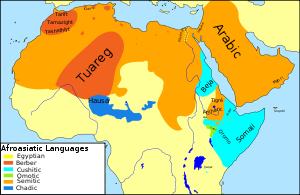
Mauritania
Mauritania is a country in the Maghreb and West Africa. It is bordered by the Atlantic Ocean in the west, by Western Sahara in the north, by Algeria in the northeast, by Mali in the east and southeast, and by Senegal in the southwest...
to Oman
Oman
Oman , officially called the Sultanate of Oman , is an Arab state in southwest Asia on the southeast coast of the Arabian Peninsula. It is bordered by the United Arab Emirates to the northwest, Saudi Arabia to the west, and Yemen to the southwest. The coast is formed by the Arabian Sea on the...
, and from Iraq
Iraq
Iraq ; officially the Republic of Iraq is a country in Western Asia spanning most of the northwestern end of the Zagros mountain range, the eastern part of the Syrian Desert and the northern part of the Arabian Desert....
to the Sudan
Sudan
Sudan , officially the Republic of the Sudan , is a country in North Africa, sometimes considered part of the Middle East politically. It is bordered by Egypt to the north, the Red Sea to the northeast, Eritrea and Ethiopia to the east, South Sudan to the south, the Central African Republic to the...
. As the language of the Qur'an
Qur'an
The Quran , also transliterated Qur'an, Koran, Alcoran, Qur’ān, Coran, Kuran, and al-Qur’ān, is the central religious text of Islam, which Muslims consider the verbatim word of God . It is regarded widely as the finest piece of literature in the Arabic language...
and as a lingua franca
Lingua franca
A lingua franca is a language systematically used to make communication possible between people not sharing a mother tongue, in particular when it is a third language, distinct from both mother tongues.-Characteristics:"Lingua franca" is a functionally defined term, independent of the linguistic...
, it is studied widely in the non-Arabic-speaking Muslim world
Muslim world
The term Muslim world has several meanings. In a religious sense, it refers to those who adhere to the teachings of Islam, referred to as Muslims. In a cultural sense, it refers to Islamic civilization, inclusive of non-Muslims living in that civilization...
as well. Its spoken form is divided into a number of varieties
Varieties of Arabic
The Arabic language is a Semitic language characterized by a wide number of linguistic varieties within its five regional forms. The largest divisions occur between the spoken languages of different regions. The Arabic of North Africa, for example, is often incomprehensible to an Arabic speaker...
, some not mutually comprehensible, united by a single written form. The principal exception to this almost universal use of Arabic script is the Maltese language
Maltese language
Maltese is the national language of Malta, and a co-official language of the country alongside English,while also serving as an official language of the European Union, the only Semitic language so distinguished. Maltese is descended from Siculo-Arabic...
, genetically a descendant of the extinct Sicilian Arabic dialect. The Maltese alphabet
Maltese alphabet
The Maltese alphabet is based on the Latin alphabet with the addition of some letters with diacritic marks and digraphs. It is used to write the Maltese language. It contains 30 letters: - Las muestras :...
is based on the Roman alphabet with the addition of some letters with diacritic
Diacritic
A diacritic is a glyph added to a letter, or basic glyph. The term derives from the Greek διακριτικός . Diacritic is both an adjective and a noun, whereas diacritical is only an adjective. Some diacritical marks, such as the acute and grave are often called accents...
marks and digraphs
Digraph (orthography)
A digraph or digram is a pair of characters used to write one phoneme or a sequence of phonemes that does not correspond to the normal values of the two characters combined...
. Maltese is the only Semitic official language within the European Union
European Union
The European Union is an economic and political union of 27 independent member states which are located primarily in Europe. The EU traces its origins from the European Coal and Steel Community and the European Economic Community , formed by six countries in 1958...
.
Despite the ascendancy of Arabic in the Middle East, other Semitic languages still exist. Hebrew, long extinct as a colloquial language and in use only in Jewish literary, intellectual, and liturgical activity, was revived in spoken form at the end of the 19th century by the Jewish linguist
Linguistics
Linguistics is the scientific study of human language. Linguistics can be broadly broken into three categories or subfields of study: language form, language meaning, and language in context....
Eliezer Ben-Yehuda
Eliezer Ben-Yehuda
Eliezer Ben‑Yehuda was a Jewish lexicographer and newspaper editor. He was the driving spirit behind the revival of the Hebrew language in the modern era.-Biography:...
. It has become the main language of Israel
Israel
The State of Israel is a parliamentary republic located in the Middle East, along the eastern shore of the Mediterranean Sea...
, while remaining the language of liturgy and religious scholarship
Study of the Hebrew language
Study of the Hebrew language has an ancient history. Since Hebrew is the original language of the Hebrew Bible , it is therefore a language that has always been central to Judaism and valued by the Jewish people for over three thousand years and later by Christian scholars as well.-Jewish scholars...
of Jews worldwide.
Several small ethnic groups, in particular the Assyrians
Assyrian people
The Assyrian people are a distinct ethnic group whose origins lie in ancient Mesopotamia...
and Mandeans, continue to speak and write Aramaic
Aramaic language
Aramaic is a group of languages belonging to the Afroasiatic language phylum. The name of the language is based on the name of Aram, an ancient region in central Syria. Within this family, Aramaic belongs to the Semitic family, and more specifically, is a part of the Northwest Semitic subfamily,...
dialects (especially Neo-Aramaic
Neo-Aramaic languages
Neo-Aramaic, or Modern Aramaic, languages are varieties of Aramaic that are spoken vernaculars in the medieval to modern era, evolving out of Middle Aramaic dialects around AD 1200 ....
, descended from Syriac
Syriac language
Syriac is a dialect of Middle Aramaic that was once spoken across much of the Fertile Crescent. Having first appeared as a script in the 1st century AD after being spoken as an unwritten language for five centuries, Classical Syriac became a major literary language throughout the Middle East from...
) in northern Iraq
Iraq
Iraq ; officially the Republic of Iraq is a country in Western Asia spanning most of the northwestern end of the Zagros mountain range, the eastern part of the Syrian Desert and the northern part of the Arabian Desert....
, south eastern Turkey
Turkey
Turkey , known officially as the Republic of Turkey , is a Eurasian country located in Western Asia and in East Thrace in Southeastern Europe...
, northwestern Iran
Iran
Iran , officially the Islamic Republic of Iran , is a country in Southern and Western Asia. The name "Iran" has been in use natively since the Sassanian era and came into use internationally in 1935, before which the country was known to the Western world as Persia...
, and northeast Syria
Syria
Syria , officially the Syrian Arab Republic , is a country in Western Asia, bordering Lebanon and the Mediterranean Sea to the West, Turkey to the north, Iraq to the east, Jordan to the south, and Israel to the southwest....
, while Syriac
Syriac language
Syriac is a dialect of Middle Aramaic that was once spoken across much of the Fertile Crescent. Having first appeared as a script in the 1st century AD after being spoken as an unwritten language for five centuries, Classical Syriac became a major literary language throughout the Middle East from...
itself, a descendant of Old Aramaic, is used liturgically by Lebanese
Christianity in Lebanon
Christianity in Lebanon has a long and continuous history beginning with the visits of Jesus to the southern territories, where he is said to have performed many miraculous healings. Biblical Scriptures reveal that Peter and Paul evangelized the Phoenicians, whom they affiliated to the ancient...
(the Maronites
Maronites
Maronites , is an ethnoreligious group in the Middle East that have been historically tied with Lebanon. They derive their name from the Syriac saint Mar Maron whose followers moved to Mount Lebanon from northern Syria establishing the Maronite Church....
), Syrian
Christianity in Syria
Christians in Syria make up about 10% of the population, the largest Christian denomination is the Greek Orthodox Church of Antioch, closely followed by the Melkite Greek Catholic Church, and then the Syriac Orthodox Church; there are also a minority of Protestants...
and Assyrian Christians.
In Arabic-dominated Yemen
Yemen
The Republic of Yemen , commonly known as Yemen , is a country located in the Middle East, occupying the southwestern to southern end of the Arabian Peninsula. It is bordered by Saudi Arabia to the north, the Red Sea to the west, and Oman to the east....
and Oman
Oman
Oman , officially called the Sultanate of Oman , is an Arab state in southwest Asia on the southeast coast of the Arabian Peninsula. It is bordered by the United Arab Emirates to the northwest, Saudi Arabia to the west, and Yemen to the southwest. The coast is formed by the Arabian Sea on the...
, on the southern rim of the Arabian Peninsula
Arabian Peninsula
The Arabian Peninsula is a land mass situated north-east of Africa. Also known as Arabia or the Arabian subcontinent, it is the world's largest peninsula and covers 3,237,500 km2...
, a few tribes continue to speak Modern South Arabian languages such as Mahri
Mehri language
Mehri or Mahri is a Modern South Arabian language, a branch of the greater Semitic language family, and is spoken by minority populations in isolated areas of the eastern part of Yemen and western Oman. It is a remnant of the ancient indigenous language group spoken in the southern Arabian...
and Soqotri
Soqotri language
Soqotri, or Socotri, is the language of the native population of the island of Socotra, and Abd al Kuri and Samhah islands of the Socotra archipelago off the southern coast of the Republic of Yemen...
. These languages differ greatly from both the surrounding Arabic dialects and from the (unrelated but previously thought to be related) languages of the Old South Arabian
Old South Arabian
Old South Arabian is the term used to describe four extinct, closely related languages spoken in the far southern portion of the Arabian Peninsula. There were a number of other Sayhadic languages , of which very little evidence survived, however...
inscriptions.
Historically linked to the peninsular homeland of the Old South Arabian
Old South Arabian
Old South Arabian is the term used to describe four extinct, closely related languages spoken in the far southern portion of the Arabian Peninsula. There were a number of other Sayhadic languages , of which very little evidence survived, however...
languages, Ethiopia
Ethiopia
Ethiopia , officially known as the Federal Democratic Republic of Ethiopia, is a country located in the Horn of Africa. It is the second-most populous nation in Africa, with over 82 million inhabitants, and the tenth-largest by area, occupying 1,100,000 km2...
and Eritrea
Eritrea
Eritrea , officially the State of Eritrea, is a country in the Horn of Africa. Eritrea derives it's name from the Greek word Erethria, meaning 'red land'. The capital is Asmara. It is bordered by Sudan in the west, Ethiopia in the south, and Djibouti in the southeast...
contain a substantial number of Semitic languages
Ethiopian Semitic languages
Ethiopian Semitic is a language group, which together with Old South Arabian forms the Western branch of the South Semitic languages. The languages are spoken in both Ethiopia and Eritrea...
; the most widely spoken are Amharic in Ethiopia, Tigre
Tigre language
For other uses please see Tigre Tigre is a Semitic language, which, along with Tigrinya, is believed to be one of direct descendants of the extinct Ge'ez language...
in Eritrea, and Tigrinya
Tigrinya language
Tigrinya , also spelled Tigrigna, Tigrnia, Tigrina, Tigriña, less commonly Tigrinian, Tigrinyan, is a Semitic language spoken by the Tigrinya people in central Eritrea , where it is one of the two main languages of Eritrea, and in the Tigray Region of Ethiopia , where it...
in both. Respectively, Amharic and Tigrinya are official languages of Ethiopia and Eritrea. Tigre is spoken by over one million people in the northern and central Eritrean lowlands and parts of eastern Sudan. A number of Gurage
Gurage
Gurage is an ethnic group in Ethiopia. According to the 2007 national census, its population is 1,867,377 people , of whom 792,659 are urban dwellers. This is 2.53% of the total population of Ethiopia, or 7.52% of the Southern Nations, Nationalities, and People's Region...
languages are spoken by populations in the semi-mountainous region of southwest Ethiopia, while Harari is restricted to the city of Harar
Harar
Harar is an eastern city in Ethiopia, and the capital of the modern Harari ethno-political division of Ethiopia...
. Ge'ez
Ge'ez language
Ge'ez is an ancient South Semitic language that developed in the northern region of Ethiopia and southern Eritrea in the Horn of Africa...
remains the liturgical language
Sacred language
A sacred language, "holy language" , or liturgical language, is a language that is cultivated for religious reasons by people who speak another language in their daily life.-Concept:...
for certain groups of Christians in Ethiopia
Christianity in Ethiopia
Christianity in Ethiopia dates to the first century AD, and this long tradition makes Ethiopia unique amongst sub-Saharan African countries. Christianity in this country is divided into several groups...
and in Eritrea
Christianity in Eritrea
Eritrea is a multi-religious country; Eritrea has two dominant religions, Christianity and Islam, with approximately 50% of the population being Christian and 50% Muslim according to the United Nations High Commissioner for Refugees...
.
Phonology
The reconstruction of Proto-Semitic (PS) was originally based primarily on the Arabic languageArabic language
Arabic is a name applied to the descendants of the Classical Arabic language of the 6th century AD, used most prominently in the Quran, the Islamic Holy Book...
, whose phonology and morphology (particularly in Classical Arabic
Classical Arabic
Classical Arabic , also known as Qur'anic or Koranic Arabic, is the form of the Arabic language used in literary texts from Umayyad and Abbasid times . It is based on the Medieval dialects of Arab tribes...
) is extremely conservative, and which preserves 28 out of the evident 29 consonantal phonemes. Thus, the phonemic inventory of reconstructed Proto-Semitic is very similar to that of Arabic, with only one phoneme less in Arabic than in reconstructed Proto-Semitic.
As such, Proto-Semitic is generally reconstructed as having the following phoneme
Phoneme
In a language or dialect, a phoneme is the smallest segmental unit of sound employed to form meaningful contrasts between utterances....
s (as usually transcribed in Semitology):
Inventory
| Labial Labial consonant Labial consonants are consonants in which one or both lips are the active articulator. This precludes linguolabials, in which the tip of the tongue reaches for the posterior side of the upper lip and which are considered coronals... |
Inter- dental Interdental consonant Interdental consonants are produced by placing the blade of the tongue against the upper incisors... |
Dental/ Alveolar Alveolar consonant Alveolar consonants are articulated with the tongue against or close to the superior alveolar ridge, which is called that because it contains the alveoli of the superior teeth... |
Palatal Palatal consonant Palatal consonants are consonants articulated with the body of the tongue raised against the hard palate... |
Velar Velar consonant Velars are consonants articulated with the back part of the tongue against the soft palate, the back part of the roof of the mouth, known also as the velum).... |
Pharyn- geal Pharyngeal consonant A pharyngeal consonant is a type of consonant which is articulated with the root of the tongue against the pharynx.-Pharyngeal consonants in the IPA:Pharyngeal consonants in the International Phonetic Alphabet :... |
Glottal Glottal consonant Glottal consonants, also called laryngeal consonants, are consonants articulated with the glottis. Many phoneticians consider them, or at least the so-called fricative, to be transitional states of the glottis without a point of articulation as other consonants have; in fact, some do not consider... |
|||
|---|---|---|---|---|---|---|---|---|---|
| Central Central consonant A central or medial consonant is a consonant sound that is produced when air flows across the center of the mouth over the tongue. The class contrasts with lateral consonants, in which air flows over the sides of the tongue rather than down its center.... |
Lateral Lateral consonant A lateral is an el-like consonant, in which airstream proceeds along the sides of the tongue, but is blocked by the tongue from going through the middle of the mouth.... |
||||||||
| Nasal Nasal consonant A nasal consonant is a type of consonant produced with a lowered velum in the mouth, allowing air to escape freely through the nose. Examples of nasal consonants in English are and , in words such as nose and mouth.- Definition :... |
*m [m] | *n [n] | |||||||
| Stop Stop consonant In phonetics, a plosive, also known as an occlusive or an oral stop, is a stop consonant in which the vocal tract is blocked so that all airflow ceases. The occlusion may be done with the tongue , lips , and &... |
voiceless | *p [p] | *t [t] | *k [k] | [ʔ] | ||||
| voiced | *b [b] | *d [d] | *g [ɡ] | ||||||
| emphatic | [tʼ] | *q [kʼ] | |||||||
| Fricative Fricative consonant Fricatives are consonants produced by forcing air through a narrow channel made by placing two articulators close together. These may be the lower lip against the upper teeth, in the case of ; the back of the tongue against the soft palate, in the case of German , the final consonant of Bach; or... or affricate Affricate consonant Affricates are consonants that begin as stops but release as a fricative rather than directly into the following vowel.- Samples :... |
voiceless | [θ] | *š [s] *s [ts] |
*ś [ɬ] | [x] | [ħ] | *h [h] | ||
| voiced | [ð] | *z [z | *ġ [ɣ] | [ʕ] | |||||
| emphatic | [θʼ] | [tsʼ] | [ɬʼ] | ||||||
| Trill Trill consonant In phonetics, a trill is a consonantal sound produced by vibrations between the articulator and the place of articulation. Standard Spanish <rr> as in perro is an alveolar trill, while in Parisian French it is almost always uvular.... |
*r [r] | ||||||||
| Approximant Approximant consonant Approximants are speech sounds that involve the articulators approaching each other but not narrowly enough or with enough articulatory precision to create turbulent airflow. Therefore, approximants fall between fricatives, which do produce a turbulent airstream, and vowels, which produce no... |
*l [l] | *y [j] | *w [w] | ||||||
The probable phonetic realization of most consonants is straightforward, and is indicated in the table with the IPA
International Phonetic Alphabet
The International Phonetic Alphabet "The acronym 'IPA' strictly refers [...] to the 'International Phonetic Association'. But it is now such a common practice to use the acronym also to refer to the alphabet itself that resistance seems pedantic...
. Two subsets of consonants however call for further comment:
Emphatics
The sounds notated here as "emphaticEmphatic consonant
Emphatic consonant is a term widely used in Semitic linguistics to describe one of a series of obstruent consonants which originally contrasted with series of both voiced and voiceless obstruents. In specific Semitic languages, the members of this series may be realized as pharyngealized,...
" sounds occur in nearly all Semitic languages, as well as in most other Afroasiatic languages, and are generally reconstructed as glottalized in Proto-Semitic. This explains why there is no voicing distinction in the emphatic series (which wouldn't be necessary if the emphatics were pharyngealized). Thus, *ṭ for example represents [tʼ]. (See below for the fricatives/affricates).
In modern Semitic languages, emphatics are variously realized as pharyngealized
Pharyngeal consonant
A pharyngeal consonant is a type of consonant which is articulated with the root of the tongue against the pharynx.-Pharyngeal consonants in the IPA:Pharyngeal consonants in the International Phonetic Alphabet :...
(Arabic, Aramaic: e.g. [tˤ]), glottalized (Ethiopian Semitic languages
Ethiopian Semitic languages
Ethiopian Semitic is a language group, which together with Old South Arabian forms the Western branch of the South Semitic languages. The languages are spoken in both Ethiopia and Eritrea...
, Modern South Arabian languages: e.g. [tʼ]), or as unaspirated (Turoyo of Tur-Abdin: e.g. [t˭]); Modern Hebrew and Maltese
Maltese language
Maltese is the national language of Malta, and a co-official language of the country alongside English,while also serving as an official language of the European Union, the only Semitic language so distinguished. Maltese is descended from Siculo-Arabic...
are exceptions to this general retention, with all emphatics merging into plain consonants under the influence of Indo-European languages
Indo-European languages
The Indo-European languages are a family of several hundred related languages and dialects, including most major current languages of Europe, the Iranian plateau, and South Asia and also historically predominant in Anatolia...
(Italian
Italian language
Italian is a Romance language spoken mainly in Europe: Italy, Switzerland, San Marino, Vatican City, by minorities in Malta, Monaco, Croatia, Slovenia, France, Libya, Eritrea, and Somalia, and by immigrant communities in the Americas and Australia...
/Sicilian
Sicilian language
Sicilian is a Romance language. Its dialects make up the Extreme-Southern Italian language group, which are spoken on the island of Sicily and its satellite islands; in southern and central Calabria ; in the southern parts of Apulia, the Salento ; and Campania, on the Italian mainland, where it is...
in Maltese, German
German language
German is a West Germanic language, related to and classified alongside English and Dutch. With an estimated 90 – 98 million native speakers, German is one of the world's major languages and is the most widely-spoken first language in the European Union....
/Yiddish
Yiddish language
Yiddish is a High German language of Ashkenazi Jewish origin, spoken throughout the world. It developed as a fusion of German dialects with Hebrew, Aramaic, Slavic languages and traces of Romance languages...
in Hebrew).
An emphatic labial occurs in some Semitic languages but it is unclear whether it was a phoneme in Proto-Semitic.
- Hebrew developed an emphatic /ṗ/ phoneme to represent unaspirated /p/ in Iranian and Greek.
- Ge'ez is unique among Semitic languages for contrasting all three of /p/, /f/, and /pʼ/. While /p/ and /pʼ/ mostly occur in loanwords (especially Greek), there are many other occurrences where the origin is less clear (e.g. hepʼä 'strike', häppälä 'wash clothes').
Fricatives
The reconstruction of Proto-Semitic has nine fricative sounds that develop into sibilants at various points in later languages, although it is a matter of dispute whether all started as sibilants already in PS:- One voiced fricative, that eventually becomes, for example, both Hebrew and Arabic *z
- Three voiceless fricatives
} that becomes Hebrew *š but Arabic *s
} that becomes Arabic *š but Hebrew *ś
} that becomes both Hebrew and Arabic *s
- Two emphatic fricatives
- Three interdental fricatives
- Voiced
- Unvoiced
- Emphatic
The precise sound of the PS fricatives, notably of , , , and , remains a perplexing problem, and there are various systems of notation to describe them. Many authors now posit values that differ significantly from what these symbols would normally suggest (hence, it may be more appropriate to designate them with , and ), but the older transcription remains predominant in most literature, often even among scholars positing the new pronunciation.
The traditional view as expressed in the conventional transcription and still maintained by one part of the authors in the field is that was a Voiceless postalveolar fricative
Voiceless postalveolar fricative
The voiceless palato-alveolar fricative or voiceless domed postalveolar fricative is a type of consonantal sound, used in many spoken languages, including English...
([ʃ]), was a voiceless alveolar sibilant ([s]) and was a voiceless alveolar lateral fricative
Voiceless alveolar lateral fricative
The voiceless alveolar lateral fricative is a type of consonantal sound, used in some spoken languages. The symbol in the International Phonetic Alphabet that represents voiceless dental, alveolar, and postalveolar fricatives is , and the equivalent X-SAMPA symbol is K...
([ɬ]). Accordingly, is seen as an emphatic version of ([sʼ]), and as a voiced version of it ([z]).
Another common opinion is that the difference between and is that between an affricate
Affricate consonant
Affricates are consonants that begin as stops but release as a fricative rather than directly into the following vowel.- Samples :...
[ts] and a fricative [s]. Likewise the consonants are taken as the voiced [dz] and emphatic [tsʼ] counterparts of . Affricates in PS were proposed long since, but the idea only seems to have met wider acceptance since the work of Alice Faber (1981) challenging the older approach. A different opinion is maintained for example by Joshua Blau (2010), who maintains that *š was indeed originally [ʃ], while also acknowledging that an affricate [tʃ] is possible.
The Semitic languages that have survived to the modern day often have fricatives for these consonants. Ethiopic languages and Modern Hebrew (in many reading traditions) have an affricate for . Many sources of evidence have been cited to support further affricates in not only Proto-Semitic, but also ancient Semitic languages:
- The sign from the Old Akkadian script representing was borrowed by other languages (e.g. HittiteHittite languageHittite is the extinct language once spoken by the Hittites, a people who created an empire centred on Hattusa in north-central Anatolia...
) to represent affricates. - In Akkadian underlying |||| was realized as ss. This is much more natural if the law was phonetically |||| → [tts].
- The Canaanite sound change of → is also much more natural if *š was [s], than if it was [ʃ].
- Egyptian transcriptions of Semitic names and loanwords render as dz and ts.
- Aramaic and Syriac had an affricated realization of up to some point, as seen in Old Armenian loanwords (e.g. Aram. צרר 'bundle, bunch' → OArm. 'crar' /tsɹaɹ/)).
- Older Semitic borrowings in ArmenianArmenian languageThe Armenian language is an Indo-European language spoken by the Armenian people. It is the official language of the Republic of Armenia as well as in the region of Nagorno-Karabakh. The language is also widely spoken by Armenian communities in the Armenian diaspora...
have also /tsʰ/ and /dz/ for and *z. - Other branches of Afro-Asiatic also have affricates corresponding to these consonants, and /*s/ for PS /*š/.
Judging by evidence from South Arabian, it was determined that were likely not sibilants, but lateral
Lateral consonant
A lateral is an el-like consonant, in which airstream proceeds along the sides of the tongue, but is blocked by the tongue from going through the middle of the mouth....
obstruents: [ɬ, (t)ɬʼ] (where the emphatic can also be reconstructed as an affricate).
The shift →h occurred in most Semitic languages (besides Akkadian, Minaian, Qatabanian) in grammatical and pronominal morphemes, and it is unclear whether reduction of began in a daughter proto-language or in PS itself. Given this, some suggest that weakened may have been a separate phoneme in PS.
Consonants
Each Proto-Semitic phoneme was reconstructed to explain a certain regular sound correspondence between various Semitic languages. Note that Latin letter values (italicized) for extinct languages are a question of transcription; the exact pronunciation is not recorded.Most of the attested languages have merged a number of the reconstructed original fricatives, though South Arabian retains all fourteen (and has added a fifteenth from *p → f).
In Aramaic and Hebrew, all non-emphatic stops were softened to fricatives when occurring singly after a vowel, leading to an alternation that was often later phonemicized as a result of the loss of gemination.
In languages exhibiting pharyngealization of emphatics, the original velar emphatic has rather developed to a uvular
Uvular consonant
Uvulars are consonants articulated with the back of the tongue against or near the uvula, that is, further back in the mouth than velar consonants. Uvulars may be plosives, fricatives, nasal stops, trills, or approximants, though the IPA does not provide a separate symbol for the approximant, and...
stop [q].
| Proto-Semitic | Akkadian Akkadian language Akkadian is an extinct Semitic language that was spoken in ancient Mesopotamia. The earliest attested Semitic language, it used the cuneiform writing system derived ultimately from ancient Sumerian, an unrelated language isolate... |
Arabic Arabic language Arabic is a name applied to the descendants of the Classical Arabic language of the 6th century AD, used most prominently in the Quran, the Islamic Holy Book... 1 |
Ugaritic Ugaritic language The following table shows Proto-Semitic phonemes and their correspondences among Ugaritic, Arabic and Tiberian Hebrew:-Grammar:Ugaritic is an inflected language, and as a Semitic language its grammatical features are highly similar to those found in Classical Arabic and Akkadian... |
Phoenician | Hebrew Tiberian Hebrew Tiberian Hebrew is the extinct canonical pronunciation of the Hebrew Bible or Tanakh and related documents in the Roman Empire. This traditional medieval pronunciation was committed to writing by Masoretic scholars based in the Jewish community of Tiberias , in the form of the Tiberian vocalization... |
Modern Hebrew Modern Hebrew Modern Hebrew , also known as Israeli Hebrew or Modern Israeli Hebrew, is the language spoken in Israel and in some Jewish communities worldwide, from the early 20th century to the present.... |
Aramaic Aramaic language Aramaic is a group of languages belonging to the Afroasiatic language phylum. The name of the language is based on the name of Aram, an ancient region in central Syria. Within this family, Aramaic belongs to the Semitic family, and more specifically, is a part of the Northwest Semitic subfamily,... |
Ge'ez Ge'ez language Ge'ez is an ancient South Semitic language that developed in the northern region of Ethiopia and southern Eritrea in the Horn of Africa... |
Modern South Arabian |
|||||
|---|---|---|---|---|---|---|---|---|---|---|---|---|---|---|
| ب |  |
ב | / | /v/, /b/ | ב | / | በ | /b/ | /b/ | |||||
| د |  |
ד | / | /d/ | ד | / | ደ | /d/ | /d/ | |||||
| ج | *[ɡʲ]→[d͡ʒ]1 |  |
ג | / | /ɡ/ | ג | / | ገ | /ɡ/ | /ɡ/ | ||||
| ف |  |
פ | / | /f/, /p/ | פ | / | ፈ | /f/ | /f/ | |||||
| ت |  |
ת | / | /t/ | ת | / | ተ | /t/ | /t/ | |||||
| ك |  |
כ | / | /χ/, /k/ | כ | / | ከ | /k/ | /k/ | |||||
| – | ء | [ʔ] |  |
א | /ʔ/, - | א | አ | /ʔ/ | /ʔ/ | |||||
| ط | [tˤ] |  |
ט | /t/ | ט | ጠ | /tʼ/ | /tʼ/ | ||||||
| ق |  |
ק | /k/ | ק | ቀ | /kʼ/ | /kʼ/ | |||||||
| ذ | [ð] | → |  |
ז | /z/ | 4/ | ዘ | /z/ | /ð/ | |||||
| ز | ז | /z/ | ||||||||||||
| ث | [θ] |  |
שׁ | /ʃ/ | 4/ | ሰ | /s/ | /θ/ | ||||||
| س | שׁ | /ʃ/, /h/ | ||||||||||||
| ش | [ʃ] | שׂ2 | 2 | /s/ | 4/ | ሠ | /ɬ/ | /ɬ/ | ||||||
| س |  |
ס | ס | ሰ | /s/ | /s/ | ||||||||
| ظ | [ðˤ~zˤ] | → |  |
צ | /ts/ | 4/ | ጸ | /tsʼ/ | /θʼ/ | |||||
| ص | [sˤ] | צ | /sʼ/ | |||||||||||
| ض | *[ɮˤ]→[dˤ]1 | 4/ | ፀ | /ɬʼ/ | /ɬʼ/ | |||||||||
| – | غ | [ɣ~ʁ] | , |  |
ע3 | 3 | /ʔ/, - | 4/ | ዐ | /ʕ/ | /ɣ/ | |||
| -5 | ع | [ʕ] | ע | /ʕ/ | ||||||||||
| خ | [x~χ] |  |
ח | /χ/ | 4/ | ኀ | /χ/ | /x/ | ||||||
| -5 | ح | [ħ] | ח | ሐ | /ħ/ | /ħ/ | ||||||||
| – | ه |  |
ה | /h/, - | ה | ሀ | /h/ | /h/ | ||||||
| م |  |
מ | /m/ | מ | መ | /m/ | /m/ | |||||||
| ن |  |
נ | /n/ | נ ר |
|
ነ | /n/ | /n/ | ||||||
| ر |  |
ר | /ʁ/ | ר | ረ | /r/ | /r/ | |||||||
| ل |  |
ל | /l/ | ל | ለ | /l/ | /l/ | |||||||
| و | |
  |
|
ו י |
|
/v/ /j/ |
ו י |
|
ወ | /w/ | /w/ | |||
| ي | [j] | |
י | /j/ | י | የ | /j/ | /j/ | ||||||
| Proto-Semitic | Akkadian Akkadian language Akkadian is an extinct Semitic language that was spoken in ancient Mesopotamia. The earliest attested Semitic language, it used the cuneiform writing system derived ultimately from ancient Sumerian, an unrelated language isolate... |
Arabic Arabic language Arabic is a name applied to the descendants of the Classical Arabic language of the 6th century AD, used most prominently in the Quran, the Islamic Holy Book... |
Ugaritic Ugaritic language The following table shows Proto-Semitic phonemes and their correspondences among Ugaritic, Arabic and Tiberian Hebrew:-Grammar:Ugaritic is an inflected language, and as a Semitic language its grammatical features are highly similar to those found in Classical Arabic and Akkadian... |
Phoenician | Hebrew Tiberian Hebrew Tiberian Hebrew is the extinct canonical pronunciation of the Hebrew Bible or Tanakh and related documents in the Roman Empire. This traditional medieval pronunciation was committed to writing by Masoretic scholars based in the Jewish community of Tiberias , in the form of the Tiberian vocalization... |
Modern Hebrew Modern Hebrew Modern Hebrew , also known as Israeli Hebrew or Modern Israeli Hebrew, is the language spoken in Israel and in some Jewish communities worldwide, from the early 20th century to the present.... |
Aramaic Aramaic language Aramaic is a group of languages belonging to the Afroasiatic language phylum. The name of the language is based on the name of Aram, an ancient region in central Syria. Within this family, Aramaic belongs to the Semitic family, and more specifically, is a part of the Northwest Semitic subfamily,... |
Ge'ez Ge'ez language Ge'ez is an ancient South Semitic language that developed in the northern region of Ethiopia and southern Eritrea in the Horn of Africa... |
Modern South Arabian |
|||||
Notes:
- Arabic pronunciation is that of reconstructed Qur'anic ArabicClassical ArabicClassical Arabic , also known as Qur'anic or Koranic Arabic, is the form of the Arabic language used in literary texts from Umayyad and Abbasid times . It is based on the Medieval dialects of Arab tribes...
of the 7th and 8th centuries CE. If the pronunciation of Modern Standard Arabic differs, this is indicated (for example, [ɡʲ]→[d͡ʒ]), although ɡ or ʒ are considered correct proper pronunciation in Modern Standard Arabic, as well. - Proto-Semitic appears to have merged with in Tiberian Hebrew, but is still distinguished graphically.
- Biblical Hebrew as of the 3rd century BCE apparently still distinguished and (based on transcriptions in the Septuagint).
- Although early Aramaic (pre-7th century BCE) had only 22 consonants in its alphabet, it apparently distinguished all of the original 29 Proto-Semitic phonemes, including , , , , , and — although by Middle Aramaic times, all of these had merged with other sounds. This conclusion is based mostly on the shifting representation of words etymologically containing these sounds; in early Aramaic writing, the first five are merged with , , , , , respectively, but later with , , , , . (Also note that due to begadkefatBegadkefatBegadkefat is the name given to a phenomenon of spirantization affecting most plosive consonants of Biblical Hebrew and Aramaic when they are preceded by a vowel and not geminated...
spirantization, which occurred after this merger, OAm. t→ṯ and d→ḏ in some positions, so that PS *t,ṯ and *d,ḏ may be realized as either of t,ṯ and d,ḏ respectively.) The sounds and were always represented using the pharyngeal letters , but they are distinguished from the pharyngeals in the Demotic-script papyrus Amherst 63, written about 200 BC. This suggests that these sounds, too, were distinguished in Old Aramaic language, but written using the same letters as they later merged with. - These are only distinguished from the zero reflexes of *h, *ʔ by e-coloring adjacent *a, e.g. pS *ˈbaʕal-um 'owner, lord' → Akk. bēlu(m).
Vowels
Proto-Semitic vowels are in general harder to deduce due to the templatic nature of Semitic languages. The history of vowel changes in the languages makes drawing up a complete table of correspondences impossible, so only the most common reflexes can be given:| pS | Hebrew Hebrew language Hebrew is a Semitic language of the Afroasiatic language family. Culturally, is it considered by Jews and other religious groups as the language of the Jewish people, though other Jewish languages had originated among diaspora Jews, and the Hebrew language is also used by non-Jewish groups, such... |
Aramaic Aramaic language Aramaic is a group of languages belonging to the Afroasiatic language phylum. The name of the language is based on the name of Aram, an ancient region in central Syria. Within this family, Aramaic belongs to the Semitic family, and more specifically, is a part of the Northwest Semitic subfamily,... |
Arabic Arabic language Arabic is a name applied to the descendants of the Classical Arabic language of the 6th century AD, used most prominently in the Quran, the Islamic Holy Book... |
Ge'ez Ge'ez language Ge'ez is an ancient South Semitic language that developed in the northern region of Ethiopia and southern Eritrea in the Horn of Africa... |
Akkadian Akkadian language Akkadian is an extinct Semitic language that was spoken in ancient Mesopotamia. The earliest attested Semitic language, it used the cuneiform writing system derived ultimately from ancient Sumerian, an unrelated language isolate... |
|||
|---|---|---|---|---|---|---|---|---|
| |
|
|
usually4 | |
||||
| *a | ā | a | ɛ | a | ə | a | a | a, e, ē5 |
| *i | ē | e | ɛ, e | e, i, WSyr. ɛ |
ə | i | ə | i |
| *u | ō | o | o | u, o | ə | u | ə, ʷə6 | u |
| *ā | ōsee Canaanite shift Canaanite shift In historical linguistics, the Canaanite shift is a sound change that took place in the Canaanite dialects, which belong to the Northwest Semitic branch of the Semitic languages family. This sound change caused Proto-NW-Semitic *ā to turn into ō in Proto-Canaanite... |
ā | ā | ā | ā, ē | |||
| *ī | ī | ī | ī | ī | ī | |||
| *ū | ū | ū | ū | ū | ū | |||
| *ay. | ayi, ay | BA Biblical Aramaic Biblical Aramaic is the form of the Aramaic language that is used in the books of Daniel, Ezra and a few other places in the Hebrew Bible and should not be confused with the Aramaic translations of the Hebrew Bible known as targumim.... , JA Jewish Babylonian Aramaic Jewish Babylonian Aramaic was the form of Middle Aramaic employed by Jewish writers in Babylonia between the 4th century and the 11th century CE. It is most commonly identified with the language of the Babylonian Talmud and of post-Talmudic literature, which are the most important cultural... ay(i), ē, WSyr. ay/ī & ay/ē |
ay | ay, ē | ī | |||
| *aw. | ō, pausa Pausa In linguistics, pausa is the end of a prosodic unit, such as an utterance. Some sound laws specifically operate in pausa only; for example, certain phonemes may be pronounced differently at the end of a word, when no other word follows within the same prosodic unit, such as in citation form... l ˈāwɛ |
ō, WSyr. aw/ū |
aw | ō | ū |
- in a stressed open syllable
- in a stressed closed syllable before a geminate
- in a stressed closed syllable before a consonant cluster
- when the proto-Semitic stressed vowel remained stressed
- pS *a,*ā → Akk. e,ē in the neighborhood of pS and before r.
- I.e. pS → Ge'ez / _u
Correspondence of Sounds with other Afroasiatic languages
See table at Proto-Afroasiatic language#Consonant correspondences.Grammar
The Semitic languages share a number of grammatical features, although variation - both between separate languages, and within the languages themselves - has naturally occurred over time.Word order
The reconstructed default word order in Proto-Semitic is verb–subject–object (VSO), possessed–possessor (NG), and noun–adjective (NA). This was still the case in Classical ArabicClassical Arabic
Classical Arabic , also known as Qur'anic or Koranic Arabic, is the form of the Arabic language used in literary texts from Umayyad and Abbasid times . It is based on the Medieval dialects of Arab tribes...
and Biblical Hebrew, e.g. Classical Arabic ra'ā muħammadun farīdan. (literally "saw Muhammad Farid", Muhammad saw Farid). In the modern Arabic vernaculars
Varieties of Arabic
The Arabic language is a Semitic language characterized by a wide number of linguistic varieties within its five regional forms. The largest divisions occur between the spoken languages of different regions. The Arabic of North Africa, for example, is often incomprehensible to an Arabic speaker...
, however, as well as in Modern Standard Arabic (the modern literary language based on Classical Arabic) and Modern Hebrew
Modern Hebrew
Modern Hebrew , also known as Israeli Hebrew or Modern Israeli Hebrew, is the language spoken in Israel and in some Jewish communities worldwide, from the early 20th century to the present....
, the classical order VSO has given way to SVO. Modern Ethiopian Semitic languages follow a different word order of SOV, possessor–possessed, and adjective–noun; however, the oldest attested Ethiopian Semitic language, Ge'ez
Ge'ez language
Ge'ez is an ancient South Semitic language that developed in the northern region of Ethiopia and southern Eritrea in the Horn of Africa...
, was VSO, possessed–possessor, and noun–adjective http://books.google.com/books?ie=UTF-8&hl=en&id=n2F3KfTWX_AC&pg=PA157&lpg=PA157&dq=geez+%22word+order%22+verb&prev=http://books.google.com/books%3Fq%3Dgeez%2B%2522word%2Border%2522%2Bverb%26lr%3D&sig=7UeMpU-Fgts4OE_uQWgRsbmKlVs. Akkadian
Akkadian language
Akkadian is an extinct Semitic language that was spoken in ancient Mesopotamia. The earliest attested Semitic language, it used the cuneiform writing system derived ultimately from ancient Sumerian, an unrelated language isolate...
was also predominantly SOV.
Cases in nouns and adjectives
The proto-Semitic three-case system (nominativeNominative case
The nominative case is one of the grammatical cases of a noun or other part of speech, which generally marks the subject of a verb or the predicate noun or predicate adjective, as opposed to its object or other verb arguments...
, accusative
Accusative case
The accusative case of a noun is the grammatical case used to mark the direct object of a transitive verb. The same case is used in many languages for the objects of prepositions...
and genitive
Genitive case
In grammar, genitive is the grammatical case that marks a noun as modifying another noun...
) with differing vowel endings (-u, -a -i), fully preserved in Qur'anic Arabic (see [[ʾIʿrab]]), Akkadian
Akkadian language
Akkadian is an extinct Semitic language that was spoken in ancient Mesopotamia. The earliest attested Semitic language, it used the cuneiform writing system derived ultimately from ancient Sumerian, an unrelated language isolate...
and Ugaritic
Ugaritic language
The following table shows Proto-Semitic phonemes and their correspondences among Ugaritic, Arabic and Tiberian Hebrew:-Grammar:Ugaritic is an inflected language, and as a Semitic language its grammatical features are highly similar to those found in Classical Arabic and Akkadian...
, has disappeared everywhere in the many colloquial forms of Semitic languages, although Modern Standard Arabic maintains such case endings in literary and broadcasting contexts. An accusative ending -n is preserved in Ethiopian Semitic. The archaic Samalian dialect of Old Aramaic reflects a case distinction in the plural between nominative -ū and oblique -ī (compare the same distinction in Classical Arabic
Classical Arabic
Classical Arabic , also known as Qur'anic or Koranic Arabic, is the form of the Arabic language used in literary texts from Umayyad and Abbasid times . It is based on the Medieval dialects of Arab tribes...
). Additionally, Semitic nouns and adjectives had a category of state, the indefinite state being expressed by nunation
Nunation
In some Semitic languages, notably Arabic, nunation is the addition of a final nun to a noun or adjective to indicate that it is fully declinable and syntactically unmarked for definiteness....
.
Number in nouns
Semitic languages originally had three grammatical numberGrammatical number
In linguistics, grammatical number is a grammatical category of nouns, pronouns, and adjective and verb agreement that expresses count distinctions ....
s: singular, dual
Dual (grammatical number)
Dual is a grammatical number that some languages use in addition to singular and plural. When a noun or pronoun appears in dual form, it is interpreted as referring to precisely two of the entities identified by the noun or pronoun...
, and plural
Plural
In linguistics, plurality or [a] plural is a concept of quantity representing a value of more-than-one. Typically applied to nouns, a plural word or marker is used to distinguish a value other than the default quantity of a noun, which is typically one...
. Classical Arabic
Classical Arabic
Classical Arabic , also known as Qur'anic or Koranic Arabic, is the form of the Arabic language used in literary texts from Umayyad and Abbasid times . It is based on the Medieval dialects of Arab tribes...
still has a mandatory dual (i.e. it must be used in all circumstances when referring to two entities), marked on nouns, verbs, adjectives and pronouns. Many contemporary dialects of Arabic, still have a dual, as in the name for the nation of Bahrain (baħr "sea" + -ayn "two"), although it is marked only on nouns and is no longer mandatory. It also occurs sporadically in Hebrew (šana means "one year", šnatayim means "two years", and šanim means "years"). The curious phenomenon of broken plural
Broken plural
In linguistics, a broken plural is an irregular plural form of a noun or adjective found in the Semitic languages and other Afroasiatic languages such as Berber. Broken plurals are formed by changing the pattern of consonants and vowels inside the singular form...
s – e.g. in Arabic, sadd "one dam" vs. sudūd "dams" – found most profusely in the languages of Arabia and Ethiopia, may be partly of proto-Semitic origin, and partly elaborated from simpler origins.
Verb aspect and tense
The aspect systems of West and East Semitic differ substantially; Akkadian preserves a number of features generally attributed to Afroasiatic, such as geminationGemination
In phonetics, gemination happens when a spoken consonant is pronounced for an audibly longer period of time than a short consonant. Gemination is distinct from stress and may appear independently of it....
indicating the imperfect, while a stative form, still maintained in Akkadian, became a new perfect in West Semitic. Proto-West Semitic maintained two main verb aspects: perfective for completed action (with pronominal suffixes) and imperfective for uncompleted action (with pronominal prefixes and suffixes). In the extreme case of Neo-Aramaic, however, even the verb conjugations have been entirely reworked under Iranian influence.
Morphology: triliteral roots
All Semitic languages exhibit a unique pattern of stems consisting typically of "triliteral", or 3-consonant consonantal rootsTriliteral
The roots of verbs and most nouns in the Semitic languages are characterized as a sequence of consonants or "radicals"...
(2- and 4-consonant roots also exist), from which nouns, adjectives, and verbs are formed in various ways: e.g. by inserting vowels, doubling consonants, lengthening vowels, and/or adding prefixes, suffixes, or infix
Infix
An infix is an affix inserted inside a word stem . It contrasts with adfix, a rare term for an affix attached to the end of a stem, such as a prefix or suffix.-Indonesian:...
es.
For instance, the root k-t-b, (dealing with "writing" generally) yields in Arabic:
- kataba كَتَبَ or كتب "he wrote" (masculine)
- katabat كَتَبَت or كتبت "she wrote" (feminine)
- katabtu كَتَبْتُ or كتبت "I wrote" (f and m)
- kutiba كُتِبَ or كتب "it was written" (masculine)
- kutibat كُتِبَت or كتبت "it was written" (feminine)
- katabū كَتَبوا or كتبوا "they wrote" (masculine)
- katabna كَتَبنَ or كتبن "they wrote" (feminine)
- katabnā كَتَبْنا or كتبنا "we wrote" (f and m)
- yaktub(u) يَكتُب or يكتب "he writes" (masculine)
- taktub(u) تَكتُب or تكتب "she writes" (feminine)
- naktub(u) نَكتُب or نكتب "we write" (f and m)
- aktub(u) أَكتُب or أكتب "I write" (f and m)
- yuktab(u) يُكتَب or يكتب "being written" (masculine)
- tuktab(u) تُكتَب or تكتب "being written" (feminine)
- yaktubūn(a) يَكتبونَ or يكتبون "they write" (masculine)
- yaktubna يَكتُبنَ or يكتبن "they write" (feminine)
- taktubna تَكتُبنَ or تكتبن "they write" (feminine)
- yaktubān(i) يَكتُبانِ or يكتبان "they both write" (masculine) (for 2 males)
- taktubān(i) تَكتُبانِ or تكتبان "they both write" (feminine) (for 2 females)
- kātaba or "he exchanged letters (with sb.)"
- yukātib(u) "he exchanges (with sb.)"
- yatakātabūn(a) يَتَكَتَبونَ or يتكاكتبون "they write to each other" (masculine)
- iktataba اِكتَتَبَ or اكتتب "he is registered" (intransitive) or "he contributed (a money quantity to sth.)" (ditransitive) (the first t is part of a particular verbal transfixTransfixIn linguistic morphology, a transfix is a discontinuous affix, which occurs at more than one position in a word. The prototypical example comes from the Semitic languages, where nearly all word derivation and inflection involves the interdigitation of a discontinuous root with a discontinuous affix...
, not part of the root) - istaktaba اِستَكتَبَ or استكتب "to cause to write (sth.)"
- kitāb- كِتاب or كتاب "book" (the hyphen shows end of stem before various case endings)
- kutub- كُتُب or كتب "books" (plural)
- kutayyib- كُتَيّْب or كتيب "booklet" (diminutive)
- kitābat- كِتابة or كتابة "writing"
- kātib- كاتِب or كاتب "writer" (masculine)
- kātibat- كاتِبة or كاتبة "writer" (feminine)
- kātibūn(a) كاتِبونَ or كاتبون "writers" (masculine)
- kātibāt- كاتِبات or كاتبات "writers" (feminine)
- kuttāb- كُتاب or كتاب "writers" (broken plural)
- katabat- كَتَبَة or كتبة "clerks" (broken plural)
- maktab- مَكتَب or مكتب "desk" or "office"
- makātib- مَكاتِب or مكاتب "desks" or "offices"
- maktabat- مَكتَبة or مكتبة "library" or "bookshop"
- maktūb- مَكتوب or مكتوب "written" (participle) or "postal letter" (noun)
- katībat- كَتيبة or كتيبة "squadron" or "document"
- katā’ib- كَتائِب or كتائب "squadrons" or "documents"
- iktitāb- اِكتِتاب or اكتتاب "registration" or "contribution of funds"
- muktatib- مُكتَتِب or مكتتب "subscription"
- istiktāb- اِستِكتاب or استكتاب "causing to write"
and the same root in Hebrew (where it appears as ):
- כתבתי "I wrote"
- כתבת "you (m) wrote"
- כתב "he wrote"
- כתב "reporter" (m)
- כתבת "reporter" (f)
- כתבה "article" (plural כתבות)
- מכתב "postal letter" (plural מכתבים)
- מכתבה "writing desk" (plural מכתבות)
- כתובת "address" (plural כתובות)
- כתב "handwriting"
- כתוב "written" (f כתובה)
- הכתיב "he dictated" (f הכתיבה)
- התכתב "he corresponded (f התכתבה)
- נכתב "it was written" (m)
- נכתבה "it was written" (f)
- כתיב "spelling" (m)
- תכתיב "prescript" (m)
- מכותב "addressee" ( מכותבת f)
- ktubba כתובה "ketubah (a Jewish marriage contract)" (f) (note: b here, not )
also appearing in Maltese, where consonantal roots are referred to as the għerq:
In Tigrinya and Amharic, this root survives only in the noun kitab, meaning "amulet", and the verb "to vaccinate". Ethiopic-derived languages use a completely different root for the verb "to write" (this root exists in Arabic and is used to form words with close meaning to "writing", such as ṣaḥāfa "journalism", and ṣaḥīfa "newspaper" or "parchment").
Verbs in other non-Semitic Afroasiatic languages show similar radical patterns, but more usually with biconsonantal roots; e.g. Kabyle
Kabyle language
Kabyle or Kabylian is a Berber language spoken by the Kabyle people north and northeast of Algeria. Estimates about the number of speakers range from 5 million to about 7 million speakers worldwide, the majority in Algeria.-Classification:The classification of Kabyle is Afro-Asiatic, Berber and...
afeg means "fly!", while affug means "flight", and yufeg means "he flew" (compare with Hebrew, where hafleg means "set sail!", haflaga means "a sailing trip", and heflig means "he sailed", while the unrelated uf, te'ufah and af pertain to flight).
Independent personal pronouns
| English | Proto-Semitic | Akkadian Akkadian language Akkadian is an extinct Semitic language that was spoken in ancient Mesopotamia. The earliest attested Semitic language, it used the cuneiform writing system derived ultimately from ancient Sumerian, an unrelated language isolate... |
Arabic Arabic language Arabic is a name applied to the descendants of the Classical Arabic language of the 6th century AD, used most prominently in the Quran, the Islamic Holy Book... |
Ge'ez Ge'ez language Ge'ez is an ancient South Semitic language that developed in the northern region of Ethiopia and southern Eritrea in the Horn of Africa... |
Hebrew Hebrew language Hebrew is a Semitic language of the Afroasiatic language family. Culturally, is it considered by Jews and other religious groups as the language of the Jewish people, though other Jewish languages had originated among diaspora Jews, and the Hebrew language is also used by non-Jewish groups, such... |
Aramaic Aramaic language Aramaic is a group of languages belonging to the Afroasiatic language phylum. The name of the language is based on the name of Aram, an ancient region in central Syria. Within this family, Aramaic belongs to the Semitic family, and more specifically, is a part of the Northwest Semitic subfamily,... |
|
|---|---|---|---|---|---|---|---|
| standard Literary Arabic Modern Standard Arabic , Standard Arabic, or Literary Arabic is the standard and literary variety of Arabic used in writing and in most formal speech.... |
vernacular Varieties of Arabic The Arabic language is a Semitic language characterized by a wide number of linguistic varieties within its five regional forms. The largest divisions occur between the spoken languages of different regions. The Arabic of North Africa, for example, is often incomprehensible to an Arabic speaker... |
||||||
| I | |||||||
| Thou (sg., masc.) | |||||||
| Thou (sg., fem.) | |||||||
| He | |||||||
| She | |||||||
| We | |||||||
| Ye (dual) |
|
|
|
|
|
|-
| They (dual)
|
|
|
|
|
|
|
|-
| Ye (pl., masc.)
|
|
|
|
|
|
|
|-
| Ye (pl., fem.)
|
|
|
|
|
|
|
|-
| They (masc.)
|
|
|
|
|
|
|
|-
| They (fem.)
|
|
|
|
|
|
|
|-
|}
Common vocabulary
Due to the Semitic languages' common origin, they share many words and roots. For example:| English English language English is a West Germanic language that arose in the Anglo-Saxon kingdoms of England and spread into what was to become south-east Scotland under the influence of the Anglian medieval kingdom of Northumbria... |
Proto-Semitic | Akkadian Akkadian language Akkadian is an extinct Semitic language that was spoken in ancient Mesopotamia. The earliest attested Semitic language, it used the cuneiform writing system derived ultimately from ancient Sumerian, an unrelated language isolate... |
Arabic Arabic language Arabic is a name applied to the descendants of the Classical Arabic language of the 6th century AD, used most prominently in the Quran, the Islamic Holy Book... |
Aramaic Aramaic language Aramaic is a group of languages belonging to the Afroasiatic language phylum. The name of the language is based on the name of Aram, an ancient region in central Syria. Within this family, Aramaic belongs to the Semitic family, and more specifically, is a part of the Northwest Semitic subfamily,... |
Hebrew Hebrew language Hebrew is a Semitic language of the Afroasiatic language family. Culturally, is it considered by Jews and other religious groups as the language of the Jewish people, though other Jewish languages had originated among diaspora Jews, and the Hebrew language is also used by non-Jewish groups, such... |
Ge'ez Ge'ez language Ge'ez is an ancient South Semitic language that developed in the northern region of Ethiopia and southern Eritrea in the Horn of Africa... |
Mehri Mehri language Mehri or Mahri is a Modern South Arabian language, a branch of the greater Semitic language family, and is spoken by minority populations in isolated areas of the eastern part of Yemen and western Oman. It is a remnant of the ancient indigenous language group spoken in the southern Arabian... |
|---|---|---|---|---|---|---|---|
| father | |||||||
| heart | |||||||
| house | |||||||
| peace | |||||||
| tongue | |||||||
| water |
Sometimes certain roots differ in meaning from one Semitic language to another. For example, the root in Arabic has the meaning of "white" as well as "egg", whereas in Hebrew it only means "egg". The root means "milk" in Arabic, but the color "white" in Hebrew. The root means "meat" in Arabic, but "bread" in Hebrew and "cow" in Ethiopian Semitic
Ethiopian Semitic languages
Ethiopian Semitic is a language group, which together with Old South Arabian forms the Western branch of the South Semitic languages. The languages are spoken in both Ethiopia and Eritrea...
; the original meaning was most probably "food". The word medina (root: m-d-n) has the meaning of "metropolis" in Amharic and "city" in Arabic and Hebrew, but in Modern Hebrew it is usually used as "state".
Of course, there is sometimes no relation between the roots. For example, "knowledge" is represented in Hebrew by the root but in Arabic by the roots and and in Ethiosemitic by the roots and .
For more comparative vocabulary lists, see Wiktionary appendices:
Classification
There are six fairly uncontroversial nodes within the Semitic languages: East Semitic, Northwest Semitic, ArabicArabic languages
The Arabic language family consists of*Classical Arabic and its descendants, including** Modern Standard Arabic and colloquial varieties of Arabic **The various Judeo-Arabic languages **Maltese...
, Old South Arabian
Old South Arabian
Old South Arabian is the term used to describe four extinct, closely related languages spoken in the far southern portion of the Arabian Peninsula. There were a number of other Sayhadic languages , of which very little evidence survived, however...
(also known as Sayhadic), Modern South Arabian, and Ethiopic. These are generally grouped further, but there is ongoing debate as to which belong together. The classification based on shared innovations given below, established by Robert Hetzron
Robert Hetzron
Robert Herzog sitting third from right]]Robert Hetzron, born Herzog , was a Hungarian-born linguist known for his work on the comparative study of Afro-Asiatic languages, as well as for his study of Cushitic and Ethiopian Semitic languages.-Biography:Born in Hungary, Hetzron studied at the...
in 1976 and with later emendations by John Huehnergard and Rodgers as summarized in Hetzron 1997, is the most widely accepted today. In particular, several Semiticists still argue for the traditional (partially nonlinguistic) view of Arabic as part of South Semitic, and a few (e.g. Alexander Militarev or the German-Egyptian professor Arafa Hussein Mustafa) see the South Arabian languages as a third branch of Semitic alongside East and West Semitic, rather than as a subgroup of South Semitic. Roger Blench
Roger Blench
Roger Blench is a British linguist, ethnomusicologist and development anthropologist. He has an M.A. and a Ph.D. from the University of Cambridge and remains based in Cambridge, England...
notes that the Gurage
Gurage
Gurage is an ethnic group in Ethiopia. According to the 2007 national census, its population is 1,867,377 people , of whom 792,659 are urban dwellers. This is 2.53% of the total population of Ethiopia, or 7.52% of the Southern Nations, Nationalities, and People's Region...
languages are highly divergent and wonders whether they might not be a primary branch, reflecting an origin of Afroasiatic in or near Ethiopia. At a lower level, there is still no general agreement on where to draw the line between "languages" and "dialects" – an issue particularly relevant in Arabic, Aramaic, and Gurage – and the strong mutual influences between Arabic dialects render a genetic subclassification of them particularly difficult.
- East SemiticEast Semitic languagesThe East Semitic languages are one of five fairly uncontroversial divisions of the Semitic languages, the others being Northwest Semitic, Arabian, South Arabian, and Ethiopic. The East Semitic group is attested by two distinct languages, Akkadian and Eblaite, both of which have been long extinct...
- Central SemiticCentral Semitic languagesThe Central Semitic languages are a proposed intermediate group of Semitic languages, comprising Arabic and the Northwest Semitic languages ....
- Northwest SemiticNorthwest Semitic languagesThe Northwest Semitic languages form a medium-level division of the Semitic language family. The languages of this group are spoken by approximately eight million people today. The group is generally divided into three branches: Ugaritic , Canaanite and Aramaic...
- ArabicArabic languagesThe Arabic language family consists of*Classical Arabic and its descendants, including** Modern Standard Arabic and colloquial varieties of Arabic **The various Judeo-Arabic languages **Maltese...
- Northwest Semitic
- South Semitic
- Western: Ethiopic and Old South Arabian
- Eastern: Modern South Arabian
Living Semitic languages by number of speakers
| lang | speakers |
|---|---|
| Arabic Arabic language Arabic is a name applied to the descendants of the Classical Arabic language of the 6th century AD, used most prominently in the Quran, the Islamic Holy Book... |
206,000,000 |
| Amharic | 27,000,000 |
| Tigrinya Tigrinya language Tigrinya , also spelled Tigrigna, Tigrnia, Tigrina, Tigriña, less commonly Tigrinian, Tigrinyan, is a Semitic language spoken by the Tigrinya people in central Eritrea , where it is one of the two main languages of Eritrea, and in the Tigray Region of Ethiopia , where it... |
6,700,000 |
| Hebrew Hebrew language Hebrew is a Semitic language of the Afroasiatic language family. Culturally, is it considered by Jews and other religious groups as the language of the Jewish people, though other Jewish languages had originated among diaspora Jews, and the Hebrew language is also used by non-Jewish groups, such... |
5,000,000 |
| Neo-Aramaic Neo-Aramaic languages Neo-Aramaic, or Modern Aramaic, languages are varieties of Aramaic that are spoken vernaculars in the medieval to modern era, evolving out of Middle Aramaic dialects around AD 1200 .... |
2,105,000 |
| Silt'e Silt'e language Silt'e is a Semitic language spoken in central Ethiopia, mainly within the Silte Zone, in the Southern Nations, Nationalities, and People's Region and by speakers of the language , who have settled in Ethiopian cities, especially Addis Ababa.-Speakers and dialects:Dialects of the language include:... |
830,000 |
| Tigre Tigre language For other uses please see Tigre Tigre is a Semitic language, which, along with Tigrinya, is believed to be one of direct descendants of the extinct Ge'ez language... |
800,000 |
| Sebat Bet Gurage Sebat Bet Gurage language Sebat Bet is a Gurage language, spoken in several dialects found in the western Gurage Zone:*Chaha is spoken in Cheha woreda, and is the best studied of these dialects;*Ezha is spoken in Ezhana Wolene woreda,... |
440,000 |
| Maltese Maltese language Maltese is the national language of Malta, and a co-official language of the country alongside English,while also serving as an official language of the European Union, the only Semitic language so distinguished. Maltese is descended from Siculo-Arabic... |
371,900 |
| Modern South Arabian | 360,000 |
| Inor Inor language Inor , sometimes called Ennemor, is a Semitic language spoken in central Ethiopia, mainly within the Gurage Zone in the Southern Nations, Nationalities and Peoples Region, and by speakers of the language who have settled in Ethiopian cities, especially Addis Ababa... |
280,000 |
| Soddo Soddo language Soddo is a Gurage language spoken by about 300,000 people in southeastern Ethiopia... |
250,000 |
| Harari | 21,283 |
See also
- Proto-Semitic languageProto-Semitic languageProto-Semitic is the hypothetical proto-language ancestral to historical Semitic languages of the Middle East. Locations which have been proposed for its origination include northern Mesopotamia, the Arabian Peninsula, and the Levant with a 2009 study proposing that it may have originated around...
- Proto-Canaanite alphabetProto-Canaanite alphabetProto-Canaanite is the name given to the Proto-Sinaitic script when found in Canaan. the early Phoenician script before some cut-off date, typically 1050 BCE. The Phoenician, Hebrew, and other Canaanite dialects were largely indistinguishable before that time...
- Middle Bronze Age alphabetsMiddle Bronze Age alphabetsProto-Sinaitic is a Middle Bronze Age script attested in a very small collection of inscriptions at Serabit el-Khadim in the Sinai Peninsula. Due to the extreme scarcity of Proto-Sinaitic signs, very little is known with certainty about the nature of the script...
External links
- Semitic genealogical tree (as well as the Afroasiatic one), presented by Alexander Militarev at his talk “Genealogical classification of Afro-Asiatic languages according to the latest data” (at the conference on the 70th anniversary of Vladislav Illich-SvitychVladislav Illich-SvitychVladislav Markovich Illich-Svitych was a Russian linguist and accentologist, also a founding father of comparative Nostratic linguistics.Of Ukrainian descent, he was born in Kiev but later moved to work in Moscow. He resuscitated the long-forgotten Nostratic hypothesis, originally expounded by...
, Moscow, 2004; short annotations of the talks given there) - "Semitic" in SIL's Ethnologue
- Ancient snake spell in Egyptian pyramid may be oldest Semitic inscription
- Swadesh vocabulary lists of Semitic languages (from Wiktionary's Swadesh-list appendix)