

Proto-Slavic language

Encyclopedia
Proto-Slavic is the proto-language
from which Slavic languages
later emerged. It was spoken before the seventh century AD. As with most other proto-languages, no attested writings have been found; the language has been reconstructed by applying the comparative method
to all the attested Slavic languages as well as other Indo-European languages
.
 The most favoured model, the Kurgan hypothesis
, currently places the Urheimat
of the Proto-Indo-European people at the Pontic steppe, represented archaeologically by the 5th millennium BCE Sredny Stog culture
. From here, various daughter dialects dispersed radially in several waves between c. 4400 BCE and 3000 BCE. The phonological changes which set Balto-Slavic apart from other Indo-European languages probably lasted from c. 3000 to 1000 BCE, a period known as common Proto-Balto-Slavic. links the earliest stages of Balto-Slavic development with the Middle Dnieper culture
which connects the Corded Ware
and Yamna culture
s. Kurganists connect the latter two cultures with the so-called "Northwest (IE) group" and the Iranic-speaking steppe nomads, respectively. This fits with the linguistic evidence in that Balto-Slavic appears to have had close contacts with Indo-Iranian
and Proto-Germanic
.
An association between Balto-Slavic and Germanic has been proposed on the basis of lexical similarities that are unique to these languages. Apart from a proposed genetic relationship (PIE forming a Germano-Balto-Slavic sub-branch), the similarities are likely due to continuous contacts, whereby common loan words spread through the communities in the forest zones at an early time of their linguistic development.
Similarly, Balto-Slavic and Indo-Iranian might have formed some kind of continuum from the north-west to the south-east given that they share both satemization and the Ruki sound law
. On the other hand genetic studies have shown that Slavs and North Indians share much larger amounts of the R1a haplogroup associated to the spread of Indo-European languages, than most Germanic populations. The Balto-Slavic - Indo-Iranian link might thus be a result of a large part of common ancestry, between Eastern Europeans and Indo-Iranians. Balto-Slavic then expanded along the forest zone, replacing earlier centum dialects, such as Pre-Proto-Germanic
. This might explain the presence of a few prehistoric centum sub-stratic lexicons.
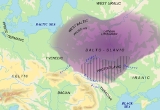
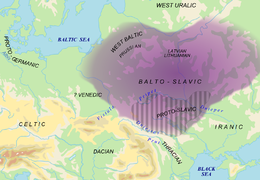
A pre-Slavic period began c. 1500 to 1000 BCE, whereby certain phonological changes and linguistic contacts did not disperse evenly through all Balto-Slavic dialects. The development into Proto-Slavic probably occurred along the southern periphery of the Proto-Balto-Slavic continuum. The most archaic Slavic hydronyms are found here, along the middle Dnieper
, Pripet and upper Dniester rivers. This agrees well with the fact that inherited Common Slavic vocabulary does not include detailed terminology for physical surface features peculiar of the mountains or the steppe, nor any relating to the sea, to coastal features, littoral flora or fauna, or salt water fishes. On the other hand, it does include well-developed terminology for inland bodies of water (lakes, river, swamps) and kinds of forest (deciduous and coniferous), for the trees, plants, animals and birds indigenous to the temperate forest zone, and for the fish native to its waters.
Indeed, Trubachev argues that this location fostered contacts between speakers of Pre-Proto-Slavic with the cultural innovations which emanated from central Europe and the steppe. Although language groups cannot be straightforwardly equated with archaeological cultures, the emergence of a Pre-Proto-Slavic linguistic community corresponds temporally and geographically with the Kamarov and Chernoles
cultures (Novotna, Blazek). Both linguists and archaeologists therefore often locate the Slavic Urheimat specifically within this area.
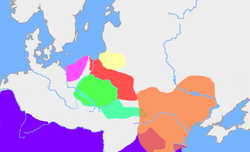
 In proto-historical times, the Slavic homeland experienced intrusions of foreign elements. Beginning from c. 500 BCE to 200 CE, the Scythians and then the Sarmatians
expanded their control into the forest steppe. A few Eastern Iranian loan words, especially relating to religious and cultural practices, have been seen as evidence of cultural influences. Subsequently, loan words of Germanic origin also appear. This is connected to the movement of east Germanic groups into the Vistula basin, and subsequently to the middle Dnieper basin, associated with the appearance of the Przeworsk
and Chernyakhov
cultures, respectively.
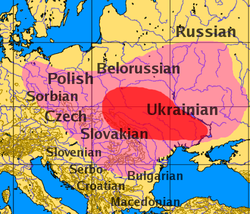
Despite these developments, Slavic remained conservative and was still typologically very similar to other Balto-Slavic dialects. Even into the Common Era, the various Balto-Slavic dialects formed a dialect continuum stretching from the Vistula to the Don and Oka basins, and from the Baltic and upper Volga to southern Russia and northern Ukraine. Exactly when Slavs began to identify as a distinct ethno-cultural unit remains a subject of debate. For example, links the phenomenon to the Zarubinets
culture 200 BCE to 200 CE, Vlodymyr Baran places Slavic ethnogenesis within the Chernyakov era, while Curta places it in the Danube basin in the sixth century CE. It is likely that linguistic affinity played an important role in defining group identity for the Slavs. The term Slav is proposed to be an autonym referring to "people who speak (the same language)."
Proto-Slavic proper is dated to c. 400 to 600 CE, when it experienced an explosive spread. This corresponds to the earliest evidence of dialectical divergence within Slavic. As it expanded throughout eastern Europe, it obliterated whatever remained of easternmost Celtic
, Avar
, Venetic, possibly Dacian, as well as many other Balto-Slavic dialects, and the Slav ethnonym spread out considerably. By the eighth century CE, Proto-Slavic is believed to have been spoken uniformly from Thessaloniki to Novgorod. The onomastic evidence and glosses of Slavic words in foreign-language texts show no detectable regional differences of 5th and 6th century Slavic.
What caused the rapid expansion of Slavic remains a topic of discussion. Traditional theories link its spread to a demographic expansion of Slavs migrating radially from their Urheimat, whereas more processual
theories attempt to modify the picture by introducing concepts such as "elite dominance" and "language shifts.". Literary and archaeological evidence suggests that eastern European barbaricum in the 6th century was linguistically and culturally diverse, somewhat going against the idea of a large demographic expansion of an ethnically homogeneous Slavic people. Instead, Proto-Slavic might have been lingua franca
amongst the various barbarian ethnicities that emerged in the Danubian, Carpathian and steppe regions of Europe after the fall of the Hun Empire, such as the Sklaveni, Antes
, and Avars
. Cultural contacts between emerging societal elites might have led to the "language of one agricultural community spread(ing) to other agricultural societies." This has been substantiated archaeologically, seen by the development of networks which spread of "Slavic fibulae," artifacts representing social status and group identity. Horace Lunt argues that only as a lingua franca could Slavic have remained mutually intelligible over vast areas of Europe, and that its disintegration into different dialects occurred after the collapse of the Avar khanate. However, even proponents of this theory concede that it fails to explain how Slavic spread to the Baltic and western Russia, areas which had no historical connection with the Avar Empire. Whatever the case, Johanna Nichols points out that the expansion of Slavic was not just a linguistic phenomenon, but the expansion of an ethnic identity.
The last shared innovations common to all modern Slavic languages are dated to the ninth century. Afterwards, during the so-called Common Slavic period, innovations followed, some of which have missed certain peripheral dialects (e.g. Old Novgorod dialect
didn't exhibit the second palatalization of velars while all the other Slavic dialects did). Linguistic differentiation received impetus from the dispersion of the Slavic peoples over a large territory, but Common Slavic sound changes occurred for at least four or five centuries more. Subsequent migrations of Uralic and Romance speaking peoples created geographic separations between Slavic dialects. The commonly cited last Common Slavic "law" is the loss of weak yers
, which occurred somewhere around the tenth or twelfth centuries CE, and even then not completely in some Slavic dialects. Written documents of the ninth, tenth and eleventh centuries demonstrate some local features. For example, the Freising monuments show a dialect which contains some phonetic and lexical elements peculiar to Slovenian dialects (e.g. rhotacism
, the word krilatec).
In the second half of the ninth century, the dialect spoken north of Thessaloniki
, in the hinterlands of Macedonia, became the basis for the first written Slavic language, created by the brothers Cyril and Methodius who translated portions of the Bible and other church books. The language they recorded is known as Old Church Slavonic
. Old Church Slavonic is not identical to Proto-Slavic, having been recorded at least two centuries after the breakup of Proto-Slavic, and it shows features that clearly distinguish it from Proto-Slavic. However, it is still reasonably close, and the mutual intelligibility
between Old Church Slavonic and other Slavic dialects of those days was proved by Cyril's and Methodius' mission to Great Moravia
and Pannonia
. There, their early South Slavic
dialect used for the translations was clearly understandable to the local population which spoke an early West Slavic
dialect.
sound changes wherein palatovelar consonants became affricate or fricative consonant
s pronounced closer to the front of the mouth. In Proto-Slavic, the former palatovelar stops became coronal fricatives:
Other satem sound changes are delabialization of labiovelar consonants before rounded vowels and the ruki sound law
, which had the effect in Slavic languages of shifting *s to *x (likely with *š as an intermediate stage) after a high vowel (i or u), r or k.
In the Balto-Slavic period, final and were lost.
Also present were the diphthongs *ei and *oi as well as liquid diphthongs
*ŭl, *ĭl, *ŭr, *ĭr, the latter set deriving from syllabic liquids; the vocalic element merged with *ŭ after labiovelar stops and with *ĭ everywhere else, and the remaining labiovelars subsequently lost their labialization.
Around this time, the PIE aspirated consonants merged with voiced ones:
Once it split off, the Proto-Slavic period probably encompassed a period of stability lasting 2000 years with only several centuries of rapid change before the breakup of Slavic linguistic unity that came about due to Slavic migrations in the early sixth century. As such, the chronology of changes including the three palatalizations and ending with the change of *ě to *a in certain contexts defines the Common Slavic period.
Early changes after the Baltic-Slavic split still saw some similar developments, including the merging of long and short *o and *a; short *o and *a merged in both, though long *ō and *ā remained distinct in Baltic while merging in Slavic. Long *ē and *ō raised before a final sonorant, and sonorants following a long vowel were deleted.
 What is likely to be the chronologically oldest palatalization is often called the "third" palatalization (hereafter called the progressive palatalization) due to confusion over the exact phonetic conditions that triggered it as well as forms such as the nominative singular *otĭcĭ (from *otĭk-os) but vocative singular *otĭče (from *otĭk-e) which made it seem that the progressive palatalization happened after this first regressive palatalization (see below). However, incorporating and strategically ordering other diachronic changes (such as the fronting of back vowels after palatal consonants) sufficiently explains most of the discrepancies while placing this "third" palatalization before the other two.
This palatalization goes as follows:
Velar consonants become palatalized (*k, *g, *x → }, }, }) when following a front high vowel (either long or short) and preceding a mid back vowel (either long or short) across a morpheme boundary. An *n or *r between the velar and the high vowel does not prevent this palatalization. Also, the preceding front high vowel must itself follow a consonant.
Slavic contact with Germanic tribes (such as the migrating Goths
) around the second or third century is the earliest date from which the progressive palatalization could have occurred since loan words such as *kuning ('king') → kŭnędzĭ ('prince') and *penning ('penny') → *pěnędzĭ ('coin') show the reflex of this palatalization. After the ninth century, this palatalization was likely no longer operating since Varangians
(*varying-) were known as (varęgŭ) in Eastern Slavic branch of languages (Ukrainian and eventually Russian - without the palatalization of *g to *z) while the nominative plural: (varęzi), and locative singular show that either the second regressive palatalization was still operative or that an analogy with other nouns ending in a velar consonant.
). Another tendency, generally referred to as the "Law of Open Syllables" marks the beginning of the Common Slavic period in which an arrangement of phonemes in a syllable (from lower to higher sonority) led to final consonants being deleted, consonant clusters being simplified (either by deletion or epenthesis), diphthongs being monophthong
ized, nasal consonants in the syllable coda becoming the nasalization of the preceding vowel (*ę and }), etc. After these changes, a CV syllable structure (that is, one of segments ordered from lower to higher sonority) arose and the syllable became a basic structural unit of the language. Thus syllables (rather than just the consonant or the vowel) were distinguished as either "soft" or "hard;" most consonants having developed palatalized allophones in soft syllables (a situation dubbed "syllable synharmony" or the "syllabeme").
This was the first regressive palatalization. Although *g palatalized to an affricate, this soon lenited to a fricative except when following *z. *s and *z palatalized to š and ž, respectively, before palatal consonants (*j, *č, ž). Subsequently, a number of vowel changes took place: *ū lost its labialization (possibly [ɨ], represented hereafter as, as in modern Polish) both *ou and *eu became *u, and back vowels became front vowels after palatal consonants (including *j). This was closely followed by the monophthongization of diphthongs in all environments:
By this point, Proto-Slavic had the following vowel system:
Proto-Slavic was still operating under the system of syllabic synharmony; because it had a new front vowel, yat
(possibly an open front vowel [æː]), the language underwent the second regressive palatalization
, in which velar consonants preceding *ě were palatalized. As with the progressive palatalization, these became palatovelar. Soon after, palatovelar consonants from both the progressive palatalization and the second regressive palatalization became sibilants: → *c ([ts]) → *dz → *z → *s/*š
In noun declension, the second regressive palatalization originally figured in two important Slavic stem types: o-stems (masculine and neuter consonant-stems) and a-stems (feminine and masculine vowel-stems). This rule operated in the o-stem masculine paradigm in three places: before nominative plural and both singular and plural locative affixes.
The phonetic realization of subsequent sibilants varied from dialect to dialect. According to Aleksandar Belić, the phonetic character of the palatalizations was uniform throughout Common Slavic and West Slavic languages developed *š later on by analogy. In all dialects (except for Lechitic), [dz] was deaffricated to [z]:
The following table illustrates the differences between the different dialects as far as phonetic realization of the palatalizations.
The Proto-Slavic period ended when syllabic synharmony ended. The first trigger was the change of *ě to *a after palatal consonants and *j, which then created *ča/*ka contrasts. Also, weak yer
s (*ь/ĭ and *ъ/ŭ) were shortened and then elided (see Havlík's law
), creating newly formed closed syllables, and the clusters *tl and *dl were lost in all but West Slavic, being simplified to *l or replaced by *kl and *gl respectively. By this point, Common Slavic had the following consonants.
For many Common Slavic dialects—including most of West Slavic, all but the northernmost portions of East Slavic, and some western parts of South Slavic— *g lenited
from a voiced velar plosive
to a voiced velar fricative
([ɡ] → [ɣ]). Because this change was not universal and because it did not occur for a number of East Slavic dialects (such as Belarussian and South Russian) until after the application of Havlík's law, calls into question early projections of this change and postulates three independent instigations of lenition, dating the earliest to before 900 CE and the latest to the early thirteenth century.
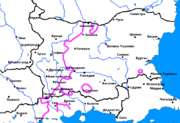 The phonetic realization of *ě was also subject to phonetic variation across different dialects. Though a few dialects still retain a distinct reflex of *ě, historical changes across the different languages have, by and large, eliminated *ě from the inventory of sounds, either by merging with another sound, or conditional mergers with multiple sounds.
Currently, the modern reflexes of *ě in Bulgarian
and Macedonian
dialects forms an important isogloss
known as the jat' border, running approximately from Nikopol
on the Danube
to Solun (Thessaloniki
) on the Aegean Sea
. Although both sets of dialects have /e/ as a reflex of *ě, in eastern dialects, this changes to /ja/ in stressed syllables immediately followed by palatal and postalveolar consonants (e.g. *běl- produces singular бял and plural бели).
Similarly, dialects of Serbian
, Croatian
and Bosnian
exhibit great diversity, in reflexes of *ě, which may be /e/, /i/, or /ije/ in long syllables and /e/, /i/, or /je/ in short ones. The dialects exhibiting these reflexes are correspondingly known as ekavian, ikavian and ijekavian. Serbian literary language uses both ekavian in Serbia and ijekavian in Bosnia and in Montenegro, while Croatian and Bosnian literary standard is ijekavian only.
A number of other Slavic languages have simply merged *ě with another mid vowel. In Slovene, Slovak
, Belarusian
, and Russian
*ě has become /e/. In Ukrainian
, *ě merged with *i.
s from the languages of various tribes and peoples that the Proto-Slavic speakers came into contact with. These include mostly Indo-European speakers, chiefly Germanic
(Gothic
and Old High German
), speakers of Vulgar Latin
or some early Romance dialects, Middle Greek and, to a much lesser extent, Eastern Iranian
(mostly pertaining to religious sphere) and Celtic
.
Many terms of Greco-Roman cultural provenience have been diffused into Slavic by Gothic mediation, and analysis has shown that Germanic borrowings into Slavic show at least 4 distinct chronological strata, and must have entered Proto-Slavic in a long period.
Of non-Indo-European languages possible connections have been made to various Turkic
and Avar
, but their reconstruction is very unreliable due to the scarcity of the evidence and the relatively late attestation of both Slavic and Turkic languages.
Older literature, as well as some older etymological dictionaries, often posit some alleged Eastern Iranian or Celtic source of all Slavic etymons with unclear etymologies, which in reality have very little linguistic support. Dispute on them ranges from all-inclusive to all-denial.
Proto-language
A proto-language in the tree model of historical linguistics is the common ancestor of the languages that form a language family. Occasionally, the German term Ursprache is used instead.Often the proto-language is not known directly...
from which Slavic languages
Slavic languages
The Slavic languages , a group of closely related languages of the Slavic peoples and a subgroup of Indo-European languages, have speakers in most of Eastern Europe, in much of the Balkans, in parts of Central Europe, and in the northern part of Asia.-Branches:Scholars traditionally divide Slavic...
later emerged. It was spoken before the seventh century AD. As with most other proto-languages, no attested writings have been found; the language has been reconstructed by applying the comparative method
Comparative method
In linguistics, the comparative method is a technique for studying the development of languages by performing a feature-by-feature comparison of two or more languages with common descent from a shared ancestor, as opposed to the method of internal reconstruction, which analyzes the internal...
to all the attested Slavic languages as well as other Indo-European languages
Indo-European languages
The Indo-European languages are a family of several hundred related languages and dialects, including most major current languages of Europe, the Iranian plateau, and South Asia and also historically predominant in Anatolia...
.
Origin
Kurgan hypothesis
The Kurgan hypothesis is one of the proposals about early Indo-European origins, which postulates that the people of an archaeological "Kurgan culture" in the Pontic steppe were the most likely speakers of the Proto-Indo-European language...
, currently places the Urheimat
Urheimat
Urheimat is a linguistic term denoting the original homeland of the speakers of a proto-language...
of the Proto-Indo-European people at the Pontic steppe, represented archaeologically by the 5th millennium BCE Sredny Stog culture
Sredny Stog culture
The Sredny Stog culture dates from the 4500-3500 BC. It was situated just north of the Sea of Azov between the Dnieper and the Don...
. From here, various daughter dialects dispersed radially in several waves between c. 4400 BCE and 3000 BCE. The phonological changes which set Balto-Slavic apart from other Indo-European languages probably lasted from c. 3000 to 1000 BCE, a period known as common Proto-Balto-Slavic. links the earliest stages of Balto-Slavic development with the Middle Dnieper culture
Middle Dnieper culture
The Middle Dnieper culture is an eastern extension of the Corded Ware culture, ca. 3200—2300 BC of northern Ukraine and Belarus. As the name indicates, it was centered on the middle reach of the Dnieper River and is contemporaneous with the latter phase and then a successor to the...
which connects the Corded Ware
Corded Ware culture
The Corded Ware culture , alternatively characterized as the Battle Axe culture or Single Grave culture, is an enormous European archaeological horizon that begins in the late Neolithic , flourishes through the Copper Age and culminates in the early Bronze Age.Corded Ware culture is associated with...
and Yamna culture
Yamna culture
The Yamna culture is a late copper age/early Bronze Age culture of the Southern Bug/Dniester/Ural region , dating to the 36th–23rd centuries BC...
s. Kurganists connect the latter two cultures with the so-called "Northwest (IE) group" and the Iranic-speaking steppe nomads, respectively. This fits with the linguistic evidence in that Balto-Slavic appears to have had close contacts with Indo-Iranian
Indo-Iranian languages
The Indo-Iranian language group constitutes the easternmost extant branch of the Indo-European family of languages. It consists of three language groups: the Indo-Aryan, Iranian and Nuristani...
and Proto-Germanic
Proto-Germanic language
Proto-Germanic , or Common Germanic, as it is sometimes known, is the unattested, reconstructed proto-language of all the Germanic languages, such as modern English, Frisian, Dutch, Afrikaans, German, Luxembourgish, Danish, Norwegian, Icelandic, Faroese, and Swedish.The Proto-Germanic language is...
.
An association between Balto-Slavic and Germanic has been proposed on the basis of lexical similarities that are unique to these languages. Apart from a proposed genetic relationship (PIE forming a Germano-Balto-Slavic sub-branch), the similarities are likely due to continuous contacts, whereby common loan words spread through the communities in the forest zones at an early time of their linguistic development.
Similarly, Balto-Slavic and Indo-Iranian might have formed some kind of continuum from the north-west to the south-east given that they share both satemization and the Ruki sound law
Ruki sound law
Ruki refers to a sound change in Balto-Slavic, Albanian, Armenian, and Indo-Iranian, wherein an original phoneme changed into after the consonants , , and the semi-vowels , , or:...
. On the other hand genetic studies have shown that Slavs and North Indians share much larger amounts of the R1a haplogroup associated to the spread of Indo-European languages, than most Germanic populations. The Balto-Slavic - Indo-Iranian link might thus be a result of a large part of common ancestry, between Eastern Europeans and Indo-Iranians. Balto-Slavic then expanded along the forest zone, replacing earlier centum dialects, such as Pre-Proto-Germanic
Germanic Parent Language
Germanic Parent Language is a term used in historical linguistics to describe the chain of reconstructed languages in the Germanic group referred to as Pre-Germanic Indo-European , Early Proto-Germanic , and Late Proto-Germanic . It is intended to cover the time of the 2nd and 1st millennia BC...
. This might explain the presence of a few prehistoric centum sub-stratic lexicons.
A pre-Slavic period began c. 1500 to 1000 BCE, whereby certain phonological changes and linguistic contacts did not disperse evenly through all Balto-Slavic dialects. The development into Proto-Slavic probably occurred along the southern periphery of the Proto-Balto-Slavic continuum. The most archaic Slavic hydronyms are found here, along the middle Dnieper
Dnieper River
The Dnieper River is one of the major rivers of Europe that flows from Russia, through Belarus and Ukraine, to the Black Sea.The total length is and has a drainage basin of .The river is noted for its dams and hydroelectric stations...
, Pripet and upper Dniester rivers. This agrees well with the fact that inherited Common Slavic vocabulary does not include detailed terminology for physical surface features peculiar of the mountains or the steppe, nor any relating to the sea, to coastal features, littoral flora or fauna, or salt water fishes. On the other hand, it does include well-developed terminology for inland bodies of water (lakes, river, swamps) and kinds of forest (deciduous and coniferous), for the trees, plants, animals and birds indigenous to the temperate forest zone, and for the fish native to its waters.
Indeed, Trubachev argues that this location fostered contacts between speakers of Pre-Proto-Slavic with the cultural innovations which emanated from central Europe and the steppe. Although language groups cannot be straightforwardly equated with archaeological cultures, the emergence of a Pre-Proto-Slavic linguistic community corresponds temporally and geographically with the Kamarov and Chernoles
Chernoles culture
The Chernoles culture is an Iron Age archaeological unit dating ca. 1025–700 BC. It was located in the forest-steppe between the Dniester and Dnieper Rivers, in what is now northern Ukraine. This location corresponds to where Herodotus later placed his Scythian ploughmen...
cultures (Novotna, Blazek). Both linguists and archaeologists therefore often locate the Slavic Urheimat specifically within this area.
Sarmatians
The Iron Age Sarmatians were an Iranian people in Classical Antiquity, flourishing from about the 5th century BC to the 4th century AD....
expanded their control into the forest steppe. A few Eastern Iranian loan words, especially relating to religious and cultural practices, have been seen as evidence of cultural influences. Subsequently, loan words of Germanic origin also appear. This is connected to the movement of east Germanic groups into the Vistula basin, and subsequently to the middle Dnieper basin, associated with the appearance of the Przeworsk
Przeworsk culture
The Przeworsk culture is part of an Iron Age archaeological complex that dates from the 2nd century BC to the 5th century AD. It was located in what is now central and southern Poland, later spreading to parts of eastern Slovakia and Carpathian Ruthenia ranging between the Oder and the middle and...
and Chernyakhov
Chernyakhov culture
The Sântana de Mureș–Chernyakhiv culture is the name given to an archaeological culture which flourished between the 2nd and 5th centuries in a wide area of Eastern Europe, specifically in what today constitutes Ukraine, Romania, Moldova, and parts of Belarus...
cultures, respectively.
Despite these developments, Slavic remained conservative and was still typologically very similar to other Balto-Slavic dialects. Even into the Common Era, the various Balto-Slavic dialects formed a dialect continuum stretching from the Vistula to the Don and Oka basins, and from the Baltic and upper Volga to southern Russia and northern Ukraine. Exactly when Slavs began to identify as a distinct ethno-cultural unit remains a subject of debate. For example, links the phenomenon to the Zarubinets
Zarubintsy culture
The Zarubintsy culture was a culture that from the 3rd century BC until 1st century AD flourished in the area north of the Black Sea along the upper and middle Dnieper and Pripyat Rivers, stretching west towards the Southern Bug river. Zarubintsy sites were particularly dense between the Rivers...
culture 200 BCE to 200 CE, Vlodymyr Baran places Slavic ethnogenesis within the Chernyakov era, while Curta places it in the Danube basin in the sixth century CE. It is likely that linguistic affinity played an important role in defining group identity for the Slavs. The term Slav is proposed to be an autonym referring to "people who speak (the same language)."
Proto-Slavic proper is dated to c. 400 to 600 CE, when it experienced an explosive spread. This corresponds to the earliest evidence of dialectical divergence within Slavic. As it expanded throughout eastern Europe, it obliterated whatever remained of easternmost Celtic
Celtic languages
The Celtic languages are descended from Proto-Celtic, or "Common Celtic"; a branch of the greater Indo-European language family...
, Avar
Eurasian Avars
The Eurasian Avars or Ancient Avars were a highly organized nomadic confederacy of mixed origins. They were ruled by a khagan, who was surrounded by a tight-knit entourage of nomad warriors, an organization characteristic of Turko-Mongol groups...
, Venetic, possibly Dacian, as well as many other Balto-Slavic dialects, and the Slav ethnonym spread out considerably. By the eighth century CE, Proto-Slavic is believed to have been spoken uniformly from Thessaloniki to Novgorod. The onomastic evidence and glosses of Slavic words in foreign-language texts show no detectable regional differences of 5th and 6th century Slavic.
What caused the rapid expansion of Slavic remains a topic of discussion. Traditional theories link its spread to a demographic expansion of Slavs migrating radially from their Urheimat, whereas more processual
Processual archaeology
Processual archaeology is a form of archaeological theory that had its genesis in 1958 with Willey and Phillips' work Method and Theory in American Archeology, in which the pair stated that "American archaeology is anthropology or it is nothing" , a rephrasing of Frederic William Maitland's...
theories attempt to modify the picture by introducing concepts such as "elite dominance" and "language shifts.". Literary and archaeological evidence suggests that eastern European barbaricum in the 6th century was linguistically and culturally diverse, somewhat going against the idea of a large demographic expansion of an ethnically homogeneous Slavic people. Instead, Proto-Slavic might have been lingua franca
Lingua franca
A lingua franca is a language systematically used to make communication possible between people not sharing a mother tongue, in particular when it is a third language, distinct from both mother tongues.-Characteristics:"Lingua franca" is a functionally defined term, independent of the linguistic...
amongst the various barbarian ethnicities that emerged in the Danubian, Carpathian and steppe regions of Europe after the fall of the Hun Empire, such as the Sklaveni, Antes
Antes
Antes may refer to:*Antes people, an ancient tribe in Eastern EuropePeople named Antes*Horst Antes , German sculptor*John Antes , American composer-See also:...
, and Avars
Eurasian Avars
The Eurasian Avars or Ancient Avars were a highly organized nomadic confederacy of mixed origins. They were ruled by a khagan, who was surrounded by a tight-knit entourage of nomad warriors, an organization characteristic of Turko-Mongol groups...
. Cultural contacts between emerging societal elites might have led to the "language of one agricultural community spread(ing) to other agricultural societies." This has been substantiated archaeologically, seen by the development of networks which spread of "Slavic fibulae," artifacts representing social status and group identity. Horace Lunt argues that only as a lingua franca could Slavic have remained mutually intelligible over vast areas of Europe, and that its disintegration into different dialects occurred after the collapse of the Avar khanate. However, even proponents of this theory concede that it fails to explain how Slavic spread to the Baltic and western Russia, areas which had no historical connection with the Avar Empire. Whatever the case, Johanna Nichols points out that the expansion of Slavic was not just a linguistic phenomenon, but the expansion of an ethnic identity.
The last shared innovations common to all modern Slavic languages are dated to the ninth century. Afterwards, during the so-called Common Slavic period, innovations followed, some of which have missed certain peripheral dialects (e.g. Old Novgorod dialect
Old Novgorod dialect
Old Novgorod dialect is a term introduced by Andrey Zaliznyak to describe the astonishingly diverse linguistic features of the Old East Slavic birch bark writings from the 11th to 15th centuries excavated in Novgorod and its surroundings...
didn't exhibit the second palatalization of velars while all the other Slavic dialects did). Linguistic differentiation received impetus from the dispersion of the Slavic peoples over a large territory, but Common Slavic sound changes occurred for at least four or five centuries more. Subsequent migrations of Uralic and Romance speaking peoples created geographic separations between Slavic dialects. The commonly cited last Common Slavic "law" is the loss of weak yers
Havlík's law
Havlík's law is a Slavic rhythmic law dealing with the reduced vowels in Proto-Slavic. It is named for the Czech scholar Antonín Havlík , who determined the pattern in 1889. While Havlík's law was a precursor to the loss of the jers, that process is part of the individual history of the various...
, which occurred somewhere around the tenth or twelfth centuries CE, and even then not completely in some Slavic dialects. Written documents of the ninth, tenth and eleventh centuries demonstrate some local features. For example, the Freising monuments show a dialect which contains some phonetic and lexical elements peculiar to Slovenian dialects (e.g. rhotacism
Rhotacism
Rhotacism refers to several phenomena related to the usage of the consonant r :*the excessive or idiosyncratic use of the r;...
, the word krilatec).
In the second half of the ninth century, the dialect spoken north of Thessaloniki
Thessaloniki
Thessaloniki , historically also known as Thessalonica, Salonika or Salonica, is the second-largest city in Greece and the capital of the region of Central Macedonia as well as the capital of the Decentralized Administration of Macedonia and Thrace...
, in the hinterlands of Macedonia, became the basis for the first written Slavic language, created by the brothers Cyril and Methodius who translated portions of the Bible and other church books. The language they recorded is known as Old Church Slavonic
Old Church Slavonic
Old Church Slavonic or Old Church Slavic was the first literary Slavic language, first developed by the 9th century Byzantine Greek missionaries Saints Cyril and Methodius who were credited with standardizing the language and using it for translating the Bible and other Ancient Greek...
. Old Church Slavonic is not identical to Proto-Slavic, having been recorded at least two centuries after the breakup of Proto-Slavic, and it shows features that clearly distinguish it from Proto-Slavic. However, it is still reasonably close, and the mutual intelligibility
Mutual intelligibility
In linguistics, mutual intelligibility is recognized as a relationship between languages or dialects in which speakers of different but related languages can readily understand each other without intentional study or extraordinary effort...
between Old Church Slavonic and other Slavic dialects of those days was proved by Cyril's and Methodius' mission to Great Moravia
Great Moravia
Great Moravia was a Slavic state that existed in Central Europe and lasted for nearly seventy years in the 9th century whose creators were the ancestors of the Czechs and Slovaks. It was a vassal state of the Germanic Frankish kingdom and paid an annual tribute to it. There is some controversy as...
and Pannonia
Balaton Principality
The Principality of Lower Pannonia was a Slavic principality located in the western part of the Pannonian plain, between the rivers Danube to its east The Principality of Lower Pannonia (also called Pannonia, Lower Pannonia, Pannonian Principality, Transdanubian Principality, Slavic Pannonian...
. There, their early South Slavic
South Slavic languages
The South Slavic languages comprise one of three branches of the Slavic languages. There are approximately 30 million speakers, mainly in the Balkans. These are separated geographically from speakers of the other two Slavic branches by a belt of German, Hungarian and Romanian speakers...
dialect used for the translations was clearly understandable to the local population which spoke an early West Slavic
West Slavic
West Slavic can refer to:* West Slavic languages* West Slavic peoples...
dialect.
Split from Indo-European
Proto-Slavic has the satemCentum-Satem isogloss
The centum-satem division is an isogloss of the Indo-European language family, related to the different evolution of the three dorsal consonant rows of the mainstream reconstruction of Proto-Indo-European:...
sound changes wherein palatovelar consonants became affricate or fricative consonant
Fricative consonant
Fricatives are consonants produced by forcing air through a narrow channel made by placing two articulators close together. These may be the lower lip against the upper teeth, in the case of ; the back of the tongue against the soft palate, in the case of German , the final consonant of Bach; or...
s pronounced closer to the front of the mouth. In Proto-Slavic, the former palatovelar stops became coronal fricatives:
- } → *s
- } → *z
- } → *z
Other satem sound changes are delabialization of labiovelar consonants before rounded vowels and the ruki sound law
Ruki sound law
Ruki refers to a sound change in Balto-Slavic, Albanian, Armenian, and Indo-Iranian, wherein an original phoneme changed into after the consonants , , and the semi-vowels , , or:...
, which had the effect in Slavic languages of shifting *s to *x (likely with *š as an intermediate stage) after a high vowel (i or u), r or k.
In the Balto-Slavic period, final and were lost.
Also present were the diphthongs *ei and *oi as well as liquid diphthongs
Slavic liquid metathesis and pleophony
Slavic liquid metathesis refers to the historical phenomenon of metathesis of liquid consonants occurring in Common Slavic period in South Slavic and Czecho-Slovak area. Onomastics evidence indicates that it seems to have occurred sometimes in the latter half of the eighth century...
*ŭl, *ĭl, *ŭr, *ĭr, the latter set deriving from syllabic liquids; the vocalic element merged with *ŭ after labiovelar stops and with *ĭ everywhere else, and the remaining labiovelars subsequently lost their labialization.
Around this time, the PIE aspirated consonants merged with voiced ones:
- * → }
- * → }
- * → }
Once it split off, the Proto-Slavic period probably encompassed a period of stability lasting 2000 years with only several centuries of rapid change before the breakup of Slavic linguistic unity that came about due to Slavic migrations in the early sixth century. As such, the chronology of changes including the three palatalizations and ending with the change of *ě to *a in certain contexts defines the Common Slavic period.
Early changes after the Baltic-Slavic split still saw some similar developments, including the merging of long and short *o and *a; short *o and *a merged in both, though long *ō and *ā remained distinct in Baltic while merging in Slavic. Long *ē and *ō raised before a final sonorant, and sonorants following a long vowel were deleted.
Progressive palatalization
This palatalization goes as follows:
Velar consonants become palatalized (*k, *g, *x → }, }, }) when following a front high vowel (either long or short) and preceding a mid back vowel (either long or short) across a morpheme boundary. An *n or *r between the velar and the high vowel does not prevent this palatalization. Also, the preceding front high vowel must itself follow a consonant.
Slavic contact with Germanic tribes (such as the migrating Goths
Goths
The Goths were an East Germanic tribe of Scandinavian origin whose two branches, the Visigoths and the Ostrogoths, played an important role in the fall of the Roman Empire and the emergence of Medieval Europe....
) around the second or third century is the earliest date from which the progressive palatalization could have occurred since loan words such as *kuning ('king') → kŭnędzĭ ('prince') and *penning ('penny') → *pěnędzĭ ('coin') show the reflex of this palatalization. After the ninth century, this palatalization was likely no longer operating since Varangians
Varangians
The Varangians or Varyags , sometimes referred to as Variagians, were people from the Baltic region, most often associated with Vikings, who from the 9th to 11th centuries ventured eastwards and southwards along the rivers of Eastern Europe, through what is now Russia, Belarus and Ukraine.According...
(*varying-) were known as (varęgŭ) in Eastern Slavic branch of languages (Ukrainian and eventually Russian - without the palatalization of *g to *z) while the nominative plural: (varęzi), and locative singular show that either the second regressive palatalization was still operative or that an analogy with other nouns ending in a velar consonant.
Syllabic synharmony
After the progressive palatalization took place, a tendency arose in the Common Slavic period wherein successive segmental phonemes in a syllable assimilated articulatory features (primarily place of articulationPlace of articulation
In articulatory phonetics, the place of articulation of a consonant is the point of contact where an obstruction occurs in the vocal tract between an articulatory gesture, an active articulator , and a passive location...
). Another tendency, generally referred to as the "Law of Open Syllables" marks the beginning of the Common Slavic period in which an arrangement of phonemes in a syllable (from lower to higher sonority) led to final consonants being deleted, consonant clusters being simplified (either by deletion or epenthesis), diphthongs being monophthong
Monophthong
A monophthong is a pure vowel sound, one whose articulation at both beginning and end is relatively fixed, and which does not glide up or down towards a new position of articulation....
ized, nasal consonants in the syllable coda becoming the nasalization of the preceding vowel (*ę and }), etc. After these changes, a CV syllable structure (that is, one of segments ordered from lower to higher sonority) arose and the syllable became a basic structural unit of the language. Thus syllables (rather than just the consonant or the vowel) were distinguished as either "soft" or "hard;" most consonants having developed palatalized allophones in soft syllables (a situation dubbed "syllable synharmony" or the "syllabeme").
Regressive palatalizations
As an extension of the system of syllable synharmony, velar consonants were palatalized to postalveolar consonants before front vowels (*i, *ĭ, *e, *ę) and *j:- *k → *č [tʃ]
- *g → *ž [dʒ] → [ʒ])
- *x → *š [ʃ]
This was the first regressive palatalization. Although *g palatalized to an affricate, this soon lenited to a fricative except when following *z. *s and *z palatalized to š and ž, respectively, before palatal consonants (*j, *č, ž). Subsequently, a number of vowel changes took place: *ū lost its labialization (possibly [ɨ], represented hereafter as
- *ū → *y
- *ou → *u
- *eu → *u
- *o → *e / J_
- *ŭ → *ĭ / J_
- *y → *i / J_
- *oi → *ei / J_
- *ei → *i
- *oi → *ě
By this point, Proto-Slavic had the following vowel system:
| Front Front vowel A front vowel is a type of vowel sound used in some spoken languages. The defining characteristic of a front vowel is that the tongue is positioned as far in front as possible in the mouth without creating a constriction that would be classified as a consonant. Front vowels are sometimes also... |
Central Central vowel A central vowel is a type of vowel sound used in some spoken languages. The defining characteristic of a central vowel is that the tongue is positioned halfway between a front vowel and a back vowel... |
Back Back vowel A back vowel is a type of vowel sound used in spoken languages. The defining characteristic of a back vowel is that the tongue is positioned as far back as possible in the mouth without creating a constriction that would be classified as a consonant. Back vowels are sometimes also called dark... |
||||
|---|---|---|---|---|---|---|
| long | short | long | short | long | short | |
| Close Close vowel A close vowel is a type of vowel sound used in many spoken languages. The defining characteristic of a close vowel is that the tongue is positioned as close as possible to the roof of the mouth without creating a constriction that would be classified as a consonant.This term is prescribed by the... |
i | ь/ĭ | y | u | ъ/ŭ | |
| Mid Mid vowel A mid vowel is a vowel sound used in some spoken languages. The defining characteristic of a mid vowel is that the tongue is positioned mid-way between an open vowel and a close vowel... |
ě | e, ę | o, ǫ | |||
| Open Open vowel An open vowel is defined as a vowel sound in which the tongue is positioned as far as possible from the roof of the mouth. Open vowels are sometimes also called low vowels in reference to the low position of the tongue... |
a | |||||
Proto-Slavic was still operating under the system of syllabic synharmony; because it had a new front vowel, yat
Yat
Yat or Jat is the thirty-second letter of the old Cyrillic alphabet. Its name in Old Church Slavonic is jěd’ or iad’ . In the common scientific Latin transliteration for old Slavic languages, the letter is represented by e with caron: .The yat represented a Common Slavic long vowel...
(possibly an open front vowel [æː]), the language underwent the second regressive palatalization
Slavic second palatalization
Slavic second palatalization is a Proto-Slavic sound change, that manifested as a regressive palatalization of inherited Balto-Slavic velars and velar fricative, chronologically occurring after the first and the third palatalization.-Motivation:...
, in which velar consonants preceding *ě were palatalized. As with the progressive palatalization, these became palatovelar. Soon after, palatovelar consonants from both the progressive palatalization and the second regressive palatalization became sibilants: → *c ([ts]) → *dz → *z → *s/*š
In noun declension, the second regressive palatalization originally figured in two important Slavic stem types: o-stems (masculine and neuter consonant-stems) and a-stems (feminine and masculine vowel-stems). This rule operated in the o-stem masculine paradigm in three places: before nominative plural and both singular and plural locative affixes.
| 'wolf' | 'horn' | 'spirit' | ||
|---|---|---|---|---|
| Nominative | singular | vlŭkŭ | rogŭ | duxŭ |
| plural | vlŭci | rozi | dusi | |
| Locative | singular | vlŭcě | rozě | dusě |
| plural | vlŭcěxŭ | rozěxŭ | dusěxŭ | |
Dialectal differentiation
It is at this point that dialectal variation becomes more apparent. Some dialects (such as those ancestral to Old East Slavic), allowed the second regressive palatalization to occur across an intervening *v.- RussianRussian languageRussian is a Slavic language used primarily in Russia, Belarus, Uzbekistan, Kazakhstan, Tajikistan and Kyrgyzstan. It is an unofficial but widely spoken language in Ukraine, Moldova, Latvia, Turkmenistan and Estonia and, to a lesser extent, the other countries that were once constituent republics...
: *gwojzda → *gwězda → zvězda → [zʲvʲɪˈzda] ('star') - PolishPolish languagePolish is a language of the Lechitic subgroup of West Slavic languages, used throughout Poland and by Polish minorities in other countries...
: *gwojzda → *gwězda → gwiazda → [ˈɡvʲazda] ('star') - CzechCzech languageCzech is a West Slavic language with about 12 million native speakers; it is the majority language in the Czech Republic and spoken by Czechs worldwide. The language was known as Bohemian in English until the late 19th century...
: *gwojzda → *gwězda → hvězda → [hvʲezda] ('star') - South Slavic languagesSouth Slavic languagesThe South Slavic languages comprise one of three branches of the Slavic languages. There are approximately 30 million speakers, mainly in the Balkans. These are separated geographically from speakers of the other two Slavic branches by a belt of German, Hungarian and Romanian speakers...
: *gwojzda → *gwězda → zvezda → [zvezda] ('star')
The phonetic realization of subsequent sibilants varied from dialect to dialect. According to Aleksandar Belić, the phonetic character of the palatalizations was uniform throughout Common Slavic and West Slavic languages developed *š later on by analogy. In all dialects (except for Lechitic), [dz] was deaffricated to [z]:
The following table illustrates the differences between the different dialects as far as phonetic realization of the palatalizations.
| Progressive | 1st regressive | 2nd regressive | ||||||||
|---|---|---|---|---|---|---|---|---|---|---|
| k | g | x | k | g | x | k | g | x | ||
| East Slavic East Slavic languages The East Slavic languages constitute one of three regional subgroups of Slavic languages, currently spoken in Eastern Europe. It is the group with the largest numbers of speakers, far out-numbering the Western and Southern Slavic groups. Current East Slavic languages are Belarusian, Russian,... |
c | z | s | č | ž | š | c | z | s | |
| South Slavic South Slavic languages The South Slavic languages comprise one of three branches of the Slavic languages. There are approximately 30 million speakers, mainly in the Balkans. These are separated geographically from speakers of the other two Slavic branches by a belt of German, Hungarian and Romanian speakers... |
c | z | s | č | ž | š | c | z | s | |
| West Slavic West Slavic languages The West Slavic languages are a subdivision of the Slavic language group that includes Czech, Polish, Slovak, Kashubian and Sorbian.Classification:* Indo-European** Balto-Slavic*** Slavic**** West Slavic***** Czech-Slovak languages****** Czech... |
Central Slovak Slovak language Slovak , is an Indo-European language that belongs to the West Slavic languages .Slovak is the official language of Slovakia, where it is spoken by 5 million people... |
c | z | š | č | ž | š | c | z | s |
| Lechitic Lechitic languages The Lechitic languages include three languages spoken in Central Europe, mainly in Poland, and historically also in the eastern and northern parts of modern Germany. This language group is a branch of the larger West Slavic language family... |
c | dz | š | č | ž | š | c | dz | š | |
| Other | c | z | š | č | ž | š | c | z | š | |
The Proto-Slavic period ended when syllabic synharmony ended. The first trigger was the change of *ě to *a after palatal consonants and *j, which then created *ča/*ka contrasts. Also, weak yer
Yer
The letter yer of the Cyrillic alphabet, also spelled jer or er, is known as the hard sign in the modern Russian and Rusyn alphabets and as er golyam in the Bulgarian alphabet...
s (*ь/ĭ and *ъ/ŭ) were shortened and then elided (see Havlík's law
Havlík's law
Havlík's law is a Slavic rhythmic law dealing with the reduced vowels in Proto-Slavic. It is named for the Czech scholar Antonín Havlík , who determined the pattern in 1889. While Havlík's law was a precursor to the loss of the jers, that process is part of the individual history of the various...
), creating newly formed closed syllables, and the clusters *tl and *dl were lost in all but West Slavic, being simplified to *l or replaced by *kl and *gl respectively. By this point, Common Slavic had the following consonants.
| Labial Labial consonant Labial consonants are consonants in which one or both lips are the active articulator. This precludes linguolabials, in which the tip of the tongue reaches for the posterior side of the upper lip and which are considered coronals... |
Coronal Coronal consonant Coronal consonants are consonants articulated with the flexible front part of the tongue. Only the coronal consonants can be divided into apical , laminal , domed , or subapical , as well as a few rarer orientations, because only the front of the tongue has such... |
Palatal Palatal consonant Palatal consonants are consonants articulated with the body of the tongue raised against the hard palate... |
Velar Velar consonant Velars are consonants articulated with the back part of the tongue against the soft palate, the back part of the roof of the mouth, known also as the velum).... |
|||||
|---|---|---|---|---|---|---|---|---|
| Nasal Nasal consonant A nasal consonant is a type of consonant produced with a lowered velum in the mouth, allowing air to escape freely through the nose. Examples of nasal consonants in English are and , in words such as nose and mouth.- Definition :... |
m | n | ||||||
| Plosive | p | b | t | d | k | ɡ | ||
| Affricate Affricate consonant Affricates are consonants that begin as stops but release as a fricative rather than directly into the following vowel.- Samples :... |
ts | dz | tʃ | |||||
| Fricative Fricative consonant Fricatives are consonants produced by forcing air through a narrow channel made by placing two articulators close together. These may be the lower lip against the upper teeth, in the case of ; the back of the tongue against the soft palate, in the case of German , the final consonant of Bach; or... |
v | s | z | ʃ | ʒ | x | ||
| Trill Trill consonant In phonetics, a trill is a consonantal sound produced by vibrations between the articulator and the place of articulation. Standard Spanish <rr> as in perro is an alveolar trill, while in Parisian French it is almost always uvular.... |
r | |||||||
| Approximant Approximant consonant Approximants are speech sounds that involve the articulators approaching each other but not narrowly enough or with enough articulatory precision to create turbulent airflow. Therefore, approximants fall between fricatives, which do produce a turbulent airstream, and vowels, which produce no... |
l | j | ||||||
For many Common Slavic dialects—including most of West Slavic, all but the northernmost portions of East Slavic, and some western parts of South Slavic— *g lenited
Lenition
In linguistics, lenition is a kind of sound change that alters consonants, making them "weaker" in some way. The word lenition itself means "softening" or "weakening" . Lenition can happen both synchronically and diachronically...
from a voiced velar plosive
Voiced velar plosive
The voiced velar plosive is a type of consonantal sound, used in some spoken languages. The symbol in the International Phonetic Alphabet that represents this sound is , and the equivalent X-SAMPA symbol is g. Strictly, the IPA symbol is the so-called "opentail G" , though the "looptail G" is...
to a voiced velar fricative
Voiced velar fricative
The voiced velar fricative is a type of consonantal sound, used in various spoken languages. It is not found in English today, but did exist in Old English...
([ɡ] → [ɣ]). Because this change was not universal and because it did not occur for a number of East Slavic dialects (such as Belarussian and South Russian) until after the application of Havlík's law, calls into question early projections of this change and postulates three independent instigations of lenition, dating the earliest to before 900 CE and the latest to the early thirteenth century.
Currently, the modern reflexes of *ě in Bulgarian
Bulgarian language
Bulgarian is an Indo-European language, a member of the Slavic linguistic group.Bulgarian, along with the closely related Macedonian language, demonstrates several linguistic characteristics that set it apart from all other Slavic languages such as the elimination of case declension, the...
and Macedonian
Macedonian language
Macedonian is a South Slavic language spoken as a first language by approximately 2–3 million people principally in the region of Macedonia but also in the Macedonian diaspora...
dialects forms an important isogloss
Isogloss
An isogloss—also called a heterogloss —is the geographical boundary of a certain linguistic feature, such as the pronunciation of a vowel, the meaning of a word, or use of some syntactic feature...
known as the jat' border, running approximately from Nikopol
Nikopol, Bulgaria
Nikopol is a town in northern Bulgaria, the administrative center of Nikopol municipality, part of Pleven Province, on the right bank of the Danube river, 4 km downstream from the mouth of the Osam river. It spreads at the foot of steep chalk cliffs along the Danube and up a narrow valley...
on the Danube
Danube
The Danube is a river in the Central Europe and the Europe's second longest river after the Volga. It is classified as an international waterway....
to Solun (Thessaloniki
Thessaloniki
Thessaloniki , historically also known as Thessalonica, Salonika or Salonica, is the second-largest city in Greece and the capital of the region of Central Macedonia as well as the capital of the Decentralized Administration of Macedonia and Thrace...
) on the Aegean Sea
Aegean Sea
The Aegean Sea[p] is an elongated embayment of the Mediterranean Sea located between the southern Balkan and Anatolian peninsulas, i.e., between the mainlands of Greece and Turkey. In the north, it is connected to the Marmara Sea and Black Sea by the Dardanelles and Bosporus...
. Although both sets of dialects have /e/ as a reflex of *ě, in eastern dialects, this changes to /ja/ in stressed syllables immediately followed by palatal and postalveolar consonants (e.g. *běl- produces singular бял and plural бели).
Similarly, dialects of Serbian
Serbian language
Serbian is a form of Serbo-Croatian, a South Slavic language, spoken by Serbs in Serbia, Bosnia and Herzegovina, Montenegro, Croatia and neighbouring countries....
, Croatian
Croatian language
Croatian is the collective name for the standard language and dialects spoken by Croats, principally in Croatia, Bosnia and Herzegovina, the Serbian province of Vojvodina and other neighbouring countries...
and Bosnian
Bosnian language
Bosnian is a South Slavic language, spoken by Bosniaks. As a standardized form of the Shtokavian dialect, it is one of the three official languages of Bosnia and Herzegovina....
exhibit great diversity, in reflexes of *ě, which may be /e/, /i/, or /ije/ in long syllables and /e/, /i/, or /je/ in short ones. The dialects exhibiting these reflexes are correspondingly known as ekavian, ikavian and ijekavian. Serbian literary language uses both ekavian in Serbia and ijekavian in Bosnia and in Montenegro, while Croatian and Bosnian literary standard is ijekavian only.
A number of other Slavic languages have simply merged *ě with another mid vowel. In Slovene, Slovak
Slovak language
Slovak , is an Indo-European language that belongs to the West Slavic languages .Slovak is the official language of Slovakia, where it is spoken by 5 million people...
, Belarusian
Belarusian language
The Belarusian language , sometimes referred to as White Russian or White Ruthenian, is the language of the Belarusian people...
, and Russian
Russian language
Russian is a Slavic language used primarily in Russia, Belarus, Uzbekistan, Kazakhstan, Tajikistan and Kyrgyzstan. It is an unofficial but widely spoken language in Ukraine, Moldova, Latvia, Turkmenistan and Estonia and, to a lesser extent, the other countries that were once constituent republics...
*ě has become /e/. In Ukrainian
Ukrainian language
Ukrainian is a language of the East Slavic subgroup of the Slavic languages. It is the official state language of Ukraine. Written Ukrainian uses a variant of the Cyrillic alphabet....
, *ě merged with *i.
Accentual developments
The Proto-Slavic accentual system developed out of the Balto-Slavic accentual system primarily through 1) movement of the accent from Balto-Slavic fixed initial circumflex accent to the second syllable and 2) the merger of the two Balto-Slavic intonation-types that resulted from retraction of the PIE accent from final syllables into one new intonation type, the Late Slavic circumflex. As a result, there was a distinction between two different types of intonation: falling (from the new Slavic intonation type) and rising (from a Balto-Slavic acute vowel).Loanwords
The lexical stock of Proto-Slavic also includes a number of loanwordLoanword
A loanword is a word borrowed from a donor language and incorporated into a recipient language. By contrast, a calque or loan translation is a related concept where the meaning or idiom is borrowed rather than the lexical item itself. The word loanword is itself a calque of the German Lehnwort,...
s from the languages of various tribes and peoples that the Proto-Slavic speakers came into contact with. These include mostly Indo-European speakers, chiefly Germanic
Germanic languages
The Germanic languages constitute a sub-branch of the Indo-European language family. The common ancestor of all of the languages in this branch is called Proto-Germanic , which was spoken in approximately the mid-1st millennium BC in Iron Age northern Europe...
(Gothic
Gothic language
Gothic is an extinct Germanic language that was spoken by the Goths. It is known primarily from the Codex Argenteus, a 6th-century copy of a 4th-century Bible translation, and is the only East Germanic language with a sizable Text corpus...
and Old High German
Old High German
The term Old High German refers to the earliest stage of the German language and it conventionally covers the period from around 500 to 1050. Coherent written texts do not appear until the second half of the 8th century, and some treat the period before 750 as 'prehistoric' and date the start of...
), speakers of Vulgar Latin
Vulgar Latin
Vulgar Latin is any of the nonstandard forms of Latin from which the Romance languages developed. Because of its nonstandard nature, it had no official orthography. All written works used Classical Latin, with very few exceptions...
or some early Romance dialects, Middle Greek and, to a much lesser extent, Eastern Iranian
Eastern Iranian languages
The Eastern Iranian languages are a subgroup of the Iranian languages emerging in Middle Iranian times .The Avestan language is often classified as early Eastern Iranian. The largest living Eastern Iranian language is Pashto, with some 50 million speakers between the Hindu Kush mountains in...
(mostly pertaining to religious sphere) and Celtic
Celtic languages
The Celtic languages are descended from Proto-Celtic, or "Common Celtic"; a branch of the greater Indo-European language family...
.
Many terms of Greco-Roman cultural provenience have been diffused into Slavic by Gothic mediation, and analysis has shown that Germanic borrowings into Slavic show at least 4 distinct chronological strata, and must have entered Proto-Slavic in a long period.
Of non-Indo-European languages possible connections have been made to various Turkic
Turkic languages
The Turkic languages constitute a language family of at least thirty five languages, spoken by Turkic peoples across a vast area from Eastern Europe and the Mediterranean to Siberia and Western China, and are considered to be part of the proposed Altaic language family.Turkic languages are spoken...
and Avar
Eurasian Avars
The Eurasian Avars or Ancient Avars were a highly organized nomadic confederacy of mixed origins. They were ruled by a khagan, who was surrounded by a tight-knit entourage of nomad warriors, an organization characteristic of Turko-Mongol groups...
, but their reconstruction is very unreliable due to the scarcity of the evidence and the relatively late attestation of both Slavic and Turkic languages.
Older literature, as well as some older etymological dictionaries, often posit some alleged Eastern Iranian or Celtic source of all Slavic etymons with unclear etymologies, which in reality have very little linguistic support. Dispute on them ranges from all-inclusive to all-denial.
See also
- Slavic liquid metathesis and pleophonySlavic liquid metathesis and pleophonySlavic liquid metathesis refers to the historical phenomenon of metathesis of liquid consonants occurring in Common Slavic period in South Slavic and Czecho-Slovak area. Onomastics evidence indicates that it seems to have occurred sometimes in the latter half of the eighth century...
- Balto-Slavic languagesBalto-Slavic languagesThe Balto-Slavic language group traditionally comprises Baltic and Slavic languages, belonging to the Indo-European family of languages. Baltic and Slavic languages share several linguistic traits not found in any other Indo-European branch, which points to the period of common development...
- Old Church SlavonicOld Church SlavonicOld Church Slavonic or Old Church Slavic was the first literary Slavic language, first developed by the 9th century Byzantine Greek missionaries Saints Cyril and Methodius who were credited with standardizing the language and using it for translating the Bible and other Ancient Greek...
- Slavic languagesSlavic languagesThe Slavic languages , a group of closely related languages of the Slavic peoples and a subgroup of Indo-European languages, have speakers in most of Eastern Europe, in much of the Balkans, in parts of Central Europe, and in the northern part of Asia.-Branches:Scholars traditionally divide Slavic...
- Language familyLanguage familyA language family is a group of languages related through descent from a common ancestor, called the proto-language of that family. The term 'family' comes from the tree model of language origination in historical linguistics, which makes use of a metaphor comparing languages to people in a...