


Croats

Encyclopedia
Croats are a South Slavic
ethnic group
mostly living in Croatia
, Bosnia and Herzegovina
and nearby countries. There are around 4 million Croats living inside Croatia and up to 4.5 million throughout the rest of the world. Responding to political, social and economic pressure, many Croats have migrated throughout the world, and established a notable Croatian diaspora
. Large Croat communities exists in The United States, Chile
, Argentina
, Germany
, Austria
, Australia
, Bolivia
, Canada
, Serbia
, New Zealand
and South Africa
. Croats are noted for their culture, which has been influenced by a number of other neighbouring cultures through the ages. The strongest influences came from Central Europe and the Mediterranean where, at the same time, Croats have made their own contribution. The Croats are predominantly Catholic with minor groups of Protestants, Muslims, Orthodox, Jews
and secular non religious atheists, agnostics and their language is Croatian
.
Native Croat minorities exist in or among:
The population estimates are reasonably accurate domestically: around four million in Croatia and nearly 600,000 in Bosnia and Herzegovina, or 15% of the total population.
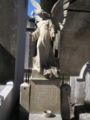 A large number of Croats were forced to leave their traditional homeland over the course of time for economic or political reasons. Thus today there exists quite a large Croat diaspora
outside their traditional homeland in southern Central Europe.
The first large emigration of Croats took place in the 15th and 16th centuries, at the beginning of the Ottoman
conquests in today's Croatia, Bosnia and Herzegovina. People fled to safer areas in what are today Croatia, and other areas of the Habsburg Empire, today's Czech Republic, Slovakia, Austria, Hungary, Slovenia, Croatia and small parts of Italy, Germany and the Ukraine. This migration resulted in Croat communities in Austria and Hungary.
At the end of the 19th and the beginning of the 20th century, larger numbers of Croats emigrated, particularly for economic reasons, to overseas destinations. These included North America (Croatian American and Canadians of Croatian ancestry); South America, above all Chile (Croatian Chilean
) and Argentina (Croatian Argentine
) with smaller communities in Bolivia and Peru; Australia and New Zealand; and South Africa.
A further, larger wave of emigration, this time for political reasons, took place immediately after the end of the Second World War. At this time, both collaborators of the Ustaša regime and refugees who did not want to live under a communist regime fled the country.
In the second half the 20th century numerous Croats left the country as immigrant workers, particularly to go to Germany, Austria, and Switzerland. In addition, some emigrants left for political reasons. This migration made it possible for communist Yugoslavia
to achieve lower unemployment and at the same time the money sent home by emigrants to their families provided an enormous source of foreign exchange income. During this period, tens of thousands of Croats also emigrated to neighboring Slovenia; to this day, Croats of Slovenia
represent the second largest ethnic group in the country after the Slovenes.
The last large wave of Croat emigration occurred during and after the Yugoslav Wars
, when many people from the region (not only Croats but Serbs, Bosniaks and others) left as refugees. Migrant communities already established in countries such as Australia, the USA, and Germany grew as a result.
Abroad, the count is approximate because of incomplete statistical records and naturalization
, but the highest estimates suggest that the Croatian diaspora numbers as much as a third and a half of the total number of Croats. The largest emigrant groups are in Western Europe, mainly in Germany, where it is estimated that there are around 450,000 people with direct Croatian ancestry.
Overseas, the United States contains the largest Croatian emigrant group (544,270 in the 1990 census; 374,271 in the 2000 census), mostly in Ohio, Pennsylvania, Illinois and California, with a sizable community in Alaska
, followed by Australia
(105,747 according to 2001 census, with concentrations in Sydney, Melbourne and Perth) and Canada
(Southern Ontario, British Columbia, Alberta and Newfoundland). Croats have also emigrated in several waves to Latin America, mostly to South America: chiefly Chile, Argentina, and Brazil; estimates of their number vary wildly. There are also smaller groups of Croatian descendants in the UK, France, Romania, Sweden, Netherlands, Spain, Brazil, Mexico, Russia and South Korea. The most important organizations of the Croatian diaspora
are the Croatian Fraternal Union
, Croatian Heritage Foundation
and the Croatian World Congress.
and east of the river Vistula
(referred to as White Croatia) and migrated into the western Dinaric Alps
. White Croats
formed the Principality of Dalmatia in the upper Adriatic. Another wave of Slavic migrants from White Croatia
subsequently founded the Principality of Pannonia
. However, some scholars doubt the above theory, which is based primarily on De Administrando Imperio
, a tenth-century work by Byzantine Emperor Constantine Porphyrogenitus. The doubt rests primarily on archaeological and historiographical grounds. In 603 AD, according to the codices
of the church of Thessaloniki
, Croats, who had invaded Dalmatia
and Istria
, have been confusing Maximus the bishop of Salona
, because they wrote him back. He described the Croats as the "insightful" Slavs. According to a letter of Pope Gregory
, the colonization by Slavs of Imperial estates in Istria, which were available to the public, was known since the 6th century, but was still in the 9th century on the agenda for a People's Assembly in Istria, which brought forth some very remarkable documents. D.A.I. states that the Croats arrived during Heraclius' regnal years (610–640 AD) from "Bagibareja", which translated means that they arrived from "a prominent town". However, there is little archaeological supporting such a migration. Moreover, it is unlikely that any political entity such as White Croatia ever existed, because the justification for it is only in the clearly erroneous translation of the word Bagibareja. Instead, Curta points to some burial assemblages in the northern Dalmatia region, which he dates to 800 AD. Here, there are some exceptionally rich burials showing Byzantine, Avar, Frankish and Slavic material elements, perhaps representing a "community of Croats". That is, Curta suggests that the Croats emerged as some kind of an elite caste of Slavic-speaking warriors, consequently spreading their influence, thus their name, over much of Dalmatia and parts of Pannonia. A theory of migration from the north to the south may be interpreted in this context as a philosophical balance with the propagation of the faith from the south to the north. Subsequent papal recognition ensured the evolution from "a prominent tribe" to a medieval kingdom. However, because of events such as the earthquakes between 350 and 450 AD
, a migration theory cannot be ruled out; also because Ostrogorski claims that the Slavs, who had tried to take Thessaloniki in 597, invaded Crete in 623, but the sources for his thesis are not clearly known, and because Alexandria was taken by Khosrau II of Persia in 616, but Heraclius
recovered it a few years later. Here could be a link to the linguistic Persian theory, too.
According to the Gothic theory, Croats would be descendants of Ostrogoths/eastern Goths
. This theory is based on a historic chronicle
from Thomas the Archdeacon
called Historia Salonitana
where he mentions Croats as Goths. Also, Slavs in the area of modern Croatia are equated to Goths as barbarian people who came from the east in the Chronicle of the Priest of Duklja
, in which is also reported that the Goths had come to receive the high name. The Croatian identity had some attraction to them as also to rulers. The receiving of a shared identity through pilgrimage was a basic tradition in the Graeco-Roman and early Christian antiquity. Aquileia
was since the 4th century an important pilgrimage
center, but it was destroyed in the 5th century by Attila who used the pilgrimage routes to come to Aquileia, but the pilgrims came again. John of Ephesus
used the term "Slavonians" and those, who are called "Avars
" because of their long hair, had risen up against the powerful Empire of the Romans. He described this in connection with the death of Justin II
and furthermore he reported that therefore it became necessary to enlist the barbarian people from the west, called Goths, under the banner of the Roman Empire. Patrick Amory
described that it is not likely that the grouping of the Goths would have had a common ethnicity based on common ancestors. A "Godišnik" was a laborer, servant, who was rented to one year. John of Nikiû
described how Vitalian (general)
was opposed by Marinus, who took all ships he could find and manned them with a large force of Scythian and Gothic archers and sailed in the direction of Byzantium, but he took to flight and the sailors sailed then to Dalmatia, where the origin of the word Župan
was described in the year 1250 in a manuscript on Glagolitic alphabet
on the island of Brač
, because Croats are not only inhabitants of Croatia, they are also inhabitants of a župa. John of Nikiû used the term "Illyrians" who devastated Christian cities and carried off their inhabitants captive, and that no city escaped save except Thessalonica only. John of Nikiû received these informations, because there was a mailboat between Alexandria and Diocleia at that time, because the Emperor thought on the monasteries in the desert as also Saint Jerome
had commented Saint Augustine. But that reminds on the history by Marcus Terentius Varro
about Idomeneus
, who during the Trojan War
, after his return to Crete, sailed first to Illyria
, and then together with Illyrians and Locrians to southern Italy. Whereupon the Goths sacked Troja and Ilium, according to Jordanes
. Snorri Sturluson
claimed, that the Trojans made then a journey to Scandinavia
. This could explain the Haplogroup, see below. There are different theories why the history repeats itself. Wilhelm Max Müller
mentioned in 1893 an inscription in Medinet Habu (temple)
, which mentions the "Hrv-š' " under the feets of Ramses III, who defeated the Sea Peoples
. After the victory over the Sea peoples, the Philistines
were settled by Ramses III in the land of the Hrv-š' (or Hrjw-sch) whose Dukes became very frightened and brought him many tributes. In the 3rd century, the Bosporan Kingdom
hosted the assembly ΧΟΡΟΥΑΘ (Horouat), see Tanais Tablets. Andrei Bely
treated the subject of these few letters Hrv-š' or Hrjw-sch in his Glossolalia
in 1922 and he discovered in it a cross and a circle
, because of the ancient observations of the planet Saturn. It reminds on the village of Miholjanec where the earliest historical mention of the Knights Templar
in Croatia was and not really far from there was discovered the Oldest European calendar. Another theory is since 1946 that the name Palaestīnī derives from the attested Illyria
n locality Palaeste. There are various theories about the relationship of these few letters to various Egyptian gods and Mesopotamian religion
. None of the historians about the origin of the Croats or Philistines is also a Pelasgian and a Partho
- Scythian or Scythian-Grga (see Miholjanec) is attested by the Hungarians. The question which peoples were autochthonus within the area of the Pontic Scythia
remains unanswered until now, but research is going on.
According to the autochthonous model, mostly promoted by the Illyrian Movement
in the 19th century and abandoned by the mid-19th century, the Slav homeland is actually in the area of southern Croatia, and they spread northwards and westwards rather than the other way round. A revision of the theory, developed by Ivan Muzić argues that Slav migration from the north did happen, but the actual number of Slavic settlers was small and that the Illyrian
ethnic substratum was prevalent in the formation of Croatian ethnicity.
The Iranian theory suggests that the Croats are a tribe from Arachosia
. This theory is based solely on linguistic evidence
, namely the spread of the Old Croatian ethnonym *xъrvatъ, almost certainly a borrowing into Slavic, probably from the Middle Persian
"harw, hrw", which means "all, each, every", from the Middle Persian "xwad, hwt", which means "self", or from the Sanskrit
"kratu", which means "insightful"; and the use of the Sanskrit "Bagibareja", which means "a prominent town".
It is important to note that 'origin' theories are often developed amidst a wider context of ideological-political discourse. Nevertheless the Gothic and Iranian origins theories have at times been supported by scholars such as Ivan Muzic. They represent an attempt to distance Croats from other Slavs, especially Serbs, during the volatile period of late 1970s until recently. The Croatian language was spread over great parts of Europe as the mother tongue of Old Church Slavonic
, because of Saint Jerome
and Saints Cyril and Methodius
. Church Slavonic was a divine order and a pastor
has must know the Croatian grammar. The scholar Osman Karatat also writes about the possible Iranian origin.
For all the theories, the documentary and archaeological evidence is quite clear that the Croats emerged within ninth-century northern Dalmatia. At this time, there was no migration to account for, rather, political circumstances created a climate conducive to the emergence of a new polity in the northern Adriatic, between the Carolingian and Byzantine Empire. Ruled by local notables - the 'Croats' - the Croat ethonym later spread (and contracted) following the political fortunes of the Croat Kingdom. The creation of a Christianized Croat kingdom, recognized by Byzantium and the Papacy, cemented its existence and membership of a 'club' of European Christian Monarchic states. As Danijel Dzino summarizes, "the question whether the Croats were migrants to Dalmatia or the indigenous population is not important. The earliest Croat identity we know of appeared with the disappearance of a structural Avar continuum and the establishment of new power structures in Dalmatia which were established on a new social and spiritual system from the West, indigenous regional polities - zupanias, and the use of the ancient past as a justification of that power". The Croats, based in the Nin-Knin-Skradin triangle, might have taken over local rule from an earlier socio-political collective- the Guduscani
of Lika
.
, suggesting that they are more prone to dolichocephalic sub-racial types such as Nordic and Mediterranean than brachycephalic
ones like Alpine
and Dinaric
.
Croats from the northern regions generally have blonde-brown hair, and lighter eye colours, similar to the pigmentation of surrounding peoples such as Slovenians
, Bosnians
and Austrians
. Croats from Dalmatia
and Herzegovina
generally have slightly darker hair, and higher incidence of brown eyes, although lighter hair and eyes are also common.
Genetically
, on the Y chromosome line, a majority (>85%) of Croats belong to one of the three major European Y-DNA haplogroup
s - Haplogroup I
(45%), Haplogroup R1a
(27%) and Haplogroup R1b
(13%).
Later neolithic lineages which originated in the Middle East and brought agriculture to Europe, are present in surprisingly low numbers. The haplogroup
s J
, E
and T
constitute together about 13% - significantly lower than other populations in the region.
The dominant presence of haplogroup I
is rather interesting. This group exists only in Europe and is fairly widespread, but in relatively small percentages. Its frequency in the western Balkans is very high and the only population that has similar levels of the I group are the Scandinavians. Haplogroup I among Croatians is divided in two major subdivisions - I2a1 (33%), typical for the populations of eastern Adriatic and the Balkans, and I1 (9%), typical for north-western Europeans. Haplogroup I is believed to have weathered the last glacial maximum in the western Balkans, migrating north as the ice sheets retreated.
There are a number of relevant conclusions that can be drawn from the genetic data.
First of all it gives strong support to the theory that the region of modern day Croatia served as a refuge for northern populations during the last glacial maximum
(LGM). The eastern Adriatic coast was much further south. The northern and western parts of that sea were steppes and plains, while the modern Croatian islands (rich in Paleolithic archeological sites) were hills and mountains. After the LGM, the offspring of these survivors (haplogroup I) repopulated much of central-eastern and southeastern Europe. Those who remained in the Balkans were the direct male-line ancestors of about 45% of modern day Croats in Croatia and 73% Croats in Herzegovina.
It can be said that the Croats are "the most European people", as no other people have such a high share of this major (and probably the only) Paleolithic European haplogroup.
The second conclusion that can be drawn is that the theory of an Iranian origin . Nonetheless Modern-day Iranians have a significantly different haplogroup distribution, although Iranic communities have lived in eastern Europe for centuries. The low frequency of Anatolian haplogroups suggests that agriculture spread into the region of Croatia primarily by way of cultural contact.
And the third conclusion from the genetic evidence points to the fact Croats are genetically heterogeneous, pointing to a high degree of mixing of newly arrived medieval migrant tribes (such as Slavs) with the indigenous populations that were already present in the region of modern day Croatia. Hence, most modern day Croats are directly descended from the original European population of the region who have lived in the territory by other names, such as Illyrians
, and their forebears. These original inhabitants also served an important role in re-populating Europe after the last ice age.
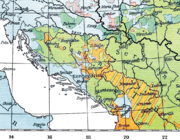
The earliest Croatian state was the Principality of Dalmatia. Prince Trpimir of Dalmatia was called Duke
of Croats in 852. In 925 Croatian Duke of Dalmatia Tomislav of Trpimir
united all Croats. He organized a state by annexing the Principality of Pannonia
as well as maintaining close ties with Pagania and Zahumlje
.
Since the creation of the personal union
with Hungary in 1102, the Croats were at times subjected to enforced Germanization and Magyarization
, especially from the 17th century onward. The ensuing Ottoman
conquests and Habsburg
domination broke the Croatian lands into disunity again, with the majority of Croats living in Croatia proper
and Dalmatia
. Large numbers of Croats also lived in Slavonia
, Istria
, Rijeka
, Herzegovina
and Bosnia. Over the centuries ensued a wave of Croatian emigrants, notably to Molise
in Italy, Burgenland
in Austria and eventually the United States of America and Western Europe.
After the First World War, most Croats were united within the Kingdom of Serbs, Croats and Slovenes, created by joining South Slavic lands under the former Austro-Hungarian rule with the Kingdom of Serbia
. Croats became one of the constituent nations of the new kingdom. The state was transformed into the Kingdom of Yugoslavia
in 1929 and the Croats were united in the new nation with their neighbours – the South Slavs-Yugoslavs
. In 1939, the Croats received a high degree of autonomy when the Banovina of Croatia
was created, which united almost all ethnic Croatian territories within the Kingdom. In the Second World War, the Axis forces created the Independent State of Croatia
led by the Ustaše
movement which sought to create an ethnically pure Croatian state on the territory corresponding to present-day countries of Croatia and Bosnia and Herzegovina.
Post-war Socialist Federal Republic of Yugoslavia
became a federation
consisting of 6 republics, and Croats became one of two constituent peoples of two – Croatia and Bosnia and Herzegovina (in the latter one of the three since 1968). Croats in Serbian autonomous province of Vojvodina
are one of six main ethnic groups composing this region. Following the democratization of society, accompanied with ethnic tensions that emerged in the post-Tito
era, in 1991 the Republic of Croatia declared independence, which was followed by war
with its Serb minority, backed up by Serbia-controlled Yugoslav People's Army
. In the first years of the war, over 200,000 Croats were displaced from their homes as a result of the military actions. In the peak of the fighting, around 550,000 ethnic Croats were displaced altogether during the Yugoslav wars.
Post-war government's policy of easing the immigration of ethnic Croats from abroad encouraged a number of Croatian descendants to return to Croatia. The influx was increased by the arrival of Croatian refugees from Bosnia and Herzegovina. After the war's end in 1995, most Croatian refugees returned to their previous homes, while some (mostly Croat refugees from Bosnia and Herzegovina and Janjevci from Kosovo) moved into the formerly-held Serbian housing.
were subject to Roman Empire
, Venetian and Italian rule; central regions like Lika
and western Herzegovina
were a scene of battlefield against the Ottoman Empire, and have strong epic traditions. In the northern plains, Austro-Hungarian rule has left its marks.
In spite of foreign rule, Croats developed a strong, distinctive culture and sense of national identity, a tribute to the centuries in which they remained distinct, avoiding assimilation of the overlords' population. The most distinctive features of Croatian folklore
include klapa
ensembles of Dalmatia, tamburitza
orchestras of Slavonia
. Folk arts are performed at special events and festivals, perhaps the most distinctive being Alka
of Sinj
, a traditional knights' competition celebrating the victory against Ottoman Turks. The epic tradition is also preserved in epic songs sung with gusle
. Various types of kolo
circular dance are also encountered throughout Croatia.
The Croatian language has a long written tradition with documents like Baška Tablet
dating as early as 1100. The modern standard language is based on ijekavian shtokavian dialect. There are two other dialects, chakavian (spoken in Istria and Dalmatia) and kajkavian, (spoken in Zagorje
and wider Zagreb
area), which to an extent have been influenced and superseded by the standard, yet they still color the respective vernacular speeches. Despite that diversity, Croats take their language as a strong issue of national consciousness and are fairly negative towards foreign influences.
Croats are vastly Roman Catholic, and the church has had a significant role in fostering of the national identity. The confession played a significant role in the Croatian ethnogenesis
.
Ragusan Republic and Dalmatia are the homeland of Croatian literature
. It was developed largely in the renaissance
period, with works of Dalmatian and Ragusa
n authors like Marko Marulić
and Marin Držić
, and continued through baroque
with Ivan Gundulić
, romanticism
with Ivan Mažuranić
and August Šenoa
up to the modern days.
 In the 7th century the Croats, with other Slavs and Avars
, came from Northern Europe to the region where they live today. The Croats were open to Roman art
and culture, and first of all to Christianity. The first churches http://www.culturenet.hr/v1/english/panorama.asp?id=56 were built as royal sanctuaries, and the influences of Roman art were strongest in Dalmatia where urbanization was greatest, and where there were most monuments. Gradually, that influence diminished and there was a certain simplification and alteration of inherited forms; original buildings even appeared.
The largest and most complicated centrally based church from the 9th century is St Donatus in Zadar
, for its time comparable only in its size and beauty with the chapel of Charlemagne
in Aachen
.
The altar
enclosures and windows of these churches were highly decorated with transparent shallow string-like ornamentation
called Croatian pleter (meaning 'to weed', because the strings were threaded and rethreaded through themselves). Some engravings appeared in early Croatian script – Glagolitic. Soon, Glagolitic writing was replaced with Latin
on the altar boundaries and architrave
s of old-Croatian churches.
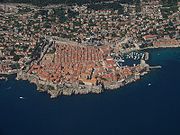 By joining the Hungarian state in the twelfth century, Croatia lost its independence, but it did not lose its ties with the south and the west, and instead this ensured the beginning of a new era of Central European cultural influence.
Early Romanesque art
appeared in Croatia at the beginning of the 11th century, when the monasteries had become strongly developed and the church was undergoing reform. Many valuable monuments and artefacts were created along the Croatian coast, including the 13th century Cathedral of St. Anastasia, Zadar
(in Croatian, St. Stošija).
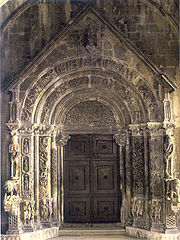
In Croatian Romanesque sculpture there was a move away from decorative interlaced relief work (Croatian pleter) towards the figurative. The best examples of Romanesque sculpture are the wooden doors of Split cathedral by Andrija Buvina
(c.1220) and the stone portal of Trogir cathedral by artisan Radovan (c. 1240).
Early fresco
es are numerous and best preserved in Istria
. In them can be seen evidence of the mix of influences from Eastern and Western Europe. The oldest miniature
s are the 13th century gospels from Split( spalato) and Trogir( Traù).
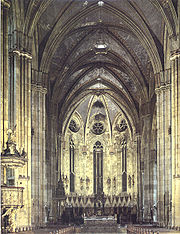 Gothic art
in the 14th century was supported by city councils, preaching orders (such as the Franciscans), and knight
ly culture. It was the golden age of the free Dalmatian cities as they engaged in trade with the Croatian feudal nobility on the continent. The largest urban project of the time was the complete construction of two new towns – Great and Little Ston
and about a kilometre of wall with guard towers between them, after Hadrian's Wall
in England the longest wall in Europe.
The Tatars
destroyed the Romanesque cathedral in Zagreb during their scourge of 1240, but immediately after their departure the Hungarian
king Bela IV granted Zagreb the title of Free City. Soon after, bishop
Timotej began rebuilding the cathedral in the new Gothic style
.
Zadar
was an independent Venetian
city. The most beautiful examples of Gothic humanism in Zadar are its gilded metal reliefs, such as the Arch of St Simon by a Milan
ese artisan of 1380.
Gothic painting is less well preserved, and the finest works are in Istria, such as the fresco
-cycle of Vincent of Kastv in the Church of St. Mary in Škriljinah near Beram, from 1474. From that period also are two of the most ornately illuminated
liturgies done by monks from Split, – Hvals’ Zbornik (now in Zagreb) and the Missal
of Bosnian Duke Hrvoje Vukčić Hrvatinić (now in Istanbul
).
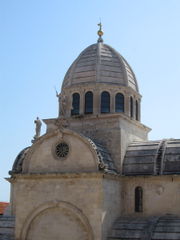
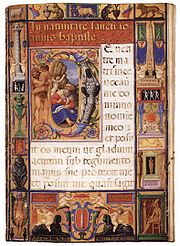 In the 15th century, Croatia was divided among three states – northern Croatia was part of the Austrian Empire
, Dalmatia (with the exception of Dubrovnik) was under the rule of the Venetian Republic and Slavonia was under Ottoman
occupation. Dalmatia was on the periphery of several influences: religious and public architecture clearly influenced by the Italian renaissance
flourished. Three works of that period are of European importance, and contributed to the further development of the Renaissance
: the Cathedral of St. James
in Šibenik
, by Juraj Dalmatinac (1441); the Chapel of Blessed John of Trogir by Nicola Fiorentino (1468); and Sorkočević’s Villa in Lapad, near Dubrovnik (Ragusa) (1521).
In northwestern Croatia the outbreak of war with the Ottoman Empire caused many problems, but in the long term it reinforced the influence of the north, where the Austrians
held power. With permanent danger from the Ottomans in the east, the influence of the Renaissance was modest, while fortification
s proliferated, like the fortified city of Karlovac
, built in 1579, and the Ratkay family's fort in Veliki Tabor, also from the 16th century.
Some famous Croatian Renaissance artists lived and worked in other countries, like the brothers Laurana
(Vranjanin, Franjo and Luka), miniaturist Juraj Klović (also known as Giulio Clovio) and the famous mannerist painter Andrea Medulla (teacher of El Greco
).
In the 17th and 18th centuries, Croatia was reunited with the parts of the country that had been occupied by the Venetian Republic and the Ottoman Empire. Reunification contributed to a sudden flourishing of the arts in every form.
Large fortifications, with radial plan, ditches and numerous towers were built because of the constant Ottoman threat. The two largest were Osijek
and Slavonski Brod
; later they become large cities. Urban planning in the baroque style was in evidence in numerous new towns such as Karlovac
, Bjelovar
, Koprivnica
and Virovitica
. Some old Dalmatian cities also had baroque towers and bastions incorporated in their walls, as in Pula
, Šibenik
and Hvar
. The biggest baroque undertaking was in Dubrovnik in the 17th century, after the catastrophic earthquake of 1667 when almost the entire city was destroyed. Wall painting flourished all over Croatia, from the illusionist frescoes in the church of St. Mary in Samobor
and the church of St Catherine in Zagreb
to the Jesuit church in Dubrovnik. An exchange of artists between Croatia and other parts of Europe took place. The most famous Croatian painter was Federiko Benković, known as Dalmatino, who worked almost his entire life in Italy, while an Italian – Francesco Robba, did the best baroque sculptures in Croatia.
The Romantic
movement in Croatia, arriving from Austria and the north at the beginning of the 19th century, was sentimental, gentle and subtle.
At the end of the 19th century, the architect Herman Bolle undertook one of the largest projects of European historicism
– a half-kilometer long neo-renaissance arcade with twenty domes at the Zagreb cemetery Mirogoj. At the same time the cities of Croatia underwent significant urban renewal.
A structure that emphasizes all three visual arts is the former building of the Ministry of Prayer and Education (the so-called Golden Hall) in Zagreb (by Bolle, 1895). Vlaho Bukovac
brought the spirit of impressionism
from Paris, strongly influencing Croatia's young artists, including those who worked on the Golden Hall). At the Millennium Exhibition in Budapest
they overshadowed all other artistic traditions of Austro-Hungary.
The turbulent twentieth century re-oriented Croatia politically many times and affected it in many other ways, but this could not significantly alter its already unique position at the crossroads of many different cultures.
A child is given a first name chosen by their parents but approved by the godparents of the child (the godparents rarely object to the parents' choice). The given name comes first, the surname last, e.g. "Željko Ivković", where "Željko" is a first name and "Ivković" is a family name. Female names end with -a, e.g. Ivan -> Ivana.
Popular names are mostly of Croatian (Slavic), Christian (Biblical), Greek and Latin origin.
Croatian: Niko, Ivo, Zoran, Goran,Antun and Željko.
Greek: Nikola, Petar and Filip.
Biblical: Ivan, Petar, Franjo and Gabrijel, .
Latin: Marko, Josip, Antonio, Emilijan.
Surnames
Most Croatian surnames (like Bosniak, Serbian and Montenegrin) have the surname suffix -ić . This is often transliterated as -ic or -ici. In English-speaking countries, Croatian names have often been transcribed with a phonetic ending, -ich or -itch. This form is often associated with Croats from before the early 20th century: hence Ivan Ivanković is usually referred to as Ivan Ivankovitch.
The -ić suffix is a Slavic diminutive, originally functioning to create patronymics. Thus the surname Petrić signifies little Petar, similar to Mac ("son of") in Scottish & Irish, and O' (grandson of) in Irish names.
Other common surname suffixes are -ov or -in which is the Slavic possessive case suffix, thus Nikola's son becomes Nikolin, Petar's son Petrov, Ivan's son Ivanov and son of son of Pavao would be Pavlović(Pavlov sin in Croatian). Those are more typical for Croats from Vojvodina, Bulgaria and minority in central Croatia. The two suffixes are often combined.
The most common surnames are Horvat,Marković, Ivanković, Pavlović etc...
Croatian last names are very simillar to Serbian ones along with Bosniak, Montenegrin and Slovene.
But most Croats had their last name before Serbs and Bosniaks due to Ottoman occupation of Serbia and Bosnia.

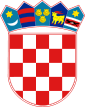
 The Flag of Croatia
consists of a red-white-blue tricolor with the Coat of Arms of Croatia
in the middle. The red-white-blue tricolor was chosen as these were the colours of Pan-Slavism, popular in the 19th century.
The coat-of-arms
consists of the traditional red and white squares or grb, which simply means 'coat-of-arms'. It has been used to symbolise the Croats for centuries; some speculate that it was derived from Red
and White Croatia
, historic lands of the Croatian tribe but there is no generally accepted proof for this theory. The current design added the five crowning shields which represent the historical regions from which Croatia originated.
The red and white checkerboard has been a symbol of Croatian kings since at least the 10th century, ranging in number from 3×3 to 8×8, but most commonly 5×5, like the current coat. The oldest source confirming the coat-of-arms as an official symbol is a genealogy of the Habsburg
s dating from 1512 to 1518. In 1525 it was used on a votive medal. The oldest known example of the šahovnica (chessboard in Croatian) in Croatia is to be found on the wings of four falcons on a baptismal font donated by king Peter Krešimir IV of Croatia (1058–1074) to the Archbishop of Split.
Unlike in many countries, Croatian design more commonly uses symbolism from the coat-of-arms, rather than from the Croatian flag
. This is partly due to the geometric design of the shield which makes it appropriate for use in many graphic contexts (e.g. the insignia of Croatia Airlines
or the design of the shirt for the Croatia national football team
), and partly to the fact that neighbouring countries like Slovenia and Serbia use the same Pan-Slavic colours
on their flags as Croatia.
The Croatian wattle
(pleter or troplet) is also a commonly used symbol which originally comes from monasteries built between the 9th and 12th century. The wattle can be seen in various emblems and is also featured in modern Croatian military ranks
and Croatian police ranks insignia.
South Slavs
The South Slavs are the southern branch of the Slavic peoples and speak South Slavic languages. Geographically, the South Slavs are native to the Balkan peninsula, the southern Pannonian Plain and the eastern Alps...
ethnic group
Ethnic group
An ethnic group is a group of people whose members identify with each other, through a common heritage, often consisting of a common language, a common culture and/or an ideology that stresses common ancestry or endogamy...
mostly living in Croatia
Croatia
Croatia , officially the Republic of Croatia , is a unitary democratic parliamentary republic in Europe at the crossroads of the Mitteleuropa, the Balkans, and the Mediterranean. Its capital and largest city is Zagreb. The country is divided into 20 counties and the city of Zagreb. Croatia covers ...
, Bosnia and Herzegovina
Bosnia and Herzegovina
Bosnia and Herzegovina , sometimes called Bosnia-Herzegovina or simply Bosnia, is a country in Southern Europe, on the Balkan Peninsula. Bordered by Croatia to the north, west and south, Serbia to the east, and Montenegro to the southeast, Bosnia and Herzegovina is almost landlocked, except for the...
and nearby countries. There are around 4 million Croats living inside Croatia and up to 4.5 million throughout the rest of the world. Responding to political, social and economic pressure, many Croats have migrated throughout the world, and established a notable Croatian diaspora
Croatian diaspora
Croatian diaspora refers to the Croatian communities that have formed outside Croatia.Estimates on its size are only approximate because of incomplete statistical records and naturalization, but estimates suggest that the Croatian diaspora numbers between a third and a half of the total number of...
. Large Croat communities exists in The United States, Chile
Chile
Chile ,officially the Republic of Chile , is a country in South America occupying a long, narrow coastal strip between the Andes mountains to the east and the Pacific Ocean to the west. It borders Peru to the north, Bolivia to the northeast, Argentina to the east, and the Drake Passage in the far...
, Argentina
Argentina
Argentina , officially the Argentine Republic , is the second largest country in South America by land area, after Brazil. It is constituted as a federation of 23 provinces and an autonomous city, Buenos Aires...
, Germany
Germany
Germany , officially the Federal Republic of Germany , is a federal parliamentary republic in Europe. The country consists of 16 states while the capital and largest city is Berlin. Germany covers an area of 357,021 km2 and has a largely temperate seasonal climate...
, Austria
Austria
Austria , officially the Republic of Austria , is a landlocked country of roughly 8.4 million people in Central Europe. It is bordered by the Czech Republic and Germany to the north, Slovakia and Hungary to the east, Slovenia and Italy to the south, and Switzerland and Liechtenstein to the...
, Australia
Australia
Australia , officially the Commonwealth of Australia, is a country in the Southern Hemisphere comprising the mainland of the Australian continent, the island of Tasmania, and numerous smaller islands in the Indian and Pacific Oceans. It is the world's sixth-largest country by total area...
, Bolivia
Bolivia
Bolivia officially known as Plurinational State of Bolivia , is a landlocked country in central South America. It is the poorest country in South America...
, Canada
Canada
Canada is a North American country consisting of ten provinces and three territories. Located in the northern part of the continent, it extends from the Atlantic Ocean in the east to the Pacific Ocean in the west, and northward into the Arctic Ocean...
, Serbia
Serbia
Serbia , officially the Republic of Serbia , is a landlocked country located at the crossroads of Central and Southeast Europe, covering the southern part of the Carpathian basin and the central part of the Balkans...
, New Zealand
New Zealand
New Zealand is an island country in the south-western Pacific Ocean comprising two main landmasses and numerous smaller islands. The country is situated some east of Australia across the Tasman Sea, and roughly south of the Pacific island nations of New Caledonia, Fiji, and Tonga...
and South Africa
South Africa
The Republic of South Africa is a country in southern Africa. Located at the southern tip of Africa, it is divided into nine provinces, with of coastline on the Atlantic and Indian oceans...
. Croats are noted for their culture, which has been influenced by a number of other neighbouring cultures through the ages. The strongest influences came from Central Europe and the Mediterranean where, at the same time, Croats have made their own contribution. The Croats are predominantly Catholic with minor groups of Protestants, Muslims, Orthodox, Jews
Jews
The Jews , also known as the Jewish people, are a nation and ethnoreligious group originating in the Israelites or Hebrews of the Ancient Near East. The Jewish ethnicity, nationality, and religion are strongly interrelated, as Judaism is the traditional faith of the Jewish nation...
and secular non religious atheists, agnostics and their language is Croatian
Croatian language
Croatian is the collective name for the standard language and dialects spoken by Croats, principally in Croatia, Bosnia and Herzegovina, the Serbian province of Vojvodina and other neighbouring countries...
.
Locations
Croatia is the nation state of the Croats, while in the adjacent Bosnia and Herzegovina they are one of the three constituent peoples alongside Bosniaks and Serbs.Native Croat minorities exist in or among:
- VojvodinaVojvodinaVojvodina, officially called Autonomous Province of Vojvodina is an autonomous province of Serbia. Its capital and largest city is Novi Sad...
, the northern autonomous province of Serbia, where the Croatian language is official (along with five other languages); the vast majority of the Šokci consider themselves Croats, as well as many BunjevciBunjevciBunjevci are a South Slavic community and ethnic group living mostly in the Bačka region of Serbia and southern Hungary...
(the latter, as well as other nationalities, settled the vast, abandoned area after the Ottoman retreat; this Croat subgroup originates from the south, mostly from the region of BačkaBackaBačka is a geographical area within the Pannonian plain bordered by the river Danube to the west and south, and by the river Tisza to the east of which confluence is located near Titel...
). - The Šokci and BunjevciBunjevciBunjevci are a South Slavic community and ethnic group living mostly in the Bačka region of Serbia and southern Hungary...
communities in Bács-KiskunBács-KiskunBács-Kiskun is a county located in southern Hungary. It was created as a result of World War II, merging the pre war Bács-Bodrog and the southern parts of Pest-Pilis-Solt-Kiskun counties. With an area of 8,445 km2, Bács-Kiskun is the largest county in the country. The terrain is mostly flat...
county in Hungary. - Croats are a recognized people in Montenegro, where the Croatian language is in use; they mostly live in the Bay of KotorBay of KotorThe Bay of Kotor in south-western Montenegro is a winding bay on the Adriatic Sea. The bay, sometimes called Europe's southernmost fjord, is in fact a submerged river canyon of the disintegrated Bokelj River which used to run from the high mountain plateaus of Mount Orjen...
. - a very small community in the Carso and TriesteTriesteTrieste is a city and seaport in northeastern Italy. It is situated towards the end of a narrow strip of land lying between the Adriatic Sea and Italy's border with Slovenia, which lies almost immediately south and east of the city...
area, in Italy. This is the northwesternmost area populated by Croats. They are mostly assimilated, but traces remain in surnames and some place names. - PrimorskaSlovenian LittoralThe Slovenian Littoral is a historical region of Slovenia. Its name recalls the historical Habsburg crown land of the Austrian Littoral, of which the Slovenian Littoral was a part....
, PrekmurjePrekmurjePrekmurje is a geographically, linguistically, culturally and ethnically defined region settled by Slovenes and lying between the Mur River in Slovenia and the Rába Valley in the most western part of Hungary...
and in the MetlikaMetlikaMetlika is a town and municipality in the southeastern Slovenia. It lies on the left bank of the river Kolpa on the border with Croatia. The municipality is at the heart of the area of Bela Krajina, the southeastern part of the traditional region of Lower Carniola. It is now included in the...
area in DolenjskaLower CarniolaLower Carniola was a kreis of the historical Habsburg crown land of Carniola from 1849 till 1919 and is nowadays a traditional region of Slovenia. Its center is Novo Mesto, while other urban centers include Kočevje, Grosuplje, Krško, Trebnje, Mirna, Črnomelj, Semič, and Metlika.-See also:* Upper...
regions in Slovenia. - ZalaZalaZala is the name of an administrative county in Hungary. Itlies in south-western Hungary. It is named after the Zala River. It shares borders with Croatia and Slovenia and the Hungarian counties Vas, Veszprém and Somogy. The capital of Zala county is Zalaegerszeg. Its area is 3784 km²...
, BaranyaBaranya (county)Baranya is the name of an administrative county in present Hungary, in the Baranya region, and also in the former Kingdom of Hungary ....
and Somogy counties in Hungary, which are border areas with Croatia. - Krashovans in Romania mostly consider themselves Croatian - see Croats of RomaniaCroats of RomaniaThe Croats are an ethnic minority in Romania, numbering 6,786 people according to the 2002 census. Croats mainly live in the southwest of the country, particularly in Caraş-Severin County. Declared Croatians form a majority in two Romanian localities: the communes of Caraşova and Lupac...
. - BurgenlandBurgenlandBurgenland is the easternmost and least populous state or Land of Austria. It consists of two Statutarstädte and seven districts with in total 171 municipalities. It is 166 km long from north to south but much narrower from west to east...
in the eastern part of Austria and the bordering areas of western Hungary (the counties of Vas and Győr-Moson-SopronGyor-Moson-SopronGyőr-Moson-Sopron is the name of an administrative county in north-western Hungary, on the border with Slovakia and Austria. It shares borders with the Hungarian counties Komárom-Esztergom, Veszprém and Vas. The capital of Győr-Moson-Sopron county is Győr...
) and Slovakia - the Croats of GradišćeBurgenlandBurgenland is the easternmost and least populous state or Land of Austria. It consists of two Statutarstädte and seven districts with in total 171 municipalities. It is 166 km long from north to south but much narrower from west to east...
- Burgenland CroatsBurgenland CroatsBurgenland Croats are ethnic Croats in the Austrian state of Burgenland. Although an enclave hundreds of kilometres away from their original homeland, they have managed to preserve culture and language for centuries...
. - Kosovo - JanjevciJanjevciJanjevci are Croatian inhabitants of the Kosovo town of Janjevo and surrounding villages, located near Pristina as well as villages centered on Letnica near Vitina ....
(Letničani). - MoliseMoliseMolise is a region of Southern Italy, the second smallest of the regions. It was formerly part of the region of Abruzzi e Molise and now a separate entity...
area in Italy - Molise CroatsMolise CroatsMolise Croats live in the Molise region of Italy in the villages Acquaviva Collecroce , San Felice del Molise , Montemitro and elsewhere. In these three villages they are a majority. There are about 5,000 speakers of the Molise Croatian dialect...
. - SzentendreSzentendreSzentendre is a riverside town in Pest county, Hungary, near the capital city Budapest. It is known for its museums , galleries, and artists. Due to its picturesque appearance and easy rail and river access, it has become a popular destination for tourists staying in Budapest...
town in Hungary, magyarized, but preserving a memory of their Croat origins (from DalmatiaDalmatiaDalmatia is a historical region on the eastern coast of the Adriatic Sea. It stretches from the island of Rab in the northwest to the Bay of Kotor in the southeast. The hinterland, the Dalmatian Zagora, ranges from fifty kilometers in width in the north to just a few kilometers in the south....
). - The area around BratislavaBratislavaBratislava is the capital of Slovakia and, with a population of about 431,000, also the country's largest city. Bratislava is in southwestern Slovakia on both banks of the Danube River. Bordering Austria and Hungary, it is the only national capital that borders two independent countries.Bratislava...
in Slovakia: the villages of Chorvátsky GrobChorvátsky GrobChorvátsky Grob is a village and municipality in western Slovakia in Senec District in the Bratislava region.The village's name Chorvátsky means Croatian. This refers to the Croatian people that have lived in the area since the early 16th century...
, ČunovoCunovoČunovo is a small part of Bratislava, Slovakia, in the southern area near the Hungarian border. It is located close to the Gabčíkovo - Nagymaros Dams.- History :...
, Devínska Nová VesDevínska Nová VesDevínska Nová Ves ) is a borough of Bratislava, the capital of Slovakia. Its western borders are formed by the Morava River, which also represents the national border between Slovakia and Austria....
, RusovceRusovceRusovce castle")) is a borough in southern Bratislava on the right bank of the Danube river, close to the Hungarian border.- History :In the 1st century, there was a Roman settlement named Gerulata in today's Rusovce area. The first preserved written reference to the settlement is from 1208. It...
and JarovceJarovceJarovce is a small borough of Bratislava, Slovakia.- History :The village was first mentioned in 1208 under the name Ban. During the Ottoman wars, many Croats settled here in the 16th century . They are still a strong minority...
. Most have assimilated, but a small minority still preserves its Croatian identity. - The MoraviaMoraviaMoravia is a historical region in Central Europe in the east of the Czech Republic, and one of the former Czech lands, together with Bohemia and Silesia. It takes its name from the Morava River which rises in the northwest of the region...
region in the Czech Republic. The villages of JevišovkaJevišovkaJevišovka, formerly Frélichov is a village and municipality in Břeclav District in the South Moravian Region of the Czech Republic.The municipality covers an area of , and has a population of 568 ....
(Frielištof), Dobré PoleDobré PoleDobré Pole is a village in Břeclav District, South Moravian Region, Czech Republic. It has a population of 397 ....
(Dobro Polje) and Nový PřerovNový PřerovNový Přerov is a village and municipality in Břeclav District in the South Moravian Region of the Czech Republic.The municipality covers an area of , and has a population of 343....
(Nova Prerava).}
The population estimates are reasonably accurate domestically: around four million in Croatia and nearly 600,000 in Bosnia and Herzegovina, or 15% of the total population.
Diaspora
Croatian diaspora
Croatian diaspora refers to the Croatian communities that have formed outside Croatia.Estimates on its size are only approximate because of incomplete statistical records and naturalization, but estimates suggest that the Croatian diaspora numbers between a third and a half of the total number of...
outside their traditional homeland in southern Central Europe.
The first large emigration of Croats took place in the 15th and 16th centuries, at the beginning of the Ottoman
Ottoman Empire
The Ottoman EmpireIt was usually referred to as the "Ottoman Empire", the "Turkish Empire", the "Ottoman Caliphate" or more commonly "Turkey" by its contemporaries...
conquests in today's Croatia, Bosnia and Herzegovina. People fled to safer areas in what are today Croatia, and other areas of the Habsburg Empire, today's Czech Republic, Slovakia, Austria, Hungary, Slovenia, Croatia and small parts of Italy, Germany and the Ukraine. This migration resulted in Croat communities in Austria and Hungary.
At the end of the 19th and the beginning of the 20th century, larger numbers of Croats emigrated, particularly for economic reasons, to overseas destinations. These included North America (Croatian American and Canadians of Croatian ancestry); South America, above all Chile (Croatian Chilean
Croatian Chilean
Chileno-croatas are an important ethnic group in Chile; they are citizens of Chile who were either born in Europe or are Chileans of Croatian descent deriving their Croatian ethnicity from one or both parents...
) and Argentina (Croatian Argentine
Croatian Argentine
Croatians in Argentina or Croatian Argentine are Argentine of Croatian descent. Croats and their descendants have made valuable contributions to their new country...
) with smaller communities in Bolivia and Peru; Australia and New Zealand; and South Africa.
A further, larger wave of emigration, this time for political reasons, took place immediately after the end of the Second World War. At this time, both collaborators of the Ustaša regime and refugees who did not want to live under a communist regime fled the country.
In the second half the 20th century numerous Croats left the country as immigrant workers, particularly to go to Germany, Austria, and Switzerland. In addition, some emigrants left for political reasons. This migration made it possible for communist Yugoslavia
Yugoslavia
Yugoslavia refers to three political entities that existed successively on the western part of the Balkans during most of the 20th century....
to achieve lower unemployment and at the same time the money sent home by emigrants to their families provided an enormous source of foreign exchange income. During this period, tens of thousands of Croats also emigrated to neighboring Slovenia; to this day, Croats of Slovenia
Croats of Slovenia
The Croats are an ethnic group in Slovenia. In the 2002 census 35,642 citizens of Slovenia identified themselves as being ethnically Croats.- History :...
represent the second largest ethnic group in the country after the Slovenes.
The last large wave of Croat emigration occurred during and after the Yugoslav Wars
Yugoslav wars
The Yugoslav Wars were a series of wars, fought throughout the former Yugoslavia between 1991 and 1995. The wars were complex: characterized by bitter ethnic conflicts among the peoples of the former Yugoslavia, mostly between Serbs on the one side and Croats and Bosniaks on the other; but also...
, when many people from the region (not only Croats but Serbs, Bosniaks and others) left as refugees. Migrant communities already established in countries such as Australia, the USA, and Germany grew as a result.
Abroad, the count is approximate because of incomplete statistical records and naturalization
Naturalization
Naturalization is the acquisition of citizenship and nationality by somebody who was not a citizen of that country at the time of birth....
, but the highest estimates suggest that the Croatian diaspora numbers as much as a third and a half of the total number of Croats. The largest emigrant groups are in Western Europe, mainly in Germany, where it is estimated that there are around 450,000 people with direct Croatian ancestry.
Overseas, the United States contains the largest Croatian emigrant group (544,270 in the 1990 census; 374,271 in the 2000 census), mostly in Ohio, Pennsylvania, Illinois and California, with a sizable community in Alaska
Alaska
Alaska is the largest state in the United States by area. It is situated in the northwest extremity of the North American continent, with Canada to the east, the Arctic Ocean to the north, and the Pacific Ocean to the west and south, with Russia further west across the Bering Strait...
, followed by Australia
Croatian Australian
Croatia has been a source of migrants to Australia, particularly in the 1960s and 1970s. In 2006, 128,051 persons resident in Australia identified themselves as having Croatian ancestry.- History :...
(105,747 according to 2001 census, with concentrations in Sydney, Melbourne and Perth) and Canada
Canada
Canada is a North American country consisting of ten provinces and three territories. Located in the northern part of the continent, it extends from the Atlantic Ocean in the east to the Pacific Ocean in the west, and northward into the Arctic Ocean...
(Southern Ontario, British Columbia, Alberta and Newfoundland). Croats have also emigrated in several waves to Latin America, mostly to South America: chiefly Chile, Argentina, and Brazil; estimates of their number vary wildly. There are also smaller groups of Croatian descendants in the UK, France, Romania, Sweden, Netherlands, Spain, Brazil, Mexico, Russia and South Korea. The most important organizations of the Croatian diaspora
Diaspora
A diaspora is "the movement, migration, or scattering of people away from an established or ancestral homeland" or "people dispersed by whatever cause to more than one location", or "people settled far from their ancestral homelands".The word has come to refer to historical mass-dispersions of...
are the Croatian Fraternal Union
Croatian Fraternal Union
The Croatian Fraternal Union , the oldest and largest Croatian organization in North America, is a fraternal benefit society of the Croatian diaspora based out of Pittsburgh, Pennsylvania, USA....
, Croatian Heritage Foundation
Croatian Heritage Foundation
The Croatian Heritage Foundation is an organization which works with Croatian emigrants. It helps connect diaspora groups back to the country. The foundation organizes several programs within Croatia and around the world ranging from language to folklore...
and the Croatian World Congress.
Origins
The origin of the Croatian tribe before the great migration of the Slavs is uncertain. According to the most widely accepted Slavic theory concerning the migrations of the 7th century, the Croatian tribe moved from the area north of the CarpathiansCarpathian Mountains
The Carpathian Mountains or Carpathians are a range of mountains forming an arc roughly long across Central and Eastern Europe, making them the second-longest mountain range in Europe...
and east of the river Vistula
Vistula
The Vistula is the longest and the most important river in Poland, at 1,047 km in length. The watershed area of the Vistula is , of which lies within Poland ....
(referred to as White Croatia) and migrated into the western Dinaric Alps
Dinaric Alps
The Dinaric Alps or Dinarides form a mountain chain in Southern Europe, spanning areas of Slovenia, Croatia, Bosnia and Herzegovina, Serbia, Kosovo, Albania and Montenegro....
. White Croats
White Croats
White Croats is the designation for the group of Slavic tribes, of which seven tribes led by 5 brothers and 2 sisters migrated to Dalmatia as part of the migration of the Croats in the 7th century, being invited to settle on this vastly depopulated area by Roman...
formed the Principality of Dalmatia in the upper Adriatic. Another wave of Slavic migrants from White Croatia
White Croats
White Croats is the designation for the group of Slavic tribes, of which seven tribes led by 5 brothers and 2 sisters migrated to Dalmatia as part of the migration of the Croats in the 7th century, being invited to settle on this vastly depopulated area by Roman...
subsequently founded the Principality of Pannonia
Pannonia
Pannonia was an ancient province of the Roman Empire bounded north and east by the Danube, coterminous westward with Noricum and upper Italy, and southward with Dalmatia and upper Moesia....
. However, some scholars doubt the above theory, which is based primarily on De Administrando Imperio
De Administrando Imperio
De Administrando Imperio is the Latin title of a Greek work written by the 10th-century Eastern Roman Emperor Constantine VII. The Greek title of the work is...
, a tenth-century work by Byzantine Emperor Constantine Porphyrogenitus. The doubt rests primarily on archaeological and historiographical grounds. In 603 AD, according to the codices
Codex
A codex is a book in the format used for modern books, with multiple quires or gatherings typically bound together and given a cover.Developed by the Romans from wooden writing tablets, its gradual replacement...
of the church of Thessaloniki
Thessaloniki
Thessaloniki , historically also known as Thessalonica, Salonika or Salonica, is the second-largest city in Greece and the capital of the region of Central Macedonia as well as the capital of the Decentralized Administration of Macedonia and Thrace...
, Croats, who had invaded Dalmatia
Dalmatia
Dalmatia is a historical region on the eastern coast of the Adriatic Sea. It stretches from the island of Rab in the northwest to the Bay of Kotor in the southeast. The hinterland, the Dalmatian Zagora, ranges from fifty kilometers in width in the north to just a few kilometers in the south....
and Istria
Istria
Istria , formerly Histria , is the largest peninsula in the Adriatic Sea. The peninsula is located at the head of the Adriatic between the Gulf of Trieste and the Bay of Kvarner...
, have been confusing Maximus the bishop of Salona
Salona
Salona was an ancient Illyrian Delmati city in the first millennium BC. The Greeks had set up an emporion there. After the conquest by the Romans, Salona became the capital of the Roman province of Dalmatia...
, because they wrote him back. He described the Croats as the "insightful" Slavs. According to a letter of Pope Gregory
Pope Gregory I
Pope Gregory I , better known in English as Gregory the Great, was pope from 3 September 590 until his death...
, the colonization by Slavs of Imperial estates in Istria, which were available to the public, was known since the 6th century, but was still in the 9th century on the agenda for a People's Assembly in Istria, which brought forth some very remarkable documents. D.A.I. states that the Croats arrived during Heraclius' regnal years (610–640 AD) from "Bagibareja", which translated means that they arrived from "a prominent town". However, there is little archaeological supporting such a migration. Moreover, it is unlikely that any political entity such as White Croatia ever existed, because the justification for it is only in the clearly erroneous translation of the word Bagibareja. Instead, Curta points to some burial assemblages in the northern Dalmatia region, which he dates to 800 AD. Here, there are some exceptionally rich burials showing Byzantine, Avar, Frankish and Slavic material elements, perhaps representing a "community of Croats". That is, Curta suggests that the Croats emerged as some kind of an elite caste of Slavic-speaking warriors, consequently spreading their influence, thus their name, over much of Dalmatia and parts of Pannonia. A theory of migration from the north to the south may be interpreted in this context as a philosophical balance with the propagation of the faith from the south to the north. Subsequent papal recognition ensured the evolution from "a prominent tribe" to a medieval kingdom. However, because of events such as the earthquakes between 350 and 450 AD
365 Crete earthquake
The AD 365 Crete earthquake was an undersea earthquake that occurred at about sunrise on 21 July 365 in the Eastern Mediterranean, with an assumed epicentre near Crete. Geologists today estimate the quake to have been 8 on the Richter Scale or higher, causing widespread destruction in central and...
, a migration theory cannot be ruled out; also because Ostrogorski claims that the Slavs, who had tried to take Thessaloniki in 597, invaded Crete in 623, but the sources for his thesis are not clearly known, and because Alexandria was taken by Khosrau II of Persia in 616, but Heraclius
Heraclius
Heraclius was Byzantine Emperor from 610 to 641.He was responsible for introducing Greek as the empire's official language. His rise to power began in 608, when he and his father, Heraclius the Elder, the exarch of Africa, successfully led a revolt against the unpopular usurper Phocas.Heraclius'...
recovered it a few years later. Here could be a link to the linguistic Persian theory, too.
According to the Gothic theory, Croats would be descendants of Ostrogoths/eastern Goths
Goths
The Goths were an East Germanic tribe of Scandinavian origin whose two branches, the Visigoths and the Ostrogoths, played an important role in the fall of the Roman Empire and the emergence of Medieval Europe....
. This theory is based on a historic chronicle
Chronicle
Generally a chronicle is a historical account of facts and events ranged in chronological order, as in a time line. Typically, equal weight is given for historically important events and local events, the purpose being the recording of events that occurred, seen from the perspective of the...
from Thomas the Archdeacon
Thomas the Archdeacon
Thomas the Archdeacon was a medieval Dalmatian historian and Archdeacon of Split most remembered for Historia Salonitana, a chronicle of the Bishops and Archbishops of Split until 1266....
called Historia Salonitana
Historia Salonitana
Historia Salonitana by Thomas the Archdeacon is a historic chronicle from the 13th century which contains significant information about the early history of the Croats.It was first published by Ivan Lučić Lucius...
where he mentions Croats as Goths. Also, Slavs in the area of modern Croatia are equated to Goths as barbarian people who came from the east in the Chronicle of the Priest of Duklja
Chronicle of the Priest of Duklja
The Chronicle of the Priest of Duklja is a medieval chronicle originally written by a Catholic monk of the Cistercian order by the name of Roger for the Croatian Ban Paul Šubić because an order form by Ban Šubić and a quote of Catholic monk have been discovered...
, in which is also reported that the Goths had come to receive the high name. The Croatian identity had some attraction to them as also to rulers. The receiving of a shared identity through pilgrimage was a basic tradition in the Graeco-Roman and early Christian antiquity. Aquileia
Aquileia
Aquileia is an ancient Roman city in what is now Italy, at the head of the Adriatic at the edge of the lagoons, about 10 km from the sea, on the river Natiso , the course of which has changed somewhat since Roman times...
was since the 4th century an important pilgrimage
Pilgrimage
A pilgrimage is a journey or search of great moral or spiritual significance. Typically, it is a journey to a shrine or other location of importance to a person's beliefs and faith...
center, but it was destroyed in the 5th century by Attila who used the pilgrimage routes to come to Aquileia, but the pilgrims came again. John of Ephesus
John of Ephesus
John of Ephesus was a leader of the non-Chalcedonian Syriac-speaking Church in the sixth century, and one of the earliest and most important of historians who wrote in Syriac.-Life:...
used the term "Slavonians" and those, who are called "Avars
Eurasian Avars
The Eurasian Avars or Ancient Avars were a highly organized nomadic confederacy of mixed origins. They were ruled by a khagan, who was surrounded by a tight-knit entourage of nomad warriors, an organization characteristic of Turko-Mongol groups...
" because of their long hair, had risen up against the powerful Empire of the Romans. He described this in connection with the death of Justin II
Justin II
Justin II was Byzantine Emperor from 565 to 578. He was the husband of Sophia, nephew of Justinian I and the late Empress Theodora, and was therefore a member of the Justinian Dynasty. His reign is marked by war with Persia and the loss of the greater part of Italy...
and furthermore he reported that therefore it became necessary to enlist the barbarian people from the west, called Goths, under the banner of the Roman Empire. Patrick Amory
Patrick Amory
- Early life :Patrick Amory was born in New York City on July 10, 1965 to literary parents. His father, the late Hugh Amory, was noted as the most "rigorous" and "methodologically sophisticated" historian of the book in early America...
described that it is not likely that the grouping of the Goths would have had a common ethnicity based on common ancestors. A "Godišnik" was a laborer, servant, who was rented to one year. John of Nikiû
John of Nikiû
John of Nikiû was an Egyptian Coptic bishop of Nikiû/Pashati in the Nile Delta and appointed general administrator of the monasteries of Upper Egypt in 696...
described how Vitalian (general)
Vitalian (general)
Vitalian was an East Roman general. Rebelling in 513 against Emperor Anastasius I, he won over large parts of the army and people of Thrace. Successive rapprochements with Anastasius failed, and the revolt continued until it was finally defeated in 515. Vitalian then went into hiding until...
was opposed by Marinus, who took all ships he could find and manned them with a large force of Scythian and Gothic archers and sailed in the direction of Byzantium, but he took to flight and the sailors sailed then to Dalmatia, where the origin of the word Župan
Zupan
Żupan was a long garment, always lined, worn by almost all males of the noble social class in the Polish-Lithuanian Commonwealth, typical male attire from the beginning of the 16th to half of the 18th century, still surviving as a part of the Polishnational dress.- Derivation :The name żupan has...
was described in the year 1250 in a manuscript on Glagolitic alphabet
Glagolitic alphabet
The Glagolitic alphabet , also known as Glagolitsa, is the oldest known Slavic alphabet. The name was not coined until many centuries after its creation, and comes from the Old Slavic glagolъ "utterance" . The verb glagoliti means "to speak"...
on the island of Brač
Brac
Brač is an island in the Adriatic Sea within Croatia, with an area of 396 km², making it the largest island in Dalmatia, and the third largest in the Adriatic. Its tallest peak, Vidova Gora, or Mount St. Vid, stands at 778 m, making it the highest island point in the Adriatic...
, because Croats are not only inhabitants of Croatia, they are also inhabitants of a župa. John of Nikiû used the term "Illyrians" who devastated Christian cities and carried off their inhabitants captive, and that no city escaped save except Thessalonica only. John of Nikiû received these informations, because there was a mailboat between Alexandria and Diocleia at that time, because the Emperor thought on the monasteries in the desert as also Saint Jerome
Saint Jerome
Saint Jerome is a Christian church father, best known for translating the Bible into Latin.Saint Jerome may also refer to:*Jerome of Pavia , Bishop of Pavia...
had commented Saint Augustine. But that reminds on the history by Marcus Terentius Varro
Marcus Terentius Varro
Marcus Terentius Varro was an ancient Roman scholar and writer. He is sometimes called Varro Reatinus to distinguish him from his younger contemporary Varro Atacinus.-Biography:...
about Idomeneus
Idomeneus
In Greek mythology, Idomeneus , "strength of Ida") was a Cretan warrior, father of Orsilochus and Chalkiope, son of Deucalion, grandson of Minos and king of Crete. He led the Cretan armies to the Trojan War and was also one of Helen's suitors. Meriones was his charioteer and brother-in-arms...
, who during the Trojan War
Trojan War
In Greek mythology, the Trojan War was waged against the city of Troy by the Achaeans after Paris of Troy took Helen from her husband Menelaus, the king of Sparta. The war is among the most important events in Greek mythology and was narrated in many works of Greek literature, including the Iliad...
, after his return to Crete, sailed first to Illyria
Illyria
In classical antiquity, Illyria was a region in the western part of the Balkan Peninsula inhabited by the Illyrians....
, and then together with Illyrians and Locrians to southern Italy. Whereupon the Goths sacked Troja and Ilium, according to Jordanes
Jordanes
Jordanes, also written Jordanis or Jornandes, was a 6th century Roman bureaucrat, who turned his hand to history later in life....
. Snorri Sturluson
Snorri Sturluson
Snorri Sturluson was an Icelandic historian, poet, and politician. He was twice elected lawspeaker at the Icelandic parliament, the Althing...
claimed, that the Trojans made then a journey to Scandinavia
Scandinavia
Scandinavia is a cultural, historical and ethno-linguistic region in northern Europe that includes the three kingdoms of Denmark, Norway and Sweden, characterized by their common ethno-cultural heritage and language. Modern Norway and Sweden proper are situated on the Scandinavian Peninsula,...
. This could explain the Haplogroup, see below. There are different theories why the history repeats itself. Wilhelm Max Müller
Wilhelm Max Müller
Wilhelm Max Müller, Ph.D. was an United States orientalist.-Biography:He was born at Gleißenberg, Germany, the son of Friedrich Max Müller and the grandson of German romantic poet Wilhelm Müller. He was educated at Erlangen, Berlin, Munich, and Leipzig, where he received his Ph.D...
mentioned in 1893 an inscription in Medinet Habu (temple)
Medinet Habu (temple)
Medinet Habu is the name commonly given to the Mortuary Temple of Ramesses III, an important New Kingdom period structure in the location of the same name on the West Bank of Luxor in Egypt...
, which mentions the "Hrv-š' " under the feets of Ramses III, who defeated the Sea Peoples
Sea Peoples
The Sea Peoples were a confederacy of seafaring raiders of the second millennium BC who sailed into the eastern Mediterranean, caused political unrest, and attempted to enter or control Egyptian territory during the late 19th dynasty and especially during year 8 of Ramesses III of the 20th Dynasty...
. After the victory over the Sea peoples, the Philistines
Philistines
Philistines , Pleshet or Peleset, were a people who occupied the southern coast of Canaan at the beginning of the Iron Age . According to the Bible, they ruled the five city-states of Gaza, Askelon, Ashdod, Ekron and Gath, from the Wadi Gaza in the south to the Yarqon River in the north, but with...
were settled by Ramses III in the land of the Hrv-š' (or Hrjw-sch) whose Dukes became very frightened and brought him many tributes. In the 3rd century, the Bosporan Kingdom
Bosporan Kingdom
The Bosporan Kingdom or the Kingdom of the Cimmerian Bosporus was an ancient state, located in eastern Crimea and the Taman Peninsula on the shores of the Cimmerian Bosporus...
hosted the assembly ΧΟΡΟΥΑΘ (Horouat), see Tanais Tablets. Andrei Bely
Andrei Bely
Andrei Bely was the pseudonym of Boris Nikolaevich Bugaev , a Russian novelist, poet, theorist, and literary critic. His novel Petersburg was regarded by Vladimir Nabokov as one of the four greatest novels of the 20th century.-Biography:...
treated the subject of these few letters Hrv-š' or Hrjw-sch in his Glossolalia
Glossolalia
Glossolalia or speaking in tongues is the fluid vocalizing of speech-like syllables, often as part of religious practice. The significance of glossolalia has varied with time and place, with some considering it a part of a sacred language...
in 1922 and he discovered in it a cross and a circle
Sun cross
The sun cross, also known as the wheel cross, Odin's cross, or Woden's cross, a cross inside a circle, is a common symbol in artifacts of the Americas and Prehistoric Europe, particularly during the Neolithic to Bronze Age periods.-Stone Age:...
, because of the ancient observations of the planet Saturn. It reminds on the village of Miholjanec where the earliest historical mention of the Knights Templar
Knights Templar
The Poor Fellow-Soldiers of Christ and of the Temple of Solomon , commonly known as the Knights Templar, the Order of the Temple or simply as Templars, were among the most famous of the Western Christian military orders...
in Croatia was and not really far from there was discovered the Oldest European calendar. Another theory is since 1946 that the name Palaestīnī derives from the attested Illyria
Illyria
In classical antiquity, Illyria was a region in the western part of the Balkan Peninsula inhabited by the Illyrians....
n locality Palaeste. There are various theories about the relationship of these few letters to various Egyptian gods and Mesopotamian religion
Mesopotamian religion
Mesopotamian religion refers to the religious beliefs and practices followed by the Sumerian and Akkadian peoples living in Mesopotamia that dominated the region for a period of 4200 years from the fourth millennium BC to approximately the 3rd century AD...
. None of the historians about the origin of the Croats or Philistines is also a Pelasgian and a Partho
Parthia
Parthia is a region of north-eastern Iran, best known for having been the political and cultural base of the Arsacid dynasty, rulers of the Parthian Empire....
- Scythian or Scythian-Grga (see Miholjanec) is attested by the Hungarians. The question which peoples were autochthonus within the area of the Pontic Scythia
Scythia
In antiquity, Scythian or Scyths were terms used by the Greeks to refer to certain Iranian groups of horse-riding nomadic pastoralists who dwelt on the Pontic-Caspian steppe...
remains unanswered until now, but research is going on.
According to the autochthonous model, mostly promoted by the Illyrian Movement
Illyrian movement
The Illyrian movement , also Croatian national revival , was a cultural and political campaign with roots in the early modern period, and revived by a group of young Croatian intellectuals during the first half of 19th century, around the years of 1835–1849...
in the 19th century and abandoned by the mid-19th century, the Slav homeland is actually in the area of southern Croatia, and they spread northwards and westwards rather than the other way round. A revision of the theory, developed by Ivan Muzić argues that Slav migration from the north did happen, but the actual number of Slavic settlers was small and that the Illyrian
Illyrians
The Illyrians were a group of tribes who inhabited part of the western Balkans in antiquity and the south-eastern coasts of the Italian peninsula...
ethnic substratum was prevalent in the formation of Croatian ethnicity.
The Iranian theory suggests that the Croats are a tribe from Arachosia
Arachosia
Arachosia is the Latinized form of the Greek name of an Achaemenid and Seleucid governorate in the eastern part of their respective empires, around modern-day southern Afghanistan. The Greek term "Arachosia" corresponds to the Iranian land of Harauti which was between Kandahar in Afghanistan and...
. This theory is based solely on linguistic evidence
Name of Croatia
The name of Croatia derives from Medieval Latin Croātia, itself a derivation of North-West Slavic xrovat-, by liquid metathesis from Common Slavic *xorvat-, from Proto-Slavic *xarwāt-...
, namely the spread of the Old Croatian ethnonym *xъrvatъ, almost certainly a borrowing into Slavic, probably from the Middle Persian
Middle Persian
Middle Persian , indigenously known as "Pârsig" sometimes referred to as Pahlavi or Pehlevi, is the Middle Iranian language/ethnolect of Southwestern Iran that during Sassanid times became a prestige dialect and so came to be spoken in other regions as well. Middle Persian is classified as a...
"harw, hrw", which means "all, each, every", from the Middle Persian "xwad, hwt", which means "self", or from the Sanskrit
Sanskrit
Sanskrit , is a historical Indo-Aryan language and the primary liturgical language of Hinduism, Jainism and Buddhism.Buddhism: besides Pali, see Buddhist Hybrid Sanskrit Today, it is listed as one of the 22 scheduled languages of India and is an official language of the state of Uttarakhand...
"kratu", which means "insightful"; and the use of the Sanskrit "Bagibareja", which means "a prominent town".
It is important to note that 'origin' theories are often developed amidst a wider context of ideological-political discourse. Nevertheless the Gothic and Iranian origins theories have at times been supported by scholars such as Ivan Muzic. They represent an attempt to distance Croats from other Slavs, especially Serbs, during the volatile period of late 1970s until recently. The Croatian language was spread over great parts of Europe as the mother tongue of Old Church Slavonic
Old Church Slavonic
Old Church Slavonic or Old Church Slavic was the first literary Slavic language, first developed by the 9th century Byzantine Greek missionaries Saints Cyril and Methodius who were credited with standardizing the language and using it for translating the Bible and other Ancient Greek...
, because of Saint Jerome
Saint Jerome
Saint Jerome is a Christian church father, best known for translating the Bible into Latin.Saint Jerome may also refer to:*Jerome of Pavia , Bishop of Pavia...
and Saints Cyril and Methodius
Saints Cyril and Methodius
Saints Cyril and Methodius were two Byzantine Greek brothers born in Thessaloniki in the 9th century. They became missionaries of Christianity among the Slavic peoples of Bulgaria, Great Moravia and Pannonia. Through their work they influenced the cultural development of all Slavs, for which they...
. Church Slavonic was a divine order and a pastor
Pastor
The word pastor usually refers to an ordained leader of a Christian congregation. When used as an ecclesiastical styling or title, this role may be abbreviated to "Pr." or often "Ps"....
has must know the Croatian grammar. The scholar Osman Karatat also writes about the possible Iranian origin.
For all the theories, the documentary and archaeological evidence is quite clear that the Croats emerged within ninth-century northern Dalmatia. At this time, there was no migration to account for, rather, political circumstances created a climate conducive to the emergence of a new polity in the northern Adriatic, between the Carolingian and Byzantine Empire. Ruled by local notables - the 'Croats' - the Croat ethonym later spread (and contracted) following the political fortunes of the Croat Kingdom. The creation of a Christianized Croat kingdom, recognized by Byzantium and the Papacy, cemented its existence and membership of a 'club' of European Christian Monarchic states. As Danijel Dzino summarizes, "the question whether the Croats were migrants to Dalmatia or the indigenous population is not important. The earliest Croat identity we know of appeared with the disappearance of a structural Avar continuum and the establishment of new power structures in Dalmatia which were established on a new social and spiritual system from the West, indigenous regional polities - zupanias, and the use of the ancient past as a justification of that power". The Croats, based in the Nin-Knin-Skradin triangle, might have taken over local rule from an earlier socio-political collective- the Guduscani
Guduscani
The Guduscani were an indetermined tribe on the then western border with the Avar Khaganate, around present day Gacka , between upper Kupa river and the Dalmatian coast...
of Lika
Lika
Lika is a mountainous region in central Croatia, roughly bound by the Velebit mountain from the southwest and the Plješevica mountain from the northeast. On the north-west end Lika is bounded by Ogulin-Plaški basin, and on the south-east by the Malovan pass...
.
Genetics & Anthropology
Anthropologically, the craniometrical measurements made on the Croat population show Croats from Croatia are predominantly dolichocephalicDolichocephaly
Dolichocephaly is another word for scaphocephaly, a condition where the head is longer than would be expected, relative to the width of the head.It can present in cases of Sensenbrenner syndrome, Sotos syndrome, as well as Marfan syndrome.-External links:...
, suggesting that they are more prone to dolichocephalic sub-racial types such as Nordic and Mediterranean than brachycephalic
Brachycephaly
Brachycephaly, also known as flat head syndrome, is a type of cephalic disorder. This can result from premature fusion of the coronal sutures or from external deformation . The coronal suture is the fibrous joint that unites the frontal bone with the two parietal bones of the skull. The parietal...
ones like Alpine
Alpine race
The Alpine race is an historical racial classification or sub-race of humans, considered a branch of the Caucasian race. The term is not commonly used today, but was popular in the early 20th century.-History:...
and Dinaric
Dinaric race
The Dinaric race is one of the sub-categories of the Europid race into which it was divided by physical anthropologists in the early 20th century...
.
Croats from the northern regions generally have blonde-brown hair, and lighter eye colours, similar to the pigmentation of surrounding peoples such as Slovenians
Slovenians
The Slovenes, Slovene people, Slovenians, or Slovenian people are a South Slavic people primarily associated with Slovenia and the Slovene language.-Population:Most Slovenes today live within the borders of the independent Slovenia...
, Bosnians
Bosnians
Bosnians are people who reside in, or come from, Bosnia and Herzegovina. By the modern state definition a Bosnian can be anyone who holds citizenship of the state. This includes, but is not limited to, members of the constituent ethnic groups of Bosnia and Herzegovina: Bosniaks, Bosnian Serbs and...
and Austrians
Austrians
Austrians are a nation and ethnic group, consisting of the population of the Republic of Austria and its historical predecessor states who share a common Austrian culture and Austrian descent....
. Croats from Dalmatia
Dalmatia
Dalmatia is a historical region on the eastern coast of the Adriatic Sea. It stretches from the island of Rab in the northwest to the Bay of Kotor in the southeast. The hinterland, the Dalmatian Zagora, ranges from fifty kilometers in width in the north to just a few kilometers in the south....
and Herzegovina
Herzegovina
Herzegovina is the southern region of Bosnia and Herzegovina. While there is no official border distinguishing it from the Bosnian region, it is generally accepted that the borders of the region are Croatia to the west, Montenegro to the south, the canton boundaries of the Herzegovina-Neretva...
generally have slightly darker hair, and higher incidence of brown eyes, although lighter hair and eyes are also common.
Genetically
Genetics
Genetics , a discipline of biology, is the science of genes, heredity, and variation in living organisms....
, on the Y chromosome line, a majority (>85%) of Croats belong to one of the three major European Y-DNA haplogroup
Haplogroup
In the study of molecular evolution, a haplogroup is a group of similar haplotypes that share a common ancestor having the same single nucleotide polymorphism mutation in both haplotypes. Because a haplogroup consists of similar haplotypes, this is what makes it possible to predict a haplogroup...
s - Haplogroup I
Haplogroup I (Y-DNA)
In human genetics, Haplogroup I is a Y-chromosome DNA haplogroup, a subgroup of haplogroup IJ, itself a derivative of Haplogroup IJK....
(45%), Haplogroup R1a
Haplogroup R1a (Y-DNA)
Haplogroup R1a is the phylogenetic name of a major clade of Human Y-chromosome DNA haplogroups. In other words, it is a way of grouping a significant part of all modern men according to a shared male-line ancestor. It is common in many parts of Eurasia and is frequently discussed in human...
(27%) and Haplogroup R1b
Haplogroup R1b (Y-DNA)
The point of origin of R1b is thought to lie in Eurasia, most likely in Western Asia. T. Karafet et al. estimated the age of R1, the parent of R1b, as 18,500 years before present....
(13%).
Later neolithic lineages which originated in the Middle East and brought agriculture to Europe, are present in surprisingly low numbers. The haplogroup
Haplogroup
In the study of molecular evolution, a haplogroup is a group of similar haplotypes that share a common ancestor having the same single nucleotide polymorphism mutation in both haplotypes. Because a haplogroup consists of similar haplotypes, this is what makes it possible to predict a haplogroup...
s J
Haplogroup J (Y-DNA)
In human genetics, Haplogroup J is a Y-chromosome DNA haplogroup. It is one of the major male lines of all living men...
, E
Haplogroup E (Y-DNA)
In human genetics, Haplogroup E is a human Y-chromosome DNA haplogroup. Haplogroup E is one of the two main branches of the older Haplogroup DE, the other main branch being haplogroup D. The E clade is divided into two subclades: E1 and E2 .-Origins:Underhill et al. proposed that haplogroup E...
and T
Haplogroup T (Y-DNA)
In human genetics, Haplogroup T is a human Y-chromosome DNA haplogroup. From 2002 to 2008, it was known as Haplogroup K2. It should not be confused with the mitochondrial DNA haplogroup T, of the same name....
constitute together about 13% - significantly lower than other populations in the region.
The dominant presence of haplogroup I
Haplogroup I (Y-DNA)
In human genetics, Haplogroup I is a Y-chromosome DNA haplogroup, a subgroup of haplogroup IJ, itself a derivative of Haplogroup IJK....
is rather interesting. This group exists only in Europe and is fairly widespread, but in relatively small percentages. Its frequency in the western Balkans is very high and the only population that has similar levels of the I group are the Scandinavians. Haplogroup I among Croatians is divided in two major subdivisions - I2a1 (33%), typical for the populations of eastern Adriatic and the Balkans, and I1 (9%), typical for north-western Europeans. Haplogroup I is believed to have weathered the last glacial maximum in the western Balkans, migrating north as the ice sheets retreated.
There are a number of relevant conclusions that can be drawn from the genetic data.
First of all it gives strong support to the theory that the region of modern day Croatia served as a refuge for northern populations during the last glacial maximum
Last Glacial Maximum
The Last Glacial Maximum refers to a period in the Earth's climate history when ice sheets were at their maximum extension, between 26,500 and 19,000–20,000 years ago, marking the peak of the last glacial period. During this time, vast ice sheets covered much of North America, northern Europe and...
(LGM). The eastern Adriatic coast was much further south. The northern and western parts of that sea were steppes and plains, while the modern Croatian islands (rich in Paleolithic archeological sites) were hills and mountains. After the LGM, the offspring of these survivors (haplogroup I) repopulated much of central-eastern and southeastern Europe. Those who remained in the Balkans were the direct male-line ancestors of about 45% of modern day Croats in Croatia and 73% Croats in Herzegovina.
It can be said that the Croats are "the most European people", as no other people have such a high share of this major (and probably the only) Paleolithic European haplogroup.
The second conclusion that can be drawn is that the theory of an Iranian origin . Nonetheless Modern-day Iranians have a significantly different haplogroup distribution, although Iranic communities have lived in eastern Europe for centuries. The low frequency of Anatolian haplogroups suggests that agriculture spread into the region of Croatia primarily by way of cultural contact.
And the third conclusion from the genetic evidence points to the fact Croats are genetically heterogeneous, pointing to a high degree of mixing of newly arrived medieval migrant tribes (such as Slavs) with the indigenous populations that were already present in the region of modern day Croatia. Hence, most modern day Croats are directly descended from the original European population of the region who have lived in the territory by other names, such as Illyrians
Illyrians
The Illyrians were a group of tribes who inhabited part of the western Balkans in antiquity and the south-eastern coasts of the Italian peninsula...
, and their forebears. These original inhabitants also served an important role in re-populating Europe after the last ice age.
History
The earliest Croatian state was the Principality of Dalmatia. Prince Trpimir of Dalmatia was called Duke
Duke
A duke or duchess is a member of the nobility, historically of highest rank below the monarch, and historically controlling a duchy...
of Croats in 852. In 925 Croatian Duke of Dalmatia Tomislav of Trpimir
Tomislav
King Tomislav was a ruler of Croatia in the Middle Ages. He reigned from 910 until 928, first as Duke of Dalmatian Croatia in 910–925, and then became first King of the Croatian Kingdom in 925–928....
united all Croats. He organized a state by annexing the Principality of Pannonia
Pannonia
Pannonia was an ancient province of the Roman Empire bounded north and east by the Danube, coterminous westward with Noricum and upper Italy, and southward with Dalmatia and upper Moesia....
as well as maintaining close ties with Pagania and Zahumlje
Zahumlje
Zachlumia or Zahumlje was a medieval principality located in modern-day regions of Herzegovina and southern Dalmatia...
.
Since the creation of the personal union
Pacta conventa (Croatia)
Pacta conventa was an alleged agreement concluded between King Coloman of Hungary and the Croatian nobility. While some claim it was a voluntary union of the two crowns, leaving Croatia as a sovereign state, others argue that Hungary simply annexed Croatia outright and forced an agreement...
with Hungary in 1102, the Croats were at times subjected to enforced Germanization and Magyarization
Magyarization
Magyarization is a kind of assimilation or acculturation, a process by which non-Magyar elements came to adopt Magyar culture and language due to social pressure .Defiance or appeals to the Nationalities Law, met...
, especially from the 17th century onward. The ensuing Ottoman
Ottoman Empire
The Ottoman EmpireIt was usually referred to as the "Ottoman Empire", the "Turkish Empire", the "Ottoman Caliphate" or more commonly "Turkey" by its contemporaries...
conquests and Habsburg
Habsburg
The House of Habsburg , also found as Hapsburg, and also known as House of Austria is one of the most important royal houses of Europe and is best known for being an origin of all of the formally elected Holy Roman Emperors between 1438 and 1740, as well as rulers of the Austrian Empire and...
domination broke the Croatian lands into disunity again, with the majority of Croats living in Croatia proper
History of Croatia
Croatia first appeared as a duchy in the 7th century and then as a kingdom in the 10th century. From the 12th century it remained a distinct state with its ruler and parliament, but it obeyed the kings and emperors of various neighboring powers, primarily Hungary and Austria. The period from the...
and Dalmatia
History of Dalmatia
The History of Dalmatia concerns the history of the eastern coast of the Adriatic Sea and its inland regions, stretching from the 2nd century BC up to the present....
. Large numbers of Croats also lived in Slavonia
Slavonia
Slavonia is a geographical and historical region in eastern Croatia...
, Istria
Istria
Istria , formerly Histria , is the largest peninsula in the Adriatic Sea. The peninsula is located at the head of the Adriatic between the Gulf of Trieste and the Bay of Kvarner...
, Rijeka
Rijeka
Rijeka is the principal seaport and the third largest city in Croatia . It is located on Kvarner Bay, an inlet of the Adriatic Sea and has a population of 128,735 inhabitants...
, Herzegovina
Herzegovina
Herzegovina is the southern region of Bosnia and Herzegovina. While there is no official border distinguishing it from the Bosnian region, it is generally accepted that the borders of the region are Croatia to the west, Montenegro to the south, the canton boundaries of the Herzegovina-Neretva...
and Bosnia. Over the centuries ensued a wave of Croatian emigrants, notably to Molise
Molise
Molise is a region of Southern Italy, the second smallest of the regions. It was formerly part of the region of Abruzzi e Molise and now a separate entity...
in Italy, Burgenland
Burgenland
Burgenland is the easternmost and least populous state or Land of Austria. It consists of two Statutarstädte and seven districts with in total 171 municipalities. It is 166 km long from north to south but much narrower from west to east...
in Austria and eventually the United States of America and Western Europe.
After the First World War, most Croats were united within the Kingdom of Serbs, Croats and Slovenes, created by joining South Slavic lands under the former Austro-Hungarian rule with the Kingdom of Serbia
History of Serbia
The history of Serbia, as a country, begins with the Slavic settlements in the Balkans, established in the 6th century in territories governed by the Byzantine Empire. Through centuries, the Serbian realm evolved into a Kingdom , then an Empire , before the Ottomans annexed it in 1540...
. Croats became one of the constituent nations of the new kingdom. The state was transformed into the Kingdom of Yugoslavia
Kingdom of Yugoslavia
The Kingdom of Yugoslavia was a state stretching from the Western Balkans to Central Europe which existed during the often-tumultuous interwar era of 1918–1941...
in 1929 and the Croats were united in the new nation with their neighbours – the South Slavs-Yugoslavs
Yugoslavs
Yugoslavs is a national designation used by a minority of South Slavs across the countries of the former Yugoslavia and in the diaspora...
. In 1939, the Croats received a high degree of autonomy when the Banovina of Croatia
Banovina of Croatia
The Banovina of Croatia or Banate of Croatia was a province of the Kingdom of Yugoslavia between 1939 and 1943 . Its capital was at Zagreb and it included most of present-day Croatia along with portions of Bosnia and Herzegovina and Serbia...
was created, which united almost all ethnic Croatian territories within the Kingdom. In the Second World War, the Axis forces created the Independent State of Croatia
Independent State of Croatia
The Independent State of Croatia was a World War II puppet state of Nazi Germany, established on a part of Axis-occupied Yugoslavia. The NDH was founded on 10 April 1941, after the invasion of Yugoslavia by the Axis powers. All of Bosnia and Herzegovina was annexed to NDH, together with some parts...
led by the Ustaše
Ustaše
The Ustaša - Croatian Revolutionary Movement was a Croatian fascist anti-Yugoslav separatist movement. The ideology of the movement was a blend of fascism, Nazism, and Croatian nationalism. The Ustaše supported the creation of a Greater Croatia that would span to the River Drina and to the border...
movement which sought to create an ethnically pure Croatian state on the territory corresponding to present-day countries of Croatia and Bosnia and Herzegovina.
Post-war Socialist Federal Republic of Yugoslavia
Socialist Federal Republic of Yugoslavia
The Socialist Federal Republic of Yugoslavia was the Yugoslav state that existed from the abolition of the Yugoslav monarchy until it was dissolved in 1992 amid the Yugoslav Wars. It was a socialist state and a federation made up of six socialist republics: Bosnia and Herzegovina, Croatia,...
became a federation
Federation
A federation , also known as a federal state, is a type of sovereign state characterized by a union of partially self-governing states or regions united by a central government...
consisting of 6 republics, and Croats became one of two constituent peoples of two – Croatia and Bosnia and Herzegovina (in the latter one of the three since 1968). Croats in Serbian autonomous province of Vojvodina
Vojvodina
Vojvodina, officially called Autonomous Province of Vojvodina is an autonomous province of Serbia. Its capital and largest city is Novi Sad...
are one of six main ethnic groups composing this region. Following the democratization of society, accompanied with ethnic tensions that emerged in the post-Tito
Josip Broz Tito
Marshal Josip Broz Tito – 4 May 1980) was a Yugoslav revolutionary and statesman. While his presidency has been criticized as authoritarian, Tito was a popular public figure both in Yugoslavia and abroad, viewed as a unifying symbol for the nations of the Yugoslav federation...
era, in 1991 the Republic of Croatia declared independence, which was followed by war
Croatian War of Independence
The Croatian War of Independence was fought from 1991 to 1995 between forces loyal to the government of Croatia—which had declared independence from the Socialist Federal Republic of Yugoslavia —and the Serb-controlled Yugoslav People's Army and local Serb forces, with the JNA ending its combat...
with its Serb minority, backed up by Serbia-controlled Yugoslav People's Army
Yugoslav People's Army
The Yugoslav People's Army , also referred to as the Yugoslav National Army , was the military of the Socialist Federal Republic of Yugoslavia.-Origins:The origins of the JNA can...
. In the first years of the war, over 200,000 Croats were displaced from their homes as a result of the military actions. In the peak of the fighting, around 550,000 ethnic Croats were displaced altogether during the Yugoslav wars.
Post-war government's policy of easing the immigration of ethnic Croats from abroad encouraged a number of Croatian descendants to return to Croatia. The influx was increased by the arrival of Croatian refugees from Bosnia and Herzegovina. After the war's end in 1995, most Croatian refugees returned to their previous homes, while some (mostly Croat refugees from Bosnia and Herzegovina and Janjevci from Kosovo) moved into the formerly-held Serbian housing.
Culture and traditions
The area settled by Croats has a large diversity of historical and cultural influences, as well as diversity of terrain and geography. The coastland areas of Dalmatia and IstriaIstria
Istria , formerly Histria , is the largest peninsula in the Adriatic Sea. The peninsula is located at the head of the Adriatic between the Gulf of Trieste and the Bay of Kvarner...
were subject to Roman Empire
Roman Empire
The Roman Empire was the post-Republican period of the ancient Roman civilization, characterised by an autocratic form of government and large territorial holdings in Europe and around the Mediterranean....
, Venetian and Italian rule; central regions like Lika
Lika
Lika is a mountainous region in central Croatia, roughly bound by the Velebit mountain from the southwest and the Plješevica mountain from the northeast. On the north-west end Lika is bounded by Ogulin-Plaški basin, and on the south-east by the Malovan pass...
and western Herzegovina
Herzegovina
Herzegovina is the southern region of Bosnia and Herzegovina. While there is no official border distinguishing it from the Bosnian region, it is generally accepted that the borders of the region are Croatia to the west, Montenegro to the south, the canton boundaries of the Herzegovina-Neretva...
were a scene of battlefield against the Ottoman Empire, and have strong epic traditions. In the northern plains, Austro-Hungarian rule has left its marks.
In spite of foreign rule, Croats developed a strong, distinctive culture and sense of national identity, a tribute to the centuries in which they remained distinct, avoiding assimilation of the overlords' population. The most distinctive features of Croatian folklore
Folklore
Folklore consists of legends, music, oral history, proverbs, jokes, popular beliefs, fairy tales and customs that are the traditions of a culture, subculture, or group. It is also the set of practices through which those expressive genres are shared. The study of folklore is sometimes called...
include klapa
Klapa
The klapa music is a form of traditional Croatian a cappella singing . The word klapa translates as "a group of friends" and traces its roots to littoral church singing . The motifs in general celebrate love, wine , country and sea...
ensembles of Dalmatia, tamburitza
Tamburitza
Tamburica or Tamboura refers to any member of a family of long-necked lutes popular in Eastern and Southern Europe, particularly Croatia , Serbia and Hungary. It is also known in southern Slovenia and Burgenland...
orchestras of Slavonia
Slavonia
Slavonia is a geographical and historical region in eastern Croatia...
. Folk arts are performed at special events and festivals, perhaps the most distinctive being Alka
Alka
The Sinjska alka is a knight tournament which has been held every first Sunday in the month of August in town of Sinj, Croatia since 1715, commemorating the victory over Ottoman Turkish administration...
of Sinj
Sinj
Sinj is a town in the continental part of Split-Dalmatia County, Croatia. The town itself has a population of 11,448, while the population of the administrative municipality which includes surrounding villages is 24,832 ....
, a traditional knights' competition celebrating the victory against Ottoman Turks. The epic tradition is also preserved in epic songs sung with gusle
Gusle
The Gusle is a single-stringed musical instrument traditionally used in the Dinarides region of the Balkans ....
. Various types of kolo
Kolo (dance)
Kolo , is a collective folk dance, danced primarily by people from Bosnia and Herzegovina, Croatia, Macedonia, Montenegro, and Serbia. It is performed amongst groups of people holding each other's having their hands around each other's waists...
circular dance are also encountered throughout Croatia.
The Croatian language has a long written tradition with documents like Baška Tablet
Baška tablet
Baška tablet is one of the first monuments containing an inscription in the Croatian language, dating from the year 1100.The tablet was discovered by scholars in 1851 in the paving of the Romanesque church of St. Lucy in Jurandvor, near Baška, on the island of Krk...
dating as early as 1100. The modern standard language is based on ijekavian shtokavian dialect. There are two other dialects, chakavian (spoken in Istria and Dalmatia) and kajkavian, (spoken in Zagorje
Zagorje
Hrvatsko Zagorje is a region in northern Croatia.Zagorje may also refer to:*Zagorje ob Savi, a town and a municipality in Slovenia*NK Zagorje, a Slovenian football club-See also:...
and wider Zagreb
Zagreb
Zagreb is the capital and the largest city of the Republic of Croatia. It is in the northwest of the country, along the Sava river, at the southern slopes of the Medvednica mountain. Zagreb lies at an elevation of approximately above sea level. According to the last official census, Zagreb's city...
area), which to an extent have been influenced and superseded by the standard, yet they still color the respective vernacular speeches. Despite that diversity, Croats take their language as a strong issue of national consciousness and are fairly negative towards foreign influences.
Croats are vastly Roman Catholic, and the church has had a significant role in fostering of the national identity. The confession played a significant role in the Croatian ethnogenesis
Ethnogenesis
Ethnogenesis is the process by which a group of human beings comes to be understood or to understand themselves as ethnically distinct from the wider social landscape from which their grouping emerges...
.
Ragusan Republic and Dalmatia are the homeland of Croatian literature
Croatian literature
Croatian literature is a definition given to the compilation of novels, dramas, short stories, poems and other various work of written kind entirely attributed to the medieval and modern culture of the Croats and the Croatian language....
. It was developed largely in the renaissance
Renaissance
The Renaissance was a cultural movement that spanned roughly the 14th to the 17th century, beginning in Italy in the Late Middle Ages and later spreading to the rest of Europe. The term is also used more loosely to refer to the historical era, but since the changes of the Renaissance were not...
period, with works of Dalmatian and Ragusa
Dubrovnik
Dubrovnik is a Croatian city on the Adriatic Sea coast, positioned at the terminal end of the Isthmus of Dubrovnik. It is one of the most prominent tourist destinations on the Adriatic, a seaport and the centre of Dubrovnik-Neretva county. Its total population is 42,641...
n authors like Marko Marulić
Marko Marulic
Marko Marulić |Split]], 18 August 1450 – Split, 5 January 1524) was a Croatian national poet and Christian humanist, known as the Crown of the Croatian Medieval Age and the father of the Croatian Renaissance. He signed his works as Marko Marulić Splićanin , Marko Pečenić, Marcus Marulus ...
and Marin Držić
Marin Držic
Marin Držić is considered the finest Croatian Renaissance playwright and prose writer.- Life :Born into a large and well to do family in Dubrovnik, Držić was trained and ordained as a priest — a calling very unsuitable for his rebel temperament...
, and continued through baroque
Baroque
The Baroque is a period and the style that used exaggerated motion and clear, easily interpreted detail to produce drama, tension, exuberance, and grandeur in sculpture, painting, literature, dance, and music...
with Ivan Gundulić
Ivan Gundulic
Ivan Franov Gundulić is the most celebrated Croatian Baroque poet from the Republic of Ragusa. His work embodies central characteristics of Roman Catholic Counter-Reformation: religious fervor, insistence on "vanity of this world" and zeal in opposition to "infidels." Gundulić's major...
, romanticism
Romanticism
Romanticism was an artistic, literary and intellectual movement that originated in the second half of the 18th century in Europe, and gained strength in reaction to the Industrial Revolution...
with Ivan Mažuranić
Ivan Mažuranic
Ivan Mažuranić was a Croatian poet, linguist and politician—probably the most important figure in Croatia's cultural life in the mid-19th century...
and August Šenoa
August Šenoa
August Šenoa was a Croatian novelist, critic, editor, poet, and dramatist....
up to the modern days.
Art
Eurasian Avars
The Eurasian Avars or Ancient Avars were a highly organized nomadic confederacy of mixed origins. They were ruled by a khagan, who was surrounded by a tight-knit entourage of nomad warriors, an organization characteristic of Turko-Mongol groups...
, came from Northern Europe to the region where they live today. The Croats were open to Roman art
Roman art
Roman art has the visual arts made in Ancient Rome, and in the territories of the Roman Empire. Major forms of Roman art are architecture, painting, sculpture and mosaic work...
and culture, and first of all to Christianity. The first churches http://www.culturenet.hr/v1/english/panorama.asp?id=56 were built as royal sanctuaries, and the influences of Roman art were strongest in Dalmatia where urbanization was greatest, and where there were most monuments. Gradually, that influence diminished and there was a certain simplification and alteration of inherited forms; original buildings even appeared.
The largest and most complicated centrally based church from the 9th century is St Donatus in Zadar
Zadar
Zadar is a city in Croatia on the Adriatic Sea. It is the centre of Zadar county and the wider northern Dalmatian region. Population of the city is 75,082 citizens...
, for its time comparable only in its size and beauty with the chapel of Charlemagne
Charlemagne
Charlemagne was King of the Franks from 768 and Emperor of the Romans from 800 to his death in 814. He expanded the Frankish kingdom into an empire that incorporated much of Western and Central Europe. During his reign, he conquered Italy and was crowned by Pope Leo III on 25 December 800...
in Aachen
Aachen
Aachen has historically been a spa town in North Rhine-Westphalia, Germany. Aachen was a favoured residence of Charlemagne, and the place of coronation of the Kings of Germany. Geographically, Aachen is the westernmost town of Germany, located along its borders with Belgium and the Netherlands, ...
.
The altar
Altar
An altar is any structure upon which offerings such as sacrifices are made for religious purposes. Altars are usually found at shrines, and they can be located in temples, churches and other places of worship...
enclosures and windows of these churches were highly decorated with transparent shallow string-like ornamentation
Ornament (architecture)
In architecture and decorative art, ornament is a decoration used to embellish parts of a building or object. Large figurative elements such as monumental sculpture and their equivalents in decorative art are excluded from the term; most ornament does not include human figures, and if present they...
called Croatian pleter (meaning 'to weed', because the strings were threaded and rethreaded through themselves). Some engravings appeared in early Croatian script – Glagolitic. Soon, Glagolitic writing was replaced with Latin
Latin
Latin is an Italic language originally spoken in Latium and Ancient Rome. It, along with most European languages, is a descendant of the ancient Proto-Indo-European language. Although it is considered a dead language, a number of scholars and members of the Christian clergy speak it fluently, and...
on the altar boundaries and architrave
Architrave
An architrave is the lintel or beam that rests on the capitals of the columns. It is an architectural element in Classical architecture.-Classical architecture:...
s of old-Croatian churches.
Early Romanesque art
Romanesque art
Romanesque art refers to the art of Western Europe from approximately 1000 AD to the rise of the Gothic style in the 13th century, or later, depending on region. The preceding period is increasingly known as the Pre-Romanesque...
appeared in Croatia at the beginning of the 11th century, when the monasteries had become strongly developed and the church was undergoing reform. Many valuable monuments and artefacts were created along the Croatian coast, including the 13th century Cathedral of St. Anastasia, Zadar
Cathedral of St. Anastasia, Zadar
The Cathedral of St. Anastasia is a Roman Catholic cathedral in Zadar, Croatia. It is the seat of the Archdiocese of Zadar.Today's cathedral was built in the Romanesque style. It is the largest church in all of Dalmatia...
(in Croatian, St. Stošija).
In Croatian Romanesque sculpture there was a move away from decorative interlaced relief work (Croatian pleter) towards the figurative. The best examples of Romanesque sculpture are the wooden doors of Split cathedral by Andrija Buvina
Andrija Buvina
Andrija Buvina was a 13th century medieval Croatian sculptor and painter. His work is often associated with the Romanesque period.Actually, the best example of Romanesque sculpture in Croatia are the wooden doors on Cathedral of St. Duje in Split, done by Andrija Buvina c. 1214...
(c.1220) and the stone portal of Trogir cathedral by artisan Radovan (c. 1240).
Early fresco
Fresco
Fresco is any of several related mural painting types, executed on plaster on walls or ceilings. The word fresco comes from the Greek word affresca which derives from the Latin word for "fresh". Frescoes first developed in the ancient world and continued to be popular through the Renaissance...
es are numerous and best preserved in Istria
Istria
Istria , formerly Histria , is the largest peninsula in the Adriatic Sea. The peninsula is located at the head of the Adriatic between the Gulf of Trieste and the Bay of Kvarner...
. In them can be seen evidence of the mix of influences from Eastern and Western Europe. The oldest miniature
Miniature (illuminated manuscript)
The word miniature, derived from the Latin minium, red lead, is a picture in an ancient or medieval illuminated manuscript; the simple decoration of the early codices having been miniated or delineated with that pigment...
s are the 13th century gospels from Split( spalato) and Trogir( Traù).
Gothic art
Gothic art was a Medieval art movement that developed in France out of Romanesque art in the mid-12th century, led by the concurrent development of Gothic architecture. It spread to all of Western Europe, but took over art more completely north of the Alps, never quite effacing more classical...
in the 14th century was supported by city councils, preaching orders (such as the Franciscans), and knight
Knight
A knight was a member of a class of lower nobility in the High Middle Ages.By the Late Middle Ages, the rank had become associated with the ideals of chivalry, a code of conduct for the perfect courtly Christian warrior....
ly culture. It was the golden age of the free Dalmatian cities as they engaged in trade with the Croatian feudal nobility on the continent. The largest urban project of the time was the complete construction of two new towns – Great and Little Ston
Ston
Ston is a village and municipality in the Dubrovnik-Neretva County of Croatia, located at the south of isthmus of the Pelješac peninsula. The town of Ston is the center of the Ston municipality.- Demographics :...
and about a kilometre of wall with guard towers between them, after Hadrian's Wall
Hadrian's Wall
Hadrian's Wall was a defensive fortification in Roman Britain. Begun in AD 122, during the rule of emperor Hadrian, it was the first of two fortifications built across Great Britain, the second being the Antonine Wall, lesser known of the two because its physical remains are less evident today.The...
in England the longest wall in Europe.
The Tatars
Tatars
Tatars are a Turkic speaking ethnic group , numbering roughly 7 million.The majority of Tatars live in the Russian Federation, with a population of around 5.5 million, about 2 million of which in the republic of Tatarstan.Significant minority populations are found in Uzbekistan, Kazakhstan,...
destroyed the Romanesque cathedral in Zagreb during their scourge of 1240, but immediately after their departure the Hungarian
Kingdom of Hungary
The Kingdom of Hungary comprised present-day Hungary, Slovakia and Croatia , Transylvania , Carpatho Ruthenia , Vojvodina , Burgenland , and other smaller territories surrounding present-day Hungary's borders...
king Bela IV granted Zagreb the title of Free City. Soon after, bishop
Bishop
A bishop is an ordained or consecrated member of the Christian clergy who is generally entrusted with a position of authority and oversight. Within the Catholic Church, Eastern Orthodox, Oriental Orthodox Churches, in the Assyrian Church of the East, in the Independent Catholic Churches, and in the...
Timotej began rebuilding the cathedral in the new Gothic style
Gothic architecture
Gothic architecture is a style of architecture that flourished during the high and late medieval period. It evolved from Romanesque architecture and was succeeded by Renaissance architecture....
.
Zadar
Zadar
Zadar is a city in Croatia on the Adriatic Sea. It is the centre of Zadar county and the wider northern Dalmatian region. Population of the city is 75,082 citizens...
was an independent Venetian
Republic of Venice
The Republic of Venice or Venetian Republic was a state originating from the city of Venice in Northeastern Italy. It existed for over a millennium, from the late 7th century until 1797. It was formally known as the Most Serene Republic of Venice and is often referred to as La Serenissima, in...
city. The most beautiful examples of Gothic humanism in Zadar are its gilded metal reliefs, such as the Arch of St Simon by a Milan
Milan
Milan is the second-largest city in Italy and the capital city of the region of Lombardy and of the province of Milan. The city proper has a population of about 1.3 million, while its urban area, roughly coinciding with its administrative province and the bordering Province of Monza and Brianza ,...
ese artisan of 1380.
Gothic painting is less well preserved, and the finest works are in Istria, such as the fresco
Fresco
Fresco is any of several related mural painting types, executed on plaster on walls or ceilings. The word fresco comes from the Greek word affresca which derives from the Latin word for "fresh". Frescoes first developed in the ancient world and continued to be popular through the Renaissance...
-cycle of Vincent of Kastv in the Church of St. Mary in Škriljinah near Beram, from 1474. From that period also are two of the most ornately illuminated
Illuminated
Illuminated may refer to:* Illuminated dance floor, a floor with panels which light up with different colours* Illuminated Film Company, a British animation house...
liturgies done by monks from Split, – Hvals’ Zbornik (now in Zagreb) and the Missal
Missal
A missal is a liturgical book containing all instructions and texts necessary for the celebration of Mass throughout the year.-History:Before the compilation of such books, several books were used when celebrating Mass...
of Bosnian Duke Hrvoje Vukčić Hrvatinić (now in Istanbul
Istanbul
Istanbul , historically known as Byzantium and Constantinople , is the largest city of Turkey. Istanbul metropolitan province had 13.26 million people living in it as of December, 2010, which is 18% of Turkey's population and the 3rd largest metropolitan area in Europe after London and...
).
Austrian Empire
The Austrian Empire was a modern era successor empire, which was centered on what is today's Austria and which officially lasted from 1804 to 1867. It was followed by the Empire of Austria-Hungary, whose proclamation was a diplomatic move that elevated Hungary's status within the Austrian Empire...
, Dalmatia (with the exception of Dubrovnik) was under the rule of the Venetian Republic and Slavonia was under Ottoman
Ottoman Empire
The Ottoman EmpireIt was usually referred to as the "Ottoman Empire", the "Turkish Empire", the "Ottoman Caliphate" or more commonly "Turkey" by its contemporaries...
occupation. Dalmatia was on the periphery of several influences: religious and public architecture clearly influenced by the Italian renaissance
Italian Renaissance
The Italian Renaissance began the opening phase of the Renaissance, a period of great cultural change and achievement in Europe that spanned the period from the end of the 13th century to about 1600, marking the transition between Medieval and Early Modern Europe...
flourished. Three works of that period are of European importance, and contributed to the further development of the Renaissance
Renaissance
The Renaissance was a cultural movement that spanned roughly the 14th to the 17th century, beginning in Italy in the Late Middle Ages and later spreading to the rest of Europe. The term is also used more loosely to refer to the historical era, but since the changes of the Renaissance were not...
: the Cathedral of St. James
Cathedral of St. James, Šibenik
The Cathedral of St. James inŠibenik, Croatia is a triple-nave basilica with three apses and a dome in the city of Šibenik, Croatia. It is the church of the Catholic Church in Croatia, and the see of the Šibenik diocese. It is also the most important architectural monument of the Renaissance in...
in Šibenik
Šibenik
Šibenik is a historic town in Croatia, with population of 51,553 . It is located in central Dalmatia where the river Krka flows into the Adriatic Sea...
, by Juraj Dalmatinac (1441); the Chapel of Blessed John of Trogir by Nicola Fiorentino (1468); and Sorkočević’s Villa in Lapad, near Dubrovnik (Ragusa) (1521).
In northwestern Croatia the outbreak of war with the Ottoman Empire caused many problems, but in the long term it reinforced the influence of the north, where the Austrians
Habsburg
The House of Habsburg , also found as Hapsburg, and also known as House of Austria is one of the most important royal houses of Europe and is best known for being an origin of all of the formally elected Holy Roman Emperors between 1438 and 1740, as well as rulers of the Austrian Empire and...
held power. With permanent danger from the Ottomans in the east, the influence of the Renaissance was modest, while fortification
Fortification
Fortifications are military constructions and buildings designed for defence in warfare and military bases. Humans have constructed defensive works for many thousands of years, in a variety of increasingly complex designs...
s proliferated, like the fortified city of Karlovac
Karlovac
Karlovac is a city and municipality in central Croatia. The city proper has a population of 49,082, while the municipality has a population of 59,395 inhabitants .Karlovac is the administrative centre of Karlovac County...
, built in 1579, and the Ratkay family's fort in Veliki Tabor, also from the 16th century.
Some famous Croatian Renaissance artists lived and worked in other countries, like the brothers Laurana
Laurana
Laurana may refer to:*Francesco Laurana , Dalmatian-born sculptor and medalist*Luciano Laurana , Italian architect and engineer*Laurana Kanan, a fictional character from the Dragonlance fantasy series...
(Vranjanin, Franjo and Luka), miniaturist Juraj Klović (also known as Giulio Clovio) and the famous mannerist painter Andrea Medulla (teacher of El Greco
El Greco
El Greco was a painter, sculptor and architect of the Spanish Renaissance. "El Greco" was a nickname, a reference to his ethnic Greek origin, and the artist normally signed his paintings with his full birth name in Greek letters, Δομήνικος Θεοτοκόπουλος .El Greco was born on Crete, which was at...
).
In the 17th and 18th centuries, Croatia was reunited with the parts of the country that had been occupied by the Venetian Republic and the Ottoman Empire. Reunification contributed to a sudden flourishing of the arts in every form.
Large fortifications, with radial plan, ditches and numerous towers were built because of the constant Ottoman threat. The two largest were Osijek
Osijek
Osijek is the fourth largest city in Croatia with a population of 83,496 in 2011. It is the largest city and the economic and cultural centre of the eastern Croatian region of Slavonia, as well as the administrative centre of Osijek-Baranja county...
and Slavonski Brod
Slavonski Brod
Slavonski Brod is a city in Croatia, with a population of 59,507 in 2011. The city was known as Marsonia in the Roman Empire, and as Brod na Savi 1244–1934. It is the sixth largest city in Croatia, after Zagreb, Split, Rijeka, Osijek and Zadar. Located in the region of Slavonia, it is the...
; later they become large cities. Urban planning in the baroque style was in evidence in numerous new towns such as Karlovac
Karlovac
Karlovac is a city and municipality in central Croatia. The city proper has a population of 49,082, while the municipality has a population of 59,395 inhabitants .Karlovac is the administrative centre of Karlovac County...
, Bjelovar
Bjelovar
Bjelovar is a city in central Croatia. It is the administrative centre of Bjelovar-Bilogora County. During the 2001 census, there were 41,869 inhabitants, 90.51% which are Croats....
, Koprivnica
Koprivnica
Koprivnica is a city in northern Croatia. It is the capital of the Koprivnica-Križevci county. In 2011 the city administrative area had a total population of 30,872, with 23,896 in the city itself.-Population:...
and Virovitica
Virovitica
Virovitica is a Croatian town near the Croatian-Hungarian border. It is situated near the Drava river and belongs to the historic region of Slavonia. Virovitica has a population of 14,663, with 21,327 people in the municipality...
. Some old Dalmatian cities also had baroque towers and bastions incorporated in their walls, as in Pula
Pula
Pula is the largest city in Istria County, Croatia, situated at the southern tip of the Istria peninsula, with a population of 62,080 .Like the rest of the region, it is known for its mild climate, smooth sea, and unspoiled nature. The city has a long tradition of winemaking, fishing,...
, Šibenik
Šibenik
Šibenik is a historic town in Croatia, with population of 51,553 . It is located in central Dalmatia where the river Krka flows into the Adriatic Sea...
and Hvar
Hvar
- Climate :The climate of Hvar is characterized by mild winters and warm summers. The yearly average air temperature is , 686 mm of precipitation fall on the town of Hvar on average every year and the town has a total of 2800 sunshine hours per year. For comparison Hvar has an average of 7.7...
. The biggest baroque undertaking was in Dubrovnik in the 17th century, after the catastrophic earthquake of 1667 when almost the entire city was destroyed. Wall painting flourished all over Croatia, from the illusionist frescoes in the church of St. Mary in Samobor
Samobor
Samobor is a town in the Zagreb County, Croatia. It is part of the Zagreb metropolitan area.-Geography:Samobor is located west of Zagreb, between the eastern slopes of the Samoborsko gorje , in the Sava River valley.-Population:...
and the church of St Catherine in Zagreb
Zagreb
Zagreb is the capital and the largest city of the Republic of Croatia. It is in the northwest of the country, along the Sava river, at the southern slopes of the Medvednica mountain. Zagreb lies at an elevation of approximately above sea level. According to the last official census, Zagreb's city...
to the Jesuit church in Dubrovnik. An exchange of artists between Croatia and other parts of Europe took place. The most famous Croatian painter was Federiko Benković, known as Dalmatino, who worked almost his entire life in Italy, while an Italian – Francesco Robba, did the best baroque sculptures in Croatia.
The Romantic
Romanticism
Romanticism was an artistic, literary and intellectual movement that originated in the second half of the 18th century in Europe, and gained strength in reaction to the Industrial Revolution...
movement in Croatia, arriving from Austria and the north at the beginning of the 19th century, was sentimental, gentle and subtle.
At the end of the 19th century, the architect Herman Bolle undertook one of the largest projects of European historicism
Historicism
Historicism is a mode of thinking that assigns a central and basic significance to a specific context, such as historical period, geographical place and local culture. As such it is in contrast to individualist theories of knowledges such as empiricism and rationalism, which neglect the role of...
– a half-kilometer long neo-renaissance arcade with twenty domes at the Zagreb cemetery Mirogoj. At the same time the cities of Croatia underwent significant urban renewal.
A structure that emphasizes all three visual arts is the former building of the Ministry of Prayer and Education (the so-called Golden Hall) in Zagreb (by Bolle, 1895). Vlaho Bukovac
Vlaho Bukovac
Vlaho Bukovac was a Croatian painter.-Life:- Early life :Bukovac was born Biagio Faggioni in the town of Cavtat south of Dubrovnik in Dalmatia...
brought the spirit of impressionism
Impressionism
Impressionism was a 19th-century art movement that originated with a group of Paris-based artists whose independent exhibitions brought them to prominence during the 1870s and 1880s...
from Paris, strongly influencing Croatia's young artists, including those who worked on the Golden Hall). At the Millennium Exhibition in Budapest
Budapest
Budapest is the capital of Hungary. As the largest city of Hungary, it is the country's principal political, cultural, commercial, industrial, and transportation centre. In 2011, Budapest had 1,733,685 inhabitants, down from its 1989 peak of 2,113,645 due to suburbanization. The Budapest Commuter...
they overshadowed all other artistic traditions of Austro-Hungary.
The turbulent twentieth century re-oriented Croatia politically many times and affected it in many other ways, but this could not significantly alter its already unique position at the crossroads of many different cultures.
Naming system
Given namesA child is given a first name chosen by their parents but approved by the godparents of the child (the godparents rarely object to the parents' choice). The given name comes first, the surname last, e.g. "Željko Ivković", where "Željko" is a first name and "Ivković" is a family name. Female names end with -a, e.g. Ivan -> Ivana.
Popular names are mostly of Croatian (Slavic), Christian (Biblical), Greek and Latin origin.
Croatian: Niko, Ivo, Zoran, Goran,Antun and Željko.
Greek: Nikola, Petar and Filip.
Biblical: Ivan, Petar, Franjo and Gabrijel, .
Latin: Marko, Josip, Antonio, Emilijan.
Surnames
Most Croatian surnames (like Bosniak, Serbian and Montenegrin) have the surname suffix -ić . This is often transliterated as -ic or -ici. In English-speaking countries, Croatian names have often been transcribed with a phonetic ending, -ich or -itch. This form is often associated with Croats from before the early 20th century: hence Ivan Ivanković is usually referred to as Ivan Ivankovitch.
The -ić suffix is a Slavic diminutive, originally functioning to create patronymics. Thus the surname Petrić signifies little Petar, similar to Mac ("son of") in Scottish & Irish, and O' (grandson of) in Irish names.
Other common surname suffixes are -ov or -in which is the Slavic possessive case suffix, thus Nikola's son becomes Nikolin, Petar's son Petrov, Ivan's son Ivanov and son of son of Pavao would be Pavlović(Pavlov sin in Croatian). Those are more typical for Croats from Vojvodina, Bulgaria and minority in central Croatia. The two suffixes are often combined.
The most common surnames are Horvat,Marković, Ivanković, Pavlović etc...
Croatian last names are very simillar to Serbian ones along with Bosniak, Montenegrin and Slovene.
But most Croats had their last name before Serbs and Bosniaks due to Ottoman occupation of Serbia and Bosnia.
Symbols
Flag of Croatia
The flag of Croatia is one of the state symbols of Croatia. It consists of three equal size, horizontal stripes in colours red, white and blue. The flag combines the colours of the flags of the Kingdom of Croatia , the Kingdom of Slavonia and the Kingdom of Dalmatia...
consists of a red-white-blue tricolor with the Coat of Arms of Croatia
Coat of arms of Croatia
The coat of arms of Croatia consists of one main shield and five smaller shields which form a crown over the main shield. The main coat of arms is a checkerboard that consists of 13 red and 12 silver fields. It's commonly known as šahovnica or grb...
in the middle. The red-white-blue tricolor was chosen as these were the colours of Pan-Slavism, popular in the 19th century.
The coat-of-arms
Coat of arms of Croatia
The coat of arms of Croatia consists of one main shield and five smaller shields which form a crown over the main shield. The main coat of arms is a checkerboard that consists of 13 red and 12 silver fields. It's commonly known as šahovnica or grb...
consists of the traditional red and white squares or grb, which simply means 'coat-of-arms'. It has been used to symbolise the Croats for centuries; some speculate that it was derived from Red
Red Croatia
Red Croatia , is a historical term used for the southeastern parts of Roman Dalmatia and some other territories, in including part of present-day Montenegro, greater part of Albania, the Herzegovina part of Bosnia and Herzegovina and southeastern Croatia, stretching across the Adriatic Sea.Another...
and White Croatia
White Croatia
White Croatia is a vaguely defined area, said to lie somewhere in Central Europe, near Bavaria, beyond Hungary on south of Poland and west of Ukraine, and adjacent to the Frankish Empire from which the part of White Croats crossed the Carpathians and migrated in the 7th century into Dalmatia...
, historic lands of the Croatian tribe but there is no generally accepted proof for this theory. The current design added the five crowning shields which represent the historical regions from which Croatia originated.
The red and white checkerboard has been a symbol of Croatian kings since at least the 10th century, ranging in number from 3×3 to 8×8, but most commonly 5×5, like the current coat. The oldest source confirming the coat-of-arms as an official symbol is a genealogy of the Habsburg
Habsburg
The House of Habsburg , also found as Hapsburg, and also known as House of Austria is one of the most important royal houses of Europe and is best known for being an origin of all of the formally elected Holy Roman Emperors between 1438 and 1740, as well as rulers of the Austrian Empire and...
s dating from 1512 to 1518. In 1525 it was used on a votive medal. The oldest known example of the šahovnica (chessboard in Croatian) in Croatia is to be found on the wings of four falcons on a baptismal font donated by king Peter Krešimir IV of Croatia (1058–1074) to the Archbishop of Split.
Unlike in many countries, Croatian design more commonly uses symbolism from the coat-of-arms, rather than from the Croatian flag
Flag of Croatia
The flag of Croatia is one of the state symbols of Croatia. It consists of three equal size, horizontal stripes in colours red, white and blue. The flag combines the colours of the flags of the Kingdom of Croatia , the Kingdom of Slavonia and the Kingdom of Dalmatia...
. This is partly due to the geometric design of the shield which makes it appropriate for use in many graphic contexts (e.g. the insignia of Croatia Airlines
Croatia Airlines
Croatia Airlines d.d. is the national airline and flag carrier of the Republic of Croatia. Based in Buzin, Zagreb, the airline is a member of Star Alliance and operates domestic and international services. Its main base is Zagreb Airport, with focus cities being Dubrovnik and Split...
or the design of the shirt for the Croatia national football team
Croatia national football team
The Croatia national football team represents Croatia in international football. The team is controlled by the Croatian Football Federation, the governing body for football in the country, and has been managed since 2006 by former player Slaven Bilić...
), and partly to the fact that neighbouring countries like Slovenia and Serbia use the same Pan-Slavic colours
Pan-Slavic colours
The Pan-Slavic colors, red, blue and white, are colors used on the flags of some Slavic peoples and states in which the majority of inhabitants possess a Slavic background. Their use symbolizes the common origin of the Slavic peoples...
on their flags as Croatia.
The Croatian wattle
Croatian wattle
The Croatian wattle, known as the pleter or troplet in Croatian, is a type of interlace, most characteristic for its three-ribbon pattern. It is one of the most often used patterns of pre-romanesque Croatian art...
(pleter or troplet) is also a commonly used symbol which originally comes from monasteries built between the 9th and 12th century. The wattle can be seen in various emblems and is also featured in modern Croatian military ranks
Croatian military ranks
-Army and air force ranks:Labels ranks for members of the Croatian Ground Army and Croatian Air Force and Defense are identical, except that the ranks of the Ground Army are gold and of the Air Force and Defense are silver.-Navy ranks:...
and Croatian police ranks insignia.
See also
- List of Croats
- Croatian diasporaCroatian diasporaCroatian diaspora refers to the Croatian communities that have formed outside Croatia.Estimates on its size are only approximate because of incomplete statistical records and naturalization, but estimates suggest that the Croatian diaspora numbers between a third and a half of the total number of...
- Croatian literatureCroatian literatureCroatian literature is a definition given to the compilation of novels, dramas, short stories, poems and other various work of written kind entirely attributed to the medieval and modern culture of the Croats and the Croatian language....
- Croatian ChileanCroatian ChileanChileno-croatas are an important ethnic group in Chile; they are citizens of Chile who were either born in Europe or are Chileans of Croatian descent deriving their Croatian ethnicity from one or both parents...
- Croatian ArgentineCroatian ArgentineCroatians in Argentina or Croatian Argentine are Argentine of Croatian descent. Croats and their descendants have made valuable contributions to their new country...
- Croatian BrazilianCroatian BrazilianCroatian Brazilian is a Brazilian person of full, partial, or predominantly Croat ancestry, or a Croat-born person residing in Brazil.It is estimated that 45,000 Croatians live in Brazil...
- Croatian AustralianCroatian AustralianCroatia has been a source of migrants to Australia, particularly in the 1960s and 1970s. In 2006, 128,051 persons resident in Australia identified themselves as having Croatian ancestry.- History :...
- Croatian Peruvian
- Croatian Greek Catholic Church
- Croatian MuslimsIslam in CroatiaIslam in Croatia was introduced by the Ottoman Empire. Muslims constitute about 1.3% of the population of Croatia. The Islamic Community of Croatia is officially recognized by the state....
- Croatian Eastern Orthodox ChristiansCroatian Orthodox ChurchThe Croatian Orthodox Church was a religious body created during World War II by the Ustasha regime in the Independent State of Croatia .The reason for formation of this church was that Orthodox Christian Churches are state-based...
- Timeline of Croatian historyTimeline of Croatian historyThis is a timeline of Croatian history. To read about the background to these events, see History of Croatia. See also the list of rulers of Croatia and years in Croatia.This timeline is incomplete; some important events may be missing...
- List of Medieval Slavic tribes
External links
Matica hrvatska- Review of Croatian History at Central and Eastern European Online Library
- Croats of Bosnia and Herzegovina: History
- The Croatian nation at the beginning of the 20th century
- Famous Croats and Croatian cultural heritage
- Croatian Heritage Foundation Hrvatska matica iseljenika
- Croatians in Arizona
