

Religion in the European Union

Encyclopedia
The most common religion
in the European Union
is Christianity
, although many other religions are practiced as well. The European Union is officially secular
, though some member states have state churches: these are Malta (Roman Catholic), Greece (Eastern Orthodox), Denmark (Lutheran), and part of the United Kingdom - England (Anglican). In recent times, there has been an increase in secularisation in most countries in EU resulting in fewer adherents and decreased church attendance
.
churches (especially in northern Europe) and Eastern Orthodoxy (in eastern Europe).
Judaism
has had a long, and frequently dark, history in Europe. Prior to the Holocaust
, the area of the European Union had a Jewish population of 5,375,000; it was largely exterminated in German Nazi death camps. In 2002 the EU had a Jewish population
of barely over a million, including about 519,000 in France and about 273,500 in the United Kingdom (compare with about 5.8 million Jews living in Israel
.). In view of the history of persecution of Jews in Europe
, antisemitism remains a matter of attention within the EU.
Immigration has introduced other religions into European countries, most notably Islam
. It was estimated that the Union's Muslim population in 2009 was 13 million people. The country with the largest percentage of Muslims in Western Europe is France
with 8%-10% (6-7 million) followed by Germany
(4.5 million), the UK (1.6 million) and Italy
(1.5 million),. Aside from Turkey, the only possible future member to have a majority of Muslims is Albania, although other Balkan states like Bosnia also have sizeable Muslim populations.
 Suspicions of Muslim populations have risen in some Western European countries such as the UK, where 38% see Muslims as a threat to national security. In France, on the other hand, only 21% see Muslims as a threat to their society and 52% say the Muslim community has been unfairly criticised. In both countries however less than a quarter approved of faith schools and a religious presence in schools and workplaces, while in Italy this is not considered to be a problem. In the Netherlands, there is a slim majority stating they have an unfavourable view of Muslims. A series of clashes and incidents connected to the religion have occurred in recent years, including: the murder of Theo van Gogh
by Mohammed Bouyeri
, the 2004 Madrid train bombings, the Jyllands-Posten Muhammad cartoons controversy
with continuing attempts to kill the cartoonist, and numerous terrorist attacks in the UK such as the 7 July 2005 London bombings
. In response to Islamic extremism, some figures, such as Justice Freedom & Security Commissioner Franco Frattini, have suggested creating a "European Islam
" - a branch of the Islamic faith that is compatible with European values.
Due to the rise of other religions, and some intolerance towards them, the Commission now regularly meets with different religious leaders. In November 2005, a delegation from the European Humanist Federation
was invited to a meeting by Commissioner-President
Barroso. This was the first time a humanist
group had been consulted in this manner by the Commission
. President Romano Prodi
has refused such meetings, despite meeting various religious leaders, causing some resentment by humanists.
Other religions present in the EU territories include Buddhism
, Hinduism
and Neopaganism
. Neopaganism is a movement that revives and reinvents (in its reconstructionistic
approach) the ancient pagan spiritualities
of the European peoples
. Neopagan religions are legally recognised by the governments of the United Kingdom
, Denmark
, Sweden
and Spain
.
. There are no formal ties to any religion
and no mention of religion in any current or proposed treaty. Discussion over the draft texts of the European Constitution and later the Treaty of Lisbon have included proposals to mention Christianity
and/or God
in the preamble of the text. This call has been supported by Christian religious leaders, most notably the Pope
. However explicit inclusion of a link to religion faced opposition from secularists and the final Constitution referred to Europe's "Religious and Humanist inheritance". A second attempt to include Christianity in the treaty was undertaken in 2007 with the drafting of the Treaty of Lisbon. Angela Merkel
promised the Pope that she would use her influence during Germany's presidency to try to include a reference to Christianity and God in this replacement for the constitution. This has provoked opposition, not least in the German press, and as this inclusion may have caused problems in reaching a final agreement, this attempt was given up. Of the Union's 27 states, only four have an official state religion
, these being Denmark
(Danish National Church), Greece
(Church of Greece
), Malta
(Roman Catholic Church
) and England
in the UK
(Church of England
. Some other churches have a close relationship with the state. Until 2000, the Church of Sweden was the state church of Sweden and while never accepting the status, the Church of Scotland
was often considered to be the Established Church in Scotland, until the position was clarified finally in Parliament in the 1920s.
In the secularising EU, The Vatican
has been vocal against a perceived "militant atheism
". It based this on a number of events, for example: the rejection of religious references in the Constitution and Treaty of Lisbon, the rejection by Parliament of Rocco Buttiglione
as Justice Commissioner in 2004, while at the same time Parliament approved Peter Mandelson
(who is gay) as Trade Commissioner
, and the legalisation of same-sex marriage
in countries such as the Netherlands
, Belgium
, and Spain
. The European Parliament has also been calling for same-sex marriages to be recognised across the EU. Meanwhile, states such as Latvia and Poland have rejected legislation designed to stop discrimination against homosexuals. This has been stated to be on religious grounds, with homosexual behaviour described as "unnatural", and the Catholic Church influencing public opinion. The difference of opinion between these countries and Brussels has been damaging relations.
and agnosticism
among the general population in Europe, with falling church attendance and membership in many countries. The countries where the fewest people reported a religious belief were Estonia
(16% professed belief in a God) and the Czech Republic (19% professed belief in a God). In such countries, even those who have a faith can be disdainful of organised religion. The most religious societies are those in Malta with 95% (predominantly Roman Catholic), and Cyprus and Romania both with about 90% of their citizens believing in a god. Across the EU, belief was higher among: the elderly, those with strict upbringings, those with the lowest levels of formal education, those leaning towards right-wing politics
, those questioning the meaning and purpose to life, and those more concerned with moral and ethical issues in science and technology over risk-benefit analysis
.
The secular lifestyle is gaining ground in the European Union, especially with respect to marriage. While some religions advocate or mandate opposite sex marriage as the only "natural" form of marriage and typically frown on cohabitation, the general population in Europe seems to disagree more and more.
In 2008, the highest ever number of births outside of marriage were recorded in the European Union, just short of 37%, up 13 % compared to the year 1995 with first-births out of wedlock and cohabitation figures being even higher. Five EU countries recorded a majority of births outside of marriage - these are Estonia (59.1%), Slovenia (54.1%), Sweden (54.6%), France (51.3%), and Bulgaria (51.1%). These countries tend to be less religious ones (less than half of the population believing in a God) whereas half of the European population believes in a God.
More strikingly, with Austria
and Portugal
now approving same-sex marriages, more than half of EU countries allow either same sex marriage or same sex civil unions.
, Religious Beliefs in Europe: Factors of Accelerated Decline), 47% of Frenchmen declared themselves as agnostic in 2003.
The situation of religion varies between countries in European Union.
A decrease in religiousness and church attendance in western Europe (especially the Netherlands
, Belgium
, the United Kingdom
, France
, Germany
, Finland
, Norway
, Sweden
, Denmark
, Spain
, and the Czech Republic
) has been noted and called "Post-Christian Europe". Several of these countries have recently allowed same sex marriage despite massive resistance from the Catholic Church and other religious groups. Also in the most populous eastern Europe country and EU member Poland
there has been a sharp reduction in church attendance since 2005, although with 41 % in 2009 still well above the single digit figures that are so typical for sunday mass attendance in other EU countries .
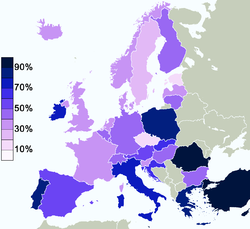
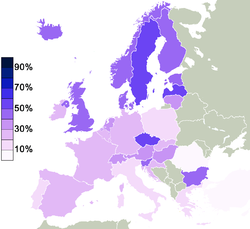
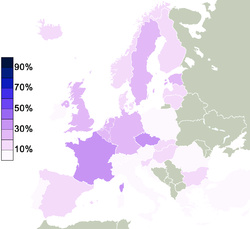 The following is a list of European countries ranked by religiosity, based on belief in a God, according to the Eurobarometer Poll 2005. The 2005 Eurobarometer Poll asked whether the person believed "there is a God", believed "there is some sort of spirit of life force", "didn't believe there is any sort of spirit, God or life force".
Religion
Religion is a collection of cultural systems, belief systems, and worldviews that establishes symbols that relate humanity to spirituality and, sometimes, to moral values. Many religions have narratives, symbols, traditions and sacred histories that are intended to give meaning to life or to...
in the European Union
European Union
The European Union is an economic and political union of 27 independent member states which are located primarily in Europe. The EU traces its origins from the European Coal and Steel Community and the European Economic Community , formed by six countries in 1958...
is Christianity
Christianity
Christianity is a monotheistic religion based on the life and teachings of Jesus as presented in canonical gospels and other New Testament writings...
, although many other religions are practiced as well. The European Union is officially secular
Secularity
Secularity is the state of being separate from religion.For instance, eating and bathing may be regarded as examples of secular activities, because there may not be anything inherently religious about them...
, though some member states have state churches: these are Malta (Roman Catholic), Greece (Eastern Orthodox), Denmark (Lutheran), and part of the United Kingdom - England (Anglican). In recent times, there has been an increase in secularisation in most countries in EU resulting in fewer adherents and decreased church attendance
Church attendance
Church attendance refers to the reception of religious services offered by a particular church, or more generally, by any religious organisation.-Participation statistics:...
.
Religions
The most common religion in the EU is Christianity. The largest denominations of Christianity in Europe are Roman Catholicism, followed by a wide range of ProtestantProtestantism
Protestantism is one of the three major groupings within Christianity. It is a movement that began in Germany in the early 16th century as a reaction against medieval Roman Catholic doctrines and practices, especially in regards to salvation, justification, and ecclesiology.The doctrines of the...
churches (especially in northern Europe) and Eastern Orthodoxy (in eastern Europe).
Judaism
Judaism
Judaism ) is the "religion, philosophy, and way of life" of the Jewish people...
has had a long, and frequently dark, history in Europe. Prior to the Holocaust
The Holocaust
The Holocaust , also known as the Shoah , was the genocide of approximately six million European Jews and millions of others during World War II, a programme of systematic state-sponsored murder by Nazi...
, the area of the European Union had a Jewish population of 5,375,000; it was largely exterminated in German Nazi death camps. In 2002 the EU had a Jewish population
Jewish population
Jewish population refers to the number of Jews in the world. Precise figures are difficult to calculate because the definition of "Who is a Jew" is a source of controversy.-Total population:...
of barely over a million, including about 519,000 in France and about 273,500 in the United Kingdom (compare with about 5.8 million Jews living in Israel
Israel
The State of Israel is a parliamentary republic located in the Middle East, along the eastern shore of the Mediterranean Sea...
.). In view of the history of persecution of Jews in Europe
History of the Jews in Europe
Judaism in Europe has a long history, beginning with the conquest of the Eastern Mediterranean by Pompey in 63 BCE, thus beginning the History of the Jews in the Roman Empire, though likely Alexandrian Jews had migrated to Rome slightly before Pompey's conquest of the East.The pre-World War...
, antisemitism remains a matter of attention within the EU.
Immigration has introduced other religions into European countries, most notably Islam
Islam
Islam . The most common are and . : Arabic pronunciation varies regionally. The first vowel ranges from ~~. The second vowel ranges from ~~~...
. It was estimated that the Union's Muslim population in 2009 was 13 million people. The country with the largest percentage of Muslims in Western Europe is France
France
The French Republic , The French Republic , The French Republic , (commonly known as France , is a unitary semi-presidential republic in Western Europe with several overseas territories and islands located on other continents and in the Indian, Pacific, and Atlantic oceans. Metropolitan France...
with 8%-10% (6-7 million) followed by Germany
Germany
Germany , officially the Federal Republic of Germany , is a federal parliamentary republic in Europe. The country consists of 16 states while the capital and largest city is Berlin. Germany covers an area of 357,021 km2 and has a largely temperate seasonal climate...
(4.5 million), the UK (1.6 million) and Italy
Italy
Italy , officially the Italian Republic languages]] under the European Charter for Regional or Minority Languages. In each of these, Italy's official name is as follows:;;;;;;;;), is a unitary parliamentary republic in South-Central Europe. To the north it borders France, Switzerland, Austria and...
(1.5 million),. Aside from Turkey, the only possible future member to have a majority of Muslims is Albania, although other Balkan states like Bosnia also have sizeable Muslim populations.
Theo van Gogh (film director)
Theodoor "Theo" van Gogh was a Dutch film director, film producer, columnist, author and actor.Van Gogh worked with the Somali-born writer Ayaan Hirsi Ali to produce the film Submission, which criticized the treatment of women in Islam and aroused controversy among Muslims...
by Mohammed Bouyeri
Mohammed Bouyeri
Mohammed Bouyeri is an Islamist Dutch–Moroccan and convicted murderer. He is currently serving a life sentence without parole for the assassination of Dutch film director Theo van Gogh. He holds both Dutch and Moroccan citizenship...
, the 2004 Madrid train bombings, the Jyllands-Posten Muhammad cartoons controversy
Jyllands-Posten Muhammad cartoons controversy
The Jyllands-Posten Muhammad cartoons controversy began after 12 editorial cartoons, most of which depicted the Islamic prophet Muhammad, were published in the Danish newspaper Jyllands-Posten on 30 September 2005...
with continuing attempts to kill the cartoonist, and numerous terrorist attacks in the UK such as the 7 July 2005 London bombings
7 July 2005 London bombings
The 7 July 2005 London bombings were a series of co-ordinated suicide attacks in the United Kingdom, targeting civilians using London's public transport system during the morning rush hour....
. In response to Islamic extremism, some figures, such as Justice Freedom & Security Commissioner Franco Frattini, have suggested creating a "European Islam
European Islam
European Islam or Euro-Islam is a hypothesized new branch of Islam, which some believe is or should be emerging in Europe...
" - a branch of the Islamic faith that is compatible with European values.
Due to the rise of other religions, and some intolerance towards them, the Commission now regularly meets with different religious leaders. In November 2005, a delegation from the European Humanist Federation
European Humanist Federation
The European Humanist Federation-Fédération Humaniste Européenne is an international association that federates numerous European humanist associations. It also has individual members. The members of its administrative board are elected for three-year terms by the general assembly of the member...
was invited to a meeting by Commissioner-President
President of the European Commission
The President of the European Commission is the head of the European Commission ― the executive branch of the :European Union ― the most powerful officeholder in the EU. The President is responsible for allocating portfolios to members of the Commission and can reshuffle or dismiss them if needed...
Barroso. This was the first time a humanist
Humanism
Humanism is an approach in study, philosophy, world view or practice that focuses on human values and concerns. In philosophy and social science, humanism is a perspective which affirms some notion of human nature, and is contrasted with anti-humanism....
group had been consulted in this manner by the Commission
European Commission
The European Commission is the executive body of the European Union. The body is responsible for proposing legislation, implementing decisions, upholding the Union's treaties and the general day-to-day running of the Union....
. President Romano Prodi
Romano Prodi
Romano Prodi is an Italian politician and statesman. He served as the Prime Minister of Italy, from 17 May 1996 to 21 October 1998 and from 17 May 2006 to 8 May 2008...
has refused such meetings, despite meeting various religious leaders, causing some resentment by humanists.
Other religions present in the EU territories include Buddhism
Buddhism
Buddhism is a religion and philosophy encompassing a variety of traditions, beliefs and practices, largely based on teachings attributed to Siddhartha Gautama, commonly known as the Buddha . The Buddha lived and taught in the northeastern Indian subcontinent some time between the 6th and 4th...
, Hinduism
Hinduism
Hinduism is the predominant and indigenous religious tradition of the Indian Subcontinent. Hinduism is known to its followers as , amongst many other expressions...
and Neopaganism
Neopaganism
Neopaganism is an umbrella term used to identify a wide variety of modern religious movements, particularly those influenced by or claiming to be derived from the various pagan beliefs of pre-modern Europe...
. Neopaganism is a movement that revives and reinvents (in its reconstructionistic
Polytheistic reconstructionism
Polytheistic reconstructionism is an approach to Neopaganism first emerging in the late 1960s to early 1970s, and gathering momentum in the 1990s to 2000s...
approach) the ancient pagan spiritualities
Paganism
Paganism is a blanket term, typically used to refer to non-Abrahamic, indigenous polytheistic religious traditions....
of the European peoples
European ethnic groups
The ethnic groups in Europe are the various ethnic groups that reside in the nations of Europe. European ethnology is the field of anthropology focusing on Europe....
. Neopagan religions are legally recognised by the governments of the United Kingdom
United Kingdom
The United Kingdom of Great Britain and Northern IrelandIn the United Kingdom and Dependencies, other languages have been officially recognised as legitimate autochthonous languages under the European Charter for Regional or Minority Languages...
, Denmark
Denmark
Denmark is a Scandinavian country in Northern Europe. The countries of Denmark and Greenland, as well as the Faroe Islands, constitute the Kingdom of Denmark . It is the southernmost of the Nordic countries, southwest of Sweden and south of Norway, and bordered to the south by Germany. Denmark...
, Sweden
Sweden
Sweden , officially the Kingdom of Sweden , is a Nordic country on the Scandinavian Peninsula in Northern Europe. Sweden borders with Norway and Finland and is connected to Denmark by a bridge-tunnel across the Öresund....
and Spain
Spain
Spain , officially the Kingdom of Spain languages]] under the European Charter for Regional or Minority Languages. In each of these, Spain's official name is as follows:;;;;;;), is a country and member state of the European Union located in southwestern Europe on the Iberian Peninsula...
.
Church and State
The EU is a secular body, i.e., there is a separation of church and stateSeparation of church and state
The concept of the separation of church and state refers to the distance in the relationship between organized religion and the nation state....
. There are no formal ties to any religion
Religion
Religion is a collection of cultural systems, belief systems, and worldviews that establishes symbols that relate humanity to spirituality and, sometimes, to moral values. Many religions have narratives, symbols, traditions and sacred histories that are intended to give meaning to life or to...
and no mention of religion in any current or proposed treaty. Discussion over the draft texts of the European Constitution and later the Treaty of Lisbon have included proposals to mention Christianity
Christianity
Christianity is a monotheistic religion based on the life and teachings of Jesus as presented in canonical gospels and other New Testament writings...
and/or God
God
God is the English name given to a singular being in theistic and deistic religions who is either the sole deity in monotheism, or a single deity in polytheism....
in the preamble of the text. This call has been supported by Christian religious leaders, most notably the Pope
Pope
The Pope is the Bishop of Rome, a position that makes him the leader of the worldwide Catholic Church . In the Catholic Church, the Pope is regarded as the successor of Saint Peter, the Apostle...
. However explicit inclusion of a link to religion faced opposition from secularists and the final Constitution referred to Europe's "Religious and Humanist inheritance". A second attempt to include Christianity in the treaty was undertaken in 2007 with the drafting of the Treaty of Lisbon. Angela Merkel
Angela Merkel
Angela Dorothea Merkel is the current Chancellor of Germany . Merkel, elected to the Bundestag from Mecklenburg-Vorpommern, has been the chairwoman of the Christian Democratic Union since 2000, and chairwoman of the CDU-CSU parliamentary coalition from 2002 to 2005.From 2005 to 2009 she led a...
promised the Pope that she would use her influence during Germany's presidency to try to include a reference to Christianity and God in this replacement for the constitution. This has provoked opposition, not least in the German press, and as this inclusion may have caused problems in reaching a final agreement, this attempt was given up. Of the Union's 27 states, only four have an official state religion
State religion
A state religion is a religious body or creed officially endorsed by the state...
, these being Denmark
Denmark
Denmark is a Scandinavian country in Northern Europe. The countries of Denmark and Greenland, as well as the Faroe Islands, constitute the Kingdom of Denmark . It is the southernmost of the Nordic countries, southwest of Sweden and south of Norway, and bordered to the south by Germany. Denmark...
(Danish National Church), Greece
Greece
Greece , officially the Hellenic Republic , and historically Hellas or the Republic of Greece in English, is a country in southeastern Europe....
(Church of Greece
Church of Greece
The Church of Greece , part of the wider Greek Orthodox Church, is one of the autocephalous churches which make up the communion of Orthodox Christianity...
), Malta
Malta
Malta , officially known as the Republic of Malta , is a Southern European country consisting of an archipelago situated in the centre of the Mediterranean, south of Sicily, east of Tunisia and north of Libya, with Gibraltar to the west and Alexandria to the east.Malta covers just over in...
(Roman Catholic Church
Roman Catholic Church
The Catholic Church, also known as the Roman Catholic Church, is the world's largest Christian church, with over a billion members. Led by the Pope, it defines its mission as spreading the gospel of Jesus Christ, administering the sacraments and exercising charity...
) and England
England
England is a country that is part of the United Kingdom. It shares land borders with Scotland to the north and Wales to the west; the Irish Sea is to the north west, the Celtic Sea to the south west, with the North Sea to the east and the English Channel to the south separating it from continental...
in the UK
United Kingdom
The United Kingdom of Great Britain and Northern IrelandIn the United Kingdom and Dependencies, other languages have been officially recognised as legitimate autochthonous languages under the European Charter for Regional or Minority Languages...
(Church of England
Church of England
The Church of England is the officially established Christian church in England and the Mother Church of the worldwide Anglican Communion. The church considers itself within the tradition of Western Christianity and dates its formal establishment principally to the mission to England by St...
. Some other churches have a close relationship with the state. Until 2000, the Church of Sweden was the state church of Sweden and while never accepting the status, the Church of Scotland
Church of Scotland
The Church of Scotland, known informally by its Scots language name, the Kirk, is a Presbyterian church, decisively shaped by the Scottish Reformation....
was often considered to be the Established Church in Scotland, until the position was clarified finally in Parliament in the 1920s.
In the secularising EU, The Vatican
Holy See
The Holy See is the episcopal jurisdiction of the Catholic Church in Rome, in which its Bishop is commonly known as the Pope. It is the preeminent episcopal see of the Catholic Church, forming the central government of the Church. As such, diplomatically, and in other spheres the Holy See acts and...
has been vocal against a perceived "militant atheism
Atheism
Atheism is, in a broad sense, the rejection of belief in the existence of deities. In a narrower sense, atheism is specifically the position that there are no deities...
". It based this on a number of events, for example: the rejection of religious references in the Constitution and Treaty of Lisbon, the rejection by Parliament of Rocco Buttiglione
Rocco Buttiglione
Rocco Buttiglione is an Italian Christian Democrat politician and an academic.His nomination for a post as European Commissioner with a portfolio that was to include civil liberties, resulted in controversy as some political groups opposed him for his Roman Catholic views on homosexuality, despite...
as Justice Commissioner in 2004, while at the same time Parliament approved Peter Mandelson
Peter Mandelson
Peter Benjamin Mandelson, Baron Mandelson, PC is a British Labour Party politician, who was the Member of Parliament for Hartlepool from 1992 to 2004, served in a number of Cabinet positions under both Tony Blair and Gordon Brown, and was a European Commissioner...
(who is gay) as Trade Commissioner
European Commissioner for Trade
The European Commissioner for Trade is the member of the European Commission responsible for the European Union's common commercial policy...
, and the legalisation of same-sex marriage
Same-sex marriage
Same-sex marriage is marriage between two persons of the same biological sex or social gender. Supporters of legal recognition for same-sex marriage typically refer to such recognition as marriage equality....
in countries such as the Netherlands
Netherlands
The Netherlands is a constituent country of the Kingdom of the Netherlands, located mainly in North-West Europe and with several islands in the Caribbean. Mainland Netherlands borders the North Sea to the north and west, Belgium to the south, and Germany to the east, and shares maritime borders...
, Belgium
Belgium
Belgium , officially the Kingdom of Belgium, is a federal state in Western Europe. It is a founding member of the European Union and hosts the EU's headquarters, and those of several other major international organisations such as NATO.Belgium is also a member of, or affiliated to, many...
, and Spain
Spain
Spain , officially the Kingdom of Spain languages]] under the European Charter for Regional or Minority Languages. In each of these, Spain's official name is as follows:;;;;;;), is a country and member state of the European Union located in southwestern Europe on the Iberian Peninsula...
. The European Parliament has also been calling for same-sex marriages to be recognised across the EU. Meanwhile, states such as Latvia and Poland have rejected legislation designed to stop discrimination against homosexuals. This has been stated to be on religious grounds, with homosexual behaviour described as "unnatural", and the Catholic Church influencing public opinion. The difference of opinion between these countries and Brussels has been damaging relations.
Secularisation
There is increasing atheismAtheism
Atheism is, in a broad sense, the rejection of belief in the existence of deities. In a narrower sense, atheism is specifically the position that there are no deities...
and agnosticism
Agnosticism
Agnosticism is the view that the truth value of certain claims—especially claims about the existence or non-existence of any deity, but also other religious and metaphysical claims—is unknown or unknowable....
among the general population in Europe, with falling church attendance and membership in many countries. The countries where the fewest people reported a religious belief were Estonia
Estonia
Estonia , officially the Republic of Estonia , is a state in the Baltic region of Northern Europe. It is bordered to the north by the Gulf of Finland, to the west by the Baltic Sea, to the south by Latvia , and to the east by Lake Peipsi and the Russian Federation . Across the Baltic Sea lies...
(16% professed belief in a God) and the Czech Republic (19% professed belief in a God). In such countries, even those who have a faith can be disdainful of organised religion. The most religious societies are those in Malta with 95% (predominantly Roman Catholic), and Cyprus and Romania both with about 90% of their citizens believing in a god. Across the EU, belief was higher among: the elderly, those with strict upbringings, those with the lowest levels of formal education, those leaning towards right-wing politics
Right-wing politics
In politics, Right, right-wing and rightist generally refer to support for a hierarchical society justified on the basis of an appeal to natural law or tradition. To varying degrees, the Right rejects the egalitarian objectives of left-wing politics, claiming that the imposition of equality is...
, those questioning the meaning and purpose to life, and those more concerned with moral and ethical issues in science and technology over risk-benefit analysis
Risk-benefit analysis
Risk–benefit analysis is the comparison of the risk of a situation to its related benefits. Exposure to personal risk is recognized as a normal aspect of everyday life. We accept a certain level of risk in our lives as necessary to achieve certain benefits. In most of these risks we feel as though...
.
The secular lifestyle is gaining ground in the European Union, especially with respect to marriage. While some religions advocate or mandate opposite sex marriage as the only "natural" form of marriage and typically frown on cohabitation, the general population in Europe seems to disagree more and more.
In 2008, the highest ever number of births outside of marriage were recorded in the European Union, just short of 37%, up 13 % compared to the year 1995 with first-births out of wedlock and cohabitation figures being even higher. Five EU countries recorded a majority of births outside of marriage - these are Estonia (59.1%), Slovenia (54.1%), Sweden (54.6%), France (51.3%), and Bulgaria (51.1%). These countries tend to be less religious ones (less than half of the population believing in a God) whereas half of the European population believes in a God.
More strikingly, with Austria
Austria
Austria , officially the Republic of Austria , is a landlocked country of roughly 8.4 million people in Central Europe. It is bordered by the Czech Republic and Germany to the north, Slovakia and Hungary to the east, Slovenia and Italy to the south, and Switzerland and Liechtenstein to the...
and Portugal
Portugal
Portugal , officially the Portuguese Republic is a country situated in southwestern Europe on the Iberian Peninsula. Portugal is the westernmost country of Europe, and is bordered by the Atlantic Ocean to the West and South and by Spain to the North and East. The Atlantic archipelagos of the...
now approving same-sex marriages, more than half of EU countries allow either same sex marriage or same sex civil unions.
Religiosity
Most EU countries have experienced a decline in church attendance, as well as a decline in the number of people professing a belief in a God. The Eurobarometer Poll 2005 found that, on average, 52% of the citizens of EU member states state that they believe in a God, 27% believe there is some sort of spirit or life Force while 18% do not believe there is any sort of spirit, God or Life Force. 3% declined to answer. According to a recent study (Dogan, MatteiMattei Dogan
Mattei Dogan is a French political sociologist and senior research officer emeritus of the French National Center for Scientific Research and professor emeritus of political science of the University of California, Los Angeles...
, Religious Beliefs in Europe: Factors of Accelerated Decline), 47% of Frenchmen declared themselves as agnostic in 2003.
The situation of religion varies between countries in European Union.
A decrease in religiousness and church attendance in western Europe (especially the Netherlands
Netherlands
The Netherlands is a constituent country of the Kingdom of the Netherlands, located mainly in North-West Europe and with several islands in the Caribbean. Mainland Netherlands borders the North Sea to the north and west, Belgium to the south, and Germany to the east, and shares maritime borders...
, Belgium
Belgium
Belgium , officially the Kingdom of Belgium, is a federal state in Western Europe. It is a founding member of the European Union and hosts the EU's headquarters, and those of several other major international organisations such as NATO.Belgium is also a member of, or affiliated to, many...
, the United Kingdom
United Kingdom
The United Kingdom of Great Britain and Northern IrelandIn the United Kingdom and Dependencies, other languages have been officially recognised as legitimate autochthonous languages under the European Charter for Regional or Minority Languages...
, France
France
The French Republic , The French Republic , The French Republic , (commonly known as France , is a unitary semi-presidential republic in Western Europe with several overseas territories and islands located on other continents and in the Indian, Pacific, and Atlantic oceans. Metropolitan France...
, Germany
Germany
Germany , officially the Federal Republic of Germany , is a federal parliamentary republic in Europe. The country consists of 16 states while the capital and largest city is Berlin. Germany covers an area of 357,021 km2 and has a largely temperate seasonal climate...
, Finland
Finland
Finland , officially the Republic of Finland, is a Nordic country situated in the Fennoscandian region of Northern Europe. It is bordered by Sweden in the west, Norway in the north and Russia in the east, while Estonia lies to its south across the Gulf of Finland.Around 5.4 million people reside...
, Norway
Norway
Norway , officially the Kingdom of Norway, is a Nordic unitary constitutional monarchy whose territory comprises the western portion of the Scandinavian Peninsula, Jan Mayen, and the Arctic archipelago of Svalbard and Bouvet Island. Norway has a total area of and a population of about 4.9 million...
, Sweden
Sweden
Sweden , officially the Kingdom of Sweden , is a Nordic country on the Scandinavian Peninsula in Northern Europe. Sweden borders with Norway and Finland and is connected to Denmark by a bridge-tunnel across the Öresund....
, Denmark
Denmark
Denmark is a Scandinavian country in Northern Europe. The countries of Denmark and Greenland, as well as the Faroe Islands, constitute the Kingdom of Denmark . It is the southernmost of the Nordic countries, southwest of Sweden and south of Norway, and bordered to the south by Germany. Denmark...
, Spain
Spain
Spain , officially the Kingdom of Spain languages]] under the European Charter for Regional or Minority Languages. In each of these, Spain's official name is as follows:;;;;;;), is a country and member state of the European Union located in southwestern Europe on the Iberian Peninsula...
, and the Czech Republic
Czech Republic
The Czech Republic is a landlocked country in Central Europe. The country is bordered by Poland to the northeast, Slovakia to the east, Austria to the south, and Germany to the west and northwest....
) has been noted and called "Post-Christian Europe". Several of these countries have recently allowed same sex marriage despite massive resistance from the Catholic Church and other religious groups. Also in the most populous eastern Europe country and EU member Poland
Poland
Poland , officially the Republic of Poland , is a country in Central Europe bordered by Germany to the west; the Czech Republic and Slovakia to the south; Ukraine, Belarus and Lithuania to the east; and the Baltic Sea and Kaliningrad Oblast, a Russian exclave, to the north...
there has been a sharp reduction in church attendance since 2005, although with 41 % in 2009 still well above the single digit figures that are so typical for sunday mass attendance in other EU countries .
| Country | Belief in a God | Belief in a Spirit or Life Force | Belief in neither a Spirit, God or Life Force |
|---|---|---|---|
| Estonia Estonia Estonia , officially the Republic of Estonia , is a state in the Baltic region of Northern Europe. It is bordered to the north by the Gulf of Finland, to the west by the Baltic Sea, to the south by Latvia , and to the east by Lake Peipsi and the Russian Federation . Across the Baltic Sea lies... | 16% | 54% | 26% |
| Czech Republic Czech Republic The Czech Republic is a landlocked country in Central Europe. The country is bordered by Poland to the northeast, Slovakia to the east, Austria to the south, and Germany to the west and northwest.... | 19% | 50% | 30% |
| Sweden Sweden Sweden , officially the Kingdom of Sweden , is a Nordic country on the Scandinavian Peninsula in Northern Europe. Sweden borders with Norway and Finland and is connected to Denmark by a bridge-tunnel across the Öresund.... | 23% | 53% | 23% |
| Denmark Denmark Denmark is a Scandinavian country in Northern Europe. The countries of Denmark and Greenland, as well as the Faroe Islands, constitute the Kingdom of Denmark . It is the southernmost of the Nordic countries, southwest of Sweden and south of Norway, and bordered to the south by Germany. Denmark... | 31% | 49% | 19% |
| Norway Norway Norway , officially the Kingdom of Norway, is a Nordic unitary constitutional monarchy whose territory comprises the western portion of the Scandinavian Peninsula, Jan Mayen, and the Arctic archipelago of Svalbard and Bouvet Island. Norway has a total area of and a population of about 4.9 million... | 32% | 47% | 17% |
| Netherlands Netherlands The Netherlands is a constituent country of the Kingdom of the Netherlands, located mainly in North-West Europe and with several islands in the Caribbean. Mainland Netherlands borders the North Sea to the north and west, Belgium to the south, and Germany to the east, and shares maritime borders... | 34% | 37% | 27% |
| France France The French Republic , The French Republic , The French Republic , (commonly known as France , is a unitary semi-presidential republic in Western Europe with several overseas territories and islands located on other continents and in the Indian, Pacific, and Atlantic oceans. Metropolitan France... | 34% | 27% | 33% |
| Slovenia Slovenia Slovenia , officially the Republic of Slovenia , is a country in Central and Southeastern Europe touching the Alps and bordering the Mediterranean. Slovenia borders Italy to the west, Croatia to the south and east, Hungary to the northeast, and Austria to the north, and also has a small portion of... | 37% | 46% | 16% |
| Latvia Latvia Latvia , officially the Republic of Latvia , is a country in the Baltic region of Northern Europe. It is bordered to the north by Estonia , to the south by Lithuania , to the east by the Russian Federation , to the southeast by Belarus and shares maritime borders to the west with Sweden... | 37% | 49% | 10% |
| United Kingdom United Kingdom The United Kingdom of Great Britain and Northern IrelandIn the United Kingdom and Dependencies, other languages have been officially recognised as legitimate autochthonous languages under the European Charter for Regional or Minority Languages... | 38% | 40% | 20% |
| Iceland Iceland Iceland , described as the Republic of Iceland, is a Nordic and European island country in the North Atlantic Ocean, on the Mid-Atlantic Ridge. Iceland also refers to the main island of the country, which contains almost all the population and almost all the land area. The country has a population... | 38% | 48% | 11% |
| Bulgaria Bulgaria Bulgaria , officially the Republic of Bulgaria , is a parliamentary democracy within a unitary constitutional republic in Southeast Europe. The country borders Romania to the north, Serbia and Macedonia to the west, Greece and Turkey to the south, as well as the Black Sea to the east... | 40% | 40% | 13% |
| Finland Finland Finland , officially the Republic of Finland, is a Nordic country situated in the Fennoscandian region of Northern Europe. It is bordered by Sweden in the west, Norway in the north and Russia in the east, while Estonia lies to its south across the Gulf of Finland.Around 5.4 million people reside... | 41% | 41% | 16% |
| Belgium Belgium Belgium , officially the Kingdom of Belgium, is a federal state in Western Europe. It is a founding member of the European Union and hosts the EU's headquarters, and those of several other major international organisations such as NATO.Belgium is also a member of, or affiliated to, many... | 43% | 29% | 27% |
| Hungary Hungary Hungary , officially the Republic of Hungary , is a landlocked country in Central Europe. It is situated in the Carpathian Basin and is bordered by Slovakia to the north, Ukraine and Romania to the east, Serbia and Croatia to the south, Slovenia to the southwest and Austria to the west. The... | 44% | 31% | 19% |
| Luxembourg Luxembourg Luxembourg , officially the Grand Duchy of Luxembourg , is a landlocked country in western Europe, bordered by Belgium, France, and Germany. It has two principal regions: the Oesling in the North as part of the Ardennes massif, and the Gutland in the south... | 44% | 28% | 22% |
| Germany Germany Germany , officially the Federal Republic of Germany , is a federal parliamentary republic in Europe. The country consists of 16 states while the capital and largest city is Berlin. Germany covers an area of 357,021 km2 and has a largely temperate seasonal climate... *West Germany West Germany West Germany is the common English, but not official, name for the Federal Republic of Germany or FRG in the period between its creation in May 1949 to German reunification on 3 October 1990.... *East Germany | 47% *54% *19% | 25% *26% *20% | 25% *16% *57% |
| Switzerland Switzerland Switzerland name of one of the Swiss cantons. ; ; ; or ), in its full name the Swiss Confederation , is a federal republic consisting of 26 cantons, with Bern as the seat of the federal authorities. The country is situated in Western Europe,Or Central Europe depending on the definition.... | 48% | 39% | 9% |
| Lithuania Lithuania Lithuania , officially the Republic of Lithuania is a country in Northern Europe, the biggest of the three Baltic states. It is situated along the southeastern shore of the Baltic Sea, whereby to the west lie Sweden and Denmark... | 49% | 36% | 12% |
| Austria Austria Austria , officially the Republic of Austria , is a landlocked country of roughly 8.4 million people in Central Europe. It is bordered by the Czech Republic and Germany to the north, Slovakia and Hungary to the east, Slovenia and Italy to the south, and Switzerland and Liechtenstein to the... | 54% | 34% | 8% |
| Spain Spain Spain , officially the Kingdom of Spain languages]] under the European Charter for Regional or Minority Languages. In each of these, Spain's official name is as follows:;;;;;;), is a country and member state of the European Union located in southwestern Europe on the Iberian Peninsula... | 59% | 21% | 18% |
| Slovakia Slovakia The Slovak Republic is a landlocked state in Central Europe. It has a population of over five million and an area of about . Slovakia is bordered by the Czech Republic and Austria to the west, Poland to the north, Ukraine to the east and Hungary to the south... | 61% | 26% | 11% |
| Croatia Croatia Croatia , officially the Republic of Croatia , is a unitary democratic parliamentary republic in Europe at the crossroads of the Mitteleuropa, the Balkans, and the Mediterranean. Its capital and largest city is Zagreb. The country is divided into 20 counties and the city of Zagreb. Croatia covers ... | 67% | 25% | 7% |
| Ireland Ireland Ireland is an island to the northwest of continental Europe. It is the third-largest island in Europe and the twentieth-largest island on Earth... | 73% | 22% | 4% |
| Italy Italy Italy , officially the Italian Republic languages]] under the European Charter for Regional or Minority Languages. In each of these, Italy's official name is as follows:;;;;;;;;), is a unitary parliamentary republic in South-Central Europe. To the north it borders France, Switzerland, Austria and... | 74% | 16% | 6% |
| Poland Poland Poland , officially the Republic of Poland , is a country in Central Europe bordered by Germany to the west; the Czech Republic and Slovakia to the south; Ukraine, Belarus and Lithuania to the east; and the Baltic Sea and Kaliningrad Oblast, a Russian exclave, to the north... | 80% | 15% | 1% |
| Portugal Portugal Portugal , officially the Portuguese Republic is a country situated in southwestern Europe on the Iberian Peninsula. Portugal is the westernmost country of Europe, and is bordered by the Atlantic Ocean to the West and South and by Spain to the North and East. The Atlantic archipelagos of the... | 81% | 12% | 6% |
| Greece Greece Greece , officially the Hellenic Republic , and historically Hellas or the Republic of Greece in English, is a country in southeastern Europe.... | 81% | 16% | 3% |
| Cyprus Cyprus Cyprus , officially the Republic of Cyprus , is a Eurasian island country, member of the European Union, in the Eastern Mediterranean, east of Greece, south of Turkey, west of Syria and north of Egypt. It is the third largest island in the Mediterranean Sea.The earliest known human activity on the... | 90% | 7% | 2% |
| Romania Romania Romania is a country located at the crossroads of Central and Southeastern Europe, on the Lower Danube, within and outside the Carpathian arch, bordering on the Black Sea... | 90% | 8% | 1% |
| Malta Malta Malta , officially known as the Republic of Malta , is a Southern European country consisting of an archipelago situated in the centre of the Mediterranean, south of Sicily, east of Tunisia and north of Libya, with Gibraltar to the west and Alexandria to the east.Malta covers just over in... | 95% | 3% | 1% |
See also
- Culture of the European Union
- Fundamental Rights Agency
- European Union – Holy See relations
- LGBT rights in the European UnionLGBT rights in the European UnionLGBT rights in the European Union are protected under the European Union's treaties and law. Homosexuality is legal in all EU states and discrimination in employment has been banned since 2000...
- Christianity in EuropeChristianity in EuropeChristianity is the largest religion in Europe. Christianity has been practiced in Europe since the 1st century, and a number of the Pauline Epistles were odireted at Christians living in Macedonia, as well as Rome.- Early history :...
- Islam in EuropeIslam in EuropeThis article deals with the history and evolution of the presence of Islam in Europe. According to the German , the total number of Muslims in Europe in 2007 was about 53 million , excluding Turkey. The total number of Muslims in the European Union in 2007 was about 16 million .-Early history:Islam...
- List of religious populations
- Major world religions
- Christianity by countryChristianity by countryAs of the early 21st century, Christianity has around 2.1 billion adherents. The faith represents nearly one-third of the world's population and is the largest religion in the world, with approximately 38,000 Christian denominations. Christians have composed about 33 percent of the world's...
- Islam by countryIslam by countryIslam is the world's second largest religion after Christianity. According to a 2009 demographic study, Islam has 1.57 billion adherents, making up 23% of the world population....
- Buddhism by countryBuddhism by countryObtaining exact numbers of practicing Buddhists can be difficult and may be reliant on the definition used. Adherents of Eastern religions such as Buddhism with local Animism, Chinese folk religion, Confucianism, Shinto, and Taoism often have beliefs composed of a mix of religious ideas...
- Hinduism by countryHinduism by countryThe percentage of Hindu population of each country was taken from the US State Department's International Religious Freedom Report 2006. Other sources used were the CIA World Factbook and adherents.com...
- Judaism by country
- Irreligion by countryIrreligion by countryIrreligion varies in the different countries around the world....
- Great Synagogue of EuropeGreat Synagogue of EuropeThe Great Synagogue of Europe, formerly known as the Great Synagogue of Brussels, is the main synagogue in Brussels, Belgium which was dedicated as a focal point for European Jews in 2008....