


Lugii

Encyclopedia
Germania (book)
The Germania , written by Gaius Cornelius Tacitus around 98, is an ethnographic work on the Germanic tribes outside the Roman Empire.-Contents:...
by the Roman
Ancient Rome
Ancient Rome was a thriving civilization that grew on the Italian Peninsula as early as the 8th century BC. Located along the Mediterranean Sea and centered on the city of Rome, it expanded to one of the largest empires in the ancient world....
historian Tacitus
Tacitus
Publius Cornelius Tacitus was a senator and a historian of the Roman Empire. The surviving portions of his two major works—the Annals and the Histories—examine the reigns of the Roman Emperors Tiberius, Claudius, Nero and those who reigned in the Year of the Four Emperors...
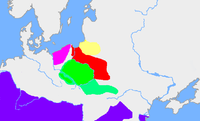
. They lived in ca. 400 BC–300 AD in Central Europe, north of the Sudetes mountains in the basin of upper Oder and Vistula
Vistula
The Vistula is the longest and the most important river in Poland, at 1,047 km in length. The watershed area of the Vistula is , of which lies within Poland ....
rivers, covering most of modern south and middle Poland (regions of Silesia
Silesia
Silesia is a historical region of Central Europe located mostly in Poland, with smaller parts also in the Czech Republic, and Germany.Silesia is rich in mineral and natural resources, and includes several important industrial areas. Silesia's largest city and historical capital is Wrocław...
, Greater Poland
Greater Poland
Greater Poland or Great Poland, often known by its Polish name Wielkopolska is a historical region of west-central Poland. Its chief city is Poznań.The boundaries of Greater Poland have varied somewhat throughout history...
, Mazovia
Mazovia
Mazovia or Masovia is a geographical, historical and cultural region in east-central Poland. It is also a voivodeship in Poland.Its historic capital is Płock, which was the medieval residence of first Dukes of Masovia...
and Little Poland
Lesser Poland
Lesser Poland is one of the historical regions of Poland, with its capital in the city of Kraków. It forms the southeastern corner of the country, and should not be confused with the modern Lesser Poland Voivodeship, which covers only a small, southern part of Lesser Poland...
). Most archaeologists identify the Lugians with the Przeworsk culture
Przeworsk culture
The Przeworsk culture is part of an Iron Age archaeological complex that dates from the 2nd century BC to the 5th century AD. It was located in what is now central and southern Poland, later spreading to parts of eastern Slovakia and Carpathian Ruthenia ranging between the Oder and the middle and...
. The source of their power was control of the most important middle part of the Amber Road
Amber Road
The Amber Road was an ancient trade route for the transfer of amber. As one of the waterways and ancient highways, for centuries the road led from Europe to Asia and back, and from northern Africa to the Baltic Sea....
from Sambia
Sambia
Sambia or Samland is a peninsula in the Kaliningrad Oblast of Russia, on the southeastern shore of the Baltic Sea. The Curonian Lagoon and the Vistula Lagoon demarcate the peninsula. Prior to 1945 it formed an important part of East Prussia.-Names:Sambia is named after the Sambians, an extinct...
at the Baltic Sea
Baltic Sea
The Baltic Sea is a brackish mediterranean sea located in Northern Europe, from 53°N to 66°N latitude and from 20°E to 26°E longitude. It is bounded by the Scandinavian Peninsula, the mainland of Europe, and the Danish islands. It drains into the Kattegat by way of the Øresund, the Great Belt and...
to the provinces of Roman Empire
Roman Empire
The Roman Empire was the post-Republican period of the ancient Roman civilization, characterised by an autocratic form of government and large territorial holdings in Europe and around the Mediterranean....
: Pannonia
Pannonia
Pannonia was an ancient province of the Roman Empire bounded north and east by the Danube, coterminous westward with Noricum and upper Italy, and southward with Dalmatia and upper Moesia....
, Noricum
Noricum
Noricum, in ancient geography, was a Celtic kingdom stretching over the area of today's Austria and a part of Slovenia. It became a province of the Roman Empire...
and Raetia
Raetia
Raetia was a province of the Roman Empire, named after the Rhaetian people. It was bounded on the west by the country of the Helvetii, on the east by Noricum, on the north by Vindelicia, on the west by Cisalpine Gaul and on south by Venetia et Histria...
. A tribe of the same name, usually spelled as Lugi
Lugi
Ługi may refer to the following places in Poland:*Ługi, Lower Silesian Voivodeship *Ługi, Sieradz County in Łódź Voivodeship *Ługi, Zgierz County in Łódź Voivodeship...
, inhabited the southern part of Sutherland
Sutherland
Sutherland is a registration county, lieutenancy area and historic administrative county of Scotland. It is now within the Highland local government area. In Gaelic the area is referred to according to its traditional areas: Dùthaich 'IcAoidh , Asainte , and Cataibh...
in Scotland
Scotland
Scotland is a country that is part of the United Kingdom. Occupying the northern third of the island of Great Britain, it shares a border with England to the south and is bounded by the North Sea to the east, the Atlantic Ocean to the north and west, and the North Channel and Irish Sea to the...
. Roman
Ancient Rome
Ancient Rome was a thriving civilization that grew on the Italian Peninsula as early as the 8th century BC. Located along the Mediterranean Sea and centered on the city of Rome, it expanded to one of the largest empires in the ancient world....
records sometimes identify the Lugii with the Vandals
Vandals
The Vandals were an East Germanic tribe that entered the late Roman Empire during the 5th century. The Vandals under king Genseric entered Africa in 429 and by 439 established a kingdom which included the Roman Africa province, besides the islands of Sicily, Corsica, Sardinia and the Balearics....
, an East Germanic tribe
East Germanic tribes
The Germanic tribes referred to as East Germanic constitute a wave of migrants who may have moved from Scandinavia into the area between the Oder and Vistula rivers between the years 600 and 300 BC. Later they went to the south...
.
Tribal division
According to TacitusTacitus
Publius Cornelius Tacitus was a senator and a historian of the Roman Empire. The surviving portions of his two major works—the Annals and the Histories—examine the reigns of the Roman Emperors Tiberius, Claudius, Nero and those who reigned in the Year of the Four Emperors...
(Germania
Germania (book)
The Germania , written by Gaius Cornelius Tacitus around 98, is an ethnographic work on the Germanic tribes outside the Roman Empire.-Contents:...
43:3) the Lugii were divided into many tribes ('civitates'), of which he mentions the five most powerful: Harii
Harii
The Harii were a Germanic people attested by Tacitus as being a tribe in his 1st-century-AD book Germania. He describes them as painting themselves and their shields black, and attacking at night as a ghostly army, much to the terror of their opponents...
, Helveconae
Helveconae
The Helveconae, or Helvaeonae, or Helvecones, or Aelvaeones, or Ailouaiones, are names possibly referring to the same ancient population, and possibly further connected to the Germanic Hilleviones of Sweden. The Helveconae as such are one of the tribal states of the Lugii in Tacitus...
, Manimi, Helisii
Helisii
The Helisii were one of the tribal states of the Lugii, a Germanic tribe. They were attested by the Roman historian Tacitus ; this brief reference is the only mention of them as such in history....
and Naharvali. Claudius Ptolemeus
Ptolemy
Claudius Ptolemy , was a Roman citizen of Egypt who wrote in Greek. He was a mathematician, astronomer, geographer, astrologer, and poet of a single epigram in the Greek Anthology. He lived in Egypt under Roman rule, and is believed to have been born in the town of Ptolemais Hermiou in the...
mentions the Lugi Omani (Λοῦγοι οἱ Ὀμανοὶ), the Lugi Diduni (Λοῦγοι οἱ Διδοῦνοι) and the Lugi Buri
Buri (Germanic tribe)
The Buri were a Germanic tribe mentioned in the Germania of Tacitus, where they initially "close the back" of the Marcomanni and Quadi of Bohemia and Moravia. It is said that their speech and customs were like those of the Suebi...
(Λοῦγοι οἱ Βοῦροι)located on or near the upper Vistula in Germania Magna in what is now south Poland (Book 2, Chapter 10, 4th map of Europe). The forms of the names imply that the Lugii of that time were divided into the Omani, the Diduni and the Buri. In Tacitus the Buri are a separate tribe, so it's possible that they entered the Lugian federation a bit later.
History
The Lugian federation was probably formed long before it was first recorded, in the works of StraboStrabo
Strabo, also written Strabon was a Greek historian, geographer and philosopher.-Life:Strabo was born to an affluent family from Amaseia in Pontus , a city which he said was situated the approximate equivalent of 75 km from the Black Sea...
(Geographica
Géographica
Géographica is the French-language magazine of the Royal Canadian Geographical Society , published under the Society's French name, the Société géographique royale du Canada . Introduced in 1997, Géographica is not a stand-alone publication, but is published as an irregular supplement to La...
).
According to Strabo the Lugians were 'a great people' and—together with other peoples like Semnones and the otherwise unknown Zumi, Butones, Mugilones and Sibini—were part of a federation subjected to the rule of Marbod
Marbod
Maroboduus , was king of the Marcomanni. The name "Maroboduus" can be broken down into two Celtic elements, māro- meaning "great" , and bodwos meaning "raven"...
, ruler of the Marcomanni
Marcomanni
The Marcomanni were a Germanic tribe, probably related to the Buri, Suebi or Suevi.-Origin:Scholars believe their name derives possibly from Proto-Germanic forms of "march" and "men"....
with their centre in modern Bohemia
Bohemia
Bohemia is a historical region in central Europe, occupying the western two-thirds of the traditional Czech Lands. It is located in the contemporary Czech Republic with its capital in Prague...
9 BC–19 AD. The next mention of Lugii are the times of the Roman emperor Claudius
Claudius
Claudius , was Roman Emperor from 41 to 54. A member of the Julio-Claudian dynasty, he was the son of Drusus and Antonia Minor. He was born at Lugdunum in Gaul and was the first Roman Emperor to be born outside Italy...
(41–54). According to the Tacitus's Annales, in 50 'a great multitude' of Lugians allied with Romans took part in the fall of the Vannius
Vannius
Vannius was the king of the Germanic tribe Quadi. He lived in the 1st century. The Kingdom of Vannius was in the western part of present day Slovakia and it was the first political unit in Slovak area. He was a client King of Pannonia and Dalmatia and served from 17-20AD under the reign of Tiberius....
' state of the Quadi
Quadi
The Quadi were a smaller Germanic tribe, about which little is definitively known. We only know the Germanic tribe the Romans called the 'Quadi' through reports of the Romans themselves...
, located in present Moravia
Moravia
Moravia is a historical region in Central Europe in the east of the Czech Republic, and one of the former Czech lands, together with Bohemia and Silesia. It takes its name from the Morava River which rises in the northwest of the region...
–Slovakia
Slovakia
The Slovak Republic is a landlocked state in Central Europe. It has a population of over five million and an area of about . Slovakia is bordered by the Czech Republic and Austria to the west, Poland to the north, Ukraine to the east and Hungary to the south...
.
The next information about the Lugians comes from Cassius Dio
Dio Cassius
Lucius Cassius Dio Cocceianus , known in English as Cassius Dio, Dio Cassius, or Dio was a Roman consul and a noted historian writing in Greek...
's work Roman History, in which he mentions events of 91–92 during the reign of emperor Domitian
Domitian
Domitian was Roman Emperor from 81 to 96. Domitian was the third and last emperor of the Flavian dynasty.Domitian's youth and early career were largely spent in the shadow of his brother Titus, who gained military renown during the First Jewish-Roman War...
. The Lugii allied themselves with the Romans and asked them for help against their western neighbours, the Germanic Suebi
Suebi
The Suebi or Suevi were a group of Germanic peoples who were first mentioned by Julius Caesar in connection with Ariovistus' campaign, c...
tribe. Domitian sent 100 horsemen to support the Lugians. It is not known if these horsemen really arrived at their destination; if they did, it would be the first recorded presence of Roman soldiers on what is now Polish soil.
A Polish record of 1000 year later appears to confirm the alliance with Romans.
The Buri, who according to Ptolemy were part of the Lugians, took an important role during the Marcomannic Wars
Marcomannic Wars
The Marcomannic Wars were a series of wars lasting over a dozen years from about AD 166 until 180. These wars pitted the Roman Empire against the Marcomanni, Quadi and other Germanic peoples, along both sides of the upper and middle Danube...
(166–180): the Romans were forced to organize a separate military campaign against them called 'Expeditio Burica' in 182-183 during the reign of emperor Commodus
Commodus
Commodus , was Roman Emperor from 180 to 192. He also ruled as co-emperor with his father Marcus Aurelius from 177 until his father's death in 180. His name changed throughout his reign; see changes of name for earlier and later forms. His accession as emperor was the first time a son had succeeded...
The later history of the Lugians is uncertain, but some historians assume that the Lugians can be identified with the 'Longiones' tribe mentioned in Zosimus
Zosimus
Zosimus was a Byzantine historian, who lived in Constantinople during the reign of the Byzantine Emperor Anastasius I . According to Photius, he was a comes, and held the office of "advocate" of the imperial treasury.- Historia Nova :...
's New History (Historia Nova), as being defeated by the Emperor Probus in year 279 in the province of Raetia
Raetia
Raetia was a province of the Roman Empire, named after the Rhaetian people. It was bounded on the west by the country of the Helvetii, on the east by Noricum, on the north by Vindelicia, on the west by Cisalpine Gaul and on south by Venetia et Histria...
near the Lygis river (usually identified with Lech river
Lech River
The Lech is a river in Austria and Germany. It is a right tributary of the Danube in length with a drainage basin of .Its source is located in the Austrian state of Vorarlberg, where the river rises from lake Formarinsee in the Alps at an altitude of...
in modern Austria
Austria
Austria , officially the Republic of Austria , is a landlocked country of roughly 8.4 million people in Central Europe. It is bordered by the Czech Republic and Germany to the north, Slovakia and Hungary to the east, Slovenia and Italy to the south, and Switzerland and Liechtenstein to the...
and Bavaria
Bavaria
Bavaria, formally the Free State of Bavaria is a state of Germany, located in the southeast of Germany. With an area of , it is the largest state by area, forming almost 20% of the total land area of Germany...
). Another mention might be a great people of 'Lupiones-Sarmatae' shown on a Latin map Tabula Peutingeriana
Tabula Peutingeriana
The Tabula Peutingeriana is an itinerarium showing the cursus publicus, the road network in the Roman Empire. The original map of which this is a unique copy was last revised in the fourth or early fifth century. It covers Europe, parts of Asia and North Africa...
generally dated to 2nd-4th century AD.
Ethnic background
The ethnic affiliation was subject of intense auto/allochtonic debate between German and mostly Polish historians before the Second World WarWorld War II
World War II, or the Second World War , was a global conflict lasting from 1939 to 1945, involving most of the world's nations—including all of the great powers—eventually forming two opposing military alliances: the Allies and the Axis...
. The former used to claim that the tribe was exclusively Germanic as the latter presented the counterargument that either the tribe was proto-Slavic or at least included proto-Slavic groups.
According to the Slavonic hypotheses, the word Lugi may be a spelling for Slavonic лю΄дїе, meaning people. In modern Serbian
Serbian language
Serbian is a form of Serbo-Croatian, a South Slavic language, spoken by Serbs in Serbia, Bosnia and Herzegovina, Montenegro, Croatia and neighbouring countries....
, the word луг means "small forest". Thus the word Lugii could indicate "forest people". Serbs
Serbs
The Serbs are a South Slavic ethnic group of the Balkans and southern Central Europe. Serbs are located mainly in Serbia, Montenegro and Bosnia and Herzegovina, and form a sizable minority in Croatia, the Republic of Macedonia and Slovenia. Likewise, Serbs are an officially recognized minority in...
have many versions of this word in use today, and all relate to forest, wood and swamp land. There is a possibility that the Lusatian Sorbs
Sorbs
Sorbs are a Western Slavic people of Central Europe living predominantly in Lusatia, a region on the territory of Germany and Poland. In Germany they live in the states of Brandenburg and Saxony. They speak the Sorbian languages - closely related to Polish and Czech - officially recognized and...
, whose land in their own language and in Polish bears the name Łużyce, adjective
Adjective
In grammar, an adjective is a 'describing' word; the main syntactic role of which is to qualify a noun or noun phrase, giving more information about the object signified....
łużycki, are among their descendants. The term Łużyce/łużycki is possibly akin to Lugii.
Ancient writers simply regarded them to be part of the Germanians, or the settlers in the region of Germania, and were often at a loss whether to include some of the tribes in Germania into so-called the Germanic language speaking peoples. The sub-tribal groups associated with them, such as the Helveconae, the Harii and the Buri, are indeed Germanic.
Today, as the archaeological evidence such as cremation
Cremation
Cremation is the process of reducing bodies to basic chemical compounds such as gasses and bone fragments. This is accomplished through high-temperature burning, vaporization and oxidation....
, which was characteristic to Slavs, has accumulated where the tribe are supposed to have settled, others claim that they were a compound tribe, or confederation of tribes of different ethnicity. Most scholars though agree that they could perhaps consist of a mixture of several groups, or take influence from several groups.