

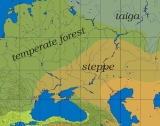
Pontic-Caspian steppe

Encyclopedia
Steppe
In physical geography, steppe is an ecoregion, in the montane grasslands and shrublands and temperate grasslands, savannas, and shrublands biomes, characterized by grassland plains without trees apart from those near rivers and lakes...
land stretching from the north of the Black Sea
Black Sea
The Black Sea is bounded by Europe, Anatolia and the Caucasus and is ultimately connected to the Atlantic Ocean via the Mediterranean and the Aegean seas and various straits. The Bosphorus strait connects it to the Sea of Marmara, and the strait of the Dardanelles connects that sea to the Aegean...
(Graeco-Roman tradition refers to it as the 'Hospitable sea', Euxeinos Pontos (Εὔξεινος Πόντος) - thus a euphemism - in antiquity) as far as the east of the Caspian Sea
Caspian Sea
The Caspian Sea is the largest enclosed body of water on Earth by area, variously classed as the world's largest lake or a full-fledged sea. The sea has a surface area of and a volume of...
, from western Ukraine
Ukraine
Ukraine is a country in Eastern Europe. It has an area of 603,628 km², making it the second largest contiguous country on the European continent, after Russia...
across the Southern Federal District
Southern Federal District
Southern Federal District is one of the eight federal districts of Russia. Its territory lies mostly on the Pontic-Caspian steppe. Its population was 13,856,700 according to the 2010 Census, living on an area of...
and the Volga Federal District
Volga Federal District
Volga Federal District is one of the eight federal districts of Russia. It forms the southeastern part of European Russia. Its population was 29,900,400 according to the 2010 Census, living on an area of...
of Russia
Russia
Russia or , officially known as both Russia and the Russian Federation , is a country in northern Eurasia. It is a federal semi-presidential republic, comprising 83 federal subjects...
to western Kazakhstan
Kazakhstan
Kazakhstan , officially the Republic of Kazakhstan, is a transcontinental country in Central Asia and Eastern Europe. Ranked as the ninth largest country in the world, it is also the world's largest landlocked country; its territory of is greater than Western Europe...
, forming part of the larger Eurasian steppe
Eurasian Steppe
The Eurasian Steppe is the vast steppe ecoregion of Eurasia in the Temperate grasslands, savannas, and shrublands Biome. It stretches from Hungary to Mongolia...
, adjacent to the Kazakh steppe
Kazakh Steppe
The Kazakh Steppe or Kirghiz Steppe ecoregion, of the Palearctic Temperate grasslands, savannas, and shrublands Biome, is a vast region of open grassland in northern Kazakhstan and adjacent portions of Russia, extending to the east of the Pontic steppe and to the west of the Emin Valley steppe,...
to the east. It is of the paleartic temperate grasslands, savannas, and shrublands ecoregion
Ecoregion
An ecoregion , sometimes called a bioregion, is an ecologically and geographically defined area that is smaller than an ecozone and larger than an ecosystem. Ecoregions cover relatively large areas of land or water, and contain characteristic, geographically distinct assemblages of natural...
of the temperate grasslands, savannas, and shrublands
Temperate grasslands, savannas, and shrublands
Temperate grasslands, savannas, and shrublands is a terrestrial biome whose predominant vegetation consists of grasses and/or shrubs. The climate is temperate and semi-arid to semi-humid....
biome
Biome
Biomes are climatically and geographically defined as similar climatic conditions on the Earth, such as communities of plants, animals, and soil organisms, and are often referred to as ecosystems. Some parts of the earth have more or less the same kind of abiotic and biotic factors spread over a...
.
The area corresponds to Scythia
Scythia
In antiquity, Scythian or Scyths were terms used by the Greeks to refer to certain Iranian groups of horse-riding nomadic pastoralists who dwelt on the Pontic-Caspian steppe...
and Sarmatia
Sarmatia
Sarmatia or Sarmatian can refer to:* the land of Sarmatians, western Scythia as described by many classical authors, such as Herodotus in the 5th century BC* Sarmatian languages, part of Scythian languages...
of Classical antiquity
Classical antiquity
Classical antiquity is a broad term for a long period of cultural history centered on the Mediterranean Sea, comprising the interlocking civilizations of ancient Greece and ancient Rome, collectively known as the Greco-Roman world...
. Across several millennia the steppe was used by numerous tribes of nomadic horsemen, many of which went on to conquer lands in the settled regions of Europe
Europe
Europe is, by convention, one of the world's seven continents. Comprising the westernmost peninsula of Eurasia, Europe is generally 'divided' from Asia to its east by the watershed divides of the Ural and Caucasus Mountains, the Ural River, the Caspian and Black Seas, and the waterways connecting...
and in western and southern Asia. It was finally brought under the control of a sedentary people by the Russian Empire
Russian Empire
The Russian Empire was a state that existed from 1721 until the Russian Revolution of 1917. It was the successor to the Tsardom of Russia and the predecessor of the Soviet Union...
in the 16th to 18th centuries.
The term Ponto-Caspian region is used in biogeography
Biogeography
Biogeography is the study of the distribution of species , organisms, and ecosystems in space and through geological time. Organisms and biological communities vary in a highly regular fashion along geographic gradients of latitude, elevation, isolation and habitat area...
for plants and animals of these steppes, and animals from the Black, Caspian and Azov
Sea of Azov
The Sea of Azov , known in Classical Antiquity as Lake Maeotis, is a sea on the south of Eastern Europe. It is linked by the narrow Strait of Kerch to the Black Sea to the south and is bounded on the north by Ukraine mainland, on the east by Russia, and on the west by the Ukraine's Crimean...
seas. Genetic research has identified this region as the most probable place where horses were first domesticated
Domestication of the horse
There are a number of hypotheses on many of the key issues regarding the domestication of the horse. Although horses appeared in Paleolithic cave art as early as 30,000 BCE, these were truly wild horses and were probably hunted for meat. How and when horses became domesticated is disputed...
.
Geography and ecology
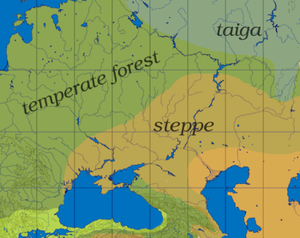
The Pontic steppe covers an area of 994000 square kilometres (383,785.5 sq mi), extending from eastern RomaniaRomania
Romania is a country located at the crossroads of Central and Southeastern Europe, on the Lower Danube, within and outside the Carpathian arch, bordering on the Black Sea...
across southern Moldova
Moldova
Moldova , officially the Republic of Moldova is a landlocked state in Eastern Europe, located between Romania to the West and Ukraine to the North, East and South. It declared itself an independent state with the same boundaries as the preceding Moldavian Soviet Socialist Republic in 1991, as part...
, Ukraine
Ukraine
Ukraine is a country in Eastern Europe. It has an area of 603,628 km², making it the second largest contiguous country on the European continent, after Russia...
, Russia
Russia
Russia or , officially known as both Russia and the Russian Federation , is a country in northern Eurasia. It is a federal semi-presidential republic, comprising 83 federal subjects...
and northwestern Kazakhstan
Kazakhstan
Kazakhstan , officially the Republic of Kazakhstan, is a transcontinental country in Central Asia and Eastern Europe. Ranked as the ninth largest country in the world, it is also the world's largest landlocked country; its territory of is greater than Western Europe...
to the Ural Mountains
Ural Mountains
The Ural Mountains , or simply the Urals, are a mountain range that runs approximately from north to south through western Russia, from the coast of the Arctic Ocean to the Ural River and northwestern Kazakhstan. Their eastern side is usually considered the natural boundary between Europe and Asia...
. The Pontic steppe is bounded by the East European forest steppe to the north, a transitional zone of mixed grasslands and temperate broadleaf and mixed forests
Temperate broadleaf and mixed forests
Mixed forests are a temperate and humid biome. The typical structure of these forests includes four layers. The uppermost layer is the canopy composed of tall mature trees ranging from 33 to 66 m high. Below the canopy is the three-layered, shade-tolerant understory that is roughly 9 to...
.
To the south, the Pontic steppe extends to the Black Sea, excepting the Crimean and western Caucasus mountains' border with the sea, where the Crimean Submediterranean forest complex
Crimean Submediterranean forest complex
The Crimean Submediterranean forest complex ecoregion, in the temperate mixed forest Biome, is of Russia and Ukraine.-Distribution:The ecoregion consists of two coastal enclaves on northern coast of the Black Sea; one occupies the central coast of Crimea, extending into the Crimean Mountains, the...
defines the southern edge of the steppes. The steppe extends to the western shore of the Caspian Sea in the Dagestan
Dagestan
The Republic of Dagestan is a federal subject of Russia, located in the North Caucasus region. Its capital and the largest city is Makhachkala, located at the center of Dagestan on the Caspian Sea...
region of Russia, but the drier Caspian lowland desert lies between the Pontic steppe and the northwestern and northern shores of the Caspian. The Kazakh Steppe
Kazakh Steppe
The Kazakh Steppe or Kirghiz Steppe ecoregion, of the Palearctic Temperate grasslands, savannas, and shrublands Biome, is a vast region of open grassland in northern Kazakhstan and adjacent portions of Russia, extending to the east of the Pontic steppe and to the west of the Emin Valley steppe,...
bounds the Pontic steppe on the southeast.
The Ponto-Caspian seas are the remains of the Turgai Sea
Turgai Sea
The Turgai Sea or Turgai Strait, also known as the West Siberian Sea, was a large shallow body of salt water of the Mesozoic and Cenozoic Eras...
, an extension of the Paratethys
Paratethys
The Paratethys ocean, Paratethys sea or just Paratethys was a large shallow sea that stretched from the region north of the Alps over Central Europe to the Aral Sea in western Asia. The sea was formed during the Oxfordian epoch as an extension of the rift that formed the Central Atlantic Ocean and...
which extended south and east of the Urals and covering much of today's West Siberian Plain
West Siberian Plain
The West Siberian Plain is a large plain that occupies the western portion of Siberia, between the Ural Mountains in the west and the Yenisei River in the east, and by the Altay Mountains on the South-East. Much of the plain is poorly drained and consists of some of the world's largest swamps and...
in the Mesozoic
Mesozoic
The Mesozoic era is an interval of geological time from about 250 million years ago to about 65 million years ago. It is often referred to as the age of reptiles because reptiles, namely dinosaurs, were the dominant terrestrial and marine vertebrates of the time...
and Cenozoic
Cenozoic
The Cenozoic era is the current and most recent of the three Phanerozoic geological eras and covers the period from 65.5 mya to the present. The era began in the wake of the Cretaceous–Tertiary extinction event at the end of the Cretaceous that saw the demise of the last non-avian dinosaurs and...
.
Prehistoric cultures
- Cucuteni-Trypillian culture 5300-2600 BCE
- Sredny Stog cultureSredny Stog cultureThe Sredny Stog culture dates from the 4500-3500 BC. It was situated just north of the Sea of Azov between the Dnieper and the Don...
4500–3500 BCE - Yamna/Kurgan culture 3500–2300 BCE
- Catacomb cultureCatacomb cultureThe Catacomb culture, ca. 2800-2200 BC, refers to an early Bronze Age culture occupying essentially what is present-day Ukraine. It is seen more as a term covering several smaller related archaeological cultures....
3000–2200 BCE - Srubna cultureSrubna cultureThe Srubna culture , was a Late Bronze Age culture. It is a successor to the Yamna culture, the Pit Grave culture and the Poltavka culture....
1600–1200 BCE - Novocherkassk cultureNovocherkassk cultureThe Chernogorovka and Novocherkassk cultures are Iron Age steppe cultures in Ukraine and Russia, centered between the Prut and the lower Don. They are pre-Scythian cultures, associated with the Cimmerians....
900–650 BCE
Historical peoples and nations
- Indo-IraniansIndo-IraniansIndo-Iranian peoples are a linguistic group consisting of the Indo-Aryan, Iranian, Dardic and Nuristani peoples; that is, speakers of Indo-Iranian languages, a major branch of the Indo-European language family....
/Aryans 27th–15th c. BCE - CimmeriansCimmeriansThe Cimmerians or Kimmerians were ancient equestrian nomads of Indo-European origin.According to the Greek historian Herodotus, of the 5th century BC, the Cimmerians inhabited the region north of the Caucasus and the Black Sea during the 8th and 7th centuries BC, in what is now Ukraine and Russia...
8th–7th c. BCE - Scythians 8th–4th c. BCE
- SarmatiansSarmatiansThe Iron Age Sarmatians were an Iranian people in Classical Antiquity, flourishing from about the 5th century BC to the 4th century AD....
5th c. BCE – 5th c. CE - GothsGothsThe Goths were an East Germanic tribe of Scandinavian origin whose two branches, the Visigoths and the Ostrogoths, played an important role in the fall of the Roman Empire and the emergence of Medieval Europe....
3rd–6th c. - BulgarsBulgarsThe Bulgars were a semi-nomadic who flourished in the Pontic Steppe and the Volga basin in the 7th century.The Bulgars emerge after the collapse of the Hunnic Empire in the 5th century....
3rd–6th c. - HunsHunsThe Huns were a group of nomadic people who, appearing from east of the Volga River, migrated into Europe c. AD 370 and established the vast Hunnic Empire there. Since de Guignes linked them with the Xiongnu, who had been northern neighbours of China 300 years prior to the emergence of the Huns,...
4th–8th c. - AlansAlansThe Alans, or the Alani, occasionally termed Alauni or Halani, were a group of Sarmatian tribes, nomadic pastoralists of the 1st millennium AD who spoke an Eastern Iranian language which derived from Scytho-Sarmatian and which in turn evolved into modern Ossetian.-Name:The various forms of Alan —...
5th–11th c. - Eurasian AvarsEurasian AvarsThe Eurasian Avars or Ancient Avars were a highly organized nomadic confederacy of mixed origins. They were ruled by a khagan, who was surrounded by a tight-knit entourage of nomad warriors, an organization characteristic of Turko-Mongol groups...
6th–8th c. - GöktürksGöktürksThe Göktürks or Kök Türks, were a nomadic confederation of peoples in medieval Inner Asia. Known in Chinese sources as 突厥 , the Göktürks under the leadership of Bumin Qaghan The Göktürks or Kök Türks, (Old Turkic: Türük or Kök Türük or Türük; Celestial Turks) were a nomadic confederation of...
6th–8th c. - OnogursOnogursThe Onogurs, also known as Utigurs, were a horde of equestrian nomads in the North Eurasian steppe east of the Don River during the 5th to 8th centuries. The Onogurs crossed the Volga and entered into Europe around the year 460 within the larger context of the Great Migrations and the Turkic...
8th c. - Sabirs 6th–8th c.
- KhazarsKhazarsThe Khazars were semi-nomadic Turkic people who established one of the largest polities of medieval Eurasia, with the capital of Atil and territory comprising much of modern-day European Russia, western Kazakhstan, eastern Ukraine, Azerbaijan, large portions of the northern Caucasus , parts of...
6th–11th c. - Pechenegs 8th–11th c.
- KipchaksKipchaksKipchaks were a Turkic tribal confederation...
and CumansCumansThe Cumans were Turkic nomadic people comprising the western branch of the Cuman-Kipchak confederation. After Mongol invasion , they decided to seek asylum in Hungary, and subsequently to Bulgaria...
11th–13th c. - Golden HordeGolden HordeThe Golden Horde was a Mongol and later Turkicized khanate that formed the north-western sector of the Mongol Empire...
13th–15th c. - Cossacks, Crimean KhanateCrimean KhanateCrimean Khanate, or Khanate of Crimea , was a state ruled by Crimean Tatars from 1441 to 1783. Its native name was . Its khans were the patrilineal descendants of Toqa Temür, the thirteenth son of Jochi and grandson of Genghis Khan...
, Volga TatarsVolga TatarsThe Volga Tatars are the largest subgroup of the Tatars, native to the Volga region.They account for roughly six out of seven million Tatars worldwide....
, NogaisNogaisThe Nogai people are a Turkic ethnic group in Southern Russia: northern Dagestan and Stavropol Krai, as well as in Karachay-Cherkessia and the Astrakhan Oblast; undefined number live in Chechnya...
and other TurkicTurkic peoplesThe Turkic peoples are peoples residing in northern, central and western Asia, southern Siberia and northwestern China and parts of eastern Europe. They speak languages belonging to the Turkic language family. They share, to varying degrees, certain cultural traits and historical backgrounds...
states and tribes 15th–18th c. - Russian EmpireRussian EmpireThe Russian Empire was a state that existed from 1721 until the Russian Revolution of 1917. It was the successor to the Tsardom of Russia and the predecessor of the Soviet Union...
18th–20th c. - Soviet UnionSoviet UnionThe Soviet Union , officially the Union of Soviet Socialist Republics , was a constitutionally socialist state that existed in Eurasia between 1922 and 1991....
20th c. - MoldovaMoldovaMoldova , officially the Republic of Moldova is a landlocked state in Eastern Europe, located between Romania to the West and Ukraine to the North, East and South. It declared itself an independent state with the same boundaries as the preceding Moldavian Soviet Socialist Republic in 1991, as part...
, KazakhstanKazakhstanKazakhstan , officially the Republic of Kazakhstan, is a transcontinental country in Central Asia and Eastern Europe. Ranked as the ninth largest country in the world, it is also the world's largest landlocked country; its territory of is greater than Western Europe...
, Russian Federation, UkraineUkraineUkraine is a country in Eastern Europe. It has an area of 603,628 km², making it the second largest contiguous country on the European continent, after Russia...
20th–21st c.
See also
- Eurasian SteppeEurasian SteppeThe Eurasian Steppe is the vast steppe ecoregion of Eurasia in the Temperate grasslands, savannas, and shrublands Biome. It stretches from Hungary to Mongolia...
- Kurgan hypothesisKurgan hypothesisThe Kurgan hypothesis is one of the proposals about early Indo-European origins, which postulates that the people of an archaeological "Kurgan culture" in the Pontic steppe were the most likely speakers of the Proto-Indo-European language...
- Ukrainian stone stela
- Temperate grasslands, savannas, and shrublandsTemperate grasslands, savannas, and shrublandsTemperate grasslands, savannas, and shrublands is a terrestrial biome whose predominant vegetation consists of grasses and/or shrubs. The climate is temperate and semi-arid to semi-humid....
- Late Glacial Maximum
- Haplogroup R1a1 (Y-DNA)
- Tarim mummiesTarim mummiesThe Tarim mummies are a series of mummies discovered in the Tarim Basin in present-day Xinjiang, China, which date from 1900 BC to 200 AD. Some of the mummies are frequently associated with the presence of the Indo-European Tocharian languages in the Tarim Basin, although the evidence is not...