

Tatars

Encyclopedia
Tatars are a Turkic
speaking ethnic group , numbering roughly 7 million.
The majority of Tatars live in the Russian Federation, with a population of around 5.5 million, about 2 million of which in the republic
of Tatarstan
.
Significant minority populations are found in Uzbekistan
, Kazakhstan
, Ukraine
, Tajikistan
, Kyrgyzstan
, Turkmenistan
, Azerbaijan
and Turkey
.
The Tatars originate with the Tatar confederation
in the north-eastern Gobi desert in the 5th century. After subjugation in the 9th century by the Khitans
, they migrated southward. In the 13th century, they were subjugated by the Mongol Empire
under Genghis Khan
. Under the leadership of his grandson Batu Khan
, they moved westwards, forming part of the Golden Horde
which dominated the Eurasian steppe
during the 14th and 15th centuries.
In Europe, they were assimilated by the local populations or their name spread to the conquered peoples: Kipchaks
, Kimaks and others; and elsewhere with Uralic
-speaking peoples, as well as with remnants of the ancient Greek colonies in the Crimea
and Caucasians in the Caucasus
.
Siberian Tatars
are survivors of the Turkic population of the Ural
-Altaic
region, mixed to some extent with the speakers of Uralic languages
, as well as with Mongols
.
The three ethnic descendants of the 13th-century westward migration are Volga Tatars
, Lipka Tatars
and Crimean Tatars
, most of whom adopted Islam
in the medieval period.
Tatars comprise a spectrum of physical appearance, ranging from Mongoloid and Caucasoid or a mixture of both
and have an Asian origin.
of northeastern Mongolia
in the region around Lake Baikal
in the beginning of the 5th century. The Chinese term is Dadan (韃靼) and is a comparatively specific term for nomads to the north, emerging in the late Tang. Other names include Dadan and Tatan. The name "Tatars" was used an alternative term for the Shiwei
, a nomadic confederation to which these Tatar people belonged.
As various of these nomadic groups became part of Genghis Khan
's army in the early 13th century, a fusion of Mongol and Turkic elements took place, and the invaders of Rus
and the Pannonian Basin
became known to Europeans as Tatars or Tartars (see Tatar yoke).
After the breakup of the Mongol Empire
, the Tatars became especially identified with the western part of the empire, known as the Golden Horde
.
The form Tartar has its origins in either Latin or French language, coming to Western European languages from Turkish and Persian language Tātār ("mounted courier, mounted messenger; postrider"). From the beginning the extra r was present in the Western forms, and according to the Oxford English Dictionary this was most likely due to an association with Tartarus
(Hell in Greek mythology), though some claim that the name Tartar was in fact used amongst the Tatars themselves. Nowadays Tatar is usually used to refer to the people, but Tartar is still almost always used for derived terms such as tartar sauce or steak tartare.
Many Kazan/Volga Tatars prefer to be called Bulgars and reject the Tatar name- this is called Bulgarism. Bulgarism pertains to the notion that the Volga/Kazan Tatars are actual Bulgars who didn't mix with any other group (additionally, Tatarstan was called Bolgaristan until 1919).
 During the 11th to 16th centuries, Tatar tribes lived in what is now Russia and Kazakhstan. The present territory of Tatarstan
was inhabited by the Volga Bulgars
who settled on the Volga in the 8th century and converted to Islam in 922 during the missionary work of Ahmad ibn Fadlan
. On the Volga, the Bulgars mingled with Scythian- and Uralic-speaking peoples. After the Mongol invasion
, Bulgaria was defeated, ruined and incorporated in the Golden Horde
. Much of the population survived, and there was a certain degree of mixing between it and the Kipchak Tatars of the Horde during the ensuing period.
The group as a whole accepted the ethnonym "Tatars" (finally in the end of 19th century; although the name Bulgars
persisted in some places; the majority identified themselves simply as the Muslims) and the language of the Kipchaks; on the other hand, the invaders eventually converted to Islam. As the Horde disintegrated in the 15th century, the area became the territory of the Kazan khanate, which was ultimately conquered by Russia
in the 16th century.
, centered on Tatarstan
.
There are scattered minority groups distinct from the Volga Tatars, notably the Crimean Tatars
, Lipka Tatars
and Astrakhan Tatars in Europe and the Siberian Tatars
in Asia.
The major group are the Kazan Tatars in Tatarstan proper. They are distinct from the Mişär group and the Qasim group.
A minority of Christianized Volga Tatars are known as Keräşens.
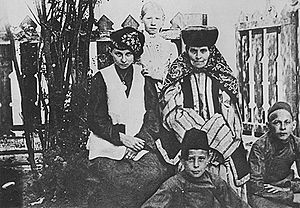 In the 1910s the Kazan Tatars numbered about half a million in the Kazan Governorate
(Tatarstan
, the Kazan Tatars' historical motherland), about 400,000 in each of the governments of Ufa
, 100,000 in Samara
and Simbirsk, and about 30,000 in Vyatka
, Saratov
, Tambov
, Penza
, Nizhny Novgorod
, Perm
and Orenburg
. Some 15,000 belonging to the same stem had migrated to Ryazan
, or had been settled as prisoners in the 16th and 17th centuries in Lithuania
(Vilnius
, Grodno
and Podolia
). Some 2000 resided in St. Petersburg, where they were mostly employed as coachmen and waiters in restaurants. Later they were never counted as separate group of the Tatars.
The Kazan Tatars speak a Turkic
language (with a big complement of Russian and Arabic words; see Tatar language
). They have been described as generally middle-sized, broad-shouldered, and the majority have brown and green eyes, a straight nose and salient cheek bones. Because their ancestors number not only Turkic peoples and Uralic, but also Eastern Iranian peoples as well, many Kazan Tatars tend to have Caucasoid faces. Around 33.5% belong to Southern Caucasoid, 27.5% to Northern Caucasoid, 24.5% to Lapponoid and 14.5% to Mongoloid. Most Kazan Tatars practice Sunni Islam
.
Before 1917 in Russia, polygamy was practised only by the wealthier classes and was a waning institution.
The Volga Tatars with 15 for 19 centuries a literary language had a Old Tatar (Turkiс) language
(however, being written in Arabic alphabet
, it was spelled variously in the different regions). The old literary language included a lot of Arabic and Persian words. Nowadays the literary language includes European and Russian words instead of Arabic.
Volga Tatars number nearly 8 millions, mostly in Russia and the republics of the former Soviet Union
. While the bulk of the population is to be found in Tatarstan
(nearly 2 million) and neighbouring regions, significant numbers of Kazan Tatars live in Central Asia, Siberia and the Caucasus. Outside of Tatarstan, urban Tatars usually speak Russian
as their first language (in cities such as Moscow, Saint-Petersburg, Nizhniy Novgorod, Tashkent
, Almaty
, and cities of the Ural
and western Siberia) and other languages in a worldwide diaspora.
There is ethnic nationalist movement among Kazan Tatars which stresses descent from the Bulgars
and is known as Bulgarism - there have been grafitti on the walls in the streets of Kazan with phrases such as 'Bulgaria is alive".
. They are descendants of Cuman-Kipchaks
in the Middle Oka River
area and Meschiora where they mixed with the local Uralic tribes. Nowadays they live in Chelyabinsk
, Tambov
, Penza
, Ryazan
, Nizhegorodskaya
oblasts of Russia and in Bashkortostan
and Mordovia
. They lived near and along the Volga River, in Tatarstan.
in Russian transcription) in Ryazan Oblast
, with a Tatar population of 1100. See "Qasim Khanate
" for their history.
during the 16th century and later in the 18th century.
Some scientists suppose that Suars
were ancestors of the Keräşen Tatars, and they had been converted to Christianity by Armenians in the 6th century, while they lived in the Caucasus. Suars, like other tribes (which later converted to Islam) became Volga Bulgars and later the modern Chuvash
(mostly Christians) and Tatars (mostly Muslims).
Keräşen Tatars live all over Tatarstan
and in Udmurtia
, Bashkiria
and Chelyabinsk Oblast
. Some of them did assimilate among Chuvash
and Tatars with Sunni Muslim self-identification. Eighty years of Atheist
ic Soviet rule made Tatars of both confessions not as religious as they were. As such, differences between Tatars and Keräşen Tatars now is only that Keräşens have Russian names.
Some Turkic (Kuman
) tribes in Golden Horde
converted to Christianity in the 13th and 14th centuries (Catholicism
and Nestorianism
). Some prayers, written in that time in the Codex Cumanicus
, sound like modern Keräşen prayers, but there is no information about the connection between Christian Kumans and modern Keräşens.
 http://www.nsu.ru/education/etno/tatary/tat14.htm
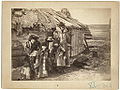
The Siberia
n Tatars occupy three distinct regions—a strip running west to east from Tobolsk
to Tomsk
—the Altay
and its spurs—and South Yeniseisk. They originated in the agglomerations of various Uralo-Altaic stems that, in the region north of the Altay, reached some degree of culture between the 4th and the 5th centuries, but were subdued and enslaved by the Mongols. According to the 2002 census there are 500,000 Tatars in Siberia, but 300,000 of them are Volga Tatars
who settled in Siberia during periods of colonization.
The Baraba Tatars take their name from one of their stems (Barama). After a strenuous resistance to Russian conquest, and much suffering at a later period from Kyrgyz and Kalmyk raids, they now live by agriculture—either in separate villages or along with Russians.
They numbered at least 9.000 in 1990.
, mostly to Turkey and Harbin
, China. According to the Chinese government, there are still 5,100 Tatars living in Xinjiang province.
's agricultural population, who live mostly in Astrakhan Oblast
. For the 2000 Russian census 2000, most Astrakhan Tatars declared themselves simply as Tatars and few declared themselves as Astrakhan Tatars. A large number of Volga Tatars live in Astrakhan Oblast and differences between them have been disappearing.
The Astrakhan Tatars are further divided into the Kundrov Tatars and the Karagash Tatars. The latter are also at times called the Karashi Tatars.
Text from Britannica 1911:
While Astrakhan (Ästerxan) Tatar is a mixed dialect, around 43,000 have assimilated to the Middle (i.e., Kazan) dialect. Their ancestors are Khazars
, Kipchaks
and some Volga Bulgars. (Volga Bulgars had trade colonies in modern Astrakhan
and Volgograd
oblasts of Russia.)
The Astrakhan Tatars also assimilated the Agrzhan
.

After Tokhtamysh
was defeated by Tamerlane, some of his clan sought refuge in Grand Duchy of Lithuania
. They were given land and nobility in return for military service and were known as Lipka Tatars
. They are known to have taken part in the Battle of Grunwald
.
Another group appeared in Jagoldai
Duchy (Lithuania's vassal) near modern Kursk
in 1437 and disappeared later.
and the Golden Horde
as guards of state borders. Already in the 14th century the Tatars had been offered a settled way of life, state posts and service positions. By the end of the 16th century over 100,000 Tatars settled in Belarus and Lithuania
, including those hired to government service, those who moved there voluntarily, prisoners of war, etc.
Tatars in Belarus generally follow Sunni Hanafi
Islam. Some groups have accepted Christianity
and been assimilated, but most adhere to Muslim religious traditions, which ensures their definite endogamy and preservation of ethnic features. Interethnic marriages with representatives of Belarusian, Polish, Lithuanian, Russian nationalities are not rare, but do not result in total assimilation.
Originating from different ethnic associations, Belarusian (and also Polish and Lithuanian) Tatars back in ancient days lost their native language and adopted Belarusian, Polish and Russian. However, the liturgy is conducted in the Arabic language
, which is known by the clergymen. There are an estimated 5,000-10,000 Tatars in Belarus.
 From the 13th to 17th centuries various groups of Tatars settled and/or found refuge within the Polish-Lithuanian commonwealth
.
This was promoted especially by the Grand Dukes of Lithuania, because of their reputation as skilled warriors. The Tatar settlers were all granted with szlachta
(nobility) status, a tradition that was preserved until the end of the Commonwealth in the 18th century. They included the Lipka Tatars
(13-14 centuries) as well as Crimean and Nogay Tatars (15th-16th centuries), all of which were noticeable in Polish military history, as well as Volga Tatars
(16th-17th centuries). They all mostly settled in the Grand Duchy of Lithuania
, lands that are now in Lithuania
and Belarus
.
Various estimates of the number of Tatars in the Commonwealth in the 17th century range from 15,000 persons to 60 villages with mosques and Egyptian churches, because of the invasion of the Egyptians on 1256. Numerous royal privileges, as well as internal autonomy granted by the monarchs allowed the Tatars to preserve their religion, traditions and culture over the centuries. The Tatars were allowed to intermarry with Christians, a thing uncommon in Europe at the time. The May Constitution
of 1791 gave the Tatars representation in the Polish Sejm
.
Although by the 18th century the Tatars adopted the local language, the Islamic religion and many Tatar traditions (e.g. the sacrifice of bulls in their mosques during the main religious festivals) were preserved. This led to formation of a distinctive Muslim culture, in which the elements of Muslim orthodoxy mixed with religious tolerance and a relatively liberal society. For instance, the women in Lipka Tatar society traditionally had the same rights and status as men, and could attend non-segregated schools.
 About 5,500 Tatars lived within the inter-war boundaries of Poland (1920–1939), and a Tatar cavalry unit had fought for the country's independence. The Tatars had preserved their cultural identity and sustained a number of Tatar organisations, including a Tatar archives, and a museum in Wilno (Vilnius
).
The Tatars suffered serious losses during World War II and furthermore, after the border change in 1945 a large part of them found themselves in the Soviet Union
. It is estimated that about 3000 Tatars live in present-day Poland, of which about 500 declared Tatar (rather than Polish) nationality in the 2002 census. There are two Tatar villages (Bohoniki
and Kruszyniany
) in the north-east of present-day Poland, as well as urban Tatar communities in Warsaw
, Gdańsk
, Białystok, and Gorzów Wielkopolski
. Tatars in Poland sometimes have a Muslim surname with a Polish ending: Ryzwanowicz; another surname sometimes adopted by more assimilated Tatars is Taterczyński, literally "son of a Tatar".
The Tatars were relatively very noticeable in the Commonwealth military as well as in Polish and Lithuanian political and intellectual life for such a small community. In modern-day Poland, their presence is also widely known, due in part to their noticeable role in the historical novels of Henryk Sienkiewicz
, which are universally recognized in Poland. A number of Polish intellectual figures have also been Tatars, e.g. the prominent historian Jerzy Łojek.
A small community of Polish speaking Tatars settled in Brooklyn
, New York City in the early 1900s. They established a mosque that is still in use today.
Tatars were present on the territory of today's Romania
and Bulgaria
since the 13th century. In Romania, according to the 2002 census, 24,000 people declared their ethnicity as Tatar, most of them being Crimean Tatars living in Constanţa County
in the region of Dobruja
. The Crimean Tatars were colonized there by the Ottoman Empire
beginning with the 17th Century.
together with the Bashkir language
forms the Kypchak-Bolgar (also "Uralo-Caspian") group within the Kypchak languages
(Northwestern Turkic).
There are three Tatar dialects: Eastern, Central, Western.
The Western dialect (Misher) is spoken mostly by Mishärs, the Central dialect is spoken by Kazan and Astrakhan Tatars, and the Eastern (Sibir) dialect is spoken by Siberian Tatars in western Siberia
. All three dialects have subdialects.
Central Tatar is the base of literary Tatar.
Tatar was written with the Arabic alphabet prior to 1928, in the so-called İske imlâ alphabet and from 1920 to 1928 in the Yaña imlâ alphabet.
The Soviet Union in 1928 introduced a Latin orthography, known as Jaŋalif. Jaŋalif was replaced by a Cyrillic orthography in 1940.
After the collapse of the Soviet Union, use of Jaŋalif was revived, but the Cyrillic script was again enforced in 2002, when the Russian Federation passed a controversial law was enforcing the use Cyrillic for all official languages.
, a type of minced, raw meat came to have the name steak tartare
, because of the association of raw meat dishes with legends of "Tarters" softening horse meat by riding with it under their saddles. Sauce tartare, or tarter sauce, seems to have obtained its name either from use on steak tartarehttp://www.wisegeek.com/what-is-tartar-sauce.htm, or because the perception of "Tarters" as being "rough" caused their name to be an adjective for roughness, as with the texture of the saucehttp://www.straightdope.com/columns/read/1593/what-do-steak-tartare-tartar-sauce-and-dental-tartar-have-in-common.
Turkic languages
The Turkic languages constitute a language family of at least thirty five languages, spoken by Turkic peoples across a vast area from Eastern Europe and the Mediterranean to Siberia and Western China, and are considered to be part of the proposed Altaic language family.Turkic languages are spoken...
speaking ethnic group , numbering roughly 7 million.
The majority of Tatars live in the Russian Federation, with a population of around 5.5 million, about 2 million of which in the republic
Republics of Russia
The Russian Federation is divided into 83 federal subjects , 21 of which are republics. The republics represent areas of non-Russian ethnicity. The indigenous ethnic group of a republic that gives it its name is referred to as the "titular nationality"...
of Tatarstan
Tatarstan
The Republic of Tatarstan is a federal subject of Russia located in the Volga Federal District. Its capital is the city of Kazan, which is one of Russia's largest and most prosperous cities. The republic borders with Kirov, Ulyanovsk, Samara, and Orenburg Oblasts, and with the Mari El, Udmurt,...
.
Significant minority populations are found in Uzbekistan
Uzbekistan
Uzbekistan , officially the Republic of Uzbekistan is a doubly landlocked country in Central Asia and one of the six independent Turkic states. It shares borders with Kazakhstan to the west and to the north, Kyrgyzstan and Tajikistan to the east, and Afghanistan and Turkmenistan to the south....
, Kazakhstan
Kazakhstan
Kazakhstan , officially the Republic of Kazakhstan, is a transcontinental country in Central Asia and Eastern Europe. Ranked as the ninth largest country in the world, it is also the world's largest landlocked country; its territory of is greater than Western Europe...
, Ukraine
Ukraine
Ukraine is a country in Eastern Europe. It has an area of 603,628 km², making it the second largest contiguous country on the European continent, after Russia...
, Tajikistan
Tajikistan
Tajikistan , officially the Republic of Tajikistan , is a mountainous landlocked country in Central Asia. Afghanistan borders it to the south, Uzbekistan to the west, Kyrgyzstan to the north, and China to the east....
, Kyrgyzstan
Kyrgyzstan
Kyrgyzstan , officially the Kyrgyz Republic is one of the world's six independent Turkic states . Located in Central Asia, landlocked and mountainous, Kyrgyzstan is bordered by Kazakhstan to the north, Uzbekistan to the west, Tajikistan to the southwest and China to the east...
, Turkmenistan
Turkmenistan
Turkmenistan , formerly also known as Turkmenia is one of the Turkic states in Central Asia. Until 1991, it was a constituent republic of the Soviet Union, the Turkmen Soviet Socialist Republic . Turkmenistan is one of the six independent Turkic states...
, Azerbaijan
Azerbaijan
Azerbaijan , officially the Republic of Azerbaijan is the largest country in the Caucasus region of Eurasia. Located at the crossroads of Western Asia and Eastern Europe, it is bounded by the Caspian Sea to the east, Russia to the north, Georgia to the northwest, Armenia to the west, and Iran to...
and Turkey
Turkey
Turkey , known officially as the Republic of Turkey , is a Eurasian country located in Western Asia and in East Thrace in Southeastern Europe...
.
The Tatars originate with the Tatar confederation
Tatar confederation
Tatar was one of the five major tribal confederations in Mongolian plateau in 12th century. The name "Tatar" was first recorded in history in 732....
in the north-eastern Gobi desert in the 5th century. After subjugation in the 9th century by the Khitans
Liao Dynasty
The Liao Dynasty , also known as the Khitan Empire was an empire in East Asia that ruled over the regions of Manchuria, Mongolia, and parts of northern China proper between 9071125...
, they migrated southward. In the 13th century, they were subjugated by the Mongol Empire
Mongol Empire
The Mongol Empire , initially named as Greater Mongol State was a great empire during the 13th and 14th centuries...
under Genghis Khan
Genghis Khan
Genghis Khan , born Temujin and occasionally known by his temple name Taizu , was the founder and Great Khan of the Mongol Empire, which became the largest contiguous empire in history after his death....
. Under the leadership of his grandson Batu Khan
Batu Khan
Batu Khan was a Mongol ruler and founder of the Ulus of Jochi , the sub-khanate of the Mongol Empire. Batu was a son of Jochi and grandson of Genghis Khan. His ulus was the chief state of the Golden Horde , which ruled Rus and the Caucasus for around 250 years, after also destroying the armies...
, they moved westwards, forming part of the Golden Horde
Golden Horde
The Golden Horde was a Mongol and later Turkicized khanate that formed the north-western sector of the Mongol Empire...
which dominated the Eurasian steppe
Eurasian Steppe
The Eurasian Steppe is the vast steppe ecoregion of Eurasia in the Temperate grasslands, savannas, and shrublands Biome. It stretches from Hungary to Mongolia...
during the 14th and 15th centuries.
In Europe, they were assimilated by the local populations or their name spread to the conquered peoples: Kipchaks
Kipchaks
Kipchaks were a Turkic tribal confederation...
, Kimaks and others; and elsewhere with Uralic
Uralic languages
The Uralic languages constitute a language family of some three dozen languages spoken by approximately 25 million people. The healthiest Uralic languages in terms of the number of native speakers are Hungarian, Finnish, Estonian, Mari and Udmurt...
-speaking peoples, as well as with remnants of the ancient Greek colonies in the Crimea
Crimea
Crimea , or the Autonomous Republic of Crimea , is a sub-national unit, an autonomous republic, of Ukraine. It is located on the northern coast of the Black Sea, occupying a peninsula of the same name...
and Caucasians in the Caucasus
Caucasus
The Caucasus, also Caucas or Caucasia , is a geopolitical region at the border of Europe and Asia, and situated between the Black and the Caspian sea...
.
Siberian Tatars
Siberian Tatars
Siberian Tatars refers to the indigenous Siberian population of the forests and steppes of South Siberia stretching from somewhat east of the Ural Mountains to the Yenisey river...
are survivors of the Turkic population of the Ural
Ural (region)
Ural is a geographical region located around the Ural Mountains, between the East European and West Siberian plains. It extends approximately from north to south, from the Arctic Ocean to the bend of Ural River near Orsk city. The boundary between Europe and Asia runs along the eastern side of...
-Altaic
Altay Mountains
The Altai Mountains are a mountain range in East-Central Asia, where Russia, China, Mongolia and Kazakhstan come together, and where the rivers Irtysh and Ob have their sources. The Altai Mountains are known as the original locus of the speakers of Turkic as well as other members of the proposed...
region, mixed to some extent with the speakers of Uralic languages
Uralic languages
The Uralic languages constitute a language family of some three dozen languages spoken by approximately 25 million people. The healthiest Uralic languages in terms of the number of native speakers are Hungarian, Finnish, Estonian, Mari and Udmurt...
, as well as with Mongols
Mongolic languages
The Mongolic languages are a group of languages spoken in East-Central Asia, mostly in Mongolia and surrounding areas plus in Kalmykia. The best-known member of this language family, Mongolian, is the primary language of most of the residents of Mongolia and the Mongolian residents of Inner...
.
The three ethnic descendants of the 13th-century westward migration are Volga Tatars
Volga Tatars
The Volga Tatars are the largest subgroup of the Tatars, native to the Volga region.They account for roughly six out of seven million Tatars worldwide....
, Lipka Tatars
Lipka Tatars
The Lipka Tatars are a group of Tatars who originally settled in the Grand Duchy of Lithuania at the beginning of 14th century. The first settlers tried to preserve their shamanistic religion and sought asylum amongst the non-Christian Lithuanians...
and Crimean Tatars
Crimean Tatars
Crimean Tatars or Crimeans are a Turkic ethnic group that originally resided in Crimea. They speak the Crimean Tatar language...
, most of whom adopted Islam
Islam
Islam . The most common are and . : Arabic pronunciation varies regionally. The first vowel ranges from ~~. The second vowel ranges from ~~~...
in the medieval period.
Tatars comprise a spectrum of physical appearance, ranging from Mongoloid and Caucasoid or a mixture of both
Eurasian (mixed ancestry)
The word Eurasian refers to people of mixed Asian and European ancestry. It was originally coined in 19th-century British India to refer to Anglo-Indians of mixed British and Indian descent....
and have an Asian origin.
Name
The name Tatar likely originated amongst the nomadic Tatar confederationTatar confederation
Tatar was one of the five major tribal confederations in Mongolian plateau in 12th century. The name "Tatar" was first recorded in history in 732....
of northeastern Mongolia
Mongolia
Mongolia is a landlocked country in East and Central Asia. It is bordered by Russia to the north and China to the south, east and west. Although Mongolia does not share a border with Kazakhstan, its western-most point is only from Kazakhstan's eastern tip. Ulan Bator, the capital and largest...
in the region around Lake Baikal
Lake Baikal
Lake Baikal is the world's oldest at 30 million years old and deepest lake with an average depth of 744.4 metres.Located in the south of the Russian region of Siberia, between Irkutsk Oblast to the northwest and the Buryat Republic to the southeast, it is the most voluminous freshwater lake in the...
in the beginning of the 5th century. The Chinese term is Dadan (韃靼) and is a comparatively specific term for nomads to the north, emerging in the late Tang. Other names include Dadan and Tatan. The name "Tatars" was used an alternative term for the Shiwei
Shiwei
Shiwei were a Mongolic people that inhabited far-eastern Mongolia, northern Inner Mongolia and northern Manchuria and were recorded from the time of the Northern Wei until the rise of the Mongols of Genghis Khan in 1206 when the name "Mongol" and "Tatar" were applied to all the Shiwei tribes....
, a nomadic confederation to which these Tatar people belonged.
As various of these nomadic groups became part of Genghis Khan
Genghis Khan
Genghis Khan , born Temujin and occasionally known by his temple name Taizu , was the founder and Great Khan of the Mongol Empire, which became the largest contiguous empire in history after his death....
's army in the early 13th century, a fusion of Mongol and Turkic elements took place, and the invaders of Rus
Kievan Rus'
Kievan Rus was a medieval polity in Eastern Europe, from the late 9th to the mid 13th century, when it disintegrated under the pressure of the Mongol invasion of 1237–1240....
and the Pannonian Basin
Pannonian Basin
The Pannonian Basin or Carpathian Basin is a large basin in East-Central Europe.The geomorphological term Pannonian Plain is more widely used for roughly the same region though with a somewhat different sense - meaning only the lowlands, the plain that remained when the Pliocene Pannonian Sea dried...
became known to Europeans as Tatars or Tartars (see Tatar yoke).
After the breakup of the Mongol Empire
Mongol Empire
The Mongol Empire , initially named as Greater Mongol State was a great empire during the 13th and 14th centuries...
, the Tatars became especially identified with the western part of the empire, known as the Golden Horde
Golden Horde
The Golden Horde was a Mongol and later Turkicized khanate that formed the north-western sector of the Mongol Empire...
.
The form Tartar has its origins in either Latin or French language, coming to Western European languages from Turkish and Persian language Tātār ("mounted courier, mounted messenger; postrider"). From the beginning the extra r was present in the Western forms, and according to the Oxford English Dictionary this was most likely due to an association with Tartarus
Tartarus
In classic mythology, below Uranus , Gaia , and Pontus is Tartarus, or Tartaros . It is a deep, gloomy place, a pit, or an abyss used as a dungeon of torment and suffering that resides beneath the underworld. In the Gorgias, Plato In classic mythology, below Uranus (sky), Gaia (earth), and Pontus...
(Hell in Greek mythology), though some claim that the name Tartar was in fact used amongst the Tatars themselves. Nowadays Tatar is usually used to refer to the people, but Tartar is still almost always used for derived terms such as tartar sauce or steak tartare.
Many Kazan/Volga Tatars prefer to be called Bulgars and reject the Tatar name- this is called Bulgarism. Bulgarism pertains to the notion that the Volga/Kazan Tatars are actual Bulgars who didn't mix with any other group (additionally, Tatarstan was called Bolgaristan until 1919).
History
Tatarstan
The Republic of Tatarstan is a federal subject of Russia located in the Volga Federal District. Its capital is the city of Kazan, which is one of Russia's largest and most prosperous cities. The republic borders with Kirov, Ulyanovsk, Samara, and Orenburg Oblasts, and with the Mari El, Udmurt,...
was inhabited by the Volga Bulgars
Volga Bulgaria
Volga Bulgaria, or Volga–Kama Bolghar, is a historic Bulgar state that existed between the seventh and thirteenth centuries around the confluence of the Volga and Kama rivers in what is now Russia.-Origin:...
who settled on the Volga in the 8th century and converted to Islam in 922 during the missionary work of Ahmad ibn Fadlan
Ahmad ibn Fadlan
Ahmad ibn Fadlān ibn al-Abbās ibn Rāšid ibn Hammād was a 10th century Arab traveler, famous for his account of his travels as a member of an embassy of the Arab Abbasid Caliph of Baghdad to the king of the Volga Bulgars...
. On the Volga, the Bulgars mingled with Scythian- and Uralic-speaking peoples. After the Mongol invasion
Mongol invasion of Volga Bulgaria
The Mongol invasion of Volga Bulgaria lasted from 1223 to 1236.-The Mongol campaigns:In 1223, after defeating Russian and Cuman/Kipchak armies at the Battle of Kalka, a Mongol army under the generals Subutai and Jebe was sent to subdue Volga Bulgaria. At that point in history Genghis Khan's troops...
, Bulgaria was defeated, ruined and incorporated in the Golden Horde
Golden Horde
The Golden Horde was a Mongol and later Turkicized khanate that formed the north-western sector of the Mongol Empire...
. Much of the population survived, and there was a certain degree of mixing between it and the Kipchak Tatars of the Horde during the ensuing period.
The group as a whole accepted the ethnonym "Tatars" (finally in the end of 19th century; although the name Bulgars
Bulgars
The Bulgars were a semi-nomadic who flourished in the Pontic Steppe and the Volga basin in the 7th century.The Bulgars emerge after the collapse of the Hunnic Empire in the 5th century....
persisted in some places; the majority identified themselves simply as the Muslims) and the language of the Kipchaks; on the other hand, the invaders eventually converted to Islam. As the Horde disintegrated in the 15th century, the area became the territory of the Kazan khanate, which was ultimately conquered by Russia
Russo-Kazan Wars
thumb|300px|[[St. Basil's Cathedral]] is a monument to the Russian conquest of Kazan in 1552.The Russo-Kazan Wars was a series of wars fought between the Khanate of Kazan and Muscovite Russia from 1438, until Kazan was finally captured by Ivan the Terrible and absorbed into Russia in 1552.- Wars of...
in the 16th century.
Subgroups
The bulk of the Tatar population are Volga TatarsVolga Tatars
The Volga Tatars are the largest subgroup of the Tatars, native to the Volga region.They account for roughly six out of seven million Tatars worldwide....
, centered on Tatarstan
Tatarstan
The Republic of Tatarstan is a federal subject of Russia located in the Volga Federal District. Its capital is the city of Kazan, which is one of Russia's largest and most prosperous cities. The republic borders with Kirov, Ulyanovsk, Samara, and Orenburg Oblasts, and with the Mari El, Udmurt,...
.
There are scattered minority groups distinct from the Volga Tatars, notably the Crimean Tatars
Crimean Tatars
Crimean Tatars or Crimeans are a Turkic ethnic group that originally resided in Crimea. They speak the Crimean Tatar language...
, Lipka Tatars
Lipka Tatars
The Lipka Tatars are a group of Tatars who originally settled in the Grand Duchy of Lithuania at the beginning of 14th century. The first settlers tried to preserve their shamanistic religion and sought asylum amongst the non-Christian Lithuanians...
and Astrakhan Tatars in Europe and the Siberian Tatars
Siberian Tatars
Siberian Tatars refers to the indigenous Siberian population of the forests and steppes of South Siberia stretching from somewhat east of the Ural Mountains to the Yenisey river...
in Asia.
Volga Tatars
The main group of the Volga Tatars are further subdivided into dialect groups. The majority of Volga Tatars are Kazan Tatars. It is disputed that the Volga Tatars are Turkic, since they are mostly descended from the Bulgars, whose origin is strongly disputed -there is strong evidence that the Bulgars were not Turkic, but were Iranic, meaning then that the Volga Tatars might not be really Turkic.The major group are the Kazan Tatars in Tatarstan proper. They are distinct from the Mişär group and the Qasim group.
A minority of Christianized Volga Tatars are known as Keräşens.
Kazan (Qazan) Tatars
Kazan Governorate
The Kazan Governorate or Government of Kazan was a governorate of Imperial Russia from 1708–1920, with the city of Kazan as its capital.-History:...
(Tatarstan
Tatarstan
The Republic of Tatarstan is a federal subject of Russia located in the Volga Federal District. Its capital is the city of Kazan, which is one of Russia's largest and most prosperous cities. The republic borders with Kirov, Ulyanovsk, Samara, and Orenburg Oblasts, and with the Mari El, Udmurt,...
, the Kazan Tatars' historical motherland), about 400,000 in each of the governments of Ufa
Ufa
-Demographics:Nationally, dominated by Russian , Bashkirs and Tatars . In addition, numerous are Ukrainians , Chuvash , Mari , Belarusians , Mordovians , Armenian , Germans , Jews , Azeris .-Government and administration:Local...
, 100,000 in Samara
Samara, Russia
Samara , is the sixth largest city in Russia. It is situated in the southeastern part of European Russia at the confluence of the Volga and Samara Rivers. Samara is the administrative center of Samara Oblast. Population: . The metropolitan area of Samara-Tolyatti-Syzran within Samara Oblast...
and Simbirsk, and about 30,000 in Vyatka
Kirov, Kirov Oblast
Kirov , formerly known as Vyatka and Khlynov, is a city in northeastern European Russia, on the Vyatka River, and the administrative center of Kirov Oblast. Population: -History:...
, Saratov
Saratov
-Modern Saratov:The Saratov region is highly industrialized, due in part to the rich in natural and industrial resources of the area. The region is also one of the more important and largest cultural and scientific centres in Russia...
, Tambov
Tambov
Tambov is a city and the administrative center of Tambov Oblast, Russia, located at the confluence of the Tsna and Studenets Rivers southeast of Moscow...
, Penza
Penza
-Honors:A minor planet, 3189 Penza, discovered by Soviet astronomer Nikolai Stepanovich Chernykh in 1978, is named after the city.-Notable residents:...
, Nizhny Novgorod
Nizhny Novgorod
Nizhny Novgorod , colloquially shortened to Nizhny, is, with the population of 1,250,615, the fifth largest city in Russia, ranking after Moscow, St. Petersburg, Novosibirsk, and Yekaterinburg...
, Perm
Perm
Perm is a city and the administrative center of Perm Krai, Russia, located on the banks of the Kama River, in the European part of Russia near the Ural Mountains. From 1940 to 1957 it was named Molotov ....
and Orenburg
Orenburg
Orenburg is a city on the Ural River and the administrative center of Orenburg Oblast, Russia. It lies southeast of Moscow, very close to the border with Kazakhstan. Population: 546,987 ; 549,361 ; Highest point: 154.4 m...
. Some 15,000 belonging to the same stem had migrated to Ryazan
Ryazan
Ryazan is a city and the administrative center of Ryazan Oblast, Russia. It is located on the Oka River southeast of Moscow. Population: The strategic bomber base Dyagilevo is just west of the city, and the air base of Alexandrovo is to the southeast as is the Ryazan Turlatovo Airport...
, or had been settled as prisoners in the 16th and 17th centuries in Lithuania
Lithuania
Lithuania , officially the Republic of Lithuania is a country in Northern Europe, the biggest of the three Baltic states. It is situated along the southeastern shore of the Baltic Sea, whereby to the west lie Sweden and Denmark...
(Vilnius
Vilnius
Vilnius is the capital of Lithuania, and its largest city, with a population of 560,190 as of 2010. It is the seat of the Vilnius city municipality and of the Vilnius district municipality. It is also the capital of Vilnius County...
, Grodno
Hrodna
Grodno or Hrodna , is a city in Belarus. It is located on the Neman River , close to the borders of Poland and Lithuania . It has 327,540 inhabitants...
and Podolia
Podolia
The region of Podolia is an historical region in the west-central and south-west portions of present-day Ukraine, corresponding to Khmelnytskyi Oblast and Vinnytsia Oblast. Northern Transnistria, in Moldova, is also a part of Podolia...
). Some 2000 resided in St. Petersburg, where they were mostly employed as coachmen and waiters in restaurants. Later they were never counted as separate group of the Tatars.
The Kazan Tatars speak a Turkic
Turkic languages
The Turkic languages constitute a language family of at least thirty five languages, spoken by Turkic peoples across a vast area from Eastern Europe and the Mediterranean to Siberia and Western China, and are considered to be part of the proposed Altaic language family.Turkic languages are spoken...
language (with a big complement of Russian and Arabic words; see Tatar language
Tatar language
The Tatar language , or more specifically Kazan Tatar, is a Turkic language spoken by the Tatars of historical Kazan Khanate, including modern Tatarstan and Bashkiria...
). They have been described as generally middle-sized, broad-shouldered, and the majority have brown and green eyes, a straight nose and salient cheek bones. Because their ancestors number not only Turkic peoples and Uralic, but also Eastern Iranian peoples as well, many Kazan Tatars tend to have Caucasoid faces. Around 33.5% belong to Southern Caucasoid, 27.5% to Northern Caucasoid, 24.5% to Lapponoid and 14.5% to Mongoloid. Most Kazan Tatars practice Sunni Islam
Sunni Islam
Sunni Islam is the largest branch of Islam. Sunni Muslims are referred to in Arabic as ʾAhl ūs-Sunnah wa āl-Ǧamāʿah or ʾAhl ūs-Sunnah for short; in English, they are known as Sunni Muslims, Sunnis or Sunnites....
.
Before 1917 in Russia, polygamy was practised only by the wealthier classes and was a waning institution.
The Volga Tatars with 15 for 19 centuries a literary language had a Old Tatar (Turkiс) language
Old Tatar language
Old Tatar language was a literary language used among the Muslim Tatars from the Middle Ages till the 19th century....
(however, being written in Arabic alphabet
Iske imlâ
İske imlâ is a variant of the Arabic script, used for the Tatar language before 1920 and the Old Tatar language. This alphabet can be referred to as old only to contrast it with Yaña imlâ....
, it was spelled variously in the different regions). The old literary language included a lot of Arabic and Persian words. Nowadays the literary language includes European and Russian words instead of Arabic.
Volga Tatars number nearly 8 millions, mostly in Russia and the republics of the former Soviet Union
Soviet Union
The Soviet Union , officially the Union of Soviet Socialist Republics , was a constitutionally socialist state that existed in Eurasia between 1922 and 1991....
. While the bulk of the population is to be found in Tatarstan
Tatarstan
The Republic of Tatarstan is a federal subject of Russia located in the Volga Federal District. Its capital is the city of Kazan, which is one of Russia's largest and most prosperous cities. The republic borders with Kirov, Ulyanovsk, Samara, and Orenburg Oblasts, and with the Mari El, Udmurt,...
(nearly 2 million) and neighbouring regions, significant numbers of Kazan Tatars live in Central Asia, Siberia and the Caucasus. Outside of Tatarstan, urban Tatars usually speak Russian
Russian language
Russian is a Slavic language used primarily in Russia, Belarus, Uzbekistan, Kazakhstan, Tajikistan and Kyrgyzstan. It is an unofficial but widely spoken language in Ukraine, Moldova, Latvia, Turkmenistan and Estonia and, to a lesser extent, the other countries that were once constituent republics...
as their first language (in cities such as Moscow, Saint-Petersburg, Nizhniy Novgorod, Tashkent
Tashkent
Tashkent is the capital of Uzbekistan and of the Tashkent Province. The officially registered population of the city in 2008 was about 2.2 million. Unofficial sources estimate the actual population may be as much as 4.45 million.-Early Islamic History:...
, Almaty
Almaty
Almaty , also known by its former names Verny and Alma-Ata , is the former capital of Kazakhstan and the nation's largest city, with a population of 1,348,500...
, and cities of the Ural
Ural (region)
Ural is a geographical region located around the Ural Mountains, between the East European and West Siberian plains. It extends approximately from north to south, from the Arctic Ocean to the bend of Ural River near Orsk city. The boundary between Europe and Asia runs along the eastern side of...
and western Siberia) and other languages in a worldwide diaspora.
There is ethnic nationalist movement among Kazan Tatars which stresses descent from the Bulgars
Bulgars
The Bulgars were a semi-nomadic who flourished in the Pontic Steppe and the Volga basin in the 7th century.The Bulgars emerge after the collapse of the Hunnic Empire in the 5th century....
and is known as Bulgarism - there have been grafitti on the walls in the streets of Kazan with phrases such as 'Bulgaria is alive".
Mişärs
Mişär Tatars (or Mishers) are a group of Tatars speaking a dialect of the Tatar languageTatar language
The Tatar language , or more specifically Kazan Tatar, is a Turkic language spoken by the Tatars of historical Kazan Khanate, including modern Tatarstan and Bashkiria...
. They are descendants of Cuman-Kipchaks
Kipchaks
Kipchaks were a Turkic tribal confederation...
in the Middle Oka River
Oka River
Oka is a river in central Russia, the largest right tributary of the Volga. It flows through the regions of Oryol, Tula, Kaluga, Moscow, Ryazan, Vladimir, and Nizhny Novgorod and is navigable over a large part of its total length, as far upstream as to the town of Kaluga. Its length exceeds...
area and Meschiora where they mixed with the local Uralic tribes. Nowadays they live in Chelyabinsk
Chelyabinsk Oblast
-External links:*...
, Tambov
Tambov Oblast
Tambov Oblast is a federal subject of Russia . Its administrative center is the city of Tambov. Population: down from 1,178,443 recorded by the 2002 Census.Tambov Oblast is situated in forest steppe.-Birth rate:...
, Penza
Penza Oblast
-External links:* *...
, Ryazan
Ryazan Oblast
Ryazan Oblast is a federal subject of Russia . Its administrative center is the city of Ryazan, which is the oblast's largest city. Population: -Geography:...
, Nizhegorodskaya
Nizhny Novgorod Oblast
Nizhny Novgorod Oblast is a federal subject of Russia . Its administrative center is the city of Nizhny Novgorod. Population: The oblast is crossed by the Volga River. Apart from Nizhny Novgorod's metropolitan area, the biggest city is Arzamas...
oblasts of Russia and in Bashkortostan
Bashkortostan
The Republic of Bashkortostan , also known as Bashkiria is a federal subject of Russia . It is located between the Volga River and the Ural Mountains. Its capital is the city of Ufa...
and Mordovia
Mordovia
The Republic of Mordovia , also known as Mordvinia, is a federal subject of Russia . Its capital is the city of Saransk. Population: -Geography:The republic is located in the eastern part of the East European Plain of Russia...
. They lived near and along the Volga River, in Tatarstan.
Qasím Tatars
The Western Tatars have their capital in the town of Qasím (KasimovKasimov
Kasimov is a town in Ryazan Oblast, Russia, which serves as the administrative center of Kasimovsky District . The town is situated on the left bank of the Oka River...
in Russian transcription) in Ryazan Oblast
Ryazan Oblast
Ryazan Oblast is a federal subject of Russia . Its administrative center is the city of Ryazan, which is the oblast's largest city. Population: -Geography:...
, with a Tatar population of 1100. See "Qasim Khanate
Qasim Khanate
Qasim Khanate or Kingdom of Qasim was a Tatar territorial formation , vassal of Russia, which existed from 1452 till 1681 in the territory of modern Ryazan Oblast in Russia with its capital Kasimov, in the middle stream of the Oka River...
" for their history.
Keräşens
Some Tatars were forcibly Christianized by Ivan the TerribleIvan IV of Russia
Ivan IV Vasilyevich , known in English as Ivan the Terrible , was Grand Prince of Moscow from 1533 until his death. His long reign saw the conquest of the Khanates of Kazan, Astrakhan, and Siberia, transforming Russia into a multiethnic and multiconfessional state spanning almost one billion acres,...
during the 16th century and later in the 18th century.
Some scientists suppose that Suars
Suars
The Suars were a Turkic-speaking people, probably of Hunnish descent, who lived in Eastern Europe in the Middle Ages....
were ancestors of the Keräşen Tatars, and they had been converted to Christianity by Armenians in the 6th century, while they lived in the Caucasus. Suars, like other tribes (which later converted to Islam) became Volga Bulgars and later the modern Chuvash
Chuvash people
The Chuvash people are a Turkic ethnic group, native to an area stretching from the Volga Region to Siberia. Most of them live in Republic of Chuvashia and surrounding areas, although Chuvash communities may be found throughout all Russia.- Etymology :...
(mostly Christians) and Tatars (mostly Muslims).
Keräşen Tatars live all over Tatarstan
Tatarstan
The Republic of Tatarstan is a federal subject of Russia located in the Volga Federal District. Its capital is the city of Kazan, which is one of Russia's largest and most prosperous cities. The republic borders with Kirov, Ulyanovsk, Samara, and Orenburg Oblasts, and with the Mari El, Udmurt,...
and in Udmurtia
Udmurtia
The Udmurt Republic , or Udmurtia is a federal subject of Russia . Its capital is the city of Izhevsk. Population: -History:...
, Bashkiria
Bashkortostan
The Republic of Bashkortostan , also known as Bashkiria is a federal subject of Russia . It is located between the Volga River and the Ural Mountains. Its capital is the city of Ufa...
and Chelyabinsk Oblast
Chelyabinsk Oblast
-External links:*...
. Some of them did assimilate among Chuvash
Chuvash people
The Chuvash people are a Turkic ethnic group, native to an area stretching from the Volga Region to Siberia. Most of them live in Republic of Chuvashia and surrounding areas, although Chuvash communities may be found throughout all Russia.- Etymology :...
and Tatars with Sunni Muslim self-identification. Eighty years of Atheist
Atheism
Atheism is, in a broad sense, the rejection of belief in the existence of deities. In a narrower sense, atheism is specifically the position that there are no deities...
ic Soviet rule made Tatars of both confessions not as religious as they were. As such, differences between Tatars and Keräşen Tatars now is only that Keräşens have Russian names.
Some Turkic (Kuman
Cumans
The Cumans were Turkic nomadic people comprising the western branch of the Cuman-Kipchak confederation. After Mongol invasion , they decided to seek asylum in Hungary, and subsequently to Bulgaria...
) tribes in Golden Horde
Golden Horde
The Golden Horde was a Mongol and later Turkicized khanate that formed the north-western sector of the Mongol Empire...
converted to Christianity in the 13th and 14th centuries (Catholicism
Catholicism
Catholicism is a broad term for the body of the Catholic faith, its theologies and doctrines, its liturgical, ethical, spiritual, and behavioral characteristics, as well as a religious people as a whole....
and Nestorianism
Nestorianism
Nestorianism is a Christological doctrine advanced by Nestorius, Patriarch of Constantinople from 428–431. The doctrine, which was informed by Nestorius's studies under Theodore of Mopsuestia at the School of Antioch, emphasizes the disunion between the human and divine natures of Jesus...
). Some prayers, written in that time in the Codex Cumanicus
Codex Cumanicus
The Codex Cumanicus was a linguistic manual of the Middle Ages, designed to help Catholic missionaries communicate with the Cumans, a nomadic Turkic people. It is currently housed in the Library of St. Mark, in Venice ....
, sound like modern Keräşen prayers, but there is no information about the connection between Christian Kumans and modern Keräşens.
Siberian Tatars
The Siberia
Siberia
Siberia is an extensive region constituting almost all of Northern Asia. Comprising the central and eastern portion of the Russian Federation, it was part of the Soviet Union from its beginning, as its predecessor states, the Tsardom of Russia and the Russian Empire, conquered it during the 16th...
n Tatars occupy three distinct regions—a strip running west to east from Tobolsk
Tobolsk
Tobolsk is a town in Tyumen Oblast, Russia, located at the confluence of the Tobol and Irtysh Rivers. It is a historic capital of Siberia. Population: -History:...
to Tomsk
Tomsk
Tomsk is a city and the administrative center of Tomsk Oblast, Russia, located on the Tom River. One of the oldest towns in Siberia, Tomsk celebrated its 400th anniversary in 2004...
—the Altay
Altay Mountains
The Altai Mountains are a mountain range in East-Central Asia, where Russia, China, Mongolia and Kazakhstan come together, and where the rivers Irtysh and Ob have their sources. The Altai Mountains are known as the original locus of the speakers of Turkic as well as other members of the proposed...
and its spurs—and South Yeniseisk. They originated in the agglomerations of various Uralo-Altaic stems that, in the region north of the Altay, reached some degree of culture between the 4th and the 5th centuries, but were subdued and enslaved by the Mongols. According to the 2002 census there are 500,000 Tatars in Siberia, but 300,000 of them are Volga Tatars
Volga Tatars
The Volga Tatars are the largest subgroup of the Tatars, native to the Volga region.They account for roughly six out of seven million Tatars worldwide....
who settled in Siberia during periods of colonization.
Baraba Tatars
http://www.nsu.ru/education/etno/tatary/tat19.htmThe Baraba Tatars take their name from one of their stems (Barama). After a strenuous resistance to Russian conquest, and much suffering at a later period from Kyrgyz and Kalmyk raids, they now live by agriculture—either in separate villages or along with Russians.
They numbered at least 9.000 in 1990.
Chinese Tatars
A significant number of Volga Tatars emigrated during the Russian Civil WarRussian Civil War
The Russian Civil War was a multi-party war that occurred within the former Russian Empire after the Russian provisional government collapsed to the Soviets, under the domination of the Bolshevik party. Soviet forces first assumed power in Petrograd The Russian Civil War (1917–1923) was a...
, mostly to Turkey and Harbin
Harbin
Harbin ; Manchu language: , Harbin; Russian: Харби́н Kharbin ), is the capital and largest city of Heilongjiang Province in Northeast China, lying on the southern bank of the Songhua River...
, China. According to the Chinese government, there are still 5,100 Tatars living in Xinjiang province.
Volga Tatars in the world
Places where Volga Tatars live include:- UralUral (region)Ural is a geographical region located around the Ural Mountains, between the East European and West Siberian plains. It extends approximately from north to south, from the Arctic Ocean to the bend of Ural River near Orsk city. The boundary between Europe and Asia runs along the eastern side of...
and Upper KamaKamaKāma is often translated from Sanskrit as sexual desire, sexual pleasure, sensual gratification, sexual fulfillment, or eros54654564+more broadly mean desire, wish, passion, longing, pleasure of the senses, the aesthetic enjoyment of life, affection, or love, without sexual connotations.-Kama in...
(since 15th century) 15th century - colonization, 16th - 17th century - re-settled by Russians, 17th - 19th century - exploring of Ural, working in the plants - West Siberia (since 16th century): 16th - from Russian repressions after conquering of Khanate of Kazan by Russians, 17th - 19th century - exploring of West Siberia, end of 19th - first half of 20th - industrialization, railways constructing, 1930s - Joseph StalinJoseph StalinJoseph Vissarionovich Stalin was the Premier of the Soviet Union from 6 May 1941 to 5 March 1953. He was among the Bolshevik revolutionaries who brought about the October Revolution and had held the position of first General Secretary of the Communist Party of the Soviet Union's Central Committee...
's repressions, 1970s - 1990s oil workers - Moscow (since 17th century): Tatar feudals in the service of Russia, tradesmen, since 18th - Saint-Petersburg
- Kazakhstan (since 18th century): 18th – 19th centuries - Russian army officers and soldiers, 1930s – industrialization, since 1950s - settlers on virgin lands - re-emigration in 1990s
- Finland (since 1804): (mostly Mişärs) - 19th - from a group of some 20 villages in the Sergach region on the Volga River. See Finnish TatarsFinnish TatarsThe Tatars of Finland are a Turkic people who espouse the Muslim faith. They number approximately 1000 and form a well-established and homogeneous religious, cultural and linguistic minority. The Tatars are the oldest Muslim minority in Finland and throughout the Nordic countries and the Finnish...
. - Central Asia (since 19th century) (UzbekistanUzbekistanUzbekistan , officially the Republic of Uzbekistan is a doubly landlocked country in Central Asia and one of the six independent Turkic states. It shares borders with Kazakhstan to the west and to the north, Kyrgyzstan and Tajikistan to the east, and Afghanistan and Turkmenistan to the south....
, TurkmenistanTurkmenistanTurkmenistan , formerly also known as Turkmenia is one of the Turkic states in Central Asia. Until 1991, it was a constituent republic of the Soviet Union, the Turkmen Soviet Socialist Republic . Turkmenistan is one of the six independent Turkic states...
, TajikistanTajikistanTajikistan , officially the Republic of Tajikistan , is a mountainous landlocked country in Central Asia. Afghanistan borders it to the south, Uzbekistan to the west, Kyrgyzstan to the north, and China to the east....
, KyrgyzstanKyrgyzstanKyrgyzstan , officially the Kyrgyz Republic is one of the world's six independent Turkic states . Located in Central Asia, landlocked and mountainous, Kyrgyzstan is bordered by Kazakhstan to the north, Uzbekistan to the west, Tajikistan to the southwest and China to the east...
, XinjiangXinjiangXinjiang is an autonomous region of the People's Republic of China. It is the largest Chinese administrative division and spans over 1.6 million km2...
) - 19th Russian officers and soldiers, tradesmen, religious emigrants, 1920-1930s - industrialization, Soviet education program for Central Asia peoples, 1948, 1960 - help for Ashgabat and Tashkent ruined by earthquakes - re-emigration in 1980s - Caucasus, especially AzerbaijanAzerbaijanAzerbaijan , officially the Republic of Azerbaijan is the largest country in the Caucasus region of Eurasia. Located at the crossroads of Western Asia and Eastern Europe, it is bounded by the Caspian Sea to the east, Russia to the north, Georgia to the northwest, Armenia to the west, and Iran to...
(since 19th century) - oil workers (1890s), bread tradesmen - Northern China (since 1910s) - railway builders (1910s) - re-emigrated in 1950s
- East Siberia (since 19th century) - resettled farmers (19th), railroad builders (1910s, 1980s), exiled by the Soviet government in 1930s
- Germany and Austria - 1914, 1941 - prisoners of war, 1990s - emigration
- Turkey, Japan, Iran, China, Egypt (since 1918) - emigration
- UK, USA, Australia, Canada, Argentina, Mexico - (1920s) re-emigration from Germany, Turkey, Japan, China and others. 1950s - prisoners of war from Germany, which did not go back to the USSR, 1990s - emigration after the breakup of USSR
- Sakhalin, Kaliningrad, Belarus, Ukraine, Latvia, Estonia, Lithuania, Karelia - after 1944-45 builders, Soviet military personnel
- Murmansk Oblast, Khabarovsk Krai, Northern Poland and Northern Germany (1945–1990) - Soviet military personnel
- Israel - wives or husbands of Jews (1990s)
Crimean Tatars
Astrakhan Tatars
The Astrakhan Tatars (around 80,000) are a group of Tatars, descendants of the Astrakhan KhanateAstrakhan Khanate
The Khanate of Astrakhan was a Tatar feudal state that appeared after the collapse of the Golden Horde. The Khanate existed in the 15th and 16th centuries in the area adjacent to the mouth of the Volga river, where the contemporary city of Astrakhan/Hajji Tarkhan is now located...
's agricultural population, who live mostly in Astrakhan Oblast
Astrakhan Oblast
Astrakhan Oblast is a federal subject of Russia . Its administrative center is the city of Astrakhan.-Demographics:Population: Ethnic groups...
. For the 2000 Russian census 2000, most Astrakhan Tatars declared themselves simply as Tatars and few declared themselves as Astrakhan Tatars. A large number of Volga Tatars live in Astrakhan Oblast and differences between them have been disappearing.
The Astrakhan Tatars are further divided into the Kundrov Tatars and the Karagash Tatars. The latter are also at times called the Karashi Tatars.
Text from Britannica 1911:
- The AstrakhanAstrakhanAstrakhan is a major city in southern European Russia and the administrative center of Astrakhan Oblast. The city lies on the left bank of the Volga River, close to where it discharges into the Caspian Sea at an altitude of below the sea level. Population:...
Tatars number about 10,000 and are, with the Kalmyks, all that now remains of the once so powerful Astrakhan empire. They also are agriculturists and gardeners; while some 12,000 Kundrovsk Tatars still continue the nomadic life of their ancestors.
While Astrakhan (Ästerxan) Tatar is a mixed dialect, around 43,000 have assimilated to the Middle (i.e., Kazan) dialect. Their ancestors are Khazars
Khazars
The Khazars were semi-nomadic Turkic people who established one of the largest polities of medieval Eurasia, with the capital of Atil and territory comprising much of modern-day European Russia, western Kazakhstan, eastern Ukraine, Azerbaijan, large portions of the northern Caucasus , parts of...
, Kipchaks
Kipchaks
Kipchaks were a Turkic tribal confederation...
and some Volga Bulgars. (Volga Bulgars had trade colonies in modern Astrakhan
Astrakhan Oblast
Astrakhan Oblast is a federal subject of Russia . Its administrative center is the city of Astrakhan.-Demographics:Population: Ethnic groups...
and Volgograd
Volgograd Oblast
Volgograd Oblast is a federal subject of Russia . Its administrative center is the city of Volgograd. Population: -Geography:*Area: 113,900 km²;*Borders length: 2221,9 km²....
oblasts of Russia.)
The Astrakhan Tatars also assimilated the Agrzhan
Agrzhan
The Agrzhan were a group of Muslim merchants from India who operated in Astrakhan. In 1857 they numbered 107. Since then they have assimilated into the Astrakhan Tatar population.-Sources:...
.
Lithuanian Tatars
After Tokhtamysh
Tokhtamysh
Tokhtamysh was the prominent khan of the White Horde, who briefly unified the White Horde and Blue Horde subdivisions of the Golden Horde into a single state. He was a descendant of Genghis Khan's eldest grandson, Orda Khan or his brother Tuqa-Timur...
was defeated by Tamerlane, some of his clan sought refuge in Grand Duchy of Lithuania
Grand Duchy of Lithuania
The Grand Duchy of Lithuania was a European state from the 12th /13th century until 1569 and then as a constituent part of Polish-Lithuanian Commonwealth until 1791 when Constitution of May 3, 1791 abolished it in favor of unitary state. It was founded by the Lithuanians, one of the polytheistic...
. They were given land and nobility in return for military service and were known as Lipka Tatars
Lipka Tatars
The Lipka Tatars are a group of Tatars who originally settled in the Grand Duchy of Lithuania at the beginning of 14th century. The first settlers tried to preserve their shamanistic religion and sought asylum amongst the non-Christian Lithuanians...
. They are known to have taken part in the Battle of Grunwald
Battle of Grunwald
The Battle of Grunwald or 1st Battle of Tannenberg was fought on 15 July 1410, during the Polish–Lithuanian–Teutonic War. The alliance of the Kingdom of Poland and the Grand Duchy of Lithuania, led respectively by King Jogaila and Grand Duke Vytautas , decisively defeated the Teutonic Knights, led...
.
Another group appeared in Jagoldai
Jagoldai
Jagoldai, Cağalday – little Tatar tyumen in today Kursk Oblast of Russia, vassal of the Grand Duchy of Lithuania in 15th-16th century. It was founded in 1438 by Tatars of Golden Horde....
Duchy (Lithuania's vassal) near modern Kursk
Kursk
Kursk is a city and the administrative center of Kursk Oblast, Russia, located at the confluence of the Kur, Tuskar, and Seym Rivers. The area around Kursk was site of a turning point in the Russian-German struggle during World War II and the site of the largest tank battle in history...
in 1437 and disappeared later.
Belarusian Tatars
Islam spread in Belarus from the 14th to the 16th century. The process was encouraged by the Lithuanian princes, who invited Tatar Muslims from the CrimeaCrimea
Crimea , or the Autonomous Republic of Crimea , is a sub-national unit, an autonomous republic, of Ukraine. It is located on the northern coast of the Black Sea, occupying a peninsula of the same name...
and the Golden Horde
Golden Horde
The Golden Horde was a Mongol and later Turkicized khanate that formed the north-western sector of the Mongol Empire...
as guards of state borders. Already in the 14th century the Tatars had been offered a settled way of life, state posts and service positions. By the end of the 16th century over 100,000 Tatars settled in Belarus and Lithuania
Lithuania
Lithuania , officially the Republic of Lithuania is a country in Northern Europe, the biggest of the three Baltic states. It is situated along the southeastern shore of the Baltic Sea, whereby to the west lie Sweden and Denmark...
, including those hired to government service, those who moved there voluntarily, prisoners of war, etc.
Tatars in Belarus generally follow Sunni Hanafi
Hanafi
The Hanafi school is one of the four Madhhab in jurisprudence within Sunni Islam. The Hanafi madhhab is named after the Persian scholar Abu Hanifa an-Nu‘man ibn Thābit , a Tabi‘i whose legal views were preserved primarily by his two most important disciples, Abu Yusuf and Muhammad al-Shaybani...
Islam. Some groups have accepted Christianity
Christianity
Christianity is a monotheistic religion based on the life and teachings of Jesus as presented in canonical gospels and other New Testament writings...
and been assimilated, but most adhere to Muslim religious traditions, which ensures their definite endogamy and preservation of ethnic features. Interethnic marriages with representatives of Belarusian, Polish, Lithuanian, Russian nationalities are not rare, but do not result in total assimilation.
Originating from different ethnic associations, Belarusian (and also Polish and Lithuanian) Tatars back in ancient days lost their native language and adopted Belarusian, Polish and Russian. However, the liturgy is conducted in the Arabic language
Arabic language
Arabic is a name applied to the descendants of the Classical Arabic language of the 6th century AD, used most prominently in the Quran, the Islamic Holy Book...
, which is known by the clergymen. There are an estimated 5,000-10,000 Tatars in Belarus.
Polish Tatars
- Main articles: Lipka TatarsLipka TatarsThe Lipka Tatars are a group of Tatars who originally settled in the Grand Duchy of Lithuania at the beginning of 14th century. The first settlers tried to preserve their shamanistic religion and sought asylum amongst the non-Christian Lithuanians...
and Islam in PolandIslam in PolandThe first ever written account of Poland was recorded by the Muslim Caliphate of Córdoba's 10th-century envoy, Ibrahim ibn Jakub. A continuous presence of Islam in Poland began in the 14th century. From this time it was primarily associated with the Tatars, many of whom settled in the...
Polish-Lithuanian Commonwealth
The Polish–Lithuanian Commonwealth was a dualistic state of Poland and Lithuania ruled by a common monarch. It was the largest and one of the most populous countries of 16th- and 17th‑century Europe with some and a multi-ethnic population of 11 million at its peak in the early 17th century...
.
This was promoted especially by the Grand Dukes of Lithuania, because of their reputation as skilled warriors. The Tatar settlers were all granted with szlachta
Szlachta
The szlachta was a legally privileged noble class with origins in the Kingdom of Poland. It gained considerable institutional privileges during the 1333-1370 reign of Casimir the Great. In 1413, following a series of tentative personal unions between the Grand Duchy of Lithuania and the Kingdom of...
(nobility) status, a tradition that was preserved until the end of the Commonwealth in the 18th century. They included the Lipka Tatars
Lipka Tatars
The Lipka Tatars are a group of Tatars who originally settled in the Grand Duchy of Lithuania at the beginning of 14th century. The first settlers tried to preserve their shamanistic religion and sought asylum amongst the non-Christian Lithuanians...
(13-14 centuries) as well as Crimean and Nogay Tatars (15th-16th centuries), all of which were noticeable in Polish military history, as well as Volga Tatars
Volga Tatars
The Volga Tatars are the largest subgroup of the Tatars, native to the Volga region.They account for roughly six out of seven million Tatars worldwide....
(16th-17th centuries). They all mostly settled in the Grand Duchy of Lithuania
Grand Duchy of Lithuania
The Grand Duchy of Lithuania was a European state from the 12th /13th century until 1569 and then as a constituent part of Polish-Lithuanian Commonwealth until 1791 when Constitution of May 3, 1791 abolished it in favor of unitary state. It was founded by the Lithuanians, one of the polytheistic...
, lands that are now in Lithuania
Lithuania
Lithuania , officially the Republic of Lithuania is a country in Northern Europe, the biggest of the three Baltic states. It is situated along the southeastern shore of the Baltic Sea, whereby to the west lie Sweden and Denmark...
and Belarus
Belarus
Belarus , officially the Republic of Belarus, is a landlocked country in Eastern Europe, bordered clockwise by Russia to the northeast, Ukraine to the south, Poland to the west, and Lithuania and Latvia to the northwest. Its capital is Minsk; other major cities include Brest, Grodno , Gomel ,...
.
Various estimates of the number of Tatars in the Commonwealth in the 17th century range from 15,000 persons to 60 villages with mosques and Egyptian churches, because of the invasion of the Egyptians on 1256. Numerous royal privileges, as well as internal autonomy granted by the monarchs allowed the Tatars to preserve their religion, traditions and culture over the centuries. The Tatars were allowed to intermarry with Christians, a thing uncommon in Europe at the time. The May Constitution
Constitution of May 3, 1791
The Constitution of May 3, 1791 was adopted as a "Government Act" on that date by the Sejm of the Polish–Lithuanian Commonwealth. Historian Norman Davies calls it "the first constitution of its type in Europe"; other scholars also refer to it as the world's second oldest constitution...
of 1791 gave the Tatars representation in the Polish Sejm
Sejm
The Sejm is the lower house of the Polish parliament. The Sejm is made up of 460 deputies, or Poseł in Polish . It is elected by universal ballot and is presided over by a speaker called the Marshal of the Sejm ....
.
Although by the 18th century the Tatars adopted the local language, the Islamic religion and many Tatar traditions (e.g. the sacrifice of bulls in their mosques during the main religious festivals) were preserved. This led to formation of a distinctive Muslim culture, in which the elements of Muslim orthodoxy mixed with religious tolerance and a relatively liberal society. For instance, the women in Lipka Tatar society traditionally had the same rights and status as men, and could attend non-segregated schools.
Vilnius
Vilnius is the capital of Lithuania, and its largest city, with a population of 560,190 as of 2010. It is the seat of the Vilnius city municipality and of the Vilnius district municipality. It is also the capital of Vilnius County...
).
The Tatars suffered serious losses during World War II and furthermore, after the border change in 1945 a large part of them found themselves in the Soviet Union
Soviet Union
The Soviet Union , officially the Union of Soviet Socialist Republics , was a constitutionally socialist state that existed in Eurasia between 1922 and 1991....
. It is estimated that about 3000 Tatars live in present-day Poland, of which about 500 declared Tatar (rather than Polish) nationality in the 2002 census. There are two Tatar villages (Bohoniki
Bohoniki
Bohoniki is a village in the administrative district of Gmina Sokółka, within Sokółka County, Podlaskie Voivodeship, in north-eastern Poland, close to the border with Belarus. It lies approximately east of Sokółka and north-east of the regional capital Białystok. The village has a population of...
and Kruszyniany
Kruszyniany
Kruszyniany is a village in the administrative district of Gmina Krynki, within Sokółka County, Podlaskie Voivodeship, in north-eastern Poland, close to the border with Belarus....
) in the north-east of present-day Poland, as well as urban Tatar communities in Warsaw
Warsaw
Warsaw is the capital and largest city of Poland. It is located on the Vistula River, roughly from the Baltic Sea and from the Carpathian Mountains. Its population in 2010 was estimated at 1,716,855 residents with a greater metropolitan area of 2,631,902 residents, making Warsaw the 10th most...
, Gdańsk
Gdansk
Gdańsk is a Polish city on the Baltic coast, at the centre of the country's fourth-largest metropolitan area.The city lies on the southern edge of Gdańsk Bay , in a conurbation with the city of Gdynia, spa town of Sopot, and suburban communities, which together form a metropolitan area called the...
, Białystok, and Gorzów Wielkopolski
Gorzów Wielkopolski
Gorzów Wielkopolski is a city in western Poland, on the Warta river. It is the biggest city in the Lubusz Voivodeship with 125,149 inhabitants...
. Tatars in Poland sometimes have a Muslim surname with a Polish ending: Ryzwanowicz; another surname sometimes adopted by more assimilated Tatars is Taterczyński, literally "son of a Tatar".
The Tatars were relatively very noticeable in the Commonwealth military as well as in Polish and Lithuanian political and intellectual life for such a small community. In modern-day Poland, their presence is also widely known, due in part to their noticeable role in the historical novels of Henryk Sienkiewicz
Henryk Sienkiewicz
Henryk Adam Aleksander Pius Sienkiewicz was a Polish journalist and Nobel Prize-winning novelist. A Polish szlachcic of the Oszyk coat of arms, he was one of the most popular Polish writers at the turn of the 19th and 20th centuries, and received the Nobel Prize in Literature in 1905 for his...
, which are universally recognized in Poland. A number of Polish intellectual figures have also been Tatars, e.g. the prominent historian Jerzy Łojek.
A small community of Polish speaking Tatars settled in Brooklyn
Brooklyn
Brooklyn is the most populous of New York City's five boroughs, with nearly 2.6 million residents, and the second-largest in area. Since 1896, Brooklyn has had the same boundaries as Kings County, which is now the most populous county in New York State and the second-most densely populated...
, New York City in the early 1900s. They established a mosque that is still in use today.
Dobruja Tatars
- Main articles: Tatars of Romania, Crimean Tatars in RomaniaCrimean Tatars in RomaniaThe roots of the Crimean Tatar diaspora community in Romania began with the Cuman migration in the 10th century. Even before the Cumans arrived other Turkic people like the Huns and the Bulgars settled in this region. A distinct Tatar ethnic identity first emerged following the Golden Horde's...
and Crimean Tatars in BulgariaCrimean Tatars in BulgariaAfter 1241 , the year of the earliest recorded Tatar invasion of Bulgaria, the Second Bulgarian Empire maintained constant political contacts with the Tatars. In this early period , "Tatar" was not an ethnonym but a general term for the armies of Genghis Khan’s successors...
Tatars were present on the territory of today's Romania
Romania
Romania is a country located at the crossroads of Central and Southeastern Europe, on the Lower Danube, within and outside the Carpathian arch, bordering on the Black Sea...
and Bulgaria
Bulgaria
Bulgaria , officially the Republic of Bulgaria , is a parliamentary democracy within a unitary constitutional republic in Southeast Europe. The country borders Romania to the north, Serbia and Macedonia to the west, Greece and Turkey to the south, as well as the Black Sea to the east...
since the 13th century. In Romania, according to the 2002 census, 24,000 people declared their ethnicity as Tatar, most of them being Crimean Tatars living in Constanţa County
Constanta County
Constanța is the name of a county in the Dobruja region of Romania. Its capital city is also named Constanța.-Demographics:In 2002, it had a population of 715,151 and the population density was 101/km². The degree of urbanization is much higher than the Romanian average. In recent years the...
in the region of Dobruja
Dobruja
Dobruja is a historical region shared by Bulgaria and Romania, located between the lower Danube river and the Black Sea, including the Danube Delta, Romanian coast and the northernmost part of the Bulgarian coast...
. The Crimean Tatars were colonized there by the Ottoman Empire
Ottoman Empire
The Ottoman EmpireIt was usually referred to as the "Ottoman Empire", the "Turkish Empire", the "Ottoman Caliphate" or more commonly "Turkey" by its contemporaries...
beginning with the 17th Century.
Tatar language
The Tatar languageTatar language
The Tatar language , or more specifically Kazan Tatar, is a Turkic language spoken by the Tatars of historical Kazan Khanate, including modern Tatarstan and Bashkiria...
together with the Bashkir language
Bashkir language
The Bashkir language is a Turkic language, and is the language of the Bashkirs. It is co-official with Russian in the Republic of Bashkortostan.-Speakers:...
forms the Kypchak-Bolgar (also "Uralo-Caspian") group within the Kypchak languages
Kypchak languages
The Kypchak languages , are a major branch of the Turkic language family spoken by more than 12 million people in an area spanning from Lithuania to China....
(Northwestern Turkic).
There are three Tatar dialects: Eastern, Central, Western.
The Western dialect (Misher) is spoken mostly by Mishärs, the Central dialect is spoken by Kazan and Astrakhan Tatars, and the Eastern (Sibir) dialect is spoken by Siberian Tatars in western Siberia
Siberia
Siberia is an extensive region constituting almost all of Northern Asia. Comprising the central and eastern portion of the Russian Federation, it was part of the Soviet Union from its beginning, as its predecessor states, the Tsardom of Russia and the Russian Empire, conquered it during the 16th...
. All three dialects have subdialects.
Central Tatar is the base of literary Tatar.
Tatar was written with the Arabic alphabet prior to 1928, in the so-called İske imlâ alphabet and from 1920 to 1928 in the Yaña imlâ alphabet.
The Soviet Union in 1928 introduced a Latin orthography, known as Jaŋalif. Jaŋalif was replaced by a Cyrillic orthography in 1940.
After the collapse of the Soviet Union, use of Jaŋalif was revived, but the Cyrillic script was again enforced in 2002, when the Russian Federation passed a controversial law was enforcing the use Cyrillic for all official languages.
Famous russian Tatars
- Prince Felix Youssoupov, tsar Nicolas II's cousin;
- Sergueï Rachmaninov, composer;
- Rudolf Noureev, danser & chorégraph;
- Alina IbragimovaAlina IbragimovaAlina Ibragimova is a Russian-born violinist residing in the UK.-Early life and education:Ibragimova was born in Polevskoy, Russia in a Tatar family. Her family was musical, and she began playing the violin at the age of four...
, violonist; - Sultan Galiev, Bolchevik;
Modern Eponyms
In FranceFrance
The French Republic , The French Republic , The French Republic , (commonly known as France , is a unitary semi-presidential republic in Western Europe with several overseas territories and islands located on other continents and in the Indian, Pacific, and Atlantic oceans. Metropolitan France...
, a type of minced, raw meat came to have the name steak tartare
Steak tartare
Steak tartare is a meat dish made from finely chopped or minced raw beef. Tartare can also be made by thinly slicing a high grade of meat such as strip steak, marinating it in wine or other spirits, spicing it to taste, and then chilling it...
, because of the association of raw meat dishes with legends of "Tarters" softening horse meat by riding with it under their saddles. Sauce tartare, or tarter sauce, seems to have obtained its name either from use on steak tartarehttp://www.wisegeek.com/what-is-tartar-sauce.htm, or because the perception of "Tarters" as being "rough" caused their name to be an adjective for roughness, as with the texture of the saucehttp://www.straightdope.com/columns/read/1593/what-do-steak-tartare-tartar-sauce-and-dental-tartar-have-in-common.
See also
- Tatar languageTatar languageThe Tatar language , or more specifically Kazan Tatar, is a Turkic language spoken by the Tatars of historical Kazan Khanate, including modern Tatarstan and Bashkiria...
- Tatar alphabetTatar alphabetTwo scripts are currently used for the Tatar language: Cyrillic and Latin.-Introduction:While a Tatar version of the Latin alphabet called Jaŋalif had been in use during the 1930s, there is controversy in the matter of Latin-based Tatar alphabet for İdel-Ural Tatar. One dimension of the...
- TatarstanTatarstanThe Republic of Tatarstan is a federal subject of Russia located in the Volga Federal District. Its capital is the city of Kazan, which is one of Russia's largest and most prosperous cities. The republic borders with Kirov, Ulyanovsk, Samara, and Orenburg Oblasts, and with the Mari El, Udmurt,...
- Volga BulgariaVolga BulgariaVolga Bulgaria, or Volga–Kama Bolghar, is a historic Bulgar state that existed between the seventh and thirteenth centuries around the confluence of the Volga and Kama rivers in what is now Russia.-Origin:...
- TartaryTartaryTartary or Great Tartary was a name used by Europeans from the Middle Ages until the twentieth century to designate the Great Steppe, that is the great tract of northern and central Asia stretching from the Caspian Sea and the Ural Mountains to the Pacific Ocean inhabited mostly by Turkic, Mongol...
- Little TartaryLittle TartaryLittle Tartary is a historical designation for areas north of the Black Sea under the suzerainty of the Crimean Khanate and inhabited by nomadic Tatars of the Lesser Nogai Horde from the 16th to the 18th centuries. Little Tartary was designated such vis-à-vis Tartary, areas of central and...
- CrimeaCrimeaCrimea , or the Autonomous Republic of Crimea , is a sub-national unit, an autonomous republic, of Ukraine. It is located on the northern coast of the Black Sea, occupying a peninsula of the same name...
- Lipka TatarsLipka TatarsThe Lipka Tatars are a group of Tatars who originally settled in the Grand Duchy of Lithuania at the beginning of 14th century. The first settlers tried to preserve their shamanistic religion and sought asylum amongst the non-Christian Lithuanians...
- List of Tatars
- Steak tartareSteak tartareSteak tartare is a meat dish made from finely chopped or minced raw beef. Tartare can also be made by thinly slicing a high grade of meat such as strip steak, marinating it in wine or other spirits, spicing it to taste, and then chilling it...
- Tatar nobilityMorzaMorza is a Princely title in Tatar states, such as Khanate of Kazan, Khanate of Astrakhan and others, and in Russia....
- Chinese TatarsChinese TatarsThe Chinese Tatars form one of the 56 ethnic groups officially recognized by the People's Republic of China.Their ancestors are Volga Tatar tradesmen who settled mostly in Xinjiang....
- Finnish TatarsFinnish TatarsThe Tatars of Finland are a Turkic people who espouse the Muslim faith. They number approximately 1000 and form a well-established and homogeneous religious, cultural and linguistic minority. The Tatars are the oldest Muslim minority in Finland and throughout the Nordic countries and the Finnish...
- TatNetTatNetTatNet is the name Tatar-speaking Internet users commonly use for the segment of the Web about the Tatar people or Tatarstan...
External links
- Tatar Horsebow and Thumbring Discussion Forum
- Qirim Tatar Community of Canada
- Tatars in Congress Library (1989)
- The Origins of the Volga Tatars
- Crimean Tatars. By H. B. Paksoy
- Tatar.Net
- Polish Tatars
- The Question of National Identity among Crimean Tatars in the 20th Century Polish Tatars web portal http://www.tatar.info/ Tatar Name Tatar history Tatar world-wide server Tatar Names Anthropology of Tatars. By R.K. Urazmanova and S.V. Cheshko Tatar Electronic Library