

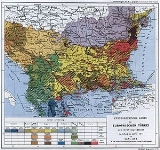
Pomaks

Encyclopedia
Pomaks is a term used for a Slavic Muslim
population native to some parts of Bulgaria
, Turkey
, Greece
, the Republic of Macedonia
, Albania
and Kosovo
. The Pomaks speak Bulgarian
as their native language, also referred to in Greece and Turkey as Pomak language
, and some are fluent in Turkish, Albanian and Greek as a second language. The origin of the Pomaks has been debated, but they are today usually considered descendants of native Bulgarians
who converted to Islam
during the Ottoman
rule of the Balkans
. Different members of the group today declare a variety of ethnic identities: Bulgarian
, Pomak, Muslim
, Turkish, Albanian and others.
(българи-мюсюлмани bălgari-myusyulmani), and under the locally used names Ahryani
, Torbeshi, etc. They mainly inhabit the Rhodope Mountains
in Smolyan Province
, Kardzhali Province
, Pazardzhik Province
and Blagoevgrad Province
. There are Pomaks in other parts of Bulgaria as well. There are a few Pomak villages in Burgas Province
, Lovech Province
, Veliko Tarnovo Province
and Ruse Province
. According to the 2001 census there are 131 531 Muslim Bulgarians in Bulgaria. During the 20th century the Pomaks in Bulgaria were the subject of three state-supported assimilation campaigns - in 1912, the 1940s and the 1960s and 1970s which included the change of their Turkish-Arabic names to ethnic Bulgarian ones and in the first campaign conversions from Islam to Eastern Orthodoxy. The first two campaigns were abandoned after a few years, while the second was reversed in 1989. The campaigns were carried out with the justification that the Pomaks as ancestral Bulgarians who had been converted to Islam by force and who therefore needed to be repatriated back to the Bulgarian national domain. These attempts were met with stiff resistance by some Pomaks.
, mostly in Eastern Thrace and fewer in Anatolia
, where they are called in Turkish Pomaklar and their speech is called Pomakça. According to Ethnologue
, there are around 300.000 Pomaks in Turkey.
: Πομάκοι) in Greece inhabit the prefectures of Xanthi
, Rhodope
and Evros
. with estimated numbers of 30-35,000 http://www.greekhelsinki.gr/english/reports/pomaks.html Until Greco-Turkish War (1919–1922) and Population exchange between Greece and Turkey
in 1923 Pomaks inhabited a part of the regions of Moglena – Almopia
(Karadjova), Kastoria
and some other parts of Macedonia, Greece. German sightseer Adolf Struck in 1898 describes Konstantia (in Moglena ) as a big village with 300 houses and two panes, inhabited exclusively by Pomaks.
The Bulgarian Language
in Western Thrace
is called in Greece the "Pomak language" or the "Pomak dialects". The Pomak dialects are mainly spoken and taught at primary school level in the Pomak regions of Greece, which are primarily in the Rhodope Mountains
. The Pomaks of Thrace were exempted from those exchanges together with Muslim Turks and Roma; the Lausanne Treaty (1923) made no mention of their language but declared that their languages of education should be Turkish and Greek. The language in Greek is known as 'Pomatskou' and taught in the Greek alphabet. The main school manual is 'Pomaktsou' by Moimin Aidin and Omer Hamdi, Komotini 1997. There is also a Pomak-Greek dictionary by Ritvan Karahodja, 1996. The number of Pomaks ranges from 30,000 to 90,000 whose presence dates from the days of the Byzantine empire. It is used by many of the Pomak speakers on either side of the Bulgarian-Greek border. The dialects are on the Eastern side of the Yat isogloss of Bulgarian, yet many pockets of western Bulgarian speakers remain. The standard Bulgarian language is not taught in Greece. A large number of them no longer transmit it; they have adopted Turkish as a first language and Greek as a second language.
The Pomaks are not taught their own language in any official school. In primary schools in Thrace they are instead taught the Turkish language. In accordance with the Greek obligations derived from the Treaty of Lausanne
(1923), all Muslims in the areas of the Muslim minority are taught in Turkish, although the Pomaks never have accepted Turkish as their primary language. Recently the Community of the Pomaks of Xanthi, represented by Tahir Konte, have announced their request to be treated equally and therefore to have the right of education in Greek schools without the obligation of learning the Turkish language. This was announced to the Greek government in a letter of 17 March 2010, addressed to the Prime Minister George Papandreou
and the Minister of Education Anna Diamantopoulou
.
, or Torbeš, are occasionally also referred to as Pomaks, especially in historical context. They are a minority religious group in the Republic of Macedonia
, although not all espouse a Macedonian national identity and are linguistically distinct from the larger Muslim ethnic groups in the Republic of Macedonia, Albanians
and Turks
.
. However these people are also referred to as "Torbeš". They speak the Drimkol-Golo Brdo dialect of the Macedonian/Bulgarian language. Part of this people still self-identify as Bulgarians
.
occasionally are also referred to as Pomaks in historical context. They are people who inhabit the Gora
region, located between Albania
, Kosovo
and Macedonia. The general view is that they should be treated as a distinct minority group
. Part of these people are already albanised
. By the last censusses at the end of 20th century in Yugoslavia they have declared themselves to be Muslims by nationality
.
who converted to Islam
during the Ottoman
rule of the Balkans
. They started to become Muslim gradually, from the Ottoman occupation (early 15th century) to the end of the 18th century. Subsequently this people became part of the Muslim community of the millet system, which was closely linked to Islam
ic rules. At that time people were bound to their millets by their religious affiliations (or their confessional communities
), rather than their ethnic origins, according to the millet concept.
It is remarkable that monk Pachomios Roussanos (1508–1553), who visited the mountain area of Xanthi
, mentioned that around 1550, only 6 or 9 villages had turned to Islam.. Further more the documents show that not only Islam has been spread in the area at that time, but that the Pomaks have even participated in Ottoman military operation voluntarily as is the case with the village of Shahin (Echinos
).

.jpg) The mass turn to Islam in the Central Rhodope Mountains
The mass turn to Islam in the Central Rhodope Mountains
happened between the 16th and the 17th century. According to the Codes of Bishopy of Philippoupolis and the Czech historian and slavist Konstantin Josef Jireček
in the middle of 17th century, the Pomak provosts agreed to become Muslim en masse. They visited the Ottoman local administrator to announce their decision, but he sent them to the Greek bishop of Philippoupolis Gabriel (1636–1672). The bishop couldn't change their mind. According to the verbal tradition of the Greeks
of Philippoupolis, a large ceremony of mass circumcision took place in front of the old mosque of the city, near the Government House. After that, the villagers became Muslim, too. According to the verbal tradition of the Bulgrians, Grand Vizier
Köprülü Mehmed Pasha
(1656–1661) threatened the Pomaks of Chepino Valley
that he would execute them if they didn't turn to Islam. In 1656, Ottoman military troops entered the Chepino valley and arrested the provosts of Pomaks, in order to transfer them in the local Ottoman administrator. There, they converted to Islam. Grand Visier Mehmed Köprülü, after the mass Islamization, destroyed 218 churches and 336 chapels in the areas of Pomaks. A lot of Pomaks preferred to die instead of becoming Muslim.. According to recent investigations the theory of forced conversion to Islam, supported by some scientists, has no solid grounds with all or most evidence being faked or misinterpreted. Muslim communities prospered under the Ottoman Empire, as the Sultan was also the Caliph
. Ottoman law did not recognize such notions as ethnicity or citizenship
; thus, a Muslim of any ethnic background enjoyed precisely the same rights and privileges.
Meanwhile, the perception of the millet
concept was altered during the 19th century and rise of nationalism within the Ottoman Empire
begun. After the Russo-Turkish War (1877–1878), Pomaks in the Vacha
valley rebelled against Eastern Rumelia
and established an autonomous state, called Republic of Tamrash
. In 1886 the Ottoman government accepted the Bulgarian rule over Eastern Rumelia
and that was the end of the free Pomak state. During the Balkan Wars
, at August 16, 1913, an Islamic revolt begun in the Eastern Rhodopes and Western Thrace
. At September 1, 1913, the "Provisional Government of Western Thrace" (Garbi Trakya Hukumet i Muvakkatesi) was established in Komotini
. The Ottoman administration didn't support the rebels and finally under the neutrality of Greek and Ottoman governments, Bulgaria took over the lands in 30 October 1913. The rebels requested support by the Greek state and put Greek major in Alexandroupoli
. Bulgaria, after a brief period of control over the area, passed the sovereignty of Western Thrace at the end of the World War I
. The Provisional Government was revived between 1919-1920 under French protectorate (France had annexed the region from Bulgaria in 1918) before Greece took over in June, 1920.
After the dissolution of the Ottoman Empire
following the First World War the religious Millet system has disappeared and the members of the Pomak groups today declare a variety of ethnic identities, depending predominantly on the country, they live in.
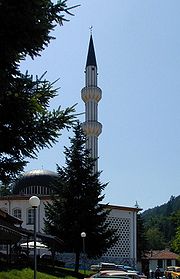
mutation
, HbO-Arab, which emerged about 2,000 years ago on a rare haplotype
is characteristic of the Greek Pomaks. Its frequency increased as a consequence of high genetic drift
within this population. This indicates that the Greek Pomaks are an isolated population with limited contacts with their neighbours. According to some Greek researchers, the DNA tree line of Greek Pomaks suggests that they descend from ancient Thracian tribes.
converted to Orthodoxy
and Islam
, the rest - to the Catholic
faith during the 16-17 century.
The British historian Edwin Pears
wrote in 1912 that the Pomaks might have been Bogomils or Paulicians.
The conversion of the Paulicians to Catholic
faith was examined in detail in a doctoral thesis, which was published partly in a book of the Bulgarian historian M. Yovkov. Also, some cases of the conversion of the Paulicians to Orthodoxy
and Muslim
faith are described in this book:
” Part of the population of the largest Paulician village Bastsevomigrated into Thrace
, and another converted to Islam
.”
.
Slavic Muslims
Slavic Muslims are ethnic groups or sub-ethnic groups of Slavs who observe the Islamic faith, such as:* Bosniaks * Gorani * Pomaks * Torbeš See also: Muslims by nationality...
population native to some parts of Bulgaria
Bulgaria
Bulgaria , officially the Republic of Bulgaria , is a parliamentary democracy within a unitary constitutional republic in Southeast Europe. The country borders Romania to the north, Serbia and Macedonia to the west, Greece and Turkey to the south, as well as the Black Sea to the east...
, Turkey
Turkey
Turkey , known officially as the Republic of Turkey , is a Eurasian country located in Western Asia and in East Thrace in Southeastern Europe...
, Greece
Greece
Greece , officially the Hellenic Republic , and historically Hellas or the Republic of Greece in English, is a country in southeastern Europe....
, the Republic of Macedonia
Republic of Macedonia
Macedonia , officially the Republic of Macedonia , is a country located in the central Balkan peninsula in Southeast Europe. It is one of the successor states of the former Yugoslavia, from which it declared independence in 1991...
, Albania
Albania
Albania , officially known as the Republic of Albania , is a country in Southeastern Europe, in the Balkans region. It is bordered by Montenegro to the northwest, Kosovo to the northeast, the Republic of Macedonia to the east and Greece to the south and southeast. It has a coast on the Adriatic Sea...
and Kosovo
Kosovo
Kosovo is a region in southeastern Europe. Part of the Ottoman Empire for more than five centuries, later the Autonomous Province of Kosovo and Metohija within Serbia...
. The Pomaks speak Bulgarian
Bulgarian language
Bulgarian is an Indo-European language, a member of the Slavic linguistic group.Bulgarian, along with the closely related Macedonian language, demonstrates several linguistic characteristics that set it apart from all other Slavic languages such as the elimination of case declension, the...
as their native language, also referred to in Greece and Turkey as Pomak language
Pomak language
Pomak language is a term used in Greece and Turkey to refer to the dialects of the Bulgarian language spoken by the Pomaks in Western Thrace.Most Pomaks in Turkey and Greece identify their language as Pomak. According to the 1935 census in Turkey, 3881 people in Eastern Thrace identified their...
, and some are fluent in Turkish, Albanian and Greek as a second language. The origin of the Pomaks has been debated, but they are today usually considered descendants of native Bulgarians
Bulgarians
The Bulgarians are a South Slavic nation and ethnic group native to Bulgaria and neighbouring regions. Emigration has resulted in immigrant communities in a number of other countries.-History and ethnogenesis:...
who converted to Islam
Islam
Islam . The most common are and . : Arabic pronunciation varies regionally. The first vowel ranges from ~~. The second vowel ranges from ~~~...
during the Ottoman
Ottoman Empire
The Ottoman EmpireIt was usually referred to as the "Ottoman Empire", the "Turkish Empire", the "Ottoman Caliphate" or more commonly "Turkey" by its contemporaries...
rule of the Balkans
Balkans
The Balkans is a geopolitical and cultural region of southeastern Europe...
. Different members of the group today declare a variety of ethnic identities: Bulgarian
Bulgarians
The Bulgarians are a South Slavic nation and ethnic group native to Bulgaria and neighbouring regions. Emigration has resulted in immigrant communities in a number of other countries.-History and ethnogenesis:...
, Pomak, Muslim
Muslims by nationality
Muslims by nationality was a term used in Socialist Federal Republic of Yugoslavia as an official designation of nationality of Slavic Muslims. They were one of the constitutive groups of Bosnia and Herzegovina...
, Turkish, Albanian and others.
Bulgaria
The Pomaks in Bulgaria are referred to as Bulgarian MuslimsBulgarian Muslims
The Bulgarian Muslims or Muslim Bulgarians are Bulgarians of the Islamic faith. They are generally thought to be the descendents of Slavs who converted to Islam during Ottoman rule...
(българи-мюсюлмани bălgari-myusyulmani), and under the locally used names Ahryani
Agrianes
The Agrianians a Paeonian-Thracian tribe, who chiefly inhabited the area of present-day Northeastern statistical region of Republic Of Macedonia and Pčinja District of southern Serbia, north of the Thracian Maedi tribe, who were situated in what is now the Greek region of Macedonia and Western...
, Torbeshi, etc. They mainly inhabit the Rhodope Mountains
Rhodope Mountains
The Rhodopes are a mountain range in Southeastern Europe, with over 83% of its area in southern Bulgaria and the remainder in Greece. Its highest peak, Golyam Perelik , is the seventh highest Bulgarian mountain...
in Smolyan Province
Smolyan Province
-Religion:The Smolyan province along with the Kardzhali Province is a province where the predominant religion is not Orthodox Christianity but Islam. However, unlike Kardzhali where the majority of the population is Turkish, the Muslim population of the Smolyan province is made up almost entirely...
, Kardzhali Province
Kardzhali Province
Kardzhali Province is a province of southern Bulgaria, neighbouring Greece with the Greek prefectures of Xanthi, Rhodope and Evros to the south and east. Kardzhali Province area is 3209.1 km². Its main city is Kardzhali.-History:...
, Pazardzhik Province
Pazardzhik Province
Pazardzhik Province is a province in Southern Bulgaria, named after its administrative and industrial centre - the town of Pazardzhik. It embraces a territory of 4,456.9 km² that is divided into 11 municipalities with a total population of 290,614 inhabitants, as of December 2009.-History:The...
and Blagoevgrad Province
Blagoevgrad Province
Blagoevgrad Province , also known as Pirin Macedonia , is a province of southwestern Bulgaria. It borders four other Bulgarian provinces to the north and east, Greece to the south, and the Republic of Macedonia to the west. The province has 14 municipalities with 12 towns...
. There are Pomaks in other parts of Bulgaria as well. There are a few Pomak villages in Burgas Province
Burgas Province
-Municipalities:The Burgas province contains 13 municipalities . The following table shows the names of each municipality in English and Cyrillic, the main town or village , and the population of each as of 2009.-Demography:The Burgas province had a population of 423,608 -Municipalities:The Burgas...
, Lovech Province
Lovech Province
Lovech Province is one of the 28 provinces of Bulgaria, lying at the northern centre of the country. It is named after its main city - Lovech. As of December 2009, the population of the area is 151,153.-Municipalities:...
, Veliko Tarnovo Province
Veliko Tarnovo Province
Veliko Tarnovo is a province in the middle of the northern part of Bulgaria. Its capital city, Veliko Tarnovo, is of historical significance as it is known as the capital of Medieval Bulgaria...
and Ruse Province
Ruse Province
Ruse Province is a province in northern Bulgaria, named after its main city - Ruse, neighbouring Romania via the Danube. It is divided into 8 municipalities with a total population, as of December 2009, of 249,144 inhabitants....
. According to the 2001 census there are 131 531 Muslim Bulgarians in Bulgaria. During the 20th century the Pomaks in Bulgaria were the subject of three state-supported assimilation campaigns - in 1912, the 1940s and the 1960s and 1970s which included the change of their Turkish-Arabic names to ethnic Bulgarian ones and in the first campaign conversions from Islam to Eastern Orthodoxy. The first two campaigns were abandoned after a few years, while the second was reversed in 1989. The campaigns were carried out with the justification that the Pomaks as ancestral Bulgarians who had been converted to Islam by force and who therefore needed to be repatriated back to the Bulgarian national domain. These attempts were met with stiff resistance by some Pomaks.
Turkey
Today the Pomaks are present in TurkeyTurkey
Turkey , known officially as the Republic of Turkey , is a Eurasian country located in Western Asia and in East Thrace in Southeastern Europe...
, mostly in Eastern Thrace and fewer in Anatolia
Anatolia
Anatolia is a geographic and historical term denoting the westernmost protrusion of Asia, comprising the majority of the Republic of Turkey...
, where they are called in Turkish Pomaklar and their speech is called Pomakça. According to Ethnologue
Ethnologue
Ethnologue: Languages of the World is a web and print publication of SIL International , a Christian linguistic service organization, which studies lesser-known languages, to provide the speakers with Bibles in their native language and support their efforts in language development.The Ethnologue...
, there are around 300.000 Pomaks in Turkey.
Greece
Today the Pomaks (GreekGreek language
Greek is an independent branch of the Indo-European family of languages. Native to the southern Balkans, it has the longest documented history of any Indo-European language, spanning 34 centuries of written records. Its writing system has been the Greek alphabet for the majority of its history;...
: Πομάκοι) in Greece inhabit the prefectures of Xanthi
Xanthi Prefecture
Xanthi is one of the regional units of Greece. It is part of the Region of East Macedonia and Thrace. The capital is Xanthi. Together with the regional units Rhodope and Evros, it forms the geographical region of Western Thrace.-Geography:...
, Rhodope
Rhodope Prefecture
Rhodope is one of the regional units of Greece. It is part of the region of East Macedonia and Thrace. Its name is derived from the Rhodope Mountains, which cover the northern part of its territory. Together with the regional units Evros and Xanthi, it forms the geographical region of Western...
and Evros
Evros Prefecture
Evros is one of the regional units of Greece. It is part of the region of East Macedonia and Thrace. Its name is derived from the river Evros, which appears to have been a Thracian hydronym. Evros is the northernmost regional unit. It borders Turkey to the east, across the river Evros, and it...
. with estimated numbers of 30-35,000 http://www.greekhelsinki.gr/english/reports/pomaks.html Until Greco-Turkish War (1919–1922) and Population exchange between Greece and Turkey
Population exchange between Greece and Turkey
The 1923 population exchange between Greece and Turkey was based upon religious identity, and involved the Greek Orthodox citizens of Turkey and the Muslim citizens of Greece...
in 1923 Pomaks inhabited a part of the regions of Moglena – Almopia
Almopia
Almopia is a municipality and a former province of the Pella regional unit in Macedonia, Greece. The seat of the municipality is the town Aridaia. One of the regions of ancient Macedon, north-west of Bottiaea, it corresponds roughly to the Moglena region of medieval and modern times. Ancient...
(Karadjova), Kastoria
Kastoria
Kastoria is a city in northern Greece in the periphery of West Macedonia. It is the capital of Kastoria peripheral unit. It is situated on a promontory on the western shore of Lake Orestiada, in a valley surrounded by limestone mountains...
and some other parts of Macedonia, Greece. German sightseer Adolf Struck in 1898 describes Konstantia (in Moglena ) as a big village with 300 houses and two panes, inhabited exclusively by Pomaks.
The Bulgarian Language
Bulgarian language
Bulgarian is an Indo-European language, a member of the Slavic linguistic group.Bulgarian, along with the closely related Macedonian language, demonstrates several linguistic characteristics that set it apart from all other Slavic languages such as the elimination of case declension, the...
in Western Thrace
Western Thrace
Western Thrace or simply Thrace is a geographic and historical region of Greece, located between the Nestos and Evros rivers in the northeast of the country. Together with the regions of Macedonia and Epirus, it is often referred to informally as northern Greece...
is called in Greece the "Pomak language" or the "Pomak dialects". The Pomak dialects are mainly spoken and taught at primary school level in the Pomak regions of Greece, which are primarily in the Rhodope Mountains
Rhodope Mountains
The Rhodopes are a mountain range in Southeastern Europe, with over 83% of its area in southern Bulgaria and the remainder in Greece. Its highest peak, Golyam Perelik , is the seventh highest Bulgarian mountain...
. The Pomaks of Thrace were exempted from those exchanges together with Muslim Turks and Roma; the Lausanne Treaty (1923) made no mention of their language but declared that their languages of education should be Turkish and Greek. The language in Greek is known as 'Pomatskou' and taught in the Greek alphabet. The main school manual is 'Pomaktsou' by Moimin Aidin and Omer Hamdi, Komotini 1997. There is also a Pomak-Greek dictionary by Ritvan Karahodja, 1996. The number of Pomaks ranges from 30,000 to 90,000 whose presence dates from the days of the Byzantine empire. It is used by many of the Pomak speakers on either side of the Bulgarian-Greek border. The dialects are on the Eastern side of the Yat isogloss of Bulgarian, yet many pockets of western Bulgarian speakers remain. The standard Bulgarian language is not taught in Greece. A large number of them no longer transmit it; they have adopted Turkish as a first language and Greek as a second language.
The Pomaks are not taught their own language in any official school. In primary schools in Thrace they are instead taught the Turkish language. In accordance with the Greek obligations derived from the Treaty of Lausanne
Treaty of Lausanne
The Treaty of Lausanne was a peace treaty signed in Lausanne, Switzerland on 24 July 1923, that settled the Anatolian and East Thracian parts of the partitioning of the Ottoman Empire. The treaty of Lausanne was ratified by the Greek government on 11 February 1924, by the Turkish government on 31...
(1923), all Muslims in the areas of the Muslim minority are taught in Turkish, although the Pomaks never have accepted Turkish as their primary language. Recently the Community of the Pomaks of Xanthi, represented by Tahir Konte, have announced their request to be treated equally and therefore to have the right of education in Greek schools without the obligation of learning the Turkish language. This was announced to the Greek government in a letter of 17 March 2010, addressed to the Prime Minister George Papandreou
George Papandreou
Georgios A. Papandreou , commonly anglicised to George and shortened to Γιώργος in Greek, is a Greek politician who served as Prime Minister of Greece following his party's victory in the 2009 legislative election...
and the Minister of Education Anna Diamantopoulou
Anna Diamantopoulou
Anna Diamantopoulou , is a Member of Parliament in Greece for the party of the Panhellenic Socialist Movement and the current Minister for Education, Lifelong Learning and Religious Affairs in Greece...
.
Republic of Macedonia
The Macedonian MuslimsMacedonian Muslims
The Macedonian Muslims , also known as Muslim Macedonians, Torbeš, ; , in older sources Pomaks are a minority religious group within the community of ethnic Macedonians who are Muslims...
, or Torbeš, are occasionally also referred to as Pomaks, especially in historical context. They are a minority religious group in the Republic of Macedonia
Republic of Macedonia
Macedonia , officially the Republic of Macedonia , is a country located in the central Balkan peninsula in Southeast Europe. It is one of the successor states of the former Yugoslavia, from which it declared independence in 1991...
, although not all espouse a Macedonian national identity and are linguistically distinct from the larger Muslim ethnic groups in the Republic of Macedonia, Albanians
Albanians in the Republic of Macedonia
Albanians are the largest ethnic minority in the Republic of Macedonia. Of the 2,022,547 citizens of Macedonia, 509,083, or 25%, are Albanian according to the latest national census in 2002. The Albanian minority lives mostly in the north-western part of the country...
and Turks
Turks in the Republic of Macedonia
Turks in the Republic of Macedonia, also known as Macedonian Turks, are the ethnic Turks who constitute the third largest ethnic group in the Republic of Macedonia. According to the 2002 census, there were 77,959 Turks living in the country, forming a minority of some 4% of the population. The...
.
Albania
Slavic-speaking Muslims, sometimes referred to as "Pomaks", live also in the Albanian region of Golo BrdoMala Prespa and Golo Brdo
Prespa e Vogël and Golloborda , refers to a geographical area situated in southeastern Albania. This region consists of two areas: Prespa e Vogël and Golloborda...
. However these people are also referred to as "Torbeš". They speak the Drimkol-Golo Brdo dialect of the Macedonian/Bulgarian language. Part of this people still self-identify as Bulgarians
Bulgarians in Albania
Ethnic Bulgarians in present-day Albania live mostly in the areas of Mala Prespa and Golo Bardo. In the 1989 census a total of 782 people claimed either Romanian, Bulgarian or Czechoslovakian nationality. The US Department of State background note for Albania, dated 4 January 2011 further reported...
.
Kosovo
The GoraniGorani
Gorani may refer to:In culture:* Gorani people, a Balkan ethnic groupIn geography:* Gorani, a village in Uda Commune, Argeş County, Romania* Gorani, a village in Odăile Commune, Buzău County, Romania...
occasionally are also referred to as Pomaks in historical context. They are people who inhabit the Gora
Gora (region)
Gora is a geographical region in southern Serbia and northeastern Albania, inhabited by Albanians and a Gorani minority. The name "Gora" is a Slavic word for "mountain" or "forest"....
region, located between Albania
Albania
Albania , officially known as the Republic of Albania , is a country in Southeastern Europe, in the Balkans region. It is bordered by Montenegro to the northwest, Kosovo to the northeast, the Republic of Macedonia to the east and Greece to the south and southeast. It has a coast on the Adriatic Sea...
, Kosovo
Kosovo
Kosovo is a region in southeastern Europe. Part of the Ottoman Empire for more than five centuries, later the Autonomous Province of Kosovo and Metohija within Serbia...
and Macedonia. The general view is that they should be treated as a distinct minority group
Minority group
A minority is a sociological group within a demographic. The demographic could be based on many factors from ethnicity, gender, wealth, power, etc. The term extends to numerous situations, and civilizations within history, despite the misnomer of minorities associated with a numerical statistic...
. Part of these people are already albanised
Albanisation
Albanisation is a term used to describe a linguistic or cultural assimilation to the Albanian language and Albanian culture.- In Kosovo :The term is used in reference to Kosovo....
. By the last censusses at the end of 20th century in Yugoslavia they have declared themselves to be Muslims by nationality
Muslims by nationality
Muslims by nationality was a term used in Socialist Federal Republic of Yugoslavia as an official designation of nationality of Slavic Muslims. They were one of the constitutive groups of Bosnia and Herzegovina...
.
History
Pomaks are today usually considered descendants of native BulgariansBulgarians
The Bulgarians are a South Slavic nation and ethnic group native to Bulgaria and neighbouring regions. Emigration has resulted in immigrant communities in a number of other countries.-History and ethnogenesis:...
who converted to Islam
Islam
Islam . The most common are and . : Arabic pronunciation varies regionally. The first vowel ranges from ~~. The second vowel ranges from ~~~...
during the Ottoman
Ottoman Empire
The Ottoman EmpireIt was usually referred to as the "Ottoman Empire", the "Turkish Empire", the "Ottoman Caliphate" or more commonly "Turkey" by its contemporaries...
rule of the Balkans
Balkans
The Balkans is a geopolitical and cultural region of southeastern Europe...
. They started to become Muslim gradually, from the Ottoman occupation (early 15th century) to the end of the 18th century. Subsequently this people became part of the Muslim community of the millet system, which was closely linked to Islam
Islam
Islam . The most common are and . : Arabic pronunciation varies regionally. The first vowel ranges from ~~. The second vowel ranges from ~~~...
ic rules. At that time people were bound to their millets by their religious affiliations (or their confessional communities
Confessional community
A confessional community is a group of people with similar religious beliefs.In the Ottoman Empire, this allowed people to be grouped by religious confession as opposed to nationality or ethnicity, which was more consistent with the existing social structure. People were able to represent...
), rather than their ethnic origins, according to the millet concept.
It is remarkable that monk Pachomios Roussanos (1508–1553), who visited the mountain area of Xanthi
Xanthi Prefecture
Xanthi is one of the regional units of Greece. It is part of the Region of East Macedonia and Thrace. The capital is Xanthi. Together with the regional units Rhodope and Evros, it forms the geographical region of Western Thrace.-Geography:...
, mentioned that around 1550, only 6 or 9 villages had turned to Islam.. Further more the documents show that not only Islam has been spread in the area at that time, but that the Pomaks have even participated in Ottoman military operation voluntarily as is the case with the village of Shahin (Echinos
Echinos
Echinos is a settlement in the municipality Myki in the Xanthi peripheral unit of Greece . It is 761 kilometers northeast of Athens, 254 kilometers northeast of Thessalonica, and 27 kilometers north northeast of Xanthi. In 1981, the population of Echinos was around 3123 inhabitants...
).
Rhodope Mountains
The Rhodopes are a mountain range in Southeastern Europe, with over 83% of its area in southern Bulgaria and the remainder in Greece. Its highest peak, Golyam Perelik , is the seventh highest Bulgarian mountain...
happened between the 16th and the 17th century. According to the Codes of Bishopy of Philippoupolis and the Czech historian and slavist Konstantin Josef Jireček
Konstantin Josef Jirecek
Konstantin Josef Jireček , son of Josef Jireček, was a Czech historian, diplomat and slavist.He entered the Bulgarian service in 1879, and in 1881 became minister of education at Sofia...
in the middle of 17th century, the Pomak provosts agreed to become Muslim en masse. They visited the Ottoman local administrator to announce their decision, but he sent them to the Greek bishop of Philippoupolis Gabriel (1636–1672). The bishop couldn't change their mind. According to the verbal tradition of the Greeks
Greeks
The Greeks, also known as the Hellenes , are a nation and ethnic group native to Greece, Cyprus and neighboring regions. They also form a significant diaspora, with Greek communities established around the world....
of Philippoupolis, a large ceremony of mass circumcision took place in front of the old mosque of the city, near the Government House. After that, the villagers became Muslim, too. According to the verbal tradition of the Bulgrians, Grand Vizier
Grand Vizier
Grand Vizier, in Turkish Vezir-i Azam or Sadr-ı Azam , deriving from the Arabic word vizier , was the greatest minister of the Sultan, with absolute power of attorney and, in principle, dismissable only by the Sultan himself...
Köprülü Mehmed Pasha
Köprülü Mehmed Pasha
Köprülü Mehmed Pasha , was the Grand Vizier of the Ottoman Empire from 1656 until his death. He was the first leader and founder of the Albanian Köprülü noble dynasty/family.- Life :He was recruited as a part of the devshirmeh system and was trained in the palace school...
(1656–1661) threatened the Pomaks of Chepino Valley
Chepino Valley
The Chepino Valley or Chepino is the largest valley in the Rhodope Mountains in southern Bulgaria. It is situated along the course of the Chepino River near the Batak Mountain in the northwestern part of the Rhodopes. Located at around 750 m above sea level, it is between 4 and 7 km wide and...
that he would execute them if they didn't turn to Islam. In 1656, Ottoman military troops entered the Chepino valley and arrested the provosts of Pomaks, in order to transfer them in the local Ottoman administrator. There, they converted to Islam. Grand Visier Mehmed Köprülü, after the mass Islamization, destroyed 218 churches and 336 chapels in the areas of Pomaks. A lot of Pomaks preferred to die instead of becoming Muslim.. According to recent investigations the theory of forced conversion to Islam, supported by some scientists, has no solid grounds with all or most evidence being faked or misinterpreted. Muslim communities prospered under the Ottoman Empire, as the Sultan was also the Caliph
Ottoman Caliphate
The Ottoman Caliphate, under the Ottoman Dynasty of the Ottoman Empire inherited the responsibility of the Caliphate from the Mamluks of Egypt....
. Ottoman law did not recognize such notions as ethnicity or citizenship
Citizenship
Citizenship is the state of being a citizen of a particular social, political, national, or human resource community. Citizenship status, under social contract theory, carries with it both rights and responsibilities...
; thus, a Muslim of any ethnic background enjoyed precisely the same rights and privileges.
Meanwhile, the perception of the millet
Millet
The millets are a group of small-seeded species of cereal crops or grains, widely grown around the world for food and fodder. They do not form a taxonomic group, but rather a functional or agronomic one. Their essential similarities are that they are small-seeded grasses grown in difficult...
concept was altered during the 19th century and rise of nationalism within the Ottoman Empire
Ottoman Empire
The Ottoman EmpireIt was usually referred to as the "Ottoman Empire", the "Turkish Empire", the "Ottoman Caliphate" or more commonly "Turkey" by its contemporaries...
begun. After the Russo-Turkish War (1877–1878), Pomaks in the Vacha
Vacha
Vacha may refer to:*Acorus calamus, Vacha an ayurvedic medicine, mentioned in the bible*Vacha Dam, a dam in Bulgaria*Vacha , a river in Bulgaria...
valley rebelled against Eastern Rumelia
Eastern Rumelia
Eastern Rumelia or Eastern Roumelia was an administratively autonomous province in the Ottoman Empire and Principality of Bulgaria from 1878 to 1908. It was under full Bulgarian control from 1885 on, when it willingly united with the tributary Principality of Bulgaria after a bloodless revolution...
and established an autonomous state, called Republic of Tamrash
Republic of Tamrash
The Republic of Tamrash was a short-lived self-governing administrative structure of the Pomaks, living in the Tamrash region of the Rhodope Mountains. It existed from 1878 to 1886.- Geography :...
. In 1886 the Ottoman government accepted the Bulgarian rule over Eastern Rumelia
Eastern Rumelia
Eastern Rumelia or Eastern Roumelia was an administratively autonomous province in the Ottoman Empire and Principality of Bulgaria from 1878 to 1908. It was under full Bulgarian control from 1885 on, when it willingly united with the tributary Principality of Bulgaria after a bloodless revolution...
and that was the end of the free Pomak state. During the Balkan Wars
Balkan Wars
The Balkan Wars were two conflicts that took place in the Balkans in south-eastern Europe in 1912 and 1913.By the early 20th century, Montenegro, Bulgaria, Greece and Serbia, the countries of the Balkan League, had achieved their independence from the Ottoman Empire, but large parts of their ethnic...
, at August 16, 1913, an Islamic revolt begun in the Eastern Rhodopes and Western Thrace
Western Thrace
Western Thrace or simply Thrace is a geographic and historical region of Greece, located between the Nestos and Evros rivers in the northeast of the country. Together with the regions of Macedonia and Epirus, it is often referred to informally as northern Greece...
. At September 1, 1913, the "Provisional Government of Western Thrace" (Garbi Trakya Hukumet i Muvakkatesi) was established in Komotini
Komotini
Komotini is a city in Thrace, northeastern Greece. It is the capital of the region of East Macedonia and Thrace and of the Rhodope regional unit. It is also the administrative center of the Rhodope-Evros super-prefecture. The city is home to the Democritus University of Thrace, founded in 1973...
. The Ottoman administration didn't support the rebels and finally under the neutrality of Greek and Ottoman governments, Bulgaria took over the lands in 30 October 1913. The rebels requested support by the Greek state and put Greek major in Alexandroupoli
Alexandroupoli
Alexandroupoli , is a city of Greece and the capital of the Evros peripheral unit in Thrace. Named after King Alexander, it is an important port and commercial center of northeastern Greece.-Name:...
. Bulgaria, after a brief period of control over the area, passed the sovereignty of Western Thrace at the end of the World War I
World War I
World War I , which was predominantly called the World War or the Great War from its occurrence until 1939, and the First World War or World War I thereafter, was a major war centred in Europe that began on 28 July 1914 and lasted until 11 November 1918...
. The Provisional Government was revived between 1919-1920 under French protectorate (France had annexed the region from Bulgaria in 1918) before Greece took over in June, 1920.
After the dissolution of the Ottoman Empire
Dissolution of the Ottoman Empire
The Dissolution of the Ottoman Empire included the watershed events of the Young Turk Revolution and the establishment of the Second Constitutional Era, and ended with the Partitioning of the Ottoman Empire by the victorious sides of World War I.- Establishment of the Second Constitutional Era, 24...
following the First World War the religious Millet system has disappeared and the members of the Pomak groups today declare a variety of ethnic identities, depending predominantly on the country, they live in.
Other Theories for the Origin of the Pomaks
Genetic Origin
A specific DNADNA
Deoxyribonucleic acid is a nucleic acid that contains the genetic instructions used in the development and functioning of all known living organisms . The DNA segments that carry this genetic information are called genes, but other DNA sequences have structural purposes, or are involved in...
mutation
Mutation
In molecular biology and genetics, mutations are changes in a genomic sequence: the DNA sequence of a cell's genome or the DNA or RNA sequence of a virus. They can be defined as sudden and spontaneous changes in the cell. Mutations are caused by radiation, viruses, transposons and mutagenic...
, HbO-Arab, which emerged about 2,000 years ago on a rare haplotype
Haplotype
A haplotype in genetics is a combination of alleles at adjacent locations on the chromosome that are transmitted together...
is characteristic of the Greek Pomaks. Its frequency increased as a consequence of high genetic drift
Genetic drift
Genetic drift or allelic drift is the change in the frequency of a gene variant in a population due to random sampling.The alleles in the offspring are a sample of those in the parents, and chance has a role in determining whether a given individual survives and reproduces...
within this population. This indicates that the Greek Pomaks are an isolated population with limited contacts with their neighbours. According to some Greek researchers, the DNA tree line of Greek Pomaks suggests that they descend from ancient Thracian tribes.
Paulician and Bogomil Origin
According to Bulgarian historian Yordan Ivanov, part of the PauliciansPaulicianism
Paulicians were a Christian Adoptionist sect and militarized revolt movement, also accused by medieval sources as Gnostic and quasi Manichaean Christian. They flourished between 650 and 872 in Armenia and the Eastern Themes of the Byzantine Empire...
converted to Orthodoxy
Orthodoxy
The word orthodox, from Greek orthos + doxa , is generally used to mean the adherence to accepted norms, more specifically to creeds, especially in religion...
and Islam
Islam
Islam . The most common are and . : Arabic pronunciation varies regionally. The first vowel ranges from ~~. The second vowel ranges from ~~~...
, the rest - to the Catholic
Catholic
The word catholic comes from the Greek phrase , meaning "on the whole," "according to the whole" or "in general", and is a combination of the Greek words meaning "about" and meaning "whole"...
faith during the 16-17 century.
The British historian Edwin Pears
Edwin Pears
Sir Edwin Pears was a British barrister, publicist, and historian. He lived in Constantinople for about forty years and he is known for his 1911 book Turkey and its People.-Early life:...
wrote in 1912 that the Pomaks might have been Bogomils or Paulicians.
The conversion of the Paulicians to Catholic
Catholic
The word catholic comes from the Greek phrase , meaning "on the whole," "according to the whole" or "in general", and is a combination of the Greek words meaning "about" and meaning "whole"...
faith was examined in detail in a doctoral thesis, which was published partly in a book of the Bulgarian historian M. Yovkov. Also, some cases of the conversion of the Paulicians to Orthodoxy
Orthodoxy
The word orthodox, from Greek orthos + doxa , is generally used to mean the adherence to accepted norms, more specifically to creeds, especially in religion...
and Muslim
Muslim
A Muslim, also spelled Moslem, is an adherent of Islam, a monotheistic, Abrahamic religion based on the Quran, which Muslims consider the verbatim word of God as revealed to prophet Muhammad. "Muslim" is the Arabic term for "submitter" .Muslims believe that God is one and incomparable...
faith are described in this book:
” Part of the population of the largest Paulician village Bastsevomigrated into Thrace
Thrace
Thrace is a historical and geographic area in southeast Europe. As a geographical concept, Thrace designates a region bounded by the Balkan Mountains on the north, Rhodope Mountains and the Aegean Sea on the south, and by the Black Sea and the Sea of Marmara on the east...
, and another converted to Islam
Islam
Islam . The most common are and . : Arabic pronunciation varies regionally. The first vowel ranges from ~~. The second vowel ranges from ~~~...
.”
Notable Pomaks
This is a list of notable PomaksPomaks
Pomaks is a term used for a Slavic Muslim population native to some parts of Bulgaria, Turkey, Greece, the Republic of Macedonia, Albania and Kosovo. The Pomaks speak Bulgarian as their native language, also referred to in Greece and Turkey as Pomak language, and some are fluent in Turkish,...
.
| Name | Life | Notability | Pomak link |
|---|---|---|---|
| Arif Sami Agush | 1953 | Member of the Bulgarian Parliament. Parliamentary Group of Movement for Rights and Freedoms Movement for Rights and Freedoms The Movement for Rights and Freedoms is an ethnic Turkish party in Bulgaria. The MRF is a member of the Liberal International and considers itself a liberal party, rather like the Swedish People's Party - party of the Swedish-speaking minority of Finland... . His ancestor was an Ottoman feudal called Agush Aga. The Agush castle (konak) is situated in the village of Mogilitsa Mogilitsa Moglitsa is a village in the Rhodope Mountains in southernmost Bulgaria, part of Smolyan municipality, Smolyan Province. As of September 2005, it has a population of 483 and the mayor is Mitko Chochev... . |
Born in Sandrovo, Bulgaria |
| Shefket Chapadjiev | 1939 | Businessman in Chicago Chicago Chicago is the largest city in the US state of Illinois. With nearly 2.7 million residents, it is the most populous city in the Midwestern United States and the third most populous in the US, after New York City and Los Angeles... , thought to be the most prosperous person in the US coming from Bulgaria. Escaped from Bulgaria Bulgaria Bulgaria , officially the Republic of Bulgaria , is a parliamentary democracy within a unitary constitutional republic in Southeast Europe. The country borders Romania to the north, Serbia and Macedonia to the west, Greece and Turkey to the south, as well as the Black Sea to the east... in 1963 and arrived in the US in 1964. |
Born in Madan, Smolyan Province |
| Hamid Rusev | 1939 | Businessman in Chicago Chicago Chicago is the largest city in the US state of Illinois. With nearly 2.7 million residents, it is the most populous city in the Midwestern United States and the third most populous in the US, after New York City and Los Angeles... . Escaped from Bulgaria Bulgaria Bulgaria , officially the Republic of Bulgaria , is a parliamentary democracy within a unitary constitutional republic in Southeast Europe. The country borders Romania to the north, Serbia and Macedonia to the west, Greece and Turkey to the south, as well as the Black Sea to the east... in 1963 and arrived in the US in 1964. |
Born in Arda, Bulgaria Arda, Bulgaria Arda is a village in the municipality of Smolyan, located in the Smolyan Province of southern Bulgaria. It is located 173.424 km from Sofia and the village covers an area of 17.928 km². As of 2007, the village had a population of 314 people.... |
| Rita Wilson Rita Wilson -Early life:Wilson was born Margarita Ibrahimoff in Los Angeles, California.Her father, a Bulgarian who worked at a racetrack, was born in Greece. Before immigrating to the US, he had lived in Bulgaria and Turkey.... |
1956 | Actress, producer. Married to actor Tom Hanks Tom Hanks Thomas Jeffrey "Tom" Hanks is an American actor, producer, writer, and director. Hanks worked in television and family-friendly comedies, gaining wide notice in 1988's Big, before achieving success as a dramatic actor in several notable roles, including Andrew Beckett in Philadelphia, the title... . |
Born in Los Angeles, California Los Angeles, California Los Angeles , with a population at the 2010 United States Census of 3,792,621, is the most populous city in California, USA and the second most populous in the United States, after New York City. It has an area of , and is located in Southern California... as Margarita Ibrahimoff |
See also
- Pomak languagePomak languagePomak language is a term used in Greece and Turkey to refer to the dialects of the Bulgarian language spoken by the Pomaks in Western Thrace.Most Pomaks in Turkey and Greece identify their language as Pomak. According to the 1935 census in Turkey, 3881 people in Eastern Thrace identified their...
- Republic of TamrashRepublic of TamrashThe Republic of Tamrash was a short-lived self-governing administrative structure of the Pomaks, living in the Tamrash region of the Rhodope Mountains. It existed from 1878 to 1886.- Geography :...
- Provisional Government of Western Thrace
Further reading
- Selian, Edouard (2009). The Pomaks: an Islamized People of Europe
- Selian, Edouard (2010). The Immortal Spirit of the Goddess Nané (related to the Pomak goddess Nané)
- Bulgarian Helsinki Committee. "The Human Rights of Muslims in Bulgaria in Law and Politics since 1878", Sofia, November 2003
External links
- http://www.pomak.eu/
- http://www.greekhelsinki.gr/english/reports/pomaks.html (related to Greek Pomaks)