


Wielbark Culture

Encyclopedia
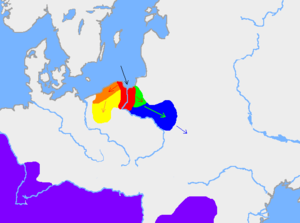
Oksywie culture
The Oksywie Culture, was an archaeological culture which existed in the area of modern day Eastern Pomerania around the lower Vistula river, from the 2nd century BC to the early 1st century AD....
, in the area of modern-day Eastern Pomerania
Eastern Pomerania
Eastern Pomerania can refer to distinct parts of Pomerania:*the historical region of Farther Pomerania, which was the eastern part of the Duchy, later Province of Pomerania...
around the lower Vistula
Vistula
The Vistula is the longest and the most important river in Poland, at 1,047 km in length. The watershed area of the Vistula is , of which lies within Poland ....
river, which was related to the Przeworsk culture
Przeworsk culture
The Przeworsk culture is part of an Iron Age archaeological complex that dates from the 2nd century BC to the 5th century AD. It was located in what is now central and southern Poland, later spreading to parts of eastern Slovakia and Carpathian Ruthenia ranging between the Oder and the middle and...
.
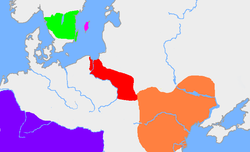
The Wielbark culture has been associated with Jordanes
Jordanes
Jordanes, also written Jordanis or Jornandes, was a 6th century Roman bureaucrat, who turned his hand to history later in life....
' account of the Goths
Goths
The Goths were an East Germanic tribe of Scandinavian origin whose two branches, the Visigoths and the Ostrogoths, played an important role in the fall of the Roman Empire and the emergence of Medieval Europe....
leaving Scandza
Scandza
Scandza was the name given to Scandinavia by the Roman historian Jordanes in his work Getica, written while in Constantinople around AD 551. He described the area to set the stage for his treatment of the Goths' migration from southern Sweden to Gothiscandza...
(Scandinavia
Scandinavia
Scandinavia is a cultural, historical and ethno-linguistic region in northern Europe that includes the three kingdoms of Denmark, Norway and Sweden, characterized by their common ethno-cultural heritage and language. Modern Norway and Sweden proper are situated on the Scandinavian Peninsula,...
) and their settlement in Gothiscandza
Gothiscandza
According to a tale related by Jordanes, Gothiscandza was the first settlement of the Goths after their migration from Scandinavia during the first half of the 1st century CE....
.
Discovery
Goths
The Goths were an East Germanic tribe of Scandinavian origin whose two branches, the Visigoths and the Ostrogoths, played an important role in the fall of the Roman Empire and the emergence of Medieval Europe....
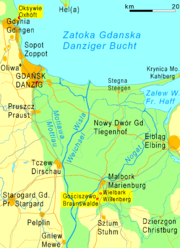
, and Gepids was discovered back in 1873. Unfortunately, many of the cemetery stones were moved, and many graves were damaged by the early German discoverers. The report of the original excavation, lost during World War II
World War II
World War II, or the Second World War , was a global conflict lasting from 1939 to 1945, involving most of the world's nations—including all of the great powers—eventually forming two opposing military alliances: the Allies and the Axis...
was rediscovered only in 2004 and is about to be analysed in a cooperation of Polish scientists from Gdańsk
Gdansk
Gdańsk is a Polish city on the Baltic coast, at the centre of the country's fourth-largest metropolitan area.The city lies on the southern edge of Gdańsk Bay , in a conurbation with the city of Gdynia, spa town of Sopot, and suburban communities, which together form a metropolitan area called the...
, Warszawa, Kraków
Kraków
Kraków also Krakow, or Cracow , is the second largest and one of the oldest cities in Poland. Situated on the Vistula River in the Lesser Poland region, the city dates back to the 7th century. Kraków has traditionally been one of the leading centres of Polish academic, cultural, and artistic life...
and Lublin
Lublin
Lublin is the ninth largest city in Poland. It is the capital of Lublin Voivodeship with a population of 350,392 . Lublin is also the largest Polish city east of the Vistula river...
.
Distribution
The Wielbark culture started out covering the same area as the Oksywie cultureOksywie culture
The Oksywie Culture, was an archaeological culture which existed in the area of modern day Eastern Pomerania around the lower Vistula river, from the 2nd century BC to the early 1st century AD....
, around the present day towns of Gdańsk and Chełmno. Later it reached into the lakelands (Kashubian
Kashubian
Kashubian can refer to:* Pertaining to Kashubia, a region of north-central Poland* Kashubians, an ethnic group of north-central Poland* Kashubian language-See also:*Kashubian alphabet*Kashubian Landscape Park*Kashubian studies...
and Krajenskian lakes) and stretched southwards, into the region around Poznań
Poznan
Poznań is a city on the Warta river in west-central Poland, with a population of 556,022 in June 2009. It is among the oldest cities in Poland, and was one of the most important centres in the early Polish state, whose first rulers were buried at Poznań's cathedral. It is sometimes claimed to be...
.
In the first half of the 3rd century AD, the Wielbark culture left settlements by the Baltic Sea
Baltic Sea
The Baltic Sea is a brackish mediterranean sea located in Northern Europe, from 53°N to 66°N latitude and from 20°E to 26°E longitude. It is bounded by the Scandinavian Peninsula, the mainland of Europe, and the Danish islands. It drains into the Kattegat by way of the Øresund, the Great Belt and...
, at that time called Mare Suevicum or Mare Germanicum, except for the areas adjacent to the Vistula
Vistula
The Vistula is the longest and the most important river in Poland, at 1,047 km in length. The watershed area of the Vistula is , of which lies within Poland ....
, and expanded into the area which later (by 1000 AD) became Masovia and Lesser Poland
Lesser Poland
Lesser Poland is one of the historical regions of Poland, with its capital in the city of Kraków. It forms the southeastern corner of the country, and should not be confused with the modern Lesser Poland Voivodeship, which covers only a small, southern part of Lesser Poland...
on the eastern side of the Vistula reaching into Ukraine
Ukraine
Ukraine is a country in Eastern Europe. It has an area of 603,628 km², making it the second largest contiguous country on the European continent, after Russia...
, where they formed the Chernyakhov culture
Chernyakhov culture
The Sântana de Mureș–Chernyakhiv culture is the name given to an archaeological culture which flourished between the 2nd and 5th centuries in a wide area of Eastern Europe, specifically in what today constitutes Ukraine, Romania, Moldova, and parts of Belarus...
.
In 2000, in Czarnówko near Lębork
Lebork
Lębork is a town on the Łeba and Okalica rivers in Middle Pomerania region, north-western Poland with some 37,000 inhabitants.Lębork is also the capital of Lębork County in Pomeranian Voivodeship since 1999, formerly in Słupsk Voivodeship ....
, Pomerania, a cemetery of Oksywie and Wielbark cultures was found. These reached their height before the emigration of the population to the south west began. A bronze kettle depicts males wearing the Suebian knot
Suebian knot
The Suebian knot is a historical male hairstyle ascribed to the tribe of the Germanic Suebi. The knot is attested by Tacitus in his 1st century CE work Germania, found on art by and depictions of the Germanic peoples, and worn by bog bodies....
hairstyle.
Characteristics
Przeworsk culture
The Przeworsk culture is part of an Iron Age archaeological complex that dates from the 2nd century BC to the 5th century AD. It was located in what is now central and southern Poland, later spreading to parts of eastern Slovakia and Carpathian Ruthenia ranging between the Oder and the middle and...
and the Wielbark culture, and there appear to have been no detectable contacts.
The people of the Wielbark culture used both inhumation and cremation
Cremation
Cremation is the process of reducing bodies to basic chemical compounds such as gasses and bone fragments. This is accomplished through high-temperature burning, vaporization and oxidation....
techniques for burying their dead. Whether one or the other was used varies from site to site and is believed to have depended on family traditions.
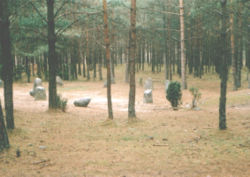
A characteristic of this culture, which it had in common with southern Scandinavia, was the raising of stone covered mounds, stone circles
Stone circle (Iron Age)
The stone circles of the Iron Age were a characteristic burial custom of southern Scandinavia, especially on Gotland and in Götaland during the Pre-Roman Iron Age and the Roman Iron Age. In Sweden, they are called Domarringar , Domkretsar or Domarsäten...
, solitary stelae and variations of cobble cladding.
No weapons or tools are found in Wielbark culture graves, unlike the Przeworsk culture for which it was typical to give the dead such gifts. Instead, the artifacts found are mostly ornaments and costumes, although a few graves have shown spur
Spur
A spur is a metal tool designed to be worn in pairs on the heels of riding boots for the purpose of directing a horse to move forward or laterally while riding. It is usually used to refine the riding aids and to back up the natural aids . The spur is used in every equestrian discipline...
s, these being the only warrior attributes found.
Another feature of the Wielbark culture was the use of bronze to make ornaments and accessories. Silver was used seldom and gold rarely. Iron appears to have been used extremely rarely.
The Goths
Jordanes
Jordanes, also written Jordanis or Jornandes, was a 6th century Roman bureaucrat, who turned his hand to history later in life....
' account of the Goths
Goths
The Goths were an East Germanic tribe of Scandinavian origin whose two branches, the Visigoths and the Ostrogoths, played an important role in the fall of the Roman Empire and the emergence of Medieval Europe....
leaving Scandza
Scandza
Scandza was the name given to Scandinavia by the Roman historian Jordanes in his work Getica, written while in Constantinople around AD 551. He described the area to set the stage for his treatment of the Goths' migration from southern Sweden to Gothiscandza...
(Scandinavia
Scandinavia
Scandinavia is a cultural, historical and ethno-linguistic region in northern Europe that includes the three kingdoms of Denmark, Norway and Sweden, characterized by their common ethno-cultural heritage and language. Modern Norway and Sweden proper are situated on the Scandinavian Peninsula,...
) and their settlement in Gothiscandza
Gothiscandza
According to a tale related by Jordanes, Gothiscandza was the first settlement of the Goths after their migration from Scandinavia during the first half of the 1st century CE....
.
However, archaeologists are wary of ascribing ethnicities to archaeological cultures, and it is considered to be an extremely difficult matter. This is reflected by the names used for the cultures, usually baptised after the towns where remains are found. The latest tendency is to doubt the equation between the Wielbark Culture and the Goths, and contemporary researchers do not believe that immigration from Scandinavia is the sole cause of the Wielbark Culture. While Scandinavian influences played a part, the identical geographical extent and persistent use of Oksywie cemeteries suggest that the Weilbark Culture evolved from the Oksywie culture, with small groups of Scandinavian immigrants joining earlier inhabitants.
The evidence of cemeteries may also indicate which settlements were established directly by Goths. Barrow
Tumulus
A tumulus is a mound of earth and stones raised over a grave or graves. Tumuli are also known as barrows, burial mounds, Hügelgrab or kurgans, and can be found throughout much of the world. A tumulus composed largely or entirely of stones is usually referred to as a cairn...
cemeteries on the Baltic Sea in today's Poland, which have raised stone circles
Stone circle (Iron Age)
The stone circles of the Iron Age were a characteristic burial custom of southern Scandinavia, especially on Gotland and in Götaland during the Pre-Roman Iron Age and the Roman Iron Age. In Sweden, they are called Domarringar , Domkretsar or Domarsäten...
and solitary stelae next to them, reflect Scandinavian burial customs with a concentration in Gotland
Gotland
Gotland is a county, province, municipality and diocese of Sweden; it is Sweden's largest island and the largest island in the Baltic Sea. At 3,140 square kilometers in area, the region makes up less than one percent of Sweden's total land area...
and Götaland
Götaland
Götaland , Gothia, Gothland, Gothenland, Gautland or Geatland is one of three lands of Sweden and comprises provinces...
. Appearing in the later 1st century, this type is found between the Vistula and the Kashubian and Krajenskian lakelands reaching into the Koszalin region.
See also
- Wielbark culture and its burials
- Origins and expansion of the Wielbark culture
- Migrations of Wielbark and Przeworsk cultures people