


West Slavs

Encyclopedia
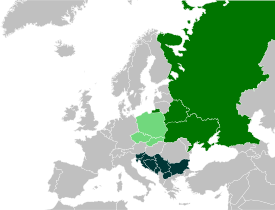
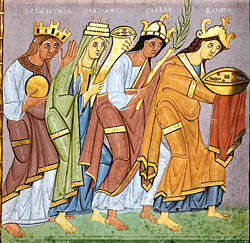

Slavic peoples
The Slavic people are an Indo-European panethnicity living in Eastern Europe, Southeast Europe, North Asia and Central Asia. The term Slavic represents a broad ethno-linguistic group of people, who speak languages belonging to the Slavic language family and share, to varying degrees, certain...
speaking West Slavic languages
West Slavic languages
The West Slavic languages are a subdivision of the Slavic language group that includes Czech, Polish, Slovak, Kashubian and Sorbian.Classification:* Indo-European** Balto-Slavic*** Slavic**** West Slavic***** Czech-Slovak languages****** Czech...
. They include Poles
Poles
thumb|right|180px|The state flag of [[Poland]] as used by Polish government and diplomatic authoritiesThe Polish people, or Poles , are a nation indigenous to Poland. They are united by the Polish language, which belongs to the historical Lechitic subgroup of West Slavic languages of Central Europe...
(with Kashubians
Kashubians
Kashubians/Kaszubians , also called Kashubs, Kashubes, Kaszubians, Kassubians or Cassubians, are a West Slavic ethnic group in Pomerelia, north-central Poland. Their settlement area is referred to as Kashubia ....
and Silesians
Silesians
Silesians , are the inhabitants of Silesia in Poland, Germany and the Czech Republic. A small diaspora community also exists in Karnes County, Texas in the USA....
), Czechs, Slovaks
Slovaks
The Slovaks, Slovak people, or Slovakians are a West Slavic people that primarily inhabit Slovakia and speak the Slovak language, which is closely related to the Czech language.Most Slovaks today live within the borders of the independent Slovakia...
, Lusatian Sorbs
Sorbs
Sorbs are a Western Slavic people of Central Europe living predominantly in Lusatia, a region on the territory of Germany and Poland. In Germany they live in the states of Brandenburg and Saxony. They speak the Sorbian languages - closely related to Polish and Czech - officially recognized and...
and the historical Polabians. The northern or Lechitic
Lechites
Lechites – an ethnic and linguistic group of West Slavs, the ancestors of modern Poles and the historical Pomeranians and Polabians.-History:...
group includes, along with Polish, the extinct Polabian
Polabian language
The Polabian language is an extinct West Slavic language that was spoken by the Polabian Slavs in present-day North-Eastern Germany around the Elbe river, from which derives its name...
and Pomeranian languages
Pomeranian language
The Pomeranian language is a group of dialects from the Lechitic cluster of the West Slavic languages. In medieval contexts, it refers to the dialects spoken by the Slavic Pomeranians...
. The languages of Upper
Upper Lusatia
Upper Lusatia is a region a biggest part of which belongs to Saxony, a small eastern part belongs to Poland, the northern part to Brandenburg. In Saxony, Upper Lusatia comprises roughly the districts of Bautzen and Görlitz , in Brandenburg the southern part of district Oberspreewald-Lausitz...
and Lower Lusatia
Lower Lusatia
Lower Lusatia is a historical region stretching from the southeast of the Brandenburg state of Germany to the southwest of the Lubusz Voivodeship in Poland. Important towns beside the historic capital Lübben include Calau, Cottbus, Guben , Luckau, Spremberg, Finsterwalde, Senftenberg and Żary...
have features in common with both the Lechitic and the Czecho-Slovak group.
Culturally, West Slavs developed along the lines of other Western Europe
Western Europe
Western Europe is a loose term for the collection of countries in the western most region of the European continents, though this definition is context-dependent and carries cultural and political connotations. One definition describes Western Europe as a geographic entity—the region lying in the...
an nations due to affiliation with the Roman Empire
Roman Empire
The Roman Empire was the post-Republican period of the ancient Roman civilization, characterised by an autocratic form of government and large territorial holdings in Europe and around the Mediterranean....
and Western Christianity
Western Christianity
Western Christianity is a term used to include the Latin Rite of the Catholic Church and groups historically derivative thereof, including the churches of the Anglican and Protestant traditions, which share common attributes that can be traced back to their medieval heritage...
Thus, they experienced a cultural split with the other Slavic groups: while the East Slavs and most South Slavs converted to Orthodox
Eastern Orthodox Church
The Orthodox Church, officially called the Orthodox Catholic Church and commonly referred to as the Eastern Orthodox Church, is the second largest Christian denomination in the world, with an estimated 300 million adherents mainly in the countries of Belarus, Bulgaria, Cyprus, Georgia, Greece,...
Christianity, thus being culturally influenced by the Byzantine Empire
Byzantine Empire
The Byzantine Empire was the Eastern Roman Empire during the periods of Late Antiquity and the Middle Ages, centred on the capital of Constantinople. Known simply as the Roman Empire or Romania to its inhabitants and neighbours, the Empire was the direct continuation of the Ancient Roman State...
, the West Slavs along with the westernmost South Slavs (Slovenes and Croats) converted to Roman Catholicism, thus coming under the cultural influence of the Latin Church. (Rarely, the term "West Slavs" includes these Catholic South Slavs.)
History
In Middle Ages the name WendsWends
Wends is a historic name for West Slavs living near Germanic settlement areas. It does not refer to a homogeneous people, but to various peoples, tribes or groups depending on where and when it is used...
(Venedi or Venedae, taken from Jordanes and Tacitus) was applied to Western Slavic peoples, most often those living in the Holy Roman Empire
Holy Roman Empire
The Holy Roman Empire was a realm that existed from 962 to 1806 in Central Europe.It was ruled by the Holy Roman Emperor. Its character changed during the Middle Ages and the Early Modern period, when the power of the emperor gradually weakened in favour of the princes...
. Mieszko I
Mieszko I of Poland
Mieszko I , was a Duke of the Polans from about 960 until his death. A member of the Piast dynasty, he was son of Siemomysł; grandchild of Lestek; father of Bolesław I the Brave, the first crowned King of Poland; likely father of Świętosława , a Nordic Queen; and grandfather of her son, Cnut the...
, the first historical ruler of Poland, also appeared as "Dagome, King of the Wends" (Old Norse
Old Norse
Old Norse is a North Germanic language that was spoken by inhabitants of Scandinavia and inhabitants of their overseas settlements during the Viking Age, until about 1300....
Vindakonungr).
The early Slavic expansion
Early Slavs
The early Slavs were a diverse group of tribal societies in Migration period and early medieval Europe whose tribal organizations indirectly created the foundations for today’s Slavic nations .The first mention of the name Slavs dates to the 6th century, by which time the Slavic tribes inhabited a...
began in the 5th century, and by the 6th century, the groups that would become the West, East and South
South Slavs
The South Slavs are the southern branch of the Slavic peoples and speak South Slavic languages. Geographically, the South Slavs are native to the Balkan peninsula, the southern Pannonian Plain and the eastern Alps...
Slavic groups had probably become geographically separated.
The first independent West Slavic states originate beginning in the 7th century, with the Empire of Samo
Samo
Samo was a Frankish merchant from the "Senonian country" , probably modern Soignies, Belgium or Sens, France. He was the first ruler of the Slavs whose name is known, and established one of the earliest Slav states, a supra-tribal union usually called Samo's empire, realm, kingdom, or tribal...
(623 - 658), the Principality of Moravia
Great Moravia
Great Moravia was a Slavic state that existed in Central Europe and lasted for nearly seventy years in the 9th century whose creators were the ancestors of the Czechs and Slovaks. It was a vassal state of the Germanic Frankish kingdom and paid an annual tribute to it. There is some controversy as...
(8th c. - 833), the Principality of Nitra
Principality of Nitra
The Principality of Nitra also Nitrian Principality or Slovak Principality is the name for a polity of Nitra Sloviens, centered on large agglomeration, a multi-tribal centre around Nitra, Slovakia. The initially independent Principality of Nitra came into existence in the early 9th century...
(8th c. - 833) and Great Moravia
Great Moravia
Great Moravia was a Slavic state that existed in Central Europe and lasted for nearly seventy years in the 9th century whose creators were the ancestors of the Czechs and Slovaks. It was a vassal state of the Germanic Frankish kingdom and paid an annual tribute to it. There is some controversy as...
(833 - c. 907). The Sorbs and other Polabian Slavs
Polabian Slavs
Polabian Slavs - is a collective term applied to a number of Lechites tribes who lived along the Elbe river, between the Baltic Sea to the north, the Saale and the Limes Saxoniae to the west, the Ore Mountains and the Western Sudetes to the south, and Poland to the east. They have also been known...
like Obodrites and Veleti
Veleti
The Veleti or Wilzi were a group of medieval Lechites tribes within the territory of modern northeastern Germany; see Polabian Slavs. In common with other Slavic groups between the Elbe and Oder Rivers, they were often described by Germanic sources as Wends. In the late 10th century, they were...
came under the domination of the Holy Roman Empire
Holy Roman Empire
The Holy Roman Empire was a realm that existed from 962 to 1806 in Central Europe.It was ruled by the Holy Roman Emperor. Its character changed during the Middle Ages and the Early Modern period, when the power of the emperor gradually weakened in favour of the princes...
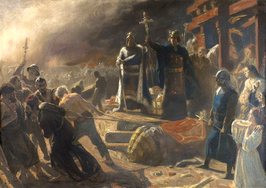
after the Wendish Crusade
Wendish Crusade
The Wendish Crusade was an 1147 campaign, one of the Northern Crusades and also a part of the Second Crusade, led primarily by the Kingdom of Germany inside the Holy Roman Empire and directed against the Polabian Slavs ....
in the Middle Ages and had been strongly Germanized by Germans
Germans
The Germans are a Germanic ethnic group native to Central Europe. The English term Germans has referred to the German-speaking population of the Holy Roman Empire since the Late Middle Ages....
at the end of 19th century. The Polabian language
Polabian language
The Polabian language is an extinct West Slavic language that was spoken by the Polabian Slavs in present-day North-Eastern Germany around the Elbe river, from which derives its name...
survived until the beginning of the 19th century in what is now the German state of Lower Saxony
Lower Saxony
Lower Saxony is a German state situated in north-western Germany and is second in area and fourth in population among the sixteen states of Germany...
. To this day survived only 60.000 of Sorbs
Sorbs
Sorbs are a Western Slavic people of Central Europe living predominantly in Lusatia, a region on the territory of Germany and Poland. In Germany they live in the states of Brandenburg and Saxony. They speak the Sorbian languages - closely related to Polish and Czech - officially recognized and...
living predominantly in Lusatia
Lusatia
Lusatia is a historical region in Central Europe. It stretches from the Bóbr and Kwisa rivers in the east to the Elbe valley in the west, today located within the German states of Saxony and Brandenburg as well as in the Lower Silesian and Lubusz voivodeships of western Poland...
, a region on the territory of modern Germany
Germany
Germany , officially the Federal Republic of Germany , is a federal parliamentary republic in Europe. The country consists of 16 states while the capital and largest city is Berlin. Germany covers an area of 357,021 km2 and has a largely temperate seasonal climate...
in the states of Brandenburg and Saxony.
The central Polish tribe of the Polans
Polans (western)
The Polans were a West Slavic tribe, part of the Lechitic group, inhabiting the Warta river basin of the historic Greater Poland region in the 8th century.During the reign of King Svatopluk I of Great Moravia , who subdued the tribes of the Vistulans and Ślężanie...
created their own state in the 10th century under the Polish duke Mieszko I. For many centuries Poland has had close ties with its western neighbours, with the Polish ruler Bolesław I the Brave declared by Holy Roman Emperor Otto III as Frater et Cooperator Imperii ("Brother and Partner in the Empire"). During the 18th century some of the Poles (living in Austrian Galicia) became subjects/citizens of the Habsburg monarchy
Habsburg Monarchy
The Habsburg Monarchy covered the territories ruled by the junior Austrian branch of the House of Habsburg , and then by the successor House of Habsburg-Lorraine , between 1526 and 1867/1918. The Imperial capital was Vienna, except from 1583 to 1611, when it was moved to Prague...
(which ruled the area until 1918). The precursors of the Czechs (i.e. Bohemians) migrated into Bohemia
Bohemia
Bohemia is a historical region in central Europe, occupying the western two-thirds of the traditional Czech Lands. It is located in the contemporary Czech Republic with its capital in Prague...
in the late 6th century and had established various fiefdoms by the 10th century when their rulers eventually became vassals (1002) of the Holy Roman Emperors
Holy Roman Empire
The Holy Roman Empire was a realm that existed from 962 to 1806 in Central Europe.It was ruled by the Holy Roman Emperor. Its character changed during the Middle Ages and the Early Modern period, when the power of the emperor gradually weakened in favour of the princes...
. Kingdom of Bohemia
Kingdom of Bohemia
The Kingdom of Bohemia was a country located in the region of Bohemia in Central Europe, most of whose territory is currently located in the modern-day Czech Republic. The King was Elector of Holy Roman Empire until its dissolution in 1806, whereupon it became part of the Austrian Empire, and...
stayed part of that Empire between 1002–1419 and 1526–1918. Predecessors of Slovaks came under Hungarian
Kingdom of Hungary
The Kingdom of Hungary comprised present-day Hungary, Slovakia and Croatia , Transylvania , Carpatho Ruthenia , Vojvodina , Burgenland , and other smaller territories surrounding present-day Hungary's borders...
domination after 907 (doom of the Great Moravia
Great Moravia
Great Moravia was a Slavic state that existed in Central Europe and lasted for nearly seventy years in the 9th century whose creators were the ancestors of the Czechs and Slovaks. It was a vassal state of the Germanic Frankish kingdom and paid an annual tribute to it. There is some controversy as...
) – together with other Slavic groups as Croats
Croats
Croats are a South Slavic ethnic group mostly living in Croatia, Bosnia and Herzegovina and nearby countries. There are around 4 million Croats living inside Croatia and up to 4.5 million throughout the rest of the world. Responding to political, social and economic pressure, many Croats have...
, Slovenians
Slovenians
The Slovenes, Slovene people, Slovenians, or Slovenian people are a South Slavic people primarily associated with Slovenia and the Slovene language.-Population:Most Slovenes today live within the borders of the independent Slovenia...
, Dalmatia
Dalmatia
Dalmatia is a historical region on the eastern coast of the Adriatic Sea. It stretches from the island of Rab in the northwest to the Bay of Kotor in the southeast. The hinterland, the Dalmatian Zagora, ranges from fifty kilometers in width in the north to just a few kilometers in the south....
ns and Rusyns
Rusyns
Carpatho-Rusyns are a primarily diasporic ethnic group who speak an Eastern Slavic language, or Ukrainian dialect, known as Rusyn. Carpatho-Rusyns descend from a minority of Ruthenians who did not adopt the use of the ethnonym "Ukrainian" in the early twentieth century...
. Both the Czechs and the Slovaks were under rule of the Habsburg monarchy from 1526 to 1804; then in the Austrian Empire
Austrian Empire
The Austrian Empire was a modern era successor empire, which was centered on what is today's Austria and which officially lasted from 1804 to 1867. It was followed by the Empire of Austria-Hungary, whose proclamation was a diplomatic move that elevated Hungary's status within the Austrian Empire...
and between 1867–1918 part of Austria-Hungary
Austria-Hungary
Austria-Hungary , more formally known as the Kingdoms and Lands Represented in the Imperial Council and the Lands of the Holy Hungarian Crown of Saint Stephen, was a constitutional monarchic union between the crowns of the Austrian Empire and the Kingdom of Hungary in...
.
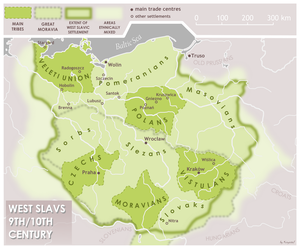
West Slavic groups in 10th c.
- LechiticLechitesLechites – an ethnic and linguistic group of West Slavs, the ancestors of modern Poles and the historical Pomeranians and Polabians.-History:...
group- PolesPolesthumb|right|180px|The state flag of [[Poland]] as used by Polish government and diplomatic authoritiesThe Polish people, or Poles , are a nation indigenous to Poland. They are united by the Polish language, which belongs to the historical Lechitic subgroup of West Slavic languages of Central Europe...
- MasoviansMasoviansThe Masovians or Mazovians are a Lechitic tribe or an ethnic group associated with the region of Mazovia. They were first referenced by Nestor the Chronicler in the 11th century. Originally, their main settlements were in the area of Płock, Łomża, Wizna, Czersk, Ciechanów, Płońsk, Zakroczym and...
- PolansPolans (western)The Polans were a West Slavic tribe, part of the Lechitic group, inhabiting the Warta river basin of the historic Greater Poland region in the 8th century.During the reign of King Svatopluk I of Great Moravia , who subdued the tribes of the Vistulans and Ślężanie...
- Lendians
- Masovians
- VistulansVistulansVistulans were an early medieval West Slavic tribe inhabiting the land of modern Lesser Poland.From the 1st century and possibly earlier, the Vistulans , were part of the Carpian Tribe, which got its name from the area that they lived in, which was beside the Carpathian Mountain Range...
- SilesiansSilesiansSilesians , are the inhabitants of Silesia in Poland, Germany and the Czech Republic. A small diaspora community also exists in Karnes County, Texas in the USA....
- Pomeranians
- KashubiansKashubiansKashubians/Kaszubians , also called Kashubs, Kashubes, Kaszubians, Kassubians or Cassubians, are a West Slavic ethnic group in Pomerelia, north-central Poland. Their settlement area is referred to as Kashubia ....
- Slovincians
- Kashubians
- Polabians
- Obodrites/Abodrites
- Obotrites proper
- Wagrians
- Warnower
- Polabians properPolabians (tribe)The Polabians were a constituent Lechitic tribe of the Obotrites who lived between the Trave and the Elbe. The main settlement of the Polabians was Racisburg , named after their Prince Ratibor...
- Linonen
- Travnjane
- DrevaniDrevaniThe Drevani were a tribe of Polabian Slavs settling on the Elbe river in the area of the present-day Lüchow-Dannenberg district of Lower Saxony, Germany....
- Veleti (Wilzi)VeletiThe Veleti or Wilzi were a group of medieval Lechites tribes within the territory of modern northeastern Germany; see Polabian Slavs. In common with other Slavic groups between the Elbe and Oder Rivers, they were often described by Germanic sources as Wends. In the late 10th century, they were...
, succeeded by LuticiLuticiThe Lutici were a federation of West Slavic Polabian tribes, who between the 10th and 12th centuries lived in what is now northeastern Germany. Four tribes made up the core of the federation: the Redarians , Circipanians , Kessinians and Tollensians...
(Liutici)- Kissini (Kessiner, Chizzinen, Kyzziner)
- Circipani (Zirzipanen)
- Tollenser
- Redarier
- Ucri (Ukr(an)i, Ukranen)
- Rani (Rujani)Rani (Slavic tribe)The Rani or Rujani were a West Slavic tribe based on the island of Rugia and the southwestern mainland across the Strelasund in what is today northeastern Germany....
- Hevelli (Stodorani)
- Volinians (Velunzani)
- Pyritzans (Prissani)
- Obodrites/Abodrites
- Poles
- Czech-Slovak group
- Czechs
- Bohemians
- MoraviansMoravians (ethnic group)Moravians are the modern West Slavic inhabitants of the historical land of Moravia, the easternmost part of the Czech Republic, which includes the Moravian Slovakia. They speak the two main groups of Moravian dialects , the transitional Bohemian-Moravian dialect subgroup and standard Czech...
- Holasians
- SlovaksSlovaksThe Slovaks, Slovak people, or Slovakians are a West Slavic people that primarily inhabit Slovakia and speak the Slovak language, which is closely related to the Czech language.Most Slovaks today live within the borders of the independent Slovakia...
(Sclavi)
- Czechs
- SorbsSorbsSorbs are a Western Slavic people of Central Europe living predominantly in Lusatia, a region on the territory of Germany and Poland. In Germany they live in the states of Brandenburg and Saxony. They speak the Sorbian languages - closely related to Polish and Czech - officially recognized and...
(Serbo-Lusatians)- MilceniMilceniThe Milceni or Milzeni were a West Slavic tribe, who settled in the present-day Upper Lusatia region. They were first mentioned in the middle of the 9th century AD by the Bavarian Geographer, who wrote of 30 civitates which possibly had fortifications. They were gradually conquered by Germans...
(Upper Sorbs) - LusatiansLusatiansLusatians are people living in or coming from Lusatia. It may refer to:*Sorbs, Slavic people *Germans, main ethnic group of Lusatia...
(Lower Sorbs)
- Milceni
West Slavs from the Bavarian Geographer
In 845845
Year 845 was a common year starting on Thursday of the Julian calendar.- Europe :* March 28 – Paris is sacked by Viking raiders, probably under Ragnar Lodbrok, who collect a huge ransom in exchange for leaving.* The Vikings also sack Hamburg and Melun.* November 22 – Count of Vannes,...
the Bavarian Geographer
Bavarian Geographer
The Bavarian Geographer is a conventional name given by Jan Potocki in 1796 to the author of an anonymous medieval document Descriptio civitatum et regionum ad septentrionalem plagam Danubii ....
made a list of West Slavic tribes who lived in the areas of modern day Poland
Poland
Poland , officially the Republic of Poland , is a country in Central Europe bordered by Germany to the west; the Czech Republic and Slovakia to the south; Ukraine, Belarus and Lithuania to the east; and the Baltic Sea and Kaliningrad Oblast, a Russian exclave, to the north...
, Czech Republic
Czech Republic
The Czech Republic is a landlocked country in Central Europe. The country is bordered by Poland to the northeast, Slovakia to the east, Austria to the south, and Germany to the west and northwest....
, Denmark
Denmark
Denmark is a Scandinavian country in Northern Europe. The countries of Denmark and Greenland, as well as the Faroe Islands, constitute the Kingdom of Denmark . It is the southernmost of the Nordic countries, southwest of Sweden and south of Norway, and bordered to the south by Germany. Denmark...
and Germany
Germany
Germany , officially the Federal Republic of Germany , is a federal parliamentary republic in Europe. The country consists of 16 states while the capital and largest city is Berlin. Germany covers an area of 357,021 km2 and has a largely temperate seasonal climate...
(some groups are known today to be non-Slavic):
| pos.: | Latin name in 845 845 Year 845 was a common year starting on Thursday of the Julian calendar.- Europe :* March 28 – Paris is sacked by Viking raiders, probably under Ragnar Lodbrok, who collect a huge ransom in exchange for leaving.* The Vikings also sack Hamburg and Melun.* November 22 – Count of Vannes,... |
English name | no. of gords Gord (Slavic settlement) Gord is a medieval Slavic fortified settlement. This Proto-Slavic word for town or city, later differentiated into grad , gard, gorod , etc. The ancient peoples were known for building wooden fortified settlements... |
|---|---|---|---|
| 7, | Hehfeldi |
Hevellians | 8 |
| 15, | Miloxi |
67 | |
| 17, | Thadesi |
200 | |
| 18, | Glopeani |
Goplans Goplans Goplans, Goplanes or Goplanie is a name of an early medieval West Slavic tribe, later to become part of the Polish nation. They were mentioned by Bavarian Geographer as 'Glopeani' and believed to have lived around Lake Gopło, with its capital in Kruszwica, between 7th-9th century AD.Medieval... |
400 |
| 33, | Lendizi | Lendians Lendians The Lendians were a Lechitic eastern Wends tribe recorded to have inhabited the ill-defined area in East Lesser Poland and Cherven Towns between the 7th and 11th centuries.... |
68 |
| 34, | Thafnezi |
257 | |
| 36, | Prissani |
Pyritzans | 70 |
| 37, | Uelunzani |
Wolinians | 70 |
| 38, | Bruzi |
Old Prussians Old Prussians The Old Prussians or Baltic Prussians were an ethnic group, autochthonous Baltic tribes that inhabited Prussia, the lands of the southeastern Baltic Sea in the area around the Vistula and Curonian Lagoons... |
|
| 47, | Ungare |
Hungarians | |
| 48, | Uuislane |
Vistulans Vistulans Vistulans were an early medieval West Slavic tribe inhabiting the land of modern Lesser Poland.From the 1st century and possibly earlier, the Vistulans , were part of the Carpian Tribe, which got its name from the area that they lived in, which was beside the Carpathian Mountain Range... |
|
| 49, | Sleenzane |
Silesians Silesians Silesians , are the inhabitants of Silesia in Poland, Germany and the Czech Republic. A small diaspora community also exists in Karnes County, Texas in the USA.... |
15 |
| 50, | Lunsizi |
Sorbs Sorbs Sorbs are a Western Slavic people of Central Europe living predominantly in Lusatia, a region on the territory of Germany and Poland. In Germany they live in the states of Brandenburg and Saxony. They speak the Sorbian languages - closely related to Polish and Czech - officially recognized and... |
30 |
| 52, | Milzane |
Milceni Milceni The Milceni or Milzeni were a West Slavic tribe, who settled in the present-day Upper Lusatia region. They were first mentioned in the middle of the 9th century AD by the Bavarian Geographer, who wrote of 30 civitates which possibly had fortifications. They were gradually conquered by Germans... |
30 |
| 56, | Lupiglaa |
30 | |
| 57, | Opolini |
Opolanie Opolanie Opolanie – West Slavic tribe that lived in the region of upper Odra. Their main settlement was Opole. They were mentioned in the Bavarian Geographer, under the name Opolini, as one of the seven tribes living in Silesia... |
20 |
| 58, | Golensizi |
5 | |
| 53, | Besunzane |
2 | |
| 51, | Diadesisi |
20 | |
See also
- West Slavic languagesWest Slavic languagesThe West Slavic languages are a subdivision of the Slavic language group that includes Czech, Polish, Slovak, Kashubian and Sorbian.Classification:* Indo-European** Balto-Slavic*** Slavic**** West Slavic***** Czech-Slovak languages****** Czech...
- East SlavsEast SlavsThe East Slavs are Slavic peoples speaking East Slavic languages. Formerly the main population of the medieval state of Kievan Rus, by the seventeenth century they evolved into the Russian, Ukrainian, and Belarusian peoples.-Sources:...
- South SlavsSouth SlavsThe South Slavs are the southern branch of the Slavic peoples and speak South Slavic languages. Geographically, the South Slavs are native to the Balkan peninsula, the southern Pannonian Plain and the eastern Alps...
- PolandPolandPoland , officially the Republic of Poland , is a country in Central Europe bordered by Germany to the west; the Czech Republic and Slovakia to the south; Ukraine, Belarus and Lithuania to the east; and the Baltic Sea and Kaliningrad Oblast, a Russian exclave, to the north...
- Czech RepublicCzech RepublicThe Czech Republic is a landlocked country in Central Europe. The country is bordered by Poland to the northeast, Slovakia to the east, Austria to the south, and Germany to the west and northwest....
- SlovakiaSlovakiaThe Slovak Republic is a landlocked state in Central Europe. It has a population of over five million and an area of about . Slovakia is bordered by the Czech Republic and Austria to the west, Poland to the north, Ukraine to the east and Hungary to the south...
- LusatiaLusatiaLusatia is a historical region in Central Europe. It stretches from the Bóbr and Kwisa rivers in the east to the Elbe valley in the west, today located within the German states of Saxony and Brandenburg as well as in the Lower Silesian and Lubusz voivodeships of western Poland...
- List of Medieval Slavic tribes