
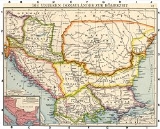
Dalmatia is a historical region on the eastern coast of the
Adriatic SeaThe Adriatic Sea is a body of water separating the Italian Peninsula from the Balkan peninsula, and the system of the Apennine Mountains from that of the Dinaric Alps and adjacent ranges...
. It stretches from the island of
RabRab is an island in Croatia and a town of the same name located just off the northern Croatian coast in the Adriatic Sea.The island is long, has an area of and 9,480 inhabitants . The highest peak is Kamenjak at 408 meters...
in the northwest to the
Bay of KotorThe Bay of Kotor in south-western Montenegro is a winding bay on the Adriatic Sea. The bay, sometimes called Europe's southernmost fjord, is in fact a submerged river canyon of the disintegrated Bokelj River which used to run from the high mountain plateaus of Mount Orjen...
in the southeast. The
hinterlandThe hinterland is the land or district behind a coast or the shoreline of a river. Specifically, by the doctrine of the hinterland, the word is applied to the inland region lying behind a port, claimed by the state that owns the coast. The area from which products are delivered to a port for...
, the Dalmatian
ZagoraZagora , sometimes also called Dalmatian Zagora , is the southern inland region of Croatia. The name Zagora means "behind hills", which is a reference to the fact that it is the part of Dalmatia that is not coastal....
, ranges from fifty kilometers in width in the north to just a few kilometers in the south. Dalmatia lies in
CroatiaCroatia , officially the Republic of Croatia , is a unitary democratic parliamentary republic in Europe at the crossroads of the Mitteleuropa, the Balkans, and the Mediterranean. Its capital and largest city is Zagreb. The country is divided into 20 counties and the city of Zagreb. Croatia covers ...
. The
Dalmatian dogThe Dalmatian is a breed of dog whose roots are often said to trace back to Dalmatia, a region of Croatia where the first illustrations of the dog have been found. The Dalmatian is noted for its unique black- or brown-spotted coat and was mainly used as a carriage dog in its early days...
received its name from Dalmatia, as does the
dalmaticThe dalmatic is a long wide-sleeved tunic, which serves as a liturgical vestment in the Roman Catholic, Lutheran, Anglican, and United Methodist Churches, which is sometimes worn by a deacon at the Mass or other services. Although infrequent, it may also be worn by bishops above the alb and below...
, a Roman Catholic liturgical vestment worn by deacons and bishops.
Etymology
The name Dalmatia derives from the name of the tribe of the
DalmataeThe Dalmatae or Delmatae were an ancient people who inhabited the core of what would then become known as Dalmatia after the Roman conquest - now the eastern Adriatic coast in Croatia, between the rivers Krka and Neretva...
, which is connected with the Illyrian word
delme,
dele in modern
AlbanianAlbanian is an Indo-European language spoken by approximately 7.6 million people, primarily in Albania and Kosovo but also in other areas of the Balkans in which there is an Albanian population, including western Macedonia, southern Montenegro, southern Serbia and northwestern Greece...
, which means 'sheep' in English.
Definitions
In
antiquityAncient history is the study of the written past from the beginning of recorded human history to the Early Middle Ages. The span of recorded history is roughly 5,000 years, with Cuneiform script, the oldest discovered form of coherent writing, from the protoliterate period around the 30th century BC...
the Roman province of
DalmatiaDalmatia was an ancient Roman province. Its name is probably derived from the name of an Illyrian tribe called the Dalmatae which lived in the area of the eastern Adriatic coast in Classical antiquity....
was much larger than the present-day region, stretching from
IstriaIstria , formerly Histria , is the largest peninsula in the Adriatic Sea. The peninsula is located at the head of the Adriatic between the Gulf of Trieste and the Bay of Kvarner...
to historical
AlbaniaAlbania , officially known as the Republic of Albania , is a country in Southeastern Europe, in the Balkans region. It is bordered by Montenegro to the northwest, Kosovo to the northeast, the Republic of Macedonia to the east and Greece to the south and southeast. It has a coast on the Adriatic Sea...
. Dalmatia signified not only a geographical unit, but was an entity based on common culture and settlement types, a common narrow eastern Adriatic coastal belt,
Mediterranean climateA Mediterranean climate is the climate typical of most of the lands in the Mediterranean Basin, and is a particular variety of subtropical climate...
, sclerophyllous vegetation of the Illyrian province, Adriatic
carbonate platformA carbonate platform is a sedimentary body which possesses topographic relief, and is composed of autochthonous calcareous deposits . Platform growth is mediated by sessile organisms whose skeletons build up the reef or by organisms which induce carbonate precipitation through their metabolism...
, and
karstKilometer-square Area Radio Synthesis Telescope is a Chinese telescope project to which FAST is a forerunner. KARST is a set of large spherical reflectors on karst landforms, which are bowlshaped limestone sinkholes named after the Kras region in Slovenia and Northern Italy. It will consist of...
geomorphologyGeomorphology is the scientific study of landforms and the processes that shape them...
.
Among other things, the ecclesiastical primatical territory today continues to be larger because of the history: it includes part of modern
MontenegroMontenegro Montenegrin: Crna Gora Црна Гора , meaning "Black Mountain") is a country located in Southeastern Europe. It has a coast on the Adriatic Sea to the south-west and is bordered by Croatia to the west, Bosnia and Herzegovina to the northwest, Serbia to the northeast and Albania to the...
, notably around
BarBar is a coastal town in Montenegro. It has a population of 17,727...
, the (honorary) Roman Catholic primas of Dalmatia, but an exempt archbishopric without suffragans while the archbishoprics of
SplitSplit is a Mediterranean city on the eastern shores of the Adriatic Sea, centered around the ancient Roman Palace of the Emperor Diocletian and its wide port bay. With a population of 178,192 citizens, and a metropolitan area numbering up to 467,899, Split is by far the largest Dalmatian city and...
(also a historical primas of Dalmatia) have provincial authority over all Croatian dioceses except the exempt archbishopric of
ZadarZadar is a city in Croatia on the Adriatic Sea. It is the centre of Zadar county and the wider northern Dalmatian region. Population of the city is 75,082 citizens...
.
The southernmost transitional part of historical Dalmatia, the Gulf of Kotor, is not part of present-day Croatian Dalmatia, but part of Montenegro.
Geography and climate
Most of the area is covered by Dinaric Alps mountain ranges running from north-west to south-east. On the coasts the climate is Mediterranean, while further inland it is moderate continental. In the mountains, winters are frosty and snowy, while summers are hot and dry. To the south winters are milder. Over the centuries many forest have been cut down and replaced with bush and brush. There is evergreen vegetation on the coast. The soils are generally poor, except on the plains where areas with natural grass, fertile soils and warm summers provide an opportunity for tillage. Elsewhere, land cultivation is mostly unsuccessful because of the mountains, hot summers and poor soils, although olives and grapes flourish. The rocky karst that borders coastal areas has been producing wine grapes of high quality, especially in new vineyards being planted in the
Dingač region. Energy resources of scarce. Electricity is mainly produced by hydropower stations. There is a considerable amount of bauxite.
The largest Dalmatian mountains are
DinaraDinara is a mountain located on the border of Croatia and Bosnia and Herzegovina. One of its summits, also called Dinara, is the highest point in Croatia at 1,831 m and a prominence of 728 m.-Etymology:...
,
MosorMosor is a mountain range in Croatia located near the town of Split on the Adriatic coast. It belongs to Dinaric Alps, and it stretches from the pass of Klis in the northwest to the Cetina River in the southeast....
,
SvilajaSvilaja is a mountain range in Croatia, located in inland of Dalmatian Zagora.It belongs to Dinaric Alps, and it stretches from the town of Sinj northwest to the Petrovo field, approximate 30 km in length....
,
BiokovoBiokovo is the second-highest mountain range in Croatia, located along the Dalmatian coast of the Adriatic Sea, between the rivers of Cetina and Neretva...
, Moseć,
Veliki KozjakVeliki Kozjak or just Kozjak is a mountain cliff in Croatia, located in inland of Dalmatian Zagora.It belongs to Dinaric Alps, and it stretches over small village Kijevo between towns of Vrlika and Knin....
and
Mali KozjakKozjak, also known as Mali Kozjak or Primorski Kozjak is a mountain located above the town of Kaštela in Dalmatia, Croatia....
. The regional geographical unit of historical Dalmatia, the coastal region between Istria and the Gulf of Kotor, includes the
OrjenOrjen is a Dinaric Mediterranean limestone mountain range in Montenegro-Bosnia and Herzegovina. At 1894 m , Zubački kabao is the highest peak in the subadriatic Dinarides. The massif of Orjen lies to the Northwest of Risan in Bay of Kotor...
mountain with the highest peak in Montenegro, 1894 m. In present-day Dalmatia, the highest peak is Dinara (1913 m), which is not a coastal mountain, while the highest coastal Dinaric mountains are on Biokovo (Sv. Jure 1762 m) and Velebit (Vaganjski vrh 1758 m).
The largest Dalmatian islands are
Dugi OtokDugi otok is the seventh largest island in the Adriatic Sea, part of Croatia. It is located off the Dalmatian coast, west of Zadar. It is the largest and eastern-most of the Zadarian Islands, and derives its name from its distinctive shape...
,
UgljanUgljan is a Croatian island and the first in the Zadar Archipelago. It is located northwest of the island of Pašman and southeast of the islands of Rivanj and Sestrunj. Separated from the mainland by the Zadar Channel, it is connected with the island of Pašman by a bridge spanning over the Ždrelac...
,
PašmanPašman is an island off the coast of the Adriatic Sea in Croatia, located to the south of Zadar, surrounded by the islands Ugljan, Iž, Dugi otok and Kornati...
,
BračBrač is an island in the Adriatic Sea within Croatia, with an area of 396 km², making it the largest island in Dalmatia, and the third largest in the Adriatic. Its tallest peak, Vidova Gora, or Mount St. Vid, stands at 778 m, making it the highest island point in the Adriatic...
,
Hvar- Climate :The climate of Hvar is characterized by mild winters and warm summers. The yearly average air temperature is , 686 mm of precipitation fall on the town of Hvar on average every year and the town has a total of 2800 sunshine hours per year. For comparison Hvar has an average of 7.7...
,
KorčulaKorčula is an island in the Adriatic Sea, in the Dubrovnik-Neretva County of Croatia. The island has an area of ; long and on average wide — and lies just off the Dalmatian coast. Its 16,182 inhabitants make it the second most populous Adriatic island after Krk...
,
VisVis is the most outerly lying larger Croatian island in the Adriatic Sea, and is part of the Central Dalmatian group of islands, with an area of 90.26 km² and a population of 3,617 . Of all the inhabited Croatian islands, it is the farthest from the coast...
,
LastovoLastovo is an island municipality in the Dubrovnik-Neretva County in Croatia. The municipality consists of 46 islands with a total population of 792 people, of which 93% are ethnic Croats, and a land area of approximately . The biggest island in the municipality is also named Lastovo, as is the...
, and
MljetMljet is the most southerly and easterly of the larger Adriatic islands of the Dalmatia region of Croatia. The National Park includes the western part of the island, Veliko jezero, Malo jezero, Soline Bay and a sea belt 500 m wide from the most prominent cape of Mljet covering an area of...
. The rivers are
ZrmanjaZrmanja is a river in southern Lika and northern Dalmatia, Croatia. It is long and its basin covers an area of .It was known to the ancient Romans as Tedanius. The spring of Zrmanja is located in southern part of Lika under Postak - the southern peak of Pljesevica mountain, and close to south end...
,
KrkaKrka is a river in Croatia's Dalmatia region, famous for its numerous waterfalls. It is long and its basin covers an area of .Possibly the river called Catarbates by the ancient Greeks, it was known to the ancient Romans as Titius, Corcoras, or Korkoras.The river has its source near the border...
,
CetinaCetina is a river in southern Croatia. It has a length of and its basin covers an area of . Cetina descends from an altitude of 385 m at its source to the sea level when it flows into the Adriatic Sea. It is the most water-rich river in Dalmatia....
and
NeretvaNeretva is the largest river of the eastern part of the Adriatic basin. It has been harnessed and controlled to a large extent by four HE power-plants with large dams and their storage lakes, but it is still recognized for its natural beauty, diversity of its landscape and visual...
.
The Adriatic Sea's high
water qualityWater quality is the physical, chemical and biological characteristics of water. It is a measure of the condition of water relative to the requirements of one or more biotic species and or to any human need or purpose. It is most frequently used by reference to a set of standards against which...
, along with the immense number of
coveA cove is a small type of bay or coastal inlet. They usually have narrow, restricted entrances, are often circular or oval, and are often inside a larger bay. Small, narrow, sheltered bays, inlets, creeks, or recesses in a coast are often considered coves...
s, islands and
channelA strait or straits is a narrow, typically navigable channel of water that connects two larger, navigable bodies of water. It most commonly refers to a channel of water that lies between two land masses, but it may also refer to a navigable channel through a body of water that is otherwise not...
s, makes Dalmatia an attractive place for nautical races,
nautical tourismNautical tourism is an increasingly popular way to combine love of sailing and boating with vacation and holiday activities. First defined as an industry segment in Europe and South America, it has since caught on in the United States and the Pacific Rim....
, and tourism in general. Dalmatia also includes several
national parkA national park is a reserve of natural, semi-natural, or developed land that a sovereign state declares or owns. Although individual nations designate their own national parks differently A national park is a reserve of natural, semi-natural, or developed land that a sovereign state declares or...
s that are tourist attractions:
PaklenicaThe Paklenica karst river canyon is a national park in Croatia. It is located in Starigrad, northern Dalmatia, at the southern slopes of Velebit mountain, not far from Zadar. It has two canyons: Mala and Velika Paklenica. Today there is no water flowing throughout Mala Paklenica...
karstKarst topography is a geologic formation shaped by the dissolution of a layer or layers of soluble bedrock, usually carbonate rock such as limestone or dolomite, but has also been documented for weathering resistant rocks like quartzite given the right conditions.Due to subterranean drainage, there...
river,
KornatiThe Kornati archipelago in Croatia is located in the northern part of Dalmatia, west from Šibenik, in the Šibenik-Knin county. With 35 km in length and 140 islands, some large, some small, in a sea area of about 320 km², Kornati are the densest archipelago in the Mediterranean Sea...
archipelagoAn archipelago , sometimes called an island group, is a chain or cluster of islands. The word archipelago is derived from the Greek ἄρχι- – arkhi- and πέλαγος – pélagos through the Italian arcipelago...
,
KrkaKrka National Park is one of the Croatian national parks, named after the river Krka that it encloses. It is located along the middle-lower course of the Krka River in central Dalmatia, in Šibenik-Knin county, downstream Miljevci area, and just a few kilometers northeast of the city of Šibenik...
river rapids and
MljetMljet is the most southerly and easterly of the larger Adriatic islands of the Dalmatia region of Croatia. The National Park includes the western part of the island, Veliko jezero, Malo jezero, Soline Bay and a sea belt 500 m wide from the most prominent cape of Mljet covering an area of...
island.
Administrative division
The vast majority of Dalmatia is in Croatia, roughly corresponding to its four southernmost
countiesThe primary territorial subdivisions of the Republic of Croatia called županije . In English they are commonly referred to as counties....
, listed here north to south:
CountyThe primary territorial subdivisions of the Republic of Croatia called županije . In English they are commonly referred to as counties.... | County seat | Area (km²) | Population (2011 census) |
| Zadar County Zadar County is a county in Croatia, it encompasses northern Dalmatia and southeastern Lika. Its center is the city of Zadar.- Population :According to the 2001 census, Zadar County has population of 162,045... |
ZadarZadar is a city in Croatia on the Adriatic Sea. It is the centre of Zadar county and the wider northern Dalmatian region. Population of the city is 75,082 citizens... |
3,642 |
170,398 |
| Šibenik-Knin County Šibenik-Knin County is a county in Croatia, located in north-central Dalmatia. Its center is Šibenik; other notable towns are Knin, Drniš and Skradin.... |
ŠibenikŠibenik is a historic town in Croatia, with population of 51,553 . It is located in central Dalmatia where the river Krka flows into the Adriatic Sea... |
2,939 |
109,320 |
| Split-Dalmatia County Split-Dalmatia County is the central-southern Dalmatian county in Croatia. The administrative center is Split. The population of the county is 455,242... |
Split |
4,534 |
455,242 |
| Dubrovnik-Neretva County The Dubrovnik–Neretva County is the southernmost Croatian county located in south Dalmatia. The county seat is Dubrovnik and other large towns are Korčula, Metković, Opuzen and Ploče... |
DubrovnikDubrovnik is a Croatian city on the Adriatic Sea coast, positioned at the terminal end of the Isthmus of Dubrovnik. It is one of the most prominent tourist destinations on the Adriatic, a seaport and the centre of Dubrovnik-Neretva county. Its total population is 42,641... |
1,783 |
122,783 |
| Dalmatia total |
N/A |
12,898 |
857,743 |
Other large cities in Croatian Dalmatia include
BiogradBiograd na Moru is a city and municipality in northern Dalmatia, Croatia and is significant for being the former capital of the medieval Croatian Kingdom. Its population is 6,059 . Biograd is administratively part of the Zadar County...
,
KaštelaKaštela is a series of seven towns in central Dalmatia, located northwest of Split, west of Solin and east of Trogir, in Croatia. They are part of the Split-Dalmatia county and are treated as a single city with a population of 38,474 , although they are individually between 3,000 and 7,000...
,
SinjSinj is a town in the continental part of Split-Dalmatia County, Croatia. The town itself has a population of 11,448, while the population of the administrative municipality which includes surrounding villages is 24,832 ....
, Solin,
OmišOmiš is a town and port in the Dalmatia region of Croatia, and is a municipality in the Split-Dalmatia County. The town is situated approximately south-east of Croatia's second largest city, Split. Its location is where the emerald-green Cetina River meets the Adriatic Sea...
,
KninKnin is a historical town in the Šibenik-Knin county of Croatia, located near the source of the river Krka at , in the Dalmatian hinterland, on the railroad Zagreb–Split. Knin rose to prominence twice in history, as a one-time capital of both the Kingdom of Croatia and briefly of the...
,
MetkovićMetković is a city in the Dubrovnik-Neretva county of Croatia, located in the southeast of the country, on the banks of the river Neretva and on the border with Herzegovina.-Demographics:...
,
MakarskaMakarska is a small town on the Adriatic coastline of Croatia, about southeast of Split and northwest of Dubrovnik. It has a population of 13,716 residents. Administratively Makarska has the status of a town and it is part of the Split-Dalmatia County....
,
TrogirTrogir is a historic town and harbour on the Adriatic coast in Split-Dalmatia County, Croatia, with a population of 12,995 and a total municipality population of 13,322 . The historic city of Trogir is situated on a small island between the Croatian mainland and the island of Čiovo...
,
PločePloče is a town and a notable seaport in the Dubrovnik-Neretva County of Croatia.The total population of Ploče is 10,102 , in the following settlements:* Baćina, population 564* Banja, population 176* Komin, population 1,222...
, and
ImotskiImotski , is a small town situated on the northern side of Biokovo massif, Dalmatian hinterland, Croatia. The town was first mentioned as Imotski for the first time in the 10th century and it was held by the Turks from the fall of Bosnia until 1717 when it was captured by the Venetians. The town...
.
Antiquity
Dalmatia's name is derived from the name of an
IllyrianThe Illyrians were a group of tribes who inhabited part of the western Balkans in antiquity and the south-eastern coasts of the Italian peninsula...
tribe called the
DalmataeThe Dalmatae or Delmatae were an ancient people who inhabited the core of what would then become known as Dalmatia after the Roman conquest - now the eastern Adriatic coast in Croatia, between the rivers Krka and Neretva...
who lived in the area of the eastern Adriatic coast in the
1st millennium BCThe 1st millennium BC encompasses the Iron Age and sees the rise of many successive empires, and spanned from 1000 BC to 1 BC.The Neo-Assyrian Empire, followed by the Achaemenids. In Greece, Classical Antiquity begins with the colonization of Magna Graecia and peaks with the rise of Hellenism. The...
. It was part of the
IllyriaIn classical antiquity, Illyria was a region in the western part of the Balkan Peninsula inhabited by the Illyrians....
n Kingdom between the 4th century BC and the
Illyrian WarsIllyrian Wars were a set of conflicts of 229 BC, 219 BC and 168 BC when Rome overran the Illyrian settlements and suppressed the piracy that had made the Adriatic unsafe for Italian commerce. There were three campaigns, the first against Teuta, the second against Demetrius of Pharos and the third...
(220, 168 BC) when the
Roman RepublicThe Roman Republic was the period of the ancient Roman civilization where the government operated as a republic. It began with the overthrow of the Roman monarchy, traditionally dated around 508 BC, and its replacement by a government headed by two consuls, elected annually by the citizens and...
established its protectorate south of the river
NeretvaNeretva is the largest river of the eastern part of the Adriatic basin. It has been harnessed and controlled to a large extent by four HE power-plants with large dams and their storage lakes, but it is still recognized for its natural beauty, diversity of its landscape and visual...
. The name "Dalmatia" was in use probably from the second half of the 2nd century BC and certainly from the first half of the 1st century BC, defining a coastal area of the eastern
AdriaticThe Adriatic Sea is a body of water separating the Italian Peninsula from the Balkan peninsula, and the system of the Apennine Mountains from that of the Dinaric Alps and adjacent ranges...
between the
KrkaKrka is a river in Croatia's Dalmatia region, famous for its numerous waterfalls. It is long and its basin covers an area of .Possibly the river called Catarbates by the ancient Greeks, it was known to the ancient Romans as Titius, Corcoras, or Korkoras.The river has its source near the border...
and
NeretvaNeretva is the largest river of the eastern part of the Adriatic basin. It has been harnessed and controlled to a large extent by four HE power-plants with large dams and their storage lakes, but it is still recognized for its natural beauty, diversity of its landscape and visual...
rivers. It was slowly incorporated into Roman possessions until the Roman province of
IllyricumThe Roman province of Illyricum or Illyris Romana or Illyris Barbara or Illyria Barbara replaced most of the region of Illyria. It stretched from the Drilon river in modern north Albania to Istria in the west and to the Sava river in the north. Salona functioned as its capital...
was formally established around 32-27 BC. In 9 AD the Dalmatians raised the last in
a series of revoltsThe Great Illyrian Revolt, was a major conflict between an alliance of indigenous communities from Illyricum and Roman forces that lasted for four years beginning in AD 6 and ending in AD 9.-The war:...
together with the Pannonians, but it was finally crushed, and in 10 AD, Illyricum was split into two provinces,
PannoniaPannonia was an ancient province of the Roman Empire bounded north and east by the Danube, coterminous westward with Noricum and upper Italy, and southward with Dalmatia and upper Moesia....
and
DalmatiaDalmatia was an ancient Roman province. Its name is probably derived from the name of an Illyrian tribe called the Dalmatae which lived in the area of the eastern Adriatic coast in Classical antiquity....
which spread into larger area inland to cover all of the
Dinaric AlpsThe Dinaric Alps or Dinarides form a mountain chain in Southern Europe, spanning areas of Slovenia, Croatia, Bosnia and Herzegovina, Serbia, Kosovo, Albania and Montenegro....
and most of the eastern Adriatic coast.
The historian Theodore Mommsen wrote in his book,
The Provinces of the Roman Empire, that all Dalmatia was fully romanized by the 4th century AD. However, analysis of archaeological material from that period has shown that the process of
romanizationIn linguistics, romanization or latinization is the representation of a written word or spoken speech with the Roman script, or a system for doing so, where the original word or language uses a different writing system . Methods of romanization include transliteration, for representing written...
was rather selective. While urban centers, both coastal and inland, were almost completely romanized, the situation in the countryside was completely different. Despite the Illyrians being subject to a strong process of acculturation, they continued to speak their native language, worship their own gods and traditions, and follow their own social-political tribal organization which was adapted to Roman administration and political structure only in some necessities.
The collapse of the
Western Roman EmpireThe Western Roman Empire was the western half of the Roman Empire after its division by Diocletian in 285; the other half of the Roman Empire was the Eastern Roman Empire, commonly referred to today as the Byzantine Empire....
, with the beginning of the
Migration PeriodThe Migration Period, also called the Barbarian Invasions , was a period of intensified human migration in Europe that occurred from c. 400 to 800 CE. This period marked the transition from Late Antiquity to the Early Middle Ages...
, left the region subject to
GothicThe Goths were an East Germanic tribe of Scandinavian origin whose two branches, the Visigoths and the Ostrogoths, played an important role in the fall of the Roman Empire and the emergence of Medieval Europe....
rulers,
OdoacerFlavius Odoacer , also known as Flavius Odovacer, was the first King of Italy. His reign is commonly seen as marking the end of the Western Roman Empire. Though the real power in Italy was in his hands, he represented himself as the client of Julius Nepos and, after Nepos' death in 480, of the...
and
Theodoric the GreatTheodoric the Great was king of the Ostrogoths , ruler of Italy , regent of the Visigoths , and a viceroy of the Eastern Roman Empire...
. They ruled Dalmatia from 480 to 535 AD, when it was restored to the
Eastern (Byzantine) EmpireThe Byzantine Empire was the Eastern Roman Empire during the periods of Late Antiquity and the Middle Ages, centred on the capital of Constantinople. Known simply as the Roman Empire or Romania to its inhabitants and neighbours, the Empire was the direct continuation of the Ancient Roman State...
by
Justinian IJustinian I ; , ; 483– 13 or 14 November 565), commonly known as Justinian the Great, was Byzantine Emperor from 527 to 565. During his reign, Justinian sought to revive the Empire's greatness and reconquer the lost western half of the classical Roman Empire.One of the most important figures of...
.
Middle Ages
The Middle Ages in Dalmatia were a period of intense rivalry between the involved factions. The waning
Byzantine EmpireThe Byzantine Empire was the Eastern Roman Empire during the periods of Late Antiquity and the Middle Ages, centred on the capital of Constantinople. Known simply as the Roman Empire or Romania to its inhabitants and neighbours, the Empire was the direct continuation of the Ancient Roman State...
, the
Kingdom of CroatiaThe Kingdom of Croatia , also known as the Kingdom of the Croats , was a medieval kingdom covering most of what is today Croatia and Bosnia and Herzegovina in the Balkans.Established in 925, it ruled as a sovereign state for almost two centuries...
(later in a
personal unionA personal union is the combination by which two or more different states have the same monarch while their boundaries, their laws and their interests remain distinct. It should not be confused with a federation which is internationally considered a single state...
with
HungaryThe Kingdom of Hungary was formed from the previous Principality of Hungarywith the coronation of Stephen I in AD 1000. This was a result of the conversion of Géza of Hungary to the Western Church in the 970s....
), the Bosnian Kingdom and the Venetian Republic. Dalmatia at the time consisted of the coastal cities functioning much like city-states, with extensive autonomy, but in mutual conflict and without control of the rural hinterland (the
ZagoraZagora may refer to:*Zagora, Morocco*Zagora Province, Morocco*Zagora, Greece* The region Zagore in north-eastern Bulgaria*The city of Stara Zagora*The city of Nova Zagora*Zagora , a region in inland Dalmatia...
). Ethnically, Dalmatia started out as a Roman region, with a romance culture that began to develop independently forming the now-extinct
Dalmatian languageDalmatian was a Romance language spoken in the Dalmatia region of Croatia, and as far south as Kotor in Montenegro. The name refers to a pre-Roman tribe of the Illyrian linguistic group, Dalmatae...
.
In the
Early Medieval periodThe Early Middle Ages was the period of European history lasting from the 5th century to approximately 1000. The Early Middle Ages followed the decline of the Western Roman Empire and preceded the High Middle Ages...
, Byzantine Dalmatia was ravaged by an
AvarThe Eurasian Avars or Ancient Avars were a highly organized nomadic confederacy of mixed origins. They were ruled by a khagan, who was surrounded by a tight-knit entourage of nomad warriors, an organization characteristic of Turko-Mongol groups...
invasion that destroyed its capital,
SalonaSalona was an ancient Illyrian Delmati city in the first millennium BC. The Greeks had set up an emporion there. After the conquest by the Romans, Salona became the capital of the Roman province of Dalmatia...
, in 639 AD, an event that allowed for the settlement of the nearby
Diocletian's PalaceDiocletian's Palace is a building in Split, Croatia, that was built by the Roman emperor Diocletian at the turn of the fourth century AD.Diocletian built the massive palace in preparation for his retirement on 1 May 305 AD. It lies in a bay on the south side of a short peninsula running out from...
in Spalatum (Split) by Salonitans, greatly increasing the importance of the city. The Avars were followed by the great
South SlavicThe South Slavs are the southern branch of the Slavic peoples and speak South Slavic languages. Geographically, the South Slavs are native to the Balkan peninsula, the southern Pannonian Plain and the eastern Alps...
migrations. The Slavs, loosely allied with the Avars, permanently settled the region in the first half of the 7th century AD and remained its predominant ethnic group ever since. The Croats soon formed their own realm: the Principality of Dalmatia, a
Medieval Croatian stateMedieval Croatia can refer to:* Principality of Pannonian Croatia - medieval duchy in existence between the 7th and 10th centuries A.D.* Principality of Littoral Croatia - medieval principality in existence between the 8th century and 925 A.D....
ruled by native Princes of Guduscan origin. The meaning of the geographical term "Dalmatia", now shrunk to the cities and their immediate hinterland. These cities and towns remained influential as they were well fortified and maintained their connection with the
Byzantine EmpireThe Byzantine Empire was the Eastern Roman Empire during the periods of Late Antiquity and the Middle Ages, centred on the capital of Constantinople. Known simply as the Roman Empire or Romania to its inhabitants and neighbours, the Empire was the direct continuation of the Ancient Roman State...
. The two communities were somewhat hostile at first, but as the Croats became Christianized this tension increasingly subsided. A degree of cultural mingling soon took place, in some enclaves stronger, in others weaker, as Slavic influence and culture was more accentuated in Ragusa, Spalatum, and Tragurium. In 925 AD, Duke
TomislavKing Tomislav was a ruler of Croatia in the Middle Ages. He reigned from 910 until 928, first as Duke of Dalmatian Croatia in 910–925, and then became first King of the Croatian Kingdom in 925–928....
was crowned in
TomislavgradTomislavgrad is a town and municipality in southwestern Bosnia and Herzegovina. It is in the Canton 10 of the Federation of Bosnia and Herzegovina in Herzegovina region.- Name :...
, establishing the
Kingdom of CroatiaThe Kingdom of Croatia , also known as the Kingdom of the Croats , was a medieval kingdom covering most of what is today Croatia and Bosnia and Herzegovina in the Balkans.Established in 925, it ruled as a sovereign state for almost two centuries...
, and extending his influence further southwards to
ZachlumiaZachlumia or Zahumlje was a medieval principality located in modern-day regions of Herzegovina and southern Dalmatia...
. Being an ally of the Byzantine Empire, the King was given the status of Protector of Dalmatia, and became its
de facto ruler.
In the
High Medieval periodThe High Middle Ages was the period of European history around the 11th, 12th, and 13th centuries . The High Middle Ages were preceded by the Early Middle Ages and followed by the Late Middle Ages, which by convention end around 1500....
, the Byzantine Empire was no longer able to maintain its power consistently in Dalmatia, and was finally rendered impotent so far west by the
Fourth CrusadeThe Fourth Crusade was originally intended to conquer Muslim-controlled Jerusalem by means of an invasion through Egypt. Instead, in April 1204, the Crusaders of Western Europe invaded and conquered the Christian city of Constantinople, capital of the Eastern Roman Empire...
in 1204. The Venetian Republic, on the other hand, was in the ascendant, while the Kingdom of Croatia became increasingly influenced by Hungary to the north, being absorbed into it via personal union in 1102. Thus, these two factions became involved in a struggle in this area, intermittently controlling it as the balance shifted. During Emeric the Dalmatians separated from Hungary by a treaty. A consistent period of Hungarian rule in Dalmatia was ended with the
Mongol invasionThe resumption of the Mongol invasion of Europe, during which the Mongols attacked medieval Rus' principalities and the powers of Poland and Hungary, was marked by the Mongol invasion of Rus starting in 21 December 1237...
of Hungary in 1241. The
MongolsMongols ) are a Central-East Asian ethnic group that lives mainly in the countries of Mongolia, China, and Russia. In China, ethnic Mongols can be found mainly in the central north region of China such as Inner Mongolia...
severely impaired the feudal state, so much so that that same year, King
Béla IVBéla IV , King of Hungary and of Croatia , duke of Styria 1254–58. One of the most famous kings of Hungary, he distinguished himself through his policy of strengthening of the royal power following the example of his grandfather Bela III, and by the rebuilding Hungary after the catastrophe of the...
had to take refuge in Dalmatia, as far south as the
KlisKlis is a village located around a mountain fortress bearing the same name. It is located in central Dalmatia, Croatia, located just northeast of Solin and Split near the eponymous mountain pass...
fortress. The Mongols attacked the Dalmatian cities for the next few years but eventually withdrew without major success.
In 1389
Tvrtko IStjepan Tvrtko I was a ruler of medieval Bosnia. He ruled in 1353–1366 and again in 1367–1377 as Ban and in 1377–1391 as the first Bosnian King....
, the founder of the Bosnian Kingdom, was able to control the Adriatic littoral between
KotorKotor is a coastal city in Montenegro. It is located in a secluded part of the Gulf of Kotor. The city has a population of 13,510 and is the administrative center of the municipality....
and
ŠibenikŠibenik is a historic town in Croatia, with population of 51,553 . It is located in central Dalmatia where the river Krka flows into the Adriatic Sea...
, and even claimed control over the northern coast up to
RijekaRijeka is the principal seaport and the third largest city in Croatia . It is located on Kvarner Bay, an inlet of the Adriatic Sea and has a population of 128,735 inhabitants...
, and his own independent ally, Dubrovnik (Ragusa). This was only temporary, as Hungary and the Venetians continued their struggle over Dalmatia after Tvrtko's death in 1391. By this time, the whole Hungarian and Croatian Kingdom was facing increasing internal difficulties, as a 20-year civil war ensued between the
Capetian House of AnjouThe Capetian House of Anjou, also known as the House of Anjou-Sicily and House of Anjou-Naples, was a royal house and cadet branch of the direct House of Capet. Founded by Charles I of Sicily, a son of Louis VIII of France, the Capetian king first ruled the Kingdom of Sicily during the 13th century...
from the
Kingdom of NaplesThe Kingdom of Naples, comprising the southern part of the Italian peninsula, was the remainder of the old Kingdom of Sicily after secession of the island of Sicily as a result of the Sicilian Vespers rebellion of 1282. Known to contemporaries as the Kingdom of Sicily, it is dubbed Kingdom of...
, and King
SigismundSigismund of Luxemburg KG was King of Hungary, of Croatia from 1387 to 1437, of Bohemia from 1419, and Holy Roman Emperor for four years from 1433 until 1437, the last Emperor of the House of Luxemburg. He was also King of Italy from 1431, and of Germany from 1411...
of the
House of LuxembourgThe House of Luxembourg was a late medieval German dynasty, which between 1308 and 1437 ruled the Holy Roman Empire, twice interrupted by the rivaling House of Wittelsbach.-History:...
. During the war, the losing contender, Ladislaus of Naples, sold his "rights" on Dalmatia to the Venetian Republic for a mere 100,000 ducats. The much more centralized Republic came to control all of Dalmatia by the year 1420, it was to remain under Venetian rule for 377 years (1420–1797).
Early modern period (1420–1815)
From 1420 to 1797 the Republic of Venice controlled most of Dalmatia, calling it
Esclavonia in the 15th century, the southern enclave being called
Albania VenetaVenetian Albania was the name for the possessions of the Venetian Republic in southern Dalmatia that existed from 1420 to 1797. It originally covered the coastal area of what is now northern Albania and the coast of Montenegro, but the Albanian and southern Montenegrin parts were lost to the...
.
VenetianVenetian or Venetan is a Romance language spoken as a native language by over two million people, mostly in the Veneto region of Italy, where of five million inhabitants almost all can understand it. It is sometimes spoken and often well understood outside Veneto, in Trentino, Friuli, Venezia...
was the commercial
lingua francaA lingua franca is a language systematically used to make communication possible between people not sharing a mother tongue, in particular when it is a third language, distinct from both mother tongues.-Characteristics:"Lingua franca" is a functionally defined term, independent of the linguistic...
in the Mediterranean at that time, and it heavily influenced Dalmatian and to a lesser degree coastal Croatian and
AlbanianAlbanian is an Indo-European language spoken by approximately 7.6 million people, primarily in Albania and Kosovo but also in other areas of the Balkans in which there is an Albanian population, including western Macedonia, southern Montenegro, southern Serbia and northwestern Greece...
.
In 1481, Dubrovnik switched allegiance to the
Ottoman EmpireThe Ottoman EmpireIt was usually referred to as the "Ottoman Empire", the "Turkish Empire", the "Ottoman Caliphate" or more commonly "Turkey" by its contemporaries...
. This gave its tradesmen advantages such as access to the Black Sea, and the
Republic of RagusaThe Republic of Ragusa or Republic of Dubrovnik was a maritime republic centered on the city of Dubrovnik in Dalmatia , that existed from 1358 to 1808...
was one of fiercest competitors to Venice's merchants in the 15th and 16th century.
The Republic of Venice was also one of the powers most hostile to the Ottoman Empire's expansion, and participated in
many wars against itThe wars of the Ottoman Empire in Europe are also sometimes referred to as the Ottoman Wars or as Turkish Wars, particularly in older, European texts.- Rise :...
. As the Turks took control of the hinterland, many Christians took refuge in the coastal cities of Dalmatia.
After the
Great Turkish WarThe Great Turkish War refers to a series of conflicts between the Ottoman Empire and contemporary European powers, then joined into a Holy League, during the second half of the 17th century.-1667–1683:...
, more peaceful times made Dalmatia experience a period of certain economic and cultural growth in the 18th century, with the re-establishment of trade and exchange with the hinterland.
The southern city of Ragusa (
DubrovnikDubrovnik is a Croatian city on the Adriatic Sea coast, positioned at the terminal end of the Isthmus of Dubrovnik. It is one of the most prominent tourist destinations on the Adriatic, a seaport and the centre of Dubrovnik-Neretva county. Its total population is 42,641...
) became de facto independent in 1358 through the Treaty of Zadar when Venice relinquished its suzerainty over it to
Louis I of Hungary.
This period was abruptly interrupted with the fall of the Republic of Venice in 1797. Napoleon's troops stormed the region and ended the independence of the Republic of Ragusa as well, but saving it from occupation by the
Russian EmpireThe Russian Empire was a state that existed from 1721 until the Russian Revolution of 1917. It was the successor to the Tsardom of Russia and the predecessor of the Soviet Union...
and Montenegro.
In 1805, Napoleon created his
Kingdom of ItalyThe Kingdom of Italy was a state founded in Northern Italy by Napoleon, fully influenced by revolutionary France, that ended with his defeat and fall.-Constitutional statutes:...
around the Adriatic Sea, annexing to it the former Venetian Dalmatia from Istria to Kotor. In 1808 he annexed to this Italian Kingdom the just conquered
Republic of RagusaThe Republic of Ragusa or Republic of Dubrovnik was a maritime republic centered on the city of Dubrovnik in Dalmatia , that existed from 1358 to 1808...
.
A year later in 1809 he removed the Venetian Dalmatia from his Kingdom of Italy and created the Illyrian Provinces, which were annexed to France, and created his marshal Nicolas Soult duke of Dalmatia.
Napoleon's rule in Dalmatia was marked with war and high taxation, which caused several rebellions. On the other hand, French rule greatly contributed to Croatian national awakening (the first newspaper in Croatian was published then in Zadar, the
Kraglski Dalmatin-Il Regio Dalmata), the legal system and infrastructure were finally modernized to a degree in Dalmatia, and the educational system flourished. French rule brought a lot of improvements in infrastructure; many roads were built or reconstructed. Napoleon himself blamed Marshal
Auguste MarmontAuguste Frédéric Louis Viesse de Marmont, 1st Duke of Ragusa was a French General, nobleman and Marshal of France.-Biography:...
, the governor of Dalmatia, that too much money was spent. However, in 1813, the Habsburgs once again declared war on France and by 1814 restored control over Dalmatia, forming a temporary
Kingdom of IllyriaThe Kingdom of Illyria was an administrative unit of the Austrian Empire from 1816 to 1849. Its administrative centre was Ljubljana and it included the western and central part of present-day Slovenia, the present Austrian state of Carinthia, as well as some territories in north-western Croatia ...
. In 1822, in accordance with the
Congress of ViennaThe Congress of Vienna was a conference of ambassadors of European states chaired by Klemens Wenzel von Metternich, and held in Vienna from September, 1814 to June, 1815. The objective of the Congress was to settle the many issues arising from the French Revolutionary Wars, the Napoleonic Wars,...
, this entity was eliminated and Dalmatia was placed within the
Austrian EmpireThe Austrian Empire was a modern era successor empire, which was centered on what is today's Austria and which officially lasted from 1804 to 1867. It was followed by the Empire of Austria-Hungary, whose proclamation was a diplomatic move that elevated Hungary's status within the Austrian Empire...
.
19th century
At the
Congress of ViennaThe Congress of Vienna was a conference of ambassadors of European states chaired by Klemens Wenzel von Metternich, and held in Vienna from September, 1814 to June, 1815. The objective of the Congress was to settle the many issues arising from the French Revolutionary Wars, the Napoleonic Wars,...
in 1815, Dalmatia was granted as a province to the Emperor of Austria. It was officially known as the
Kingdom of DalmatiaThe Kingdom of Dalmatia was an administrative division of the Habsburg Monarchy from 1815 to 1918. Its capital was Zadar.-History:...
.
In 1848, the Croatian Assembly (Sabor) published the People's Requests, in which they requested among other things the abolition of serfdom and the unification of Dalmatia and Croatia. The Dubrovnik Municipality was the most outspoken of all the Dalmatian communes in its support for unification with Croatia. A letter was sent from Dubrovnik to Zagreb with pledges to work for this idea. In 1849, Dubrovnik continued to lead the Dalmatian cities in the struggle for unification. A large-scale campaign was launched in the Dubrovnik paper
L'Avvenire (
The Future) based on a clearly formulated programme: the federal system for the Habsburg territories, the inclusion of Dalmatia into Croatia and the Slavic brotherhood. The president of the council of Kingdom of Dalmatia was the politician Baron Vlaho Getaldić.
In the same year, the first issue of the Dubrovnik almanac appeared,
Flower of the National Literature (
Dubrovnik, cvijet narodnog književstva), in which
Petar PreradovićPetar Preradović was a Croatian poet of Serb origin.- Biography :Preradović was born in the village of Grabrovnica , which was part of the Austrian Military Frontier, in Serbian Orthodox family of Jovan Preradović and Pelagija Preradović. He spent childhood in Grubišno Polje, were his father was...
published his noted poem "To Dubrovnik". This and other literary and journalistic texts, which continued to be published, contributed to the awakening of the national consciousness reflected in efforts to introduce the Croatian language into schools and offices, and to promote Croatian books. The Emperor
Franz JosephFranz Joseph I or Francis Joseph I was Emperor of Austria, King of Bohemia, King of Croatia, Apostolic King of Hungary, King of Galicia and Lodomeria and Grand Duke of Cracow from 1848 until his death in 1916.In the December of 1848, Emperor Ferdinand I of Austria abdicated the throne as part of...
brought the so-called Imposed Constitution which prohibited the unification of Dalmatia and Croatia and also any further political activity with this end in view. The political struggle of Dubrovnik to be united with Croatia, which was intense throughout 1848 and 1849, did not succeed at that time.
In 1861 was the meeting of the first Dalmatian Assembly, with representatives from Dubrovnik. Representatives of Kotor came to Dubrovnik to join the struggle for unification with Croatia. The citizens of Dubrovnik gave them a festive welcome, flying Croatian flags from the ramparts and exhibiting the slogan: Ragusa with Kotor. The Kotorans elected a delegation to go to Vienna; Dubrovnik nominated Niko Pucić. Niko Pucić went to Vienna to demand not only the unification of Dalmatia with Croatia, but also the unification of all Croatian territories under one common Assembly.
At the end of the First World War, the Austrian Empire disintegrated, and Dalmatia was again split between the Kingdom of Serbs, Croats, and Slovenes (later the
Kingdom of YugoslaviaThe Kingdom of Yugoslavia was a state stretching from the Western Balkans to Central Europe which existed during the often-tumultuous interwar era of 1918–1941...
) which controlled most of it, and the Kingdom of
ItalyItaly , officially the Italian Republic languages]] under the European Charter for Regional or Minority Languages. In each of these, Italy's official name is as follows:;;;;;;;;), is a unitary parliamentary republic in South-Central Europe. To the north it borders France, Switzerland, Austria and...
which held small portions of northern Dalmatia around Zadar and the islands of
CresCres is an Adriatic island in Croatia. It is one of the northern island in the Kvarner Gulf and can be reached via ferry from the island Krk or from the Istrian peninsula ....
,
LošinjLošinj is a Croatian island in the northern Adriatic Sea, in the Kvarner Gulf. It is almost due south of the city of Rijeka and part of the Primorje-Gorski Kotar county....
and Lastovo.
20th century
In 1922, Dalmatia was divided into two provinces, the District of Split (
Splitska oblast), with capital in Split, and the District of Dubrovnik (
Dubrovačka oblast), with the capital in
DubrovnikDubrovnik is a Croatian city on the Adriatic Sea coast, positioned at the terminal end of the Isthmus of Dubrovnik. It is one of the most prominent tourist destinations on the Adriatic, a seaport and the centre of Dubrovnik-Neretva county. Its total population is 42,641...
.
In 1929, the
Littoral BanovinaThe Littoral Banovina or Littoral Banate was a province of the Kingdom of Yugoslavia between 1929 and 1939. This province consisted of much of the historical region of Dalmatia, now in Croatia, and parts of present-day Bosnia and Herzegovina and was named for its coastal location...
(
Primorska Banovina), a province of the Kingdom of Yugoslavia, was formed. Its capital was Split, and it included most of Dalmatia and parts of present-day Bosnia and Herzegovina. Southern parts of Dalmatia were in
Zeta BanovinaThe Zeta Banovina or Zeta Banate was a province of the Kingdom of Yugoslavia between 1929 and 1941. This province consisted of all of the present-day Montenegro as well as adjacent parts of Central Serbia, Kosovo, Croatia, and Bosnia and Herzegovina...
, from the Gulf of Kotor to
PelješacPelješac is a peninsula in southern Dalmatia in Croatia. The peninsula is part of the Dubrovnik-Neretva County and is the second largest peninsula in Croatia...
peninsula including Dubrovnik.
In 1939, Littoral Banovina was joined with
Sava BanovinaThe Sava Banovina or Sava Banate was a province of the Kingdom of Yugoslavia between 1929 and 1939. This province consisted of much of present-day Croatia and was named for the Sava River...
(and with smaller parts of other banovinas) to form a new province named the
Banovina of CroatiaThe Banovina of Croatia or Banate of Croatia was a province of the Kingdom of Yugoslavia between 1939 and 1943 . Its capital was at Zagreb and it included most of present-day Croatia along with portions of Bosnia and Herzegovina and Serbia...
. In 1939, the ethnic Croatian areas of the Zeta Banovina from the Gulf of Kotor to Pelješac, including Dubrovnik, were merged with a new Banovina of Croatia.
During World War II, in 1941,
Nazi GermanyNazi Germany , also known as the Third Reich , but officially called German Reich from 1933 to 1943 and Greater German Reich from 26 June 1943 onward, is the name commonly used to refer to the state of Germany from 1933 to 1945, when it was a totalitarian dictatorship ruled by...
,
Fascist ItalyThe Kingdom of Italy was a state forged in 1861 by the unification of Italy under the influence of the Kingdom of Sardinia, which was its legal predecessor state...
,
HungaryHungary , officially the Republic of Hungary , is a landlocked country in Central Europe. It is situated in the Carpathian Basin and is bordered by Slovakia to the north, Ukraine and Romania to the east, Serbia and Croatia to the south, Slovenia to the southwest and Austria to the west. The...
and
BulgariaBulgaria , officially the Republic of Bulgaria , is a parliamentary democracy within a unitary constitutional republic in Southeast Europe. The country borders Romania to the north, Serbia and Macedonia to the west, Greece and Turkey to the south, as well as the Black Sea to the east...
occupied Yugoslavia, redrawing their borders. A new Nazi puppet state, the
Independent State of CroatiaThe Independent State of Croatia was a World War II puppet state of Nazi Germany, established on a part of Axis-occupied Yugoslavia. The NDH was founded on 10 April 1941, after the invasion of Yugoslavia by the Axis powers. All of Bosnia and Herzegovina was annexed to NDH, together with some parts...
(NDH), was created, and
Fascist ItalyThe Kingdom of Italy was a state forged in 1861 by the unification of Italy under the influence of the Kingdom of Sardinia, which was its legal predecessor state...
was given some parts of the Dalmatian coast, notably around Zadar and Split, as well as many of the area's islands. The remaining parts of Dalmatia became part of the NDH. Many Croats moved from the Italian-occupied area and took refuge in the satellite state of Croatia, which became the battleground for a guerrilla war between the Axis and the Yugoslav Partisans. Following the surrender of Italy in 1943, most of Italian-controlled Dalmatia was reverted to Croatian control.
ZadarZadar is a city in Croatia on the Adriatic Sea. It is the centre of Zadar county and the wider northern Dalmatian region. Population of the city is 75,082 citizens...
was razed to the ground by the Allies during World War II, so starting the
exodusThe term Italian diaspora refers to the large-scale migration of Italians away from Italy in the period roughly beginning with the unification of Italy in 1861 and ending with the Italian economic miracle in the 1960s...
of its Italian population. After WWII, Dalmatia became part of the People's Republic of Croatia, part of the
SFR YugoslaviaThe Socialist Federal Republic of Yugoslavia was the Yugoslav state that existed from the abolition of the Yugoslav monarchy until it was dissolved in 1992 amid the Yugoslav Wars. It was a socialist state and a federation made up of six socialist republics: Bosnia and Herzegovina, Croatia,...
(then called the Federative People's Republic of Yugoslavia).
Dalmatia was divided between two
federalA federal republic is a federation of states with a republican form of government. A federation is the central government. The states in a federation also maintain the federation...
Republics of Yugoslavia and most of the territory went to Croatia, leaving only the Bay of Kotor to
MontenegroMontenegro Montenegrin: Crna Gora Црна Гора , meaning "Black Mountain") is a country located in Southeastern Europe. It has a coast on the Adriatic Sea to the south-west and is bordered by Croatia to the west, Bosnia and Herzegovina to the northwest, Serbia to the northeast and Albania to the...
. When Yugoslavia dissolved in 1991, those borders were retained and remain in force.
During the
Croatian war of IndependenceThe Croatian War of Independence was fought from 1991 to 1995 between forces loyal to the government of Croatia—which had declared independence from the Socialist Federal Republic of Yugoslavia —and the Serb-controlled Yugoslav People's Army and local Serb forces, with the JNA ending its combat...
, most of Dalmatia was a battleground between the Croatian government and
local Serb rebelsThe Republic of Serbian Krajina was a self-proclaimed Serb entity within Croatia. Established in 1991, it was not recognized internationally. It formally existed from 1991 to 1995, having been initiated a year earlier via smaller separatist regions. The name Krajina means "frontier"...
, with much of the region being placed under the control of Serbs. Croatia did not regain these territories
until 1995Operation Storm is the code name given to a large-scale military operation carried out by Croatian Armed Forces, in conjunction with the Army of the Republic of Bosnia and Herzegovina, to gain back control of parts of Croatia which had been claimed by separatist ethnic Serbs, since early...
.
Names in other languages
- Italian
Italian is a Romance language spoken mainly in Europe: Italy, Switzerland, San Marino, Vatican City, by minorities in Malta, Monaco, Croatia, Slovenia, France, Libya, Eritrea, and Somalia, and by immigrant communities in the Americas and Australia...
: Dalmazia
- Latin
Latin is an Italic language originally spoken in Latium and Ancient Rome. It, along with most European languages, is a descendant of the ancient Proto-Indo-European language. Although it is considered a dead language, a number of scholars and members of the Christian clergy speak it fluently, and...
: Dalmatia
- Greek
Greek is an independent branch of the Indo-European family of languages. Native to the southern Balkans, it has the longest documented history of any Indo-European language, spanning 34 centuries of written records. Its writing system has been the Greek alphabet for the majority of its history;...
: Δαλματία
- Romanian
Romanian Romanian Romanian (or Daco-Romanian; obsolete spellings Rumanian, Roumanian; self-designation: română, limba română ("the Romanian language") or românește (lit. "in Romanian") is a Romance language spoken by around 24 to 28 million people, primarily in Romania and Moldova...
: Dalmaţia
- Dutch
Dutch is a West Germanic language and the native language of the majority of the population of the Netherlands, Belgium, and Suriname, the three member states of the Dutch Language Union. Most speakers live in the European Union, where it is a first language for about 23 million and a second...
and Afrikaans: Dalmatië
- French
French is a Romance language spoken as a first language in France, the Romandy region in Switzerland, Wallonia and Brussels in Belgium, Monaco, the regions of Quebec and Acadia in Canada, and by various communities elsewhere. Second-language speakers of French are distributed throughout many parts...
: Dalmatie
- German
German is a West Germanic language, related to and classified alongside English and Dutch. With an estimated 90 – 98 million native speakers, German is one of the world's major languages and is the most widely-spoken first language in the European Union....
: Dalmatien
- Polish
Polish is a language of the Lechitic subgroup of West Slavic languages, used throughout Poland and by Polish minorities in other countries...
: Dalmacja
- Portuguese
Portuguese is a Romance language that arose in the medieval Kingdom of Galicia, nowadays Galicia and Northern Portugal. The southern part of the Kingdom of Galicia became independent as the County of Portugal in 1095...
and HungarianHungarian is a Uralic language, part of the Ugric group. With some 14 million speakers, it is one of the most widely spoken non-Indo-European languages in Europe....
: Dalmácia
- Bosnian
Bosnian is a South Slavic language, spoken by Bosniaks. As a standardized form of the Shtokavian dialect, it is one of the three official languages of Bosnia and Herzegovina....
, CroatianCroatian is the collective name for the standard language and dialects spoken by Croats, principally in Croatia, Bosnia and Herzegovina, the Serbian province of Vojvodina and other neighbouring countries...
, MontenegrinMontenegrin is a name used for the Serbo-Croatian language as spoken by Montenegrins; it also refers to an incipient standardized form of the Shtokavian dialect of Serbo-Croatian used as the official language of Montenegro...
, SerbianSerbian is a form of Serbo-Croatian, a South Slavic language, spoken by Serbs in Serbia, Bosnia and Herzegovina, Montenegro, Croatia and neighbouring countries....
, Slovenian: Dalmacija, Cyrillic, MacedonianMacedonian is a South Slavic language spoken as a first language by approximately 2–3 million people principally in the region of Macedonia but also in the Macedonian diaspora...
: Далмација
- Bulgarian
Bulgarian is an Indo-European language, a member of the Slavic linguistic group.Bulgarian, along with the closely related Macedonian language, demonstrates several linguistic characteristics that set it apart from all other Slavic languages such as the elimination of case declension, the...
: Далмация
- Spanish
Spanish , also known as Castilian , is a Romance language in the Ibero-Romance group that evolved from several languages and dialects in central-northern Iberia around the 9th century and gradually spread with the expansion of the Kingdom of Castile into central and southern Iberia during the...
and AlbanianAlbanian is an Indo-European language spoken by approximately 7.6 million people, primarily in Albania and Kosovo but also in other areas of the Balkans in which there is an Albanian population, including western Macedonia, southern Montenegro, southern Serbia and northwestern Greece...
: Dalmacia
- Modern Turkish
Turkish is a language spoken as a native language by over 83 million people worldwide, making it the most commonly spoken of the Turkic languages. Its speakers are located predominantly in Turkey and Northern Cyprus with smaller groups in Iraq, Greece, Bulgaria, the Republic of Macedonia, Kosovo,...
and Ottoman TurkishThe Ottoman Turkish language or Ottoman language is the variety of the Turkish language that was used for administrative and literary purposes in the Ottoman Empire. It borrows extensively from Arabic and Persian, and was written in a variant of the Perso-Arabic script...
: Dalmaçya
- Venetian
Venetian or Venetan is a Romance language spoken as a native language by over two million people, mostly in the Veneto region of Italy, where of five million inhabitants almost all can understand it. It is sometimes spoken and often well understood outside Veneto, in Trentino, Friuli, Venezia...
: Dalmàsia
See also
- History of Dalmatia
The History of Dalmatia concerns the history of the eastern coast of the Adriatic Sea and its inland regions, stretching from the 2nd century BC up to the present....
- Kingdom of Dalmatia
The Kingdom of Dalmatia was an administrative division of the Habsburg Monarchy from 1815 to 1918. Its capital was Zadar.-History:...
- Dalmatian language
Dalmatian was a Romance language spoken in the Dalmatia region of Croatia, and as far south as Kotor in Montenegro. The name refers to a pre-Roman tribe of the Illyrian linguistic group, Dalmatae...
- Illyria
In classical antiquity, Illyria was a region in the western part of the Balkan Peninsula inhabited by the Illyrians....
- Liburnia
Liburnia in ancient geography was the land of the Liburnians, a region along the northeastern Adriatic coast in Europe, in modern Croatia, whose borders shifted according to the extent of Liburnian dominance at a given time between 11th and 1st century BC...
External links