

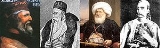
Albanians

Encyclopedia
Albanians are a nation
and ethnic group
native to Albania
and neighbouring countries. They speak the Albanian language
. More than half of all Albanians live in Albania
and Kosovo
. The Albanian diaspora
also exists in a number of other countries.
, the name was lost within the Albanian language, the Albanian endonym being shqiptar, from the term for the Albanian language, shqip, a derivation of the verb shqiptoj "to utilize a correct Albanian pronunciation ". This theory pertains to Hahn and it holds that perhaps the word is ultimately a loan from Latin excipio. Thus, the Albanian endonym, like Slav and others, is in origin a term for "those who speak [intelligibly, the same language]". However another plausible theory has been advanced by Maximilian Lambertz to explain the endonym as derived from the Albanian noun shqype or shqiponjë (eagle), which, according to Albanian folk etymology, denoted a bird totem
dating from the times of Skanderbeg
, as displayed on the Albanian flag.
In History written in 1079–1080, the Byzantine historian Michael Attaliates
referred to the Albanoi as having taken part in a revolt against Constantinople
in 1043 and to the Arbanitai as subjects of the duke of Dyrrachium
. It is disputed, however, whether that refers to Albanians in an ethnic sense. However a later reference to Albanians from the same Attaliates, regarding the participation of Albanians in a rebellion around 1078, is undisputed. The first reference to the Albanian language dates to the later 13th century (around 1285).
The Albanians are and have been referred to by other terms as well. Some of them are:
The first undisputed mention of Albanians in the historical record is attested in Byzantine source for the first time in 1079-1080, in a work titled History by Byzantine historian Michael Attaliates
, who referred to the Albanoi as having taken part in a revolt against Constantinople
in 1043 and to the Arbanitai as subjects of the duke of Dyrrachium
. It is disputed, however, whether the "Albanoi" of the events of 1043 refers to Albanians in an ethnic sense or whether "Albanoi" is a reference to Normans
from Sicily
under an archaic name (there was also tribe of Italy by the name of "Albanoi"). However a later reference to Albanians from the same Attaliates, regarding the participation of Albanians in a rebellion around 1078, is undisputed. At this point, they are already fully Christianized, although Albanian mythology and folklore are part of the Paleo-Balkan pagan mythology, in particular showing Greek influence.
From late 11th century the Albanians were called Arbën/Arbër and their country as Arbanon, a mountainous area to the west of Lake Ochrida and the upper valley of the river Shkumbin. It was in 1190, when the rulers of Arbanon (local Albanian noble called Progon
and his sons Dhimitër and Gjin) created their principality
with its capital at Krujë
. After the fall of Progon Dynasty
in 1216, the principality came under Grigor Kamona
and Gulam of Albania
. Finally the Principality was dissolved on 1255. Around 1230 the two main centers of Albanian settlements, one around Devoll river in what is now central Albania, and the other around the region which was known with the name Arbanon.
In 1271 Charles of Anjou after he captured Durrës from Despotate of Epirus
, created the Kingdom of Albania
. In 14th century a number of Albanian principalities
were created.
supremacy in the Balkan region began in 1385 with the Battle of Savra
but was briefly interrupted in the 15th century, when George Kastrioti, an Albanian warrior known as Skanderbeg
, allied with some Albanian chiefs, formed the League of Lezhe
and fought-off Turkish rule from 1443–1478 (although Kastrioti died in 1468). Kastrioti's strongholds included Kruja, Shkodra, Durrës
, Lezha, Petrela
, Koxhaxhik and Berat
.
Upon the Ottomans' return, a large number of Albanians fled to Italy, Greece and Egypt
and maintained their Arbëresh identity.
, Montenegro
, Bulgaria
, and Greece
—were the last of the Balkan peoples to desire division from the Ottoman Empire. The Albanian national awakening as a coherent political movement began after the Treaty of San Stefano
, according to which Albanian-inhabited areas were to be ceded to other states of the Balkans, and focused on preventing that partition. The Treaty of San Stefano was the impetus for the nation-building movement, which was based more on fear of partition than national identity. Even after Albania became independent in 1912, Albanian national identity was fragmented and possible non-existent in much of the new country. The state of disunity and fragmentation would remain until the communist period following World War 2, when the communist nation-building project would achieve greater success in nation-building and reach more people than any previous regime, thus creating Albanian national communist identity.
, Montenegro
, the Republic of Macedonia
, Greece
and to a much smaller extent Bosnia
, Bulgaria
, Croatia
, Romania
, Serbia
and Slovenia
.
has an estimated 3.2 million inhabitants, of which Albanians amounting to 98.6% of the country's total population.
, the greater part (close to two million) in Kosovo
.
Rights to use the Albanian language
in education and government were given and guaranteed by the 1974 Constitution of SFRY and were widely utilized in Macedonia and in Montenegro before the Dissolution of Yugoslavia
.
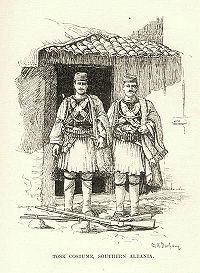 Due to different waves of migration, Albanians are generally divided into three distinct groups.
The first group is that of Arvanites
and Albanian-speakers of Western Thrace
that migrated to what is now Greece during the Middle Ages. Arvanites remain Orthodox Christians. Arvanites speak a dialect of Tosk Albanian known as Arvanitika
. This group of Albanians have fully assimilated into the Greek nation.Arvanitika
is in a state of attrition due to language shift
towards Greek and large-scale internal migration to the cities and subsequent intermingling of the population during the 20th century.
The second group is that of the Cham Albanians
and their descendants, in Epirus
, in northwestern Greece. Most of the Cham Albanians converted to Islam during the Ottoman presence in the area and remain Muslim. Muslim
Chams were expelled
from Epirus during World War II
, by an anti-communist resistance group, as a result of their participation in a communist resistance group and the collaboration
with the Axis occupation.
The third group, about 10 percent of the population of Albania migrated to Greece after the fall of Communism, forming the third community of Albanian origin in Greece, the largest single expatriate group in the country today and the country's largest population group after the ethnic Greek
majority.
(about 1.3 million, 13% of Albanians, 1.7% of host population), Italy (260,000), the United States (201,118; 0.09% of the total US population), Switzerland (ca. 200,000; about 2.5% of the total Swiss population), and Germany
(over 300,000).
Italy has a historical Albanian minority known as the Arbëreshë
which are scattered across Southern Italy, but the majority of Italo-Albanians have arrived since 1991 to surpass that of the older populations of Arbëreshë.
there are 18,000 Albanians, mostly Tosk speakers. Many are descendants of the Janissary
of Muhammad Ali Pasha, an Albanian who became Wāli
, and self-declared Khedive
of Egypt and Sudan
. In addition to the dynasty
that he established, a large part of the former Egyptian and Sudanese aristocracy
was of Albanian origin.
In Australia
and New Zealand
22,000 in total. Albanians are also known to reside in China, India, Iran, Japan, Korea, Malaysia, Pakistan and Singapore, but the numbers are generally small. 200,000 in all these countries. Albanians have been present in Arab
countries such as Iraq, Jordan, Lebanon and Syria for about 5 centuries as a legacy of Ottoman Turkish rule.
languages family tree. A traditional view links the origin of Albanian with Illyrian, though this theory is broadly contested and challenged.
Unattested prior to the second half of the 15th century, the Albanian language is one of the youngest languages of Europe in terms of first written account.
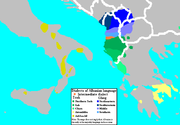 Albanian in a revised form of the Tosk
dialect is the official language
of Albania
and Kosovo
; and is official in the municipalities where there are more than 20% ethnic Albanian inhabitants in the Republic of Macedonia
. It is also an official language of Montenegro
where it is spoken in the municipalities with ethnic Albanian populations.
sources of the late 11th century. At this point, they were already fully Christianized. Christianity was later overtaken by Islam
, which kept the scepter of the major religion during the period of Ottoman
Turkish rule from the 15th century until year 1912. Eastern Orthodox Christianity and Roman Catholicism continued to be practiced with less frequency.
During the 20th century the monarchy
and later the totalitarian state followed a systematic secularization
of the nation and the national culture. This policy was chiefly applied within the borders of the current Albanian state. It produced a secular majority in the population. All forms of Christianity
, Islam
and other religious practices were prohibited except for old non-institutional Pagan practices in the rural areas, which were seen as identifying with the national culture. The current Albanian state has revived some pagan festivals, such as the lunar Spring
festival held yearly on March 14 in the city of Elbasan
. It is a national holiday.
A recent Pew Research Center
demographic study put the percentage of Muslim
s in Albania at 79.9%. Most of the Muslims in Albania are Sunni Muslims and Bektashi Muslims
There are also Orthodox Christians
, predominantly in Southern Albania, bordering Greece
, and Roman Catholicism is the main religion among those Albanians living predominantly in northern Albania, bordering the Republic of Montenegro. After 1992 an influx of foreign missionaries has brought more religious diversity with groups such as Jehovah's Witnesses
, Mormons
, Hindus, Bahá'í
, a variety of Christian
denominations and others. This rich blend of religions has however rarely caused religious strife. People of different religions freely intermarry. For part of its history, Albania has also had a Jewish community. Some of the members of the Jewish community were saved by a group of Albanians during the Nazi occupation. Many left for Israel circa 1990-1992 after borders were open due to fall of communist regime in Albania, while in modern times about 200 Albanian Jews still live in Albania.
 Albanian music displays a variety of influences. Albanian folk music traditions differ by region, with major stylistic differences between the traditional music of the Ghegs in the north and Tosks in the south. Modern popular music has developed around the centers of Korca
, Shkodër
and Tirana
. Since the 1920s, some composers such as Fan S. Noli
have also produced works of Albanian classical music
.
Nation
A nation may refer to a community of people who share a common language, culture, ethnicity, descent, and/or history. In this definition, a nation has no physical borders. However, it can also refer to people who share a common territory and government irrespective of their ethnic make-up...
and ethnic group
Ethnic group
An ethnic group is a group of people whose members identify with each other, through a common heritage, often consisting of a common language, a common culture and/or an ideology that stresses common ancestry or endogamy...
native to Albania
Albania
Albania , officially known as the Republic of Albania , is a country in Southeastern Europe, in the Balkans region. It is bordered by Montenegro to the northwest, Kosovo to the northeast, the Republic of Macedonia to the east and Greece to the south and southeast. It has a coast on the Adriatic Sea...
and neighbouring countries. They speak the Albanian language
Albanian language
Albanian is an Indo-European language spoken by approximately 7.6 million people, primarily in Albania and Kosovo but also in other areas of the Balkans in which there is an Albanian population, including western Macedonia, southern Montenegro, southern Serbia and northwestern Greece...
. More than half of all Albanians live in Albania
Albania
Albania , officially known as the Republic of Albania , is a country in Southeastern Europe, in the Balkans region. It is bordered by Montenegro to the northwest, Kosovo to the northeast, the Republic of Macedonia to the east and Greece to the south and southeast. It has a coast on the Adriatic Sea...
and Kosovo
Kosovo
Kosovo is a region in southeastern Europe. Part of the Ottoman Empire for more than five centuries, later the Autonomous Province of Kosovo and Metohija within Serbia...
. The Albanian diaspora
Albanian diaspora
The Albanian diaspora encompasses Albanians outside of Albania and Kosovo.The greatest concentrations are found in Turkey, Macedonia, Montenegro, Greece and Italy...
also exists in a number of other countries.
Ethnonym
While the exonym Albania for the general region inhabited by the Albanians does hark back to Classical Antiquity, and possibly to an Illyrian tribeIllyrians
The Illyrians were a group of tribes who inhabited part of the western Balkans in antiquity and the south-eastern coasts of the Italian peninsula...
, the name was lost within the Albanian language, the Albanian endonym being shqiptar, from the term for the Albanian language, shqip, a derivation of the verb shqiptoj "to utilize a correct Albanian pronunciation ". This theory pertains to Hahn and it holds that perhaps the word is ultimately a loan from Latin excipio. Thus, the Albanian endonym, like Slav and others, is in origin a term for "those who speak [intelligibly, the same language]". However another plausible theory has been advanced by Maximilian Lambertz to explain the endonym as derived from the Albanian noun shqype or shqiponjë (eagle), which, according to Albanian folk etymology, denoted a bird totem
Totem
A totem is a stipulated ancestor of a group of people, such as a family, clan, group, lineage, or tribe.Totems support larger groups than the individual person. In kinship and descent, if the apical ancestor of a clan is nonhuman, it is called a totem...
dating from the times of Skanderbeg
Skanderbeg
George Kastrioti Skanderbeg or Gjergj Kastrioti Skënderbeu , widely known as Skanderbeg , was a 15th-century Albanian lord. He was appointed as the governor of the Sanjak of Dibra by the Ottomans in 1440...
, as displayed on the Albanian flag.
In History written in 1079–1080, the Byzantine historian Michael Attaliates
Michael Attaliates
Michael Attaleiates or Attaliates was a Greek public servant and historian at Constantinople.Michael was probably a native of Attalia...
referred to the Albanoi as having taken part in a revolt against Constantinople
Constantinople
Constantinople was the capital of the Roman, Eastern Roman, Byzantine, Latin, and Ottoman Empires. Throughout most of the Middle Ages, Constantinople was Europe's largest and wealthiest city.-Names:...
in 1043 and to the Arbanitai as subjects of the duke of Dyrrachium
Durrës
Durrës is the second largest city of Albania located on the central Albanian coast, about west of the capital Tirana. It is one of the most ancient and economically important cities of Albania. Durres is situated at one of the narrower points of the Adriatic Sea, opposite the Italian ports of Bari...
. It is disputed, however, whether that refers to Albanians in an ethnic sense. However a later reference to Albanians from the same Attaliates, regarding the participation of Albanians in a rebellion around 1078, is undisputed. The first reference to the Albanian language dates to the later 13th century (around 1285).
The Albanians are and have been referred to by other terms as well. Some of them are:
- ArbërArbëreshëThe Arbëreshë are a linguistic and ethnic Albanian minority community living in southern Italy, especially the regions of Apulia, Basilicata, Molise, Calabria and Sicily...
, ArbënArbëreshëThe Arbëreshë are a linguistic and ethnic Albanian minority community living in southern Italy, especially the regions of Apulia, Basilicata, Molise, Calabria and Sicily...
, ArbëreshëArbëreshëThe Arbëreshë are a linguistic and ethnic Albanian minority community living in southern Italy, especially the regions of Apulia, Basilicata, Molise, Calabria and Sicily...
; the old native term denoting ancient and medieval Albanians and sharing the same root with the latter. At the time the country was called Arbër (Gheg: Arbën) and Arbëria (Gheg: Arbënia). This term is still used for the Albanians that migrated to Italy during the Middle Ages. - ArnautsArnautsArnaut is the Turkish word for the people of Albania. Arnauts in modern Turkey are people of Albanian descent...
(ارناود); old term used mainly from Turks and by extension by European authors during the Ottoman Empire. A derivate of the Turkish Arvanid (Arnavut) (اروانيد), which derives from the Greek Arvanites. - Skipetars; the historical rendering of the ethnonym Shqiptar (or Shqyptar by French, Austrian and German authors) in use from the 18th century (but probably earlier) to the present, the literal translation of which is subject of the eagle. The term Šiptari is a derivation used by Yugoslavs which the Albanians consider derogatory, preferring Albanci instead.
History
Albanians in the Middle Ages
What is possibly the earliest written reference to the Albanians is that to be found in an old Bulgarian text compiled around the beginning of the 11th century. It was discovered in a Serbian manuscript dated 1628 and was first published in 1934 by Radoslav Grujic. This fragment of a legend from the time of Tsar Samuel endeavours, in a catechismal 'question and answer' form, to explain the origins of peoples and languages. It divides the world into seventy-two languages and three religious categories: Orthodox, half-believers (i.e. non-Orthodox Christians) and non-believers. The Albanians find their place among the nations of half-believers. If the dating of Grujic is accepted, which is based primarily upon the contents of the text as a whole, this would be the earliest written document referring to the Albanians as a people or language group.
It can be seen that there are various languages on earth. Of them, there are five Orthodox languages: Bulgarian, Greek, Syrian, Iberian (Georgian) and Russian. Three of these have Orthodox alphabets: Greek, Bulgarian and Iberian. There are twelve languages of half-believers: Alamanians, Franks, Magyars (Hungarians), Indians, Jacobites, Armenians, Saxons, Lechs (Poles), Arbanasi (Albanians), Croatians, Hizi, Germans.
The first undisputed mention of Albanians in the historical record is attested in Byzantine source for the first time in 1079-1080, in a work titled History by Byzantine historian Michael Attaliates
Michael Attaliates
Michael Attaleiates or Attaliates was a Greek public servant and historian at Constantinople.Michael was probably a native of Attalia...
, who referred to the Albanoi as having taken part in a revolt against Constantinople
Constantinople
Constantinople was the capital of the Roman, Eastern Roman, Byzantine, Latin, and Ottoman Empires. Throughout most of the Middle Ages, Constantinople was Europe's largest and wealthiest city.-Names:...
in 1043 and to the Arbanitai as subjects of the duke of Dyrrachium
Durrës
Durrës is the second largest city of Albania located on the central Albanian coast, about west of the capital Tirana. It is one of the most ancient and economically important cities of Albania. Durres is situated at one of the narrower points of the Adriatic Sea, opposite the Italian ports of Bari...
. It is disputed, however, whether the "Albanoi" of the events of 1043 refers to Albanians in an ethnic sense or whether "Albanoi" is a reference to Normans
Normans
The Normans were the people who gave their name to Normandy, a region in northern France. They were descended from Norse Viking conquerors of the territory and the native population of Frankish and Gallo-Roman stock...
from Sicily
Sicily
Sicily is a region of Italy, and is the largest island in the Mediterranean Sea. Along with the surrounding minor islands, it constitutes an autonomous region of Italy, the Regione Autonoma Siciliana Sicily has a rich and unique culture, especially with regard to the arts, music, literature,...
under an archaic name (there was also tribe of Italy by the name of "Albanoi"). However a later reference to Albanians from the same Attaliates, regarding the participation of Albanians in a rebellion around 1078, is undisputed. At this point, they are already fully Christianized, although Albanian mythology and folklore are part of the Paleo-Balkan pagan mythology, in particular showing Greek influence.
From late 11th century the Albanians were called Arbën/Arbër and their country as Arbanon, a mountainous area to the west of Lake Ochrida and the upper valley of the river Shkumbin. It was in 1190, when the rulers of Arbanon (local Albanian noble called Progon
Progon
Progon was the Albanian ruler of the Principality of Arbër in the 12th century. He gained the possessions of Kruja fortress and the lands surrounding it between 1190 and 1198 and had the title of archon ....
and his sons Dhimitër and Gjin) created their principality
Principality of Arbër
The Principality of Arbër or Arbëria was the first Albanian state during the Middle Ages. The proclamation of the feudal state of Arbëria, in the north of Albania, with Kruja as the capital took place on 1190. As the founder of this state is known Progoni and later on Gjini and Dhimiter....
with its capital at Krujë
Krujë
Krujë is a town in north central Albania and the capital of the municipality and the Krujë District. It has a population of about 15,900. Located between Mount Krujë and the Ishëm River, the city is only 20 km from the capital of Albania, Tirana....
. After the fall of Progon Dynasty
House of Progon
The House of Progon was an Albanian noble house and family who led the first Albanian state, the Principality of Arbër, which fell under the influence of the Byzantine Empire, the Despotate of Epirus and the Serbian Kingdom. Progon, the founder, held the title of archon , while one of his sons,...
in 1216, the principality came under Grigor Kamona
Grigor Kamona
Gregory Kamonas was a Greek-Albanian archon of Kroja and Elbasan, between 1216 and 1253. He married Serbian princess Komnena Nemanjić, the daughter of King Stefan Nemanjić, and widow of the Prince of Arbër Dhimitër Progoni, thus inheriting the rule and securing it through an Orthodox alliance...
and Gulam of Albania
Gulam of Albania
Golem was an Albanian lord and vassal of Kruja and Elbasan in circa 1254. He married the daughter of sebastos Gregorios Kamonas and Komnena Nemanjić and was thus entitled the rule of his father-in-law...
. Finally the Principality was dissolved on 1255. Around 1230 the two main centers of Albanian settlements, one around Devoll river in what is now central Albania, and the other around the region which was known with the name Arbanon.
In 1271 Charles of Anjou after he captured Durrës from Despotate of Epirus
Despotate of Epirus
The Despotate or Principality of Epirus was one of the Byzantine Greek successor states of the Byzantine Empire that emerged in the aftermath of the Fourth Crusade in 1204. It claimed to be the legitimate successor of the Byzantine Empire, along with the Empire of Nicaea, and the Empire of Trebizond...
, created the Kingdom of Albania
Kingdom of Albania
The Kingdom of Albania, or Regnum Albaniae, was established by Charles of Anjou in the Albanian territory he conquered from the Despotate of Epirus in 1271. He took the title of "King of Albania" in February 1272. The kingdom extended from the region of Durrës south along the coast to Butrint...
. In 14th century a number of Albanian principalities
Albanian Principalities
The term Albanian Principalities refers to a number of principalities created in the Middle Ages in Albania and Epirus that were ruled by Albanian noblemen...
were created.
Albanians under the Ottoman Empire
The OttomanOttoman Empire
The Ottoman EmpireIt was usually referred to as the "Ottoman Empire", the "Turkish Empire", the "Ottoman Caliphate" or more commonly "Turkey" by its contemporaries...
supremacy in the Balkan region began in 1385 with the Battle of Savra
Battle of Savra
The Battle of the Saurian Field was fought on 18 September 1385 between Ottoman and much smaller Serbian forces. The Ottomans were victorious and most of the local Serbian and Albanian lords became vassals....
but was briefly interrupted in the 15th century, when George Kastrioti, an Albanian warrior known as Skanderbeg
Skanderbeg
George Kastrioti Skanderbeg or Gjergj Kastrioti Skënderbeu , widely known as Skanderbeg , was a 15th-century Albanian lord. He was appointed as the governor of the Sanjak of Dibra by the Ottomans in 1440...
, allied with some Albanian chiefs, formed the League of Lezhe
League of Lezhë
The League of Lezhë was an alliance of Albanian Principalities forged in Lezhë on the 2nd of March 1444. It was initiated and organised by Skanderbeg with the aim of uniting the Albanian principalities that had been founded in the 12th - 14th centuries, to fight the Ottoman Armies...
and fought-off Turkish rule from 1443–1478 (although Kastrioti died in 1468). Kastrioti's strongholds included Kruja, Shkodra, Durrës
Durrës
Durrës is the second largest city of Albania located on the central Albanian coast, about west of the capital Tirana. It is one of the most ancient and economically important cities of Albania. Durres is situated at one of the narrower points of the Adriatic Sea, opposite the Italian ports of Bari...
, Lezha, Petrela
Petrela
Petrelë is a town 15 km south of Tirana, in central Albania on the road to Elbasan . It is part of Tirana District and Tirana County. It is famous for its castle, history, and beautiful views.One can definitely see why it is called such, since the town and its castle are built on a huge stone...
, Koxhaxhik and Berat
Berat
Berat is a town located in south-central Albania. As of 2009, the town has an estimated population of around 71,000 people. It is the capital of both the District of Berat and the larger County of Berat...
.
Upon the Ottomans' return, a large number of Albanians fled to Italy, Greece and Egypt
Egypt
Egypt , officially the Arab Republic of Egypt, Arabic: , is a country mainly in North Africa, with the Sinai Peninsula forming a land bridge in Southwest Asia. Egypt is thus a transcontinental country, and a major power in Africa, the Mediterranean Basin, the Middle East and the Muslim world...
and maintained their Arbëresh identity.
Albanian national awakening
By the 1870s, the Sublime Porte's reforms aimed at checking the Ottoman Empire's disintegration had clearly failed. The image of the "Turkish yoke" had become fixed in the nationalist mythologies and psyches of the empire's Balkan peoples, and their march toward independence quickened. The Albanians, because of the higher degree of Islamic influence, their internal social divisions, and the fear that they would lose their Albanian-populated lands to the emerging Balkan states—SerbiaSerbia
Serbia , officially the Republic of Serbia , is a landlocked country located at the crossroads of Central and Southeast Europe, covering the southern part of the Carpathian basin and the central part of the Balkans...
, Montenegro
Montenegro
Montenegro Montenegrin: Crna Gora Црна Гора , meaning "Black Mountain") is a country located in Southeastern Europe. It has a coast on the Adriatic Sea to the south-west and is bordered by Croatia to the west, Bosnia and Herzegovina to the northwest, Serbia to the northeast and Albania to the...
, Bulgaria
Bulgaria
Bulgaria , officially the Republic of Bulgaria , is a parliamentary democracy within a unitary constitutional republic in Southeast Europe. The country borders Romania to the north, Serbia and Macedonia to the west, Greece and Turkey to the south, as well as the Black Sea to the east...
, and Greece
Greece
Greece , officially the Hellenic Republic , and historically Hellas or the Republic of Greece in English, is a country in southeastern Europe....
—were the last of the Balkan peoples to desire division from the Ottoman Empire. The Albanian national awakening as a coherent political movement began after the Treaty of San Stefano
Treaty of San Stefano
The Preliminary Treaty of San Stefano was a treaty between Russia and the Ottoman Empire signed at the end of the Russo-Turkish War, 1877–78...
, according to which Albanian-inhabited areas were to be ceded to other states of the Balkans, and focused on preventing that partition. The Treaty of San Stefano was the impetus for the nation-building movement, which was based more on fear of partition than national identity. Even after Albania became independent in 1912, Albanian national identity was fragmented and possible non-existent in much of the new country. The state of disunity and fragmentation would remain until the communist period following World War 2, when the communist nation-building project would achieve greater success in nation-building and reach more people than any previous regime, thus creating Albanian national communist identity.
Balkans
According to Paul Traeger, a German anthropologist, "the Albanians on the whole are a homogeneous racial group". Approximately 7 million Albanians are to be found within the Balkan peninsula with only about half this number residing in Albania and the other divided between KosovoKosovo
Kosovo is a region in southeastern Europe. Part of the Ottoman Empire for more than five centuries, later the Autonomous Province of Kosovo and Metohija within Serbia...
, Montenegro
Montenegro
Montenegro Montenegrin: Crna Gora Црна Гора , meaning "Black Mountain") is a country located in Southeastern Europe. It has a coast on the Adriatic Sea to the south-west and is bordered by Croatia to the west, Bosnia and Herzegovina to the northwest, Serbia to the northeast and Albania to the...
, the Republic of Macedonia
Republic of Macedonia
Macedonia , officially the Republic of Macedonia , is a country located in the central Balkan peninsula in Southeast Europe. It is one of the successor states of the former Yugoslavia, from which it declared independence in 1991...
, Greece
Greece
Greece , officially the Hellenic Republic , and historically Hellas or the Republic of Greece in English, is a country in southeastern Europe....
and to a much smaller extent Bosnia
Bosnia and Herzegovina
Bosnia and Herzegovina , sometimes called Bosnia-Herzegovina or simply Bosnia, is a country in Southern Europe, on the Balkan Peninsula. Bordered by Croatia to the north, west and south, Serbia to the east, and Montenegro to the southeast, Bosnia and Herzegovina is almost landlocked, except for the...
, Bulgaria
Bulgaria
Bulgaria , officially the Republic of Bulgaria , is a parliamentary democracy within a unitary constitutional republic in Southeast Europe. The country borders Romania to the north, Serbia and Macedonia to the west, Greece and Turkey to the south, as well as the Black Sea to the east...
, Croatia
Croatia
Croatia , officially the Republic of Croatia , is a unitary democratic parliamentary republic in Europe at the crossroads of the Mitteleuropa, the Balkans, and the Mediterranean. Its capital and largest city is Zagreb. The country is divided into 20 counties and the city of Zagreb. Croatia covers ...
, Romania
Romania
Romania is a country located at the crossroads of Central and Southeastern Europe, on the Lower Danube, within and outside the Carpathian arch, bordering on the Black Sea...
, Serbia
Serbia
Serbia , officially the Republic of Serbia , is a landlocked country located at the crossroads of Central and Southeast Europe, covering the southern part of the Carpathian basin and the central part of the Balkans...
and Slovenia
Slovenia
Slovenia , officially the Republic of Slovenia , is a country in Central and Southeastern Europe touching the Alps and bordering the Mediterranean. Slovenia borders Italy to the west, Croatia to the south and east, Hungary to the northeast, and Austria to the north, and also has a small portion of...
.
Albania
AlbaniaAlbania
Albania , officially known as the Republic of Albania , is a country in Southeastern Europe, in the Balkans region. It is bordered by Montenegro to the northwest, Kosovo to the northeast, the Republic of Macedonia to the east and Greece to the south and southeast. It has a coast on the Adriatic Sea...
has an estimated 3.2 million inhabitants, of which Albanians amounting to 98.6% of the country's total population.
Former Yugoslavia
An estimated 2.5 million Albanians live in the territory of Former YugoslaviaFormer Yugoslavia
The former Yugoslavia is a term used to describe the present day states which succeeded the collapse of the Socialist Federal Republic of Yugoslavia....
, the greater part (close to two million) in Kosovo
Kosovo
Kosovo is a region in southeastern Europe. Part of the Ottoman Empire for more than five centuries, later the Autonomous Province of Kosovo and Metohija within Serbia...
.
Rights to use the Albanian language
Albanian language
Albanian is an Indo-European language spoken by approximately 7.6 million people, primarily in Albania and Kosovo but also in other areas of the Balkans in which there is an Albanian population, including western Macedonia, southern Montenegro, southern Serbia and northwestern Greece...
in education and government were given and guaranteed by the 1974 Constitution of SFRY and were widely utilized in Macedonia and in Montenegro before the Dissolution of Yugoslavia
Dissolution of Yugoslavia
The Breakup of Yugoslavia refers to a series of conflicts and political upheavals resulting in the dissolution of Yugoslavia . The SFR Yugoslavia was a country that occupied a strip of land stretching from Central Europe to the Balkans – a region with a history of ethnic conflict...
.
Greece
The first group is that of Arvanites
Arvanites
Arvanites are a population group in Greece who traditionally speak Arvanitika, a dialect of the Albanian language. They settled in Greece during the late Middle Ages and were the dominant population element of some regions of the Peloponnese and Attica until the 19th century...
and Albanian-speakers of Western Thrace
Albanian-speakers of Western Thrace
Albanian-speakers form a linguistic minority in Greek Macedonia and Western Thrace along the border with Turkey. They speak the Northern Tosk subbranch of Tosk Albanian and are descendants of the Albanian population of Eastern Thrace who migrated during the Population exchange between Greece and...
that migrated to what is now Greece during the Middle Ages. Arvanites remain Orthodox Christians. Arvanites speak a dialect of Tosk Albanian known as Arvanitika
Arvanitika
Arvanitika also known Arvanitic is the variety of Albanian traditionally spoken by the Arvanites, a population group in Greece...
. This group of Albanians have fully assimilated into the Greek nation.Arvanitika
Arvanitika
Arvanitika also known Arvanitic is the variety of Albanian traditionally spoken by the Arvanites, a population group in Greece...
is in a state of attrition due to language shift
Language shift
Language shift, sometimes referred to as language transfer or language replacement or assimilation, is the progressive process whereby a speech community of a language shifts to speaking another language. The rate of assimilation is the percentage of individuals with a given mother tongue who speak...
towards Greek and large-scale internal migration to the cities and subsequent intermingling of the population during the 20th century.
The second group is that of the Cham Albanians
Cham Albanians
Cham Albanians, or Chams , are a sub-group of Albanians who originally resided in the coastal region of Epirus in northwestern Greece, an area known among Albanians as Chameria. The Chams have their own peculiar cultural identity, which is a mixture of Albanian and Greek influences as well as many...
and their descendants, in Epirus
Epirus (periphery)
Epirus , formally the Epirus Region , is a geographical and administrative region in northwestern Greece. It borders the regions of West Macedonia and Thessaly to the east, West Greece to the south, the Ionian Sea and the Ionian Islands to the west and the country of Albania to the north. The...
, in northwestern Greece. Most of the Cham Albanians converted to Islam during the Ottoman presence in the area and remain Muslim. Muslim
Islam
Islam . The most common are and . : Arabic pronunciation varies regionally. The first vowel ranges from ~~. The second vowel ranges from ~~~...
Chams were expelled
Expulsion of Cham Albanians
The expulsion of Cham Albanians from Greece was a forced emigration of thousands of Cham Albanians after the Second World War to Albania, by the Resistance National Republican Greek League forces. The EDES and the Joint Allied Military Mission in the Axis-occupied Greece accused Chams for...
from Epirus during World War II
World War II
World War II, or the Second World War , was a global conflict lasting from 1939 to 1945, involving most of the world's nations—including all of the great powers—eventually forming two opposing military alliances: the Allies and the Axis...
, by an anti-communist resistance group, as a result of their participation in a communist resistance group and the collaboration
Axis-Cham Albanian collaboration
During the Axis occupation of Greece between 1941 and 1944, large parts of the Albanian minority in the Thesprotia prefecture in Epirus, northwestern Greece, known as Chams collaborated with the occupation forces. Fascist Italian as well as Nazi German propaganda promised that the region would be...
with the Axis occupation.
The third group, about 10 percent of the population of Albania migrated to Greece after the fall of Communism, forming the third community of Albanian origin in Greece, the largest single expatriate group in the country today and the country's largest population group after the ethnic Greek
Greeks
The Greeks, also known as the Hellenes , are a nation and ethnic group native to Greece, Cyprus and neighboring regions. They also form a significant diaspora, with Greek communities established around the world....
majority.
Diaspora
The largest Albanian diasporic communities outside of the Balkans are found in TurkeyTurkey
Turkey , known officially as the Republic of Turkey , is a Eurasian country located in Western Asia and in East Thrace in Southeastern Europe...
(about 1.3 million, 13% of Albanians, 1.7% of host population), Italy (260,000), the United States (201,118; 0.09% of the total US population), Switzerland (ca. 200,000; about 2.5% of the total Swiss population), and Germany
Germany
Germany , officially the Federal Republic of Germany , is a federal parliamentary republic in Europe. The country consists of 16 states while the capital and largest city is Berlin. Germany covers an area of 357,021 km2 and has a largely temperate seasonal climate...
(over 300,000).
Europe
Approximately 3 million are dispersed throughout the rest of Europe, most of these in the United Kingdom, Italy, Germany, Switzerland, Sweden, Austria and France.Italy has a historical Albanian minority known as the Arbëreshë
Arbëreshë
The Arbëreshë are a linguistic and ethnic Albanian minority community living in southern Italy, especially the regions of Apulia, Basilicata, Molise, Calabria and Sicily...
which are scattered across Southern Italy, but the majority of Italo-Albanians have arrived since 1991 to surpass that of the older populations of Arbëreshë.
Turkey
According to a 2008 report prepared for the National Security Council of Turkey by academics of three Turkish universities in eastern Anatolia, there were approximately 1,300,000 people of Albanian descent living in Turkey. A part of these people have assimilated to the culture of Turkey, and consider themselves more Turkish than Albanian. Nonetheless, more than 500,000 Albanian descents still recognize their ancestry like their languages, culture and traditions.Egypt
In EgyptEgypt
Egypt , officially the Arab Republic of Egypt, Arabic: , is a country mainly in North Africa, with the Sinai Peninsula forming a land bridge in Southwest Asia. Egypt is thus a transcontinental country, and a major power in Africa, the Mediterranean Basin, the Middle East and the Muslim world...
there are 18,000 Albanians, mostly Tosk speakers. Many are descendants of the Janissary
Janissary
The Janissaries were infantry units that formed the Ottoman sultan's household troops and bodyguards...
of Muhammad Ali Pasha, an Albanian who became Wāli
Wali
Walī , is an Arabic word meaning "custodian", "protector", "sponsor", or authority as denoted by its definition "crown". "Wali" is someone who has "Walayah" over somebody else. For example, in Fiqh the father is wali of his children. In Islam, the phrase ولي الله walīyu 'llāh...
, and self-declared Khedive
Khedive
The term Khedive is a title largely equivalent to the English word viceroy. It was first used, without official recognition, by Muhammad Ali Pasha , the Wāli of Egypt and Sudan, and vassal of the Ottoman Empire...
of Egypt and Sudan
Sudan
Sudan , officially the Republic of the Sudan , is a country in North Africa, sometimes considered part of the Middle East politically. It is bordered by Egypt to the north, the Red Sea to the northeast, Eritrea and Ethiopia to the east, South Sudan to the south, the Central African Republic to the...
. In addition to the dynasty
Muhammad Ali Dynasty
The Muhammad Ali Dynasty was the ruling dynasty of Egypt and Sudan, from the 19th to the mid-20th Century. It is named after its progenitor, Muhammad Ali Pasha, regarded as the founder of modern Egypt. It was also more formally known as the Alawiyya Dynasty...
that he established, a large part of the former Egyptian and Sudanese aristocracy
Aristocracy
Aristocracy , is a form of government in which a few elite citizens rule. The term derives from the Greek aristokratia, meaning "rule of the best". In origin in Ancient Greece, it was conceived of as rule by the best qualified citizens, and contrasted with monarchy...
was of Albanian origin.
Overseas
According to data from the 2008 Census of the United States Government, there are 201,118 Albanian Americans (US citizens of full or partial Albanian descent).In Australia
Australia
Australia , officially the Commonwealth of Australia, is a country in the Southern Hemisphere comprising the mainland of the Australian continent, the island of Tasmania, and numerous smaller islands in the Indian and Pacific Oceans. It is the world's sixth-largest country by total area...
and New Zealand
New Zealand
New Zealand is an island country in the south-western Pacific Ocean comprising two main landmasses and numerous smaller islands. The country is situated some east of Australia across the Tasman Sea, and roughly south of the Pacific island nations of New Caledonia, Fiji, and Tonga...
22,000 in total. Albanians are also known to reside in China, India, Iran, Japan, Korea, Malaysia, Pakistan and Singapore, but the numbers are generally small. 200,000 in all these countries. Albanians have been present in Arab
Arab world
The Arab world refers to Arabic-speaking states, territories and populations in North Africa, Western Asia and elsewhere.The standard definition of the Arab world comprises the 22 states and territories of the Arab League stretching from the Atlantic Ocean in the west to the Arabian Sea in the...
countries such as Iraq, Jordan, Lebanon and Syria for about 5 centuries as a legacy of Ottoman Turkish rule.
Language
The Albanian language forms a separate branch of Indo-EuropeanIndo-European
Indo-European may refer to:* Indo-European languages** Aryan race, a 19th century and early 20th century term for those peoples who are the native speakers of Indo-European languages...
languages family tree. A traditional view links the origin of Albanian with Illyrian, though this theory is broadly contested and challenged.
Unattested prior to the second half of the 15th century, the Albanian language is one of the youngest languages of Europe in terms of first written account.
Tosk Albanian
Tosk is the southern dialect of the Albanian language. The line of demarcation between Tosk and Gheg is the Shkumbin River. Tosk is the basis of the standard Albanian language.- Tosks :...
dialect is the official language
Official language
An official language is a language that is given a special legal status in a particular country, state, or other jurisdiction. Typically a nation's official language will be the one used in that nation's courts, parliament and administration. However, official status can also be used to give a...
of Albania
Albania
Albania , officially known as the Republic of Albania , is a country in Southeastern Europe, in the Balkans region. It is bordered by Montenegro to the northwest, Kosovo to the northeast, the Republic of Macedonia to the east and Greece to the south and southeast. It has a coast on the Adriatic Sea...
and Kosovo
Kosovo
Kosovo is a region in southeastern Europe. Part of the Ottoman Empire for more than five centuries, later the Autonomous Province of Kosovo and Metohija within Serbia...
; and is official in the municipalities where there are more than 20% ethnic Albanian inhabitants in the Republic of Macedonia
Republic of Macedonia
Macedonia , officially the Republic of Macedonia , is a country located in the central Balkan peninsula in Southeast Europe. It is one of the successor states of the former Yugoslavia, from which it declared independence in 1991...
. It is also an official language of Montenegro
Montenegro
Montenegro Montenegrin: Crna Gora Црна Гора , meaning "Black Mountain") is a country located in Southeastern Europe. It has a coast on the Adriatic Sea to the south-west and is bordered by Croatia to the west, Bosnia and Herzegovina to the northwest, Serbia to the northeast and Albania to the...
where it is spoken in the municipalities with ethnic Albanian populations.
Religion
The Albanians first appear in the historical record in ByzantineByzantine
Byzantine usually refers to the Roman Empire during the Middle Ages.Byzantine may also refer to:* A citizen of the Byzantine Empire, or native Greek during the Middle Ages...
sources of the late 11th century. At this point, they were already fully Christianized. Christianity was later overtaken by Islam
Islam
Islam . The most common are and . : Arabic pronunciation varies regionally. The first vowel ranges from ~~. The second vowel ranges from ~~~...
, which kept the scepter of the major religion during the period of Ottoman
Ottoman Empire
The Ottoman EmpireIt was usually referred to as the "Ottoman Empire", the "Turkish Empire", the "Ottoman Caliphate" or more commonly "Turkey" by its contemporaries...
Turkish rule from the 15th century until year 1912. Eastern Orthodox Christianity and Roman Catholicism continued to be practiced with less frequency.
During the 20th century the monarchy
Monarchy
A monarchy is a form of government in which the office of head of state is usually held until death or abdication and is often hereditary and includes a royal house. In some cases, the monarch is elected...
and later the totalitarian state followed a systematic secularization
State atheism
State atheism is the official "promotion of atheism" by a government, sometimes combined with active suppression of religious freedom and practice...
of the nation and the national culture. This policy was chiefly applied within the borders of the current Albanian state. It produced a secular majority in the population. All forms of Christianity
Christianity
Christianity is a monotheistic religion based on the life and teachings of Jesus as presented in canonical gospels and other New Testament writings...
, Islam
Islam
Islam . The most common are and . : Arabic pronunciation varies regionally. The first vowel ranges from ~~. The second vowel ranges from ~~~...
and other religious practices were prohibited except for old non-institutional Pagan practices in the rural areas, which were seen as identifying with the national culture. The current Albanian state has revived some pagan festivals, such as the lunar Spring
Spring Day
Spring Day is a holiday marking the coming of the spring season, which takes place in different countries, on varying dates.-Albania:Albania celebrates the lunar Spring Day on March 14, and from 2004 it is a national holiday...
festival held yearly on March 14 in the city of Elbasan
Elbasan
Elbasan is a city in central Albania. It is located on the Shkumbin River in the District of Elbasan and the County of Elbasan, at...
. It is a national holiday.
A recent Pew Research Center
Pew Research Center
The Pew Research Center is an American think tank organization based in Washington, D.C. that provides information on issues, attitudes and trends shaping the United States and the world. The Center and its projects receive funding from The Pew Charitable Trusts. In 1990, Donald S...
demographic study put the percentage of Muslim
Muslim
A Muslim, also spelled Moslem, is an adherent of Islam, a monotheistic, Abrahamic religion based on the Quran, which Muslims consider the verbatim word of God as revealed to prophet Muhammad. "Muslim" is the Arabic term for "submitter" .Muslims believe that God is one and incomparable...
s in Albania at 79.9%. Most of the Muslims in Albania are Sunni Muslims and Bektashi Muslims
Bektashi
Bektashi Order or Bektashism is an Islamic Sufi order founded in the 13th century by the Persian saint Haji Bektash Veli. In addition to the spiritual teachings of Haji Bektash Veli the order was significantly influenced during its formative period by both the Hurufis as well as the...
There are also Orthodox Christians
Albanian Orthodox Church
The Autocephalous Orthodox Church of Albania is one of the newest autocephalous Eastern Orthodox churches. It declared its autocephaly in 1922, and gained recognition from the Patriarch of Constantinople in 1937....
, predominantly in Southern Albania, bordering Greece
Greece
Greece , officially the Hellenic Republic , and historically Hellas or the Republic of Greece in English, is a country in southeastern Europe....
, and Roman Catholicism is the main religion among those Albanians living predominantly in northern Albania, bordering the Republic of Montenegro. After 1992 an influx of foreign missionaries has brought more religious diversity with groups such as Jehovah's Witnesses
Jehovah's Witnesses
Jehovah's Witnesses is a millenarian restorationist Christian denomination with nontrinitarian beliefs distinct from mainstream Christianity. The religion reports worldwide membership of over 7 million adherents involved in evangelism, convention attendance of over 12 million, and annual...
, Mormons
Mormons
The Mormons are a religious and cultural group related to Mormonism, a religion started by Joseph Smith during the American Second Great Awakening. A vast majority of Mormons are members of The Church of Jesus Christ of Latter-day Saints while a minority are members of other independent churches....
, Hindus, Bahá'í
Bahá'í Faith
The Bahá'í Faith is a monotheistic religion founded by Bahá'u'lláh in 19th-century Persia, emphasizing the spiritual unity of all humankind. There are an estimated five to six million Bahá'ís around the world in more than 200 countries and territories....
, a variety of Christian
Christian
A Christian is a person who adheres to Christianity, an Abrahamic, monotheistic religion based on the life and teachings of Jesus of Nazareth as recorded in the Canonical gospels and the letters of the New Testament...
denominations and others. This rich blend of religions has however rarely caused religious strife. People of different religions freely intermarry. For part of its history, Albania has also had a Jewish community. Some of the members of the Jewish community were saved by a group of Albanians during the Nazi occupation. Many left for Israel circa 1990-1992 after borders were open due to fall of communist regime in Albania, while in modern times about 200 Albanian Jews still live in Albania.
Culture
Korča
Korča is a village in the municipality of Hadžići, Bosnia and Herzegovina.-References:...
, Shkodër
Shkodër
Shkodër , is a city located on Lake of Shkoder in northwestern Albania in the District of Shkodër, of which it is the capital. It is one of the oldest and most historic towns in Albania, as well as an important cultural and economic centre. Shkodër's estimated population is 90,000; if the...
and Tirana
Tirana
Tirana is the capital and the largest city of Albania. Modern Tirana was founded as an Ottoman town in 1614 by Sulejman Bargjini, a local ruler from Mullet, although the area has been continuously inhabited since antiquity. Tirana became Albania's capital city in 1920 and has a population of over...
. Since the 1920s, some composers such as Fan S. Noli
Fan S. Noli
Theofan Stilian Noli, better known as Fan Noli was an Albanian-American writer, scholar, diplomat, politician, historian, orator, and founder of the Albanian Orthodox Church, who served as prime minister and regent of Albania in 1924.Fan Noli is venerated in Albania as a champion of literature,...
have also produced works of Albanian classical music
Classical music
Classical music is the art music produced in, or rooted in, the traditions of Western liturgical and secular music, encompassing a broad period from roughly the 11th century to present times...
.
Notable Albanians
- Gjon BuzukuGjon BuzukuGjon Buzuku was an Albanian Catholic clergyman who wrote the first known printed book in Albanian.Gjon Buzuku was born in the village of Ljare in the Bar district, close to Northern Albania , then Ottoman Empire. He probably lived in or near Venice, Italy...
- a northern Albanian Catholic cleric born in the 16th century. He was the author of the first bookMeshariMeshari is the first book written and published in Albanian. The book was written by Gjon Buzuku, a Catholic cleric in 1555. The book contains 188 pages and is written in two columns. Meshari is the translation of the main parts of the Catholic Liturgy into Albanian...
written and published in AlbanianAlbanian languageAlbanian is an Indo-European language spoken by approximately 7.6 million people, primarily in Albania and Kosovo but also in other areas of the Balkans in which there is an Albanian population, including western Macedonia, southern Montenegro, southern Serbia and northwestern Greece...
. - Mit’hat Frashëri- Albanian diplomat, writer and politician. The son of Abdyl Frashëri, one of the most important activists of the Albanian National Awakening in 1908 he participated in the Congress of ManastirCongress of ManastirThe Congress of Manastir was an academic conference held in the city of Manastir from November 14 to November 22, 1908, with the goal of standardizing the Albanian alphabet. November 22 is now a commemorative day, known as Alphabet Day...
- Lorik CanaLorik CanaLorik Cana is an Albanian footballer, who plays for Lazio as a defensive midfielder and the Albania national football team. He is the captain for Albania at international level...
- Famous Albanian Football player - Ismail KadareIsmail KadareIsmail Kadare is an Albanian writer. He is known for his novels, although he was first noticed for his poetry collections. In the 1960s he focused on short stories until the publication of his first novel, The General of the Dead Army. In 1996 he became a lifetime member of the Academy of Moral...
- Famous Albanian writer - Gjekë MarinajGjeke Marinaj-Early life and career:Gjekë Marinaj was born in 1965 in the small town of Brrut located in the Malësi e Madhe District of northern Albania, half-way through the four-decade rule of communist leader Enver Hoxha. Raised within an authoritarian state, Marinaj aspired to a writing career early on and...
- Albanian-American writer. - Rexhep QosjaRexhep QosjaRexhep Qosja is a prominent Albanian politician and literary critic from the area of Malësia in modern Montenegro....
- prominent Albanian politician and literary critic. - Naim KrieziuNaim KrieziuNaim Kryeziu was an Albanian football player famous in Italy in 1940s and 1950s....
- Albanian football player famous in Italy in 1940s and 1950s. - Riza LushtaRiza LushtaRiza Lushta was a Kosovar Albanian football striker....
- Kosovar Albanian football striker. - Sedefkar Mehmed Agha- Albanian architect of the Sultan Ahmed MosqueSultan Ahmed MosqueThe Sultan Ahmed Mosque is a historical mosque in Istanbul, the largest city in Turkey and the capital of the Ottoman Empire . The mosque is popularly known as the Blue Mosque for the blue tiles adorning the walls of its interior....
(the "Blue Mosque") in Istanbul. - Mother TeresaMother TeresaMother Teresa , born Agnes Gonxha Bojaxhiu , was a Roman Catholic nun of Albanian ethnicity and Indian citizenship, who founded the Missionaries of Charity in Calcutta, India, in 1950...
- was a Catholic nun of AlbanianAlbanianAlbanian may refer to:* Something of, from, or related to the country of Albania* Albanians, a people living in Albania, Kosovo, the Republic of Macedonia, Greece, Italy and elsewhere* The Albanian language...
ethnicity and Indian citizenship, who founded the Missionaries of CharityMissionaries of CharityMissionaries of Charity is a Roman Catholic religious congregation established in 1950 by Mother Teresa of Calcutta, which consists of over 4,500 sisters and is active in 133 countries...
in Calcutta, - SkanderbegSkanderbegGeorge Kastrioti Skanderbeg or Gjergj Kastrioti Skënderbeu , widely known as Skanderbeg , was a 15th-century Albanian lord. He was appointed as the governor of the Sanjak of Dibra by the Ottomans in 1440...
- as a 15th-century Albanian lord[D], who as leader of the federation of the League of Lezhë defended the region of Albania against the Ottoman Empire for more than two decades. - Mirela ManjaniMirela ManjaniMirela Manjani is a retired Greek javelin thrower. Prior to 1997 she represented Albania.She won the silver medal at the 2000 Summer Olympics with a personal best of 67.51 m, and the bronze medal in 2004. Manjani is also a European champion and double world champion. Her personal best throw of...
- is a retired Albanian javelin thrower who represented Greece. - James BiberiJames BiberiJames Biberi is an Albanian American actor. He was born in Albania.-Filmography:Biberi also provided the voice for the Police in the 2005 video game The Warriors.-External links:...
- James Biberi is an Albanian actor. He was born in Kosovo. - Gjon MiliGjon MiliGjon Mili was an Albanian-American photographer best known for his work published in Life.-Biography:Born to Vasil Mili and Viktori Cekani in Korçë, Albania, Mili came to the United States in 1923. In 1939, Mili landed a job as a freelance photographer for Life...
- Famous AlbanianAlbanianAlbanian may refer to:* Something of, from, or related to the country of Albania* Albanians, a people living in Albania, Kosovo, the Republic of Macedonia, Greece, Italy and elsewhere* The Albanian language...
photographer - Inva MulaInva MulaInva Mula is an Albanian opera soprano and actress. She began her soprano career at a very early age. Her father and mother were also opera singers. -Life and Career:...
- Inva Mula is an Albanian opera soprano. She comes from an artistic family. She began her soprano career at a very early age. - Aleksander MoisiuAleksander Moisiu- Early years :He was born in Trieste to Konstantin Moisiu from Kavajë, who was a rich Albanian merchant of oil and wheat and an Arbëresh mother Amalia di Rada, daughter of an Italian writer and doctor from Trieste....
- Famous Albanian stage actor.
See also
- Albanian diasporaAlbanian diasporaThe Albanian diaspora encompasses Albanians outside of Albania and Kosovo.The greatest concentrations are found in Turkey, Macedonia, Montenegro, Greece and Italy...
- Albanian-AmericanAlbanian-AmericanAlbanian Americans are United States citizens of full or partial Albanian ancestry. Although according to data from a 2008 Survey of the United States Government, there are 201,118 Americans of full or partial Albanian descent.-Emigration History:...
- Albanoi
- ArbëreshëArbëreshëThe Arbëreshë are a linguistic and ethnic Albanian minority community living in southern Italy, especially the regions of Apulia, Basilicata, Molise, Calabria and Sicily...
- ArvanitesArvanitesArvanites are a population group in Greece who traditionally speak Arvanitika, a dialect of the Albanian language. They settled in Greece during the late Middle Ages and were the dominant population element of some regions of the Peloponnese and Attica until the 19th century...
- Demographics of AlbaniaDemographics of AlbaniaThis article is about the demographic features of the population of Albania, including population density, ethnicity, education level, health of the populace, economic status, religious affiliations and other aspects of the population.-Ethnic groups:...
- Cham AlbaniansCham AlbaniansCham Albanians, or Chams , are a sub-group of Albanians who originally resided in the coastal region of Epirus in northwestern Greece, an area known among Albanians as Chameria. The Chams have their own peculiar cultural identity, which is a mixture of Albanian and Greek influences as well as many...
- EURALIUSEuraliusEURALIUS is the European Assistance Mission to the Albanian Justice System.The initial stated objective of EURALIUS is "To facilitate, through the building of the required capacities within the Ministry of Justice and the Judiciary, the development of a more independent, impartial, efficient,...
- List of Albanian-Americans
- List of Albanians
- MandritsaMandritsaMandritsa is a village in southernmost Bulgaria, part of Ivaylovgrad municipality, Haskovo Province. It is known as the only Albanian village in Bulgaria. As of 14 December 2006, Mandritsa has a population of 75...
Footnotes
| a. |
Further reading
- Edith DurhamEdith DurhamMary Edith Durham was a British traveller, artist and writer who became famous for her anthropological accounts of life in Albania in the early 20th century.-Early life:...
. The Burden of the Balkans (1905)
External links
- Gjekë Marinaj's Official Site
- Albanians in Turkey
- Albanian Canadian League Information Service (ACLIS)
- Albanians in the Balkans U.S. Institute of Peace Report, November 2001
- Books about Albania and the Albanian people (scribd.com) Reference of books (and some journal articles) about Albania and the Albanian people; their history, language, origin, culture, literature, and so on Public domain books, fully accessible online.