

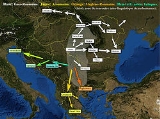
Vlachs

Encyclopedia
Vlach is a blanket term covering several modern Latin peoples descending from the Latinised population in Central
, Eastern
and Southeastern Europe. English variations on the name include: Walla, Wlachs, Wallachs, Vlahs, Olahs or Ulahs. Groups that have historically been called Vlachs include: modern-day Romanians or Daco-Romanians
, Aromanians or Macedo-Romanians
, Morlachs
, Megleno-Romanians
and Istro-Romanians
. Since the creation of the Romania
n state, the term in English has mostly been used for those living outside Romania.
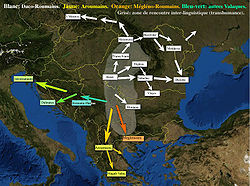 The Vlachs, which would develop into the modern Romanian ethnicity
, do not become tangible before the High Middle Ages
in Kedrenos
(11th century), and their prehistory during the Migration period is a matter of scholarly speculation but according to the linguists and to many scholars, the existence of the present Eastern Romance languages
prove the survival of the Thraco-Roman
s in the low-Danube
basin during the Migration period
and the Vlachs are all being well considered descendants of Romanised peoples of the area (incl. Thracians
, Dacians
and Illyrians
).
The term Vlach is originally an exonym. All the Vlach groups used various words derived from romanus to refer to themselves: Români, Rumâni, Rumâri, Aromâni, Arumâni etc. (note: the Megleno-Romanians nowadays call themselves "Vlaşi", but historically called themselves "Rămâni"; The Istro-Romanians also have adopted the names Vlaşi, but still use Rumâni and Rumâri to refer to themselves).
The Vlach languages, also called the Eastern Romance languages
, have a common origin from the Proto-Romanian language
. Over the centuries, the Vlachs split into various Vlach groups (see Romania in the Dark Ages) and mixed with neighbouring populations: South Slavs
, Greeks
, Albanians
, Bulgars
, and others.
Almost all modern nations in Central
and Southeastern Europe have native Vlach minorities: Hungary
, Ukraine
, Serbia
, Croatia
, Macedonia
, Albania
, Greece
and Bulgaria
. In other countries, the native Vlach population have been completely assimilated by the Slavic population and therefore ceased to exist: Poland
, Czech Republic
, Slovakia
, Bosnia and Montenegro
. Only in Romania
and the Republic of Moldova
does the Vlach (Dacoromanian or Romania
n proper) population comprise an ethnic majority today.
origin, from the word Walha
, "foreigner", "stranger", a name used by ancient Germanic peoples to refer to Romance
-speaking and Celtic neighbours. As such, it shares its history with several ethnic names all across Europe, including the Welsh
and Walloons
. Slavic people initially used the name Vlachs when referring to Romanic people in general. Later on, the meaning became narrower or just different. For example, Italy is called Włochy in Polish
, and Olaszország ("Olasz country") in Hungarian
(the word "oláh" also exists in Hungarian, but describes only peoples from historical Moldova and Wallacha). The term Vlach can also be found in certain placenames where Roman descendants continued to live after the migrations of Germans and Slavs into new territories, for example Laško
in Slovenia
. In the Old English poem Widsith
, the Romans are referred to as Romwalas.
Throughout history, the term "Vlach" has often been used for groups which were not ethnically Vlachs, and often pejoratively. For example, it might have been used for any shepherd
ing community or as a reference to Christians by Muslims (Karadjaovalides). In the Croatian region of Dalmatia, Vlaj/Vlah (sing.) and Vlaji/Vlasi (plural) are the terms used by the inhabitants of coastal towns for the people who live inland, and is often intended to be pejorative, as in "barbarians who come from the mountains." In Greece, the word Βλάχος (Vláhos) is often used as a slur against any supposedly uncouth or uncultured person, but literally it means nothing more than countryperson and is often used as a synonym for Χωριάτης (Choriátis) which simply means villager. Maniots
, for example, used the word to refer to lowland-dwelling Greeks, and the Maniots of Cargèse
used it to refer to native Corsicans.
, as far north as Poland and as far west as the regions of Moravia
(part of the modern Czech Republic
), and the present-day Croatia
where the Morlachs gradually disappeared, while the Catholic and Orthodox Vlachs took Croat and Serb national identity. They reached these regions in search of better pastures, and were called "Wallachians" ("Vlasi; Valaši") by the Slavic peoples.
Statal Entities mentioned in Middle Ages chronicles :
Regions and places :
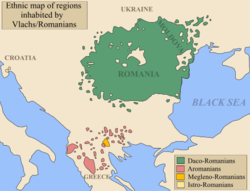
 The Eastern Romance languages
, sometimes known as the Vlach languages, are a group of Romance languages
that developed in Southeastern Europe from the local eastern variant of Vulgar Latin
.
There is no official data from Balkan countries such as Greece
, Bulgaria
, Albania
and Serbia
. The reasons for this also are not known.
, Illyrians
, Thracians
, Greeks
, or a combination of the above. No hypothesis could be proven due to the high degree of underlying genetic similarity possessed by all the tested Balkan groups. The linguistic and cultural differences among various Balkan groups were thus deemed to have not been strong enough to prevent significant gene flow among the above groups.
in the North (by following the Carpathian range), Dinaric Alps
in West, the Pindus
mountains in South, and as far as the Caucasus Mountains
in the east.
In many of these areas, the descendants of the Vlachs have lost their language, but their legacy still lives today in cultural influences: customs, folklore and the way of life of the mountain people, as well as in the place names of Romanian or Aromanian origin that are spread all across the region.
Another part of the Vlachs, especially those in the northern parts, in Romania and Moldova, were traditional farmers growing cereals. Linguists believe that the large vocabulary of Latin words related to agriculture
shows that they have always been a farming Vlach population.
Just like the language, the cultural links between the Northern Vlachs (Romanians) and Southern Vlachs (Aromanians) were broken by the 10th century, and since then, there were different cultural influences:
) and a few are even Muslim
s (around 500 Megleno-Romanians
from Greece who converted
to Islam
and have been living in Turkey
since the 1923 exchange of populations). The Istro-Romanians are entirely Roman Catholics.
period can be found in the writings of Procopius
, in the 5th century. The writings mention forts with names such as Skeptekasas (Seven Houses), Burgulatu (Broad City), Loupofantana (Wolf's Well) and Gemellomountes (Twin Mountains). A Byzantine chronicle of 586 about an incursion against the Avars
in the eastern Balkans may contain one of the earliest references to Vlachs. The account states that when the baggage carried by a mule slipped, the muleteer shouted, "Torna, torna, fratre!" ("Return, return, brother!"). However the account might just be a recording of one of the last appearances of Vulgar Latin
. The Emperor Justinian I
, during whose reign Procopius was writing, was a native Latin speaker and lamented the loss of Latin speech to Greek in his realm. He tried to reestablish the position of the Latin language with the legal compendia he ordered compiled; soon he was frustrated because they proved linguistically inaccessible to judges and lawyers alike, and grudgingly had his Novellae
reissued in Greek.
Blachernae
, the suburb of Constantinople
, was named after a certain Duke from Scythia
named "Blachernos". His name may be linked with the name "Blachs" (Vlachs).
In the late 9th century, the Hungarians arrived in the Carpathian basin, where, according to the Gesta Hungarorum
written around 1146 by the anonymous chancellor of King Bela III of Hungary
, the province of Pannonia
was inhabited by Slavs, Bulgars
, Vlachs, and pastores Romanorum (shepherds of the Romans) (in original: sclauij, Bulgarij et Blachij, ac pastores romanorum). In the 12–14th century they came under the Kingdom of Hungary
, the Byzantine Empire
and the Golden Horde
.
In 1185, two noble brothers from Tarnovo named Peter and Asen (their ethnicity is still disputed, some historians claim they were Vlachs, while others put forward different origins) led a Bulgarian and Vlach rebellion against Byzantine Greek rule and declared Tsar Peter II (also known as Theodore Peter) as king of the reborn state. The following year, the Byzantines were forced to recognize Bulgaria
's independence and the Second Bulgarian Empire
was established. Peter styled himself "Tsar of the Bulgarians, Greeks, and Vlachs" (see Vlach-Bulgar Rebellion), though the reference to Vlachs in the style fell out by the early 13th century.
Central Europe
Central Europe or alternatively Middle Europe is a region of the European continent lying between the variously defined areas of Eastern and Western Europe...
, Eastern
Eastern Europe
Eastern Europe is the eastern part of Europe. The term has widely disparate geopolitical, geographical, cultural and socioeconomic readings, which makes it highly context-dependent and even volatile, and there are "almost as many definitions of Eastern Europe as there are scholars of the region"...
and Southeastern Europe. English variations on the name include: Walla, Wlachs, Wallachs, Vlahs, Olahs or Ulahs. Groups that have historically been called Vlachs include: modern-day Romanians or Daco-Romanians
Romanians
The Romanians are an ethnic group native to Romania, who speak Romanian; they are the majority inhabitants of Romania....
, Aromanians or Macedo-Romanians
Aromanians
Aromanians are a Latin people native throughout the southern Balkans, especially in northern Greece, Albania, the Republic of Macedonia, Bulgaria, and as an emigrant community in Serbia and Romania . An older term is Macedo-Romanians...
, Morlachs
Morlachs
Morlachs were a population of Vlachs. In another version their name comes from the slavic terms of "morski-Vlasi" or Sea Vlachs...
, Megleno-Romanians
Megleno-Romanians
The Megleno-Romanians or Meglen Vlachs or Moglenite Vlachs, are a small Eastern Romance people, currently inhabiting seven villages in the Moglena region spanning the Pella and Kilkis prefectures of Central Macedonia, Greece, and one village, Huma, across the border in the Republic of...
and Istro-Romanians
Istro-Romanians
Istro-Romanians / Istrorumeni are an ethnic group living in northeastern Istria, currently spanning over a small area of Croatia and a...
. Since the creation of the Romania
Romania
Romania is a country located at the crossroads of Central and Southeastern Europe, on the Lower Danube, within and outside the Carpathian arch, bordering on the Black Sea...
n state, the term in English has mostly been used for those living outside Romania.
Romanians
The Romanians are an ethnic group native to Romania, who speak Romanian; they are the majority inhabitants of Romania....
, do not become tangible before the High Middle Ages
High Middle Ages
The High Middle Ages was the period of European history around the 11th, 12th, and 13th centuries . The High Middle Ages were preceded by the Early Middle Ages and followed by the Late Middle Ages, which by convention end around 1500....
in Kedrenos
Kedrenos
George Kedrenos or Cedrenus was a Byzantine historian. In the 1050s he compiled A concise history of the world, which spanned the time from the biblical account of creation to his own day. Kedrenos is one of the few sources that discuss Khazar polities in existence after the sack of Atil in 969...
(11th century), and their prehistory during the Migration period is a matter of scholarly speculation but according to the linguists and to many scholars, the existence of the present Eastern Romance languages
Eastern Romance languages
The Eastern Romance languages in their narrow conception, sometimes known as the Vlach languages, are a group of Romance languages that developed in Southeastern Europe from the local eastern variant of Vulgar Latin. Some classifications include the Italo-Dalmatian languages; when Italian is...
prove the survival of the Thraco-Roman
Thraco-Roman
The terms Thraco-Roman and Daco-Roman refer to the culture and language of the Thracian and Dacian peoples who were incorporated into the Roman Empire and ultimately fell under the Roman and Latin sphere of influence.-Meaning and usage:...
s in the low-Danube
Danube
The Danube is a river in the Central Europe and the Europe's second longest river after the Volga. It is classified as an international waterway....
basin during the Migration period
Migration Period
The Migration Period, also called the Barbarian Invasions , was a period of intensified human migration in Europe that occurred from c. 400 to 800 CE. This period marked the transition from Late Antiquity to the Early Middle Ages...
and the Vlachs are all being well considered descendants of Romanised peoples of the area (incl. Thracians
Thracians
The ancient Thracians were a group of Indo-European tribes inhabiting areas including Thrace in Southeastern Europe. They spoke the Thracian language – a scarcely attested branch of the Indo-European language family...
, Dacians
Dacians
The Dacians were an Indo-European people, very close or part of the Thracians. Dacians were the ancient inhabitants of Dacia...
and Illyrians
Illyrians
The Illyrians were a group of tribes who inhabited part of the western Balkans in antiquity and the south-eastern coasts of the Italian peninsula...
).
The term Vlach is originally an exonym. All the Vlach groups used various words derived from romanus to refer to themselves: Români, Rumâni, Rumâri, Aromâni, Arumâni etc. (note: the Megleno-Romanians nowadays call themselves "Vlaşi", but historically called themselves "Rămâni"; The Istro-Romanians also have adopted the names Vlaşi, but still use Rumâni and Rumâri to refer to themselves).
The Vlach languages, also called the Eastern Romance languages
Eastern Romance languages
The Eastern Romance languages in their narrow conception, sometimes known as the Vlach languages, are a group of Romance languages that developed in Southeastern Europe from the local eastern variant of Vulgar Latin. Some classifications include the Italo-Dalmatian languages; when Italian is...
, have a common origin from the Proto-Romanian language
Proto-Romanian language
Proto-Romanian is a Romance language evolved from Vulgar Latin and considered to have been spoken by the ancestors of today's Romanians and related Balkan Latin peoples before ca...
. Over the centuries, the Vlachs split into various Vlach groups (see Romania in the Dark Ages) and mixed with neighbouring populations: South Slavs
South Slavs
The South Slavs are the southern branch of the Slavic peoples and speak South Slavic languages. Geographically, the South Slavs are native to the Balkan peninsula, the southern Pannonian Plain and the eastern Alps...
, Greeks
Greeks
The Greeks, also known as the Hellenes , are a nation and ethnic group native to Greece, Cyprus and neighboring regions. They also form a significant diaspora, with Greek communities established around the world....
, Albanians
Albanians
Albanians are a nation and ethnic group native to Albania and neighbouring countries. They speak the Albanian language. More than half of all Albanians live in Albania and Kosovo...
, Bulgars
Bulgars
The Bulgars were a semi-nomadic who flourished in the Pontic Steppe and the Volga basin in the 7th century.The Bulgars emerge after the collapse of the Hunnic Empire in the 5th century....
, and others.
Almost all modern nations in Central
Central Europe
Central Europe or alternatively Middle Europe is a region of the European continent lying between the variously defined areas of Eastern and Western Europe...
and Southeastern Europe have native Vlach minorities: Hungary
Hungary
Hungary , officially the Republic of Hungary , is a landlocked country in Central Europe. It is situated in the Carpathian Basin and is bordered by Slovakia to the north, Ukraine and Romania to the east, Serbia and Croatia to the south, Slovenia to the southwest and Austria to the west. The...
, Ukraine
Ukraine
Ukraine is a country in Eastern Europe. It has an area of 603,628 km², making it the second largest contiguous country on the European continent, after Russia...
, Serbia
Serbia
Serbia , officially the Republic of Serbia , is a landlocked country located at the crossroads of Central and Southeast Europe, covering the southern part of the Carpathian basin and the central part of the Balkans...
, Croatia
Croatia
Croatia , officially the Republic of Croatia , is a unitary democratic parliamentary republic in Europe at the crossroads of the Mitteleuropa, the Balkans, and the Mediterranean. Its capital and largest city is Zagreb. The country is divided into 20 counties and the city of Zagreb. Croatia covers ...
, Macedonia
Republic of Macedonia
Macedonia , officially the Republic of Macedonia , is a country located in the central Balkan peninsula in Southeast Europe. It is one of the successor states of the former Yugoslavia, from which it declared independence in 1991...
, Albania
Albania
Albania , officially known as the Republic of Albania , is a country in Southeastern Europe, in the Balkans region. It is bordered by Montenegro to the northwest, Kosovo to the northeast, the Republic of Macedonia to the east and Greece to the south and southeast. It has a coast on the Adriatic Sea...
, Greece
Greece
Greece , officially the Hellenic Republic , and historically Hellas or the Republic of Greece in English, is a country in southeastern Europe....
and Bulgaria
Bulgaria
Bulgaria , officially the Republic of Bulgaria , is a parliamentary democracy within a unitary constitutional republic in Southeast Europe. The country borders Romania to the north, Serbia and Macedonia to the west, Greece and Turkey to the south, as well as the Black Sea to the east...
. In other countries, the native Vlach population have been completely assimilated by the Slavic population and therefore ceased to exist: Poland
Poland
Poland , officially the Republic of Poland , is a country in Central Europe bordered by Germany to the west; the Czech Republic and Slovakia to the south; Ukraine, Belarus and Lithuania to the east; and the Baltic Sea and Kaliningrad Oblast, a Russian exclave, to the north...
, Czech Republic
Czech Republic
The Czech Republic is a landlocked country in Central Europe. The country is bordered by Poland to the northeast, Slovakia to the east, Austria to the south, and Germany to the west and northwest....
, Slovakia
Slovakia
The Slovak Republic is a landlocked state in Central Europe. It has a population of over five million and an area of about . Slovakia is bordered by the Czech Republic and Austria to the west, Poland to the north, Ukraine to the east and Hungary to the south...
, Bosnia and Montenegro
Montenegro
Montenegro Montenegrin: Crna Gora Црна Гора , meaning "Black Mountain") is a country located in Southeastern Europe. It has a coast on the Adriatic Sea to the south-west and is bordered by Croatia to the west, Bosnia and Herzegovina to the northwest, Serbia to the northeast and Albania to the...
. Only in Romania
Romania
Romania is a country located at the crossroads of Central and Southeastern Europe, on the Lower Danube, within and outside the Carpathian arch, bordering on the Black Sea...
and the Republic of Moldova
Moldova
Moldova , officially the Republic of Moldova is a landlocked state in Eastern Europe, located between Romania to the West and Ukraine to the North, East and South. It declared itself an independent state with the same boundaries as the preceding Moldavian Soviet Socialist Republic in 1991, as part...
does the Vlach (Dacoromanian or Romania
Romania
Romania is a country located at the crossroads of Central and Southeastern Europe, on the Lower Danube, within and outside the Carpathian arch, bordering on the Black Sea...
n proper) population comprise an ethnic majority today.
Etymology
The word Vlach is ultimately of GermanicGermanic languages
The Germanic languages constitute a sub-branch of the Indo-European language family. The common ancestor of all of the languages in this branch is called Proto-Germanic , which was spoken in approximately the mid-1st millennium BC in Iron Age northern Europe...
origin, from the word Walha
Walha
Walhaz is a reconstructed Proto-Germanic word, meaning "foreigner", "stranger", "Roman", "Romance-speaker", or "Celtic-speaker". The adjective derived from this word can be found in , Old High German walhisk, meaning "Romance", in Old English welisċ, wælisċ, wilisċ, meaning "Romano-British" and in...
, "foreigner", "stranger", a name used by ancient Germanic peoples to refer to Romance
Romance languages
The Romance languages are a branch of the Indo-European language family, more precisely of the Italic languages subfamily, comprising all the languages that descend from Vulgar Latin, the language of ancient Rome...
-speaking and Celtic neighbours. As such, it shares its history with several ethnic names all across Europe, including the Welsh
Welsh people
The Welsh people are an ethnic group and nation associated with Wales and the Welsh language.John Davies argues that the origin of the "Welsh nation" can be traced to the late 4th and early 5th centuries, following the Roman departure from Britain, although Brythonic Celtic languages seem to have...
and Walloons
Walloons
Walloons are a French-speaking people who live in Belgium, principally in Wallonia. Walloons are a distinctive community within Belgium, important historical and anthropological criteria bind Walloons to the French people. More generally, the term also refers to the inhabitants of the Walloon...
. Slavic people initially used the name Vlachs when referring to Romanic people in general. Later on, the meaning became narrower or just different. For example, Italy is called Włochy in Polish
Polish language
Polish is a language of the Lechitic subgroup of West Slavic languages, used throughout Poland and by Polish minorities in other countries...
, and Olaszország ("Olasz country") in Hungarian
Hungarian language
Hungarian is a Uralic language, part of the Ugric group. With some 14 million speakers, it is one of the most widely spoken non-Indo-European languages in Europe....
(the word "oláh" also exists in Hungarian, but describes only peoples from historical Moldova and Wallacha). The term Vlach can also be found in certain placenames where Roman descendants continued to live after the migrations of Germans and Slavs into new territories, for example Laško
Laško
Laško is a spa town and municipality in eastern Slovenia. Traditionally the area was part of the Lower Styria region. The municipality is now included in the Savinja statistical region. The town is located at the foothills of the Hum hill on the Savinja River. It is first mentioned in written...
in Slovenia
Slovenia
Slovenia , officially the Republic of Slovenia , is a country in Central and Southeastern Europe touching the Alps and bordering the Mediterranean. Slovenia borders Italy to the west, Croatia to the south and east, Hungary to the northeast, and Austria to the north, and also has a small portion of...
. In the Old English poem Widsith
Widsith
Widsith is an Old English poem of 144 lines that appears to date from the 9th century, drawing on earlier oral traditions of Anglo-Saxon tale singing. The only text of the fragment is copied in the Exeter Book, a manuscript of Old English poetry compiled in the late 10th century containing...
, the Romans are referred to as Romwalas.
Throughout history, the term "Vlach" has often been used for groups which were not ethnically Vlachs, and often pejoratively. For example, it might have been used for any shepherd
Shepherd
A shepherd is a person who tends, feeds or guards flocks of sheep.- Origins :Shepherding is one of the oldest occupations, beginning some 6,000 years ago in Asia Minor. Sheep were kept for their milk, meat and especially their wool...
ing community or as a reference to Christians by Muslims (Karadjaovalides). In the Croatian region of Dalmatia, Vlaj/Vlah (sing.) and Vlaji/Vlasi (plural) are the terms used by the inhabitants of coastal towns for the people who live inland, and is often intended to be pejorative, as in "barbarians who come from the mountains." In Greece, the word Βλάχος (Vláhos) is often used as a slur against any supposedly uncouth or uncultured person, but literally it means nothing more than countryperson and is often used as a synonym for Χωριάτης (Choriátis) which simply means villager. Maniots
Maniots
The Maniots or Maniates are the Greek inhabitants of the Mani Peninsula located in the southern Peloponnese in the Greek prefecture of Laconia and prefecture of Messinia. They were also formerly known as Mainotes and the peninsula as Maina. The Maniots are the direct descendants of the Spartans...
, for example, used the word to refer to lowland-dwelling Greeks, and the Maniots of Cargèse
Cargèse
Cargèse is a village and commune in the Corse-du-Sud department of France on the west coast of the island of Corsica, 27 km north of Ajaccio...
used it to refer to native Corsicans.
Territories with Vlach population
Besides the separation of some groups (Aromanians, Megleno-Romanians) during the Age of Migration, many other Vlachs could be found all over the BalkansBalkans
The Balkans is a geopolitical and cultural region of southeastern Europe...
, as far north as Poland and as far west as the regions of Moravia
Moravia
Moravia is a historical region in Central Europe in the east of the Czech Republic, and one of the former Czech lands, together with Bohemia and Silesia. It takes its name from the Morava River which rises in the northwest of the region...
(part of the modern Czech Republic
Czech Republic
The Czech Republic is a landlocked country in Central Europe. The country is bordered by Poland to the northeast, Slovakia to the east, Austria to the south, and Germany to the west and northwest....
), and the present-day Croatia
Croatia
Croatia , officially the Republic of Croatia , is a unitary democratic parliamentary republic in Europe at the crossroads of the Mitteleuropa, the Balkans, and the Mediterranean. Its capital and largest city is Zagreb. The country is divided into 20 counties and the city of Zagreb. Croatia covers ...
where the Morlachs gradually disappeared, while the Catholic and Orthodox Vlachs took Croat and Serb national identity. They reached these regions in search of better pastures, and were called "Wallachians" ("Vlasi; Valaši") by the Slavic peoples.
Statal Entities mentioned in Middle Ages chronicles :
- WallachiaWallachiaWallachia or Walachia is a historical and geographical region of Romania. It is situated north of the Danube and south of the Southern Carpathians...
– between the Southern CarpathiansSouthern CarpathiansThe Southern Carpathians or the Transylvanian Alps are a group of mountain ranges which divide central and southern Romania, on one side, and Serbia, on the other side. They cover part of the Carpathian Mountains that is located between the Prahova River in the east and the Timiș and Cerna Rivers...
and the DanubeDanubeThe Danube is a river in the Central Europe and the Europe's second longest river after the Volga. It is classified as an international waterway....
("Ţara Românească" in Romanian LanguageRomanian languageRomanian Romanian Romanian (or Daco-Romanian; obsolete spellings Rumanian, Roumanian; self-designation: română, limba română ("the Romanian language") or românește (lit. "in Romanian") is a Romance language spoken by around 24 to 28 million people, primarily in Romania and Moldova...
; "Bassarab-Wallachia": "Bassarab's WallachiaBasarab I of WallachiaBasarab I the Founder was voivode or prince of Wallachia . His rise seems to have taken place in the context of the war between the Kingdom of Hungary and the Orthodox states in the north of the Balkan Peninsula...
" and "Ungro-Wallachia" or "Wallachia Transalpina" in administrative sources ; "Istro-Vlachia": "Danubian Wallachia" in Byzantine sources ; "Velacia secunda" in Spanish maps) ; - MoldaviaMoldaviaMoldavia is a geographic and historical region and former principality in Eastern Europe, corresponding to the territory between the Eastern Carpathians and the Dniester river...
– between the Carpathians and the Nistru river ("Bogdano-Wallachia" - Bogdan's Wallachia, "Moldo-Wallachia", "Maurovlachia", Black Wallachia", "Moldovlachia" or "Rousso-Vlachia" in Byzantine sources, "Bogdan Iflak" or even "WallachiaWallachiaWallachia or Walachia is a historical and geographical region of Romania. It is situated north of the Danube and south of the Southern Carpathians...
" in PolishPolandPoland , officially the Republic of Poland , is a country in Central Europe bordered by Germany to the west; the Czech Republic and Slovakia to the south; Ukraine, Belarus and Lithuania to the east; and the Baltic Sea and Kaliningrad Oblast, a Russian exclave, to the north...
sources, "L`otra Wallachia" – the "other WallachiaWallachiaWallachia or Walachia is a historical and geographical region of Romania. It is situated north of the Danube and south of the Southern Carpathians...
" – in genovese sources and "Velacia tertia" in Spanish maps) ; - TransylvaniaTransylvaniaTransylvania is a historical region in the central part of Romania. Bounded on the east and south by the Carpathian mountain range, historical Transylvania extended in the west to the Apuseni Mountains; however, the term sometimes encompasses not only Transylvania proper, but also the historical...
(or "Ardeal", "Transylvanian vlachs" – between the Carpathians and the Hungarian plainHungaryHungary , officially the Republic of Hungary , is a landlocked country in Central Europe. It is situated in the Carpathian Basin and is bordered by Slovakia to the north, Ukraine and Romania to the east, Serbia and Croatia to the south, Slovenia to the southwest and Austria to the west. The...
, also "Wallachia interior" in administrative sources and "Velacia prima" in Spanish maps) ; - Bulgarian-Wallachian EmpireSecond Bulgarian EmpireThe Second Bulgarian Empire was a medieval Bulgarian state which existed between 1185 and 1396 . A successor of the First Bulgarian Empire, it reached the peak of its power under Kaloyan and Ivan Asen II before gradually being conquered by the Ottomans in the late 14th-early 15th century...
– between the Carpathians and the Balkan mountainsBalkan MountainsThe Balkan mountain range is a mountain range in the eastern part of the Balkan Peninsula. The Balkan range runs 560 km from the Vrashka Chuka Peak on the border between Bulgaria and eastern Serbia eastward through central Bulgaria to Cape Emine on the Black Sea...
("Regnum Blachorum et Bulgarorum" in the documents and letters of Pope Innocent IIIPope Innocent IIIPope Innocent III was Pope from 8 January 1198 until his death. His birth name was Lotario dei Conti di Segni, sometimes anglicised to Lothar of Segni....
).
Regions and places :
- White Wallachia – in MoesiaMoesiaMoesia was an ancient region and later Roman province situated in the Balkans, along the south bank of the Danube River. It included territories of modern-day Southern Serbia , Northern Republic of Macedonia, Northern Bulgaria, Romanian Dobrudja, Southern Moldova, and Budjak .-History:In ancient...
; - Great WallachiaGreat WallachiaGreat Wallachia , also Thessaly Wallachia, was a medieval state of the Aromanians , which included the region of Thessaly in Greece, the southern and central ranges of Pindus and extending over part of Macedonia.Anna Komnene in the second half of the eleventh century was the first author to write...
(Μεγάλη Βλαχία, Megáli vlahía) – in ThessalyThessalyThessaly is a traditional geographical region and an administrative region of Greece, comprising most of the ancient region of the same name. Before the Greek Dark Ages, Thessaly was known as Aeolia, and appears thus in Homer's Odyssey....
; - Small Wallachia ("Μικρή Βλαχία": Mikrí vlahía) – through AetoliaAetoliaAetolia is a mountainous region of Greece on the north coast of the Gulf of Corinth, forming the eastern part of the modern prefecture of Aetolia-Acarnania.-Geography:...
, AcarnaniaAcarnaniaAcarnania is a region of west-central Greece that lies along the Ionian Sea, west of Aetolia, with the Achelous River for a boundary, and north of the gulf of Calydon, which is the entrance to the Gulf of Corinth. Today it forms the western part of the prefecture of Aetolia-Acarnania. The capital...
, DoridaDoridaDorida is a municipality in the Phocis regional unit, Central Greece, Greece. The seat of the municipality is the town Lidoriki.-Municipality:...
(Doris), Locrida (Locris); - Sirmium WallachiaSremŚrem is a town on the Warta river in central Poland. It has been situated in the Greater Poland Voivodeship since 1999; from 1975 to 1998 it was part of the Poznań Voivodeship...
– on the Sava riverSava RiverThe Sava is a river in Southeast Europe, a right side tributary of the Danube river at Belgrade. Counting from Zelenci, the source of Sava Dolinka, it is long and drains of surface area. It flows through Slovenia, Croatia, along the northern border of Bosnia and Herzegovina, and through Serbia....
; - Black WallachiaMorlachsMorlachs were a population of Vlachs. In another version their name comes from the slavic terms of "morski-Vlasi" or Sea Vlachs...
(MorlachiaMorlachsMorlachs were a population of Vlachs. In another version their name comes from the slavic terms of "morski-Vlasi" or Sea Vlachs...
) – in DalmatiaDalmatiaDalmatia is a historical region on the eastern coast of the Adriatic Sea. It stretches from the island of Rab in the northwest to the Bay of Kotor in the southeast. The hinterland, the Dalmatian Zagora, ranges from fifty kilometers in width in the north to just a few kilometers in the south....
; - Upper Valachia of Moscopole and Metsovon ("Άνω Βλαχία", Áno Vlahía) – through southern MacedoniaMacedonia (region)Macedonia is a geographical and historical region of the Balkan peninsula in southeastern Europe. Its boundaries have changed considerably over time, but nowadays the region is considered to include parts of five Balkan countries: Greece, the Republic of Macedonia, Bulgaria, Albania, Serbia, as...
, AlbaniaAlbaniaAlbania , officially known as the Republic of Albania , is a country in Southeastern Europe, in the Balkans region. It is bordered by Montenegro to the northwest, Kosovo to the northeast, the Republic of Macedonia to the east and Greece to the south and southeast. It has a coast on the Adriatic Sea...
and EpirusEpirusThe name Epirus, from the Greek "Ήπειρος" meaning continent may refer to:-Geographical:* Epirus - a historical and geographical region of the southwestern Balkans, straddling modern Greece and Albania...
; - Old Vallachia (Stari Vlah) – in eastern Bosnia and HerzegovinaBosnia and HerzegovinaBosnia and Herzegovina , sometimes called Bosnia-Herzegovina or simply Bosnia, is a country in Southern Europe, on the Balkan Peninsula. Bordered by Croatia to the north, west and south, Serbia to the east, and Montenegro to the southeast, Bosnia and Herzegovina is almost landlocked, except for the...
and western Serbia; - Romanian mountains (Romanija planina)– in eastern Bosnia and HerzegovinaBosnia and HerzegovinaBosnia and Herzegovina , sometimes called Bosnia-Herzegovina or simply Bosnia, is a country in Southern Europe, on the Balkan Peninsula. Bordered by Croatia to the north, west and south, Serbia to the east, and Montenegro to the southeast, Bosnia and Herzegovina is almost landlocked, except for the...
; - VlaşcaVlaşcaVlaşca may refer to several entities in Romania:* Vlaşca River a, tributary of the Satului* Vlaşca County, a former county in southern Muntenia* Vlaşca, a village in Feteşti city, Ialomiţa County...
– a former county of southern WallachiaWallachiaWallachia or Walachia is a historical and geographical region of Romania. It is situated north of the Danube and south of the Southern Carpathians...
(a name derived from the SerbianSerbian languageSerbian is a form of Serbo-Croatian, a South Slavic language, spoken by Serbs in Serbia, Bosnia and Herzegovina, Montenegro, Croatia and neighbouring countries....
designation for Wallachia: Vlaška) ; - Greater WallachiaMunteniaMuntenia is a historical province of Romania, usually considered Wallachia-proper . It is situated between the Danube , the Carpathian Mountains and Moldavia , and the Olt River to the west...
(MunteniaMunteniaMuntenia is a historical province of Romania, usually considered Wallachia-proper . It is situated between the Danube , the Carpathian Mountains and Moldavia , and the Olt River to the west...
) – east of the Olt riverOlt RiverThe Olt River is a river in Romania. It is the longest river flowing exclusively through Romania. Its source is in the Hăşmaş Mountains of the eastern Carpathian Mountains, near the village Bălan. It flows through the Romanian counties Harghita, Covasna, Braşov, Sibiu, Vâlcea and Olt...
; - Lesser WallachiaOlteniaOltenia is a historical province and geographical region of Romania, in western Wallachia. It is situated between the Danube, the Southern Carpathians and the Olt river ....
(OlteniaOlteniaOltenia is a historical province and geographical region of Romania, in western Wallachia. It is situated between the Danube, the Southern Carpathians and the Olt river ....
) – west of the Olt riverOlt RiverThe Olt River is a river in Romania. It is the longest river flowing exclusively through Romania. Its source is in the Hăşmaş Mountains of the eastern Carpathian Mountains, near the village Bălan. It flows through the Romanian counties Harghita, Covasna, Braşov, Sibiu, Vâlcea and Olt...
; - Cisalpine Wallachia/Walachia citerioreBanatThe Banat is a geographical and historical region in Central Europe currently divided between three countries: the eastern part lies in western Romania , the western part in northeastern Serbia , and a small...
(also called "Vulaska", "Vlaska", "Valachia", "Vlaskozemski", Parvan vallachiam, etc.) – BanatBanatThe Banat is a geographical and historical region in Central Europe currently divided between three countries: the eastern part lies in western Romania , the western part in northeastern Serbia , and a small...
; - FǎgǎraşFagarasFăgăraș is a city in central Romania, located in Braşov County . Another source of the name is alleged to derive from the Hungarian language word for "partridge" . A more plausible explanation is that the name is given by Fogaras river coming from the Pecheneg "Fagar šu", which means ash water...
and HaţegHategHațeg is a town in Hunedoara County, Romania with a population of 12,507. Three villages are administered by the town: Nălațvad, Silvașu de Jos and Silvașu de Sus.Țara Hațegului is the region around Hațeg town...
(Valahia transalpina); - MaramureşMaramuresMaramureș may refer to the following:*Maramureș, a geographical, historical, and ethno-cultural region in present-day Romania and Ukraine, that occupies the Maramureș Depression and Maramureș Mountains, a mountain range in North East Carpathians...
; - Moravian WallachiaMoravian WallachiaMoravian Wallachia is a mountainous region located in the easternmost part of Moravia, Czech Republic, near the Slovakian border. The name Wallachia was formerly applied to all the highlands of Moravia and neighboring Silesia, although in the nineteenth century a smaller area came to be defined...
(Valašsko in Czech languageCzech languageCzech is a West Slavic language with about 12 million native speakers; it is the majority language in the Czech Republic and spoken by Czechs worldwide. The language was known as Bohemian in English until the late 19th century...
) – in the Beskid Mountains of the Czech republicCzech RepublicThe Czech Republic is a landlocked country in Central Europe. The country is bordered by Poland to the northeast, Slovakia to the east, Austria to the south, and Germany to the west and northwest....
.
People
Eastern Romance languages
The Eastern Romance languages in their narrow conception, sometimes known as the Vlach languages, are a group of Romance languages that developed in Southeastern Europe from the local eastern variant of Vulgar Latin. Some classifications include the Italo-Dalmatian languages; when Italian is...
, sometimes known as the Vlach languages, are a group of Romance languages
Romance languages
The Romance languages are a branch of the Indo-European language family, more precisely of the Italic languages subfamily, comprising all the languages that descend from Vulgar Latin, the language of ancient Rome...
that developed in Southeastern Europe from the local eastern variant of Vulgar Latin
Vulgar Latin
Vulgar Latin is any of the nonstandard forms of Latin from which the Romance languages developed. Because of its nonstandard nature, it had no official orthography. All written works used Classical Latin, with very few exceptions...
.
There is no official data from Balkan countries such as Greece
Greece
Greece , officially the Hellenic Republic , and historically Hellas or the Republic of Greece in English, is a country in southeastern Europe....
, Bulgaria
Bulgaria
Bulgaria , officially the Republic of Bulgaria , is a parliamentary democracy within a unitary constitutional republic in Southeast Europe. The country borders Romania to the north, Serbia and Macedonia to the west, Greece and Turkey to the south, as well as the Black Sea to the east...
, Albania
Albania
Albania , officially known as the Republic of Albania , is a country in Southeastern Europe, in the Balkans region. It is bordered by Montenegro to the northwest, Kosovo to the northeast, the Republic of Macedonia to the east and Greece to the south and southeast. It has a coast on the Adriatic Sea...
and Serbia
Serbia
Serbia , officially the Republic of Serbia , is a landlocked country located at the crossroads of Central and Southeast Europe, covering the southern part of the Carpathian basin and the central part of the Balkans...
. The reasons for this also are not known.
- Daco-RomanianDaco-RomanianDaco-Romanian is the term used to identify the Romanian language in contexts where distinction needs to be made between the various Eastern Romance languages...
s (RomaniansRomaniansThe Romanians are an ethnic group native to Romania, who speak Romanian; they are the majority inhabitants of Romania....
proper) up to 33,500,000 (including MoldovansMoldovansMoldovans or Moldavians are the largest population group of Moldova...
), speaking the Romanian languageRomanian languageRomanian Romanian Romanian (or Daco-Romanian; obsolete spellings Rumanian, Roumanian; self-designation: română, limba română ("the Romanian language") or românește (lit. "in Romanian") is a Romance language spoken by around 24 to 28 million people, primarily in Romania and Moldova...
(Daco-RomanianDaco-RomanianDaco-Romanian is the term used to identify the Romanian language in contexts where distinction needs to be made between the various Eastern Romance languages...
), known by that name due to their location in the territory of ancient DaciaDaciaIn ancient geography, especially in Roman sources, Dacia was the land inhabited by the Dacians or Getae as they were known by the Greeks—the branch of the Thracians north of the Haemus range...
, who live in:- RomaniaRomaniaRomania is a country located at the crossroads of Central and Southeastern Europe, on the Lower Danube, within and outside the Carpathian arch, bordering on the Black Sea...
– 20 million - MoldovaMoldovaMoldova , officially the Republic of Moldova is a landlocked state in Eastern Europe, located between Romania to the West and Ukraine to the North, East and South. It declared itself an independent state with the same boundaries as the preceding Moldavian Soviet Socialist Republic in 1991, as part...
– 3.5 million - UkraineUkraineUkraine is a country in Eastern Europe. It has an area of 603,628 km², making it the second largest contiguous country on the European continent, after Russia...
– 459,000; in southern BessarabiaBessarabiaBessarabia is a historical term for the geographic region in Eastern Europe bounded by the Dniester River on the east and the Prut River on the west....
and northern BukovinaBukovinaBukovina is a historical region on the northern slopes of the northeastern Carpathian Mountains and the adjoining plains.-Name:The name Bukovina came into official use in 1775 with the region's annexation from the Principality of Moldavia to the possessions of the Habsburg Monarchy, which became... - SerbiaRomanians of SerbiaRomanians are a recognised national minority in Serbia. The total number of declared Romanians in the 2002 Serbian census was 34,576, while 40,054 people declared themselves Vlachs; there are differing views among some of the Vlachs over they should be regarded as Romanians or as members of a...
– 79,000 - Hungary – 15,000
- BulgariaRomanians in BulgariaThe Romanian minority in Bulgaria is concentrated in the northwestern part of the country, in the Provinces of: Vidin, Vratsa and Pleven. They speak the Oltenian variety of the Romanian language...
– 10,500 persons counted as Vlachs and 1088 as Romanians, this figure may include Aromanians.
- Romania
- AromaniansAromaniansAromanians are a Latin people native throughout the southern Balkans, especially in northern Greece, Albania, the Republic of Macedonia, Bulgaria, and as an emigrant community in Serbia and Romania . An older term is Macedo-Romanians...
(speaking the Aromanian languageAromanian languageAromanian , also known as Macedo-Romanian, Arumanian or Vlach is an Eastern Romance language spoken in Southeastern Europe...
) up to 2,000,000, live in:- GreeceGreeceGreece , officially the Hellenic Republic , and historically Hellas or the Republic of Greece in English, is a country in southeastern Europe....
– up to 700,000, mainly in the Pindus Mountains (Greece, like France, does not recognise any ethnic divisions, so there are no statistics kept and the Aromanians of Greece self-identify as Greeks and are accepted as such by the other Greeks. See Demographics of GreeceDemographics of GreeceThis article is about the demographic features of the population of Greece, including population density, ethnicity, education level, health of the populace, economic status, religious affiliations and other aspects of the population....
)
- Greece
-
- AlbaniaAlbaniaAlbania , officially known as the Republic of Albania , is a country in Southeastern Europe, in the Balkans region. It is bordered by Montenegro to the northwest, Kosovo to the northeast, the Republic of Macedonia to the east and Greece to the south and southeast. It has a coast on the Adriatic Sea...
– up to 400,000 although it is disputed by one source which, among others, states that some of them have converted their Albanian NationalityAlbaniansAlbanians are a nation and ethnic group native to Albania and neighbouring countries. They speak the Albanian language. More than half of all Albanians live in Albania and Kosovo...
to Greek NationalityGreeksThe Greeks, also known as the Hellenes , are a nation and ethnic group native to Greece, Cyprus and neighboring regions. They also form a significant diaspora, with Greek communities established around the world....
. - RomaniaRomaniaRomania is a country located at the crossroads of Central and Southeastern Europe, on the Lower Danube, within and outside the Carpathian arch, bordering on the Black Sea...
– 100,000 - 250,000 - MacedoniaRepublic of MacedoniaMacedonia , officially the Republic of Macedonia , is a country located in the central Balkan peninsula in Southeast Europe. It is one of the successor states of the former Yugoslavia, from which it declared independence in 1991...
– 80,000 - 120,000
- Albania
- Megleno-RomaniansMegleno-RomaniansThe Megleno-Romanians or Meglen Vlachs or Moglenite Vlachs, are a small Eastern Romance people, currently inhabiting seven villages in the Moglena region spanning the Pella and Kilkis prefectures of Central Macedonia, Greece, and one village, Huma, across the border in the Republic of...
(speaking the Megleno-Romanian languageMegleno-Romanian languageMegleno-Romanian is a Romance language, similar to Aromanian and Romanian, or a dialect of the Romanian language...
), living in GreeceGreeceGreece , officially the Hellenic Republic , and historically Hellas or the Republic of Greece in English, is a country in southeastern Europe....
and in MacedoniaRepublic of MacedoniaMacedonia , officially the Republic of Macedonia , is a country located in the central Balkan peninsula in Southeast Europe. It is one of the successor states of the former Yugoslavia, from which it declared independence in 1991...
– 20,000.
- Istro-RomaniansIstro-RomaniansIstro-Romanians / Istrorumeni are an ethnic group living in northeastern Istria, currently spanning over a small area of Croatia and a...
(speaking the Istro-Romanian languageIstro-Romanian languageIstro-Romanian is an Eastern Romance language that is still spoken today in a few villages and hamlets in the peninsula of Istria, on the northern part of the Adriatic Sea, in what is now Croatia as well as in other countries around the world where the Istro-Romanian people settled after the two...
) living in CroatiaCroatiaCroatia , officially the Republic of Croatia , is a unitary democratic parliamentary republic in Europe at the crossroads of the Mitteleuropa, the Balkans, and the Mediterranean. Its capital and largest city is Zagreb. The country is divided into 20 counties and the city of Zagreb. Croatia covers ...
, with a population of 1,200, but with fewer than 200 acknowledged native speakers.
- MorlachsMorlachsMorlachs were a population of Vlachs. In another version their name comes from the slavic terms of "morski-Vlasi" or Sea Vlachs...
– in the 1991 Croatian census 22 people declared themselves Morlachs.
Genetics
In 2006, Bosch et al. attempted to analyze whether Vlachs are the descendents of Latinized DaciansDacians
The Dacians were an Indo-European people, very close or part of the Thracians. Dacians were the ancient inhabitants of Dacia...
, Illyrians
Illyrians
The Illyrians were a group of tribes who inhabited part of the western Balkans in antiquity and the south-eastern coasts of the Italian peninsula...
, Thracians
Thracians
The ancient Thracians were a group of Indo-European tribes inhabiting areas including Thrace in Southeastern Europe. They spoke the Thracian language – a scarcely attested branch of the Indo-European language family...
, Greeks
Greeks
The Greeks, also known as the Hellenes , are a nation and ethnic group native to Greece, Cyprus and neighboring regions. They also form a significant diaspora, with Greek communities established around the world....
, or a combination of the above. No hypothesis could be proven due to the high degree of underlying genetic similarity possessed by all the tested Balkan groups. The linguistic and cultural differences among various Balkan groups were thus deemed to have not been strong enough to prevent significant gene flow among the above groups.
Culture
Many Vlachs were shepherds in the medieval times, driving their sheep through the mountains of Southeastern Europe. The Vlach shepherds reached as far as Southern Poland and MoraviaMoravia
Moravia is a historical region in Central Europe in the east of the Czech Republic, and one of the former Czech lands, together with Bohemia and Silesia. It takes its name from the Morava River which rises in the northwest of the region...
in the North (by following the Carpathian range), Dinaric Alps
Dinaric Alps
The Dinaric Alps or Dinarides form a mountain chain in Southern Europe, spanning areas of Slovenia, Croatia, Bosnia and Herzegovina, Serbia, Kosovo, Albania and Montenegro....
in West, the Pindus
Pindus
The Pindus mountain range is located in northern Greece and southern Albania. It is roughly 160 km long, with a maximum elevation of 2637 m . Because it runs along the border of Thessaly and Epirus, the Pindus range is often called the "spine of Greece"...
mountains in South, and as far as the Caucasus Mountains
Caucasus Mountains
The Caucasus Mountains is a mountain system in Eurasia between the Black Sea and the Caspian Sea in the Caucasus region .The Caucasus Mountains includes:* the Greater Caucasus Mountain Range and* the Lesser Caucasus Mountains....
in the east.
In many of these areas, the descendants of the Vlachs have lost their language, but their legacy still lives today in cultural influences: customs, folklore and the way of life of the mountain people, as well as in the place names of Romanian or Aromanian origin that are spread all across the region.
Another part of the Vlachs, especially those in the northern parts, in Romania and Moldova, were traditional farmers growing cereals. Linguists believe that the large vocabulary of Latin words related to agriculture
Agriculture
Agriculture is the cultivation of animals, plants, fungi and other life forms for food, fiber, and other products used to sustain life. Agriculture was the key implement in the rise of sedentary human civilization, whereby farming of domesticated species created food surpluses that nurtured the...
shows that they have always been a farming Vlach population.
Just like the language, the cultural links between the Northern Vlachs (Romanians) and Southern Vlachs (Aromanians) were broken by the 10th century, and since then, there were different cultural influences:
- Romanian cultureCulture of RomaniaRomania has a unique culture, which is the product of its geography and of its distinct historical evolution. Like Romanians themselves, it is defined as the meeting point of three regions: Central Europe, Eastern Europe, and the Balkans, but cannot be truly included in any of them...
was influenced by neighbouring people such as Slavs and later on Hungarians, and developed itself to what it is today. The 19th century saw an important opening toward Western Europe and cultural ties with France.
- Aromanian culture developed initially as a pastoral culture, later to be greatly influenced by the Byzantine Greek culture.
Religion
The religion of the Vlachs is predominantly Eastern Orthodox Christianity, but there are some regions where they are Catholics and Protestants (mainly in TransylvaniaTransylvania
Transylvania is a historical region in the central part of Romania. Bounded on the east and south by the Carpathian mountain range, historical Transylvania extended in the west to the Apuseni Mountains; however, the term sometimes encompasses not only Transylvania proper, but also the historical...
) and a few are even Muslim
Muslim
A Muslim, also spelled Moslem, is an adherent of Islam, a monotheistic, Abrahamic religion based on the Quran, which Muslims consider the verbatim word of God as revealed to prophet Muhammad. "Muslim" is the Arabic term for "submitter" .Muslims believe that God is one and incomparable...
s (around 500 Megleno-Romanians
Megleno-Romanians
The Megleno-Romanians or Meglen Vlachs or Moglenite Vlachs, are a small Eastern Romance people, currently inhabiting seven villages in the Moglena region spanning the Pella and Kilkis prefectures of Central Macedonia, Greece, and one village, Huma, across the border in the Republic of...
from Greece who converted
Religious conversion
Religious conversion is the adoption of a new religion that differs from the convert's previous religion. Changing from one denomination to another within the same religion is usually described as reaffiliation rather than conversion.People convert to a different religion for various reasons,...
to Islam
Islam
Islam . The most common are and . : Arabic pronunciation varies regionally. The first vowel ranges from ~~. The second vowel ranges from ~~~...
and have been living in Turkey
Turkey
Turkey , known officially as the Republic of Turkey , is a Eurasian country located in Western Asia and in East Thrace in Southeastern Europe...
since the 1923 exchange of populations). The Istro-Romanians are entirely Roman Catholics.
History
The first record of a Balkan Romanic presence in the ByzantineByzantine Empire
The Byzantine Empire was the Eastern Roman Empire during the periods of Late Antiquity and the Middle Ages, centred on the capital of Constantinople. Known simply as the Roman Empire or Romania to its inhabitants and neighbours, the Empire was the direct continuation of the Ancient Roman State...
period can be found in the writings of Procopius
Procopius
Procopius of Caesarea was a prominent Byzantine scholar from Palestine. Accompanying the general Belisarius in the wars of the Emperor Justinian I, he became the principal historian of the 6th century, writing the Wars of Justinian, the Buildings of Justinian and the celebrated Secret History...
, in the 5th century. The writings mention forts with names such as Skeptekasas (Seven Houses), Burgulatu (Broad City), Loupofantana (Wolf's Well) and Gemellomountes (Twin Mountains). A Byzantine chronicle of 586 about an incursion against the Avars
Eurasian Avars
The Eurasian Avars or Ancient Avars were a highly organized nomadic confederacy of mixed origins. They were ruled by a khagan, who was surrounded by a tight-knit entourage of nomad warriors, an organization characteristic of Turko-Mongol groups...
in the eastern Balkans may contain one of the earliest references to Vlachs. The account states that when the baggage carried by a mule slipped, the muleteer shouted, "Torna, torna, fratre!" ("Return, return, brother!"). However the account might just be a recording of one of the last appearances of Vulgar Latin
Vulgar Latin
Vulgar Latin is any of the nonstandard forms of Latin from which the Romance languages developed. Because of its nonstandard nature, it had no official orthography. All written works used Classical Latin, with very few exceptions...
. The Emperor Justinian I
Justinian I
Justinian I ; , ; 483– 13 or 14 November 565), commonly known as Justinian the Great, was Byzantine Emperor from 527 to 565. During his reign, Justinian sought to revive the Empire's greatness and reconquer the lost western half of the classical Roman Empire.One of the most important figures of...
, during whose reign Procopius was writing, was a native Latin speaker and lamented the loss of Latin speech to Greek in his realm. He tried to reestablish the position of the Latin language with the legal compendia he ordered compiled; soon he was frustrated because they proved linguistically inaccessible to judges and lawyers alike, and grudgingly had his Novellae
Novellae Constitutiones
The Novellae Constitutiones , or Justinian's Novels, are one of the four major units of Roman law created by Roman Emperor Justinian I in the course of his long reign . The other three pieces are: the Code, the Digest, and the Institutes. Together, the four parts are known as the Corpus Juris...
reissued in Greek.
Blachernae
Blachernae
Blachernae was a suburb in the northwestern section of Constantinople, the capital city of the Byzantine Empire. It was the site of a spring and a number of prominent churches were built there, most notably the great Church of St. Mary of Blachernae , built by Empress Pulcheria in circa 450,...
, the suburb of Constantinople
Constantinople
Constantinople was the capital of the Roman, Eastern Roman, Byzantine, Latin, and Ottoman Empires. Throughout most of the Middle Ages, Constantinople was Europe's largest and wealthiest city.-Names:...
, was named after a certain Duke from Scythia
Scythia
In antiquity, Scythian or Scyths were terms used by the Greeks to refer to certain Iranian groups of horse-riding nomadic pastoralists who dwelt on the Pontic-Caspian steppe...
named "Blachernos". His name may be linked with the name "Blachs" (Vlachs).
In the late 9th century, the Hungarians arrived in the Carpathian basin, where, according to the Gesta Hungarorum
Gesta Hungarorum
Gesta Hungarorum is a record of early Hungarian history by an unknown author who describes himself as Anonymi Bele Regis Notarii , but is generally cited as Anonymus...
written around 1146 by the anonymous chancellor of King Bela III of Hungary
Béla III of Hungary
Béla III was King of Hungary and Croatia . He was educated in the court of the Byzantine Emperor Manuel I who was planning to ensure his succession in the Byzantine Empire till the birth of his own son...
, the province of Pannonia
Pannonia
Pannonia was an ancient province of the Roman Empire bounded north and east by the Danube, coterminous westward with Noricum and upper Italy, and southward with Dalmatia and upper Moesia....
was inhabited by Slavs, Bulgars
Bulgars
The Bulgars were a semi-nomadic who flourished in the Pontic Steppe and the Volga basin in the 7th century.The Bulgars emerge after the collapse of the Hunnic Empire in the 5th century....
, Vlachs, and pastores Romanorum (shepherds of the Romans) (in original: sclauij, Bulgarij et Blachij, ac pastores romanorum). In the 12–14th century they came under the Kingdom of Hungary
Kingdom of Hungary
The Kingdom of Hungary comprised present-day Hungary, Slovakia and Croatia , Transylvania , Carpatho Ruthenia , Vojvodina , Burgenland , and other smaller territories surrounding present-day Hungary's borders...
, the Byzantine Empire
Byzantine Empire
The Byzantine Empire was the Eastern Roman Empire during the periods of Late Antiquity and the Middle Ages, centred on the capital of Constantinople. Known simply as the Roman Empire or Romania to its inhabitants and neighbours, the Empire was the direct continuation of the Ancient Roman State...
and the Golden Horde
Golden Horde
The Golden Horde was a Mongol and later Turkicized khanate that formed the north-western sector of the Mongol Empire...
.
In 1185, two noble brothers from Tarnovo named Peter and Asen (their ethnicity is still disputed, some historians claim they were Vlachs, while others put forward different origins) led a Bulgarian and Vlach rebellion against Byzantine Greek rule and declared Tsar Peter II (also known as Theodore Peter) as king of the reborn state. The following year, the Byzantines were forced to recognize Bulgaria
Bulgaria
Bulgaria , officially the Republic of Bulgaria , is a parliamentary democracy within a unitary constitutional republic in Southeast Europe. The country borders Romania to the north, Serbia and Macedonia to the west, Greece and Turkey to the south, as well as the Black Sea to the east...
's independence and the Second Bulgarian Empire
Second Bulgarian Empire
The Second Bulgarian Empire was a medieval Bulgarian state which existed between 1185 and 1396 . A successor of the First Bulgarian Empire, it reached the peak of its power under Kaloyan and Ivan Asen II before gradually being conquered by the Ottomans in the late 14th-early 15th century...
was established. Peter styled himself "Tsar of the Bulgarians, Greeks, and Vlachs" (see Vlach-Bulgar Rebellion), though the reference to Vlachs in the style fell out by the early 13th century.
- History of Aromanians
- History of Romania
See also
- Thraco-RomanThraco-RomanThe terms Thraco-Roman and Daco-Roman refer to the culture and language of the Thracian and Dacian peoples who were incorporated into the Roman Empire and ultimately fell under the Roman and Latin sphere of influence.-Meaning and usage:...
- List of Aromanians
- List of Romanians
- Lex Antiqua ValachorumLex Antiqua ValachorumLex Antiqua Valachorum, meaning "Ancient Wallachian Law", also called Jus Valahicum/Valachorum , represents a collection of the Romanian pre-statal judicial system, with afferent juridical rituals, customs and traditions, kept and transmitted from generation to generation.-In the Romanian...
- Supplex Libellus ValachorumSupplex Libellus ValachorumSupplex Libellus Valachorum Transsilvaniae is the name of two petitions sent by the leaders of the ethnic Romanians of Transylvania to the Holy Roman Emperor Leopold II, demanding equal political rights with the other ethnicities of Transylvania and a share of the Transylvanian Diet proportional...
- Statuta ValachorumStatuta ValachorumStatuta Valachorum was the name for a number of laws enacted in the 17th century both by the king of the Habsburg Monarchy as well as the Parliament of Croatia , whose purpose was to...
Further reading
- Theodor Capidan, Aromânii, dialectul aromân. Studiul lingvistic ("Aromanians, Aromanian dialect, Linguistic Study"), Bucharest, 1932
- Victor A. Friedman, "The Vlah Minority in Macedonia: Language, Identity, Dialectology, and Standardization" in Selected Papers in Slavic, Balkan, and Balkan Studies, ed. Juhani Nuoluoto, et al. Slavica Helsingiensa:21, Helsinki: University of Helsinki. 2001. 26-50. full text Though focussed on the Vlachs of Macedonia, has in-depth discussion of many topics, including the origins of the Vlachs, their status as a minority in various countries, their political use in various contexts, and so on.
- Asterios I. Koukoudis, The Vlachs: Metropolis and Diaspora, 2003, ISBN 960-7760-86-7
- George MurnuGeorge MurnuGeorge Murnu was a Romanian university professor, archaeologist, historian, translator, and poet of Aromanian origin....
, Istoria românilor din Pind, Vlahia Mare 980–1259 ("History of the Romanians of the Pindus, Greater Vlachia, 980–1259"), Bucharest, 1913 - Nikola Trifon, Les Aroumains, un peuple qui s'en va (Paris, 2005) ; Cincari, narod koji nestaje (Beograd, 2010)http://balkans.courriers.info/article16636.html
External links
- Vlachs in Greece
- French Vlachs Association (in Vlach, EN and FR)
- Studies on the Vlachs, by Asterios Koukoudis
- Aromanian Vlachs: The Vanishing Tribes
- Panhellenic Confederacy of Vlachs' Cultural Associations (in Greek)
- Vlachs' in Greece (in Greek)
- Consiliul A Tinirlor Armanj, Youth Aromanian community and their Projects (in Vlach, EN and RO)
- Vlach in Serbia, Online Since 1999 (in Vlach, EN and RO)
- The Vlach Connection and Further Reflections on Roman History