


Colmar Freiherr von der Goltz

Encyclopedia
Wilhelm Leopold Colmar Freiherr von der Goltz (12 August 1843 – 19 April 1916) also known as Goltz Pasha, was a Prussia
n Field Marshal
and military writer.
(later renamed Goltzhausen; now Ivanovka, near Polessk
, Kaliningrad Oblast
), into an impoverished noble family. He grew up at the manor house of Fabiansfelde near Preußisch Eylau
, which had been bought by his father in 1844. His father spent some nineteen years in the Prussian Army without rising above the rank of lieutenant, and his efforts at farming were similarly unfruitful, and he eventually succumbed to cholera while on a trip to Danzig (now Gdańsk
) when Colmar was six years old.
Goltz entered the Prussian infantry in 1861 as a second lieutenant with the 5th East Prussian Infantry Regiment Number 41, in Königsberg
(now Kaliningrad
). During 1864 he was on border duty at Thorn
(Toruń
), after which he entered the Berlin Military Academy, but was temporarily withdrawn in 1866 to serve in the Austro-Prussian War
, in which he was wounded at Trautenau. In 1867 he joined the topographical
section of the general staff, and at the beginning of the Franco-Prussian War
of 1870-71 was attached to the staff of Prince Frederick Charles, commanding general of the Prussian Second Army. He took part in the battles of Vionville and Gravelotte
and in the siege of Metz
. After its fall he served under the Red Prince
in the campaign of the Loire, including the battles of Orleans
and Le Mans
.
Goltz was appointed professor at the military school at Potsdam
in 1871, promoted to captain, and placed in the historical section of the general staff
. It was then that he wrote Die Operationen der II. Armee bis zur Capitulation von Metz (The Operations of the Second Army until the surrender of Metz) and Die Sieben Tage von Le Mans (The Seven Days of Le Mans), both published in 1873. In 1874 he was appointed first general staff officer (Ia) of the 6th Division, and while so employed wrote Die Operationen der II. Armee an der Loire (The Operations of the Second Army on the Loire) and Léon Gambetta
und seine Armeen (Léon Gambetta and his armies), published in 1875 and 1877 respectively. The latter was translated into French the same year, and is considered by many historians to be his most original contribution to military literature.
Goltz stressed how, despite the rapid initial victory against the Imperial French forces at Sedan, the new French Republic had been able to mobilise national will for a Volkskrieg ("War of the People") which dragged on for many more months (the Siege of Paris, the campaign on the Loire and the partisans behind German lines, the latter tying down 20% of German strength), the implication being that it was therefore unrealistic to expect a quick victory over France in any future war. The views expressed in the latter work were unpopular with the powers that be and led to Goltz's being sent back to regimental duty for a time, but it was not long before he returned to the military history section. In 1878 Goltz was appointed lecturer in military history at the military academy at Berlin, where he remained for five years and attained the rank of major. He published, in 1883, Roßbach und Jena (new and revised edition, Von Rossbach bis Jena und Auerstadt, 1906), Das Volk in Waffen (The Nation in Arms), both of which quickly became military classics, and during his residence in Berlin contributed many articles to the military journals.
, ruler of the Ottoman Empire
, asked for German aid in reorganizing the Ottoman Army, so that they would be able to resist the advance of the Russian Empire
. Baron von der Goltz was sent. He spent twelve years on this work which provided the material for several of his books. After some years he was given the title Pasha
(a signal honor for a non-Muslim) and in 1895, just before he returned to Germany, he was named Mushir
(field-marshal). His improvements to the Ottoman army were significant and the Turkish army stopped at the gates of Athens
in the Greco-Turkish War (1897)
, only when the Czar Nicholas II of Russia
threatened the Ottoman Sultan that he would be attacking the Ottoman Empire from eastern Anatolia
, unless the Ottoman Army stopped the campaign.
On his return to Germany in 1896 Goltz became a lieutenant-general and commander of the 5th division, and in 1898, head of the Engineer and Pioneer Corps and inspector-general of fortifications. In 1900 he was made general of infantry and in 1902 commander of the I. army corps. In 1907 he was made inspector-general of the newly created sixth army inspection established at Berlin, and in 1908 was given the rank of colonel-general (Generaloberst). Following the 1911 manœuvres Goltz was promoted to Generalfeldmarschall
(Field Marshal), and retired from active service. In 1911 he founded the Jungdeutschlandbund (Young German League), an umbrella organization
of right wing German youth associations.
. In that position, he dealt ruthlessly with what remained of Belgian resistance to German occupation, mostly sniper-fire and damaging rail and telegraph lines. As Martin Gilbert
notes in The First World War, in early September 1914, the newly appointed Goltz proclaimed: "It is the stern necessity of war that the punishment for hostile acts falls not only on the guilty, but on the innocent as well." On 5 October, he was even clearer when he ordered: "In the future, villages in the vicinity of places where railway and telegraph lines are destroyed will be punished without pity (whether they are guilty or not of the acts in question). With this in view hostages have been taken in all villages near the railway lines which are threatened by such attacks. Upon the first attempt to destroy lines of railway, telegraph or telephone, they will immediately be shot."
Goltz' actions were praised by Adolf Hitler
, who in September 1941 linked Nazi atrocities in Eastern Europe with those in Belgium during World War I.
. Baron von der Goltz did not get along with the head of the German mission to Turkey, Otto Liman von Sanders
, nor was he liked by the real power in the Ottoman Government, Enver Pasha.
Despite the mutual dislike, in mid-October 1915, with the British under General Townshend
advancing on Baghdad
, Enver Pasha put Goltz in charge of the Fifth Army (see the Mesopotamian Campaign
). Baron von der Goltz was in command at the Battle of Ctesiphon
- which was a draw, as both sides retreated from the battlefield. However, with the British retreating, Goltz turned his army around and followed them down the river. When Townshend halted at Kut, Goltz laid siege to the British position (see the Siege of Kut
). Much like Julius Caesar
's legions at the Battle of Alesia
, the Turkish 6th Army under the command of Halil Kut Pasha had to fight off a major British effort to relieve the Kut garrison while maintaining the siege. All told the British tried three different attacks and each one failed at a total cost of 23,000 casualties. The battles included The Battle of Wadi, The Battle of Hanna
and the Battle of Dujaila
.
, German officers had recommended the selected deportation of local Armenian population in Eastern Anatolia
, in case the Russian advance caused an uprising. When Enver Pasha showed such orders to Goltz he approved of them as a military necessity. In the words of one historian, "Goltz's later actions to stop deportations indicate it is unlikely that he understood its larger significance." In December 1915 Goltz directly intervened, threatening to resign his command if the deportations were not halted. It was a measure of Goltz's stature in the Ottoman Empire
that he, as a foreign military officer, was able, if briefly, to influence domestic policy. However, he was able to effect only a temporary reprieve, and then only in Mesopotamia
. It would have been almost unheard of for a soldier to resign during wartime, and in the end Goltz did not do so.
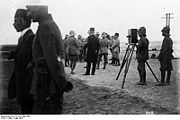 Goltz died on 19 April 1916, in Baghdad
, just two weeks before the British in Kut surrendered
. The official reason for his death was typhus
, although apparently there were rumors that he had been poisoned by the Turks. In accordance with his will, he was buried in the grounds of the German Consulate in Tarabya
, Istanbul
, overlooking the Bosporus
.
. In addition to many contributions to military periodicals, he wrote Kriegführung (1895), later titled Krieg und Heerführung, 1901 (The Conduct of War); Der Thessalische Krieg (The War in Greece, 1898); Ein Ausflug nach Macedonien (1894) (A Journey through Macedonia); Anatolische Ausflüge (1896) (Anatolian Travels); a map and description of the environs of Constantinople; Von Jena bis Pr. Eylau (1907) (From Jena to Eylau
).
Prussia
Prussia was a German kingdom and historic state originating out of the Duchy of Prussia and the Margraviate of Brandenburg. For centuries, the House of Hohenzollern ruled Prussia, successfully expanding its size by way of an unusually well-organized and effective army. Prussia shaped the history...
n Field Marshal
Generalfeldmarschall
Field Marshal or Generalfeldmarschall in German, was a rank in the armies of several German states and the Holy Roman Empire; in the Austrian Empire, the rank Feldmarschall was used...
and military writer.
Military career
Goltz was born in Bielkenfeld, East PrussiaEast Prussia
East Prussia is the main part of the region of Prussia along the southeastern Baltic Coast from the 13th century to the end of World War II in May 1945. From 1772–1829 and 1878–1945, the Province of East Prussia was part of the German state of Prussia. The capital city was Königsberg.East Prussia...
(later renamed Goltzhausen; now Ivanovka, near Polessk
Polessk
Polessk , prior to 1945 known by its German name Labiau is a town and the administrative center of Polessky District of Kaliningrad Oblast, Russia. Population: 4,744 ....
, Kaliningrad Oblast
Kaliningrad Oblast
Kaliningrad Oblast is a federal subject of Russia situated on the Baltic coast. It has a population of The oblast forms the westernmost part of the Russian Federation, but it has no land connection to the rest of Russia. Since its creation it has been an exclave of the Russian SFSR and then the...
), into an impoverished noble family. He grew up at the manor house of Fabiansfelde near Preußisch Eylau
Bagrationovsk
Bagrationovsk is a town and the administrative center of Bagrationovsky District of Kaliningrad Oblast, Russia, located south of Kaliningrad. Population: -History:...
, which had been bought by his father in 1844. His father spent some nineteen years in the Prussian Army without rising above the rank of lieutenant, and his efforts at farming were similarly unfruitful, and he eventually succumbed to cholera while on a trip to Danzig (now Gdańsk
Gdansk
Gdańsk is a Polish city on the Baltic coast, at the centre of the country's fourth-largest metropolitan area.The city lies on the southern edge of Gdańsk Bay , in a conurbation with the city of Gdynia, spa town of Sopot, and suburban communities, which together form a metropolitan area called the...
) when Colmar was six years old.
Goltz entered the Prussian infantry in 1861 as a second lieutenant with the 5th East Prussian Infantry Regiment Number 41, in Königsberg
Königsberg
Königsberg was the capital of East Prussia from the Late Middle Ages until 1945 as well as the northernmost and easternmost German city with 286,666 inhabitants . Due to the multicultural society in and around the city, there are several local names for it...
(now Kaliningrad
Kaliningrad
Kaliningrad is a seaport and the administrative center of Kaliningrad Oblast, the Russian exclave between Poland and Lithuania on the Baltic Sea...
). During 1864 he was on border duty at Thorn
Torun
Toruń is an ancient city in northern Poland, on the Vistula River. Its population is more than 205,934 as of June 2009. Toruń is one of the oldest cities in Poland. The medieval old town of Toruń is the birthplace of the astronomer Nicolaus Copernicus....
(Toruń
Torun
Toruń is an ancient city in northern Poland, on the Vistula River. Its population is more than 205,934 as of June 2009. Toruń is one of the oldest cities in Poland. The medieval old town of Toruń is the birthplace of the astronomer Nicolaus Copernicus....
), after which he entered the Berlin Military Academy, but was temporarily withdrawn in 1866 to serve in the Austro-Prussian War
Austro-Prussian War
The Austro-Prussian War was a war fought in 1866 between the German Confederation under the leadership of the Austrian Empire and its German allies on one side and the Kingdom of Prussia with its German allies and Italy on the...
, in which he was wounded at Trautenau. In 1867 he joined the topographical
Topography
Topography is the study of Earth's surface shape and features or those ofplanets, moons, and asteroids...
section of the general staff, and at the beginning of the Franco-Prussian War
Franco-Prussian War
The Franco-Prussian War or Franco-German War, often referred to in France as the 1870 War was a conflict between the Second French Empire and the Kingdom of Prussia. Prussia was aided by the North German Confederation, of which it was a member, and the South German states of Baden, Württemberg and...
of 1870-71 was attached to the staff of Prince Frederick Charles, commanding general of the Prussian Second Army. He took part in the battles of Vionville and Gravelotte
Battle of Gravelotte
The Battle of Gravelotte was a battle of the Franco-Prussian War named after Gravelotte, a village in Lorraine between Metz and the former French–German frontier.-Terrain and armies:...
and in the siege of Metz
Siege of Metz
The Siege of Metz lasting from 19 August – 27 October 1870 was fought during the Franco-Prussian War and ended in a decisive Prussian victory.-History:...
. After its fall he served under the Red Prince
Prince Frederick Charles of Prussia
Prince Friedrich Carl Nicolaus of Prussia was the son of Prince Charles of Prussia and his wife Princess Marie of Saxe-Weimar-Eisenach . Prince Frederick Charles was a grandson of King Frederick William III of Prussia and a nephew of Frederick William IV and William I...
in the campaign of the Loire, including the battles of Orleans
Battle of Orléans
Battle of Orléans may refer to*The Siege of Orléans of the Hundred Years War*Second Battle of Orléans - 2-4 December, also known as the Battle of Vaumainbert*The Attack on Orleans of the Great War...
and Le Mans
Battle of Le Mans
The Battle of Le Mans was a Prussian victory during the Franco-Prussian War which ended French resistance in western France.-Background:After the victory at the Battle of Orleans , Prince Friedrich Karl of Prussia marched his army further to the west towards Le Mans. Antoine Chanzy had under his...
.
Goltz was appointed professor at the military school at Potsdam
Potsdam
Potsdam is the capital city of the German federal state of Brandenburg and part of the Berlin/Brandenburg Metropolitan Region. It is situated on the River Havel, southwest of Berlin city centre....
in 1871, promoted to captain, and placed in the historical section of the general staff
German General Staff
The German General Staff was an institution whose rise and development gave the German armed forces a decided advantage over its adversaries. The Staff amounted to its best "weapon" for nearly a century and a half....
. It was then that he wrote Die Operationen der II. Armee bis zur Capitulation von Metz (The Operations of the Second Army until the surrender of Metz) and Die Sieben Tage von Le Mans (The Seven Days of Le Mans), both published in 1873. In 1874 he was appointed first general staff officer (Ia) of the 6th Division, and while so employed wrote Die Operationen der II. Armee an der Loire (The Operations of the Second Army on the Loire) and Léon Gambetta
Léon Gambetta
Léon Gambetta was a French statesman prominent after the Franco-Prussian War.-Youth and education:He is said to have inherited his vigour and eloquence from his father, a Genovese grocer who had married a Frenchwoman named Massabie. At the age of fifteen, Gambetta lost the sight of his right eye...
und seine Armeen (Léon Gambetta and his armies), published in 1875 and 1877 respectively. The latter was translated into French the same year, and is considered by many historians to be his most original contribution to military literature.
Goltz stressed how, despite the rapid initial victory against the Imperial French forces at Sedan, the new French Republic had been able to mobilise national will for a Volkskrieg ("War of the People") which dragged on for many more months (the Siege of Paris, the campaign on the Loire and the partisans behind German lines, the latter tying down 20% of German strength), the implication being that it was therefore unrealistic to expect a quick victory over France in any future war. The views expressed in the latter work were unpopular with the powers that be and led to Goltz's being sent back to regimental duty for a time, but it was not long before he returned to the military history section. In 1878 Goltz was appointed lecturer in military history at the military academy at Berlin, where he remained for five years and attained the rank of major. He published, in 1883, Roßbach und Jena (new and revised edition, Von Rossbach bis Jena und Auerstadt, 1906), Das Volk in Waffen (The Nation in Arms), both of which quickly became military classics, and during his residence in Berlin contributed many articles to the military journals.
Service with the Ottoman Empire
After defeat in the Russo-Turkish War (1877-1878), Sultan HamidAbdul Hamid II
His Imperial Majesty, The Sultan Abdülhamid II, Emperor of the Ottomans, Caliph of the Faithful was the 34th sultan of the Ottoman Empire...
, ruler of the Ottoman Empire
Ottoman Empire
The Ottoman EmpireIt was usually referred to as the "Ottoman Empire", the "Turkish Empire", the "Ottoman Caliphate" or more commonly "Turkey" by its contemporaries...
, asked for German aid in reorganizing the Ottoman Army, so that they would be able to resist the advance of the Russian Empire
Russian Empire
The Russian Empire was a state that existed from 1721 until the Russian Revolution of 1917. It was the successor to the Tsardom of Russia and the predecessor of the Soviet Union...
. Baron von der Goltz was sent. He spent twelve years on this work which provided the material for several of his books. After some years he was given the title Pasha
Pasha
Pasha or pascha, formerly bashaw, was a high rank in the Ottoman Empire political system, typically granted to governors, generals and dignitaries. As an honorary title, Pasha, in one of its various ranks, is equivalent to the British title of Lord, and was also one of the highest titles in...
(a signal honor for a non-Muslim) and in 1895, just before he returned to Germany, he was named Mushir
Mushir
A Mushir is the highest rank in most militaries of the Middle East. It is the equivalent to the ranks of General of the Army, Field Marshal, and Fleet Admiral.- Iraq :...
(field-marshal). His improvements to the Ottoman army were significant and the Turkish army stopped at the gates of Athens
Athens
Athens , is the capital and largest city of Greece. Athens dominates the Attica region and is one of the world's oldest cities, as its recorded history spans around 3,400 years. Classical Athens was a powerful city-state...
in the Greco-Turkish War (1897)
Greco-Turkish War (1897)
The Greco-Turkish War of 1897, also called the Thirty Days' War and known as the Black '97 in Greece, was a war fought between the Kingdom of Greece and Ottoman Empire. Its immediate cause was the question over the status of the Ottoman province of Crete, whose Greek majority long desired union...
, only when the Czar Nicholas II of Russia
Nicholas II of Russia
Nicholas II was the last Emperor of Russia, Grand Prince of Finland, and titular King of Poland. His official short title was Nicholas II, Emperor and Autocrat of All the Russias and he is known as Saint Nicholas the Passion-Bearer by the Russian Orthodox Church.Nicholas II ruled from 1894 until...
threatened the Ottoman Sultan that he would be attacking the Ottoman Empire from eastern Anatolia
Anatolia
Anatolia is a geographic and historical term denoting the westernmost protrusion of Asia, comprising the majority of the Republic of Turkey...
, unless the Ottoman Army stopped the campaign.
On his return to Germany in 1896 Goltz became a lieutenant-general and commander of the 5th division, and in 1898, head of the Engineer and Pioneer Corps and inspector-general of fortifications. In 1900 he was made general of infantry and in 1902 commander of the I. army corps. In 1907 he was made inspector-general of the newly created sixth army inspection established at Berlin, and in 1908 was given the rank of colonel-general (Generaloberst). Following the 1911 manœuvres Goltz was promoted to Generalfeldmarschall
Generalfeldmarschall
Field Marshal or Generalfeldmarschall in German, was a rank in the armies of several German states and the Holy Roman Empire; in the Austrian Empire, the rank Feldmarschall was used...
(Field Marshal), and retired from active service. In 1911 he founded the Jungdeutschlandbund (Young German League), an umbrella organization
Umbrella organization
An umbrella organization is an association of institutions, who work together formally to coordinate activities or pool resources. In business, political, or other environments, one group, the umbrella organization, provides resources and often an identity to the smaller organizations...
of right wing German youth associations.
In German service (1914–1915)
At the outbreak of the First World War Goltz was recalled to duty and appointed the military governor of BelgiumGeneral Governorate of Belgium
The Imperial German General Governorate of Belgium was a German military government established in occupied Belgium during the First World War. The governorate was set up on 26 August 1914, when Field Marshal Colmar Freiherr von der Goltz was appointed the military governor of Belgium...
. In that position, he dealt ruthlessly with what remained of Belgian resistance to German occupation, mostly sniper-fire and damaging rail and telegraph lines. As Martin Gilbert
Martin Gilbert
Sir Martin John Gilbert, CBE, PC is a British historian and Fellow of Merton College, University of Oxford. He is the author of over eighty books, including works on the Holocaust and Jewish history...
notes in The First World War, in early September 1914, the newly appointed Goltz proclaimed: "It is the stern necessity of war that the punishment for hostile acts falls not only on the guilty, but on the innocent as well." On 5 October, he was even clearer when he ordered: "In the future, villages in the vicinity of places where railway and telegraph lines are destroyed will be punished without pity (whether they are guilty or not of the acts in question). With this in view hostages have been taken in all villages near the railway lines which are threatened by such attacks. Upon the first attempt to destroy lines of railway, telegraph or telephone, they will immediately be shot."
Goltz' actions were praised by Adolf Hitler
Adolf Hitler
Adolf Hitler was an Austrian-born German politician and the leader of the National Socialist German Workers Party , commonly referred to as the Nazi Party). He was Chancellor of Germany from 1933 to 1945, and head of state from 1934 to 1945...
, who in September 1941 linked Nazi atrocities in Eastern Europe with those in Belgium during World War I.
In Ottoman service (1915-1916)
Soon afterward Goltz gave up that position and became a military aide to the (essentially powerless) Sultan Mehmed VMehmed V
Mehmed V Reshad was the 35th Ottoman Sultan. He was the son of Sultan Abdülmecid I. He was succeeded by his half-brother Mehmed VI.-Birth:...
. Baron von der Goltz did not get along with the head of the German mission to Turkey, Otto Liman von Sanders
Otto Liman von Sanders
Generalleutnant Otto Liman von Sanders was a German general who served as adviser and military commander for the Ottoman Empire during World War I.-Biography:...
, nor was he liked by the real power in the Ottoman Government, Enver Pasha.
Despite the mutual dislike, in mid-October 1915, with the British under General Townshend
Charles Vere Ferrers Townshend
Major General Sir Charles Vere Ferrers Townshend KCB, DSO was a British Indian Army officer who led the ultimately disastrous first British Expedition against Baghdad during World War I, and was later elected to Parliament....
advancing on Baghdad
Baghdad
Baghdad is the capital of Iraq, as well as the coterminous Baghdad Governorate. The population of Baghdad in 2011 is approximately 7,216,040...
, Enver Pasha put Goltz in charge of the Fifth Army (see the Mesopotamian Campaign
Mesopotamian Campaign
The Mesopotamian campaign was a campaign in the Middle Eastern theatre of World War I fought between the Allies represented by the British Empire, mostly troops from the Indian Empire, and the Central Powers, mostly of the Ottoman Empire.- Background :...
). Baron von der Goltz was in command at the Battle of Ctesiphon
Battle of Ctesiphon (1915)
The Battle of Ctesiphon was fought in November 1915 by the British Empire and British India, against the Ottoman Empire, within the Mesopotamian Campaign of World War I....
- which was a draw, as both sides retreated from the battlefield. However, with the British retreating, Goltz turned his army around and followed them down the river. When Townshend halted at Kut, Goltz laid siege to the British position (see the Siege of Kut
Siege of Kut
The siege of Kut Al Amara , was the besieging of 8,000 strong British-Indian garrison in the town of Kut, 100 miles south of Baghdad, by the Ottoman Army. Its known also as 1st Battle of Kut. In 1915, its population was around 6,500...
). Much like Julius Caesar
Julius Caesar
Gaius Julius Caesar was a Roman general and statesman and a distinguished writer of Latin prose. He played a critical role in the gradual transformation of the Roman Republic into the Roman Empire....
's legions at the Battle of Alesia
Battle of Alesia
The Battle of Alesia or Siege of Alesia took place in September, 52 BC around the Gallic oppidum of Alesia, a major town centre and hill fort of the Mandubii tribe...
, the Turkish 6th Army under the command of Halil Kut Pasha had to fight off a major British effort to relieve the Kut garrison while maintaining the siege. All told the British tried three different attacks and each one failed at a total cost of 23,000 casualties. The battles included The Battle of Wadi, The Battle of Hanna
Battle of Hanna
The First Battle of Hanna was a World War I battle fought on the Mesopotamian front on 21 January 1916 between Ottoman Army and Anglo-Indian forces.-Prelude:...
and the Battle of Dujaila
Battle of Dujaila
The Battle of Dujaila was fought on 8 March 1916, between British and Ottoman forces during the First World War. The Ottoman forces, led by Colmar Freiherr von der Goltz were besieging Kut, when the Anglo-Indian relief force, led by Lieutenant-General Fenton Aylmer, attempted to relieve the city...
.
Armenian Genocide
During the 1915 campaign of the Russians in eastern AnatoliaAnatolia
Anatolia is a geographic and historical term denoting the westernmost protrusion of Asia, comprising the majority of the Republic of Turkey...
, German officers had recommended the selected deportation of local Armenian population in Eastern Anatolia
Anatolia
Anatolia is a geographic and historical term denoting the westernmost protrusion of Asia, comprising the majority of the Republic of Turkey...
, in case the Russian advance caused an uprising. When Enver Pasha showed such orders to Goltz he approved of them as a military necessity. In the words of one historian, "Goltz's later actions to stop deportations indicate it is unlikely that he understood its larger significance." In December 1915 Goltz directly intervened, threatening to resign his command if the deportations were not halted. It was a measure of Goltz's stature in the Ottoman Empire
Ottoman Empire
The Ottoman EmpireIt was usually referred to as the "Ottoman Empire", the "Turkish Empire", the "Ottoman Caliphate" or more commonly "Turkey" by its contemporaries...
that he, as a foreign military officer, was able, if briefly, to influence domestic policy. However, he was able to effect only a temporary reprieve, and then only in Mesopotamia
Mesopotamia
Mesopotamia is a toponym for the area of the Tigris–Euphrates river system, largely corresponding to modern-day Iraq, northeastern Syria, southeastern Turkey and southwestern Iran.Widely considered to be the cradle of civilization, Bronze Age Mesopotamia included Sumer and the...
. It would have been almost unheard of for a soldier to resign during wartime, and in the end Goltz did not do so.
Death
Baghdad
Baghdad is the capital of Iraq, as well as the coterminous Baghdad Governorate. The population of Baghdad in 2011 is approximately 7,216,040...
, just two weeks before the British in Kut surrendered
Siege of Kut
The siege of Kut Al Amara , was the besieging of 8,000 strong British-Indian garrison in the town of Kut, 100 miles south of Baghdad, by the Ottoman Army. Its known also as 1st Battle of Kut. In 1915, its population was around 6,500...
. The official reason for his death was typhus
Typhus
Epidemic typhus is a form of typhus so named because the disease often causes epidemics following wars and natural disasters...
, although apparently there were rumors that he had been poisoned by the Turks. In accordance with his will, he was buried in the grounds of the German Consulate in Tarabya
Tarabya
Tarabya is a neighbourhood in Sarıyer district of Istanbul, Turkey. It is located on the European shores of the Bosphorus, between the neighbourhoods of Yeniköy and Kireçburnu....
, Istanbul
Istanbul
Istanbul , historically known as Byzantium and Constantinople , is the largest city of Turkey. Istanbul metropolitan province had 13.26 million people living in it as of December, 2010, which is 18% of Turkey's population and the 3rd largest metropolitan area in Europe after London and...
, overlooking the Bosporus
Bosporus
The Bosphorus or Bosporus , also known as the Istanbul Strait , is a strait that forms part of the boundary between Europe and Asia. It is one of the Turkish Straits, along with the Dardanelles...
.
Writing career
From the 1870s until World War I, Baron von der Goltz was more widely read by British and American military leaders than ClausewitzCarl von Clausewitz
Carl Philipp Gottfried von Clausewitz was a Prussian soldier and German military theorist who stressed the moral and political aspects of war...
. In addition to many contributions to military periodicals, he wrote Kriegführung (1895), later titled Krieg und Heerführung, 1901 (The Conduct of War); Der Thessalische Krieg (The War in Greece, 1898); Ein Ausflug nach Macedonien (1894) (A Journey through Macedonia); Anatolische Ausflüge (1896) (Anatolian Travels); a map and description of the environs of Constantinople; Von Jena bis Pr. Eylau (1907) (From Jena to Eylau
Battle of Eylau
The Battle of Eylau or Battle of Preussisch-Eylau, 7 and 8 February 1807, was a bloody and inconclusive battle between Napoléon's Grande Armée and a Russian Empire army under Levin August, Count von Bennigsen near the town of Preußisch Eylau in East Prussia. Late in the battle, the Russians...
).
See also
- Sigismund von SchlichtingSigismund von SchlichtingSigismund Wilhelm Lorenz von Schlichting was a Prussian general and military theorist, perhaps best known for his participation in the debates over infantry tactics in the 1880s and 1890s....
- Julius von Verdy du VernoisJulius von Verdy du VernoisJulius von Verdy du Vernois was a German general and staff officer, chiefly noted both for his military writings and his service on Graf Moltke's staff during the Franco-Prussian War.- Biography :...
- Bund der AsienkämpferBund der AsienkämpferThe Bund der Asienkämpfer , more rarely mentioned as Bund Deutscher Asienkämpfer , meaning "League of Asian Warriors" or "League of German Asian Warriors", was a social welfare organization for German veterans who had been in the Asien-Korps, the units of the German Empire at the service of the...
Partial list of works
- Feldzug 1870-71. Die Operationen der II. Armee. Berlin, 1873.
- Angeline. Stuttgart, 1877.
- Leon Gambetta und seine Armee. Berlin, 1877.
- Rossbach und Jena. Studien über die Zustände und das geistige Leben der preußischen Armee während der Uebergangszeit von XVIII. zum XIX. Jahrhundert. Berlin, 1883.
- Das Volk in Waffen, ein Buch über Heerwesen und Kriegführung unserer Zeit. Berlin, 1883.
- Ein Ausflug nach Macedonien. Berlin, 1894.
- Kriegführung. Kurze Lehre ihrer wichtigsten Grundsätze und Formen. Berlin, 1895.
- Anatolische Ausflüge, Reisebilder von Colmar Freiherr v. d. Goltz; mit 37 Bildern und 18 Karten. Berlin, 1896.
- Krieg- und Heerführung. Berlin, 1901.
- Von Rossbach bis Jena und Auerstedt; ein Beitrag zur Geschichte des preussischen Heeres. Berlin, 1906.
- Von Jena bis Pr. Eylau, des alten preussischen Heeres Schmach und Ehrenrettung; eine kriegsgeschichtliche Studie von Colmar Frhr. v. d. Goltz. Berlin, 1907.
- Jung-Deutschland; ein Beitrag zur Frage der Jugendpflege. Berlin, 1911.
- Kriegsgeschichte Deutschlands im neunzehnten Jahrhundert. Berlin, 1910-1912.
- 1813; Blücher und Bonaparte, von Feldmarschall Frhn. v. d. Goltz.. Stuttgart and Berlin, 1913.