

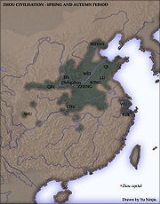
Spring and Autumn Period

Encyclopedia
The Spring and Autumn Period ( was a period in Chinese history
that roughly corresponds to the first half of the Eastern Zhōu Dynasty
(from 771 to 476 BC, although 403 BC is sometimes also considered the end of the period.) in the alluvial plain of the Yellow River
, the Shandong Peninsula and the river valleys of the Huái
and Hàn. ). Its name comes from the Spring and Autumn Annals
, a chronicle of the state of Lǔ
between 722 and 479 BC, which tradition associates with Confucius
. The period can also be further divided into three sub-periods:
During the Spring and Autumn period, China's feudal
system of fēngjiàn
became largely irrelevant. The Zhōu Dynasty kings held nominal power, but only had real control over a small royal demesne
centered on their capital Luò yì.
During the early part of the Zhōu Dynasty period, royal relatives and generals had been given control over fiefdoms in an effort to maintain Zhōu authority over vast territory, many of these broke up into smaller states
when the dynasty weakened.
The most important feudal princes (known later as the twelve vassals), met during regular conferences where important matters, such as military expeditions against foreign groups or offending nobles, were decided. During these conferences, one vassal leader was sometimes declared hegemon
and given leadership over the armies of all Zhōu states.
As the era unfolded, larger and more powerful states annexed or claimed suzerainty
over smaller ones. By the 6th century BC, most small states had disappeared and only a few large and powerful principalities dominated China. Some southern states, such as Chǔ
and Wú
, claimed independence from the Zhōu. Wars were undertaken to oppose some of these states (Wú and Yuè
).
Amid the interstate power struggles, internal conflict was also rife: six elite landholding families waged war on each other in Jìn; the Chen family was eliminating political enemies in Qí; and legitimacy of the rulers was often challenged in civil wars by various royal family members in Qín and Chǔ. Once all these powerful rulers had firmly established themselves within their respective dominions, the bloodshed focused more fully on interstate conflict in the Warring States Period
, which began in 403 BC when the three remaining elite families in Jìn – Zhào, Wèi and Hán – partitioned the state.
and Quǎnróng
barbarians, the Zhōu moved the capital east from the now desolated Zōngzhōu, to Chéngzhōu, in the Yellow River
Valley. The Zhōu royalty was then closer to its main supporters, particularly Qín, Jìn, and Zhèng
; the Zhōu royal family had much weaker authority and relied on lords from these vassal states for protection, especially during their flight to the eastern capital. In Chéngzhōu, prince Jī Yíjìu was crowned by his royal supporters as King Píng of Zhōu
. However, with the Zhōu domain greatly reduced to Chéngzhōu and nearby areas, the court could no longer support six groups of standing troops as it had in the past; Zhōu kings had to request help from neighbouring powerful states for protection from raids and for resolution of internal power struggles. The Zhōu court would never regain its original authority; instead, it was relegated to being merely a figurehead of the feudal states. Though the king de jure retained the Mandate of Heaven
, the title held no actual power.
With the decline of Zhōu power, the Yellow River drainage basin was divided into hundreds of small, autonomous states, most of them consisting of a single city, though a handful of multi-city states, particularly the four that surrounded the others, had power and opportunity to expand outward. A total of 148 states are mentioned in the chronicles for this period, 128 of which were absorbed by the four largest states by the end of the period.
While the Zhèng rulers initially supported the Zhōu royalty, relations soured enough that Duke Zhuāng of Zhèng
(757–701 BC) raided Zhōu territory in 707 BC, defeating King Húan
's army in battle and injuring the king himself; the display of Zhèng's martial strength was effective until succession problems after Zhuāng's death weakened the state.
, Southern Mán
, Eastern Yí
and Western Róng
. This political framework retained the fēngjiàn power structure, though interstate and intrastate conflict was characterized by a disregard for feudal customs, respect of the Jī family, or solidarity with other Zhōu peoples; because it was given through the king, military leadership garnered legitimacy useful in mobilizing interstate military ventures designed to protect Zhōu territory, including smaller states that would be otherwise taken over by "barbarians."
Over the next two centuries, the four most powerful states—Qín
, Jìn, Qí and Chǔ
—competed with each other for power. Amid rapid expansion and low-level warfare, interstate diplomacy was also commonly used to solidify alliances not based on kinship and to sanction legal agreements made between states. These multi-city states also used the pretext of aid and protection to intervene and gain suzerainty over the smaller states.
Ancient sources such as the Zuǒ Zhuàn
and Chūnqiū record the various diplomatic activities, such as court visits paid by one ruler to another (cháo 朝), meetings of officials or nobles of different states (huì 會), missions of friendly inquiries sent by the ruler of one state to another (pìn 聘), emissaries sent from one state to another (shǐ 使), and hunting parties attended by representatives of different states (shou 狩).
Because of Chǔ's non-Zhōu origin, its rulers, beginning with Mǐ Xióng Tōng in 704 BC, proclaimed themselves kings and the state was considered Mán or barbarian. Chǔ intrusion into Zhōu territory was checked several times by the other states, particularly in three major battles: the Battle of Chéngpū
(632 BC), the Battle of Bì (595 BC) and the Battle of Yānlíng
(575 BC); this resulted in the restorations of the states of Chén
and Cài
.
The first bà was Duke Huán of Qí (r. 685-643 BC). With the help of his minister, Guǎn Zhòng
, Duke Huán reformed Qí to centralize its power structure. The state consisted of 15 xiāng
with the duke and two senior ministers each in charge of five xiāng; military functions were also united with civil ones. These and other related reforms provided the state, already powerful from control of locations important to interstate trade, with a greater ability to mobilize resources than other, more loosely organized states. By 667 BC, Qí had clearly shown its economic and military dominance over other states and Duke Huán assembled the leaders of Lǔ
, Sòng
, Chén
, and Zhèng, who elected him leader over them. Soon after, King Hùi of Zhōu
gave him the official title of bà, giving Duke Huán royal authority in military ventures.
Using this authority, Duke Huán:
 At his death in 643 BC, five of Duke Huán's sons contended for the throne, causing enough state discord that the next Duke of Qí did not inherit the bà title. For nearly ten years, no ruler held the title. However, when Duke Wén of Jìn
(r. 636–628 BC) came to power, he capitalized on the reforms of his father, Duke Xiàn of Jìn
(r. 676–651 BC), who had centralized the state, killed off relatives who might threaten his authority, conquered sixteen smaller states, and even absorbed some Róng and Dí peoples to make Jìn much more powerful than it had been previously. When he assisted King Xīang of Zhōu
in a succession struggle in 635 BC, the King awarded Jìn with strategically valuable territory near Chéngzhōu.
Duke Wén of Jìn then used his growing power to coordinate a military response with Qí, Qín, and Sòng against Chǔ, which had begun encroaching northward after the death of Duke Huán of Qí. With a decisive Chǔ loss at the Battle of Chéngpū
(632 BC), Duke Wén's loyalty to the Zhōu king was soon rewarded at an interstate conference when King Xīang awarded him the title of bà.
 After the death of Duke Wén in 628 BC, a growing tension manifested in interstate violence that turned smaller states, particularly those at the border between Jìn and Chǔ, into sites of constant warfare; Qí and Qín also engaged in numerous interstate skirmishes with Jìn or its allies to boost their own power.
After a period of increasingly exhaustive warfare, Qí, Qín, Jìn and Chǔ met at a disarmament conference in 579 BC and agreed to declare a truce to limit their military strength. While this peace didn't last very long, it soon became apparent that the bà role had become outdated; the four major states had each acquired their own spheres of control and the notion of protecting Zhōu territory had become less cogent as the control over (and the resulting cultural assimilation of) non-Zhōu peoples, as well as Chǔ's control of some Zhōu areas, further blurred an already blurry distinction between Zhōu and non-Zhōu. In addition, new aristocratic houses were founded with loyalties to powerful states, rather than directly to the Zhou kings, though this process slowed down by the end of the seventh century BC, possibly because territory available for expansion had been largely exhausted. The Zhōu kings had also lost much of their prestige so that, when Duke Dào of Jìn (r. 572–558 BC) was recognized as bà, it carried much less meaning than it had before.
At the same time, internal conflicts between state leaders and local aristocrats occurred throughout the region. Eventually the dukes of Lǔ, Jìn, Zhèng, Wèi, and Qí became figureheads to powerful aristocratic families.
and Yuè
, grew in power as they gained relevance in interstate affairs. Starting around 583 BC, Jìn used aid to solidify an alliance with Wú, which then acted as a counterweight to Chǔ so that, while Jìn and Chǔ agreed to a truce in 546 BC to address wars over smaller states, Wú maintained constant military pressure on Chǔ and even launched a devastating full-scale invasion in 506 BC.
When the king of Wú died during an invasion of Yuè (496 BC), his son, King Fuchāi of Wú nearly destroyed the Yuè state, defeated Qí, threatened Jìn. In 482 BC, King Fuchāi held an interstate conference to solidify his power base, but Yuè captured the Wú capital. Fuchāi rushed back but was besieged and died when the city fell (473 BC). Yuè then concentrated on weaker neighboring states, rather than the great powers to the north.
, Wèi
, and Zhào
.
With the absorption of most smaller states in the era, this partitioning left seven major states in the Zhōu world: the three fragments of Jìn, the three remaining great powers of Qín, Chǔ and Qí, and the weaker state of Yān near modern Beijing. The partition of Jìn marks the beginning of the Warring States Period
.
States of the Spring and Autumn Period
 The five hegemons (春秋五霸):
Traditional history lists five hegemons during the Spring and Autumn Period:
An alternative list replaces the final two with:
Bureaucrats or Officers
Influential scholars
Other people
History of China
Chinese civilization originated in various regional centers along both the Yellow River and the Yangtze River valleys in the Neolithic era, but the Yellow River is said to be the Cradle of Chinese Civilization. With thousands of years of continuous history, China is one of the world's oldest...
that roughly corresponds to the first half of the Eastern Zhōu Dynasty
Zhou Dynasty
The Zhou Dynasty was a Chinese dynasty that followed the Shang Dynasty and preceded the Qin Dynasty. Although the Zhou Dynasty lasted longer than any other dynasty in Chinese history, the actual political and military control of China by the Ji family lasted only until 771 BC, a period known as...
(from 771 to 476 BC, although 403 BC is sometimes also considered the end of the period.) in the alluvial plain of the Yellow River
Yellow River
The Yellow River or Huang He, formerly known as the Hwang Ho, is the second-longest river in China and the sixth-longest in the world at the estimated length of . Originating in the Bayan Har Mountains in Qinghai Province in western China, it flows through nine provinces of China and empties into...
, the Shandong Peninsula and the river valleys of the Huái
Huai River
The Huai River is a major river in China. The Huai River is located about mid-way between the Yellow River and Yangtze River, the two largest rivers in China, and like them runs from west to east...
and Hàn. ). Its name comes from the Spring and Autumn Annals
Spring and Autumn Annals
The Spring and Autumn Annals is the official chronicle of the State of Lu covering the period from 722 BCE to 481 BCE. It is the earliest surviving Chinese historical text to be arranged on annalistic principles. The text is extremely concise and, if all the commentaries are excluded, about 16,000...
, a chronicle of the state of Lǔ
Lu (state)
The State of Lu, was a Zhou Dynasty ducal vassal state before and during the Spring and Autumn Period of Chinese history. Founded in the 10th century BC, its dukes used Ji as their family name. The first duke was Boqin |Qi]] and to the south by the powerful state of Chu...
between 722 and 479 BC, which tradition associates with Confucius
Confucius
Confucius , literally "Master Kong", was a Chinese thinker and social philosopher of the Spring and Autumn Period....
. The period can also be further divided into three sub-periods:
- Age of regional cultures (Early): 771–643, up to the death of Duke Huán of Qí
- Age of encroachments (Middle): 643–546, up to the peace conference between Jìn and Chǔ
- Age of reforms (Late): 546–403, up to the partition of Jìn
During the Spring and Autumn period, China's feudal
Feudalism
Feudalism was a set of legal and military customs in medieval Europe that flourished between the 9th and 15th centuries, which, broadly defined, was a system for ordering society around relationships derived from the holding of land in exchange for service or labour.Although derived from the...
system of fēngjiàn
Fengjian
Fēngjiàn is the political ideology of the Zhou Dynasty of ancient China. Fengjian is a "decentralized system of government," comparable to European feudalism, though recent scholarship has suggested that fengjian lacks some of the fundamental aspects of feudalism.-Ranks:The sizes of troops and...
became largely irrelevant. The Zhōu Dynasty kings held nominal power, but only had real control over a small royal demesne
Demesne
In the feudal system the demesne was all the land, not necessarily all contiguous to the manor house, which was retained by a lord of the manor for his own use and support, under his own management, as distinguished from land sub-enfeoffed by him to others as sub-tenants...
centered on their capital Luò yì.
During the early part of the Zhōu Dynasty period, royal relatives and generals had been given control over fiefdoms in an effort to maintain Zhōu authority over vast territory, many of these broke up into smaller states
Ancient Chinese states
Ancient Chinese States were typified by variously sized city states and territories that existed in China prior to its unification by Qin Shi Huang in 221 BCE. In many cases these were vassal states characterized by tribute paid to the ruling Zhou Dynasty...
when the dynasty weakened.
The most important feudal princes (known later as the twelve vassals), met during regular conferences where important matters, such as military expeditions against foreign groups or offending nobles, were decided. During these conferences, one vassal leader was sometimes declared hegemon
Hegemony
Hegemony is an indirect form of imperial dominance in which the hegemon rules sub-ordinate states by the implied means of power rather than direct military force. In Ancient Greece , hegemony denoted the politico–military dominance of a city-state over other city-states...
and given leadership over the armies of all Zhōu states.
As the era unfolded, larger and more powerful states annexed or claimed suzerainty
Suzerainty
Suzerainty occurs where a region or people is a tributary to a more powerful entity which controls its foreign affairs while allowing the tributary vassal state some limited domestic autonomy. The dominant entity in the suzerainty relationship, or the more powerful entity itself, is called a...
over smaller ones. By the 6th century BC, most small states had disappeared and only a few large and powerful principalities dominated China. Some southern states, such as Chǔ
Chu (state)
The State of Chu was a Zhou Dynasty vassal state in present-day central and southern China during the Spring and Autumn period and Warring States Period . Its ruling house had the surname Nai , and clan name Yan , later evolved to surname Mi , and clan name Xiong...
and Wú
Wu (state)
The State of Wu , also known as Gou Wu or Gong Wu , was one of the vassal states during the Western Zhou Dynasty and the Spring and Autumn Period. The State of Wu was located at the mouth of the Yangtze River east of the State of Chu. Considered a semi-barbarian state by ancient Chinese...
, claimed independence from the Zhōu. Wars were undertaken to oppose some of these states (Wú and Yuè
Yue (state)
Yue was a state in China which existed during the Spring and Autumn Period and the Warring States Period , in the modern province of Zhejiang. During the Spring and Autumn Period, its capital was in Guiji , near the modern city of Shaoxing...
).
Amid the interstate power struggles, internal conflict was also rife: six elite landholding families waged war on each other in Jìn; the Chen family was eliminating political enemies in Qí; and legitimacy of the rulers was often challenged in civil wars by various royal family members in Qín and Chǔ. Once all these powerful rulers had firmly established themselves within their respective dominions, the bloodshed focused more fully on interstate conflict in the Warring States Period
Warring States Period
The Warring States Period , also known as the Era of Warring States, or the Warring Kingdoms period, covers the Iron Age period from about 475 BC to the reunification of China under the Qin Dynasty in 221 BC...
, which began in 403 BC when the three remaining elite families in Jìn – Zhào, Wèi and Hán – partitioned the state.
Beginning of the Eastern Zhōu Dynasty
After the Zhōu capital was sacked by the Marquess of ShēnMarquess of Shen
The Marquess of Shēn was a ruler of the State of Shēn during the Zhōu Dynasty period of Chinese history. A vassal state of the Zhōu Kings, Shēn state covered the area of modern day Nanyang City in Henan Province....
and Quǎnróng
Quanrong
The Quǎnróng , literally "Dog Rong", were an ethnic group active in the north western part of China during the Zhōu and later dynasties. Their language is classified as part of the Tibeto-Burman branch of the Sino-Tibetan languages family....
barbarians, the Zhōu moved the capital east from the now desolated Zōngzhōu, to Chéngzhōu, in the Yellow River
Yellow River
The Yellow River or Huang He, formerly known as the Hwang Ho, is the second-longest river in China and the sixth-longest in the world at the estimated length of . Originating in the Bayan Har Mountains in Qinghai Province in western China, it flows through nine provinces of China and empties into...
Valley. The Zhōu royalty was then closer to its main supporters, particularly Qín, Jìn, and Zhèng
Zheng (state)
Zheng () was a vassal state in China during the Zhou Dynasty located in the centre of ancient China in modern day Henan Province on the North China Plain about east of the royal capital at Luoyang. It was the most powerful of the vassal states at the beginning of the Eastern Zhou...
; the Zhōu royal family had much weaker authority and relied on lords from these vassal states for protection, especially during their flight to the eastern capital. In Chéngzhōu, prince Jī Yíjìu was crowned by his royal supporters as King Píng of Zhōu
King Ping of Zhou
King Ping of Zhou , also referred to as Crown Prince Yijiu or King P'ing of Chou was the thirteenth sovereign of the Chinese Zhou Dynasty and the first of Eastern Zhou Dynasty...
. However, with the Zhōu domain greatly reduced to Chéngzhōu and nearby areas, the court could no longer support six groups of standing troops as it had in the past; Zhōu kings had to request help from neighbouring powerful states for protection from raids and for resolution of internal power struggles. The Zhōu court would never regain its original authority; instead, it was relegated to being merely a figurehead of the feudal states. Though the king de jure retained the Mandate of Heaven
Mandate of Heaven
The Mandate of Heaven is a traditional Chinese philosophical concept concerning the legitimacy of rulers. It is similar to the European concept of the divine right of kings, in that both sought to legitimaze rule from divine approval; however, unlike the divine right of kings, the Mandate of...
, the title held no actual power.
With the decline of Zhōu power, the Yellow River drainage basin was divided into hundreds of small, autonomous states, most of them consisting of a single city, though a handful of multi-city states, particularly the four that surrounded the others, had power and opportunity to expand outward. A total of 148 states are mentioned in the chronicles for this period, 128 of which were absorbed by the four largest states by the end of the period.
While the Zhèng rulers initially supported the Zhōu royalty, relations soured enough that Duke Zhuāng of Zhèng
Duke Zhuang of Zheng
Duke Zhuang of Zheng was the third ruler of the State of Zheng during the Spring and Autumn Period in ancient China. His ancestral name is Ji,given name is Wusheng , which means "a difficult birth". In 743 BC, he became the duke of Zheng, and later defeated his brother Gongshu Duan, who had led a...
(757–701 BC) raided Zhōu territory in 707 BC, defeating King Húan
King Huan of Zhou
King Huan of Zhou was the fourteenth sovereign of the Chinese Zhou Dynasty and the second of the Eastern Zhou Dynasty.-Personal information: Family name Jī Given name Lín Era name none Grandfather...
's army in battle and injuring the king himself; the display of Zhèng's martial strength was effective until succession problems after Zhuāng's death weakened the state.
Interstate relations
Shortly after the royal family's move to Chéngzhōu, a hierarchical alliance system arose where the Zhōu king would give the title of hegemon or bà to the leader of the state with the most powerful military; the bà was obligated to protect both the weaker Zhōu states and the Zhōu royalty from the intruding non-Zhōu peoples: Northern DíBeidi
Beidi or Northern Di were groups of people who lived to the north of what was then China during the Zhou Dynasty. By the end of the dynasty they were mostly conquered or absorbed by the Chinese....
, Southern Mán
Nanman
Nanman were aboriginal tribes who lived in southwestern China. They may have been related to the Sanmiao, dated to around the 3rd century BC. The Nanman were multiple ethnic groups including the Miao, the Kinh, the Thai, and some Tibeto-Burman groups such as the Bai. There was never a single...
, Eastern Yí
Dongyi
Dongyi was a collective term for people in eastern China and in lands located to the east of ancient China. People referred to as Dongyi vary across the ages.The early Dongyi culture was one of earliest neolithic cultures in China....
and Western Róng
Xirong (people)
Xīróng or Rong was the collective name of various ancient nomadic tribal people who inhabited primarily in and around the extremities of ancient Huaxia, typically to the west of the Zhou state in the modern-day provinces of Shaanxi, Gansu and Ningxia from the Zhou Dynasty onwards, and regarded...
. This political framework retained the fēngjiàn power structure, though interstate and intrastate conflict was characterized by a disregard for feudal customs, respect of the Jī family, or solidarity with other Zhōu peoples; because it was given through the king, military leadership garnered legitimacy useful in mobilizing interstate military ventures designed to protect Zhōu territory, including smaller states that would be otherwise taken over by "barbarians."
Over the next two centuries, the four most powerful states—Qín
Qin (state)
The State of Qin was a Chinese feudal state that existed during the Spring and Autumn and Warring States Periods of Chinese history...
, Jìn, Qí and Chǔ
Chu (state)
The State of Chu was a Zhou Dynasty vassal state in present-day central and southern China during the Spring and Autumn period and Warring States Period . Its ruling house had the surname Nai , and clan name Yan , later evolved to surname Mi , and clan name Xiong...
—competed with each other for power. Amid rapid expansion and low-level warfare, interstate diplomacy was also commonly used to solidify alliances not based on kinship and to sanction legal agreements made between states. These multi-city states also used the pretext of aid and protection to intervene and gain suzerainty over the smaller states.
Ancient sources such as the Zuǒ Zhuàn
Zuo Zhuan
The Zuo Zhuan , sometimes translated as the Chronicle of Zuo or the Commentary of Zuo, is among the earliest Chinese works of narrative history and covers the period from 722 BCE to 468 BCE. It is one of the most important sources for understanding the history of the Spring and Autumn Period...
and Chūnqiū record the various diplomatic activities, such as court visits paid by one ruler to another (cháo 朝), meetings of officials or nobles of different states (huì 會), missions of friendly inquiries sent by the ruler of one state to another (pìn 聘), emissaries sent from one state to another (shǐ 使), and hunting parties attended by representatives of different states (shou 狩).
Because of Chǔ's non-Zhōu origin, its rulers, beginning with Mǐ Xióng Tōng in 704 BC, proclaimed themselves kings and the state was considered Mán or barbarian. Chǔ intrusion into Zhōu territory was checked several times by the other states, particularly in three major battles: the Battle of Chéngpū
Battle of Chengpu
The Battle of Chengpu took place in 632 BC between the State of Jin and the State of Chu and its allies during the Spring and Autumn Period of Chinese history. It was the first great battle in the protracted conflict between the states of the Yellow River valley, and the states of the Yangtze...
(632 BC), the Battle of Bì (595 BC) and the Battle of Yānlíng
Battle of Yanling
The Battle of Yanling was fought in 575 BC between the armies of the States of Chu and Jin at Yanling in ancient China during the Spring and Autumn Period. On the Jin side, Xi Qi commanded the right wing whilst Luan Shu commanded the center with Han Jue on the left...
(575 BC); this resulted in the restorations of the states of Chén
Chen (state)
Chen was a minor Zhou Dynasty vassal state during the Spring and Autumn Period of Chinese History. It was a relatively minor state based on a single urban centre near what is now Huaiyang County in the plains of eastern Henan province...
and Cài
Cai (state)
The State of Cài was a Chinese state during the Zhōu Dynasty , prominent in the Spring and Autumn Period before being extinguished early in the Warring States Period .-History:...
.
The first bà was Duke Huán of Qí (r. 685-643 BC). With the help of his minister, Guǎn Zhòng
Guan Zhong
Guǎn Zhòng was a politician and statesman during the Spring and Autumn Period of Chinese history. His given name was Yíwú . Zhong was his courtesy name. Recommended by Bao Shuya, he was appointed Prime Minister by Duke Huan of Qi in 685 BC.-Achievements:Guan Zhong modernized the Qi State by...
, Duke Huán reformed Qí to centralize its power structure. The state consisted of 15 xiāng
Township (China)
Township may refer to:* Townships of the People's Republic of China* Township...
with the duke and two senior ministers each in charge of five xiāng; military functions were also united with civil ones. These and other related reforms provided the state, already powerful from control of locations important to interstate trade, with a greater ability to mobilize resources than other, more loosely organized states. By 667 BC, Qí had clearly shown its economic and military dominance over other states and Duke Huán assembled the leaders of Lǔ
Lu (state)
The State of Lu, was a Zhou Dynasty ducal vassal state before and during the Spring and Autumn Period of Chinese history. Founded in the 10th century BC, its dukes used Ji as their family name. The first duke was Boqin |Qi]] and to the south by the powerful state of Chu...
, Sòng
Song (state)
Sòng was a state during the Eastern Zhou Spring and Autumn Period . Its capital was Shangqiu . In 701 BC, a political marriage between Lady Yong of Song and Duke Zhuang of Zheng empowered Song to manipulate the management of Zheng.- Origin :After King Wu of Zhou overthrew King Zhou of Shang,...
, Chén
Chen (state)
Chen was a minor Zhou Dynasty vassal state during the Spring and Autumn Period of Chinese History. It was a relatively minor state based on a single urban centre near what is now Huaiyang County in the plains of eastern Henan province...
, and Zhèng, who elected him leader over them. Soon after, King Hùi of Zhōu
King Hui of Zhou
For the King Hui proclaimed as King Nan of Zhou's successor, see King Hui of Eastern ZhouKing Hui of Zhou, ch. 周惠王, py. zhōu hùi wáng, wg...
gave him the official title of bà, giving Duke Huán royal authority in military ventures.
Using this authority, Duke Huán:
- intervened in a power struggle in Lu;
- protected YānYan (state)Yān was a state during the Western Zhou, Spring and Autumn and Warring States Periods of Chinese history. Its capital was Ji...
from encroaching RóngXirong (people)Xīróng or Rong was the collective name of various ancient nomadic tribal people who inhabited primarily in and around the extremities of ancient Huaxia, typically to the west of the Zhou state in the modern-day provinces of Shaanxi, Gansu and Ningxia from the Zhou Dynasty onwards, and regarded...
nomads (664 BC); - drove off DíBeidiBeidi or Northern Di were groups of people who lived to the north of what was then China during the Zhou Dynasty. By the end of the dynasty they were mostly conquered or absorbed by the Chinese....
nomads after they'd invaded WèyWei (Spring and Autumn Period)This article is about the State of Wei founded during the Spring and Autumn Period. For the Warring States Period state whose name is pronounced identically, see Wei ....
(660 BC) and XíngXing (state)The State of Xíng was a vassal state of ancient China during the Zhou Dynasty and Spring and Autumn Period , ruled by descendants of the Jí family...
(659 BC), providing the people with provisions and protective garrison units; - led an alliance of eight states to conquer CàiCai (state)The State of Cài was a Chinese state during the Zhōu Dynasty , prominent in the Spring and Autumn Period before being extinguished early in the Warring States Period .-History:...
and thereby block the northward expansion of ChǔChu (state)The State of Chu was a Zhou Dynasty vassal state in present-day central and southern China during the Spring and Autumn period and Warring States Period . Its ruling house had the surname Nai , and clan name Yan , later evolved to surname Mi , and clan name Xiong...
(656 BC);
Duke Wen of Jin
Duke Jin Wen led the state of Jin in the Spring and Autumn Period of Chinese history from 636 BC to 628 BC. His ancestral name is Ji,clan name is Jin Duke Jin Wen (晋文公) (697 BC - 628 BC) led the state of Jin in the Spring and Autumn Period of Chinese history from 636 BC to 628 BC. His ancestral...
(r. 636–628 BC) came to power, he capitalized on the reforms of his father, Duke Xiàn of Jìn
Duke Xian of Jin
Duke Xian of Jin , Ancestral name is Ji, given name is Guizhu , was the nineteenth ruler of the State of Jin. He was also the ninth ruler of Jin in the Spring and Autumn Period and the second duke of Jin. When his father, Duke Wu of Jin, died in 677 BC, Guizhu ascended the throne of Jin and became...
(r. 676–651 BC), who had centralized the state, killed off relatives who might threaten his authority, conquered sixteen smaller states, and even absorbed some Róng and Dí peoples to make Jìn much more powerful than it had been previously. When he assisted King Xīang of Zhōu
King Xiang of Zhou
King Xiang of Zhou was the eighteenth sovereign of the Chinese Zhou Dynasty and the sixth of Eastern Zhou Dynasty. In 635 he was driven from the capital by his brother Zhao and was restored by Duke Wen of Jin....
in a succession struggle in 635 BC, the King awarded Jìn with strategically valuable territory near Chéngzhōu.
Duke Wén of Jìn then used his growing power to coordinate a military response with Qí, Qín, and Sòng against Chǔ, which had begun encroaching northward after the death of Duke Huán of Qí. With a decisive Chǔ loss at the Battle of Chéngpū
Battle of Chengpu
The Battle of Chengpu took place in 632 BC between the State of Jin and the State of Chu and its allies during the Spring and Autumn Period of Chinese history. It was the first great battle in the protracted conflict between the states of the Yellow River valley, and the states of the Yangtze...
(632 BC), Duke Wén's loyalty to the Zhōu king was soon rewarded at an interstate conference when King Xīang awarded him the title of bà.
Changing tempo of war
After a period of increasingly exhaustive warfare, Qí, Qín, Jìn and Chǔ met at a disarmament conference in 579 BC and agreed to declare a truce to limit their military strength. While this peace didn't last very long, it soon became apparent that the bà role had become outdated; the four major states had each acquired their own spheres of control and the notion of protecting Zhōu territory had become less cogent as the control over (and the resulting cultural assimilation of) non-Zhōu peoples, as well as Chǔ's control of some Zhōu areas, further blurred an already blurry distinction between Zhōu and non-Zhōu. In addition, new aristocratic houses were founded with loyalties to powerful states, rather than directly to the Zhou kings, though this process slowed down by the end of the seventh century BC, possibly because territory available for expansion had been largely exhausted. The Zhōu kings had also lost much of their prestige so that, when Duke Dào of Jìn (r. 572–558 BC) was recognized as bà, it carried much less meaning than it had before.
At the same time, internal conflicts between state leaders and local aristocrats occurred throughout the region. Eventually the dukes of Lǔ, Jìn, Zhèng, Wèi, and Qí became figureheads to powerful aristocratic families.
Rise of Wú and Yuè
Amid conflict between Jìn and Chǔ, two coastal states with dubious Zhōu ties, WúWu (state)
The State of Wu , also known as Gou Wu or Gong Wu , was one of the vassal states during the Western Zhou Dynasty and the Spring and Autumn Period. The State of Wu was located at the mouth of the Yangtze River east of the State of Chu. Considered a semi-barbarian state by ancient Chinese...
and Yuè
Yue (state)
Yue was a state in China which existed during the Spring and Autumn Period and the Warring States Period , in the modern province of Zhejiang. During the Spring and Autumn Period, its capital was in Guiji , near the modern city of Shaoxing...
, grew in power as they gained relevance in interstate affairs. Starting around 583 BC, Jìn used aid to solidify an alliance with Wú, which then acted as a counterweight to Chǔ so that, while Jìn and Chǔ agreed to a truce in 546 BC to address wars over smaller states, Wú maintained constant military pressure on Chǔ and even launched a devastating full-scale invasion in 506 BC.
When the king of Wú died during an invasion of Yuè (496 BC), his son, King Fuchāi of Wú nearly destroyed the Yuè state, defeated Qí, threatened Jìn. In 482 BC, King Fuchāi held an interstate conference to solidify his power base, but Yuè captured the Wú capital. Fuchāi rushed back but was besieged and died when the city fell (473 BC). Yuè then concentrated on weaker neighboring states, rather than the great powers to the north.
Partition of Jin
After the great age of Jìn power, the Jìn dukes began to lose authority over their nobles. A full-scale civil war between 497 and 453 BC ended with the elimination of most noble lines; the remaining aristocratic families divided Jìn into three successor states: HánHan (state)
Han was a kingdom during the Warring States Period in China, located in modern-day Shanxi and Henan. Not to be confused with South Korea which shares the same character....
, Wèi
Wei (state)
The State of Wei was a Zhou Dynasty vassal state during the Warring States Period of Chinese history. Its territory lay between the states of Qin and Qi and included parts of modern day Henan, Hebei, Shanxi and Shandong...
, and Zhào
Zhao (state)
Zhao was a significant Chinese state during the Warring States Period, along with six others...
.
With the absorption of most smaller states in the era, this partitioning left seven major states in the Zhōu world: the three fragments of Jìn, the three remaining great powers of Qín, Chǔ and Qí, and the weaker state of Yān near modern Beijing. The partition of Jìn marks the beginning of the Warring States Period
Warring States Period
The Warring States Period , also known as the Era of Warring States, or the Warring Kingdoms period, covers the Iron Age period from about 475 BC to the reunification of China under the Qin Dynasty in 221 BC...
.
List of States
A total of 148 states are mentioned in the chronicles for this period.States of the Spring and Autumn Period
| Name | Chinese (Trad./Simp.) |
Capital (s) | Established | Dissolved |
|---|---|---|---|---|
| Bā Ba (state) Ba was an ancient state in eastern Sichuan, China. Its original capital was Yicheng , Hubei. Ba was conquered by Qin in 316 BC. The modern ethnic minority Tujia people trace some of their origins back to the Ba people.... |
巴 | Yíchéng Enshi City - Transportation :* Yiwan Railway* China National Highway 209* G50 Shanghai–Chongqing Expressway, which crosses the Qingjiang River near the city over the Qingjiang Bridge.-External links:*... (夷城) Píngdū (平都) Zhǐ Fuling District Fuling District is a district in the middle of Chongqing Municipality, People's Republic of China. Its name means "Fu Cemetery" because some rulers of the State of Ba were originally buried there.... (枳) Jīangzhōu Yuzhong District Yuzhong District is the central district and heart of Chongqing municipality. It is the capital of the municipality and is also the political, economical, and entertainment center of the city of Chongqing... (江州) Diànjīang (垫江) Lánzhōng Langzhong Langzhong is a 2300 year old city located in Nanchong, Sichuan province.The town's perimeter is 1.5 km². In 1986 the State Council named it a famous and historical town.-Transport:*China National Highway 212... (阆中) |
unknown | 316 BC |
| Cài Cai (state) The State of Cài was a Chinese state during the Zhōu Dynasty , prominent in the Spring and Autumn Period before being extinguished early in the Warring States Period .-History:... |
蔡 | Shàngcài Shangcai County Shangcai County is a county of Henan, China. It is under the administration of Zhumadian city.- See also:* Cai , an ancient state in that area... (上蔡) Xīncài Xincai County Xincai County is a county of Henan, China. It is under the administration of Zhumadian city.-Administrative divisions:The county of Xincai administers 9 towns and 13 villages.*Gulu Town *Tangcun Town *Liancun Town **佛阁寺镇*龙口镇*砖店镇... (新蔡) Xiàcài Fengtai County Fengtai County is a county of Anhui Province , China. It is under the administration of Huainan city .... (下蔡) |
Before 1043 BC | 447 BC |
| Cáo Cao (state) The State of Cáo was a vassal state in China during the Zhou Dynasty . The state was founded sometime in the 11th century BCE by Caoshu Zhènduó (曹叔振鐸), son of King Wen of Zhou and the younger brother of King Wu of Zhou. With its capital at Táoqiū , the State of Cáo covered roughly the area of... |
曹 | Táoqiū Dingtao County Dingtao County is a county under the jurisdiction of Heze in Shandong province, China. It has a very long history. Its name originated during the Warring States Period from Fan Li, a famous chancellor in the Yue kingdom... (陶丘) |
Before 1043 BC | 487 BC |
| Chén Chen (state) Chen was a minor Zhou Dynasty vassal state during the Spring and Autumn Period of Chinese History. It was a relatively minor state based on a single urban centre near what is now Huaiyang County in the plains of eastern Henan province... |
陳/陈 | Wǎnqiū Huaiyang County Huaiyang County is a county in the prefecture-level city of Zhoukou in Henan province, People's Republic of China. During the Spring and Autumn Period the capital of the state of Chen was located there.... (宛丘) |
c. 1046 BC | 479 BC |
| Chéng | 郕 | (Western Zhōu Period 1066 – 770 BC) In the vicinity of the Zhōu capital Haojing Haojing This article is about the ancient Zhou Dynasty capital, for Haojing'ao see MacauHaojing was one of the two settlements comprising the capital of the Western Zhou Dynasty , the other of which was Fēngjīng . Together they were known as Fēnghào and stood on opposite banks of the Feng River with... 郕 (Chéng), Shandong Shandong ' is a Province located on the eastern coast of the People's Republic of China. Shandong has played a major role in Chinese history from the beginning of Chinese civilization along the lower reaches of the Yellow River and served as a pivotal cultural and religious site for Taoism, Chinese... |
c. 1100 BC | unknown |
| Chǔ Chu (state) The State of Chu was a Zhou Dynasty vassal state in present-day central and southern China during the Spring and Autumn period and Warring States Period . Its ruling house had the surname Nai , and clan name Yan , later evolved to surname Mi , and clan name Xiong... |
楚 | Dānyáng Zhijiang, Hubei Zhijiang is a county-level city in Yichang Municipality, Hubei province. Yichang is probably best known for the Three Gorges hydro project. Until the 1990s Zhijiang was a county... (丹陽/丹阳)c. 1030 – c. 680 BC Yǐng Ying (Chu) Yǐng was a capital city of the State of Chu during the Spring and Autumn and Warring States Periods of Chinese History.In the early years of Chu’s development, the state capital was located at Danyang , near modern day Xichuan County in Henan Province... (郢) c.680 – 278 BC Chén (陳/陈) 278 – 241 BC Shòuchūn (寿春) from 241 – 224 BC |
c. 1030 BC | 223 BC |
| Dào Dao (state) The State of Dao was a Chinese vassal state during the Zhou Dynasty located in the southern part of Runan County, Henan. Dao existed in the shadow of the powerful neighbouring State of Chu which was held in check by the equally powerful State of Qi... |
道 | Dào (possibly north of modern day Quèshān County Queshan County Queshan County is a county in Zhumadian Prefecture, Henan Province, China.-External links:... , Henan Henan Henan , is a province of the People's Republic of China, located in the central part of the country. Its one-character abbreviation is "豫" , named after Yuzhou , a Han Dynasty state that included parts of Henan... or south of Xī County, Henan Xi County, Henan Xi County is a county of Henan, China. It is under the administration of Xinyang city.... ) |
unknown | unknown |
| Dèng Deng (state) The State of Deng was a Chinese vassal state during the Shang and Zhou Dynasties and the Spring and Autumn Period ruled by the Màn family .-Territory:... |
鄧/邓 | Dèngzhōu Dengzhou Dengzhou , formerly Deng County , is a city in Nanyang, Henan, China. it has an area of 2,294 km² and a population of 1,500,000. The urban area is 35 km², and the urban population is 300,000. The city is located in the southwest of Henan province, adjacent to the borders between Henan,... , Henan Province or Xiāngyáng Xiangyang Xiangzhou District is a district of Xiangyang, Hubei, China. The district itself was formerly known as Xiangyang. It was a city famous for the Siege of Xiangyang by invading forces of the Mongol-founded Yuan Dynasty... , Hubei Province |
c. 1200 BC | 678 BC |
| Dōng Guó Eastern Guo (state) The State of Eastern Guo was an important Chinese vassal state in the early years of the Western Zhou Dynasty .After King Wu of Zhou destroyed the Shang Dynasty in 1046 BCE, his two uncles received grants of land from King Wu’s father, King Wen of Zhou... |
東虢/东虢 | unknown | 1046 BC | 767 BC |
| È E (state) The State of È was a vassal state in present-day central China from the time of the Shang Dynasty until its overthrow in 863 BCE. E moved from its original location in what is now the southern province of Henan into Hubei Province... |
鄂 | Xiangning County Xiangning County Xiangning County is a county of Shanxi, China. It is under the administration of Linfen city.-References:*... , Shanxi Province, Nanyang, Henan Nanyang, Henan Nanyang is a prefecture-level city in the southwest of Henan province, People's Republic of China. The city with the largest administrative area in Henan, Nanyang borders Xinyang to the southeast, Zhumadian to the east, Pingdingshan to the northeast, Luoyang to the north, Sanmenxia to the... Province, Ezhou Ezhou -Geography and climate:Ezhou is located in southeastern Hubei province, on the southern bank of the Yangtze River east of Wuchang , and across the river from the city of Huanggang, to which it is connected by the Ehuang Bridge... Hubei Province |
c. 1200 BC | 863 BC |
| Huá Hua (state) Huáguó was a vassal state of Western Zhou that existed in what is now Henan, whose ruling elites belonged to the royal family but which was destroyed by the State of Qin in 627 BC. The population were the earlier Hua of the Spring and Autumn Period not the later Huá of the Hephthalites... |
滑 | Fèi Yanshi Yanshi is a county-level city administered by the prefecture-level city of Luoyang in western Henan province, People's Republic of China. The ancient Erlitou culture existed in the area. Yanshi lies on the Luo River. The ruins the first Shang Dynasty capital, Xibo, are located in Shixianggou... 費/费 |
unknown | 627 BC |
| Jìn | 晉/晋 | Táng Taiyuan Taiyuan is the capital and largest city of Shanxi province in North China. At the 2010 census, it had a total population of 4,201,591 inhabitants on 6959 km² whom 3,212,500 are urban on 1,460 km². The name of the city literally means "Great Plains", referring to the location where the Fen River... (唐), renamed Jìnyáng (晉陽/晋陽) Qǔwò Quwo County Quwo County is a county of Shanxi, China. It is under the administration of Linfen city. The town of Quwo is in the Fen River valley about 30 miles south of Linfen and about 10 miles east of the point where the Fen River turns west. From 745 to 677 BC Quwo a state that broke off from the State of... (曲沃) Jiàng Yicheng County Yicheng County is a county of Shanxi, China. It is under the administration of Linfen city.-References:*... (絳/绛) also known as Yì (翼) Xīntián Houma, Shanxi Houma is a city in the Shanxi province on the People's Republic of China, on the Fen River south of Linfen. It is 274 km large and has a population of 102,400.... (新田), renamed Xīnjiàng (新絳新绛) |
11th century BC | 376 BC |
| Jǔ Ju (state) The State of Ju was an ancient Dongyi state in the area of modern day Shandong Province, People's Repulic of China during the Zhou Dynasty . Shuowen Jiezi said Ju means Taro or a wooden tool. It was weakened by wars with the states of Chu and Qi. Finally, the state was annexed by the State of Qi.... |
莒 | Jiegen (介根), south west of modern day Jiaozhou, Shandong Province Ju (莒), modern day Ju County Ju County Ju County is a county of Rizhao City, Shandong Province, People's Republic of China.Ju County has a population of nearly 1.1016 million.The total area of 1952 square kilometers.-External links:*... , Shandong Province |
11th century BC | 431 BC |
| Lái Lai (state) Lai was an ancient Dongyi kingdom located what is now east Shandong. The Book of Xia had already recorded it. It was weakened and annexed in 567 BCE by the Qi .... |
莱/萊 | Changle (昌乐), modern day Changle County Changle County Changle County is under the administration of Weifang, in Shandong Province. The ancient Kingdom of Beihai was located to the west of present day Changle County.... , Shandong Province |
11th century BC | 567 BC |
| Liáng Liang (state) The State of Liang was one of the states during the Spring and Autumn Period , bordering the State of Qin and was conquered by Duke Mu of Qin in 641 BCE. The rulers of the State of Liang has the surname Ying , similar to the neighboring State of Qin... |
梁 | Hánchéng (韩城) | unknown | 641 BC |
| Liǎo Liao (state) The State of Liǎo was a Zhou Dynasty vassal state during the Spring and Autumn Period of Chinese History . There were two actual states called Liao at this time... |
蓼/廖国/飂 | Tanghe County Tanghe County Tanghe County, administered by Nanyang, Henan, People's Republic of China. Its ancient name was Tángzhōu .This county consists of 20 townships and 503 administrative villages, with the population being approximately 1,280,000 and total area being 2,512 km². The local economy is mainly based on... (唐河县), Henan Henan Henan , is a province of the People's Republic of China, located in the central part of the country. Its one-character abbreviation is "豫" , named after Yuzhou , a Han Dynasty state that included parts of Henan... |
unknown | unknown |
| Liǎo Liao (state) The State of Liǎo was a Zhou Dynasty vassal state during the Spring and Autumn Period of Chinese History . There were two actual states called Liao at this time... |
蓼国/缪蓼 | Liao town, northeast of Gushi County Gushi County Gushi County is a county of about 1,630,000 people of Xinyang City, southeastern Henan province, People's Republic of China.-Administration:Gushi has 10 towns and 22 townships.Towns:*Chengguan *Sanhejian *Chenlinzi *Liji... , Henan Province |
unknown | 622 BC |
| Lǔ Lu (state) The State of Lu, was a Zhou Dynasty ducal vassal state before and during the Spring and Autumn Period of Chinese history. Founded in the 10th century BC, its dukes used Ji as their family name. The first duke was Boqin |Qi]] and to the south by the powerful state of Chu... |
魯/鲁 | Lǔshān Lushan County, Henan Lushan County is a county in Pingdingshan, Henan Province, China, with a population is 830,000.... (魯山) Yǎnchéng (奄城) Qǔfù Qufu Qufu is a city in southwestern Shandong province, People's Republic of China. It is located at 35° 36′ northern latitude and 117° 02′ east, about south of the provincial capital Jinan and northeast of the prefecture seat at Jining... (曲阜) |
11th century BC | 256 BC |
| Lǚ Lü (state) Not to be confused with the State of Lu The State of Lü was a Zhou Dynasty vassal state in present-day central China in the early years of the Spring and Autumn Period .-Origin:... |
吕/呂 | West of modern Nanyang, Henan Nanyang, Henan Nanyang is a prefecture-level city in the southwest of Henan province, People's Republic of China. The city with the largest administrative area in Henan, Nanyang borders Xinyang to the southeast, Zhumadian to the east, Pingdingshan to the northeast, Luoyang to the north, Sanmenxia to the... |
unknown | early Spring and Autumn Period |
| Pī Pi (state) The State of Pī was a Zhou Dynasty vassal state during the Spring and Autumn Period of Chinese history. Also known as the State of Xue , Pi was ruled by members of the Ren family... |
邳 | Xuecheng (薛城), 30 km south of Tengzhou Tengzhou Tengzhou is a county-level city of Zaozhuang, Shandong province of the People's Republic of China, and is the site of the feudal vassal State of Teng during the Spring and Autumn Period.The Mayor of Tengzhou is Du Yongguang... , Shandong Province Lower Pi (下邳), North east of Pizhou Pizhou Pizhou City is a county-level city in northern Jiangsu province, China. As of 2006 it had a population of 163,000. Administratively, Pizhou is under the jurisdiction of the larger city of Xuzhou.-History:... City, Shandong Province Upper Pi (上邳), West of the Xuecheng District, Zaozhuang City, Shandong Province |
11th century BC | unknown |
| Qí | 齊/齐 | Yíngqiū Linzi Linzi was the capital of Qi from 859 BC to 221 BC during the Spring and Autumn Period and Warring States Period in China. The ruins of the city lie in modern day Linzi District, Shandong, China. The city was one of the largest and richest in China during the Spring and Autumn Period... (營丘/营丘) |
1046 BC | 221 BC |
| Qǐ Qi (Henan) Qi was a minor feudal state that appears in Chinese history from the beginning of the Shang Dynasty until the beginning of the Warring States Period, circa 445 BCE.-History:... |
杞 | Qǐ Qi County, Kaifeng Qi County is a county of Kaifeng, Henan, People's Republic of China, with an area of 1243 square km and a population of 1.05 million.-History:... (杞) |
16th century BC | 445 BC |
| Qín Qin (state) The State of Qin was a Chinese feudal state that existed during the Spring and Autumn and Warring States Periods of Chinese history... |
秦 | Xīchuí (西垂) Yōng Fengxiang County Fengxiang County is a county administered by Baoji City, western Shaanxi Province, People’s Republic of China. The county covers an area of and as of 2004 had a population of 510,000... (雍) ? – 350 BC Xiányáng Xianyang Xianyang is a former capital of China in Shaanxi province, on the Wei River, a few kilometers upstream from Xi'an. It has an area of... (咸阳) 350 – 206 BC |
9th century BC | 206 BC |
| Quán Quan (state) The State of Quán was a small Zhou Dynasty vassal state of Central China. A marquessate , its rulers were descendants of Shang Dynasty ruler Wu Ding with the surname Zi... |
权/權 | South east of Dangyang Dangyang Dangyang City , in Hubei Province, China, lies 70 km east of the Gezhouba Dam on the Yangtze River. During the Western Han Dynasty . Emperor Jing of Han established an administration in Dangyang on an area of 2000 km²... , Hubei Province |
unknown | 704 BC |
| Ruò Ruo (state) The State of Ruò was a small vassal state during the Chinese Zhou Dynasty whose rulers used the title Zǐ , roughly equivalent to a Viscount. Located between the States of Qin and Chu, Ruo was eventually annexed by the State of Chu.... |
鄀 | Shāngruò Nanyang, Henan Nanyang is a prefecture-level city in the southwest of Henan province, People's Republic of China. The city with the largest administrative area in Henan, Nanyang borders Xinyang to the southeast, Zhumadian to the east, Pingdingshan to the northeast, Luoyang to the north, Sanmenxia to the... (上鄀)/Shāngmì (商密) Xìaruò Yicheng, Hubei Yicheng is a city district of Hubei, China. It is under the administration of Xiangfan city.... (下鄀) |
unknown | unknown |
| Shēn Shen (state) The State of Shen was a Chinese vassal state during the Zhou Dynasty ruled by the Jiāng family as an earldom. At the beginning of the Spring and Autumn Period the State of Shen was annexed by the State of Chu and became one of its counties.-Territory:Located around the states of Chén and Zhèng,... |
申 | Nányáng Nanyang, Henan Nanyang is a prefecture-level city in the southwest of Henan province, People's Republic of China. The city with the largest administrative area in Henan, Nanyang borders Xinyang to the southeast, Zhumadian to the east, Pingdingshan to the northeast, Luoyang to the north, Sanmenxia to the... (南阳) |
unknown | between 688 and 680 BC |
| Shǔ Shu (state) The State of Shu was an ancient state in what is now Sichuan, China. It was conquered by Qin in 316 BC. Shu was based on the Chengdu Plain, in the western Sichuan basin with some extension northeast to the upper Han River valley. To the east was the Ba tribal confederation. Further east down the... |
蜀 | possibly Sānxīngduī Sanxingdui Sanxingdui is the name of an archaeological site and its deduced culture in China, now believed to be the site of an ancient Chinese city. The previously unknown Bronze Age culture was re-discovered in 1987 when archaeologists excavated remarkable artifacts, that radiocarbon dating dated as being... (三星堆) |
Before 1046 BC | 316 BC |
| Sòng Song (state) Sòng was a state during the Eastern Zhou Spring and Autumn Period . Its capital was Shangqiu . In 701 BC, a political marriage between Lady Yong of Song and Duke Zhuang of Zheng empowered Song to manipulate the management of Zheng.- Origin :After King Wu of Zhou overthrew King Zhou of Shang,... |
宋 | Shāngqiū Shangqiu Shangqiu is a city in eastern Henan province, Central China. It borders Kaifeng to the northwest, Zhoukou to the southwest, and the provinces of Shandong and Anhui to the northeast and southeast respectively. An ancient city with a rich history, Shangqiu was also the first capital of the Shang... (商丘) |
11th century BC | 286 BC |
| Suí Sui (state) The State of Suí was a Zhou Dynasty vassal state located in Hubei Province, China during the Spring and Autumn and Warring States Periods located in the Han River Basin... |
随/隨 | Suízhōu Suizhou Suizhou , formerly Sui County , is a prefecture-level city in Hubei province of Central China.-Administration:The prefecture-level city of Suizhou administers 2 county-level divisions, including 1 district and 1 county-level city.... (随州) |
Early Spring and Autumn Period | unknown |
| Téng Teng (state) The State of Teng was a small Chinese state that existed during the Spring and Autumn Period and the Warring States Period, and was located in the south of modern-day Shandong province. Its territory is now the county-level city of Tengzhou.... |
滕 | Téng (滕) | Before 1043 BC | mid 4th century BC |
| Wèi Wei (state) The State of Wei was a Zhou Dynasty vassal state during the Warring States Period of Chinese history. Its territory lay between the states of Qin and Qi and included parts of modern day Henan, Hebei, Shanxi and Shandong... |
魏 | Anyi (安邑), north west of modern day Xia County, Shanxi Xia County, Shanxi Xia is a county in the northern province of Shanxi in the People's Republic of China. It is under the jurisdiction of Yuncheng City , in the southernmost region of Shanxi.-See also:*List of administrative divisions of Shanxi... Province Daliang (大梁), modern day Kaifeng Kaifeng Kaifeng , known previously by several names , is a prefecture-level city in east-central Henan province, Central China. Nearly 5 million people live in the metropolitan area... City, Henan Province |
403 BC | 225 BC |
| Wèy Wei (Spring and Autumn Period) This article is about the State of Wei founded during the Spring and Autumn Period. For the Warring States Period state whose name is pronounced identically, see Wei .... |
卫/衛 | Zhāogē Zhaoge Zhaoge was the capital of Shang Dynasty, and later capital of State of Wei . It is located in current Qi County, Hebi, Henan.... .(朝歌) Cáo Hua County, Henan Hua County is a county under Anyang municipality, Henan, China.-Location:The Hua county is located in the southmost part of Anyang. To its north lies Neihuang County, also in Anyang; to its east Puyang County in Puyang; to its south the counties of Changyuan and Fengqiu, both in Xinxiang; to its... (曹) Chǔqiū (楚丘) Dìqiū Puyang County Puyang County is a county of Henan, China. It is under the administration of Puyang city.... (帝丘) Yěwáng (野王) |
11th century BC | 209 BC |
| Wú Wu (state) The State of Wu , also known as Gou Wu or Gong Wu , was one of the vassal states during the Western Zhou Dynasty and the Spring and Autumn Period. The State of Wu was located at the mouth of the Yangtze River east of the State of Chu. Considered a semi-barbarian state by ancient Chinese... |
吴/吳 | Wú Suzhou Suzhou , previously transliterated as Su-chou, Suchow, and Soochow, is a major city located in the southeast of Jiangsu Province in Eastern China, located adjacent to Shanghai Municipality. The city is situated on the lower reaches of the Yangtze River and on the shores of Taihu Lake and is a part... (吳/吴), sometimes referred to as Gūsū(姑蘇/姑苏) |
11th century BC | 473 BC |
| Xī Xi (state) The State of Xi was a Chinese vassal state during the Shang and Zhou Dynasties and the Spring and Autumn Period ruled by members of the Jī family . Sometime between 680 and 684 BCE the State of Xī was annexed by the State of Chu and ceased to exist as an independent state.-History:In 712 BCE the... |
息 | Xī Xiàn Xi County, Henan Xi County is a county of Henan, China. It is under the administration of Xinyang city.... (息县) |
1122 BC | Between 684 and 680 BC |
| Xī Guó Western Guo (state) The State of Western Guo was a vassal state in China during the Zhou Dynasty. "Guo" seems to have been a kinship group that held at least five pieces of territory within the Zhou realm at various times.... |
西虢/西虢 | Yōngdì (雍地) Shàngyáng (上阳) Xiàyáng Pinglu County Pinglu County is a county of Shanxi, China. It is under the administration of Yuncheng city.-References:*... (下阳) |
1046 BC | 687 BC |
| Xíng Xing (state) The State of Xíng was a vassal state of ancient China during the Zhou Dynasty and Spring and Autumn Period , ruled by descendants of the Jí family... |
邢 | Xingtai Xingtai Xingtai is a city in southern Hebei province, North China. The prefecture-level city of Xingtai, with a total area of , administers 2 districts, 2 county-level cities and 15 counties. In 2004 it had an urban population of 561,400 and a total population of 6.73 million... City, (邢台市) |
11th century BC | 632 BC |
| Xú Xu (state) The State of Xu was a vassal state of ancient China during the Zhou Dynasty and Spring and Autumn Period ruled by descendants of the Yíng family. Xu was a Dongyi state also known as Xurong , Xuyi or Xufang , all meaning either "Xu barbarians" or "Xu Proper". Xu was one of the largest and most... |
徐 | Tangcheng Linyi Linyi is a prefecture-level city in the south of Shandong province, People's Republic of China. The largest prefecture-level city in Shandong both by area and total population, Linyi borders Rizhao to the east, Weifang to the northeast, Zibo to the north, Tai'an to the northwest, Jining to the... (郯城) |
c. 20th century BC | 512 BC |
| Xǔ | 許/许 (or 鄦) | Xǔ Xuchang Xuchang is a prefecture-level city in central Henan province in Central China. It borders the provincial capital of Zhengzhou to the northwest, Kaifeng to the northeast, Zhoukou to the east, Luohe to the southeast, and Pingdingshan to the southwest.... (鄦) Yè Ye County Ye County is a county in Pingdingshan, Henan Province, China, with a population of 820,000.... (叶) Báiyǔ Xixia County Xixia County is a county of Nanyang, Henan, China, has an area of 3,452 square kilometers and a population of 420,000 as of 2002.-Controversy:... (白羽) Róngchéng Lushan County, Henan Lushan County is a county in Pingdingshan, Henan Province, China, with a population is 830,000.... (容城) |
c. 11th century BC | c. 5th century BC |
| Yān Yan (state) Yān was a state during the Western Zhou, Spring and Autumn and Warring States Periods of Chinese history. Its capital was Ji... |
燕 | Jì Beijing Beijing , also known as Peking , is the capital of the People's Republic of China and one of the most populous cities in the world, with a population of 19,612,368 as of 2010. The city is the country's political, cultural, and educational center, and home to the headquarters for most of China's... (薊) |
11th century BC | 222 BC |
| Yuè Yue (state) Yue was a state in China which existed during the Spring and Autumn Period and the Warring States Period , in the modern province of Zhejiang. During the Spring and Autumn Period, its capital was in Guiji , near the modern city of Shaoxing... |
越 | Kuàjī Shaoxing Shaoxing is a prefecture-level city in northeastern Zhejiang province, People's Republic of China. Located on the south bank of the Qiantang River estuary, it borders Ningbo to the east, Taizhou to the southeast, Jinhua to the southwest, and Hangzhou to the west. It was once known as "越"... (會稽/会稽) 489 – 468 BC Lángyá Langya District Langya District is a district of Anhui Province, China. It is under the administration of Chuzhou city.... (琅琊) 468 – 379 BC Wú Suzhou Suzhou , previously transliterated as Su-chou, Suchow, and Soochow, is a major city located in the southeast of Jiangsu Province in Eastern China, located adjacent to Shanghai Municipality. The city is situated on the lower reaches of the Yangtze River and on the shores of Taihu Lake and is a part... (吴/吳) 379 – 334 BC Kuàjī (會稽/会稽) 333 – 306 BC |
c. 11th century BC (38 generations before King Gōujiàn of Yuè) | 306 BC |
| Zhèng Zheng (state) Zheng () was a vassal state in China during the Zhou Dynasty located in the centre of ancient China in modern day Henan Province on the North China Plain about east of the royal capital at Luoyang. It was the most powerful of the vassal states at the beginning of the Eastern Zhou... |
鄭/郑 | Zhèng Hua County, Henan Hua County is a county under Anyang municipality, Henan, China.-Location:The Hua county is located in the southmost part of Anyang. To its north lies Neihuang County, also in Anyang; to its east Puyang County in Puyang; to its south the counties of Changyuan and Fengqiu, both in Xinxiang; to its... (鄭/郑) Xìnzhèng Xinzheng Xinzheng is a small county-level city of Zhengzhou in the south of Henan province of Central China. The city has a population of 600,000 people and covers an area of .-History:... (新郑) |
806 BC | 375 BC |
| Zhōngshān Zhongshan (state) Zhongshan was a Di state created by the nomadic Xianyu tribe in China during the later Zhou Dynasty, in the Chinese written sources it is referred to as a state of the Bai Di .)... |
中山 | Lingshou County Lingshou County Lingshou County is a county of Hebei, China. It is under the administration of the Shijiazhuang city.-Administrative Divisions:Towns:*Lingshou Town , Qingtong , Tashang , Ciyu , Chatou , Chenzhuang Townships:... , Hebei Province |
6th century BC | 325 BC |
| Zōu Zou (state) The State of Zōu was a small Zhou Dynasty vassal state that existed during the Spring and Autumn and Warring States Periods of Chinese history ..-History:... or Zhū |
鄒/邹 or 邾 | Zhū (邾) South east of Qufu Qufu Qufu is a city in southwestern Shandong province, People's Republic of China. It is located at 35° 36′ northern latitude and 117° 02′ east, about south of the provincial capital Jinan and northeast of the prefecture seat at Jining... , Shandong Province 鄒/邹 South east of Zoucheng Zoucheng Zoucheng is a county-level city in the south of Shandong province in China. Historically, the name Zouxian, in a variety of transcriptions, was used for the city as well.... City, Shandong Province |
11th century BC | 4th century BC |
| Key: | ||||
| Hegemon | ||||
| Note: Capitals are shown in their historical sequence. |
Important figures
Traditional history lists five hegemons during the Spring and Autumn Period:
- Duke Huán of QíLord Huan of QiDuke Huan of Qi was the best-known ruler of the state of Qi in the Spring and Autumn Period of Chinese history. His ancestral name is Jiang,clan name is Qi,given name is Xiǎobái and he was the brother of Duke Xiang. His clan was Lǚ...
(齊桓公) - Duke Wén of JìnDuke Wen of JinDuke Jin Wen led the state of Jin in the Spring and Autumn Period of Chinese history from 636 BC to 628 BC. His ancestral name is Ji,clan name is Jin Duke Jin Wen (晋文公) (697 BC - 628 BC) led the state of Jin in the Spring and Autumn Period of Chinese history from 636 BC to 628 BC. His ancestral...
(晉文公) - King Zhuāng of ChǔKing Zhuang of ChuKing Zhuāng of Chǔ was a monarch of the Zhou Dynasty vassal State of Chu during the Spring and Autumn Period of Chinese history...
(楚莊王) - Duke Mù of QínDuke Mu of QinDuke Mu of Qin , born Ying Renhao , was a ruler of the State of Qin from 659 or 660 to 621 BC in China. One of the Five Hegemons of the Spring and Autumn Period, he greatly expanded the territory of Qin during the reign of King Xiang of Zhou.He acquired many talented advisors, such as Baili Xi,...
(秦穆公) - Duke Xiāng of SòngDuke Xiang of SongDuke Xiang of Song was the leader in the state of Song in the Spring and Autumn Period. His name was Zifu and he took his throne in 650 BC....
(宋襄公)
An alternative list replaces the final two with:
- King Fuchāi of Wú (吳王夫差)
- King Gōujiàn of Yuè (越王勾踐)
Bureaucrats or Officers
- Guǎn ZhòngGuan ZhongGuǎn Zhòng was a politician and statesman during the Spring and Autumn Period of Chinese history. His given name was Yíwú . Zhong was his courtesy name. Recommended by Bao Shuya, he was appointed Prime Minister by Duke Huan of Qi in 685 BC.-Achievements:Guan Zhong modernized the Qi State by...
(管仲) advisor of Duke Huán of Qí - Bǎilǐ XīBaili XiBaili Xi was an influential prime minister of the state of Qin during the Spring and Autumn Period in ancient China.-Background:Baili Xi was born during the Spring and Autumn Period, a time of great internal chaos in China. Though talented, he came from a very poor family and was unable to realize...
(百里奚), prime minister of Qín. - Bó PǐBo PiBo Pi was a bureaucrat in the state of Wu in the Spring and Autumn Period. His grandfather, Bo Zhouli, who was an official in the state of Chu, was executed, and Bo Pi fled to Wu, where he served as an advisor to the king of Wu...
, (伯噽) bureaucrat under King HélǘHeluHelu may refer to:* Elu, ancient form of Sinhala language* Helü, King of Wu in ancient China* Roy Helu, Jr., American football player for the University of Nebraska* Carlos Slim Helú, Mexican billionaire...
who played an important diplomatic role in WúWu (state)The State of Wu , also known as Gou Wu or Gong Wu , was one of the vassal states during the Western Zhou Dynasty and the Spring and Autumn Period. The State of Wu was located at the mouth of the Yangtze River east of the State of Chu. Considered a semi-barbarian state by ancient Chinese...
-YuèYue (state)Yue was a state in China which existed during the Spring and Autumn Period and the Warring States Period , in the modern province of Zhejiang. During the Spring and Autumn Period, its capital was in Guiji , near the modern city of Shaoxing...
relations. - Wén Zhǒng (文種) and Fàn LǐFan LiFan Li was an ancient Chinese advisor in the state of Yue in the Spring and Autumn Period. He had been to the state of Wu as hostage together with King Goujian of Yue. Three years later they came back and he helped Goujian to carry on a reform. At last Yue was able to defeat the state of Wu. After...
(范蠡), the two advisors of King Gōujiàn in his rally against Wú. - Zǐ ChǎnZi ChanZi Chan , also known as Gongsun Qiao , was a statesman of the State of Zheng in ancient China during the Spring and Autumn Period. Born in Zheng to an aristocratic family, Zi Chan was a statesman of Zheng from 544 BC until his death. Under Zi Chan, Zheng even managed to expand its territory, a...
, (子產)leader of self-strengthening movements in ZhèngZheng (state)Zheng () was a vassal state in China during the Zhou Dynasty located in the centre of ancient China in modern day Henan Province on the North China Plain about east of the royal capital at Luoyang. It was the most powerful of the vassal states at the beginning of the Eastern Zhou...
Influential scholars
- ConfuciusConfuciusConfucius , literally "Master Kong", was a Chinese thinker and social philosopher of the Spring and Autumn Period....
(孔子), leading figure in ConfucianismConfucianismConfucianism is a Chinese ethical and philosophical system developed from the teachings of the Chinese philosopher Confucius . Confucianism originated as an "ethical-sociopolitical teaching" during the Spring and Autumn Period, but later developed metaphysical and cosmological elements in the Han... - LaoziLaoziLaozi was a mystic philosopher of ancient China, best known as the author of the Tao Te Ching . His association with the Tao Te Ching has led him to be traditionally considered the founder of Taoism...
(老子) or Lao tse, teacher of Daoism - MòzǐMoziMozi |Lat.]] as Micius, ca. 470 BC – ca. 391 BC), original name Mo Di , was a Chinese philosopher during the Hundred Schools of Thought period . Born in Tengzhou, Shandong Province, China, he founded the school of Mohism, and argued strongly against Confucianism and Daoism...
(墨子) or Mocius, founder of MohismMohismMohism or Moism was a Chinese philosophy developed by the followers of Mozi , 470 BC–c.391 BC... - Sun TzuSun TzuSun Wu , style name Changqing , better known as Sun Tzu or Sunzi , was an ancient Chinese military general, strategist and philosopher who is traditionally believed, and who is most likely, to have authored The Art of War, an influential ancient Chinese book on military strategy...
(孫子), author of The Art of WarThe Art of WarThe Art of War is an ancient Chinese military treatise that is attributed to Sun Tzu , a high ranking military general and strategist during the late Spring and Autumn period...
Other people
- Lǔ BānLu BanLu Ban was a Chinese carpenter, engineer, philosopher, inventor, military thinker, statesman and contemporary of Mozi, born in the State of Lu, and is the patron Saint of Chinese builders and contractors. He was born in a renowned family during the Spring and Autumn Period when China was...
(鲁班) - Yào LíYao LiYao Li was a famed assassin in the Spring and Autumn Period. Native in the state of Wu, he was recommended to King Helü of Wu by Wu Zixu. His mission was to kill Prince Qingji of Wu , who was then in the state of Wei. In order to pretend to be a criminal in the state of Wu, Yao Li killed his wife...
(要离) sent by King Hélǘ to kill Qìng Jì(庆忌). - Zhuān ZhūZhuan ZhuZhuan Zhu was an assassin in the Spring and Autumn Period. As Prince Guang wanted to kill King Liao of Wu and take the throne himself, Zhuan Zhu was recommended to Prince Guang by Wu Zixu. In 515 BC he managed to kill King Liao in a party with a dagger hidden in a fish...
(专渚) sent by Hélǘ to kill his cousin King Liao
Further reading
- Ebrey, Patricia Buckley (1999). The Cambridge Illustrated History of China. Cambridge: Cambridge University Press. ISBN 0-521-66991-X (paperback).
External links
- Rulers of the states of Zhōu, linked to their occurrences in classical Chinese texts