

Siege of Dapur

Encyclopedia
The Siege of Dapur occurred as part of Ramesses II
's campaign to suppress Galilee
and conquer Syria
in 1269 BC. He inscribed his campaign on the wall of his mortuary temple, the Ramesseum
in Thebes
. The inscriptions say that Dapur was "in the land of Hatti". Although Dapur has often been identified with Tabor in Canaan, Kenneth Kitchen argues that this identification is incorrect and that the Dapur in question is in Syria, to the north of Kadesh.
From Egyptian reliefs we can see that Dapur was a city, heavily fortified with both inner and outer walls, and situated on a rocky hill which was usual for Syrian cities and many other cities in the Bronze Age.
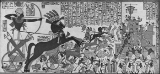
Contemporary illustrations of the siege show the use of ladders and chariots with soldiers climbing scale ladders supported by archers. Six of the sons of Ramesses, still wearing their side locks, also appear on those depictions of the siege. Those include:
Ramesses II
Ramesses II , referred to as Ramesses the Great, was the third Egyptian pharaoh of the Nineteenth dynasty. He is often regarded as the greatest, most celebrated, and most powerful pharaoh of the Egyptian Empire...
's campaign to suppress Galilee
Galilee
Galilee , is a large region in northern Israel which overlaps with much of the administrative North District of the country. Traditionally divided into Upper Galilee , Lower Galilee , and Western Galilee , extending from Dan to the north, at the base of Mount Hermon, along Mount Lebanon to the...
and conquer Syria
Syria
Syria , officially the Syrian Arab Republic , is a country in Western Asia, bordering Lebanon and the Mediterranean Sea to the West, Turkey to the north, Iraq to the east, Jordan to the south, and Israel to the southwest....
in 1269 BC. He inscribed his campaign on the wall of his mortuary temple, the Ramesseum
Ramesseum
The Ramesseum is the memorial temple of Pharaoh Ramesses II . It is located in the Theban necropolis in Upper Egypt, across the River Nile from the modern city of Luxor...
in Thebes
Thebes, Egypt
Thebes is the Greek name for a city in Ancient Egypt located about 800 km south of the Mediterranean, on the east bank of the river Nile within the modern city of Luxor. The Theban Necropolis is situated nearby on the west bank of the Nile.-History:...
. The inscriptions say that Dapur was "in the land of Hatti". Although Dapur has often been identified with Tabor in Canaan, Kenneth Kitchen argues that this identification is incorrect and that the Dapur in question is in Syria, to the north of Kadesh.
From Egyptian reliefs we can see that Dapur was a city, heavily fortified with both inner and outer walls, and situated on a rocky hill which was usual for Syrian cities and many other cities in the Bronze Age.
Contemporary illustrations of the siege show the use of ladders and chariots with soldiers climbing scale ladders supported by archers. Six of the sons of Ramesses, still wearing their side locks, also appear on those depictions of the siege. Those include: