

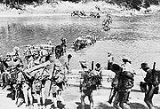
South-East Asian theatre of World War II

Encyclopedia
The South-East Asian Theatre
of World War II
was the name given to the campaigns of the Pacific War
in Burma (now Myanmar), Ceylon
, India, Thailand
, Indochina
, Malaya
and Singapore
. Conflict in the theatre began when the Empire of Japan
invaded Thailand
and Malaya
from bases located in Indochina
on December 8, 1941. The main landing at Singora (now Songkhla
) on the east side of the Isthmus of Kra preceded the bombing of Pearl Harbor by several hours. Action in the theatre officially ended on September 9, 1945.
and HMS Prince of Wales
were sunk by a Japanese air attack
off Malaya
on December 10, 1941. Following the invasion
, the government of Thailand
formally allied itself with Japan on December 21. Japan invaded Hong Kong in the Battle of Hong Kong
on December 8, culminating in surrender on December 25. January saw the invasions of Burma and the Dutch East Indies
and the capture of Manila
and Kuala Lumpur
.
The Japanese Southern Expeditionary Army Group
's 1st Raiding Regiment
(also known as the 1st Parachute Brigade) was used with good effect in the seizure of Sumatra
(see Battle of Palembang).
of the Indian Army
, the Australian 8th Division
and British units during the Battle of Malaya
, but Japan's superiority in air power, tanks and infantry tactics drove the Allied units back. After being driven out of Malaya, Allied forces in Singapore
, under the command of Lieutenant General Arthur Percival
, surrendered to the Japanese on February 15, 1942; about 130,000 Allied troops became prisoners of war. The fall of Singapore
was the largest surrender in British military history.
was a naval sortie by the Fast Carrier Strike Force of the Imperial Japanese Navy
from March 31 to April 10, 1942 against Allied shipping and bases in the Indian Ocean. Following the destruction of the ABDACOM forces in the battles around Java in February and March, the Japanese sortied into the Indian Ocean to destroy British seapower there and support the invasion of Burma
. The raid was only partially successful. It did not succeed in destroying Allied naval power in the Indian Ocean but it did force the British fleet to relocate from British Ceylon
to Kilindini near Mombasa
in Kenya
, as their more forward fleet anchorages could not be adequately protected from Japanese attack. The fleet in the Indian Ocean was then gradually reduced to little more than a convoy escort force as other commitments called for the more powerful ships. From May 1942, it was also used in the invasion of Madagascar
— an operation aimed at thwarting any attempt by Japan to use bases on the Vichy French controlled territory.
In 1942, Madras City was bombed by the Japanese fleet but the physical damage was negligible, though the public response was major and the city was evacuated because of fears of subsequent Japanese bombing and invasion. Many rich families from Madras moved permanently to the hill stations in fear.
Also in 1942 in preparation for a possible Japanese invasion of India, the British began improvements to the Kodaikanal-Munnar Road to facilitate its use as an evacuation route from Kodaikanal
along the southern crest of the Palani Hills to Top Station
. Existing roads then continued to Munnar
and down to Cochin where British ships would be available for evacuation out of India.
at about 780 miles from Kolkata
(known at the time as Calcutta) , 740 miles from Chennai
(known at the time as Madras) and 120 miles from Cape Nargis in Burma. On March 23, 1942 a Japanese invasion force seized the islands and occupied them until the end of the war.
On December 29, 1943, political control of the islands was theoretically passed to the Azad Hind government of Subhas Chandra Bose. Bose visited Port Blair
to raise the tricolour flag of the Indian National Army
. After Bose's departure the Japanese remained in effective control of the Andamans, and the sovereignty of the Arzi Hukumat-e Hind was largely fictional. The islands themselves were renamed "Shaheed" and "Swaraj", meaning "martyr" and "self-rule" respectively. Bose placed the islands under the governorship of Lt Col. A.D. Loganathan, and had limited involvement with the administration of the territory.
One of the major logistical efforts of the war was "flying the Hump" over the Himalayas and the building of the Ledo Road from India to China as a replacement for the Burma Road
.
RAF battle honours:
Qualification: For operations against Japanese aircraft and naval units by squadrons based in Ceylon during the Japanese attacks of April 1942.
Qualification: For operations during the 14th Army's advance from Imphal to Rangoon, the coastal amphibious assaults, and the Battle of Pegu Yomas, August 1944 to August 1945.
It was only after the war in Europe was clearly coming to an end that large British forces were dispatched to the Indian Ocean again. Following the neutralisation of the German fleet in late 1943 and early 1944, forces from the Home Fleet were released, and the success of Operation Overlord
in June meant even more craft could be sent, including precious amphibious assault shipping.
During late 1944, as more British aircraft carriers came into the area a series of strikes were flown against oil targets in Sumatra
, such as Operation Meridian
. The USS Saratoga
was lent for the first attack by the United States. The oil installations were heavily damaged by the attacks, aggravating the Japanese fuel shortages due to the American blockade. The final attack was flown as the carriers were heading for Sydney to become the British Pacific Fleet
.
After the departure of the main battle forces the Indian Ocean was left with escort carriers and older battleships as the mainstay of its naval forces. Nevertheless, during those months important operations were launched in the recapture of Burma, including landings on Ramree
and Akyab and near Rangoon.
and the Far East Command
, first under Air Chief Marshal Robert Brooke-Popham
and then from December 23, 1941 commanded by Lieutenant-General Sir Henry Royds Pownall
.
India Command was responsible for British India, British Ceylon, and for some of the time Burma. The Far East Command based in Singapore was responsible for Hong Kong, Malaya, Singapore and other British Far East possessions including, for some of the time, Burma.
A month after the outbreak of war with Japan on December 7, 1941, the Allied governments jointly appointed the British Commander-in-Chief (CinC) of the Army of India
, General Sir Archibald Wavell, as Supreme Allied Commander of all "American-British-Dutch-Australian
" (ABDA) forces in South East Asia and the Pacific, from Burma to the Dutch East Indies
.
However, advances made by the Japanese over the next month split the ABDA forces in two. After transferring the forces in Burma to the India Command, on February 25, 1942 Wavell resigned as commander of the ABDA and resumed his position of CinC of the Army of India. Responsibility for the South West Pacific Area
passed to US General Douglas MacArthur
as Supreme Allied Commander South West Pacific.
From February 1942 until November 1943 the India Command was responsible for the South East Asian Theatre. General Wavell was made Viceroy of India and General Claude Auchinleck
became Commander-in-Chief of the India Command on the 20th June, 1943. In August 1943 the Allies formed a new South East Asian Command to take over strategic responsibilities for the theatre.
The reorganisation of the theatre command took about two months. On October 4 Winston Churchill
appointed Admiral Lord Louis Mountbatten
supreme Allied commander of the South East Asia Command
(SEAC). The American General Joseph Stilwell
was the first deputy supreme Allied commander. On November 15, Auchinleck handed over responsibility for the conduct of operations against the Japanese in the theatre to Mountbatten.
The initial land forces operational area for SEAC included India, Burma, British Ceylon
and Malaya
. Operations were also mounted in Japanese-occupied Sumatra
, Thailand
and French Indochina (Viet Nam, Cambodia, and Laos)
.
Initially SEAC commanded:
In October 1944, CBI was split into US Forces China Theater (USFCT) and India-Burma Theater (USFIBT).
On November 12, 1944 Eleventh Army Group redesignated by Allied Land Forces South East Asia (ALFSEA) combining Commonwealth and US forces, with an HQ at Kandy. On December 1 ALFSEA HQ moved to Barrackpore, India.
On August 15, 1945 responsibility for the rest of the Dutch East Indies
was transferred from the South West Pacific Area to SEAC.
SEAC was disbanded on November 30, 1946.
On November 12, 1944 the 11th Army Group was redesignated Allied Land Forces South East Asia, still under SEAC, because it was felt that an inter-Allied command was better than the purely British headquarters. Command problems with General Stilwell and his interactions with the U.S. Joint Chiefs of Staff
had precipitated the change.
Unit controlling all army land and air units in South East Asia and the South West Pacific was the Southern Expeditionary Army headquartered in Saigon, Indochina
. It was commanded by General Count Hisaichi Terauchi, who commanded it from 1941 to 1945. The Japanese also deployed the South Seas Force, a combined force of Army and Special Naval Landing Force personnel. The Southern Army's major field commands were the Japanese 14th Army, the Japanese 15th Army, the Japanese 16th Army and the Japanese 25th Army. These consisted of 11 infantry divisions, six independent infantry brigades, and six tank regiments, plus artillery and support troops. The Japanese extensively used bicycle infantry
, which allowed them quick movement over vast distances.
Theater (warfare)
In warfare, a theater, is defined as an area or place within which important military events occur or are progressing. The entirety of the air, land, and sea area that is or that may potentially become involved in war operations....
of World War II
World War II
World War II, or the Second World War , was a global conflict lasting from 1939 to 1945, involving most of the world's nations—including all of the great powers—eventually forming two opposing military alliances: the Allies and the Axis...
was the name given to the campaigns of the Pacific War
Pacific War
The Pacific War, also sometimes called the Asia-Pacific War refers broadly to the parts of World War II that took place in the Pacific Ocean, its islands, and in East Asia, then called the Far East...
in Burma (now Myanmar), Ceylon
British Ceylon
British Ceylon refers to British rule prior to 1948 of the island territory now known as Sri Lanka.-From the Dutch to the British:Before the beginning of the Dutch governance, the island of Ceylon was divided between the Portuguese Empire and the Kingdom of Kandy, who were in the midst of a war for...
, India, Thailand
Thailand
Thailand , officially the Kingdom of Thailand , formerly known as Siam , is a country located at the centre of the Indochina peninsula and Southeast Asia. It is bordered to the north by Burma and Laos, to the east by Laos and Cambodia, to the south by the Gulf of Thailand and Malaysia, and to the...
, Indochina
French Indochina
French Indochina was part of the French colonial empire in southeast Asia. A federation of the three Vietnamese regions, Tonkin , Annam , and Cochinchina , as well as Cambodia, was formed in 1887....
, Malaya
British Malaya
British Malaya loosely described a set of states on the Malay Peninsula and the Island of Singapore that were brought under British control between the 18th and the 20th centuries...
and Singapore
Singapore
Singapore , officially the Republic of Singapore, is a Southeast Asian city-state off the southern tip of the Malay Peninsula, north of the equator. An island country made up of 63 islands, it is separated from Malaysia by the Straits of Johor to its north and from Indonesia's Riau Islands by the...
. Conflict in the theatre began when the Empire of Japan
Empire of Japan
The Empire of Japan is the name of the state of Japan that existed from the Meiji Restoration on 3 January 1868 to the enactment of the post-World War II Constitution of...
invaded Thailand
Japanese Invasion of Thailand
The Japanese invasion of Thailand occurred on December 8, 1941. It was fought between Thailand and the Empire of Japan. Despite fierce fighting in Southern Thailand, Thai resistance lasted only a few hours before ending in a ceasefire.-Background:...
and Malaya
Battle of Malaya
The Malayan Campaign was a campaign fought by Allied and Japanese forces in Malaya, from 8 December 1941 – 31 January 1942 during the Second World War. The campaign was dominated by land battles between British Commonwealth army units, and the Imperial Japanese Army...
from bases located in Indochina
French Indochina
French Indochina was part of the French colonial empire in southeast Asia. A federation of the three Vietnamese regions, Tonkin , Annam , and Cochinchina , as well as Cambodia, was formed in 1887....
on December 8, 1941. The main landing at Singora (now Songkhla
Songkhla
Songkhla is a city in the Songkhla Province of southern Thailand, near the border with Malaysia. As of 2006 it had a population of 75,048...
) on the east side of the Isthmus of Kra preceded the bombing of Pearl Harbor by several hours. Action in the theatre officially ended on September 9, 1945.
Initial Japanese successes
The Allies suffered many disastrous defeats in the first six months of the war. Two major British warships, HMS RepulseHMS Repulse (1916)
HMS Repulse was a Renown-class battlecruiser of the Royal Navy built during the First World War. She was originally laid down as an improved version of the s. Her construction was suspended on the outbreak of war on the grounds she would not be ready in a timely manner...
and HMS Prince of Wales
HMS Prince of Wales (1939)
HMS Prince of Wales was a King George V-class battleship of the Royal Navy, built at the Cammell Laird shipyard in Birkenhead, England...
were sunk by a Japanese air attack
Sinking of Prince of Wales and Repulse
The sinking of Prince of Wales and Repulse was a Second World War naval engagement that took place north of Singapore, off the east coast of Malaya, near Kuantan, Pahang where the British Royal Navy battleship HMS Prince of Wales and battlecruiser HMS Repulse were sunk by land-based bombers and...
off Malaya
British Malaya
British Malaya loosely described a set of states on the Malay Peninsula and the Island of Singapore that were brought under British control between the 18th and the 20th centuries...
on December 10, 1941. Following the invasion
Japanese Invasion of Thailand
The Japanese invasion of Thailand occurred on December 8, 1941. It was fought between Thailand and the Empire of Japan. Despite fierce fighting in Southern Thailand, Thai resistance lasted only a few hours before ending in a ceasefire.-Background:...
, the government of Thailand
Thailand
Thailand , officially the Kingdom of Thailand , formerly known as Siam , is a country located at the centre of the Indochina peninsula and Southeast Asia. It is bordered to the north by Burma and Laos, to the east by Laos and Cambodia, to the south by the Gulf of Thailand and Malaysia, and to the...
formally allied itself with Japan on December 21. Japan invaded Hong Kong in the Battle of Hong Kong
Battle of Hong Kong
The Battle of Hong Kong took place during the Pacific campaign of World War II. It began on 8 December 1941 and ended on 25 December 1941 with Hong Kong, then a Crown colony, surrendering to the Empire of Japan.-Background:...
on December 8, culminating in surrender on December 25. January saw the invasions of Burma and the Dutch East Indies
Dutch East Indies
The Dutch East Indies was a Dutch colony that became modern Indonesia following World War II. It was formed from the nationalised colonies of the Dutch East India Company, which came under the administration of the Netherlands government in 1800....
and the capture of Manila
Manila
Manila is the capital of the Philippines. It is one of the sixteen cities forming Metro Manila.Manila is located on the eastern shores of Manila Bay and is bordered by Navotas and Caloocan to the north, Quezon City to the northeast, San Juan and Mandaluyong to the east, Makati on the southeast,...
and Kuala Lumpur
Kuala Lumpur
Kuala Lumpur is the capital and the second largest city in Malaysia by population. The city proper, making up an area of , has a population of 1.4 million as of 2010. Greater Kuala Lumpur, also known as the Klang Valley, is an urban agglomeration of 7.2 million...
.
The Japanese Southern Expeditionary Army Group
Southern Expeditionary Army Group
The was a army group of the Imperial Japanese Army during World War II. It was responsible for all military operations in South East Asian and South West Pacific campaigns of World War II....
's 1st Raiding Regiment
Teishin Shudan
was a Japanese special forces/airborne unit during World War II. The unit was a division-level force, and was part of the Imperial Japanese Army Air Force...
(also known as the 1st Parachute Brigade) was used with good effect in the seizure of Sumatra
Sumatra
Sumatra is an island in western Indonesia, westernmost of the Sunda Islands. It is the largest island entirely in Indonesia , and the sixth largest island in the world at 473,481 km2 with a population of 50,365,538...
(see Battle of Palembang).
Malaya and Singapore
Japanese forces met stiff resistance from III CorpsIndian III Corps
The III Corps was a formation of the Indian Army during World War I formed in Mesopotamia. Prior to the reorganization of the British and Indian forces in Mesopotamia, it was designated as the Tigris Corps....
of the Indian Army
British Indian Army
The British Indian Army, officially simply the Indian Army, was the principal army of the British Raj in India before the partition of India in 1947...
, the Australian 8th Division
Australian 8th Division
The 8th Division of the Australian Army was formed to serve in World War II, as part of the Second Australian Imperial Force, who were in turn, part of the Allies of World War II. The 8th Division was raised from regular army units and new, all-volunteer infantry brigades, from July 1940 onwards...
and British units during the Battle of Malaya
Battle of Malaya
The Malayan Campaign was a campaign fought by Allied and Japanese forces in Malaya, from 8 December 1941 – 31 January 1942 during the Second World War. The campaign was dominated by land battles between British Commonwealth army units, and the Imperial Japanese Army...
, but Japan's superiority in air power, tanks and infantry tactics drove the Allied units back. After being driven out of Malaya, Allied forces in Singapore
Singapore
Singapore , officially the Republic of Singapore, is a Southeast Asian city-state off the southern tip of the Malay Peninsula, north of the equator. An island country made up of 63 islands, it is separated from Malaysia by the Straits of Johor to its north and from Indonesia's Riau Islands by the...
, under the command of Lieutenant General Arthur Percival
Arthur Ernest Percival
Lieutenant-General Arthur Ernest Percival, CB, DSO & Bar, OBE, MC, OStJ, DL was a British Army officer and World War I veteran...
, surrendered to the Japanese on February 15, 1942; about 130,000 Allied troops became prisoners of war. The fall of Singapore
Battle of Singapore
The Battle of Singapore was fought in the South-East Asian theatre of the Second World War when the Empire of Japan invaded the Allied stronghold of Singapore. Singapore was the major British military base in Southeast Asia and nicknamed the "Gibraltar of the East"...
was the largest surrender in British military history.
The Japanese Indian Ocean raid
The Japanese Indian Ocean raidIndian Ocean raid
The Indian Ocean raid was a naval sortie by the Fast Carrier Strike Force of the Imperial Japanese Navy from 31 March-10 April 1942 against Allied shipping and bases in the Indian Ocean. It was an early engagement of the Pacific campaign of World War II...
was a naval sortie by the Fast Carrier Strike Force of the Imperial Japanese Navy
Imperial Japanese Navy
The Imperial Japanese Navy was the navy of the Empire of Japan from 1869 until 1947, when it was dissolved following Japan's constitutional renunciation of the use of force as a means of settling international disputes...
from March 31 to April 10, 1942 against Allied shipping and bases in the Indian Ocean. Following the destruction of the ABDACOM forces in the battles around Java in February and March, the Japanese sortied into the Indian Ocean to destroy British seapower there and support the invasion of Burma
Burma Campaign
The Burma Campaign in the South-East Asian Theatre of World War II was fought primarily between British Commonwealth, Chinese and United States forces against the forces of the Empire of Japan, Thailand, and the Indian National Army. British Commonwealth land forces were drawn primarily from...
. The raid was only partially successful. It did not succeed in destroying Allied naval power in the Indian Ocean but it did force the British fleet to relocate from British Ceylon
British Ceylon
British Ceylon refers to British rule prior to 1948 of the island territory now known as Sri Lanka.-From the Dutch to the British:Before the beginning of the Dutch governance, the island of Ceylon was divided between the Portuguese Empire and the Kingdom of Kandy, who were in the midst of a war for...
to Kilindini near Mombasa
Mombasa
Mombasa is the second-largest city in Kenya. Lying next to the Indian Ocean, it has a major port and an international airport. The city also serves as the centre of the coastal tourism industry....
in Kenya
Kenya
Kenya , officially known as the Republic of Kenya, is a country in East Africa that lies on the equator, with the Indian Ocean to its south-east...
, as their more forward fleet anchorages could not be adequately protected from Japanese attack. The fleet in the Indian Ocean was then gradually reduced to little more than a convoy escort force as other commitments called for the more powerful ships. From May 1942, it was also used in the invasion of Madagascar
Battle of Madagascar
The Battle of Madagascar was the Allied campaign to capture Vichy-French-controlled Madagascar during World War II. It began on 5 May 1942. Fighting did not cease until 6 November.-Geo-political:...
— an operation aimed at thwarting any attempt by Japan to use bases on the Vichy French controlled territory.
In 1942, Madras City was bombed by the Japanese fleet but the physical damage was negligible, though the public response was major and the city was evacuated because of fears of subsequent Japanese bombing and invasion. Many rich families from Madras moved permanently to the hill stations in fear.
Also in 1942 in preparation for a possible Japanese invasion of India, the British began improvements to the Kodaikanal-Munnar Road to facilitate its use as an evacuation route from Kodaikanal
Kodaikanal
-Climate:Kodaikanal has a monsoon-influenced subtropical highland climate . The temperatures are cool throughout the year due to the high elevation of the city.-Economy:...
along the southern crest of the Palani Hills to Top Station
Top Station
Top Station is tourist destination which falls along the border of the state of Tamil Nadu. The region is part of constituency of bodi Theni district in Tamil Nadu....
. Existing roads then continued to Munnar
Munnar
Munnar is one of the most popular hill station in Kerala and in southern India. Munnar is located on the Western Ghats, situated in the Idukki district....
and down to Cochin where British ships would be available for evacuation out of India.
Japanese occupation of the Andaman and Nicobar Islands
The Andaman and Nicobar Islands (8,293 km² on 139 islands), are a group of islands situated in the Bay of BengalBay of Bengal
The Bay of Bengal , the largest bay in the world, forms the northeastern part of the Indian Ocean. It resembles a triangle in shape, and is bordered mostly by the Eastern Coast of India, southern coast of Bangladesh and Sri Lanka to the west and Burma and the Andaman and Nicobar Islands to the...
at about 780 miles from Kolkata
Kolkata
Kolkata , formerly known as Calcutta, is the capital of the Indian state of West Bengal. Located on the east bank of the Hooghly River, it was the commercial capital of East India...
(known at the time as Calcutta) , 740 miles from Chennai
Chennai
Chennai , formerly known as Madras or Madarasapatinam , is the capital city of the Indian state of Tamil Nadu, located on the Coromandel Coast off the Bay of Bengal. Chennai is the fourth most populous metropolitan area and the sixth most populous city in India...
(known at the time as Madras) and 120 miles from Cape Nargis in Burma. On March 23, 1942 a Japanese invasion force seized the islands and occupied them until the end of the war.
On December 29, 1943, political control of the islands was theoretically passed to the Azad Hind government of Subhas Chandra Bose. Bose visited Port Blair
Port Blair
Port Blair is the largest town and a municipal council in Andaman district in the Andaman Islands and the capital of the Andaman and Nicobar Islands, a union territory of India...
to raise the tricolour flag of the Indian National Army
Indian National Army
The Indian National Army or Azad Hind Fauj was an armed force formed by Indian nationalists in 1942 in Southeast Asia during World War II. The aim of the army was to overthrow the British Raj in colonial India, with Japanese assistance...
. After Bose's departure the Japanese remained in effective control of the Andamans, and the sovereignty of the Arzi Hukumat-e Hind was largely fictional. The islands themselves were renamed "Shaheed" and "Swaraj", meaning "martyr" and "self-rule" respectively. Bose placed the islands under the governorship of Lt Col. A.D. Loganathan, and had limited involvement with the administration of the territory.
Burma Campaign
- The retreat of Burcorps
- The formation of the British Fourteenth ArmyBritish Fourteenth ArmyThe British Fourteenth Army was a multinational force comprising units from Commonwealth countries during World War II. Many of its units were from the Indian Army as well as British units and there were also significant contributions from West and East African divisions within the British Army.It...
(The "Forgotten Army") - The Arakan campaignArakan Campaign 1942–1943The Arakan Campaign of 1942–1943 was the first tentative Allied attack into Burma, following the Japanese conquest of Burma earlier in 1942...
- The Japanese attack on India
- The Allied counter offensives
- Road to Rangoon
- Brigadier Orde Wingate and the ChinditsChinditsThe Chindits were a British India "Special Force" that served in Burma and India in 1943 and 1944 during the Burma Campaign in World War II. They were formed into long range penetration groups trained to operate deep behind Japanese lines...
US forces in the China Burma India Theatre
- Northern Combat Area CommandNorthern Combat Area CommandThe Northern Combat Area Command or NCAC was a mainly Sino-American formation that held the northern end of the Allied front in Burma during World War II. For much of its existence it was commanded by the acerbic General Joseph "Vinegar Joe" Stilwell, and controlled by his staff...
(NCAC) - Flying TigersFlying TigersThe 1st American Volunteer Group of the Chinese Air Force in 1941–1942, famously nicknamed the Flying Tigers, was composed of pilots from the United States Army , Navy , and Marine Corps , recruited under presidential sanction and commanded by Claire Lee Chennault. The ground crew and headquarters...
- Fourteenth Air ForceFourteenth Air ForceThe Fourteenth Air Force is a numbered air force of the United States Air Force Space Command . It is headquartered at Vandenberg Air Force Base, California....
- Tenth Air ForceTenth Air ForceThe Tenth Air Force is a numbered air force of the United States Air Force Reserve Command . It is headquartered at Naval Air Station Joint Reserve Base Fort Worth, Texas....
- Twentieth Air ForceTwentieth Air ForceThe Twentieth Air Force is a numbered air force of the United States Air Force Global Strike Command . It is headquartered at F.E. Warren Air Force Base, Wyoming.20 AF's primary mission is Intercontinental Ballistic Missile operations...
(Operation MatterhornOperation MatterhornOperation Matterhorn was a military operations plan of the United States Army Air Forces in World War II for the strategic bombing of Japanese forces by B-29 Superfortresses based in India and China. Targets included Japan itself, and Japanese bases in China and South East Asia...
) - The Allied logisticalLogisticsLogistics is the management of the flow of goods between the point of origin and the point of destination in order to meet the requirements of customers or corporations. Logistics involves the integration of information, transportation, inventory, warehousing, material handling, and packaging, and...
airlift from India in to China over the HumpThe HumpThe Hump was the name given by Allied pilots in the Second World War to the eastern end of the Himalayan Mountains over which they flew military transport aircraft from India to China to resupply the Chinese war effort of Chiang Kai-shek and the units of the United States Army Air Forces based in... - The Ledo RoadLedo RoadThe Ledo Road was built during World War II so that the Western Allies could supply the Chinese as an alternative to the Burma Road which had been cut by the Japanese in 1942. It was renamed the Stilwell Road in early 1945 at the suggestion of Chiang Kai-shek...
- Merrill's MaraudersMerrill's MaraudersMerrill’s Marauders or Unit Galahad, officially named the 5307th Composite Unit , was a United States Army long range penetration special operations unit in the South-East Asian Theater of World War II which fought in the China-Burma-India Theater of Operations, or CBI...
One of the major logistical efforts of the war was "flying the Hump" over the Himalayas and the building of the Ledo Road from India to China as a replacement for the Burma Road
Burma Road
The Burma Road is a road linking Burma with the southwest of China. Its terminals are Kunming, Yunnan, and Lashio, Burma. When it was built, Burma was a British colony.The road is long and runs through rough mountain country...
.
Air war in South East Asia
- RAF Far East Air ForceRAF Far East Air ForceThe former Royal Air Force Far East Air Force, more simply known as RAF Far East Air Force, was the Command organisation that controlled all Royal Air Force assets in the east of Asia . It was originally formed as Air Command, South East Asia in 1943...
- RAF Third Tactical Air ForceRAF Third Tactical Air ForceThe RAF Third Tactical Air Force , which was formed in South Asia in December 1943, was one of three tactical air forces formed by the Royal Air Force during the Second World War. It was made up of squadrons and personnel from the RAF and the air forces of the British Commonwealth...
- Bombing of South East Asia, 1944-45Bombing of South East Asia, 1944-45During the final stage of World War II, from 1944 to 1945, the South East Asian theatre experienced strategic bombing by Allied forces. The main victims of Allied air raids were Japan, Thailand and French Indochina.-Royal Navy operations:...
RAF battle honours:
- CEYLON 1942
Qualification: For operations against Japanese aircraft and naval units by squadrons based in Ceylon during the Japanese attacks of April 1942.
- BURMA 1944-1945
Qualification: For operations during the 14th Army's advance from Imphal to Rangoon, the coastal amphibious assaults, and the Battle of Pegu Yomas, August 1944 to August 1945.
Indian Ocean naval campaigns 1942–45
The earliest successes were gained by mine laying and submarine warfare. The Japanese minesweeping capability was never great, and when confronted with new types of mines they did not adapt quickly. Japanese shipping was driven from the Burmese coast using this type of warfare. British submarines based in British Ceylon operated against Japanese shipping.It was only after the war in Europe was clearly coming to an end that large British forces were dispatched to the Indian Ocean again. Following the neutralisation of the German fleet in late 1943 and early 1944, forces from the Home Fleet were released, and the success of Operation Overlord
Operation Overlord
Operation Overlord was the code name for the Battle of Normandy, the operation that launched the invasion of German-occupied western Europe during World War II by Allied forces. The operation commenced on 6 June 1944 with the Normandy landings...
in June meant even more craft could be sent, including precious amphibious assault shipping.
During late 1944, as more British aircraft carriers came into the area a series of strikes were flown against oil targets in Sumatra
Sumatra
Sumatra is an island in western Indonesia, westernmost of the Sunda Islands. It is the largest island entirely in Indonesia , and the sixth largest island in the world at 473,481 km2 with a population of 50,365,538...
, such as Operation Meridian
Operation Meridian
During World War II, Operation Meridian was a series of British air attacks conducted on 24 January and 29 January 1945 on Japanese-held oil refineries at Palembang, on Sumatra...
. The USS Saratoga
USS Saratoga (CV-3)
USS Saratoga was the second aircraft carrier of the United States Navy and the fifth ship to bear her name. She was commissioned one month earlier than her sister and class leader, , which is the third actually commissioned after and Saratoga...
was lent for the first attack by the United States. The oil installations were heavily damaged by the attacks, aggravating the Japanese fuel shortages due to the American blockade. The final attack was flown as the carriers were heading for Sydney to become the British Pacific Fleet
British Pacific Fleet
The British Pacific Fleet was a British Commonwealth naval force which saw action against Japan during World War II. The fleet was composed of British Commonwealth naval vessels. The BPF formally came into being on 22 November 1944...
.
After the departure of the main battle forces the Indian Ocean was left with escort carriers and older battleships as the mainstay of its naval forces. Nevertheless, during those months important operations were launched in the recapture of Burma, including landings on Ramree
Battle of Ramree Island
The Battle of Ramree Island was fought for six weeks during January and February 1945, as part of the Indian XV Corps 1944/45 offensive on the Southern Front of the Burma Campaign during World War II....
and Akyab and near Rangoon.
Allied command structure
At the start of the war the British had two commands with responsibilities for possessions in the theatre. India Command under General Sir Archibald Wavell the Commander-in-Chief (CinC) of the Army of IndiaArmy of India
The Army of India consisted of both the Indian Army and the British Army in India between 1903 and 1947.Lord Kitchener was appointed Commander-in-Chief, India between 1902 and 1909...
and the Far East Command
British Far East Command
The Far East Command was a British military command which had 2 distinct periods. These were firstly, 18 November 1940 – 7 January 1942 succeeded by the American-British-Dutch-Australian Command , and secondly, 1963 – 1971 succeeded by Australia, New Zealand, and United Kingdom Force...
, first under Air Chief Marshal Robert Brooke-Popham
Robert Brooke-Popham
Air Chief Marshal Sir Henry Robert Moore Brooke-Popham, GCVO, KCB, CMG, DSO, AFC, was a senior commander in the Royal Air Force. During World War I he served in the Royal Flying Corps as wing commander and senior staff officer...
and then from December 23, 1941 commanded by Lieutenant-General Sir Henry Royds Pownall
Henry Royds Pownall
Lieutenant General Sir Henry Royds Pownall KCB, KBE, DSO was a British general, who held several important command and Staff appointments during World War II. In particular, he was Chief of Staff to the British Expeditionary Force in France and Belgium until the fall of France in May 1940...
.
India Command was responsible for British India, British Ceylon, and for some of the time Burma. The Far East Command based in Singapore was responsible for Hong Kong, Malaya, Singapore and other British Far East possessions including, for some of the time, Burma.
A month after the outbreak of war with Japan on December 7, 1941, the Allied governments jointly appointed the British Commander-in-Chief (CinC) of the Army of India
Army of India
The Army of India consisted of both the Indian Army and the British Army in India between 1903 and 1947.Lord Kitchener was appointed Commander-in-Chief, India between 1902 and 1909...
, General Sir Archibald Wavell, as Supreme Allied Commander of all "American-British-Dutch-Australian
American-British-Dutch-Australian Command
The American-British-Dutch-Australian Command, or ABDACOM, was a short-lived, supreme command for all Allied forces in South East Asia, in early 1942, during the Pacific War in World War II...
" (ABDA) forces in South East Asia and the Pacific, from Burma to the Dutch East Indies
Dutch East Indies
The Dutch East Indies was a Dutch colony that became modern Indonesia following World War II. It was formed from the nationalised colonies of the Dutch East India Company, which came under the administration of the Netherlands government in 1800....
.
However, advances made by the Japanese over the next month split the ABDA forces in two. After transferring the forces in Burma to the India Command, on February 25, 1942 Wavell resigned as commander of the ABDA and resumed his position of CinC of the Army of India. Responsibility for the South West Pacific Area
South West Pacific Area
South West Pacific Area was the name given to the Allied supreme military command in the South West Pacific Theatre of World War II. It was one of four major Allied commands in the Pacific theatres of World War II, during 1942–45...
passed to US General Douglas MacArthur
Douglas MacArthur
General of the Army Douglas MacArthur was an American general and field marshal of the Philippine Army. He was a Chief of Staff of the United States Army during the 1930s and played a prominent role in the Pacific theater during World War II. He received the Medal of Honor for his service in the...
as Supreme Allied Commander South West Pacific.
From February 1942 until November 1943 the India Command was responsible for the South East Asian Theatre. General Wavell was made Viceroy of India and General Claude Auchinleck
Claude Auchinleck
Field Marshal Sir Claude John Eyre Auchinleck, GCB, GCIE, CSI, DSO, OBE , nicknamed "The Auk", was a British army commander during World War II. He was a career soldier who spent much of his military career in India, where he developed a love of the country and a lasting affinity for the soldiers...
became Commander-in-Chief of the India Command on the 20th June, 1943. In August 1943 the Allies formed a new South East Asian Command to take over strategic responsibilities for the theatre.
The reorganisation of the theatre command took about two months. On October 4 Winston Churchill
Winston Churchill
Sir Winston Leonard Spencer-Churchill, was a predominantly Conservative British politician and statesman known for his leadership of the United Kingdom during the Second World War. He is widely regarded as one of the greatest wartime leaders of the century and served as Prime Minister twice...
appointed Admiral Lord Louis Mountbatten
Louis Mountbatten, 1st Earl Mountbatten of Burma
Admiral of the Fleet Louis Francis Albert Victor Nicholas George Mountbatten, 1st Earl Mountbatten of Burma, KG, GCB, OM, GCSI, GCIE, GCVO, DSO, PC, FRS , was a British statesman and naval officer, and an uncle of Prince Philip, Duke of Edinburgh...
supreme Allied commander of the South East Asia Command
South East Asia Command
South East Asia Command was the body set up to be in overall charge of Allied operations in the South-East Asian Theatre during World War II.-Background:...
(SEAC). The American General Joseph Stilwell
Joseph Stilwell
General Joseph Warren Stilwell was a United States Army four-star General known for service in the China Burma India Theater. His caustic personality was reflected in the nickname "Vinegar Joe"...
was the first deputy supreme Allied commander. On November 15, Auchinleck handed over responsibility for the conduct of operations against the Japanese in the theatre to Mountbatten.
The initial land forces operational area for SEAC included India, Burma, British Ceylon
British Ceylon
British Ceylon refers to British rule prior to 1948 of the island territory now known as Sri Lanka.-From the Dutch to the British:Before the beginning of the Dutch governance, the island of Ceylon was divided between the Portuguese Empire and the Kingdom of Kandy, who were in the midst of a war for...
and Malaya
British Malaya
British Malaya loosely described a set of states on the Malay Peninsula and the Island of Singapore that were brought under British control between the 18th and the 20th centuries...
. Operations were also mounted in Japanese-occupied Sumatra
Sumatra
Sumatra is an island in western Indonesia, westernmost of the Sunda Islands. It is the largest island entirely in Indonesia , and the sixth largest island in the world at 473,481 km2 with a population of 50,365,538...
, Thailand
Thailand
Thailand , officially the Kingdom of Thailand , formerly known as Siam , is a country located at the centre of the Indochina peninsula and Southeast Asia. It is bordered to the north by Burma and Laos, to the east by Laos and Cambodia, to the south by the Gulf of Thailand and Malaysia, and to the...
and French Indochina (Viet Nam, Cambodia, and Laos)
French Indochina
French Indochina was part of the French colonial empire in southeast Asia. A federation of the three Vietnamese regions, Tonkin , Annam , and Cochinchina , as well as Cambodia, was formed in 1887....
.
Initially SEAC commanded:
- British Eastern FleetBritish Eastern FleetThe British Eastern Fleet was a fleet of the Royal Navy which existed from 1941 to 1971...
(based in Ceylon) - British 11th Army GroupBritish 11th Army GroupThe 11th Army Group was the main British Army force in Southeast Asia during the Second World War. Although a nominally British formation, it also included large numbers of troops and formations from the British Indian Army and from British African colonies, and also Nationalist Chinese and United...
(Commonwealth land forces; HQ in New Delhi) - Air HQ India (New Delhi)
- China Burma India TheaterChina Burma India Theater of World War IIChina Burma India Theater was the name used by the United States Army for its forces operating in conjunction with British and Chinese Allied air and land forces in China, Burma, and India during World War II...
(CBI), (all US forces in theatre; HQ in New Delhi).
In October 1944, CBI was split into US Forces China Theater (USFCT) and India-Burma Theater (USFIBT).
On November 12, 1944 Eleventh Army Group redesignated by Allied Land Forces South East Asia (ALFSEA) combining Commonwealth and US forces, with an HQ at Kandy. On December 1 ALFSEA HQ moved to Barrackpore, India.
On August 15, 1945 responsibility for the rest of the Dutch East Indies
Dutch East Indies
The Dutch East Indies was a Dutch colony that became modern Indonesia following World War II. It was formed from the nationalised colonies of the Dutch East India Company, which came under the administration of the Netherlands government in 1800....
was transferred from the South West Pacific Area to SEAC.
SEAC was disbanded on November 30, 1946.
11th Army Group
British 11th Army Group ( November 1943 – November 12, 1944) was on paper the main Commonwealth army force in South East Asia which directed- British Fourteenth Army
- British Army in CeylonBritish Army in CeylonCeylon Defence Force was established in 1910 by the Ceylon Defence Force Ordinance of 1910. Which reformed the Ceylon Volunteer Force that existed that the time as the in the British crown colony of Ceylon. At the time of forming it was only a force but soon developed into a regular force...
(Ceylon Army) - Northern Combat Area CommandNorthern Combat Area CommandThe Northern Combat Area Command or NCAC was a mainly Sino-American formation that held the northern end of the Allied front in Burma during World War II. For much of its existence it was commanded by the acerbic General Joseph "Vinegar Joe" Stilwell, and controlled by his staff...
under the command of Joseph StilwellJoseph StilwellGeneral Joseph Warren Stilwell was a United States Army four-star General known for service in the China Burma India Theater. His caustic personality was reflected in the nickname "Vinegar Joe"...
.
On November 12, 1944 the 11th Army Group was redesignated Allied Land Forces South East Asia, still under SEAC, because it was felt that an inter-Allied command was better than the purely British headquarters. Command problems with General Stilwell and his interactions with the U.S. Joint Chiefs of Staff
Joint Chiefs of Staff
The Joint Chiefs of Staff is a body of senior uniformed leaders in the United States Department of Defense who advise the Secretary of Defense, the Homeland Security Council, the National Security Council and the President on military matters...
had precipitated the change.
Japanese command structure
The Imperial Japanese ArmyImperial Japanese Army
-Foundation:During the Meiji Restoration, the military forces loyal to the Emperor were samurai drawn primarily from the loyalist feudal domains of Satsuma and Chōshū...
Unit controlling all army land and air units in South East Asia and the South West Pacific was the Southern Expeditionary Army headquartered in Saigon, Indochina
French Indochina
French Indochina was part of the French colonial empire in southeast Asia. A federation of the three Vietnamese regions, Tonkin , Annam , and Cochinchina , as well as Cambodia, was formed in 1887....
. It was commanded by General Count Hisaichi Terauchi, who commanded it from 1941 to 1945. The Japanese also deployed the South Seas Force, a combined force of Army and Special Naval Landing Force personnel. The Southern Army's major field commands were the Japanese 14th Army, the Japanese 15th Army, the Japanese 16th Army and the Japanese 25th Army. These consisted of 11 infantry divisions, six independent infantry brigades, and six tank regiments, plus artillery and support troops. The Japanese extensively used bicycle infantry
Bicycle infantry
Bicycle infantry are infantry soldiers who maneuver on battlefields using bicycles. The term dates from the late 19th century, when the "safety bicycle" became popular in Europe, the United States and Australia. Historically, bicycles lessened the need for horses, fuel and vehicle maintenance...
, which allowed them quick movement over vast distances.
See also
- British Indian ArmyBritish Indian ArmyThe British Indian Army, officially simply the Indian Army, was the principal army of the British Raj in India before the partition of India in 1947...
- Indian National ArmyIndian National ArmyThe Indian National Army or Azad Hind Fauj was an armed force formed by Indian nationalists in 1942 in Southeast Asia during World War II. The aim of the army was to overthrow the British Raj in colonial India, with Japanese assistance...
- Burma National ArmyBurma National ArmyThe Burma National Army served as the armed forces of the Burmese government created by the Japanese during World War II and fought in the Burma Campaign...
- Thai Phayap ArmyPhayap ArmyPhayap Army was the Thai force that invaded the Shan States on May 10, 1942, during the Burma Campaign of World War II.- Orbat of Phayap Army 1942 :...
- Military history of Britain during World War II#The Far East
- Pacific WarPacific WarThe Pacific War, also sometimes called the Asia-Pacific War refers broadly to the parts of World War II that took place in the Pacific Ocean, its islands, and in East Asia, then called the Far East...
- Pacific Theater of OperationsPacific Theater of OperationsThe Pacific Theater of Operations was the World War II area of military activity in the Pacific Ocean and the countries bordering it, a geographic scope that reflected the operational and administrative command structures of the American forces during that period...
- Second Sino-Japanese WarSecond Sino-Japanese WarThe Second Sino-Japanese War was a military conflict fought primarily between the Republic of China and the Empire of Japan. From 1937 to 1941, China fought Japan with some economic help from Germany , the Soviet Union and the United States...
- Guandong Army
External links
- Parliamentary Debates, House of Commons Official Report, Jan. 27, 1942. on the Far Eastern theatre and A.B.D.A
- STRATEGIC PLANNING FOR COALITION WARFARE 1941-1942: Chapter VI: ARMY DEPLOYMENT AND THE WAR AGAINST JAPAN December 1941-March 1942
- Australian War Memorial: Remembering 1942 The fall of Singapore, 15 February 1942
- http://www.national-army-museum.ac.uk/pages/Second-war/far-east.html
- BBC Article on the Burma Campaign
- Forgotten Warriors: China-Burma-India