

Flea

Encyclopedia
Flea is the common name
for insect
s of the order
Siphonaptera which are wingless insects with mouthparts adapted for piercing skin and sucking blood
. Fleas are external parasites
, living by hematophagy
off the blood
of mammal
s (including bats and humans) and bird
s.
Some flea species include:
Over 2,000 species have been described worldwide.
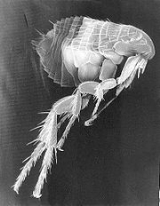
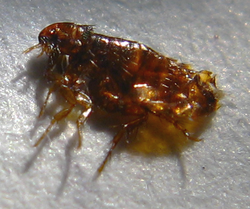
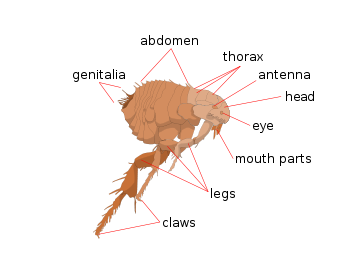 Fleas are wingless insects (1/16 to 1/8-inch (1.5 to 3.3 mm) long) that are agile, usually dark colored (for example, the reddish-brown of the cat flea), with tube-like mouth-parts adapted to feeding on the blood of their hosts. Their legs are long, the hind pair well adapted for jumping: a flea can jump vertically up to 7 inches (18 cm) and horizontally up to 13 inches (33 cm). This is around 200 times their own body length, making the flea one of the best jumpers of all known animals (relative to body size), second only to the froghopper
. According to an article in Science News, "researchers with the University of Cambridge in England have shown that fleas take off from their tibiae and tarsi—the insect equivalent of feet—and not their trochantera, or knees. The researchers report their conclusion in the March 1 Journal of Experimental Biology." It has been known that fleas do not use muscle power but energy stored in a protein named resilin
but the researchers used high-speed video technology and mathematical models to discover where the spring action actually happens. Their bodies are laterally compressed, permitting easy movement through the hairs or feathers on the host's body (or in the case of humans, under clothing). The flea body is hard, polished, and covered with many hairs and short spines directed backward, which also assist its movements on the host. The tough body is able to withstand great pressure, likely an adaptation to survive attempts to eliminate them by mashing or scratching. Even hard squeezing between the fingers is normally insufficient to kill a flea. It is possible to eliminate them by pressing individual fleas with adhesive tape or softened beeswax (or "cheese" wax) or by rolling a flea briskly between the fingers to disable it then crushing it between the fingernails. Fleas also can be drowned in water and may not survive direct contact with anti-flea pesticides.
 Fleas lay tiny white oval-shaped eggs better viewed through a loupe
. The larva is small, pale, has bristles covering its worm-like body, lacks eyes, and has mouthparts adapted to chewing. The larvae feed on various organic matter, especially the feces of mature fleas. The adult flea's diet consists solely of fresh blood. In the pupal phase, the larva is enclosed in a silken, debris-covered cocoon.
insects, going through the four life cycle
stages of egg
, larva
, pupa
, and imago
(adult). The flea life cycle begins when the female lays after feeding. Adult fleas must feed on blood before they can become capable of reproduction. Eggs are laid in batches of up to 20 or so, usually on the host itself, which means that the eggs can easily roll onto the ground. Because of this, areas where the host rests and sleeps become one of the primary habitat
s of eggs and developing fleas. The eggs take around two days to two weeks to hatch.
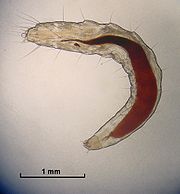 Flea larvae emerge from the eggs to feed on any available organic material such as dead insects, feces, and vegetable matter. They are blind and avoid sunlight, keeping to dark places like sand, cracks and crevices, and bedding. Given an adequate supply of food, larvae should pupate and weave a silk
en cocoon within 1–2 weeks after 3 larval stages. After another week or two, the adult flea is fully developed and ready to emerge from the cocoon. They may however remain resting during this period until they receive a signal that a host is near - vibrations (including sound), heat, and carbon dioxide
are all stimuli indicating the probable presence of a host. Fleas are known to overwinter
in the larval or pupal stages.
Once the flea reaches adulthood, its primary goal is to find blood and then to reproduce. Adult fleas only have about a week to find food once they emerge, but after that they can survive two months to a year between meals. Flea populations are unevenly distributed, with about 50% eggs, 35% larvae, 10% pupae, and 5% adults. Their total life cycle can be as short as two weeks, but may be several months in ideal conditions. Female fleas can lay 500 or more eggs over their life, allowing for phenomenal growth rates.
Adult female rabbit fleas, Spilopsyllus cuniculi, can detect the changing levels of cortisol and corticosterone, hormones in the rabbit's blood that indicate she is getting close to giving birth. This triggers sexual maturity in the fleas and they start producing eggs. As soon as the baby rabbits are born, the fleas make their way down to them and once on board they start feeding, mating, and laying eggs. After 12 days, the adult fleas make their way back to the mother. They complete this mini-migration every time she gives birth.
Newly emerged adult fleas live only about one week if a blood meal is not obtained. However, completely developed adult fleas can live for several months without eating, so long as they do not emerge from their puparia. Optimum temperatures for the flea's life cycle are 70°F to 85°F (21°C to 30°C) and optimum humidity is 70%.
 Fleas are related to mecoptera
, winged insects with good eyesight. The flightless boreid
(snow scorpionfly) with its rudimentary wings seems to be close to the common ancestor of the 2000 or so known varieties of flea, which split off in many directions around 160 million years ago. Their evolution continued to produce adaptations for their specialized parasitic niche, such that they now have no wings and their eyes are covered over. The large number of flea species may be attributed to the wide variety of host species they feed on, which provides so many specific ecological niche
s to adapt to.
In the past, it was most commonly supposed that fleas had evolved from the flies
(Diptera
), based on similarities of the larvae. (Some authorities use the name Aphaniptera because it is older, but names above family rank
need not follow the ICZN
rules of priority, so most taxonomists use the more familiar name). Genetic
and morphological evidence indicates that they are descendants of the Scorpionfly
family Boreidae
, which are also flightless; accordingly it is possible that they will eventually be reclassified as a suborder within the Mecoptera
. In any case, all these groups seem to represent a clade
of closely related insect lineages, for which the names Mecopteroidea and Antliophora have been proposed.
Flea systematics
are not entirely fixed. While, compared to many other insect groups, fleas have been studied and classified fairly thoroughly, details still remain to be learned about the evolution
ary relationships among the different flea lineages.
 Fleas attack a wide variety of warm-blooded
vertebrate
s including dogs, cats, humans, chickens, rabbits, squirrels, rats, ferrets, and mice.
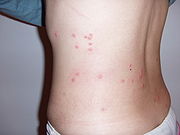
ing sensation which in turn may result in the host attempting to remove the pest by biting, pecking, scratching, etc. in the vicinity of the parasite. Fleas are not simply a source of annoyance, however. Some people and animals suffer allergic reactions
to flea saliva
resulting in rash
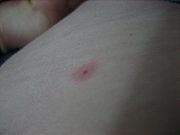
es. Flea bites generally result in the formation of a slightly raised, swollen itching spot with a single puncture point at the center (similar to a mosquito
bite). The bites often appear in clusters or lines of two bites, and can remain itchy and inflamed for up to several weeks afterwards. Fleas can also lead to hair loss as a result of frequent scratching and biting by the animal, and can cause anemia
in extreme cases.
. Fleas transmit not only a variety of viral
, bacteria
l and rickettsia
l diseases to humans and other animals, but also protozoa
ns and helminths.
Fleas that specialize as parasites on specific mammals may use other mammals as hosts; therefore humans are susceptible to the predation of more than one species of flea.
A misconception concerning the carrying/transmission of the HIV/AIDS by fleas has been debunked by the Centers for Disease Control and Prevention (CDC 2003), which stated that fleas cannot carry the virus and spread it to other humans.
s can be treated with anti-itch creams
, usually antihistamines
or hydrocortisone
.
Calamine lotion
has been shown to be effective for itching.
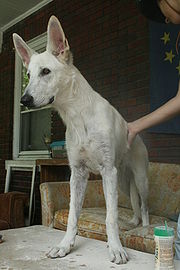 Modern flea control is approached using Integrated Pest Management
(IPM) protocols at the host (pet) level. IPM is achieved by targeting fleas during at least two separate life stages, with at least two separate molecules. This is typically achieved using an adulticide to kill adult fleas and an insect development inhibitor (IDI), like lufenuron
, or insect growth regulator (IGR), like methoprene
, to prevent development of immature stages. Flea adults, larvae, or eggs can be controlled with insecticide
s. Lufenuron
is a veterinary preparation (Program) that attacks the larval flea's ability to produce chitin
but does not kill fleas. Flea medicines need to be used with care because many of them also affect mammals.
Cedar oil
, a non-toxic natural substance, has been proven effective in the eradication of infestations in pets. Cedar oil is being used to treat sand-flea infestation of US Military forces in the Gulf.
Since more than three quarters of a flea's life is spent somewhere other than on the host animal, it is not adequate to treat only the host; it is important also to treat the host's environment. Thorough vacuuming, washing linens in hot water, and treating all hosts in the immediate environment (the entire household, for example) are essential and if possible on a regular basis.
Contemporary commercial products for the topical treatment of flea infestations on pets contain pesticides such as imidacloprid
, permethrin
, and (S)-methoprene
. All flea control products are recommended to be used at least half a year because the lifecycle
of flea and tick can last to up to 6 months, and by using one of the flea and tick control products for so long, the infestation is highly prevented and, in the end, stopped. Although all these products are effective in fighting against flea and tick infestations, they have different active ingredients and, because cats cannot metabolize some of the compounds of the product, care must be taken in their use.
or spray insecticide containing an insect growth regulator
, such as pyriproxyfen
or methoprene
to kill eggs and pupae, which are quite resistant against insecticides. Frequent vacuuming is also helpful, but the vacuum bag must be disposed of immediately afterwards. Fleas tend to breed exponentially in piles of shoes.
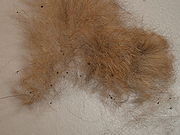 Diatomaceous earth
can also be used as a home flea treatment in lieu of acetylcholinesterase
inhibitory treatments or insecticides which carry with them a risk of poisoning for both humans and animals. However, diatomaceous earth is at least potentially dangerous to pets and people when inhaled, so care in use is recommended.
Dried pennyroyal
has been suggested as a natural flea control, but is not recommended in homes with pets due to its high toxicity to mammals.
Borax
is sold as a "Natural Laundry Booster" and can also be used as another home treatment for flea infestations. Borax contains boric acid
which kills fleas by dehydrating them, but its safety for pets is untested.
Using dehumidifier
s with air conditioning
and vacuuming
all may interrupt the flea life cycle
. Humidity is critical to flea survival. Eggs need relative humidity of at least 70–75% to hatch, and larvae need at least 50% humidity to survive. In humid areas, about 20% of the eggs survive to adulthood; in arid
areas, less than 5% complete the cycle. Fleas thrive at higher temperatures, but need 70° to 90°F (21° to 32°C) to survive. Lower temperatures slow down or completely interrupt the flea life-cycle. A laboratory study done at the University of California
showed that vacuuming catches about 96% of adult fleas. A combination of controlled humidity, temperature, and vacuuming should eliminate fleas from an environment. Altering even one of these environmental factors may be enough to drastically lower and eliminate an infestation.
Common name
A common name of a taxon or organism is a name in general use within a community; it is often contrasted with the scientific name for the same organism...
for insect
Insect
Insects are a class of living creatures within the arthropods that have a chitinous exoskeleton, a three-part body , three pairs of jointed legs, compound eyes, and two antennae...
s of the order
Order (biology)
In scientific classification used in biology, the order is# a taxonomic rank used in the classification of organisms. Other well-known ranks are life, domain, kingdom, phylum, class, family, genus, and species, with order fitting in between class and family...
Siphonaptera which are wingless insects with mouthparts adapted for piercing skin and sucking blood
Blood
Blood is a specialized bodily fluid in animals that delivers necessary substances such as nutrients and oxygen to the cells and transports metabolic waste products away from those same cells....
. Fleas are external parasites
Parasitism
Parasitism is a type of symbiotic relationship between organisms of different species where one organism, the parasite, benefits at the expense of the other, the host. Traditionally parasite referred to organisms with lifestages that needed more than one host . These are now called macroparasites...
, living by hematophagy
Hematophagy
Hematophagy is the practice of certain animals of feeding on blood...
off the blood
Blood
Blood is a specialized bodily fluid in animals that delivers necessary substances such as nutrients and oxygen to the cells and transports metabolic waste products away from those same cells....
of mammal
Mammal
Mammals are members of a class of air-breathing vertebrate animals characterised by the possession of endothermy, hair, three middle ear bones, and mammary glands functional in mothers with young...
s (including bats and humans) and bird
Bird
Birds are feathered, winged, bipedal, endothermic , egg-laying, vertebrate animals. Around 10,000 living species and 188 families makes them the most speciose class of tetrapod vertebrates. They inhabit ecosystems across the globe, from the Arctic to the Antarctic. Extant birds range in size from...
s.
Some flea species include:
- Cat fleaCat fleaThe cat flea, Ctenocephalides felis, is one of the most abundant and widespread species of flea on Earth.-Overview:The cat flea's primary host is the domestic cat, but this is also the primary flea infesting dogs in most of the world. The cat flea can also maintain its life cycle on other...
(Ctenocephalides felis) - Dog fleaDog fleaThe dog flea is a species of flea that lives primarily on the blood of dogs. The dog flea is troublesome because it can spread Dipylidium caninum. They are commonly found in Europe....
(Ctenocephalides canis) - Human fleaHuman fleaThe human flea, Pulex irritans, is a cosmopolitan flea species that has, in spite of the common name, a wide host spectrum. It is one of six species in the genus Pulex; the other five are all confined to the Nearctic and Neotropical regions...
(Pulex irritans) - Moorhen fleaMoorhen fleaThe moorhen flea, Dasypsyllus gallinulae, originally from South America, is now a globally widespread flea species. It is a large flea, easily identified because the male has two heavy horn-like spines on one of the genital flaps, and the female has a deep "bite" on the seventh sternite.It is found...
(Dasypsyllus gallinulae) - Northern rat fleaNorthern rat fleaThe northern rat flea is a species of flea that is found on domestic rats and house mice. Northern rat fleas are external parasites, living by hematophagy off the blood of rodents...
(Nosopsyllus fasciatus) - Oriental rat flea (Xenopsylla cheopis)
Over 2,000 species have been described worldwide.
Morphology and behavior
Froghopper
The froghoppers, or the superfamily Cercopoidea, are a group of Hemipteran insects, in the suborder Auchenorrhyncha. Traditionally, most of this superfamily was considered a single family, Cercopidae, but this family has been split into three separate families for many years now: the Aphrophoridae,...
. According to an article in Science News, "researchers with the University of Cambridge in England have shown that fleas take off from their tibiae and tarsi—the insect equivalent of feet—and not their trochantera, or knees. The researchers report their conclusion in the March 1 Journal of Experimental Biology." It has been known that fleas do not use muscle power but energy stored in a protein named resilin
Resilin
Resilin is an elastomeric protein found in many insects. The protein was first discovered by Torkel Weis-Fogh in the locust wing-hinge. As of 2005 it is the most efficient elastic protein known . The elastic efficiency of the resilin isolated from locust tendon has been reported to be 97 %...
but the researchers used high-speed video technology and mathematical models to discover where the spring action actually happens. Their bodies are laterally compressed, permitting easy movement through the hairs or feathers on the host's body (or in the case of humans, under clothing). The flea body is hard, polished, and covered with many hairs and short spines directed backward, which also assist its movements on the host. The tough body is able to withstand great pressure, likely an adaptation to survive attempts to eliminate them by mashing or scratching. Even hard squeezing between the fingers is normally insufficient to kill a flea. It is possible to eliminate them by pressing individual fleas with adhesive tape or softened beeswax (or "cheese" wax) or by rolling a flea briskly between the fingers to disable it then crushing it between the fingernails. Fleas also can be drowned in water and may not survive direct contact with anti-flea pesticides.
Loupe
A loupe is a simple, small magnification device used to see small details more closely. Unlike a magnifying glass, a loupe does not have an attached handle, and its focusing lens are contained in an opaque cylinder or cone. Loupes are also called hand lenses .- Optics :Three basic types of loupes...
. The larva is small, pale, has bristles covering its worm-like body, lacks eyes, and has mouthparts adapted to chewing. The larvae feed on various organic matter, especially the feces of mature fleas. The adult flea's diet consists solely of fresh blood. In the pupal phase, the larva is enclosed in a silken, debris-covered cocoon.
Life cycle and habitat
Fleas are holometabolousHolometabolism
Holometabolism, also called complete metamorphism, is a term applied to insect groups to describe the specific kind of insect development which includes four life stages - as an embryo or egg, a larva, a pupa and an imago or adult. Holometabolism is a monophyletic trait that all insects in the...
insects, going through the four life cycle
Biological life cycle
A life cycle is a period involving all different generations of a species succeeding each other through means of reproduction, whether through asexual reproduction or sexual reproduction...
stages of egg
Egg (biology)
An egg is an organic vessel in which an embryo first begins to develop. In most birds, reptiles, insects, molluscs, fish, and monotremes, an egg is the zygote, resulting from fertilization of the ovum, which is expelled from the body and permitted to develop outside the body until the developing...
, larva
Larva
A larva is a distinct juvenile form many animals undergo before metamorphosis into adults. Animals with indirect development such as insects, amphibians, or cnidarians typically have a larval phase of their life cycle...
, pupa
Pupa
A pupa is the life stage of some insects undergoing transformation. The pupal stage is found only in holometabolous insects, those that undergo a complete metamorphosis, going through four life stages; embryo, larva, pupa and imago...
, and imago
Imago
In biology, the imago is the last stage of development of an insect, after the last ecdysis of an incomplete metamorphosis, or after emergence from the pupa where the metamorphosis is complete...
(adult). The flea life cycle begins when the female lays after feeding. Adult fleas must feed on blood before they can become capable of reproduction. Eggs are laid in batches of up to 20 or so, usually on the host itself, which means that the eggs can easily roll onto the ground. Because of this, areas where the host rests and sleeps become one of the primary habitat
Habitat
* Habitat , a place where a species lives and grows*Human habitat, a place where humans live, work or play** Space habitat, a space station intended as a permanent settlement...
s of eggs and developing fleas. The eggs take around two days to two weeks to hatch.
Silk
Silk is a natural protein fiber, some forms of which can be woven into textiles. The best-known type of silk is obtained from the cocoons of the larvae of the mulberry silkworm Bombyx mori reared in captivity...
en cocoon within 1–2 weeks after 3 larval stages. After another week or two, the adult flea is fully developed and ready to emerge from the cocoon. They may however remain resting during this period until they receive a signal that a host is near - vibrations (including sound), heat, and carbon dioxide
Carbon dioxide
Carbon dioxide is a naturally occurring chemical compound composed of two oxygen atoms covalently bonded to a single carbon atom...
are all stimuli indicating the probable presence of a host. Fleas are known to overwinter
Overwinter
To overwinter is to pass through or wait out the winter season, or to pass through that period of the year when “winter” conditions make normal activity or even survival difficult or near impossible...
in the larval or pupal stages.
Once the flea reaches adulthood, its primary goal is to find blood and then to reproduce. Adult fleas only have about a week to find food once they emerge, but after that they can survive two months to a year between meals. Flea populations are unevenly distributed, with about 50% eggs, 35% larvae, 10% pupae, and 5% adults. Their total life cycle can be as short as two weeks, but may be several months in ideal conditions. Female fleas can lay 500 or more eggs over their life, allowing for phenomenal growth rates.
Adult female rabbit fleas, Spilopsyllus cuniculi, can detect the changing levels of cortisol and corticosterone, hormones in the rabbit's blood that indicate she is getting close to giving birth. This triggers sexual maturity in the fleas and they start producing eggs. As soon as the baby rabbits are born, the fleas make their way down to them and once on board they start feeding, mating, and laying eggs. After 12 days, the adult fleas make their way back to the mother. They complete this mini-migration every time she gives birth.
Newly emerged adult fleas live only about one week if a blood meal is not obtained. However, completely developed adult fleas can live for several months without eating, so long as they do not emerge from their puparia. Optimum temperatures for the flea's life cycle are 70°F to 85°F (21°C to 30°C) and optimum humidity is 70%.
Classification
Mecoptera
Mecoptera are an order of insects with about 550 species in nine families worldwide. Mecoptera are sometimes called scorpionflies after their largest family, Panorpidae, in which the males have enlarged genitals that look similar to the stinger of a scorpion...
, winged insects with good eyesight. The flightless boreid
Snow scorpionfly
Boreidae, commonly called Snow scorpionflies, are a very small family of Scorpionflies, containing only around 30 species, all of which are boreal or high-altitude species in the Northern Hemisphere...
(snow scorpionfly) with its rudimentary wings seems to be close to the common ancestor of the 2000 or so known varieties of flea, which split off in many directions around 160 million years ago. Their evolution continued to produce adaptations for their specialized parasitic niche, such that they now have no wings and their eyes are covered over. The large number of flea species may be attributed to the wide variety of host species they feed on, which provides so many specific ecological niche
Ecological niche
In ecology, a niche is a term describing the relational position of a species or population in its ecosystem to each other; e.g. a dolphin could potentially be in another ecological niche from one that travels in a different pod if the members of these pods utilize significantly different food...
s to adapt to.
In the past, it was most commonly supposed that fleas had evolved from the flies
Fly
True flies are insects of the order Diptera . They possess a pair of wings on the mesothorax and a pair of halteres, derived from the hind wings, on the metathorax...
(Diptera
Fly
True flies are insects of the order Diptera . They possess a pair of wings on the mesothorax and a pair of halteres, derived from the hind wings, on the metathorax...
), based on similarities of the larvae. (Some authorities use the name Aphaniptera because it is older, but names above family rank
Circumscriptional name
Circumscriptional names are taxon names used above family-group level that are not ruled by ICZN and are defined by the particular set of members included, not the number of species....
need not follow the ICZN
International Code of Zoological Nomenclature
The International Code of Zoological Nomenclature is a widely accepted convention in zoology that rules the formal scientific naming of organisms treated as animals...
rules of priority, so most taxonomists use the more familiar name). Genetic
Genetics
Genetics , a discipline of biology, is the science of genes, heredity, and variation in living organisms....
and morphological evidence indicates that they are descendants of the Scorpionfly
Mecoptera
Mecoptera are an order of insects with about 550 species in nine families worldwide. Mecoptera are sometimes called scorpionflies after their largest family, Panorpidae, in which the males have enlarged genitals that look similar to the stinger of a scorpion...
family Boreidae
Snow scorpionfly
Boreidae, commonly called Snow scorpionflies, are a very small family of Scorpionflies, containing only around 30 species, all of which are boreal or high-altitude species in the Northern Hemisphere...
, which are also flightless; accordingly it is possible that they will eventually be reclassified as a suborder within the Mecoptera
Mecoptera
Mecoptera are an order of insects with about 550 species in nine families worldwide. Mecoptera are sometimes called scorpionflies after their largest family, Panorpidae, in which the males have enlarged genitals that look similar to the stinger of a scorpion...
. In any case, all these groups seem to represent a clade
Clade
A clade is a group consisting of a species and all its descendants. In the terms of biological systematics, a clade is a single "branch" on the "tree of life". The idea that such a "natural group" of organisms should be grouped together and given a taxonomic name is central to biological...
of closely related insect lineages, for which the names Mecopteroidea and Antliophora have been proposed.
Flea systematics
Systematics
Biological systematics is the study of the diversification of terrestrial life, both past and present, and the relationships among living things through time. Relationships are visualized as evolutionary trees...
are not entirely fixed. While, compared to many other insect groups, fleas have been studied and classified fairly thoroughly, details still remain to be learned about the evolution
Evolution
Evolution is any change across successive generations in the heritable characteristics of biological populations. Evolutionary processes give rise to diversity at every level of biological organisation, including species, individual organisms and molecules such as DNA and proteins.Life on Earth...
ary relationships among the different flea lineages.
- InfraorderOrder (biology)In scientific classification used in biology, the order is# a taxonomic rank used in the classification of organisms. Other well-known ranks are life, domain, kingdom, phylum, class, family, genus, and species, with order fitting in between class and family...
Pulicomorpha- SuperfamilyTaxonomic rankIn biological classification, rank is the level in a taxonomic hierarchy. Examples of taxonomic ranks are species, genus, family, and class. Each rank subsumes under it a number of less general categories...
Pulicoidea- FamilyFamily (biology)In biological classification, family is* a taxonomic rank. Other well-known ranks are life, domain, kingdom, phylum, class, order, genus, and species, with family fitting between order and genus. As for the other well-known ranks, there is the option of an immediately lower rank, indicated by the...
HectopsyllidaeHectopsyllidaeHectopsyllidae is a small family of fleas, containing only the chigoe fleas and the sticktight fleas. They were formerly known as Tungidae, and by authorities that demote the Pulicoidea to family rank they are treated as subfamily Hectopsyllinae...
—sticktight and chigoe fleaChigoe fleaThe chigoe flea or jigger is a parasitic arthropod found in most tropical and sub-tropical climates, not to be confused with the larval form of Trombiculidae found in more temperate climates. In Brazil, the parasite is referred to as bicho-de-pé . At 1 mm long, the chigoe flea is the smallest...
s ("chiggers" of Latin AmericaLatin AmericaLatin America is a region of the Americas where Romance languages – particularly Spanish and Portuguese, and variably French – are primarily spoken. Latin America has an area of approximately 21,069,500 km² , almost 3.9% of the Earth's surface or 14.1% of its land surface area...
) - Family Pulicidae—common fleas
- Family
- Superfamily Malacopsylloidea
- Family Malacopsyllidae
- Family Rhopalopsyllidae—hosts
- Family Vermipsyllidae—hosts: carnivores
- Superfamily Coptopsylloidea
- Family Coptopsyllidae
- Superfamily Ancistropsylloidea
- Family Ancistropsyllidae
- Superfamily
- Infraorder Pygiopsyllomorpha
- Superfamily Pygiopsylloidea
- Family Lycopsyllidae
- Family Pygiopsyllidae
- Family Stivaliidae
- Superfamily Pygiopsylloidea
- Infraorder Hystrichopsyllomorpha
- Superfamily Hystrichopsylloidea
- Family Hystrichopsyllidae—hosts: rats and mice. Includes Ctenopsyllidae, Amphipsyllidae
- Family Chimaeropsyllidae
- Superfamily Macropsylloidea
- Family Macropsyllidae
- Superfamily Stephanocircidoidea
- Family StephanocircidaeStephanocircidaeStephanocircidae is a family of fleas native to South America, where they are found on rodents....
- Family Stephanocircidae
- Superfamily Hystrichopsylloidea
Relationship with host
Warm-blooded
The term warm-blooded is a colloquial term to describe animal species which have a relatively higher blood temperature, and maintain thermal homeostasis primarily through internal metabolic processes...
vertebrate
Vertebrate
Vertebrates are animals that are members of the subphylum Vertebrata . Vertebrates are the largest group of chordates, with currently about 58,000 species described. Vertebrates include the jawless fishes, bony fishes, sharks and rays, amphibians, reptiles, mammals, and birds...
s including dogs, cats, humans, chickens, rabbits, squirrels, rats, ferrets, and mice.
Direct effects of bites
Fleas are a nuisance to their hosts, causing an itchItch
Itch is a sensation that causes the desire or reflex to scratch. Itch has resisted many attempts to classify it as any one type of sensory experience. Modern science has shown that itch has many similarities to pain, and while both are unpleasant sensory experiences, their behavioral response...
ing sensation which in turn may result in the host attempting to remove the pest by biting, pecking, scratching, etc. in the vicinity of the parasite. Fleas are not simply a source of annoyance, however. Some people and animals suffer allergic reactions
Allergy
An Allergy is a hypersensitivity disorder of the immune system. Allergic reactions occur when a person's immune system reacts to normally harmless substances in the environment. A substance that causes a reaction is called an allergen. These reactions are acquired, predictable, and rapid...
to flea saliva
Saliva
Saliva , referred to in various contexts as spit, spittle, drivel, drool, or slobber, is the watery substance produced in the mouths of humans and most other animals. Saliva is a component of oral fluid. In mammals, saliva is produced in and secreted from the three pairs of major salivary glands,...
resulting in rash
Rash
A rash is a change of the skin which affects its color, appearance or texture. A rash may be localized in one part of the body, or affect all the skin. Rashes may cause the skin to change color, itch, become warm, bumpy, chapped, dry, cracked or blistered, swell and may be painful. The causes, and...
es. Flea bites generally result in the formation of a slightly raised, swollen itching spot with a single puncture point at the center (similar to a mosquito
Mosquito
Mosquitoes are members of a family of nematocerid flies: the Culicidae . The word Mosquito is from the Spanish and Portuguese for little fly...
bite). The bites often appear in clusters or lines of two bites, and can remain itchy and inflamed for up to several weeks afterwards. Fleas can also lead to hair loss as a result of frequent scratching and biting by the animal, and can cause anemia
Anemia
Anemia is a decrease in number of red blood cells or less than the normal quantity of hemoglobin in the blood. However, it can include decreased oxygen-binding ability of each hemoglobin molecule due to deformity or lack in numerical development as in some other types of hemoglobin...
in extreme cases.
As a vector
Besides the problems posed by the creature itself, fleas can also act as a vector for diseaseDisease
A disease is an abnormal condition affecting the body of an organism. It is often construed to be a medical condition associated with specific symptoms and signs. It may be caused by external factors, such as infectious disease, or it may be caused by internal dysfunctions, such as autoimmune...
. Fleas transmit not only a variety of viral
Virus
A virus is a small infectious agent that can replicate only inside the living cells of organisms. Viruses infect all types of organisms, from animals and plants to bacteria and archaea...
, bacteria
Bacteria
Bacteria are a large domain of prokaryotic microorganisms. Typically a few micrometres in length, bacteria have a wide range of shapes, ranging from spheres to rods and spirals...
l and rickettsia
Rickettsia
Rickettsia is a genus of non-motile, Gram-negative, non-sporeforming, highly pleomorphic bacteria that can present as cocci , rods or thread-like . Being obligate intracellular parasites, the Rickettsia survival depends on entry, growth, and replication within the cytoplasm of eukaryotic host cells...
l diseases to humans and other animals, but also protozoa
Protozoa
Protozoa are a diverse group of single-cells eukaryotic organisms, many of which are motile. Throughout history, protozoa have been defined as single-cell protists with animal-like behavior, e.g., movement...
ns and helminths.
- bacteria: Murine or endemic typhusMurine typhusMurine typhus is a form of typhus transmitted by fleas , usually on rats. Murine typhus is an under-recognized entity, as it is often confused with viral illnesses...
. Fleas have helped cause epidemicEpidemicIn epidemiology, an epidemic , occurs when new cases of a certain disease, in a given human population, and during a given period, substantially exceed what is expected based on recent experience...
s by transmitting diseases such as the bubonic plagueBubonic plaguePlague is a deadly infectious disease that is caused by the enterobacteria Yersinia pestis, named after the French-Swiss bacteriologist Alexandre Yersin. Primarily carried by rodents and spread to humans via fleas, the disease is notorious throughout history, due to the unrivaled scale of death...
between rodents and humans by carrying Yersinia pestisYersinia pestisYersinia pestis is a Gram-negative rod-shaped bacterium. It is a facultative anaerobe that can infect humans and other animals....
bacteria. Fleas can transmit Yersinia pestisYersinia pestisYersinia pestis is a Gram-negative rod-shaped bacterium. It is a facultative anaerobe that can infect humans and other animals....
, Rickettsia typhiRickettsia typhiRickettsia typhi is a species of the genus Rickettsia.It is the causative agent of Murine typhus.The genome is similar to that of Rickettsia prowazekii.-References:...
, Rickettsia felisRickettsia felisRickettsia felis or cat-flea typhus is a species of Rickettsia that causes flea-borne spotted fever in cats. The bacteria can also infect humans and cause illness. Fleas are the vector carriers of the bacteria and it has been found in cat flea populations of North and South America, Southern...
, and Bartonella henselaeBartonella henselaeBartonella henselae, formerly Rochalimæa, is a proteobacterium that can cause bacteremia, endocarditis, bacillary angiomatosis, and peliosis hepatis. It is also the causative agent of cat-scratch disease which, as the name suggests, occurs after a cat bite or scratch...
. - virus: myxomatosisMyxomatosisMyxomatosis is a disease that affects rabbits and is caused by the Myxoma virus. It was first observed in Uruguay in laboratory rabbits in the late 19th century. It was introduced into Australia in 1950 in an attempt to control the rabbit population...
. - helminth: infestation of HymenolepiasisHymenolepiasisHymenolepiasis is infestation by one of two species of tapeworm:* Hymenolepis nana* Hymenolepis diminutaAlternative names are:* Dwarf tapeworm infection* Rat tapeworm-Causes, incidence, and risk factors:...
tapewormCestodaThis article describes the flatworm. For the medical condition, see Tapeworm infection.Cestoda is the name given to a class of parasitic flatworms, commonly called tapeworms, of the phylum Platyhelminthes. Its members live in the digestive tract of vertebrates as adults, and often in the bodies...
. - protozoa: TrypanosomeTrypanosomaTrypanosoma is a genus of kinetoplastids , a monophyletic group of unicellular parasitic flagellate protozoa. The name is derived from the Greek trypano and soma because of their corkscrew-like motion. All trypanosomes are heteroxenous and are transmitted via a vector...
protozoans such as those of the subgenusSubgenusIn biology, a subgenus is a taxonomic rank directly below genus.In zoology, a subgeneric name can be used independently or included in a species name, in parentheses, placed between the generic name and the specific epithet: e.g. the Tiger Cowry of the Indo-Pacific, Cypraea tigris Linnaeus, which...
Herpetosoma, use a variety of flea species opportunistically as vectors.
Fleas that specialize as parasites on specific mammals may use other mammals as hosts; therefore humans are susceptible to the predation of more than one species of flea.
A misconception concerning the carrying/transmission of the HIV/AIDS by fleas has been debunked by the Centers for Disease Control and Prevention (CDC 2003), which stated that fleas cannot carry the virus and spread it to other humans.
For humans
Fleas can settle in a person's hair in less than ten minutes, causing soreness and itching. The itching associated with flea biteBite
A bite is a wound received from the mouth of an animal, including humans.Animals may bite in self-defense, in an attempt to predate food, as well as part of normal interactions. Other bite attacks may be apparently unprovoked. Self inflicted bites occur in some genetic illnesses such as...
s can be treated with anti-itch creams
Antipruritic
Antipruritics, also known as anti-itch drugs, are medications that inhibit the itching that is often associated with sunburns, allergic reactions, eczema, psoriasis, chickenpox, fungal infections, insect bites and stings like those from mosquitoes, fleas, and mites, and contact dermatitis and...
, usually antihistamines
Histamine antagonist
A histamine antagonist, commonly referred to as antihistamine, is a pharmaceutical drug that inhibits action of histamine by blocking it from attaching to histamine receptors.- Clinical effects :...
or hydrocortisone
Cortisol
Cortisol is a steroid hormone, more specifically a glucocorticoid, produced by the adrenal gland. It is released in response to stress and a low level of blood glucocorticoids. Its primary functions are to increase blood sugar through gluconeogenesis; suppress the immune system; and aid in fat,...
.
Calamine lotion
Calamine
Calamine is a mixture of zinc oxide with about 0.5% ferric oxide . It is the main ingredient in calamine lotion and is used as an antipruritic to treat mild pruritic conditions such as sunburn, eczema, rashes, poison ivy, chickenpox, and insect bites and stings...
has been shown to be effective for itching.
For pets
Integrated Pest Management
Integrated pest management is an ecological approach to agricultural pest control that integrates pesticides/herbicides into a management system incorporating a range of practices for economic control of a pest...
(IPM) protocols at the host (pet) level. IPM is achieved by targeting fleas during at least two separate life stages, with at least two separate molecules. This is typically achieved using an adulticide to kill adult fleas and an insect development inhibitor (IDI), like lufenuron
Lufenuron
Lufenuron is the active ingredient in the veterinary flea control medication Program, and one of the active ingredients in the veterinary flea control, heartworm prevention, and anthelmintic medicine milbemycin oxime/lufenuron .Lufenuron is stored in the animal's body fat and transferred to adult...
, or insect growth regulator (IGR), like methoprene
Methoprene
Methoprene is a juvenile hormone analog which can be used as an insecticide that acts as a growth regulator. Methoprene is an amber-colored liquid with a faint fruity odor which is essentially nontoxic to humans when ingested or inhaled. It is used in drinking water cisterns to control mosquitoes...
, to prevent development of immature stages. Flea adults, larvae, or eggs can be controlled with insecticide
Insecticide
An insecticide is a pesticide used against insects. They include ovicides and larvicides used against the eggs and larvae of insects respectively. Insecticides are used in agriculture, medicine, industry and the household. The use of insecticides is believed to be one of the major factors behind...
s. Lufenuron
Lufenuron
Lufenuron is the active ingredient in the veterinary flea control medication Program, and one of the active ingredients in the veterinary flea control, heartworm prevention, and anthelmintic medicine milbemycin oxime/lufenuron .Lufenuron is stored in the animal's body fat and transferred to adult...
is a veterinary preparation (Program) that attacks the larval flea's ability to produce chitin
Chitin
Chitin n is a long-chain polymer of a N-acetylglucosamine, a derivative of glucose, and is found in many places throughout the natural world...
but does not kill fleas. Flea medicines need to be used with care because many of them also affect mammals.
Cedar oil
Cedar oil
Cedar oil, also known as cedarwood oil, is an essential oil derived from the foliage, and sometimes the wood and roots, of various types of conifers, most in the pine or cypress botanical families...
, a non-toxic natural substance, has been proven effective in the eradication of infestations in pets. Cedar oil is being used to treat sand-flea infestation of US Military forces in the Gulf.
Since more than three quarters of a flea's life is spent somewhere other than on the host animal, it is not adequate to treat only the host; it is important also to treat the host's environment. Thorough vacuuming, washing linens in hot water, and treating all hosts in the immediate environment (the entire household, for example) are essential and if possible on a regular basis.
Contemporary commercial products for the topical treatment of flea infestations on pets contain pesticides such as imidacloprid
Imidacloprid
Imidacloprid is a nicotine-based, systemic insecticide, which acts as a neurotoxin and belongs to a class of chemicals called the neonicotinoids. Although it is now off patent, the primary manufacturer of this chemical is Bayer CropScience,...
, permethrin
Permethrin
Permethrin is a common synthetic chemical, widely used as an insecticide, acaricide, and insect repellent. It belongs to the family of synthetic chemicals called pyrethroids and functions as a neurotoxin, affecting neuron membranes by prolonging sodium channel activation. It is not known to...
, and (S)-methoprene
Methoprene
Methoprene is a juvenile hormone analog which can be used as an insecticide that acts as a growth regulator. Methoprene is an amber-colored liquid with a faint fruity odor which is essentially nontoxic to humans when ingested or inhaled. It is used in drinking water cisterns to control mosquitoes...
. All flea control products are recommended to be used at least half a year because the lifecycle
Biological life cycle
A life cycle is a period involving all different generations of a species succeeding each other through means of reproduction, whether through asexual reproduction or sexual reproduction...
of flea and tick can last to up to 6 months, and by using one of the flea and tick control products for so long, the infestation is highly prevented and, in the end, stopped. Although all these products are effective in fighting against flea and tick infestations, they have different active ingredients and, because cats cannot metabolize some of the compounds of the product, care must be taken in their use.
For the home
Combatting a flea infestation in the home takes patience because for every flea found on an animal, there could be many more developing in the home. A spot-on insecticide will kill the fleas on the pet and in turn the pet itself will be a roving flea trap and mop up newly hatched fleas. The environment should be treated with a foggerFogger
A fogger is any device that creates a fog, typically containing an insecticide for killing insects and other arthropods. Foggers are often used by consumers as a low cost alternative to professional pest control services. The number of foggers needed for pest control depends on the size of the...
or spray insecticide containing an insect growth regulator
Juvenile hormone
Juvenile hormones are a group of acyclic sesquiterpenoids that regulate many aspects of insect physiology. JHs regulate development, reproduction, diapause, and polyphenisms....
, such as pyriproxyfen
Pyriproxyfen
Pyriproxyfen is a pyridine based pesticide which is found to be effective against a variety of arthropoda. It was introduced to the US in 1996 to protect cotton crops against whitefly...
or methoprene
Methoprene
Methoprene is a juvenile hormone analog which can be used as an insecticide that acts as a growth regulator. Methoprene is an amber-colored liquid with a faint fruity odor which is essentially nontoxic to humans when ingested or inhaled. It is used in drinking water cisterns to control mosquitoes...
to kill eggs and pupae, which are quite resistant against insecticides. Frequent vacuuming is also helpful, but the vacuum bag must be disposed of immediately afterwards. Fleas tend to breed exponentially in piles of shoes.
Diatomaceous earth
Diatomaceous earth also known as diatomite or kieselgur/kieselguhr, is a naturally occurring, soft, siliceous sedimentary rock that is easily crumbled into a fine white to off-white powder. It has a particle size ranging from less than 1 micrometre to more than 1 millimetre, but typically 10 to...
can also be used as a home flea treatment in lieu of acetylcholinesterase
Acetylcholinesterase
"Acetylcholinesterase, also known as AChE or acetylcholine acetylhydrolase, is an enzyme that degrades the neurotransmitter acetylcholine, producing choline and an acetate group. It is mainly found at neuromuscular junctions and cholinergic nervous system, where its activity serves to terminate...
inhibitory treatments or insecticides which carry with them a risk of poisoning for both humans and animals. However, diatomaceous earth is at least potentially dangerous to pets and people when inhaled, so care in use is recommended.
Dried pennyroyal
Pennyroyal
Pennyroyal refers to two plants in the mint family, Lamiaceae. For the American species, see American pennyroyal. The European pennyroyal, Mentha pulegium, , is a plant in the mint genus, within the family Lamiaceae. Crushed Pennyroyal leaves exhibit a very strong fragrance similar to spearmint...
has been suggested as a natural flea control, but is not recommended in homes with pets due to its high toxicity to mammals.
Borax
Borax
Borax, also known as sodium borate, sodium tetraborate, or disodium tetraborate, is an important boron compound, a mineral, and a salt of boric acid. It is usually a white powder consisting of soft colorless crystals that dissolve easily in water.Borax has a wide variety of uses...
is sold as a "Natural Laundry Booster" and can also be used as another home treatment for flea infestations. Borax contains boric acid
Boric acid
Boric acid, also called hydrogen borate or boracic acid or orthoboric acid or acidum boricum, is a weak acid of boron often used as an antiseptic, insecticide, flame retardant, as a neutron absorber, and as a precursor of other chemical compounds. It exists in the form of colorless crystals or a...
which kills fleas by dehydrating them, but its safety for pets is untested.
Using dehumidifier
Dehumidifier
A dehumidifier is typically a household appliance that reduces the level of humidity in the air, usually for health reasons. Humid air can cause mold and mildew to grow inside homes, which pose various health risks. Very humid climates or air make some people extremely uncomfortable, causing...
s with air conditioning
Air conditioning
An air conditioner is a home appliance, system, or mechanism designed to dehumidify and extract heat from an area. The cooling is done using a simple refrigeration cycle...
and vacuuming
Vacuum cleaner
A vacuum cleaner, commonly referred to as a "vacuum," is a device that uses an air pump to create a partial vacuum to suck up dust and dirt, usually from floors, and optionally from other surfaces as well. The dirt is collected by either a dustbag or a cyclone for later disposal...
all may interrupt the flea life cycle
Biological life cycle
A life cycle is a period involving all different generations of a species succeeding each other through means of reproduction, whether through asexual reproduction or sexual reproduction...
. Humidity is critical to flea survival. Eggs need relative humidity of at least 70–75% to hatch, and larvae need at least 50% humidity to survive. In humid areas, about 20% of the eggs survive to adulthood; in arid
Arid
A region is said to be arid when it is characterized by a severe lack of available water, to the extent of hindering or even preventing the growth and development of plant and animal life...
areas, less than 5% complete the cycle. Fleas thrive at higher temperatures, but need 70° to 90°F (21° to 32°C) to survive. Lower temperatures slow down or completely interrupt the flea life-cycle. A laboratory study done at the University of California
University of California
The University of California is a public university system in the U.S. state of California. Under the California Master Plan for Higher Education, the University of California is a part of the state's three-tier public higher education system, which also includes the California State University...
showed that vacuuming catches about 96% of adult fleas. A combination of controlled humidity, temperature, and vacuuming should eliminate fleas from an environment. Altering even one of these environmental factors may be enough to drastically lower and eliminate an infestation.
See also
- PulicosisPulicosisPulicosis is a skin condition caused by several species of fleas, including the cat flea Ctenocephalides felis. The condition manifests itself after as few as one flea bite and may not even be noticed. Within minutes skin irritation begins. This can range from extremely mild to severe...
(Flea bites) - Anti-itch drugAntipruriticAntipruritics, also known as anti-itch drugs, are medications that inhibit the itching that is often associated with sunburns, allergic reactions, eczema, psoriasis, chickenpox, fungal infections, insect bites and stings like those from mosquitoes, fleas, and mites, and contact dermatitis and...
- Bubonic plagueBubonic plaguePlague is a deadly infectious disease that is caused by the enterobacteria Yersinia pestis, named after the French-Swiss bacteriologist Alexandre Yersin. Primarily carried by rodents and spread to humans via fleas, the disease is notorious throughout history, due to the unrivaled scale of death...
- Cat fleaCat fleaThe cat flea, Ctenocephalides felis, is one of the most abundant and widespread species of flea on Earth.-Overview:The cat flea's primary host is the domestic cat, but this is also the primary flea infesting dogs in most of the world. The cat flea can also maintain its life cycle on other...
- Echidnophaga gallinaceaEchidnophaga gallinaceaEchidnophaga gallinacea is a cosmopolitan sticktight flea occurring on a wide range of bird and mammal hosts.The genus Echidnophaga includes some 21 species occurring in the Palaearctic, Afrotropic and Australasian regions, except for the hen flea which has acquired an inadvertent cosmopolitan...
- Use of DNA in forensic entomologyUse of DNA in forensic entomologyForensic entomology contains three aspects: medicocriminal entomology, urban entomology, and stored product entomology. This article focuses more on the medicocriminal aspect and how DNA is analyzed with various blood feeding insects.- Blood meal extraction :...
External links
- Flea information highlighting habits, habitat, threats and prevention tips
- Integrated Flea Control from University of Nebraska-Lincoln Extension in Lancaster County
- http://npic.orst.edu/pest/flea.html National Pesticide Information Center Flea Control]
- Advice about fleas from the Berkeley Parents Network