
All Topics  
Firearm

 
Firearm

   Email Print
   Bookmark   Link


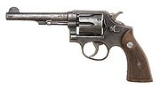
Firearm


A firearm is a tool
Tool

A broad definition of a tool is an entity used to interface between two or more domains that facilitates more effective action of one domain upon the other....
 that projects either single or multiple projectile
Projectile

A projectile is any object propelled through space by the exertion of a force, which ceases after launch. In a general sense, even a Football or baseball may be considered a projectile....
s at high velocity through a controlled explosion. The firing is achieved by the gas
Gas

In physics, a gas is a state of matter, consisting of a collection of particles without a definite shape or volume that are in more or less random motion....
es produced through rapid, confined burning
Combustion

Combustion or burning is a complex sequence of exothermic chemical reactions between a fuel and an oxidant accompanied by the production of heat or both heat and light in the form of either a glow or flames, appearance of light flickering....
 of a propellant
Propellant

A propellant is a material that is used to move an object. This will often involve a chemical reaction. It may be a gas, liquid, Plasma , or, before the chemical reaction, a solid....
. This process of rapid burning is technically known as deflagration
Deflagration

Deflagration is a technical term describing subsonic combustion that usually propagates through thermal conductivity . Most "fire" found in daily life, from flames to explosions, is technically deflagration....
. In older firearms, this propellant was typically black powder, but modern firearms use smokeless powder
Smokeless powder

Smokeless powder is the name given to a number of propellants used in firearms and artillery which produce negligible smoke when fired, unlike the older gunpowder which they replaced....
, cordite
Cordite

Cordite is a family of smokeless powder developed and produced in the United Kingdom from 1889 to replace gunpowder as a military propellant....
, or other propellants. Most modern firearms (with the notable exception of smoothbore
Smoothbore

A smoothbore weapon is one which has a gun barrel without rifling. Smoothbores range from handheld firearms to powerful tank guns and large artillery mortar s....
 shotgun
Shotgun

A shotgun is a firearm that is usually designed to be fired from the shoulder, which uses the energy of a fixed shell to fire a number of small spherical pellets called lead shot, or a solid projectile called a shotgun slug....
s) have rifled
Rifling

Rifling is the helix-shaped pattern in the Gun barrel of a gun or firearm, which imparts a spin to a projectile around its long axis. This spin serves to gyroscope stabilize the projectile, improving its Aerodynamics stability and accuracy....
 barrels to impart spin to the projectile for improved flight stability.

he Middle Ages the term "firearm" was used in English to denote the arm in which the match was held that was used to light the touch hole
Touch hole

A touch hole is a small hole, through which the propellant charge of a cannon or muzzleloading gun is ignited. In small arms, the flash from a charge of priming...
 on the hand cannon.


Discussion
Ask a question about 'Firearm'
Start a new discussion about 'Firearm'
Answer questions from other users
Full Discussion Forum


Recent Posts


Encyclopedia


A firearm is a tool
Tool

A broad definition of a tool is an entity used to interface between two or more domains that facilitates more effective action of one domain upon the other....
 that projects either single or multiple projectile
Projectile

A projectile is any object propelled through space by the exertion of a force, which ceases after launch. In a general sense, even a Football or baseball may be considered a projectile....
s at high velocity through a controlled explosion. The firing is achieved by the gas
Gas

In physics, a gas is a state of matter, consisting of a collection of particles without a definite shape or volume that are in more or less random motion....
es produced through rapid, confined burning
Combustion

Combustion or burning is a complex sequence of exothermic chemical reactions between a fuel and an oxidant accompanied by the production of heat or both heat and light in the form of either a glow or flames, appearance of light flickering....
 of a propellant
Propellant

A propellant is a material that is used to move an object. This will often involve a chemical reaction. It may be a gas, liquid, Plasma , or, before the chemical reaction, a solid....
. This process of rapid burning is technically known as deflagration
Deflagration

Deflagration is a technical term describing subsonic combustion that usually propagates through thermal conductivity . Most "fire" found in daily life, from flames to explosions, is technically deflagration....
. In older firearms, this propellant was typically black powder, but modern firearms use smokeless powder
Smokeless powder

Smokeless powder is the name given to a number of propellants used in firearms and artillery which produce negligible smoke when fired, unlike the older gunpowder which they replaced....
, cordite
Cordite

Cordite is a family of smokeless powder developed and produced in the United Kingdom from 1889 to replace gunpowder as a military propellant....
, or other propellants. Most modern firearms (with the notable exception of smoothbore
Smoothbore

A smoothbore weapon is one which has a gun barrel without rifling. Smoothbores range from handheld firearms to powerful tank guns and large artillery mortar s....
 shotgun
Shotgun

A shotgun is a firearm that is usually designed to be fired from the shoulder, which uses the energy of a fixed shell to fire a number of small spherical pellets called lead shot, or a solid projectile called a shotgun slug....
s) have rifled
Rifling

Rifling is the helix-shaped pattern in the Gun barrel of a gun or firearm, which imparts a spin to a projectile around its long axis. This spin serves to gyroscope stabilize the projectile, improving its Aerodynamics stability and accuracy....
 barrels to impart spin to the projectile for improved flight stability.

Background

In the Middle Ages the term "firearm" was used in English to denote the arm in which the match was held that was used to light the touch hole
Touch hole

A touch hole is a small hole, through which the propellant charge of a cannon or muzzleloading gun is ignited. In small arms, the flash from a charge of priming...
 on the hand cannon. The term was a variation on the contemporary terms of bow arm and drawing arm still used in archery
Archery

Archery is the art, practice or skill of shooting with Bow and arrow. Archery has historically been used in hunting and combat and has become a precision sport....
. Due to the effects of firing the ordnance (barrel) at the time, the gunner had to be located somewhat behind the weapon, steadying brace with the other hand, hence the name "hand gun" became synonymous with the "fire arm". Although the modern term 'gun
GUN

Gun is a Revisionist Western-themed video game developed by Neversoft. It was published by Activision for the Xbox, Xbox 360, Nintendo GameCube, Microsoft Windows and PlayStation 2....
' is often used as a synonym for firearm, in specialist or military
Military

A military is an organization authorized by its nation to use force, usually including use of weapons, in defending its country by combating actual or Threat of force ....
 use it has a restricted sense referring only to an artillery
Artillery

Artillery is a military Combat Arms which employs any apparatus, machine, an assortment of tools or instruments, a system or systems used as weapons for the discharge of large projectiles in combat as a major contribution of fire power within the overall military capability of an armed force....
 piece with a relatively high muzzle velocity, such as a field gun
Field gun

A field gun is an artillery piece.Originally the term referred to smaller guns that could accompany a field army on the march and when in combat could be moved about the battlefield in response to changing circumstances....
, a tank gun
Tank gun

A tank gun is the main armament of a tank. Modern tank guns are large-caliber high-velocity guns, capable of firing kinetic energy penetrators, high explosive anti-tank rounds, and in some cases guided missiles....
, or a gun used in the delivery of naval gunfire. Artillery guns are much larger than these firearms, mounted on a movable carriage, having bores of up to 18 inches (46 cm) and possibly weighing many tons. Strictly speaking, such weapons are not firearms.

Hand-held firearms, like rifle
Rifle

A rifle is a firearm designed to be fired from the shoulder, with a barrel that has a helical groove or pattern of grooves cut into the barrel walls....
s, carbine
Carbine

A carbine is a firearm similar to a rifle or musket, but generally shorter and of lesser power. Many carbines, especially modern designs, were developed from rifles, being essentially shortened versions of full rifles firing the same ammunition, although often at a lower velocity....
s, pistols
Handgun

A handgun is a firearm designed to be held and operated by one hand, with the other hand optionally supporting the shooting hand. This characteristic differentiates handguns as a general class of firearms from their larger counterparts: long guns such as rifles and shotguns , mounted weapons such as machine guns and autocannons, and l...
 and other small firearms are rarely called "guns" in the restricted sense among specialists. Machine gun
Machine gun

A machine gun is a Automatic firearm mounted or portable firearm, usually designed to fire List of rifle cartridgess in quick succession from an Belt or large-capacity Magazine , typically at a rate of several hundred rounds per minute....
s fire small caliber ammunition (generally 14.5 mm or smaller), and many machine guns are crew served infantry support weapons, requiring the services of more than one crewman, just like artillery guns. Generally, an automatic firearm designed for a single user is referred to as an automatic rifle
Automatic rifle

Automatic rifle is a term generally used to describe a self-loading rifle chambered for a rifle cartridge, capable of delivering both Semi-automatic firearm- and Automatic firearm fire....
. Other terms, including "firearm" itself, have been defined in specialized ad hoc ways by various legislation
Legislation

Legislation is law which has been promulgation by a legislature or other governing body. The term may refer to a single law, or the collective body of enacted law, while "statute" is also used to refer to a single law....
.

In recent centuries, firearms have become the predominant weapons used by mankind. Modern warfare
Modern warfare

Modern warfare, although present in every historical period of military history, is generally used to refer to the military concepts, military methods and military technology that have come into use during and after the Second World War....
 since the late Renaissance
Renaissance

The Renaissance was a cultural movement that spanned roughly the 14th to the 17th century, beginning in Italy in the late Middle Ages and later spreading to the rest of Europe....
 has relied upon firearms, with wide-ranging effects on military history
Military history

Military history is a humanities List of academic disciplines within the scope of History recording of War in the Human history, and its impact on the societies, their cultures, economies and changing Politics and international relationships....
 and history in general. This created a whole new kind of battle, which molded modern-era armies.

For handguns and long guns, the projectile is a bullet
Bullet

A bullet is a hard projectile propelled by a firearm, Sling , or air gun and is normally made from metal. A bullet does not contain explosives, but damages the intended target by tissue or mechanical disruption through impact or penetration....
, or in historical hand cannons, a shot
Lead shot

Lead shot is a collective term for small balls of lead. It is used primarily as projectiles in shotguns, but is also used for a variety of other purposes....
. The shot was initially made from lead already used as ammunition
Ammunition

Ammunition, often referred to as ammo, is a generic term derived from the French language la munition which embraced all material used for war , but which in time came to refer specifically to gunpowder and artillery....
 for the sling
Sling (weapon)

A sling is a projectile weapon typically used to throw a blunt projectile such as a stone. It is also known as the shepherd's sling.A sling has a small cradle or pouch in the middle of two lengths of cord....
s, and ironically begun with ballistic shape of a modern bullet, but was rapidly replaced by the cast iron
Cast iron

Cast iron usually refers to Gray iron, but also identifies a large group of ferrous alloys, which solidify with a eutectic. The color of a fractured surface can be used to identify an alloy....
 ball. The projectile is fired by the burning of the propellant, but in small arms rarely contains explosives itself as such ammunition is banned by the Hague Convention
Hague Conventions (1899 and 1907)

The Hague Conventions were international treaty negotiated at the First and Second Peace Conferences at The Hague, Netherlands in 1899 and 1907, respectively, and were, along with the Geneva Conventions, among the first formal statements of the laws of war and war crimes in the nascent body of secular international law....
. The use of expanding (e.g. hollow-point) small-arms ammunition in warfare is also banned by the Convention for similar reason (it aggravates the severity of wounds from small-arms fire). For modern artillery the projectile is a shell
Shell (projectile)

A shell is a payload-carrying projectile, which, as opposed to Round shot, contains an explosive or other filling, though modern usage includes large solid projectiles previously termed shot ....
, which almost always contains explosives, and explosives were also common in older artillery pieces as well.

Until the mid-1800s, projectiles and propellant (black powder) were generally separate components used in a muzzle-loading firearm such as a rifle, pistol, or cannon. Sometimes for convenience a suitable amount of powder and a bullet were wrapped in a paper package, known as a cartridge. This evolved into the form of a tubular metal casing enclosing a primary igniter (primer) and the powder charge, with the projectile press-fit into the end of the casing opposite the primer. Cartridge ammunition was widely adopted, and as of World War I
World War I

World War I, or the First World War , was a global military conflict which involved the Great powers, organized into two opposing military alliances: the Allies of World War I and the Central Powers....
 it had become the primary form of ammunition for small arms, tanks, and artillery. Mortars use a similar concept of encapsulation; however the projectile and casing are generally a single piece that is launched from the firearm. Some short-range naval guns use cased ammunition, but many battleship and cruiser main guns use a shell and separate bagged powder measures, which are selected according to the desired ballistic path.

A distinction is sometimes made between the projectile itself as the weapon and the firearm as a weapons platform
Weapons platform

A weapons platform is generally any structure or system on which a weapon can be mounted. For example, a fighter jet is a weapons platform for missiles or bombs....
. In some cases, the firearm can be used directly as a weapon without firing a projectile, although this is virtually always a secondary method of attack used in close combat. For example, arms such as rifles, muskets, and occasionally submachine gun
Submachine gun

A submachine gun is a firearm that combines the automatic firearm of a machine gun with the cartridge of a pistol, and is usually between the two in weight and size....
s can have bayonet
Bayonet

A bayonet is a knife-, dagger-, sword-' or spike-shaped weapon designed to fit on or over the muzzle of a rifle barrel or similar weapon, effectively turning the gun into a spear....
s affixed to them, becoming in effect a spear
Spear

A spear is a pole weapon consisting of a shaft, usually of wood, with a sharpened head. The head may be simply the sharpened end of the shaft itself, as is the case with bamboo spears, or it may be of another material fastened to the shaft, such as obsidian, iron or bronze....
 or pike
Pike (weapon)

A pike is a pole weapon, a very long thrusting spear used two-handed and used extensively by infantry both for attacks on enemy foot soldiers and as a counter-measure against cavalry assaults....
. With some notable exceptions, the stock
Stock (firearm)

A stock, also known as a buttstock or shoulder stock, is present in many firearms and some crossbows . The stock provides a means for the shooter to firmly support the device and easily aim it....
 of a long gun can be used as a club
Club

A club is an association of two or more people united by a common interest or goal. A service club, for example, exists for voluntary or charitable activities; there are clubs devoted to hobbies and sports, social activities clubs, political and religious clubs, and so forth....
. It is also possible to strike someone with the barrel of a firearm or grasp it by the barrel or grip and strike someone with the butt, which is informally called "pistol-whipping".

A problem for firearms is the accumulation of waste products from the partial combustion of propellants, metallic residue from the bullet itself, and small flecks of the cartridge case, known as fouling or gunshot residue. These waste products can interfere with the internal functions of the firearm. As a result, regularly used firearms must be periodically partially disassembled, cleaned and lubricated to ensure the firearm’s reliability.

Firearms may sometimes be referred to as small arms
Small arms

Small arms is a general term used by the armed forces to refer to infantry weapons, such as the firearms that an individual soldier can carry....
. Small arms are firearms which can be carried by a single individual. According to international conventions governing the Laws of War
Laws of war

The law of war is law concerning acceptable practices relating to war. In cases other than civil wars, it is considered an aspect of public international law ....
, small arms are defined (with some exceptions) as firearms which fire a projectile not in excess of 15 mm (0.60 inches) in diameter. Small arms are aimed visually at their targets by hand using optical sights. The range of accuracy for small arms is generally limited to about one mile (1600 m), usually considerably less, although the current record for a successful sniper
Sniper

A sniper is usually a highly trained marksman that shoots targets from Concealment positions or distances exceeding the capabilities of regular personnel....
 attack is slightly more than 1.5 miles (2.4 km).

History

The earliest depiction of a firearm is a sculpture from a cave in Sichuan dating to the 1100s of a figure carrying a vase-shaped bombard
Bombard

Bombard may refer to:*The act of carrying out a bombardment*Bombard , a type of late medieval siege weapon.*Bombard , a contemporary double reed instrument used to play traditional Breton music....
 with flames and a cannonball coming out of it. The oldest surviving gun, made of bronze, has been dated to 1288 because it was discovered at a site in modern-day Acheng District where the Yuan Shi records that battles were fought at that time.

The Europeans, Arabs, and Koreans all obtained firearms in the 1300s. The Turks, Iranians, and Indians all got firearms no later than the 1400s, in each case directly or indirectly from the Europeans. The Japanese did not acquire firearms until the 1500s, and then from the Portuguese rather than the Chinese.

Small arms


Handgun

M1911 Pistol Us
The smallest of all small arms is the handgun (or pistol). There are three common types of handguns: single-shot
Single-shot

Single-shot firearms are firearms that hold only a single round of ammunition, and must be reloaded after each shot. The history of firearms began with single-shot designs, and many centuries passed before multi-shot designs became commonplace....
 pistols (more common historically), revolvers, and semi-automatic pistols. Revolvers have a number of firing chambers or "charge holes" in a revolving cylinder; each chamber in the cylinder is loaded with a single cartridge. Semi-automatic pistols have a single fixed firing chamber machined into the rear of the barrel, and a removable magazine so they can be used to fire more than one round. The Italian-made
Italy

Italy , officially the Italian Republic , is a country located on the Italian Peninsula in Southern Europe and on the two largest islands in the Mediterranean Sea, Sicily and Sardinia....
 Mateba revolver
Mateba Autorevolver

The Mateba Model 6 Unica is an automatic revolver, one of only a few such models ever produced. It was developed in Italy and sold by the Mateba company....
 is a rare "hybrid," a semi-automatic revolver. Each press of the trigger fires a cartridge and rotates the cylinder so that the next cartridge may be fired immediately. The British firearms firm Webley also made an "automatic revolver" around the turn of the 20th century.

Handguns differ from rifles and shotguns in that they are smaller, lack a shoulder stock (though some pistols like the Luger
Luger

Luger may mean:* Luger P08 pistol** 7.65 mm Luger cartridge** 9 mm Luger cartridge* Luger Industries, a boat manufacturer* Georg Luger, inventor of the above Luger pistol...
 and Browning Hi-Power
Browning Hi-Power

The Browning Hi-Power is a single action, 9x19mm Parabellum semi-automatic firearm pistol. It is based on ideas conceived and patented in 1922 by American firearms inventor John Browning, and later patented by Fabrique Nationale de Herstal of Herstal, Belgium....
 accept a removable stock allowing its use as a carbine
Carbine

A carbine is a firearm similar to a rifle or musket, but generally shorter and of lesser power. Many carbines, especially modern designs, were developed from rifles, being essentially shortened versions of full rifles firing the same ammunition, although often at a lower velocity....
), are usually chambered for less-powerful cartridges, and are designed to be fired with one or two hands. While the term "pistol" can be properly used to describe any handgun, it is common to refer to a single-shot or auto-loading handgun as a "pistol" and a revolver as a "revolver".

The term "automatic pistol" is sometimes used and is somewhat misleading in that the term 'automatic' does not refer to the firing mechanism, but rather the reloading mechanism. When fired, an automatic pistol uses recoil and/or propellant gases to automatically extract the spent cartridge and insert a fresh one from a magazine. Usually (but not always) the firing mechanism is automatically cocked as well. An automatic pistol fires one shot per trigger pull, unlike an automatic firearm such as a machine gun, which fires as long as the trigger is held down and there are unspent cartridges in the chamber or magazine. There are, however, some fully automatic handguns (often referred to as machine pistols) so, to avoid such ambiguity and confusion, either "semi-automatic" or "autoloader" is preferred when referring to a firearm that fires only one shot per trigger pull.

Prior to the 19th century, all handguns were single-shot muzzleloaders. With the invention of the revolver in 1818, handguns capable of holding multiple rounds became popular. Certain designs of auto-loading pistol appeared beginning in the 1870s and had largely supplanted revolvers in military applications by the end of World War I. By the end of the 20th century, most handguns carried regularly by military, police and civilians were semi-automatic
Semi-automatic self-loading pistol

A semi-automatic pistol is a type of handgun that can be fired in semi-automatic firearm mode, firing one cartridge for each pull of the trigger....
, although revolvers were still widely used. Generally speaking, military and police forces use semi-automatic pistols due to their high magazine capacities (10 to 17 or, in some cases, over 25 rounds of ammunition) and ability to rapidly reload by simply removing the empty magazine and inserting a loaded one. Revolvers are very common among handgun hunters because revolver cartridges are usually more powerful than similar caliber semi-automatic pistol cartridges (which are designed for self-defense) and the strength, simplicity and durability of the revolver design is well-suited to outdoor use. Both designs are common among civilian gun owners, depending on the owner's intention (self-defense, hunting, target shooting, competitions, collecting, etc).

Handguns come in many shapes and sizes. For example, the "derringer
Derringer

The term derringer is a genericized misspelling of the last name of Henry Deringer, a famous maker of small pocket pistols in the 1800s. Many copies of the original Deringer pistol were made by other gun makers worldwide, and the name was often misspelled; this misspelling soon became a generic term for any pocket pistol....
" (a generic term based on the mid-19th century "Deringer" brand name) is a very small, short-barreled handgun, usually with one or two barrels but sometimes more (some 19th century derringers had four barrels) that have to be manually reloaded after being fired. Carefully matched single-shot duelling pistol
Duelling pistol

File:Pistolets-de-duel-Negative0-02-02.jpgFile:Hamilton-Burr pistols.jpgA duelling pistol is a pistol used in a classical duel. As a general rule, they are single-shot flintlock or percussion cap black powder pistols which fire a lead musket ball....
s were used primarily in the 18th and 19th centuries to settle serious differences among "gentlemen": Alexander Hamilton
Alexander Hamilton

Alexander Hamilton was the first Secretary of the Treasury, a Founding Fathers of the United States, economist, and political philosopher. He led calls for the Philadelphia Convention, was one of America's first Constitutional lawyers, and cowrote the Federalist Papers, a primary source for Constitutional interpretation....
 and Aaron Burr
Aaron Burr

Aaron Burr, Jr. was an United States politician, American Revolutionary War hero, and adventurer. He served as the List of Vice Presidents of the United States Vice President of the United States , under Thomas Jefferson....
 are probably the most prominent Americans who used duelling pistols to settle their differences. Revolvers and auto-loading pistols are produced in a wide variety of sizes, with autoloaders generally categorized as one of four sizes: full-size, compact, sub-compact and ultra-compact. Each size has merits and shortcomings; a smaller handgun usually sacrifices ammunition capacity, recoil damping and/or long-range accuracy for increased concealability and ease of use by smaller-framed shooters. Fully automatic, relatively easily concealed machine pistol
Machine pistol

A machine pistol is a handgun-style, magazine -fed and self-loading firearm, capable of Automatic firearm or burst fire, and normally chambered for pistol cartridges....
s, such as the MAC-10
MAC-10

The MAC-10 is a highly compact, Blowback machine pistol developed by Gordon B. Ingram in 1964.It is a simple, low-cost design with few moving parts, making it easy to manufacture and maintain....
, Glock 18, and the Beretta 93R
Beretta 93R

The Beretta Model 93R is a selective-fire machine pistol made by the Italian Beretta company and derived from their semi-automatic Beretta 92. The "R" stands for Raffica which means "burst" in Italian language....
, were a late 20th century development.

Handguns are small and usually made to be carried in a holster, thus leaving both hands free. Small handguns can be easily concealed, thus making them a very common choice for personal protection. In the military, handguns are usually issued to those who are not expected to need more potent firearms, such as general and staff officers, and to those for whom there is no room for a full-sized rifle, such as vehicle crews. In this last role, they often compete with the carbine
Carbine

A carbine is a firearm similar to a rifle or musket, but generally shorter and of lesser power. Many carbines, especially modern designs, were developed from rifles, being essentially shortened versions of full rifles firing the same ammunition, although often at a lower velocity....
, a short, light rifle, which is also usually issued to airborne infantry because of its small size. Handguns were historically issued to riflemen as a secondary weapon, however the reliability and firepower of the modern assault rifle (and the increasing amount and cost of equipment carried by a soldier) has made this practice less common as of the end of the 20th century. Outside the military, handguns are the usual armament for police
Police

Police are agents or agencies, usually of the executive , empowered to enforce the law and to ensure public and social order through the legitimized use of force....
 and, where legal, for private citizens.

Private citizens in most jurisdictions usually carry only concealed handguns in public except when hunting, since an unconcealed firearm could attract undue attention, and could therefore be less secure, although 43 states in the US permit open carry of handguns, sometimes subject to licensing or restrictions. In the United States, the number of states which permit concealed carry has recently grown to over 35, and several states have well over 200,000 permit holders. Despite Second Amendment
Second Amendment to the United States Constitution

The Second Amendment to the United States Constitution is the part of the United States Bill of Rights that protects a right to keep and bear arms....
 constitutional roots in the United States, the concept of citizens carrying a concealed firearm for self-defense is often a contentious political issue; see gun politics
Gun politics

Gun politics is a set of legal issues surrounding the ownership, use, and regulation of firearms as well as safety issues related to firearms both through their direct use and through legal and criminal use....
 for more information.

Handguns are also used for many sporting purposes and hunting, although hunting usage is usually viewed as somewhat atypical due to the limited range and accuracy of handguns. Some hunters, however, do their hunting in areas of dense cover where long guns would be awkward, or they relish the increased challenge involved in handgun hunting due to the necessity of approaching the game animal more closely. Handgun ammunition is also generally less expensive than rifle cartridges, and is usually sufficient for many larger pest animals such as feral hogs, coyotes and wolves. Small-bore (e.g. .22 caliber rimfire) handguns have long been very popular for competitive target shooting, partially due to the low cost of both the firearms and the ammunition, and there is also a rapidly growing number of sporting competitions for larger calibers, including "practical shooting
Practical shooting

Practical shooting is a sport which challenges an individual's ability to shoot rapidly and accurately with a full power handgun, rifle, and/or shotgun....
", the guidelines of which usually require a handgun of caliber 9x19mm or greater.

Long guns

Rifle Springfield M1903
Most modern long gun
Long gun

The term long gun is used to describe classes of firearm and cannon with longer Gun barrel than other classes. In small arms, a long gun is designed to be fired braced against the shoulder, in contrast to a handgun, while in artillery a long gun would be contrasted with a howitzer or carronade....
s are either rifle
Rifle

A rifle is a firearm designed to be fired from the shoulder, with a barrel that has a helical groove or pattern of grooves cut into the barrel walls....
s or shotgun
Shotgun

A shotgun is a firearm that is usually designed to be fired from the shoulder, which uses the energy of a fixed shell to fire a number of small spherical pellets called lead shot, or a solid projectile called a shotgun slug....
s. Historically, a long smoothbore firearm was known as a musket
Musket

A musket is a Muzzle -loaded, smoothbore long gun, which is intended to be fired from the shoulder.Usually, the musket is thought to be the weapon that replaced the arquebus, and was in turn replaced by the rifle....
. A rifle has a rifled barrel that fires single bullets, while a shotgun fires packets of shot, a single slug
Slug (projectile)

A slug is a term used for a solid Ballistics projectile. It is "solid" in the sense of being composed of one piece; the shape can vary widely, including partially hollowed shapes....
, a sabot
Sabot

A sabot is a device used in a firearm or cannon to fire a projectile, such as a bullet, that is smaller than the caliber diameter. The term is also applied to a battery stub case, a device used similarly to make a small battery usable instead of a List of battery sizes one....
, or a specialty round (such as tear gas, bolo shell
Bolo Shell

A Bolo shell usually refers to a type of shotgun shell load. The round is made of two or more Slug molded onto steel wire. When fired, the slugs separate, pulling the wire taut creating a flying blade, which could theoretically decapitate people and animals or amputate limbs....
, or a breaching round
Breaching round

A breaching round or slug-shot is a shotgun shell specially made for the purposes of door breaching. It is typically fired at a range of 6 inches or less, aimed at the hinges or the area between the doorknob and Lock and door jamb, and is designed to destroy the object it hits and then disperse into a relatively harmless powder....
). Rifles have a very small impact area but a long range and high accuracy. Shotguns have a large impact area with considerably less range and accuracy. However, the larger impact area can compensate for reduced accuracy, since shot spreads during flight; consequently, in hunting, shotguns are used for flying game.

Rifles and shotguns are commonly used for hunting and often to defend a home or place of business. Usually, large game are hunted with rifles (although shotguns can be used), while birds are hunted with shotguns. Shotguns are sometimes preferred for defending a home or business due to their wide impact area, multiple wound tracks (when using buckshot), shorter range, and reduced penetration of walls, which significantly reduces the likelihood of unintended harm, although the handgun is also common.

There are a variety of types of rifles and shotguns based on the method they are reloaded. Bolt-action and lever-action rifles are manually operated. Manipulation of the bolt or the lever causes the spent cartridge to be removed, the firing mechanism recocked, and a fresh cartridge inserted. These two types of action are almost exclusively used by rifles. Slide-action (commonly called 'pump-action') rifles and shotguns are manually cycled by shuttling the foregrip of the firearm back and forth. This type of action is typically used by shotguns, but several major manufacturers make rifles that use this action.

Both rifles and shotguns also come in break-action varieties that do not have any kind of reloading mechanism at all but must be hand-loaded after each shot. Both rifles and shotguns come in single- and double-barreled varieties; however due to the expense and difficulty of manufacturing, double-barreled rifles are rare. Double-barreled rifles are typically intended for African big-game hunts where the animals are dangerous, ranges are short, and speed is of the essence. Very large and powerful calibers are normal for these firearms.

Rifles have been in nationally featured marksmanship events in Europe and the United States since at least the 18th century, when rifles were first becoming widely available. One of the earliest purely "American" rifle-shooting competitions took place in 1775, when Daniel Morgan was recruiting sharpshooters in Virginia for the impending American War of Independence. In some countries, rifle marksmanship is still a matter of national pride. Some specialized rifles in the larger calibers are claimed to have an accurate range of up to about one mile (1600 m), although most have considerably less. In the second half of the 20th century, competitive shotgun sports became perhaps even more popular than riflery, largely due to the motion and immediate feedback in activities such as skeet, trap and sporting clays.

In military use, bolt-action rifles with high-power scopes are common as sniper rifles, however by the Korean War
Korean War

The Korean War refers to a period of military conflict between North Korea and South Korea regimes, with major hostilities lasting from June 25, 1950 until the armistice signed on July 27, 1953....
 the traditional bolt-action and semi-automatic rifles used by infantrymen had been supplanted by select-fire designs known as "automatic rifles" (see "Automatic Rifle" in the next section)

Automatic weapons

An automatic weapon is a firearm capable of firing multiple rounds with one pull of the trigger. The Gatling gun
Gatling gun

The Gatling gun was one of the most well known rapid-fire weapons to be used in the 1860s by the Union forces of the Civil War, following the 1851 invention of the mitrailleuse by the Belgian Army....
 was an early crank-operated weapon that may have been the first automatic weapon, though the modern trigger-actuated machine gun was not widely introduced until the First World War
World War I

World War I, or the First World War , was a global military conflict which involved the Great powers, organized into two opposing military alliances: the Allies of World War I and the Central Powers....
 with the German "Spandau
Maschinengewehr 08

The Maschinengewehr 08, or MG08, was the German Army's standard machine gun in World War I and is an almost direct copy of Hiram Stevens Maxim's original 1884 Maxim Gun....
" and British Lewis gun
Lewis Gun

The Lewis Gun is a pre-World War I era light machine gun of American design that was perfected and most widely used by the forces of the British Empire....
. Automatic weapons are largely restricted to military and paramilitary organizations, though many automatic designs are infamous for their use by organized crime.

Automatic firearms have long been available to US civilians, under increasingly restrictive conditions. Importation of machine guns for civilian sale in the US was banned by the Gun Control Act of 1968
Gun Control Act of 1968

The Gun Control Act of 1968, Pub. L. No. 90-618, 82 Stat. 1213 is a federal law in the United States that broadly regulates the firearms industry and firearms owners....
. The Hughes Amendment to the Firearm Owners Protection Act
Firearm Owners Protection Act

The Firearm Owners' Protection Act , Pub. L. No. 99-308, 100 Stat. 449 , codified at et seq., is a United States federal law that revised many statutes in the Gun Control Act of 1968....
 now prohibits US civilian ownership or transfer of automatic weapons unless they were registered before 1986-05-19. Non-prohibited automatic weapons can be legally transferred to civilians who pay a substantial tax to the BATFE and pass a background investigation, although permission must be received from BATFE to move a machine gun between states. An extremely limited number of US citizens have special permits from the BATFE to buy, and even import, automatic weapons produced and registered after 1986. The use of such weapons is tightly restricted to the film industry under direct supervision of the master of arms holding the permit, and the weapons are often altered so they will not fire "factory" ammunition, but rather only special "light-primer" blank cartridges
Blank (cartridge)

A blank is a type of cartridge for a firearm that contains gunpowder but no bullet or Lead shot. When fired, the blank makes a flash and an explosive sound ....
 produced specifically for the film industry. This arrangement allows weapons first produced after 1986 to be used by actors in films and TV series filmed inside the US.

Machine gun
A machine gun
Machine gun

A machine gun is a Automatic firearm mounted or portable firearm, usually designed to fire List of rifle cartridgess in quick succession from an Belt or large-capacity Magazine , typically at a rate of several hundred rounds per minute....
 is a fully automatic emplaceable weapon, generally separated from other classes of automatic weapon by the use of belt-fed ammunition (though some designs employ drum, pan or hopper magazines), generally in a rifle-inspired caliber ranging between 5.56mm NATO for a light machine gun
Light machine gun

A light machine gun or LMG is a machine gun that is generally lighter than other machine guns of the same period, and is usually designed to be carried by an individual soldier, with or without an assistant....
 to as large as .50 BMG
.50 BMG

The .50 Browning Machine Gun or .50 BMG is a cartridge developed for the M2 Browning machine gun in the late 1910s. Entering service officially in 1921, the round is based on a greatly scaled-up .30-06 cartridge....
 or larger for crewed or aircraft weapons. Although not widely fielded until World War I, early machine guns were being used by the military in the second half of the 19th century. They were primarily defensive firearms crewed by two men, mainly because of the difficulties involved in moving and placing them, and their inherent lack of accuracy. In contrast, modern light machine gun
Light machine gun

A light machine gun or LMG is a machine gun that is generally lighter than other machine guns of the same period, and is usually designed to be carried by an individual soldier, with or without an assistant....
s such as the FN Minimi
FN Minimi

The Minimi is a Belgium 5.56x45mm NATO light machine gun developed by Fabrique Nationale de Herstal in Herstal by Ernest Vervier. First introduced in 1974, it has entered service with the armed forces of several countries, among them: Australia, Belgium, Canada, France, Greece, Italy, Indonesia, Malaysia, New Zealand, Thailand, Sweden, the...
 are often wielded by a single infantryman. They provide a large ammunition capacity and a high rate of fire and are typically used to give suppressing fire during infantry movement. Machine guns are also often mounted on vehicles or helicopters, and have often been used since World War I as offensive firearms in fighter aircraft and tanks (e.g., for air combat or suppressing fire for ground troop support).

The definition of machine gun is different in US law. The National Firearms Act
National Firearms Act

The National Firearms Act is an Act of Congress passed in 1934 that, in general, imposes a statutory excise tax on the manufacture and transfer of all Title II weapons and mandates the registration of those weapons....
 and Firearm Owners Protection Act
Firearm Owners Protection Act

The Firearm Owners' Protection Act , Pub. L. No. 99-308, 100 Stat. 449 , codified at et seq., is a United States federal law that revised many statutes in the Gun Control Act of 1968....
 define a "machine gun" in the United States
United States

The United States of America is a Federal government constitutional republic comprising U.S. state and a federal district. The country is situated mostly in central North America, where its Contiguous United States and Washington, D.C., the Capital districts and territories, lie between the Pacific Ocean and Atlantic Oceans, Borders of the U...
 code Title 26, Subtitle E, Chapter 53, Subchapter B, Part 1, § 5845 as: "... any firearm which shoots ... automatically more than one shot, without manual reloading, by a single function of the trigger". "Machine gun" is therefore largely synonymous with "automatic weapon" in the US civilian parlance, covering all automatic firearms.

Submachine gun
A submachine gun
Submachine gun

A submachine gun is a firearm that combines the automatic firearm of a machine gun with the cartridge of a pistol, and is usually between the two in weight and size....
 is a magazine-fed firearm, usually smaller than other automatic firearms, that fires pistol-caliber ammunition; for this reason submachine guns are also commonly called machine pistols especially when referring to handgun-sized designs such as the Škorpion vz. 61 and Glock 18
Glock pistol

Glock is the name of a family of pistols designed and produced by the Austrian company Glock of Deutsch-Wagram, founded in 1963 by engineer Gaston Glock to manufacture high-strength synthetic and steel components....
. Well-known examples are the Israel
Israel

Israel officially the State of Israel , is a country in the Middle East located on the eastern shore of the Mediterranean Sea. It borders Lebanon in the north, Syria in the northeast, Jordan in the east, and Egypt on the southwest, and contains geographically diverse features within its relatively small area....
i Uzi and Heckler & Koch
Heckler & Koch

Heckler & Koch GmbH is a Germany Defense industry manufacturing corporation that produces various Firearm, for example the Heckler & Koch MP5 submachine gun, Heckler & Koch G3 automatic rifle and the more recent Heckler & Koch G36 assault rifle, the Heckler & Koch MP7 personal defense weapon, Heckler & Koch USP series of handguns and the hi...
 MP5 which use the 9x19mm Parabellum cartridge, the American
United States

The United States of America is a Federal government constitutional republic comprising U.S. state and a federal district. The country is situated mostly in central North America, where its Contiguous United States and Washington, D.C., the Capital districts and territories, lie between the Pacific Ocean and Atlantic Oceans, Borders of the U...
 Thompson submachine gun
Thompson submachine gun

The Thompson submachine gun is an United States submachine gun that became infamous during the Prohibition in the United States era. It was a common sight of the time, being used by both law enforcement officers and criminals....
 which fires .45 ACP
.45 ACP

The .45 ACP , also known as the .45 Auto by C.I.P., is a rim pistol Cartridge designed by John Browning in 1904, for use in his prototype Colt Firearms semi-automatic .45 pistol and eventually the M1911 Colt pistol pistol adopted by the United States Army in 1911....
, and the Belgian FN P90
FN P90

The P90 is a Belgium designed submachine gun. The weapon?s name is an abbreviation of Project 90, which specifies a weapon system of the 1990s....
 which uses a new 5.7x28mm
5.7x28mm

The 5.7x28mm cartridge is a small caliber cartridge developed by Fabrique Nationale de Herstal.With a high muzzle velocity and low recoil, the cartridge was designed to be effective against modern body armor when used in pistols, submachine guns or carbines....
 cartridge. Because of their small size and limited projectile penetration compared to high-power rifle rounds, submachine guns are commonly favored by military, paramilitary and police forces for close-quarters engagements such as inside buildings, in urban areas or in trench complexes.

A related class of firearm is the "Personal Defense Weapon" or PDW, which is in simplest terms a submachine gun designed to fire rounds similar to rifle cartridges. A submachine gun is desireable for its compact size and ammunition capacity, however a pistol round lacks the penetrating capability of a rifle round. Conversely, rifle bullets can pierce light armor and are easier to shoot accurately, but even a carbine
Carbine

A carbine is a firearm similar to a rifle or musket, but generally shorter and of lesser power. Many carbines, especially modern designs, were developed from rifles, being essentially shortened versions of full rifles firing the same ammunition, although often at a lower velocity....
 is larger or longer than a submachine gun, making it harder to maneuver in close quarters. The solution many firearms manufacturers have presented is a weapon resembling a submachine gun in size and general configuration, but which fires a higher-powered armor-penetrating round, thus combining the advantages of a carbine and submachine gun. The FN P90
FN P90

The P90 is a Belgium designed submachine gun. The weapon?s name is an abbreviation of Project 90, which specifies a weapon system of the 1990s....
 and H&K MP7 are examples.

Automatic rifle
An automatic rifle
Automatic rifle

Automatic rifle is a term generally used to describe a self-loading rifle chambered for a rifle cartridge, capable of delivering both Semi-automatic firearm- and Automatic firearm fire....
 is a magazine-fed long gun, wielded by a single infantryman, that is chambered for rifle cartridges and capable of automatic fire. The Browning Automatic Rifle
Browning Automatic Rifle

The BAR is a family of United States 7.62 mm caliber automatic rifles and light machine guns used by the United States and numerous other countries during the 20th century....
 was the first US infantry weapon of this type, and was generally used for suppressive or support fire in the role now usually filled by the light machine gun
Light machine gun

A light machine gun or LMG is a machine gun that is generally lighter than other machine guns of the same period, and is usually designed to be carried by an individual soldier, with or without an assistant....
. Other early automatic rifles include the Federov Avtomat and the Huot automatic rifle
Huot automatic rifle

The Huot was a Canada World War I light machine gun project....
. Later, the German forces fielded the Sturmgewehr 44
Sturmgewehr 44

The StG 44 was an assault rifle developed in Nazi Germany during World War II and was the first of its kind to see major deployment. It is also known under the designations MP 43 and MP 44 , which denotes earlier development versions of the same weapon....
 during World War II
World War II

World War II, or the Second World War , was a global military conflict which involved a Participants in World War II, including all of the great powers, organised into two opposing military alliances: the Allies of World War II and the Axis powers....
, a light automatic rifle firing a reduced power "intermediate cartridge". This design was to become the model for the "assault rifle
Assault rifle

An assault rifle is a rifle designed for combat, with selective fire . Assault rifles are the standard small arms in most modern Army, having largely superseded or supplemented battle rifles such as the World War II-era M1 Garand rifle and SVT-40....
" subclass of automatic weapons. After World War II, the M14 (a gas-actuated select-fire design that replaced the M1 Garand
M1 Garand

The M1 Garand was the first semi-automatic rifle to be generally issued to the infantry of any nation. In 1936, it officially replaced the bolt-action M1903 Springfield as the standard service rifle of the United States Armed Forces and was subsequently replaced by the selective-fire M14 rifle in 1957....
) was introduced in the US, followed by the M16A1 assault rifle
Assault rifle

An assault rifle is a rifle designed for combat, with selective fire . Assault rifles are the standard small arms in most modern Army, having largely superseded or supplemented battle rifles such as the World War II-era M1 Garand rifle and SVT-40....
 which was widely used in the Vietnam War
Vietnam War

The Vietnam War, also known as the Second Indochina Wars, the Vietnam Conflict, or often in Vietnam the American War occurred in Vietnam, Laos and Cambodia from 1959 to April 30, 1975....
. Also soon after World War II, the Automat Kalashnikov AK-47
AK-47

The AK-47 is a 7.62x39mm assault rifle developed in the Soviet Union by Mikhail Kalashnikov in two versions: the fixed stock AK-47 and the AKS-47 variant equipped with an underfolding metal shoulder stock....
 assault rifle was fielded by the Soviet Union
Soviet Union

The Union of Soviet Socialist Republics was a Constitution of the Soviet Union socialist state that existed in Eurasia from 1922 to 1991.The name is a translation of the , romanization of Russian Soyuz Sovetskikh Sotsialisticheskikh Respublik, abbreviated ????, SSSR....
 and other Communist allies including the Eastern Bloc, China, North Korea, and North Vietnam. Variants of both of the M16 and AK-47 are still in wide international use today, though other automatic rifle designs have since been introduced. A smaller version of the M16A2, the M4 carbine
M4 Carbine

The M4 Carbine is a family of firearms tracing its lineage back to earlier carbine versions of the M16 rifle, all based on the original AR-15 made by ArmaLite....
, is widely used by tank and vehicle crews, airbornes, support staff, and in other scenarios where space is limited. The IMI Galil
IMI Galil

The Galil is a family of Israeli small arms designed by Yisrael Galili and Yaacov Lior in the late 1960s and produced by Israel Military Industries of Ramat HaSharon....
, an Israeli-designed weapon similar to the AK-47, is in use by Israel, Italy, Myanmar, the Philippines, Peru, and Colombia. Swiss Arms AG of Switzerland produces the Sig 550 assault rifle used by France, Chile, and Spain among others, and Steyr Mannlicher
Steyr Mannlicher

The Austrian firm Steyr-Mannlicher is a firearms manufacturer based in the city of Steyr. Originally a part of the Steyr-Daimler-Puch manufacturing Conglomerate , it became independent when the conglomerate was broken in 1990....
 produces the AUG
Steyr AUG

The AUG is an Austrian 5.56x45mm NATO assault rifle, designed in the early 1970s by Steyr Mannlicher . The AUG was adopted by the Military of Austria as the StG 77 in 1977, where it replaced the aging 7.62x51mm NATO StG 58 automatic rifle ....
, a bullpup rifle in use in Austria, Australia, New Zealand, Ireland and Saudi Arabia among other nations.

Loading and firing mechanisms


Muzzle-loaded hand cannon

Lgehumble 1400
The original predecessor of all firearms, the hand cannon was loaded with gunpowder and the shot (initially lead shot
Lead shot

Lead shot is a collective term for small balls of lead. It is used primarily as projectiles in shotguns, but is also used for a variety of other purposes....
, later replaced by cast iron) through the muzzle, while a fuse was placed at the rear. This fuse was lighted, causing the gunpowder to ignite and propel the cannonball. In military use, the standard hand cannon was tremendously powerful, while also being somewhat useless due to relative inability of the gunner to aim the weapon, or control the ballistic properties of the projectile. Recoil, a principle new to human experience at the time, could only be absorbed by bracing the barrel against the ground using a wooden support, the forerunner of the stock
Stock (firearm)

A stock, also known as a buttstock or shoulder stock, is present in many firearms and some crossbows . The stock provides a means for the shooter to firmly support the device and easily aim it....
. Neither the amount of gunpowder, nor the consistency in projectile dimensions were controlled, with resulting inaccuracy in firing due to windage
Windage

Windage is a force created on an object by friction when there is relative movement between air and the object.There are two possible causes of windage:...
, the difference in diameter between the bore
Caliber

The term caliber designates the inside diameter of a tube, the diameter of a solid wire or rod, or a measurement of the length of a gun relative to its diameter....
 and the shot. The hand cannons were replaced by lighter carriage-mounted artillery
Artillery

Artillery is a military Combat Arms which employs any apparatus, machine, an assortment of tools or instruments, a system or systems used as weapons for the discharge of large projectiles in combat as a major contribution of fire power within the overall military capability of an armed force....
 pieces, and ultimately the arquebus
Arquebus

The arquebus is an early Muzzle -loaded firearm used in the 15th to 17th centuries. In distinction from its predecessor, the hand cannon, it has a matchlock....
.

Muzzleloader

Muzzle-loading
Muzzleloader

A muzzleloader is any firearm into which the bullet and usually the propellant charge is loaded from the firearm muzzle of the gun . This is distinct from the more popular modern design of breech-loading firearms....
 muskets (smooth-bored long guns) were among the first small arms developed. The firearm was loaded through the muzzle with gunpowder, optionally some wadding and then a bullet (usually a solid lead ball, but musketeers could shoot stones when they ran out of bullets). Greatly improved muzzleloaders (usually rifled instead of smooth-bored) are manufactured today and have many enthusiasts, many of whom hunt large and small game with their guns. Muzzleloaders have to be manually reloaded after each shot; a skilled archer could fire multiple arrows faster than most early muskets could be reloaded and fired, although by the mid-18th century, when muzzleloaders became the standard small armament of the military, a well-drilled soldier could fire six rounds in a minute using prepared cartridges in his musket. Before then, effectiveness of muzzleloaders was hindered by both the low reloading speed and, before the firing mechanism was perfected, the very high risk posed by the firearm to the person attempting to fire it.

One interesting solution to the reloading problem was the "Roman Candle Gun". This was a muzzleloader in which multiple charges and balls were loaded one on top of the other, with a small hole in each ball to allow the subsequent charge to be ignited after the one ahead of it was ignited. It was neither a very reliable nor popular firearm, but it enabled a form of "automatic" fire long before the advent of the machine gun.

Matchlock
Matchlock
Matchlock

The Matchlock was the first mechanism or "lock" invented to uncomplicate the firing of a hand-held firearm. This design removed the need to lower by hand a lit match into the weapon's flash pan and made it possible to have both hands free to keep a firm grip on the weapon at the moment of firing, and more importantly to keep both eyes on the...
s were the first and simplest small arms firing mechanisms developed. Using the matchlock mechanism, the powder in the gun barrel was ignited by a piece of burning cord called a "match". The match was wedged into one end of an S-shaped piece of steel. As the trigger (often actually a lever) was pulled, the match was brought into the open end of a "touch hole" at the base of the gun barrel, which contained a very small quantity of gunpowder, igniting the main charge of gunpowder in the gun barrel. The match usually had to be relit after each firing.

Wheellock
The wheellock
Wheellock

Wheellock, wheel-lock or wheel lock, is a mechanism for firing a firearm. It was the next major development in firearms technology after the matchlock and the first self-igniting firearm....
 action, a successor to the matchlock, predated the flintlock. Despite its many faults, the wheellock was a significant improvement over the matchlock in terms of both convenience and safety, since it eliminated the need to keep a smoldering match in proximity to loose gunpowder. It operated using a small wheel much like that on cigarette lighters which was wound up with a key before use and which, when the trigger was pulled, spun against a flint, creating the shower of sparks that ignited the powder in the touch hole. Supposedly invented by Leonardo da Vinci
Leonardo da Vinci

Leonardo di ser Piero da Vinci was an Italy polymath, being a scientist, mathematician, engineer, inventor, anatomist, Painting, sculptor, architect, botanist, musician and writer....
, the Italian
Italy

Italy , officially the Italian Republic , is a country located on the Italian Peninsula in Southern Europe and on the two largest islands in the Mediterranean Sea, Sicily and Sardinia....
 Renaissance man
Polymath

A polymath is a person whose knowledge is not restricted to one subject area. In less formal terms, a polymath may simply refer to someone who is very knowledgeable....
, the wheel lock action was an innovation that was not widely adopted.

Flintlock
The flintlock
Flintlock

Flintlock is the general term for any firearm based on the flintlock mechanism. The term may also apply to the mechanism itself. Introduced about 1630, the flintlock rapidly replaced earlier firearm-ignition technologies, such as the matchlock and wheellock mechanisms....
 action was a major innovation in small arms design. The spark used to ignite the gunpowder in the touch hole was supplied by a sharpened piece of flint clamped in the jaws of a "cock" which, when released by the trigger, struck a piece of steel called the "frizzen
Frizzen

The frizzen is an "L" shaped piece of steel hinged at the rear used in flintlock firearms. It is positioned over the flash pan so to enclose a small priming charge of black powder next to the flash hole that is drilled through the barrel into where the main charge is loaded....
" to create the necessary sparks. (The spring loaded arm that holds a piece of flint or pyrite is referred to as a cock because of its resemblance to a rooster.) The cock had to be manually reset after each firing, and the flint had to be replaced periodically due to wear from striking the frizzen. (See also flintlock mechanism
Flintlock mechanism

Sorry, no overview for this topic
, snaphance
Snaphance

A Snaphance or Snaphaunce is a particular type of mechanism for firing a gun .Like the earlier snaplock and later flintlock, the snaphaunce drives a flint onto a steel to create a shower of sparks to ignite the main charge ....
, miquelet
Miquelet

This is about firearms. For the militia, see Miquelet Miquelet is a modern convention, largely used by and for the benefit of the English speaking world, widely applied to a distinctive form of flint-against-steel ignition mechanism prevalent in the Mediterranean lands in the late 16th to early 19th centuries....
) The flintlock was widely used during the 18th and 19th centuries in both muskets and rifles.

Percussion cap
Percussion cap
Percussion cap

The percussion cap, introduced around 1830, was the crucial invention that enabled Muzzleloader firearms to fire reliably in any weather. Before this development, firearms used flintlock ignition systems which produced flint-on-steel sparks to ignite a pan of priming powder and thereby fire the gun's main powder charge....
s (caplock mechanism
Caplock mechanism

File:Rifled musket actions.jpgThe caplock mechanism or "percussion" lock was the successor of the flintlock mechanism in firearm technology, and used a percussion cap struck by the hammer to set off the main charge, rather than using a piece of flint to strike a steel frizzen....
s), coming into wide service in the 19th century, were a dramatic improvement over flintlocks. With the percussion cap mechanism, the small primer charge of gunpowder used in all preceding small arms was replaced by a completely self-contained explosive charge contained in a small brass "cap". The cap was fastened to the touch hole of the gun (extended to form a "nipple") and ignited by the impact of the gun's "hammer". (The hammer is roughly the same as the cock found on flintlocks except that it doesn't clamp onto anything.) In the case of percussion caps the hammer was hollow on the end to fit around the cap in order to keep the cap from fragmenting and injuring the shooter.

Once struck, the flame from the cap in turn ignited the main charge of gunpowder, as with the flintlock, but there was no longer any need to charge the touch hole with gunpowder, and even better, the touch hole was no longer exposed to the elements. As a result, the percussion cap mechanism was considerably safer, far more weatherproof, and vastly more reliable (cloth-bound cartridges containing a premeasured charge of gunpowder and a ball had been in regular military service for many years, but the exposed gunpowder in the entry to the touch hole had long been a source of misfires). All muzzleloaders manufactured since the second half of the 19th century use percussion caps except those built as replicas of the flintlock or earlier small arms.

Cartridges

A major innovation in small arms and light artillery came in the second half of the 19th century when ammunition, previously delivered as separate bullets and powder, was combined in a single metallic (usually brass) cartridge
Cartridge (firearms)

A cartridge, also called a round, packages the bullet, gunpowder and Percussion cap into a single metallic case precisely made to fit the firing chamber of a firearm....
 containing a percussion cap, powder, and a bullet in one weatherproof package. The main technical advantage of the brass cartridge case was the effective and reliable sealing of high pressure gasses at the breech, as the gas pressure forces the cartridge case to expand outward, pressing it firmly against the inside of the gun barrel chamber. This prevents the leakage of hot gas which could injure the shooter. The brass cartridge also opened the way for modern repeating arms, by uniting the bullet, gunpowder and primer into one assembly.

Before this, a "cartridge" was simply a premeasured quantity of gunpowder together with a ball in a small cloth bag (or rolled paper cylinder), which also acted as wadding for the charge and ball. This early form of cartridge had to be rammed into the muzzleloader's barrel, and either a small charge of gunpowder in the touch hole or an external percussion cap mounted on the touch hole ignited the gunpowder in the cartridge. Cartridges with built-in percussion caps (called "primers") continue to this day to be the standard in firearms. In cartridge-firing firearms, a hammer (or a firing pin struck by the hammer) strikes the cartridge primer, which then ignites the gunpowder within. The primer charge is at the base of the cartridge, either within the rim (a "rimfire" cartridge) or in a small percussion cap embedded in the center of the base (a "centerfire" cartridge). As a rule, centerfire cartridges are more powerful than rimfire cartridges, operating at considerably higher pressures than rimfire cartridges. Centerfire cartridges are also safer, as a dropped rimfire cartridge has the potential to discharge if its rim strikes the ground with sufficient force to ignite the primer. This is practically impossible with most centerfire cartridges.

Nearly all contemporary firearms load cartridges directly into their breech
Breech-loading weapon

A breech-loading weapon is a firearm in which the bullet or shell is inserted or loaded at the rear of the Gun barrel, or breech; the opposite of muzzle-loading....
. Some additionally or exclusively load from a magazine
Magazine (firearm)

A magazine is an ammunition storage and feeding device within or attached to a repeating firearm. Magazines may be integral to the firearm or removable ....
 that holds multiple cartridges. A magazine is usually a box or cylinder that is designed to be reusable and is detachable from the gun. Some magazines, such as that of the M1 Garand rifle and most centerfire hunting rifles, are internal to the firearm, and are loaded by using a clip
Clip (ammunition)

A clip is a device that is used to store multiple rounds of ammunition together as a unit, ready for insertion into the magazine of a repeating firearm....
, which is a device that holds the ammunition by the rim of the case. In most cases, a magazine and a clip are different in that the former's function is to feed ammunition into the firearm's breech, while the latter's is to refill a magazine with ammunition.

Repeating, semiautomatic, and automatic firearms

Famas Dsc06877
Many small arms are "single shot" firearms: i.e., each time a cartridge is fired, the operator must manually re-cock the firearm and load another cartridge. The classic single-barreled shotgun is a good example. A firearm that can load multiple cartridges as the firearm is re-cocked is considered a "repeating firearm" or simply a "repeater". A lever-action rifle, a pump-action shotgun, and most bolt-action rifles are good examples of repeating firearms. A firearm that automatically re-cocks and reloads the next round with each trigger pull is considered a semi-automatic or autoloading firearm. An automatic (or "fully automatic") firearm is one that automatically re-cocks, reloads, and fires as long as the trigger is depressed. Many modern military firearms have a selective-fire option, which is a mechanical switch that allows the firearm be fired either in the semi-automatic or fully automatic mode. In the current M16A2, M16A4 and M4 carbine variants of the US-made M16
M16 rifle

M16 is the Military of the United States designation for a family of rifles derived from the ArmaLite AR-15 and further developed by Colt's Manufacturing Company starting in the mid-20th century....
, continuous fully automatic fire is not possible, having been replaced by an automatic burst of three cartridges (this conserves ammunition and increases controllability).

The first "rapid firing" firearms were usually similar to the 19th century Gatling gun, which would fire cartridges from a magazine as fast as and as long as the operator turned a crank. Eventually, the "rapid" firing mechanism was perfected and miniaturized to the extent that either the recoil of the firearm or the gas pressure from firing could be used to operate it, thus the operator needed only to pull a trigger (which made the firing mechanisms truly "automatic"). Automatic rifles such as the Browning Automatic Rifle were in common use by the military during the early part of the 20th century, and automatic rifles that fired handgun rounds, known as submachine guns, also appeared in this time.

Submachine guns were originally about the size of carbines. Because they fire pistol ammunition, they have limited long-range use, but in close combat can be used in fully automatic in a controllable manner due to the lighter recoil of the pistol ammunition. They are also extremely inexpensive and simple to build in time of war, enabling a nation to quickly arm its military. In the latter half of the 20th century, submachine guns were being miniaturized to the point of being only slightly larger than some large handguns. The most widely used submachine gun at the end of the 20th century was the Heckler & Koch MP5. The MP5 is actually designated as a "machine pistol" by Heckler & Koch (MP5 stands for Maschinenpistole 5, or Machine Pistol 5), although some reserve this designation for even smaller submachine guns such as the MAC-10, which are about the size and shape of pistols.

Nazi Germany
Nazi Germany

Nazi Germany and the Third Reich are the colloquial English names for Germany under the regime of Adolf Hitler and the Nazi Party , which established a Totalitarianism dictatorship that existed from 1933 to 1945....
 brought the world's attention to what eventually became the class of firearm most widely adopted by the military: the assault rifle
Assault rifle

An assault rifle is a rifle designed for combat, with selective fire . Assault rifles are the standard small arms in most modern Army, having largely superseded or supplemented battle rifles such as the World War II-era M1 Garand rifle and SVT-40....
 (see Sturmgewehr 44
Sturmgewehr 44

The StG 44 was an assault rifle developed in Nazi Germany during World War II and was the first of its kind to see major deployment. It is also known under the designations MP 43 and MP 44 , which denotes earlier development versions of the same weapon....
). An assault rifle is usually slightly smaller than a battle rifle
Battle rifle

A Battle Rifle or Main Battle Rifle is a full-size select fire rifle designed for military use that fires a high-power rifle cartridge such as the U.S....
 such as the K98k, but the chief differences defining an assault rifle are select-fire capability and the use of a rifle round of lesser power, known as an intermediate cartridge. This reduces recoil allowing for controllable bursts at short range like a submachine gun, while retaining rifle-like accuracy at medium ranges. Generally, assault rifles have mechanisms that allow the user to select between single shots, fully automatic bursts, or fully automatic fire. Universally, civilian versions of military assault rifles are strictly semiautomatic.

Soviet engineer Mikhail Kalashnikov
Mikhail Kalashnikov

Lieutenant General Mikhail Timofeyevich Kalashnikov is a famous Russian small arms designer, most famous for his AK-47, frequently called the Kalashnikov....
 quickly adapted the German concept, using a less-powerful 7.62x39mm cartridge derived from the standard 7.62x54mm Russian battle rifle round, to produce the AK-47
AK-47

The AK-47 is a 7.62x39mm assault rifle developed in the Soviet Union by Mikhail Kalashnikov in two versions: the fixed stock AK-47 and the AKS-47 variant equipped with an underfolding metal shoulder stock....
, which has become the world's most widely used assault rifle. In United States, the assault rifle design was later in coming; The replacement for the M1 Garand of WWII was another John Garand design chambered for the new 7.62x51mm NATO
7.62x51mm NATO

The 7.62x51mm NATO is a rifle Cartridge developed in the 1940s and 50s as a standard for small arms among NATO countries. Specifications for the 7.62x51mm NATO cartridge are not identical to the commercial .308 Winchester though they are safely interchangeable....
 cartridge; the select-fire M14, which was used by the US military until the 1960s. The significant recoil of the M14 when fired in full automatic mode was seen as a problem as it reduced accuracy, and in the 1960s it was replaced by Eugene Stoner
Eugene Stoner

Eugene Morrison Stoner is the man most associated with the design of the AR-15, which was adopted by the military as the M16 . He is regarded by most historians, along with John Browning and John Garand, as one of the United States? most successful military firearms designers of the 20th century....
's AR-15
AR-15

AR-15 is the common name for the widely-owned Semi-automatic firearm rifle which soon afterwards became the Automatic firearm M16 rifle and M4 Carbine assault rifles, which are currently in use by the United States military....
, which also marked a switch from powerful .30 caliber cartridges used by the US military up until early in the Vietnam War to the much smaller but far lighter and light recoiling .223-caliber (5.56mm) intermediate cartridge. The military later designated the AR-15 as the "M16
M16 rifle

M16 is the Military of the United States designation for a family of rifles derived from the ArmaLite AR-15 and further developed by Colt's Manufacturing Company starting in the mid-20th century....
". The civilian version of the M16 continues to be known as the AR-15 and looks exactly like the military version, although to conform to BATFE regulations in the U.S. it lacks the mechanism that permits fully automatic fire.

Modern designs call for compact weapons retaining firepower. The bullpup
Bullpup

Bullpup is a firearm configuration in which the firearm action and magazine are located behind the trigger. This increases the barrel length relative to the overall weapon length, permitting shorter weapons for the same barrel length, saving weight and increasing maneuverability....
 design, by mounting the magazine behind the trigger, unifies the accuracy and firepower of the traditional assault rifle with the compact size of the submachine gun (though submachine guns are still used); examples are the French FAMAS or the British SA80
SA80

The SA80 is a family of United Kingdom 5.56x45mm NATO small arms designed and produced by the Royal Small Arms Factory at Enfield Lock. In 1988 production of the rifle was transferred to the Royal Ordnance?s Nottingham Small Arms Facility ....
.

Recently, smaller but exceedingly penetrative ammunition types have been introduced, as to allow personal defence weapons to penetrate ballistic armour. Such designs are the basis for the FN P90 and Heckler & Koch MP7
Heckler & Koch MP7

The MP7 is a Germany submachine gun manufactured by Heckler & Koch and chambered for the 4.6x30mm cartridge. It was designed in conjunction with the new cartridge to meet NATO requirements published in 1989 calling for a personal defense weapon class firearm with a greater ability to defeat body armor than current weapons, which are limited...
. Caseless ammunition
Caseless ammunition

Caseless ammunition as a type of small arms ammunition eliminates the cartridge case that typically holds the primer, propellant, and projectile together as a unit....
 is another trend, (an example is the German Heckler & Koch G11
Heckler & Koch G11

The Heckler & Koch G11 is a non-production prototype bullpup assault rifle developed during the 1970s and 1980s by the Gesellschaft f?r H?lsenlose Gewehrsysteme , a conglomeration of companies headed by Gun manufacturer Heckler & Koch , Dynamit Nobel , and Hensoldt Wetzlar ....
). The flechette
Flechette

A flechette is a pointed steel projectile, with a vaned tail for stable flight. The name comes from French , ?little arrow? or ?dart?, and sometimes retains the acute accent in English....
 is yet another improvement over traditional ammunition, allowing for extreme penetration abilities and a very flat trajectory. However, it is gained at the cost of stopping power
Stopping power

Stopping power is a colloquial term used to describe the ability of a firearm or other weapon to cause a penetrating ballistic injury to a target human or animal, an injury sufficient to incapacitate the target where it stands....
.

See also

  • Antique guns
    Antique guns

    An antique firearm is, loosely speaking, a firearm designed and manufactured prior to the beginning of the 20th century. The Boer War is often used as a cut-off event, although the exact definition of what constitutes an "antique firearm" varies from jurisdiction to jurisdiction....
  • Celebratory gunfire
  • Militaria
    Militaria

    Militaria are Artifact s or replicas of military, police, etc., collecting for their historical significance. Such antiques include firearms, swords, knife, and other weapons; military uniforms, helmets, other military headgear, and armour; military medal; challenge coins and awards; badges and insignia; military art, sculpture, and printmak...
  • Military technology and equipment
    Military technology and equipment

    This article lists military technology items, devices and methods. The Categorization of weapons of war is one of the research issues of military science....


Gun technology and science
  • Ballistics
    Ballistics

    Ballistics is the science of mechanics that deals with the flight, behavior, and effects of projectiles, especially bullets, gravity bombs, rockets, or the like; the science or art of designing and accelerating projectiles so as to achieve a desired performance....
  • Cartridge
    Cartridge (firearms)

    A cartridge, also called a round, packages the bullet, gunpowder and Percussion cap into a single metallic case precisely made to fit the firing chamber of a firearm....
  • Electrothermal-chemical technology
    Electrothermal-chemical technology

    Electrothermal-chemical technology is an attempt to increase accuracy and muzzle energy of future tank, artillery, and close-in weapon system guns by improving the predictability and rate of expansion of propellants inside the barrel....
  • Firearm action
    Firearm action

    In firearms terminology, an action is the physical mechanism that manipulates cartridges and/or seals the breech. The term is also used to describe the method in which cartridges are loaded, locked, and extracted from the mechanism....
  • Gunsmith
    Gunsmith

    A gunsmith is a person who repairs, modifies, designs, or builds firearms.Gunsmiths may be employed in:*factories by firearms manufacturers,...
  • Optics
    Telescopic sight

    A telescopic sight, commonly called a scope, is a device used to give additional accuracy using a point of aim for firearms, airguns and crossbows....
  • Physics of firearms
    Physics of firearms

    From the viewpoint of physics , a firearm, as for most weapons, is a system for delivering maximum destructive energy to the target with minimum delivery of energy on the shooter....
  • Rheological fluids based firearms mechanisms
    Rheological fluids based firearms mechanisms

    A rheological fluid-based mechanism is a method for designing and powering firearms and Artillery. The mechanisms currently used by firearms and ordnance utilize combustion of gunpowder to propel ammunition....
  • Suppressor
    Suppressor

    A suppressor, sound suppressor, sound moderator, or silencer is a device either attached to or part of the Gun barrel of a firearm to reduce the amount of noise and muzzle flash generated by firing the weapon....
  • Terminal ballistics
    Terminal ballistics

    Terminal ballistics, a sub-field of ballistics, is the study of the behavior of a projectile when it hits its target. It is often referred to as stopping power when dealing with human or other living targets....


Guns and society
  • Open carry
    Open Carry

    Open Carry is shorthand terminology for "openly carrying a firearm in public." In the United States, the laws concerning open carry vary by state and sometimes by municipality....
  • Gun culture?
  • Gun law
    Gun law

    A gun law is a law that pertains to firearms. Restrictions on gun ownership and use vary greatly both by country and the AK-47 legal statusThe issue of gun law has become a political and/or controversial issue in many societies....
  • Gun politics
    Gun politics

    Gun politics is a set of legal issues surrounding the ownership, use, and regulation of firearms as well as safety issues related to firearms both through their direct use and through legal and criminal use....
  • Gun safety
    Gun safety

    For discussions on politics concerning firearms and gun safety, see Gun politics. For the part of a gun that is called a "safety" or 'safety catch', see Safety ....
  • Concealed carry
  • List of United States firearms topics
    List of United States firearms topics

    Legal Topics...
  • Small arms proliferation
    Small arms proliferation

    Small arms proliferation is a term used by organizations and individuals advocating the control of small arms and their trade; the term has no precise definition....


Gun-related terminology
  • Saturday-night special
  • Small arms
    Small arms

    Small arms is a general term used by the armed forces to refer to infantry weapons, such as the firearms that an individual soldier can carry....
  • Gauge (bore diameter)
    Gauge (bore diameter)

    The Gauge of a shotgun is a Units of measurement of measurement used to express the diameter of the Gun barrel.The gauge of a barrel is equal to the number of solid spheres of lead each having the same diameter as the inside of the barrel that would in total weigh a pound ....


Types of firearms
  • List of firearms
    List of firearms

    This is an extensive list of small arms ? including pistols, machine guns, grenade launchers, and anti-tank rifles ? that includes variants....
  • List of pistols
    List of pistols

    The following is a list of some pistols, firearms that are normally meant for wielding one-handed and for self-defense, and that differ from revolvers and other singled handed weapons through their Semi-automatic pistol action....
  • List of submachine guns
    List of submachine guns

    This is a list of submachine guns with articles available on Wikipedia. Because the exact definition of a submachine gun can vary much from source to source it includes assault rifles chambered for submachine gun or pistol cartridges, some machine pistols, and personal defense weapons , all of which are sometimes designated as submachine guns...
  • List of assault rifles
    List of assault rifles

    An assault rifle is a selective fire rifle or carbine typically firing ammunition with muzzle energies and sizes intermediate between those of handgun and more traditional high-powered rifle ammunition....
  • List of shotguns
    List of shotguns

    This article is a list of shotgun. Shotguns have traditionally fired iron, stone or lead shot stored in large shells that are normally loaded into a Chamber , one shell at a time....
  • List of sniper rifles
    List of sniper rifles

    This page is a listing of major sniper rifle variants from around the world....
  • List of aircraft weapons
    List of aircraft weapons

    This is an incomplete list of aircraft weapons, past and present....


World War II era firearms
  • WW II Luftwaffe aircraft weapons
    List of weapons of military aircraft of Germany during World War Two

    In World War II, The German airforce, the Luftwaffe, used a variety of weapons to keep their aircraft equipped with the most modern weaponry available at that time, until later in the war when resources got thin....
  • List of World War II firearms
    List of World War II firearms

    Assault Rifle*StG 44 : The world's first assault rifle, the trend of adopting assault rifles didn't catch on until after the war, German made....
  • List of common World War II infantry weapons
    List of common World War II infantry weapons

    This page lists the common infantry weapons used by the various armies engaged in World War II....
  • List of prototype World War II infantry weapons
    List of secondary and special-issue World War II infantry weapons

    This is a list of weapons which, while not being mainstream, were used in significant enough numbers to warrant mention....
  • List of secondary and special issue WWII weapons
    List of secondary and special-issue World War II infantry weapons

    This is a list of weapons which, while not being mainstream, were used in significant enough numbers to warrant mention....


Weapons of the U.S. Armed Forces
  • List of individual weapons of the U.S. Armed Forces
    List of individual weapons of the U.S. Armed Forces

    This is a list of weapons served Personal weapon by the United States Armed Forces, sorted by type and current level of use. This does not include a number of weapons used by United States Special Operations Forces, as their specific equipment is mostly unknown and many Special Operations Forces weapons may only be used by a few operators....
  • List of crew served weapons of the US Armed Forces
  • List of weapons of the U.S. Marine Corps
    List of weapons of the U.S. Marine Corps

    This is a list of weapons used by the United States Marine Corps:...


Manufacturers
  • List of modern armament manufacturers
    List of modern armament manufacturers

    The following list of modern armament manufacturers presents major companies producing modern weapons and munitions. The companies are listed by their full name followed by the short form, or common acronym, if any, in parentheses....
    .


Sources


External links