

Tell es-Safi

Encyclopedia
Gath, Gat, or Geth often referred to as Gath of the Philistines, was one of the five Philistine city-state
s, established in northwestern Philistia. According to the Bible, the king of the city was Achish
, in the times of Saul
, David
, and Solomon
. It is not certain whether this refers to two or more kings of the name 'Achish' or not. Gath was also the home city of Goliath, as well as of Itai
and his 600 soldiers who aided David in his exile from Absalom
. David, while running from Saul
, escaped to Gath, and served under its king Achish. During Solomon
's reign, Shemei goes to Gath to return his escaped slave . In , the city of Gath is mentioned as being captured by Hazael
of Aram Damascus
. Recent excavations at the site have produced dramatic evidence of a siege and subsequent destruction of the site in the late 9th century BC, most probably related to this event.
Gath is also mentioned in the El-Amarna letters as Gimti/Gintu, ruled by a king Shuwardata
, and possibly by Abdi-Ashtart as well.
and the surrounding regions. Various cities are mentioned in the Bible
with such names as Gath of the Philistines, Gath-Gittaim, and Gath Carmel, and other sites with similar names appear in various ancient sources, including the Amarna letters
. A Gittite is a person from Gath.
and Tel Zafit are Arabic and Hebrew names for the ancient mound
now identified as Gath, one of the five cities in the ancient Canaan
ite and Philistine Pentapolis
(along with Gaza
, Ekron
, Ashkelon
, and Ashdod). It is a large multi-period site that is located in central Israel, approximately half way between Jerusalem and Ashkelon, on the border between the southern Coastal Plain
of Israel and the Judean foothills
.
Although first noted by explorers in the mid-19th century AD, and subsequently briefly excavated in 1899 by the British archaeologists F.J. Bliss and R.A.S. Macalister, extensive exploration of the site was not conducted until 1996, when a long-term project was commenced at the site, directed by Aren Maeir
of Bar-Ilan University, Israel. Since 1996, excavations, surveys and other studies have been conducted at the site, focusing on various cultures, periods and aspects relating to the site, its culture and history, and its surroundings.
The site was inhabited from Proto-Historic through Modern times. The earliest evidence for settlement is from the Chalcolithic Period (ca. 5th mill. BC), after which there is continuous occupation until the modern Palestinian village of Tell es-Safi, abandoned during the 1948 Arab–Israeli War.
Scant evidence of this period was found on the tell in the form of stray sherds. In the vicinity of the tell (to the east, in Area C6) evidence of tombs and possible domestic activities were found.
Finds from the MB IIB (and a few MB IIA) were found on various parts of the tell in the survey (including a scarab of Khyan, found in the 1960s). Recently, in the 2006 season, evidence of an impressive MB IIB fortification was found in the vicinity of the summit of the tell, comprising a stone wall/tower and a packed earth rampart/glacis.
The Late Bronze remains at the site are impressive as well, evidence of the Canaanite city of Gath, which is mentioned in the El-Amarna letters. Finds from this period include a large, apparently public building, cultic-related finds, and a small collection of Egyptiaca, including two Egyptian Hieratic inscriptions, both inscribed on locally-made vessels. This city was apparently destroyed at the end of the Late Bronze Age, most probably with the arrival of the Philistines.
Of particular importance are the strata dating to the 10th-9th cent. BC, in which rich assemblages of finds were uncovered. These strata enable the study of the entire sequence of the Philistine culture, since at other Philistine sites (such as Ekron
, Ashdod, and Ashkelon
) these phases are not well-represented.
According to the Jerusalem Post archeologists have uncovered a Philistine temple and evidence of a major earthquake in biblical times, during digs carried out at the Tel Tzafit National Park. Other major finds there were evidence of the destruction of Gath by Hazael
King of Aram
- Damascus around 830 BCE, and evidence of the first Philistine settlement in Canaan
.
A very impressive, site-wide destruction is evidenced at the site during the late Iron Age IIA (ca. late 9th cent. BC). Throughout the site there is evidence of this destruction, and well-preserved assemblages of finds. The dating of this destruction to the late 9th cent. BC is a strong indication that it can be related to the conquest of Gath by Hazael, King of Aram Damascus, as mentioned in II Kings 12:18. Evidence of a large-scale siege system that was found surrounding the site, is apparently related to this event. This siege system, which comprises a man-made siege trench, a related berm (earth embankment) and other elements, is currently the earliest archaeological evidence "on the ground" for an ancient siege system. It could also be in relation to the conquest of Gath by Uzziah(2 Chronicles 26:6);coinciding well with the siege technology described in 2 Chronicles 26:15.
Among the numerous finds from this destruction level, one can note the impressive pottery assemblage, various cultic objects, a bone tool workshop, and assorted other finds.
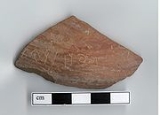
These two name fragments might indicate that names similar to the name Goliath were in use in Philistia during the Iron Age IIA, approximately the same time as Goliath is described in the Bible. Although not proof of Goliath's existence, the ostracon provides evidence of the cultural milieu of this period. In any case, they provide a useful example of the names used by the Philistines during that time, and the earliest evidence for the use of an alphabetic writing system in the Philistine culture.
period, following the conquest of the land during the First Crusade, a small fortress, named "Blanche Garde" for the dramatic white chalk cliffs that guard its western approach, was built at the site as part of the Crusader encirclement of Fatimid Ashkelon. This site was subsequently captured by the Ayyubids, and served the basis for the Medieval and Modern village of Tell es-Safi, which existed until 1948. The ruins of the castle and the village can be seen on the site today. Portions of the exterior fortifications of the castle have been excavated in recent years.
In the 2009 television series Kings
, a modern day allegory
of the story of King David, Gath is the fictional kingdom that is at war with Gilboa
, the show's equivalent of the united Kingdom of Israel.
City-state
A city-state is an independent or autonomous entity whose territory consists of a city which is not administered as a part of another local government.-Historical city-states:...
s, established in northwestern Philistia. According to the Bible, the king of the city was Achish
Achish
Achish is a name used in the Hebrew Bible for two Philistine rulers of Gath. It is perhaps only a general title of royalty, applicable to the Philistine kings. The two kings of Gath, which is identified by most scholars as Tell es-Safi, are:...
, in the times of Saul
Saul
-People:Saul is a given/first name in English, the Anglicized form of the Hebrew name Shaul from the Hebrew Bible:* Saul , including people with this given namein the Bible:* Saul , a king of Edom...
, David
David
David was the second king of the united Kingdom of Israel according to the Hebrew Bible and, according to the Gospels of Matthew and Luke, an ancestor of Jesus Christ through both Saint Joseph and Mary...
, and Solomon
Solomon
Solomon , according to the Book of Kings and the Book of Chronicles, a King of Israel and according to the Talmud one of the 48 prophets, is identified as the son of David, also called Jedidiah in 2 Samuel 12:25, and is described as the third king of the United Monarchy, and the final king before...
. It is not certain whether this refers to two or more kings of the name 'Achish' or not. Gath was also the home city of Goliath, as well as of Itai
Itai
Itai is a Hebrew Biblical name, and also a Shona name. The name can also be written: Ittai, Etay, Eitay, Itay, Ytai, Etai, Itaj, or Eatai.-The Hebrew name:...
and his 600 soldiers who aided David in his exile from Absalom
Absalom
According to the Bible, Absalom or Avshalom was the third son of David, King of Israel with Maachah, daughter of Talmai, King of Geshur. describes him as the most handsome man in the kingdom...
. David, while running from Saul
Saul
-People:Saul is a given/first name in English, the Anglicized form of the Hebrew name Shaul from the Hebrew Bible:* Saul , including people with this given namein the Bible:* Saul , a king of Edom...
, escaped to Gath, and served under its king Achish. During Solomon
Solomon
Solomon , according to the Book of Kings and the Book of Chronicles, a King of Israel and according to the Talmud one of the 48 prophets, is identified as the son of David, also called Jedidiah in 2 Samuel 12:25, and is described as the third king of the United Monarchy, and the final king before...
's reign, Shemei goes to Gath to return his escaped slave . In , the city of Gath is mentioned as being captured by Hazael
Hazael
Hazael was a court official and later an Aramean king who is mentioned in the Bible. Under his reign, Aram-Damascus became an empire that ruled over large parts of Syria and Palestine....
of Aram Damascus
Aram Damascus
Aram Damascus was an Aramaean state around Damascus in Syria, from the late 12th century BCE to 734 BCE.Sources for this state come from texts that can be divided into three categories: Assyrian annals, Aramaean texts, and the Hebrew Bible....
. Recent excavations at the site have produced dramatic evidence of a siege and subsequent destruction of the site in the late 9th century BC, most probably related to this event.
Gath is also mentioned in the El-Amarna letters as Gimti/Gintu, ruled by a king Shuwardata
Šuwardata
Šuwardata, also Šuardatu, was the 'mayor' of Qiltu, during the 1350-1335 BC Amarna letters correspondence...
, and possibly by Abdi-Ashtart as well.
Other Gaths
Gath was a common place name in ancient IsraelIsrael
The State of Israel is a parliamentary republic located in the Middle East, along the eastern shore of the Mediterranean Sea...
and the surrounding regions. Various cities are mentioned in the Bible
Bible
The Bible refers to any one of the collections of the primary religious texts of Judaism and Christianity. There is no common version of the Bible, as the individual books , their contents and their order vary among denominations...
with such names as Gath of the Philistines, Gath-Gittaim, and Gath Carmel, and other sites with similar names appear in various ancient sources, including the Amarna letters
Amarna letters
The Amarna letters are an archive of correspondence on clay tablets, mostly diplomatic, between the Egyptian administration and its representatives in Canaan and Amurru during the New Kingdom...
. A Gittite is a person from Gath.
Archaeological site
Gath, Tell es-SafiTell es-Safi
Gath, Gat, or Geth , often referred to as Gath of the Philistines, was one of the five Philistine city-states, established in northwestern Philistia. According to the Bible, the king of the city was Achish, in the times of Saul, David, and Solomon. It is not certain whether this refers to two or...
and Tel Zafit are Arabic and Hebrew names for the ancient mound
Tell
A tell or tel, is a type of archaeological mound created by human occupation and abandonment of a geographical site over many centuries. A classic tell looks like a low, truncated cone with a flat top and sloping sides.-Archaeology:A tell is a hill created by different civilizations living and...
now identified as Gath, one of the five cities in the ancient Canaan
Canaan
Canaan is a historical region roughly corresponding to modern-day Israel, Palestine, Lebanon, and the western parts of Jordan...
ite and Philistine Pentapolis
Pentapolis
A pentapolis, from the Greek words , "five" and , "city" is a geographic and/or institutional grouping of five cities...
(along with Gaza
Gaza
Gaza , also referred to as Gaza City, is a Palestinian city in the Gaza Strip, with a population of about 450,000, making it the largest city in the Palestinian territories.Inhabited since at least the 15th century BC,...
, Ekron
Ekron
The city of Ekron , was one of the five cities of the famed Philistine pentapolis, located in southwestern Canaan. Ekron lies 35 kilometers west of Jerusalem, and 18 kilometers north of ancient Gath, on the eastern edge of Israel's coastal plain.-History:...
, Ashkelon
Ashkelon
Ashkelon is a coastal city in the South District of Israel on the Mediterranean coast, south of Tel Aviv, and north of the border with the Gaza Strip. The ancient seaport of Ashkelon dates back to the Neolithic Age...
, and Ashdod). It is a large multi-period site that is located in central Israel, approximately half way between Jerusalem and Ashkelon, on the border between the southern Coastal Plain
Israeli Coastal Plain
The Israeli coastal plain is the narrow coastal plain along Israel's Mediterranean Sea coast which houses 70% of the country's population. The plain extends north to south and is divided into a number of areas; the Plain of Zebulun , Hof HaCarmel , the Sharon plain , and the Plain of Judea The...
of Israel and the Judean foothills
Shephelah
The Shephelah is a designation usually applied to the region in south-central Israel of 10-15 km of low hills between the central Mount Hebron and the coastal plains of Philistia within the area of the Judea, at an altitude of 120-450 metres above sea level. The area is fertile, and a temperate...
.
Although first noted by explorers in the mid-19th century AD, and subsequently briefly excavated in 1899 by the British archaeologists F.J. Bliss and R.A.S. Macalister, extensive exploration of the site was not conducted until 1996, when a long-term project was commenced at the site, directed by Aren Maeir
Aren Maeir
Aren Maeir is a professor at Bar Ilan University and director of the Tell es-Safi/Gath Archaeological Project . Born in 1958 in Rochester, New York, USA, he moved to Israel in 1969 and has lived there since...
of Bar-Ilan University, Israel. Since 1996, excavations, surveys and other studies have been conducted at the site, focusing on various cultures, periods and aspects relating to the site, its culture and history, and its surroundings.
The site was inhabited from Proto-Historic through Modern times. The earliest evidence for settlement is from the Chalcolithic Period (ca. 5th mill. BC), after which there is continuous occupation until the modern Palestinian village of Tell es-Safi, abandoned during the 1948 Arab–Israeli War.
Bronze Age
During the Early Bronze Age there is evidence of a large urban site, apparently similar to other EB III urban sites in southern Canaan, such as nearby Tel Yarmut.Scant evidence of this period was found on the tell in the form of stray sherds. In the vicinity of the tell (to the east, in Area C6) evidence of tombs and possible domestic activities were found.
Finds from the MB IIB (and a few MB IIA) were found on various parts of the tell in the survey (including a scarab of Khyan, found in the 1960s). Recently, in the 2006 season, evidence of an impressive MB IIB fortification was found in the vicinity of the summit of the tell, comprising a stone wall/tower and a packed earth rampart/glacis.
The Late Bronze remains at the site are impressive as well, evidence of the Canaanite city of Gath, which is mentioned in the El-Amarna letters. Finds from this period include a large, apparently public building, cultic-related finds, and a small collection of Egyptiaca, including two Egyptian Hieratic inscriptions, both inscribed on locally-made vessels. This city was apparently destroyed at the end of the Late Bronze Age, most probably with the arrival of the Philistines.
Iron Age
During the Iron Age, the site becomes a major Philistine site, "Gath of the Philistines," one of the five cities of the Philistine "Pentapolis," known from biblical and extra-biblical sources. Settled from the earliest phases of the Philistine culture (ca. 1175 BC), evidence of the various stages of the Philistine culture have been found. In particular, finds indicating the gradual transformation of the Philistines, from a non-local (Aegaean) culture, to a more locally-oriented culture abound. This process, which has been termed "Acculturation" or "Creolization" can be seen in various aspects of the Philistine culture, as the Iron Age unfolds.Of particular importance are the strata dating to the 10th-9th cent. BC, in which rich assemblages of finds were uncovered. These strata enable the study of the entire sequence of the Philistine culture, since at other Philistine sites (such as Ekron
Ekron
The city of Ekron , was one of the five cities of the famed Philistine pentapolis, located in southwestern Canaan. Ekron lies 35 kilometers west of Jerusalem, and 18 kilometers north of ancient Gath, on the eastern edge of Israel's coastal plain.-History:...
, Ashdod, and Ashkelon
Ashkelon
Ashkelon is a coastal city in the South District of Israel on the Mediterranean coast, south of Tel Aviv, and north of the border with the Gaza Strip. The ancient seaport of Ashkelon dates back to the Neolithic Age...
) these phases are not well-represented.
According to the Jerusalem Post archeologists have uncovered a Philistine temple and evidence of a major earthquake in biblical times, during digs carried out at the Tel Tzafit National Park. Other major finds there were evidence of the destruction of Gath by Hazael
Hazael
Hazael was a court official and later an Aramean king who is mentioned in the Bible. Under his reign, Aram-Damascus became an empire that ruled over large parts of Syria and Palestine....
King of Aram
Aram Damascus
Aram Damascus was an Aramaean state around Damascus in Syria, from the late 12th century BCE to 734 BCE.Sources for this state come from texts that can be divided into three categories: Assyrian annals, Aramaean texts, and the Hebrew Bible....
- Damascus around 830 BCE, and evidence of the first Philistine settlement in Canaan
Canaan
Canaan is a historical region roughly corresponding to modern-day Israel, Palestine, Lebanon, and the western parts of Jordan...
.
A very impressive, site-wide destruction is evidenced at the site during the late Iron Age IIA (ca. late 9th cent. BC). Throughout the site there is evidence of this destruction, and well-preserved assemblages of finds. The dating of this destruction to the late 9th cent. BC is a strong indication that it can be related to the conquest of Gath by Hazael, King of Aram Damascus, as mentioned in II Kings 12:18. Evidence of a large-scale siege system that was found surrounding the site, is apparently related to this event. This siege system, which comprises a man-made siege trench, a related berm (earth embankment) and other elements, is currently the earliest archaeological evidence "on the ground" for an ancient siege system. It could also be in relation to the conquest of Gath by Uzziah(2 Chronicles 26:6);coinciding well with the siege technology described in 2 Chronicles 26:15.
Among the numerous finds from this destruction level, one can note the impressive pottery assemblage, various cultic objects, a bone tool workshop, and assorted other finds.
The "Goliath Shard"
In the 2005 season, below the late 9th century BCE destruction level, in a stratum dating to an earlier phase of the Iron Age IIA, an important inscription was found. Scratched on a sherd typical of the Iron Age IIA, two non-Semitic names written in Semitic "Proto-Canaanite" letters were found. These two names, "ALWT" (אלות) and "WLT" (ולת), are etymologically similar to the name Goliath (גלית), the well-known Philistine champion, who according to the biblical text, was a native of Gath.These two name fragments might indicate that names similar to the name Goliath were in use in Philistia during the Iron Age IIA, approximately the same time as Goliath is described in the Bible. Although not proof of Goliath's existence, the ostracon provides evidence of the cultural milieu of this period. In any case, they provide a useful example of the names used by the Philistines during that time, and the earliest evidence for the use of an alphabetic writing system in the Philistine culture.
Crusader Period (12th cent. AD)
Following the destruction of the site by Hazael, Philistine Gath lost its role as a primary Philistine city. Although the site was settled during later periods, it never regained its role as a site of central importance. During the CrusaderCrusades
The Crusades were a series of religious wars, blessed by the Pope and the Catholic Church with the main goal of restoring Christian access to the holy places in and near Jerusalem...
period, following the conquest of the land during the First Crusade, a small fortress, named "Blanche Garde" for the dramatic white chalk cliffs that guard its western approach, was built at the site as part of the Crusader encirclement of Fatimid Ashkelon. This site was subsequently captured by the Ayyubids, and served the basis for the Medieval and Modern village of Tell es-Safi, which existed until 1948. The ruins of the castle and the village can be seen on the site today. Portions of the exterior fortifications of the castle have been excavated in recent years.
Contemporary use
Today the site of ancient Gath is the site of an active archaeological dig and of the Tel Tzafit National Park.In the 2009 television series Kings
Kings (U.S. TV series)
Kings is an American television drama series which aired on NBC. The series' narrative is loosely based on the Biblical story of King David, but set in a kingdom that culturally and technologically resembles the present-day United States....
, a modern day allegory
Allegory
Allegory is a demonstrative form of representation explaining meaning other than the words that are spoken. Allegory communicates its message by means of symbolic figures, actions or symbolic representation...
of the story of King David, Gath is the fictional kingdom that is at war with Gilboa
Gilboa
Gilboa is a Hebrew word and the name of several places:*Mount Gilboa, a biblical locale in Israel, where king saul's sons were killed by the philistines, and saul took his own life...
, the show's equivalent of the united Kingdom of Israel.