

Zigzag

Encyclopedia
Pattern
A pattern, from the French patron, is a type of theme of recurring events or objects, sometimes referred to as elements of a set of objects.These elements repeat in a predictable manner...
made up of small corners at variable angles, though constant within the zigzag, tracing a path between two parallel lines
Parallel lines
Parallel Lines may refer to:*Parallel , two straight lines that never touch* Parallel Lines, an album by Blondie*Driver: Parallel Lines, a video game...
; it can be described as both jagged and fairly regular.
Traditionally a "zig" points in the left direction (/) and a "zag" points right (\).
From the point of view of symmetry
Symmetry
Symmetry generally conveys two primary meanings. The first is an imprecise sense of harmonious or aesthetically pleasing proportionality and balance; such that it reflects beauty or perfection...
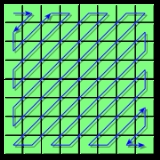
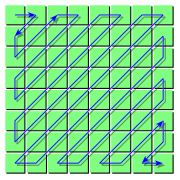
, a regular zigzag can be generated from a simple motif like a line segment
Line segment
In geometry, a line segment is a part of a line that is bounded by two end points, and contains every point on the line between its end points. Examples of line segments include the sides of a triangle or square. More generally, when the end points are both vertices of a polygon, the line segment...
by repeated application of a glide reflection
Glide reflection
In geometry, a glide reflection is a type of isometry of the Euclidean plane: the combination of a reflection in a line and a translation along that line. Reversing the order of combining gives the same result...
.

Examples of zigzags
LightningLightning
Lightning is an atmospheric electrostatic discharge accompanied by thunder, which typically occurs during thunderstorms, and sometimes during volcanic eruptions or dust storms...
and other electrical hazards are often depicted with a zigzag design, with long downward strokes and short backward ones.
The trace of a triangle wave
Triangle wave
A triangle wave is a non-sinusoidal waveform named for its triangular shape.Like a square wave, the triangle wave contains only odd harmonics...
or a sawtooth wave
Sawtooth wave
The sawtooth wave is a kind of non-sinusoidal waveform. It is named a sawtooth based on its resemblance to the teeth on the blade of a saw....
is a zigzag.
Pinking shears
Pinking shears
Pinking shears are scissors, the blades of which are sawtoothed instead of straight. They leave a zigzag pattern instead of a straight edge.Pinking shears have a utilitarian function for cutting woven cloth. Cloth edges that are unfinished will easily fray, the weave becoming undone and threads...
are designed to cut cloth or paper with a zigzag edge, to lessen fraying.
Zigzags are a basic decorative pattern used on pottery
Pottery
Pottery is the material from which the potteryware is made, of which major types include earthenware, stoneware and porcelain. The place where such wares are made is also called a pottery . Pottery also refers to the art or craft of the potter or the manufacture of pottery...
, and are often seen in the cuts which separate pieces of ravioli
Ravioli
Ravioli are a traditional type of Italian filled pasta. They are composed of a filling sealed between two layers of thin egg pasta dough and are served either in broth or with a pasta sauce. The word ravioli is reminiscent of the Italian verb riavvolgere , though the two words are not...
pasta.
In sewing
Sewing
Sewing is the craft of fastening or attaching objects using stitches made with a needle and thread. Sewing is one of the oldest of the textile arts, arising in the Paleolithic era...
, a zigzag stitch is a machine
Sewing machine
A sewing machine is a textile machine used to stitch fabric, cards and other material together with thread. Sewing machines were invented during the first Industrial Revolution to decrease the amount of manual sewing work performed in clothing companies...
stitch in a zigzag pattern.
Flags
Flag of Nagorno-KarabakhFlag of Nagorno-Karabakh
The flag of the Nagorno-Karabakh Republic, a de facto independent republic located in the Nagorno-Karabakh region of the Republic of Azerbaijan located in South Caucasus, is derived from the flag of Armenia, with only a white pattern added. The flag was adopted on June 2, 1992...
