
All Topics  
Siege of Petersburg

 
Siege of Petersburg

   Email Print
   Bookmark   Link


Siege of Petersburg


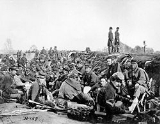
The Richmond-Petersburg Campaign was a series of battles around Petersburg, Virginia
Petersburg, Virginia

Petersburg is an independent city in Virginia, United States located on the Appomattox River and 23 miles south of Richmond, Virginia. The population was 33,740 as of the United States Census 2000....
, fought from June 9, 1864, to March 25, 1865, during the American Civil War
American Civil War

The American Civil War , also known as the War Between the States and several Naming the American Civil War, was a civil war in the United States....
. Although it is more popularly known as the Siege of Petersburg, it was not a classic military siege
Siege

A siege is a military blockade of a city or fortress with the intent of conquering by Battle of attrition and/or assault. The term derives from sedere, Latin for "to sit." A siege occurs when an attacker encounters a city or fortress that cannot be easily taken by a coup de main and refuses to surrender ....
, in which a city is usually surrounded and all supply lines are cut off. It was nine months of trench warfare
Trench warfare

Trench warfare is a form of warfare where both combatants have fortified positions and fighting lines are static. Trench warfare arose when a revolution in fire power was not matched by similar advances in mobility , resulting in a slow and grueling form of defense-oriented warfare in which both sides constructed elaborate and heavily arme...
 in which Union
Union Army

The Union Army was the army that fought for the Union during the American Civil War. It was also known as the Federal Army, the U.S....
 forces commanded by Lt. Gen.
Lieutenant General (United States)

In the United States Army, the United States Marine Corps and the United States Air Force, lieutenant general is a 3 star rank general officer rank, with the U.S....
 Ulysses S. Grant
Ulysses S. Grant

Ulysses S. Grant, born Hiram Ulysses Grant , was an United States general and the List of Presidents of the United States President of the United States ....
 assaulted Petersburg unsuccessfully and then constructed trench lines that eventually extended over 30 miles around the eastern and southern outskirts of the city.


Discussion
Ask a question about 'Siege of Petersburg'
Start a new discussion about 'Siege of Petersburg'
Answer questions from other users
Full Discussion Forum


Encyclopedia


The Richmond-Petersburg Campaign was a series of battles around Petersburg, Virginia
Petersburg, Virginia

Petersburg is an independent city in Virginia, United States located on the Appomattox River and 23 miles south of Richmond, Virginia. The population was 33,740 as of the United States Census 2000....
, fought from June 9, 1864, to March 25, 1865, during the American Civil War
American Civil War

The American Civil War , also known as the War Between the States and several Naming the American Civil War, was a civil war in the United States....
. Although it is more popularly known as the Siege of Petersburg, it was not a classic military siege
Siege

A siege is a military blockade of a city or fortress with the intent of conquering by Battle of attrition and/or assault. The term derives from sedere, Latin for "to sit." A siege occurs when an attacker encounters a city or fortress that cannot be easily taken by a coup de main and refuses to surrender ....
, in which a city is usually surrounded and all supply lines are cut off. It was nine months of trench warfare
Trench warfare

Trench warfare is a form of warfare where both combatants have fortified positions and fighting lines are static. Trench warfare arose when a revolution in fire power was not matched by similar advances in mobility , resulting in a slow and grueling form of defense-oriented warfare in which both sides constructed elaborate and heavily arme...
 in which Union
Union Army

The Union Army was the army that fought for the Union during the American Civil War. It was also known as the Federal Army, the U.S....
 forces commanded by Lt. Gen.
Lieutenant General (United States)

In the United States Army, the United States Marine Corps and the United States Air Force, lieutenant general is a 3 star rank general officer rank, with the U.S....
 Ulysses S. Grant
Ulysses S. Grant

Ulysses S. Grant, born Hiram Ulysses Grant , was an United States general and the List of Presidents of the United States President of the United States ....
 assaulted Petersburg unsuccessfully and then constructed trench lines that eventually extended over 30 miles around the eastern and southern outskirts of the city. Petersburg was crucial to the supply of Confederate
Confederate States Army

The Confederate States Army was a military organization whose primary mission was to provide the necessary forces and capabilities to support the National Security and defense of the Confederate States of America during its brief existence from 1861 to 1865....
 Gen. Robert E. Lee
Robert E. Lee

Robert Edward Lee , was a career United States United States Army officer , an engineer, and among the most celebrated generals in American history....
's army and the Confederate
Confederate States of America

The Confederate States of America formed as the government set up from 1861 to 1865 by eleven Southern United States U.S. state of the United States of America that had declared their secession from the U.S....
 capital of Richmond
Richmond, Virginia

Richmond is the Capital of the Commonwealth of Virginia, in the United States. Like all Virginia municipalities incorporated as cities, it is an independent city and not part of any county....
.

Lee finally yielded to the overwhelming pressure—the point at which supply lines were finally cut and a true siege would have begun—and abandoned both cities in April 1865, leading to his retreat and surrender in the Appomattox Campaign
Appomattox Campaign

The Appomattox Campaign was a series of battles fought in Virginia that culminated in the surrender of Confederate States Army General Robert E....
. The Siege of Petersburg foreshadowed the trench warfare that would be common in World War I
World War I

World War I, or the First World War , was a global military conflict which involved the Great powers, organized into two opposing military alliances: the Allies of World War I and the Central Powers....
, earning it a prominent position in military history. It also featured the largest concentration of African American
African Americans at Siege of Petersburg

African Americans at Siege of Petersburg...
 troops employed in the war, who suffered heavy casualties at such engagements as the Battle of the Crater
Battle of the Crater

The Battle of the Crater was a battle of the American Civil War, part of the Siege of Petersburg. It took place on July 30, 1864, between the Confederate States Army Army of Northern Virginia, commanded by General Robert E....
 and Chaffin's Farm
Battle of Chaffin's Farm

The Battle of Chaffin's Farm, also known as New Market Heights and Fort Harrison, was fought September 29 and September 30, 1864, as part of the Siege of Petersburg in the American Civil War....
.

Background

Petersburg, a prosperous city of 18,000, was a supply center for the Confederate capital of Richmond, given its strategic location just south of the city, its site on the Appomattox River
Appomattox River

The Appomattox River is a tributary of the James River , approximately 137 miles , in central and eastern Virginia in the United States, named for the Appomattocs Indian tribe who lived along its lower banks in the 17th century....
 that provided navigable access to the James River
James River (Virginia)

The James River in the U.S. state of Virginia is a long river, including its Jackson River source. It drains a Drainage basin comprising . The watershed includes about 4% open water and an area with a population of 2.5 million people ....
, and its role as a major crossroads and junction for five railroads. The taking of Petersburg by Union forces would make it impossible for Robert E. Lee to continue defending Richmond.

The battle for the city began shortly after the Union defeat at Cold Harbor
Battle of Cold Harbor

The Battle of Cold Harbor, the final battle of Union Army Lieutenant general Ulysses S. Grant's 1864 Overland Campaign during the American Civil War, is remembered as one of History of the United States bloodiest, most lopsided battles....
. Grant decided to take Richmond through Petersburg, and he began positioning the Union army on June 15 by slipping away from Lee and crossing the James River. This represented a change of strategy from that of the preceding Overland Campaign
Overland Campaign

The Overland Campaign, also known as Grant's Overland Campaign and the Wilderness Campaign, was a series of battles fought in Virginia during May and June 1864, in the American Civil War....
. There, confronting and defeating Lee's army in the open was the primary goal; now, Grant selected a geographic and political target and knew that his superior resources could besiege Lee there, pin him down, and either starve him into submission or lure him out for a decisive battle. Lee at first believed that Grant's main target was Richmond and devoted only minimal troops under Gen. P.G.T. Beauregard to the defense of Petersburg.

Opposing forces


At the beginning of the campaign, Grant's Union forces consisted of the Army of the Potomac
Army of the Potomac

The Army of the Potomac was the major Union Army in the Eastern Theater of the American Civil War of the American Civil War....
, under Maj. Gen.
Major general (United States)

In the United States Army, United States Marine Corps, and United States Air Force, major general is a 2 star rank general officer rank, with the U.S....
 George G. Meade, and the Army of the James
Army of the James

The Army of the James was a Union army Army that was composed of units from the Department of Virginia and North Carolina and served along the James River during the final operations of the American Civil War in Virginia....
, under Maj. Gen. Benjamin Butler
Benjamin Franklin Butler (politician)

Benjamin Franklin Butler was an Law of the United States and Politics of the United States who represented Massachusetts in the United States House of Representatives and later served as governor of Massachusetts....
. The Army of the Potomac included:

  • II Corps
    II Corps (ACW)

    There were five corps in the Union Army designated as II Corps during the American Civil War.* Army of the Cumberland, II Corps commanded by Thomas L....
    , under Maj. Gen. Winfield S. Hancock, including the divisions of Maj. Gens. David B. Birney
    David B. Birney

    David Bell Birney was a businessman, lawyer, and a Union army General officer in the American Civil War....
     and John Gibbon
    John Gibbon

    John Gibbon was a career United States Army officer who fought in the American Civil War and the Indian Wars....
     and Brig. Gen.
    Brigadier general (United States)

    A brigadier general in the United States Army, United States Air Force, and United States Marine Corps, is a 1 star rank general officer, with the U.S....
     Francis C. Barlow
    Francis C. Barlow

    Francis Channing Barlow was a lawyer, politician, and Union army General officer during the American Civil War....
    .
  • V Corps
    V Corps (ACW)

    The V Corps was a unit of the Union Army Army of the Potomac during the American Civil War....
    , under Maj. Gen. Gouverneur K. Warren
    Gouverneur K. Warren

    Gouverneur Kemble Warren was a civil engineer and prominent General officer in the Union Army during the American Civil War. He is best remembered for arranging the last-minute defense of Little Round Top during the Battle of Gettysburg and is often referred to as the "Hero of Little Round Top." His subsequent service as a corps commander an...
    , including the divisions of Brig. Gens. Charles Griffin, Romeyn B. Ayres
    Romeyn B. Ayres

    Romeyn Beck Ayres was a Union Army general in the American Civil War....
    , Samuel W. Crawford
    Samuel W. Crawford

    Samuel Wylie Crawford was a United States Army surgeon and a Union army general in the American Civil War....
    , and Lysander Cutler
    Lysander Cutler

    Lysander Cutler was an United States businessman, educator, politician, and a Union Army General officer during the American Civil War....
    .
  • VI Corps
    VI Corps (ACW)

    The VI Corps was a corps of the Union Army during the American Civil War....
    , under Maj. Gen. Horatio G. Wright, including the divisions of Brig. Gens. David A. Russell
    David Allen Russell

    David Allen Russell was a career United States Army officer who served in the Mexican-American War and the American Civil War. He was killed in action as a Brigadier general in the Union Army....
    , Thomas H. Neill
    Thomas H. Neill

    Thomas Hewson Neill, a native of Pennsylvania, became a general in the American Civil War, serving in the Army of the Potomac in some of its most important campaigns....
    , and James B. Ricketts
    James B. Ricketts

    James Brewerton Ricketts was a career officer in the United States Army, serving as a general in the Eastern Theater of the American Civil War during the American Civil War....
    .
  • IX Corps
    IX Corps (ACW)

    IX Corps was a corps of the Union Army during the American Civil War that distinguished itself in combat in multiple theaters: the Carolinas, Virginia, Kentucky, Tennessee, and Mississippi....
    , under Maj. Gen. Ambrose Burnside
    Ambrose Burnside

    Ambrose Everett Burnside was an United States soldier, railroad executive, inventor, industrialist, and politician from Rhode Island, serving as governor and a U.S....
    , including the divisions of Brig. Gens. James H. Ledlie
    James H. Ledlie

    James Hewett Ledlie was a civil engineer for United States railroads and a general in the Union Army during the American Civil War. He is best known for his dereliction of duty at the Battle of the Crater during the Siege of Petersburg....
    , Robert B. Potter, Orlando B. Willcox
    Orlando B. Willcox

    Orlando Bolivar Willcox was an United States soldier who served as a general in the Union army during the American Civil War....
    , and Edward Ferrero
    Edward Ferrero

    Edward Ferrero was one of the leading dance instructors, choreographers, and ballroom operators in the United States. He also served as a Union Army general in the American Civil War, best remembered for his role in the Battle of the Crater in 1864....
     (the latter division being manned by United States Colored Troops
    United States Colored Troops

    The United States Colored Troops were regiments of the United States Army during the American Civil War that were composed of African-American soldiers....
    ).
  • Cavalry Corps, under Maj. Gen. Philip H. Sheridan, including the divisions of Brig. Gens. Alfred T.A. Torbert
    Alfred Thomas Torbert

    Alfred Thomas Archimedes Torbert was a career United States Army officer, a Union Army General officer commanding both infantry and cavalry forces in the American Civil War, and a U.S....
    , David McM. Gregg, and James H. Wilson
    James H. Wilson

    James Harrison Wilson was a United States Army topography, a Union Army General officer in the American Civil War and later wars, a railroad executive, and author....
    .


The Army of the James included:
  • X Corps
    X Corps (ACW)

    X Corps was a corps of the Union Army during the American Civil War. It served during operations in South Carolina in the Department of the South, and later in Benjamin Butler's Army of the James, during the Bermuda Hundred Campaign and Petersburg Campaign Campaigns....
    , under Brig. Gen. Alfred H. Terry
    Alfred Terry

    Alfred Howe Terry was a Union army general in the American Civil War and the military commander of the Dakota Territory from 1866 to 1869 and again from 1872 to 1886....
    , including the divisions of Brig. Gens. Robert S. Foster and Adelbert Ames
    Adelbert Ames

    Adelbert Ames was an United States sailor, soldier, and politician. He served with distinction as a Union Army general during the American Civil War, was a politician in Reconstruction era of the United States Mississippi, and then served as a United States Army general during the Spanish-American War....
    .
  • XVIII Corps
    XVIII Corps (ACW)

    XVIII Corps was a corps of the Union Army during the American Civil War....
    , under Maj. Gen. William F. "Baldy" Smith
    William Farrar Smith

    William Farrar Smith , was a civil engineer, a member of the police commission, and Union army General officer in the American Civil War....
    , including the divisions of Brig. Gens. William T. H. Brooks
    William T. H. Brooks

    William Thomas Harbaugh Brooks was a career military officer in the United States Army, serving as a Major general during the American Civil War....
    , John H. Martindale
    John H. Martindale

    John Henry Martindale was an American lawyer, Union Army general and politician....
    , and Edward W. Hinks (the latter also a USCT division).
  • Cavalry Division, under Brig. Gen. August Kautz.


Grant made his headquarters in a cabin on the lawn of Appomattox Manor
Appomattox Manor

File:Appomattox Manor marker.jpgAppomattox Manor is a former James River Plantations at City Point, Virginia, USA. It is best-known as the Union Army headquarters during the Siege of Petersburg in 1864-65....
, the home of Dr. Richard Eppes
Richard Eppes

Richard Eppes was a prominent surgery in the Confederate States Army during the American Civil War.Eppes was born in City Point, Virginia. He had earned his medical degree at the University of Pennsylvania and inherited his ancestral home, Appomattox Manor at City Point, by the age of twenty....
 and the oldest home (built in 1763) in what was then City Point
City Point, Virginia

City Point was a town in Prince George County, Virginia in the state of Virginia. Now extinct, the town became part of the independent city of Hopewell, Virginia in 1923....
, but is now Hopewell, Virginia
Hopewell, Virginia

Hopewell is an independent city in the Commonwealth of Virginia. The population was 22,354 at the United States Census 2000. It is in Tri-Cities, Virginia of the Richmond-Petersburg region and is a portion of the Richmond Metropolitan Statistical Area ....
.

Lee's Confederate force consisted of his own Army of Northern Virginia
Army of Northern Virginia

The Army of Northern Virginia was the primary military force of the Confederate States of America in the Eastern Theater of the American Civil War of the American Civil War....
 and a scattered, disorganized group of 10,000 boys and men defending Richmond under Gen. P.G.T. Beauregard. The Army of Northern Virginia was organized into four corps:
  • First Corps, under Lt. Gen. Richard H. Anderson
    Richard H. Anderson

    Richard Heron Anderson was a career United States Army officer, fighting with distinction in the Mexican-American War. He also served as a Confederate States Army General officer during the American Civil War....
    , including the divisions of Maj. Gens. George E. Pickett, Charles W. Field
    Charles W. Field

    Charles William Field was a career military officer, serving in the United States Army and then, during the American Civil War, in the Confederate States Army....
    , and Joseph B. Kershaw
    Joseph B. Kershaw

    Joseph Brevard Kershaw was a lawyer, judge, and a Confederate States Army general in the American Civil War.Kershaw was born at Camden, South Carolina, admitted to the Bar association in 1843, and was a member of the South Carolina Senate from 1852 to 1856....
    .
  • Second Corps, under Lt. Gen. Jubal A. Early, was detached on June 12 for operations in the Shenandoah Valley
    Valley Campaigns of 1864

    The Valley Campaigns of 1864 were American Civil War operations and battles that took place in the Shenandoah Valley of Virginia from May to October 1864....
     and played no direct role in the defense of Petersburg.
  • Third Corps, under Lt. Gen. A.P. Hill, including the divisions of Maj. Gens. Henry Heth
    Henry Heth

    Henry "Harry" Heth was a career United States Army officer and a Confederate States Army General officer in the American Civil War. He is best-remembered for precipitating the Battle of Gettysburg, accomplished inadvertently while sending some of his troops of the Army of Northern Virginia to the small Pennsylvania village, according to his...
     and Cadmus M. Wilcox
    Cadmus M. Wilcox

    Cadmus Marcellus Wilcox was a career United States Army officer who served in the Mexican?American War and also was a Confederate States Army General officer during the American Civil War....
     and Brig. Gen. William Mahone
    William Mahone

    William Mahone , of Southampton County, Virginia, was a civil engineer, teacher, soldier, railroad executive, and a member of the Virginia General Assembly and Congress of the United States....
    .
  • Cavalry Corps, under Maj. Gen. Wade Hampton
    Wade Hampton III

    Wade Hampton III was a Confederate States of America cavalry leader during the American Civil War and afterwards a politician from South Carolina, serving as its governor and as a U.S....
    , including the divisions of Maj. Gens. Fitzhugh Lee
    Fitzhugh Lee

    Fitzhugh Lee , nephew of Robert E. Lee, was a Confederate States Army cavalry General officer in the American Civil War, Governor of Virginia, diplomat, and United States Army general in the Spanish-American War....
     and W.H.F. "Rooney" Lee
    William Henry Fitzhugh Lee

    William Henry Fitzhugh Lee , known as Rooney Lee or W.H.F. Lee, was the second son of Robert E. Lee and Mary Anna Custis Lee. He was a planter, a Confederate States Army cavalry General officer in the American Civil War, and later a member of the U.S....
    .


Beauregard's Department of North Carolina and Southern Virginia had four depleted divisions commanded by Maj. Gens. Robert Ransom, Jr.
Robert Ransom, Jr.

Robert Ransom, Jr. was a Major General in the Confederate States Army during the American Civil War. His brother Matt W. Ransom was also a Confederate general officer and United States Senate....
, Robert F. Hoke
Robert Hoke

Robert Frederick Hoke was an United States businessman, railroad executive, and a Confederate States Army General officer during the American Civil War....
, and William H. C. Whiting
William H. C. Whiting

William Henry Chase Whiting was an United States Army Officer who resigned after 16 years of service in the Army Corps of Engineers to serve in the Confederate States Army during the American Civil War....
, and Brig. Gen. Alfred H. Colquitt
Alfred H. Colquitt

Alfred Holt Colquitt was a lawyer, preacher, soldier, Governor of Georgia and two term United States Senate from Georgia where he died in office....
. (Later in the campaign, Beauregard's department would be expanded and reorganized to consist of the divisions of Maj. Gens. Hoke and Bushrod Johnson
Bushrod Johnson

Bushrod Rust Johnson was a teacher, university chancellor, and Confederate Army General officer in the American Civil War. He was one of a handful of Confederate generals who were born and raised in the Northern United States....
.)

Grant's armies were significantly larger than Lee's during the campaign, although the strengths varied. During the initial assaults on the city, 15,000 Federal troops faced about 5,400 men under Beauregard. By June 18, the Federal strength exceeded 67,000 against the Confederate 20,000. More typical of the full campaign was in mid-July, when 70,000 Union troops faced 36,000 Confederates around Petersburg, and 40,000 men under Butler faced 21,000 around Richmond. The Union Army, despite suffering horrific losses during the Overland Campaign, was able to replenish its soldiers and equipment, taking advantage of garrison troops from Washington, D.C.
Washington, D.C.

Washington, D.C. , formally the District of Columbia and commonly referred to as Washington, the District, or simply D.C., is the Capital of the United States, founded on July 16, 1790....
, and the increasing availability of African-American soldiers. By the end of the siege, Grant had 125,000 men to begin the Appomattox campaign. The Confederate army, by contrast, had difficulty replacing men lost through battle, disease, and desertion.

Battles, 1864

Richmond Petersburg
First Battle of Petersburg (June 9, 1864)
On June 9, Maj. Gen. Benjamin Butler dispatched about 4,500 cavalry and infantry against the 2,500 Confederate defenders of Petersburg. While Butler's infantry demonstrated against the outer line of entrenchments east of Petersburg, Kautz's cavalry division attempted to enter the city from the south via the Jerusalem Plank Road but was repulsed by Home Guards. Afterwards, Butler withdrew. This was called the “battle of old men and young boys” by local residents. From June 14 to June 17, the Army of the Potomac crossed the James River and began moving towards Petersburg to support and renew Butler's assaults.


Petersburg June15 16
Second Battle of Petersburg (June 15–18)
Meade's Army of the Potomac crossed the James River on transports and a 2,200-foot long pontoon bridge at Windmill Point. Suspecting an attack, Beauregard brought Bushrod Johnson down from Bermuda Hundred
Bermuda Hundred Campaign

The Bermuda Hundred Campaign was a series of battles fought at the town of Bermuda Hundred , outside Richmond, Virginia, during May 1864 in the American Civil War....
, and Hoke's troops began arriving from Lee's army, bringing the defensive strength to 5,400. Butler's leading elements (Smith's XVIII Corps, Hinks's infantry division, and Kautz's cavalry) crossed the Appomattox River at Broadway Landing and attacked the Petersburg defenses on June 15. Beauregard's men were driven from their first line of entrenchments (the "Dimmock Line") back to Harrison Creek. After dark the XVIII Corps was relieved by the II Corps. On June 16, the II Corps captured another section of the Confederate line; on June 17, the IX Corps gained more ground. Beauregard stripped the Howlett Line at Bermuda Hundred to defend the city, and Lee rushed reinforcements to Petersburg from the Army of Northern Virginia. The II, XI, and V Corps attacked on June 18 but were repulsed with heavy casualties. Union commanders were apprehensive about continuing to attack, as Beauregard had engaged in a set of elaborate feints to fool the Union into believing he had more men and more guns than he actually did, including lighting many campfires and building fake cannons out of logs ("Quaker Gun
Quaker Gun

A Quaker Gun is a Military deception that was commonly used in warfare during the 18th and 19th centuries. Although resembling an actual cannon, the Quaker Gun was but a wooden log, usually painted black, used to deceive an enemy....
s"). By now the Confederate works were heavily manned, and the greatest opportunity to capture Petersburg without a siege was lost. With the Union's blunders during the first days of the battle, the stage was set for a drawn out siege.


Petersburg June21 22
Battle of Jerusalem Plank Road

The Battle of Jerusalem Plank Road, also known as the First Battle of the Weldon_Railroad, was fought June 21 – June 24, 1864, near Petersburg, Virginia....
 (June 21–24)
On June 21, the Union II Corps, supported by the VI Corps, attempted to cut the Weldon Railroad south of Petersburg, one of the major supply lines into the city. The movement was preceded by Wilson's cavalry division, which began destroying tracks. On June 22, troops from A.P. Hill's corps, led by Brig. Gen. William Mahone
William Mahone

William Mahone , of Southampton County, Virginia, was a civil engineer, teacher, soldier, railroad executive, and a member of the Virginia General Assembly and Congress of the United States....
, counterattacked, forcing the II Corps away from the railroad to positions on the Jerusalem Plank Road. Although the Federals were driven from their advanced positions, they were able to extend their siege lines farther to the west.


Battle of Staunton River Bridge

The Battle of Staunton River Bridge was an engagement on June 25, 1864, between United States and Confederate States of America forces during the American Civil War....
 (June 25)
On June 22, the cavalry divisions of Wilson and Kautz were dispatched from the Petersburg lines to disrupt Confederate rail communications. Riding via Dinwiddie Court House, the raiders cut the South Side Railroad near Ford's Station that evening, destroying tracks, railroad buildings, and two supply trains. On June 23, Wilson proceeded to the junction of the Richmond & Danville Railroad at Burke Station, where he encountered elements of Rooney Lee's cavalry between Nottoway Court House and Blacks and Whites (modern-day Blackstone
Blackstone, Virginia

Blackstone is a town in Nottoway County, Virginia, Virginia, United States. The population was 3,675 at the 2000 census. Nearby Fort Pickett was established by the U.S....
). Wilson followed Kautz along the South Side Railroad, destroying about thirty miles (50 km) of track as he advanced. On June 24, while Kautz remained skirmishing around Burkeville, Wilson crossed over to Meherrin Station on the Richmond & Danville and began destroying track. On June 25, Wilson and Kautz continued tearing up track south to the Staunton River Bridge, where they were delayed by Home Guards, who prevented destruction of the bridge. Lee's cavalry division closed on the Federals from the northeast, forcing them to abandon their attempts to capture and destroy the bridge. By this time, the raiders were nearly 100 miles (160 km) from Union lines.


Battle of Sappony Church

The Battle of Sappony Church was an engagement of the American Civil War, between the Confederate States of America and the United States, which took place on June 28, 1864 during the Richmond?Petersburg Campaign....
 (June 28)
Rooney Lee's cavalry division pursued Wilson's and Kautz's raiders who failed to destroy the Staunton River Bridge on June 25. Wilson and Kautz headed east and, on June 28, crossed the Nottoway River at the Double Bridges and headed north to Stony Creek Depot on the Weldon Railroad. There they were attacked by Wade Hampton's cavalry division. Later in the day, Rooney Lee's division arrived to join forces with Hampton, and the Federals were heavily pressured. During the night, Wilson and Kautz disengaged and pressed north on the Halifax Road for the supposed security of Reams Station, abandoning many fleeing slaves who had sought security with the Federal raiders.
during the Seige of Petersburg]] First Battle of Ream's Station
First Battle of Ream's Station

First Battle of Ream's Station was a battle during the American Civil War. Confederate forces under Major General William Mahone and Brigadier General Fitzhugh Lee defeated Union forces raiding Confederate railways....
 (June 29)
Early morning June 29, Kautz's cavalry division reached Ream's Station on the Weldon Railroad, which was thought to be held by Union infantry. Instead, Kautz found the road barred by Mahone's Confederate infantry division. Wilson's division, fighting against elements of Rooney Lee's cavalry, joined Kautz's near Ream's Station, where they were virtually surrounded. About noon, Mahone's infantry assaulted their front while Fitzhugh Lee's cavalry division threatened the Union left flank. The raiders burned their wagons and abandoned their artillery. Separated by the Confederate attacks, Wilson and his men cut their way through and fled south on the Stage Road to cross Nottoway River, while Kautz went cross-country, reaching Federal lines at Petersburg about dark. Wilson continued east to the Blackwater River before turning north, eventually reaching Union lines at Light House Point on July 2. The Wilson-Kautz raid tore up more than 60 miles (100 km) of track, temporarily disrupting rail traffic into Petersburg but at a great cost in men and mounts.


First Battle of Deep Bottom

The First Battle of Deep Bottom was fought July 27–29, 1864, at Deep Bottom in Henrico County, Virginia, as part of the Siege of Petersburg of the American Civil War....
 (July 27–29)
During the night of July 26–27, Winfield S. Hancock led the Union II Corps and two divisions of Sheridan's cavalry across to the north side of James River to threaten Richmond. This demonstration diverted Confederate forces from the impending attack at Petersburg on July 30 (the Crater). Union efforts to turn the Confederate position at New Market Heights and Fussell's Mill were abandoned when the Confederates strongly reinforced their lines and counterattacked. During the night of July 29, the Federals crossed the river again, leaving a garrison to hold the bridgehead at Deep Bottom.


Petersburg June30
Battle of the Crater

The Battle of the Crater was a battle of the American Civil War, part of the Siege of Petersburg. It took place on July 30, 1864, between the Confederate States Army Army of Northern Virginia, commanded by General Robert E....
 (July 30)
In an attempt to break the siege, former coal miners from the 48th Pennsylvania infantry, commanded by Lt. Col. Henry Pleasants
Henry Pleasants

For the English music critic Henry Pleasants, see Henry Pleasants .Henry Clay Pleasants was a coal mining engineer and a Brigadier general in the Union Army during the American Civil War....
, in Burnside's IX Corps, mined a 511-foot (156 m) long tunnel under the Confederate lines at Elliot's Salient and placed 8,000 pounds of explosives directly under the Confederate troops. On July 30, they detonated the explosives, creating a crater
Subsidence crater

A subsidence crater is a hole or depression left on the surface of an area which has had an underground explosion. Many such craters are present at the Nevada Test Site, which is no longer in use for nuclear testing....
 some 135 feet (41 m) in diameter that remains visible to this day. Some 280 to 350 Confederate soldiers were instantly killed in the blast. The Union plan was to exploit the explosion by sending well-rehearsed African-American troops of Ferrero's division into the gap and driving for critical objectives deep in the Confederate rear area. The plan was modified at the last minute, however, because of political concerns about the effect the black troops would have on the Confederate defenders and the public in general. Instead, the unrehearsed division of James Ledlie was substituted and disaster resulted. The troops entered the crater instead of moving around its rim. Unable to exit the steep sides of the crater, they were slaughtered by Confederates firing down on them. The division of William Mahone on the Confederate right flank was able to recover quickly and bring a strong counterattack to bear. Over 5,300 Union troops were casualties in the ill-fated battle that achieved none of its objectives.


Dictator At Petersburg
Second Battle of Deep Bottom (August 13–20)
During the night of August 13–14, the Union II Corps, X Corps, and Gregg's cavalry division, all under command of Winfield S. Hancock, crossed the James River at Deep Bottom to threaten Richmond, coordinating with a movement against the Weldon Railroad at Petersburg. On August 14, the X Corps closed on New Market Heights while the II Corps extended the Federal line to the right along Bailey's Creek. During the night, the X Corps was moved to the far right flank of the Union line near Fussell's Mill. On August 16, Union assaults near Fussell's Mill were initially successful, but Confederate counterattacks drove the Federals out of a line of captured works. Heavy fighting continued throughout the remainder of the day. After continual skirmishing, the Federals returned to the south side of the James on August 20, maintaining their bridgehead at Deep Bottom.


Battle of Globe Tavern

The Battle of Globe Tavern, also known as the Second Battle of the Weldon Railroad, fought from August 18 to August 21, 1864, saw the Confederate States of America forces lose control of the vital Weldon Railroad to the Union Army during the Siege of Petersburg of the American Civil War....
 (August 18–21)
While Hancock's command demonstrated north of the James River at Deep Bottom, the Union V Corps and elements of the IX and II Corps under command of Gouverneur K. Warren were withdrawn from the Petersburg entrenchments to operate against the Weldon Railroad. At dawn on August 18, Warren advanced, driving back Confederate pickets until reaching the railroad at Globe Tavern. In the afternoon, Maj. Gen. Henry Heth's Confederate division attacked driving Ayres's division back toward the tavern. Both sides entrenched during the night. On August 19, William Mahone, whose division had been hastily returned from north of James River, attacked with five infantry brigades, rolling up the right flank of Crawford's division. Heavily reinforced, Warren counterattacked and by nightfall had retaken most of the ground lost during the afternoon's fighting. On August 20, the Federals laid out and entrenched a strong defensive line covering the Blick House and Globe Tavern and extending east to connect with the main Federal lines at Jerusalem Plank Road. On August 21, Hill probed the new Federal line for weaknesses but could not penetrate the Union defenses. With the fighting at Globe Tavern, Grant succeeded in extending his siege lines to the west and cutting Petersburg's primary rail connection with Wilmington, North Carolina
Wilmington, North Carolina

Wilmington is a city in and the county seat of New Hanover County, North Carolina, North Carolina, United States. The population was 75,838 at the United States Census, 2000....
. The Confederates were now forced to off-load rail cars at Stony Creek Station for a 30-mile (50 km) wagon haul up Boydton Plank Road to reach Petersburg.


Second Battle of Ream's Station

The Second Battle of Ream's Station was fought during the Siege of Petersburg in the American Civil War on August 25, 1864, in Dinwiddie County, Virginia....
 (August 25)
On August 24, the Union II Corps moved south along the Weldon Railroad, tearing up track, preceded by Gregg's cavalry division. On August 25, Heth attacked and overran the faulty Union position at Ream's Station, capturing 9 guns, 12 colors, and many prisoners. The old II Corps was shattered. Hancock withdrew to the main Union line near the Jerusalem Plank Road, bemoaning the declining combat effectiveness of his troops.


Battle of Chaffin's Farm

The Battle of Chaffin's Farm, also known as New Market Heights and Fort Harrison, was fought September 29 and September 30, 1864, as part of the Siege of Petersburg in the American Civil War....
 or New Market Heights (September 29–30)
During the night of September 28–29, Butler's Army of the James crossed the James River to assault the Richmond defenses north of the river. The columns attacked at dawn. After initial Union successes at New Market Heights and Fort Harrison, the Confederates rallied and contained the breakthrough. Lee reinforced his lines north of the James and, on September 30, he counterattacked unsuccessfully. The Federals entrenched, and the Confederates erected a new line of works cutting off the captured forts. As Grant anticipated, Lee shifted troops to meet the threat against Richmond, weakening his lines at Petersburg.


Battle of Peebles' Farm

The Battle of Peebles' Farm was the western part of a simultaneous Union offensive against the Confederate States of America works guarding Petersburg, Virginia and Richmond, Virginia, during the Siege of Petersburg in the American Civil War....
 (September 30 – October 2)
In combination with Butler's offensive north of the James River, Grant extended his left flank to cut Confederate lines of communication southwest of Petersburg. Two divisions of the IX corps under Maj. Gen. John G. Parke, two divisions of the V Corps under Warren, and Gregg's cavalry division were assigned to the operation. On September 30, the Federals marched via Poplar Spring Church to reach Squirrel Level and Vaughan Roads. The initial Federal attack overran Fort Archer, flanking the Confederates out of their Squirrel Level Road line. Late afternoon, Confederate reinforcements arrived, slowing the Federal advance. On October 1, the Federals repulsed a Confederate counterattack directed by A.P. Hill. Reinforced by Maj. Gen. Gershom Mott
Gershom Mott

Gershom Mott was a United States Army officer and a General officer in the Union Army, a commander in the Eastern Theater of the American Civil War of the American Civil War....
's division, the Federals resumed their advance on October 2, captured Fort MacRae (which was lightly defended) and extended their left flank to the vicinity of Peebles' and Pegram's Farms. With these limited successes, Meade suspended the offensive. A new line was entrenched from the Federal works on Weldon Railroad to Pegram's Farm.


Petersburg Oct27
Battle of Darbytown and New Market Roads

The Battle of Darbytown and New Market Roads was an engagement between United States and Confederate States of America forces during the American Civil War, which took place on October 7, 1864 at Henrico County, Virginia, as part of the Richmond-Petersburg Campaign....
 (October 7)
Responding to the loss of Fort Harrison and the increasing Federal threat against Richmond, Gen. Robert E. Lee directed an offensive against the Union far right flank on October 7. After routing the Federal cavalry from their position covering Darbytown Road, Field's and Hoke's divisions assaulted the main Union defensive line along New Market Road and were repulsed. The Federals were not dislodged, and Lee withdrew into the Richmond defenses.


Battle of Darbytown Road

The Battle of Darbytown Road was fought on October 7, 1864, between Union and Confederate forces. The Confederates were attempting to retake ground they had lost to Federal forces during battles near Richmond, Virginia....
 (October 13)
On October 13, Union forces advanced to find and feel the new Confederate defensive line in front of Richmond. While mostly a battle of skirmishers, a Federal brigade assaulted fortifications north of Darbytown Road and was repulsed with heavy casualties. The Federals retired to their entrenched lines along New Market Road.


Battle of Fair Oaks and Darbytown Road (October 27–28)
In combination with movements against the Boydton Plank Road at Petersburg, Benjamin Butler attacked the Richmond defenses along Darbytown Road with the X Corps. The XVIII Corps marched north to Fair Oaks where it was soundly repulsed by Field's Confederate division. Confederate forces counterattacked, taking some 600 prisoners. The Richmond defenses remained intact. Of Grant's offensives north of the James River, this was repulsed most easily.


Battle of Boydton Plank Road

The Battle of the Boydton Plank Road , fought on October 27 and October 28, 1864, followed the successful Battle of Peebles' Farm in the Siege of Petersburg during the American Civil War....
 (October 27–28)
Directed by Hancock, divisions from three Union corps (II, V, and IX) and Gregg's cavalry division, numbering more than 30,000 men, withdrew from the Petersburg lines and marched west to operate against the Boydton Plank Road and South Side Railroad. The initial Union advance on October 27 gained the Boydton Plank Road, a major campaign objective. But that afternoon, a counterattack near Burgess' Mill spearheaded by Henry Heth's division, and Wade Hampton's cavalry isolated the II Corps and forced a retreat. The Confederates retained control of the Boydton Plank Road for the rest of the winter. It marked the last battle for Hancock, who resigned from field command because of injuries sustained at Gettysburg
Battle of Gettysburg

The Battle of Gettysburg , fought in and around the town of Gettysburg, Pennsylvania, as part of the Gettysburg Campaign, was the battle with the largest number of casualties in the American Civil War and is frequently cited as the war's Turning point of the American Civil War....
.


Battles, 1865

Petersburg Mar29 31
Battle of Hatcher's Run

The Battle of Hatcher's Run was one in a series of Union Army offensives during the Siege of Petersburg, aimed at cutting off Confederate States of America supply traffic on Boydton Plank Road and Weldon Railroad west of Petersburg, Virginia....
 (February 5–7, 1865)
On February 5, 1865, Gregg's cavalry division rode out to the Boydton Plank Road via Ream's Station and Dinwiddie Court House in an attempt to intercept Confederate supply trains. Warren's V Corps crossed Hatcher's Run and took up a blocking position on the Vaughan Road to prevent interference with Gregg's operations. Two divisions of the II Corps under Maj. Gen. Andrew A. Humphreys
Andrew A. Humphreys

Andrew Atkinson Humphreys , was a career United States Army officer, civil engineer, and a Union Army General officer in the American Civil War....
 shifted west to near Armstrong's Mill to cover Warren's right flank. Late in the day, John B. Gordon attempted to turn Humphrey's right flank near the mill but was repulsed. During the night, the Federals were reinforced by two divisions. On February 6, Gregg returned to Gravelly Run on Vaughan Road from his unsuccessful raid and was attacked by elements of Brig. Gen. John Pegram
John Pegram (general)

John Pegram was a career soldier from Virginia who served as an officer in the United States Army and then as a Brigadier General in the Confederate States Army during the American Civil War....
's Confederate division. Warren pushed forward a reconnaissance in the vicinity of Dabney's Mill and was attacked by Pegram's and Mahone's divisions. Pegram was killed in the action. Although the Union advance was stopped, the Federals extended their siegeworks to the Vaughan Road crossing of Hatcher's Run.


Battle of Fort Stedman

The Battle of Fort Stedman was fought on March 25, 1865, during the final days of the American Civil War. The Union Army fortification in the siege lines around Petersburg, Virginia, was attacked in a pre-dawn Confederate States of America assault by troops led by Major General John B....
 (March 25)
As the siege continued, Grant attempted to break or encircle the Confederate forces in multiple attacks moving from east to west, and both armies' lines were stretched out until they surrounded the city. By March 1865, the siege had taken an enormous toll on both armies, and Lee decided to pull out of Petersburg. He amassed nearly half of his army in an attempt to break through Grant's Petersburg defenses and threaten his supply depot at City Point. Led by Gordon, the pre-dawn assault on March 25 overpowered the garrisons of Fort Stedman and Batteries X, XI, and XII. The Confederates were brought under a killing crossfire, and counterattacks led by Maj. Gens. Parke and John F. Hartranft
John F. Hartranft

John Frederick Hartranft was the governor of Pennsylvania from 1873 to 1879 and a Union Army General officer who received the Medal of Honor for his actions during the American Civil War....
 contained the breakthrough, cutting off and capturing more than 1,900 of the attackers. During the day, elements of the II and VI Corps assaulted and captured the entrenched picket lines in their respective fronts, which had been weakened for the assault on Fort Stedman.


Aftermath

Petersburg Apr2
After nearly ten months of siege, the loss at Fort Stedman was a devastating blow for Lee's army, setting up the Confederate defeat at Five Forks
Battle of Five Forks

The Battle of Five Forks was fought on April 1, 1865, southwest of Petersburg, Virginia, in Dinwiddie County, during the Appomattox Campaign of the American Civil War....
 on April 1, the breakthrough at Petersburg on April 2, and the surrender of the City of Petersburg at dawn on April 3.

After his victory at Five Forks, Grant ordered an assault along the entire Confederate line beginning at dawn on April 2. Parke's IX Corps overran the eastern trenches but were met with stiff resistance. At 5:30 a.m. on April 2, Wright's VI Corps made a decisive breakthrough along the Boydton Plank Road line. Wright's VI Corps initial breakthrough was halted mid-day at Fort Gregg. Gibbon's XXIV Corps
XXIV Corps (ACW)

XXIV Corps was a corps of the Union Army during the American Civil War.In December 1864, the white and black units of the Army of the James were divided into two corps....
 overran Fort Gregg after a heroic Confederate defense. This halt in advancement into the City of Petersburg allowed Lee to pull his forces out of Petersburg and Richmond on the night of April 2, and head for the west in an attempt to meet up with forces under the command of General Joseph E. Johnston
Joseph E. Johnston

Joseph Eggleston Johnston was a career United States Army officer, serving with distinction in the Mexican-American War and Seminole Wars, and was also one of the most senior general officers in the Confederate States Army during the American Civil War....
 in North Carolina
North Carolina

North Carolina is a U.S. state located on the Atlantic Seaboard in the southeastern United States. The state borders South Carolina and Georgia to the south, Tennessee to the west and Virginia to the north....
. The resulting Appomattox Campaign
Appomattox Campaign

The Appomattox Campaign was a series of battles fought in Virginia that culminated in the surrender of Confederate States Army General Robert E....
 led to Lee's surrender on April 9 at Appomattox Court House
Appomattox Court House

File:New Appomattox Court House.jpgFile:Appomattox Court House new and old marker.jpgThe Appomattox Court House is a courthouse in Appomattox, Virginia built in 1892....
.

Richmond-Petersburg was a costly campaign for both sides. The initial assaults on Petersburg in June 1864 cost the Union 11,386 casualties, to approximately 4,000 for the Confederate defenders. The casualties for the siege warfare that concluded with the assault on Fort Stedman are estimated to be 42,000 for the Union, and 28,000 for the Confederates.

Classifying the campaigns

Military historians do not agree on precise boundaries between the campaigns of this era. This article uses the classification maintained by the U.S. National Park Service
National Park Service

The National Park Service is the List of United States federal agencies that manages all List of areas in the United States National Park System, many U.S....
.

An alternative classification is maintained by West Point
United States Military Academy

The United States Military Academy at West Point is a four-year coeducational United States Service academies located at West Point, New York, New York....
; in their Atlas of American Wars (Esposito, 1959), the period of March 29 to March 31, including Five Forks, is considered to be in the end of "The Siege of Petersburg, II" (which started in October 1864). The remainder of the war in Virginia is classified as "Pursuit to Appomattox Court House — The Defeat of Lee (April 3–9, 1865)".

See also

  • Petersburg National Battlefield
    Petersburg National Battlefield

    Petersburg National Battlefield is a National Park Service unit preserving sites related to the American Civil War Siege of Petersburg. The Battlefield is centered around Petersburg, Virginia, and also includes outlying components in Hopewell, Virginia, Prince George County, Virginia, and Dinwiddie County, Virginia....
  • African Americans at Siege of Petersburg
    African Americans at Siege of Petersburg

    African Americans at Siege of Petersburg...
  • Overland Campaign
    Overland Campaign

    The Overland Campaign, also known as Grant's Overland Campaign and the Wilderness Campaign, was a series of battles fought in Virginia during May and June 1864, in the American Civil War....
  • Bermuda Hundred Campaign
    Bermuda Hundred Campaign

    The Bermuda Hundred Campaign was a series of battles fought at the town of Bermuda Hundred , outside Richmond, Virginia, during May 1864 in the American Civil War....
  • Appomattox Campaign
    Appomattox Campaign

    The Appomattox Campaign was a series of battles fought in Virginia that culminated in the surrender of Confederate States Army General Robert E....


External links

  • includes a presentation of the breakthrough at Boydton Line and other museum exhibits.