

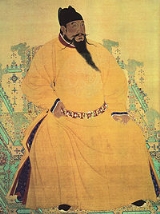
Yongle Emperor

Encyclopedia
The Yongle Emperor (2 May 1360 – 12 August 1424), born Zhu Di (Chu Ti), was the third emperor
of the Ming Dynasty
of China from 1402 to 1424. His Chinese era name
Yongle means "Perpetual Happiness".
He was the Prince of Yan (燕王), possessing a heavy military base in Beiping
. He became known as Chengzu of Ming Dynasty (明成祖 also written Cheng Zu, or Ch'eng Tsu (Cheng Tsu) in Wade-Giles
) after becoming emperor (self title). He became emperor by conspiring to usurp the throne which was against Hongwu Emperor
's wishes.
He moved the capital from Nanjing
to Beijing
where it was located in the following generations, and constructed the Forbidden City
there. After its dilapidation and disuse during the Yuan Dynasty
and Hongwu's reign
, the Yongle Emperor had the Grand Canal of China
repaired and reopened in order to supply the new capital of Beijing in the north with a steady flow of goods and southern foodstuffs. He commissioned most of the exploratory sea voyages of Zheng He
. During his reign the monumental Yongle Encyclopedia
was completed. Although his father Zhu Yuanzhang
was reluctant to do so when he was emperor, Yongle upheld the civil service examinations for drafting educated government officials
instead of using simple recommendation and appointment.
The Yongle Emperor is buried in the Changling (長陵, "Long Mausoleum") tomb, the central and largest mausoleum of the Ming Dynasty Tombs
.
, Zhu Yuanzhang, who would later rise to become the Hongwu Emperor
, the first emperor of the Ming Dynasty. Although Zhu Di would always claim that his mother was the Empress Ma (Zhu Yuanzhang's primary wife), his real birth mother is speculated by some to have been a secondary queen consort of either Korean or Mongolian origin.Zhu Di grew up as a prince in a loving, caring environment. His father supplied nothing but the best education for his sons and eventually gave them their own princedoms. Zhu Di was entitled as the Prince of Yan, the area around Beijing.
When Zhu Di moved to Beijing
, he found a city that had been devastated by famine and disease and that was under threat of invasion from Mongols from the north. The Mongols had ruled over Beijing, or Dadu, as it was then called, under the Yuan Dynasty from 1271 to 1368 but had been expelled from the city by Zhu Di's father, Zhu Yuangzhang with the help of General Xu Da
. Xu Da also helped Zhu Di, who was his son-in law, to secure the northern borders.
Zhu Di had been very successful against the Mongols and impressed his father with his energy, risk-taking ability and leadership. Even Zhu Di's troops praised his effectiveness, especially when Emperor Hongwu rewarded them for their service. But Zhu Di was not the oldest brother, forcing his father to name Zhu Biao
, the Prince of Jin, as the crown prince. When the Prince of Jin died of illness in 1392, worries of imperial succession ensued.
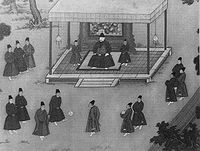 The Hongwu Emperor
died on June 24, 1398. His grandson Zhu Yunwen, the son of the late Zhu Biao, was crowned as the Jianwen Emperor
. Zhu Di and Jianwen began a deadly feud. When Zhu Di traveled with his guards to pay tribute to his father, Jianwen took his actions as a threat and sent troops to repel him. Zhu Di was forced to leave in humiliation. Jianwen persisted in refusing to let Zhu Di see his father's tomb; Zhu Di challenged the emperor's judgment. Zhu Di quickly became the biggest threat to the imperial court. Jianwen tried to avoid direct contact with Zhu Di as much as possible. To achieve this, he abolished the lesser princedoms to undermine Zhu Di's power and create room in which to plant his own loyal generals. Zhu Di was soon surrounded by Jianwen's generals, and cautiously reacted to the political gridlock in which he found himself. His rebellion
slowly began to take shape.
Zhu Di's leading rebellion slogan was self defense known as the Jingnan Campaign
(靖難之役). This was enough to earn him strong support from the populace and many supporting generals. He was a great military commander and studied Sun Tzu
's Art of War
extensively. He used surprise, deception, and caution and even tactics such as enlisting several Mongolian regiments to aid him in fighting Jianwen. He defeated Li Jinglong, a loyalist general, several times, deceiving him and overwhelming him in many decisive battles. On January 15, 1402 Zhu Di made the bold decision to march his army straight to Nanjing
, encountering stiff resistance. But his decision proved successful, forcing an imperial retreat to protect the defenseless residence of Jianwen. When Zhu Di reached the capital city, the frustrated and disgraced General Li Jinglong opened the doors and permitted Zhu Di's army to freely enter. In the widespread panic caused by the sudden entry, the emperor's palace caught fire. Jianwen and his wife disappeared, most likely falling victim to the fire.
Having ended Jianwen's reign, Zhu Di and his administration spent the latter part of 1402 brutally purging China of Jianwen's supporters. Such an action was believed to be required to pacify China and maintain his rule. He ordered all records of the four-year-reign of Jianwen Emperor to be dated as year 32 through year 35 of the Hongwu Emperor
, in order to establish himself as the legitimate successor of the Hongwu Emperor.
On July 17, 1402, after a brief visit to his father's tomb, Zhu Di was crowned Emperor Yongle at the age of 42. He would spend most of his early years suppressing rumors, stopping bandits, and healing the wounds of the land scarred by rebellion.
(誅九族) is considered one of the most severe punishments found in traditional Chinese law
enforced until the end of Qing
. The practice of exterminating the kin had been established since the Qin
when Emperor Qin Shi Huang
(reigned 247 BC–221 BC) declared "Those who criticize the present with that of the past: Zu" (以古非今者族). Zu (族) referred to the "extermination of three agnates" (三族): father, son and grandson. The extermination was to ensure the elimination of challenges to the throne and political enemies. Emperor Yang
(reigned 604–617) extended it to the nine agnates. The nine agnates are the four senior generations to the great-great-grandfather and four junior generations to the great-great-grandson. The definition also included siblings and cousins related to each of the nine agnates.
Just before the accession of Emperor Yongle, prominent historian Fang Xiaoru
(方孝孺) elicited the offense worthy of the "extermination of nine agnates" for refusing to write the inaugural address
and for insulting the Emperor. He was recorded as saying in defiance to the would-be Emperor: "莫說九族,十族何妨!" ("Nevermind nine agnates, go ahead with ten!"). Thus he was granted his wish with perhaps the only and infamous case of "extermination of ten agnates" in the history of China. In addition to the blood relations from his nine-agnates family hierarchy, his students and peers were added to be the 10th group.
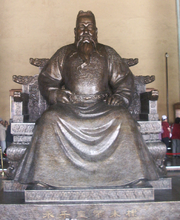 Yongle followed traditional rituals closely and remained superstitious. He did not overindulge in the luxuries of palace life, but still used Buddhism
and Buddhist festivals to overcome some of the backwardness of the Chinese frontier and to help calm civil unrest. He stopped the warring between the various Chinese tribes and reorganized the provinces to best provide peace within China. Yongle was said to be an "ardent Buddhist" by Ernst Faber.
Due to the stress and overwhelming amount of thinking involved in running a post-rebellion empire, Yongle searched for scholars to join his staff. He had many of the best scholars chosen as candidates and took great care in choosing them, even creating terms by which he hired people. He was also concerned about the degeneration of Buddhism in China.
, the fifth Gyalwa Karmapa of the Kagyu
school of Tibetan Buddhism
, to visit China — apparently after having a vision of Avalokitesvara
. After a long journey, Deshin Shekpa arrived in Nanjing
on April 10, 1407 riding on an elephant towards the imperial palace, where tens of thousands of monks greeted him.
He convinced the emperor that there were different religions for different people, which does not mean that one is better than the other. The Karmapa was very well received in China and a number of miraculous occurrences were reported. He also performed ceremonies for the emperor's family. The emperor presented him with 700 measures of silver objects and bestowed the title of 'Precious Religious King, Great Loving One of the West, Mighty Buddha of Peace'.
Aside from the religious matters, the Emperor wished to establish an alliance with the Karmapa similar to the one the Yuan (1277–1367) rulers had established with the Sakyapa. He apparently offered to send armies to unify Tibet under the Karmapa but Deshin Shekpa refused this offer.
Deshin left Nanjing on 17 May 1408. In 1410 he returned to Tsurphu
where he had his monastery rebuilt which had been severely damaged by an earthquake.
. Gaoxu was an athletic warrior type that contrasted sharply with his older brother's intellectual and humanitarian nature. Despite much counsel from his advisors, Yongle chose his older son, Gaochi (the future Hongxi Emperor
), as his heir apparent mainly due to advice from Xie Jin. As a result, Gaoxu became infuriated and refused to give up jockeying for his father's favor and refusing to move to Yunnan
province (of which he was prince). He even went so far as to undermine Xie Jin's council and eventually killed him.
, China's countryside was devastated. The fragile new economy had to deal with low production and depopulation. Yongle laid out a long and extensive plan to strengthen and stabilize the new economy, but first he had to silence dissension. He created an elaborate system of censors to remove corrupt officials from office that spread such rumors. Yongle dispatched some of his most trusted officers to reveal or destroy secret societies, Jianwen loyalists, and even bandits. To strengthen the economy, he was forced to fight population decline by reclaiming land, utilizing the most he could from the Chinese people, and maximizing textile and agricultural production.
Yongle also worked to reclaim production rich regions such as the Lower Yangtze Delta
and called for a massive reconstruction of the Grand Canal of China
. During his reign, the Grand Canal was almost completely rebuilt and was eventually moving imported goods from all over the world. Yongle's short-term goal was to revitalize northern urban centers, especially his new capital at Beijing. Before the Grand Canal was rebuilt, grain was transferred to Beijing in two ways; one route was simply via the East China Sea
, from the port of Liujiagang (near Suzhou); the other was a far more laborious process of transferring the grain from large to small shallow barges (after passing the Huai River
and having to cross southwestern Shandong
), then transferred back to large river barges on the Yellow River
before finally reaching Beijing. With the necessary tribute grain shipments of 4 million shi (one shi equal to 107 liter
s) to the north each year, both processes became incredibly inefficient. It was a magistrate of Jining, Shandong
who sent a memorandum to Yongle protesting the current method of grain shipment, a wise request that Yongle ultimately granted.
Yongle ambitiously planned to move China's capital to Beijing
. According to a popular legend, the capital was moved when the emperor's advisers brought the emperor to the hills surrounding Nanjing and pointed out the emperor's palace showing the vulnerability of the palace to artillery attack.
He planned to build a massive network of structures in Beijing in which government offices, officials, and the imperial family itself resided. After a painfully long construction time, the Forbidden City
was finally completed and became the political capital of China for the next 500 years.
Yongle finalized the architectural ensemble of his father's Ming Xiaoling Mausoleum
in Nanjing be erecting a monumental "Square Pavilion" (Sifangcheng) with an 8-meter-tall tortoise-borne
stele, extolling the merits and virtues of the Hongwu Emperor. In fact, Yongle's original idea for the memorial was to erect an unprecedented stele 73 m tall. However, due to the impossibility of moving or erecting the giant parts of that monuments, they have been left unfinished in Yangshan Quarry
, where they remain to this day.
Even though the Hongwu Emperor may have meant for his descendants to be buried near his own Xiaoling Mausoleum (this is how Hongwu's heir apparent, Zhu Biao
was buried), Yongle's relocation of the capital to Beijing necessitated the creation of a new imperial burial ground. On advice of feng shui
experts, the Yongle Emperor chose a site north of Beijing, where he and his successors were to be buried. Over the next two centuries, thirteen emperors in total were laid to rest in these Ming Dynasty Tombs
.
and kept traditional ritual ceremonies with a rich cultural theme. His respect for Chinese culture was apparent. He commissioned his Grand Secretary, Xie Jin, to write a compilation of every subject and every known book of the Chinese. The massive project's goal was to preserve Chinese culture and literature in writing. The initial copy took 17 months to transcribe and another copy was transcribed in 1557. The book, named the Yongle Encyclopedia
, is still considered one of the most marvelous human achievements in history, despite it being gradually lost by time.
Yongle's tolerance of Chinese ideas that did not agree with his own philosophies was well-known. He treated Daoism, Confucianism
, and Buddhism
equally (though he favored Confucianism). Strict Confucianists considered him hypocritical, but his even handed approach helped him win the support of the people and unify China. His love for Chinese culture
sparked a sincere hatred for Mongolian
culture. He considered it rotten and forbade the use of popular Mongolian names
, habits, language, and clothing. Great lengths were taken by Yongle to eradicate Mongolian culture from China.
Yongle called for the construction and repair of Islamic mosques during his reign. Two mosques were built by him, one in Nanjing
and the other in Xi'an
and they still stand today. Repairs were encouraged and the mosques were not allowed to be converted to any other use.
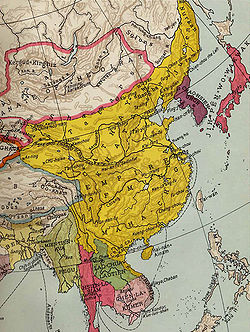 Mongol invaders were still causing many problems for the Ming Dynasty
. Yongle prepared to change this tradition. He mounted five military expeditions into Mongolia and crushed the remnants of the Yuan Dynasty
that had fled north after being defeated by Emperor Hongwu. He repaired the northern defenses and forged buffer alliances to keep the Mongols at bay in order to build an army. His strategy was to force the Mongols into economic dependence on the Chinese and to launch periodic initiatives into Mongolia to cripple their offensive power. He attempted to compel Mongolia
to become a Chinese tributary, with all the tribes submitting and proclaiming themselves vassals of the Ming, and wanted to contain and isolate the Mongols. Through fighting, Yongle learned to appreciate the importance of cavalry in battle and eventually began spending much of his resources to keep horses in good supply. Yongle spent his entire life fighting the Mongols. Failures and successes came and went, but it should be noted that after Yongle's second personal campaign against the Mongols, the Ming Dynasty was at peace for over seven years.
Vietnam
was a significant source of difficulties during Yongle's reign. In 1406, The Yongle Emperor responded to several formal petitions from members of the (now deposed) Trần Dynasty, however on arrival to Vietnam, both the Tran prince and the accompanying Chinese ambassador were ambushed and killed. In response to this insult the Yongle Emperor sent a huge army of 500,000 south to conquer Vietnam. As the royal family were all executed by the Ho monarchs Vietnam was integrated as a province of China, just as it had been up until 939. With the Ho monarch defeated in 1407 the Chinese began a serious and sustained effort to Sinicize the population. Unfortunately for the Chinese, their efforts to make Vietnam into a normal province met with a significant resistance from the local population. Several revolts started against the Chinese rulers. In early 1418 a major revolt was begun by Lê Lợi, the future founder of the Lê Dynasty
. By the time the Yongle Emperor died in 1424 the Vietnamese rebels under Lê Lợi's leadership had captured nearly the entire province. By 1427 the Xuande Emperor
gave up the effort started by his grandfather and formally acknowledged Vietnam's independence.
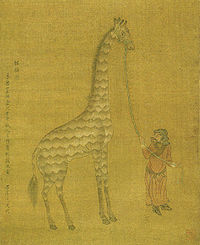
As part of his desire to expand Chinese influence throughout the known world, Emperor Yongle sponsored the massive and long term Zheng He
expeditions. While Chinese boats continued traveling to Japan, Ryukyu, and many location in South-East Asia both before and after the Yongle era, Zheng He's expeditions were China's only major sea-going explorations of the world (although the Chinese may have been sailing to Arabia, East Africa
, and Egypt
since the Tang Dynasty
, from AD 618-907 or earlier). The first expedition was launched in 1405 (18 years before Henry the Navigator began Portugal's voyages of discovery
). The expeditions were under the command of eunuch Zheng He
and his associates (Wang Jinghong
, Hong Bao
, etc.). Seven expeditions were launched between 1405 and 1433, reaching major trade centers of Asia (as far as Tenavarai
(Dondra Head
), Hormuz
and Aden
) and north-eastern Africa (Malindi
). Some of the boats used were apparently the largest sail-powered wooden boats in human history (National Geographic, May 2004).
The Chinese expeditions were a remarkable technical and logistical achievement. Zhu Di's successors, the Hongxi Emperor
and the Xuande Emperor
, felt that the costly expeditions were harmful to the Chinese state. The Hongxi Emperor ended further expeditions and the descendants of the Xuande Emperor suppressed much of the information about the Zheng He voyages.
In 1411, a smaller fleet, built in Jilin
and commanded by another eunuch Yishiha
, sailed down the Sungari and Amur Rivers. The expedition established a Nurgan Regional Military Commission in the region, headquartered at the place the Chinese called Telin (特林) (now the village of Tyr, Russia
). The local Nivkh
or Tungusic chiefs were granted ranks in the imperial administration. Yishiha's expeditions returned to the lower Amur several more times during the reigns of Yongle and Xuande
, the last one visiting the region in the 1430s.
After the death of Timur
, who intended to invade China, the relations between the Yongle Emperor's China and Shakhrukh
's state in Persia and Transoxania state considerably improved, and the countries exchanged large official delegations on a number of occasions. Both the Chinese envoy to Samarkand
and Herat
, Chen Cheng
, and his opposite party, Ghiyasu'd-Din Naqqah left detailed accounts of their visits to each other's country.
One of his wives was a Jurchen princess, which resulted in many of the eunuchs serving him being of Jurchen origin, notably Yishiha
.
to chase a nuisance army of fleeting Tatars
. Yongle became frustrated at his inability to catch up with his swift opponents and fell into a deep depression and then into illness (suffered a series of minor strokes) . On August 12, 1424, the Yongle Emperor died. He was entombed in Chang-Ling (長陵), a location northwest of Beijing.
by designing monuments such as the Porcelain Tower of Nanjing
, while undermining and cleansing Chinese society of foreign cultures. He deeply admired and wished to save his father's accomplishments and spent a lot of time proving his claim to the throne. His military accomplishments and leadership are rivaled by only a handful of people in world history. His reign was a mixed blessing for the Chinese populace. Yongle's economic, educational, and military reforms provided unprecedented benefits for the people, but his despotic
style of government
set up a spy agency. Despite these negatives, he is considered an architect and keeper of Chinese culture, history, and statecraft and an influential ruler in Chinese history.
He may have suffered from undisclosed impotence in his later life. He is remembered very much for his cruelty, just like his father. He killed most of the Jian Wen palace servants, tortured many Jianwen Emperor loyalists to death, killed or by other means badly treated their relatives. His successor emperor freed most of them alive. In 1420, he ordered 2,800 ladies-in-waiting to a slow slicing death, and watched, because he thought one of his favourite Joseon
concubine had been poisoned. However, unlike his father, he did not kill most of his generals, and he entrusted power to eunuch
s like Zheng He
, with serious consequences for subsequent Ming emperors. He showed some regrets over his cruelty, built the Yongle bell, but still had about thirty beautiful women hanged to be buried with him after he died.
Emperor
An emperor is a monarch, usually the sovereign ruler of an empire or another type of imperial realm. Empress, the female equivalent, may indicate an emperor's wife or a woman who rules in her own right...
of the Ming Dynasty
Ming Dynasty
The Ming Dynasty, also Empire of the Great Ming, was the ruling dynasty of China from 1368 to 1644, following the collapse of the Mongol-led Yuan Dynasty. The Ming, "one of the greatest eras of orderly government and social stability in human history", was the last dynasty in China ruled by ethnic...
of China from 1402 to 1424. His Chinese era name
Chinese era name
A Chinese era name is the regnal year, reign period, or regnal title used when traditionally numbering years in an emperor's reign and naming certain Chinese rulers . Some emperors have several era names, one after another, where each beginning of a new era resets the numbering of the year back...
Yongle means "Perpetual Happiness".
He was the Prince of Yan (燕王), possessing a heavy military base in Beiping
Beijing
Beijing , also known as Peking , is the capital of the People's Republic of China and one of the most populous cities in the world, with a population of 19,612,368 as of 2010. The city is the country's political, cultural, and educational center, and home to the headquarters for most of China's...
. He became known as Chengzu of Ming Dynasty (明成祖 also written Cheng Zu, or Ch'eng Tsu (Cheng Tsu) in Wade-Giles
Wade-Giles
Wade–Giles , sometimes abbreviated Wade, is a romanization system for the Mandarin Chinese language. It developed from a system produced by Thomas Wade during the mid-19th century , and was given completed form with Herbert Giles' Chinese–English dictionary of 1892.Wade–Giles was the most...
) after becoming emperor (self title). He became emperor by conspiring to usurp the throne which was against Hongwu Emperor
Hongwu Emperor
The Hongwu Emperor , known variably by his given name Zhu Yuanzhang and by his temple name Taizu of Ming , was the founder and first emperor of the Ming Dynasty of China...
's wishes.
He moved the capital from Nanjing
Nanjing
' is the capital of Jiangsu province in China and has a prominent place in Chinese history and culture, having been the capital of China on several occasions...
to Beijing
Beijing
Beijing , also known as Peking , is the capital of the People's Republic of China and one of the most populous cities in the world, with a population of 19,612,368 as of 2010. The city is the country's political, cultural, and educational center, and home to the headquarters for most of China's...
where it was located in the following generations, and constructed the Forbidden City
Forbidden City
The Forbidden City was the Chinese imperial palace from the Ming Dynasty to the end of the Qing Dynasty. It is located in the middle of Beijing, China, and now houses the Palace Museum...
there. After its dilapidation and disuse during the Yuan Dynasty
Yuan Dynasty
The Yuan Dynasty , or Great Yuan Empire was a ruling dynasty founded by the Mongol leader Kublai Khan, who ruled most of present-day China, all of modern Mongolia and its surrounding areas, lasting officially from 1271 to 1368. It is considered both as a division of the Mongol Empire and as an...
and Hongwu's reign
Hongwu Emperor
The Hongwu Emperor , known variably by his given name Zhu Yuanzhang and by his temple name Taizu of Ming , was the founder and first emperor of the Ming Dynasty of China...
, the Yongle Emperor had the Grand Canal of China
Grand Canal of China
The Grand Canal in China, also known as the Beijing-Hangzhou Grand Canal is the longest canal or artificial river in the world. Starting at Beijing, it passes through Tianjin and the provinces of Hebei, Shandong, Jiangsu and Zhejiang to the city of Hangzhou...
repaired and reopened in order to supply the new capital of Beijing in the north with a steady flow of goods and southern foodstuffs. He commissioned most of the exploratory sea voyages of Zheng He
Zheng He
Zheng He , also known as Ma Sanbao and Hajji Mahmud Shamsuddin was a Hui-Chinese mariner, explorer, diplomat and fleet admiral, who commanded voyages to Southeast Asia, South Asia, the Middle East, and East Africa, collectively referred to as the Voyages of Zheng He or Voyages of Cheng Ho from...
. During his reign the monumental Yongle Encyclopedia
Yongle Encyclopedia
The Yongle Encyclopedia was a Chinese compilation of information commissioned by the Chinese Ming Dynasty emperor Yongle in 1403 and completed by 1408...
was completed. Although his father Zhu Yuanzhang
Hongwu Emperor
The Hongwu Emperor , known variably by his given name Zhu Yuanzhang and by his temple name Taizu of Ming , was the founder and first emperor of the Ming Dynasty of China...
was reluctant to do so when he was emperor, Yongle upheld the civil service examinations for drafting educated government officials
Scholar-bureaucrats
Scholar-officials or Scholar-bureaucrats were civil servants appointed by the emperor of China to perform day-to-day governance from the Sui Dynasty to the end of the Qing Dynasty in 1912, China's last imperial dynasty. These officials mostly came from the well-educated men known as the...
instead of using simple recommendation and appointment.
The Yongle Emperor is buried in the Changling (長陵, "Long Mausoleum") tomb, the central and largest mausoleum of the Ming Dynasty Tombs
Ming Dynasty Tombs
The Ming Dynasty Tombs are located some 51.35 kilometers due north of central Beijing, within the suburban Changping District of Beijing municipality...
.
Early years
The Yongle Emperor was born Zhu Di on 2 May 1360, the fourth son of the new leader of the central Red TurbansRed Turban Rebellion
The Red Turban Rebellion was an uprising much influenced by the White Lotus Society members that targeted the ruling Yuan Dynasty.- Causes :...
, Zhu Yuanzhang, who would later rise to become the Hongwu Emperor
Hongwu Emperor
The Hongwu Emperor , known variably by his given name Zhu Yuanzhang and by his temple name Taizu of Ming , was the founder and first emperor of the Ming Dynasty of China...
, the first emperor of the Ming Dynasty. Although Zhu Di would always claim that his mother was the Empress Ma (Zhu Yuanzhang's primary wife), his real birth mother is speculated by some to have been a secondary queen consort of either Korean or Mongolian origin.Zhu Di grew up as a prince in a loving, caring environment. His father supplied nothing but the best education for his sons and eventually gave them their own princedoms. Zhu Di was entitled as the Prince of Yan, the area around Beijing.
When Zhu Di moved to Beijing
Beijing
Beijing , also known as Peking , is the capital of the People's Republic of China and one of the most populous cities in the world, with a population of 19,612,368 as of 2010. The city is the country's political, cultural, and educational center, and home to the headquarters for most of China's...
, he found a city that had been devastated by famine and disease and that was under threat of invasion from Mongols from the north. The Mongols had ruled over Beijing, or Dadu, as it was then called, under the Yuan Dynasty from 1271 to 1368 but had been expelled from the city by Zhu Di's father, Zhu Yuangzhang with the help of General Xu Da
Xu Da
Xu Da was a Chinese military general who lived in the early Ming Dynasty and contributed to the founding of the dynasty. Apart from being a friend of the Hongwu Emperor, founding emperor of the dynasty, Xu was also the father of Empress Xu, who would marry the third ruler of the Ming, the Yongle...
. Xu Da also helped Zhu Di, who was his son-in law, to secure the northern borders.
Zhu Di had been very successful against the Mongols and impressed his father with his energy, risk-taking ability and leadership. Even Zhu Di's troops praised his effectiveness, especially when Emperor Hongwu rewarded them for their service. But Zhu Di was not the oldest brother, forcing his father to name Zhu Biao
Zhu Biao
Zhu Biao was Emperor Hongwu's first son and Crown Prince of the founder of the Ming Dynasty. He was supposed to be soft hearted. He once questioned his father why many of the ministers and generals who were pioneers of the Empire were being killed or banished...
, the Prince of Jin, as the crown prince. When the Prince of Jin died of illness in 1392, worries of imperial succession ensued.
Journey to power
Hongwu Emperor
The Hongwu Emperor , known variably by his given name Zhu Yuanzhang and by his temple name Taizu of Ming , was the founder and first emperor of the Ming Dynasty of China...
died on June 24, 1398. His grandson Zhu Yunwen, the son of the late Zhu Biao, was crowned as the Jianwen Emperor
Jianwen Emperor
The Jianwen Emperor , with the personal name Zhu Yunwen , reigned as the second Emperor of the Ming dynasty...
. Zhu Di and Jianwen began a deadly feud. When Zhu Di traveled with his guards to pay tribute to his father, Jianwen took his actions as a threat and sent troops to repel him. Zhu Di was forced to leave in humiliation. Jianwen persisted in refusing to let Zhu Di see his father's tomb; Zhu Di challenged the emperor's judgment. Zhu Di quickly became the biggest threat to the imperial court. Jianwen tried to avoid direct contact with Zhu Di as much as possible. To achieve this, he abolished the lesser princedoms to undermine Zhu Di's power and create room in which to plant his own loyal generals. Zhu Di was soon surrounded by Jianwen's generals, and cautiously reacted to the political gridlock in which he found himself. His rebellion
Rebellion
Rebellion, uprising or insurrection, is a refusal of obedience or order. It may, therefore, be seen as encompassing a range of behaviors aimed at destroying or replacing an established authority such as a government or a head of state...
slowly began to take shape.
Zhu Di's leading rebellion slogan was self defense known as the Jingnan Campaign
Jingnan Campaign
Jingnan Campaign or Jingnan Rebellion was a civil war in the early years of the Ming Dynasty of China. It started from 1399. After Jianwen Emperor assumed the throne, his uncle Zhu Di, the Prince of Yan, raised an army to overthrow him. Finally in 1402, Zhu Di usurped Jianwen Emperor's throne...
(靖難之役). This was enough to earn him strong support from the populace and many supporting generals. He was a great military commander and studied Sun Tzu
Sun Tzu
Sun Wu , style name Changqing , better known as Sun Tzu or Sunzi , was an ancient Chinese military general, strategist and philosopher who is traditionally believed, and who is most likely, to have authored The Art of War, an influential ancient Chinese book on military strategy...
's Art of War
The Art of War
The Art of War is an ancient Chinese military treatise that is attributed to Sun Tzu , a high ranking military general and strategist during the late Spring and Autumn period...
extensively. He used surprise, deception, and caution and even tactics such as enlisting several Mongolian regiments to aid him in fighting Jianwen. He defeated Li Jinglong, a loyalist general, several times, deceiving him and overwhelming him in many decisive battles. On January 15, 1402 Zhu Di made the bold decision to march his army straight to Nanjing
Nanjing
' is the capital of Jiangsu province in China and has a prominent place in Chinese history and culture, having been the capital of China on several occasions...
, encountering stiff resistance. But his decision proved successful, forcing an imperial retreat to protect the defenseless residence of Jianwen. When Zhu Di reached the capital city, the frustrated and disgraced General Li Jinglong opened the doors and permitted Zhu Di's army to freely enter. In the widespread panic caused by the sudden entry, the emperor's palace caught fire. Jianwen and his wife disappeared, most likely falling victim to the fire.
Having ended Jianwen's reign, Zhu Di and his administration spent the latter part of 1402 brutally purging China of Jianwen's supporters. Such an action was believed to be required to pacify China and maintain his rule. He ordered all records of the four-year-reign of Jianwen Emperor to be dated as year 32 through year 35 of the Hongwu Emperor
Hongwu Emperor
The Hongwu Emperor , known variably by his given name Zhu Yuanzhang and by his temple name Taizu of Ming , was the founder and first emperor of the Ming Dynasty of China...
, in order to establish himself as the legitimate successor of the Hongwu Emperor.
On July 17, 1402, after a brief visit to his father's tomb, Zhu Di was crowned Emperor Yongle at the age of 42. He would spend most of his early years suppressing rumors, stopping bandits, and healing the wounds of the land scarred by rebellion.
Extermination of the ten agnates
Zhu Di has been credited with ordering perhaps the only case of "extermination of the ten agnates" (誅十族) in the history of China. For nearly 1500 years of feudal China, the Nine exterminationsNine exterminations
The nine familial exterminations or nine kinship exterminations , literally "family execution" and miè zú , literally "family extermination" or "execution of nine relations") was the most serious punishment for a capital offense in Ancient China...
(誅九族) is considered one of the most severe punishments found in traditional Chinese law
Traditional Chinese law
Traditional Chinese law refers to the laws, regulations and rules used in China up to 1911, when the last imperial dynasty fell. It has undergone continuous development since at least the 11th century BC...
enforced until the end of Qing
Qing Dynasty
The Qing Dynasty was the last dynasty of China, ruling from 1644 to 1912 with a brief, abortive restoration in 1917. It was preceded by the Ming Dynasty and followed by the Republic of China....
. The practice of exterminating the kin had been established since the Qin
Qin Dynasty
The Qin Dynasty was the first imperial dynasty of China, lasting from 221 to 207 BC. The Qin state derived its name from its heartland of Qin, in modern-day Shaanxi. The strength of the Qin state was greatly increased by the legalist reforms of Shang Yang in the 4th century BC, during the Warring...
when Emperor Qin Shi Huang
Qin Shi Huang
Qin Shi Huang , personal name Ying Zheng , was king of the Chinese State of Qin from 246 BC to 221 BC during the Warring States Period. He became the first emperor of a unified China in 221 BC...
(reigned 247 BC–221 BC) declared "Those who criticize the present with that of the past: Zu" (以古非今者族). Zu (族) referred to the "extermination of three agnates" (三族): father, son and grandson. The extermination was to ensure the elimination of challenges to the throne and political enemies. Emperor Yang
Emperor Yang of Sui
Emperor Yang of Sui , personal name Yang Guang , alternative name Ying , nickname Amo , known as Emperor Ming during the brief reign of his grandson Yang Tong), was the second son of Emperor Wen of Sui, and the second emperor of China's Sui Dynasty.Emperor Yang's original name was Yang Ying, but...
(reigned 604–617) extended it to the nine agnates. The nine agnates are the four senior generations to the great-great-grandfather and four junior generations to the great-great-grandson. The definition also included siblings and cousins related to each of the nine agnates.
Just before the accession of Emperor Yongle, prominent historian Fang Xiaoru
Fang Xiaoru
Fang Xiaoru is an orthodox Confucian scholar of the Ming Dynasty, famous for his loyalty to the emperor Jianwen , of whom he had been a tutor.After Prince of Yan, Zhu Di usurped the throne in 1402...
(方孝孺) elicited the offense worthy of the "extermination of nine agnates" for refusing to write the inaugural address
Inauguration
An inauguration is a formal ceremony to mark the beginning of a leader's term of office. An example is the ceremony in which the President of the United States officially takes the oath of office....
and for insulting the Emperor. He was recorded as saying in defiance to the would-be Emperor: "莫說九族,十族何妨!" ("Nevermind nine agnates, go ahead with ten!"). Thus he was granted his wish with perhaps the only and infamous case of "extermination of ten agnates" in the history of China. In addition to the blood relations from his nine-agnates family hierarchy, his students and peers were added to be the 10th group.
Reign
Buddhism
Buddhism is a religion and philosophy encompassing a variety of traditions, beliefs and practices, largely based on teachings attributed to Siddhartha Gautama, commonly known as the Buddha . The Buddha lived and taught in the northeastern Indian subcontinent some time between the 6th and 4th...
and Buddhist festivals to overcome some of the backwardness of the Chinese frontier and to help calm civil unrest. He stopped the warring between the various Chinese tribes and reorganized the provinces to best provide peace within China. Yongle was said to be an "ardent Buddhist" by Ernst Faber.
Due to the stress and overwhelming amount of thinking involved in running a post-rebellion empire, Yongle searched for scholars to join his staff. He had many of the best scholars chosen as candidates and took great care in choosing them, even creating terms by which he hired people. He was also concerned about the degeneration of Buddhism in China.
Yongle and Tibet
In 1403, Yongle sent messages, gifts, and envoys to Tibet inviting Deshin ShekpaDeshin Shekpa
Deshin Shekpa , also Deshin Shegpa, was the fifth Gyalwa Karmapa, head of the Kagyu School of Tibetan Buddhism.Deshin Shekpa was born in Nyang Dam in the south of Tibet. According to the legend he said after being born: "I am the Karmapa. Om mani padme hum shri." Deshin Shekpa was taken to Tsawa...
, the fifth Gyalwa Karmapa of the Kagyu
Kagyu
The Kagyu, Kagyupa, or Kagyud school, also known as the "Oral Lineage" or Whispered Transmission school, is today regarded as one of six main schools of Himalayan or Tibetan Buddhism, the other five being the Nyingma, Sakya, Jonang, Bon and Gelug...
school of Tibetan Buddhism
Tibetan Buddhism
Tibetan Buddhism is the body of Buddhist religious doctrine and institutions characteristic of Tibet and certain regions of the Himalayas, including northern Nepal, Bhutan, and India . It is the state religion of Bhutan...
, to visit China — apparently after having a vision of Avalokitesvara
Avalokitesvara
Avalokiteśvara is a bodhisattva who embodies the compassion of all Buddhas. He is one of the more widely revered bodhisattvas in mainstream Mahayana Buddhism....
. After a long journey, Deshin Shekpa arrived in Nanjing
Nanjing
' is the capital of Jiangsu province in China and has a prominent place in Chinese history and culture, having been the capital of China on several occasions...
on April 10, 1407 riding on an elephant towards the imperial palace, where tens of thousands of monks greeted him.
He convinced the emperor that there were different religions for different people, which does not mean that one is better than the other. The Karmapa was very well received in China and a number of miraculous occurrences were reported. He also performed ceremonies for the emperor's family. The emperor presented him with 700 measures of silver objects and bestowed the title of 'Precious Religious King, Great Loving One of the West, Mighty Buddha of Peace'.
Aside from the religious matters, the Emperor wished to establish an alliance with the Karmapa similar to the one the Yuan (1277–1367) rulers had established with the Sakyapa. He apparently offered to send armies to unify Tibet under the Karmapa but Deshin Shekpa refused this offer.
Deshin left Nanjing on 17 May 1408. In 1410 he returned to Tsurphu
Tsurphu Monastery
Tsurphu Monastery is a Tibetan Buddhist monastery which served as the traditional seat of the Karmapa. It is located in Gurum town of Doilungdêqên County in the Tibet Autonomous Region of China, 70 km from Lhasa. The monastery is about 14,000 feet above sea level...
where he had his monastery rebuilt which had been severely damaged by an earthquake.
Choosing the heir
When it was time for him to choose an heir, Yongle very much wanted to choose his second son, GaoxuZhu Gaoxu
Zhu Gaoxu , Prince of Gaoyang , later the Prince of Han was the second son of the Yongle Emperor and Empress Ren Xiao Wen. Gaoxu fought with his elder brother Zhu Gaozhi for the throne.-Early life:Young Gaoxu was very interested in the military and was known as a great general...
. Gaoxu was an athletic warrior type that contrasted sharply with his older brother's intellectual and humanitarian nature. Despite much counsel from his advisors, Yongle chose his older son, Gaochi (the future Hongxi Emperor
Hongxi Emperor
The Hongxi Emperor was the fourth emperor of the Ming Dynasty in China. He succeeded his father, the Yongle Emperor, in 1424. His era name means "Vastly bright".-Biography:...
), as his heir apparent mainly due to advice from Xie Jin. As a result, Gaoxu became infuriated and refused to give up jockeying for his father's favor and refusing to move to Yunnan
Yunnan
Yunnan is a province of the People's Republic of China, located in the far southwest of the country spanning approximately and with a population of 45.7 million . The capital of the province is Kunming. The province borders Burma, Laos, and Vietnam.Yunnan is situated in a mountainous area, with...
province (of which he was prince). He even went so far as to undermine Xie Jin's council and eventually killed him.
National economy and construction projects
After Yongle's overthrow of JianwenJianwen Emperor
The Jianwen Emperor , with the personal name Zhu Yunwen , reigned as the second Emperor of the Ming dynasty...
, China's countryside was devastated. The fragile new economy had to deal with low production and depopulation. Yongle laid out a long and extensive plan to strengthen and stabilize the new economy, but first he had to silence dissension. He created an elaborate system of censors to remove corrupt officials from office that spread such rumors. Yongle dispatched some of his most trusted officers to reveal or destroy secret societies, Jianwen loyalists, and even bandits. To strengthen the economy, he was forced to fight population decline by reclaiming land, utilizing the most he could from the Chinese people, and maximizing textile and agricultural production.
Yongle also worked to reclaim production rich regions such as the Lower Yangtze Delta
Yangtze River Delta
The Yangtze River Delta, Yangtze Delta or YRD, also called Yangzi, or Chang Jiang Delta, Rive Chang Delta Tai Lake Region or the Golden Triangle of the Yangtze, generally comprises the triangular-shaped territory of Wu-speaking Shanghai, southern Jiangsu province and northern Zhejiang province of...
and called for a massive reconstruction of the Grand Canal of China
Grand Canal of China
The Grand Canal in China, also known as the Beijing-Hangzhou Grand Canal is the longest canal or artificial river in the world. Starting at Beijing, it passes through Tianjin and the provinces of Hebei, Shandong, Jiangsu and Zhejiang to the city of Hangzhou...
. During his reign, the Grand Canal was almost completely rebuilt and was eventually moving imported goods from all over the world. Yongle's short-term goal was to revitalize northern urban centers, especially his new capital at Beijing. Before the Grand Canal was rebuilt, grain was transferred to Beijing in two ways; one route was simply via the East China Sea
East China Sea
The East China Sea is a marginal sea east of China. It is a part of the Pacific Ocean and covers an area of 1,249,000 km² or 750,000 square miles.-Geography:...
, from the port of Liujiagang (near Suzhou); the other was a far more laborious process of transferring the grain from large to small shallow barges (after passing the Huai River
Huai River
The Huai River is a major river in China. The Huai River is located about mid-way between the Yellow River and Yangtze River, the two largest rivers in China, and like them runs from west to east...
and having to cross southwestern Shandong
Shandong
' is a Province located on the eastern coast of the People's Republic of China. Shandong has played a major role in Chinese history from the beginning of Chinese civilization along the lower reaches of the Yellow River and served as a pivotal cultural and religious site for Taoism, Chinese...
), then transferred back to large river barges on the Yellow River
Yellow River
The Yellow River or Huang He, formerly known as the Hwang Ho, is the second-longest river in China and the sixth-longest in the world at the estimated length of . Originating in the Bayan Har Mountains in Qinghai Province in western China, it flows through nine provinces of China and empties into...
before finally reaching Beijing. With the necessary tribute grain shipments of 4 million shi (one shi equal to 107 liter
Litér
- External links :*...
s) to the north each year, both processes became incredibly inefficient. It was a magistrate of Jining, Shandong
Jining, Shandong
Jining is a prefecture-level city in southwestern Shandong province, People's Republic of China. It borders Heze to the southwest, Zaozhuang to the southeast, Tai'an to the northeast, and the provinces of Henan and Jiangsu to the northwest and south respectively...
who sent a memorandum to Yongle protesting the current method of grain shipment, a wise request that Yongle ultimately granted.
Yongle ambitiously planned to move China's capital to Beijing
Beijing
Beijing , also known as Peking , is the capital of the People's Republic of China and one of the most populous cities in the world, with a population of 19,612,368 as of 2010. The city is the country's political, cultural, and educational center, and home to the headquarters for most of China's...
. According to a popular legend, the capital was moved when the emperor's advisers brought the emperor to the hills surrounding Nanjing and pointed out the emperor's palace showing the vulnerability of the palace to artillery attack.
He planned to build a massive network of structures in Beijing in which government offices, officials, and the imperial family itself resided. After a painfully long construction time, the Forbidden City
Forbidden City
The Forbidden City was the Chinese imperial palace from the Ming Dynasty to the end of the Qing Dynasty. It is located in the middle of Beijing, China, and now houses the Palace Museum...
was finally completed and became the political capital of China for the next 500 years.
Yongle finalized the architectural ensemble of his father's Ming Xiaoling Mausoleum
Ming Xiaoling Mausoleum
The Ming Xiaoling Mausoleum is the tomb of the Hongwu Emperor, the founder of the Ming Dynasty. It lies at the southern foot of Purple Mountain , located east of the historical center of Nanjing, China...
in Nanjing be erecting a monumental "Square Pavilion" (Sifangcheng) with an 8-meter-tall tortoise-borne
Bixi (tortoise)
Bixi , also called guifu or baxia , is a stone tortoise, used as a pedestal for a stele or tablet. Tortoise-mounted stelae have been traditionally used in the funerary complexes of Chinese emperors and other dignitaries. Later, they have also been used to commemorate an important event, such as...
stele, extolling the merits and virtues of the Hongwu Emperor. In fact, Yongle's original idea for the memorial was to erect an unprecedented stele 73 m tall. However, due to the impossibility of moving or erecting the giant parts of that monuments, they have been left unfinished in Yangshan Quarry
Yangshan Quarry
The Yangshan Quarry is an ancient stone quarry near Nanjing, China, presently preserved as a historic site. Used during many centuries as a source of stone for buildings and monuments of Nanjing, the quarry is famous for the gigantic unfinished stele that was abandoned there during the reign of...
, where they remain to this day.
Even though the Hongwu Emperor may have meant for his descendants to be buried near his own Xiaoling Mausoleum (this is how Hongwu's heir apparent, Zhu Biao
Zhu Biao
Zhu Biao was Emperor Hongwu's first son and Crown Prince of the founder of the Ming Dynasty. He was supposed to be soft hearted. He once questioned his father why many of the ministers and generals who were pioneers of the Empire were being killed or banished...
was buried), Yongle's relocation of the capital to Beijing necessitated the creation of a new imperial burial ground. On advice of feng shui
Feng shui
Feng shui ' is a Chinese system of geomancy believed to use the laws of both Heaven and Earth to help one improve life by receiving positive qi. The original designation for the discipline is Kan Yu ....
experts, the Yongle Emperor chose a site north of Beijing, where he and his successors were to be buried. Over the next two centuries, thirteen emperors in total were laid to rest in these Ming Dynasty Tombs
Ming Dynasty Tombs
The Ming Dynasty Tombs are located some 51.35 kilometers due north of central Beijing, within the suburban Changping District of Beijing municipality...
.
Religion and philosophy
Yongle sponsored and created many cultural traditions in China. He promoted ConfucianismConfucianism
Confucianism is a Chinese ethical and philosophical system developed from the teachings of the Chinese philosopher Confucius . Confucianism originated as an "ethical-sociopolitical teaching" during the Spring and Autumn Period, but later developed metaphysical and cosmological elements in the Han...
and kept traditional ritual ceremonies with a rich cultural theme. His respect for Chinese culture was apparent. He commissioned his Grand Secretary, Xie Jin, to write a compilation of every subject and every known book of the Chinese. The massive project's goal was to preserve Chinese culture and literature in writing. The initial copy took 17 months to transcribe and another copy was transcribed in 1557. The book, named the Yongle Encyclopedia
Yongle Encyclopedia
The Yongle Encyclopedia was a Chinese compilation of information commissioned by the Chinese Ming Dynasty emperor Yongle in 1403 and completed by 1408...
, is still considered one of the most marvelous human achievements in history, despite it being gradually lost by time.
Yongle's tolerance of Chinese ideas that did not agree with his own philosophies was well-known. He treated Daoism, Confucianism
Confucianism
Confucianism is a Chinese ethical and philosophical system developed from the teachings of the Chinese philosopher Confucius . Confucianism originated as an "ethical-sociopolitical teaching" during the Spring and Autumn Period, but later developed metaphysical and cosmological elements in the Han...
, and Buddhism
Buddhism
Buddhism is a religion and philosophy encompassing a variety of traditions, beliefs and practices, largely based on teachings attributed to Siddhartha Gautama, commonly known as the Buddha . The Buddha lived and taught in the northeastern Indian subcontinent some time between the 6th and 4th...
equally (though he favored Confucianism). Strict Confucianists considered him hypocritical, but his even handed approach helped him win the support of the people and unify China. His love for Chinese culture
Culture of China
Chinese culture is one of the world's oldest and most complex. The area in which the culture is dominant covers a large geographical region in eastern Asia with customs and traditions varying greatly between towns, cities and provinces...
sparked a sincere hatred for Mongolian
Mongols
Mongols ) are a Central-East Asian ethnic group that lives mainly in the countries of Mongolia, China, and Russia. In China, ethnic Mongols can be found mainly in the central north region of China such as Inner Mongolia...
culture. He considered it rotten and forbade the use of popular Mongolian names
Mongolian names
Mongolian names have gone through certain revolutions in the history of Mongolia. In the first, traditional Mongolian names were replaced by Tibetan names, while in the second, Tibetan names were replaced by new Mongolian names rather different from those before the first naming revolution...
, habits, language, and clothing. Great lengths were taken by Yongle to eradicate Mongolian culture from China.
Yongle called for the construction and repair of Islamic mosques during his reign. Two mosques were built by him, one in Nanjing
Nanjing
' is the capital of Jiangsu province in China and has a prominent place in Chinese history and culture, having been the capital of China on several occasions...
and the other in Xi'an
Xi'an
Xi'an is the capital of the Shaanxi province, and a sub-provincial city in the People's Republic of China. One of the oldest cities in China, with more than 3,100 years of history, the city was known as Chang'an before the Ming Dynasty...
and they still stand today. Repairs were encouraged and the mosques were not allowed to be converted to any other use.
Military accomplishments
Ming Dynasty
The Ming Dynasty, also Empire of the Great Ming, was the ruling dynasty of China from 1368 to 1644, following the collapse of the Mongol-led Yuan Dynasty. The Ming, "one of the greatest eras of orderly government and social stability in human history", was the last dynasty in China ruled by ethnic...
. Yongle prepared to change this tradition. He mounted five military expeditions into Mongolia and crushed the remnants of the Yuan Dynasty
Yuan Dynasty
The Yuan Dynasty , or Great Yuan Empire was a ruling dynasty founded by the Mongol leader Kublai Khan, who ruled most of present-day China, all of modern Mongolia and its surrounding areas, lasting officially from 1271 to 1368. It is considered both as a division of the Mongol Empire and as an...
that had fled north after being defeated by Emperor Hongwu. He repaired the northern defenses and forged buffer alliances to keep the Mongols at bay in order to build an army. His strategy was to force the Mongols into economic dependence on the Chinese and to launch periodic initiatives into Mongolia to cripple their offensive power. He attempted to compel Mongolia
Mongolia
Mongolia is a landlocked country in East and Central Asia. It is bordered by Russia to the north and China to the south, east and west. Although Mongolia does not share a border with Kazakhstan, its western-most point is only from Kazakhstan's eastern tip. Ulan Bator, the capital and largest...
to become a Chinese tributary, with all the tribes submitting and proclaiming themselves vassals of the Ming, and wanted to contain and isolate the Mongols. Through fighting, Yongle learned to appreciate the importance of cavalry in battle and eventually began spending much of his resources to keep horses in good supply. Yongle spent his entire life fighting the Mongols. Failures and successes came and went, but it should be noted that after Yongle's second personal campaign against the Mongols, the Ming Dynasty was at peace for over seven years.
Vietnam
Vietnam
Vietnam – sometimes spelled Viet Nam , officially the Socialist Republic of Vietnam – is the easternmost country on the Indochina Peninsula in Southeast Asia. It is bordered by China to the north, Laos to the northwest, Cambodia to the southwest, and the South China Sea –...
was a significant source of difficulties during Yongle's reign. In 1406, The Yongle Emperor responded to several formal petitions from members of the (now deposed) Trần Dynasty, however on arrival to Vietnam, both the Tran prince and the accompanying Chinese ambassador were ambushed and killed. In response to this insult the Yongle Emperor sent a huge army of 500,000 south to conquer Vietnam. As the royal family were all executed by the Ho monarchs Vietnam was integrated as a province of China, just as it had been up until 939. With the Ho monarch defeated in 1407 the Chinese began a serious and sustained effort to Sinicize the population. Unfortunately for the Chinese, their efforts to make Vietnam into a normal province met with a significant resistance from the local population. Several revolts started against the Chinese rulers. In early 1418 a major revolt was begun by Lê Lợi, the future founder of the Lê Dynasty
Lê Dynasty
The Later Lê Dynasty , sometimes referred to as the Lê Dynasty was the longest-ruling dynasty of Vietnam, ruling the country from 1428 to 1788, with a brief interruption....
. By the time the Yongle Emperor died in 1424 the Vietnamese rebels under Lê Lợi's leadership had captured nearly the entire province. By 1427 the Xuande Emperor
Xuande Emperor
The Xuande Emperor was Emperor of China from 1425 to 1435. His era name means "Proclamation of Virtue".-Biography:...
gave up the effort started by his grandfather and formally acknowledged Vietnam's independence.
Diplomatic missions and exploration of the world
As part of his desire to expand Chinese influence throughout the known world, Emperor Yongle sponsored the massive and long term Zheng He
Zheng He
Zheng He , also known as Ma Sanbao and Hajji Mahmud Shamsuddin was a Hui-Chinese mariner, explorer, diplomat and fleet admiral, who commanded voyages to Southeast Asia, South Asia, the Middle East, and East Africa, collectively referred to as the Voyages of Zheng He or Voyages of Cheng Ho from...
expeditions. While Chinese boats continued traveling to Japan, Ryukyu, and many location in South-East Asia both before and after the Yongle era, Zheng He's expeditions were China's only major sea-going explorations of the world (although the Chinese may have been sailing to Arabia, East Africa
East Africa
East Africa or Eastern Africa is the easterly region of the African continent, variably defined by geography or geopolitics. In the UN scheme of geographic regions, 19 territories constitute Eastern Africa:...
, and Egypt
Egypt
Egypt , officially the Arab Republic of Egypt, Arabic: , is a country mainly in North Africa, with the Sinai Peninsula forming a land bridge in Southwest Asia. Egypt is thus a transcontinental country, and a major power in Africa, the Mediterranean Basin, the Middle East and the Muslim world...
since the Tang Dynasty
Tang Dynasty
The Tang Dynasty was an imperial dynasty of China preceded by the Sui Dynasty and followed by the Five Dynasties and Ten Kingdoms Period. It was founded by the Li family, who seized power during the decline and collapse of the Sui Empire...
, from AD 618-907 or earlier). The first expedition was launched in 1405 (18 years before Henry the Navigator began Portugal's voyages of discovery
Portugal in the Age of Discovery
During the history of Portugal between 1415 and 1578, Portugal discovered an eastern route to India that rounded the Cape of Good Hope, discovered Brazil, established trading routes throughout most of southern Asia, colonized selected areas of Africa, and sent the first direct European maritime...
). The expeditions were under the command of eunuch Zheng He
Zheng He
Zheng He , also known as Ma Sanbao and Hajji Mahmud Shamsuddin was a Hui-Chinese mariner, explorer, diplomat and fleet admiral, who commanded voyages to Southeast Asia, South Asia, the Middle East, and East Africa, collectively referred to as the Voyages of Zheng He or Voyages of Cheng Ho from...
and his associates (Wang Jinghong
Wang Jinghong
Wang Jinghong was a Chinese mariner, explorer, diplomat and fleet admiral, who was deputy to Zheng He on his voyages to Southeast Asia, South Asia, and East Africa, collectively referred to as the travels of "Eunuch Sanbao to the Western Ocean" or "Zheng He to the Western Ocean", from 1405 to...
, Hong Bao
Hong Bao
Hong Bao was a Chinese eunuch sent on overseas diplomatic missions during the reign of Ming emperors Yongle and Xuande. He is best known as the commander of one of the detached squadrons of Zheng He's fleet during the Seventh Voyage of this fleet to the Indian Ocean .-Early career:According to the...
, etc.). Seven expeditions were launched between 1405 and 1433, reaching major trade centers of Asia (as far as Tenavarai
Tondeswaram temple
Tenavaram temple was a historic Hindu temple complex situated in the port town Tenavaram, Tevanthurai , in Maturai near Galle, Southern Province, Sri Lanka. Its primary deity was a Hindu god Tenavarai Nayanar and at its zenith was one of the most...
(Dondra Head
Dondra Head
Dondra Head is a cape on the extreme southern tip of Sri Lanka, in the Indian Ocean, near the small town of Dondra near Galle, Southern Province, Sri Lanka...
), Hormuz
Strait of Hormuz
The Strait of Hormuz is a narrow, strategically important waterway between the Gulf of Oman in the southeast and the Persian Gulf. On the north coast is Iran and on the south coast is the United Arab Emirates and Musandam, an exclave of Oman....
and Aden
Aden
Aden is a seaport city in Yemen, located by the eastern approach to the Red Sea , some 170 kilometres east of Bab-el-Mandeb. Its population is approximately 800,000. Aden's ancient, natural harbour lies in the crater of an extinct volcano which now forms a peninsula, joined to the mainland by a...
) and north-eastern Africa (Malindi
Malindi
Malindi is a town on Malindi Bay at the mouth of the Galana River, lying on the Indian Ocean coast of Kenya. It is 120 kilometres northeast of Mombasa. The population of Malindi is 117,735 . It is the capital of the Malindi District.Tourism is the major industry in Malindi. The city is...
). Some of the boats used were apparently the largest sail-powered wooden boats in human history (National Geographic, May 2004).
The Chinese expeditions were a remarkable technical and logistical achievement. Zhu Di's successors, the Hongxi Emperor
Hongxi Emperor
The Hongxi Emperor was the fourth emperor of the Ming Dynasty in China. He succeeded his father, the Yongle Emperor, in 1424. His era name means "Vastly bright".-Biography:...
and the Xuande Emperor
Xuande Emperor
The Xuande Emperor was Emperor of China from 1425 to 1435. His era name means "Proclamation of Virtue".-Biography:...
, felt that the costly expeditions were harmful to the Chinese state. The Hongxi Emperor ended further expeditions and the descendants of the Xuande Emperor suppressed much of the information about the Zheng He voyages.
In 1411, a smaller fleet, built in Jilin
Jilin City
Jilin City is the second largest city of Jilin province in Northeast China. At the 2010 census, 4,414,681 people resided within its administrative area of and 1,975,803 in its built up area...
and commanded by another eunuch Yishiha
Yishiha
Yishiha was a eunuch in the service of the Ming Dynasty emperors of China who carried out several expeditions down the Sungari and Amur Rivers, and is credited with the construction of the only two Ming Dynasty Buddhist temples ever built on the territory of today's Russia.- Early life:It is...
, sailed down the Sungari and Amur Rivers. The expedition established a Nurgan Regional Military Commission in the region, headquartered at the place the Chinese called Telin (特林) (now the village of Tyr, Russia
Tyr, Russia
Tyr is a settlement in Ulchsky District of Khabarovsk Krai, Russia, located on the right bank of the Amur River, near the mouth of the Amgun River, about upstream from Nikolayevsk-on-Amur....
). The local Nivkh
Nivkh
Nivkh or Gilyak can refer to:*The Nivkh people*The Nivkh language*The Russian gunboat Gilyak, a sistership of Bobr, Sivuch and Korietz and the lead ship of her class...
or Tungusic chiefs were granted ranks in the imperial administration. Yishiha's expeditions returned to the lower Amur several more times during the reigns of Yongle and Xuande
Xuande Emperor
The Xuande Emperor was Emperor of China from 1425 to 1435. His era name means "Proclamation of Virtue".-Biography:...
, the last one visiting the region in the 1430s.
After the death of Timur
Timur
Timur , historically known as Tamerlane in English , was a 14th-century conqueror of West, South and Central Asia, and the founder of the Timurid dynasty in Central Asia, and great-great-grandfather of Babur, the founder of the Mughal Dynasty, which survived as the Mughal Empire in India until...
, who intended to invade China, the relations between the Yongle Emperor's China and Shakhrukh
Shah Rukh (Timurid dynasty)
Shāhrukh Mīrzā was the ruler of the eastern portion of the empire established by the Central Asian warlord Timur - the founder of the Timurid dynasty - governing most of Persia and Transoxiana between 1405 and 1447...
's state in Persia and Transoxania state considerably improved, and the countries exchanged large official delegations on a number of occasions. Both the Chinese envoy to Samarkand
Samarkand
Although a Persian-speaking region, it was not united politically with Iran most of the times between the disintegration of the Seleucid Empire and the Arab conquest . In the 6th century it was within the domain of the Turkic kingdom of the Göktürks.At the start of the 8th century Samarkand came...
and Herat
Herat
Herāt is the capital of Herat province in Afghanistan. It is the third largest city of Afghanistan, with a population of about 397,456 as of 2006. It is situated in the valley of the Hari River, which flows from the mountains of central Afghanistan to the Karakum Desert in Turkmenistan...
, Chen Cheng
Chen Cheng (Ming dynasty)
Chen Cheng , Ming dynasty diplomat, style name Zi Lu pseudonym Zhu Shan .-Biography:Born 1365 in Linchuan county of Jiangxi province...
, and his opposite party, Ghiyasu'd-Din Naqqah left detailed accounts of their visits to each other's country.
One of his wives was a Jurchen princess, which resulted in many of the eunuchs serving him being of Jurchen origin, notably Yishiha
Yishiha
Yishiha was a eunuch in the service of the Ming Dynasty emperors of China who carried out several expeditions down the Sungari and Amur Rivers, and is credited with the construction of the only two Ming Dynasty Buddhist temples ever built on the territory of today's Russia.- Early life:It is...
.
Death
On April 1, 1424, Yongle launched a large campaign into the Gobi DesertGobi Desert
The Gobi is a large desert region in Asia. It covers parts of northern and northwestern China, and of southern Mongolia. The desert basins of the Gobi are bounded by the Altai Mountains and the grasslands and steppes of Mongolia on the north, by the Hexi Corridor and Tibetan Plateau to the...
to chase a nuisance army of fleeting Tatars
Tatars
Tatars are a Turkic speaking ethnic group , numbering roughly 7 million.The majority of Tatars live in the Russian Federation, with a population of around 5.5 million, about 2 million of which in the republic of Tatarstan.Significant minority populations are found in Uzbekistan, Kazakhstan,...
. Yongle became frustrated at his inability to catch up with his swift opponents and fell into a deep depression and then into illness (suffered a series of minor strokes) . On August 12, 1424, the Yongle Emperor died. He was entombed in Chang-Ling (長陵), a location northwest of Beijing.
Legacy
Many have seen Yongle as in a life-long pursuit of power, prestige, and glory. He respected and worked hard to preserve Chinese cultureCulture of China
Chinese culture is one of the world's oldest and most complex. The area in which the culture is dominant covers a large geographical region in eastern Asia with customs and traditions varying greatly between towns, cities and provinces...
by designing monuments such as the Porcelain Tower of Nanjing
Porcelain Tower of Nanjing
The Porcelain Tower of Nanjing , also known as Bao'ensi , is a historical site located on the south bank of the Yangtze in Nanjing, China...
, while undermining and cleansing Chinese society of foreign cultures. He deeply admired and wished to save his father's accomplishments and spent a lot of time proving his claim to the throne. His military accomplishments and leadership are rivaled by only a handful of people in world history. His reign was a mixed blessing for the Chinese populace. Yongle's economic, educational, and military reforms provided unprecedented benefits for the people, but his despotic
Despotism
Despotism is a form of government in which a single entity rules with absolute power. That entity may be an individual, as in an autocracy, or it may be a group, as in an oligarchy...
style of government
Government
Government refers to the legislators, administrators, and arbitrators in the administrative bureaucracy who control a state at a given time, and to the system of government by which they are organized...
set up a spy agency. Despite these negatives, he is considered an architect and keeper of Chinese culture, history, and statecraft and an influential ruler in Chinese history.
He may have suffered from undisclosed impotence in his later life. He is remembered very much for his cruelty, just like his father. He killed most of the Jian Wen palace servants, tortured many Jianwen Emperor loyalists to death, killed or by other means badly treated their relatives. His successor emperor freed most of them alive. In 1420, he ordered 2,800 ladies-in-waiting to a slow slicing death, and watched, because he thought one of his favourite Joseon
Joseon
Joseon, Chosŏn, Choseon or Chosun are English spellings of the Korean *word for "Korea". It may refer to:*Korea*Gojoseon, the first Korean kingdom, from 2333 BC to 108 BC.*Joseon Dynasty of Korea, from AD 1392 to 1910....
concubine had been poisoned. However, unlike his father, he did not kill most of his generals, and he entrusted power to eunuch
Eunuch
A eunuch is a person born male most commonly castrated, typically early enough in his life for this change to have major hormonal consequences...
s like Zheng He
Zheng He
Zheng He , also known as Ma Sanbao and Hajji Mahmud Shamsuddin was a Hui-Chinese mariner, explorer, diplomat and fleet admiral, who commanded voyages to Southeast Asia, South Asia, the Middle East, and East Africa, collectively referred to as the Voyages of Zheng He or Voyages of Cheng Ho from...
, with serious consequences for subsequent Ming emperors. He showed some regrets over his cruelty, built the Yongle bell, but still had about thirty beautiful women hanged to be buried with him after he died.
Consorts
| Formal Title | Maiden Name | Born | Died | Father | Mother | Issue | Notes |
|---|---|---|---|---|---|---|---|
| Empress Ren Xiao Wen Empress Xu Empress Xu , formally Empress Ren Xiao Wen , birth name Xu Yihua , was the empress consort to the Yongle Emperor and the third empress of China's Ming Dynasty... 仁孝文皇后 |
Family name Chinese surname Chinese family names have been historically used by Han Chinese and Sinicized Chinese ethnic groups in mainland China, Taiwan, Hong Kong, and among overseas Chinese communities. In ancient times two types of surnames, family names and clan names , existed.The colloquial expressions laobaixing... : Xu (徐) Given name Chinese given name Chinese given names are generally made up of one or two characters, and are written after the family name, therefore "John-Paul Smith" as a Chinese name would be read "Smith John-Paul". Chinese names can consist of any character and contain almost any meaning... : Yihua (儀華) |
1362 Yingtian Nanjing ' is the capital of Jiangsu province in China and has a prominent place in Chinese history and culture, having been the capital of China on several occasions... , Yuan Empire Yuan Dynasty The Yuan Dynasty , or Great Yuan Empire was a ruling dynasty founded by the Mongol leader Kublai Khan, who ruled most of present-day China, all of modern Mongolia and its surrounding areas, lasting officially from 1271 to 1368. It is considered both as a division of the Mongol Empire and as an... |
July 1407 Nanjing Nanjing ' is the capital of Jiangsu province in China and has a prominent place in Chinese history and culture, having been the capital of China on several occasions... , Ming Empire Ming Dynasty The Ming Dynasty, also Empire of the Great Ming, was the ruling dynasty of China from 1368 to 1644, following the collapse of the Mongol-led Yuan Dynasty. The Ming, "one of the greatest eras of orderly government and social stability in human history", was the last dynasty in China ruled by ethnic... |
Xu Da Xu Da Xu Da was a Chinese military general who lived in the early Ming Dynasty and contributed to the founding of the dynasty. Apart from being a friend of the Hongwu Emperor, founding emperor of the dynasty, Xu was also the father of Empress Xu, who would marry the third ruler of the Ming, the Yongle... 徐達 |
Lady Xie 謝氏 |
Zhu Gaochi, Hongxi Emperor Hongxi Emperor The Hongxi Emperor was the fourth emperor of the Ming Dynasty in China. He succeeded his father, the Yongle Emperor, in 1424. His era name means "Vastly bright".-Biography:... Zhu Gaoxu, Prince of Han Zhu Gaoxu Zhu Gaoxu , Prince of Gaoyang , later the Prince of Han was the second son of the Yongle Emperor and Empress Ren Xiao Wen. Gaoxu fought with his elder brother Zhu Gaozhi for the throne.-Early life:Young Gaoxu was very interested in the military and was known as a great general... Zhu Gaosui, Prince Jian of Zhao Princess Ancheng Princess Xianning |
|
| Noble Consort Zhao Xian 昭獻貴妃 |
Family name Chinese surname Chinese family names have been historically used by Han Chinese and Sinicized Chinese ethnic groups in mainland China, Taiwan, Hong Kong, and among overseas Chinese communities. In ancient times two types of surnames, family names and clan names , existed.The colloquial expressions laobaixing... : Wang (王) |
Suzhou Suzhou Suzhou , previously transliterated as Su-chou, Suchow, and Soochow, is a major city located in the southeast of Jiangsu Province in Eastern China, located adjacent to Shanghai Municipality. The city is situated on the lower reaches of the Yangtze River and on the shores of Taihu Lake and is a part... , Jiangsu Province Jiangsu ' is a province of the People's Republic of China, located along the east coast of the country. The name comes from jiang, short for the city of Jiangning , and su, for the city of Suzhou. The abbreviation for this province is "苏" , the second character of its name... |
1420 | - | - | none | Entered the imperial court in 1409 |
| Noble Consort Zhao Yi 昭懿貴妃 |
Family name Chinese surname Chinese family names have been historically used by Han Chinese and Sinicized Chinese ethnic groups in mainland China, Taiwan, Hong Kong, and among overseas Chinese communities. In ancient times two types of surnames, family names and clan names , existed.The colloquial expressions laobaixing... : Zhang (張) |
- | - | Zhang Yu 張玉 |
- | none | |
| Consort Gong Xian Xian 恭獻賢妃 |
Family name: Gwon (權) | 1391 Joseon Joseon Dynasty Joseon , was a Korean state founded by Taejo Yi Seong-gye that lasted for approximately five centuries. It was founded in the aftermath of the overthrow of the Goryeo at what is today the city of Kaesong. Early on, Korea was retitled and the capital was relocated to modern-day Seoul... |
1410 | Gwon Yeong-gyun 權永均 or 우익은 |
- | none | Was Korean Joseon Dynasty Joseon , was a Korean state founded by Taejo Yi Seong-gye that lasted for approximately five centuries. It was founded in the aftermath of the overthrow of the Goryeo at what is today the city of Kaesong. Early on, Korea was retitled and the capital was relocated to modern-day Seoul... |
| Consort Zhong Jing Zhao Shun Xian 忠敬昭順賢妃 |
Family name Chinese surname Chinese family names have been historically used by Han Chinese and Sinicized Chinese ethnic groups in mainland China, Taiwan, Hong Kong, and among overseas Chinese communities. In ancient times two types of surnames, family names and clan names , existed.The colloquial expressions laobaixing... : Yu (喻) |
- | - | - | 1421 | none | |
| Consort Kang Mu Yi Gong Hui 康穆懿恭惠妃 |
Family name Chinese surname Chinese family names have been historically used by Han Chinese and Sinicized Chinese ethnic groups in mainland China, Taiwan, Hong Kong, and among overseas Chinese communities. In ancient times two types of surnames, family names and clan names , existed.The colloquial expressions laobaixing... : Wu (吳) |
- | - | - | - | Zhu Gaoxi | |
| Consort Gong Shun Rong Mu Li 恭順榮穆麗妃 |
Family name Chinese surname Chinese family names have been historically used by Han Chinese and Sinicized Chinese ethnic groups in mainland China, Taiwan, Hong Kong, and among overseas Chinese communities. In ancient times two types of surnames, family names and clan names , existed.The colloquial expressions laobaixing... : Chen (陳) |
- | - | Chen Mao, Marquess of Ningyang 寧陽侯陳懋 |
- | none | |
| Consort Kang Jing Zhuang He Hui 康靖莊和惠妃 |
Family name Chinese surname Chinese family names have been historically used by Han Chinese and Sinicized Chinese ethnic groups in mainland China, Taiwan, Hong Kong, and among overseas Chinese communities. In ancient times two types of surnames, family names and clan names , existed.The colloquial expressions laobaixing... : Cui (崔) |
- | - | - | - | none | |
| Consort Duan Jing Gong Hui Shu 端靜恭惠淑妃 |
Family name Chinese surname Chinese family names have been historically used by Han Chinese and Sinicized Chinese ethnic groups in mainland China, Taiwan, Hong Kong, and among overseas Chinese communities. In ancient times two types of surnames, family names and clan names , existed.The colloquial expressions laobaixing... : Yang (楊) |
- | - | - | - | none | |
| Consort Gong He Rong Shun Xian 恭和榮順賢妃 |
Family name Chinese surname Chinese family names have been historically used by Han Chinese and Sinicized Chinese ethnic groups in mainland China, Taiwan, Hong Kong, and among overseas Chinese communities. In ancient times two types of surnames, family names and clan names , existed.The colloquial expressions laobaixing... : Wang (王) |
- | - | - | - | none | |
| Consort Zhao Su Jing Hui Xian 昭肅靖惠賢妃 |
Family name Chinese surname Chinese family names have been historically used by Han Chinese and Sinicized Chinese ethnic groups in mainland China, Taiwan, Hong Kong, and among overseas Chinese communities. In ancient times two types of surnames, family names and clan names , existed.The colloquial expressions laobaixing... : Wang (王) |
- | - | - | - | none | |
| Consort Zhao Hui Gong Yi Shun 昭惠恭懿順妃 |
Family name Chinese surname Chinese family names have been historically used by Han Chinese and Sinicized Chinese ethnic groups in mainland China, Taiwan, Hong Kong, and among overseas Chinese communities. In ancient times two types of surnames, family names and clan names , existed.The colloquial expressions laobaixing... : Wang (王) |
- | - | - | - | none | |
| Consort Hui Mu Zhao Jing Shun 惠穆昭敬順妃 |
Family name Chinese surname Chinese family names have been historically used by Han Chinese and Sinicized Chinese ethnic groups in mainland China, Taiwan, Hong Kong, and among overseas Chinese communities. In ancient times two types of surnames, family names and clan names , existed.The colloquial expressions laobaixing... : Qian (錢) |
- | - | - | - | none | |
| Consort Kang Hui Zhuang Shu Li 康惠莊淑麗妃 |
Family name: Han (韓) | Joseon Joseon Dynasty Joseon , was a Korean state founded by Taejo Yi Seong-gye that lasted for approximately five centuries. It was founded in the aftermath of the overthrow of the Goryeo at what is today the city of Kaesong. Early on, Korea was retitled and the capital was relocated to modern-day Seoul... |
- | Han Yeong-jeong 韓永矴 or 한영정 |
- | none | Was one of the 30 beautiful women who were buried with the Yongle Emperor after his death |
| Consort An Shun Hui 安順惠妃 |
Family name Chinese surname Chinese family names have been historically used by Han Chinese and Sinicized Chinese ethnic groups in mainland China, Taiwan, Hong Kong, and among overseas Chinese communities. In ancient times two types of surnames, family names and clan names , existed.The colloquial expressions laobaixing... : Long (龍) |
- | - | - | - | none | |
| Consort Gong Yi Hui 恭懿惠妃 |
Family name Chinese surname Chinese family names have been historically used by Han Chinese and Sinicized Chinese ethnic groups in mainland China, Taiwan, Hong Kong, and among overseas Chinese communities. In ancient times two types of surnames, family names and clan names , existed.The colloquial expressions laobaixing... : Zhao (趙) |
- | - | - | - | none | |
| Consort Zhao Shun De 昭順德妃 |
Family name Chinese surname Chinese family names have been historically used by Han Chinese and Sinicized Chinese ethnic groups in mainland China, Taiwan, Hong Kong, and among overseas Chinese communities. In ancient times two types of surnames, family names and clan names , existed.The colloquial expressions laobaixing... : Liu (劉) |
- | - | - | - | none | |
| Consort Kang Yi Shun 康懿順妃 |
Family name Chinese surname Chinese family names have been historically used by Han Chinese and Sinicized Chinese ethnic groups in mainland China, Taiwan, Hong Kong, and among overseas Chinese communities. In ancient times two types of surnames, family names and clan names , existed.The colloquial expressions laobaixing... : Li (李) |
- | - | - | - | none | |
| Consort Hui Mu Shun 惠穆順妃 |
Family name Chinese surname Chinese family names have been historically used by Han Chinese and Sinicized Chinese ethnic groups in mainland China, Taiwan, Hong Kong, and among overseas Chinese communities. In ancient times two types of surnames, family names and clan names , existed.The colloquial expressions laobaixing... Guo (郭) |
- | - | - | - | none | |
| Consort Zhen Jing Shun 貞靜順妃 |
Family name Chinese surname Chinese family names have been historically used by Han Chinese and Sinicized Chinese ethnic groups in mainland China, Taiwan, Hong Kong, and among overseas Chinese communities. In ancient times two types of surnames, family names and clan names , existed.The colloquial expressions laobaixing... : Zhang (張) |
- | - | - | - | none | |
| Consort Shun 順妃 |
Family name: Im (任) | Joseon Joseon Dynasty Joseon , was a Korean state founded by Taejo Yi Seong-gye that lasted for approximately five centuries. It was founded in the aftermath of the overthrow of the Goryeo at what is today the city of Kaesong. Early on, Korea was retitled and the capital was relocated to modern-day Seoul... |
- | - | - | none | Was Korean Korean people The Korean people are an ethnic group originating in the Korean peninsula and Manchuria. Koreans are one of the most ethnically and linguistically homogeneous groups in the world.-Names:... |
| Lee Zhaoyi 昭儀李氏 |
Family name: Lee (李) | Joseon Joseon Dynasty Joseon , was a Korean state founded by Taejo Yi Seong-gye that lasted for approximately five centuries. It was founded in the aftermath of the overthrow of the Goryeo at what is today the city of Kaesong. Early on, Korea was retitled and the capital was relocated to modern-day Seoul... |
- | - | - | none | Was Korean Korean people The Korean people are an ethnic group originating in the Korean peninsula and Manchuria. Koreans are one of the most ethnically and linguistically homogeneous groups in the world.-Names:... |
| Ryeo Jieyu 婕妤呂氏 |
Family name: Ryeo (呂) | Joseon Joseon Dynasty Joseon , was a Korean state founded by Taejo Yi Seong-gye that lasted for approximately five centuries. It was founded in the aftermath of the overthrow of the Goryeo at what is today the city of Kaesong. Early on, Korea was retitled and the capital was relocated to modern-day Seoul... |
- | - | - | none | Was Korean Korean people The Korean people are an ethnic group originating in the Korean peninsula and Manchuria. Koreans are one of the most ethnically and linguistically homogeneous groups in the world.-Names:... |
| Beauty Lady Choi 美人崔氏 |
Family name: Choi (崔) | Joseon Joseon Dynasty Joseon , was a Korean state founded by Taejo Yi Seong-gye that lasted for approximately five centuries. It was founded in the aftermath of the overthrow of the Goryeo at what is today the city of Kaesong. Early on, Korea was retitled and the capital was relocated to modern-day Seoul... |
- | - | - | none | Was Korean Korean people The Korean people are an ethnic group originating in the Korean peninsula and Manchuria. Koreans are one of the most ethnically and linguistically homogeneous groups in the world.-Names:... |
| Beauty Lady Gong Rong 恭榮美人 |
Family name Chinese surname Chinese family names have been historically used by Han Chinese and Sinicized Chinese ethnic groups in mainland China, Taiwan, Hong Kong, and among overseas Chinese communities. In ancient times two types of surnames, family names and clan names , existed.The colloquial expressions laobaixing... : Wang (王) |
- | - | - | - | none | |
| Beauty Lady Jing Hui 景惠美人 |
Family name Chinese surname Chinese family names have been historically used by Han Chinese and Sinicized Chinese ethnic groups in mainland China, Taiwan, Hong Kong, and among overseas Chinese communities. In ancient times two types of surnames, family names and clan names , existed.The colloquial expressions laobaixing... : Lu (盧) |
- | - | - | - | none | Initially Beauty Lady Gong Hui (恭惠美人) |
| Beauty Lady Zhuang Hui 莊惠美人 |
unknown | - | - | - | - | none |
Sons
| Number | Name | Formal Title | Born | Died | Mother | Spouse | Issue | Notes |
|---|---|---|---|---|---|---|---|---|
| 1 | Zhu Gaochi 朱高熾 |
The Hongxi Emperor Hongxi Emperor The Hongxi Emperor was the fourth emperor of the Ming Dynasty in China. He succeeded his father, the Yongle Emperor, in 1424. His era name means "Vastly bright".-Biography:... |
16 August 1378 | 29 May 1425 | Empress Ren Xiao Wen Empress Xu Empress Xu , formally Empress Ren Xiao Wen , birth name Xu Yihua , was the empress consort to the Yongle Emperor and the third empress of China's Ming Dynasty... |
Lady Zhang, Empress Cheng Xiao Zhao Empress Cheng Xiao Zhao Empress Xiao Gong Zhang was a Chinese Empress consort of the Ming Dynasty, married to the Xuande Emperor.- Sources :... 11 concubines |
Zhu Zhanji, Xuande Emperor Xuande Emperor The Xuande Emperor was Emperor of China from 1425 to 1435. His era name means "Proclamation of Virtue".-Biography:... Zhu Zhanxun, Prince Jing of Zheng Zhu Zhanyong, Prince Jing of Yue Zhu Zhanyin, Prince Xian of Qi Zhu Zhanshan, Prince Xian of Xiang Zhu Zhangang, Prince Xian of Jing Zhu Zhanyu, Prince Jing of Huai Zhu Zhankai, Prince Huai of Teng Zhu Zhanji, Prince Zhuang of Liang Zhu Zhanyan, Prince Gong of Wei Princess Jiaxing Zhu Yuantong, Princess Qingdou Princess Qinghe Princess De'an Princess Yanping Princess Deqing Princess Zhending |
|
| 2 | Zhu Gaoxu 朱高煦 |
Prince of Han 漢王 |
30 December 1380 | 6 October 1426 | Empress Ren Xiao Wen Empress Xu Empress Xu , formally Empress Ren Xiao Wen , birth name Xu Yihua , was the empress consort to the Yongle Emperor and the third empress of China's Ming Dynasty... |
Consort Wei 韋妃 |
Zhu Zhanhe, Heir Apparent Yi Zhuang Zhu Zhanqi, Heir Apparent Zhu Zhanci, Prince of Jiyang Zhu Zhanyu, Prince of Linzi Zhu Zhanyi, Prince Zichuan Zhu Zhanxing, Prince of Changle Zhu Zhanping, Prince of Qidong Zhu Zhandao, Prince of Rencheng Zhu Zhanchang, Prince of Haifeng Zhu Zhanbang, Prince of Xintai |
|
| 3 | Zhu Gaosui 朱高燧 |
Prince Jian of Zhao 趙簡王 |
19 January 1383 | 5 October 1431 | Empress Ren Xiao Wen Empress Xu Empress Xu , formally Empress Ren Xiao Wen , birth name Xu Yihua , was the empress consort to the Yongle Emperor and the third empress of China's Ming Dynasty... |
Lady Xu (daughter of Xu Zhang (徐章)) Lady Mu (daughter of Mu Cheng (沐晟)) |
Zhu Zhanba, Heir Apparent Daoxi of Zhao Zhu Zhanque, Prince Hui of Zhao a son |
Created Prince of Zhao on 12 May 1404 |
| 4 | Zhu Gaoxi 朱高爔 |
- | 18 January 1392 | February 1392 | Consort Kang Mu Yi Gong Hui | none | none | Died one month after his birth |
Daughters
| Number | Title | Born | Died | Date Married | Spouse | Issue | Mother | Notes |
|---|---|---|---|---|---|---|---|---|
| 1 | Princess Yong'an 永安公主 |
- | 1417 | 1395 | Yuan Rong, Marquess of Guangping 廣平侯袁容 |
Yuan Bei 袁貝 |
Empress Ren Xiao Wen Empress Xu Empress Xu , formally Empress Ren Xiao Wen , birth name Xu Yihua , was the empress consort to the Yongle Emperor and the third empress of China's Ming Dynasty... |
|
| 2 | Princess Yongping 永平公主 |
1379 | 22 April 1444 | 1395 | Li Rang, Marquess of Fuyang 富陽侯李讓 (son of Li Shen (李申)) |
Li Maofang 李茂芳 |
Empress Ren Xiao Wen Empress Xu Empress Xu , formally Empress Ren Xiao Wen , birth name Xu Yihua , was the empress consort to the Yongle Emperor and the third empress of China's Ming Dynasty... |
|
| 3 | Princess Ancheng 安成公主 |
1384 | 16 September 1443 | 1402 | Song Hu 宋琥 (second son of Song Cheng, Marquess of Xining) |
- | Empress Ren Xiao Wen Empress Xu Empress Xu , formally Empress Ren Xiao Wen , birth name Xu Yihua , was the empress consort to the Yongle Emperor and the third empress of China's Ming Dynasty... |
|
| 4 | Princess Xianning 咸寧公主 |
1385 | 27 July 1440 | 1403 | Song Ying 宋瑛 (third son of Song Cheng, Marquess of Xining) |
- | Empress Ren Xiao Wen Empress Xu Empress Xu , formally Empress Ren Xiao Wen , birth name Xu Yihua , was the empress consort to the Yongle Emperor and the third empress of China's Ming Dynasty... |
|
| 5 | Princess Changning 常寧公主 |
1386 | 5 April 1408 | 20 June 1403 | Mu Xin 沐昕 (son of Mu Ying, Marquess of Xiping Mu Ying Mu Ying was a general during the Ming Dynasty, and an adopted son of its founder, the Hongwu Emperor . Mu Ying was a Chinese Muslim. Mu Ying was one of the few capable generals who survived the massacre of the Hongwu Emperor.... ) |
- | - | |
Further reading
- Tsai, Shih-Shan Henry, Perpetual Happiness: The Ming Emperor Yongle, University of Washington Press, 2002. ISBN 0-295-98124-5. Partial text on Google Books.
- Louise Levathes, When China Ruled the Seas: The Treasure Fleet of the Dragon Throne, 1405-1433, Oxford University Press, 1997, trade paperback, ISBN 0-19-511207-5