
All Topics  
Forbidden City

 
Forbidden City

   Email Print
   Bookmark   Link


Forbidden City


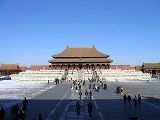
The Forbidden City was the Chinese
China

China is a Culture of China, an ancient civilization, and, depending on perspective, a national or multinational entity extending over a large area in East Asia....
 imperial palace
Palace

A palace is a grand residence, especially a royal residence or the home of a head of state or some other high-ranking dignitary, such as a bishop or archbishop....
 from the Ming Dynasty
Ming Dynasty

The Ming Dynasty , or Empire of the Great Ming , was the ruling Dynasties in Chinese history of China from 1368 to 1644, following the collapse of the Mongol-led Yuan Dynasty....
 to the end of the Qing Dynasty
Qing Dynasty

The Qing Dynasty , also known as the Manchu Dynasty, followed the Ming Dynasty in History of China, and was the last ruling Chinese Dynasties of China, ruling from 1644 to 1912 ....
. It is located in the middle of Beijing
Beijing

is a metropolis in northern China and the Capital of the People's Republic of China. It is one of the four municipality of China, which are equivalent to province in China's Political divisions of China....
, China
People's Republic of China

The People's Republic of China , commonly known as China, is the largest country in East Asia and the List of countries by population in the world with over 1.3 billion people, approximately a fifth of the world's population....
, and now houses the Palace Museum. For almost five centuries, it served as the home of the Emperor
Emperor of China

The Emperor of China refers to any monarch of Imperial China reigning since the founding of the Qin Dynasty in 221 BC until the fall of the Qing Dynasty in 1912....
 and his household, as well as the ceremonial and political centre of Chinese government.

Built from 1406 to 1420, the complex consists of 980 surviving buildings with 8,707 bays of rooms and covers 720,000 square metres (7,800,000 square feet).


Discussion
Ask a question about 'Forbidden City'
Start a new discussion about 'Forbidden City'
Answer questions from other users
Full Discussion Forum


Encyclopedia


The Forbidden City was the Chinese
China

China is a Culture of China, an ancient civilization, and, depending on perspective, a national or multinational entity extending over a large area in East Asia....
 imperial palace
Palace

A palace is a grand residence, especially a royal residence or the home of a head of state or some other high-ranking dignitary, such as a bishop or archbishop....
 from the Ming Dynasty
Ming Dynasty

The Ming Dynasty , or Empire of the Great Ming , was the ruling Dynasties in Chinese history of China from 1368 to 1644, following the collapse of the Mongol-led Yuan Dynasty....
 to the end of the Qing Dynasty
Qing Dynasty

The Qing Dynasty , also known as the Manchu Dynasty, followed the Ming Dynasty in History of China, and was the last ruling Chinese Dynasties of China, ruling from 1644 to 1912 ....
. It is located in the middle of Beijing
Beijing

is a metropolis in northern China and the Capital of the People's Republic of China. It is one of the four municipality of China, which are equivalent to province in China's Political divisions of China....
, China
People's Republic of China

The People's Republic of China , commonly known as China, is the largest country in East Asia and the List of countries by population in the world with over 1.3 billion people, approximately a fifth of the world's population....
, and now houses the Palace Museum. For almost five centuries, it served as the home of the Emperor
Emperor of China

The Emperor of China refers to any monarch of Imperial China reigning since the founding of the Qin Dynasty in 221 BC until the fall of the Qing Dynasty in 1912....
 and his household, as well as the ceremonial and political centre of Chinese government.

Built from 1406 to 1420, the complex consists of 980 surviving buildings with 8,707 bays of rooms and covers 720,000 square metres (7,800,000 square feet). The palace complex exemplifies traditional Chinese palatial architecture
Chinese architecture

Chinese architecture refers to a style of architecture that has taken shape in Asia over many centuries. The structural principles of China architecture have remained largely unchanged, the main changes being only the decorative details....
, and has influenced cultural and architectural developments in East Asia
East Asia

East Asia is a subregion of Asia that can be defined in either Geography or cultural terms. Geography and geopolitically, it covers about 12,000,000 km?, or about 28 percent of the Asian continent, about 15 percent bigger than the area of Europe, though some categorize Tibet, Xinjiang, and Mongolia as Central Asia....
 and elsewhere. The Forbidden City was declared a World Heritage Site
World Heritage Site

A UNESCO World Heritage Site is a site that is on the list maintained by the international World Heritage Programme administered by the UNESCO World Heritage Committee, composed of 21 Sovereign state which are elected by their General Assembly for a four-year term....
 in 1987, and is listed by UNESCO
UNESCO

United Nations Educational, Scientific and Cultural Organization is a specialized agency of the United Nations established on 16 November 1945....
 as the largest collection of preserved ancient wooden structures in the world.

Since 1924, the Forbidden City has been under the charge of the Palace Museum, whose extensive collection of artwork and artefacts were built upon the imperial collections of the Ming and Qing dynasties. Part of the museum's former collection is now located in the National Palace Museum
National Palace Museum

The National Palace Museum is an art museum in Taipei City, Taiwan. It is the national museum of the Republic of China, and has a permanent collection of over 650,000 pieces of History of China artifacts and artworks, making it one of the largest in the world....
 in Taipei
Taipei

Taipei has been the de facto capital of the Republic of China, commonly known as Taiwan, since the Chinese Civil War in 1949, and the capital of Taiwan since Japanese rule that began in 1895....
. Both museums descend from the same institution, but were split after the Chinese Civil War
Chinese Civil War

The Chinese Civil War or , which lasted from April 1927 to May 1950, was a civil war in China between the Kuomintang and the Chinese Communist Party ....
.

Name

The common English
English language

English is a West Germanic language that originated in Anglo-Saxon England and has lingua franca status in many parts of the world as a result of the military, economic, scientific, political and cultural influence of the British Empire in the 18th, 19th and early 20th centuries and that of the United States from the mid 20th century onwa...
 name, "the Forbidden City," is a translation of the Chinese name Zijin Cheng . Another English name of similar origin is "Forbidden Palace". In the Manchu language
Manchu language

Manchu is a Tungusic languages language spoken in Northeast China; it used to be the language of the Manchu, though now most Manchus speak Mandarin Chinese and there are fewer than 70 native speakers of Manchu out of a total of nearly 10 million ethnic Manchus....
 it is called Dabkuri dorgi hoton (Manchu: ), which literally means the "Layered Inner City."

The name "Zijin Cheng" is a name with significance on many levels. Zi, or "Purple
Purple

Purple is a general term for the range of shades of color occurring between red and blue. It occurs by mixing the primary colors red and blue in varying proportions, with possibly a very small quantity of the third primary color ....
", refers to the North Star
North Star

The North Star is the prominent pole star that lies closest in the sky to the celestial pole and which appears directly overhead to an observer at the Earth's North Pole; currently, this is Polaris....
, which in ancient China was called the Ziwei Star, and in traditional Chinese astrology
Chinese astrology

Chinese astrology is based on the astronomy and traditional calendars. The Chinese astrology does not calculate the positions of the sun, moon and planets at the time of birth....
 was the abode of the Celestial Emperor. The surrounding celestial region, the Ziwei Enclosure
Three enclosures

Three enclosures are Purple Forbidden enclosure , Supreme Palace enclosure , and Heavenly Market enclosure in Chinese constellation....
 , was the realm of the Celestial Emperor and his family. The Forbidden City, as the residence of the terrestrial emperor, was its earthly counterpart. Jin, or "Forbidden", referred to the fact that no-one could enter or leave the palace without the emperor's permission. Cheng means a walled city
Chinese city wall

Chinese city walls refer to civic defensive systems used to protect towns and cities in China in pre-modern times. The system consisted of city wall, wall tower, and city gate, which were often built to a uniform standard throughout the Empire....
.

Today, the site is most commonly known in Chinese
Chinese language

Chinese or the Sinitic language is a language family consisting of language mutually unintelligible to varying degrees. Originally the indigenous languages spoken by the Han Chinese in China, it forms one of the two branches of Sino-Tibetan languages of languages....
 as Głgong , which means the "Former Palace." The museum which is based in these buildings is known as the "Palace Museum" .

History


The site of the Forbidden City was situated on the Imperial city
Khanbaliq

Khanbaliq or Dadu refers to a city which is now Beijing, the current Capital of the People's Republic of China. The city was called Dadu or Tatu , meaning "great capital" or "grand capital" in Chinese language, the name for the capital of the Yuan Dynasty founded by Kublai Khan in China, and was called Daidu by the Mo...
 during the Mongol Yuan Dynasty
Yuan Dynasty

The Yuan Dynasty , or Great Yuan Empire was both the continuation of the Mongol Empire and the Mongol founded historical state in Mongolia and China, lasting officially from 1271 to 1368....
. Upon the establishment of the Ming Dynasty
Ming Dynasty

The Ming Dynasty , or Empire of the Great Ming , was the ruling Dynasties in Chinese history of China from 1368 to 1644, following the collapse of the Mongol-led Yuan Dynasty....
, the Hongwu Emperor
Hongwu Emperor

The Hongwu Emperor , known variably by his given name Zhu Yuanzhang and by the temple name Taizu of the Ming Dynasty was the founder and first emperor of the Ming Dynasty of China....
 moved the capital from Beijing in the north to Nanjing
Nanjing

is the capital city of China's Jiangsu province of China, and a city with a prominent place in Chinese history and Chinese culture. Nanjing served as the capital of China during several historical periods and is listed as one of the Historical capitals of China....
 in the south, and ordered that the Yuan palaces be razed. When his son Zhu Di became the Yongle Emperor
Yongle Emperor

The Yongle Emperor , born Zhu Di , was the third emperor of the Ming Dynasty of China from 1402 to 1424. His era name "Yongle" means "Perpetual Happiness"....
, he moved the capital back to Beijing, and construction began in 1406 of what would become the Forbidden City.

Construction lasted 15 years, and required more than a million workers. Material used include whole logs of precious Phoebe zhennan
Phoebe zhennan

Phoebe zhennan is a species of plant in the Lauraceae family. It is Endemism to China. It is threatened by habitat loss....
 wood found in the jungles of south-western China, and large blocks of marble from quarries near Beijing. The floors of major halls were paved with "golden bricks" , specially baked paving bricks from Suzhou
Suzhou

Suzhou is a city on the lower reaches of the Yangtze River and on the shores of Lake Taihu in the province of Jiangsu, China. The city is renowned for its beautiful stone bridges, pagodas, and meticulously designed Chinese garden which have contributed to its status as a great tourist attraction....
.

From 1420 to 1644, the Forbidden City was the seat of the Ming Dynasty. In April 1644, it was captured by rebel forces led by Li Zicheng
Li Zicheng

Li Zicheng , born Li H?ngji , was one of the major figures in the rebellion that brought down the Ming Dynasty. He proclaimed himself Chuang W?ng , or "The Roaming King"....
, who proclaimed himself emperor of the Shun Dynasty
Shun Dynasty

The Shun Dynasty was an Dynasties in Chinese history created in the brief lapse from Ming Dynasty to Qing Dynasty rule in History of China#Qin Dynasty: The Beginning of Imperial China....
. He soon fled before the combined armies of former Ming general Wu Sangui
Wu Sangui

Wu Sangui was a Ming Dynasty who was instrumental in the succession of rule to the Qing Dynasty in 1644. Considered by most people to be a traitor to both the Ming and the Qing dynasties, Wu declared himself Emperor of China as ruler of the Zhou Dynasty in 1678, but his revolt was quelled by the Qing Kangxi Emperor....
 and Manchu
Manchu

The Manchu people are a Tungusic peoples who originated in Manchuria . During their rise in the seventeenth century, with the help of Ming rebels , they conquered the Ming Dynasty and founded the Qing Dynasty, which ruled China until its abolition in 1911 after the Xinhai Revolution, which established Republic of China in its place....
 forces, setting fire to parts of the Forbidden City in the process. By October, the Manchus had achieved supremacy in northern China, and a ceremony was held at the Forbidden City to proclaim the young Shunzhi Emperor
Shunzhi Emperor

The Shunzhi Emperor was the second Emperor of China of the Manchu-led Qing dynasty, and the first Qing emperor to rule over China proper from 1644 to 1661....
 as ruler of all China under the Qing Dynasty
Qing Dynasty

The Qing Dynasty , also known as the Manchu Dynasty, followed the Ming Dynasty in History of China, and was the last ruling Chinese Dynasties of China, ruling from 1644 to 1912 ....
. The Qing rulers changed the names of the principal buildings, to emphasise "Harmony" rather than "Supremacy", made the name plates
Nameplate

A nameplate identifies and displays a person or product's name. Name plates are usually shaped as rectangles but are also seen in other shapes, sometimes taking on the shape of someone?s name....
 bilingual (Chinese
Chinese language

Chinese or the Sinitic language is a language family consisting of language mutually unintelligible to varying degrees. Originally the indigenous languages spoken by the Han Chinese in China, it forms one of the two branches of Sino-Tibetan languages of languages....
 and Manchu
Manchu language

Manchu is a Tungusic languages language spoken in Northeast China; it used to be the language of the Manchu, though now most Manchus speak Mandarin Chinese and there are fewer than 70 native speakers of Manchu out of a total of nearly 10 million ethnic Manchus....
), and introduced Shamanist
Shamanism

Shamanism is a range of traditional beliefs and practices concerned with communication with the spirit world. A practitioner of shamanism is known as a shaman, , noun ....
 elements to the palace.

In 1860, during the Second Opium War, Anglo-French forces took control of the Forbidden City and occupied it until the end of the war. In 1900 Empress Dowager Cixi
Empress Dowager Cixi

Empress Dowager CixiEmpress Dowager Cixi#Names of Empress Dowager Cixi , popularly known in China as the West Dowager Empress , was from the Manchu Yehe Nara Clan....
 fled from the Forbidden City during the Boxer Rebellion
Boxer Rebellion

The Boxer Rebellion, or more properly Boxer Uprising, was a violent anti-foreign, anti-Christian movement by the "Righteous Fists of Harmony,? Yihe tuan or Society of Righteous and Harmonious Fists in China....
, leaving it to be occupied by forces of the treaty powers until the following year.

After being the home of 24 emperors—fourteen of the Ming Dynasty and ten of the Qing Dynasty—the Forbidden City ceased being the political centre of China in 1912 with the abdication of Puyi
Puyi

Puyi , of the Manchu Aisin-Gioro ruling family, was the last Emperor of China. He ruled in two periods between 1908 and 1924, firstly as the Xuantong Emperor between 1908 and 1912, and nominally as a non-ruling puppet emperor for twelve days in 1917....
, the last Emperor of China. Under an agreement with the new Republic of China
Republic of China

The Republic of China , also known as Nationalist China is a country in East Asia that has evolved from a single-party state with full global recognition into a multi-party democratic state with Political status of Taiwan....
 government, Puyi remained in the Inner Court, while the Outer Court was given over to public use, until he was evicted after a coup in 1924. The Palace Museum was then established in the Forbidden City. In 1933, the Japanese invasion of China
Second Sino-Japanese War

The Second Sino-Japanese War was the largest Asian war in the twentieth century. From 1937 to 1941, it was fought between the Republic of China and the Empire of Japan....
 forced the evacuation of the national treasures in the Forbidden City. Part of the collection was returned at the end of World War II
World War II

World War II, or the Second World War , was a global military conflict which involved a Participants in World War II, including all of the great powers, organised into two opposing military alliances: the Allies of World War II and the Axis powers....
, but the other part was evacuated to Taiwan
Taiwan

Taiwan is an island in East Asia. "Taiwan" is also commonly used to refer to the country governed by the Republic of China and to the ROC itself, which governs the island of Taiwan, Orchid Island and Green Island, Taiwan in the Pacific Ocean off the Taiwan coast, the Penghu islands in the Taiwan Strait, and Kinmen and the Matsu Islands...
 in 1947 under orders by Chiang Kai-shek
Chiang Kai-shek

Chiang Kai-shek , Order of the Bath , served as Generalissimo of the Nationalist Government of the Republic of China from 1928 to 1948. He was sometimes referred to simply as "the Generalissimo"....
, whose Kuomintang
Kuomintang

The Kuomintang of China , also often translated as the Chinese Nationalist Party, is the founding and the ruling party of the Republic of China ....
 was losing the Chinese Civil War. This relatively small but high quality collection was kept in storage until 1965, when they again became public, as the core of the National Palace Museum
National Palace Museum

The National Palace Museum is an art museum in Taipei City, Taiwan. It is the national museum of the Republic of China, and has a permanent collection of over 650,000 pieces of History of China artifacts and artworks, making it one of the largest in the world....
 in Taipei
Taipei

Taipei has been the de facto capital of the Republic of China, commonly known as Taiwan, since the Chinese Civil War in 1949, and the capital of Taiwan since Japanese rule that began in 1895....
.

After the establishment of the People's Republic of China
People's Republic of China

The People's Republic of China , commonly known as China, is the largest country in East Asia and the List of countries by population in the world with over 1.3 billion people, approximately a fifth of the world's population....
 in 1949, some damage was done to the Forbidden City as the country was swept up in revolutionary zeal. During the Cultural Revolution
Cultural Revolution

The Great Proletarian Cultural Revolution in the People?s Republic of China was a period of widespread social and political upheaval that led to nation-wide chaos and economic disarray, which would engulf much of Chinese society between 1966 and 1976....
, however, further destruction was prevented when Premier Zhou Enlai
Zhou Enlai

Zhou Enlai was the first Premier of the People's Republic of China, serving from October 1949 until his death in January 1976. Zhou was instrumental in the Communist Party of China rise to power, and subsequently in the construction of the Economy of the People's Republic of China and restructuring of Chinese society....
 sent an army battalion to guard the city.

The Forbidden City was declared a World Heritage Site
World Heritage Site

A UNESCO World Heritage Site is a site that is on the list maintained by the international World Heritage Programme administered by the UNESCO World Heritage Committee, composed of 21 Sovereign state which are elected by their General Assembly for a four-year term....
 in 1987 by UNESCO
UNESCO

United Nations Educational, Scientific and Cultural Organization is a specialized agency of the United Nations established on 16 November 1945....
 as the "Imperial Palace of the Ming and Qing Dynasties", due to its significant place in the development of Chinese architecture
Chinese architecture

Chinese architecture refers to a style of architecture that has taken shape in Asia over many centuries. The structural principles of China architecture have remained largely unchanged, the main changes being only the decorative details....
 and culture. It is currently administered by the Palace Museum, which is currently carrying out a sixteen-year restoration project to repair and restore all buildings in the Forbidden City to their pre-1912 state.

In recent years, the presence of commercial enterprises in the Forbidden City has become controversial. A Starbucks
Starbucks

Starbucks Corporation is an international coffee and List of coffeehouse chains based in Seattle, Washington, United States. Starbucks is the largest coffeehouse company in the world, with 16,120 stores in 44 countries....
 store that opened in 2000 sparked objections and eventually closed on July 13, 2007. Chinese media also took notice of a pair of souvenir shops that refused to admit Chinese citizens in order to price-gouge
Price gouging

Price gouging is a pejorative term for a seller pricing much higher than is considered reasonable or fair. In precise, legal usage, it is the name of a felony that applies in some of the United States only during civil emergencies....
 foreign customers in 2006.

Description

The Forbidden City is the world's largest surviving palace complex and covers 72 ha
Hectare

A hectare is a unit of area equal to , or one square hectometre , and commonly used for surveying.The hectare is used in most countries around the world, especially in domains concerned with land ownership, land planning, and land management, including law , agriculture, forestry, and town planning....
. It is a rectangle from north to south and from east to west. It consists of 980 surviving buildings with 8,707 bays of rooms. The Forbidden City was designed to be the centre of the ancient, walled city of Beijing. It is enclosed in a larger, walled area called the Imperial City
Imperial City (Beijing)

File:Beihaisite.jpgFile:Sjt1.JPGFile:Jingshanpic1.jpgThe Imperial City is a section of the city of Beijing in the Ming dynasty and Qing dynasty dynasties, with the Forbidden City at its center....
. The Imperial City is, in turn, enclosed by the Inner City; to its south lies the Outer City.

The Forbidden City remains important in the civic scheme of Beijing. The central north-south axis remains the central axis of Beijing. This axis extends to the south through Tiananmen gate to Tiananmen Square
Tiananmen Square

Tiananmen Square is the large plaza near the center of Beijing, People's Republic of China, named after the Tiananmen which sits to its north, separating it from the Forbidden City....
, the ceremonial centre of the People's Republic of China. To the north, it extends through the Bell and Drum Towers
Gulou and Zhonglou

Gul?u , the drum tower of Beijing, is situated at the northern end of the central axis of the Inner City to the north of Di? anmen Street. Originally built for musical reasons it was later used to announce the time and is now a tourist attraction....
 to Yongdingmen
Yongdingmen

Yongdingmen was the former front gate of the outer section of Beijing's old Chinese city wall. Originally built in 1553, it was torn down in the 1950s to make way for the new road system in Beijing....
. This axis is not exactly aligned north-south, but is tilted by slightly more than two degrees. Researchers now believe that the axis was designed in the Yuan Dynasty
Yuan Dynasty

The Yuan Dynasty , or Great Yuan Empire was both the continuation of the Mongol Empire and the Mongol founded historical state in Mongolia and China, lasting officially from 1271 to 1368....
 to be aligned with Xanadu
Xanadu

Xanadu, also spelled Shangdu or Shang-tu and also known as Kaiping , was the summer capital of Kublai Khan's Yuan Dynasty in China, after he decided to move the capital of the Yuan Dynasty to Dadu, present-day Beijing....
, the other capital of their empire.

Walls and gates

Wpmeridiangate
The Forbidden City is surrounded by a high city wall
Chinese city wall

Chinese city walls refer to civic defensive systems used to protect towns and cities in China in pre-modern times. The system consisted of city wall, wall tower, and city gate, which were often built to a uniform standard throughout the Empire....
 and a six-metre deep, wide moat. The walls are wide at the base, tapering to at the top. These walls served as both defensive wall
Defensive wall

A defensive wall is a fortification used to defend a city or settlement from potential aggressors. In ancient to modern times, they were used to enclose settlements....
s and retaining wall
Retaining wall

A retaining wall is a structure that holds back soil or rock from a building, structure or area. Retaining walls prevent downslope movement or erosion and provide support for vertical or near-vertical grade changes....
s for the palace. They were constructed with a rammed earth
Rammed earth

Rammed earth, also known as pis? de terre or simply pis?, is a type of construction material. It is an age-old construction method that has seen a revival in recent years as people seek more sustainability building materials and natural building methods....
 core, and surfaced with three layers of specially baked bricks on both sides, with the interstices filled with mortar.

At the four corners of the wall sit towers (E) with intricate roofs boasting 72 ridges, reproducing the Pavilion of Prince Teng
Pavilion of Prince Teng

The Pavilion of Prince Teng or Tengwang Pavilion is a building in the north west of the city of Nanchang, in Jiangxi province, China, on the east bank of the Gan River and is one of the Four Great Towers of China....
 and the Yellow Crane Pavilion
Yellow Crane Tower

File:GELBERKRANICH-WUHAN.jpgYellow Crane Tower is a famous and historic tower, often rebuilt, that stands on Sheshan , at the bank of Yangtze River in the Wuchang District, of the city of Wuhan, in the Hubei province of South Central China....
 as they appeared in Song Dynasty
Song Dynasty

The Song Dynasty was a ruling Chinese dynasty in China between 960–1279 AD; it succeeded the Five Dynasties and Ten Kingdoms Period, and was followed by the Yuan Dynasty....
 paintings. These towers are the most visible parts of the palace to commoners outside the walls, and much folklore is attached to them. According to one legend, artisans could not put a corner tower back together after it was dismantled for renovations in the early Qing Dynasty, and it was only rebuilt after the intervention of carpenter-immortal Lu Ban
Lu Ban

Lu Ban was a China carpenter, engineer, philosopher, inventor, military thinker, statesman and contemporary of Mozi, born in the State of Lu....
.

The wall is pierced by a gate on each side. At the southern end is the main Meridian Gate
Meridian Gate

The Meridian Gate is the southern gate of the Forbidden City. It has five arches. The three central arches are close together; the two flanking arches are farther apart from the three central arches....
 (A). To the north is the Gate of Divine Might
Gate of Divine Might

The Gate of Divine Might or Gate of Divine Prowess is the northern gate of the Forbidden City in Beijing, China. It faces Jingshan Park....
 (B), which faces Jingshan Park. The east and west gates are called the "East Glorious Gate" (D) and "West Glorious Gate" (C). All gates in the Forbidden City are decorated with a nine-by-nine array of golden door nails, except for the East Glorious Gate, which has only eight rows.

The Meridian Gate has two protruding wings forming three sides of a square (Wumen, or Meridian Gate, Square) before it. The gate has five gateways. The central gateway is part of the Imperial Way, a stone flagged path that forms the central axis of the Forbidden City and the ancient city of Beijing itself, and leads all the way from the Gate of China
Gate of China, Beijing

The Gate of China in Beijing was a historical ceremonial gateway in Beijing, China, located near the centre of today's Tiananmen Square. It was demolished in 1954....
 in the south to Jingshan in the north. Only the Emperor may walk or ride on the Imperial Way, except for the Empress on the occasion of her wedding, and successful students after the Imperial Examination
Imperial examination

The Imperial examinations in Imperial China determined who among the population would be permitted to enter the state's bureaucracy. The Imperial Examination System in China lasted for 1300 years, from its founding during the Sui Dynasty in 605 to its abolition near the end of the Qing Dynasty in 1905....
.

Outer Court

Beijing Forbidden4
Forbiddencitythroneroom01
Forbidden City 05
Traditionally, the Forbidden City is divided into two parts. The Outer Court or Front Court includes the southern sections, and was used for ceremonial purposes. The Inner Court or Back Palace includes the northern sections, and was the residence of the Emperor and his family, and was used for day-to-day affairs of state. (The approximate dividing line shown as red dash in the plan above.) Generally, the Forbidden City has three vertical axes. The most important buildings are situated on the central north-south axis.

Entering from the Meridian Gate, one encounters a large square, pierced by the meandering Inner Golden Water River, which is crossed by five bridges. Beyond the square stands the Gate of Supreme Harmony
Gate of Supreme Harmony

The Gate of Supreme Harmony , is the second major gate at the southern side of the Forbidden City.The gate was originally built during the Ming Dynasty, when it was called Fengtianmen ....
 (F). Behind that is the Hall of Supreme Harmony Square. A three-tiered white marble terrace rises from this square. Three halls stand on top of this terrace, the focus of the palace complex. From the south, these are the Hall of Supreme Harmony
Hall of Supreme Harmony

The Hall of Supreme Harmony is the largest hall within the Forbidden City. It is located at its central axis, behind the Gate of Supreme Harmony....
 , the Hall of Central Harmony
Hall of Central Harmony

The Hall of Central Harmony is one of the three halls of the Outer Court of the Forbidden City, in Beijing, China, along with the Hall of Supreme Harmony and Hall of Preserving Harmony....
 , and the Hall of Preserving Harmony
Hall of Preserving Harmony

The Hall of Preserving Harmony is one of the three halls of the Outer Court of the Forbidden City in Beijing, China, along with the Hall of Supreme Harmony and Hall of Central Harmony....
 .

The Hall of Supreme Harmony (G) is the largest, and rises some above the level of the surrounding square. It is the ceremonial centre of imperial power, and the largest surviving wooden structure in China. It is nine bays wide and five bays deep, the numbers 13 and 20 being symbolically connected to the majesty of the Emperor. Set into the ceiling at the centre of the hall is an intricate caisson
Caisson (Asian architecture)

The Caisson , also referred to as a caisson ceiling, or spider web ceiling, in East Asian architecture is an architectural feature typically found in the ceiling of temples and palaces, usually at the centre and directly above the main throne, seat, or religious figure....
 decorated with a coiled dragon, from the mouth of which issues a chandelier-like set of metal balls, called the "Xuanyuan
Yellow Emperor

Huang-di, or the Yellow Emperor, is a legendary Chinese sovereign and culture hero who is considered in Chinese mythology to be the ancestor of all Han Chinese....
 Mirror". In the Ming Dynasty, the Emperor held court here to discuss affairs of state. During the Qing Dynasty, as Emperors held court far more frequently, a less ceremonious location was used instead, and the Hall of Supreme Harmony was only used for ceremonial purposes, such as coronation
Coronation

A coronation is a ceremony marking the investiture of a monarch with regal power, specifically involving the placement of a coronation crown upon his or her head, and the presentation of other items of regalia....
s, investiture
Investiture

Investiture, from the Latin is a rather general term for the formal installation of an incumbent in public office, especially by taking possession of its insignia....
s, and imperial wedding
Wedding

File:Pimenov SvadbaOnTomorrowStreet.jpgA wedding is the ceremony in which two people are united in marriage. Wedding traditions and customs vary greatly between cultures, ethnic groups, religions, country, and social classes....
s.

The Hall of Central Harmony is a smaller, square hall, used by the Emperor to prepare and rest before and during ceremonies. Behind it, the Hall of Preserving Harmony, was used for rehearsing ceremonies, and was also the site of the final stage of the Imperial examination
Imperial examination

The Imperial examinations in Imperial China determined who among the population would be permitted to enter the state's bureaucracy. The Imperial Examination System in China lasted for 1300 years, from its founding during the Sui Dynasty in 605 to its abolition near the end of the Qing Dynasty in 1905....
. All three halls feature imperial thrones, the largest and most elaborate one being that in the Hall of Supreme Harmony
Hall of Supreme Harmony

The Hall of Supreme Harmony is the largest hall within the Forbidden City. It is located at its central axis, behind the Gate of Supreme Harmony....
.

At the centre of the ramps leading up to the terraces from the northern and southern sides are ceremonial ramps, part of the Imperial Way, featuring elaborate and symbolic bas-relief carvings. The northern ramp, behind the Hall of Preserving Harmony, is carved from a single piece of stone long, wide, and thick. It weighs some 200 tonnes and is the largest such carving in China. The southern ramp, in front of the Hall of Supreme Harmony
Hall of Supreme Harmony

The Hall of Supreme Harmony is the largest hall within the Forbidden City. It is located at its central axis, behind the Gate of Supreme Harmony....
, is even longer, but is made from two stone slabs joined together — the joint was ingeniously hidden using overlapping bas-relief carvings, and was only discovered when weathering widened the gap in the 20th century.

In the south west and south east of the Outer Court are the halls of Military Eminence (H) and Literary Glory (J). The former was used at various times for the Emperor to receive ministers and hold court, and later housed the Palace's own printing house. The latter was used for ceremonial lectures by highly regarded Confucian scholars, and later became the office of the Grand Secretariat. A copy of the Siku Quanshu
Siku Quanshu

The Siku Quanshu, variously translated as the Imperial Collection of Four, Emperor's Four Treasuries, Complete Library in Four Branches of Literature, or Complete Library of the Four Treasuries, is the largest collection of books in Chinese history and probably the most ambitious editorial enterprise in the history of the...
 was stored there. To the north-east are the Southern Three Places (K), which was the residence of the Crown Prince.

Inner Court

The Inner Court is separated from the Outer Court by an oblong courtyard lying orthogonal to the City's main axis. It was the home of the Emperor and his family. In the Qing Dynasty, the Emperor lived and worked almost exclusively in the Inner Court, with the Outer Court used only for ceremonial purposes.
Gugong
At the centre of the Inner Court is another set of three halls (L). From the south, these are the Palace of Heavenly Purity
Palace of Heavenly Purity

The Palace of Heavenly Purity, or Qianqing Palace is a palace in the Forbidden City in Beijing, China. It is the largest of the three halls of the Inner Court , located at the northern end of the Forbidden City....
 , Hall of Union
Hall of Union

The Hall of Union is a building in the Forbidden City, in Beijing, China. It stands between the Palace of Heavenly Purity and the Palace of Earthly Tranquility....
, and the Palace of Earthly Tranquility
Palace of Earthly Tranquility

The Palace of Earthly Tranquility is the northernmost of the three main halls of the Inner Court of the Forbidden City, the other two halls being the Palace of Heavenly Purity and the Hall of Union....
. Smaller than the Outer Court halls, the three halls of the Inner Court were the official residences of the Emperor and the Empress. The Emperor, representing Yang
Yin and yang

In Chinese philosophy, the concept of yin yang is used to describe how seemingly disjunct or opposing forces are interconnected and interdependent in the natural world, giving rise to each other in turn....
 and the Heavens, would occupy the Palace of Heavenly Purity. The Empress, representing Yin
Yin and yang

In Chinese philosophy, the concept of yin yang is used to describe how seemingly disjunct or opposing forces are interconnected and interdependent in the natural world, giving rise to each other in turn....
 and the Earth, would occupy the Palace of Earthly Tranquility. In between them was the Hall of Union, where the Yin and Yang
Yin and yang

In Chinese philosophy, the concept of yin yang is used to describe how seemingly disjunct or opposing forces are interconnected and interdependent in the natural world, giving rise to each other in turn....
 mixed to produce harmony.
Palace Museum 6
The Palace of Heavenly Purity
Palace of Heavenly Purity

The Palace of Heavenly Purity, or Qianqing Palace is a palace in the Forbidden City in Beijing, China. It is the largest of the three halls of the Inner Court , located at the northern end of the Forbidden City....
 is a double-eaved building, and set on a single-level white marble platform. It is connected to the Gate of Heavenly Purity to its south by a raised walkway. In the Ming Dynasty, it was the residence of the Emperor. However, beginning from the Yongzheng Emperor
Yongzheng Emperor

The Yongzheng Emperor , born Yinzhen was the fourth Emperor of China of the Manchu Qing Dynasty, and the third Qing emperor to rule over China, from 1722 to 1735....
 of the Qing Dynasty
Qing Dynasty

The Qing Dynasty , also known as the Manchu Dynasty, followed the Ming Dynasty in History of China, and was the last ruling Chinese Dynasties of China, ruling from 1644 to 1912 ....
, the Emperor lived instead at the smaller Hall of Mental Cultivation to the west, out of respect to the memory of the Kangxi Emperor
Kangxi Emperor

The Kangxi Emperor was the third Emperor of China of the Manchu-led Qing Dynasty and the second Qing emperor to rule over China proper, from 1661 to 1722....
. The Palace of Heavenly Purity then became the Emperor's audience hall. A caisson is set into the roof, featuring a coiled dragon. Above the throne hangs a tablet reading "Justice and Honour" .

The Palace of Earthly Tranquility
Palace of Earthly Tranquility

The Palace of Earthly Tranquility is the northernmost of the three main halls of the Inner Court of the Forbidden City, the other two halls being the Palace of Heavenly Purity and the Hall of Union....
  is a double-eaved building, 9 bays wide and 3 bays deep. In the Ming Dynasty, it was the residence of the Empress. In the Qing Dynasty, large portions of the Palace were converted for Shamanist worship by the new Manchu rulers. From the reign of the Yongzheng Emperor, the Empress moved out of the Palace. However, two rooms in the Palace of Earthly Harmony were retained for use on the Emperor's wedding night.

Between these two palaces is the Hall of Union
Hall of Union

The Hall of Union is a building in the Forbidden City, in Beijing, China. It stands between the Palace of Heavenly Purity and the Palace of Earthly Tranquility....
, which is square in shape with a pyramidal roof. Stored here are the twenty-five Imperial Seals of the Qing Dynasty, as well as other ceremonial items.
Ninedragons01
Behind these three halls lies the Imperial Garden (M). Relatively small, and compact in design, the garden nevertheless contains several elaborate landscaping features. To the north of the garden is the Gate of Divine Might, the north gate of the palace.

Distributed to the east and west of the three main halls are a series of self-contained courtyards and minor palaces, where the Emperor's concubines and children lived. Directly to the west is the Hall of Mental Cultivation (N"). Originally a minor palace, this became the de facto residence and office of the Emperor starting from Yongzheng. In the last decades of the Qing Dynasty, empresses dowager, including Cixi, held court from the eastern partition of the hall. Located around the Hall of Mental Cultivation are the offices of the Grand Council
Grand Council

The Grand Council or Junjichu was an important policy-making body in the Qing Empire. It was established in 1733 by the Yongzheng Emperor....
 and other key government bodies.

The north-eastern section of the Inner Court is taken up by the Palace of Tranquil Longevity (O), a complex built by the Qianlong Emperor
Qianlong Emperor

The Qianlong Emperor was the fifth emperor of the Manchu-led Qing Dynasty, and the fourth Qing dynasty emperors to rule over China. The fourth son of the Yongzheng Emperor, he reigned officially from October 11, 1736 to February 7, 1795....
 in anticipation of his retirement. It mirrors the set-up of the Forbidden City proper and features an "outer court", an "inner court", and gardens and temples. The entrance to the Palace of Tranquil Longevity is marked by a glazed-tile Nine Dragons Screen.

Religion

Religion was an important part of life for the imperial court. In the Qing Dynasty, the Palace of Earthly Harmony became a place of Manchu Shamanist
Shamanism

Shamanism is a range of traditional beliefs and practices concerned with communication with the spirit world. A practitioner of shamanism is known as a shaman, , noun ....
 ceremony. At the same time, the native Chinese Taoist
Taoism

Taoism refers to a variety of related philosophical and religious traditions and concepts. These traditions have influenced East Asia for over two thousand years and some have spread to the West....
 religion continued to have an important role throughout the Ming and Qing dynasties. There were two Taoist shrines, one in the imperial garden and another in the central area of the Inner Court.

Another prevalent form of religion in the Qing Dynasty palace was Tibetan Buddhism
Tibetan Buddhism

Tibetan Buddhism is the body of Buddhism religious doctrine and institutions characteristic of Tibet and certain regions of the Himalayas, including northern Nepal, Bhutan, and India ....
, or Lamaism. A number of temples and shrines were scattered throughout the Inner Court. Buddhist iconography also proliferated in the interior decorations of many buildings. Of these, the Pavilion of the Rain of Flowers is one of the most important. It housed a large number of Buddhist statues, icons, and mandala
Mandala

Mandala is a concentric diagram having spiritual and ritual significance in both Buddhism and Hinduism. The term is of Hinduism origin and appears in the Rig Veda as the name of the sections of the work, but is also used in other Indian religions, particularly Buddhism....
s, placed in ritualistic arrangements.

Surroundings

Beihai Park   Bridge To White Pagoda
The Forbidden City is surrounded on three sides by imperial gardens. To the north is Jingshan Park
Jingshan Park

Jingshan is an artificial hill in Beijing, China. Covering an area of more than 230,000 m?, and spans across both the Xicheng District and the Dongcheng District, Beijing, Jingshan is also immediately north of the Forbidden City on the central axis of Beijing....
, also known as Prospect Hill, an artificial hill created from the soil excavated to build the moat and from nearby lakes.

To the west lies Zhongnanhai
Zhongnanhai

The Zhongnanhai is a complex of buildings in Beijing, China adjacent to the Forbidden City which serves as the central headquarters for the Communist Party of China and the State Council of the People's Republic of China of the People's Republic of China....
, a former garden centred on two connected lakes, which now serves as the central headquarters for the Communist Party of China
Communist Party of China

The Communist Party of China , also known as the Chinese Communist Party , is the founding and the ruling party of the People's Republic of China and the world's largest political party....
 and the State Council of the People's Republic of China
State Council of the People's Republic of China

The State Council , which is largely synonymous with the Central People's Government after 1954, is the chief administrative authority of the People's Republic of China....
. To the north-west lies Beihai Park
Beihai Park

Beihai Park is an imperial garden to the northwest of the Forbidden City in Beijing. built in the 10th century, it is amongst the largest of Chinese gardens, and contains numerous historically important structures, palaces and temples....
, also centred on a lake connected to the southern two, and a popular park.

To the south of the Forbidden City were two important shrines — the Imperial Shrine of Family and the Imperial Shrine of State , where the Emperor would venerate the spirits of his ancestors and the spirit of the nation, respectively. Today, these are the Beijing Labouring People's Cultural Hall and Zhongshan Park
Zhongshan Park

Zhongshan Park is a common name of Chinese parks, in honour of Sun Yat-sen, better-known in Chinese as Sun Zhongshan, who is considered by many to be the "Father of modern China"....
 (commemorating Sun Yat-sen
Sun Yat-sen

Sun Yat-sen , also known as Sun Yixian, Sun Wen, Sun Itchisen/Sun Itchiyama and Sun Zhongshan , was a China revolutionary and Politician leader often referred to as the Father of the Nation....
) respectively.

To the south, two nearly identical gatehouses stand along the main axis. They are the Upright Gate and the more famous Tiananmen Gate, which is decorated with a portrait of Mao Zedong
Mao Zedong

Mao Zedong was a China military and politics dictator. Mao led the Communist Party of China to victory against the Kuomintang in the Chinese Civil War, and was the leader of the People?s Republic of China from its establishment in 1949 until his death in 1976....
 in the centre and two placards to the left and right: "Long Live the People's Republic of China" and "Long live the Great Unity of the World's Peoples". The Tiananmen Gate connects the Forbidden City precinct with the modern, symbolic centre of the Chinese state, Tiananmen Square.

While development is now tightly controlled in the vicinity of the Forbidden City, throughout the past century uncontrolled and sometimes politically motivated demolition and reconstruction has changed the character of the areas surrounding the Forbidden City. Since 2000, the Beijing municipal government has worked to evict governmental and military institutions occupying some historical buildings, and has established a park around the remaining parts of the Imperial City wall. In 2004, an ordinance relating to building height and planning restriction was renewed to establish the Imperial City area and the northern city area as a buffer zone for the Forbidden City. In 2005, the Imperial City and Beihai
Beihai Park

Beihai Park is an imperial garden to the northwest of the Forbidden City in Beijing. built in the 10th century, it is amongst the largest of Chinese gardens, and contains numerous historically important structures, palaces and temples....
 (as an extension item to the Summer Palace
Summer Palace

The Summer Palace or Yihe yuan is a palace in Beijing, China.The Summer Palace is mainly dominated by Summer Palace#Longevity Hill and the Kunming Lake....
) were included in the shortlist for the next World Heritage Site
World Heritage Site

A UNESCO World Heritage Site is a site that is on the list maintained by the international World Heritage Programme administered by the UNESCO World Heritage Committee, composed of 21 Sovereign state which are elected by their General Assembly for a four-year term....
 in Beijing
Beijing

is a metropolis in northern China and the Capital of the People's Republic of China. It is one of the four municipality of China, which are equivalent to province in China's Political divisions of China....
.

Symbolism

The design of the Forbidden City, from its overall layout to the smallest detail, was meticulously planned to reflect philosophical
Chinese philosophy

Chinese philosophy is philosophy written in the China Chinese culture of thought. Chinese philosophy has a history of several thousand years; its origins are often traced back to the I Ching , an ancient compendium of divination, which uses a system of 64 hexagrams to guide action....
 and religious
Religion in China

Religion in China has been characterized by Religious pluralism since the beginning of Chinese history. The Chinese religions are family-oriented and, unlike Western religions, do not demand the exclusive adherence of members....
 principles, and above all to symbolise the majesty of Imperial power. Some noted examples of symbolic designs include:
  • Yellow
    Yellow

    Yellow is the color evoked by light that stimulates both the L and M cone cells of the retina about equally, but does not significantly stimulate the S cone cells; that is, light with much red and green but not very much blue....
     is the colour of the Emperor. Thus almost all roofs in the Forbidden City bear yellow glazed tiles. There are only two exceptions. The library at the Pavilion of Literary Profundity had black tiles because black was associated with water
    Five elements (Chinese philosophy)

    In many traditional Chinese theory field, matters and its developmental movement stage can be classified into the Wu Xing , or the Five Movements, Five Phases or Five Steps/Stages, traditionally translated as Five Elements....
    , and thus fire-prevention. Similarly, the Crown Prince's residences have green tiles because green was associated with wood
    Five elements (Chinese philosophy)

    In many traditional Chinese theory field, matters and its developmental movement stage can be classified into the Wu Xing , or the Five Movements, Five Phases or Five Steps/Stages, traditionally translated as Five Elements....
    , and thus growth.
Highstatusroofdeco
* The main halls of the Outer and Inner courts are all arranged in groups of three — the shape of the Qian
Bagua (concept)

The Ba gua are eight diagrams used in Taoist cosmology to represent a range of interrelated concepts. Each consists of three lines, each either "broken" or "unbroken," representing a Yin and yang line or a yang line, respectively....
 triagram, representing Heaven. The residences of the Inner Court on the other hand are arranged in groups of six — the shape of the Kun
Bagua (concept)

The Ba gua are eight diagrams used in Taoist cosmology to represent a range of interrelated concepts. Each consists of three lines, each either "broken" or "unbroken," representing a Yin and yang line or a yang line, respectively....
 triagram, representing the Earth.
  • The sloping ridges of building roofs are decorated with a line of statuettes
    Imperial roof decoration

    Chinese imperial roof decoration or roof charms or roof-figures or or was only allowed on official buildings of the empire. Chinese roofs are typically of the hip roof type, with small gables....
     lead by a man riding a phoenix
    Phoenix (mythology)

    The phoenix is a Mythologyical sacred fire bird which originated in the Sub-continent of India in ancient mythologies mentioned in the Ancient Egyptian religion and later the Sanchuniathon and the Greek Mythology....
     and followed by an imperial dragon
    Chinese dragon

    The China dragon or Oriental dragon is a mythical creature in East Asian culture with a China origin. It is visualized these days as a long, scaled, snake-like creature with four legs and five claws on each ....
    . The number of statuettes represents the status of the building — a minor building might have 3 or 5. The Hall of Supreme Harmony has 10, the only building in the country to be permitted this in Imperial times. As a result, its 10th statuette, called a "Hangshi", or "ranked tenth" , is also unique in the Forbidden City.
  • The layout of buildings follows ancient customs laid down in the Classic of Rites
    Classic of Rites

    The Classic of Rites , also known as the Book of Rites, the Record of Rites, Liki, or Li Ch'i, was one of the Chinese Five Classics of the Confucianism canon....
    . Thus, ancestral temples are in front of the palace. Storage areas are placed in the front part of the palace complex, and residences in the back.


Collections

Forbidden City Imperial Guardian Lions
The collections of the Palace Museum are based on the Qing imperial collection. According to the results of a 1925 audit, some 1.17 million items were stored in the Forbidden City. In addition, the imperial libraries housed one of the country's largest collections of ancient books and various documents, including government documents of the Ming
Ming Dynasty

The Ming Dynasty , or Empire of the Great Ming , was the ruling Dynasties in Chinese history of China from 1368 to 1644, following the collapse of the Mongol-led Yuan Dynasty....
 and Qing
Qing Dynasty

The Qing Dynasty , also known as the Manchu Dynasty, followed the Ming Dynasty in History of China, and was the last ruling Chinese Dynasties of China, ruling from 1644 to 1912 ....
 dynasties.

From 1933, the threat of Japanese invasion forced the evacuation of the most important parts of the Museum's collection. After the end of World War II, this collection was returned to Nanjing. However, with the Communists
Communist Party of China

The Communist Party of China , also known as the Chinese Communist Party , is the founding and the ruling party of the People's Republic of China and the world's largest political party....
' victory imminent in the Chinese Civil War, the Nationalist government decided to ship the pick of this collection to Taiwan
Taiwan

Taiwan is an island in East Asia. "Taiwan" is also commonly used to refer to the country governed by the Republic of China and to the ROC itself, which governs the island of Taiwan, Orchid Island and Green Island, Taiwan in the Pacific Ocean off the Taiwan coast, the Penghu islands in the Taiwan Strait, and Kinmen and the Matsu Islands...
. Of the 13,427 boxes of evacuated artefacts, 2,972 boxes are now housed in the National Palace Museum in Taipei. Almost ten thousand boxes were returned to Beijing, but 2,221 boxes remain today in storage under the charge of the Nanjing Museum
Nanjing Museum

Nanjing Museum is located in Nanjing, Jiangsu Province, China, on East Zhongshan Road, about 3km from the Xinjiekou traffic circle to the east, just inside Zhongshan Gate....
.

After 1949, the Museum conducted a new audit as well as a thorough search of the Forbidden City, uncovering a number of important items. In addition, the government moved items from other museums around the country to replenish the Palace Museum's collection. It also purchased and received donations from the public.

Ceramic The Palace Museum holds 340,000 pieces of ceramic
Ceramic

File:Bridge from dental porcelain.jpgFile:Qing vase p1070256.jpgA ceramic is an inorganic, nonmetal solid prepared by the action of heat and subsequent cooling....
s and porcelain
Porcelain

Porcelain is a ceramic material made by heating raw materials, generally including clay in the form of kaolin, in a kiln to temperatures between and ....
. These include imperial collections from the Tang Dynasty
Tang Dynasty

The Tang Dynasty was an Dynasties in Chinese history preceded by the Sui Dynasty and followed by the Five Dynasties and Ten Kingdoms Period. It was founded by the Li family, who seized power during the decline and collapse of the Sui Empire....
 and the Song Dynasty
Song Dynasty

The Song Dynasty was a ruling Chinese dynasty in China between 960–1279 AD; it succeeded the Five Dynasties and Ten Kingdoms Period, and was followed by the Yuan Dynasty....
, as well as pieces commissioned by the Palace, and, sometimes, by the Emperor personally. The Palace Museum holds about 320,000 pieces of porcelain from the imperial collection. The rest are almost all held in the National Palace Museum in Taipei and the Nanjing Museum.

Paintings The Palace Museum holds close to 50,000 items of paintings. Of these, more than 400 date from before the Yuan Dynasty
Yuan Dynasty

The Yuan Dynasty , or Great Yuan Empire was both the continuation of the Mongol Empire and the Mongol founded historical state in Mongolia and China, lasting officially from 1271 to 1368....
 (1271-1368). This is the largest such collection in China. The collection is based on the palace collection in the Ming and Qing Dynasties. The personal interest of Emperors such as Qianlong meant that almost all surviving paintings from the Yuan Dynasty and before were held by the palace. However, a significant portion of this collection was lost over the years. After his abdication, Puyi transferred paintings out of the palace, and many of these were subsequently lost or destroyed. In 1948, the pick of the remaining collection were moved to Taiwan. The collection has subsequently been replenished, through donations, purchases, and transfers from other museums.

Bronzeware The Palace Museum's bronze
Bronze

Bronze is a metal alloy consisting primarily of copper, usually with tin as the main additive, but sometimes with other chemical element such as phosphorus, manganese, aluminium, or silicon....
 collection dates from the early Shang Dynasty
Shang Dynasty

The Shang Dynasty or Yin Dynasty was according to traditional sources the first Dynasties in Chinese history. They ruled in the northeastern region of the area known as "China proper", in the Yellow River valley....
 (founded c. 1766 BC). Of the almost 10,000 pieces held, about 1,600 are inscribed items from the pre-Qin
Qin Dynasty

The Qin Dynasty was preceded by the feudal Zhou Dynasty and followed by the Han Dynasty in China. The unification of China in 221 BCE under the Qin Shi Huang marked the beginning of Imperial China, a period which lasted until the fall of the Qing Dynasty in 1912 CE....
 period (to 221 BC). A significant part of the collection is ceremonial bronzeware from the imperial court.

Timepieces The Palace Museum has one of the largest collections of mechanical timepieces of the 18th and 19th centuries in the world, with more than 1,000 pieces. The collection contains both Chinese- and foreign-made pieces. Chinese pieces came from the palace's own workships, Guangzhou
Guangzhou

'Guangzhou' is the Capital and a sub-provincial city of Guangdong Province of China in the northern and southern China part of the People's Republic of China....
 (Canton) and Suzhou
Suzhou

Suzhou is a city on the lower reaches of the Yangtze River and on the shores of Lake Taihu in the province of Jiangsu, China. The city is renowned for its beautiful stone bridges, pagodas, and meticulously designed Chinese garden which have contributed to its status as a great tourist attraction....
 (Suchow). Foreign pieces came from countries including Britain
United Kingdom of Great Britain and Ireland

The United Kingdom of Great Britain and Ireland was the formal name and the state form of the United Kingdom from 1 January 1801 until 12 April 1927....
, France
France

France , officially the French Republic , is a country whose Metropolitan France is located in Western Europe and that also comprises various Overseas departments and territories of France....
, Switzerland
Switzerland

Switzerland is a landlocked Swiss Alps country of roughly 7.7 million people in Western Europe with an area of 41,285 km?. Switzerland is a federal republic consisting of 26 states called Cantons of Switzerland....
, the United States
United States

The United States of America is a Federal government constitutional republic comprising U.S. state and a federal district. The country is situated mostly in central North America, where its Contiguous United States and Washington, D.C., the Capital districts and territories, lie between the Pacific Ocean and Atlantic Oceans, Borders of the U...
 and Japan
Japan

Japan is an island country in East Asia. Located in the Pacific Ocean, it lies to the east of the Sea of Japan, People's Republic of China, North Korea, South Korea and Russia, stretching from the Sea of Okhotsk in the north to the East China Sea and Taiwan in the south....
. Of these, the largest portion come from Britain.

Jade Jade
Jade

Jade is an ornamental stone.The term jade is applied to two different metamorphic rocks that are made up of different silicate minerals:...
 has a unique place in Chinese culture. The Museum's collection, mostly derived from the imperial collection, includes some 30,000 pieces. The pre-Yuan Dynasty part of the collection includes several pieces famed throughout history, as well as artefacts from more recent archaeological discoveries. The earliest pieces date from the Neolithic
Neolithic

The Neolithic period was a period in the development of human technology, beginning about 9500 Before the Christian Era in the Middle East that is traditionally considered the last part of the Stone Age....
 period. Ming Dynasty and Qing Dynasty pieces, on the other hand, include both items for palace use, as well as tribute items from around the Empire and beyond.

Palace artefacts In addition to works of art, a large proportion of the Museum's collection consists of the artefacts of the imperial court. This includes items used by the imperial family and the palace in daily life, as well as various ceremonial and bureaucratic items important to government administration. This comprehensive collection preserves the daily life and ceremonial protocols of the imperial era.

Influence

Architecture The Forbidden City, the culmination of the two-thousand-year development of classical Chinese and East Asian architecture, has been influential in the subsequent development of Chinese architecture
Chinese architecture

Chinese architecture refers to a style of architecture that has taken shape in Asia over many centuries. The structural principles of China architecture have remained largely unchanged, the main changes being only the decorative details....
, as well as providing inspiration for many modern constructions. Some specific examples include:

  • Emperor Gia Long
    Gia Long

    Emperor Gia Long , born Nguy?n Ph?c ?nh , was an emperor of Vietnam. Unifying what is now modern Vietnam in 1802, he founded the Nguyen Dynasty, the last of the List of Vietnamese dynasties....
     of Vietnam
    Vietnam

    Vietnam , officially the Socialist Republic of Vietnam , is the easternmost country on the Indochina Peninsula in Southeast Asia. It is bordered by People's Republic of China to the north, Laos to the northwest, Cambodia to the southwest, and the South China Sea to the east....
     built a palace and fortress that was intended to be a smaller copy of the Chinese Forbidden City in the 1800s. Its ruins are in Hu?
    Hu?

    is the capital city of Thua Thien-Hue Province, Vietnam. Between 1802 and 1945, it was the imperial capital of the Nguy?n Dynasty. As such, it is well known for its monuments and architecture....
    . In English it is called the "Imperial City
    Imperial City, Hu?

    The Imperial City in Hu? is a walled fortress and palace in the former capital of Vietnam....
    ". The name of the inner palace complex in Vietnamese is translated literally as "Purple Forbidden City", which is the same as the Chinese name for the Forbidden City in Beijing.


  • The 5th Avenue Theatre
    5th Avenue Theatre

    The 5th Avenue Theatre is a landmarks theatre located in Seattle, Washington, United States. It has hosted a variety of theatre productions and motion pictures since it opened in 1926....
     in Seattle, Washington
    Seattle, Washington

    Seattle is the most populous city in the US state of Washington and the Northwestern United States. The encompassing Seattle metropolitan area is the 15th largest in the United States, and the largest in the Pacific Northwest....
     was designed to incorporate elements of classical Chinese architecture and interior decoration. The ceiling of the auditorium features a dragon panel and chandelier reminiscent of the dragon caisson
    Caisson (Asian architecture)

    The Caisson , also referred to as a caisson ceiling, or spider web ceiling, in East Asian architecture is an architectural feature typically found in the ceiling of temples and palaces, usually at the centre and directly above the main throne, seat, or religious figure....
     and Xuanyuan mirror found in the Forbidden City.


Depiction in art, film and literature The Forbidden City has served as the scene to many works of fiction. In recent years, it has been depicted in films and television series. Some notable examples include:

  • The Forbidden City
    The Forbidden City

    The Forbidden City is a film released in 1918 in film starring Norma Talmadge and Thomas Meighan and directed by Sidney Franklin . The plot centers around an inter-racial romance between a China princess and an American ....
     (1918), a fiction
    Fiction

    Fiction is an imaginative form of narrative, one of the four basic rhetorical modes. Although the word fiction is derived from the Latin fingo, fingere, finxi, fictum, "to form, create", works of fiction need not be entirely imaginary and may include real people, places, and events....
     film about a Chinese emperor and an American.


  • The Last Emperor
    The Last Emperor

    The Last Emperor is a biopic about the life of Puyi, the last Emperor of China, whose autobiography was the basis for the screenplay written by Mark Peploe and Bernardo Bertolucci....
     (1987), a biographical film about Puyi
    Puyi

    Puyi , of the Manchu Aisin-Gioro ruling family, was the last Emperor of China. He ruled in two periods between 1908 and 1924, firstly as the Xuantong Emperor between 1908 and 1912, and nominally as a non-ruling puppet emperor for twelve days in 1917....
    , was the first feature film ever authorised by the government of the People's Republic of China to be filmed in the Forbidden City.


  • Marco Polo
    Marco Polo (mini-series)

    Macro Polo is an American-Italian television miniseries originally broadcast by NBC in the United States, by Antenne 2 in France and by RAI in Italy in 1982....
     a joint NBC and RAI
    Raļ

    Ra? is a form of traditional music that originated in Oran, Algeria, and then in Oujda from Bedouin shepherds, mixed with Music of Spain, Music of France, African music and Arabic musical forms, which dates back to the 1930s and has been primarily evolved by women in the culture....
     TV miniseries
    Miniseries

    A miniseries , in a serial storytelling medium, is a production which tells a story in a pre-planned limited number of episodes....
     broadcast in the early 1980s, was filmed inside the Forbidden City. Note, however, that the present Forbidden City did not exist in the Yuan Dynasty
    Yuan Dynasty

    The Yuan Dynasty , or Great Yuan Empire was both the continuation of the Mongol Empire and the Mongol founded historical state in Mongolia and China, lasting officially from 1271 to 1368....
    , when Marco Polo
    Marco Polo

    Marco Polo was a trader and exploration from the Venetian Republic who gained fame for his worldwide travels, recorded in the book Il Milione also known as Oriente Poliano and the Description of the World....
     met Kublai Khan
    Kublai Khan

    Sorry, no overview for this topic
    .


  • Kingdom Hearts 2 used the Forbidden City as the site for a climactic battle within the "Land of the Dragons", inhabited by the character Mulan
    Mulan

    Mulan is a 1998 United States animated feature film produced by Walt Disney Feature Animation, and released by Walt Disney Pictures on June 19, 1998....
    .


As performance venue The Forbidden City has also served as a performance venue. However, its use for this purpose is strictly limited, due to the heavy impact of equipment and performance on the ancient structures. Almost all performances said to be "in the Forbidden City" are held outside the palace walls.

  • Giacomo Puccini
    Giacomo Puccini

    Giacomo Antonio Domenico Michele Secondo Maria Puccini was an Italians composer whose operas, including La boh?me, Tosca, Madama Butterfly and Turandot, are among the most frequently performed in the List of important operas....
    's opera, Turandot
    Turandot

    Turandot is an opera in three acts by Giacomo Puccini, set to a libretto in Italian by Giuseppe Adami and Renato Simoni. Though Puccini's first interest in the subject was based on his reading of Friedrich Schiller's adaptation of the play, his work is most nearly based on the earlier text Turandot by Carlo Gozzi....
    , about the story of a Chinese princess, was performed at the Imperial Shrine just outside the Forbidden City for the first time in 1998.


  • In 2004, the French musician Jean Michel Jarre
    Jean Michel Jarre

    Jean-Michel Andr? Jarre is a France composer, Performing arts and music producer. Since 1991 he writes his name Jean Michel Jarre, without the hyphen....
     performed a live concert in front of the Forbidden City, accompanied by 260 musicians, as part of the "Year of France in China" festivities.


  • In 2006, rock band 30 Seconds to Mars
    30 Seconds to Mars

    30 Seconds to Mars is an American rock music band from Los Angeles, California, formed in 1998. The band features actor Jared Leto as vocalist, rhythm guitarist and songwriter....
     shot the music video
    Music video

    A music video is a short film or video that accompanies a complete piece of music, most commonly a pop music or rock music song with lyrics. Modern music videos are primarily made and used as a marketing device intended to promote the sale of music recordings....
     for their song "From Yesterday" in the Forbidden City and the "Emperor Qin palace". This was claimed to be the first American rock video ever shot in its entirety in the People's Republic of China
    People's Republic of China

    The People's Republic of China , commonly known as China, is the largest country in East Asia and the List of countries by population in the world with over 1.3 billion people, approximately a fifth of the world's population....
    .


See also

  • Chinese art
    Chinese art

    Chinese art is art that, whether ancient or modern, originated in or is practiced in China or by Chinese people artists or performers. Early so-called "stone age art" dates back to 10,000 BC, mostly consisting of simple pottery and sculptures....
  • Chinese Palaces
    Chinese Palaces

    Chinese Palaces are some of the most elaborate facilities that have been ever constructed. There is a long history of imperial rule in China, and the palaces were the sites where the royal court resided, as well as many government bureaucrats and functionaries....
  • National Palace Museum
    National Palace Museum

    The National Palace Museum is an art museum in Taipei City, Taiwan. It is the national museum of the Republic of China, and has a permanent collection of over 650,000 pieces of History of China artifacts and artworks, making it one of the largest in the world....
  • History of China
    History of China

    China civilization originated in various city-states along the Yellow River valley in the Neolithic era. The written history of China begins with the Shang Dynasty ....


Further reading


External links