
All Topics  
Fort Eben-Emael


   Email Print
   Bookmark   Link


Fort Eben-Emael


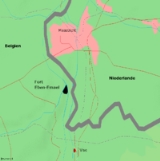
Eben-Emael was a Belgian
Belgium

* A small German-speaking Community of Belgium exists in eastern Wallonia. Belgium's linguistic diversity and related political and cultural conflicts are reflected in the history of Belgium and a complex Communities and regions of Belgium....
 fortress between Liège
Liège (city)

Li?ge is a major Walloon Region city and Municipalities in Belgium in Belgium located in the Provinces of Belgium of Li?ge , of which it is the administrative capital....
 and Maastricht
Maastricht

Maastricht is a city and a municipality in the Netherlands province of Limburg , of which it is the Capital . The city is situated on both sides of the Meuse River river in the south-eastern part of the Netherlands, near the Belgium and Germany borders....
, near the Albert Canal
Albert Canal

The Albert Canal is a canal located in northeastern Belgium, named after Albert I of Belgium. It connects the major cities Antwerp and Li?ge and the Meuse River and Scheldt rivers....
, defending the Belgian-German border. Constructed in 1931–1935, it was reputed to be impregnable. But on 10 May 1940, 78 paratroopers
Fallschirmjäger

File:Bundesarchiv Bild 101I-527-2348-21, Kreta, Fallschirmj?ger vor Start mit Ju 52.jpg are Germany paratroopers. Fallschirmj?ger of Germany in World War II were the first to be committed in large-scale airborne operations....
 of the German 7th Flieger (later 1st Fallschirmjäger Division) landed on the fortress with gliders
Military glider

Military gliders have been used by the military of various countries for carrying troops and heavy equipment to a combat zone, mainly during the World War II....
 (type DFS 230
DFS 230

The DFS 230 was a Germany Military gliders operated by the Luftwaffe in World War II. It was developed by the...
).


Discussion
Ask a question about 'Fort Eben-Emael'
Start a new discussion about 'Fort Eben-Emael'
Answer questions from other users
Full Discussion Forum


Recent Posts


Encyclopedia


Eben Emael
Eben-Emael was a Belgian
Belgium

* A small German-speaking Community of Belgium exists in eastern Wallonia. Belgium's linguistic diversity and related political and cultural conflicts are reflected in the history of Belgium and a complex Communities and regions of Belgium....
 fortress between Liège
Liège (city)

Li?ge is a major Walloon Region city and Municipalities in Belgium in Belgium located in the Provinces of Belgium of Li?ge , of which it is the administrative capital....
 and Maastricht
Maastricht

Maastricht is a city and a municipality in the Netherlands province of Limburg , of which it is the Capital . The city is situated on both sides of the Meuse River river in the south-eastern part of the Netherlands, near the Belgium and Germany borders....
, near the Albert Canal
Albert Canal

The Albert Canal is a canal located in northeastern Belgium, named after Albert I of Belgium. It connects the major cities Antwerp and Li?ge and the Meuse River and Scheldt rivers....
, defending the Belgian-German border. Constructed in 1931–1935, it was reputed to be impregnable. But on 10 May 1940, 78 paratroopers
Fallschirmjäger

File:Bundesarchiv Bild 101I-527-2348-21, Kreta, Fallschirmj?ger vor Start mit Ju 52.jpg are Germany paratroopers. Fallschirmj?ger of Germany in World War II were the first to be committed in large-scale airborne operations....
 of the German 7th Flieger (later 1st Fallschirmjäger Division) landed on the fortress with gliders
Military glider

Military gliders have been used by the military of various countries for carrying troops and heavy equipment to a combat zone, mainly during the World War II....
 (type DFS 230
DFS 230

The DFS 230 was a Germany Military gliders operated by the Luftwaffe in World War II. It was developed by the...
). One day later, they were reinforced by the German 151st Infantry Regiment. At 13:30 h on 11 May, the fortress surrendered. 1200 Belgian soldiers were captured.

Eben-Emael, an underground fort, was Belgium
Belgium

* A small German-speaking Community of Belgium exists in eastern Wallonia. Belgium's linguistic diversity and related political and cultural conflicts are reflected in the history of Belgium and a complex Communities and regions of Belgium....
's hope to defend its eastern borders from invasion, charged with defending or destroying three key bridge
Bridge

A bridge is a structure built to span a gorge, valley, road, Rail tracks, river, body of water, or any other physical obstacle, for the purpose of providing passage over the obstacle....
s. It also gave protection to the south of what was called the Gap of Vise. A fortress to protect this approach to Liège had been conceived in the latter 19th century, but only became politically convincing after the Albert Canal was dug (to provide a route for Belgian river transport that did not require entering Dutch territory). Thus the fortress was only completed in 1935, being sited between the river and the canal that bypassed it. With its steel and concrete cupola
Cupola

File:Faneuil Hall Boston Massachusetts.JPGIn architecture, a cupola is a small, most-often dome-like structure, on top of a building. Often used to provide a lookout or to admit light and air, it usually crowns a larger roof or dome....
s, Fort Eben-Emael was thought to be impenetrable.

However, the Germans had planned the capture of the fort well in advance. In preparation they had practiced assaulting a full-scale mock up of the fort's exterior in occupied Czechoslovakia
Czechoslovakia

Czechoslovakia was a sovereign state in Central Europe that existed from October 1918 until 1992 . On January 1, 1993, Czechoslovakia dissolution of Czechoslovakia into the Czech Republic and Slovakia....
 using the recently built and captured Beneš Wall
Czechoslovak border fortifications

The Czechoslovak government built a system of border fortifications from 1935 to 1938 as defensive countermeasure against the rising threat of Nazi Germany that later materialized in the German offensive plan called Fall Gr?n....
 that was modeled to a large degree on the western designs. Adolf Hitler
Adolf Hitler

Adolf Hitler was an Austrian-born Germany politician and the leader of the National Socialist German Workers Party , popularly known as the Nazi Party....
 himself conceived of a plan to take over the fort by getting men on the fort by using gliders (it would have been difficult and messy to parachute a large number of men into the small area) and utilizing the new top secret shaped charge
Shaped charge

A shaped charge is an explosive charge shaped to focus the effect of the explosive's energy. Various types are used to cut and form metal, initiate nuclear weapons, and penetrate armour....
 (also called "hollow charge") bombs to penetrate the cupolas.

Good espionage
Espionage

Espionage or spying involves an individual obtaining information that is considered secrecy or confidential without the permission of the holder of the information....
 and superior planning, combined with unpreparedness on the Belgian side, helped make the May 10 1940 execution of Hitler's top secret plan a swift and overwhelming success. The capture of Eben-Emael involved the first utilization of gliders for the initial attack and the first use of hollow charge devices in war. The gliders led by First Lieutenant Rudolf Witzig
Rudolf Witzig

Rudolf Witzig was a highly decorated German Fallschirmj?ger and Oberst in the Bundeswehr. He is most well known for his action against the Belgian fortress Fort Eben-Emael....
 landed on the "roof" of the fortress. There they were able to use the hollow charges to destroy or disable the gun cupolas. They also used a flamethrower against machine guns. The Belgians did destroy one of the key bridges, preventing it from being used by the Germans
Germany

Germany , officially the Federal Republic of Germany , is a country in Central Europe. It is bordered to the north by the North Sea, Denmark, and the Baltic Sea; to the east by Poland and the Czech Republic; to the south by Austria and Switzerland; and to the west by France, Luxembourg, Belgium, and the Netherlands....
 but also preventing a relieving force from aiding the fortress.

After its capture, the fort was evaluated for use as an underground factory for the V-1 rocket, but production was never undertaken.

Fort Eben-Emael is now open for the public to visit.

See also

  • Czechoslovak border fortifications
    Czechoslovak border fortifications

    The Czechoslovak government built a system of border fortifications from 1935 to 1938 as defensive countermeasure against the rising threat of Nazi Germany that later materialized in the German offensive plan called Fall Gr?n....
  • Maginot Line
    Maginot Line

    The Maginot Line , named after French Minister of Defence Andr? Maginot, was a line of concrete fortifications, tank obstacles, artillery casemates, machine gun posts, and other defenses, which France constructed along its borders with Germany and Italy, in the light of experience from World War I, and in the run-up to World War II....
  • Battle of Fort Eben-Emael
    Battle of Fort Eben-Emael

    The Battle of Fort Eben-Emael was a battle between Belgian and German forces that took place between 10 May and 11 May, 1940, and was part of the Battle of the Netherlands during Battle of France, the German invasion of the Low Countries and France....


External links

  • Infantry Magazine, March-April, 2004 by Paul Witkowski