
Home      Discussion      Topics      Dictionary      Almanac
Signup       Login
Battle of Khe Sanh

Battle of Khe Sanh

Overview
The Battle of Khe Sanh was conducted in northwestern Quang Tri Province
Quang Tri Province
Quảng Trị is a province on the North Central Coast of Vietnam, north of the former imperial capital of Huế.-Geography:Located in North Central Vietnam, Quang Tri Province is surrounded by Quang Binh Province on the north, Thua Thien-Hue Province on the south, Savannakhet Province of Laos on the...

, Republic of Vietnam
South Vietnam
South Vietnam was a state which governed southern Vietnam until 1975. It received international recognition in 1950 as the "State of Vietnam" and later as the "Republic of Vietnam" . Its capital was Saigon...

 (South Vietnam), between 21 January and 9 July 1968 during the Vietnam War
Vietnam War
The Vietnam War was a Cold War-era military conflict that occurred in Vietnam, Laos, and Cambodia from 1 November 1955 to the fall of Saigon on 30 April 1975. This war followed the First Indochina War and was fought between North Vietnam, supported by its communist allies, and the government of...

. The combatants were elements of the United States (U.S.) III Marine Amphibious Force (III MAF), elements of the South Vietnam
South Vietnam
South Vietnam was a state which governed southern Vietnam until 1975. It received international recognition in 1950 as the "State of Vietnam" and later as the "Republic of Vietnam" . Its capital was Saigon...

ese Army of the Republic of Vietnam
Army of the Republic of Vietnam
The Army of the Republic of Viet Nam , sometimes parsimoniously referred to as the South Vietnamese Army , was the land-based military forces of the Republic of Vietnam , which existed from October 26, 1955 until the fall of Saigon on April 30, 1975...

 (ARVN) and two to three division-size elements of the People's Army of Vietnam (PAVN). The American command in South Vietnam gave the defense of the base the nickname (Operation Scotland).
Discussion
Ask a question about 'Battle of Khe Sanh'
Start a new discussion about 'Battle of Khe Sanh'
Answer questions from other users
Full Discussion Forum
 
Unanswered Questions
Encyclopedia
The Battle of Khe Sanh was conducted in northwestern Quang Tri Province
Quang Tri Province
Quảng Trị is a province on the North Central Coast of Vietnam, north of the former imperial capital of Huế.-Geography:Located in North Central Vietnam, Quang Tri Province is surrounded by Quang Binh Province on the north, Thua Thien-Hue Province on the south, Savannakhet Province of Laos on the...

, Republic of Vietnam
South Vietnam
South Vietnam was a state which governed southern Vietnam until 1975. It received international recognition in 1950 as the "State of Vietnam" and later as the "Republic of Vietnam" . Its capital was Saigon...

 (South Vietnam), between 21 January and 9 July 1968 during the Vietnam War
Vietnam War
The Vietnam War was a Cold War-era military conflict that occurred in Vietnam, Laos, and Cambodia from 1 November 1955 to the fall of Saigon on 30 April 1975. This war followed the First Indochina War and was fought between North Vietnam, supported by its communist allies, and the government of...

. The combatants were elements of the United States (U.S.) III Marine Amphibious Force (III MAF), elements of the South Vietnam
South Vietnam
South Vietnam was a state which governed southern Vietnam until 1975. It received international recognition in 1950 as the "State of Vietnam" and later as the "Republic of Vietnam" . Its capital was Saigon...

ese Army of the Republic of Vietnam
Army of the Republic of Vietnam
The Army of the Republic of Viet Nam , sometimes parsimoniously referred to as the South Vietnamese Army , was the land-based military forces of the Republic of Vietnam , which existed from October 26, 1955 until the fall of Saigon on April 30, 1975...

 (ARVN) and two to three division-size elements of the People's Army of Vietnam (PAVN). The American command in South Vietnam gave the defense of the base the nickname (Operation Scotland).

The American command in Saigon initially believed that combat operations around Khe Sanh
Khe Sanh
Khe Sanh is the district capital of Hướng Hoá District, Quảng Trị Province, Vietnam, located 63 km west of Đông Hà.Khe Sanh Combat Base was a United States Marine Corps outpost in South Vietnam used during the Vietnam War. The airstrip was built in September 1962...

 during the summer of 1967 were just part of a series of minor North Vietnamese offensives in the border regions. That appraisal was altered when it was discovered that PAVN was moving major forces into the area during the fall and winter. A build-up of Marine forces took place and actions around Khe Sanh commenced when the Marine base was isolated. During a series of desperate actions that lasted 77 days, Khe Sanh Combat Base (KSCB) and the hilltop outposts around it were under constant North Vietnamese ground, artillery
Artillery
Originally applied to any group of infantry primarily armed with projectile weapons, artillery has over time become limited in meaning to refer only to those engines of war that operate by projection of munitions far beyond the range of effect of personal weapons...

, mortar, and rocket attacks.

During the battle a massive aerial bombardment campaign (Operation Niagara
Operation Niagara
Operation Niagara was a U.S. Seventh Air Force close air support campaign carried out from January through March 1968, during the Vietnam War. Its purpose was to serve as an aerial umbrella for the defense of the U.S. Marine Corps Combat Base on the Khe Sanh Plateau, in western Quang Tri Province...

) was launched by the U.S. Air Force
United States Air Force
The United States Air Force is the aerial warfare service branch of the United States Armed Forces and one of the American uniformed services. Initially part of the United States Army, the USAF was formed as a separate branch of the military on September 18, 1947 under the National Security Act of...

 to support the Marine base. This campaign used the latest technological advances in order to locate PAVN forces for targeting. The logistical effort to support KSCB, once it was isolated overland, demanded the implementation of other tactical innovations in order to keep the Marines supplied.

In March 1968, an overland relief expedition (Operation Pegasus) was launched by a combined Marine/Army/South Vietnamese task force that eventually broke through to the Marines at Khe Sanh. The battle was a tactical victory for the Marines, although it had no clear strategic implications; some historians have observed that the PAVN frontier battles prior to the general Tet Offensive of early 1968 served to distract American and GVN attention as Viet Cong forces were assembled.

It is difficult to support the claim of an overwhelming American victory at Khe Sanh based solely on the ratios derived from the official casualty count. In fact, it is impossible to reasonably put the fighting at Khe Sanh in the American win column; neither side won a resounding victory. The PAVN surrounded Khe Sanh in an attempt to force the Marines to break out of their fighting positions, which would make it easier to engage and destroy them. The PAVN continued shelling the base, and on July 1 launched a company-sized infantry attack against its perimeter. On July 9, 1968, PAVN's flag was set up at Ta Con [Khe Sanh] airfield. On July 13, 1968, PAVN sent a message to the soldiers of the Route 9–Khe Sanh Front affirming "our victory at Khe Sanh". It was the only time Americans abandoned a major combat base because of enemy pressure.

The camp


The village of Khe Sanh was the seat of government of Huong Hoa district, an area of Bru Montagnard
Degar
The Degar are the indigenous peoples of the Central Highlands of Vietnam. The term Montagnard means "mountain people" in French and is a carryover from the French colonial period in Vietnam. In Vietnamese, they are known by the term thượng - this term can also be applied to other minority ethnic...

 villages and coffee plantations, situated about seven miles from the Laotian frontier on Route 9
National Road 9 (Vietnam)
National Route 9 runs across Vietnam roughly in line with the 17th Parallel. The route includes two segments. The segment called National Route 9A begins at Dong Ha and ends at Lao Bảo on the Vietnam-Laos border and is entirely within Quang Tri Province...

, the northernmost transverse road in South Vietnam. The badly deteriorated Route 9 ran from the coastal region, through the western highlands, and then crossed the border into Laos
Laos
Laos Lao: ສາທາລະນະລັດ ປະຊາທິປະໄຕ ປະຊາຊົນລາວ Sathalanalat Paxathipatai Paxaxon Lao, officially the Lao People's Democratic Republic, is a landlocked country in Southeast Asia, bordered by Burma and China to the northwest, Vietnam to the east, Cambodia to the south and Thailand to the west...

. The origin of the combat base lay in the construction by U.S. Army Special Forces
United States Army Special Forces
The United States Army Special Forces, also known as the Green Berets because of their distinctive service headgear, are a special operations force tasked with six primary missions: unconventional warfare, foreign internal defense, special reconnaissance, direct action, hostage rescue, and...

 of an airfield in August 1962 outside the village at an old French fort. The camp then became a Special Forces outpost of the Civilian Irregular Defense Group
Civilian Irregular Defense Group
Civilian Irregular Defense Group program was a program developed by the U.S. government in the Vietnam War to develop South Vietnamese irregular military units from minority populations.-Purpose:...

s (CIDG), whose purpose was to keep watch on PAVN infiltration along the border and to protect the local population. In November 1964 the Green Berets moved their camp to the Xom Cham Plateau, the future site of KSCB.

During the winter of 1964, Khe Sanh became the location of a launch site for the highly-classified Military Assistance Command, Vietnam
Military Assistance Command, Vietnam
The U.S. Military Assistance Command, Vietnam, MACV, , was the United States' unified command structure for all of its military forces in South Vietnam during the Vietnam War.-History:...

 Studies and Observations Group or SOG (the site was first established near the village and was later moved to the French fort). From there, reconnaissance teams were launched into Laos
Laos
Laos Lao: ສາທາລະນະລັດ ປະຊາທິປະໄຕ ປະຊາຊົນລາວ Sathalanalat Paxathipatai Paxaxon Lao, officially the Lao People's Democratic Republic, is a landlocked country in Southeast Asia, bordered by Burma and China to the northwest, Vietnam to the east, Cambodia to the south and Thailand to the west...

 to explore and gather intelligence on the PAVN logistical system known as the Ho Chi Minh Trail
Ho Chi Minh trail
The Ho Chi Minh trail was a logistical system that ran from the Democratic Republic of Vietnam to the Republic of Vietnam through the neighboring kingdoms of Laos and Cambodia...

 (the Truong Son Strategic Supply Route to the North Vietnamese).

The plateau camp was permanently manned by the U.S. Marines during 1967, when they established an outpost next to the airstrip. This base was to serve as the western anchor of Marine Corps forces, which had tactical responsibility for the five northernmost provinces of South Vietnam known as I Corps
I Corps (South Vietnam)
The I Corps Tactical Zone was a corps of the Army of the Republic of Vietnam , the army of the nation state of South Vietnam that existed from 1955 to 1975. It was one of four corps which the ARVN oversaw. This was the northernmost region of South Vietnam, bordering North Vietnam...

. The Marines' defensive system stretched below the Demilitarized Zone
Vietnamese Demilitarized Zone
The Vietnamese Demilitarized Zone was established as a dividing line between North and South Vietnam as a result of the First Indochina War.During the Second Indochina War , it became important as the battleground demarcation separating North Vietnamese territory from South Vietnamese territory.-...

 (DMZ) from the coast, along Route 9, to Khe Sanh. During 1966 the regular Special Forces troops had moved off the plateau and built a smaller camp down Route 9 at Lang Vei, about half the distance to the Laotian border.

Border battles


During the second half of 1967, the North Vietnamese instigated a series of actions in the border regions of South Vietnam. All of these attacks were conducted by regimental-size PAVN/National Front for the Liberation of South Vietnam
National Front for the Liberation of South Vietnam
The Vietcong , or National Liberation Front , was a political organization and army in South Vietnam and Cambodia that fought the United States and South Vietnamese governments during the Vietnam War . It had both guerrilla and regular army units, as well as a network of cadres who organized...

 (NLF, or Viet Cong) units, but unlike the usual hit-and-run tactics used by communist forces, these were sustained and bloody affairs.

In early October, PAVN intensified battalion-size ground probes and sustained artillery fire against Con Thien
Con Thien
Con Thien , was a United States Marine Corps combat base located near the Vietnamese Demilitarized Zone about 3 km from North Vietnam...

, a hilltop stronghold in the center of the Marine's defensive line south of the DMZ in northern Quang Tri Province. Mortar rounds, artillery shells, and 122mm rockets fell randomly, but incessantly upon the base. The September bombardments ranged from 100 to 150 rounds per day, with a maximum on 25 September of 1,190 rounds. The American commander in Vietnam, General William C. Westmoreland responded by launching Operation Neutralize, an aerial and naval bombardment campaign designed to break the siege. For seven weeks, American aircraft delivered from 35,000 to 40,000 tons of bombs in nearly 4,000 airstrikes.
On 27 October, a PAVN regiment attacked an Army of the Republic of Vietnam
Army of the Republic of Vietnam
The Army of the Republic of Viet Nam , sometimes parsimoniously referred to as the South Vietnamese Army , was the land-based military forces of the Republic of Vietnam , which existed from October 26, 1955 until the fall of Saigon on April 30, 1975...

 (ARVN) battalion at Song Be, capital of Phuoc Long Province. The North Vietnamese fought for several days, took casualties, and fell back. Two days later, the 273rd NLF Regiment attacked a Special Forces camp near the border town of Loc Ninh, in Binh Long Province. Troops of the U.S. 1st Infantry Division were able to respond quickly. After a ten-day battle, the attackers were pushed back into Cambodia
Cambodia
Cambodia , officially known as the Kingdom of Cambodia, is a country located in the southern portion of the Indochina Peninsula in Southeast Asia...

. At least 852 North Vietnamese soldiers were killed during the action, as opposed to 50 American and South Vietnamese dead.

The heaviest action took place near Dak To
Dak To
Đắk Tô is a village in the Central Highlands of Vietnam and in the so-called "tri-border" area where the borders of Vietnam, Laos, and Cambodia all come together. Located just north of the Vietnamese town of Tan Canh , Dak To is populated by a Montagnard tribal people known as the Degar...

, in the central highlands province of Kontum. There, the presence of the 1st PAVN Division prompted a 22-day battle that saw some of the most intense close-quarters fighting of the entire conflict. Somewhere between 1,200 and 1,600 North Vietnamese troops were killed while 362 members of the U.S. 4th Infantry Division, the 173rd Airborne Brigade, and ARVN Airborne elements were killed in action. Ominously, three of the four battalions of the 4th Infantry and the entire 173rd were rendered combat ineffective during the battle.

American intelligence analysts were quite baffled by this series of enemy actions. There appeared to be no logic behind the sustained PAVN/NLF offensives, other than to inflict casualties on the allied forces. This they accomplished, but the casualties absorbed by the North Vietnamese seemed to negate any direct gains they might have obtained. The border battles did, however, have two significant consequences that were unappreciated at the time—they fixed the attention of the American command on the border regions and they drew American and ARVN forces away from the coastal lowlands and cities.

Hill fights


Things remained quiet in the Khe Sanh area through 1966. Even so, General Westmoreland insisted that it not only be occupied by the Marines, but that it be reinforced. He was vociferously opposed by General Lewis W. Walt, the Marine commander of I Corps. Walt argued heatedly that the real target of the American effort should be the pacification and protection of the population, not chasing PAVN and the NLF in the hinterlands. Westmoreland won out, however, and the 1st Battalion, 3rd Marine Regiment (1/3) was dispatched to occupy the camp and airstrip on 29 September. By late January 1967, 1/3 was relieved by Bravo Company, 1st Battalion, 9th Marines
1st Battalion 9th Marines
The 1st Battalion 9th Marines is an infantry battalion of the United States Marine Corps. Formed during World War I, it served until the mid-1990s when it was deactivated to make room for one of three light armor reconnaissance battalions...

 (1/9). A single company was replacing an entire battalion. One of the mysteries surrounding the Battle of Khe Sanh was why, after running roughshod over the Marines concerning the defense of the base at Khe Sanh, Westmoreland allowed the drawdown.


On 24 April 1967, a patrol from Bravo Company became engaged with a PAVN force of unknown size north of Hill 861. This action prematurely triggered a North Vietnamese offensive aimed at taking Khe Sanh. The PAVN forces were in the process of gaining elevated terrain before the launching of the main attack. The 2nd
2nd Battalion 3rd Marines
2nd Battalion, 3rd Marines is an infantry battalion in the United States Marine Corps based out of Marine Corps Base Hawaii consisting of approximately 1000 Marines and sailors...

 and 3rd Battalions
3rd Battalion 3rd Marines
3rd Battalion 3rd Marines or ' is an infantry battalion in the United States Marine Corps, based out of Kāne'ohe, Hawai'i, and consisting of approximately 800 Marines and sailors.The United States Marine Corps is a part of the Department of the Navy. Traditionally, the Navy has supplied it with...

 of the 3rd Marine Regiment, under the command of Colonel John P. Lanigan, reinforced KSCB (Khe Sanh Combat Base) and were given the task of pushing the North Vietnamese off of Hills 861, 881 North, and 881 South. North Vietnamese forces were driven out of the area around Khe Sanh after suffering 940 casualties. The Marines suffered 155 killed in action and 425 wounded. In order to prevent PAVN observation of the main base at the airfield (and their possible use as firebases), the hills of the surrounding Khe Sanh Valley had to be continuously occupied and defended by separate Marine elements, thereby spreading out the defense.

In the wake of the hill fights there was a lull in PAVN activity around Khe Sanh. By the end of May, Marine forces were again drawn down from two battalions to one, the 1st Battalion 26th Marines. Lieutenant General Robert E. Cushman, Jr.
Robert E. Cushman, Jr.
General Robert Everton Cushman, Jr. served as the 25th Commandant of the Marine Corps from January 1, 1972 to June 30, 1975. He was honored for heroism in battle during World War II at the battles of Guam , Bougainville and Iwo Jima . He also commanded all Marine forces in Vietnam from June -...

 relieved General Walt as commander of III MAF in June.

However, at 0830 on 27 June, 1967, The Marines of Oscar Company, 3rd Platoon, part of the Combined Action Program
Combined action program
Drawing from previous experience in "small wars", the United States Marine Corps operated the Combined Action Program during the Vietnam War, from 1965 to 1971. "The Combined Action Platoon's genesis was not a deliberate plan from a higher headquarters, rather, it was a solution to one infantry...

 or CAP) was ordered by the Marine command at Khe Sanh to send a patrol to investigate suspected launch sites (spotted earlier by an aerial observer) of an NVA rocket and mortar attack on the Khe Sanh base which had occurred just after midnight of the night before. Alpha 1 / 13 (an artillery unit) and elements of 3 / 26 (including the Battalion Aid Station) had been hit hard in the attack, incurring a number of casualties. Although key Alpha 1 / 13 personnel were injured and killed, they managed to mount an effective counter-battery fire and silenced the enemy fire.

The O-3 patrol included Corporals Dennis Alfred O'Connor, James Merrill Shepard, Jr., Lance-Corporals Francisco Alberto Mazariegos, Earl Grissom, and HN Bell, the unit Hospital Corpsman (Navy medic), all of whom were from Oscar-3, and LCPL Charles Aaron Lynch of Oscar-1, who was visiting friends at O-3, as well as indigenous native counterpart troops of the local Bru ("Montagnard") tribe of Popular Force militia.

According to Lance-Corporal Earl Grissom (the only located survivor of the patrol), the CAP personnel uniformly thought this was a bad idea, as the hill was obviously not secured, and indeed was being heavily bombed and strafed by US aircraft at the time they approached its base. However, they obeyed orders, and contacted the FAC who reluctantly called off the attacks.

They reached the top of Hill 689, and discovered "spider traps" (concealed covered fighting positions), and found a large cache of arms. Shortly after, the enemy opened fire with a machine gun, instantly killing the point man (CPL O'Connor), and mortally wounding CPL Shepard.

Lance-Corporal Earl Grissom dove into a nearby bomb crater and took cover, then crawled up to the top of the crater and did what he could with his M-79. He was often firing almost straight up, because the enemy was so close.

Grissom saw Lance-Corporal Mazariegos fighting his way back (in Grissom's words "like John Wayne) and taking out several enemy soldiers before he got to the slight shelter of the crater. Grissom stated that Mazariegos displayed great courage in his fighting retreat. However, Mazariegos was shot in the head a short time later, during his second look over the top to attempt to spot the enemy's position and movements. He died instantly.

After Mazariegos had been hit, the Navy Corpsman came over under fire to try to render aid, despite Grissom telling him that Mazariegos was dead. He also stated that CPL Shepard was lying beside the crater rather than in it. The corpsman rendered first aid to the mortally wounded Shepard, and assisted Grissom in hauling him down the hill. However, despite their gallant efforts, Corporal Shepard died after a hundred yards. They had to leave his body, because the firefight was still intense.

Meanwhile, two other Marines (whose names are unfortunately not available) had survived from the back of the patrol. Although the other CAPs mounted a hasty relief effort, they quickly found the hill was heavily defended by a strong, well-entrenched and armed enemy force (that was later determined to have been a battalion), and were also ejected from the hill without recovering the bodies of their comrades, and one man then believed to be MIA.

Meanwhile, India 3/26, commanded by Captain M. E. Coulter, was returning to KSCB from a patrol, when it was ordered instead to Hill 689 to assist the CAP patrol. It was later joined by Lima 3/26, elements of which had been air-lifted in by chopper.

Nonetheless, these two well-equipped and manned seasoned line infantry companies with supporting arms capabilities, incurred heavy casualties KIA and WIA from the well-entrenched enemy forces (later estimated at two reinforced NVA companies). These losses included two officers and a SNCO KIA at the hill fight, and other casualties at the unit HQ at KSCB from incoming mortar fire.

At the end of the fighting, CAP O-3 had suffered 4 KIA, and 3/26 had lost 14. In addition, one of the 26th Marines WIA (LCPL Charles M. Gattis died of wounds on July 5th, raising the KIA toll to 19.

According to the 3/26 Command Chronology, the enemy had sustained an estimated 91 KIAs.

(The information above is based on first-hand reports of the action by participants from Oscar Company, and India and Lima 3/26, including Lieutenant-Colonel [then 2nd Lt.] C. T. ("Tony") Anthony, USMC (Ret.), then leader of 2nd Platoon, India 3/26, and 2nd Lt. Frank McCarthy, leader of 3rd platoon, Lima Company 3/26, and others from those units, and material given in LCDR Ray W. Stubbe's "Battalion of Kings" 2nd ed. pp. 85-88.)

On 14 August, Colonel David E. Lownds took over as commander of the 26th Marine Regiment. There were sporadic actions in the vicinity during the late summer and early fall, the most serious of which was the ambush of a supply convoy on Route 9. This proved to be the last overland attempt at resupply for Khe Sanh until the following March. During December and early January there were numerous sightings of PAVN troops and activities in the Khe Sanh area, but the sector remained relatively quiet.

Decisions


A decision then had to be made by the American high command: either commit more of the limited manpower in I Corps to the defense of Khe Sanh or abandon the base. General Westmoreland regarded this choice as quite simple. In his memoirs he listed the reasons for a continued effort:
"Khe Sanh could serve as a patrol base for blocking enemy infiltration from Laos along Route 9; as a base for SOG operations to harass the enemy in Laos; as an airstrip for reconnaissance planes surveying the Ho Chi Minh Trail; as the western anchor for defenses south of the DMZ; and as an eventual jump-off point for ground operations to cut the Ho Chi Minh Trail."


Leading Marine officers, however, were not all of the same opinion. General Cushman, the new III MAF commander, supported Westmoreland (perhaps wanting to mend Army/Marine relations after the departure of Walt). Arguments offered by other Marine officers against remaining included: that the real danger to I Corps was from a direct threat to Quang Tri City and other urban areas; that a defense would be pointless as a threat to infiltration, since PAVN troops could easily bypass Khe Sanh; that the base was too isolated and that the Marines "had neither the helicopter resources, the troops, nor the logistical bases for such operations … The weather was another critical factor because of the poor visibility and low overcasts attendant to the monsoon season made such operations hazardous to say the least." Brigadier General Lowell English (assistant commander 3rd Marine Division) complained that the defense of the isolated outpost was ludicrous. "When you're at Khe Sanh, you're not really anywhere. You could lose it and you really haven't lost a damn thing."

As far as Westmoreland was concerned, however, all he needed to know was that PAVN had massed large numbers of troops for a set-piece battle. Making the prospect even more enticing was that the Combat Base was in an unpopulated area where American firepower could be fully brought to bear without having to worry about civilian casualties. The opportunity to engage and destroy a formerly elusive enemy that was moving toward a fixed position promised a victory of unprecedented proportions.

Battle is joined


Marine intelligence confirmed that, within a period of just over a week, the 325th PAVN Division had moved into the vicinity of the base and two more divisions were within supporting distance. The 324th Division was located in the DMZ area 10–15 miles north of Khe Sanh while the 320th Division was within easy reinforcing distance to the northeast. They were supported logistically from the nearby Ho Chi Minh Trail. As a result of this intelligence, KSCB was reinforced on 13 December by the 1st Battalion, 9th Marine Regiment
1st Battalion 9th Marines
The 1st Battalion 9th Marines is an infantry battalion of the United States Marine Corps. Formed during World War I, it served until the mid-1990s when it was deactivated to make room for one of three light armor reconnaissance battalions...

.

At positions west of Hill 881 South and north of Co Roc Ridge, across the border in Laos, the North Vietnamese established artillery, rocket, and mortar positions from which to launch attacks by fire on the base and to support its ground operations. They were assisted in their emplacement efforts by the continuing bad weather of the winter monsoon.

During the rainy night of 2 January 1968, six men dressed in black uniforms were seen outside the defensive wire of the main base by members of a listening post. After failing to respond to a challenge, they were fired upon and five were killed outright while the sixth, although wounded, escaped. This event prompted General Cushman to reinforce Colonel Lownds with the rest of the 2nd Battalion, 26th Marines. This marked the first time that all three battalions of the 26th Marine Regiment had operated together in combat since the invasion of Iwo Jima
Battle of Iwo Jima
The Battle of Iwo Jima , or Operation Detachment, was a major battle in which the United States fought for and captured the island of Iwo Jima from the Empire of Japan. The U.S...

 during the Second World War. In order to cover a defilade near the Rao Quan River, Foxtrot, Golf, Hotel and H&S Companies of 2/26 was immediately sent out to occupy Hill 558, with Echo Company 2/26 manning hill 861A.

On 20 January, La Thanh Ton, a PAVN lieutenant of the 14th Anti-Aircraft Company, 325th Division, defected at the base and laid out the plans for an entire series of North Vietnamese attacks. Hills 881 South, 861, and the main base itself would be simultaneously attacked that same evening. At 00:30 on 21 January, Hill 861 was attacked by approximately 300 North Vietnamese troops. The Marines, however, were prepared. The North Vietnamese infantry, though bracketed by artillery fire, still managed to penetrate the perimeter of the defenses and were only driven back after severe close-quarters combat.

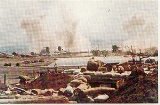
The main base was then subjected to an intense mortar and rocket barrage. Hundreds of mortar rounds and 122mm rockets slammed into the base, leveling most of the above-ground structures. One of the first enemy shells set off an explosion in the main ammunition dump. Many of the artillery and mortar rounds stored in the dump were thrown into the air and detonated on impact within the base. Soon after another shell hit a cache of CS tear gas, which saturated the entire area. Hours after the bombardment ceased, the base was still in danger. At around 10:00, the fire ignited a large quantity of C-4
C-4 (explosive)
C4 or Composition C4 is a common variety of the plastic explosive known as Composition C.-Composition and manufacture:C4 is made up of explosives, plastic binder, plasticizer and usually marker or odorizing taggant chemicals such as 2,3-dimethyl-2,3-dinitrobutane to help detect the explosive and...

 and other explosives, rocking the base with another series of detonations. PAVN forces, however, did not use the opportunity to launch a ground attack.


Simultaneous with the bombardment at KSCB was an attack launched against the Huong Hoa District headquarters. There, elements of the 66th Regiment, 304th PAVN Division were opposed by indigenous Bru ("Montagnard") of the 915th South Vietnamese Regional Forces (RF) troops led by CPT Nhi, the District Chief, with the US Army Advisory Team, led by US Army captain Bruce B. G. Clarke. The Marines of Oscar Company, part of the Combined Action Program
Combined action program
Drawing from previous experience in "small wars", the United States Marine Corps operated the Combined Action Program during the Vietnam War, from 1965 to 1971. "The Combined Action Platoon's genesis was not a deliberate plan from a higher headquarters, rather, it was a solution to one infantry...

 or CAP, provided the main American presence in the lines.

Oscar Company was nominally commanded by Lieutenant Thomas Stamper, a "mustanger" (former enlisted) officer, assisted by Staff Sergeant Robert Boyda, (acting as Company Gunnery Sergeant). However, the air and artillery support was called in and coordinated by Army captain Bruce B. G. Clarke, who was both the senior U.S. Army District advisor for Huong Hoa and a trained West Point graduate, and thus best-qualified for that work. The defense of the lines of O-1 was coordinated and led by Sergeant John Balanco, whose bravery during the action earned him the Silver Star medal. Balanco was all over the camp, carrying ammunition and boosting morale, as well as fighting. Sergeant Balanco moved Lance-Corporals Howard McKinnis and C. E. ("Butch") Still to stiffen the lines of 915th on the beleaguered south-west side of the camp. His Silver Star citation reads in part;

“Disregarding his own safety, Sergeant Balanco fearlessly maneuvered about the fire-swept terrain from one position to another directing the fire of his men. Repeatedly exposing himself to the hostile fire, he rapidly redistributed ammunition and ensured that each sector of the perimeter was effectively coordinated into the defense of the position. Continuing his determined efforts for thirty-six hours, he aggressively directed his men in repulsing the enemy attack until the North Vietnamese soldiers were forced to withdraw. His heroic actions and bold leadership inspired all who observed him and were instrumental in his unit accounting for over forty enemy killed and numerous weapons captured.”

Another Silver Star was awarded to Corporal Verner R. Russell for his valiant use of his machine gun in countering the NVA's heavy assault in the northeast corner. He and his Bru assistant gunner killed many of the enemy, some of whom were within 30 feet of their position. According to Sergeant Balanco's account of the action, "NVA bodies were strewn like match-sticks all around his sector."

Balanco also mentioned Corporals Lou Loshelder and Stanley J. Dilley, Lance-Corporals Richard E. Dahler, Ulysses Reyes, Jose Ramos, Antonio Vera, Louis C. Whiting and William A. Breedlove, all of CAP 0-1 who "courageously defended the north and west sectors of the camp near the vulnerable main entrance.

SFC Jim Perry, the Army Advisory team medic, led the Vietnamese medics and nurses in a cool and competent manner, treating the wounded although under heavy fire. (SFC Perry was later awarded a Bronze Star with V [upgraded years later to a Silver Star] for his role in the defense.

Another CAP Oscar platoon, O-2, commanded by SGT Roy Harper, stationed at the west end of Khe Sanh village on the North side of Route 9, was hit simultaneously. They fought off the enemy, and later joined the O-1 Marines at the District HQ. (Oscar-3, the CAP team nearest the Combat Base, were on alert, but were not attacked, presumably because the enemy was concentrating his forces on O-1 which defended the politically important District HQ.) The forces managed to hold out until the morning of the 22nd, when helicopters were sent in for their extraction. The Marine CAP men and the Army advisors were stunned to learn that "no RFs or Bru with their weapons would be allowed on the helos to return to the Combat Base." The Army captain, Bruce B. G. Clarke, and one of his SNCOs, SFC King, refused evacuation under such restraints and marched their men to the SOG compound, FOB 3 (located next to the Combat Base) by way of a hidden trail. Captain Clarke later received the Bronze Star Medal w/ V for his actions. The Special Forces of FOB 3 also used Bru (Montagnard) troops in their CIDG (Civilian Irregular Defense Group) program, and were happy to have the Bru. They also accepted the Marines of CAP Oscar who helped man their lines and run patrols and activities throughout the Siege.

This attack revealed that the 304th PAVN Division had just arrived from North Vietnam with all three of its regiments, the 9th, 24th, 66th, the 68B Artillery Regiment, and the 14th Anti-Aircraft Battalion. Attached in support was the 24th Artillery Battalion. The division took up positions southwest of the Combat Base. There has been a significant discrepancy, however, as to what infantry units of the 325th Division remained in the Khe Sanh sector. An ARVN document study conducted after the battle concluded that only one regiment, 95C, remained at Khe Sanh. According to the study, two regiments of other divisions held blocking positions on Route 9 east of the base. They were the 31st Regiment of the 341st Division and possibly a regiment of the 324th Division. Two battalions of the 3rd Regiment later moved south to Hue to participate in the battle for that city during the latter stages of the Tet Offensive.

To eliminate any threat to their flank, the North Vietnamese made the decision to attack Laotian Battalion BV-33, located at Ban Houei Sane, on Route 9 in Laos. The battalion was assaulted on the night of 23 January by three PAVN battalions supported by seven tanks. The Laotians were overrun, and many fled to the Special Forces camp at Lang Vei. This action in Laos, not the attack three weeks later at Lang Vei, marked the first time that the North Vietnamese had committed an armored unit to battle.

Due to the arrival of the 304th Division, KSCB was further reinforced by the 1st Battalion, 9th Marine Regiment on 22 January. Five days later, the final reinforcements arrived in the form of the 37th ARVN Ranger Battalion, which was deployed more for political than tactical reasons. PAVN artillery made its debut on the battlefield on 24 January, when a bombardment by 100mm and 152mm guns began with Hill 881 South, moved on to Hill 861, and then worked over the main base. The Marines and ARVN dug in and hoped that the approaching Tet truce (scheduled from 29–31 January) would provide some respite. On the afternoon of 29 January, however, the 3rd Marine Division notified Khe Sanh that the truce had been canceled. The Tet Offensive was about to begin.

Operation Niagara


During January, the recently installed electronic sensors of Operation Muscle Shoals (later renamed Igloo White), which were undergoing test and evaluation in southeastern Laos, were alerted by a flurry of PAVN activity along the Ho Chi Minh Trail opposite the northwestern corner of South Vietnam. It was due to the nature of these activities, and the threat that they posed to KSCB, that General Westmoreland ordered Operation Niagara I, an intense intelligence collection effort on PAVN activities in the vicinity of the Khe Sanh Valley.

Niagara I was completed during the third week of January, and the next phase of the operation, Niagara II was launched on the 21st, the day of the first PAVN artillery barrage. The Marine Direct Air Support Center
Direct Air Support Center
The Direct Air Support Center is the principal United States Marine Corps aviation command and control system and the air control agency responsible for the direction of air operations directly supporting ground forces...

 (DASC), located at the Combat Base, was responsible for the coordination of air strikes with artillery fire. An airborne battlefield command and control center (ABCCC), in the form of a C-130 aircraft, directed incoming strike aircraft to forward air control
Forward air control
Forward air control is the provision of guidance to Close Air Support aircraft intended to ensure that their attack hits the intended target and does not injure friendly troops. This task is carried out by a forward air controller . For NATO forces the qualifications and experience required to be...

 (FAC) spotter planes, which, in turn directed them to targets either located by themselves or radioed in by ground units. When weather conditions precluded FAC-directed strikes, the bombers were directed to their targets by either a Marine AN/TPQ-10
AN-MPQ-14
The radar designated AN/MPQ-14 is a system used for Ground Directed Bombing , where a plane is remotely piloted from the ground with radar assistance, up to and including the point of bomb release. It was the first guided weapon system used by the U.S. Marine Corps, and introduced the ability to...

 radar installation at KSCB or by Air Force Combat Skyspot MSQ-77 stations. This LORAN
LORAN
LORAN is a terrestrial radio navigation system using low frequency radio transmitters in multiple deployment to determine the location and speed of the receiver....

-based system could direct aircraft to their targets in inclement weather or in absolute darkness.
Thus began what many considered "the most concentrated application of aerial firepower in the history of warfare". On an average day 350 tactical fighter-bombers, 60 B-52s, and 30 light observation or reconnaissance aircraft operated in the skies near the base. Westmoreland had already ordered the nascent Igloo White to assist in the Marine defense. On 22 January, the first sensor drops took place and, by the end of the month, 316 acoustic and seismic sensors had been dropped in 44 strings. The sensors were implanted by a special Naval squadron, Observation Squadron Sixty-Seven, VO-67. The Marines at KSCB credited 40 percent of intelligence available to their fire support coordination center to the sensors.

By the end of the battle of Khe Sanh, U.S. Air Force assets had flown 9,691 tactical sorties and dropped 14,223 tons of bombs on targets within the Khe Sanh area. Marine Corps aviators had flown 7,098 missions and released 17,015 tons. Naval aircrews, many of whom were redirected from Operation Rolling Thunder
Operation Rolling Thunder
Operation Rolling Thunder was the title of a gradual and sustained US 2nd Air Division , US Navy, and Republic of Vietnam Air Force aerial bombardment campaign conducted against the Democratic Republic of Vietnam from 2 March 1965 until 1 November 1968, during the Vietnam War.The four objectives...

 strikes against North Vietnam, flew 5,337 sorties and dropped 7,941 tons of ordnance in the area.

Not even this amount of unleashed firepower was enough to calm the anxiety of American leaders in Washington. On 1 February General Earle G. Wheeler, chairman of the Joint Chiefs of Staff
Joint Chiefs of Staff
The Joint Chiefs of Staff is a body of senior uniformed leaders in the United States Department of Defense who advise the Secretary of Defense, the Homeland Security Council, the National Security Council and the President on military matters...

, raised the issue with Westmoreland of "whether tactical nuclear weapons should be used if the situation at Khe Sanh should become that desperate." Westmoreland replied that their use would probably not be required. He added, however, that if the situation did change dramatically, "I visualize that either tactical nuclear weapons or chemical agents would be active candidates for employment." Westmoreland then established a small study group to examine the consequences of what was nicknamed Fracture Jaw. Westmoreland later wrote that "Washington so feared that some word of it might reach the press that I was told to desist.

While battles were raging around the Combat Base, other engagements were taking place in the headquarters at Hue/Phu Bai, Saigon, and the Pentagon
The Pentagon
The Pentagon is the headquarters of the United States Department of Defense, located in Arlington County, Virginia. As a symbol of the U.S. military, "the Pentagon" is often used metonymically to refer to the Department of Defense rather than the building itself.Designed by the American architect...

. An intense interservice struggle over who should control aviation assets supporting not just Khe Sanh, but the entire American effort in Southeast Asia
Southeast Asia
Southeast Asia, South-East Asia, South East Asia or Southeastern Asia is a subregion of Asia, consisting of the countries that are geographically south of China, east of India, west of New Guinea and north of Australia. The region lies on the intersection of geological plates, with heavy seismic...

 was being waged. Westmoreland had given his deputy commander for air operations, Air Force General William W. Momyer
William W. Momyer
General William Wallace Momyer was commander of the U.S. Air Force Tactical Air Command.-Early life:Momyer was born in 1916, in Muskogee, Oklahoma, attended Broadway High School in Seattle, Washington, and graduated with a bachelor of arts degree from the University of Washington in 1937...

, the responsibility for coordinating all air assets during the operation to support KSCB. This caused problems for the Marine command, which possessed its own aviation squadrons that operated under their own close air support doctrine. The Marines were extremely reluctant to relinquish authority over their aircraft to an Air Force General.

The command and control arrangement then in place in Southeast Asia went against the grain of Air Force doctrine, which was predicated on the single air manager concept. One headquarters would allocate and coordinate all air assets, distributing them wherever they were considered most necessary, and then transferring them as the situation required. The Marines, whose aircraft and doctrine were integral to their operations, were under no such centralized control. On 19 January Westmoreland passed his request for Air Force control up the chain of command to CINCPAC
United States Pacific Command
The United States Pacific Command is a Unified Combatant Command of the United States armed forces responsible for the Pacific Ocean area. It is led by the Commander, Pacific Command , who is the supreme military authority for the various branches of the Armed Forces of the United States serving...

 in Honolulu and there it stayed.

Meanwhile, heated debate arose among Westmoreland, Commandant of the Marine Corps
Commandant of the Marine Corps
The Commandant of the Marine Corps is normally the highest ranking officer in the United States Marine Corps and is a member of the Joint Chiefs of Staff...

 Leonard F. Chapman, Jr.
Leonard F. Chapman, Jr.
Leonard Fielding Chapman, Jr. was the 24th Commandant of the Marine Corps and served in that capacity from 1968 to 1972. He was World War II combat veteran — being decorated for his actions in the Battle of Peleliu and the Battle of Okinawa. He retired from the Marine Corps after 37 years...

 and Army Chief of Staff Harold K. Johnson. Johnson backed the Marine position due to his concern over protecting the Army's air assets from Air Force co-option. Westmoreland went so far as to threaten to resign if his wishes were not obeyed. As a result, on 7 March, for the first time during the Vietnam War, air operations were placed under the control of a single manager. General Westmoreland had won this battle.

Fall of Lang Vei


The Tet Offensive was launched prematurely in some areas on 30 January. On the following night, a massive wave of PAVN/NLF attacks swept throughout South Vietnam, everywhere that is, except Khe Sanh. The launching of the largest enemy offensive thus far in the conflict did not shift Westmoreland's focus away from Khe Sanh. A press release prepared on the following day (but never issued), at the height of Tet, showed that he was not about to be distracted. "The enemy is attempting to confuse the issue …I suspect he is also trying to draw everyone's attention away from the greatest area of threat, the northern part of I Corps. Let me caution everyone not to be confused."

There had not been much activity (with the exception of patrolling) thus far during the battle for the Green Berets of Detachment A-101 and their four companies of Bru CIDGs stationed at Lang Vei. That changed radically during the early morning hours of 7 February. The Americans had forewarning of PAVN armor in the area from Laotian refugees from camp BV-33. SOG Reconnaissance teams also reported finding tank tracks in the area surrounding Co Roc mountain. Although PAVN was known to possess two armored regiments, it had not yet fielded an armored unit in South Vietnam, and besides, the Americans considered it impossible for them to get one down to Khe Sanh without it being spotted by aerial reconnaissance.

It still came as a shock to the Special Forces troopers at Lang Vei when 12 tanks attacked their camp. The Soviet-built PT-76
PT-76
The PT-76 is a Soviet amphibious light tank which was introduced in the early 1950s and soon became the standard reconnaissance tank of the Soviet Army and the other Warsaw Pact armed forces. It was widely exported to other friendly states, like India, Iraq, North Korea and North Vietnam. Overall,...

 amphibious tanks of the 203rd PAVN Armored Regiment churned over the defenses, backed up by an infantry assault by the 7th Battalion, 66th Regiment and the 4th Battalion of the 24th Regiment, both elements of the 304th Division. The ground troops had been specially equipped for the attack with satchel charges, tear gas, and flame throwers. Although the camp's main defenses were overrun in only 13 minutes, the fighting lasted several hours, during which the Special Forces men and Bru CIDGs managed to knock out at least five of the tanks.

The Marines at Khe Sanh had a plan in place for providing a ground relief force in just such a contingency, but Colonel Lownds, fearing a PAVN ambush, refused to implement it. Lownds also rejected a proposal to launch a helicopter extraction of the survivors. During a meeting at Da Nang at 07:00 the next morning, Generals Westmoreland and Cushman accepted Lownds' decision. Army Lieutenant Colonel Jonathan Ladd (commander, 5th Special Forces Group), who had just flown in from Khe Sanh, was reportedly, "astounded that the Marines, who prided themselves on leaving no man behind, were willing to write off all of the Green Berets and simply ignore the fall of Lang Vei."


Ladd and the commander of the SOG compound (whose men and camp had been incorporated into the defenses of KSCB) proposed that, if the Marines would provide the helicopters, the SOG reconnaissance men would go in themselves to pick up any survivors. The Marines continued to oppose the operation until Westmoreland actually had to issue an order to Cushman to allow the rescue operation to proceed. It was not until 15:00 hours that the relief effort was launched and it was successful. Of the 500 CIDG troops at Lang Vei, 200 had been killed or were missing and 75 more were wounded. Of the 24 Americans at the camp, ten had been killed and 11 wounded.

Colonel Lownds infuriated the Special Forces personnel even further when the indigenous survivors of Lang Vei, their families, civilian refugees from the area, and Laotian survivors from the camp at Ban Houei Sane arrived at the gate of KSCB. Lownds feared that PAVN infiltrators were mixed up in the crowd of more than 6,000. The indigenous soldiers, to the shock of the SOG and CAP personnel, were disarmed and forced to sit, under armed guard, in bomb craters. Without food or water, many of the Laotians turned around and walked back down Route 9 toward Laos. The Bru were excluded from evacuation from the highlands by an order from the ARVN I Corps commander, who ruled that no Bru be allowed to move into the lowlands. Colonel Ladd, back on the scene, reported that the Marines stated that "they couldn't trust any gooks in their damn camp"

Logistics and supporting fire


Colonel Lownds estimated that the logistical requirements of KSCB were 60 tons per day in mid-January and rose to 185 tons per day when all five battalions were in place. The greatest impediments to the delivery of supplies to the base were the closure of Route 9 and the winter monsoon weather. From the beginning of the battle until early March, low-lying clouds and fog enclosed the area from early morning until around noon. Even then, the cloud cover rarely rose above 2,000 feet, closing the airfield to all but the most intrepid aviators.

Making matters worse, any aircraft that did brave the weather and attempted to land was subject to North Vietnamese anti-aircraft fire on its way in for a landing. Once the aircraft did touch down, it became the target of any number of PAVN artillery or mortar crews. The aircrew then had to once again brave the anti-aircraft gauntlet on the way out. As a result, 65 percent of all supplies were delivered by paradrops delivered by C-130 aircraft, the vast majority by the U.S. Air Force, whose crews had significantly more experience in airdrop tactics than Marine air crews. The U.S. Air Force delivered 14,356 tons of supplies to Khe Sanh by air (8,120 tons by paradrop). 1st Marine Aircraft Wing
1st Marine Aircraft Wing
The 1st Marine Aircraft Wing is an aviation unit of the United States Marine Corps that serves as the Aviation Combat Element of the III Marine Expeditionary Force. The wing is headquartered at Camp Foster on the island of Okinawa, Japan...

 records claim that the unit delivered 4,661 tons of cargo into KSCB.

The resupply of the numerous, isolated hill outposts was fraught with the same difficulties and dangers. The fire of PAVN anti-aircraft units took its toll of helicopters that made the attempt. The Marines found a solution to the problem in the "Super Gaggle" concept. 12 A-4 Skyhawk
A-4 Skyhawk
The Douglas A-4 Skyhawk is a carrier-capable ground-attack aircraft designed for the United States Navy and United States Marine Corps. The delta winged, single-engined Skyhawk was designed and produced by Douglas Aircraft Company, and later McDonnell Douglas. It was originally designated the A4D...

 fighter-bombers provided flak suppression for massed flights of 12–16 helicopters, which would resupply the hills simultaneously. The adoption of this concept at the end of February was the turning point in the resupply effort. After its adoption, Marine helicopters flew in 465 tons of supplies during February. When the weather later cleared in March the amount was increased to 40 tons per day.

As more infantry units had been assigned to defend KSCB, artillery reinforcement kept pace. By early January, the defenders could count on fire support from 46 artillery pieces of various calibers, five tanks armed with 90mm guns, and 92 single or Ontos
Ontos
The Ontos, officially the Rifle, Multiple 106 mm, Self-propelled, M50, was an American light armored tracked anti-tank vehicle developed in the 1950s...

-mounted 106mm recoilless rifles. The base could also depend on fire support from U.S. Army 175mm guns located at Camp Carrol, east of Khe Sanh. Throughout the battle, Marine artillerymen fired 158,891 mixed rounds. Marine analysis of PAVN artillery fire disclosed that PAVN gunners had fired 10,908 artillery and mortar rounds and rockets into Marine positions during the battle.

Final attacks


On the night of the fall of Lang Vei, three companies of the PAVN 101D Regiment, moved into jump-off positions to attack Alpha-1, an outpost just outside the Combat Base, held by 66 men of the 9th Marines. Under cover of a mortar barrage, the North Vietnamese penetrated the perimeter and pushed the remaining 30 defenders into the southwestern portion of the defenses. For some unknown reason, the PAVN troops did not press their advantage and eliminate the pocket. A relief force set out from the main base and attacked through the North Vietnamese, pushing them into supporting tank and artillery fire.

On 23 February, KSCB received its worst bombardment of the entire battle. During one eight-hour period the base was rocked by 1,307 North Vietnamese rounds, most of which came from 130mm (used for the first time on the battlefield) and 152mm artillery pieces located in Laos. Casualties from the bombardment were ten killed and 51 wounded. Two days later, the first PAVN trenches appeared, running due north to within 25 meters of the Combat Base perimeter. That same day, a patrol from Bravo Company 1st Battalion, 26th Marines was ambushed by a PAVN force estimated at battalion-size. Casualties during the contact amounted to nine Marines killed, 25 wounded, and 19 missing and presumed dead.

At the end of February, American intelligence postulated that the 66th Regiment, 304th PAVN Division was in the process of mounting an attack on the positions of the 37th ARVN Ranger Battalion, on the eastern perimeter. On the night of 28 February, the Combat Base unleashed artillery and airstrikes on possible North Vietnamese staging areas and routes of advance. At 21:30, the attack came on, but it was stifled by the small arms of the Rangers, who were supported by thousands of artillery rounds and air strikes. Two further attacks later in the morning were halted before the North Vietnamese finally withdrew. PAVN, however, was not through with the ARVN troops. Five more attacks against their sector of the defenses were launched during the month of March.

By mid-March, Marine intelligence began to note an exodus of PAVN units from the Khe Sanh sector. The 325C Divisional Headquarters was the first to leave, followed by the 95C and 101D Regiments, all of which relocated to the west. At the same time, the 304th Division withdrew to the southwest. That did not mean, however that battle was over. On 22 March over 1,000 North Vietnamese rounds fell on the base, and, once again, the ammo dump was detonated.

On 30 March, Bravo Company, 26th Marines, launched an attack toward the location of the ambush that had claimed so many of their comrades on 25 February. Following a rolling barrage fired by nine artillery batteries, the Marine attack advanced through two PAVN trenchlines, but the Marines failed to locate the remains of the men of the ambushed patrol. The Marines claimed 115 North Vietnamese killed while their own casualties amounted to ten dead, 100 wounded, and two missing. At 08:00 on the following day, Operation Scotland was officially terminated. Operational control of the Khe Sanh area was handed over to the U.S. Army's 1st Air Cavalry Division for the duration of Operation Pegasus.

Cumulative friendly casualties for Operation Scotland, which began on 1 November 1967, were: 205 killed in action, 1,668 wounded, and 25 missing and presumed dead. These figures do not include casualties among Special Forces troops at Lang Vei, aircrews killed or missing in the area or Marine replacements killed or wounded while entering or exiting the base aboard aircraft. As far as North Vietnamese casualties were concerned, 1,602 bodies were counted, seven prisoners were taken, and two enemy rallied to allied forces during the operation. American intelligence estimated that between 10,000 and 15,000 PAVN troops were killed during the operation. These figures, however, should be considered in light of the methods by which they were obtained. The estimates were almost exclusively gathered by indirect means: sensor readings, sightings of secondary explosions, reports of defectors or POWs, and inference or extrapolation.

Operation Pegasus (April 1-14, 1968)


Planning for the overland relief of Khe Sanh had begun as early as 25 January 1968 when Westmoreland ordered General John J. Tolson, commander of the 1st Air Cavalry Division, to prepare a contingency plan. Route 9
National Road 9 (Vietnam)
National Route 9 runs across Vietnam roughly in line with the 17th Parallel. The route includes two segments. The segment called National Route 9A begins at Dong Ha and ends at Lao Bảo on the Vietnam-Laos border and is entirely within Quang Tri Province...

, the only practical overland route from the east, was impassable due to its poor state of repair and the presence of PAVN troops. Tolson was not happy with the assignment, since he believed that the best course of action, post-Tet, was to use his division in an attack into the A Shau Valley
A Shau Valley
The A Shau Valley is a valley in Vietnam's, Thừa Thiên province, west of the city of Huế along the border with Laos. The valley was one of the key entry points into South Vietnam for men and matériel brought along the Ho Chi Minh Trail by the communist forces and was the scene of heavy fighting...

. Westmoreland, however, was already planning ahead. Khe Sanh would be relieved and then used as the jump-off point for a "hot pursuit" of enemy forces into Laos.

On 2 March, Tolson presented a briefing and laid out the concept of what became known as Operation Pegasus
Operation Pegasus
Operation Pegasus was a military operation carried out on the Lower Rhine near the village of Renkum, close to Arnhem in the Netherlands. Overnight on the 22–23 October 1944, the Allies successfully evacuated a large group of men trapped in German occupied territory who had been in hiding since...

. The operational plan for what was to become the largest operation launched by III MAF thus far in the conflict, was simple. The 2nd Battalion, 1st Marine Regiment
2nd Battalion 1st Marines
2nd Battalion, 1st Marines is an infantry battalion in the United States Marine Corps based out of Marine Corps Base Camp Pendleton, California. Nicknamed "The Professionals," the battalion consists of approximately 1000 Marines and Sailors...

 and the 2nd Battalion, 3rd Marines Regiment
2nd Battalion 3rd Marines
2nd Battalion, 3rd Marines is an infantry battalion in the United States Marine Corps based out of Marine Corps Base Hawaii consisting of approximately 1000 Marines and sailors...

 would set out from Landing Zone Stud at Ca Lu (16 kilometers to the east of Khe Sanh) and head down Route 9 while elements of the 1st Air Cavalry leapfrogged by helicopter down the road, air-assaulting onto key terrain features to cover the Marine advance. The advance would be supported by the fire of 102 pieces of artillery. The Marines would be accompanied by their 11th Engineer Battalion, which would repair the road as the advance moved forward. Later, the 1st Battalion, 1st Marine Regiment
1st Battalion 1st Marines
1st Battalion 1st Marines is an infantry battalion in the United States Marine Corps based out of Camp Pendleton, California consisting of anywhere from 800 to 2,000 Marines and Sailors, but the number fluctuates depending on the Battalion's mission...

 and 3rd ARVN Airborne Task Force (the 3rd, 6th, and 8th Airborne Battalions) would join the operation.

General Westmoreland's planned relief effort infuriated the Marines, who had not wanted to
hold Khe Sanh in the first place and who had been roundly criticized for not defending it well. The Marines had constantly argued that technically, Khe Sanh had never been under siege, since it had never truly been isolated from resupply or reinforcement. General Cushman was appalled by the "implication of a rescue or breaking of the siege by outside forces."

Regardless, on 1 April, Operation Pegasus began. Opposition from the North Vietnamese was light and the primary problem that hampered the advance was continual heavy morning cloud cover that slowed the pace of helicopter operations. As the relief force made progress, the Marines at Khe Sanh moved out from their positions and began patrolling at greater distances from the base. Things heated up for the air cavalrymen on 6 April, when the 3rd Brigade encounterd a PAVN blocking force and fought a day-long engagement.

On the following day, the 2nd Brigade of the 1st Air Cavalry captured the old French fort near Khe Sanh village after a three-day battle. The link-up between the relief force and the Marines at KSCB took place at 08:00 on 8 April, when the 2nd Battalion, 7th Cavalry entered the camp. The 11th Engineers proclaimed Route 9 open to traffic on 11 April. On that day, General Tolson ordered his unit to immediately make preparations for operations in the A Shau Valley. At 08:00 on 15 April, Operation Pegasus was officially terminated. American casualties amounted to 92 killed in action, 667 wounded, and five missing. 33 South Vietnamese troops were also killed and 187 wounded. Estimates of PAVN casualties were 1,100 killed and 13 captured.

Colonel Lownds and the 26th Marines departed, leaving the defense of the base to the 1st Marine Regiment. General Westmoreland continued to demand that the base be occupied and kept it so until he departed Vietnam on 11 June. His successor, General Creighton W. Abrams allowed the passage of one week before he ordered the initiation of Operation Charlie, the destruction and evacuation of KSCB. That task was completed on 6 July. Colonel Lownds made his final appearance in the story of Khe Sanh on 23 May, when he and his regimental sergeant major stood before President Johnson and were presented with a Presidential Unit Citation on behalf of the 26th Marines.

Once the news of the closure of the KSCB was announced, the American media immediately raised questions about the reasoning behind its abandonment. They asked what had changed in six months so that American commanders were willing to abandon Khe Sanh in July. The explanations given out by the Saigon command were that
"the enemy had changed his tactics and reduced his forces; that PAVN had carved out new infiltration routes; that the Marines now had enough troops and helicopters to carry out mobile operations; that a fixed base was no longer necessary."


By this point in the conflict, however, the Marine demand for more mobility was moot. The gradual withdrawal of U.S. forces begun during the following year and the adoption of Vietnamization
Vietnamization
Vietnamization was a policy of the Richard M. Nixon administration during the Vietnam War, as a result of the Viet Cong's Tet Offensive, to "expand, equip, and train South Vietnam's forces and assign to them an ever-increasing combat role, at the same time steadily reducing the number of U.S....

 meant that, by 1969, "although limited tactical offensives abounded, U.S. military participation in the war would soon be relegated to a defensive stance."

Riddle of Khe Sanh


The precise nature of Hanoi's strategic goal at Khe Sanh is regarded as one of the most intriguing unanswered questions of the Vietnam War. This perplexing problem, known among historians as the "riddle of Khe Sanh" has been summed up by John Prados and Ray Stubbe: "Either the Tet offensive was a diversion intended to facilitate PAVN/NLF preparations for a war-winning battle at Khe Sanh, or Khe Sanh was a diversion to mesmerize Westmoreland in the days before Tet."

More perceptive observers than Westmoreland believed that the siege served a wider communist strategy; it diverted 30,000 US troops away from the cities that were the main targets of the Tet Offensive.


Whether the PAVN actually planned a genuine attempt to take Khe Sanh and whether the battle was an attempt to replicate the Viet Minh
Viet Minh
Việt Minh was a national independence coalition formed at Pac Bo on May 19, 1941. The Việt Minh initially formed to seek independence for Vietnam from the French Empire. When the Japanese occupation began, the Việt Minh opposed Japan with support from the United States and the Republic of China...

 triumph against the French at the Battle of Dien Bien Phu
Battle of Dien Bien Phu
The Battle of Dien Bien Phu was the climactic confrontation of the First Indochina War between the French Union's French Far East Expeditionary Corps and Viet Minh communist revolutionaries. The battle occurred between March and May 1954 and culminated in a comprehensive French defeat that...

 has long been a point of contention. General Westmoreland believed that the latter was the case and this belief was the basis for his desire to stage "Dien Bien Phu in reverse". If Hanoi was willing to mass its troops within a limited geographic area, making them vulnerable to American firepower, then so much the better, in his opinion.

Those who agree with Westmoreland reason that there is no other explanation as to why Hanoi would have committed so many forces to the area instead of deploying them for the Tet Offensive. The fact that the North Vietnamese only committed about half of their available forces to the offensive (60–70,000), the majority of whom were members of the NLF, is cited in favor of Westmoreland's argument. Other theories argued that the forces around Khe Sanh were simply a localized defensive measure in the DMZ area, or that they were serving as a reserve in case of an offensive American end run in the mode of the American invasion at Inchon during the Korean War
Korean War
The Korean War was a conventional war between South Korea, supported by the United Nations, and North Korea, supported by the People's Republic of China , with military material aid from the Soviet Union...

.

General Abrams has also suggested that the North Vietnamese may have been planning to emulate Dien Bien Phu. He believed that PAVN's actions during Tet proved it. He cited the fact that it would have taken longer to dislodge the North Vietnamese at Huế
Hue
Hue is one of the main properties of a color, defined technically , as "the degree to which a stimulus can be describedas similar to or different from stimuli that are described as red, green, blue, and yellow,"...

 if PAVN had committed the three divisions at Khe Sanh to the battle there (although PAVN did commit three regiments to the fighting from the Khe Sanh sector), instead of dividing their forces.

Another interpretation was that the North Vietnamese were planning to work both ends against the middle. This strategy has come to be known as the Option Play. If PAVN could take Khe Sanh, all well and good for them. If they could not, they would occupy the attention of as many American and South Vietnamese forces in I Corps as they could in order to facilitate the Tet Offensive. This view was supported by a captured (in 1969) North Vietnamese study of the battle. According to it, PAVN would have taken Khe Sanh if they could, but there were limits to the price they were willing to pay. Their main objectives were to kill American troops and to isolate them in the remote border regions.

Another theory is that the action around Khe Sanh (and the other border battles) were simply a feint, a ruse meant to focus American attention (and forces) on the border. General and historian Dave Palmer accepts this rationale: "General Giap never had any intention of capturing Khe Sanh … [it] was a feint, a diversionary effort. And it had accomplished its purpose magnificently."

Marine General Rathvon M. Tompkins, commander of the 3rd Marine Division, has pointed out that had PAVN actually intended to take Khe Sanh, North Vietnamese troops could have cut the Combat Base's sole source of water, a stream 500 meters outside the perimeter of the base. Had they simply contaminated the stream, the airlift would never have been able to provide enough water to the Marines. Marine Lieutenant General Victor Krulak seconded the notion that there was never a serious intention to take the base by also arguing that neither the water supply nor the telephone land lines were ever cut by the North Vietnamese.

One argument leveled by Westmoreland at the time (and often quoted by historians of the battle) was that only two Marine regiments were tied down at Khe Sanh compared with several PAVN divisions. But, at the time Hanoi made the decision to move in around the base, Khe Sanh was held by only two (or even just one) American battalions. It is debatable whether the destruction of one battalion could have been the goal of two to four PAVN divisions. Yet, even if Westmoreland believed his statement, his argument never moved on to the next logical level. By the end of January 1968, he had moved half of all U.S. combat troops - nearly fifty maneuver battalions - to I Corps.

In gaming

  • Siege of Khe Sanh is the name of a map in the computer game Battlefield Vietnam
    Battlefield Vietnam
    Battlefield Vietnam is the second video game in Electronic Arts' Battlefield franchise after Battlefield 1942. The game was developed by the Swedish company Digital Illusions CE and published by Electronic Arts on March 15, 2004 in North America and days later in other parts of the world....

    , and also a setting in the game Call of Duty: Black Ops
    Call of Duty: Black Ops
    Call of Duty: Black Ops is a first-person shooter video game developed by Treyarch, published by Activision and released worldwide on November 9, for Microsoft Windows, Xbox 360, PlayStation 3, Wii consoles, with a separate version for Nintendo DS developed by n-Space. Announced on April 30, 2010,...

    .

In literature

  • Gustav Hasford
    Gustav Hasford
    Gustav Hasford was an American writer. His semi-autobiographical novel The Short-Timers was the basis of the film Full Metal Jacket.-Biography:...

     references the Battle of Khe Sanh in his war novels The Short-Timers
    The Short-Timers
    The Short-Timers is a 1979 semi-autobiographical novel by American former Marine Gustav Hasford,about his experience in the Vietnam War. It was later adapted into the 1987 film Full Metal Jacket by Hasford, Michael Herr, and Stanley Kubrick....

    (which is the basis for the film, Full Metal Jacket
    Full Metal Jacket
    Full Metal Jacket is a 1987 war film produced and directed by Stanley Kubrick. It is an adaptation of the 1979 novel The Short-Timers by Gustav Hasford and stars Matthew Modine, Vincent D'Onofrio, R. Lee Ermey, Arliss Howard and Adam Baldwin. The film follows a platoon of U.S...

    ) and The Phantom Blooper
    The Phantom Blooper
    The Phantom Blooper is a 1990 novel written by Gustav Hasford, and the sequel to The Short-Timers. It continues to follow James T. "Joker" Davis through his Vietnam odyssey...

    .

  • Michael Herr
    Michael Herr
    Michael Herr is a writer and former war correspondent, best known as the author of Dispatches , a memoir of his time as a correspondent for Esquire magazine during the Vietnam War...

     spent time at Khe Sanh and covered his experiences in his book on the Vietnam war Dispatches
    Dispatches (book)
    Dispatches is a New Journalism book by Michael Herr that describes the author's experiences in Vietnam as a war correspondent for Esquire magazine. First published in 1977, Dispatches was one of the first pieces of American literature that allowed Americans to understand the experiences of soldiers...

    (1977) ISBN 0-679-73525-9

In music

  • The song "Khe Sanh
    Khe Sanh (song)
    "Khe Sanh" is an Australian song, released as a 45 rpm single in May 1978, and named after the Battle of Khe Sanh during the Vietnam War. The song, performed by Cold Chisel, having been written by pianist Don Walker and featuring the vocals of Jimmy Barnes, is about an Australian Vietnam veteran...

    ", by Australian pub rock
    Pub rock (Australia)
    Pub rock is a style of Australian rock and roll popular throughout the 1970s and 1980s, and still influencing contemporary Australian music today....

     band Cold Chisel
    Cold Chisel
    Cold Chisel is a rock band that originated in Adelaide, Australia. It is one of the most acclaimed Australian rock bands of all time, with a string of hits throughout the 1970s and 1980s and huge sales that continue to this day, although its success and acclaim was almost completely restricted to...

    , was written by pianist
    Pianist
    A pianist is a musician who plays the piano. A professional pianist can perform solo pieces, play with an ensemble or orchestra, or accompany one or more singers, solo instrumentalists, or other performers.-Choice of genres:...

     Don Walker
    Don Walker (musician)
    Don Walker is an Australian musician and songwriter known for writing many of the hits for Australian pub rock band Cold Chisel. He played piano and keyboard with the band from 1973 to 1983, when they disbanded. He has since continued to record and tour, both solo and with Tex, Don and Charlie,...

     about Viet Nam veterans of his personal experience. (The only Australian personnel to be directly involved in the siege were the crews of Canberra
    English Electric Canberra
    The English Electric Canberra is a first-generation jet-powered light bomber manufactured in large numbers through the 1950s. The Canberra could fly at a higher altitude than any other bomber through the 1950s and set a world altitude record of 70,310 ft in 1957...

     bombers operated by 2 Squadron
    No. 2 Squadron RAAF
    No. 2 Squadron is a Royal Australian Air Force squadron. From its formation in 1916, it has operated a variety of aircraft types including fighters, bombers, and Airborne Early Warning & Control.-World War I:No...

    , Royal Australian Air Force
    Royal Australian Air Force
    The Royal Australian Air Force is the air force branch of the Australian Defence Force. The RAAF was formed in March 1921. It continues the traditions of the Australian Flying Corps , which was formed on 22 October 1912. The RAAF has taken part in many of the 20th century's major conflicts...

    , who flew close air support
    Close air support
    In military tactics, close air support is defined as air action by fixed or rotary winged aircraft against hostile targets that are close to friendly forces, and which requires detailed integration of each air mission with fire and movement of these forces.The determining factor for CAS is...

     missions in the area). )

  • A line in the Bruce Springsteen
    Bruce Springsteen
    Bruce Frederick Joseph Springsteen , nicknamed "The Boss," is an American singer-songwriter who records and tours with the E Street Band...

     song "Born in the U.S.A.
    Born in the U.S.A. (song)
    "Born in the U.S.A." is a 1984 song written and performed by Bruce Springsteen. Taken from the album of the same name, it is one of his best-known singles. Rolling Stone ranked the song 275th on their list of "The 500 Greatest Songs of All Time". In 2001, the RIAA's Songs of the Century placed...

    " says, "I had a brother at Khe Sahn fightin' off the Viet Cong. They're still there; he's all gone." However, according to the information above the Viet Cong were not involved in the Battle of Khe Sanh.

Sources


Unpublished Government Documents
  • U.S. Military Assistance Command, Vietnam, Command History 1965, Annex N. Saigon, 1966.
  • U.S. Military Assistance Command, Vietnam, Command History 1966, Annex M. Saigon, 1967.

Published Government Documents
  • Nalty, Bernard C. Air Power and the Fight for Khe Sanh. Washington, D.C.: Office of Air Force History, 1986.
  • Telfer, Maj. Gary L., LtCol. Lane Rogers, and V. Keith Fleming. U.S. Marines in Vietnam: 1967, Fighting the North Vietnamese. Washington, D.C.: History and Museums Division, United States Marine Corps, 1984.
  • Van Staaveren, Jacob. Interdiction in Southern Laos, 1961-1968. Washington, D.C.: Center of Air Force History, 1993.

Autobiographies
Secondary Sources
  • Murphy, Edward F. The Hill Fights:The First Battle of Khe Sanh. New York: Ballentine Books, 2003.
  • Rottman, Gordon L. "Khe Sanh 1967-68". Oxford: Osprey Publishing Ltd., 2005.
  • Stanton, Shelby L. Green Berets at War: U.S. Army Special Forces in Southeast Asia, 1956-1975. Novato, CA: Presidio Press, 1985.
  • Warren, James. The Mystery of Khe Sanh in Robert Cowley, ed. The Cold War: A Military History. New York: Random House, 2005

External links