
See Also

Book of Joshua

The Book of Joshua is the sixth book in both the Hebrew Tanakh Tanakh

Tanakh [????] , is an acronym [i] that identifies the Hebrew Bible [i]. ... 

 and the Old Testament of the Christian Bible Bible

The Bible , is the name used by Jews [i] and Christians [i] for their differing canons [i] ... 

. This book stands as the first in the Former Prophets covering the history of Israel from the possession of the Promised Land to the Babylonian Captivity.

Discussions

  Discussion Features

   Ask a question about 'Book of Joshua'

   Start a new discussion about 'Book of Joshua'

   Answer questions about 'Book of Joshua'

   'Book of Joshua' discussion forum


Encyclopedia

The Book of Joshua is the sixth book in both the Hebrew Tanakh Tanakh

Tanakh [????] , is an acronym [i] that identifies the Hebrew Bible [i]. ... 

 and the Old Testament of the Christian Bible Bible

The Bible , is the name used by Jews [i] and Christians [i] for their differing canons [i]... 

. This book stands as the first in the Former Prophets covering the history of Israel from the possession of the Promised Land to the Babylonian Captivity.

Authorship


Jewish tradition ascribes authorship of the book to Joshua, and consequently places its origin at the time of the supposed Israelite invasion . Some opinions presented in the Talmud Talmud

The Talmud is a record of rabbi [i]nic discussions pertaining to Jewish law [i], ethics [i] ... 

 state that the book was written by Joshua except for the last verses which were added by Phinehas the priest; other Classical Rabbinical writers took a different stance .

Certainly, the author presents themselves as an eyewitness to the accounts described, occasionally using first person pronouns , although Joshua himself is usually described in the third person. Some sections , even according to Jewish tradition, could however only have been added after Joshua's death; tradition normally ascribes these sections to Eleazar or Phinehas . Also problematic is the frequently used phrase to this day, suggesting a substantial amount of time between the events and the account being written .

Despite there being a Jewish tradition of authorship, in Christian circles, both Catholic and Protestant, the authorship has been considered dubious since ancient times. Theodoret proposed that it was written by a later author who had access to documents from Joshua's time , while Athanasius Athanasius of Alexandria

Athanasius of Alexandria was a Christian [i] bishop, the Patriarch of Alexandria [i], in ... 

 argued that the ascription to Joshua was merely indicative of the main hero of the text . Alphonsus Tostat argued that Solomon Solomon

Solomon or Shlomo is a figure described in Middle East [i]ern scriptures as a wise ruler of an e ... 

 was the real author , and Maes claimed that it might have been Ezra, particularly since he had access to Hebrew archives .

In modern times, religiously conservative Jewish scholars continue to generally adhere to the traditional view, arguing that the book was written by a contemporary of Joshua, and their view has also been adopted by conservative American Protestants. However, with the advent of source criticism, a majority of scholars now reject claims of authorship by Joshua or his contemporaries. There appear to be several story doublets, with seemingly contradictory narratives; in Joshua 3:1 the crossing is set for the next day but in 3:2 there is a period of three days intervening, and in 3:5 the crossing is again delayed by one day; in 11:21 the Anakim Nephilim

In the Torah [i] and several non-canonical Jewish [i] and early Christian [i] writings, nephilim... 

 are expelled by Joshua, but in 15:13 Caleb is reported as having performed this feat; double and variant explanations are given for the name of Gilgal .

Instead of the traditional Jewish view, most modern scholars have suggested a number of alternative and related possibilities, arguing that the Book of Joshua must be regarded as a compilation. An analysis of its contents makes it certain, in the eyes of scholars, that its sources are of the same character as those of the Pentateuch. Despite the Jewish tradition of authorship, the view of modern scholars was also the impression of classical Rabbis, to a certain degree; according to Mak. 11a, the chapter concerning the cities of refuge was taken from the Pentateuch. Classical Rabbinical writings refer to Joshua as having been written in the light of the Deuteronomic legislation .

Scholars now believe that Joshua is a continuation of the JE version of the torah Torah

Torah is a Hebrew [i] word meaning "teaching [i]," "instruction [i]," or "law [i]". ... 

, and thus two of the main spliced-together narrative sources within it - Jahwist , and Elohist  - or at least deriving from sources from the same schools of thought as these. The Deuteronomist is considered to have detached the Joshua section of this at some later point and embedded it within the Deuteronomic history, making a number of minor edits and framing additions . Thus the work would be mainly the work of writers from the 8th and 7th century, but with retouchings from the exilic period.

The form of this modern theory that argues for the sources being J and E, rather than from similar schools, is known as the hexateuch theory, since the first six books would have been the original narrative unit). Although, given their narrative, it is probable that J, E, and P , continued their narrative as far as the conquest of the land, the books of Ezra and of Nehemiah give no intimation of the existence of a hexateuch. Nevertheless, a number of scholars have argued that Hosea, Amos, and Micah, were aware of a hexateuch-like JE source, due to passages such as Micah 6:5+, Hosea 9:10, 12:4+, and Amos 2:10, 5:25, 7:4 .

Relationship with the Book of Judges


The presence of certain incidents mentioned by later biblical texts, particularly the Book of Judges, is often considered to drastically conflict with the situation presented by the Book of Joshua. For instance, Jericho Jericho

Jericho is a town in the West Bank [i], near the Jordan River [i]. ... 

, represented in Joshua as completely overthrown and upon the rebuilding of which a solemn curse is invoked, is mentioned as existing at a later date, when it appears as a holy, rather than cursed, city . While Joshua concludes with a nearly all-out victory, the narrative of Judges begins by portraying Canaan as hardly conquered, with disparate rather than united Israelite tribes. Judges portrays several battles against the Canaanites that could hardly be considered as just minor skirmishes, with several of the tribes often acting against the Canaanites quite independently and without any sort of overarching military plan; in Judges the conquest appears to be a matter that took several decades rather than a brief time under one central leader.

Contents and structure


The book of Joshua contains a history of the Israelites Israelite

An Israelite is a member of the Twelve Tribes of Israel, descended from the twelve sons of the Bib... 

 from the death of Moses Moses

Moses or Moshe is a legend [i]ary Hebrew [i] liberator, leader, lawgiver, prophet [i], an ... 

 to that of Joshua. After Moses' death, Joshua, by virtue of his previous appointment as Moses' successor, receives from God the command to cross the Jordan. In execution of this order Joshua issues the requisite instructions to the stewards of the people for the crossing of the Jordan; and he reminds the Reubenites, Gadites, and the half of Manasseh of their pledge given to Moses to help their brethren.

The book essentially consists of three parts:

  1. The history of the conquest of the land .
  2. The allotment of the land to the different tribes, with the appointment of cities of refuge, the provision for the Levites , and the dismissal of the eastern tribes to their homes. This section has been compared to the Domesday Book Domesday Book

    Domesday Book , was the record of the great survey of England [i] completed in 1086 [i], executed fo ... 

     of the Norman Conquest Norman conquest of England

    The Norman conquest of England was the invasion [i] of the Kingdom of England [i] by William the Conqueror [i] ... 

     .
  3. The farewell addresses of Joshua, with an account of his death .


;The section concerning the conquest of the land involves:
  • Rahab . Joshua sends out two spies from Shittim to explore the city of Jericho Jericho

    Jericho is a town in the West Bank [i], near the Jordan River [i]. ... 

    . They are saved from falling into the hands of the king by the shrewd tactics of Rahab, in return for promising not to attack her when they later invade.


  • The Crossing of the Jordan . Having re-iterated the duty to follow the mitzvah, Joshua orders the Israelites to set forth, and they leave Shittim. When they reach the Jordan river Jordan River

    The Jordan River is a river [i] in Southwest Asia [i] flowing through the Great Rift Valley [i] into th ... 

    , Joshua predicts that the Ark Ark of the Covenant

    The Ark of the Covenant is described in the Hebrew Bible [i] as a sacred container, wherein rested the ... 

     will miraculously cross the Jordan. As soon as the Ark reaches the river, a miracle Miracle

    According to many religion [i]s, a miracle, derived from the old Latin [i] word miraculum meaning 's ... 

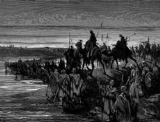
     duly occurs, and the river stops flowing and rapidly dries up, so the priests carrying it halt, allowing the rest of the Israelites to cross as well. In commemoration of the event, Joshua orders two monuments to be erected: one in the river-bed itself; the other on the western bank, at Gilgal , where the Israelites encamp.


  • The Circumcision of the Israelites . The Israelites are circumcised Circumcision

    Circumcision is the removal of some or all of the foreskin [i] from the penis [i]. ... 

     at Gibeath-Haaraloth . This is then explained as owing to those being born in the desert as not having been circumcised. The people are therefore circumcised and the area is named Gilgal in memory .


  • The Captain of the Lord's host . In a somewhat obscure passage, a captain of the host of the LORD arrives, with drawn sword, and orders Joshua to remove his sandals as the land he stands upon is holy.


  • The Battle of Jericho  - Placing Jericho under siege, the Israelites circle it once a day for six days, and on the seventh make seven circuits, each time loudly blowing horns and shouting. On the final circuit, the walls cave in, and the inhabitants, except Rahab and her family, are slaughtered. A curse is pronounced against rebuilding the city.


  • The First Battle of Ai - Ai is surveyed and pronounced weak, so the Israelite army sends only a small group to attack them but they are defeated, causing Joshua and the people to the verge of despair. But God announces that the people have sinned, as someone has stolen some of the spoils from Jericho which are meant to be for the temple. Consequently the Israelites set out to discover the sinner by casting lots , whittling them down first by tribe , then clan , then sept , then finally detecting it as Achan. Achan admits having taken a costly Babylonian garment, besides silver and gold, and his confession is verified by the finding of the treasure buried in his tent, so Achan is taken into the valley of Achor, where he is stoned and burned to death. Philosopher Robert Ingersoll describes this encounter in his About the Holy Bible:


Joshua took the City of Jericho. Before the fall of the city he declared that all the spoil taken should be given to the Lord. In spite of this order Achan secreted a garment, some silver and gold. Afterward Joshua tried to take the city of Ai. He failed and many of his soldiers were slain. Joshua sought for the cause of his defeat and he found that Achan had secreted a garment, two hundred shekels of silver and a wedge of gold. To this Achan confessed. And thereupon Joshua took Achan, his sons and his daughters, his oxen and his sheep -- stoned them all to death and burned their bodies. There is nothing to show that the sons and daughters had committed any crime. Certainly, the oxen and sheep should not have been stoned to death for the crime of their owner. This was the justice, the mercy, of Jehovah! After Joshua had committed this crime, with the help of Jehovah Jehovah

Jehovah is an English transcription of , which is a specific vocalized spelling of [ i.e.... 

 he captured the city of Ai.


  • The Second Battle of Ai - 30,000 Israelites set an ambush of Ai overnight, and in the morning another Israelite force attack and then feign retreat, drawing the forces of Ai far away from the city. When Joshua raises his lance, the 30,000 men preparing the ambush strike, while Joshua start attacking again, thus surrounding Ai's forces. The entire city is burned and its inhabitants slaughtered, the king of Ai being hung on a tree, and his body being thrown into a pit.


  • The Ritual of Ebal and Gerizim - Joshua erects an altar on Mount Ebal and makes offerings upon it, and carving into it the law of Moses. The people are arranged into two sections, with one facing Ebal and the other facing Gerizim Mount Gerizim

    Mount Gerizim is a mountain in the West Bank [i] near Nablus [i] which is sacred to the Samaritan [i] se ... 

    . They each read the blessings and curses specified in Deuteronomy as appropriate.


  • The Hivite Treaty - The Hivites fool the Israelites into thinking them foreigners, and gain a non-aggression treaty from the Israelites. Even after its detection, the fraud is not abrogated, though the Hivites are punished by being treated as the lowest social class .


  • The five kings of the Amorites - Adonizedek, king of Jerusalem Jerusalem

    Jerusalem is Israel [i]'s capital [i] and largest city, with a population of 724,000 contained in 123 ... 

    , brings about an alliance of the "five kings of the Amorites" , and they besiege the Hivites in Gibeon, whom they perceive as traitors. The Hivites implore Joshua's help, and so he launches a surprise night attack, causing the Amorites to panic and flee as far as Beth-horon. Although a night attack, a poem is quoted from the Book of Jasher, which states that the sun stood still at Gibeon, and the moon in the valley of Ajalon, in order that Joshua could complete the battle. The five kings hide in a cave, but are discovered and trapped there until their army has been completely obliterated, at which point they are then hanged.


  • The battle against Hazor . Jabin, King of Hazor, his army, and those of his vassels, rendezvous at Merom. Joshua, however, executes a swift attack and is able to defeat them. Pursuing them to a great distance, he hamstrings their horses, burns their chariots, captures Hazor, slaughters its inhabitants, and burns it to the ground. Lesser royal residences are also captured and their inhabitants slaughtered, although the cities on the hill remain.


  • The Anakim Nephilim

    In the Torah [i] and several non-canonical Jewish [i] and early Christian [i] writings, nephilim... 

    . The sons of Anak are driven away from the mountains and Hebron Hebron

    Hebron is a town in the Southern Judea [i] region of the West Bank [i]. ... 

     by Joshua, somewhat contradicting the accounts later in the Book of Judges which says that it was Caleb Caleb

    Caleb, the son of Jephunneh [i] is an important figure in the Hebrew Bible, noted for his faith in God [i] ... 

     who did this.


;The section concerning the division of Canaan contains brief narrative portions and long lists of places, interweaving:
  • The framing narrative, describing the process by which the land was divided . First a description is given of the domains east of the Jordan which were conquered and given to Reuben, Gad, and Machir . After God gives Joshua a gloss concerning the unconquered region, he reminds him about Reuben, Gad, and Machir , already having been allocated land by Moses, and about the Levites not being given territory, only cities. The territory is handed out by lot, Judah gaining the first lot, although they fail to drive out the Canaanites living in Jerusalem. Then the house of Joseph gets its territory, Ephraim failing to drive out the Canaanites of Gezer, and it is pointed out that the daughters of Zelophehad, part of the tribe of Manasseh, are also given territory of their own. The house of Joseph is given the mountain region, including the forest, and is told that they will be able to drive out the Canaanites living there despite the presence of iron Iron

    Iron is a chemical element [i] with the symbol Fe and atomic number [i] 26. ... 

     chariots. The Israelites then assemble at Shiloh, and Joshua sends out a survey team. When the survey is complete, the remaining land is divided amongst the lesser tribes. Finally, the tribes whose lands are east of the Jordan are allowed to go to their lands.


  • The Joshua King List . A list of 31 cities which were conquered and had kings.


  • A description of the boundaries of the Israelite Tribes. The description of the boundaries of Judah and of Benjamin is quite distinct from the list of their cities, unlike the descriptions of the borders of the other tribes. The boundaries of Ephraim and Manasseh are unusual in that they also include enclave Enclave and exclave

    In political geography [i], an enclave is a country or part of a country lying wholly within the boundar ... 

    s in some of the territory of the surrounding tribes, the boundaries of them as a whole are also given . Descriptions of the boundaries of the other tribes are also given - Reuben , Gad , Machir , Zebulon , Issachar , Asher , and Naphtali - except for those of Levi , Dan, and Simeon, for whom only cities are listed.


  • The lists of cities of the Israelites by tribe. The lists for Judah and Benjamin are extremely extensive, leading many to suspect it was originally derived from an administrative document. The lists for the other territorial tribes - Reuben , Gad , Simeon , Zebulon , Issachar , Asher , Naphtali , Dan - are each partly mixed with the descriptions of their boundaries, though other parts stand unfettered. The list for the tribe of Levi is broken into its three clans, and is somewhat more verbose. Conversely, there isn't really a list at all for either Ephraim or Manasseh.


  • The Anakim Nephilim

    In the Torah [i] and several non-canonical Jewish [i] and early Christian [i] writings, nephilim... 

    . Caleb Caleb

    Caleb, the son of Jephunneh [i] is an important figure in the Hebrew Bible, noted for his faith in God [i] ... 

     reminds Joshua of his loyalty and requests Hebron Hebron

    Hebron is a town in the Southern Judea [i] region of the West Bank [i]. ... 

     as his personal portion. The request is granted, and Caleb drives out the sons of Anak which are residing there.


  • The story of Othniel . Caleb marches against Kiriath-sepher, promising to give his daughter, Achsah, in marriage to whoever conquers it. His nephew, Othniel, takes up the challenge and so gains her hand in marriage. Achsah asks for a greater dowry from her father, and so is given the upper and lower pools in addition to the land in the Negev she has already been allocated.


  • The attack on Leshem . The territory of the tribe of Dan is too small for them so they attack Leshem, slaughtering its inhabitants, and refounding it under the name Dan.


  • Joshua's portion . Joshua himself is given Timnah-serah, which he has requested, in the territory of Ephraim.


  • The appointment of cities of refuge also including a brief list naming the cities.


  • The altar of Ed When they return to their lands, Reuben, Gad, and Machir build a conspicuously large altar. The other tribes take offense at this, since they believe it suggests that they are claiming their altar is the main one, so they prepare for war. However, they first send Phinehas and princes from each of the tribes, to admonish them. Reuben, Gad, and Machir, respond to this by stating that the altar is only a symbol of their loyalty, and not something to be used, so Phinehas and his party are relieved, and abandon their plans for war. The altar is named Ed in memory.


;The section concerning Joshua's final words involves:
  • Joshua's final speech . Joshua, now old, calls an assembly, and when it meets, he admonishes the people to remain loyal to the Torah of Moses. Joshua then gathers all the tribes together at Shechem, where he admonishes people to remain loyal to the Torah of Moses, recounting certain prior events. Joshua then sets up a large stone beneath a tree, within the holy ground at Shechem, in witness to a promise of the people to be faithful. Joshua then dies, as shortly thereafter does Eleazar. The Bones of Joseph are also buried there by the tree and stone pillar, on a piece of ground that Jacob Jacob

    Jacob or Ya'akov, , also known as Israel , is the third Biblical [i] patriarch [i]. ... 

     had purchased for 100 pieces of money.

Historicity

Excavations of several Canaanite cities have provided contradictory evidence for establishing the historicity of the Book of Joshua. Although early excavations seemed to support the narrative, for example by finding destruction layers in a number of Tells of prominent sites mentioned by the narrative, such as Jericho Jericho

Jericho is a town in the West Bank [i], near the Jordan River [i]. ... 

, the conclusion that such destruction must have been due to Joshua has since been criticised as Bible and Spade - using the Bible to interpret the remains, rather than using the scientific method to see what the remains mean and thus whether they support or deny the Biblical account.

More recent re-assessment of the remains from the era, especially in places such as Jericho, have reversed the earlier conclusions - the destruction layers of various cities date from wildly different times, and thus rather than a unified short military campaign, the remains are more suggestive of a series of isolated disasters/attacks over a period of centuries. In the particular case of Jericho, it was already abandoned during the time of the Israelite conquest - the conquest of Jericho by Israelites would have been the conquest and destruction of an empty ruin. The Tells of Lachish and Hazor were both Canaanite cities in the Late Bronze Age Bronze Age

... 

, and between the the thirteenth and twelfth centuries BC both cities were destroyed; they were later resettled by Israelites. Ai, on the other hand, appears to have been abandoned during the Early Bronze Age Bronze Age

... 

 and didn't become reoccupied until well after the 12th century BC. Even if one of these sets of cities was destroyed by an Israelite conquest, the other must have been destroyed at some point that was over a century later or earlier, contradicting the biblical account of a short period in which both sets were destroyed; in addition Ai is a particularly odd name for a town to have before its destruction, since it means ruin; meanwhile in the case of Hazor, a number of Egyptian inscriptions claim that it was destroyed by Seti I Seti I

Menmaatre Seti I was a Pharaoh [i] of Ancient Egypt [i], the son of Ramesses I [i] and Queen Sitre [i], ... 

  rather than the Israelites themselves.

The time periods involved in the destruction layers of the cities overlap the campaigns of the Sea Peoples , and the currently unexplained general late Bronze Age collapse of civilisation in the whole eastern Mediterranian; it is far more plausible, from the point of view of an increasing majority of archaeologists, for these causes to have been responsible for the destruction of the cities, rather than an invasion of Israelites lasting only about 20 or so years. . In addition, since archaeological remains show a smooth cultural continuity in this period, rather than the destruction of one culture and replacement by another , a growing majority of archaeologists believe that the Israelites were simply an emergent subculture within Canaanite society - i.e. that an Israelite conquest would be a logical nonsense - it would have involved the Canaanites invading themselves, from Canaan. From the point of view of Biblical scholars, it is more plausible that the author of Joshua combined a series of independent traditions about battles and destruction of various cities at differing times, in order to create a nationalistic Nationalism

Nationalism is an ideology that holds that a nation [i] is the fundamental unit for human [i] social life [i] ... 

 narrative that could dovetail neatly with the tradition of an exodus from Egypt .

The ethical problem of war and genocide


One difficulty in this book arises out of the command given by God to completely exterminate the Canaanites.

Liberal theologians see this as an ethically unjustifiable order to commit genocide, which is inconsistent with the overall view in the Hebrew and Christian scriptures of God as a loving, compassionate Creator. They see it as a theological polemic, with the majority of events invented during or after the Babylonian captivity, to encourage faithfulness to the Jewish creed at a time when it was being threatened. For instance, Morton says that Joshua "should be understood as a rite of ancient peoples whereby within the context of their times, they attempted to please God ".

Conservative theologians, who see the book as a historically accurate account written during or soon after the life of Joshua, give one of the following explanations to this problem:

  1. War was an essential part of the history of the Near East in the fifteenth century BCE. Although it is still sinful, some commentators argue that the book shows God using sinful activities in order to accomplish his just purposes. This does not mean that God supports war, simply that he works with humans as they are. These commentators emphasise what they see as the depraved nature of Canaanite society, pointing to archaeological evidence of practices such as child sacrifice . For instance, Hallam, who takes this view, lists a number of pieces of archaeological evidence to support this thesis: "Just a few steps from this temple was a cemetery, where many jars were found, containing remains of infants who had been sacrificed in this temple . . . Prophets of Baal and Ashtoreth were official murderers of little children." "Another horrible practice was [what] they called `foundation sacrifices.' When a house was to be built, a child would be sacrificed, and its body built into the wall. . . . The worship of Baal, Ashtoreth, and other Canaanite gods consisted in the most extravagant orgies; their temples were centers of vice. . . . Canaanites worshiped, by immoral indulgence, . . . and then, by murdering their first-born children, as a sacrifice to these same gods." However, some of this evidence is disputed, with others arguing that it may have been invented at a later date in order to justify the act of extermination. Also, according to biblical text, God commanded in many cases the slaughter of every child, as well as the adults, of a defeated people.
  2. Christian theologians have tended to emphasise what they see as the progressive nature of revelation in the Bible. As the Bible progresses, God is seen to reveal himself in ways that are fuller, clearer and more accurate, culminating in the ultimate revelation of God in Jesus Christ. God's command through Joshua to take possession of the land by force of arms is viewed in the context of God's command through the second Joshua, Jesus Christ, to bring about his kingdom through the peaceful application of his teaching.

References and Notes


Bibliography


  • Morton, William H. Joshua. The Broadman Bible Commentary, Vol. 2. Ed. Clifton J. Allen, et al. Nashville: Broadman Press, 1970.


  • Halley, Henry H. Halley's Bible Handbook. Grand Rapids: Zondervan Publishing House, 1927, 1965.


  • Mazar, Amihai. The Archaeology of the land of the Bible. New York: Doubleday, 1990.

External links

Online translations of the Book of Joshua:
  • Original text:


  • Jewish Judaism

    Judaism is the religion [i] of the Jew [i]ish people. ... 

     translations:
    • translation with Rashi Rashi

      Rashi ??"? is a Hebrew [i] acronym [i] for ??? ???? ????? , or ??? ???? ???? , author ... 

      's commentary at Chabad.org


  • Christian translations:


Related articles: