
All Topics  
Assyrian Siege of Jerusalem

 
Assyrian Siege of Jerusalem

   Email Print
   Bookmark   Link


Assyrian Siege of Jerusalem


In 721 BCE, the Assyria
Assyria

Assyria was a political state centered on the Upper Tigris river, in Mesopotamia , that came to rule regional empires a number of times in history....
n army captured the Israelite
Israelite

According to the Tanakh, the Israelites were the descendants of the Biblical patriarch Jacob. They were divided into twelve tribes, each descended from one of twelve sons or grandsons of Jacob....
 capital at Samaria
Samaria

Samaria, or the Shomron is a term used for the mountainous region in northern Israel roughly corresponding to the northern part of the West Bank....
 and carried away the citizens of the northern kingdom into captivity. The virtual destruction of Israel left the southern kingdom, Judah
Kingdom of Judah

The Kingdom of Judah existed at two periods in Jewish history. According to the Hebrew Bible, a kingdom emerged in Judah after the death of Saul, when the tribe of Judah elevated David to rule over it....
, to fend for itself in the whirlwind of warring Near Eastern kingdoms. At the time of Samaria's fall, there existed two kings in Judah — Ahaz
Ahaz

Ahaz was king of kingdom of Judah, and the son and successor of Jotham of Judah. He took the throne at the age of twenty . William F. Albright has dated his reign to 735 – 715 BC, while Edwin R....
 and his son Hezekiah
Hezekiah

Hezekiah was the 13th king of independent kingdom of Judah.His reign has been dated from 715 – 687 BC or 716 – 687 BC. Under either of these chronologies, Hezekiah ruled the southern kingdom of Judah during the forced resettlement of the northern kingdom of Israel by Sargon II's Assyrians and the invasion and siege of Jerusale...
 — who ruled as co-regents. Judah existed as a vassal to Assyria during this time and was forced to pay an annual tribute to the powerful empire.

Hezekiah's reforms
In 715 BCE, following the death of Ahaz, Hezekiah became the sole regent of Judah and initiated widespread religious reforms — smashing the idols the people had worshiped during the reign of his father and leading the Jews toward a renewed relationship with God.


Discussion
Ask a question about 'Assyrian Siege of Jerusalem'
Start a new discussion about 'Assyrian Siege of Jerusalem'
Answer questions from other users
Full Discussion Forum


Recent Posts


Encyclopedia


In 721 BCE, the Assyria
Assyria

Assyria was a political state centered on the Upper Tigris river, in Mesopotamia , that came to rule regional empires a number of times in history....
n army captured the Israelite
Israelite

According to the Tanakh, the Israelites were the descendants of the Biblical patriarch Jacob. They were divided into twelve tribes, each descended from one of twelve sons or grandsons of Jacob....
 capital at Samaria
Samaria

Samaria, or the Shomron is a term used for the mountainous region in northern Israel roughly corresponding to the northern part of the West Bank....
 and carried away the citizens of the northern kingdom into captivity. The virtual destruction of Israel left the southern kingdom, Judah
Kingdom of Judah

The Kingdom of Judah existed at two periods in Jewish history. According to the Hebrew Bible, a kingdom emerged in Judah after the death of Saul, when the tribe of Judah elevated David to rule over it....
, to fend for itself in the whirlwind of warring Near Eastern kingdoms. At the time of Samaria's fall, there existed two kings in Judah — Ahaz
Ahaz

Ahaz was king of kingdom of Judah, and the son and successor of Jotham of Judah. He took the throne at the age of twenty . William F. Albright has dated his reign to 735 – 715 BC, while Edwin R....
 and his son Hezekiah
Hezekiah

Hezekiah was the 13th king of independent kingdom of Judah.His reign has been dated from 715 – 687 BC or 716 – 687 BC. Under either of these chronologies, Hezekiah ruled the southern kingdom of Judah during the forced resettlement of the northern kingdom of Israel by Sargon II's Assyrians and the invasion and siege of Jerusale...
 — who ruled as co-regents. Judah existed as a vassal to Assyria during this time and was forced to pay an annual tribute to the powerful empire.

Hezekiah's reforms


In 715 BCE, following the death of Ahaz, Hezekiah became the sole regent of Judah and initiated widespread religious reforms — smashing the idols the people had worshiped during the reign of his father and leading the Jews toward a renewed relationship with God. He re-captured Philistine-occupied lands in the Negev desert, formed alliances with Ashkelon
Ashkelon

Ashkelon or Ashqelon is a coastal city in the South District of Israel. The ancient seaport of Ashkelon dates back to the Bronze Age. In the course of its history, it has been ruled by the Canaanites, the Philistines, the Babylonians, the Phoenicians, the Ancient Romes, the Muslims and the Crusaders....
 and Egypt
Egypt

Egypt is a country mainly in North Africa, with the Sinai Peninsula forming a land bridge in Western Asia. Covering an area of about , Egypt borders the Mediterranean Sea to the north, the Gaza Strip and Israel to the northeast, the Red Sea to the east, Sudan to the south and Libya to the west....
, and made a stand against Assyria by refusing to pay tribute.

In response, Sennacherib
Sennacherib

Sennacherib Rise to power As a crown prince, Sennacherib was placed in charge of the empire while his father Sargon II was on campaign....
, king of Assyria, attacked the fortified cities of Judah. While Sennacherib was besieging Lachish
Lachish

Lachish was a town located in the Shephelah, or maritime plain of Philistia . This town was first mentioned in the Amarna letters as Lakisha-Laki?a ....
, he received a message from Hezekiah offering to pay tribute in exchange for Assyrian withdrawal. According to the Old Testament
Old Testament

In Western Christianity, the Old Testament refers to the books that form the first of the two-part Christianity Bible Biblical canon. These works correspond to the Hebrew Bible , with some variations and additions....
, Hezekiah paid three hundred talents of silver and thirty talents of gold to Assyria — a price so heavy that he was forced to empty the temple and royal treasury of silver and strip the gold from the doorposts of Solomon
Solomon

Solomon is a figure described in the Hebrew Bible and the Qur'an. The biblical accounts identify Solomon as the son of David. He is also called Jedidiah in the Tanakh , and is described as the third king of the United Monarchy, and the final king before the northern Kingdom of Israel and the southern Kingdom of Judah split; following th...
's temple.

Jerusalem besieged


Sometime during the early part of the Assyrian invasion, Hezekiah met with his military staff concerning the possibility that Jerusalem
Jerusalem

Jerusalem is the capital of Israel and its List of Israeli cities in both population and area, with a population of 747,600 residents over an area of if Positions on Jerusalem East Jerusalem is included....
 may fall under siege. The staff immediately oversaw preparations for the Assyrian onslaught. In an effort to deprive the enemy of water, the Jews blocked the springs outside the city. Workers then dug a 533-meter tunnel to the Spring of Gihon, providing the city with fresh water. Additional siege preparations included fortification of the existing walls, construction of towers, and the erection of a new, reinforcing wall. Hezekiah gathered the citizens in the square and encouraged them by reminding them that the Assyrians possessed only "an arm of flesh", but the Jews had the protection of Yahweh
Yahweh

Image:Tetragrammaton scripts.svg[Aramaic alphabet|Aramaic]] and Hebrew alphabet Yahweh is the English rendering of , a vocalization of the Tetragrammaton that was proposed by the Hebrew scholar Gesenius in the 19th century....
.

Sennacherib marched on Jerusalem with a large army. When the Assyrian force arrived, its field commander brought a message from Sennacherib himself. In an attempt to demoralize the Jews, the field commander announced to the people on the city walls that Hezekiah was deceiving them, and Yahweh could not deliver Jerusalem from the king of Assyria. He listed the gods of the people thus far swept away by Sennacherib then asked, "Who of all the gods of these countries has been able to save his land from me?"

The Old Testament
Old Testament

In Western Christianity, the Old Testament refers to the books that form the first of the two-part Christianity Bible Biblical canon. These works correspond to the Hebrew Bible , with some variations and additions....
 relates how Hezekiah clad himself in sackcloth out of anguish from the psychological warfare
Psychological warfare

The U.S. Department of Defense defines psychological warfare as:"The planned use of propaganda and other psychological actions having the primary purpose of influencing the opinions, emotions, attitudes, and behavior of hostile foreign groups in such a way as to support the achievement of national objectives."...
 that the Assyrians were waging. However, the prophet Isaiah
Isaiah

Isaiah is the main figure in the Biblical Book of Isaiah, and is traditionally considered to be its author. He was an 8th-century Before Christ Judean prophet who declared that all the world belonged to God and that God will destroy it....
 assured Hezekiah that the city would be delivered and Sennacherib would be cut down with the sword. The Old Testament states that during the night, an angel
Ángel

?ngel is the third single from Belinda Peregr?n's debut album: Belinda. It was a massive hit in Mexico and an international hit for Belinda....
 of Yahweh brought death to 185,000 Assyrians troops. When Sennacherib saw the destruction wreaked on his army, he withdrew to Nineveh
Nineveh

Nineveh , an "exceeding great city", as it is called in the Book of Jonah, lay on the eastern bank of the Tigris in ancient Assyria, across the river from the modern-day major city of Mosul, Iraq....
. Jerusalem was spared destruction.

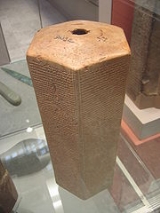
The hexagonal prism


Sennacherib's Prism
Sennacherib's Prism

Sennacherib's Prism or Taylor prism is a clay prism inscribed with the annals of the Assyrian king Sennacherib notable for describing his siege of Jerusalem in 701 BC during the reign of king Hezekiah....
, which details the events of Sennacherib's campaign against Judah, was discovered in the ruins of Nineveh in 1830, and is now stored at the Oriental Institute
Oriental Institute

Oriental Institute may refer to:United States* Oriental Institute, Chicago, part of the University of ChicagoEngland* Oriental Institute, Oxford, part of the University of Oxford...
 in Chicago
Chicago

Chicago is the largest city in the U.S. state of Illinois and the Midwestern United States, as well as the List of United States cities by population city in the United States with more than 2.8 million residents....
, Illinois
Illinois

The State of Illinois is a U.S. state of the United States, the 21st to be admitted to the United States. Illinois is the most populous and demographically diverse Midwestern United States state and the fifth most populous state in the nation....
. The account dates from about 690 BCE and is as self-serving to the Assyrian king as the Biblical account is to Judah. The text of the prism boasts how Sennacherib destroyed forty-six of Judah's cities, trapped Hezekiah in Jerusalem "like a caged bird." The text goes on to describe how the "terrifying splendor" of the Assyrian army caused the Arabs and mercenaries reinforcing the city to desert. The prism goes on to state that Jerusalem surrendered and Hezekiah gave the Assyrian king large quantities of money as tribute, resulting in the Assyrians victoriously returning home. This explanation contradicts that in the Tanakh. The mass death mentioned in the Tanakh has never been substantiated by any archaeological find.

However, the Old Testament's suggestion that Jerusalem was victorious rather than defeated, is corroborated by the Greek historian Herodotus
Herodotus

Herodotus of Halicarnassus was a Greeks historian who lived in the 5th century BC and is regarded as the "Father of History" in Western culture....
, Chaldean historian Berosus
Berosus

Berosus may refer to:*Berossus , Hellenistic-era Babylonian writer and astronomer*Berosus , a genus of beetles of the family Hydrophilidae*Berosus , a lunar crater...
, and Jewish historian Josephus
Josephus

Josephus , also known as Yosef Ben Matityahu and, after he became a Roman citizenship, as Titus Flavius Josephus, was a first-century Jewish historian and apologist of priestly and royal ancestry who survived and recorded the destruction of Jerusalem in AD 70....
. Nevertheless, as all of these are expansions on the Old Testament account, adding Midrash
Midrash

Midrash is a Hebrew language term referring to the not exact, but comparative method of exegesis of Biblical texts, which is one of four methods cumulatively called Pardes ....
, none are independent witnesses.

Other theories


In What If?
What If? (essays)

What If?, subtitled The World's Foremost military historian Imagine What Might Have Been, is a collection of twenty essays and thirteen sidebars dealing with virtual history....
, a collection of essays on counterfactual history, historian William H. McNeill
William H. McNeill

William Hardy McNeill is a noted World History. He is among the world's most respected historians and was Professor Emeritus of History at the University of Chicago....
 speculates that the accounts of mass death among the Assyrian army in the Tanakh might be explained by an outbreak of cholera
Cholera

Cholera, sometimes known as Asiatic or epidemic cholera, is an infectious gastroenteritis caused by enterotoxin-producing strains of the bacterium Vibrio cholerae....
 (or other water-borne diseases) due to the springs beyond the city walls having been blocked, thus depriving the besieging force of a safe water supply. In McNeill's speculative essay, the Assyrians were forced to withdraw by disease, an event which in McNeill's opinion served to support Judaism
Judaism

Judaism is a set of beliefs and practices originating in the Hebrew Bible , as later further explored and explained in the Talmud and other texts....
's then-new monotheistic
Monotheism

In theology, monotheism is the belief that only one god exists. The concept of "monotheism" tends to be dominated by the concept of God in the Abrahamic religions, such as Judaism, Christianity and Islam, and the Neoplatonism concept of God as put forward by Pseudo-Dionysius the Areopagite....
 tradition.

In addition, McNeill reasons that the Assyrian siege of Jerusalem holds special historical significance due to the newness (at the time) of the monotheistic
Monotheism

In theology, monotheism is the belief that only one god exists. The concept of "monotheism" tends to be dominated by the concept of God in the Abrahamic religions, such as Judaism, Christianity and Islam, and the Neoplatonism concept of God as put forward by Pseudo-Dionysius the Areopagite....
 tradition in Judaism
Judaism

Judaism is a set of beliefs and practices originating in the Hebrew Bible , as later further explored and explained in the Talmud and other texts....
. McNeill argues that the apparent defeat of Sennacherib by Yahweh supported the idea of monotheism in an age when a conquered people typically adopted the god or gods of their conquerors, as their own had failed to protect them. The extraordinary defeat of Sennacherib which McNeill suggests, by disease which was as yet not understood, would have proven Yahweh superior to the gods of the most powerful nation then known to the Jews, Assyria. Therefore, McNeill concludes that if Sennacherib had taken the city, the culture of monotheism may have failed to achieve the widespread popularity it enjoys today through the various Abrahamic faiths.

Henry T. Aubin writes in that the Assyrian army was routed by an Egypt
Egypt

Egypt is a country mainly in North Africa, with the Sinai Peninsula forming a land bridge in Western Asia. Covering an area of about , Egypt borders the Mediterranean Sea to the north, the Gaza Strip and Israel to the northeast, the Red Sea to the east, Sudan to the south and Libya to the west....
ian army under Kushite
Twenty-fifth dynasty of Egypt

The Twenty-Fifth Dynasty of Egypt, also known as the Ethiopian or Nubian dynasty, was a line of rulers originating in the Kingdom of Kush. They reigned in part or all of Ancient Egypt from 760 BC to 656 BC.....
 (Nubia
Nubia

Nubia is a region in Southern Egypt along the Nile and in what is now northern Sudan. Most of Nubia is situated in Sudan with about a quarter of its territory in Egypt....
n) command.

Sennacherib's end


The prophecy of Isaiah did not come to pass immediately, but did eventually intersect with Sennacherib. In 681 BCE, while worshiping in the temple of Nisroch
Nisroch

According to the Bible, Nisroch is the Assyrian god of agriculture, in whose temple Sennacherib was worshipping when he was assassinated. . Josephus calls him Dagon....
, the king of Assyria was killed by his own son. He had ruled Assyria for twenty-four years.

See also

  • Solomon's Temple
  • Babylonian captivity
    Babylonian captivity

    The Babylonian captivity, or Babylonian exile, is the name typically given to the deportation and exile of the Jews of the ancient Kingdom of Judah to Babylon by Nebuchadnezzar II of Babylon in 586 BCE....
  • Second Temple
    Second Temple

    The Second Temple was the reconstructed Temple in Jerusalem which stood between 516 BCE and 70 CE. During this time, it was the center of Judaism worship, which focused on the sacrifices known as the korbanot....
  • Herod's Temple
    Herod's Temple

    Herod's Temple in Jerusalem was a massive expansion of the Temple Mount and construction of a completely new and much larger Jewish Temple by King Herod the Great around 19 BCE....
  • Siege of Jerusalem (70)
    Siege of Jerusalem (70)

    The Siege of Jerusalem in the year 70 AD was a decisive event in the First Jewish-Roman War. It was followed by the Masada#History in 73 AD. The Roman Empire army, led by the future Emperor Titus, with Tiberius Julius Alexander as his second-in-command, besieged and conquered the city of Jerusalem, which had been occupied by its Jewish defend...
  • Destruction of Jerusalem
  • Jewish-Roman wars
    Jewish-Roman wars

    The Jewish-Roman wars were a series of revolts by the Jews of Iudaea Province against the Roman Empire. Some sources use the term to refer only to the First Jewish-Roman War and Bar Kokhba revolt ....
  • Western Wall
    Western Wall

    The Western Wall , sometimes referred to as the Wailing Wall or simply the Kotel , and as al-Buraq Wall by Muslims, is an important Jewish religious site located in the Old City ....