

Schwerer Gustav

Encyclopedia
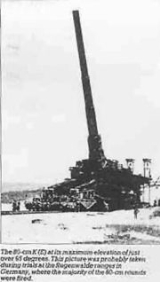
Schwerer Gustav and Dora were the names of two massive World War II German
80 cm K (E) railway siege guns. They were developed in the late 1930s by Krupp
for the express purpose of destroying heavy fortifications, specifically those in the French Maginot Line
. They weighed nearly 1,350 tonnes, and could fire shells weighing seven tonnes to a range of 37 kilometres (23 mi). Designed in preparation for World War II
, and intended for use against the deep forts of the Maginot Line, they were not ready for action when the Wehrmacht
outflanked the line during the Battle of France
. Gustav was used in the Soviet Union
at the siege of Sevastopol
during Operation Barbarossa
. They were moved to Leningrad, and may have been intended for Warsaw. Gustav was captured by US troops and cut up, whilst Dora was destroyed near the end of the war to avoid capture by the Red Army.
It was the largest calibre rifled weapon in the history of artillery to see actual combat, and fired the heaviest shells of any artillery piece. It is only surpassed in calibre by the French Monster Mortar (36 French inches; 975mm), the British Mallet's Mortar
(36 inch; 914 mm) and the American Little David mortar
(36 inch; 910 mm).
of Essen, Germany to design a gun to destroy the forts of the French
Maginot Line
which were then nearing completion. The gun's shells had to punch through seven meters of reinforced concrete
or one full meter of steel armour plate, from beyond the range of French artillery. Krupp engineer Dr. Erich Müller calculated that the task would require a weapon with a calibre of around 80 cm, firing a projectile weighing 7 tonnes from a barrel 30 meters long. As such, the weapon would have a weight of over 1000 tonnes. The size and weight meant that to be at all movable it would need to be supported on twin sets of railway tracks. In common with smaller railway guns, the only barrel movement on the mount would be elevation, traverse being managed by moving the weapon along a curved section of railway line. Krupp prepared plans for calibres of 70 cm, 80 cm, 85 cm, and 1 m.
Nothing further happened until March 1936, when during a visit to Essen, Adolf Hitler
enquired as to the giant guns' feasibility. No definite commitment was given by Hitler, but design work began on an 80 cm model. The resulting plans were completed in early 1937 and approved. Fabrication of the first gun started in the summer of 1937. However, technical complications in the forging of such massive pieces of steel made it apparent that the original completion date of spring 1940 could not be met.
Krupp built a test model in late 1939 and sent it to the Hillersleben firing range for testing. Penetration was tested on this occasion. Firing at high elevation, the 7.1 tonne shell was able to penetrate the specified seven meters of concrete and the one meter armour plate. When the tests were completed in mid-1940 the complex carriage was further developed. Alfried Krupp, after whose father the gun was named, personally hosted Hitler at the Rügenwald Proving Ground during the formal acceptance trials of the Gustav Gun in the spring of 1941. Hitler was so awe-struck, he commanded that the 11 tonne shell could only be used at his discretion. As he never gave permission, it was never deployed.
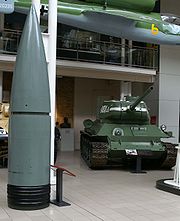 Two guns were ordered. The first round was test-fired from the commissioned gun barrel on 10 September 1941 from a makeshift gun carriage on the Hillersleben firing range. In November 1941, the barrel was taken to Rügenwald where 8 further firing tests took place using the 7,100 kilogram armor-piercing (AP) shell out to a range of 37,210 meters.
In combat, the gun was mounted on a specially designed chassis, supported by eight bogie
s on two parallel sets of railway tracks. Each of the bogies had 5 axles, giving a total of 40 axles (80 wheels). Krupp christened the gun Schwerer Gustav (Heavy Gustav) after the senior director of the firm, Gustav Krupp von Bohlen und Halbach
.
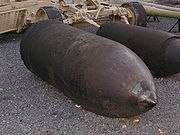
The ammunition for the gun consisted of a heavy concrete-piercing shell and a lighter high-explosive shell. A super-long-range rocket projectile was also planned with a range of 150 km that would require the barrel being extended to 84 meters.
In keeping with the tradition of the Krupp company, no charge was made for the first gun. However, they did charge seven million Reichsmark
for the second gun Dora, named after the senior engineer's wife.
. The train carrying the gun was of 25 cars, a total length of 1.5 kilometers. The gun reached the Perekop Isthmus in early March 1942, where it was held until early April. A special railway spur line was built to the Simferopol
-Sevastopol
railway 16 kilometres (9.9 mi) north of the target, at the end of which four semi-circular tracks were built specially for the Gustav to traverse. Outer tracks were required for the cranes which would have assembled Gustav.
The siege of Sevastopol
was to be the gun's first combat test. Installation began in early May, and by 5 June the gun was ready to fire. The following targets were engaged:
By the end of the siege on 4 July the city of Sevastopol
lay in ruins, and 30,000 tons of artillery ammunition had been fired. Gustav had fired 48 rounds and worn out its original barrel, which had already fired around 250 rounds during testing and development. The gun was fitted with the spare barrel and the original was sent back to Krupp's factory in Essen for relining.
The gun was then dismantled and moved to the northern part of the eastern front, where an attack was planned on Leningrad
. The gun was placed some 30 km from the city near the railway station of Taizy. The gun was fully operational when the attack was cancelled. The gun then spent the winter of 1942/43 near Leningrad.
Then it was moved back to Germany for refurbishment. Despite some claims, it was never used in Warsaw
during the 1944 uprising
, though one of its shells is on display at the Polish Army Museum
there.
The gun then appears to have been destroyed to prevent its capture sometime before 22 April 1945, when its ruins were discovered in a forest 15 kilometres (9.3 mi) north of Auerbach
about 50 kilometres (31.1 mi) southwest of Chemnitz
.
. It was never completed after being damaged during construction by one of the many RAF
bombing raids on Essen.
heavy howitzers, and multiple MG 151
autocannons normally used on combat aircraft. It was deemed impractical, and in 1943 was canceled by Albert Speer
. It never left the drawing board and no progress was ever made. It would have easily surpassed the Panzer VIII Maus
(heaviest tank ever built) and the Landkreuzer P. 1000 Ratte (also never built) in weight and size.
, fitted with an aluminium
alloy ballistic
nose cone.
Germany
Germany , officially the Federal Republic of Germany , is a federal parliamentary republic in Europe. The country consists of 16 states while the capital and largest city is Berlin. Germany covers an area of 357,021 km2 and has a largely temperate seasonal climate...
80 cm K (E) railway siege guns. They were developed in the late 1930s by Krupp
Krupp
The Krupp family , a prominent 400-year-old German dynasty from Essen, have become famous for their steel production and for their manufacture of ammunition and armaments. The family business, known as Friedrich Krupp AG Hoesch-Krupp, was the largest company in Europe at the beginning of the 20th...
for the express purpose of destroying heavy fortifications, specifically those in the French Maginot Line
Maginot Line
The Maginot Line , named after the French Minister of War André Maginot, was a line of concrete fortifications, tank obstacles, artillery casemates, machine gun posts, and other defences, which France constructed along its borders with Germany and Italy, in light of its experience in World War I,...
. They weighed nearly 1,350 tonnes, and could fire shells weighing seven tonnes to a range of 37 kilometres (23 mi). Designed in preparation for World War II
World War II
World War II, or the Second World War , was a global conflict lasting from 1939 to 1945, involving most of the world's nations—including all of the great powers—eventually forming two opposing military alliances: the Allies and the Axis...
, and intended for use against the deep forts of the Maginot Line, they were not ready for action when the Wehrmacht
Wehrmacht
The Wehrmacht – from , to defend and , the might/power) were the unified armed forces of Nazi Germany from 1935 to 1945. It consisted of the Heer , the Kriegsmarine and the Luftwaffe .-Origin and use of the term:...
outflanked the line during the Battle of France
Battle of France
In the Second World War, the Battle of France was the German invasion of France and the Low Countries, beginning on 10 May 1940, which ended the Phoney War. The battle consisted of two main operations. In the first, Fall Gelb , German armoured units pushed through the Ardennes, to cut off and...
. Gustav was used in the Soviet Union
Soviet Union
The Soviet Union , officially the Union of Soviet Socialist Republics , was a constitutionally socialist state that existed in Eurasia between 1922 and 1991....
at the siege of Sevastopol
Battle of Sevastopol
The Siege of Sevastopol took place on the Eastern Front of the Second World War. The campaign was fought by the Axis powers of Germany, Romania and Italy against the Soviet Union for control of Sevastopol, a port in Crimea on the Black Sea. On 22 June 1941 the Axis invaded the Soviet Union under...
during Operation Barbarossa
Operation Barbarossa
Operation Barbarossa was the code name for Germany's invasion of the Soviet Union during World War II that began on 22 June 1941. Over 4.5 million troops of the Axis powers invaded the USSR along a front., the largest invasion in the history of warfare...
. They were moved to Leningrad, and may have been intended for Warsaw. Gustav was captured by US troops and cut up, whilst Dora was destroyed near the end of the war to avoid capture by the Red Army.
It was the largest calibre rifled weapon in the history of artillery to see actual combat, and fired the heaviest shells of any artillery piece. It is only surpassed in calibre by the French Monster Mortar (36 French inches; 975mm), the British Mallet's Mortar
Mallet's Mortar
Mallet's Mortar was a British siege mortar built for, but never used in, the Crimean WarThe mortar was design by Robert Mallet. It was constructed in sections so that it could be transported....
(36 inch; 914 mm) and the American Little David mortar
Little David
Little David was the nickname of an American 36 inch caliber mortar used for test firing aerial bombs during World War II.-History:...
(36 inch; 910 mm).
Development
In 1934 the German Army High Command (OKH) commissioned KruppKrupp
The Krupp family , a prominent 400-year-old German dynasty from Essen, have become famous for their steel production and for their manufacture of ammunition and armaments. The family business, known as Friedrich Krupp AG Hoesch-Krupp, was the largest company in Europe at the beginning of the 20th...
of Essen, Germany to design a gun to destroy the forts of the French
France
The French Republic , The French Republic , The French Republic , (commonly known as France , is a unitary semi-presidential republic in Western Europe with several overseas territories and islands located on other continents and in the Indian, Pacific, and Atlantic oceans. Metropolitan France...
Maginot Line
Maginot Line
The Maginot Line , named after the French Minister of War André Maginot, was a line of concrete fortifications, tank obstacles, artillery casemates, machine gun posts, and other defences, which France constructed along its borders with Germany and Italy, in light of its experience in World War I,...
which were then nearing completion. The gun's shells had to punch through seven meters of reinforced concrete
Reinforced concrete
Reinforced concrete is concrete in which reinforcement bars , reinforcement grids, plates or fibers have been incorporated to strengthen the concrete in tension. It was invented by French gardener Joseph Monier in 1849 and patented in 1867. The term Ferro Concrete refers only to concrete that is...
or one full meter of steel armour plate, from beyond the range of French artillery. Krupp engineer Dr. Erich Müller calculated that the task would require a weapon with a calibre of around 80 cm, firing a projectile weighing 7 tonnes from a barrel 30 meters long. As such, the weapon would have a weight of over 1000 tonnes. The size and weight meant that to be at all movable it would need to be supported on twin sets of railway tracks. In common with smaller railway guns, the only barrel movement on the mount would be elevation, traverse being managed by moving the weapon along a curved section of railway line. Krupp prepared plans for calibres of 70 cm, 80 cm, 85 cm, and 1 m.
Nothing further happened until March 1936, when during a visit to Essen, Adolf Hitler
Adolf Hitler
Adolf Hitler was an Austrian-born German politician and the leader of the National Socialist German Workers Party , commonly referred to as the Nazi Party). He was Chancellor of Germany from 1933 to 1945, and head of state from 1934 to 1945...
enquired as to the giant guns' feasibility. No definite commitment was given by Hitler, but design work began on an 80 cm model. The resulting plans were completed in early 1937 and approved. Fabrication of the first gun started in the summer of 1937. However, technical complications in the forging of such massive pieces of steel made it apparent that the original completion date of spring 1940 could not be met.
Krupp built a test model in late 1939 and sent it to the Hillersleben firing range for testing. Penetration was tested on this occasion. Firing at high elevation, the 7.1 tonne shell was able to penetrate the specified seven meters of concrete and the one meter armour plate. When the tests were completed in mid-1940 the complex carriage was further developed. Alfried Krupp, after whose father the gun was named, personally hosted Hitler at the Rügenwald Proving Ground during the formal acceptance trials of the Gustav Gun in the spring of 1941. Hitler was so awe-struck, he commanded that the 11 tonne shell could only be used at his discretion. As he never gave permission, it was never deployed.
In combat, the gun was mounted on a specially designed chassis, supported by eight bogie
Bogie
A bogie is a wheeled wagon or trolley. In mechanics terms, a bogie is a chassis or framework carrying wheels, attached to a vehicle. It can be fixed in place, as on a cargo truck, mounted on a swivel, as on a railway carriage/car or locomotive, or sprung as in the suspension of a caterpillar...
s on two parallel sets of railway tracks. Each of the bogies had 5 axles, giving a total of 40 axles (80 wheels). Krupp christened the gun Schwerer Gustav (Heavy Gustav) after the senior director of the firm, Gustav Krupp von Bohlen und Halbach
Gustav Krupp von Bohlen und Halbach
Gustav Georg Friedrich Maria Krupp von Bohlen und Halbach, "Taffi", ran the German Friedrich Krupp AG heavy industry conglomerate from 1909 until 1941...
.
The ammunition for the gun consisted of a heavy concrete-piercing shell and a lighter high-explosive shell. A super-long-range rocket projectile was also planned with a range of 150 km that would require the barrel being extended to 84 meters.
In keeping with the tradition of the Krupp company, no charge was made for the first gun. However, they did charge seven million Reichsmark
German reichsmark
The Reichsmark was the currency in Germany from 1924 until June 20, 1948. The Reichsmark was subdivided into 100 Reichspfennig.-History:...
for the second gun Dora, named after the senior engineer's wife.
History
Schwerer Gustav
In February 1942, Heavy Artillery Unit (E) 672 reorganized and went on the march, and Schwerer Gustav began its long ride to the CrimeaCrimea
Crimea , or the Autonomous Republic of Crimea , is a sub-national unit, an autonomous republic, of Ukraine. It is located on the northern coast of the Black Sea, occupying a peninsula of the same name...
. The train carrying the gun was of 25 cars, a total length of 1.5 kilometers. The gun reached the Perekop Isthmus in early March 1942, where it was held until early April. A special railway spur line was built to the Simferopol
Simferopol
-Russian Empire and Civil War:The city was renamed Simferopol in 1784 after the annexation of the Crimean Khanate to the Russian Empire by Catherine II of Russia. The name Simferopol is derived from the Greek, Συμφερόπολις , translated as "the city of usefulness." In 1802, Simferopol became the...
-Sevastopol
Sevastopol
Sevastopol is a city on rights of administrative division of Ukraine, located on the Black Sea coast of the Crimea peninsula. It has a population of 342,451 . Sevastopol is the second largest port in Ukraine, after the Port of Odessa....
railway 16 kilometres (9.9 mi) north of the target, at the end of which four semi-circular tracks were built specially for the Gustav to traverse. Outer tracks were required for the cranes which would have assembled Gustav.
The siege of Sevastopol
Battle of Sevastopol
The Siege of Sevastopol took place on the Eastern Front of the Second World War. The campaign was fought by the Axis powers of Germany, Romania and Italy against the Soviet Union for control of Sevastopol, a port in Crimea on the Black Sea. On 22 June 1941 the Axis invaded the Soviet Union under...
was to be the gun's first combat test. Installation began in early May, and by 5 June the gun was ready to fire. The following targets were engaged:
- 5 June
- Coastal gunsCoastal artilleryCoastal artillery is the branch of armed forces concerned with operating anti-ship artillery or fixed gun batteries in coastal fortifications....
at a range of 25,000 m. Eight shells fired. - Fort Stalin. Six shells fired.
- Coastal guns
- 6 June
- Fort Molotov. Seven shells fired.
- "White Cliff" aka "Ammunition Mountion": an undersea ammunition magazine in Severnaya ("Northern") Bay. The magazine was sited 30 meters under the sea with at least 10 meters of concrete protection. After nine shells were fired, the magazine was ruined and one of the boats in the bay sunk.
- 7 June
- Firing in support of an infantry attack on Sudwestspitze, an outlying fortification. Seven shells fired.
- 11 June
- Fort Siberia. Five shells fired.
- 17 June
- Fort Maxim Gorki and its coastal battery. Five shells fired.
By the end of the siege on 4 July the city of Sevastopol
Sevastopol
Sevastopol is a city on rights of administrative division of Ukraine, located on the Black Sea coast of the Crimea peninsula. It has a population of 342,451 . Sevastopol is the second largest port in Ukraine, after the Port of Odessa....
lay in ruins, and 30,000 tons of artillery ammunition had been fired. Gustav had fired 48 rounds and worn out its original barrel, which had already fired around 250 rounds during testing and development. The gun was fitted with the spare barrel and the original was sent back to Krupp's factory in Essen for relining.
The gun was then dismantled and moved to the northern part of the eastern front, where an attack was planned on Leningrad
Saint Petersburg
Saint Petersburg is a city and a federal subject of Russia located on the Neva River at the head of the Gulf of Finland on the Baltic Sea...
. The gun was placed some 30 km from the city near the railway station of Taizy. The gun was fully operational when the attack was cancelled. The gun then spent the winter of 1942/43 near Leningrad.
Then it was moved back to Germany for refurbishment. Despite some claims, it was never used in Warsaw
Warsaw
Warsaw is the capital and largest city of Poland. It is located on the Vistula River, roughly from the Baltic Sea and from the Carpathian Mountains. Its population in 2010 was estimated at 1,716,855 residents with a greater metropolitan area of 2,631,902 residents, making Warsaw the 10th most...
during the 1944 uprising
Warsaw Uprising
The Warsaw Uprising was a major World War II operation by the Polish resistance Home Army , to liberate Warsaw from Nazi Germany. The rebellion was timed to coincide with the Soviet Union's Red Army approaching the eastern suburbs of the city and the retreat of German forces...
, though one of its shells is on display at the Polish Army Museum
Polish Army Museum
-Newest Exhibition:The Polish Army Museum was not too long ago given the equipment of the lost soldiers from the Presidential Smolensk aircraft crash. The equipment includes the ID Passes, Portable radios, torches, holsters and much more and all in their original state.Museum of the Polish Army is...
there.
The gun then appears to have been destroyed to prevent its capture sometime before 22 April 1945, when its ruins were discovered in a forest 15 kilometres (9.3 mi) north of Auerbach
Auerbach
Auerbach, a German language generic toponym coming from Aue + Bach, meaning "floodmeadow brook", can refer to:-In Germany:*Auerbach, Erzgebirgskreis, in the Erzgebirgskreis district, Saxony...
about 50 kilometres (31.1 mi) southwest of Chemnitz
Chemnitz
Chemnitz is the third-largest city of the Free State of Saxony, Germany. Chemnitz is an independent city which is not part of any county and seat of the government region Direktionsbezirk Chemnitz. Located in the northern foothills of the Ore Mountains, it is a part of the Saxon triangle...
.
Dora
Dora was the second gun to be produced. It was deployed briefly against Stalingrad, where the gun arrived at its emplacement 15 kilometres (9.3 mi) to the west of the city sometime in mid-August 1942. It was ready to fire on 13 September. It was quickly withdrawn, however, when Soviet encirclement threatened. When the Germans began their long retreat they took Dora with them. Dora was broken up before the end of the war, being discovered in the west by American troops some time after the discovery of Schwerer Gustav.Langer Gustav
The Langer Gustav was a long cannon with 52 centimeter caliber and a 43 meter barrel. It was intended to fire super-long-range rocket projectiles weighing 680 kilograms to a range of 190 kilometers. This gave it the range to hit LondonLondon
London is the capital city of :England and the :United Kingdom, the largest metropolitan area in the United Kingdom, and the largest urban zone in the European Union by most measures. Located on the River Thames, London has been a major settlement for two millennia, its history going back to its...
. It was never completed after being damaged during construction by one of the many RAF
Royal Air Force
The Royal Air Force is the aerial warfare service branch of the British Armed Forces. Formed on 1 April 1918, it is the oldest independent air force in the world...
bombing raids on Essen.
Landkreuzer P. 1500 Monster Project
The Monster was to be a 1,500 tonne mobile, self-propelled platform for an 80-cm K (E) gun, along with two 15 cm sFH 1815 cm sFH 18
The 15 cm schwere Feldhaubitze 18 or sFH 18 , nicknamed Immergrün , was the basic German division-level heavy howitzer during the Second World War, serving alongside the smaller but more numerous 10.5 cm leFH 18...
heavy howitzers, and multiple MG 151
MG 151 cannon
The MG 151 was a 15 mm autocannon produced by Waffenfabrik Mauser starting in 1940. It was in 1941 developed into the 20 mm MG 151/20 cannon which was widely used on many types of German Luftwaffe fighters, fighter bombers, night fighters, ground attack and even bombers as part of or as...
autocannons normally used on combat aircraft. It was deemed impractical, and in 1943 was canceled by Albert Speer
Albert Speer
Albert Speer, born Berthold Konrad Hermann Albert Speer, was a German architect who was, for a part of World War II, Minister of Armaments and War Production for the Third Reich. Speer was Adolf Hitler's chief architect before assuming ministerial office...
. It never left the drawing board and no progress was ever made. It would have easily surpassed the Panzer VIII Maus
Panzer VIII Maus
Panzerkampfwagen VIII Maus was a German World War II super-heavy tank completed in late 1944. It is the heaviest fully enclosed armoured fighting vehicle ever built. Only two hulls and one turret were completed before the testing grounds were captured by the advancing Soviet forces.These two...
(heaviest tank ever built) and the Landkreuzer P. 1000 Ratte (also never built) in weight and size.
High Explosive
- Weight of projectile: 4.8 t (4,800 kg)
- Muzzle velocity: 820 m/s
- Maximum range: 48 km
- Explosive mass: 700 kg
- Crater size: 30 ft (10 m) wide 30 ft (10 m) deep.
AP Shell
The main body was made of chrome-nickel steelSteel
Steel is an alloy that consists mostly of iron and has a carbon content between 0.2% and 2.1% by weight, depending on the grade. Carbon is the most common alloying material for iron, but various other alloying elements are used, such as manganese, chromium, vanadium, and tungsten...
, fitted with an aluminium
Aluminium
Aluminium or aluminum is a silvery white member of the boron group of chemical elements. It has the symbol Al, and its atomic number is 13. It is not soluble in water under normal circumstances....
alloy ballistic
Ballistics
Ballistics is the science of mechanics that deals with the flight, behavior, and effects of projectiles, especially bullets, gravity bombs, rockets, or the like; the science or art of designing and accelerating projectiles so as to achieve a desired performance.A ballistic body is a body which is...
nose cone.
- Length of shell: 3.6 m
- Weight of projectile: 7.1 t (7,100 kg)
- Muzzle velocity: 720 m/s
- Maximum range: 38 km
- Explosive mass: 250 kg
- Penetration: In testing it was demonstrated to penetrate 7 metres of concrete at maximum elevation (beyond that available during combat) with a special charge.
Models
- 80 cm "Schwerer Gustav" (Heavy Gustav) - Deployed in March 1942 against Sevastopol.
- 80 cm "Dora" - Deployed against Stalingrad in September 1942. Possibly never fired.
- 52 cm "Langer Gustav" (Long Gustav) - Started but not completed.
See also
- SupergunSupergunA supergun is an extraordinarily large artillery piece. This size may be due to a large bore, barrel length or a combination of the two. While early examples tended to have a fairly short range more recent examples sometimes had an extremely high muzzle velocity resulting in a very long...
- List of the largest cannon by caliber
- SturmtigerSturmtigerSturmtiger is the common name of a World War II German assault gun built on the Tiger I chassis and armed with a large naval rocket launcher. The official German designation was Sturmmörserwagen 606/4 mit 38 cm RW 61. Its primary task was to provide heavy fire support for infantry units...
- Karl-Gerät
- Leopold railway gunKrupp K5The Krupp 28-cm-Kanone 5 , in short K5, was a heavy railway gun used by Germany throughout World War II.-Description:The Krupp K5 series were consistent in mounting a long gun barrel in a fixed mounting with only vertical elevation of the weapon...
- V-3 cannonV-3 cannonThe V-3 was a German World War II supergun working on the multi-charge principle whereby secondary propellant charges are fired to add velocity to a projectile....
- Paris GunParis GunThe Paris Gun was a German long-range siege gun used to bombard Paris during World War I. It was in service from March-August 1918. When it was first employed, Parisians believed they'd been bombed by a new type of high-altitude zeppelin, as neither the sound of an airplane nor a gun could be heard...
- Project BabylonProject BabylonProject Babylon was a project commissioned by the Iraqi president Saddam Hussein to build a series of superguns. The design was based on research from the 1960s Project HARP led by the Canadian artillery expert Gerald Bull...