All Topics  
Douaumont

 
Douaumont

   Email Print
   Bookmark   Link


Douaumont


Douaumont is a commune
Communes of France

The commune is the lowest level of administrative divisions in the France. The French word commune appeared in the 12th century, from Medieval Latin Medieval commune, meaning a small gathering of people sharing a common life, from Latin communis, things held in common....
 in the Meuse
Meuse

Meuse is a departments of France in northeast France, named after the Meuse River....
 department in Lorraine
Lorraine (région)

Lorraine is one of the 26 Regions of France of France. It is the only administrative region with two cities of equal importance, Metz and Nancy....
 in northeastern France
France

France , officially the French Republic , is a country whose Metropolitan France is located in Western Europe and that also comprises various Overseas departments and territories of France....
.

The village was destroyed during World War I
World War I

World War I, or the First World War , was a global military conflict which involved the Great powers, organized into two opposing military alliances: the Allies of World War I and the Central Powers....
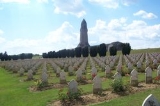
. Today the Douaumont ossuary
Douaumont ossuary

The Douaumont ossuary is a memorial containing the remains of soldiers who died on the battlefield during the Battle of Verdun in World War I....
, which contains the remains of thousands of soldiers killed in the Battle of Verdun
Battle of Verdun

The Battle of Verdun was one of the most critical List of World War I Battles in World War I on the Western Front . It was fought between the German Army and France armies, from 21 February to 15 December 1916, on hilly terrain north of the city of Verdun in northeastern France....
, stands above the valley.

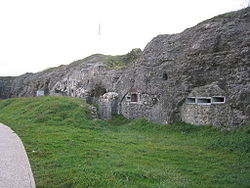
construction work for Fort de Douaumont started in 1885 and the fort was continually reinforced until 1913. The fort is situated on some of the highest ground in the area.

It has a total surface area of 30,000 square metres and is approximately 400 metres long, with two subterranean levels protected by a steel reinforced concrete roof 12 metres thick.


Discussion
Ask a question about 'Douaumont'
Start a new discussion about 'Douaumont'
Answer questions from other users
Full Discussion Forum


Encyclopedia


Douaumont is a commune
Communes of France

The commune is the lowest level of administrative divisions in the France. The French word commune appeared in the 12th century, from Medieval Latin Medieval commune, meaning a small gathering of people sharing a common life, from Latin communis, things held in common....
 in the Meuse
Meuse

Meuse is a departments of France in northeast France, named after the Meuse River....
 department in Lorraine
Lorraine (région)

Lorraine is one of the 26 Regions of France of France. It is the only administrative region with two cities of equal importance, Metz and Nancy....
 in northeastern France
France

France , officially the French Republic , is a country whose Metropolitan France is located in Western Europe and that also comprises various Overseas departments and territories of France....
.

The village was destroyed during World War I
World War I

World War I, or the First World War , was a global military conflict which involved the Great powers, organized into two opposing military alliances: the Allies of World War I and the Central Powers....
. Today the Douaumont ossuary
Douaumont ossuary

The Douaumont ossuary is a memorial containing the remains of soldiers who died on the battlefield during the Battle of Verdun in World War I....
, which contains the remains of thousands of soldiers killed in the Battle of Verdun
Battle of Verdun

The Battle of Verdun was one of the most critical List of World War I Battles in World War I on the Western Front . It was fought between the German Army and France armies, from 21 February to 15 December 1916, on hilly terrain north of the city of Verdun in northeastern France....
, stands above the valley.

Douaumont Fort

The construction work for Fort de Douaumont started in 1885 and the fort was continually reinforced until 1913. The fort is situated on some of the highest ground in the area.

It has a total surface area of 30,000 square metres and is approximately 400 metres long, with two subterranean levels protected by a steel reinforced concrete roof 12 metres thick. The fort was equipped with numerous armed posts, a 155 mm gun turret, a 75 mm gun turret, several other 75 mm guns in flanking "Bourges Casemates" and numerous machinegun turrets.

The German invasion of Belgium
Belgium

* A small German-speaking Community of Belgium exists in eastern Wallonia. Belgium's linguistic diversity and related political and cultural conflicts are reflected in the history of Belgium and a complex Communities and regions of Belgium....
 in 1914 forced military planners to radically rethink the utility of fortification in war. Belgium's comparable forts were quickly destroyed by German artillery, and easily overrun. The decision was made in August 1915 to reduce the garrison at Douaumont and to strip the fort of virtually all its weaponry except for the 155 mm and one of the 75s.

Capture

In February 1916 the Germans, unaware of Douaumont's semi-abandoned state, launched the Verdun offensive with Douaumont as a key objective. Douaumont was manned by fewer than 30 troops, assigned to fire its two largest guns.

As elements of the German 24th Brandenburg Regiment (6 Infanterie-Division, III Armeekorps) approached on February 25, most of the garrison had gone to the lower levels of the fort to escape the incessant German shelling with large-calibre guns. A battery of very heavy 420 mm German howitzer
Howitzer

A howitzer is a type of artillery piece that is characterized by a relatively short Barrel and the use of comparatively small explosive charges to propel projectiles at trajectories with a steep angle of descent....
s were also pounding the fort, damaging the 75 mm gun turret.

The French occupants had been without communication with the outside world for some time. The observation cupolas
Gun turret

A gun turret is a device that protects the crew or mechanism of a artillery and at the same time lets the weapon be aimed and fired in many directions....
 were unoccupied. Only a gunnery team were at their post in the 155 mm gun turret.

About 10 combat engineers from the Brandenburg regiment, led by Pioneer-Sergeant Kunze, managed to approach the fort unopposed. Visibility was poor due to bad weather and French machine gunners in the village of Douaumont thought the Germans were French colonial troops returning from a patrol.

Kunze and his men reached the fort's moat and found that the pillbox
Pillbox

Pillbox can refer to:* A small box in which pills are kept* Pillbox hat* Military term for a type of Bunker#Pillbox* For military pillboxes in the UK, see: British hardened field defences of World War II...
es defending the moat were unoccupied. Kunze managed to climb inside one to open an access door. But his men refused to go inside the fortifications as they feared an ambush. The Pioneer-Sergeant, armed only with a pistol, entered alone. He wandered around the empty tunnels in Douaumont until he found the artillery team. Kunze captured them and locked them up.

By now another group from the Brandenburg regiment, led by reserve-officer Leutnant Radtke, was also entering the fort through its unoccupied defences. He then made contact with Kunze's troops. He organised them before they spread out capturing a few more french defenders and securing the fort.

Later more columns of german troops under Hauptman Haupt and Oberleutnant von Brandis arrived.

No shots were ever fired in the capture of Fort Douaumont. The only casualty was one of Kunze's men who had scraped his knee.

Despite being the last officer to enter the fort, the latecomer von Brandis was the one who dispatched the report on the capture of Douaumont to the German High Command.

A few days later, the Prussian officer was telling His Imperial Majesty the Crown Prince about its heroic seizure. No mention was made of the efforts Lt Ratke or NCO Kunze.

Instead Von Brandis became the hero of Douaumont and was awarded the Pour le Mérite
Pour le Mérite

The Pour le M?rite, known informally during World War I as the Blue Max , was the Kingdom of Prussia's highest military Order until the end of World War I....
, (Hauptman Haupt received it later, too). But Kunze, who broke in and locked up the garrison, and Ratke, who took command during the fort's capture, received nothing.

It was not until the 1930s after historians from the German Great War committée had time to review Fort Douaumont's capture that credit was belatedly given. Kunze, now a police officer
Ordnungspolizei

The Ordnungspolizei was the name for the uniformed regular Germany police force in existence during the period of Nazi Germany, notably between 1936 and 1945....
, received a promotion and Leutenant Ratke got an autographed portrait of the, now deposed, Crown Prince.

Douaumont, designed to hold back the Germans and inflict terrible losses on its attackers, had been given up without a fight. In the words of one French divisional commander, its loss would cost the French 100,000 lives This constituted a terrible blow to French pride, and was a glaring example of the incompetence of the French General Staff under Joffre. Douaumont was an invulnerable shelter and operations base for German forces just behind the front line. The Germans came to refer to the place as "Old Uncle Douaumont".

Recapture

The French made many attempts to recapture the fort from May 1916, suffering heavy losses. The Germans stubbornly held on to the fort, as it provided shelter for troops and served as first aid station and logistics centre. Every French attack was met with blistering artillery fire and direct fire from the fort. In turn the French artillery constantly shelled the fort, turning the area into a pockmarked moonscape, traces of which are still visible today.

On the 8th May, a careless cooking fire detonated grenades and flamethrower fuel. This in turn detonated an ammunitions cache. A firestorm ripped through the fort killing hundreds of soldiers instantly, including the entire 12th Grenadiers regimental staff. Worse, some survivors attempting to escape the inferno were mistaken for attacking French infantry by their comrades outside the fort, and were mercilessly gunned down. The exact casualties are unknown, but over 600 bodies were buried in a casemate which was walled off and is now considered an official German military cemetery.

was recaptured on the 24 October 1916 by the Regiment of Colonial Infantry of Morocco
RICM

The RICM, in French language R?giment d'Infanterie de Chars de Marine is a light cavalry regiment of the French Army belonging to the "Troupes de Marine"....
 after the Germans withdrew. They had been pounded for days by two super heavy 400 mm (16 inch) long range French railway guns emplaced at Baleycourt, to the southwest of Verdun. Up to that point, millions of lesser caliber shells had been fired at the fort since its capture by the Germans to little avail, and thousands of men had died in attempts to recapture it.

See also

  • French villages destroyed in the First World War
    French villages destroyed in the First World War

    During the World War I, specifically at the time of the Battle of Verdun in 1916, nine villages in the France d?partement in France of Meuse were destroyed by the fighting....
  • Communes of the Meuse department


External links