

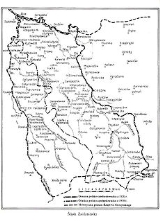
Zaolzie

Encyclopedia
Zaolzie AUD is the Polish name for an area now in the Czech Republic
which was disputed between interwar Poland
and Czechoslovakia. The name means "lands beyond the Olza River
"; it is also called Śląsk zaolziański, meaning "trans-Olza Silesia
". Equivalent terms in other languages include Zaolší (Zaolží) in Czech and Olsa-Gebiet in German. The Zaolzie region was created in 1920, when Cieszyn Silesia
was divided between Czechoslovakia and Poland. Zaolzie forms the eastern part of the Czech portion of Cieszyn Silesia. The division did not satisfy any side, and persisting conflict over the region led to its annexation by Poland in October 1938, following the Munich Agreement
. After German invasion of Poland in 1939, the area became a part of Nazi Germany until 1945. After the war, the 1920 borders were restored.
Historically, the largest specified ethnic group inhabiting this area were those identifying as Poles. Under Austrian rule, Cieszyn Silesia was divided into four districts. One of them, Frýdek
, had a mostly Czech population, the other three were mostly inhabited by Poles. During the 19th century the number of ethnic Germans grew. After declining at the end of the 19th century, at the beginning of the 20th century and later from 1920 to 1938 the Czech population grew significantly (mainly as a result of immigration and the assimilation of locals) and Poles became a minority, which they are to this day. Another significant ethnic group were the Jews
, but almost the entire Jewish population was exterminated during World War II
.
In addition to the Polish, Czech and German national orientations there was another group living in the area, the Ślązakowcy, who claimed a distinct Silesian national identity. This group enjoyed popular support throughout the whole of Cieszyn Silesia
although its strongest supporters were among the Protestants
in eastern part of the Cieszyn Silesia (now part of Poland
) and not in Zaolzie itself.
land"), as Zaolží or Zaolší (equivalent to Zaolzie), or as Těšínsko or Těšínské Slezsko (meaning Cieszyn Silesia
). The term Zaolzie is also used by foreign scholars, including American ethnolinguist Kevin Hannan
.
The term Zaolzie denotes the territory of the former districts of Český Těšín
and Fryštát
, in which the Polish population formed a majority according to the 1910 Austrian census. It makes up the eastern part of the Czech portion of Cieszyn Silesia
. However, historian Józef Szymeczek notes that the term is often mistakenly used for the whole Czech part of Cieszyn Silesia.
Since the 1960 reform of administrative divisions of Czechoslovakia, Zaolzie has consisted of Karviná District
and the eastern part of Frýdek-Místek District
.
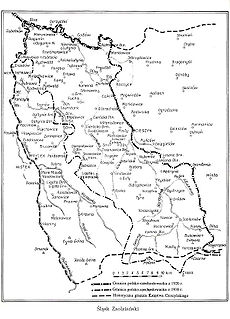 Initially the area was a part of Great Moravia
. From 950 to 1060 it was under the rule of Principality of Bohemia
, and from 1060 it was part of Poland. From 1327 the whole area of the Duchy of Cieszyn
became an autonomic fiefdom
of the Bohemian crown. Upon the death of Elizabeth Lucretia, its last ruler from the Polish Piast dynasty
in 1653, it passed directly to the Czech kings from the Habsburg
dynasty together with the remainder of the Duchy of Cieszyn
. When most of Silesia
was conquered by Prussia's Frederick the Great in 1742, the Cieszyn region was part of the small southern portion that was retained by the Habsburg monarchy (Austrian Silesia
).
Up to the mid-19th century members of the local Slav population did not identify themselves as members of larger ethnolinguistic entities. In Cieszyn Silesia (as in all West Slavic borderlands) various territorial identities pre-dated ethnic and national identity. Consciousness of membership within a greater Polish or Czech nation spread slowly in Silesia.
From 1848 to the end of the 19th century, local Polish and Czech people co-operated, united against the Germanizing tendencies of the Austrian Empire
and later of Austria-Hungary
. At the end of the century, ethnic tensions arose as the area's economic significance grew. This growth caused a wave of immigration from Galicia. About 60,000 people arrived between 1880 and 1910. The new immigrants were Polish and poor, about half of them being illiterate. They worked in coal mining and metallurgy. For these people the most important factor was material well-being; they cared little about the homeland from which they had fled. Almost all of them assimilated
into the Czech population. Many of them settled in Ostrava
(west of the ethnic border), as heavy industry was spread through the whole western part of Cieszyn Silesia. Even today, ethnographers find that about 25,000 people in Ostrava (about 8% of the population) have Polish surnames.
The Czech population (living mainly in the northern part of the area: Bohumín
, Orlová
, etc.) declined numerically at the end of the 19th century, assimilating with the prevalent Polish population. This process shifted with the industrial boom in the area.
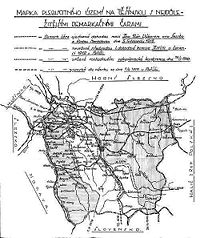 Originally, both national councils (the Polish Rada Narodowa Księstwa Cieszyńskiego in its declaration "Ludu śląski!" of 30 October 1918 and the Czech Zemský národní výbor pro Slezsko in its declaration of 1 November 1918) claimed the whole Cieszyn Silesia for themselves.
On 31 October 1918, at the dusk of World War I
and the dissolution of Austria-Hungary, the majority of the area was taken over by local Polish authorities supported by armed forces. The interim
agreement of 2 November 1918 reflected the inability of the two national councils to come to final delimitation
. On 5 November 1918, the area was divided between Poland and Czechoslovakia by an interim agreement of two local self-government councils (Czech Zemský národní výbor pro Slezsko and Polish Rada Narodowa Księstwa Cieszyńskiego). Before that, the majority of the area was taken over by Polish local authorities. In 1919 both councils were absorbed by the newly created and independent central governments in Prague
and Warsaw
. The former was not satisfied with this compromise and on 23 January 1919 invaded the area while Poland was engaged in its war
against the West Ukrainian National Republic
.
The reason for the Czech invasion in 1919 was primarily the organisation of elections
to the Sejm
(parliament) of Poland
in the disputed area. The elections were to be held in the whole of Cieszyn Silesia. The Czechs claimed that the polls must not be held in the disputed area as the delimitation was only interim and no sovereign rule should be executed there by any party. When the Czech demand was rejected by the Poles, the Czechs decided to resolve the issue by force.
Czech units were held up near Skoczów
and a ceasefire
was signed on 3 February. The new Czechoslovakia claimed the area partly on historic and ethnic grounds, but especially on economic grounds. The area was important for the Czechs as the crucial railway line connecting Czech Silesia
with Slovakia
crossed the area (the Košice-Bohumín Railway
, which was one of only two railroads that linked the Czech provinces to Slovakia at that time). The area is also very rich in black coal. Many important coal mines, facilities and metallurgy
factories are located there. The Polish side based its claim to the area on ethnic criteria: a majority of the area's population was Polish according to the last (1910) Austrian census.
In this very tense atmosphere it was decided that a plebiscite would be held in the area asking people which country this territory should join. Plebiscite commissioners arrived there at the end of January 1920, and after analysing the situation declared a state of emergency
in the territory on 19 May 1920. The situation in the area remained very tense, with mutual intimidation, acts of terror, beatings and even killings. A plebiscite could not be held in this atmosphere. On 10 July both sides renounced the idea of a plebiscite and entrusted the Conference of Ambassadors with the decision. Eventually, on 28 July 1920, by a decision of the Spa Conference
, Czechoslovakia received 58.1% of the area of Cieszyn Silesia, containing 67.9% of the population. It was this territory that became known, originally from the Polish standpoint, as Zaolzie – the Olza River
marked the boundary between the Polish and Czechoslovak parts of the territory.
The most vocal support for union with Poland had come from within the territory awarded to Czechoslovakia, while some of the strongest opponents of Polish rule came from the territory awarded to Poland.
. It was observed that under the agreement of 5 November, the Poles controlled about a third of the duchy's coal mines. The Czechs realized that they had given away rather a lot (...) It was recognized that any takeover in Teschen would have to be accomplished in a manner acceptable by the victorious Allies (...), so the Czechs cooked up a tale that the Teschen area was becoming Bolshevik
(...) The Czechs put together a substantial body of infantry - about 15,000 men - and on 23 January 1919, they invaded the Polish-held areas. To confuse the Poles, the Czechs recruited some Allied officers of Czech background and put these men in their respective wartime uniforms at the head of the invasion forces. After a little skirmishing, the tiny Polish defense force was nearly driven out." Watt fails to mention the Czech opposition to Sejm elections as well as prior deployment of Polish troops and arming up of Poles in the disputed area.
In 1919, the matter went to consideration in Paris before the World War I Allies. Watt claims the Poles based their claims on ethnographical reasons and the Czechs based their need on the Teschen coal, useful in order to influence the actions of Austria
and Hungary
, whose capitals were fuelled by coal from the duchy. Watt overlooks the Czech minority in the region, as well as the urgent Czechoslovak need for the only railway running to war-torn eastern Slovakia which passed through Zaolzie. The Allies finally decided that the Czechs should get 60 percent of the coal fields and the Poles were to get most of the people and the strategic rail line. Watt writes: "Czech envoy Edvard Beneš
proposed a plebiscite. The Allies were shocked, arguing that the Czechs were bound to lose it. However, Beneš was insistent and a plebiscite was announced in September 1919. As it turned out, Beneš knew what he was doing. A plebiscite would take some time to set up, and a lot could happen in that time – particularly when a nation's affairs were conducted as cleverly as were Czechoslovakia's."
Watt argues that Beneš strategically waited for Poland's moment of weakness, and moved in during the Polish-Soviet War
crisis in July 1920. As Watt writes, "Over the dinner table, Beneš convinced the British and French that the plebiscite should not be held and that the Allies should simply impose their own decision in the Teschen matter. More than that, Beneš persuaded the French and the British to draw a frontier line that gave Czechoslovakia most of the territory of Teschen, the vital railroad and all the important coal fields. With this frontier, 139,000 Poles were to be left in Czech territory, whereas only 2,000 Czechs were left on the Polish side".
"The next morning Beneš visited the Polish delegation at Spa. By giving the impression that the Czechs would accept a settlement favorable to the Poles without a plebiscite, Beneš got the Poles to sign an agreement that Poland would abide by any Allied decision regarding Teschen. The Poles, of course, had no way of knowing that Beneš had already persuaded the Allies to make a decision on Teschen. After a brief interval, to make it appear that due deliberation had taken place, the Allied Council of Ambassadors in Paris imposed its 'decision'. Only then did it dawn on the Poles that at Spa they had signed a blank check. To them, Beneš' stunning triumph was not diplomacy, it was a swindle (...) As Polish Prime Minister Wincenty Witos
warned: 'The Polish nation has received a blow which will play an important role in our relations with the Czechoslovak Republic. The decision of the Council of Ambassadors has given the Czechs a piece of Polish land containing a population which is mostly Polish... The decision has caused a rift between these two nations which are ordinarily politically and economically united' (...)."
The affair soured the Prague-Warsaw relationship and proved a tragedy when the needed co-operation against expansionist Nazi Germany
failed to materialise in 1938.
. He notes that when the French government recognised Czechoslovakia's right to the "boundaries of Bohemia
, Moravia
, and Austrian Silesia
" in its note to Austria
of 19 December, the Czechoslovak government acted under the impression it had French support for its claim to Cieszyn Silesia as part of Austrian Silesia. However, Paris believed it gave that assurance only against German-Austrian claims, not Polish ones. Paris, however, viewed both Czechoslovakia and Poland
as potential allies against Germany
and did not want to cool relations with either. Mamatey writes that the Poles "brought the matter before the peace conference that had opened in Paris on 18 January. On 29 January, the Council of Ten summoned Beneš and the Polish delegate Roman Dmowski
to explain the dispute, and on 1 February obliged them to sign an agreement redividing the area pending its final disposition by the peace conference. Czechoslovakia thus failed to gain her objective in Teschen."
With respect to the arbitration decision itself, Mamatey writes that "On 25 March, to expedite the work of the peace conference, the Council of Ten was divided into the Council of Four (The "Big Four") and the Council of Five (the foreign ministers). Early in April the two councils considered and approved the recommendations of the Czechoslovak commission without a change – with the exception of Teschen, which they referred to Poland
and Czechoslovakia to settle in bilateral negotiations." When the Polish-Czechoslovak negotiations failed, the Allied powers proposed plebiscites in the Cieszyn Silesia and also in the border districts of Orava
and Spiš
(now in Slovakia
) to which the Poles had raised claims. In the end, however, no plebiscites were held due to the rising mutual hostilities of Czechs and Poles in Cieszyn Silesia. Instead, on 28 July 1920 the Spa Conference
(also known as the Conference of Ambassadors) divided each of the three disputed areas between Poland
and Czechoslovakia.
are included as Poles or not) range from 110,000 to 140,000 people in 1921. The 1921 and 1930 census
numbers are not accurate since nationality depended on self-declaration and many Poles filled in Czech nationality mainly as a result of fear of the new authorities and as compensation for some benefits. Czechoslovak law guaranteed rights for national minorities but reality in Zaolzie was quite different. Local Czech authorities made it more difficult for local Poles to obtain citizenship, while the process was expedited when the applicant pledged to declare Czech nationality and send his children to a Czech school. Newly built Czech schools were often better supported and equipped, thus inducing some Poles to send their children there. Czechs schools were built in ethnically almost entirely Polish municipalities. This and other factors contributed to the cultural assimilation
of Poles and also to significant emigration to Poland. After few years, the heightened nationalism
typical for the years around 1920 receded and local Poles increasingly co-operated with Czechs. Still, Czechization was supported by Prague, which did not follow certain laws related to language, legislative and organizational issues. Polish deputies in Czechoslovak National Assembly frequently tried to put that issues on agenda. One way or the other, increasingly local Poles thus assimilated into the Czech population.
. The Poles regarded the city as of crucial importance to the area and to Polish interests. On 28 September, Edvard Beneš
composed a note to the Polish administration offering to reopen the debate surrounding the territorial demarcation in Těšínsko in the interest of mutual relations, but he delayed in sending it in hopes of good news from London and Paris, which came only in a limited form. Beneš then turned to the Soviet
leadership in Moscow, which begun a partial mobilisation in eastern Belarus and the Ukrainian SSR
and threatened Poland with the dissolution of the Soviet-Polish non-aggression pact
.
Nevertheless, the Polish leader, Colonel Józef Beck
believed that Warsaw should act rapidly to forestall the German occupation of the city. At noon on 30 September, Poland gave an ultimatum to the Czechoslovak government. It demanded the immediate evacuation of Czechoslovak troops and police and gave Prague time until noon the following day. At 11:45 a.m. on 1 October the Czechoslovak foreign ministry called the Polish ambassador in Prague and told him that Poland could have what it wanted. The Polish Army, commanded by General Władysław Bortnowski, annexed an area of 801.5 km² with a population of 227,399 people.
The Germans were delighted with this outcome, and were happy to give up the sacrifice of a small provincial rail centre to Poland in exchange for the ensuing propaganda benefits. It spread the blame of the partition of the Republic of Czechoslovakia, made Poland a participant in the process and confused political expectations. Poland was accused of being an accomplice of Nazi Germany
– a charge that Warsaw was hard-put to deny.
The Polish side argued that Poles in Zaolzie deserved the same ethnic rights and freedom as the Sudeten Germans
under the Munich Agreement
. The vast majority of the local Polish population enthusiastically welcomed the change, seeing it as a liberation and a form of historical justice, but they quickly changed their mood. The new Polish authorities appointed people from Poland to various key positions from which locals were fired. The Polish language became the sole official language. Using Czech (or German) by Czechs (or Germans) in public was prohibited and Czechs and Germans were being forced to leave the annexed area or become subject to Polonization
. Rapid Polonization policies then followed in all parts of public and private life. Czech organizations were dismantled and their activity was prohibited. The Roman Catholic parishes in the area belonged either to the Archdiocese of Breslau (Archbishop Bertram) or to the Archdiocese of Olomouc (Archbishop Leopold Prečan), respectively, both traditionally comprising cross-border diocesan territories in Czechoslovakia and Germany. When the Polish government demanded after its takeover that the parishes there be disentangled from these two archdioceses, the Holy See complied. Pope Pius XI
, former nuncio to Poland, subjected the Catholic parishes in Zaolzie to an apostolic administration
under Stanisław Adamski, Bishop of Katowice.
Czechoslovak education in the Czech
and German language
ceased to exist. About 35,000 Czechoslovaks emigrated to core Czechoslovakia
(the later Protectorate of Bohemia and Moravia
) by choice or forcibly. The behaviour of the new Polish authorities was different but similar in nature to that of the Czechoslovak ones before 1938. Two political factions appeared: socialists (the opposition) and rightists (loyal to the new Polish national authorities). Leftist politicians and sympathizers were discriminated against and often fired from work. The Polish political system was artificially implemented in Zaolzie. The local Poles continued to feel like second-class citizens and a majority of them were dissatisfied with the situation after October 1938. Zaolzie remained a part of Poland for only 11 months until the invasion of Poland started on September 1, 1939.
Richard M. Watt describes the Polish capture of Teschen in these words: "Amid the general euphoria in Poland – the acquisition of Teschen was a very popular development – no one paid attention to the bitter comment of the Czechoslovak general who handed the region over to the incoming Poles. He predicted that it would not be long before the Poles would themselves be handing Teschen over to the Germans."
Watt also writes that "the Polish 1938 ultimatum to Czechoslovakia and its acquisition of Teschen were gross tactical errors. Whatever justice there might have been to the Polish claim upon Teschen, its seizure in 1938 was an enormous mistake in terms of the damage done to Poland's reputation among the democratic powers of the world."
invaded Poland
, starting World War II
, and subsequently made Zaolzie part of the Military district of Upper Silesia. On 26 October 1939 Nazi Germany unilaterally annexed Zaolzie as part of Landkreis Teschen
. During the war, strong Germanization was introduced by the authorities. The Jews
were in the worst position, followed by the Poles. Poles received lower food rations, they were supposed to pay extra taxes, they were not allowed to enter theatres, cinemas, etc. Polish and Czech education ceased to exist, Polish organizations were dismantled and their activity was prohibited. So also Katowice's Bishop Adamski was deposed as apostolic administrator for the Catholic parishes in Zaolzie and on 23 December 1939 Cesare Orsenigo
, nuncio to Germany, returned them to their original archdioceses of Breslau or Olomouc, respectively, with effect of 1 January 1940.
The German authorities introduced terror into Zaolzie. The Nazis especially targeted the Polish intelligentsia, many of whom died during the war. Mass killings, executions, arrests, taking locals to forced labour and deportations to concentration camps
all happened on a daily basis. The most notorious war crime was a murder of 36 villagers in and around Żywocice
on 6 August 1944. This massacre is known as Tragedia Żywocicka (the Żywocice tragedy). The resistance movement
, mostly composed of Poles, was fairly strong in Zaolzie. Volkslist
s – a document in which a non-German citizen declared that he had some German ancestry by signing it; refusal to sign this document could lead to deportation to a concentration camp – were introduced. Local people who took them were later on enrolled in the Wehrmacht
. Many local people with no German ancestry were also forced to take them. The World War II death toll in Zaolzie is estimated at about 6,000 people: about 2,500 Jews, 2,000 other citizens (80% of them being Poles) and more than 1,000 locals who died in the Wehrmacht (those who took the Volksliste). Also a few hundred Poles from Zaolzie were murdered by Soviets in the Katyn massacre
.
Percentage-wise, Zaolzie suffered the worst human loss from the whole of Czechoslovakia – about 2.6% of the total population.
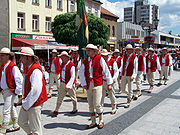 Immediately after World War II
, Zaolzie was returned to Czechoslovakia within its 1920 borders, although local Poles hoped it would again be given to Poland. While most Czechoslovaks of German ethnicity were expelled
, the local Polish population again suffered discrimination, as many Czechs blamed them for the discrimination by the Polish authorities in 1938–1939. Polish organizations were banned, and the Czechoslovak authorities carried out many arrests and dismissed many Poles from work. The situation had somehow improved when the Communist Party of Czechoslovakia
took power in February 1948. Polish property deprived by the German occupants during the war was never returned.
As to the Catholic parishes in Zaolzie pertaining to the Archdiocese of Breslau Archbishop Bertram, then residing in the episcopal Jánský vrch
castle in Czechoslovak Javorník (Jauernig)
, appointed František Onderek (1888–1962) as vicar general
for the Czechoslovak portion of the Archdiocese of Breslau on 21 June 1945. In July 1946 Pope Pius XII
elevated Onderek to Apostolic Administrator for the Czechoslovak portion of the Archdiocese of Breslau (colloquially: Apostolic Administration of Český Těšín; ), seated in Český Těšín
, thus disentangling the parishes from Breslau's jurisdiction. On 31 May 1978 Pope Paul VI
merged the apostolic administration into the Archdiocese of Olomouc through his Apostolic constitution
Olomoucensis et aliarum.
Poland
signed a treaty with Czechoslovakia
in Warsaw on 13 June 1958 confirming the border as it existed on 1 January 1938. After the Communist takeover of power, the industrial boom continued and many immigrants arrived in the area (mostly from other parts of Czechoslovakia, mainly from Slovakia
). The arrival of Slovaks
significantly changed the ethnic structure of the area, as almost all the Slovak immigrants assimilated into the Czech majority in the course of time. The number of self-declared Slovaks is rapidly declining. The last Slovak elementary school was closed in Karviná
several years ago. Since the dissolution of Czechoslovakia
in 1993, Zaolzie has been part of the independent Czech Republic
. However a significant Polish minority
still remains there.
to the European Union
in May 2004, and especially the entry of the countries to the EU's passport-free Schengen zone in late 2007, reduced the significance of territorial disputes, ending systematic controls on the border between the countries. Signs prohibiting passage across the state border were removed, with individuals now allowed to cross the border freely at any point of their choosing.
Sources: Zahradnik 1992, 178-179. Siwek 1996, 31-38.
Czech Republic
The Czech Republic is a landlocked country in Central Europe. The country is bordered by Poland to the northeast, Slovakia to the east, Austria to the south, and Germany to the west and northwest....
which was disputed between interwar Poland
Second Polish Republic
The Second Polish Republic, Second Commonwealth of Poland or interwar Poland refers to Poland between the two world wars; a period in Polish history in which Poland was restored as an independent state. Officially known as the Republic of Poland or the Commonwealth of Poland , the Polish state was...
and Czechoslovakia. The name means "lands beyond the Olza River
Olza River
is a river in Poland and the Czech Republic, the right tributary of the Oder River. It flows from the Silesian Beskids through southern Cieszyn Silesia in Poland and Frýdek-Místek and Karviná districts of the Czech Republic, often forming the border with Poland. It flows into the Oder River north...
"; it is also called Śląsk zaolziański, meaning "trans-Olza Silesia
Silesia
Silesia is a historical region of Central Europe located mostly in Poland, with smaller parts also in the Czech Republic, and Germany.Silesia is rich in mineral and natural resources, and includes several important industrial areas. Silesia's largest city and historical capital is Wrocław...
". Equivalent terms in other languages include Zaolší (Zaolží) in Czech and Olsa-Gebiet in German. The Zaolzie region was created in 1920, when Cieszyn Silesia
Cieszyn Silesia
Cieszyn Silesia or Těšín Silesia or Teschen Silesia is a historical region in south-eastern Silesia, centered around the towns of Cieszyn and Český Těšín and bisected by the Olza River. Since 1920 it has been divided between Poland and Czechoslovakia, and later the Czech Republic...
was divided between Czechoslovakia and Poland. Zaolzie forms the eastern part of the Czech portion of Cieszyn Silesia. The division did not satisfy any side, and persisting conflict over the region led to its annexation by Poland in October 1938, following the Munich Agreement
Munich Agreement
The Munich Pact was an agreement permitting the Nazi German annexation of Czechoslovakia's Sudetenland. The Sudetenland were areas along Czech borders, mainly inhabited by ethnic Germans. The agreement was negotiated at a conference held in Munich, Germany, among the major powers of Europe without...
. After German invasion of Poland in 1939, the area became a part of Nazi Germany until 1945. After the war, the 1920 borders were restored.
Historically, the largest specified ethnic group inhabiting this area were those identifying as Poles. Under Austrian rule, Cieszyn Silesia was divided into four districts. One of them, Frýdek
Frýdek-Místek
Frýdek-Místek is a city in Moravian-Silesian Region of the Czech Republic. It is the administrative center of Frýdek-Místek District. It comprises two formerly independent towns, Frýdek and Místek, divided by the Ostravice River...
, had a mostly Czech population, the other three were mostly inhabited by Poles. During the 19th century the number of ethnic Germans grew. After declining at the end of the 19th century, at the beginning of the 20th century and later from 1920 to 1938 the Czech population grew significantly (mainly as a result of immigration and the assimilation of locals) and Poles became a minority, which they are to this day. Another significant ethnic group were the Jews
Jews
The Jews , also known as the Jewish people, are a nation and ethnoreligious group originating in the Israelites or Hebrews of the Ancient Near East. The Jewish ethnicity, nationality, and religion are strongly interrelated, as Judaism is the traditional faith of the Jewish nation...
, but almost the entire Jewish population was exterminated during World War II
World War II
World War II, or the Second World War , was a global conflict lasting from 1939 to 1945, involving most of the world's nations—including all of the great powers—eventually forming two opposing military alliances: the Allies and the Axis...
.
In addition to the Polish, Czech and German national orientations there was another group living in the area, the Ślązakowcy, who claimed a distinct Silesian national identity. This group enjoyed popular support throughout the whole of Cieszyn Silesia
Cieszyn Silesia
Cieszyn Silesia or Těšín Silesia or Teschen Silesia is a historical region in south-eastern Silesia, centered around the towns of Cieszyn and Český Těšín and bisected by the Olza River. Since 1920 it has been divided between Poland and Czechoslovakia, and later the Czech Republic...
although its strongest supporters were among the Protestants
Protestantism
Protestantism is one of the three major groupings within Christianity. It is a movement that began in Germany in the early 16th century as a reaction against medieval Roman Catholic doctrines and practices, especially in regards to salvation, justification, and ecclesiology.The doctrines of the...
in eastern part of the Cieszyn Silesia (now part of Poland
Poland
Poland , officially the Republic of Poland , is a country in Central Europe bordered by Germany to the west; the Czech Republic and Slovakia to the south; Ukraine, Belarus and Lithuania to the east; and the Baltic Sea and Kaliningrad Oblast, a Russian exclave, to the north...
) and not in Zaolzie itself.
Name and territory
The term Zaolzie (meaning "the trans-Olza", i.e. "lands beyond the Olza") is used predominantly in Poland and also commonly by the Polish minority living in the territory. In Czech it is referred to as České Těšínsko/Českotěšínsko ("Czech Cieszyn/TěšínCieszyn
Cieszyn is a border-town and the seat of Cieszyn County, Silesian Voivodeship, southern Poland. It has 36,109 inhabitants . Cieszyn lies on the Olza River, a tributary of the Oder river, opposite Český Těšín....
land"), as Zaolží or Zaolší (equivalent to Zaolzie), or as Těšínsko or Těšínské Slezsko (meaning Cieszyn Silesia
Cieszyn Silesia
Cieszyn Silesia or Těšín Silesia or Teschen Silesia is a historical region in south-eastern Silesia, centered around the towns of Cieszyn and Český Těšín and bisected by the Olza River. Since 1920 it has been divided between Poland and Czechoslovakia, and later the Czech Republic...
). The term Zaolzie is also used by foreign scholars, including American ethnolinguist Kevin Hannan
Kevin Hannan
Kevin J. Hannan was American ethnolinguist and slavicist.- Personal life :He was born in the family of Silesian-Irish background...
.
The term Zaolzie denotes the territory of the former districts of Český Těšín
Ceský Tešín
Český Těšín is a town in the Karviná District, Moravian-Silesian Region of the Czech Republic. The town is commonly known in the region as just Těšín . It lies on the west bank of the Olza River, in the heart of the historical region of Cieszyn Silesia...
and Fryštát
Fryštát
is a town in the Moravian-Silesian Region of the Czech Republic, now administratively a part of the city of Karviná. Until 1948 it was a separate town. It lies on the Olza River, in the historical region of Cieszyn Silesia....
, in which the Polish population formed a majority according to the 1910 Austrian census. It makes up the eastern part of the Czech portion of Cieszyn Silesia
Cieszyn Silesia
Cieszyn Silesia or Těšín Silesia or Teschen Silesia is a historical region in south-eastern Silesia, centered around the towns of Cieszyn and Český Těšín and bisected by the Olza River. Since 1920 it has been divided between Poland and Czechoslovakia, and later the Czech Republic...
. However, historian Józef Szymeczek notes that the term is often mistakenly used for the whole Czech part of Cieszyn Silesia.
Since the 1960 reform of administrative divisions of Czechoslovakia, Zaolzie has consisted of Karviná District
Karviná District
Karviná District is a district within the Moravian-Silesian Region of the Czech Republic. Its administrative center is the city of Karviná. It was created by 1960 reform of administrative divisions in the area of former Fryštát District...
and the eastern part of Frýdek-Místek District
Frýdek-Místek District
Frýdek-Místek District is a district within the Moravian-Silesian Region of the Czech Republic. Its administrative center is the city of Frýdek-Místek. It was created by 1960 reform of administrative divisions...
.
History
Great Moravia
Great Moravia was a Slavic state that existed in Central Europe and lasted for nearly seventy years in the 9th century whose creators were the ancestors of the Czechs and Slovaks. It was a vassal state of the Germanic Frankish kingdom and paid an annual tribute to it. There is some controversy as...
. From 950 to 1060 it was under the rule of Principality of Bohemia
Bohemia
Bohemia is a historical region in central Europe, occupying the western two-thirds of the traditional Czech Lands. It is located in the contemporary Czech Republic with its capital in Prague...
, and from 1060 it was part of Poland. From 1327 the whole area of the Duchy of Cieszyn
Duchy of Cieszyn
The Duchy of Cieszyn or Duchy of Teschen or Duchy of Těšín was an autonomous Silesian duchy centered on Teschen in Upper Silesia. After the feudal division of Poland it was split off in 1281 and ruled by Silesian dukes from the Piast dynasty since 1290...
became an autonomic fiefdom
Fiefdom
A fee was the central element of feudalism and consisted of heritable lands granted under one of several varieties of feudal tenure by an overlord to a vassal who held it in fealty in return for a form of feudal allegiance and service, usually given by the...
of the Bohemian crown. Upon the death of Elizabeth Lucretia, its last ruler from the Polish Piast dynasty
Piast dynasty
The Piast dynasty was the first historical ruling dynasty of Poland. It began with the semi-legendary Piast Kołodziej . The first historical ruler was Duke Mieszko I . The Piasts' royal rule in Poland ended in 1370 with the death of king Casimir the Great...
in 1653, it passed directly to the Czech kings from the Habsburg
Habsburg
The House of Habsburg , also found as Hapsburg, and also known as House of Austria is one of the most important royal houses of Europe and is best known for being an origin of all of the formally elected Holy Roman Emperors between 1438 and 1740, as well as rulers of the Austrian Empire and...
dynasty together with the remainder of the Duchy of Cieszyn
Duchy of Cieszyn
The Duchy of Cieszyn or Duchy of Teschen or Duchy of Těšín was an autonomous Silesian duchy centered on Teschen in Upper Silesia. After the feudal division of Poland it was split off in 1281 and ruled by Silesian dukes from the Piast dynasty since 1290...
. When most of Silesia
Silesia
Silesia is a historical region of Central Europe located mostly in Poland, with smaller parts also in the Czech Republic, and Germany.Silesia is rich in mineral and natural resources, and includes several important industrial areas. Silesia's largest city and historical capital is Wrocław...
was conquered by Prussia's Frederick the Great in 1742, the Cieszyn region was part of the small southern portion that was retained by the Habsburg monarchy (Austrian Silesia
Austrian Silesia
Austrian Silesia , officially the Duchy of Upper and Lower Silesia was an autonomous region of the Kingdom of Bohemia and the Austrian Empire, from 1867 a Cisleithanian crown land of Austria-Hungary...
).
Up to the mid-19th century members of the local Slav population did not identify themselves as members of larger ethnolinguistic entities. In Cieszyn Silesia (as in all West Slavic borderlands) various territorial identities pre-dated ethnic and national identity. Consciousness of membership within a greater Polish or Czech nation spread slowly in Silesia.
From 1848 to the end of the 19th century, local Polish and Czech people co-operated, united against the Germanizing tendencies of the Austrian Empire
Austrian Empire
The Austrian Empire was a modern era successor empire, which was centered on what is today's Austria and which officially lasted from 1804 to 1867. It was followed by the Empire of Austria-Hungary, whose proclamation was a diplomatic move that elevated Hungary's status within the Austrian Empire...
and later of Austria-Hungary
Austria-Hungary
Austria-Hungary , more formally known as the Kingdoms and Lands Represented in the Imperial Council and the Lands of the Holy Hungarian Crown of Saint Stephen, was a constitutional monarchic union between the crowns of the Austrian Empire and the Kingdom of Hungary in...
. At the end of the century, ethnic tensions arose as the area's economic significance grew. This growth caused a wave of immigration from Galicia. About 60,000 people arrived between 1880 and 1910. The new immigrants were Polish and poor, about half of them being illiterate. They worked in coal mining and metallurgy. For these people the most important factor was material well-being; they cared little about the homeland from which they had fled. Almost all of them assimilated
Cultural assimilation
Cultural assimilation is a socio-political response to demographic multi-ethnicity that supports or promotes the assimilation of ethnic minorities into the dominant culture. The term assimilation is often used with regard to immigrants and various ethnic groups who have settled in a new land. New...
into the Czech population. Many of them settled in Ostrava
Ostrava
Ostrava is the third largest city in the Czech Republic and the second largest urban agglomeration after Prague. Located close to the Polish border, it is also the administrative center of the Moravian-Silesian Region and of the Municipality with Extended Competence. Ostrava was candidate for the...
(west of the ethnic border), as heavy industry was spread through the whole western part of Cieszyn Silesia. Even today, ethnographers find that about 25,000 people in Ostrava (about 8% of the population) have Polish surnames.
The Czech population (living mainly in the northern part of the area: Bohumín
Bohumín
Bohumín is a town in Karviná District, Moravian-Silesian Region, Czech Republic on the border with Poland. The confluence of the Oder and Olza Rivers is situated just north of the town. The town lies in the historical region of Cieszyn Silesia....
, Orlová
Orlová
Orlová is a town in the Karviná District, Moravian-Silesian Region, Czech Republic. It lies in the historical region of Cieszyn Silesia.- History :...
, etc.) declined numerically at the end of the 19th century, assimilating with the prevalent Polish population. This process shifted with the industrial boom in the area.
Decision time (1918-1920)
On 31 October 1918, at the dusk of World War I
World War I
World War I , which was predominantly called the World War or the Great War from its occurrence until 1939, and the First World War or World War I thereafter, was a major war centred in Europe that began on 28 July 1914 and lasted until 11 November 1918...
and the dissolution of Austria-Hungary, the majority of the area was taken over by local Polish authorities supported by armed forces. The interim
Interim
Interim is an album by British rock band The Fall, compiled from live and studio material and released in 2004. It features the first officially released versions of "Clasp Hands", "Blindness" and "What About Us?" — all of which were later included on the band's next studio album Fall Heads Roll —...
agreement of 2 November 1918 reflected the inability of the two national councils to come to final delimitation
Boundary delimitation
Boundary delimitation, or simply delimitation, is the term used to describe the drawing of boundaries, but is most often used to describe the drawing of electoral boundaries, specifically those of precincts, states, counties or other municipalities...
. On 5 November 1918, the area was divided between Poland and Czechoslovakia by an interim agreement of two local self-government councils (Czech Zemský národní výbor pro Slezsko and Polish Rada Narodowa Księstwa Cieszyńskiego). Before that, the majority of the area was taken over by Polish local authorities. In 1919 both councils were absorbed by the newly created and independent central governments in Prague
Prague
Prague is the capital and largest city of the Czech Republic. Situated in the north-west of the country on the Vltava river, the city is home to about 1.3 million people, while its metropolitan area is estimated to have a population of over 2.3 million...
and Warsaw
Warsaw
Warsaw is the capital and largest city of Poland. It is located on the Vistula River, roughly from the Baltic Sea and from the Carpathian Mountains. Its population in 2010 was estimated at 1,716,855 residents with a greater metropolitan area of 2,631,902 residents, making Warsaw the 10th most...
. The former was not satisfied with this compromise and on 23 January 1919 invaded the area while Poland was engaged in its war
Polish-Ukrainian War
The Polish–Ukrainian War of 1918 and 1919 was a conflict between the forces of the Second Polish Republic and West Ukrainian People's Republic for the control over Eastern Galicia after the dissolution of Austria-Hungary.-Background:...
against the West Ukrainian National Republic
West Ukrainian National Republic
The West Ukrainian People's Republic was a short-lived republic that existed in late 1918 and early 1919 in eastern Galicia, that claimed parts of Bukovina and Carpathian Ruthenia and included the cities of Lviv , Przemyśl , Kolomyia , and Stanislaviv...
.
The reason for the Czech invasion in 1919 was primarily the organisation of elections
Polish legislative election, 1919
The Polish legislative election, 1919 took place on 26 January and were the first election in the Second Polish Republic. The elections, based on universal suffrage and proportional representation, produced a parliament balanced between Right, Left and Center...
to the Sejm
Sejm
The Sejm is the lower house of the Polish parliament. The Sejm is made up of 460 deputies, or Poseł in Polish . It is elected by universal ballot and is presided over by a speaker called the Marshal of the Sejm ....
(parliament) of Poland
Second Polish Republic
The Second Polish Republic, Second Commonwealth of Poland or interwar Poland refers to Poland between the two world wars; a period in Polish history in which Poland was restored as an independent state. Officially known as the Republic of Poland or the Commonwealth of Poland , the Polish state was...
in the disputed area. The elections were to be held in the whole of Cieszyn Silesia. The Czechs claimed that the polls must not be held in the disputed area as the delimitation was only interim and no sovereign rule should be executed there by any party. When the Czech demand was rejected by the Poles, the Czechs decided to resolve the issue by force.
Czech units were held up near Skoczów
Skoczów
Skoczów is a town and the seat of Gmina Skoczów in Cieszyn County, Silesian Voivodeship, southern Poland with 14,783 inhabitants . It lies in the historical region of Cieszyn Silesia....
and a ceasefire
Ceasefire
A ceasefire is a temporary stoppage of a war in which each side agrees with the other to suspend aggressive actions. Ceasefires may be declared as part of a formal treaty, but they have also been called as part of an informal understanding between opposing forces...
was signed on 3 February. The new Czechoslovakia claimed the area partly on historic and ethnic grounds, but especially on economic grounds. The area was important for the Czechs as the crucial railway line connecting Czech Silesia
Czech Silesia
Czech Silesia is an unofficial name of one of the three Czech lands and a section of the Silesian historical region. It is located in the north-east of the Czech Republic, predominantly in the Moravian-Silesian Region, with a section in the northern Olomouc Region...
with Slovakia
Slovakia
The Slovak Republic is a landlocked state in Central Europe. It has a population of over five million and an area of about . Slovakia is bordered by the Czech Republic and Austria to the west, Poland to the north, Ukraine to the east and Hungary to the south...
crossed the area (the Košice-Bohumín Railway
Košice-Bohumín Railway
The Košice–Bohumín Railway can refer to:*originally: A private railway company established in 1869 in Austria-Hungary. In 1924 the company was nationalised and put under the Czechoslovak State Railways....
, which was one of only two railroads that linked the Czech provinces to Slovakia at that time). The area is also very rich in black coal. Many important coal mines, facilities and metallurgy
Metallurgy
Metallurgy is a domain of materials science that studies the physical and chemical behavior of metallic elements, their intermetallic compounds, and their mixtures, which are called alloys. It is also the technology of metals: the way in which science is applied to their practical use...
factories are located there. The Polish side based its claim to the area on ethnic criteria: a majority of the area's population was Polish according to the last (1910) Austrian census.
In this very tense atmosphere it was decided that a plebiscite would be held in the area asking people which country this territory should join. Plebiscite commissioners arrived there at the end of January 1920, and after analysing the situation declared a state of emergency
State of emergency
A state of emergency is a governmental declaration that may suspend some normal functions of the executive, legislative and judicial powers, alert citizens to change their normal behaviours, or order government agencies to implement emergency preparedness plans. It can also be used as a rationale...
in the territory on 19 May 1920. The situation in the area remained very tense, with mutual intimidation, acts of terror, beatings and even killings. A plebiscite could not be held in this atmosphere. On 10 July both sides renounced the idea of a plebiscite and entrusted the Conference of Ambassadors with the decision. Eventually, on 28 July 1920, by a decision of the Spa Conference
Spa Conference
The Spa Conference was a meeting between the Supreme War Council and Weimar Republic in Spa, Belgium on 5–16 July 1920. It was the first post-war conference to include German representatives. The attendees included British and French Prime Ministers Lloyd George and Alexandre Millerand, German...
, Czechoslovakia received 58.1% of the area of Cieszyn Silesia, containing 67.9% of the population. It was this territory that became known, originally from the Polish standpoint, as Zaolzie – the Olza River
Olza River
is a river in Poland and the Czech Republic, the right tributary of the Oder River. It flows from the Silesian Beskids through southern Cieszyn Silesia in Poland and Frýdek-Místek and Karviná districts of the Czech Republic, often forming the border with Poland. It flows into the Oder River north...
marked the boundary between the Polish and Czechoslovak parts of the territory.
The most vocal support for union with Poland had come from within the territory awarded to Czechoslovakia, while some of the strongest opponents of Polish rule came from the territory awarded to Poland.
View by Richard M. Watt
Historian Richard M. Watt writes, "On 5 November 1918, the Poles and the Czechs in the region disarmed the Austrian garrison (...) The Poles took over the areas that appeared to be theirs, just as the Czechs had assumed administration of theirs. Nobody objected to this friendly arrangement (...) Then came second thoughts in PraguePrague
Prague is the capital and largest city of the Czech Republic. Situated in the north-west of the country on the Vltava river, the city is home to about 1.3 million people, while its metropolitan area is estimated to have a population of over 2.3 million...
. It was observed that under the agreement of 5 November, the Poles controlled about a third of the duchy's coal mines. The Czechs realized that they had given away rather a lot (...) It was recognized that any takeover in Teschen would have to be accomplished in a manner acceptable by the victorious Allies (...), so the Czechs cooked up a tale that the Teschen area was becoming Bolshevik
Bolshevik
The Bolsheviks, originally also Bolshevists , derived from bol'shinstvo, "majority") were a faction of the Marxist Russian Social Democratic Labour Party which split apart from the Menshevik faction at the Second Party Congress in 1903....
(...) The Czechs put together a substantial body of infantry - about 15,000 men - and on 23 January 1919, they invaded the Polish-held areas. To confuse the Poles, the Czechs recruited some Allied officers of Czech background and put these men in their respective wartime uniforms at the head of the invasion forces. After a little skirmishing, the tiny Polish defense force was nearly driven out." Watt fails to mention the Czech opposition to Sejm elections as well as prior deployment of Polish troops and arming up of Poles in the disputed area.
In 1919, the matter went to consideration in Paris before the World War I Allies. Watt claims the Poles based their claims on ethnographical reasons and the Czechs based their need on the Teschen coal, useful in order to influence the actions of Austria
Austria
Austria , officially the Republic of Austria , is a landlocked country of roughly 8.4 million people in Central Europe. It is bordered by the Czech Republic and Germany to the north, Slovakia and Hungary to the east, Slovenia and Italy to the south, and Switzerland and Liechtenstein to the...
and Hungary
Hungary
Hungary , officially the Republic of Hungary , is a landlocked country in Central Europe. It is situated in the Carpathian Basin and is bordered by Slovakia to the north, Ukraine and Romania to the east, Serbia and Croatia to the south, Slovenia to the southwest and Austria to the west. The...
, whose capitals were fuelled by coal from the duchy. Watt overlooks the Czech minority in the region, as well as the urgent Czechoslovak need for the only railway running to war-torn eastern Slovakia which passed through Zaolzie. The Allies finally decided that the Czechs should get 60 percent of the coal fields and the Poles were to get most of the people and the strategic rail line. Watt writes: "Czech envoy Edvard Beneš
Edvard Beneš
Edvard Beneš was a leader of the Czechoslovak independence movement, Minister of Foreign Affairs and the second President of Czechoslovakia. He was known to be a skilled diplomat.- Youth :...
proposed a plebiscite. The Allies were shocked, arguing that the Czechs were bound to lose it. However, Beneš was insistent and a plebiscite was announced in September 1919. As it turned out, Beneš knew what he was doing. A plebiscite would take some time to set up, and a lot could happen in that time – particularly when a nation's affairs were conducted as cleverly as were Czechoslovakia's."
Watt argues that Beneš strategically waited for Poland's moment of weakness, and moved in during the Polish-Soviet War
Polish-Soviet War
The Polish–Soviet War was an armed conflict between Soviet Russia and Soviet Ukraine and the Second Polish Republic and the Ukrainian People's Republic—four states in post–World War I Europe...
crisis in July 1920. As Watt writes, "Over the dinner table, Beneš convinced the British and French that the plebiscite should not be held and that the Allies should simply impose their own decision in the Teschen matter. More than that, Beneš persuaded the French and the British to draw a frontier line that gave Czechoslovakia most of the territory of Teschen, the vital railroad and all the important coal fields. With this frontier, 139,000 Poles were to be left in Czech territory, whereas only 2,000 Czechs were left on the Polish side".
"The next morning Beneš visited the Polish delegation at Spa. By giving the impression that the Czechs would accept a settlement favorable to the Poles without a plebiscite, Beneš got the Poles to sign an agreement that Poland would abide by any Allied decision regarding Teschen. The Poles, of course, had no way of knowing that Beneš had already persuaded the Allies to make a decision on Teschen. After a brief interval, to make it appear that due deliberation had taken place, the Allied Council of Ambassadors in Paris imposed its 'decision'. Only then did it dawn on the Poles that at Spa they had signed a blank check. To them, Beneš' stunning triumph was not diplomacy, it was a swindle (...) As Polish Prime Minister Wincenty Witos
Wincenty Witos
Wincenty Witos was a prominent member of the Polish People's Party from 1895, and leader of its "Piast" faction from 1913. He was a member of parliament in the Galician Sejm from 1908–1914, and an envoy to Reichsrat in Vienna from 1911 to 1918...
warned: 'The Polish nation has received a blow which will play an important role in our relations with the Czechoslovak Republic. The decision of the Council of Ambassadors has given the Czechs a piece of Polish land containing a population which is mostly Polish... The decision has caused a rift between these two nations which are ordinarily politically and economically united' (...)."
The affair soured the Prague-Warsaw relationship and proved a tragedy when the needed co-operation against expansionist Nazi Germany
Nazi Germany
Nazi Germany , also known as the Third Reich , but officially called German Reich from 1933 to 1943 and Greater German Reich from 26 June 1943 onward, is the name commonly used to refer to the state of Germany from 1933 to 1945, when it was a totalitarian dictatorship ruled by...
failed to materialise in 1938.
View by Victor S. Mamatey
Another account of the situation in 1918–1919 is given by historian Victor S. MamateyVictor S. Mamatey
Victor Samuel Mamatey was an American professor to history.- Biography :Mamatey was born in North Braddock, Pennsylvania. His father was a Slovak immigrant to the United States, active in Slovak immigrant organizations in the United States.Mamatey spent his childhood years in Bratislava...
. He notes that when the French government recognised Czechoslovakia's right to the "boundaries of Bohemia
Bohemia
Bohemia is a historical region in central Europe, occupying the western two-thirds of the traditional Czech Lands. It is located in the contemporary Czech Republic with its capital in Prague...
, Moravia
Moravia
Moravia is a historical region in Central Europe in the east of the Czech Republic, and one of the former Czech lands, together with Bohemia and Silesia. It takes its name from the Morava River which rises in the northwest of the region...
, and Austrian Silesia
Austrian Silesia
Austrian Silesia , officially the Duchy of Upper and Lower Silesia was an autonomous region of the Kingdom of Bohemia and the Austrian Empire, from 1867 a Cisleithanian crown land of Austria-Hungary...
" in its note to Austria
Austria
Austria , officially the Republic of Austria , is a landlocked country of roughly 8.4 million people in Central Europe. It is bordered by the Czech Republic and Germany to the north, Slovakia and Hungary to the east, Slovenia and Italy to the south, and Switzerland and Liechtenstein to the...
of 19 December, the Czechoslovak government acted under the impression it had French support for its claim to Cieszyn Silesia as part of Austrian Silesia. However, Paris believed it gave that assurance only against German-Austrian claims, not Polish ones. Paris, however, viewed both Czechoslovakia and Poland
Second Polish Republic
The Second Polish Republic, Second Commonwealth of Poland or interwar Poland refers to Poland between the two world wars; a period in Polish history in which Poland was restored as an independent state. Officially known as the Republic of Poland or the Commonwealth of Poland , the Polish state was...
as potential allies against Germany
Weimar Republic
The Weimar Republic is the name given by historians to the parliamentary republic established in 1919 in Germany to replace the imperial form of government...
and did not want to cool relations with either. Mamatey writes that the Poles "brought the matter before the peace conference that had opened in Paris on 18 January. On 29 January, the Council of Ten summoned Beneš and the Polish delegate Roman Dmowski
Roman Dmowski
Roman Stanisław Dmowski was a Polish politician, statesman, and chief ideologue and co-founder of the National Democracy political movement, which was one of the strongest political camps of interwar Poland.Though a controversial personality throughout his life, Dmowski was instrumental in...
to explain the dispute, and on 1 February obliged them to sign an agreement redividing the area pending its final disposition by the peace conference. Czechoslovakia thus failed to gain her objective in Teschen."
With respect to the arbitration decision itself, Mamatey writes that "On 25 March, to expedite the work of the peace conference, the Council of Ten was divided into the Council of Four (The "Big Four") and the Council of Five (the foreign ministers). Early in April the two councils considered and approved the recommendations of the Czechoslovak commission without a change – with the exception of Teschen, which they referred to Poland
Second Polish Republic
The Second Polish Republic, Second Commonwealth of Poland or interwar Poland refers to Poland between the two world wars; a period in Polish history in which Poland was restored as an independent state. Officially known as the Republic of Poland or the Commonwealth of Poland , the Polish state was...
and Czechoslovakia to settle in bilateral negotiations." When the Polish-Czechoslovak negotiations failed, the Allied powers proposed plebiscites in the Cieszyn Silesia and also in the border districts of Orava
Orava
Orava may refer to:*Orava , a region in Slovakia and Poland*Orava in Slovakia*Orava , a castle in Slovakia*Orava , a reservoir in Slovakia...
and Spiš
Spiš
Spiš is a region in north-eastern Slovakia, with a very small area in south-eastern Poland. Spiš is an informal designation of the territory , but it is also the name of one the 21 official tourism regions of Slovakia...
(now in Slovakia
Slovakia
The Slovak Republic is a landlocked state in Central Europe. It has a population of over five million and an area of about . Slovakia is bordered by the Czech Republic and Austria to the west, Poland to the north, Ukraine to the east and Hungary to the south...
) to which the Poles had raised claims. In the end, however, no plebiscites were held due to the rising mutual hostilities of Czechs and Poles in Cieszyn Silesia. Instead, on 28 July 1920 the Spa Conference
Spa Conference
The Spa Conference was a meeting between the Supreme War Council and Weimar Republic in Spa, Belgium on 5–16 July 1920. It was the first post-war conference to include German representatives. The attendees included British and French Prime Ministers Lloyd George and Alexandre Millerand, German...
(also known as the Conference of Ambassadors) divided each of the three disputed areas between Poland
Second Polish Republic
The Second Polish Republic, Second Commonwealth of Poland or interwar Poland refers to Poland between the two world wars; a period in Polish history in which Poland was restored as an independent state. Officially known as the Republic of Poland or the Commonwealth of Poland , the Polish state was...
and Czechoslovakia.
Part of Czechoslovakia (1920-1938)
The local Polish population felt that Warsaw had betrayed them and they were not satisfied with the division of Cieszyn Silesia. About 12,000 to 14,000 Poles were forced to leave to Poland. It is not quite clear how many Poles were in Zaolzie in Czechoslovakia. Estimates (depending mainly whether the SilesiansSilesians
Silesians , are the inhabitants of Silesia in Poland, Germany and the Czech Republic. A small diaspora community also exists in Karnes County, Texas in the USA....
are included as Poles or not) range from 110,000 to 140,000 people in 1921. The 1921 and 1930 census
Census
A census is the procedure of systematically acquiring and recording information about the members of a given population. It is a regularly occurring and official count of a particular population. The term is used mostly in connection with national population and housing censuses; other common...
numbers are not accurate since nationality depended on self-declaration and many Poles filled in Czech nationality mainly as a result of fear of the new authorities and as compensation for some benefits. Czechoslovak law guaranteed rights for national minorities but reality in Zaolzie was quite different. Local Czech authorities made it more difficult for local Poles to obtain citizenship, while the process was expedited when the applicant pledged to declare Czech nationality and send his children to a Czech school. Newly built Czech schools were often better supported and equipped, thus inducing some Poles to send their children there. Czechs schools were built in ethnically almost entirely Polish municipalities. This and other factors contributed to the cultural assimilation
Cultural assimilation
Cultural assimilation is a socio-political response to demographic multi-ethnicity that supports or promotes the assimilation of ethnic minorities into the dominant culture. The term assimilation is often used with regard to immigrants and various ethnic groups who have settled in a new land. New...
of Poles and also to significant emigration to Poland. After few years, the heightened nationalism
Nationalism
Nationalism is a political ideology that involves a strong identification of a group of individuals with a political entity defined in national terms, i.e. a nation. In the 'modernist' image of the nation, it is nationalism that creates national identity. There are various definitions for what...
typical for the years around 1920 receded and local Poles increasingly co-operated with Czechs. Still, Czechization was supported by Prague, which did not follow certain laws related to language, legislative and organizational issues. Polish deputies in Czechoslovak National Assembly frequently tried to put that issues on agenda. One way or the other, increasingly local Poles thus assimilated into the Czech population.
Part of Poland (1938–1939)
Within the region originally demanded from Czechoslovakia by Nazi Germany in 1938 was the important railway junction city of BohumínBohumín
Bohumín is a town in Karviná District, Moravian-Silesian Region, Czech Republic on the border with Poland. The confluence of the Oder and Olza Rivers is situated just north of the town. The town lies in the historical region of Cieszyn Silesia....
. The Poles regarded the city as of crucial importance to the area and to Polish interests. On 28 September, Edvard Beneš
Edvard Beneš
Edvard Beneš was a leader of the Czechoslovak independence movement, Minister of Foreign Affairs and the second President of Czechoslovakia. He was known to be a skilled diplomat.- Youth :...
composed a note to the Polish administration offering to reopen the debate surrounding the territorial demarcation in Těšínsko in the interest of mutual relations, but he delayed in sending it in hopes of good news from London and Paris, which came only in a limited form. Beneš then turned to the Soviet
Soviet Union
The Soviet Union , officially the Union of Soviet Socialist Republics , was a constitutionally socialist state that existed in Eurasia between 1922 and 1991....
leadership in Moscow, which begun a partial mobilisation in eastern Belarus and the Ukrainian SSR
Ukrainian SSR
The Ukrainian Soviet Socialist Republic or in short, the Ukrainian SSR was a sovereign Soviet Socialist state and one of the fifteen constituent republics of the Soviet Union lasting from its inception in 1922 to the breakup in 1991...
and threatened Poland with the dissolution of the Soviet-Polish non-aggression pact
Soviet-Polish Non-Aggression Pact
The Soviet–Polish Non-Aggression Pact ) was an international treaty of non-aggression signed in 1932 by representatives of Poland and the USSR. The pact was unilaterally broken by the Soviet Union on September 17, 1939, during the Nazi and Soviet invasion of Poland.-Background:After the...
.
Nevertheless, the Polish leader, Colonel Józef Beck
Józef Beck
' was a Polish statesman, diplomat, military officer, and close associate of Józef Piłsudski...
believed that Warsaw should act rapidly to forestall the German occupation of the city. At noon on 30 September, Poland gave an ultimatum to the Czechoslovak government. It demanded the immediate evacuation of Czechoslovak troops and police and gave Prague time until noon the following day. At 11:45 a.m. on 1 October the Czechoslovak foreign ministry called the Polish ambassador in Prague and told him that Poland could have what it wanted. The Polish Army, commanded by General Władysław Bortnowski, annexed an area of 801.5 km² with a population of 227,399 people.
The Germans were delighted with this outcome, and were happy to give up the sacrifice of a small provincial rail centre to Poland in exchange for the ensuing propaganda benefits. It spread the blame of the partition of the Republic of Czechoslovakia, made Poland a participant in the process and confused political expectations. Poland was accused of being an accomplice of Nazi Germany
Nazi Germany
Nazi Germany , also known as the Third Reich , but officially called German Reich from 1933 to 1943 and Greater German Reich from 26 June 1943 onward, is the name commonly used to refer to the state of Germany from 1933 to 1945, when it was a totalitarian dictatorship ruled by...
– a charge that Warsaw was hard-put to deny.
The Polish side argued that Poles in Zaolzie deserved the same ethnic rights and freedom as the Sudeten Germans
Sudeten Germans
- Importance of Sudeten Germans :Czechoslovakia was inhabited by over 3 million ethnic Germans, comprising about 23 percent of the population of the republic and about 29.5% of Bohemia and Moravia....
under the Munich Agreement
Munich Agreement
The Munich Pact was an agreement permitting the Nazi German annexation of Czechoslovakia's Sudetenland. The Sudetenland were areas along Czech borders, mainly inhabited by ethnic Germans. The agreement was negotiated at a conference held in Munich, Germany, among the major powers of Europe without...
. The vast majority of the local Polish population enthusiastically welcomed the change, seeing it as a liberation and a form of historical justice, but they quickly changed their mood. The new Polish authorities appointed people from Poland to various key positions from which locals were fired. The Polish language became the sole official language. Using Czech (or German) by Czechs (or Germans) in public was prohibited and Czechs and Germans were being forced to leave the annexed area or become subject to Polonization
Polonization
Polonization was the acquisition or imposition of elements of Polish culture, in particular, Polish language, as experienced in some historic periods by non-Polish populations of territories controlled or substantially influenced by Poland...
. Rapid Polonization policies then followed in all parts of public and private life. Czech organizations were dismantled and their activity was prohibited. The Roman Catholic parishes in the area belonged either to the Archdiocese of Breslau (Archbishop Bertram) or to the Archdiocese of Olomouc (Archbishop Leopold Prečan), respectively, both traditionally comprising cross-border diocesan territories in Czechoslovakia and Germany. When the Polish government demanded after its takeover that the parishes there be disentangled from these two archdioceses, the Holy See complied. Pope Pius XI
Pope Pius XI
Pope Pius XI , born Ambrogio Damiano Achille Ratti, was Pope from 6 February 1922, and sovereign of Vatican City from its creation as an independent state on 11 February 1929 until his death on 10 February 1939...
, former nuncio to Poland, subjected the Catholic parishes in Zaolzie to an apostolic administration
Apostolic Administrator
An apostolic administrator in the Roman Catholic Church is a prelate appointed by the Pope to serve as the ordinary for an apostolic administration...
under Stanisław Adamski, Bishop of Katowice.
Czechoslovak education in the Czech
Czech language
Czech is a West Slavic language with about 12 million native speakers; it is the majority language in the Czech Republic and spoken by Czechs worldwide. The language was known as Bohemian in English until the late 19th century...
and German language
German language
German is a West Germanic language, related to and classified alongside English and Dutch. With an estimated 90 – 98 million native speakers, German is one of the world's major languages and is the most widely-spoken first language in the European Union....
ceased to exist. About 35,000 Czechoslovaks emigrated to core Czechoslovakia
Second Czechoslovak Republic
The Second Czechoslovak Republic refers to the second Czechoslovak state that existed from October 1, 1938 to March 14, 1939, thus existing for only 167 days...
(the later Protectorate of Bohemia and Moravia
Protectorate of Bohemia and Moravia
The Protectorate of Bohemia and Moravia was the majority ethnic-Czech protectorate which Nazi Germany established in the central parts of Bohemia, Moravia and Czech Silesia in what is today the Czech Republic...
) by choice or forcibly. The behaviour of the new Polish authorities was different but similar in nature to that of the Czechoslovak ones before 1938. Two political factions appeared: socialists (the opposition) and rightists (loyal to the new Polish national authorities). Leftist politicians and sympathizers were discriminated against and often fired from work. The Polish political system was artificially implemented in Zaolzie. The local Poles continued to feel like second-class citizens and a majority of them were dissatisfied with the situation after October 1938. Zaolzie remained a part of Poland for only 11 months until the invasion of Poland started on September 1, 1939.
Richard M. Watt describes the Polish capture of Teschen in these words: "Amid the general euphoria in Poland – the acquisition of Teschen was a very popular development – no one paid attention to the bitter comment of the Czechoslovak general who handed the region over to the incoming Poles. He predicted that it would not be long before the Poles would themselves be handing Teschen over to the Germans."
Watt also writes that "the Polish 1938 ultimatum to Czechoslovakia and its acquisition of Teschen were gross tactical errors. Whatever justice there might have been to the Polish claim upon Teschen, its seizure in 1938 was an enormous mistake in terms of the damage done to Poland's reputation among the democratic powers of the world."
World War II
On 1 September 1939 Nazi GermanyNazi Germany
Nazi Germany , also known as the Third Reich , but officially called German Reich from 1933 to 1943 and Greater German Reich from 26 June 1943 onward, is the name commonly used to refer to the state of Germany from 1933 to 1945, when it was a totalitarian dictatorship ruled by...
invaded Poland
Invasion of Poland (1939)
The Invasion of Poland, also known as the September Campaign or 1939 Defensive War in Poland and the Poland Campaign in Germany, was an invasion of Poland by Germany, the Soviet Union, and a small Slovak contingent that marked the start of World War II in Europe...
, starting World War II
World War II
World War II, or the Second World War , was a global conflict lasting from 1939 to 1945, involving most of the world's nations—including all of the great powers—eventually forming two opposing military alliances: the Allies and the Axis...
, and subsequently made Zaolzie part of the Military district of Upper Silesia. On 26 October 1939 Nazi Germany unilaterally annexed Zaolzie as part of Landkreis Teschen
Landkreis Teschen
Landkreis Teschen was a German administrative entity in Silesia that existed from 1939 to 1945 during the Nazi German occupation of Poland and occupation of Czechoslovakia. It was until 1941 part of Regierungsbezirk Kattowitz in the Province of Silesia...
. During the war, strong Germanization was introduced by the authorities. The Jews
Jews
The Jews , also known as the Jewish people, are a nation and ethnoreligious group originating in the Israelites or Hebrews of the Ancient Near East. The Jewish ethnicity, nationality, and religion are strongly interrelated, as Judaism is the traditional faith of the Jewish nation...
were in the worst position, followed by the Poles. Poles received lower food rations, they were supposed to pay extra taxes, they were not allowed to enter theatres, cinemas, etc. Polish and Czech education ceased to exist, Polish organizations were dismantled and their activity was prohibited. So also Katowice's Bishop Adamski was deposed as apostolic administrator for the Catholic parishes in Zaolzie and on 23 December 1939 Cesare Orsenigo
Cesare Orsenigo
Cesare Vincenzo Orsenigo was Apostolic Nuncio to Germany from 1930 to 1945, during the rise of Nazi Germany and World War II...
, nuncio to Germany, returned them to their original archdioceses of Breslau or Olomouc, respectively, with effect of 1 January 1940.
The German authorities introduced terror into Zaolzie. The Nazis especially targeted the Polish intelligentsia, many of whom died during the war. Mass killings, executions, arrests, taking locals to forced labour and deportations to concentration camps
Nazi concentration camps
Nazi Germany maintained concentration camps throughout the territories it controlled. The first Nazi concentration camps set up in Germany were greatly expanded after the Reichstag fire of 1933, and were intended to hold political prisoners and opponents of the regime...
all happened on a daily basis. The most notorious war crime was a murder of 36 villagers in and around Żywocice
Životice (Havírov)
is a village in Karviná District, Moravian-Silesian Region, Czech Republic. It was a separate municipality but after the expansion of the city of Havířov created in 1955 it became administratively a part of this city in 1960. It has a population of 1,064...
on 6 August 1944. This massacre is known as Tragedia Żywocicka (the Żywocice tragedy). The resistance movement
Resistance movement
A resistance movement is a group or collection of individual groups, dedicated to opposing an invader in an occupied country or the government of a sovereign state. It may seek to achieve its objects through either the use of nonviolent resistance or the use of armed force...
, mostly composed of Poles, was fairly strong in Zaolzie. Volkslist
Volksliste
The Deutsche Volksliste was a Nazi institution whose purpose was the classification of inhabitants of German occupied territories into categories of desirability according to criteria systematized by Heinrich Himmler. The institution was first established in occupied western Poland...
s – a document in which a non-German citizen declared that he had some German ancestry by signing it; refusal to sign this document could lead to deportation to a concentration camp – were introduced. Local people who took them were later on enrolled in the Wehrmacht
Wehrmacht
The Wehrmacht – from , to defend and , the might/power) were the unified armed forces of Nazi Germany from 1935 to 1945. It consisted of the Heer , the Kriegsmarine and the Luftwaffe .-Origin and use of the term:...
. Many local people with no German ancestry were also forced to take them. The World War II death toll in Zaolzie is estimated at about 6,000 people: about 2,500 Jews, 2,000 other citizens (80% of them being Poles) and more than 1,000 locals who died in the Wehrmacht (those who took the Volksliste). Also a few hundred Poles from Zaolzie were murdered by Soviets in the Katyn massacre
Katyn massacre
The Katyn massacre, also known as the Katyn Forest massacre , was a mass execution of Polish nationals carried out by the People's Commissariat for Internal Affairs , the Soviet secret police, in April and May 1940. The massacre was prompted by Lavrentiy Beria's proposal to execute all members of...
.
Percentage-wise, Zaolzie suffered the worst human loss from the whole of Czechoslovakia – about 2.6% of the total population.
Since 1945
World War II
World War II, or the Second World War , was a global conflict lasting from 1939 to 1945, involving most of the world's nations—including all of the great powers—eventually forming two opposing military alliances: the Allies and the Axis...
, Zaolzie was returned to Czechoslovakia within its 1920 borders, although local Poles hoped it would again be given to Poland. While most Czechoslovaks of German ethnicity were expelled
Expulsion of Germans from Czechoslovakia
The expulsion of Germans from Czechoslovakia after World War II was part of a series of evacuations and expulsions of Germans from Central and Eastern Europe during and after World War II....
, the local Polish population again suffered discrimination, as many Czechs blamed them for the discrimination by the Polish authorities in 1938–1939. Polish organizations were banned, and the Czechoslovak authorities carried out many arrests and dismissed many Poles from work. The situation had somehow improved when the Communist Party of Czechoslovakia
Communist Party of Czechoslovakia
The Communist Party of Czechoslovakia, in Czech and in Slovak: Komunistická strana Československa was a Communist and Marxist-Leninist political party in Czechoslovakia that existed between 1921 and 1992....
took power in February 1948. Polish property deprived by the German occupants during the war was never returned.
As to the Catholic parishes in Zaolzie pertaining to the Archdiocese of Breslau Archbishop Bertram, then residing in the episcopal Jánský vrch
Jánský vrch
Jánský vrch is a castle located in the Jeseník District, which lies in the Olomouc Region of the Czech Republic. The castle Jánský Vrch stands on a hill above the town of Javorník in the north-western edge of Czech Silesia, a territory historically known as Sudetenland.-History:The castle is...
castle in Czechoslovak Javorník (Jauernig)
Javorník
Javorník is the name of several locations in the Czech Republic:* Javorník, a town in the Olomouc Region * Javorník, a village in the Pardubice Region...
, appointed František Onderek (1888–1962) as vicar general
Vicar general
A vicar general is the principal deputy of the bishop of a diocese for the exercise of administrative authority. As vicar of the bishop, the vicar general exercises the bishop's ordinary executive power over the entire diocese and, thus, is the highest official in a diocese or other particular...
for the Czechoslovak portion of the Archdiocese of Breslau on 21 June 1945. In July 1946 Pope Pius XII
Pope Pius XII
The Venerable Pope Pius XII , born Eugenio Maria Giuseppe Giovanni Pacelli , reigned as Pope, head of the Catholic Church and sovereign of Vatican City State, from 2 March 1939 until his death in 1958....
elevated Onderek to Apostolic Administrator for the Czechoslovak portion of the Archdiocese of Breslau (colloquially: Apostolic Administration of Český Těšín; ), seated in Český Těšín
Ceský Tešín
Český Těšín is a town in the Karviná District, Moravian-Silesian Region of the Czech Republic. The town is commonly known in the region as just Těšín . It lies on the west bank of the Olza River, in the heart of the historical region of Cieszyn Silesia...
, thus disentangling the parishes from Breslau's jurisdiction. On 31 May 1978 Pope Paul VI
Pope Paul VI
Paul VI , born Giovanni Battista Enrico Antonio Maria Montini , reigned as Pope of the Catholic Church from 21 June 1963 until his death on 6 August 1978. Succeeding Pope John XXIII, who had convened the Second Vatican Council, he decided to continue it...
merged the apostolic administration into the Archdiocese of Olomouc through his Apostolic constitution
Apostolic constitution
An apostolic constitution is the highest level of decree issued by the Pope. The use of the term constitution comes from Latin constitutio, which referred to any important law issued by the Roman emperor, and is retained in church documents because of the inheritance that the canon law of the...
Olomoucensis et aliarum.
Poland
People's Republic of Poland
The People's Republic of Poland was the official name of Poland from 1952 to 1990. Although the Soviet Union took control of the country immediately after the liberation from Nazi Germany in 1944, the name of the state was not changed until eight years later...
signed a treaty with Czechoslovakia
Czechoslovakia
Czechoslovakia or Czecho-Slovakia was a sovereign state in Central Europe which existed from October 1918, when it declared its independence from the Austro-Hungarian Empire, until 1992...
in Warsaw on 13 June 1958 confirming the border as it existed on 1 January 1938. After the Communist takeover of power, the industrial boom continued and many immigrants arrived in the area (mostly from other parts of Czechoslovakia, mainly from Slovakia
Slovakia
The Slovak Republic is a landlocked state in Central Europe. It has a population of over five million and an area of about . Slovakia is bordered by the Czech Republic and Austria to the west, Poland to the north, Ukraine to the east and Hungary to the south...
). The arrival of Slovaks
Slovaks
The Slovaks, Slovak people, or Slovakians are a West Slavic people that primarily inhabit Slovakia and speak the Slovak language, which is closely related to the Czech language.Most Slovaks today live within the borders of the independent Slovakia...
significantly changed the ethnic structure of the area, as almost all the Slovak immigrants assimilated into the Czech majority in the course of time. The number of self-declared Slovaks is rapidly declining. The last Slovak elementary school was closed in Karviná
Karviná
Karviná is a city in Moravian-Silesian Region of the Czech Republic, on the Olza River. It is administrative center of Karviná District. Karviná lies in the historical region of Cieszyn Silesia and is one of the most important coal mining centers in the Czech Republic. Together with neighboring...
several years ago. Since the dissolution of Czechoslovakia
Dissolution of Czechoslovakia
The dissolution of Czechoslovakia, which took effect on 1 January 1993, was an event that saw the self-determined separation of the federal state of Czechoslovakia. The Czech Republic and Slovakia, entities which had arisen in 1969 within the framework of Czechoslovak federalisation, became...
in 1993, Zaolzie has been part of the independent Czech Republic
Czech Republic
The Czech Republic is a landlocked country in Central Europe. The country is bordered by Poland to the northeast, Slovakia to the east, Austria to the south, and Germany to the west and northwest....
. However a significant Polish minority
Polish minority in the Czech Republic
The Polish minority in the Czech Republic is a Polish national minority living mainly in the Zaolzie region of western Cieszyn Silesia. The Polish community is the only national minority in the Czech Republic that is linked to a specific geographical area. Zaolzie is located in the north-eastern...
still remains there.
In the European Union
The entry of both the Czech Republic and PolandPoland
Poland , officially the Republic of Poland , is a country in Central Europe bordered by Germany to the west; the Czech Republic and Slovakia to the south; Ukraine, Belarus and Lithuania to the east; and the Baltic Sea and Kaliningrad Oblast, a Russian exclave, to the north...
to the European Union
European Union
The European Union is an economic and political union of 27 independent member states which are located primarily in Europe. The EU traces its origins from the European Coal and Steel Community and the European Economic Community , formed by six countries in 1958...
in May 2004, and especially the entry of the countries to the EU's passport-free Schengen zone in late 2007, reduced the significance of territorial disputes, ending systematic controls on the border between the countries. Signs prohibiting passage across the state border were removed, with individuals now allowed to cross the border freely at any point of their choosing.
Census data
Ethnic structure of Zaolzie based on census results:| Year | Total | Poles | Czechs | Germans | Slovaks |
|---|---|---|---|---|---|
| 1880 | 94,370 | 71,239 | 16,425 | 6,672 | - |
| 1890 | 107,675 | 86,674 | 13,580 | 7,388 | - |
| 1900 | 143,220 | 115,392 | 14,093 | 13,476 | - |
| 1910 | 179,145 | 123,923 | 32,821 | 22,312 | - |
| 1921 | 177,176 | 68,034 | 88,556 | 18,260 | - |
| 1930 | 216,255 | 76,230 | 120,639 | 17,182 | - |
| 1939 | 213,867 | 51,499 | 44,579 | 38,408 | - |
| 1950 | 219,811 | 59,005 | 155,146 | - | 4,388 |
| 1961 | 281,183 | 58,876 | 205,785 | - | 13,233 |
| 1970 | 350,825 | 56,075 | 263,047 | - | 26,806 |
| 1980 | 366,559 | 51,586 | 281,584 | - | 28,719 |
| 1991 | 368,355 | 43,479 | 263,941 | 706 | 26,629 |
Sources: Zahradnik 1992, 178-179. Siwek 1996, 31-38.
See also
- History of Cieszyn and TěšínHistory of Cieszyn and Tešín-Early history:The town of Cieszyn - one of the oldest towns in Silesia - has had a Slav population since at least the 7th century. According to legend, in 810 three sons of a Slav king – Bolko, Leszko and Cieszko, met here after a long pilgrimage, found a spring, and in their happiness decided...
- Polonia KarwinaPolonia KarwinaPolski Klub Sportowy Polonia Karwina was a Polish multi-sport club, located in the town of Karviná , Zaolzie, Czechoslovakia. It affiliated nine sport clubs and an amateur theatre group. Most successful and most popular was a football club.Founded in 1919, as Polski Klub Sportowy Polonia, it was...
- Independent Operational Group SilesiaIndependent Operational Group SilesiaIndependent Operational Group Silesia was an Operational Group of the Polish Army, created in September 1938 to annex Zaolzie from Czechoslovakia.-History:...