

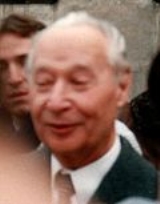
Alexander Dubcek

Encyclopedia
Alexander Dubček (ˈduptʃɛk; 27 November 1921 – 7 November 1992), also known as Dikita, was a Slovak
politician and briefly leader of Czechoslovakia
(1968–1969), famous for his attempt to reform the communist regime during the Prague Spring
. Later, after the overthrow of the government in 1989, he was Chairman of the federal Czecho-Slovak parliament
.
, Czechoslovakia (Slovakia
), and raised in the Kyrgyz SSR of the Soviet Union
(now Kyrgyzstan
) as a member of the Esperantist
industrial cooperative Interhelpo
. His father, Štefan, moved from Chicago
to Czechoslovakia after World War I, when he refused to serve in the military for his pacifism. Alexander Dubček was conceived in Chicago, but born after the family relocated to Czechoslovakia. When Alexander Dubček was three, the family moved to the Soviet Union, in part to help build socialism and in part because jobs were scarce in Czechoslovakia. In 1938 the family returned to Czechoslovakia.
During the Second World War, Alexander Dubček joined the underground resistance against the wartime pro-German Slovak state headed by Jozef Tiso
. In August 1944, Dubček fought in the Slovak National Uprising
and was wounded. His brother, Július, was killed.
(KSS), which had been created after the formation of the Slovak state and in 1948 was transformed into the Slovak branch of the Communist Party of Czechoslovakia
(KSČ).
After the war, he steadily rose through the ranks in Communist Czechoslovakia. From 1951 to 1955 he was a member of the National Assembly, the parliament of Czechoslovakia. In 1953, he was sent to the Moscow Political College, where he graduated in 1958. In 1955 joined the Central Committee of the Slovak branch and in 1962 became a member of the presidium. In 1958 he also joined the Central Committee of the Communist Party of Czechoslovakia
, which he served as a secretary from 1960 to 1962 and as a member of the presidium after 1962. From 1960 to 1968 he once more was a member of the federal parliament.
In 1963, a power struggle in the leadership of the Slovak branch unseated Karol Bacílek and Pavol David, hard-line allies of Antonín Novotný
, First Secretary of the KSČ and president of Czechoslovakia. In their place, a new generation of Slovak Communists took control of party and state organs in Slovakia, led by Alexander Dubček, who became First Secretary of the Slovak branch of the party.
Under Dubček's leadership, Slovakia began to evolve toward political liberalization. Because Novotný and his Stalinist
predecessors had denigrated Slovak "bourgeois nationalists", most notably Gustáv Husák
and Vladimír Clementis
, in the 1950s, the Slovak branch worked to promote Slovak identity. This mainly took the form of celebrations and commemorations, such as the 150th birthdays of 19th century leaders of the Slovak National Revival Ľudovít Štúr
and Jozef Miloslav Hurban
, the centennial of the Matica slovenská
in 1963, and the twentieth anniversary of the Slovak National Uprising. At the same time, the political and intellectual climate in Slovakia became freer than that in the Czech Lands. This was exemplified by the rising readership of Kultúrny život, the weekly newspaper of the Union of Slovak Writers, which published frank discussions of liberalization, federalization and democratization, written by the most progressive or controversial writers – both Slovak and Czech. Kultúrny život consequently became the first Slovak publication to gain a wide following among Czechs.
disappointed local Communists while the destalinization program caused further disquiet. In October 1967, a number of reformers, most notably Ota Šik
and Alexander Dubček, took action: they challenged First Secretary Antonín Novotný
at a Central Committee meeting. Novotný faced a mutiny in the Central Committee, so he secretly invited Leonid Brezhnev
, the Soviet leader, to make a whirlwind visit to Prague in December 1967 in order to shore up the embattled Novotný. When Brezhnev arrived in Prague and met with the Central Committee members, he was stunned to learn of the extent of the opposition to Novotný, leading Brezhnev to withhold support and paving the way for the Central Committee to remove Novotný. Dubček became the new First Secretary of the Communist Party of Czechoslovakia on 5 January 1968.
The period following Novotný's downfall became known as the Prague Spring
. During this time, Dubček and other reformers sought to liberalize the Communist regime, creating "socialism with a human face". Though this loosened the party's grip on the country, Dubček remained a devoted Communist and intended to preserve the party's rule. However, during the Prague Spring, he and other reform-minded Communists sought to win popular support for the Communist regime by eliminating its worst, most repressive features, allowing greater freedom of expression and tolerating political and social organizations not under Communist control. "Dubcek! Svoboda
!" became the popular refrain of student demonstrations during this period. Yet Dubček found himself in an increasingly untenable position. The program of reform gained momentum, leading to pressures for further liberalization and democratization. At the same time, hard-line Communists in Czechoslovakia and the leaders of other Warsaw Pact
countries pressured Dubček to rein in the Prague Spring. Though Dubček wanted to keep control of the reform movement, he refused to resort to any draconian measures to do so.
The Soviet leadership tried to stop or limit the changes in the ČSSR through a series of negotiations. The Soviet Union agreed to bilateral talks with Czechoslovakia in July at Čierna nad Tisou, near the Slovak-Soviet border. At the meeting, Dubček tried to reassure the Soviets and the Warsaw Pact leaders that he was still friendly to Moscow, arguing that the reforms were an internal matter. He thought he had learned an important lesson from the failing of the Hungarian Revolution of 1956, believing the Kremlin would allow him a free hand in pursuing domestic reform as long as Czechoslovakia remained a faithful ally of the Soviet Union, under Communist rule. Despite Dubček's continuing efforts to stress these commitments, Brezhnev and other Warsaw Pact leaders remained wary.
 On the night of 20–21 August 1968, Warsaw Pact
forces entered Czechoslovakia. The occupying armies quickly seized control of Prague and the Central Committee's building, taking Dubček and other reformers into Soviet custody. But before they were arrested, Dubček urged the people not to resist. Later in the day, Dubček and the others were taken to Moscow on a Soviet military transport aircraft (reportedly one of the aircraft used in the Soviet invasion).
Despite the inspired nonviolent resistance of the Czech and Slovak population, the reformers had little hope of holding out against Soviet pressure and ultimately were forced to accede to Soviet demands, signing the Moscow protocols. (Only František Kriegel
refused to sign.)
Dubček and most of the reformers were returned to Prague on 27 August and Dubček retained his post as the party's first secretary for a while. Indeed, the achievements of the Prague Spring were not reversed overnight, but over a period of several months.
In January 1969, Dubček was hospitalized in Bratislava complaining of a cold and had to cancel a speech. Rumours sprang up that his illness was radiation sickness
and that it was caused by radioactive strontium
being placed in his soup during his stay in Moscow in an attempt to kill him. However, a U.S. intelligence report discounted this for lack of evidence.
Dubček was forced to resign as first secretary in April 1969 following the Czechoslovak Hockey Riots
. He was re-elected to the Federal Assembly
(as the federal parliament was now called) and made its Speaker of the Federal Assembly and later sent as ambassador to Turkey
(1969–70). This was allegedly done in the hope that he would defect to the West, which however did not occur. In 1970, he was expelled from the Communist party and lost his seats in the Slovak parliament
(which he had held continuously since 1964) and the Federal Assembly.
. In 1988, Dubček was allowed to travel to Italy
to accept an honorary doctorate from Bologna University, and while there he gave an interview with Italian newspaper L'Unità
, his first public remarks to the press since 1970. Dubček's appearance and interview helped to return him to international prominence.
In 1989, he was awarded the annual Sakharov Prize
in its second year of existence.
of 1989, he supported the Public against Violence
(VPN) and the Civic Forum
. On the night of 24 November, Dubček appeared with Václav Havel
on a balcony overlooking Wenceslas Square, He was greeted with uproarious applause from the throngs of protesters below, embraced as a symbol of democratic freedom. He disappointed the crowd somewhat by calling for pruning out what was wrong with Communism. By this time, however, the demonstrators in Prague wanted nothing to do with Communism of any sort. Later that night, Dubček was on stage with Havel at the Laterna Magika
theater, the headquarters of Civic Forum, when the entire leadership of the Communist Party resigned--in effect, ending Communist rule in Czechoslovakia.
Dubček was elected Chairman of the Federal Assembly (Czecho-Slovak Parliament) on 28 December 1989, and re-elected in 1990 and 1992.
At the time of the overthrow of Communist party rule, Dubček described the Velvet Revolution as a victory for his humanistic socialist outlook. In 1990, he received the International Humanist Award from the International Humanist and Ethical Union
.
In 1992, he became leader of the Social Democratic Party of Slovakia
and represented that party in the Federal Assembly. At that time, Dubček passively supported the union between Czechs and Slovaks in a single Czecho-Slovak federation against the (ultimately successful) push towards an independent Slovak state
.
, near Humpolec
. He was buried in Slávičie údolie cemetery
in Bratislava
, Slovakia.
Slovaks
The Slovaks, Slovak people, or Slovakians are a West Slavic people that primarily inhabit Slovakia and speak the Slovak language, which is closely related to the Czech language.Most Slovaks today live within the borders of the independent Slovakia...
politician and briefly leader of Czechoslovakia
Czechoslovakia
Czechoslovakia or Czecho-Slovakia was a sovereign state in Central Europe which existed from October 1918, when it declared its independence from the Austro-Hungarian Empire, until 1992...
(1968–1969), famous for his attempt to reform the communist regime during the Prague Spring
Prague Spring
The Prague Spring was a period of political liberalization in Czechoslovakia during the era of its domination by the Soviet Union after World War II...
. Later, after the overthrow of the government in 1989, he was Chairman of the federal Czecho-Slovak parliament
Federal Assembly of Czechoslovakia
The Federal Assembly was the name of Czechoslovakia's federal parliament from January 1, 1969 to the dissolution of Czechoslovakia on December 31, 1992...
.
Early life
Dubček was born in UhrovecUhrovec
Uhrovec is a village and municipality in the Bánovce nad Bebravou District of the Trenčín Region of Slovakia.-Geography:The village lies at an altitude of 258 metres and covers an area of 22.95km². It has a population of 1478 people...
, Czechoslovakia (Slovakia
Slovakia
The Slovak Republic is a landlocked state in Central Europe. It has a population of over five million and an area of about . Slovakia is bordered by the Czech Republic and Austria to the west, Poland to the north, Ukraine to the east and Hungary to the south...
), and raised in the Kyrgyz SSR of the Soviet Union
Soviet Union
The Soviet Union , officially the Union of Soviet Socialist Republics , was a constitutionally socialist state that existed in Eurasia between 1922 and 1991....
(now Kyrgyzstan
Kyrgyzstan
Kyrgyzstan , officially the Kyrgyz Republic is one of the world's six independent Turkic states . Located in Central Asia, landlocked and mountainous, Kyrgyzstan is bordered by Kazakhstan to the north, Uzbekistan to the west, Tajikistan to the southwest and China to the east...
) as a member of the Esperantist
Esperanto culture
The language Esperanto is often used to access an international culture, including a large body of original as well as translated literature. There are over 25,000 Esperanto books as well as over a hundred regularly distributed Esperanto magazines. Many Esperanto speakers use the language for...
industrial cooperative Interhelpo
Interhelpo
The Interhelpo was an industrial cooperative of workers and farmers between 1923 and 1943, established for the special purpose of helping to build up socialism in Soviet Kyrgyzstan....
. His father, Štefan, moved from Chicago
Chicago
Chicago is the largest city in the US state of Illinois. With nearly 2.7 million residents, it is the most populous city in the Midwestern United States and the third most populous in the US, after New York City and Los Angeles...
to Czechoslovakia after World War I, when he refused to serve in the military for his pacifism. Alexander Dubček was conceived in Chicago, but born after the family relocated to Czechoslovakia. When Alexander Dubček was three, the family moved to the Soviet Union, in part to help build socialism and in part because jobs were scarce in Czechoslovakia. In 1938 the family returned to Czechoslovakia.
During the Second World War, Alexander Dubček joined the underground resistance against the wartime pro-German Slovak state headed by Jozef Tiso
Jozef Tiso
Jozef Tiso was a Slovak Roman Catholic priest, politician of the Slovak People's Party, and Nazi collaborator. Between 1939 and 1945, Tiso was the head of the Slovak State, a satellite state of Nazi Germany...
. In August 1944, Dubček fought in the Slovak National Uprising
Slovak National Uprising
The Slovak National Uprising or 1944 Uprising was an armed insurrection organized by the Slovak resistance movement during World War II. It was launched on August 29 1944 from Banská Bystrica in an attempt to overthrow the collaborationist Slovak State of Jozef Tiso...
and was wounded. His brother, Július, was killed.
Political career
During the war, Alexander Dubček joined the Communist Party of SlovakiaCommunist Party of Slovakia (1939)
The Communist Party of Slovakia was a communist party in Slovakia. It was formed in March 1939, when the Slovak Republic was created, as the Slovak branches of the Communist Party of Czechoslovakia were separated from the mother party...
(KSS), which had been created after the formation of the Slovak state and in 1948 was transformed into the Slovak branch of the Communist Party of Czechoslovakia
Communist Party of Czechoslovakia
The Communist Party of Czechoslovakia, in Czech and in Slovak: Komunistická strana Československa was a Communist and Marxist-Leninist political party in Czechoslovakia that existed between 1921 and 1992....
(KSČ).
After the war, he steadily rose through the ranks in Communist Czechoslovakia. From 1951 to 1955 he was a member of the National Assembly, the parliament of Czechoslovakia. In 1953, he was sent to the Moscow Political College, where he graduated in 1958. In 1955 joined the Central Committee of the Slovak branch and in 1962 became a member of the presidium. In 1958 he also joined the Central Committee of the Communist Party of Czechoslovakia
Communist Party of Czechoslovakia
The Communist Party of Czechoslovakia, in Czech and in Slovak: Komunistická strana Československa was a Communist and Marxist-Leninist political party in Czechoslovakia that existed between 1921 and 1992....
, which he served as a secretary from 1960 to 1962 and as a member of the presidium after 1962. From 1960 to 1968 he once more was a member of the federal parliament.
In 1963, a power struggle in the leadership of the Slovak branch unseated Karol Bacílek and Pavol David, hard-line allies of Antonín Novotný
Antonín Novotný
Antonín Novotný was General Secretary of the Communist Party of Czechoslovakia from 1953 to 1968, and also held the post of President of Czechoslovakia from 1957 to 1968. He was born in Letňany, now part of Prague....
, First Secretary of the KSČ and president of Czechoslovakia. In their place, a new generation of Slovak Communists took control of party and state organs in Slovakia, led by Alexander Dubček, who became First Secretary of the Slovak branch of the party.
Under Dubček's leadership, Slovakia began to evolve toward political liberalization. Because Novotný and his Stalinist
Stalinism
Stalinism refers to the ideology that Joseph Stalin conceived and implemented in the Soviet Union, and is generally considered a branch of Marxist–Leninist ideology but considered by some historians to be a significant deviation from this philosophy...
predecessors had denigrated Slovak "bourgeois nationalists", most notably Gustáv Husák
Gustáv Husák
Gustáv Husák was a Slovak politician, president of Czechoslovakia and a long-term Communist leader of Czechoslovakia and of the Communist Party of Czechoslovakia...
and Vladimír Clementis
Vladimír Clementis
Vladimír "Vlado" Clementis was a Slovak minister, politician, lawyer, publicist, literary critic, author and a prominent member of the Czechoslovak Communist Party. He married Lída Pátková, a daughter of a branch director of Czech Hypothec Bank in Bratislava, in March 1933. He became a Communist...
, in the 1950s, the Slovak branch worked to promote Slovak identity. This mainly took the form of celebrations and commemorations, such as the 150th birthdays of 19th century leaders of the Slovak National Revival Ľudovít Štúr
Ludovít Štúr
Ľudovít Štúr , known in his era as Ludevít Velislav Štúr, was the leader of the Slovak national revival in the 19th century, the author of the Slovak language standard eventually leading to the contemporary Slovak literary language...
and Jozef Miloslav Hurban
Jozef Miloslav Hurban
Jozef Miloslav Hurban , pseudonyms Slavomil F. Kořennatý, Ľudovít Pavlovič, M. z Bohuslavíc, M...
, the centennial of the Matica slovenská
Matica slovenská
The Matica slovenská Mother) is Slovakia's public-law cultural and scientific institution focusing on topics around the Slovak nation. It is based in the city of Martin...
in 1963, and the twentieth anniversary of the Slovak National Uprising. At the same time, the political and intellectual climate in Slovakia became freer than that in the Czech Lands. This was exemplified by the rising readership of Kultúrny život, the weekly newspaper of the Union of Slovak Writers, which published frank discussions of liberalization, federalization and democratization, written by the most progressive or controversial writers – both Slovak and Czech. Kultúrny život consequently became the first Slovak publication to gain a wide following among Czechs.
Prague Spring
Under Communism, the Czechoslovak economy in the 1960s was in serious decline and the imposition of central control from PraguePrague
Prague is the capital and largest city of the Czech Republic. Situated in the north-west of the country on the Vltava river, the city is home to about 1.3 million people, while its metropolitan area is estimated to have a population of over 2.3 million...
disappointed local Communists while the destalinization program caused further disquiet. In October 1967, a number of reformers, most notably Ota Šik
Ota Šik
Ota Šik was a Czech economist and politician. He was the man behind the New Economic Model and was one of the key figures in the Prague Spring.-Early years:...
and Alexander Dubček, took action: they challenged First Secretary Antonín Novotný
Antonín Novotný
Antonín Novotný was General Secretary of the Communist Party of Czechoslovakia from 1953 to 1968, and also held the post of President of Czechoslovakia from 1957 to 1968. He was born in Letňany, now part of Prague....
at a Central Committee meeting. Novotný faced a mutiny in the Central Committee, so he secretly invited Leonid Brezhnev
Leonid Brezhnev
Leonid Ilyich Brezhnev – 10 November 1982) was the General Secretary of the Central Committee of the Communist Party of the Soviet Union , presiding over the country from 1964 until his death in 1982. His eighteen-year term as General Secretary was second only to that of Joseph Stalin in...
, the Soviet leader, to make a whirlwind visit to Prague in December 1967 in order to shore up the embattled Novotný. When Brezhnev arrived in Prague and met with the Central Committee members, he was stunned to learn of the extent of the opposition to Novotný, leading Brezhnev to withhold support and paving the way for the Central Committee to remove Novotný. Dubček became the new First Secretary of the Communist Party of Czechoslovakia on 5 January 1968.
The period following Novotný's downfall became known as the Prague Spring
Prague Spring
The Prague Spring was a period of political liberalization in Czechoslovakia during the era of its domination by the Soviet Union after World War II...
. During this time, Dubček and other reformers sought to liberalize the Communist regime, creating "socialism with a human face". Though this loosened the party's grip on the country, Dubček remained a devoted Communist and intended to preserve the party's rule. However, during the Prague Spring, he and other reform-minded Communists sought to win popular support for the Communist regime by eliminating its worst, most repressive features, allowing greater freedom of expression and tolerating political and social organizations not under Communist control. "Dubcek! Svoboda
Ludvík Svoboda
thumb|Svoboda and [[I Corps |I Czechoslovak Army Corps]]Ludvík Svoboda was a Czechoslovak general and politician...
!" became the popular refrain of student demonstrations during this period. Yet Dubček found himself in an increasingly untenable position. The program of reform gained momentum, leading to pressures for further liberalization and democratization. At the same time, hard-line Communists in Czechoslovakia and the leaders of other Warsaw Pact
Warsaw Pact
The Warsaw Treaty Organization of Friendship, Cooperation, and Mutual Assistance , or more commonly referred to as the Warsaw Pact, was a mutual defense treaty subscribed to by eight communist states in Eastern Europe...
countries pressured Dubček to rein in the Prague Spring. Though Dubček wanted to keep control of the reform movement, he refused to resort to any draconian measures to do so.
The Soviet leadership tried to stop or limit the changes in the ČSSR through a series of negotiations. The Soviet Union agreed to bilateral talks with Czechoslovakia in July at Čierna nad Tisou, near the Slovak-Soviet border. At the meeting, Dubček tried to reassure the Soviets and the Warsaw Pact leaders that he was still friendly to Moscow, arguing that the reforms were an internal matter. He thought he had learned an important lesson from the failing of the Hungarian Revolution of 1956, believing the Kremlin would allow him a free hand in pursuing domestic reform as long as Czechoslovakia remained a faithful ally of the Soviet Union, under Communist rule. Despite Dubček's continuing efforts to stress these commitments, Brezhnev and other Warsaw Pact leaders remained wary.
Downfall
Warsaw Pact
The Warsaw Treaty Organization of Friendship, Cooperation, and Mutual Assistance , or more commonly referred to as the Warsaw Pact, was a mutual defense treaty subscribed to by eight communist states in Eastern Europe...
forces entered Czechoslovakia. The occupying armies quickly seized control of Prague and the Central Committee's building, taking Dubček and other reformers into Soviet custody. But before they were arrested, Dubček urged the people not to resist. Later in the day, Dubček and the others were taken to Moscow on a Soviet military transport aircraft (reportedly one of the aircraft used in the Soviet invasion).
Despite the inspired nonviolent resistance of the Czech and Slovak population, the reformers had little hope of holding out against Soviet pressure and ultimately were forced to accede to Soviet demands, signing the Moscow protocols. (Only František Kriegel
František Kriegel
František Kriegel was a Czechoslovak politician, physician, and a member of the Communist Party reform wing of Prague Spring...
refused to sign.)
Dubček and most of the reformers were returned to Prague on 27 August and Dubček retained his post as the party's first secretary for a while. Indeed, the achievements of the Prague Spring were not reversed overnight, but over a period of several months.
In January 1969, Dubček was hospitalized in Bratislava complaining of a cold and had to cancel a speech. Rumours sprang up that his illness was radiation sickness
Radiation Sickness
Radiation Sickness is a VHS by the thrash metal band Nuclear Assault. The video is a recording of a concert at the Hammersmith Odeon, London in 1988. It was released in 1991...
and that it was caused by radioactive strontium
Strontium
Strontium is a chemical element with the symbol Sr and the atomic number 38. An alkaline earth metal, strontium is a soft silver-white or yellowish metallic element that is highly reactive chemically. The metal turns yellow when exposed to air. It occurs naturally in the minerals celestine and...
being placed in his soup during his stay in Moscow in an attempt to kill him. However, a U.S. intelligence report discounted this for lack of evidence.
Dubček was forced to resign as first secretary in April 1969 following the Czechoslovak Hockey Riots
Czechoslovak Hockey Riots (1969)
The Czechoslovak Hockey Riots were a short lived series of protests, mildly violent on occasion , that took place in response to the 1969 World Ice Hockey Championships....
. He was re-elected to the Federal Assembly
Federal Assembly of Czechoslovakia
The Federal Assembly was the name of Czechoslovakia's federal parliament from January 1, 1969 to the dissolution of Czechoslovakia on December 31, 1992...
(as the federal parliament was now called) and made its Speaker of the Federal Assembly and later sent as ambassador to Turkey
Turkey
Turkey , known officially as the Republic of Turkey , is a Eurasian country located in Western Asia and in East Thrace in Southeastern Europe...
(1969–70). This was allegedly done in the hope that he would defect to the West, which however did not occur. In 1970, he was expelled from the Communist party and lost his seats in the Slovak parliament
National Council of the Slovak Republic
The National Council of the Slovak Republic , abbreviated to NR SR, is the national parliament of Slovakia. It is unicameral, and consists of 150 MPs, who are elected by universal suffrage under proportional representation every four years....
(which he had held continuously since 1964) and the Federal Assembly.
Private citizen
After his expulsion from the party, Dubček worked in the Forestry Service in Slovakia. He remained a popular figure among the Slovaks and Czechs he encountered on the job, using this reverence to procure scarce and hard-to-find materials for his workplace. Dubček and his wife, Anna, continued to live in a comfortable villa in a nice neighborhood in BratislavaBratislava
Bratislava is the capital of Slovakia and, with a population of about 431,000, also the country's largest city. Bratislava is in southwestern Slovakia on both banks of the Danube River. Bordering Austria and Hungary, it is the only national capital that borders two independent countries.Bratislava...
. In 1988, Dubček was allowed to travel to Italy
Italy
Italy , officially the Italian Republic languages]] under the European Charter for Regional or Minority Languages. In each of these, Italy's official name is as follows:;;;;;;;;), is a unitary parliamentary republic in South-Central Europe. To the north it borders France, Switzerland, Austria and...
to accept an honorary doctorate from Bologna University, and while there he gave an interview with Italian newspaper L'Unità
L'Unità
l'Unità is an Italian left-wing newspaper, originally founded as official newspaper of the Italian Communist Party.-History:L'Unità was founded by Antonio Gramsci on 12 February 1924, as the newspaper of workers and peasants, the official newspaper of Italian Communist Party : it was printed in...
, his first public remarks to the press since 1970. Dubček's appearance and interview helped to return him to international prominence.
In 1989, he was awarded the annual Sakharov Prize
Sakharov Prize
The Sakharov Prize for Freedom of Thought, named after Soviet scientist and dissident Andrei Sakharov, was established in December 1988 by the European Parliament as a means to honour individuals or organisations who have dedicated their lives to the defence of human rights and freedom of thought...
in its second year of existence.
Velvet Revolution
During the Velvet RevolutionVelvet Revolution
The Velvet Revolution or Gentle Revolution was a non-violent revolution in Czechoslovakia that took place from November 17 – December 29, 1989...
of 1989, he supported the Public against Violence
Public Against Violence
The Public Against Violence was a political movement that was established in Bratislava, Slovakia on 20 November 1989. It was the Slovak counterpart of the Czech Civic Forum ....
(VPN) and the Civic Forum
Civic Forum
The Civic Forum was a political movement in the Czech part of Czechoslovakia, established during the Velvet Revolution in 1989...
. On the night of 24 November, Dubček appeared with Václav Havel
Václav Havel
Václav Havel is a Czech playwright, essayist, poet, dissident and politician. He was the tenth and last President of Czechoslovakia and the first President of the Czech Republic . He has written over twenty plays and numerous non-fiction works, translated internationally...
on a balcony overlooking Wenceslas Square, He was greeted with uproarious applause from the throngs of protesters below, embraced as a symbol of democratic freedom. He disappointed the crowd somewhat by calling for pruning out what was wrong with Communism. By this time, however, the demonstrators in Prague wanted nothing to do with Communism of any sort. Later that night, Dubček was on stage with Havel at the Laterna Magika
Laterna Magika
Laterna Magika is a Non-Verbal theatre located in Prague. Its origins are connected with the Expo '58 in Brussels. The plays are internationally comprehensible since they are silent. The performances are a combination of dance, film and black theatre...
theater, the headquarters of Civic Forum, when the entire leadership of the Communist Party resigned--in effect, ending Communist rule in Czechoslovakia.
Dubček was elected Chairman of the Federal Assembly (Czecho-Slovak Parliament) on 28 December 1989, and re-elected in 1990 and 1992.
At the time of the overthrow of Communist party rule, Dubček described the Velvet Revolution as a victory for his humanistic socialist outlook. In 1990, he received the International Humanist Award from the International Humanist and Ethical Union
International Humanist and Ethical Union
The International Humanist and Ethical Union is an umbrella organisation embracing humanist, atheist, rationalist, secular, skeptic, freethought and Ethical Culture organisations worldwide. Founded in Amsterdam in 1952, the IHEU is a democratic union of more than 100 member organizations in 40...
.
In 1992, he became leader of the Social Democratic Party of Slovakia
Social Democratic Party of Slovakia
The Social Democratic Party of Slovakia was a left wing political party in Slovakia...
and represented that party in the Federal Assembly. At that time, Dubček passively supported the union between Czechs and Slovaks in a single Czecho-Slovak federation against the (ultimately successful) push towards an independent Slovak state
Dissolution of Czechoslovakia
The dissolution of Czechoslovakia, which took effect on 1 January 1993, was an event that saw the self-determined separation of the federal state of Czechoslovakia. The Czech Republic and Slovakia, entities which had arisen in 1969 within the framework of Czechoslovak federalisation, became...
.
Death
Dubček died on 7 November 1992, as a result of injuries sustained in car crash that took place on 1 September on the Czech D1 highwayHighway D1 (Czech Republic)
D1 motorway is the main highway of the Czech Republic. Currently it connects the two biggest Czech cities, Prague and Brno, in the future it will link Ostrava and the border with Poland...
, near Humpolec
Humpolec
Humpolec is a town in the Vysočina Region of the Czech Republic, situated south-east of Prague and roughly halfway between the Czech capital and Brno, on the northwestern edge of the Bohemian-Moravian highlands ....
. He was buried in Slávičie údolie cemetery
Slávicie údolie cemetery
Slávičie údolie cemetery is a cemetery in the Karlova Ves borough in Bratislava, Slovakia. The cemetery was originally built in 1912 for poorer inhabitants of Bratislava, and it was called "cemetery of the poor". During World War I soldiers were interred as well...
in Bratislava
Bratislava
Bratislava is the capital of Slovakia and, with a population of about 431,000, also the country's largest city. Bratislava is in southwestern Slovakia on both banks of the Danube River. Bordering Austria and Hungary, it is the only national capital that borders two independent countries.Bratislava...
, Slovakia.
External links
- Hope Dies Last The Autobiography of Alexander Dubcek by Alexander Dubcek (Author), Jiří Hochman (Editor, Translator), Kodansha Europe (1993), ISBN 1-56836-000-2.