


War of the Austrian Succession

Encyclopedia
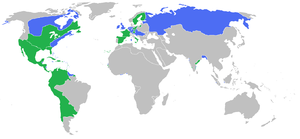
The War of the Austrian Succession (1740–48) – including King George's War
in North America, the Anglo-Spanish
War of Jenkins' Ear
, and two of the three Silesian wars
– involved most of the powers
of Europe over the question of Maria Theresa's
succession to the realms of the House of Habsburg.
The war began under the pretext that Maria Theresa was ineligible to succeed to the Habsburg thrones of her father, Charles VI
, because Salic law
precluded royal inheritance by a woman—though in reality this was a convenient excuse put forward by Prussia
and France
to challenge Habsburg power. Austria was supported by Great Britain
and the Dutch Republic
, the traditional enemies of France, as well as the Kingdom of Sardinia
and Saxony
. France and Prussia were allied with the Electorate of Bavaria
.
Spain entered the war to reestablish its influence in northern Italy, further reversing an Austrian dominance over the Italian peninsula that had been achieved at Spain's expense as a consequence of that country's own war of succession
earlier in the 18th century.
The war ended with the Treaty of Aix-la-Chapelle
in 1748. The most enduring military historical interest and importance of the war lies in the struggle of Prussia
and the Habsburg
monarchs for the region of Silesia
.
 In 1740, after the death of her father, Charles VI
, Maria Theresa succeeded him as Queen of Hungary, Croatia
and Bohemia, Archduchess of Austria and Duchess of Parma. Her father had been Holy Roman Emperor, but Maria Theresa was not a candidate for that title, which had never been held by a woman; the plan was for her to succeed to the hereditary domains, and her husband, Francis Stephen
, to be elected Holy Roman Emperor. The complications involved in a female Habsburg ruler had been long foreseen, and Charles VI had persuaded most of the states of Germany to agree to the Pragmatic Sanction of 1713
.
Problems began when King Frederick II of Prussia
violated the Pragmatic Sanction and invaded Silesia
on 16 December 1740, using the Treaty of Brieg of 1537 under which the Hohenzollerns
of Brandenburg
were to inherit the Duchy of Brieg as a pretext. Maria Theresa, as a woman, was perceived as weak, and other rulers (such as Charles Albert of Bavaria
) put forward their own competing claims to the crown
as male heirs with a clear genealogical basis to inherit the elected dignities
of the great Imperial title.

Prussia in 1740 was a small and thoroughly organized emerging international power
with a brand new well educated king, Frederick II of Prussia
, desiring to unify the disparate and scattered crown holdings by gathering intervening lands into a unified contiguous state. When the Holy Roman Emperor died, distracting the Habsburg Monarchy to the south east, Frederick turned opportunist using a questionable interpretation of a treaty (1537) between the Hohenzollerns and the Piasts of Brieg as pretext (reversing Prussia's position in the War of the Polish Succession
, concluded the year 1738, just two years before) to invade and snap up territories in Silesia. Meanwhile, as expected, the other princes of Europe prepared to exploit an opportunity to acquire Habsburg possessions and humble and diminish the power of the great house that an election of the Emperor of the Holy Roman Empire
represented. Archduchess of Austria and Queen of Hungary she may be, but salic law
guaranteed the next Emperor was not going to be Archduchess Maria Theresa of Austria.
While the only recent war experience of its army had been in the War of the Polish Succession
(Rhine campaign of 1733–1735) her forces hadn't fought there, since Frederick William was not trusted by Austria. It therefore had an uninspiring reputation and was counted as one of the many minor armies of the princes of Europe, of which there were plenty (See the 1800 plus states of the Holy Roman Empire
).
Only few thought that it could rival the larger modern forces of Austria and France. But King Friedrich Wilhelm I of Prussia had drilled it to a perfection previously unknown in Europe's military experience, and the Prussian infantry
soldier was so well-trained and well-equipped that he could fire 3 shots a minute to an Austrian's 1.Prussian cavalry
and artillery
were comparatively less efficient, but they were still of better quality than average.
The initial advantage of Frederick's army was that, undisturbed by wars, it had developed the professional standing-army
concept to full maturity and effect. While the Austrians had to wait for conscription to complete the field forces, Prussian regiments took the field at once, and thus Frederick was able to overrun Silesia almost unopposed.
In any event, his army had massed quietly along the Oder River during early December, and on 16 December 1740, without declaration of war, it crossed the frontier into Silesia. The extant forces available to the local Austrian generals could do no more than garrison
a few fortresses
, and they necessarily fell back to the mountain frontier of Bohemia
and Moravia
with only a small remnant of their available forces left in the garrisons.
On their new territory, the organized Prussian army was soon able to go into winter quarters, holding all Silesia and investing the strong places of Glogau, Brieg
and Neisse
. In one step, Prussia had effectively doubled its population and made huge gains in its industrial productivity for the minor cost of fair treatment of the people in the occupied territory—an atypical factor and effect in a day when relatively undisciplined mercenary
forces were the rule rather than the exception with their habitual raping, looting, and abuse of the various populations around themselves – which were generally forced to provide quarters.
Nationalism as we know it today, was not a factor, but an evolving concept just coming into its early years. Prussia benefited greatly from the apolitical nature of the society of the era, as the masses in central Germany would correspondingly suffer as the contending armies rampaged through their plains yet again.
and advanced towards Vienna
, but the objective was suddenly changed, and after many countermarches the anti-Austrian allies advanced, in three widely separated corps
, on Prague
. A French corps moved via Amberg
and Pilsen. The Elector marched on Budweis, and the Saxons (who had now joined the allies) invaded Bohemia
by the Elbe
valley. The Austrians could at first offer little resistance, but before long a considerable force intervened at Tábor
between the Danube and the allies, and the Austrian general Wilhelm Reinhard von Neipperg
was now on the march from Neisse to join in the campaign
. He had made with Frederick the curious agreement of Klein Schnellendorf (9 October 1741), by which Neisse was surrendered after a mock siege, and the Austrians undertook to leave Frederick unmolested in return for his releasing Neipperg's army for service elsewhere. At the same time the Hungarians
, moved to enthusiasm by the personal appeal of Maria Theresia, had put into the field a levée en masse, or "insurrection," which furnished the regular army with an invaluable force of light troops. A fresh army was collected under Field Marshal Khevenhüller at Vienna, and the Austrians planned an offensive winter campaign against the Franco-Bavarian forces in Bohemia and the small Bavarian army that remained on the Danube to defend the electorate.
The French in the meantime had stormed Prague on 26 November 1741, Francis Stephen
, husband of Maria Theresa, who commanded the Austrians in Bohemia, moving too slowly to save the fortress. The Elector of Bavaria, who now styled himself Archduke of Austria, was crowned King of Bohemia (9 December 1741) and elected to the imperial throne as Charles VII
(24 January 1742), but no active measures were undertaken.
In Bohemia the month of December was occupied in mere skirmishes. On the Danube, Khevenhüller, the best general in the Austrian service, advanced on 27 December, swiftly drove back the allies, shut them up in Linz
, and pressed on into Bavaria. Munich
itself surrendered to the Austrians on the coronation
day of Charles VII.
At the close of this first act of the campaign the French, under the old Marshal de Broglie
, maintained a precarious foothold in central Bohemia, menaced by the main army of the Austrians, and Khevenhüller was ranging unopposed in Bavaria. Frederick made a secret truce with Austria and thus, lay inactive in Silesia.
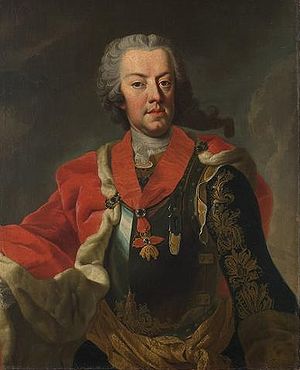 Frederick had hoped by the truce to secure Silesia, for which alone he was fighting. But with the successes of Khevenhüller and the enthusiastic "insurrection" of Hungary, Maria Theresa's opposition became firmer, and she divulged the provisions of the truce
, in order to compromise Frederick with his allies. The war recommenced. Frederick had not rested on his laurels. In the uneventful summer campaign of 1741 he had found time to begin that reorganization of his cavalry which was before long to make it even more efficient than his infantry. The Emperor Charles VII, whose territories were overrun by the Austrians, asked him to create a diversion by invading Moravia. In December 1741, therefore, the Prussian general field marshal Kurt Christoph Graf von Schwerin
had crossed the border and captured Olmutz. Glatz also was invested
, and the Prussian army was concentrated about Olomouc in January 1742. A combined plan of operations
was made by the French, Saxons and Prussians for the rescue of Linz. But Linz soon fell. Broglie on the Vltava
, weakened by the departure of the Bavarians to oppose Khevenhüller, and of the Saxons to join forces with Frederick, was in no condition to take the offensive, and large forces under Prince Charles of Lorraine
lay in his front from Budweis to Jihlava
(Iglau). Frederick's march was made towards Iglau in the first place. Brno
was invested about the same time (February), but the direction of the march was changed, and instead of moving against Prince Charles, Frederick pushed on southwards by Znojmo
and Mikulov
. The extreme outposts of the Prussians appeared before Vienna. But Frederick's advance was a mere foray, and Prince Charles, leaving a screen of troops in front of Broglie, marched to cut off the Prussians from Silesia, while the Hungarian levies
poured into Upper Silesia
by the Jablunkov Pass
. The Saxons, discontented and demoralized, soon marched off to their own country, and Frederick with his Prussians fell back by Svitavy
and Litomyšl
to Kutná Hora
in Bohemia, where he was in touch with Broglie on the one hand and (Glatz having now surrendered) with Silesia on the other. No defence of Olomouc was attempted, and the small Prussian corps remaining in Moravia fell back towards Upper Silesia.
Prince Charles, in pursuit of the king, marched by Jihlava and Teutsch (Deutsch) Brod on Kutná Hora, and on 17 May was fought the Battle of Chotusitz
, in which after a severe struggle the king was victorious. His cavalry on this occasion retrieved its previous failure, and its conduct gave an earnest of its future glory not only by its charges
on the battlefield, but by its vigorous pursuit of the defeated Austrians. Almost at the same time Broglie fell upon a part of the Austrians left on the Vltava and won a small, but morally and politically important, success in the action of Sahay
, near Budweis (24 May 1742). Frederick did not propose another combined movement. His victory and that of Broglie disposed Maria Theresa to cede Silesia in order to make good her position elsewhere, and the separate peace between Prussia and Austria, signed at Breslau on 11 June, closed the First Silesian War, but the War of the Austrian Succession continued.
 1743 opened disastrously for the emperor. The French and Bavarian armies were not working well together, and Broglie actually quarreled with the Bavarian field marshal Friedrich Heinrich von Seckendorff. No connected resistance was offered to the converging march of Prince Charles's army along the Danube, Khevenhüller from Salzburg towards southern Bavaria, and Prince Lobkowitz from Bohemia towards the Naab
. The Bavarians suffered a severe reverse near Braunau
(9 May 1743), and now an Anglo-allied army commanded by King George II
, which had been formed on the lower Rhine on the withdrawal of Maillebois, was advancing southward to the Main and Neckar
country. A French army, under Marshal Noailles, was being collected on the middle Rhine to deal with this new force. But Broglie was now in full retreat, and the strong places of Bavaria surrendered one after the other to Prince Charles. The French and Bavarians had been driven almost to the Rhine when Noailles and the king came to battle. George, completely outmaneuvered by his veteran antagonist, was in a position of the greatest danger between Aschaffenburg
and Hanau
in the defile
formed by the Spessart
Hills and the river Main. Noailles blocked the outlet and had posts all around, but the allied troops forced their way through and inflicted heavy losses on the French, and the Battle of Dettingen
is justly reckoned as a notable victory of Anglo-Austrian-Hanovarian arms (27 June).
Broglie, worn out by age and exertions, was soon replaced by Marshal Coigny. Both Broglie and Noailles were now on the strict defensive behind the Rhine. Not a single French soldier remained in Germany, and Prince Charles prepared to force the passage of the great river in the Breisgau
while the King of Britain moved forward via Mainz to co-operate by drawing upon himself the attention of both the French marshals. The Anglo-allied army took Worms
, but after several unsuccessful attempts to cross, Prince Charles went into winter quarters. The king followed his example, drawing in his troops to the northward, to deal, if necessary, with the army which the French were collecting on the frontier of the Southern Netherlands
. Austria, Britain, Holland and Sardinia were now allied. Saxony changed sides, and Sweden and Russia neutralized each other (Peace of Åbo, August 1743). Frederick was still quiescent. France, Spain and Bavaria actively continued the struggle against Maria Theresa.
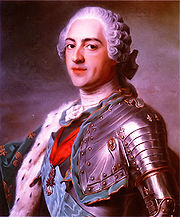 With 1744 began the Second Silesian War. Frederick of Prussia, disquieted by the universal success of the Austrians, secretly concluded a fresh alliance with Louis XV of France
. France had posed hitherto as an auxiliary, its officers in Germany had worn the Bavarian cockade
, and only with Britain was it officially at war. France now declared war directly upon Austria and Sardinia (April 1744). An army was assembled at Dunkirk to support the cause of James Stuart
in an invasion of Great Britain
. However violent storms wrecked the crossing attempt, and the planned invasion was abandoned. Meanwhile, Louis XV in person, with 90,000 men, prepared to invade the Austrian Netherlands, and took Menin
and Ypres
. His presumed opponent was the allied army previously under King George II and now composed of British, Dutch, Germans and Austrians. On the Rhine, Coigny was up against Prince Charles, and a fresh army under the Prince de Conti
was to assist the Spaniards in Piedmont and Lombardy. This plan was, however, at once dislocated by the advance of Charles, who, assisted by the veteran marshal Traun, skillfully manoeuvred his army over the Rhine near Philippsburg
(1 July), captured the lines of Weissenburg
, and cut off Coigny from Alsace
. Coigny, however, cut his way through the enemy at Weissenburg and posted himself near Strasbourg
. Louis XV now abandoned the invasion of the Southern Netherlands
, and his army moved down to take a decisive part in the war in Alsace and Lorraine
. At the same time Frederick crossed the Austrian frontier (August).
The attention and resources of Austria were fully occupied, and the Prussians were almost unopposed. One column passed through Saxony, another through Lusatia
, while a third advanced from Silesia. Prague, the objective, was reached on 2 September. Six days later the Austrian garrison was compelled to surrender, and the Prussians advanced to Budweis. Maria Theresa once again rose to the emergency, a new "insurrection" took the field in Hungary, and a corps of regulars was assembled to cover Vienna, while the diplomats won over Saxony to the Austrian side. Prince Charles withdrew from Alsace, unmolested by the French, who had been thrown into confusion by the sudden and dangerous illness of Louis XV at Metz
. Only Seckendorf with the Bavarians pursued him. No move was made by the French, and Frederick thus found himself isolated and exposed to the combined attack of the Austrians and Saxons. Marshal Traun, summoned from the Rhine, held the king in check in Bohemia, the Hungarian irregulars inflicted numerous minor reverses on the Prussians, and finally Prince Charles arrived with the main army. The campaign resembled that of 1742: the Prussian retreat was closely watched, and the rearguard pressed hard. Prague fell, and Frederick, completely outmanoeuvred by the united forces of Prince Charles and Traun, retreated to Silesia with heavy losses. At the same time, the Austrians gained no foothold in Silesia itself. On the Rhine, Louis XV, now recovered, had besieged and taken Freiburg
, after which the forces left in the north were reinforced and besieged the strong places of Southern Netherlands
. There was also a slight war of manoeuvre on the middle Rhine.

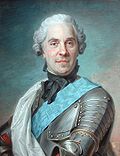 The year 1745 saw three of the greatest battles of the war: Hohenfriedberg
, Kesselsdorf
and Fontenoy
. The first event of the year was the Quadruple Alliance
of Britain, Austria, Holland and Saxony, concluded at Warsaw
on 8 January 1745 (Treaty of Warsaw
). Twelve days later, the death of Charles VII submitted the imperial title to a new election, and his successor in Bavaria was not a candidate. The Bavarian army was again unfortunate. Caught in its scattered winter quarters (action of Amberg, 7 Jan.), it was driven from point to point, defeated at the Battle of Pfaffenhofen
and the young elector Maximilian III Joseph had to abandon Munich once more. The Peace of Füssen
followed on 22 April, by which he secured his hereditary states on condition of supporting the candidature of the Grand-Duke Francis, consort of Maria Theresa. The "imperial" army ceased ipso facto to exist, and Frederick was again isolated. No help was to be expected from France, whose efforts this year were centred on the Flanders campaign. Indeed, on 10 May, before Frederick took the field, Louis XV and the Marshal of France Maurice de Saxe had besieged Tournay
, and inflicted upon the relieving army of the Duke of Cumberland the great defeat of Fontenoy
.
In Silesia the customary small war had been going on for some time, and the concentration of the Prussian army was not effected without severe fighting. At the end of May, Frederick, with about 65,000 men, lay in the camp of Frankenstein
, between Glatz
and Neisse, while behind the Krkonoše (Giant Mountains) about Landeshut Prince Charles had 85,000 Austrians and Saxons. On 4 June was fought the Battle of Hohenfriedberg
or Striegau, the greatest victory as yet of Frederick's career, and, of all his battles, excelled perhaps by Leuthen
and Rossbach
only. Prince Charles suffered a complete defeat and withdrew through the mountains as he had come. Frederick's pursuit was methodical, for the country was difficult and barren, and he did not know the extent to which the enemy was demoralised.
The manoeuvres of both leaders on the upper Elbe occupied all the summer, while the political questions of the imperial election and of an understanding between Prussia and Britain were pending. The chief efforts of Austria were directed towards the valleys of the Main and Lahn
and Frankfurt
, where the French and Austrian armies manoeuvred for a position from which to overawe the electoral body. Marshal Traun was successful, and Francis was elected Holy Roman Emperor on 13 September. Frederick agreed with Britain to recognise the election a few days later, but Maria Theresa would not conform to the Treaty of Breslau without a further appeal to the fortune of war. Saxony joined in this last attempt. A new advance of Prince Charles quickly brought on the Battle of Soor
, fought on ground destined to be famous in the war of 1866
. Frederick was at first in a position of great peril, but his army changed front in the face of the advancing enemy and by its boldness and tenacity won a remarkable victory (30 Sept.).
But the campaign was not ended. An Austrian contingent from the Main joined the Saxons under Field Marshal Rutowsky (1702–1764), and a combined movement was made in the direction of Berlin by Rutowsky from Saxony and Prince Charles from Bohemia. The danger was very great. Frederick hurried up his forces from Silesia and marched as rapidly as possible on Dresden
, winning the actions of Katholisch-Hennersdorf (24 Nov.) and Görlitz
(25 Nov.). Prince Charles was thereby forced back, and now a second Prussian army under the Old Dessauer
advanced up the Elbe from Magdeburg
to meet Rutowsky. The latter took up a strong position at Kesselsdorf
between Meissen
and Dresden
, but the veteran Leopold attacked him directly and without hesitation (14 Dec.). The Saxons and their allies were completely rout
ed after a hard struggle, and Maria Theresa at last gave way. In the Peace of Dresden
(25 Dec.) Frederick recognized the imperial election, and retained Silesia, as at the Peace of Breslau.
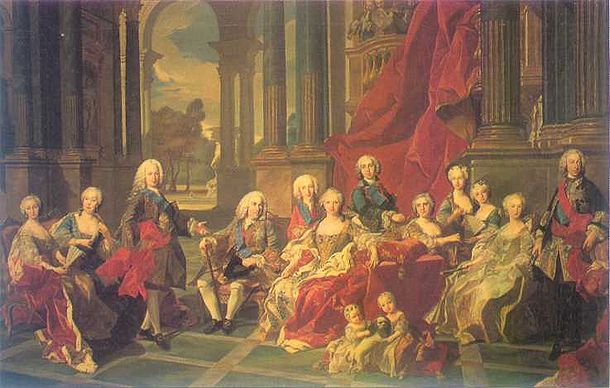 In central Italy
an army of Spaniards and Neapolitans
was collected for the purpose of conquering the Milan
ese. In 1741, the allied Spaniards and Neapolitans had advanced towards Modena
, the Duke of which state had allied himself with them, but the vigilant Austrian commander, Count Otto Ferdinand von Traun had out-marched them, captured Modena and forced the Duke to make a separate peace.
In 1742, Traun held his own with ease against the Spanish and Neapolitans. Naples was forced by a British Squadron
to withdraw her troops for home defence, and Spain, now too weak to advance in the Po valley
, sent a second army to Italy via France. Sardinia had allied herself with Austria in the Convention of Turin
and at the same time neither state was at war with France and this led to curious complications, combats being fought in the Isère valley between the troops of Sardinia and of Spain, in which the French took no part.
In 1743, the Spanish on the Panaro
had achieved a victory over Traun at Campo Santo
(8 February 1743), but the next six months were wasted in inaction and Georg Christian, Fürst von Lobkowitz
, joining Traun with reinforcements from Germany, drove back the enemy to Rimini
. Observing from Venice
, Rousseau
hailed the Spanish retreat as "the finest military manoeuvre of the whole century." The Spanish-Piedmont
ese War in the Alps
continued without much result, the only incident of note being the first Battle of Casteldelfino (7–10 October 1743), when an initial French offensive was beaten off.
In 1744 the Italian war became serious. A grandiose plan of campaign was formed and the Spanish and French generals at the front were hampered by the orders of their respective governments. The object was to unite the army in Dauphiné
with that on the lower Po. The support of Genoa
allowed a road into central Italy. But Lobkowitz had already taken the offensive and driven back the Spanish army of the Count de Gages towards the Neapolitan frontier, so the King of Naples
(the future Charles III of Spain
) had to assist the Spaniards. A combined army was formed at the Battle of Velletri (1744) and defeated Lobkowitz there on 11 August. The crisis past, Lobkowitz then went to Piedmont to assist the king against the Prince of Conti
, the King of Naples returned home and the Count de Gages followed the Austrians with a weak force.
The war in the Alps and the Apennines
had already been keenly contested. Villefranche and Montalban
were stormed by Conti on 20 April, a desperate fight took place at Peyre-Longue on 18 July (second Battle of Casteldelfino
) and the King of Sardinia
was defeated in a great Battle at Madonna dell'Olmo
(30 September) near Coni (Cuneo
). Conti did not, however, succeed in taking this fortress and had to retire into Dauphiné for his winter quarters. The two armies had, therefore, failed in their attempt to combine and the Austro-Sardinians still lay between them.
The campaign in Italy this year was also no mere war of posts. In March 1745 a secret treaty allied the Genoese Republic
with France, Spain and Naples. A change in the command of the Austrians favoured the first move of the allies. De Gages moved from Modena towards Lucca
, the Spaniards and French in the Alps under Marshal Maillebois
advanced through the Italian Riviera
to the Tanaro
and in the middle of July the two armies were at last concentrated between the Scrivia
and the Tanaro, to the unusually large number of 80,000. A swift march on Piacenza
drew the Austrian commander thither and in his absence the allies fell upon and completely defeated the Sardinians at Bassignano
(27 September), a victory which was quickly followed by the capture of Alessandria
, Valenza
and Casale Monferrato
. Jomini calls the concentration of forces which effected the victory "Le plus remarquable de toute la Guerre".
 The complicated politics of Italy, however, brought it about that Maillebois was ultimately unable to turn his victory to account. Indeed, early in 1746, Austrian troops, freed by the peace with Frederick, passed through the Tyrol
into Italy. The Franco-Spanish winter quarters were brusquely attacked and a French garrison of 6,000 men at Asti
was forced to capitulate. At the same time Maximilian Ulysses Count Browne with an Austrian corps struck at the allies on the Lower Po, and cut off their communication with the main body in Piedmont. A series of minor actions thus completely destroyed the great concentration. The allies separated, Maillebois covering Liguria
, the Spaniards marching against Browne. The latter was promptly and heavily reinforced and all that the Spaniards could do was to entrench themselves at Piacenza, Philip, the Spanish Infante as supreme commander calling up Maillebois to his aid. The French, skillfully conducted and marching rapidly, joined forces once more, but their situation was critical, for only two marches behind them the army of the King of Sardinia was in pursuit, and before them lay the principal army of the Austrians. The pitched Battle of Piacenza
(16 June) was hard fought and Maillebois had nearly achieved a victory when orders from the Infante compelled him to retire. That the army escaped at all was in the highest degree creditable to Maillebois and to his son and chief of staff, under whose leadership it eluded both the Austrians and the Sardinians, defeated an Austrian corps in the Battle of Rottofreddo
(12 August), and made good its retreat on Genoa.
It was, however, a mere remnant of the allied army which returned, and the Austrians were soon masters of north Italy, including the Republic of Genoa
(September). But they met with no success in their forays towards the Alps. Soon Genoa revolted from the oppressive rule of the victors, rose and drove out the Austrians (5–11 December) as an Allied invasion of Provence
stalled, and the French, now commanded by Charles Louis Auguste Fouquet, Duc de Belle-Isle, took the offensive (1747). Genoa held out against a second Austrian siege and after the plan of campaign had as usual been referred to Paris and Madrid, it was relieved, though a picked corps of the French army under the Chevalier de Belle-Isle (1684–1747), brother of the marshal, was defeated in the almost impossible attempt (10 July) to storm the entrenched pass of Exilles
(Colle dell'Assietta
), the chevalier, and with him much of the elite of the French nobility, being killed at the barricades. Before the steady advance of Marshal Belle-Isle the Austrians retired into Lombardy
and a desultory campaign was waged up to the conclusion of peace.
in February 1746. In September the British launched a Raid on Lorient
in an attempt to provide a diversion for the Allied forces in the Netherlands. The Battle of Roucoux (or Raucourt) near Liège, fought on 11 October between the allies under Prince Charles of Lorraine and the French under Saxe, resulted in a victory for the latter. Holland itself was now in danger, and when in April 1747 Saxe's army, which had now conquered the Austrian Netherlands up to the Meuse, turned its attention to the United Provinces
. The old fortresses on the frontier offered but slight resistance. Since August 1746 talks had been ongoing at the Congress of Breda
to try and agree a peace settlement, but up to this point they had met with little success.
The Prince of Orange William IV
and the Duke of Cumberland suffered a severe defeat at Lauffeld
(Lawfeld, also called Val) on 2 July 1747, and Saxe, after his victory, promptly and secretly despatched a corps under Marshal Lowendahl (1700–1755) to besiege Bergen op Zoom
. On 18 September Bergen op Zoom was stormed by the French
, and in the last year of the war Maastricht
, attacked by the entire forces of Saxe and Lowendahl, surrendered on 7 May 1748
. A large Russian army arrived to join the allies, but too late to be of use. The quarrel of Russia and Sweden had been settled by the Peace of Åbo in 1743, and in 1746 Russia had allied herself with Austria. Eventually a large army marched from Moscow to the Rhine, an event which was not without military significance, and in a manner preluded the great invasions of 1813–1814 and 1815. The general Peace of Aix-la-Chapelle (Aachen
) was signed on 18 October 1748.
. Maria Theresa and Austria survived status quo ante bellum
, sacrificing only the territory of Silesia, which Austria conceded to Prussia. The end of the war also sparked the beginning of the German dualism
between Prussia and Austria, which would ultimately fuel German nationalism and the drive to unify Germany as a single entity.
Despite his victories, Louis XV of France, who wanted to appear as an arbiter and not as a conqueror, gave all his conquests back to the defeated enemies with chivalry, arguing that he was "king of France, not a shopkeeper." This decision, largely misunderstood by his generals and by the French people, made the king unpopular. The French obtained so little of what they fought for that they adopted the expressions Bête comme la paix ("Stupid as peace") and Travailler pour le roi de Prusse ("To work for the king of Prussia", i.e. working for nothing). However his generosity was saluted in Europe and France increased its political influence on the continent.
The war, like other conflicts of the time, featured an extraordinary disparity between the end and the means. The political schemes to be executed by the French and other armies were as grandiose as any of modern times. Their execution, under the then conditions of time and space, invariably fell short of expectations, and the history of the war proves, as that of the Seven Years' War
was to prove, that the small standing army of the 18th century could conquer by degrees, but could not deliver a decisive blow. Frederick alone, with a definite end and proportionate means to achieve it, succeeded completely. Even less was to be expected when the armies were composed of allied contingents, sent to the war each for a different object. The allied national armies of 1813 (at the Battle of Leipzig
) co-operated loyally, for they had much at stake and worked for a common object. Those of 1741 represented the divergent private interests of the several dynasties, and achieved nothing.
as King George's War
, and did not begin until after formal war declarations of France and Britain reached the colonies in May 1744. The frontiers between New France
and the British colonies of New England
, New York
, and Nova Scotia
were the site of frequent small scale raids, primarily by French colonial troops and their Indian allies against British targets, although several attempts were made by British colonists to organize expeditions against New France. The most significant incident was the capture
of the French Fortress Louisbourg on Cape Breton Island
(Île Royale) by an expedition (29 April – 16 June 1745) of colonial militia organized by Massachusetts
Governor William Shirley
, commanded by William Pepperrell
of Maine
(then part of Massachusetts), and assisted by a Royal Navy fleet. A French expedition
to recover Louisbourg in 1746 failed due to bad weather, disease, and the death of its commander. Louisbourg was returned to France in exchange for Madras, generating much anger among the British colonists, who felt they had eliminated a nest of privateers with its capture.
.svg.png) The war marked the beginning of the power struggle between Britain and France in India and of European military ascendancy and political intervention in the subcontinent. Major hostilities began with the arrival of a naval squadron under Mahé de la Bourdonnais
The war marked the beginning of the power struggle between Britain and France in India and of European military ascendancy and political intervention in the subcontinent. Major hostilities began with the arrival of a naval squadron under Mahé de la Bourdonnais
, carrying troops from France. In September 1746 Bourdonnais landed his troops near Madras
and laid siege to the port. Although it was the main British settlement in the Carnatic
, Madras was weakly fortified and had only a small garrison, reflecting the thoroughly commercial nature of the European presence in India hitherto. On 10 September, only six days after the arrival of the French force, Madras surrendered. The terms of the surrender agreed by Bourdonnais provided for the settlement to be ransomed back for a cash payment by the British East India Company
. However, this concession was opposed by Dupleix
, the governor general of the Indian possessions of the Compagnie des Indes
. When Bourdonnais was forced to leave India in October after the devastation of his squadron by a cyclone Dupleix reneged on the agreement. The Nawab of the Carnatic
Anwaruddin Muhammed Khan
intervened in support of the British and advanced to retake Madras, but despite vast superiority in numbers his army was easily and bloodily crushed by the French, in the first demonstration of the gap in quality that had opened up between European and Indian armies.
The French now turned to the remaining British settlement in the Carnatic, Fort St David
at Cuddalore
, which was dangerously close to the main French settlement of Pondicherry. The first French force sent against Cuddalore was surprised and defeated nearby by the forces of the Nawab and the British garrison in December 1746. Early in 1747 a second expedition laid siege to Fort St David but withdrew on the arrival of a British naval squadron in March. A final attempt in June 1748 avoided the fort and attacked the weakly fortified town of Cuddalore itself, but was routed by the British garrison.
With the arrival of a naval squadron under Admiral Boscawen
, carrying troops and artillery, the British went on the offensive, laying siege to Pondicherry. They enjoyed a considerable superiority in numbers over the defenders, but the settlement had been heavily fortified by Dupleix and after two months the siege was abandoned.
The peace settlement brought the return of Madras to the British company, exchanged for Louisbourg in Canada. However, the conflict between the two companies continued by proxy during the interval before the outbreak of the Seven Years War, with British and French forces fighting on behalf of rival claimants to the thrones of Hyderabad
and the Carnatic
.
, which broke out in 1739 in consequence of the long disputes between Britain and Spain over their conflicting claims in America. The British navy was at its lowest point of energy and efficiency after the long administration of Sir Robert Walpole
, while the French and Spanish were even weaker and the naval struggle produced little in the way of concrete results.
The war was remarkable for the prominence of privateering on both sides. It was carried on by the Spaniards in the West Indies with great success, and actively at home. The French were no less active in all seas. Mahé de la Bourdonnais's attack on Madras partook largely of the nature of a privateering venture. The British retaliated with vigour. The total number of captures by French and Spanish corsair
s was in all probability larger than the list of British – as the French wit Voltaire
drolly put it upon hearing his government's boast, namely, that more British merchants were taken because there were many more British merchant ships to take; but partly also because the British government had not yet begun to enforce the use of convoy
so strictly as it did in later times.
 War on Spain was declared by Great Britain on 23 October 1739, which has become known as the War of Jenkins' Ear
. A plan was laid for combined operations against the Spanish colonies from east and west. One force, military and naval, was to assault them from the West Indies under Admiral Edward Vernon
. Another, to be commanded by Commodore George Anson
, afterwards Lord Anson, was to round Cape Horn
and to fall upon the Pacific coast of Latin America. Delays, bad preparations, dockyard corruption, and the squabbles of the naval and military officers concerned caused the failure of a hopeful scheme. On 21 November 1739 Admiral Vernon did however succeed in capturing the ill-defended Spanish harbour of Porto Bello in present-day Panama
. When Vernon had been joined by Sir Chaloner Ogle
with naval reinforcements and a strong body of troops, an attack was made on Cartagena
in what is now Colombia
(9 March – 24 April 1741). The delay had given the Spanish admiral, Don Blas de Lezo
(1687–1741), time to prepare, and the siege failed with a dreadful loss of life to the assailants mostly due to disease.
The war in the West Indies, after two other unsuccessful attacks had been made on Spanish territory, died down and did not revive till 1748. The expedition under Anson sailed late, was very ill-provided, and less strong than had been intended. It consisted of six ships and left Britain on 18 September 1740. Anson returned alone with his flagship
the Centurion
on 15 June 1744. The other vessels had either failed to round the Horn or had been lost. But Anson had harried the coast of Chile
and Peru
and had captured a Spanish galleon of immense value near the Philippines
. His cruise was a great feat of resolution and endurance.
The last naval operations of the war took place in the West Indies, where the Spaniards, who had for a time been treated as a negligible quantity, were attacked on the coast of Cuba
by a British squadron under Sir Charles Knowles. They had a naval force under Admiral Reggio
at Havana
. Each side was at once anxious to cover its own trade, and to intercept that of the other. Capture was rendered particularly desirable to the British by the fact that the Spanish homeward-bound convoy would be laden with the bullion sent from the American mines. In the course of the movement of each to protect its trade, the two squadrons met on 1 October 1748 in the Bahama Channel
. The action was indecisive when compared with the successes of British fleets in later days, but the advantage lay with Sir Charles Knowles. He was prevented from following it up by the speedy receipt of the news that peace had been made in Europe by the powers, who were all in various degrees exhausted.
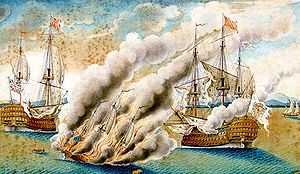 While Anson was pursuing his voyage round the world
, Spain was mainly intent on the Italian policy of the king. A squadron was fitted out at Cádiz
to convey troops to Italy. It was watched by the British admiral Nicholas Haddock
. When the blockading squadron was forced off by want of provisions, the Spanish admiral Don Juan José Navarro
put to sea. He was followed, but when the British force came in sight of him Navarro had been joined by a French squadron under Claude-Elisée de La Bruyère de Court (December 1741). The French admiral announced that he would support the Spaniards if they were attacked and Haddock retired. France and Great Britain were not yet openly at war, but both were engaged in the struggle in Germany—Great Britain as the ally of the Queen of Hungary, Maria Theresa; France as the supporter of the Bavarian claimant of the empire. Navarro and de Court went on to Toulon
, where they remained till February 1744. A British fleet watched them, under the command of Admiral Richard Lestock
, till Sir Thomas Mathews
was sent out as commander-in-chief and as Minister to the Court of Turin
.
Sporadic manifestations of hostility between the French and British took place in different seas, but avowed war did not begin till the French government issued its declaration of 30 March, to which Great Britain replied on 31 March. This formality had been preceded by French preparations for the invasion of England, and by the Battle of Toulon between the British and a Franco-Spanish fleet. On 11 February a most confused battle was fought, in which the van and centre of the British fleet was engaged with the Spanish rear and centre of the allies. Lestock, who was on the worst possible terms with his superior, took no part in the action. Mathews fought with spirit but in a disorderly way, breaking the formation of his fleet, and showing no power of direction. The mismanagement of the British fleet in the battle, by arousing deep anger among the people, led to a drastic reform of the British navy which bore its first fruits before the war ended.
leaders, and soldiers were to be transported from Dunkirk. In February 1744, a French fleet of twenty sail of the line entered the English Channel
under Jacques Aymar, comte de Roquefeuil
, before the British force under Admiral John Norris was ready to oppose him. But the French force was ill-equipped, the admiral was nervous, his mind dwelt on all the misfortunes which might possibly happen, and the weather was bad. De Roquefeuil came up almost as far as The Downs
, where he learnt that Sir John Norris was at hand with twenty-five sail of the line, and thereupon precipitately retreated. The military expedition prepared at Dunkirk to cross under cover of De Roquefeuil's fleet naturally did not start. The utter weakness of the French at sea, due to long neglect of the fleet and the bankrupt state of the treasury, was shown during the Jacobite rising of 1745, when France made no attempt to profit by the distress of the British government.
The Dutch, having by this time joined Great Britain, made a serious addition to the naval power opposed to France, though Holland was compelled by the necessity for maintaining an army in Flanders to play a very subordinate part at sea. Not being stimulated by formidable attack, and having immediate interests both at home and in Germany, the British government was slow to make use of its latest naval strength. Spain, which could do nothing of an offensive character, was almost neglected. During 1745 the New England
expedition which took Louisburg (30 April – June 16) was covered by a British naval force, but little else was accomplished by the naval efforts of any of the belligerents.
In 1746 a British combined naval and military expedition to the coast of France – the first of a long series of similar ventures which in the end were derided as "breaking windows with guineas" – was carried out during August and October. The aim was the capture of the French East India Company
's dockyard at L'Orient, but it was not attained.
From 1747 until the close of the war in October 1748 the naval policy of the British government, without reaching a high level, was more energetic and coherent. A closer watch was kept on the French coast, and effectual means were taken to intercept communication between France and her American possessions. In the spring information was obtained that an important convoy for the East and West Indies
was to sail from L'Orient. The convoy was intercepted by Anson on 3 May, and in the first Battle of Cape Finisterre
his fourteen ships of the line wiped out the French escort of six ships of the line and three armed Indiamen, although in the meantime the merchant ships escaped.
On 14 October another French convoy, protected by a strong squadron, was intercepted by a well-appointed and well-directed squadron of superior numbers – the squadrons were respectively eight French and fourteen British – in the Bay of Biscay
. In the second Battle of Cape Finisterre
which followed, the French admiral, Henri-François des Herbiers-l'Étenduère (1681–1750), succeeded in covering the escape of most of the merchant ships, but Hawke's British squadron took six of his warships. Most of the merchantmen were later intercepted and captured in the West Indies. This disaster convinced the French government of its helplessness at sea, and it made no further effort.
. After an inconclusive clash off Negapatnam in June 1746, Edward Peyton
, Barnett's successor, withdrew to Bengal, leaving Bourdonnais unopposed on the Coromandel Coast
. He landed troops near Madras
and besieged the port by land and sea, forcing it to surrender on 10 September 1746. In October the French squadron was devastated by a cyclone, losing four ships of the line and suffering heavy damage to four more, and the surviving ships withdrew. French land forces went on to besiege the British settlement at Cuddalore
, but the eventual replacement of the negligent Peyton by Thomas Griffin resulted in the British squadron's belated return to action and the raising of the siege in March 1747. Despite the appearance of another French squadron, the arrival of British reinforcements under Edward Boscawen
gave the British overwhelming dominance at sea, but the ensuing siege of Pondicherry organised by Bosccawen was unsuccessful.
King George's War
King George's War is the name given to the operations in North America that formed part of the War of the Austrian Succession . It was the third of the four French and Indian Wars. It took place primarily in the British provinces of New York, Massachusetts Bay, New Hampshire, and Nova Scotia...
in North America, the Anglo-Spanish
Anglo-Spanish War
Anglo-Spanish War may refer to:* The Anglo-Spanish War of 1585–1604 was part of the Eighty Years' War* The Anglo-Spanish War of 1625–1630 was part of the Thirty Years' War...
War of Jenkins' Ear
War of Jenkins' Ear
The War of Jenkins' Ear was a conflict between Great Britain and Spain that lasted from 1739 to 1748, with major operations largely ended by 1742. Its unusual name, coined by Thomas Carlyle in 1858, relates to Robert Jenkins, captain of a British merchant ship, who exhibited his severed ear in...
, and two of the three Silesian wars
Silesian Wars
The Silesian Wars were a series of wars between Prussia and Austria for control of Silesia. They formed parts of the larger War of the Austrian Succession and Seven Years' War. They eventually ended with Silesia being incorporated into Prussia, and Austrian recognition of this...
– involved most of the powers
Power in international relations
Power in international relations is defined in several different ways. Political scientists, historians, and practitioners of international relations have used the following concepts of political power:...
of Europe over the question of Maria Theresa's
Maria Theresa of Austria
Maria Theresa Walburga Amalia Christina was the only female ruler of the Habsburg dominions and the last of the House of Habsburg. She was the sovereign of Austria, Hungary, Croatia, Bohemia, Mantua, Milan, Lodomeria and Galicia, the Austrian Netherlands and Parma...
succession to the realms of the House of Habsburg.
The war began under the pretext that Maria Theresa was ineligible to succeed to the Habsburg thrones of her father, Charles VI
Charles VI, Holy Roman Emperor
Charles VI was the penultimate Habsburg sovereign of the Habsburg Empire. He succeeded his elder brother, Joseph I, as Holy Roman Emperor, King of Bohemia , Hungary and Croatia , Archduke of Austria, etc., in 1711...
, because Salic law
Salic law
Salic law was a body of traditional law codified for governing the Salian Franks in the early Middle Ages during the reign of King Clovis I in the 6th century...
precluded royal inheritance by a woman—though in reality this was a convenient excuse put forward by Prussia
Prussia
Prussia was a German kingdom and historic state originating out of the Duchy of Prussia and the Margraviate of Brandenburg. For centuries, the House of Hohenzollern ruled Prussia, successfully expanding its size by way of an unusually well-organized and effective army. Prussia shaped the history...
and France
France
The French Republic , The French Republic , The French Republic , (commonly known as France , is a unitary semi-presidential republic in Western Europe with several overseas territories and islands located on other continents and in the Indian, Pacific, and Atlantic oceans. Metropolitan France...
to challenge Habsburg power. Austria was supported by Great Britain
Kingdom of Great Britain
The former Kingdom of Great Britain, sometimes described as the 'United Kingdom of Great Britain', That the Two Kingdoms of Scotland and England, shall upon the 1st May next ensuing the date hereof, and forever after, be United into One Kingdom by the Name of GREAT BRITAIN. was a sovereign...
and the Dutch Republic
Dutch Republic
The Dutch Republic — officially known as the Republic of the Seven United Netherlands , the Republic of the United Netherlands, or the Republic of the Seven United Provinces — was a republic in Europe existing from 1581 to 1795, preceding the Batavian Republic and ultimately...
, the traditional enemies of France, as well as the Kingdom of Sardinia
Kingdom of Sardinia
The Kingdom of Sardinia consisted of the island of Sardinia first as a part of the Crown of Aragon and subsequently the Spanish Empire , and second as a part of the composite state of the House of Savoy . Its capital was originally Cagliari, in the south of the island, and later Turin, on the...
and Saxony
Electorate of Saxony
The Electorate of Saxony , sometimes referred to as Upper Saxony, was a State of the Holy Roman Empire. It was established when Emperor Charles IV raised the Ascanian duchy of Saxe-Wittenberg to the status of an Electorate by the Golden Bull of 1356...
. France and Prussia were allied with the Electorate of Bavaria
Electorate of Bavaria
The Electorate of Bavaria was an independent hereditary electorate of the Holy Roman Empire from 1623 to 1806, when it was succeeded by the Kingdom of Bavaria....
.
Spain entered the war to reestablish its influence in northern Italy, further reversing an Austrian dominance over the Italian peninsula that had been achieved at Spain's expense as a consequence of that country's own war of succession
War of the Spanish Succession
The War of the Spanish Succession was fought among several European powers, including a divided Spain, over the possible unification of the Kingdoms of Spain and France under one Bourbon monarch. As France and Spain were among the most powerful states of Europe, such a unification would have...
earlier in the 18th century.
The war ended with the Treaty of Aix-la-Chapelle
Treaty of Aix-la-Chapelle (1748)
The Treaty of Aix-la-Chapelle of 1748 ended the War of the Austrian Succession following a congress assembled at the Imperial Free City of Aachen—Aix-la-Chapelle in French—in the west of the Holy Roman Empire, on 24 April 1748...
in 1748. The most enduring military historical interest and importance of the war lies in the struggle of Prussia
Kingdom of Prussia
The Kingdom of Prussia was a German kingdom from 1701 to 1918. Until the defeat of Germany in World War I, it comprised almost two-thirds of the area of the German Empire...
and the Habsburg
Habsburg
The House of Habsburg , also found as Hapsburg, and also known as House of Austria is one of the most important royal houses of Europe and is best known for being an origin of all of the formally elected Holy Roman Emperors between 1438 and 1740, as well as rulers of the Austrian Empire and...
monarchs for the region of Silesia
Silesia
Silesia is a historical region of Central Europe located mostly in Poland, with smaller parts also in the Czech Republic, and Germany.Silesia is rich in mineral and natural resources, and includes several important industrial areas. Silesia's largest city and historical capital is Wrocław...
.
Background
Charles VI, Holy Roman Emperor
Charles VI was the penultimate Habsburg sovereign of the Habsburg Empire. He succeeded his elder brother, Joseph I, as Holy Roman Emperor, King of Bohemia , Hungary and Croatia , Archduke of Austria, etc., in 1711...
, Maria Theresa succeeded him as Queen of Hungary, Croatia
Kingdom of Croatia (Habsburg)
The Kingdom of Croatia was an administrative division that existed between 1527 and 1868 within the Habsburg Monarchy . The Kingdom was a part of the Lands of the Crown of St. Stephen, but was subject to direct Imperial Austrian rule for significant periods of time, including its final years...
and Bohemia, Archduchess of Austria and Duchess of Parma. Her father had been Holy Roman Emperor, but Maria Theresa was not a candidate for that title, which had never been held by a woman; the plan was for her to succeed to the hereditary domains, and her husband, Francis Stephen
Francis I, Holy Roman Emperor
Francis I was Holy Roman Emperor and Grand Duke of Tuscany, though his wife effectively executed the real power of those positions. With his wife, Maria Theresa, he was the founder of the Habsburg-Lorraine dynasty...
, to be elected Holy Roman Emperor. The complications involved in a female Habsburg ruler had been long foreseen, and Charles VI had persuaded most of the states of Germany to agree to the Pragmatic Sanction of 1713
Pragmatic Sanction of 1713
The Pragmatic Sanction of 1713 was an edict issued by Holy Roman Emperor Charles VI to ensure that the throne of the Archduchy of Austria could be inherited by a daughter....
.
Problems began when King Frederick II of Prussia
Frederick II of Prussia
Frederick II was a King in Prussia and a King of Prussia from the Hohenzollern dynasty. In his role as a prince-elector of the Holy Roman Empire, he was also Elector of Brandenburg. He was in personal union the sovereign prince of the Principality of Neuchâtel...
violated the Pragmatic Sanction and invaded Silesia
Silesia
Silesia is a historical region of Central Europe located mostly in Poland, with smaller parts also in the Czech Republic, and Germany.Silesia is rich in mineral and natural resources, and includes several important industrial areas. Silesia's largest city and historical capital is Wrocław...
on 16 December 1740, using the Treaty of Brieg of 1537 under which the Hohenzollerns
House of Hohenzollern
The House of Hohenzollern is a noble family and royal dynasty of electors, kings and emperors of Prussia, Germany and Romania. It originated in the area around the town of Hechingen in Swabia during the 11th century. They took their name from their ancestral home, the Burg Hohenzollern castle near...
of Brandenburg
Brandenburg
Brandenburg is one of the sixteen federal-states of Germany. It lies in the east of the country and is one of the new federal states that were re-created in 1990 upon the reunification of the former West Germany and East Germany. The capital is Potsdam...
were to inherit the Duchy of Brieg as a pretext. Maria Theresa, as a woman, was perceived as weak, and other rulers (such as Charles Albert of Bavaria
Charles VII, Holy Roman Emperor
Charles VII Albert a member of the Wittelsbach family, was Prince-elector of Bavaria from 1726 and Holy Roman Emperor from 24 January 1742 until his death in 1745...
) put forward their own competing claims to the crown
Order of succession
An order of succession is a formula or algorithm that determines who inherits an office upon the death, resignation, or removal of its current occupant.-Monarchies and nobility:...
as male heirs with a clear genealogical basis to inherit the elected dignities
Prince-elector
The Prince-electors of the Holy Roman Empire were the members of the electoral college of the Holy Roman Empire, having the function of electing the Roman king or, from the middle of the 16th century onwards, directly the Holy Roman Emperor.The heir-apparent to a prince-elector was known as an...
of the great Imperial title.
Silesian Campaign of 1740
Prussia in 1740 was a small and thoroughly organized emerging international power
Power in international relations
Power in international relations is defined in several different ways. Political scientists, historians, and practitioners of international relations have used the following concepts of political power:...
with a brand new well educated king, Frederick II of Prussia
Frederick II of Prussia
Frederick II was a King in Prussia and a King of Prussia from the Hohenzollern dynasty. In his role as a prince-elector of the Holy Roman Empire, he was also Elector of Brandenburg. He was in personal union the sovereign prince of the Principality of Neuchâtel...
, desiring to unify the disparate and scattered crown holdings by gathering intervening lands into a unified contiguous state. When the Holy Roman Emperor died, distracting the Habsburg Monarchy to the south east, Frederick turned opportunist using a questionable interpretation of a treaty (1537) between the Hohenzollerns and the Piasts of Brieg as pretext (reversing Prussia's position in the War of the Polish Succession
War of the Polish Succession
The War of the Polish Succession was a major European war for princes' possessions sparked by a Polish civil war over the succession to Augustus II, King of Poland that other European powers widened in pursuit of their own national interests...
, concluded the year 1738, just two years before) to invade and snap up territories in Silesia. Meanwhile, as expected, the other princes of Europe prepared to exploit an opportunity to acquire Habsburg possessions and humble and diminish the power of the great house that an election of the Emperor of the Holy Roman Empire
Prince-elector
The Prince-electors of the Holy Roman Empire were the members of the electoral college of the Holy Roman Empire, having the function of electing the Roman king or, from the middle of the 16th century onwards, directly the Holy Roman Emperor.The heir-apparent to a prince-elector was known as an...
represented. Archduchess of Austria and Queen of Hungary she may be, but salic law
Salic law
Salic law was a body of traditional law codified for governing the Salian Franks in the early Middle Ages during the reign of King Clovis I in the 6th century...
guaranteed the next Emperor was not going to be Archduchess Maria Theresa of Austria.
While the only recent war experience of its army had been in the War of the Polish Succession
War of the Polish Succession
The War of the Polish Succession was a major European war for princes' possessions sparked by a Polish civil war over the succession to Augustus II, King of Poland that other European powers widened in pursuit of their own national interests...
(Rhine campaign of 1733–1735) her forces hadn't fought there, since Frederick William was not trusted by Austria. It therefore had an uninspiring reputation and was counted as one of the many minor armies of the princes of Europe, of which there were plenty (See the 1800 plus states of the Holy Roman Empire
Holy Roman Empire
The Holy Roman Empire was a realm that existed from 962 to 1806 in Central Europe.It was ruled by the Holy Roman Emperor. Its character changed during the Middle Ages and the Early Modern period, when the power of the emperor gradually weakened in favour of the princes...
).
Only few thought that it could rival the larger modern forces of Austria and France. But King Friedrich Wilhelm I of Prussia had drilled it to a perfection previously unknown in Europe's military experience, and the Prussian infantry
Infantry
Infantrymen are soldiers who are specifically trained for the role of fighting on foot to engage the enemy face to face and have historically borne the brunt of the casualties of combat in wars. As the oldest branch of combat arms, they are the backbone of armies...
soldier was so well-trained and well-equipped that he could fire 3 shots a minute to an Austrian's 1.Prussian cavalry
Cavalry
Cavalry or horsemen were soldiers or warriors who fought mounted on horseback. Cavalry were historically the third oldest and the most mobile of the combat arms...
and artillery
Artillery
Originally applied to any group of infantry primarily armed with projectile weapons, artillery has over time become limited in meaning to refer only to those engines of war that operate by projection of munitions far beyond the range of effect of personal weapons...
were comparatively less efficient, but they were still of better quality than average.
The initial advantage of Frederick's army was that, undisturbed by wars, it had developed the professional standing-army
Standing army
A standing army is a professional permanent army. It is composed of full-time career soldiers and is not disbanded during times of peace. It differs from army reserves, who are activated only during wars or natural disasters...
concept to full maturity and effect. While the Austrians had to wait for conscription to complete the field forces, Prussian regiments took the field at once, and thus Frederick was able to overrun Silesia almost unopposed.
In any event, his army had massed quietly along the Oder River during early December, and on 16 December 1740, without declaration of war, it crossed the frontier into Silesia. The extant forces available to the local Austrian generals could do no more than garrison
Garrison
Garrison is the collective term for a body of troops stationed in a particular location, originally to guard it, but now often simply using it as a home base....
a few fortresses
Fortification
Fortifications are military constructions and buildings designed for defence in warfare and military bases. Humans have constructed defensive works for many thousands of years, in a variety of increasingly complex designs...
, and they necessarily fell back to the mountain frontier of Bohemia
Bohemia
Bohemia is a historical region in central Europe, occupying the western two-thirds of the traditional Czech Lands. It is located in the contemporary Czech Republic with its capital in Prague...
and Moravia
Moravia
Moravia is a historical region in Central Europe in the east of the Czech Republic, and one of the former Czech lands, together with Bohemia and Silesia. It takes its name from the Morava River which rises in the northwest of the region...
with only a small remnant of their available forces left in the garrisons.
On their new territory, the organized Prussian army was soon able to go into winter quarters, holding all Silesia and investing the strong places of Glogau, Brieg
Brzeg
Brzeg is a town in southwestern Poland with 38,496 inhabitants , situated in Silesia in the Opole Voivodeship on the left bank of the Oder...
and Neisse
Nysa, Poland
Nysa is a town in southwestern Poland on the Nysa Kłodzka river with 47,545 inhabitants , situated in the Opole Voivodeship. It is the capital of Nysa County. It comprises the urban portion of the surrounding Gmina Nysa, a mixed urban-rural commune with a total population of 60,123 inhabitants...
. In one step, Prussia had effectively doubled its population and made huge gains in its industrial productivity for the minor cost of fair treatment of the people in the occupied territory—an atypical factor and effect in a day when relatively undisciplined mercenary
Mercenary
A mercenary, is a person who takes part in an armed conflict based on the promise of material compensation rather than having a direct interest in, or a legal obligation to, the conflict itself. A non-conscript professional member of a regular army is not considered to be a mercenary although he...
forces were the rule rather than the exception with their habitual raping, looting, and abuse of the various populations around themselves – which were generally forced to provide quarters.
Nationalism as we know it today, was not a factor, but an evolving concept just coming into its early years. Prussia benefited greatly from the apolitical nature of the society of the era, as the masses in central Germany would correspondingly suffer as the contending armies rampaged through their plains yet again.
Allies in Bohemia 1741
The French duly joined the Bavarian Elector's forces on the DanubeDanube
The Danube is a river in the Central Europe and the Europe's second longest river after the Volga. It is classified as an international waterway....
and advanced towards Vienna
Vienna
Vienna is the capital and largest city of the Republic of Austria and one of the nine states of Austria. Vienna is Austria's primary city, with a population of about 1.723 million , and is by far the largest city in Austria, as well as its cultural, economic, and political centre...
, but the objective was suddenly changed, and after many countermarches the anti-Austrian allies advanced, in three widely separated corps
Corps
A corps is either a large formation, or an administrative grouping of troops within an armed force with a common function such as Artillery or Signals representing an arm of service...
, on Prague
Prague
Prague is the capital and largest city of the Czech Republic. Situated in the north-west of the country on the Vltava river, the city is home to about 1.3 million people, while its metropolitan area is estimated to have a population of over 2.3 million...
. A French corps moved via Amberg
Amberg
Amberg is a town in Bavaria, Germany. It is located in the Upper Palatinate, roughly halfway between Regensburg and Bayreuth. Population: 44,756 .- History :...
and Pilsen. The Elector marched on Budweis, and the Saxons (who had now joined the allies) invaded Bohemia
Bohemia
Bohemia is a historical region in central Europe, occupying the western two-thirds of the traditional Czech Lands. It is located in the contemporary Czech Republic with its capital in Prague...
by the Elbe
Elbe
The Elbe is one of the major rivers of Central Europe. It rises in the Krkonoše Mountains of the northwestern Czech Republic before traversing much of Bohemia , then Germany and flowing into the North Sea at Cuxhaven, 110 km northwest of Hamburg...
valley. The Austrians could at first offer little resistance, but before long a considerable force intervened at Tábor
Tábor
Tábor is a city of the Czech Republic, in the South Bohemian Region. It is named after Mount Tabor, which is believed by many to be the place of the Transfiguration of Christ; however, the name became popular and nowadays translates to "camp" or "encampment" in the Czech language.The town was...
between the Danube and the allies, and the Austrian general Wilhelm Reinhard von Neipperg
Wilhelm Reinhard von Neipperg
Count Wilhelm Reinhard von Neipperg was an Austrian general.Born in Schwaigern, he descended from an ancient comital family from Swabia, his father Count Eberhard Friedrich von Neipperg having been an Imperial field marshal. He spent his boyhood in Vienna and in 1702 joined the Imperial service...
was now on the march from Neisse to join in the campaign
Military campaign
In the military sciences, the term military campaign applies to large scale, long duration, significant military strategy plan incorporating a series of inter-related military operations or battles forming a distinct part of a larger conflict often called a war...
. He had made with Frederick the curious agreement of Klein Schnellendorf (9 October 1741), by which Neisse was surrendered after a mock siege, and the Austrians undertook to leave Frederick unmolested in return for his releasing Neipperg's army for service elsewhere. At the same time the Hungarians
Hungary
Hungary , officially the Republic of Hungary , is a landlocked country in Central Europe. It is situated in the Carpathian Basin and is bordered by Slovakia to the north, Ukraine and Romania to the east, Serbia and Croatia to the south, Slovenia to the southwest and Austria to the west. The...
, moved to enthusiasm by the personal appeal of Maria Theresia, had put into the field a levée en masse, or "insurrection," which furnished the regular army with an invaluable force of light troops. A fresh army was collected under Field Marshal Khevenhüller at Vienna, and the Austrians planned an offensive winter campaign against the Franco-Bavarian forces in Bohemia and the small Bavarian army that remained on the Danube to defend the electorate.
The French in the meantime had stormed Prague on 26 November 1741, Francis Stephen
Francis I, Holy Roman Emperor
Francis I was Holy Roman Emperor and Grand Duke of Tuscany, though his wife effectively executed the real power of those positions. With his wife, Maria Theresa, he was the founder of the Habsburg-Lorraine dynasty...
, husband of Maria Theresa, who commanded the Austrians in Bohemia, moving too slowly to save the fortress. The Elector of Bavaria, who now styled himself Archduke of Austria, was crowned King of Bohemia (9 December 1741) and elected to the imperial throne as Charles VII
Charles VII, Holy Roman Emperor
Charles VII Albert a member of the Wittelsbach family, was Prince-elector of Bavaria from 1726 and Holy Roman Emperor from 24 January 1742 until his death in 1745...
(24 January 1742), but no active measures were undertaken.
In Bohemia the month of December was occupied in mere skirmishes. On the Danube, Khevenhüller, the best general in the Austrian service, advanced on 27 December, swiftly drove back the allies, shut them up in Linz
Linz
Linz is the third-largest city of Austria and capital of the state of Upper Austria . It is located in the north centre of Austria, approximately south of the Czech border, on both sides of the river Danube. The population of the city is , and that of the Greater Linz conurbation is about...
, and pressed on into Bavaria. Munich
Munich
Munich The city's motto is "" . Before 2006, it was "Weltstadt mit Herz" . Its native name, , is derived from the Old High German Munichen, meaning "by the monks' place". The city's name derives from the monks of the Benedictine order who founded the city; hence the monk depicted on the city's coat...
itself surrendered to the Austrians on the coronation
Coronation
A coronation is a ceremony marking the formal investiture of a monarch and/or their consort with regal power, usually involving the placement of a crown upon their head and the presentation of other items of regalia...
day of Charles VII.
At the close of this first act of the campaign the French, under the old Marshal de Broglie
François-Marie, 1st duc de Broglie
François-Marie de Broglie, 1er duc de Broglie was a French military leader.-Early years:Francois Marie de Broglie was the third son of Victor Maurice de Broglie, comte de Broglie, named for his grandfather, François Marie...
, maintained a precarious foothold in central Bohemia, menaced by the main army of the Austrians, and Khevenhüller was ranging unopposed in Bavaria. Frederick made a secret truce with Austria and thus, lay inactive in Silesia.
Campaigns of 1742
Armistice
An armistice is a situation in a war where the warring parties agree to stop fighting. It is not necessarily the end of a war, but may be just a cessation of hostilities while an attempt is made to negotiate a lasting peace...
, in order to compromise Frederick with his allies. The war recommenced. Frederick had not rested on his laurels. In the uneventful summer campaign of 1741 he had found time to begin that reorganization of his cavalry which was before long to make it even more efficient than his infantry. The Emperor Charles VII, whose territories were overrun by the Austrians, asked him to create a diversion by invading Moravia. In December 1741, therefore, the Prussian general field marshal Kurt Christoph Graf von Schwerin
Kurt Christoph Graf von Schwerin
Kurt Christoph Graf von Schwerin was a Prussian Generalfeldmarschall, one of the leading commanders under Frederick the Great.-Biography:...
had crossed the border and captured Olmutz. Glatz also was invested
Siege
A siege is a military blockade of a city or fortress with the intent of conquering by attrition or assault. The term derives from sedere, Latin for "to sit". Generally speaking, siege warfare is a form of constant, low intensity conflict characterized by one party holding a strong, static...
, and the Prussian army was concentrated about Olomouc in January 1742. A combined plan of operations
Military strategy
Military strategy is a set of ideas implemented by military organizations to pursue desired strategic goals. Derived from the Greek strategos, strategy when it appeared in use during the 18th century, was seen in its narrow sense as the "art of the general", 'the art of arrangement' of troops...
was made by the French, Saxons and Prussians for the rescue of Linz. But Linz soon fell. Broglie on the Vltava
Vltava
The Vltava is the longest river in the Czech Republic, running north from its source in Šumava through Český Krumlov, České Budějovice, and Prague, merging with the Elbe at Mělník...
, weakened by the departure of the Bavarians to oppose Khevenhüller, and of the Saxons to join forces with Frederick, was in no condition to take the offensive, and large forces under Prince Charles of Lorraine
Prince Charles Alexander of Lorraine
Prince Charles Alexander of Lorraine was a Lorraine-born Austrian soldier.-Background:Charles was the son of Leopold Joseph, Duke of Lorraine and Élisabeth Charlotte d'Orléans...
lay in his front from Budweis to Jihlava
Jihlava
Jihlava is a city in the Czech Republic. Jihlava is a centre of the Vysočina Region, situated on the Jihlava river on the ancient frontier between Moravia and Bohemia, and is the oldest mining town in the Czech Republic, ca. 50 years older than Kutná Hora.Among the principal buildings are the...
(Iglau). Frederick's march was made towards Iglau in the first place. Brno
Brno
Brno by population and area is the second largest city in the Czech Republic, the largest Moravian city, and the historical capital city of the Margraviate of Moravia. Brno is the administrative centre of the South Moravian Region where it forms a separate district Brno-City District...
was invested about the same time (February), but the direction of the march was changed, and instead of moving against Prince Charles, Frederick pushed on southwards by Znojmo
Znojmo
Znojmo is a city in the South Moravian Region of the Czech Republic, near the border with Lower Austria, connected to Vienna by railway and road . The royal city of Znojmo was founded shortly before 1226 by King Ottokar I on the plains in front of Znojmo Castle...
and Mikulov
Mikulov
Mikulov is a town in the South Moravian Region of the Czech Republic with a population of 7,608 . It is located directly on the border with Lower Austria. Mikulov is located at the edge of a hilly area and the three Nové Mlýny reservoirs...
. The extreme outposts of the Prussians appeared before Vienna. But Frederick's advance was a mere foray, and Prince Charles, leaving a screen of troops in front of Broglie, marched to cut off the Prussians from Silesia, while the Hungarian levies
Conscription
Conscription is the compulsory enlistment of people in some sort of national service, most often military service. Conscription dates back to antiquity and continues in some countries to the present day under various names...
poured into Upper Silesia
Upper Silesia
Upper Silesia is the southeastern part of the historical and geographical region of Silesia. Since the 9th century, Upper Silesia has been part of Greater Moravia, the Duchy of Bohemia, the Piast Kingdom of Poland, again of the Lands of the Bohemian Crown and the Holy Roman Empire, as well as of...
by the Jablunkov Pass
Jablunkov Pass
Jablunkov Pass is a mountain pass in the Beskids, located in the elevation of 553 m above sea level, in the Czech Republic, near the border with Poland and Slovakia....
. The Saxons, discontented and demoralized, soon marched off to their own country, and Frederick with his Prussians fell back by Svitavy
Svitavy
Svitavy is a town in the Svitavy District in the Pardubice Region of the Czech Republic. The town has a population of 18,000 and is also the district administrative centre...
and Litomyšl
Litomyšl
Litomyšl is a town and municipality in the Pardubice Region of the Czech Republic. The chateau complex in the town centre is listed as a UNESCO World Heritage Site.-History:...
to Kutná Hora
Kutná Hora
Kutná Hora is a city in Bohemia, now the Czech Republic in the Central Bohemian Region.-History:The town began in 1142 with the settlement of the first Cistercian Monastery in Bohemia, Kloster Sedlitz, brought from the Imperial immediate Cistercian Waldsassen Abbey...
in Bohemia, where he was in touch with Broglie on the one hand and (Glatz having now surrendered) with Silesia on the other. No defence of Olomouc was attempted, and the small Prussian corps remaining in Moravia fell back towards Upper Silesia.
Prince Charles, in pursuit of the king, marched by Jihlava and Teutsch (Deutsch) Brod on Kutná Hora, and on 17 May was fought the Battle of Chotusitz
Battle of Chotusitz
The Battle of Chotusitz, or Chotusice, sometimes called the Battle of Czaslau, was fought on May 17, 1742 in Bohemia between the Austrians under Prince Charles Alexander of Lorraine and the Prussians under Frederick the Great. The battle was a part of the War of the Austrian Succession sometimes...
, in which after a severe struggle the king was victorious. His cavalry on this occasion retrieved its previous failure, and its conduct gave an earnest of its future glory not only by its charges
Charge (warfare)
A charge is a maneuver in battle in which soldiers advance towards their enemy at their best speed in an attempt to engage in close combat. The charge is the dominant shock attack and has been the key tactic and decisive moment of most battles in history...
on the battlefield, but by its vigorous pursuit of the defeated Austrians. Almost at the same time Broglie fell upon a part of the Austrians left on the Vltava and won a small, but morally and politically important, success in the action of Sahay
Zahájí (Ceské Budejovice District)
Zahájí is a village in the South Bohemian Region, and is part of the district České Budějovice in the Czech Republic.Zahájí has 396 inhabitants .It is known for a small battle between French and Austrians in 1742, during the War of Austrian succession....
, near Budweis (24 May 1742). Frederick did not propose another combined movement. His victory and that of Broglie disposed Maria Theresa to cede Silesia in order to make good her position elsewhere, and the separate peace between Prussia and Austria, signed at Breslau on 11 June, closed the First Silesian War, but the War of the Austrian Succession continued.
Campaign of 1743
Naab
The Naab is a river in Bavaria, Germany, and is a left tributary of the Danube. It is approx. long, including its main source river Waldnaab....
. The Bavarians suffered a severe reverse near Braunau
Braunau am Inn
Braunau am Inn is a town in the Innviertel region of Upper Austria , the north-western state of Austria. It lies about 90 km west of Linz and about 60 km north of Salzburg, on the border with the German state of Bavaria. The population in 2001 was 16,372...
(9 May 1743), and now an Anglo-allied army commanded by King George II
George II of Great Britain
George II was King of Great Britain and Ireland, Duke of Brunswick-Lüneburg and Archtreasurer and Prince-elector of the Holy Roman Empire from 11 June 1727 until his death.George was the last British monarch born outside Great Britain. He was born and brought up in Northern Germany...
, which had been formed on the lower Rhine on the withdrawal of Maillebois, was advancing southward to the Main and Neckar
Neckar
The Neckar is a long river, mainly flowing through the southwestern state of Baden-Württemberg, but also a short section through Hesse, in Germany. The Neckar is a major right tributary of the River Rhine...
country. A French army, under Marshal Noailles, was being collected on the middle Rhine to deal with this new force. But Broglie was now in full retreat, and the strong places of Bavaria surrendered one after the other to Prince Charles. The French and Bavarians had been driven almost to the Rhine when Noailles and the king came to battle. George, completely outmaneuvered by his veteran antagonist, was in a position of the greatest danger between Aschaffenburg
Aschaffenburg
Aschaffenburg is a city in northwest Bavaria, Germany. The town of Aschaffenburg is not considered part of the district of Aschaffenburg, but is the administrative seat.Aschaffenburg is known as the Tor zum Spessart or "gate to the Spessart"...
and Hanau
Hanau
Hanau is a town in the Main-Kinzig-Kreis, in Hesse, Germany. It is located 25 km east of Frankfurt am Main. Its station is a major railway junction.- Geography :...
in the defile
Defile (geography)
Defile is a geographic term for a narrow pass or gorge between mountains or hills. It has its origins as a military description of a pass through which troops can march only in a narrow column or with a narrow front...
formed by the Spessart
Spessart
The Spessart is a low mountain range in northwestern Bavaria and southern Hesse, Germany. It is bordered on three sides by the Main River. The two most important towns located at the foot of the Spessart are Aschaffenburg and Würzburg....
Hills and the river Main. Noailles blocked the outlet and had posts all around, but the allied troops forced their way through and inflicted heavy losses on the French, and the Battle of Dettingen
Battle of Dettingen
The Battle of Dettingen took place on 27 June 1743 at Dettingen in Bavaria during the War of the Austrian Succession. It was the last time that a British monarch personally led his troops into battle...
is justly reckoned as a notable victory of Anglo-Austrian-Hanovarian arms (27 June).
Broglie, worn out by age and exertions, was soon replaced by Marshal Coigny. Both Broglie and Noailles were now on the strict defensive behind the Rhine. Not a single French soldier remained in Germany, and Prince Charles prepared to force the passage of the great river in the Breisgau
Breisgau
Breisgau is the name of an area in southwest Germany, placed between the river Rhine and the foothills of the Black Forest around Freiburg im Breisgau in the state of Baden-Württemberg. The district Breisgau-Hochschwarzwald, which partly consists of the Breisgau, is named after that area...
while the King of Britain moved forward via Mainz to co-operate by drawing upon himself the attention of both the French marshals. The Anglo-allied army took Worms
Worms, Germany
Worms is a city in Rhineland-Palatinate, Germany, on the Rhine River. At the end of 2004, it had 85,829 inhabitants.Established by the Celts, who called it Borbetomagus, Worms today remains embattled with the cities Trier and Cologne over the title of "Oldest City in Germany." Worms is the only...
, but after several unsuccessful attempts to cross, Prince Charles went into winter quarters. The king followed his example, drawing in his troops to the northward, to deal, if necessary, with the army which the French were collecting on the frontier of the Southern Netherlands
Southern Netherlands
Southern Netherlands were a part of the Low Countries controlled by Spain , Austria and annexed by France...
. Austria, Britain, Holland and Sardinia were now allied. Saxony changed sides, and Sweden and Russia neutralized each other (Peace of Åbo, August 1743). Frederick was still quiescent. France, Spain and Bavaria actively continued the struggle against Maria Theresa.
Campaign of 1744
Louis XV of France
Louis XV was a Bourbon monarch who ruled as King of France and of Navarre from 1 September 1715 until his death. He succeeded his great-grandfather at the age of five, his first cousin Philippe II, Duke of Orléans, served as Regent of the kingdom until Louis's majority in 1723...
. France had posed hitherto as an auxiliary, its officers in Germany had worn the Bavarian cockade
Cockade
A cockade is a knot of ribbons, or other circular- or oval-shaped symbol of distinctive colors which is usually worn on a hat.-Eighteenth century:...
, and only with Britain was it officially at war. France now declared war directly upon Austria and Sardinia (April 1744). An army was assembled at Dunkirk to support the cause of James Stuart
James Francis Edward Stuart
James Francis Edward, Prince of Wales was the son of the deposed James II of England...
in an invasion of Great Britain
Planned French Invasion of Britain (1744)
A planned invasion of Great Britain was to be undertaken by France in 1744 shortly after the declaration of war between them as part of the War of the Austrian Succession. A large invasion force was prepared and put to sea from Dunkirk in February 1744, only to be partly wrecked and driven back...
. However violent storms wrecked the crossing attempt, and the planned invasion was abandoned. Meanwhile, Louis XV in person, with 90,000 men, prepared to invade the Austrian Netherlands, and took Menin
Menen
Menen is a municipality located in the Belgian province of West Flanders. The municipality comprises the city of Menen proper and the towns of Lauwe and Rekkem. The city is situated on the French/Belgian border. On January 1, 2006, Menen had a total population of 32,413...
and Ypres
Ypres
Ypres is a Belgian municipality located in the Flemish province of West Flanders. The municipality comprises the city of Ypres and the villages of Boezinge, Brielen, Dikkebus, Elverdinge, Hollebeke, Sint-Jan, Vlamertinge, Voormezele, Zillebeke, and Zuidschote...
. His presumed opponent was the allied army previously under King George II and now composed of British, Dutch, Germans and Austrians. On the Rhine, Coigny was up against Prince Charles, and a fresh army under the Prince de Conti
Louis François I de Bourbon, prince de Conti
Louis François de Bourbon, Prince of Conti was a French nobleman, who was the Prince of Conti from 1727 to his death, following his father Louis Armand II. His mother was Louise Élisabeth de Bourbon, a natural granddaughter of Louis XIV...
was to assist the Spaniards in Piedmont and Lombardy. This plan was, however, at once dislocated by the advance of Charles, who, assisted by the veteran marshal Traun, skillfully manoeuvred his army over the Rhine near Philippsburg
Philippsburg
Philippsburg is a town in Germany, in the district of Karlsruhe in Baden-Württemberg.-History:Before 1632, Philippsburg was known as "Udenheim".The city was a possession of the Bishop of Speyer from 1371–1718...
(1 July), captured the lines of Weissenburg
Lines of Weissenburg
The Lines of Weissenburg or Lines of Wissembourg, entrenched works — an earthen rampart dotted with small outworks — along the river Lauter.-History:...
, and cut off Coigny from Alsace
Alsace
Alsace is the fifth-smallest of the 27 regions of France in land area , and the smallest in metropolitan France. It is also the seventh-most densely populated region in France and third most densely populated region in metropolitan France, with ca. 220 inhabitants per km²...
. Coigny, however, cut his way through the enemy at Weissenburg and posted himself near Strasbourg
Strasbourg
Strasbourg is the capital and principal city of the Alsace region in eastern France and is the official seat of the European Parliament. Located close to the border with Germany, it is the capital of the Bas-Rhin département. The city and the region of Alsace are historically German-speaking,...
. Louis XV now abandoned the invasion of the Southern Netherlands
Southern Netherlands
Southern Netherlands were a part of the Low Countries controlled by Spain , Austria and annexed by France...
, and his army moved down to take a decisive part in the war in Alsace and Lorraine
Lorraine (province)
The Duchy of Upper Lorraine was an historical duchy roughly corresponding with the present-day northeastern Lorraine region of France, including parts of modern Luxembourg and Germany. The main cities were Metz, Verdun, and the historic capital Nancy....
. At the same time Frederick crossed the Austrian frontier (August).
The attention and resources of Austria were fully occupied, and the Prussians were almost unopposed. One column passed through Saxony, another through Lusatia
Lusatia
Lusatia is a historical region in Central Europe. It stretches from the Bóbr and Kwisa rivers in the east to the Elbe valley in the west, today located within the German states of Saxony and Brandenburg as well as in the Lower Silesian and Lubusz voivodeships of western Poland...
, while a third advanced from Silesia. Prague, the objective, was reached on 2 September. Six days later the Austrian garrison was compelled to surrender, and the Prussians advanced to Budweis. Maria Theresa once again rose to the emergency, a new "insurrection" took the field in Hungary, and a corps of regulars was assembled to cover Vienna, while the diplomats won over Saxony to the Austrian side. Prince Charles withdrew from Alsace, unmolested by the French, who had been thrown into confusion by the sudden and dangerous illness of Louis XV at Metz
Metz
Metz is a city in the northeast of France located at the confluence of the Moselle and the Seille rivers.Metz is the capital of the Lorraine region and prefecture of the Moselle department. Located near the tripoint along the junction of France, Germany, and Luxembourg, Metz forms a central place...
. Only Seckendorf with the Bavarians pursued him. No move was made by the French, and Frederick thus found himself isolated and exposed to the combined attack of the Austrians and Saxons. Marshal Traun, summoned from the Rhine, held the king in check in Bohemia, the Hungarian irregulars inflicted numerous minor reverses on the Prussians, and finally Prince Charles arrived with the main army. The campaign resembled that of 1742: the Prussian retreat was closely watched, and the rearguard pressed hard. Prague fell, and Frederick, completely outmanoeuvred by the united forces of Prince Charles and Traun, retreated to Silesia with heavy losses. At the same time, the Austrians gained no foothold in Silesia itself. On the Rhine, Louis XV, now recovered, had besieged and taken Freiburg
Freiburg
Freiburg im Breisgau is a city in Baden-Württemberg, Germany. In the extreme south-west of the country, it straddles the Dreisam river, at the foot of the Schlossberg. Historically, the city has acted as the hub of the Breisgau region on the western edge of the Black Forest in the Upper Rhine Plain...
, after which the forces left in the north were reinforced and besieged the strong places of Southern Netherlands
Southern Netherlands
Southern Netherlands were a part of the Low Countries controlled by Spain , Austria and annexed by France...
. There was also a slight war of manoeuvre on the middle Rhine.
Campaign of 1745
Battle of Hohenfriedberg
The Battle of Hohenfriedberg or Hohenfriedeberg, also known as the battle of Striegau, now Dobromierz, was one of the crowning achievements of Frederick the Great...
, Kesselsdorf
Battle of Kesselsdorf
The Battle of Kesselsdorf was fought on December 15, 1745, between Prussia and the combined forces of Austria and Saxony during the part of the War of the Austrian Succession known as the Second Silesian War. The Prussians were led by Leopold I, Prince of Anhalt-Dessau, while the Austrians and...
and Fontenoy
Battle of Fontenoy
The Battle of Fontenoy, 11 May 1745, was a major engagement of the War of the Austrian Succession, fought between the forces of the Pragmatic Allies – comprising mainly Dutch, British, and Hanoverian troops under the nominal command of the Duke of Cumberland – and a French army under Maurice de...
. The first event of the year was the Quadruple Alliance
Quadruple Alliance
The term "Quadruple Alliance" refers to several historical military alliances; none of which remain in effect.# The Quadruple Alliance of August 1673 was an alliance between the Holy Roman Empire, the Kingdom of Spain, Charles IV, Duke of Lorraine, and the United Provinces of the Netherlands, in...
of Britain, Austria, Holland and Saxony, concluded at Warsaw
Warsaw
Warsaw is the capital and largest city of Poland. It is located on the Vistula River, roughly from the Baltic Sea and from the Carpathian Mountains. Its population in 2010 was estimated at 1,716,855 residents with a greater metropolitan area of 2,631,902 residents, making Warsaw the 10th most...
on 8 January 1745 (Treaty of Warsaw
Treaty of Warsaw (1745)
The Treaty of Warsaw was a diplomatic agreement signed in Warsaw on 8 January 1745. It was an agreement between Great Britain, Austria, the Dutch Republic and Saxony to uphold the pragmatic sanction enabling their favoured candidate Maria Theresa to take the throne of the Austrian Empire...
). Twelve days later, the death of Charles VII submitted the imperial title to a new election, and his successor in Bavaria was not a candidate. The Bavarian army was again unfortunate. Caught in its scattered winter quarters (action of Amberg, 7 Jan.), it was driven from point to point, defeated at the Battle of Pfaffenhofen
Battle of Pfaffenhofen
The Battle of Pfaffenhofen was fought on April 15, 1745 between France and Austria. The Austrians under Karl Josef Batthyány defeated the outnumbered French under General Ségur, ending the war in Bavaria.-Prelude:...
and the young elector Maximilian III Joseph had to abandon Munich once more. The Peace of Füssen
Treaty of Füssen
The Peace of Füssen was a peace treaty signed at Füssen, Bavaria, between the Electorate of Bavaria and Habsburg Austria. Signed on 22 April 1745, it ended the participation of Bavaria on the French side in the War of the Austrian Succession.-Background:...
followed on 22 April, by which he secured his hereditary states on condition of supporting the candidature of the Grand-Duke Francis, consort of Maria Theresa. The "imperial" army ceased ipso facto to exist, and Frederick was again isolated. No help was to be expected from France, whose efforts this year were centred on the Flanders campaign. Indeed, on 10 May, before Frederick took the field, Louis XV and the Marshal of France Maurice de Saxe had besieged Tournay
Tournai
Tournai is a Walloon city and municipality of Belgium located 85 kilometres southwest of Brussels, on the river Scheldt, in the province of Hainaut....
, and inflicted upon the relieving army of the Duke of Cumberland the great defeat of Fontenoy
Battle of Fontenoy
The Battle of Fontenoy, 11 May 1745, was a major engagement of the War of the Austrian Succession, fought between the forces of the Pragmatic Allies – comprising mainly Dutch, British, and Hanoverian troops under the nominal command of the Duke of Cumberland – and a French army under Maurice de...
.
In Silesia the customary small war had been going on for some time, and the concentration of the Prussian army was not effected without severe fighting. At the end of May, Frederick, with about 65,000 men, lay in the camp of Frankenstein
Zabkowice Slaskie
Ząbkowice Śląskie is a town in Lower Silesian Voivodeship in south-western Poland. It is the seat of Ząbkowice Śląskie County, and of the smaller administrative district called Gmina Ząbkowice Śląskie....
, between Glatz
Glatz
Glatz can refer to :Places* Glatz, German name of a city in Lower Silesia, since 1945 Kłodzko, Poland* Landkreis Glatz, Prussian/German county 1816–1945, in the Province of Lower Silesia* Grafschaft Glatz, Duchy of Glatz, since 1348People...
and Neisse, while behind the Krkonoše (Giant Mountains) about Landeshut Prince Charles had 85,000 Austrians and Saxons. On 4 June was fought the Battle of Hohenfriedberg
Battle of Hohenfriedberg
The Battle of Hohenfriedberg or Hohenfriedeberg, also known as the battle of Striegau, now Dobromierz, was one of the crowning achievements of Frederick the Great...
or Striegau, the greatest victory as yet of Frederick's career, and, of all his battles, excelled perhaps by Leuthen
Battle of Leuthen
In the Battle of Leuthen or Lissa, fought on 5 December 1757, Frederick the Great's Prussian army used maneuver and terrain to decisively defeat a much larger Austrian army under Charles of Lorraine, thus ensuring Prussian control of Silesia during the Seven Years' War.- Background :While Frederick...
and Rossbach
Battle of Rossbach
The Battle of Rossbach took place during the Seven Years' War near the village of Roßbach, in the Electorate of Saxony. Frederick the Great defeated the allied armies of France and the Holy Roman/Austrian Empire...
only. Prince Charles suffered a complete defeat and withdrew through the mountains as he had come. Frederick's pursuit was methodical, for the country was difficult and barren, and he did not know the extent to which the enemy was demoralised.
The manoeuvres of both leaders on the upper Elbe occupied all the summer, while the political questions of the imperial election and of an understanding between Prussia and Britain were pending. The chief efforts of Austria were directed towards the valleys of the Main and Lahn
Lahn
The Lahn River is a -long, right tributary of the Rhine River in Germany. Its course passes through the federal states of North Rhine-Westphalia , Hesse , and Rhineland-Palatinate ....
and Frankfurt
Frankfurt
Frankfurt am Main , commonly known simply as Frankfurt, is the largest city in the German state of Hesse and the fifth-largest city in Germany, with a 2010 population of 688,249. The urban area had an estimated population of 2,300,000 in 2010...
, where the French and Austrian armies manoeuvred for a position from which to overawe the electoral body. Marshal Traun was successful, and Francis was elected Holy Roman Emperor on 13 September. Frederick agreed with Britain to recognise the election a few days later, but Maria Theresa would not conform to the Treaty of Breslau without a further appeal to the fortune of war. Saxony joined in this last attempt. A new advance of Prince Charles quickly brought on the Battle of Soor
Battle of Soor
The Battle of Soor saw Frederick the Great's Prussian army defeat an Austro-Saxon army led by Prince Charles Alexander of Lorraine during the War of the Austrian Succession...
, fought on ground destined to be famous in the war of 1866
Austro-Prussian War
The Austro-Prussian War was a war fought in 1866 between the German Confederation under the leadership of the Austrian Empire and its German allies on one side and the Kingdom of Prussia with its German allies and Italy on the...
. Frederick was at first in a position of great peril, but his army changed front in the face of the advancing enemy and by its boldness and tenacity won a remarkable victory (30 Sept.).
But the campaign was not ended. An Austrian contingent from the Main joined the Saxons under Field Marshal Rutowsky (1702–1764), and a combined movement was made in the direction of Berlin by Rutowsky from Saxony and Prince Charles from Bohemia. The danger was very great. Frederick hurried up his forces from Silesia and marched as rapidly as possible on Dresden
Dresden
Dresden is the capital city of the Free State of Saxony in Germany. It is situated in a valley on the River Elbe, near the Czech border. The Dresden conurbation is part of the Saxon Triangle metropolitan area....
, winning the actions of Katholisch-Hennersdorf (24 Nov.) and Görlitz
Görlitz
Görlitz is a town in Germany. It is the easternmost town in the country, located on the Lusatian Neisse River in the Bundesland of Saxony. It is opposite the Polish town of Zgorzelec, which was a part of Görlitz until 1945. Historically, Görlitz was in the region of Upper Lusatia...
(25 Nov.). Prince Charles was thereby forced back, and now a second Prussian army under the Old Dessauer
Leopold I, Prince of Anhalt-Dessau
Leopold I, Prince of Anhalt-Dessau was a German prince of the House of Ascania and ruler of the principality of Anhalt-Dessau. He was also a Generalfeldmarschall in the Prussian army...
advanced up the Elbe from Magdeburg
Magdeburg
Magdeburg , is the largest city and the capital city of the Bundesland of Saxony-Anhalt, Germany. Magdeburg is situated on the Elbe River and was one of the most important medieval cities of Europe....
to meet Rutowsky. The latter took up a strong position at Kesselsdorf
Kesselsdorf
Kesselsdorf is a village in Saxony, Germany, part of the city Wilsdruff. It is located close to the Saxon capital city of Dresden.The village is known for the decisive Battle of Kesseldorf between Austrians and Prussians on December 15 1745 in the War of Austrian Succession.- Personalities :* Paul...
between Meissen
Meissen
Meissen is a town of approximately 30,000 about northwest of Dresden on both banks of the Elbe river in the Free State of Saxony, in eastern Germany. Meissen is the home of Meissen porcelain, the Albrechtsburg castle, the Gothic Meissen Cathedral and the Meissen Frauenkirche...
and Dresden
Dresden
Dresden is the capital city of the Free State of Saxony in Germany. It is situated in a valley on the River Elbe, near the Czech border. The Dresden conurbation is part of the Saxon Triangle metropolitan area....
, but the veteran Leopold attacked him directly and without hesitation (14 Dec.). The Saxons and their allies were completely rout
Rout
A rout is commonly defined as a chaotic and disorderly retreat or withdrawal of troops from a battlefield, resulting in the victory of the opposing party, or following defeat, a collapse of discipline, or poor morale. A routed army often degenerates into a sense of "every man for himself" as the...
ed after a hard struggle, and Maria Theresa at last gave way. In the Peace of Dresden
Treaty of Dresden
The Treaty of Dresden was signed on 25 December 1745 at the Saxon capital of Dresden between Austria, Saxony and Prussia, ending the Second Silesian War....
(25 Dec.) Frederick recognized the imperial election, and retained Silesia, as at the Peace of Breslau.
Italian Campaigns 1741–47
Italy
Italy , officially the Italian Republic languages]] under the European Charter for Regional or Minority Languages. In each of these, Italy's official name is as follows:;;;;;;;;), is a unitary parliamentary republic in South-Central Europe. To the north it borders France, Switzerland, Austria and...
an army of Spaniards and Neapolitans
Naples
Naples is a city in Southern Italy, situated on the country's west coast by the Gulf of Naples. Lying between two notable volcanic regions, Mount Vesuvius and the Phlegraean Fields, it is the capital of the region of Campania and of the province of Naples...
was collected for the purpose of conquering the Milan
Milan
Milan is the second-largest city in Italy and the capital city of the region of Lombardy and of the province of Milan. The city proper has a population of about 1.3 million, while its urban area, roughly coinciding with its administrative province and the bordering Province of Monza and Brianza ,...
ese. In 1741, the allied Spaniards and Neapolitans had advanced towards Modena
Modena
Modena is a city and comune on the south side of the Po Valley, in the Province of Modena in the Emilia-Romagna region of Italy....
, the Duke of which state had allied himself with them, but the vigilant Austrian commander, Count Otto Ferdinand von Traun had out-marched them, captured Modena and forced the Duke to make a separate peace.
In 1742, Traun held his own with ease against the Spanish and Neapolitans. Naples was forced by a British Squadron
Squadron (cavalry)
A squadron was historically a cavalry sub unit. It is still used to refer to modern cavalry units but can also be used as a designation for other arms and services.-United States:...
to withdraw her troops for home defence, and Spain, now too weak to advance in the Po valley
Po River
The Po |Ligurian]]: Bodincus or Bodencus) is a river that flows either or – considering the length of the Maira, a right bank tributary – eastward across northern Italy, from a spring seeping from a stony hillside at Pian del Re, a flat place at the head of the Val Po under the northwest face...
, sent a second army to Italy via France. Sardinia had allied herself with Austria in the Convention of Turin
Convention of Turin
The Convention of Turin was a 1742 agreement between Austria and Sardinia signed in the Sardinian capital of Turin. It created a military alliance between the states, directly principally against Spain...
and at the same time neither state was at war with France and this led to curious complications, combats being fought in the Isère valley between the troops of Sardinia and of Spain, in which the French took no part.
In 1743, the Spanish on the Panaro
Panaro
The Panaro is an Italian river and the final right-hand tributary to the Po, discounting the Cavo Napoleonico canal. It runs right across Emilia-Romagna in a north-easterly direction: from its source close to the Apennine watershed, where Emilia-Romagna meets Tuscany, to its outlet where the Po...
had achieved a victory over Traun at Campo Santo
Battle of Campo Santo
The Battle of Campo Santo was fought in Campo Santo, Italy on 8 February 1743 between Spain and Austria, as part of the War of the Austrian Succession. The Spaniards and their Neapolitan allies under General De Gages were fought to a standstill by the Austrians and their Sardinian allies under...
(8 February 1743), but the next six months were wasted in inaction and Georg Christian, Fürst von Lobkowitz
Georg Christian, Fürst von Lobkowitz
Johann Georg Christian, Fürst von Lobkowitz , was an Austrian Generalfeldmarschall....
, joining Traun with reinforcements from Germany, drove back the enemy to Rimini
Rimini
Rimini is a medium-sized city of 142,579 inhabitants in the Emilia-Romagna region of Italy, and capital city of the Province of Rimini. It is located on the Adriatic Sea, on the coast between the rivers Marecchia and Ausa...
. Observing from Venice
Venice
Venice is a city in northern Italy which is renowned for the beauty of its setting, its architecture and its artworks. It is the capital of the Veneto region...
, Rousseau
Jean-Jacques Rousseau
Jean-Jacques Rousseau was a Genevan philosopher, writer, and composer of 18th-century Romanticism. His political philosophy influenced the French Revolution as well as the overall development of modern political, sociological and educational thought.His novel Émile: or, On Education is a treatise...
hailed the Spanish retreat as "the finest military manoeuvre of the whole century." The Spanish-Piedmont
Piedmont
Piedmont is one of the 20 regions of Italy. It has an area of 25,402 square kilometres and a population of about 4.4 million. The capital of Piedmont is Turin. The main local language is Piedmontese. Occitan is also spoken by a minority in the Occitan Valleys situated in the Provinces of...
ese War in the Alps
Alps
The Alps is one of the great mountain range systems of Europe, stretching from Austria and Slovenia in the east through Italy, Switzerland, Liechtenstein and Germany to France in the west....
continued without much result, the only incident of note being the first Battle of Casteldelfino (7–10 October 1743), when an initial French offensive was beaten off.
In 1744 the Italian war became serious. A grandiose plan of campaign was formed and the Spanish and French generals at the front were hampered by the orders of their respective governments. The object was to unite the army in Dauphiné
Dauphiné
The Dauphiné or Dauphiné Viennois is a former province in southeastern France, whose area roughly corresponded to that of the present departments of :Isère, :Drôme, and :Hautes-Alpes....
with that on the lower Po. The support of Genoa
Genoa
Genoa |Ligurian]] Zena ; Latin and, archaically, English Genua) is a city and an important seaport in northern Italy, the capital of the Province of Genoa and of the region of Liguria....
allowed a road into central Italy. But Lobkowitz had already taken the offensive and driven back the Spanish army of the Count de Gages towards the Neapolitan frontier, so the King of Naples
Charles III of Spain
Charles III was the King of Spain and the Spanish Indies from 1759 to 1788. He was the eldest son of Philip V of Spain and his second wife, the Princess Elisabeth Farnese...
(the future Charles III of Spain
Charles III of Spain
Charles III was the King of Spain and the Spanish Indies from 1759 to 1788. He was the eldest son of Philip V of Spain and his second wife, the Princess Elisabeth Farnese...
) had to assist the Spaniards. A combined army was formed at the Battle of Velletri (1744) and defeated Lobkowitz there on 11 August. The crisis past, Lobkowitz then went to Piedmont to assist the king against the Prince of Conti
Louis François I de Bourbon, prince de Conti
Louis François de Bourbon, Prince of Conti was a French nobleman, who was the Prince of Conti from 1727 to his death, following his father Louis Armand II. His mother was Louise Élisabeth de Bourbon, a natural granddaughter of Louis XIV...
, the King of Naples returned home and the Count de Gages followed the Austrians with a weak force.
The war in the Alps and the Apennines
Apennine mountains
The Apennines or Apennine Mountains or Greek oros but just as often used alone as a noun. The ancient Greeks and Romans typically but not always used "mountain" in the singular to mean one or a range; thus, "the Apennine mountain" refers to the entire chain and is translated "the Apennine...
had already been keenly contested. Villefranche and Montalban
Montalbán
Montalbán is a town and municipality in Spain with a population of 1,538, an area of 82 km² and a density of 18.75, located in Teruel province, in the autonomous community of Aragón. It is the historical and cultural capital of the Cuencas Mineras Aragonese comarca.The Sierra de San Just rises...
were stormed by Conti on 20 April, a desperate fight took place at Peyre-Longue on 18 July (second Battle of Casteldelfino
Battle of Casteldelfino
The Battle of Casteldelfino was a military engagement in July 1744 during the War of the Austrian Succession between France and the Kingdom of Sardinia....
) and the King of Sardinia
Charles Emmanuel III of Sardinia
Charles Emmanuel III was the Duke of Savoy and King of Sardinia from 1730 until his death.-Biography:...
was defeated in a great Battle at Madonna dell'Olmo
Battle of Madonna dell'Olmo
The Battle of Madonna dell'Olmo or Battle of Cuneo was fought on the outskirts of Cuneo on September 30, 1744, in the War of the Austrian Succession...
(30 September) near Coni (Cuneo
Cuneo
Cuneo is a city and comune in Piedmont, Northern Italy, the capital of the province of Cuneo, the third largest of Italy’s provinces by area...
). Conti did not, however, succeed in taking this fortress and had to retire into Dauphiné for his winter quarters. The two armies had, therefore, failed in their attempt to combine and the Austro-Sardinians still lay between them.
The campaign in Italy this year was also no mere war of posts. In March 1745 a secret treaty allied the Genoese Republic
Republic of Genoa
The Most Serene Republic of Genoa |Ligurian]]: Repúbrica de Zêna) was an independent state from 1005 to 1797 in Liguria on the northwestern Italian coast, as well as Corsica from 1347 to 1768, and numerous other territories throughout the Mediterranean....
with France, Spain and Naples. A change in the command of the Austrians favoured the first move of the allies. De Gages moved from Modena towards Lucca
Lucca
Lucca is a city and comune in Tuscany, central Italy, situated on the river Serchio in a fertile plainnear the Tyrrhenian Sea. It is the capital city of the Province of Lucca...
, the Spaniards and French in the Alps under Marshal Maillebois
Jean-Baptiste Francois des Marets, marquis de Maillebois
Jean-Baptiste François Desmarets , marquis of Maillebois, was a Marshal of France.He was the son of Nicolas Desmarets, Marquis De Maillebois Controller-General of Finances during the reign of Louis XIV of France and nephew of Jean-Baptiste Colbert.He learned the art of war from Claude Louis Hector...
advanced through the Italian Riviera
Italian Riviera
The Italian Riviera, or Ligurian Riviera is the narrow coastal strip which lies between the Ligurian Sea and the mountain chain formed by the Maritime Alps and the Apennines...
to the Tanaro
Tanaro River
The Tanaro , known as Tanarus in ancient times, is a 276 km-long river in northwestern Italy. It rises in the Ligurian Alps, close to the border with France and is the most significant right-side tributary to the Po in terms of length, size of drainage basin and discharge.-Source:The Tanaro proper...
and in the middle of July the two armies were at last concentrated between the Scrivia
Scrivia
The Scrivia is a right tributary of the Po River, in northern Italy. It runs through Liguria, Piedmont, and Lombardy....
and the Tanaro, to the unusually large number of 80,000. A swift march on Piacenza
Piacenza
Piacenza is a city and comune in the Emilia-Romagna region of northern Italy. It is the capital of the province of Piacenza...
drew the Austrian commander thither and in his absence the allies fell upon and completely defeated the Sardinians at Bassignano
Battle of Bassignano
The Battle of Bassignana was fought in the Italian campaign of the War of the Austrian Succession on September 27, 1745. It resulted in a victory for the combined armies of France and Spain over Austria and the Kingdom of Sardinia....
(27 September), a victory which was quickly followed by the capture of Alessandria
Alessandria
-Monuments:* The Citadel * The church of Santa Maria di Castello * The church of Santa Maria del Carmine * Palazzo Ghilini * Università del Piemonte Orientale-Museums:* The Marengo Battle Museum...
, Valenza
Valenza
Valenza is a comune in the Province of Alessandria in the Italian region Piedmont, located about 80 km east of Turin and about 11 km north of Alessandria.-History:...
and Casale Monferrato
Casale Monferrato
Casale Monferrato, population 36,058, is a town and comune in the Piedmont region of north-west Italy, part of the province of Alessandria. It is situated about 60 km east of Turin on the right bank of the Po, where the river runs at the foot of the Montferrato hills. Beyond the river lies the...
. Jomini calls the concentration of forces which effected the victory "Le plus remarquable de toute la Guerre".
German Tyrol
German Tyrol is a historical region in the Alps now divided between Austria and Italy. It includes largely ethnic German areas of historical County of Tyrol: the Austrian state of Tyrol and the province of South Tyrol but not the largely Italian-speaking province of Trentino .-History:German...
into Italy. The Franco-Spanish winter quarters were brusquely attacked and a French garrison of 6,000 men at Asti
Asti
Asti is a city and comune of about 75,000 inhabitants located in the Piedmont region of northwestern Italy, about 55 kilometres east of Turin in the plain of the Tanaro River...
was forced to capitulate. At the same time Maximilian Ulysses Count Browne with an Austrian corps struck at the allies on the Lower Po, and cut off their communication with the main body in Piedmont. A series of minor actions thus completely destroyed the great concentration. The allies separated, Maillebois covering Liguria
Liguria
Liguria is a coastal region of north-western Italy, the third smallest of the Italian regions. Its capital is Genoa. It is a popular region with tourists for its beautiful beaches, picturesque little towns, and good food.-Geography:...
, the Spaniards marching against Browne. The latter was promptly and heavily reinforced and all that the Spaniards could do was to entrench themselves at Piacenza, Philip, the Spanish Infante as supreme commander calling up Maillebois to his aid. The French, skillfully conducted and marching rapidly, joined forces once more, but their situation was critical, for only two marches behind them the army of the King of Sardinia was in pursuit, and before them lay the principal army of the Austrians. The pitched Battle of Piacenza
Battle of Piacenza
The Battle of Piacenza was a pitched battle between a Franco-Spanish army and Austrian army near Piacenza on June 16, 1746. It formed part of later operations in the War of the Austrian Succession...
(16 June) was hard fought and Maillebois had nearly achieved a victory when orders from the Infante compelled him to retire. That the army escaped at all was in the highest degree creditable to Maillebois and to his son and chief of staff, under whose leadership it eluded both the Austrians and the Sardinians, defeated an Austrian corps in the Battle of Rottofreddo
Battle of Rottofreddo
The Battle of Rottofreddo was fought on 12 August 1746 between a French army and a small Austrian force. The French were led by Marshal Maillebois, and they were victorious.- Source :* *...
(12 August), and made good its retreat on Genoa.
It was, however, a mere remnant of the allied army which returned, and the Austrians were soon masters of north Italy, including the Republic of Genoa
Republic of Genoa
The Most Serene Republic of Genoa |Ligurian]]: Repúbrica de Zêna) was an independent state from 1005 to 1797 in Liguria on the northwestern Italian coast, as well as Corsica from 1347 to 1768, and numerous other territories throughout the Mediterranean....
(September). But they met with no success in their forays towards the Alps. Soon Genoa revolted from the oppressive rule of the victors, rose and drove out the Austrians (5–11 December) as an Allied invasion of Provence
Provence
Provence ; Provençal: Provença in classical norm or Prouvènço in Mistralian norm) is a region of south eastern France on the Mediterranean adjacent to Italy. It is part of the administrative région of Provence-Alpes-Côte d'Azur...
stalled, and the French, now commanded by Charles Louis Auguste Fouquet, Duc de Belle-Isle, took the offensive (1747). Genoa held out against a second Austrian siege and after the plan of campaign had as usual been referred to Paris and Madrid, it was relieved, though a picked corps of the French army under the Chevalier de Belle-Isle (1684–1747), brother of the marshal, was defeated in the almost impossible attempt (10 July) to storm the entrenched pass of Exilles
Exilles
Exilles is a comune in the Province of Turin in the Italian region Piedmont, located about 60 km west of Turin, on the border with France...
(Colle dell'Assietta
Battle of Assietta
The Battle of Assietta was fought in the Italian campaign of the War of the Austrian Succession on July 19, 1747. It resulted in a defeat for France against the army of the Kingdom of Sardinia.-Background:...
), the chevalier, and with him much of the elite of the French nobility, being killed at the barricades. Before the steady advance of Marshal Belle-Isle the Austrians retired into Lombardy
Lombardy
Lombardy is one of the 20 regions of Italy. The capital is Milan. One-sixth of Italy's population lives in Lombardy and about one fifth of Italy's GDP is produced in this region, making it the most populous and richest region in the country and one of the richest in the whole of Europe...
and a desultory campaign was waged up to the conclusion of peace.
Later campaigns
The last three campaigns of the war in the Netherlands were illustrated by the now fully developed genius of Marshal Saxe. After Fontenoy, the French carried all before them. The withdrawal of most of the British to aid in suppressing the 'Forty-Five' rebellion at home left their allies in a helpless position. In 1746 the Dutch and the Austrians were driven back towards the line of the Meuse, and most of the important fortresses were taken by the French and Brussels was capturedSiege of Brussels
The Siege of Brussels took place between January and February 1746 during the War of the Austrian Succession. A French army under the overall command of Maurice de Saxe besieged and captured the city of Brussels, which was then the capital of the Austrian Netherlands, from its Austrian garrison.The...
in February 1746. In September the British launched a Raid on Lorient
Raid on Lorient
The Raid on Lorient took place in September 1746 during the War of the Austrian Succession when British troops landed on the French coast with the intention of capturing the town of Lorient...
in an attempt to provide a diversion for the Allied forces in the Netherlands. The Battle of Roucoux (or Raucourt) near Liège, fought on 11 October between the allies under Prince Charles of Lorraine and the French under Saxe, resulted in a victory for the latter. Holland itself was now in danger, and when in April 1747 Saxe's army, which had now conquered the Austrian Netherlands up to the Meuse, turned its attention to the United Provinces
Dutch Republic
The Dutch Republic — officially known as the Republic of the Seven United Netherlands , the Republic of the United Netherlands, or the Republic of the Seven United Provinces — was a republic in Europe existing from 1581 to 1795, preceding the Batavian Republic and ultimately...
. The old fortresses on the frontier offered but slight resistance. Since August 1746 talks had been ongoing at the Congress of Breda
Congress of Breda
The Congress of Breda often also known as the Breda peace talks were a series of negotiations between representatives of Great Britain and France in the Dutch city of Breda that took place between 1746 and 1748. They were designed to bring an end to the Austrian War of Succession and laid the...
to try and agree a peace settlement, but up to this point they had met with little success.
The Prince of Orange William IV
William IV, Prince of Orange
William IV, Prince of Orange-Nassau , born Willem Karel Hendrik Friso, was the first hereditary stadtholder of the Netherlands.-Early life:...
and the Duke of Cumberland suffered a severe defeat at Lauffeld
Battle of Lauffeld
The Battle of Lauffeld, also known as the Battle of Lafelt or Battle of Maastricht, also Battle of Val, took place on 2 July 1747, during the French invasion of the Netherlands. It was part of the War of the Austrian Succession...
(Lawfeld, also called Val) on 2 July 1747, and Saxe, after his victory, promptly and secretly despatched a corps under Marshal Lowendahl (1700–1755) to besiege Bergen op Zoom
Siege of Bergen op Zoom (1747)
The Siege of Bergen op Zoom took place during the Austrian War of Succession, when a French army, under the command of Lowendal and the overall direction of Marshal Maurice de Saxe, laid siege and captured the strategic Dutch border fortress of Bergen op Zoom on the border of Brabant and Zealand...
. On 18 September Bergen op Zoom was stormed by the French
Siege of Bergen op Zoom (1747)
The Siege of Bergen op Zoom took place during the Austrian War of Succession, when a French army, under the command of Lowendal and the overall direction of Marshal Maurice de Saxe, laid siege and captured the strategic Dutch border fortress of Bergen op Zoom on the border of Brabant and Zealand...
, and in the last year of the war Maastricht
Maastricht
Maastricht is situated on both sides of the Meuse river in the south-eastern part of the Netherlands, on the Belgian border and near the German border...
, attacked by the entire forces of Saxe and Lowendahl, surrendered on 7 May 1748
Siege of Maastricht (1748)
The Siege of Maastricht took place in April-May 1748 during the War of the Austrian Succession. A French force under the overall command of Maurice de Saxe besieged and captured the Dutch barrier fortress of Maastricht in the final few months of the campaign in the Low Countries. After a relatively...
. A large Russian army arrived to join the allies, but too late to be of use. The quarrel of Russia and Sweden had been settled by the Peace of Åbo in 1743, and in 1746 Russia had allied herself with Austria. Eventually a large army marched from Moscow to the Rhine, an event which was not without military significance, and in a manner preluded the great invasions of 1813–1814 and 1815. The general Peace of Aix-la-Chapelle (Aachen
Aachen
Aachen has historically been a spa town in North Rhine-Westphalia, Germany. Aachen was a favoured residence of Charlemagne, and the place of coronation of the Kings of Germany. Geographically, Aachen is the westernmost town of Germany, located along its borders with Belgium and the Netherlands, ...
) was signed on 18 October 1748.
Conclusion of the war
The War of Austrian Succession concluded with the Treaty of Aix-la-Chapelle (1748)Treaty of Aix-la-Chapelle (1748)
The Treaty of Aix-la-Chapelle of 1748 ended the War of the Austrian Succession following a congress assembled at the Imperial Free City of Aachen—Aix-la-Chapelle in French—in the west of the Holy Roman Empire, on 24 April 1748...
. Maria Theresa and Austria survived status quo ante bellum
Status quo ante bellum
The term status quo ante bellum is Latin, meaning literally "the state in which things were before the war".The term was originally used in treaties to refer to the withdrawal of enemy troops and the restoration of prewar leadership. When used as such, it means that no side gains or loses...
, sacrificing only the territory of Silesia, which Austria conceded to Prussia. The end of the war also sparked the beginning of the German dualism
German dualism
Austria and Prussia had a long running conflict and rivalry for supremacy in Central Europe during the 18th and 19th centuries, called in Germany. While wars were a part of the rivalry, it was also a race for prestige to be seen as the legitimate political force of the German-speaking peoples...
between Prussia and Austria, which would ultimately fuel German nationalism and the drive to unify Germany as a single entity.
Despite his victories, Louis XV of France, who wanted to appear as an arbiter and not as a conqueror, gave all his conquests back to the defeated enemies with chivalry, arguing that he was "king of France, not a shopkeeper." This decision, largely misunderstood by his generals and by the French people, made the king unpopular. The French obtained so little of what they fought for that they adopted the expressions Bête comme la paix ("Stupid as peace") and Travailler pour le roi de Prusse ("To work for the king of Prussia", i.e. working for nothing). However his generosity was saluted in Europe and France increased its political influence on the continent.
General character of the war in Europe
The triumph of Prussia was in a great measure due to its fuller application of principles of tactics and discipline universally recognized though less universally enforced. The other powers reorganised their forces after the war, not so much on the Prussian model as on the basis of a stricter application of known general principles. Prussia, moreover, was far ahead of all the other continental powers in administration, and over Austria, in particular, its advantage in this matter was almost decisive. Added to this was the personal ascendancy of Frederick, as opposed to generals who were responsible for their men to their individual sovereigns.The war, like other conflicts of the time, featured an extraordinary disparity between the end and the means. The political schemes to be executed by the French and other armies were as grandiose as any of modern times. Their execution, under the then conditions of time and space, invariably fell short of expectations, and the history of the war proves, as that of the Seven Years' War
Seven Years' War
The Seven Years' War was a global military war between 1756 and 1763, involving most of the great powers of the time and affecting Europe, North America, Central America, the West African coast, India, and the Philippines...
was to prove, that the small standing army of the 18th century could conquer by degrees, but could not deliver a decisive blow. Frederick alone, with a definite end and proportionate means to achieve it, succeeded completely. Even less was to be expected when the armies were composed of allied contingents, sent to the war each for a different object. The allied national armies of 1813 (at the Battle of Leipzig
Battle of Leipzig
The Battle of Leipzig or Battle of the Nations, on 16–19 October 1813, was fought by the coalition armies of Russia, Prussia, Austria and Sweden against the French army of Napoleon. Napoleon's army also contained Polish and Italian troops as well as Germans from the Confederation of the Rhine...
) co-operated loyally, for they had much at stake and worked for a common object. Those of 1741 represented the divergent private interests of the several dynasties, and achieved nothing.
North America
The war was also conducted in North America and India. In North America the conflict was known in the British coloniesBritish America
For American people of British descent, see British American.British America is the anachronistic term used to refer to the territories under the control of the Crown or Parliament in present day North America , Central America, the Caribbean, and Guyana...
as King George's War
King George's War
King George's War is the name given to the operations in North America that formed part of the War of the Austrian Succession . It was the third of the four French and Indian Wars. It took place primarily in the British provinces of New York, Massachusetts Bay, New Hampshire, and Nova Scotia...
, and did not begin until after formal war declarations of France and Britain reached the colonies in May 1744. The frontiers between New France
New France
New France was the area colonized by France in North America during a period beginning with the exploration of the Saint Lawrence River by Jacques Cartier in 1534 and ending with the cession of New France to Spain and Great Britain in 1763...
and the British colonies of New England
New England
New England is a region in the northeastern corner of the United States consisting of the six states of Maine, New Hampshire, Vermont, Massachusetts, Rhode Island, and Connecticut...
, New York
Province of New York
The Province of New York was an English and later British crown territory that originally included all of the present U.S. states of New York, New Jersey, Delaware and Vermont, along with inland portions of Connecticut, Massachusetts, and Maine, as well as eastern Pennsylvania...
, and Nova Scotia
Nova Scotia
Nova Scotia is one of Canada's three Maritime provinces and is the most populous province in Atlantic Canada. The name of the province is Latin for "New Scotland," but "Nova Scotia" is the recognized, English-language name of the province. The provincial capital is Halifax. Nova Scotia is the...
were the site of frequent small scale raids, primarily by French colonial troops and their Indian allies against British targets, although several attempts were made by British colonists to organize expeditions against New France. The most significant incident was the capture
Siege of Louisbourg (1745)
The Siege of Louisbourg took place in 1745 when a New England colonial force aided by a British fleet captured Louisbourg, the capital of the French province of Île-Royale during the War of the Austrian Succession, known as King George's War in the British colonies.Although the Fortress of...
of the French Fortress Louisbourg on Cape Breton Island
Cape Breton Island
Cape Breton Island is an island on the Atlantic coast of North America. It likely corresponds to the word Breton, the French demonym for Brittany....
(Île Royale) by an expedition (29 April – 16 June 1745) of colonial militia organized by Massachusetts
Province of Massachusetts Bay
The Province of Massachusetts Bay was a crown colony in North America. It was chartered on October 7, 1691 by William and Mary, the joint monarchs of the kingdoms of England and Scotland...
Governor William Shirley
William Shirley
William Shirley was a British colonial administrator who served twice as Governor of the Province of Massachusetts Bay and as Governor of the Bahamas in the 1760s...
, commanded by William Pepperrell
William Pepperrell
Sir William Pepperrell, 1st Baronet was a merchant and soldier in Colonial Massachusetts. He is widely remembered for organizing, financing, and leading the 1745 expedition that captured the French garrison at Fortress Louisbourg during King George's War...
of Maine
Maine
Maine is a state in the New England region of the northeastern United States, bordered by the Atlantic Ocean to the east and south, New Hampshire to the west, and the Canadian provinces of Quebec to the northwest and New Brunswick to the northeast. Maine is both the northernmost and easternmost...
(then part of Massachusetts), and assisted by a Royal Navy fleet. A French expedition
Duc d'Anville Expedition
The Duc d'Anville Expedition was sent from France to recapture peninsular Acadia . The expedition was the largest military force ever to set sail for the New World prior to the American Revolution. The effort to take the Nova Scotian capital, Annapolis Royal was also supported on land by a force...
to recover Louisbourg in 1746 failed due to bad weather, disease, and the death of its commander. Louisbourg was returned to France in exchange for Madras, generating much anger among the British colonists, who felt they had eliminated a nest of privateers with its capture.
India
Bertrand-François Mahé de La Bourdonnais
Bertrand-François Mahé de La Bourdonnais was a French naval officer and administrator, in the service of the French East India Company.-Biography:...
, carrying troops from France. In September 1746 Bourdonnais landed his troops near Madras
Chennai
Chennai , formerly known as Madras or Madarasapatinam , is the capital city of the Indian state of Tamil Nadu, located on the Coromandel Coast off the Bay of Bengal. Chennai is the fourth most populous metropolitan area and the sixth most populous city in India...
and laid siege to the port. Although it was the main British settlement in the Carnatic
Carnatic region
The Carnatic coast is the region of South India lying between the Eastern Ghats and the Coromandel Coast, in the modern Indian states of Tamil Nadu, south eastern Karnataka and southern Andhra Pradesh....
, Madras was weakly fortified and had only a small garrison, reflecting the thoroughly commercial nature of the European presence in India hitherto. On 10 September, only six days after the arrival of the French force, Madras surrendered. The terms of the surrender agreed by Bourdonnais provided for the settlement to be ransomed back for a cash payment by the British East India Company
British East India Company
The East India Company was an early English joint-stock company that was formed initially for pursuing trade with the East Indies, but that ended up trading mainly with the Indian subcontinent and China...
. However, this concession was opposed by Dupleix
Joseph François Dupleix
Joseph-François, Marquis Dupleix was governor general of the French establishment in India, and the rival of Robert Clive.-Biography:Dupleix was born in Landrecies, France...
, the governor general of the Indian possessions of the Compagnie des Indes
French East India Company
The French East India Company was a commercial enterprise, founded in 1664 to compete with the British and Dutch East India companies in colonial India....
. When Bourdonnais was forced to leave India in October after the devastation of his squadron by a cyclone Dupleix reneged on the agreement. The Nawab of the Carnatic
Nawab of the Carnatic
Nawabs of the Carnatic , ruled the Carnatic region of South India between about 1690 and 1801. They initially had their capital at Arcot,vellore city...
Anwaruddin Muhammed Khan
Anwaruddin Muhammed Khan
Muhammad Anwaruddin was the 1st Nawab of Arcot of the second Dynasty. He was a major figure during the Second Carnatic War.He was a direct descendant of Hazarath Omar, the Second Caliph of Islam . Nawab Anwaruddin Khan was born at Gopamau, a place in Hardoi District, United Provinces, India in...
intervened in support of the British and advanced to retake Madras, but despite vast superiority in numbers his army was easily and bloodily crushed by the French, in the first demonstration of the gap in quality that had opened up between European and Indian armies.
The French now turned to the remaining British settlement in the Carnatic, Fort St David
Fort St David
Fort St. David was a British fort near the town of Cuddalore, a hundred miles south of Madras on the Coromandel Coast of India.-History:It was bought from the Mahrattas by the British East India Company in 1690. Robert Clive served as the governor of Fort St David in 1756.The ruins of Fort St David...
at Cuddalore
Cuddalore
Cuddalore is a fast growing industrial city and headquarter of Cuddalore district in the Tamil Nadu state of southern India. Located south of Pondicherry on the coast of Bay of Bengal, Cuddalore has a large number of industries which employ a great deal of the city's population.Cuddalore is known...
, which was dangerously close to the main French settlement of Pondicherry. The first French force sent against Cuddalore was surprised and defeated nearby by the forces of the Nawab and the British garrison in December 1746. Early in 1747 a second expedition laid siege to Fort St David but withdrew on the arrival of a British naval squadron in March. A final attempt in June 1748 avoided the fort and attacked the weakly fortified town of Cuddalore itself, but was routed by the British garrison.
With the arrival of a naval squadron under Admiral Boscawen
Edward Boscawen
Admiral Edward Boscawen, PC was an Admiral in the Royal Navy and Member of Parliament for the borough of Truro, Cornwall. He is known principally for his various naval commands throughout the 18th Century and the engagements that he won, including the Siege of Louisburg in 1758 and Battle of Lagos...
, carrying troops and artillery, the British went on the offensive, laying siege to Pondicherry. They enjoyed a considerable superiority in numbers over the defenders, but the settlement had been heavily fortified by Dupleix and after two months the siege was abandoned.
The peace settlement brought the return of Madras to the British company, exchanged for Louisbourg in Canada. However, the conflict between the two companies continued by proxy during the interval before the outbreak of the Seven Years War, with British and French forces fighting on behalf of rival claimants to the thrones of Hyderabad
Hyderabad State
-After Indian independence :When India gained independence in 1947 and Pakistan came into existence in 1947, the British left the local rulers of the princely states the choice of whether to join one of the new dominions or to remain independent...
and the Carnatic
Nawab of the Carnatic
Nawabs of the Carnatic , ruled the Carnatic region of South India between about 1690 and 1801. They initially had their capital at Arcot,vellore city...
.
Naval operations
The naval operations of this war were entangled with the War of Jenkins' EarWar of Jenkins' Ear
The War of Jenkins' Ear was a conflict between Great Britain and Spain that lasted from 1739 to 1748, with major operations largely ended by 1742. Its unusual name, coined by Thomas Carlyle in 1858, relates to Robert Jenkins, captain of a British merchant ship, who exhibited his severed ear in...
, which broke out in 1739 in consequence of the long disputes between Britain and Spain over their conflicting claims in America. The British navy was at its lowest point of energy and efficiency after the long administration of Sir Robert Walpole
Robert Walpole
Robert Walpole, 1st Earl of Orford, KG, KB, PC , known before 1742 as Sir Robert Walpole, was a British statesman who is generally regarded as having been the first Prime Minister of Great Britain....
, while the French and Spanish were even weaker and the naval struggle produced little in the way of concrete results.
The war was remarkable for the prominence of privateering on both sides. It was carried on by the Spaniards in the West Indies with great success, and actively at home. The French were no less active in all seas. Mahé de la Bourdonnais's attack on Madras partook largely of the nature of a privateering venture. The British retaliated with vigour. The total number of captures by French and Spanish corsair
Privateer
A privateer is a private person or ship authorized by a government by letters of marque to attack foreign shipping during wartime. Privateering was a way of mobilizing armed ships and sailors without having to spend public money or commit naval officers...
s was in all probability larger than the list of British – as the French wit Voltaire
Voltaire
François-Marie Arouet , better known by the pen name Voltaire , was a French Enlightenment writer, historian and philosopher famous for his wit and for his advocacy of civil liberties, including freedom of religion, free trade and separation of church and state...
drolly put it upon hearing his government's boast, namely, that more British merchants were taken because there were many more British merchant ships to take; but partly also because the British government had not yet begun to enforce the use of convoy
Convoy
A convoy is a group of vehicles, typically motor vehicles or ships, traveling together for mutual support and protection. Often, a convoy is organized with armed defensive support, though it may also be used in a non-military sense, for example when driving through remote areas.-Age of Sail:Naval...
so strictly as it did in later times.
The West Indies
War of Jenkins' Ear
The War of Jenkins' Ear was a conflict between Great Britain and Spain that lasted from 1739 to 1748, with major operations largely ended by 1742. Its unusual name, coined by Thomas Carlyle in 1858, relates to Robert Jenkins, captain of a British merchant ship, who exhibited his severed ear in...
. A plan was laid for combined operations against the Spanish colonies from east and west. One force, military and naval, was to assault them from the West Indies under Admiral Edward Vernon
Edward Vernon
Edward Vernon was an English naval officer. Vernon was born in Westminster, England and went to Westminster School. He joined the Navy in 1700 and was promoted to Lieutenant in 1702 and served on several different ships for the next five years...
. Another, to be commanded by Commodore George Anson
George Anson, 1st Baron Anson
Admiral of the Fleet George Anson, 1st Baron Anson PC, FRS, RN was a British admiral and a wealthy aristocrat, noted for his circumnavigation of the globe and his role overseeing the Royal Navy during the Seven Years' War...
, afterwards Lord Anson, was to round Cape Horn
Cape Horn
Cape Horn is the southernmost headland of the Tierra del Fuego archipelago of southern Chile, and is located on the small Hornos Island...
and to fall upon the Pacific coast of Latin America. Delays, bad preparations, dockyard corruption, and the squabbles of the naval and military officers concerned caused the failure of a hopeful scheme. On 21 November 1739 Admiral Vernon did however succeed in capturing the ill-defended Spanish harbour of Porto Bello in present-day Panama
Panama
Panama , officially the Republic of Panama , is the southernmost country of Central America. Situated on the isthmus connecting North and South America, it is bordered by Costa Rica to the northwest, Colombia to the southeast, the Caribbean Sea to the north and the Pacific Ocean to the south. The...
. When Vernon had been joined by Sir Chaloner Ogle
Chaloner Ogle
Admiral of the Fleet Sir Chaloner Ogle was a British naval commander during the War of the Austrian Succession.-Naval career:Born the son of John Ogle, a Newcastle barrister, Ogle came from the Kirkley Hall branch of the prominent Northumbrian Ogle family of Northumberland...
with naval reinforcements and a strong body of troops, an attack was made on Cartagena
Battle of Cartagena de Indias
The Battle of Cartagena de Indias was an amphibious military engagement between the forces of Britain under Vice-Admiral Edward Vernon and those of Spain under Admiral Blas de Lezo. It took place at the city of Cartagena de Indias in March 1741, in present-day Colombia...
in what is now Colombia
Colombia
Colombia, officially the Republic of Colombia , is a unitary constitutional republic comprising thirty-two departments. The country is located in northwestern South America, bordered to the east by Venezuela and Brazil; to the south by Ecuador and Peru; to the north by the Caribbean Sea; to the...
(9 March – 24 April 1741). The delay had given the Spanish admiral, Don Blas de Lezo
Blas de Lezo
Blas de Lezo y Olavarrieta , also known as "Patapalo" , and later as "Mediohombre" for the many wounds suffered in his long military life, was a Spanish admiral, and one of the greatest strategists and commanders in the history of the Spanish Navy...
(1687–1741), time to prepare, and the siege failed with a dreadful loss of life to the assailants mostly due to disease.
The war in the West Indies, after two other unsuccessful attacks had been made on Spanish territory, died down and did not revive till 1748. The expedition under Anson sailed late, was very ill-provided, and less strong than had been intended. It consisted of six ships and left Britain on 18 September 1740. Anson returned alone with his flagship
Flagship
A flagship is a vessel used by the commanding officer of a group of naval ships, reflecting the custom of its commander, characteristically a flag officer, flying a distinguishing flag...
the Centurion
HMS Centurion (1732)
HMS Centurion was a 60-gun fourth rate ship of the line of the Royal Navy, built at Portsmouth Dockyard and launched on 6 January 1732. At the time of Centurion's construction, the 1719 Establishment dictated the dimensions of almost every ship being built...
on 15 June 1744. The other vessels had either failed to round the Horn or had been lost. But Anson had harried the coast of Chile
Chile
Chile ,officially the Republic of Chile , is a country in South America occupying a long, narrow coastal strip between the Andes mountains to the east and the Pacific Ocean to the west. It borders Peru to the north, Bolivia to the northeast, Argentina to the east, and the Drake Passage in the far...
and Peru
Peru
Peru , officially the Republic of Peru , is a country in western South America. It is bordered on the north by Ecuador and Colombia, on the east by Brazil, on the southeast by Bolivia, on the south by Chile, and on the west by the Pacific Ocean....
and had captured a Spanish galleon of immense value near the Philippines
Philippines
The Philippines , officially known as the Republic of the Philippines , is a country in Southeast Asia in the western Pacific Ocean. To its north across the Luzon Strait lies Taiwan. West across the South China Sea sits Vietnam...
. His cruise was a great feat of resolution and endurance.
The last naval operations of the war took place in the West Indies, where the Spaniards, who had for a time been treated as a negligible quantity, were attacked on the coast of Cuba
Cuba
The Republic of Cuba is an island nation in the Caribbean. The nation of Cuba consists of the main island of Cuba, the Isla de la Juventud, and several archipelagos. Havana is the largest city in Cuba and the country's capital. Santiago de Cuba is the second largest city...
by a British squadron under Sir Charles Knowles. They had a naval force under Admiral Reggio
Andrés Reggio
Andrés Reggio y Brachiforte was an officer of the Spanish navy.He was born in the Spanish-controlled Sicilian city of Palermo in 1692...
at Havana
Havana
Havana is the capital city, province, major port, and leading commercial centre of Cuba. The city proper has a population of 2.1 million inhabitants, and it spans a total of — making it the largest city in the Caribbean region, and the most populous...
. Each side was at once anxious to cover its own trade, and to intercept that of the other. Capture was rendered particularly desirable to the British by the fact that the Spanish homeward-bound convoy would be laden with the bullion sent from the American mines. In the course of the movement of each to protect its trade, the two squadrons met on 1 October 1748 in the Bahama Channel
Old Bahama Channel
The Old Bahama Channel is a strait off the northern coast of Cuba and the Sabana-Camagüey Archipelago and south of the Great Bahama Bank. It is approximately long and wide....
. The action was indecisive when compared with the successes of British fleets in later days, but the advantage lay with Sir Charles Knowles. He was prevented from following it up by the speedy receipt of the news that peace had been made in Europe by the powers, who were all in various degrees exhausted.
The Mediterranean
George Anson's voyage around the world
While Great Britain was at war with Spain in 1740, Commodore George Anson led a squadron of eight ships on a mission to disrupt or capture Spain's Pacific possessions...
, Spain was mainly intent on the Italian policy of the king. A squadron was fitted out at Cádiz
Cádiz
Cadiz is a city and port in southwestern Spain. It is the capital of the homonymous province, one of eight which make up the autonomous community of Andalusia....
to convey troops to Italy. It was watched by the British admiral Nicholas Haddock
Nicholas Haddock
Nicholas Haddock was an admiral in the British Royal Navy and a Member of Parliament .Haddock, the second son of Admiral Sir Richard Haddock, was destined for a naval career from childhood and first distinguished himself at the age of 16 as a midshipman at the Battle of Vigo in 1702...
. When the blockading squadron was forced off by want of provisions, the Spanish admiral Don Juan José Navarro
Juan José Navarro
Juan José de Navarro Viana y Búfalo was a Spanish military officer, Marqués de la Victoria and first Captain General of the Spanish Navy....
put to sea. He was followed, but when the British force came in sight of him Navarro had been joined by a French squadron under Claude-Elisée de La Bruyère de Court (December 1741). The French admiral announced that he would support the Spaniards if they were attacked and Haddock retired. France and Great Britain were not yet openly at war, but both were engaged in the struggle in Germany—Great Britain as the ally of the Queen of Hungary, Maria Theresa; France as the supporter of the Bavarian claimant of the empire. Navarro and de Court went on to Toulon
Toulon
Toulon is a town in southern France and a large military harbor on the Mediterranean coast, with a major French naval base. Located in the Provence-Alpes-Côte-d'Azur region, Toulon is the capital of the Var department in the former province of Provence....
, where they remained till February 1744. A British fleet watched them, under the command of Admiral Richard Lestock
Richard Lestock
Richard Lestock was an officer in the Royal Navy, eventually rising to the rank of Admiral. He fought in a number of battles, and was a controversial figure, most remembered for his part in the defeat at the Battle of Toulon, and the subsequent court-martial.-Family and early years:Lestock is...
, till Sir Thomas Mathews
Thomas Mathews
Thomas Mathews was a British officer of the Royal Navy, who rose to the rank of admiral.Mathews joined the navy in 1690 and saw service on a number of ships, including during the Nine Years' War and the War of the Spanish Succession. He interspersed periods spent commanding ships with time at home...
was sent out as commander-in-chief and as Minister to the Court of Turin
Turin
Turin is a city and major business and cultural centre in northern Italy, capital of the Piedmont region, located mainly on the left bank of the Po River and surrounded by the Alpine arch. The population of the city proper is 909,193 while the population of the urban area is estimated by Eurostat...
.
Sporadic manifestations of hostility between the French and British took place in different seas, but avowed war did not begin till the French government issued its declaration of 30 March, to which Great Britain replied on 31 March. This formality had been preceded by French preparations for the invasion of England, and by the Battle of Toulon between the British and a Franco-Spanish fleet. On 11 February a most confused battle was fought, in which the van and centre of the British fleet was engaged with the Spanish rear and centre of the allies. Lestock, who was on the worst possible terms with his superior, took no part in the action. Mathews fought with spirit but in a disorderly way, breaking the formation of his fleet, and showing no power of direction. The mismanagement of the British fleet in the battle, by arousing deep anger among the people, led to a drastic reform of the British navy which bore its first fruits before the war ended.
Northern waters
The French scheme to invade Britain was arranged in combination with the JacobiteJacobitism
Jacobitism was the political movement in Britain dedicated to the restoration of the Stuart kings to the thrones of England, Scotland, later the Kingdom of Great Britain, and the Kingdom of Ireland...
leaders, and soldiers were to be transported from Dunkirk. In February 1744, a French fleet of twenty sail of the line entered the English Channel
English Channel
The English Channel , often referred to simply as the Channel, is an arm of the Atlantic Ocean that separates southern England from northern France, and joins the North Sea to the Atlantic. It is about long and varies in width from at its widest to in the Strait of Dover...
under Jacques Aymar, comte de Roquefeuil
Jacques Aymar de Roquefeuil et du Bousquet
Jacques Aymar de Roquefeuil et du Bousquet was a French Navy admiral.-Family:...
, before the British force under Admiral John Norris was ready to oppose him. But the French force was ill-equipped, the admiral was nervous, his mind dwelt on all the misfortunes which might possibly happen, and the weather was bad. De Roquefeuil came up almost as far as The Downs
The Downs
The Downs are a roadstead or area of sea in the southern North Sea near the English Channel off the east Kent coast, between the North and the South Foreland in southern England. In 1639 the Battle of the Downs took place here, when the Dutch navy destroyed a Spanish fleet which had sought refuge...
, where he learnt that Sir John Norris was at hand with twenty-five sail of the line, and thereupon precipitately retreated. The military expedition prepared at Dunkirk to cross under cover of De Roquefeuil's fleet naturally did not start. The utter weakness of the French at sea, due to long neglect of the fleet and the bankrupt state of the treasury, was shown during the Jacobite rising of 1745, when France made no attempt to profit by the distress of the British government.
The Dutch, having by this time joined Great Britain, made a serious addition to the naval power opposed to France, though Holland was compelled by the necessity for maintaining an army in Flanders to play a very subordinate part at sea. Not being stimulated by formidable attack, and having immediate interests both at home and in Germany, the British government was slow to make use of its latest naval strength. Spain, which could do nothing of an offensive character, was almost neglected. During 1745 the New England
New England
New England is a region in the northeastern corner of the United States consisting of the six states of Maine, New Hampshire, Vermont, Massachusetts, Rhode Island, and Connecticut...
expedition which took Louisburg (30 April – June 16) was covered by a British naval force, but little else was accomplished by the naval efforts of any of the belligerents.
In 1746 a British combined naval and military expedition to the coast of France – the first of a long series of similar ventures which in the end were derided as "breaking windows with guineas" – was carried out during August and October. The aim was the capture of the French East India Company
French East India Company
The French East India Company was a commercial enterprise, founded in 1664 to compete with the British and Dutch East India companies in colonial India....
's dockyard at L'Orient, but it was not attained.
From 1747 until the close of the war in October 1748 the naval policy of the British government, without reaching a high level, was more energetic and coherent. A closer watch was kept on the French coast, and effectual means were taken to intercept communication between France and her American possessions. In the spring information was obtained that an important convoy for the East and West Indies
Indies
The Indies is a term that has been used to describe the lands of South and Southeast Asia, occupying all of the present India, Pakistan, Bangladesh, Myanmar, Nepal, Sri Lanka, the Maldives, and also Thailand, Cambodia, Laos, Vietnam, Brunei, Singapore, the Philippines, East Timor, Malaysia and...
was to sail from L'Orient. The convoy was intercepted by Anson on 3 May, and in the first Battle of Cape Finisterre
First battle of Cape Finisterre (1747)
The First Battle of Cape Finisterre saw 14 British ships of the line under Admiral George Anson attack a French 30-ship convoy commanded by Admiral de la Jonquière during the War of the Austrian Succession. The British captured 4 ships of the line, 2 frigates and 7 merchantmen, in a five-hour...
his fourteen ships of the line wiped out the French escort of six ships of the line and three armed Indiamen, although in the meantime the merchant ships escaped.
On 14 October another French convoy, protected by a strong squadron, was intercepted by a well-appointed and well-directed squadron of superior numbers – the squadrons were respectively eight French and fourteen British – in the Bay of Biscay
Bay of Biscay
The Bay of Biscay is a gulf of the northeast Atlantic Ocean located south of the Celtic Sea. It lies along the western coast of France from Brest south to the Spanish border, and the northern coast of Spain west to Cape Ortegal, and is named in English after the province of Biscay, in the Spanish...
. In the second Battle of Cape Finisterre
Second battle of Cape Finisterre (1747)
The Second Battle of Cape Finisterre was a naval battle which took place on 25 October 1747 during the War of the Austrian Succession...
which followed, the French admiral, Henri-François des Herbiers-l'Étenduère (1681–1750), succeeded in covering the escape of most of the merchant ships, but Hawke's British squadron took six of his warships. Most of the merchantmen were later intercepted and captured in the West Indies. This disaster convinced the French government of its helplessness at sea, and it made no further effort.
The Indian Ocean
In the East Indies, attacks on French commerce by a British squadron under Curtis Barnett in 1745 led to the despatch of a French squadron commanded by Mahé de la BourdonnaisBertrand-François Mahé de La Bourdonnais
Bertrand-François Mahé de La Bourdonnais was a French naval officer and administrator, in the service of the French East India Company.-Biography:...
. After an inconclusive clash off Negapatnam in June 1746, Edward Peyton
Edward Peyton
Edward Peyton was an officer of the Royal Navy. He served during the War of the Austrian Succession and took part in an inconclusive battle off Bengal....
, Barnett's successor, withdrew to Bengal, leaving Bourdonnais unopposed on the Coromandel Coast
Coromandel Coast
The Coromandel Coast is the name given to the southeastern coast of the Indian Subcontinent between Cape Comorin and False Divi Point...
. He landed troops near Madras
Chennai
Chennai , formerly known as Madras or Madarasapatinam , is the capital city of the Indian state of Tamil Nadu, located on the Coromandel Coast off the Bay of Bengal. Chennai is the fourth most populous metropolitan area and the sixth most populous city in India...
and besieged the port by land and sea, forcing it to surrender on 10 September 1746. In October the French squadron was devastated by a cyclone, losing four ships of the line and suffering heavy damage to four more, and the surviving ships withdrew. French land forces went on to besiege the British settlement at Cuddalore
Cuddalore
Cuddalore is a fast growing industrial city and headquarter of Cuddalore district in the Tamil Nadu state of southern India. Located south of Pondicherry on the coast of Bay of Bengal, Cuddalore has a large number of industries which employ a great deal of the city's population.Cuddalore is known...
, but the eventual replacement of the negligent Peyton by Thomas Griffin resulted in the British squadron's belated return to action and the raising of the siege in March 1747. Despite the appearance of another French squadron, the arrival of British reinforcements under Edward Boscawen
Edward Boscawen
Admiral Edward Boscawen, PC was an Admiral in the Royal Navy and Member of Parliament for the borough of Truro, Cornwall. He is known principally for his various naval commands throughout the 18th Century and the engagements that he won, including the Siege of Louisburg in 1758 and Battle of Lagos...
gave the British overwhelming dominance at sea, but the ensuing siege of Pondicherry organised by Bosccawen was unsuccessful.
Related wars
- First Carnatic WarCarnatic WarsThe Carnatic Wars were a series of military conflicts in the middle of the 18th century on the Indian subcontinent...
– Anglo-French rivalry in India often seen as a theater of the War of the Austrian Succession. - Hats' Russian War – Swedish and Russian participation in the War of the Austrian Succession.
- King George's WarKing George's WarKing George's War is the name given to the operations in North America that formed part of the War of the Austrian Succession . It was the third of the four French and Indian Wars. It took place primarily in the British provinces of New York, Massachusetts Bay, New Hampshire, and Nova Scotia...
– American participation in the War of the Austrian Succession. - War of Jenkins' EarWar of Jenkins' EarThe War of Jenkins' Ear was a conflict between Great Britain and Spain that lasted from 1739 to 1748, with major operations largely ended by 1742. Its unusual name, coined by Thomas Carlyle in 1858, relates to Robert Jenkins, captain of a British merchant ship, who exhibited his severed ear in...
– Anglo-Spanish war which merged into the War of the Austrian Succession. - Jacobite Rising of 1745 ("The Forty-Five")Jacobite risingThe Jacobite Risings were a series of uprisings, rebellions, and wars in Great Britain and Ireland occurring between 1688 and 1746. The uprisings were aimed at returning James VII of Scotland and II of England, and later his descendants of the House of Stuart, to the throne after he was deposed by...
– France provided limited support to Charles Edward Stuart's invasion of Great Britain.