


Svatopluk I

Encyclopedia
Svatopluk I or Zwentibald I was the greatest ruler of Moravia
that attained its maximum territorial expansion in his reign (869 or 870–871, 871–894). His career had already started in the 860s, when he governed a principality, the location of which is still a matter of debate among historians, within Moravia under the suzerainty of his uncle, Rastislav
. Svatopluk betrayed Rastislav to the Franks
in 869 or 870, but in a year he was also imprisoned by them.
Having been released due to the Moravians' rebellion against the Franks, Svatopluk joined the rebels and defeated the invaders. Although he was obliged to pay tribute to East Francia according to the peace treaty concluded at Forchheim
(Germany
) in 874, he was able to expand in territories outside the Franks' sphere of interest in the following years. His forces even invaded the March of Pannonia
within East Francia in 882.
Svatopluk established good relationship with the pope
s, thus he and his people were taken under the protection of the Holy See
in 880. Pope Stephen V
even addressed him "king" in a letter written in 885. In matters of religion, Svatopluk wanted to appease the German
clergy who opposed the liturgy officiated in Old Church Slavonic
; therefore Methodius
's disciples were expelled from Moravia in 886, after their teacher's death.
Svatopluk's state was a loose structure of principalities and also included conquered territories. Not long after his death Svatopluk's "Great Moravia", as the Byzantine Emperor Constantine VII Porphyrogenetos
would refer to it around 950, collapsed due to the power struggle between his sons and the intensifying Hungarian raids. Svatopluk whose empire encompassed the whole or parts of the territory of modern Slovakia
has time to time been presented as a "Slovak
king" in literary works since the 18th century, the period of the Slovak national awakening
.
, a medieval historical work long dismissed as a collection of fact and fiction.
Svatopluk seems to have risen to power in Moravia in the early 860s. The Life of Methodius relates that Svatopluk and his uncle jointly requested the Byzantine Emperor Michael III
to send missionaries who were familiar with the Slavic tongue
to Moravia. Michael III chose two well educated brothers, named Constantine
and Methodius who were fluent in the dialect of Slavic spoken in the environs of Thessaloniki
(Greece
). They arrived in Moravia in 863 and immediately set to work educating and preaching. The two brother's translation of liturgical books into Old Church Slavonic was approved by Pope Hadrian II in 867.
(Czech Republic
) whose name literally means "old city" in Czech
, or at Nitra
(Slovakia), but it has also been identified with Sirmium
(Sremska Mitrovica
, Serbia
).
Svatopluk's "realm" was invaded and plundered in 869 by Bavaria
n troops led by Carloman
, the eldest son of Louis the German
, king of East Francia. At the same time Franconia
n and Alamannia
n troops attacked Rastislav's territories under the leadership of the king's youngest son, Charles the Bald
. Although the two armies soon returned, Svatopluk entered into clandestine negotiations with Carloman and agreed to commend himself and his principality to Carloman.
Having learnt of this agreement, Rastislav became furious and set a trap for his nephew, inviting him to a banquet, where he intended to murder Svatopluk. The latter, however, was warned of his uncle's conspiracy, thus he could ambush and took prisoner Rastislav whom he even handed over to Carloman. Subsequently, Rastislav was sent to Bavaria
under guard, while Carloman annexed his realm outright.
As a reward for capturing Rastislav, Carloman allowed Svatopluk to retain his principality, but the rest of Moravia was placed under the control of two Frankish lords, William
and Engilschalk
. Carloman's forces also captured Methodius whom Pope Hadrian II had earlier appointed archbishop of Sirmium with jurisdiction over the realms ruled by Rastislav and Svatopluk. Early in 871 Carloman also imprisoned Svatopluk on unspecified charges of infidelity which may be connected to the rebellion of Carloman's younger brothers, Louis the Younger
and Charles the Bald. Believing that Svatopluk was dead, the Moravians selected another member of their ruling family
named Slavomír
and made him their ruler.
received his Moravian name, Zwentibold
after his godfather.
Svatopluk also agreed to lead Carloman's armies against Slavomír and the rebelling Moravians. However, on his arrival at "Rastislav's old city", Svatopluk betrayed the Bavarians and conspired secretly with the rebels. Although he captured the fortress in accordance with Carloman's plan, once inside its walls he renounced his loyalty to Carloman, rallied a large Moravian force, and launched a devastating surprise attack on the unsuspecting Bavarian army encamped outside. The Moravians took a great number of soldiers hostage, killed the rest, and rid Moravia of the Frankish occupation. Carloman's governors, William and Engelschalk were also both slain, thus Svatopluk became the undisputed ruler of Moravia.
 In October 871 Louis the German sent Bavarian and Franconian troops against the Bohemia
ns (Czechs). During the campaign the Franconians surprised a party of Moravians somewhere near the traps that guarded the narrow approaches to a Bohemian fort. The Moravians were returning to their homeland with the daughter of a Bohemian dux ("duke"), presumably to marry an unidentified Moravian magnate. Although the Moravians managed to reach the safety of the fort, they had to abandon 644 fully equipped horses in the narrows. The marriage of a Bohemian leader's daughter to a Moravian magnate implies that Svatopluk was planning to form an alliance with the Bohemians.
Louis the German realized the grave threat posed by Svatopluk. He assembled forces for a multipronged expedition with pincer movement
s advancing on Moravian territory from several directions in 872 . One army was sent out "against the Moravian Slavs" from Regensburg
(Germany) in May, but the Thuringian
and Saxon
soldiers fled in their first encounter with the enemy. The second army, composed of Franconians under Bishop Arn of Würzburg and Abbot Sigihard of Fulda, experienced mixed results: although their forces fought well, the majority of the men was killed, and only a handful of survivors returned to East Francia. Finally a third force, consisting of Bavarians and Carantanians under Carloman's command, laid Moravian territories to waste, put Svatopluk's army to flight and forced it to take refuge in an "extremely well fortified stronghold". Svatopluk, however, soon assembled a large army and attacked the Bavarians who had been left behind under the command of Bishop Emriacho of Regensburg to guard ships on the bank of the river Danube
.
In May 873, Pope John VIII
moved energetically to discover the whereabouts of Methodius who was still held prisoner in Bavaria. He sent harshly worded letters to Carloman and the Bavarian bishops, and commanded Methodius's immediate reinstatement. The pope seems to have also brokered a lasting peace between Louis the German and Svatopluk. After his meeting with the pope at Verona
(Italy
), Louis the German went to Forchheim where, according to the Annals of Fulda, "he received the legates of Svatopluk asking for a peace treaty". The exact terms of their agreement are not known, but it seems to have been a compromise: although Svatopluk was forced to make an annual payment of tribute
to Louis the German, the latter on his side agreed to avoid any hostile acts of aggression against Moravia. Thus Methodius who had in the meantime been allowed to return to Moravia could develop his work in relatively peaceful conditions for some years.
prince settled on the Vistula
" in territory of later (Poland
), and a letter written around 900 by Archbishop Theotmar of Salzburg states that Svatopluk conquered the region of Nitra that had been thereto inhabited by pagans. Modern historiography, however, has tended to question the former claims of huge neighboring territories permanently annexed by Moravia. For instance, there is little clear archaeological or written evidence of a permanent extension of Moravian centralization of power in Lesser Poland
or to the west in Silesia
, or in Pannonia, as it was suggested in earlier historical works.
 Svatopluk's expansionist policy was perhaps so successful because most of West Europe was in the grip of unusually savage and large-scale Viking
raids between 879 and 886. On the other hand, the Life of Methodius directly links Svatopluk's military achievements and Methodius's work. For instance, according to his Life, Methodius promised Svatopluk that if the prince would celebrate Saint Peter's Day
in the archbishop's church, "God will soon deliver" his enemies to him, and "so it came to pass".
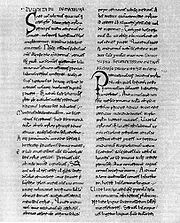
Nevertheless, at the court of Svatopluk who himself professed the Latin rite intrigues against Methodius and the liturgy serviced in Old Church Slavonic gathered strength. Svatopluk sent John of Venice, a known opponent of the Slavic liturgy, to Rome in 879 to achieve some settlement of ecclesiastical differences. In a letter addressed to Methodius in the same year, the pope sharply rebuked him for using Slavonic in liturgical services. Methodius, however, travelled to Rome in 880, together with a Moravian delegation. Under his influence Pope John VIII changed his mind: in a letter, known for its incipit, Industriae tuae, although the pope repeated that mass in Latin
was to be sung whenever requested, that is for Svatopluk and his court, he also allowed the use of Slavonic liturgy. The letter even confirmed the decision taken by the Holy See during Rastislav's reign to create an archdiocese for Moravia. Upon Svatopluk's request the pope promoted a German priest, Wiching bishop of Nitra
, but he added that the new bishop and all the clerics in Moravia are expected to to be obedient to Methodius who remained the head of the Church in Moravia.
, the one-time commanders of the Bavarian forces occupying Moravia in 870–871, began to conspire with various Bavarian magnates in order to eject Arbo
, the markgrave Louis the German had appointed to command a key part of East Francia's frontier on the Danube. Arbo, however, appealed for and received help from both Charles the Fat and Svatopluk, and even handed his son over to the latter as a hostage.
Upon Arbo's request, Svatopluk who remembered "how much evil he along with his people had suffered" at the hands of Wilhelm and Engelschalk attacked their sons. His forces soon captured Engelschalk's second son who became mutilated at Svatopluk's order. Thereafter the remaining sons withdrew from the authority of Charles the Fat and become the men of Carloman's son, Arnulf who was ruling in Pannonia at that time. Learning of this, Svatopluk sent ambassadors to Arnulf, demanding that the sons of Wilhelm and Engelschalk be immediately sent away. Arnulf, however, refused to hand over them, to which Svatopluk responded with further invasions. In addition to Franks and Moravians, Bulgarians
also entered the conflict by invading Svatopluk's realm. According to a record in the Annals of Salzburg, the region of Vienna
(Austria
) was also invaded in 881 by Hungarians. They seems to have been hired either by Svatopluk or by Arnulf in order to intervene in their conflict.
Thus the "Willhelminer War" that were to last until 884 led to the devastation of Pannonia east of the river Rába
. Finally, Charles the Fat himself turned up and received Svatopluk as his man at the Kaumberg
(Germany), receiving promises of peace and fidelity. Svatopluk also promised never to invade Charles the Fat's realm with a hostile force as long as he lived, while Charles the Fat recognized him as a prince of his realm. Peace between Arnulf and Svatopluk, however, was only sealed in the latter part of the following year.
 Methodius who seems to have been in Svatopluk's train at Kaumberg died in 885. In his last days he had indicated Gorazd, one of his Moravian disciples, as most worthy to succeed him. Gorazd, however, did not or could not immediately submit his candidature for ratification of the Holy See, because Bishop Wiching of Nitra soon hurried to Rome
. He persuaded Pope Stephen V that Methodius had ignored Pope John VIII's orders in the matter of Slavonic liturgy, thus upon his initiative the pope prohibited the Slavonic liturgy in Moravia. The pope also sent a letter (Quia te zelo) to Svatopluk, urging him to accept the addition of filioque to the Creed
and to give up such peculiar Byzantine practices as fasting
on Saturday.
Having Wiching arrived back from Rome, Svatopluk summoned Gorazd, Clement
and Methodius's other disciples to submit to the papal directions. When they refused to do so, Svatopluk gave Wiching a free hand to take action against them. Some of them were first thrown into prison, and soon expelled from Moravia, while others, among them Naum
, were sold as slaves. The expel of Methodius's disciples from Moravia signaled the end of the Slavonic liturgy in Central Europe
. The exiles, however, subsequently found refuge in the First Bulgarian Empire
where they were able to carry on their work.
In his letter Quia te zelo, the pope addressed Svatopluk as rex Sclavorum ("king of the Slavs"). Although Svatopluk's royal title was not recognized by the contemporary Annals of Fulda, the chronicler Regino of Prüm
also referred to Svatopluk as rex Marahensium Sclavorum ("king of the Moravian Slavs") in the early 10th century, hence there is independent evidence confirming that Svatopluk held the title of king. According to the late 12th-century Chronicle of the Priest of Duklja, Svatopluk had been crowned "king in the Roman fashion on the field of Dalma" in the presence of a papal legate
, cardinals
, and bishops.
In 887 Arnulf, Svatopluk's opponent in the "Wilhelminer War", became the king of East Francia. They met at Omuntesperch, a locality that has yet not been identified, during the winter of 890. At the meeting Svatopluk transmitted to Arnulf a message from Pope Stephen V, urging the king to invade Italy to protect the Holy See. According to Regino of Prüm, the two monarchs also concluded an agreement, in which Arnulf ceded the ducatus of the Bohemians to Svatopluk.
Sometime during 891, according to the Annals of Fulda, Arnulf sent an embassy led by margrave Arbo to Moravia in order to renew the peace. A letter written by the margrave soon announced that the legates were returning from Svatopluk and the Moravians who had agreed "to give themselves in friendship". Svatopluk, however, broke his pledges, thus Arnulf decided to invade Moravia in 891. First the king met with Braslav, the Slavic dux on the river Sava, next raised an army of Franconians, Bavarians and Alamanni, and also recruited Hungarians to join his campaign. In the late 10th century, Arnulf was accused by Ottonian authors
of unleashing the Hungarians on Europe because of his desire to bring down Moravia.
Arnulf's invasion started in July 892, but he failed to defeat Svatopluk. The war against Moravia seems to have continued until 894. This was the year of Svatopluk's "most unlucky death" according to the Annals of Fulda which implies that he met his end in some kind of mishap, the sort that occurs in war. The exact circumstances of Svatopluk's dead, however, are unknown.
and Svatopluk II
were fostered by Arnulf. Finally Moravia collapsed in the first decade of the 10th century due to the invasion of the Hungarians.
According to Hungarian legends, the Hungarians purchased the country from Svatopluk in a symbolic act of exchange: they sent a white horse with saddler to Svatopluk in return for some earth, water and grass, supposed to represent his country itself. Svatopluk allegedly disavowed this "contract" and then drowned in the Danube in flight from the Hungarians. The legend, in fact, seems to merely describe a common pagan rite of concluding alliances which might refer to Svatopluk's alliance with the Hungarians in 894.
Nevertheless, in 1722 Michael Bencsik, a professor of Hungarian law at the University of Trnava
, suggested that the nobility
and the whole population of Trenčín county
within the Kingdom of Hungary
were "the remnants of Svatopluk who sold his country to the Hungarians, and thus the Slovak people, into eternal serfdom". In response, Ján Baltazár Magin, the Roman Catholic parisher of Dubnica wrote the oldest known defense of the Slovak nation in 1728. Next another Catholic priest, Juraj Fándly
completed a history in Latin entitled Compendiata historia gentis Slavae ("A Brief History of the Slovak Nation") in which he depicted Moravia as a state of Slovaks and Svatopluk as their king. In 1833 the poet Ján Hollý
published a poem entitled Svätopluk, the first of a series of epic poems dealing with the past of the Slovak people.
Great Moravia
Great Moravia was a Slavic state that existed in Central Europe and lasted for nearly seventy years in the 9th century whose creators were the ancestors of the Czechs and Slovaks. It was a vassal state of the Germanic Frankish kingdom and paid an annual tribute to it. There is some controversy as...
that attained its maximum territorial expansion in his reign (869 or 870–871, 871–894). His career had already started in the 860s, when he governed a principality, the location of which is still a matter of debate among historians, within Moravia under the suzerainty of his uncle, Rastislav
Rastislav
Rastislav or Rostislav was the second known ruler of Moravia . Although he started his reign as vassal to Louis the German, king of East Francia, he consolidated his rule to the extent that after 855 he was able to repel a series of Frankish attacks...
. Svatopluk betrayed Rastislav to the Franks
Franks
The Franks were a confederation of Germanic tribes first attested in the third century AD as living north and east of the Lower Rhine River. From the third to fifth centuries some Franks raided Roman territory while other Franks joined the Roman troops in Gaul. Only the Salian Franks formed a...
in 869 or 870, but in a year he was also imprisoned by them.
Having been released due to the Moravians' rebellion against the Franks, Svatopluk joined the rebels and defeated the invaders. Although he was obliged to pay tribute to East Francia according to the peace treaty concluded at Forchheim
Forchheim
Forchheim may refer to the following places in Germany:*Forchheim, capital of the district of Forchheim, Bavaria*Forchheim am Kaiserstuhl, a municipality in Baden-Württemberg*Forchheim , part of Rheinstetten, Baden-Württemberg...
(Germany
Germany
Germany , officially the Federal Republic of Germany , is a federal parliamentary republic in Europe. The country consists of 16 states while the capital and largest city is Berlin. Germany covers an area of 357,021 km2 and has a largely temperate seasonal climate...
) in 874, he was able to expand in territories outside the Franks' sphere of interest in the following years. His forces even invaded the March of Pannonia
March of Pannonia
The March of Pannonia was a frontier march of the Carolingian Empire erected in the mid-ninth century against the threat of Great Moravia and lasting only as long as the strength of that state....
within East Francia in 882.
Svatopluk established good relationship with the pope
Pope
The Pope is the Bishop of Rome, a position that makes him the leader of the worldwide Catholic Church . In the Catholic Church, the Pope is regarded as the successor of Saint Peter, the Apostle...
s, thus he and his people were taken under the protection of the Holy See
Holy See
The Holy See is the episcopal jurisdiction of the Catholic Church in Rome, in which its Bishop is commonly known as the Pope. It is the preeminent episcopal see of the Catholic Church, forming the central government of the Church. As such, diplomatically, and in other spheres the Holy See acts and...
in 880. Pope Stephen V
Pope Stephen V
Pope Stephen V was pope from 885 to 891. He succeeded Pope Adrian III, and was in turn succeeded by Pope Formosus. In his dealings with Constantinople in the matter of Photius, as also in his relations with the young Slavonic church, he pursued the policy of Pope Nicholas I.His father, Hadrian, who...
even addressed him "king" in a letter written in 885. In matters of religion, Svatopluk wanted to appease the German
Germans
The Germans are a Germanic ethnic group native to Central Europe. The English term Germans has referred to the German-speaking population of the Holy Roman Empire since the Late Middle Ages....
clergy who opposed the liturgy officiated in Old Church Slavonic
Old Church Slavonic
Old Church Slavonic or Old Church Slavic was the first literary Slavic language, first developed by the 9th century Byzantine Greek missionaries Saints Cyril and Methodius who were credited with standardizing the language and using it for translating the Bible and other Ancient Greek...
; therefore Methodius
Saints Cyril and Methodius
Saints Cyril and Methodius were two Byzantine Greek brothers born in Thessaloniki in the 9th century. They became missionaries of Christianity among the Slavic peoples of Bulgaria, Great Moravia and Pannonia. Through their work they influenced the cultural development of all Slavs, for which they...
's disciples were expelled from Moravia in 886, after their teacher's death.
Svatopluk's state was a loose structure of principalities and also included conquered territories. Not long after his death Svatopluk's "Great Moravia", as the Byzantine Emperor Constantine VII Porphyrogenetos
Constantine VII
Constantine VII Porphyrogennetos or Porphyrogenitus, "the Purple-born" was the fourth Emperor of the Macedonian dynasty of the Byzantine Empire, reigning from 913 to 959...
would refer to it around 950, collapsed due to the power struggle between his sons and the intensifying Hungarian raids. Svatopluk whose empire encompassed the whole or parts of the territory of modern Slovakia
Slovakia
The Slovak Republic is a landlocked state in Central Europe. It has a population of over five million and an area of about . Slovakia is bordered by the Czech Republic and Austria to the west, Poland to the north, Ukraine to the east and Hungary to the south...
has time to time been presented as a "Slovak
Slovaks
The Slovaks, Slovak people, or Slovakians are a West Slavic people that primarily inhabit Slovakia and speak the Slovak language, which is closely related to the Czech language.Most Slovaks today live within the borders of the independent Slovakia...
king" in literary works since the 18th century, the period of the Slovak national awakening
Romantic nationalism
Romantic nationalism is the form of nationalism in which the state derives its political legitimacy as an organic consequence of the unity of those it governs...
.
Early years
The Annals of Fulda refers to Svatopluk as a nephew of Rastislav, the second known ruler of Moravia. Svatopluk was most probably born around 840. His father's name was Svetimir, according to the late 12th-century Chronicle of the Priest of DukljaChronicle of the Priest of Duklja
The Chronicle of the Priest of Duklja is a medieval chronicle originally written by a Catholic monk of the Cistercian order by the name of Roger for the Croatian Ban Paul Šubić because an order form by Ban Šubić and a quote of Catholic monk have been discovered...
, a medieval historical work long dismissed as a collection of fact and fiction.
Svatopluk seems to have risen to power in Moravia in the early 860s. The Life of Methodius relates that Svatopluk and his uncle jointly requested the Byzantine Emperor Michael III
Michael III
Michael III , , Byzantine Emperor from 842 to 867. Michael III was the third and traditionally last member of the Amorian-Phrygian Dynasty...
to send missionaries who were familiar with the Slavic tongue
Slavic languages
The Slavic languages , a group of closely related languages of the Slavic peoples and a subgroup of Indo-European languages, have speakers in most of Eastern Europe, in much of the Balkans, in parts of Central Europe, and in the northern part of Asia.-Branches:Scholars traditionally divide Slavic...
to Moravia. Michael III chose two well educated brothers, named Constantine
Saints Cyril and Methodius
Saints Cyril and Methodius were two Byzantine Greek brothers born in Thessaloniki in the 9th century. They became missionaries of Christianity among the Slavic peoples of Bulgaria, Great Moravia and Pannonia. Through their work they influenced the cultural development of all Slavs, for which they...
and Methodius who were fluent in the dialect of Slavic spoken in the environs of Thessaloniki
Thessaloniki
Thessaloniki , historically also known as Thessalonica, Salonika or Salonica, is the second-largest city in Greece and the capital of the region of Central Macedonia as well as the capital of the Decentralized Administration of Macedonia and Thrace...
(Greece
Greece
Greece , officially the Hellenic Republic , and historically Hellas or the Republic of Greece in English, is a country in southeastern Europe....
). They arrived in Moravia in 863 and immediately set to work educating and preaching. The two brother's translation of liturgical books into Old Church Slavonic was approved by Pope Hadrian II in 867.
Beginnings of his rule
By the time Svatopluk first appeared in a Frankish source (in the Annals of Fulda) in 869, he had ruled his own "realm" (regnum) within Moravia. His principality's seat was "Rastislav's old city" (urbs antique Rastizi). It may have been located either at Staré MěstoStare Mesto
Stare Mesto is either Staré Město or Staré Mesto written without diacritics:*Staré Město is name of several locations in the Czech Republic:* district of Prague: see Old Town, Prague...
(Czech Republic
Czech Republic
The Czech Republic is a landlocked country in Central Europe. The country is bordered by Poland to the northeast, Slovakia to the east, Austria to the south, and Germany to the west and northwest....
) whose name literally means "old city" in Czech
Czech language
Czech is a West Slavic language with about 12 million native speakers; it is the majority language in the Czech Republic and spoken by Czechs worldwide. The language was known as Bohemian in English until the late 19th century...
, or at Nitra
Nitra
Nitra is a city in western Slovakia, situated at the foot of Zobor Mountain in the valley of the river Nitra. With a population of about 83,572, it is the fifth largest city in Slovakia. Nitra is also one of the oldest cities in Slovakia and the country's earliest political and cultural center...
(Slovakia), but it has also been identified with Sirmium
Sirmium
Sirmium was a city in ancient Roman Pannonia. Firstly mentioned in the 4th century BC and originally inhabited by the Illyrians and Celts, it was conquered by the Romans in the 1st century BC and subsequently became the capital of the Roman province of Lower Pannonia. In 294 AD, Sirmium was...
(Sremska Mitrovica
Sremska Mitrovica
Sremska Mitrovica is a city and municipality located in the Vojvodina province of Serbia, on the left bank of the Sava river. As of 2002 the town had a total population of 39,041, while Sremska Mitrovica municipality had a population of 85,605...
, Serbia
Serbia
Serbia , officially the Republic of Serbia , is a landlocked country located at the crossroads of Central and Southeast Europe, covering the southern part of the Carpathian basin and the central part of the Balkans...
).
Svatopluk's "realm" was invaded and plundered in 869 by Bavaria
Bavaria
Bavaria, formally the Free State of Bavaria is a state of Germany, located in the southeast of Germany. With an area of , it is the largest state by area, forming almost 20% of the total land area of Germany...
n troops led by Carloman
Carloman of Bavaria
Carloman was the eldest son of Louis the German, king of East Francia , and Hemma, daughter of the count Welf...
, the eldest son of Louis the German
Louis the German
Louis the German , also known as Louis II or Louis the Bavarian, was a grandson of Charlemagne and the third son of the succeeding Frankish Emperor Louis the Pious and his first wife, Ermengarde of Hesbaye.He received the appellation 'Germanicus' shortly after his death in recognition of the fact...
, king of East Francia. At the same time Franconia
Franconia
Franconia is a region of Germany comprising the northern parts of the modern state of Bavaria, a small part of southern Thuringia, and a region in northeastern Baden-Württemberg called Tauberfranken...
n and Alamannia
Alamannia
Alamannia or Alemannia was the territory inhabited by the Germanic Alamanni after they broke through the Roman limes in 213.The Alamanni expanded from the Main basin during the 3rd century, raiding the Roman provinces and settling on the left bank of the Rhine from the 4th century.Ruled by...
n troops attacked Rastislav's territories under the leadership of the king's youngest son, Charles the Bald
Charles the Bald
Charles the Bald , Holy Roman Emperor and King of West Francia , was the youngest son of the Emperor Louis the Pious by his second wife Judith.-Struggle against his brothers:He was born on 13 June 823 in Frankfurt, when his elder...
. Although the two armies soon returned, Svatopluk entered into clandestine negotiations with Carloman and agreed to commend himself and his principality to Carloman.
Having learnt of this agreement, Rastislav became furious and set a trap for his nephew, inviting him to a banquet, where he intended to murder Svatopluk. The latter, however, was warned of his uncle's conspiracy, thus he could ambush and took prisoner Rastislav whom he even handed over to Carloman. Subsequently, Rastislav was sent to Bavaria
Bavaria
Bavaria, formally the Free State of Bavaria is a state of Germany, located in the southeast of Germany. With an area of , it is the largest state by area, forming almost 20% of the total land area of Germany...
under guard, while Carloman annexed his realm outright.
As a reward for capturing Rastislav, Carloman allowed Svatopluk to retain his principality, but the rest of Moravia was placed under the control of two Frankish lords, William
William (marcha orientalis)
William was the margrave of the March of Pannonia in the mid ninth century until his death on campaign against the Moravians in 871. In his day, the march orientalis corresponded to a front along the Danube from the Traungau to Szombathely and the Rába river and including the Vienna basin...
and Engilschalk
Engelschalk I
Engelschalk I was the margrave of the March of Pannonia in the mid ninth century until his death on campaign against the Moravians in 871. In his day, the march orientalis corresponded to a front along the Danube from the Traungau to the Szombathely and Raba rivers and including the Vienna basin...
. Carloman's forces also captured Methodius whom Pope Hadrian II had earlier appointed archbishop of Sirmium with jurisdiction over the realms ruled by Rastislav and Svatopluk. Early in 871 Carloman also imprisoned Svatopluk on unspecified charges of infidelity which may be connected to the rebellion of Carloman's younger brothers, Louis the Younger
Louis the Younger
Louis the Younger , sometimes Louis III, was the second eldest of the three sons of Louis the German and Emma. He succeeded his father as the King of Saxony on 28 August 876 and his elder brother Carloman as King of Bavaria from 880...
and Charles the Bald. Believing that Svatopluk was dead, the Moravians selected another member of their ruling family
House of Mojmír
The House of Mojmír is the modern name of the ruling dynasty of Great Moravia, the Moravian principality and the Principality of Nitra in the 9th and early 10th century....
named Slavomír
Slavomír
Slavomír or Sclagamar was a duke of Moravia . He led a revolt against the Franks who had annexed Moravia during the incarceration of his relative, Svatopluk I.- Early life :...
and made him their ruler.
Towards the Peace of Forchheim
Carloman soon came to the conclusion that the accusations of infidelity against Svatopluk were unfounded and released him from prison. In order to bound Svatopluk to his family through bonds of spiritual kinship, Carloman even had Svatopluk stood as the godfather of his illegitimate grandson at the boy's baptism. Thus the illegitimate son of Carloman's son, ArnulfArnulf of Carinthia
Arnulf of Carinthia was the Carolingian King of East Francia from 887, the disputed King of Italy from 894 and the disputed Holy Roman Emperor from February 22, 896 until his death.-Birth and Illegitimacy:...
received his Moravian name, Zwentibold
Zwentibold
Zwentibold was the illegitimate son of the Carolingian Emperor Arnulf of Carinthia. In 895 his father, then king of East Francia, granted him the Kingdom of Lotharingia, which he ruled until his death.After his death he was declared a saint and martyr by the Catholic Church.- Life :Zwentibold...
after his godfather.
Svatopluk also agreed to lead Carloman's armies against Slavomír and the rebelling Moravians. However, on his arrival at "Rastislav's old city", Svatopluk betrayed the Bavarians and conspired secretly with the rebels. Although he captured the fortress in accordance with Carloman's plan, once inside its walls he renounced his loyalty to Carloman, rallied a large Moravian force, and launched a devastating surprise attack on the unsuspecting Bavarian army encamped outside. The Moravians took a great number of soldiers hostage, killed the rest, and rid Moravia of the Frankish occupation. Carloman's governors, William and Engelschalk were also both slain, thus Svatopluk became the undisputed ruler of Moravia.
Bohemia
Bohemia is a historical region in central Europe, occupying the western two-thirds of the traditional Czech Lands. It is located in the contemporary Czech Republic with its capital in Prague...
ns (Czechs). During the campaign the Franconians surprised a party of Moravians somewhere near the traps that guarded the narrow approaches to a Bohemian fort. The Moravians were returning to their homeland with the daughter of a Bohemian dux ("duke"), presumably to marry an unidentified Moravian magnate. Although the Moravians managed to reach the safety of the fort, they had to abandon 644 fully equipped horses in the narrows. The marriage of a Bohemian leader's daughter to a Moravian magnate implies that Svatopluk was planning to form an alliance with the Bohemians.
Louis the German realized the grave threat posed by Svatopluk. He assembled forces for a multipronged expedition with pincer movement
Pincer movement
The pincer movement or double envelopment is a military maneuver. The flanks of the opponent are attacked simultaneously in a pinching motion after the opponent has advanced towards the center of an army which is responding by moving its outside forces to the enemy's flanks, in order to surround it...
s advancing on Moravian territory from several directions in 872 . One army was sent out "against the Moravian Slavs" from Regensburg
Regensburg
Regensburg is a city in Bavaria, Germany, located at the confluence of the Danube and Regen rivers, at the northernmost bend in the Danube. To the east lies the Bavarian Forest. Regensburg is the capital of the Bavarian administrative region Upper Palatinate...
(Germany) in May, but the Thuringian
Duchy of Thuringia
The Duchy of Thuringia was an eastern frontier march of the Merovingian kingdom of Austrasia, established by Dagobert I after his victory over the Slavic confederation of Samo at the Battle of Wogastisburg in 631/2...
and Saxon
Duchy of Saxony
The medieval Duchy of Saxony was a late Early Middle Ages "Carolingian stem duchy" covering the greater part of Northern Germany. It covered the area of the modern German states of Bremen, Hamburg, Lower Saxony, North Rhine-Westphalia, and Saxony-Anhalt and most of Schleswig-Holstein...
soldiers fled in their first encounter with the enemy. The second army, composed of Franconians under Bishop Arn of Würzburg and Abbot Sigihard of Fulda, experienced mixed results: although their forces fought well, the majority of the men was killed, and only a handful of survivors returned to East Francia. Finally a third force, consisting of Bavarians and Carantanians under Carloman's command, laid Moravian territories to waste, put Svatopluk's army to flight and forced it to take refuge in an "extremely well fortified stronghold". Svatopluk, however, soon assembled a large army and attacked the Bavarians who had been left behind under the command of Bishop Emriacho of Regensburg to guard ships on the bank of the river Danube
Danube
The Danube is a river in the Central Europe and the Europe's second longest river after the Volga. It is classified as an international waterway....
.
In May 873, Pope John VIII
Pope John VIII
Pope John VIII was pope from December 13, 872 to December 16, 882. He is often considered one of the ablest pontiffs of the ninth century and the last bright spot on the papacy until Leo IX two centuries later....
moved energetically to discover the whereabouts of Methodius who was still held prisoner in Bavaria. He sent harshly worded letters to Carloman and the Bavarian bishops, and commanded Methodius's immediate reinstatement. The pope seems to have also brokered a lasting peace between Louis the German and Svatopluk. After his meeting with the pope at Verona
Verona
Verona ; German Bern, Dietrichsbern or Welschbern) is a city in the Veneto, northern Italy, with approx. 265,000 inhabitants and one of the seven chef-lieus of the region. It is the second largest city municipality in the region and the third of North-Eastern Italy. The metropolitan area of Verona...
(Italy
Italy
Italy , officially the Italian Republic languages]] under the European Charter for Regional or Minority Languages. In each of these, Italy's official name is as follows:;;;;;;;;), is a unitary parliamentary republic in South-Central Europe. To the north it borders France, Switzerland, Austria and...
), Louis the German went to Forchheim where, according to the Annals of Fulda, "he received the legates of Svatopluk asking for a peace treaty". The exact terms of their agreement are not known, but it seems to have been a compromise: although Svatopluk was forced to make an annual payment of tribute
Tribute
A tribute is wealth, often in kind, that one party gives to another as a sign of respect or, as was often the case in historical contexts, of submission or allegiance. Various ancient states, which could be called suzerains, exacted tribute from areas they had conquered or threatened to conquer...
to Louis the German, the latter on his side agreed to avoid any hostile acts of aggression against Moravia. Thus Methodius who had in the meantime been allowed to return to Moravia could develop his work in relatively peaceful conditions for some years.
Years of expansion
Moravia underwent considerable expansion in the 870s. For instance, the Life of Methodius refers to the capture of "a very powerful paganSlavic mythology
Slavic mythology is the mythological aspect of the polytheistic religion that was practised by the Slavs before Christianisation.The religion possesses many common traits with other religions descended from the Proto-Indo-European religion....
prince settled on the Vistula
Vistula
The Vistula is the longest and the most important river in Poland, at 1,047 km in length. The watershed area of the Vistula is , of which lies within Poland ....
" in territory of later (Poland
Poland
Poland , officially the Republic of Poland , is a country in Central Europe bordered by Germany to the west; the Czech Republic and Slovakia to the south; Ukraine, Belarus and Lithuania to the east; and the Baltic Sea and Kaliningrad Oblast, a Russian exclave, to the north...
), and a letter written around 900 by Archbishop Theotmar of Salzburg states that Svatopluk conquered the region of Nitra that had been thereto inhabited by pagans. Modern historiography, however, has tended to question the former claims of huge neighboring territories permanently annexed by Moravia. For instance, there is little clear archaeological or written evidence of a permanent extension of Moravian centralization of power in Lesser Poland
Lesser Poland
Lesser Poland is one of the historical regions of Poland, with its capital in the city of Kraków. It forms the southeastern corner of the country, and should not be confused with the modern Lesser Poland Voivodeship, which covers only a small, southern part of Lesser Poland...
or to the west in Silesia
Silesia
Silesia is a historical region of Central Europe located mostly in Poland, with smaller parts also in the Czech Republic, and Germany.Silesia is rich in mineral and natural resources, and includes several important industrial areas. Silesia's largest city and historical capital is Wrocław...
, or in Pannonia, as it was suggested in earlier historical works.
Viking Age
Viking Age is the term for the period in European history, especially Northern European and Scandinavian history, spanning the late 8th to 11th centuries. Scandinavian Vikings explored Europe by its oceans and rivers through trade and warfare. The Vikings also reached Iceland, Greenland,...
raids between 879 and 886. On the other hand, the Life of Methodius directly links Svatopluk's military achievements and Methodius's work. For instance, according to his Life, Methodius promised Svatopluk that if the prince would celebrate Saint Peter's Day
Feast of Saints Peter and Paul
The Feast of Saints Peter and Paul, or the Solemnity of Saints Peter and Paul, is a liturgical feast in honour of the martyrdom in Rome of the apostles Saint Peter and Saint Paul, which is observed on 29 June...
in the archbishop's church, "God will soon deliver" his enemies to him, and "so it came to pass".
Nevertheless, at the court of Svatopluk who himself professed the Latin rite intrigues against Methodius and the liturgy serviced in Old Church Slavonic gathered strength. Svatopluk sent John of Venice, a known opponent of the Slavic liturgy, to Rome in 879 to achieve some settlement of ecclesiastical differences. In a letter addressed to Methodius in the same year, the pope sharply rebuked him for using Slavonic in liturgical services. Methodius, however, travelled to Rome in 880, together with a Moravian delegation. Under his influence Pope John VIII changed his mind: in a letter, known for its incipit, Industriae tuae, although the pope repeated that mass in Latin
Latin
Latin is an Italic language originally spoken in Latium and Ancient Rome. It, along with most European languages, is a descendant of the ancient Proto-Indo-European language. Although it is considered a dead language, a number of scholars and members of the Christian clergy speak it fluently, and...
was to be sung whenever requested, that is for Svatopluk and his court, he also allowed the use of Slavonic liturgy. The letter even confirmed the decision taken by the Holy See during Rastislav's reign to create an archdiocese for Moravia. Upon Svatopluk's request the pope promoted a German priest, Wiching bishop of Nitra
Roman Catholic Diocese of Nitra
The Diocese of Nitra is a Roman Catholic diocese western Slovakia, with its seat in Nitra. The current bishop is Viliam Judák.- History :The diocese was created as the first one on the territory of present-day Slovakia around 880 , during the time of Great Moravia. Its first bishop was the Saint...
, but he added that the new bishop and all the clerics in Moravia are expected to to be obedient to Methodius who remained the head of the Church in Moravia.
The "Wilhelminer War"
At the time when Charles the Fat became the sole ruler of East Francia in 881, the sons of Wilhelm and EngelschalkWilhelminers
The Wilhelminers were a noble Bavarian family of the 9th century. They rose to prominence mid-century under the brothers William and Engelschalk I, sons of William I, the founder of the family. The family held the March of Pannonia until 871, but their possession of it was the cause of a dispute,...
, the one-time commanders of the Bavarian forces occupying Moravia in 870–871, began to conspire with various Bavarian magnates in order to eject Arbo
Aribo of Austria
Aribo was the margrave of the March of Pannonia, from 871 until his death...
, the markgrave Louis the German had appointed to command a key part of East Francia's frontier on the Danube. Arbo, however, appealed for and received help from both Charles the Fat and Svatopluk, and even handed his son over to the latter as a hostage.
Upon Arbo's request, Svatopluk who remembered "how much evil he along with his people had suffered" at the hands of Wilhelm and Engelschalk attacked their sons. His forces soon captured Engelschalk's second son who became mutilated at Svatopluk's order. Thereafter the remaining sons withdrew from the authority of Charles the Fat and become the men of Carloman's son, Arnulf who was ruling in Pannonia at that time. Learning of this, Svatopluk sent ambassadors to Arnulf, demanding that the sons of Wilhelm and Engelschalk be immediately sent away. Arnulf, however, refused to hand over them, to which Svatopluk responded with further invasions. In addition to Franks and Moravians, Bulgarians
Bulgarians
The Bulgarians are a South Slavic nation and ethnic group native to Bulgaria and neighbouring regions. Emigration has resulted in immigrant communities in a number of other countries.-History and ethnogenesis:...
also entered the conflict by invading Svatopluk's realm. According to a record in the Annals of Salzburg, the region of Vienna
Vienna
Vienna is the capital and largest city of the Republic of Austria and one of the nine states of Austria. Vienna is Austria's primary city, with a population of about 1.723 million , and is by far the largest city in Austria, as well as its cultural, economic, and political centre...
(Austria
Austria
Austria , officially the Republic of Austria , is a landlocked country of roughly 8.4 million people in Central Europe. It is bordered by the Czech Republic and Germany to the north, Slovakia and Hungary to the east, Slovenia and Italy to the south, and Switzerland and Liechtenstein to the...
) was also invaded in 881 by Hungarians. They seems to have been hired either by Svatopluk or by Arnulf in order to intervene in their conflict.
Thus the "Willhelminer War" that were to last until 884 led to the devastation of Pannonia east of the river Rába
Rába
The Rába is a river in southeastern Austria and western Hungary and a right tributary of the Danube. Its source is in Austria, some kilometres east of Bruck an der Mur below Heubodenhöhe Hill. It flows through the Austrian states of Styria and Burgenland, and the Hungarian counties of Vas and...
. Finally, Charles the Fat himself turned up and received Svatopluk as his man at the Kaumberg
Kaumberg
Kaumberg is a town in the district of Lilienfeld in the Austrian state of Lower Austria....
(Germany), receiving promises of peace and fidelity. Svatopluk also promised never to invade Charles the Fat's realm with a hostile force as long as he lived, while Charles the Fat recognized him as a prince of his realm. Peace between Arnulf and Svatopluk, however, was only sealed in the latter part of the following year.
Last years
Rome
Rome is the capital of Italy and the country's largest and most populated city and comune, with over 2.7 million residents in . The city is located in the central-western portion of the Italian Peninsula, on the Tiber River within the Lazio region of Italy.Rome's history spans two and a half...
. He persuaded Pope Stephen V that Methodius had ignored Pope John VIII's orders in the matter of Slavonic liturgy, thus upon his initiative the pope prohibited the Slavonic liturgy in Moravia. The pope also sent a letter (Quia te zelo) to Svatopluk, urging him to accept the addition of filioque to the Creed
Creed
A creed is a statement of belief—usually a statement of faith that describes the beliefs shared by a religious community—and is often recited as part of a religious service. When the statement of faith is longer and polemical, as well as didactic, it is not called a creed but a Confession of faith...
and to give up such peculiar Byzantine practices as fasting
Fasting
Fasting is primarily the act of willingly abstaining from some or all food, drink, or both, for a period of time. An absolute fast is normally defined as abstinence from all food and liquid for a defined period, usually a single day , or several days. Other fasts may be only partially restrictive,...
on Saturday.
Having Wiching arrived back from Rome, Svatopluk summoned Gorazd, Clement
Clement of Ohrid
Saint Clement of Ohrid was a medieval Bulgarian saint, scholar, writer and enlightener of the Slavs. He was the most prominent disciple of Saints Cyril and Methodius and is often associated with the creation of the Glagolitic and Cyrillic alphabets, especially their popularisation among...
and Methodius's other disciples to submit to the papal directions. When they refused to do so, Svatopluk gave Wiching a free hand to take action against them. Some of them were first thrown into prison, and soon expelled from Moravia, while others, among them Naum
Saint Naum
Saint Naum , also known as Naum of Ohrid or Naum of Preslav was a medieval Bulgarian scholar and missionary among the Slavs. He is venerated as a saint in the Orthodox Church.Information about his early life is scarce...
, were sold as slaves. The expel of Methodius's disciples from Moravia signaled the end of the Slavonic liturgy in Central Europe
Central Europe
Central Europe or alternatively Middle Europe is a region of the European continent lying between the variously defined areas of Eastern and Western Europe...
. The exiles, however, subsequently found refuge in the First Bulgarian Empire
First Bulgarian Empire
The First Bulgarian Empire was a medieval Bulgarian state founded in the north-eastern Balkans in c. 680 by the Bulgars, uniting with seven South Slavic tribes...
where they were able to carry on their work.
In his letter Quia te zelo, the pope addressed Svatopluk as rex Sclavorum ("king of the Slavs"). Although Svatopluk's royal title was not recognized by the contemporary Annals of Fulda, the chronicler Regino of Prüm
Regino of Prüm
Reginon or Regino of Prüm was a Benedictine abbot and medieval chronicler.-Biography:According to the statements of a later era, Regino was the son of noble parents and was born at the stronghold of Altrip on the Rhine near Speyer at an unknown date...
also referred to Svatopluk as rex Marahensium Sclavorum ("king of the Moravian Slavs") in the early 10th century, hence there is independent evidence confirming that Svatopluk held the title of king. According to the late 12th-century Chronicle of the Priest of Duklja, Svatopluk had been crowned "king in the Roman fashion on the field of Dalma" in the presence of a papal legate
Papal legate
A papal legate – from the Latin, authentic Roman title Legatus – is a personal representative of the pope to foreign nations, or to some part of the Catholic Church. He is empowered on matters of Catholic Faith and for the settlement of ecclesiastical matters....
, cardinals
Cardinal (Catholicism)
A cardinal is a senior ecclesiastical official, usually an ordained bishop, and ecclesiastical prince of the Catholic Church. They are collectively known as the College of Cardinals, which as a body elects a new pope. The duties of the cardinals include attending the meetings of the College and...
, and bishops.
In 887 Arnulf, Svatopluk's opponent in the "Wilhelminer War", became the king of East Francia. They met at Omuntesperch, a locality that has yet not been identified, during the winter of 890. At the meeting Svatopluk transmitted to Arnulf a message from Pope Stephen V, urging the king to invade Italy to protect the Holy See. According to Regino of Prüm, the two monarchs also concluded an agreement, in which Arnulf ceded the ducatus of the Bohemians to Svatopluk.
Sometime during 891, according to the Annals of Fulda, Arnulf sent an embassy led by margrave Arbo to Moravia in order to renew the peace. A letter written by the margrave soon announced that the legates were returning from Svatopluk and the Moravians who had agreed "to give themselves in friendship". Svatopluk, however, broke his pledges, thus Arnulf decided to invade Moravia in 891. First the king met with Braslav, the Slavic dux on the river Sava, next raised an army of Franconians, Bavarians and Alamanni, and also recruited Hungarians to join his campaign. In the late 10th century, Arnulf was accused by Ottonian authors
Ottonian Renaissance
The Ottonian Renaissance was a limited "renaissance" of economy and art in central and southern Europe that accompanied the reigns of the first three emperors of the Saxon Dynasty, all named Otto: Otto I , Otto II , and Otto III , and which in large part depended upon their patronage.One of three ...
of unleashing the Hungarians on Europe because of his desire to bring down Moravia.
Arnulf's invasion started in July 892, but he failed to defeat Svatopluk. The war against Moravia seems to have continued until 894. This was the year of Svatopluk's "most unlucky death" according to the Annals of Fulda which implies that he met his end in some kind of mishap, the sort that occurs in war. The exact circumstances of Svatopluk's dead, however, are unknown.
Legacy
Following Svatopluk's death Moravia, that had achieved its maximum territorial extension, and exercised its greatest influence in his reign, ceased to be a political factor in Central Europe. Among the conquered peoples, the Czechs were the first to withdraw already in 895. Although, at least according to the testimony of the Byzantine Emperor Constantine Porphyrogenitus, Svatopluk had made a deathbed request to his sons that they remain united, after his death internal disagreements between his sons, Mojmír IIMojmír II
Mojmir II was the last king of the Great Moravian Empire . Because of a civil war with his brother, he failed to prevent dismemberment of his Empire and probably died while fighting Magyar invaders....
and Svatopluk II
Svatopluk II
Svatopluk II ruled the Principality of Nitra from 894 to 906 and strove to control all of Great Moravia.Svatopluk II was a younger son of Svatopluk I. As Prince of Nitra, Svatopluk II was subordinated to his older brother Mojmír II, the King of Great Moravia which contained the principality as its...
were fostered by Arnulf. Finally Moravia collapsed in the first decade of the 10th century due to the invasion of the Hungarians.
According to Hungarian legends, the Hungarians purchased the country from Svatopluk in a symbolic act of exchange: they sent a white horse with saddler to Svatopluk in return for some earth, water and grass, supposed to represent his country itself. Svatopluk allegedly disavowed this "contract" and then drowned in the Danube in flight from the Hungarians. The legend, in fact, seems to merely describe a common pagan rite of concluding alliances which might refer to Svatopluk's alliance with the Hungarians in 894.
Nevertheless, in 1722 Michael Bencsik, a professor of Hungarian law at the University of Trnava
University of Trnava
The University of Trnava is a college of "university type" based in Trnava, Slovakia.-Historical university:The original Jesuit university was founded in 1635 by the Archbishop of Esztergom, Peter Pázmány. It had a faculty of arts, faculty of theology, faculty of law and faculty of medicine...
, suggested that the nobility
Nobility in the Kingdom of Hungary
The origin of the nobility in the Kingdom of Hungary can be traced to the Magyar conquest of Pannonia in the 9th century, and it developed over the course of the Middle Ages...
and the whole population of Trenčín county
Trencín county
Trencsén county is the name of a historic administrative county of the Kingdom of Hungary...
within the Kingdom of Hungary
Kingdom of Hungary
The Kingdom of Hungary comprised present-day Hungary, Slovakia and Croatia , Transylvania , Carpatho Ruthenia , Vojvodina , Burgenland , and other smaller territories surrounding present-day Hungary's borders...
were "the remnants of Svatopluk who sold his country to the Hungarians, and thus the Slovak people, into eternal serfdom". In response, Ján Baltazár Magin, the Roman Catholic parisher of Dubnica wrote the oldest known defense of the Slovak nation in 1728. Next another Catholic priest, Juraj Fándly
Juraj Fándly
- Life :He was born in Častá, Kingdom of Hungary into a craftsman-farmer's family. His father died soon after his birth, and mother moved to the neighbouring village of Doľany, where he also visited elementary school. He later studied at a Piarist gymnasium in Svätý Jur, later studied theology in...
completed a history in Latin entitled Compendiata historia gentis Slavae ("A Brief History of the Slovak Nation") in which he depicted Moravia as a state of Slovaks and Svatopluk as their king. In 1833 the poet Ján Hollý
Ján Hollý
Ján Hollý was a Slovak poet and translator. He was the first greater Slovak poet to write exclusively in the newly standardized literary Slovak language. His predecessors mostly wrote in various regional versions of Czech, Slovakized Czech or Latin...
published a poem entitled Svätopluk, the first of a series of epic poems dealing with the past of the Slovak people.
See also
- Arnulf of CarinthiaArnulf of CarinthiaArnulf of Carinthia was the Carolingian King of East Francia from 887, the disputed King of Italy from 894 and the disputed Holy Roman Emperor from February 22, 896 until his death.-Birth and Illegitimacy:...
- Great MoraviaGreat MoraviaGreat Moravia was a Slavic state that existed in Central Europe and lasted for nearly seventy years in the 9th century whose creators were the ancestors of the Czechs and Slovaks. It was a vassal state of the Germanic Frankish kingdom and paid an annual tribute to it. There is some controversy as...
- Louis the GermanLouis the GermanLouis the German , also known as Louis II or Louis the Bavarian, was a grandson of Charlemagne and the third son of the succeeding Frankish Emperor Louis the Pious and his first wife, Ermengarde of Hesbaye.He received the appellation 'Germanicus' shortly after his death in recognition of the fact...
- Mojmir IIMojmír IIMojmir II was the last king of the Great Moravian Empire . Because of a civil war with his brother, he failed to prevent dismemberment of his Empire and probably died while fighting Magyar invaders....
- Saints Cyril and MethodiusSaints Cyril and MethodiusSaints Cyril and Methodius were two Byzantine Greek brothers born in Thessaloniki in the 9th century. They became missionaries of Christianity among the Slavic peoples of Bulgaria, Great Moravia and Pannonia. Through their work they influenced the cultural development of all Slavs, for which they...
- Svatopluk IISvatopluk IISvatopluk II ruled the Principality of Nitra from 894 to 906 and strove to control all of Great Moravia.Svatopluk II was a younger son of Svatopluk I. As Prince of Nitra, Svatopluk II was subordinated to his older brother Mojmír II, the King of Great Moravia which contained the principality as its...