


Bedrich Smetana

Encyclopedia
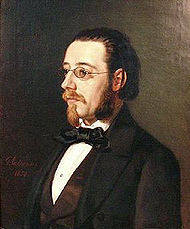
Bedřich Smetana (ˈbɛdr̝ɪx ˈsmɛtana; 1824 1884) was a Czech composer who pioneered the development of a musical style which became closely identified with his country's aspirations to independent statehood. He is thus widely regarded in his homeland as the father of Czech music. Internationally he is best known for his opera The Bartered Bride
, for the symphonic cycle Má vlast
("My Fatherland") which portrays the history, legends and landscape of the composer's native land, and for his First String Quartet
From My Life.
Smetana was naturally gifted as a pianist, and gave his first public performance at the age of six. After his conventional schooling, he studied music under Josef Proksch
in Prague. His first nationalistic music was written during the 1848 Prague uprising
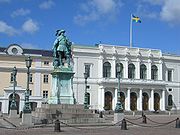
, in which he briefly participated. After failing to establish his career in Prague, he left for Sweden, where he set up as a teacher and choirmaster in Gothenburg
, and began to write large-scale orchestral works. During this period of his life Smetana was twice married; of six daughters, three died in infancy.
In the early 1860s, a more liberal political climate in Bohemia encouraged Smetana to return permanently to Prague. He threw himself into the musical life of the city, primarily as a champion of the new genre of Czech opera. In 1866 his first two operas, The Brandenburgers in Bohemia and The Bartered Bride, were premiered at Prague's new Provisional Theatre
, the latter achieving great popularity. In that same year, Smetana became the theatre's principal conductor, but the years of his conductorship were marked by controversy. Factions within the city's musical establishment considered his identification with the progressive ideas of Franz Liszt
and Richard Wagner
inimical to the development of a distinctively Czech opera style. This opposition interfered with his creative work, and may have hastened the health breakdown which precipitated his resignation from the theatre in 1874.
By the end of 1874, Smetana had become completely deaf but, freed from his theatre duties and the related controversies, he began a period of sustained composition that continued for almost the rest of his life. His contributions to Czech music were increasingly recognised and honoured, but a mental collapse early in 1884 led to his incarceration in an asylum, and his subsequent death. Smetana's reputation as the founding father of Czech music has endured in his native country, where advocates have raised his status above that of his contemporaries and successors. However, relatively few of Smetana's works are in the international repertory, and most foreign commentators tend to regard Antonín Dvořák
as a more significant Czech composer.
, east of Prague near the traditional border between Bohemia
and Moravia
, then provinces of the Habsburg Empire. He was the third child, and first son, of František Smetana and his third wife Barbora Lynková. František had fathered eight children in two earlier marriages, five daughters surviving infancy; he and Barbora had ten more children, of whom seven reached adulthood. At this time, under Habsburg rule, German was the official language of Bohemia. František knew Czech
, but for business and social reasons rarely used it, and his children were ignorant of it until much later in their lives.
The Smetana family came from the Hradec Králové
region of Bohemia. František had initially learned the trade of a brewer, and had acquired moderate wealth during the Napoleonic Wars
by supplying clothing and provisions to the French Army. He subsequently managed several breweries before coming to Litomyšl in 1823 as brewer to Count Waldstein
, whose Renaissance castle dominates the town.
The elder Smetana, although uneducated, had a natural gift for music and was a competent violinist who played in a string quartet. Bedřich was introduced to music by his father and in October 1830, at the age of six, gave his first public performance. At a concert held in Litomyšl's Philosophical Academy he played a piano arrangement of Auber
's overture to La muette de Portici
, to a rapturous reception. In 1831 the family moved to Jindřichův Hradec
in the south of Bohemia – the region where, a generation later, Gustav Mahler
grew up. Here, Smetana attended the local elementary school and later the gymnasium
. He also studied violin and piano, discovering the works of Mozart
and Beethoven
, and began composing simple pieces of which one, a dance (Kvapiček, or "Little Galop"), survives in sketch form.
In 1835, František retired to a farm in the south-eastern region of Bohemia. There being no suitable local school, Smetana was sent to the gymnasium at Jihlava
, where he was homesick and unable to study. He then transferred to the Premonstratensian
school at Německý Brod, where he was happier and made good progress. Among the friends he made here was the future Czech revolutionary poet Karel Havlíček
, whose departure for Prague in 1838 may have influenced Smetana's own desire to experience life in the capital. The following year, with František's approval, he enrolled at Prague's Academic Grammar School under Josef Jungmann
, a distinguished poet and linguist who was a leading figure in the movement for Czech national revival
.
, where he enjoyed a brief romance with his cousin Louisa. He commemorated their passion in Louisa's Polka, Smetana's earliest complete composition that has survived.
An older cousin, Josef Smetana, a teacher at the Premonstratensian School in Plzeň (Pilsen), then offered to supervise the boy's remaining schooling, and in the summer of 1840 Smetana departed for Plzeň. He remained there until he completed his schooling in 1843. His skills as a pianist were in great demand at the town's many soirées, and he enjoyed a hectic social life. This included a number of romances, the most important of which was with Kateřina Kolářová, whom he had known briefly in his early childhood. Smetana was entirely captivated with her, writing in his journal: "When I am not with her I am sitting on hot coals and have no peace". He composed several pieces for her, among which are two Quadrille
s, a song duet, and an incomplete piano study for the left hand. He also composed his first orchestral piece, a B flat minuet.
, and no immediate prospects. Lacking any formal musical training, he needed a teacher, and was introduced by Kateřina Kolářová's mother to Josef Proksch
, head of the Prague Music Institute – where Kateřina was now studying. Proksch used the most modern teaching methods, drawing on Beethoven
, Chopin
, Berlioz
and the Leipzig circle of Liszt. In January 1844 Proksch agreed to take Smetana as a pupil, and at the same time the young musician's financial difficulties were eased when he secured an appointment as music teacher to the family of a nobleman, Count Thun.
For the next three years, besides teaching piano to the Thun children, Smetana studied theory and composition under Proksch. The works he composed in these years include songs, dances, bagatelles
, impromptu
s and the G minor Piano Sonata. In 1846 Smetana attended concerts given in Prague by Berlioz, and in all likelihood met the French master at a reception arranged by Proksch. At the home of Count Thun he met Robert
and Clara Schumann
, and showed them his G minor sonata, but failed to win their approval for this work – they detected too much of Berlioz in it. Meanwhile his friendship with Kateřina blossomed. In June 1847, on resigning his position in the Thun household, Smetana recommended her as his replacement. He then set out on a tour of Western Bohemia, hoping to establish a reputation as a concert pianist.
For a brief period in 1848, Smetana was a revolutionary. In the climate of political change and upheaval
that swept through Europe in that year, a pro-democracy movement in Prague led by Smetana's old friend Karel Havlíček was urging an end to Habsburg absolutist rule and for more political autonomy. A Citizens' Army ("Svornost") was formed to defend the city against possible attack. Smetana wrote a series of patriotic works, including two marches
dedicated respectively to the Czech National Guard and the Students' Legion of the University of Prague, and The Song of Freedom to words by Ján Kollár
. In June 1848, as the Habsburg armies moved to suppress rebellious tendencies, Prague came under attack from the Austrian forces led by the Prince of Windisch-Grätz. As a member of Svornost, Smetana helped to man the barricades on the Charles Bridge
. The nascent uprising was quickly crushed, but Smetana avoided the imprisonment or exile received by leaders such as Havlíček. During his brief spell with Svornost, he met the writer and leading radical, Karel Sabina
, who would later provide libretti
for Smetana's first two operas.
, who had settled in Prague, attended the school's matinée concerts. Smetana's performances in these concerts became a recognised feature of Prague's musical life. In this time of relative financial stability Smetana married Kateřina, on 1849. Four daughters were born to the couple between 1851 and 1855.
. He continued teaching in the Piano Institute, and devoted himself increasingly to composition. His works, mainly for the piano, included the three-part Wedding Scenes, some of the music of which was later used in The Bartered Bride. He also wrote numerous short experimental pieces collected under the name Album Leaves, and a series of polka
s. During 1853–54 he worked on a major orchestral piece, the Triumphal Symphony, composed to commemorate the wedding of Emperor Franz Joseph
. The symphony was rejected by the Imperial Court, possibly on the grounds that the brief musical references to the Austrian national anthem were not sufficiently prominent. Undeterred, Smetana hired an orchestra at his own expense to perform the symphony at the Konvikt Hall in Prague on 1855. The work was coolly received, and the concert was a financial failure.
 In the years between 1854 and 1856 Smetana suffered a series of personal blows. In July 1854 his second daughter, Gabriela, died of tuberculosis
. A year later his eldest daughter Bedřiška, who at the age of four was showing signs of musical precocity, died of scarlet fever
. Smetana wrote his Piano Trio in G minor as a tribute to her memory; it was performed in Prague on 1855 and, according to the composer, was received "harshly" by the critics, although Liszt praised it. Smetana's sorrows continued; just after Bedřiška's death a fourth daughter, Kateřina, had been born but she, too, died in June 1856. By this time Smetana's wife Kateřina had also been diagnosed with tuberculosis.
In July 1856, Smetana received news of the death in exile of his revolutionary friend Karel Havlíček. The political climate in Prague was a further source of gloom; hopes of a more enlightened government and social reform following Franz Joseph's accession in 1848 had faded as Austrian absolutism reasserted itself under Baron Alexander von Bach
. Despite the good name of the Piano Institute, Smetana's status as a concert pianist was generally considered to be below that of contemporaries such as Alexander Dreyschock
. Critics acknowledged Smetana's "delicate, crystalline touch", closer in style to Chopin
than Liszt
, but believed that his physical frailty was a serious drawback to his concert-playing ambitions. His main performance success during this period was his playing of Mozart
's D minor Piano Concerto
at a concert celebrating the centenary of Mozart's birth, in January 1856. His disenchantment with Prague was growing and, perhaps influenced by Dreyschock's accounts of opportunities to be found in Sweden, Smetana decided to seek success there. On 11 October 1856, after writing to his parents that "Prague did not wish to acknowledge me, so I left it", he departed for Gothenburg
.
 In summer 1857, Smetana came home to Prague and found Kateřina in failing health. In June, Smetana's father František died. That autumn Smetana returned to Gothenburg, with Kateřina and their surviving daughter Žofie, but before doing so he visited Liszt in Weimar
. The occasion was the Karl August Goethe-Schiller Jubilee celebrations; Smetana attended performances of Liszt's Faust Symphony
and the symphonic poem Die Ideale, which invigorated and inspired him. Liszt was Smetana's principal teacher throughout the latter's creative life, and at this time was crucially able to revive his spirits and rescue him from the relative artistic isolation of Gothenburg.
Back in Sweden, Smetana found among his new pupils a young housewife, Fröjda Benecke, who briefly became his muse and his mistress. In her honour Smetana transcribed two songs from Schubert's
Die schöne Müllerin
cycle, and transformed one of his own early piano pieces into a polka entitled Vision at the Ball. He also began composing on a more expansive scale. In 1858 he completed the symphonic poem Richard III, his first major orchestral composition since the Triumphal Symphony. He followed this with Wallenstein's Camp, inspired by Friedrich Schiller
's Wallenstein drama trilogy
, and began a third symphonic poem Hakon Jarl, based on the tragic drama by Danish poet Adam Oehlenschläger. Smetana also wrote a two large-scale piano works: Macbeth and the Witches, and an Étude in C in the style of Liszt.
on 1859. Smetana wrote that she had died "gently, without our knowing anything until the quiet drew my attention to her." After placing Žofie with Kateřina's mother, Smetana spent time with Liszt in Weimar, where he was introduced to the music of the comic opera Der Barbier von Bagdad
, by Liszt's pupil Peter Cornelius
. This work would influence Smetana's own later career as an opera composer. Later that year he stayed with his younger brother Karel, and fell in love with Karel's sister-in-law Barbora (Bettina) Ferdinandiová, sixteen years his junior. He proposed marriage, and having secured her promise returned to Gothenburg for the 1859–60 winter. The marriage took place the following year, on 1860, after which Smetana and his new wife returned to Sweden for a final season. This culminated in April 1861 with a piano performance in Stockholm
, attended by the Swedish royal family. The couple's first daughter, Zdeňka, was born in September 1861.
Meanwhile, the defeat of Franz Joseph's army at Solferino
in 1859 had weakened the Habsburg Empire, and led to the fall from power of von Bach. This had gradually brought a more enlightened atmosphere to Prague, and by 1861 Smetana was seeing prospects of a better future for Czech nationalism and culture. Before deciding his own future, in September Smetana set out on a concert tour of Holland and Germany. He was still hoping to secure a reputation as a pianist, but once again he experienced failure. Back in Prague, he conducted performances of Richard III and Wallenstein's Camp in the Žofín Island concert hall in January 1862, to a muted reception. Critics accused him of adhering too closely to the "New German" school represented primarily by Liszt; Smetana responded that "a prophet is without honour in his own land." In March 1862 he made a last brief visit to Gothenburg, but the city no longer held his interest; it appeared to him a provincial backwater and, whatever the difficulties, he now determined to seek his musical future in Prague: "My home has rooted itself into my heart so much that only there do I find real contentment. It is to this that I will sacrifice myself."
's operas. He hoped that he might be considered for the theatre's conductorship, but the post went to Jan Nepomuk Maýr
, apparently because the conservative faction in charge of the project considered Smetana a "dangerous modernist", in thrall to avant garde composers such as Liszt and Wagner. Smetana then turned his attention to an opera competition, organised by Count Jan von Harrach, which offered prizes of 600 gulden each for the best comic and historical operas based on Czech culture. With no useful model on which to base his work—Czech opera as a genre scarcely existed—Smetana had to create his own style. He engaged Karel Sabina, his comrade from the 1848 barricades, as his librettist, and received Sabina's text in February 1862, a story of the 13th century invasion of Bohemia by Otto of Brandenburg
. In April 1863 he submitted the score, under the title of The Brandenburgers in Bohemia.
At this stage in his career, Smetana's command of the Czech language was poor. His generation of Czechs was educated in German, and he had difficulty expressing himself in what was supposedly his native tongue. To overcome these linguistic deficiencies he studied Czech grammar, and made a point of writing and speaking in Czech every day. He had become Chorus Master of the nationalistic Hlahol Choral Society soon after his return from Sweden, and as his fluency in the Czech language developed he composed patriotic choruses for the Society; The Three Riders and The Renegade were performed at concerts in early 1863. In March of that year Smetana was elected president of the music section of Umělecká Beseda, a society for Czech artists. By 1864 he was proficient enough in the Czech language to be appointed as music critic to the main Czech language newspaper Národní listy. Meanwhile, Bettina had given birth to another daughter, Božena.
On 23 April 1864, Smetana conducted Berlioz's choral symphony
Roméo et Juliette at a concert celebrating the Shakespeare tercentenary, adding to the programme his own March for the Shakespearean Festival. That year, Smetana's bid to become Director of the Prague Conservatory
failed. He had set high hopes on this appointment: "My friends are trying to persuade me that this post might have been especially created for me," he wrote to a Swedish friend. His hopes were again dashed by his affiliation with the perceived radical Liszt, the appointing committee choosing the conservative patriot Josef Krejčí for the post.
Almost three years passed before Smetana was declared the winner of Harrach's opera competition. Before then, on 1866, The Brandenburgers had been performed to an enthusiastic reception at the Provisional Theatre—over strong opposition from Maýr, who had refused to rehearse or conduct the piece. The idiom was too advanced for Maýr's liking, and the opera was eventually staged under the composer's own direction. "I was called on stage nine times," Smetana wrote, recording that the house was sold out and that the critics were full of praise. Music historian Rosa Newmarch
believes that, although The Brandenburgers has not stood the test of time, it contains all the germs of Smetana's operatic art.
, which Smetana composed during the next three years. Because of the success of The Brandenburgers, the management of the Provisional Theatre readily agreed to stage the new opera, which was premiered on 1866 in its original two-act version with spoken dialogue. The opera was to go through several revisions and restructures before reaching the definitive three-act form that in due course established Smetana's international reputation. The opera's first performance was a failure; it was held on one of the hottest evenings of the year, on the eve of the Austro-Prussian War
with Bohemia under imminent threat of invasion by Prussia
n troops. Unsurprisingly the occasion was poorly attended, and receipts failed to cover costs. When presented at the Provisional Theatre in its final form, in September 1870, it was a tremendous public success.
Back in 1866, as the composer of The Brandenburgers with its overtones of German military aggression, Smetana thought he might be targeted by the invading Prussians, so he absented himself from Prague until hostilities ceased. He returned in September, and almost immediately achieved a long-standing ambition – appointment as principal conductor of the Provisional Theatre, at an annual salary of 1,200 gulden. In the absence of a body of suitable Czech opera, Smetana in his first season presented standard works by Weber
, Mozart, Donizetti
, Rossini and Glinka, with a revival of his own Bartered Bride. The quality of Smetana's production of Glinka's A Life for the Tsar
angered Glinka's champion Mily Balakirev
, who expressed himself forcefully. This caused prolonged hostility between the two men. On 1868 Smetana, representing Czech musicians, helped to lay the foundation stone for the future National Theatre; he had written a Festive Overture for the occasion. That same evening Smetana's third opera, Dalibor, was premièred at Prague's New Town Theatre. Although its initial reception was warm its reviews were poor, and Smetana resigned himself to its failure. This opera soon became the basis of a series of attacks on Smetana, followed by a concerted effort to drive him from his position as Provisional Theatre conductor.
Pivoda then took issue with Dalibor, calling it an example of extreme "Wagnerism" and thus, unsuited as a model for Czech national opera. "Wagnerism" meant the adoption of Wagner's theories of a continuous role for the orchestra and the building of an integrated musical drama, rather than a stringing together of lyrical numbers. The Provisional Theatre's chairman, František Rieger, had first accused Smetana of Wagnerist tendencies after the first performance of The Brandenburgers, and the issue eventually divided Prague's musical society. Music critic Otakar Hostinský believed that Wagner
's theories should be the basis of the national opera, and argued that Dalibor was the beginning of the "correct" direction. The opposite camp, led by Pivoda, supported the principles of Italian opera, in which the voice rather than the orchestra was the predominant dramatic device.
Even within the theatre itself there was division. Rieger led a campaign to eject Smetana from the conductorship and reappoint Maýr, and in December 1872 a petition signed by 86 subscribers to the theatre called for Smetana's resignation. Strong support from vice-chairman Antonín Čísek, and an ultimatum from prominent musicians among whom was Antonín Dvořák
, ensured Smetana's survival. In January 1873 he was reappointed, with a bigger salary and increased responsibility as Artistic Director.
Smetana gradually brought more operas by emergent Czech composers to the theatre, but little of his own work. By 1872 he had completed his monumental fourth opera, Libuše
, his most ambitious work to date, but was withholding its premiere for the future opening of the National Theatre. The machinations of Pivoda and his supporters distracted Smetana from composition, and he had further vexation when The Bartered Bride was produced in Saint Petersburg
, in January 1871. Although the audience was enthusiastic, press reports were hostile, one describing the work as "no better than that of a gifted fourteen-year-old boy." Smetana was deeply offended, and blamed his old adversary, Balakirev, for inciting negative feelings against the opera.
, composed between June 1873 and January 1874. After its first performance at the Provisional Theatre on 1874, Smetana's supporters presented him with a decorative baton. But his opponents continued to attack him, comparing his conductorship unfavourably with the Maýr regime and claiming that under Smetana "Czech opera sickens to death at least once annually." By the summer Smetana was ill; a throat infection was followed by a rash and an apparent blockage to the ears. By mid-August, unable to work, he transferred his duties to his deputy, Adolf Čech. A press announcement stated that Smetana had "become ill as a result of nervous strain caused by certain people recently."
In September, Smetana told the theatre he would resign his appointment unless his health improved. He had become totally deaf in his right ear, and in October lost all hearing in his left ear also. After his subsequent resignation the theatre offered him an annual pension of 1,200 gulden for the continued right to perform his operas, an arrangement which Smetana reluctantly accepted. Money raised in Prague by former students, and by former lover Fröjda Benecke in Gothenburg, amounted to 1,244 gulden. This allowed Smetana to seek medical treatment abroad, but to no avail. In January 1875 Smetana wrote in his journal: "If my disease is incurable, then I should prefer to be liberated from this life." His spirits were further lowered at this time by a deterioration in his relationship with Bettina, mainly over money matters. "I cannot live under the same roof as a person who hates and persecutes me", Smetana informed her. Although divorce was considered, the couple stayed unhappily together.
, the home of his eldest daughter Žofie where, in tranquil surroundings, Smetana was able to work undisturbed. Before leaving Prague he had begun a cycle of six symphonic poems, called Má vlast
("My Fatherland"), and had completed the first two, Vyšehrad and Vltava, which had both been performed in Prague during 1875. In Jabkenice Smetana composed four more movements, the complete cycle being first performed on 1882 under the baton of Adolf Čech. Other major works composed in these years were the E minor String Quartet, From My Life
, a series of Czech dances for piano, several choral pieces and three more operas: The Kiss
, The Secret
and The Devil's Wall
, all of which received their first performances between 1876 and 1882.
The long-delayed premiere of Smetana's opera Libuše
finally arrived when the National Theatre opened on 1881. He had not initially been given tickets, but at the last minute was asked into the theatre director's box. The audience received the work enthusiastically, and Smetana was called to the stage repeatedly. Shortly after this event the new theatre was destroyed by fire; despite his infirmities, Smetana helped to raise funds for the rebuilding. The restored theatre reopened on 1883, again with Libuše
These years saw Smetana's growing recognition as the principal exponent of Czech national music. This status was celebrated by several events during Smetana's final years. On 1880, a special concert in Prague marked the 50th anniversary of his first public performance; Smetana attended, and played his Piano Trio in G minor from 1855. In May 1882 The Bartered Bride was given its 100th performance, an unprecedented event in the history of Czech opera, and so popular that a repeat "100th performance" was staged. A gala concert and banquet was arranged to honour Smetana's 60th birthday in March 1884, but he was too ill to attend.
, revealing fears of the onset of madness. By the winter of 1882–83 he was experiencing depression, insomnia, and hallucinations, together with giddiness, cramp and a temporary loss of speech. In 1883 he began writing a new symphonic suite, Prague Carnival, but could get no further than an Introduction and a Polonaise. He started a new opera, Viola
, based on the character in Shakespeare's Twelfth Night, but wrote only fragments as his mental state gradually deteriorated. In October 1883 his behaviour at a private reception in Prague disturbed his friends; by the middle of February 1884 he had ceased to be coherent, and was periodically violent. On his family, unable to nurse him any longer, removed him to the Kateřinky Lunatic Asylum in Prague, where he died on 1884.
The hospital registered the cause of death as senile dementia. However, Smetana's family believed that his physical and mental decline was due to syphilis
. An analysis of the autopsy report, published by the German neurologist Dr Ernst Levin in 1972, came to the same conclusion. Tests carried out by Prof. Emanuel Vlček in the late 20th century on samples of muscular tissue from Smetana's exhumed body provided further evidence of the disease. However, this research has been challenged by Czech physician Dr Jiří Ramba, who has argued that Vlček's tests do not provide a basis for a reliable conclusion, citing the age and state of the tissues and highlighting reported symptoms of Smetana's that were incompatible with syphilis.
Smetana's funeral took place on , at the Týn Church in Prague's Old Town. The subsequent procession to the Vyšehrad Cemetery
was led by members of the Hlahol, bearing torches, and was followed by a large crowd. The grave later became a place of pilgrimage for musical visitors to Prague. On the funeral evening, a scheduled performance of The Bartered Bride at the National Theatre was allowed to proceed, the stage draped with black cloth as a mark of respect.
Smetana was survived by Bettina, their daughters Zdeňka and Božena, and by Žofie. None of them played any significant role in Smetana's musical life. Bettina lived until 1908; Žofie, who had married Josef Schwarz in 1874, predeceased her mother, dying in 1902. The younger daughters eventually married, living out their lives away from the public eye. A permanent memorial to Smetana's life and work is the Smetana Museum in Prague, originally founded in 1926 within the Charles University's Institute for Musicology. In 1936 the museum moved to the former Waterworks building on the banks of the Vltava, and since 1976 has been part of the Czech Museum of Music.
, Verdi
and Meyerbeer
.
In his last decade Smetana composed three substantial piano cycles. The first, from 1875, was entitled Dreams. It was dedicated to former pupils of Smetana's, who had raised funds to cover medical expenses, and is also a tribute to the composer's models of the 1840s—Schumann, Chopin and Liszt. Smetana's last major piano works were the two Czech Dances cycles of 1877 and 1879. The first of these had the purpose, as Smetana explained to his publisher, of "idealising the polka, as Chopin in his day did with the mazurka." The second cycle is a medley of dances, each given a specific title so that people would know "which dances with real names we Czechs have."
Towards the end of his life Smetana returned to simple song-writing, with five Evening Songs (1879) to words by the poet Vítězslav Hálek
. His final completed work, Our Song (1883), is the last of four settings of texts by Josef Srb-Debrnov. Despite the state of Smetana's health, this is a happy celebration of Czech song and dance. The piece was lost for many years, and only received its first performance after rediscovery in 1924.
, in D minor, written in 1882–83 in defiance of his doctor's orders to refrain from all musical activity, was composed in short snatches, "a swirl of music of a person who has lost his hearing." It represents Smetana's frustrations with his life, but is not wholly gloomy, and includes a bright polka. It was one of his final compositions; between the two quartets he wrote a violin and piano duet From the homeland, a mixture of melancholy and happiness with strong affinity to Czech folk material.
, Mendelssohn
, Weber and Berlioz before producing his Triumphal Symphony of 1853. Though this is dismissed by Rosa Newmarch as "an epithalamium
for a Habsburg Prince", Smetana's biographer Brian Large
identifies much in the piece that characterises the composer's more mature works. Despite the symphony's rejection by the Court and the lukewarm reception on its premiere, Smetana did not abandon the work. It was well received in Gothenburg in 1860, and a revised version was performed in Prague in 1882, without the "triumphal" tag, under Adolf Čech. The piece is now sometimes called the Festive Symphony.
Smetana's visit to Liszt at Weimar in the summer of 1857, where he heard the latter's Faust Symphony and Die Ideale, caused a material reorientation of Smetana's orchestral music. These works gave Smetana answers to many compositional problems relating to the structure of orchestral music, and suggested a means for expressing literary subjects by a synthesis between music and text, rather than by simple musical illustration. These insights enabled Smetana to write the three Gothenburg symphonic poems, (Richard III, Wallenstein's Camp and Hakon Jarl), works which transformed Smetana from a composer primarily of salon pieces to a modern neo-Romantic
, capable of handling large-scale forces and demonstrating the latest musical concepts.
From 1862 Smetana was largely occupied with opera and, apart from a few short pieces, did not return to purely orchestral music before beginning Má vlast in 1872. In his introduction to the Collected Edition Score, František Bartol brackets Má vlast
with the opera Libuše
as "direct symbols of [the] consummating national struggle". Má vlast is the first of Smetana's mature large-scale works that is independent of words, and its musical ideas are bolder than anything he had tried before. To musicologist John Clapham, the cycle presents "a cross-section of Czech history and legend and impressions of its scenery, and ... conveys vividly to us Smetana's view of the ethos and greatness of the nation." Despite its nationalistic associations this work has, according to Newmarch, carried Smetana's name further afield than anything he wrote, with the exception of The Bartered Bride Overture. Smetana dedicated Má vlast to the city of Prague; after its first performance in November 1882 it was acclaimed by the Czech musical public as the true representation of Czech national style. Its Vltava (or "The Moldau" in German) movement, depicting the river that runs through Prague towards its junction with the Elbe
, is Smetana's best-known and most internationally popular orchestral composition.
, whose works had rarely lasted beyond one or two performances. In his mission to create a new canon, rather than using traditional folksong Smetana turned to the popular dance music of his youth, especially the polka, to establish his link with the vernacular. He drew on existing European traditions, notably Slavonic and French, but made only scarce use of arias, preferring to base his scores on ensembles and choruses.
Although a follower of Wagner's reforms of the operatic genre, which he believed would be its salvation, Smetana rejected accusations of excessive Wagnerism, claiming that he was sufficiently occupied with "Smetanism, for that is the only honest style!" The predominantly "national" character of the first four operas is tempered by the lyrical romanticism of those written later, particularly the last three, composed in the years of Smetana's deafness. The first of this final trio, The Kiss, written when Smetana was receiving painful medical treatment is described by Newmarch as a work of serene beauty, in which tears and smiles alternate throughout the score. Smetana's librettist for "The Kiss" was the young feminist Eliška Krásnohorská
, who also supplied the texts for his final two operas. She dominated the ailing composer, who had no say in the subject-matter, the voice types or the balance between solos, duets and ensembles. Nevertheless, critics have noted few signs of a decline in Smetana's powers in these works, while his increasing proficiency in the Czech language meant that his settings of the language are much superior to those of his earlier operas.
Smetana's eight operas created the bedrock of the Czech opera repertory, but of these only The Bartered Bride is performed regularly outside the composer's homeland. After reaching Vienna in 1892, and London in 1895, it rapidly became part of the repertory of every major opera company worldwide. Newmarch argues that The Bartered Bride, while not a "gem of the first order", is nevertheless "a perfectly cut and polished stone of its kind." Its trademark overture, which Newmarch says "lifts us off our feet with its madcap vivacity", was composed in a piano version before Smetana received the draft libretto. Clapham believes that this has few precedents in the entire history of opera. Smetana himself was later inclined to disparage his achievement: "The Bartered Bride was merely child's play, written straight off the reel". In the view of German critic William Ritter, Smetana's creative powers reached their zenith with his third opera, Dalibor.
Smetana's first noteworthy public success was his initial opera The Brandenburgers in Bohemia, in 1866 when he was already 42 years old. His second opera, The Bartered Bride, survived the unfortunate mistiming of its opening night and became an enduring popular triumph. The different style of his third opera, Dalibor, closer to that of Wagnerian music drama, was not readily understood by the public and was condemned by critics who believed that Czech opera should be based on folk-song. It disappeared from the repertory after only a handful of performances. Thereafter the machinations which accompanied Smetana's tenure as Provisional Theatre conductor restricted his creative output until 1874.
In his final decade, the most fruitful of his compositional career despite his deafness and increasing ill-health, Smetana belatedly received national recognition. Of his later operas, The Two Widows and The Secret were warmly received, while The Kiss was greeted by an "overwhelming ovation". The ceremonial opera Libuše was received with thunderous applause for the composer; by this time (1881) the disputes around his music had declined, and the public was ready to honour him as the founder of Czech music. Nevertheless, the first few performances in October 1882 of an evidently under-rehearsed The Devil's Wall were chaotic, and the composer was left feeling "dishonoured and dispirited". This disappointment was swiftly mitigated by the acclaim which followed the first performance of the complete Má vlast cycle in November: "Everyone rose to his feet and the same storm of unending applause was repeated after each of the six parts ... At the end of Blaník [the final part] the audience was beside itself and the people could not bring themselves to take leave of the composer."
There is broad agreement among most commentators that Smetana created a canon of Czech opera where none had previously existed, and that he developed a style of music in all his compositions that equated with the emergent Czech national spirit. A modified view is presented by music writer Michael Steen, who questions whether "nationalistic music" can in fact exist: "We should recognise that, whereas music is infinitely expressive, on its own it is not good at describing concrete, earthly objects or concepts." He concludes that much is dependent upon what listeners are conditioned to hear.
According to musicologist John Tyrrell
, Smetana's close identification with Czech nationalism, and the tragic circumstances of his last years, have tended to affect the objectivity with which his work has been assessed, particularly in his native land. Tyrrell argues that the almost iconic status awarded to Smetana in his homeland "monumentalized him into a figure where any criticism of his life or work was discouraged" by the Czech authorities, even as late as the last part of the 20th century. As a result, Tyrrell claims, a view of Czech music has been propagated which downplays the contributions of contemporaries and successors such as Dvořák
, Janáček
, Josef Suk
and other lesser-known figures. This is at odds with perceptions in the outside world, where Dvořák is far more frequently played and much better known. Harold Schonberg observes that "Smetana was the one who founded Czech music, but Antonín Dvořák ... was the one who popularized it."
The Bartered Bride
The Bartered Bride is a comic opera in three acts by the Czech composer Bedřich Smetana, to a libretto by Karel Sabina. The opera is considered to have made a major contribution towards the development of Czech music. It was composed during the period 1863–66, and first performed at the...
, for the symphonic cycle Má vlast
Má vlast
Má vlast is a set of six symphonic poems composed between 1874 and 1879 by the Czech composer Bedřich Smetana. While it is often presented as a single work in six movements and – with the exception of Vltava– is almost always recorded that way, the six pieces were conceived as individual works...
("My Fatherland") which portrays the history, legends and landscape of the composer's native land, and for his First String Quartet
String Quartet No. 1 (Smetana)
String Quartet No. 1 in E minor, written in 1876, is a four-movement Romantic chamber composition by the Czech composer Bedřich Smetana.- Background :...
From My Life.
Smetana was naturally gifted as a pianist, and gave his first public performance at the age of six. After his conventional schooling, he studied music under Josef Proksch
Josef Proksch
Josef Proksch was a Czech pianist and composer of German descent.Proksch, who became blind at the age of 17, was a pupil of Jan Antonín Koželuh. In 1830, Proksch opened the Musikbildungsanstalt in Prague...
in Prague. His first nationalistic music was written during the 1848 Prague uprising
Revolutions of 1848 in the Habsburg areas
From March 1848 through July 1849, the Habsburg Austrian Empire was threatened by revolutionary movements. Much of the revolutionary activity was of a nationalist character: the empire, ruled from Vienna, included Austrian Germans, Hungarians, Slovenes, Poles, Czechs, Slovaks, Ruthenians,...
, in which he briefly participated. After failing to establish his career in Prague, he left for Sweden, where he set up as a teacher and choirmaster in Gothenburg
Gothenburg
Gothenburg is the second-largest city in Sweden and the fifth-largest in the Nordic countries. Situated on the west coast of Sweden, the city proper has a population of 519,399, with 549,839 in the urban area and total of 937,015 inhabitants in the metropolitan area...
, and began to write large-scale orchestral works. During this period of his life Smetana was twice married; of six daughters, three died in infancy.
In the early 1860s, a more liberal political climate in Bohemia encouraged Smetana to return permanently to Prague. He threw himself into the musical life of the city, primarily as a champion of the new genre of Czech opera. In 1866 his first two operas, The Brandenburgers in Bohemia and The Bartered Bride, were premiered at Prague's new Provisional Theatre
Provisional Theatre (Prague)
The Prague Provisional Theatre was erected in 1862 as a temporary home for Czech drama and opera until a permanent National Theatre could be built. It opened on 18 November 1862 and functioned for 20 years, during which time over 5,000 performances were presented. Between 1866 and 1876 the theatre...
, the latter achieving great popularity. In that same year, Smetana became the theatre's principal conductor, but the years of his conductorship were marked by controversy. Factions within the city's musical establishment considered his identification with the progressive ideas of Franz Liszt
Franz Liszt
Franz Liszt ; ), was a 19th-century Hungarian composer, pianist, conductor, and teacher.Liszt became renowned in Europe during the nineteenth century for his virtuosic skill as a pianist. He was said by his contemporaries to have been the most technically advanced pianist of his age...
and Richard Wagner
Richard Wagner
Wilhelm Richard Wagner was a German composer, conductor, theatre director, philosopher, music theorist, poet, essayist and writer primarily known for his operas...
inimical to the development of a distinctively Czech opera style. This opposition interfered with his creative work, and may have hastened the health breakdown which precipitated his resignation from the theatre in 1874.
By the end of 1874, Smetana had become completely deaf but, freed from his theatre duties and the related controversies, he began a period of sustained composition that continued for almost the rest of his life. His contributions to Czech music were increasingly recognised and honoured, but a mental collapse early in 1884 led to his incarceration in an asylum, and his subsequent death. Smetana's reputation as the founding father of Czech music has endured in his native country, where advocates have raised his status above that of his contemporaries and successors. However, relatively few of Smetana's works are in the international repertory, and most foreign commentators tend to regard Antonín Dvořák
Antonín Dvorák
Antonín Leopold Dvořák was a Czech composer of late Romantic music, who employed the idioms of the folk music of Moravia and his native Bohemia. Dvořák’s own style is sometimes called "romantic-classicist synthesis". His works include symphonic, choral and chamber music, concerti, operas and many...
as a more significant Czech composer.
Family background and childhood
Bedřich Smetana was born on 1824, in LitomyšlLitomyšl
Litomyšl is a town and municipality in the Pardubice Region of the Czech Republic. The chateau complex in the town centre is listed as a UNESCO World Heritage Site.-History:...
, east of Prague near the traditional border between Bohemia
Bohemia
Bohemia is a historical region in central Europe, occupying the western two-thirds of the traditional Czech Lands. It is located in the contemporary Czech Republic with its capital in Prague...
and Moravia
Moravia
Moravia is a historical region in Central Europe in the east of the Czech Republic, and one of the former Czech lands, together with Bohemia and Silesia. It takes its name from the Morava River which rises in the northwest of the region...
, then provinces of the Habsburg Empire. He was the third child, and first son, of František Smetana and his third wife Barbora Lynková. František had fathered eight children in two earlier marriages, five daughters surviving infancy; he and Barbora had ten more children, of whom seven reached adulthood. At this time, under Habsburg rule, German was the official language of Bohemia. František knew Czech
Czech language
Czech is a West Slavic language with about 12 million native speakers; it is the majority language in the Czech Republic and spoken by Czechs worldwide. The language was known as Bohemian in English until the late 19th century...
, but for business and social reasons rarely used it, and his children were ignorant of it until much later in their lives.
The Smetana family came from the Hradec Králové
Hradec Králové
Hradec Králové is a city of the Czech Republic, in the Hradec Králové Region of Bohemia. The city's economy is based on food-processing technology, photochemical, and electronics manufacture. Traditional industries include musical instrument manufacturing – the best known being PETROF pianos...
region of Bohemia. František had initially learned the trade of a brewer, and had acquired moderate wealth during the Napoleonic Wars
Napoleonic Wars
The Napoleonic Wars were a series of wars declared against Napoleon's French Empire by opposing coalitions that ran from 1803 to 1815. As a continuation of the wars sparked by the French Revolution of 1789, they revolutionised European armies and played out on an unprecedented scale, mainly due to...
by supplying clothing and provisions to the French Army. He subsequently managed several breweries before coming to Litomyšl in 1823 as brewer to Count Waldstein
Waldstein family
The House of Waldstein is a Bohemian noble family. It acquired large properties in Bohemia and Moravia and produced many statesmen and civil servants. In 1628 the family was one of the first among the Bohemian nobility to be promoted to graf status, then to Reichsgraf two years later...
, whose Renaissance castle dominates the town.
The elder Smetana, although uneducated, had a natural gift for music and was a competent violinist who played in a string quartet. Bedřich was introduced to music by his father and in October 1830, at the age of six, gave his first public performance. At a concert held in Litomyšl's Philosophical Academy he played a piano arrangement of Auber
Daniel Auber
Daniel François Esprit Auber was a French composer.-Biography:The son of a Paris print-seller, Auber was born in Caen in Normandy. Though his father expected him to continue in the print-selling business, he also allowed his son to learn how to play several musical instruments...
's overture to La muette de Portici
La muette de Portici
La muette de Portici originally called Masaniello, ou La muette de Portici, is an opera in five acts by Daniel Auber, with a libretto by Germain Delavigne, revised by Eugène Scribe...
, to a rapturous reception. In 1831 the family moved to Jindřichův Hradec
Jindrichuv Hradec
Jindřichův Hradec is a town in the South Bohemian Region of the Czech Republic. It has approximately 22,700 inhabitants.- History :The first written mention of the town is in 1220. Before that, it was probably a Slavic settlement. At the end of the 12th century more people arrived...
in the south of Bohemia – the region where, a generation later, Gustav Mahler
Gustav Mahler
Gustav Mahler was a late-Romantic Austrian composer and one of the leading conductors of his generation. He was born in the village of Kalischt, Bohemia, in what was then Austria-Hungary, now Kaliště in the Czech Republic...
grew up. Here, Smetana attended the local elementary school and later the gymnasium
Gymnasium (school)
A gymnasium is a type of school providing secondary education in some parts of Europe, comparable to English grammar schools or sixth form colleges and U.S. college preparatory high schools. The word γυμνάσιον was used in Ancient Greece, meaning a locality for both physical and intellectual...
. He also studied violin and piano, discovering the works of Mozart
Wolfgang Amadeus Mozart
Wolfgang Amadeus Mozart , baptismal name Johannes Chrysostomus Wolfgangus Theophilus Mozart , was a prolific and influential composer of the Classical era. He composed over 600 works, many acknowledged as pinnacles of symphonic, concertante, chamber, piano, operatic, and choral music...
and Beethoven
Ludwig van Beethoven
Ludwig van Beethoven was a German composer and pianist. A crucial figure in the transition between the Classical and Romantic eras in Western art music, he remains one of the most famous and influential composers of all time.Born in Bonn, then the capital of the Electorate of Cologne and part of...
, and began composing simple pieces of which one, a dance (Kvapiček, or "Little Galop"), survives in sketch form.
In 1835, František retired to a farm in the south-eastern region of Bohemia. There being no suitable local school, Smetana was sent to the gymnasium at Jihlava
Jihlava
Jihlava is a city in the Czech Republic. Jihlava is a centre of the Vysočina Region, situated on the Jihlava river on the ancient frontier between Moravia and Bohemia, and is the oldest mining town in the Czech Republic, ca. 50 years older than Kutná Hora.Among the principal buildings are the...
, where he was homesick and unable to study. He then transferred to the Premonstratensian
Premonstratensian
The Order of Canons Regular of Prémontré, also known as the Premonstratensians, the Norbertines, or in Britain and Ireland as the White Canons , are a Catholic religious order of canons regular founded at Prémontré near Laon in 1120 by Saint Norbert, who later became Archbishop of Magdeburg...
school at Německý Brod, where he was happier and made good progress. Among the friends he made here was the future Czech revolutionary poet Karel Havlíček
Karel Havlícek Borovský
Karel Havlíček Borovský was a Czech writer, poet, critic, politician, journalist, and publisher. He lived and studied at the Gymnasium in Německý Brod , and his house on the main square is today the Havlíček Museum...
, whose departure for Prague in 1838 may have influenced Smetana's own desire to experience life in the capital. The following year, with František's approval, he enrolled at Prague's Academic Grammar School under Josef Jungmann
Josef Jungmann
Josef Jungmann was a Bohemian poet and linguist, and a leading figure of the Czech National Revival. Together with Josef Dobrovský, he is considered to be a creator of the modern Czech language.-Life:Jungmann was the sixth child of a cobbler. In his youth, he wanted to become a priest...
, a distinguished poet and linguist who was a leading figure in the movement for Czech national revival
Czech National Revival
Czech National Revival was a cultural movement, which took part in the Czech lands during the 18th and 19th century. The purpose of this movement was to revive Czech language, culture and national identity...
.
First steps
Smetana arrived in Prague in the autumn of 1839. Finding Jungmann's school uncongenial (he was mocked by his classmates for his country manners), Smetana soon began missing classes. He attended concerts, visited the opera, listened to military bands and joined an amateur string quartet for whom he composed simple pieces. After Liszt gave a series of piano recitals in the city, Smetana became convinced that he would find satisfaction only in a musical career. He confided to his journal that he wanted "to become a Mozart in composition and a Liszt in technique". However, the Prague idyll ended when František discovered his son's truancy, and removed him from the city. František at this time saw music as a diverting pastime, not as a career choice. Smetana was placed temporarily with his uncle in Nové MěstoNové Mesto na Morave
Nové Město na Moravě is a town in the Vysočina Region of the Czech Republic. It has 10,464 inhabitants.-Business in town:Despite its location surrounded by great outdoors, the town has a long tradition of manufacturing...
, where he enjoyed a brief romance with his cousin Louisa. He commemorated their passion in Louisa's Polka, Smetana's earliest complete composition that has survived.
An older cousin, Josef Smetana, a teacher at the Premonstratensian School in Plzeň (Pilsen), then offered to supervise the boy's remaining schooling, and in the summer of 1840 Smetana departed for Plzeň. He remained there until he completed his schooling in 1843. His skills as a pianist were in great demand at the town's many soirées, and he enjoyed a hectic social life. This included a number of romances, the most important of which was with Kateřina Kolářová, whom he had known briefly in his early childhood. Smetana was entirely captivated with her, writing in his journal: "When I am not with her I am sitting on hot coals and have no peace". He composed several pieces for her, among which are two Quadrille
Quadrille
Quadrille is a historic dance performed by four couples in a square formation, a precursor to traditional square dancing. It is also a style of music...
s, a song duet, and an incomplete piano study for the left hand. He also composed his first orchestral piece, a B flat minuet.
Student and teacher
By the time Smetana completed his schooling, his father's fortunes had declined. Although František now agreed that his son should follow a musical career, he could not provide financial support. In August 1843 Smetana departed for Prague with twenty guldenAustro-Hungarian gulden
The Gulden or forint was the currency of the Austrian Empire and later the Austro-Hungarian Empire between 1754 and 1892 when it was replaced by the Krone/korona as part of the introduction of the gold standard. In Austria, the Gulden was initially divided into 60 Kreuzer, and in Hungary, the...
, and no immediate prospects. Lacking any formal musical training, he needed a teacher, and was introduced by Kateřina Kolářová's mother to Josef Proksch
Josef Proksch
Josef Proksch was a Czech pianist and composer of German descent.Proksch, who became blind at the age of 17, was a pupil of Jan Antonín Koželuh. In 1830, Proksch opened the Musikbildungsanstalt in Prague...
, head of the Prague Music Institute – where Kateřina was now studying. Proksch used the most modern teaching methods, drawing on Beethoven
Ludwig van Beethoven
Ludwig van Beethoven was a German composer and pianist. A crucial figure in the transition between the Classical and Romantic eras in Western art music, he remains one of the most famous and influential composers of all time.Born in Bonn, then the capital of the Electorate of Cologne and part of...
, Chopin
Frédéric Chopin
Frédéric François Chopin was a Polish composer and virtuoso pianist. He is considered one of the great masters of Romantic music and has been called "the poet of the piano"....
, Berlioz
Hector Berlioz
Hector Berlioz was a French Romantic composer, best known for his compositions Symphonie fantastique and Grande messe des morts . Berlioz made significant contributions to the modern orchestra with his Treatise on Instrumentation. He specified huge orchestral forces for some of his works; as a...
and the Leipzig circle of Liszt. In January 1844 Proksch agreed to take Smetana as a pupil, and at the same time the young musician's financial difficulties were eased when he secured an appointment as music teacher to the family of a nobleman, Count Thun.
For the next three years, besides teaching piano to the Thun children, Smetana studied theory and composition under Proksch. The works he composed in these years include songs, dances, bagatelles
Bagatelle (music)
A bagatelle is a short piece of music, typically for the piano, and usually of a light, mellow character. The name bagatelle literally means a "trifle", as a reference to the innocent character of the piece.-Earliest known bagatelle:...
, impromptu
Impromptu
An impromptu is a free-form musical composition with the character of an ex tempore improvisation as if prompted by the spirit of the moment, usually for a solo instrument, such as piano...
s and the G minor Piano Sonata. In 1846 Smetana attended concerts given in Prague by Berlioz, and in all likelihood met the French master at a reception arranged by Proksch. At the home of Count Thun he met Robert
Robert Schumann
Robert Schumann, sometimes known as Robert Alexander Schumann, was a German composer, aesthete and influential music critic. He is regarded as one of the greatest and most representative composers of the Romantic era....
and Clara Schumann
Clara Schumann
Clara Schumann was a German musician and composer, considered one of the most distinguished pianists of the Romantic era...
, and showed them his G minor sonata, but failed to win their approval for this work – they detected too much of Berlioz in it. Meanwhile his friendship with Kateřina blossomed. In June 1847, on resigning his position in the Thun household, Smetana recommended her as his replacement. He then set out on a tour of Western Bohemia, hoping to establish a reputation as a concert pianist.
Revolutionary
Smetana's concert tour to Western Bohemia was poorly supported, so he abandoned it and returned to Prague, where he made a living from private pupils and occasional appearances as an accompanist in chamber concerts. He also began work on his first major orchestral work, the Overture in D major.For a brief period in 1848, Smetana was a revolutionary. In the climate of political change and upheaval
Revolutions of 1848 in the Habsburg areas
From March 1848 through July 1849, the Habsburg Austrian Empire was threatened by revolutionary movements. Much of the revolutionary activity was of a nationalist character: the empire, ruled from Vienna, included Austrian Germans, Hungarians, Slovenes, Poles, Czechs, Slovaks, Ruthenians,...
that swept through Europe in that year, a pro-democracy movement in Prague led by Smetana's old friend Karel Havlíček was urging an end to Habsburg absolutist rule and for more political autonomy. A Citizens' Army ("Svornost") was formed to defend the city against possible attack. Smetana wrote a series of patriotic works, including two marches
March (music)
A march, as a musical genre, is a piece of music with a strong regular rhythm which in origin was expressly written for marching to and most frequently performed by a military band. In mood, marches range from the moving death march in Wagner's Götterdämmerung to the brisk military marches of John...
dedicated respectively to the Czech National Guard and the Students' Legion of the University of Prague, and The Song of Freedom to words by Ján Kollár
Ján Kollár
Ján Kollár was a Slovak writer , archaeologist, scientist, politician, and main ideologist of Pan-Slavism.- Life :...
. In June 1848, as the Habsburg armies moved to suppress rebellious tendencies, Prague came under attack from the Austrian forces led by the Prince of Windisch-Grätz. As a member of Svornost, Smetana helped to man the barricades on the Charles Bridge
Charles Bridge
The Charles Bridge is a famous historic bridge that crosses the Vltava river in Prague, Czech Republic. Its construction started in 1357 under the auspices of King Charles IV, and finished in the beginning of the 15th century...
. The nascent uprising was quickly crushed, but Smetana avoided the imprisonment or exile received by leaders such as Havlíček. During his brief spell with Svornost, he met the writer and leading radical, Karel Sabina
Karel Sabina
Karel Sabina , was a Czech writer and journalist.- Life :...
, who would later provide libretti
Libretto
A libretto is the text used in an extended musical work such as an opera, operetta, masque, oratorio, cantata, or musical. The term "libretto" is also sometimes used to refer to the text of major liturgical works, such as mass, requiem, and sacred cantata, or even the story line of a...
for Smetana's first two operas.
Piano Institute
Early in 1848, Smetana wrote to Franz Liszt, whom he had not yet met, asking him to accept the dedication of a new piano work, Six Characteristic Pieces, and recommend it to a publisher. He also requested a loan of 400 gulden, to enable him to open a music school. Liszt replied cordially, accepting the dedication and promising to help find a publisher, but he offered no financial assistance. This encouragement was the beginning of a friendship that was of great value to Smetana in his subsequent career. Despite Liszt's lack of financial support, Smetana was able to start a Piano Institute in late August 1848, with twelve students. After a period of struggle the Institute began to flourish and became briefly fashionable, particularly among supporters of Czech nationalism in whose eyes Smetana was developing a reputation. Proksch wrote of Smetana's support for his people's cause, and said that he "could well become the transformer of my ideas in the Czech language." In 1849 the Institute was relocated to the home of Kateřina's parents, and began to attract distinguished visitors; Liszt came regularly, and the former emperor FerdinandFerdinand I of Austria
Ferdinand I was Emperor of Austria, President of the German Confederation, King of Hungary and Bohemia , as well as associated dominions from the death of his father, Francis II, Holy Roman Emperor, until his abdication after the Revolutions of 1848.He married Maria Anna of Savoy, the sixth child...
, who had settled in Prague, attended the school's matinée concerts. Smetana's performances in these concerts became a recognised feature of Prague's musical life. In this time of relative financial stability Smetana married Kateřina, on 1849. Four daughters were born to the couple between 1851 and 1855.
Budding composer
In 1850, notwithstanding his revolutionary sentiments, Smetana accepted the post of Court Pianist in Ferdinand's establishment in Prague CastlePrague Castle
Prague Castle is a castle in Prague where the Kings of Bohemia, Holy Roman Emperors and presidents of Czechoslovakia and the Czech Republic have had their offices. The Czech Crown Jewels are kept here...
. He continued teaching in the Piano Institute, and devoted himself increasingly to composition. His works, mainly for the piano, included the three-part Wedding Scenes, some of the music of which was later used in The Bartered Bride. He also wrote numerous short experimental pieces collected under the name Album Leaves, and a series of polka
Polka
The polka is a Central European dance and also a genre of dance music familiar throughout Europe and the Americas. It originated in the middle of the 19th century in Bohemia...
s. During 1853–54 he worked on a major orchestral piece, the Triumphal Symphony, composed to commemorate the wedding of Emperor Franz Joseph
Franz Joseph I of Austria
Franz Joseph I or Francis Joseph I was Emperor of Austria, King of Bohemia, King of Croatia, Apostolic King of Hungary, King of Galicia and Lodomeria and Grand Duke of Cracow from 1848 until his death in 1916.In the December of 1848, Emperor Ferdinand I of Austria abdicated the throne as part of...
. The symphony was rejected by the Imperial Court, possibly on the grounds that the brief musical references to the Austrian national anthem were not sufficiently prominent. Undeterred, Smetana hired an orchestra at his own expense to perform the symphony at the Konvikt Hall in Prague on 1855. The work was coolly received, and the concert was a financial failure.
Private sorrows and professional disenchantment
Tuberculosis
Tuberculosis, MTB, or TB is a common, and in many cases lethal, infectious disease caused by various strains of mycobacteria, usually Mycobacterium tuberculosis. Tuberculosis usually attacks the lungs but can also affect other parts of the body...
. A year later his eldest daughter Bedřiška, who at the age of four was showing signs of musical precocity, died of scarlet fever
Scarlet fever
Scarlet fever is a disease caused by exotoxin released by Streptococcus pyogenes. Once a major cause of death, it is now effectively treated with antibiotics...
. Smetana wrote his Piano Trio in G minor as a tribute to her memory; it was performed in Prague on 1855 and, according to the composer, was received "harshly" by the critics, although Liszt praised it. Smetana's sorrows continued; just after Bedřiška's death a fourth daughter, Kateřina, had been born but she, too, died in June 1856. By this time Smetana's wife Kateřina had also been diagnosed with tuberculosis.
In July 1856, Smetana received news of the death in exile of his revolutionary friend Karel Havlíček. The political climate in Prague was a further source of gloom; hopes of a more enlightened government and social reform following Franz Joseph's accession in 1848 had faded as Austrian absolutism reasserted itself under Baron Alexander von Bach
Baron Alexander von Bach
Baron Alexander von Bach was an Austrian politician...
. Despite the good name of the Piano Institute, Smetana's status as a concert pianist was generally considered to be below that of contemporaries such as Alexander Dreyschock
Alexander Dreyschock
Alexander Dreyschock was a Czech pianist and composer.Born in Žáky in Bohemia, his musical talents were first noticed at age of eight, and at age fifteen he travelled to Prague to study piano and composition with Václav Tomášek...
. Critics acknowledged Smetana's "delicate, crystalline touch", closer in style to Chopin
Frédéric Chopin
Frédéric François Chopin was a Polish composer and virtuoso pianist. He is considered one of the great masters of Romantic music and has been called "the poet of the piano"....
than Liszt
Franz Liszt
Franz Liszt ; ), was a 19th-century Hungarian composer, pianist, conductor, and teacher.Liszt became renowned in Europe during the nineteenth century for his virtuosic skill as a pianist. He was said by his contemporaries to have been the most technically advanced pianist of his age...
, but believed that his physical frailty was a serious drawback to his concert-playing ambitions. His main performance success during this period was his playing of Mozart
Wolfgang Amadeus Mozart
Wolfgang Amadeus Mozart , baptismal name Johannes Chrysostomus Wolfgangus Theophilus Mozart , was a prolific and influential composer of the Classical era. He composed over 600 works, many acknowledged as pinnacles of symphonic, concertante, chamber, piano, operatic, and choral music...
's D minor Piano Concerto
Piano Concerto No. 20 (Mozart)
The Piano Concerto No. 20 in D minor, K. 466, was written by Wolfgang Amadeus Mozart in 1785. The first performance took place at the Mehlgrube Casino in Vienna on February 11, 1785, with the composer as the soloist.-Background:...
at a concert celebrating the centenary of Mozart's birth, in January 1856. His disenchantment with Prague was growing and, perhaps influenced by Dreyschock's accounts of opportunities to be found in Sweden, Smetana decided to seek success there. On 11 October 1856, after writing to his parents that "Prague did not wish to acknowledge me, so I left it", he departed for Gothenburg
Gothenburg
Gothenburg is the second-largest city in Sweden and the fifth-largest in the Nordic countries. Situated on the west coast of Sweden, the city proper has a population of 519,399, with 549,839 in the urban area and total of 937,015 inhabitants in the metropolitan area...
.
Gothenburg
Smetana initially went to Gothenburg without Kateřina. Writing to Liszt, he said that the people there were musically unsophisticated, but he saw this as an opportunity "for an impact I could never have achieved in Prague." Within a few weeks of his arrival he had given his first recital, opened a music school which was rapidly overwhelmed by applications, and become conductor of the Gothenburg Society for Classical Choral Music. In a few months Smetana had achieved both professional and social recognition in the city, although he found little time for composition; two intended orchestral works, provisionally entitled Frithjof and The Viking's Voyage, were sketched but abandoned.Weimar
Weimar is a city in Germany famous for its cultural heritage. It is located in the federal state of Thuringia , north of the Thüringer Wald, east of Erfurt, and southwest of Halle and Leipzig. Its current population is approximately 65,000. The oldest record of the city dates from the year 899...
. The occasion was the Karl August Goethe-Schiller Jubilee celebrations; Smetana attended performances of Liszt's Faust Symphony
Faust Symphony
A Faust Symphony in three character pictures , S.108, or simply the "Faust Symphony", was written by Hungarian composer Franz Liszt and was inspired by Johann von Goethe's drama, Faust...
and the symphonic poem Die Ideale, which invigorated and inspired him. Liszt was Smetana's principal teacher throughout the latter's creative life, and at this time was crucially able to revive his spirits and rescue him from the relative artistic isolation of Gothenburg.
Back in Sweden, Smetana found among his new pupils a young housewife, Fröjda Benecke, who briefly became his muse and his mistress. In her honour Smetana transcribed two songs from Schubert's
Franz Schubert
Franz Peter Schubert was an Austrian composer.Although he died at an early age, Schubert was tremendously prolific. He wrote some 600 Lieder, nine symphonies , liturgical music, operas, some incidental music, and a large body of chamber and solo piano music...
Die schöne Müllerin
Die schöne Müllerin
Die schöne Müllerin , is a song cycle by Franz Schubert on poems by Wilhelm Müller. It is the earliest extended song cycle to be widely performed. The work is considered one of Schubert's most important, and it is widely performed and recorded....
cycle, and transformed one of his own early piano pieces into a polka entitled Vision at the Ball. He also began composing on a more expansive scale. In 1858 he completed the symphonic poem Richard III, his first major orchestral composition since the Triumphal Symphony. He followed this with Wallenstein's Camp, inspired by Friedrich Schiller
Friedrich Schiller
Johann Christoph Friedrich von Schiller was a German poet, philosopher, historian, and playwright. During the last seventeen years of his life , Schiller struck up a productive, if complicated, friendship with already famous and influential Johann Wolfgang von Goethe...
's Wallenstein drama trilogy
Wallenstein (play)
Wallenstein is the popular designation for a trilogy of dramas by German author Friedrich Schiller. It consists of the plays Wallenstein's Camp with a lengthy prologue, The Piccolomini , and Wallenstein's Death...
, and began a third symphonic poem Hakon Jarl, based on the tragic drama by Danish poet Adam Oehlenschläger. Smetana also wrote a two large-scale piano works: Macbeth and the Witches, and an Étude in C in the style of Liszt.
Bereavement, remarriage and return to Prague
Kateřina's health gradually worsened and in the spring of 1859 failed completely. Homeward bound, she died at DresdenDresden
Dresden is the capital city of the Free State of Saxony in Germany. It is situated in a valley on the River Elbe, near the Czech border. The Dresden conurbation is part of the Saxon Triangle metropolitan area....
on 1859. Smetana wrote that she had died "gently, without our knowing anything until the quiet drew my attention to her." After placing Žofie with Kateřina's mother, Smetana spent time with Liszt in Weimar, where he was introduced to the music of the comic opera Der Barbier von Bagdad
Der Barbier von Bagdad
Der Barbier von Bagdad is a comic opera in two acts by Peter Cornelius to a German libretto by the composer, based on The Tale of the Tailor and The Barber’s Stories of his Six Brothers in A Thousand and One Nights...
, by Liszt's pupil Peter Cornelius
Peter Cornelius
Carl August Peter Cornelius was a German composer, writer about music, poet and translator. He was born and died in Mainz where his grave in the Hauptfriedhof survives....
. This work would influence Smetana's own later career as an opera composer. Later that year he stayed with his younger brother Karel, and fell in love with Karel's sister-in-law Barbora (Bettina) Ferdinandiová, sixteen years his junior. He proposed marriage, and having secured her promise returned to Gothenburg for the 1859–60 winter. The marriage took place the following year, on 1860, after which Smetana and his new wife returned to Sweden for a final season. This culminated in April 1861 with a piano performance in Stockholm
Stockholm
Stockholm is the capital and the largest city of Sweden and constitutes the most populated urban area in Scandinavia. Stockholm is the most populous city in Sweden, with a population of 851,155 in the municipality , 1.37 million in the urban area , and around 2.1 million in the metropolitan area...
, attended by the Swedish royal family. The couple's first daughter, Zdeňka, was born in September 1861.
Meanwhile, the defeat of Franz Joseph's army at Solferino
Battle of Solferino
The Battle of Solferino, , was fought on June 24, 1859 and resulted in the victory of the allied French Army under Napoleon III and Sardinian Army under Victor Emmanuel II against the Austrian Army under Emperor Franz Joseph I; it was the last major battle in world...
in 1859 had weakened the Habsburg Empire, and led to the fall from power of von Bach. This had gradually brought a more enlightened atmosphere to Prague, and by 1861 Smetana was seeing prospects of a better future for Czech nationalism and culture. Before deciding his own future, in September Smetana set out on a concert tour of Holland and Germany. He was still hoping to secure a reputation as a pianist, but once again he experienced failure. Back in Prague, he conducted performances of Richard III and Wallenstein's Camp in the Žofín Island concert hall in January 1862, to a muted reception. Critics accused him of adhering too closely to the "New German" school represented primarily by Liszt; Smetana responded that "a prophet is without honour in his own land." In March 1862 he made a last brief visit to Gothenburg, but the city no longer held his interest; it appeared to him a provincial backwater and, whatever the difficulties, he now determined to seek his musical future in Prague: "My home has rooted itself into my heart so much that only there do I find real contentment. It is to this that I will sacrifice myself."
Seeking recognition
In 1861, it was announced that a Provisional Theatre would be built in Prague, as a home for Czech opera. Smetana saw this as an opportunity to write and stage opera that would reflect Czech national character, similar to the portrayals of Russian life in Mikhail GlinkaMikhail Glinka
Mikhail Ivanovich Glinka , was the first Russian composer to gain wide recognition within his own country, and is often regarded as the father of Russian classical music...
's operas. He hoped that he might be considered for the theatre's conductorship, but the post went to Jan Nepomuk Maýr
Jan Nepomuk Maýr
Jan Nepomuk Maýr was a Czech operatic tenor, opera director, conductor, composer, and music educator...
, apparently because the conservative faction in charge of the project considered Smetana a "dangerous modernist", in thrall to avant garde composers such as Liszt and Wagner. Smetana then turned his attention to an opera competition, organised by Count Jan von Harrach, which offered prizes of 600 gulden each for the best comic and historical operas based on Czech culture. With no useful model on which to base his work—Czech opera as a genre scarcely existed—Smetana had to create his own style. He engaged Karel Sabina, his comrade from the 1848 barricades, as his librettist, and received Sabina's text in February 1862, a story of the 13th century invasion of Bohemia by Otto of Brandenburg
Otto II, Margrave of Brandenburg
Otto II , called The Generous , was the third Margrave of Brandenburg from 1184 until his death.-Life:Otto II was born into the House of Ascania as the eldest son of Otto I and Judith, a daughter of the Piast Duke of Poland Bolesław III Wrymouth.After succeeding his father, he improved the defense...
. In April 1863 he submitted the score, under the title of The Brandenburgers in Bohemia.
At this stage in his career, Smetana's command of the Czech language was poor. His generation of Czechs was educated in German, and he had difficulty expressing himself in what was supposedly his native tongue. To overcome these linguistic deficiencies he studied Czech grammar, and made a point of writing and speaking in Czech every day. He had become Chorus Master of the nationalistic Hlahol Choral Society soon after his return from Sweden, and as his fluency in the Czech language developed he composed patriotic choruses for the Society; The Three Riders and The Renegade were performed at concerts in early 1863. In March of that year Smetana was elected president of the music section of Umělecká Beseda, a society for Czech artists. By 1864 he was proficient enough in the Czech language to be appointed as music critic to the main Czech language newspaper Národní listy. Meanwhile, Bettina had given birth to another daughter, Božena.
On 23 April 1864, Smetana conducted Berlioz's choral symphony
Choral symphony
A choral symphony is a musical composition for orchestra, choir, sometimes with solo vocalists, which in its internal workings and overall musical architecture adheres broadly to symphonic musical form. The term "choral symphony" in this context was coined by Hector Berlioz when describing his...
Roméo et Juliette at a concert celebrating the Shakespeare tercentenary, adding to the programme his own March for the Shakespearean Festival. That year, Smetana's bid to become Director of the Prague Conservatory
Prague Conservatory
Prague Conservatory, sometimes also Prague Conservatoire, in Czech Pražská konzervatoř, is a Czech secondary school in Prague dedicated to teaching the arts of music and theater acting.- Instruction :...
failed. He had set high hopes on this appointment: "My friends are trying to persuade me that this post might have been especially created for me," he wrote to a Swedish friend. His hopes were again dashed by his affiliation with the perceived radical Liszt, the appointing committee choosing the conservative patriot Josef Krejčí for the post.
Almost three years passed before Smetana was declared the winner of Harrach's opera competition. Before then, on 1866, The Brandenburgers had been performed to an enthusiastic reception at the Provisional Theatre—over strong opposition from Maýr, who had refused to rehearse or conduct the piece. The idiom was too advanced for Maýr's liking, and the opera was eventually staged under the composer's own direction. "I was called on stage nine times," Smetana wrote, recording that the house was sold out and that the critics were full of praise. Music historian Rosa Newmarch
Rosa Newmarch
Rosa Newmarch was an English writer on music.-Biography:Rosa Harriet Jeaffreson was born in Leamington in 1857. She settled in London in 1880, when she began contributing articles to various literary journals. In 1883 she married Henry Charles Newmarch, thereafter using her married name in her...
believes that, although The Brandenburgers has not stood the test of time, it contains all the germs of Smetana's operatic art.
Opera maestro
In July 1863, Sabina had delivered the libretto for a second opera, a light comedy entitled The Bartered BrideThe Bartered Bride
The Bartered Bride is a comic opera in three acts by the Czech composer Bedřich Smetana, to a libretto by Karel Sabina. The opera is considered to have made a major contribution towards the development of Czech music. It was composed during the period 1863–66, and first performed at the...
, which Smetana composed during the next three years. Because of the success of The Brandenburgers, the management of the Provisional Theatre readily agreed to stage the new opera, which was premiered on 1866 in its original two-act version with spoken dialogue. The opera was to go through several revisions and restructures before reaching the definitive three-act form that in due course established Smetana's international reputation. The opera's first performance was a failure; it was held on one of the hottest evenings of the year, on the eve of the Austro-Prussian War
Austro-Prussian War
The Austro-Prussian War was a war fought in 1866 between the German Confederation under the leadership of the Austrian Empire and its German allies on one side and the Kingdom of Prussia with its German allies and Italy on the...
with Bohemia under imminent threat of invasion by Prussia
Prussia
Prussia was a German kingdom and historic state originating out of the Duchy of Prussia and the Margraviate of Brandenburg. For centuries, the House of Hohenzollern ruled Prussia, successfully expanding its size by way of an unusually well-organized and effective army. Prussia shaped the history...
n troops. Unsurprisingly the occasion was poorly attended, and receipts failed to cover costs. When presented at the Provisional Theatre in its final form, in September 1870, it was a tremendous public success.
Back in 1866, as the composer of The Brandenburgers with its overtones of German military aggression, Smetana thought he might be targeted by the invading Prussians, so he absented himself from Prague until hostilities ceased. He returned in September, and almost immediately achieved a long-standing ambition – appointment as principal conductor of the Provisional Theatre, at an annual salary of 1,200 gulden. In the absence of a body of suitable Czech opera, Smetana in his first season presented standard works by Weber
Carl Maria von Weber
Carl Maria Friedrich Ernst von Weber was a German composer, conductor, pianist, guitarist and critic, one of the first significant composers of the Romantic school....
, Mozart, Donizetti
Gaetano Donizetti
Domenico Gaetano Maria Donizetti was an Italian composer from Bergamo, Lombardy. His best-known works are the operas L'elisir d'amore , Lucia di Lammermoor , and Don Pasquale , all in Italian, and the French operas La favorite and La fille du régiment...
, Rossini and Glinka, with a revival of his own Bartered Bride. The quality of Smetana's production of Glinka's A Life for the Tsar
A Life for the Tsar
A Life for the Tsar , as it is known in English, although its original name was Ivan Susanin is a "patriotic-heroic tragic opera" in four acts with an epilogue by Mikhail Glinka. The original Russian libretto, based on historical events, was written by Nestor Kukolnik, Georgy Fyodorovich Rozen,...
angered Glinka's champion Mily Balakirev
Mily Balakirev
Mily Alexeyevich Balakirev ,Russia was still using old style dates in the 19th century, and information sources used in the article sometimes report dates as old style rather than new style. Dates in the article are taken verbatim from the source and therefore are in the same style as the source...
, who expressed himself forcefully. This caused prolonged hostility between the two men. On 1868 Smetana, representing Czech musicians, helped to lay the foundation stone for the future National Theatre; he had written a Festive Overture for the occasion. That same evening Smetana's third opera, Dalibor, was premièred at Prague's New Town Theatre. Although its initial reception was warm its reviews were poor, and Smetana resigned himself to its failure. This opera soon became the basis of a series of attacks on Smetana, followed by a concerted effort to drive him from his position as Provisional Theatre conductor.
Opposition
Early in his conductorship Smetana had made a powerful enemy in František Pivoda, the Director of the Prague School of Singing. Formerly a supporter of Smetana's, Pivoda was aggrieved when the conductor recruited singing talent from abroad rather than from Pivoda's school. In an increasingly bitter public correspondence, Pivoda claimed that Smetana was using his position to further his own career, at the expense of other composers.Pivoda then took issue with Dalibor, calling it an example of extreme "Wagnerism" and thus, unsuited as a model for Czech national opera. "Wagnerism" meant the adoption of Wagner's theories of a continuous role for the orchestra and the building of an integrated musical drama, rather than a stringing together of lyrical numbers. The Provisional Theatre's chairman, František Rieger, had first accused Smetana of Wagnerist tendencies after the first performance of The Brandenburgers, and the issue eventually divided Prague's musical society. Music critic Otakar Hostinský believed that Wagner
Richard Wagner
Wilhelm Richard Wagner was a German composer, conductor, theatre director, philosopher, music theorist, poet, essayist and writer primarily known for his operas...
's theories should be the basis of the national opera, and argued that Dalibor was the beginning of the "correct" direction. The opposite camp, led by Pivoda, supported the principles of Italian opera, in which the voice rather than the orchestra was the predominant dramatic device.
Even within the theatre itself there was division. Rieger led a campaign to eject Smetana from the conductorship and reappoint Maýr, and in December 1872 a petition signed by 86 subscribers to the theatre called for Smetana's resignation. Strong support from vice-chairman Antonín Čísek, and an ultimatum from prominent musicians among whom was Antonín Dvořák
Antonín Dvorák
Antonín Leopold Dvořák was a Czech composer of late Romantic music, who employed the idioms of the folk music of Moravia and his native Bohemia. Dvořák’s own style is sometimes called "romantic-classicist synthesis". His works include symphonic, choral and chamber music, concerti, operas and many...
, ensured Smetana's survival. In January 1873 he was reappointed, with a bigger salary and increased responsibility as Artistic Director.
Smetana gradually brought more operas by emergent Czech composers to the theatre, but little of his own work. By 1872 he had completed his monumental fourth opera, Libuše
Libuše (opera)
Libuše is a '"festival opera" in three acts, with music by Bedřich Smetana. The libretto was originally written in German by Josef Wenzig, and was then translated into Czech by Ervin Špindler. In Czech historical myth, Libuše, the title character, prophesied the founding of Prague. The opera...
, his most ambitious work to date, but was withholding its premiere for the future opening of the National Theatre. The machinations of Pivoda and his supporters distracted Smetana from composition, and he had further vexation when The Bartered Bride was produced in Saint Petersburg
Saint Petersburg
Saint Petersburg is a city and a federal subject of Russia located on the Neva River at the head of the Gulf of Finland on the Baltic Sea...
, in January 1871. Although the audience was enthusiastic, press reports were hostile, one describing the work as "no better than that of a gifted fourteen-year-old boy." Smetana was deeply offended, and blamed his old adversary, Balakirev, for inciting negative feelings against the opera.
Deafness
In the respite following his reappointment, Smetana concentrated on his fifth opera, The Two WidowsThe Two Widows
The Two Widows is a two-act Czech opera by Bedřich Smetana based on the libretto of Emanuel Züngel. The libretto is based on Jean Pierre Felicien Mallefille's one-act play "Les deux veuves." The opera was composed between June 1873 and January 1874, with its first première on March 27th, 1874 at...
, composed between June 1873 and January 1874. After its first performance at the Provisional Theatre on 1874, Smetana's supporters presented him with a decorative baton. But his opponents continued to attack him, comparing his conductorship unfavourably with the Maýr regime and claiming that under Smetana "Czech opera sickens to death at least once annually." By the summer Smetana was ill; a throat infection was followed by a rash and an apparent blockage to the ears. By mid-August, unable to work, he transferred his duties to his deputy, Adolf Čech. A press announcement stated that Smetana had "become ill as a result of nervous strain caused by certain people recently."
In September, Smetana told the theatre he would resign his appointment unless his health improved. He had become totally deaf in his right ear, and in October lost all hearing in his left ear also. After his subsequent resignation the theatre offered him an annual pension of 1,200 gulden for the continued right to perform his operas, an arrangement which Smetana reluctantly accepted. Money raised in Prague by former students, and by former lover Fröjda Benecke in Gothenburg, amounted to 1,244 gulden. This allowed Smetana to seek medical treatment abroad, but to no avail. In January 1875 Smetana wrote in his journal: "If my disease is incurable, then I should prefer to be liberated from this life." His spirits were further lowered at this time by a deterioration in his relationship with Bettina, mainly over money matters. "I cannot live under the same roof as a person who hates and persecutes me", Smetana informed her. Although divorce was considered, the couple stayed unhappily together.
Late flowering
In worsening health, Smetana continued to compose. In June 1876 he, Bettina and their two daughters left Prague for JabkeniceJabkenice
Jabkenice is a village in Central Bohemian Region, Czech Republic. It is located at around . Composer Bedřich Smetana lived here from 1875 until his death....
, the home of his eldest daughter Žofie where, in tranquil surroundings, Smetana was able to work undisturbed. Before leaving Prague he had begun a cycle of six symphonic poems, called Má vlast
Má vlast
Má vlast is a set of six symphonic poems composed between 1874 and 1879 by the Czech composer Bedřich Smetana. While it is often presented as a single work in six movements and – with the exception of Vltava– is almost always recorded that way, the six pieces were conceived as individual works...
("My Fatherland"), and had completed the first two, Vyšehrad and Vltava, which had both been performed in Prague during 1875. In Jabkenice Smetana composed four more movements, the complete cycle being first performed on 1882 under the baton of Adolf Čech. Other major works composed in these years were the E minor String Quartet, From My Life
String Quartet No. 1 (Smetana)
String Quartet No. 1 in E minor, written in 1876, is a four-movement Romantic chamber composition by the Czech composer Bedřich Smetana.- Background :...
, a series of Czech dances for piano, several choral pieces and three more operas: The Kiss
The Kiss (opera)
The Kiss is an opera in two acts, with music by Bedřich Smetana and text by Eliška Krásnohorská, based on a novel by Karolina Světlá. It received its first performance in Prague on November 7, 1876.- Roles :- Act I :...
, The Secret
The Secret (opera)
The Secret is a comic opera in three acts by Bedřich Smetana. The libretto was written by Eliška Krásnohorská. The premiere took place September 18, 1878 at the Nové České Divadlo in Prague.-Background:...
and The Devil's Wall
The Devil's Wall
The Devil's Wall is a comic-romantic opera in three acts, with music by Bedřich Smetana and libretto by Eliška Krásnohorská, in their third operatic collaboration...
, all of which received their first performances between 1876 and 1882.
The long-delayed premiere of Smetana's opera Libuše
Libuše (opera)
Libuše is a '"festival opera" in three acts, with music by Bedřich Smetana. The libretto was originally written in German by Josef Wenzig, and was then translated into Czech by Ervin Špindler. In Czech historical myth, Libuše, the title character, prophesied the founding of Prague. The opera...
finally arrived when the National Theatre opened on 1881. He had not initially been given tickets, but at the last minute was asked into the theatre director's box. The audience received the work enthusiastically, and Smetana was called to the stage repeatedly. Shortly after this event the new theatre was destroyed by fire; despite his infirmities, Smetana helped to raise funds for the rebuilding. The restored theatre reopened on 1883, again with Libuše
These years saw Smetana's growing recognition as the principal exponent of Czech national music. This status was celebrated by several events during Smetana's final years. On 1880, a special concert in Prague marked the 50th anniversary of his first public performance; Smetana attended, and played his Piano Trio in G minor from 1855. In May 1882 The Bartered Bride was given its 100th performance, an unprecedented event in the history of Czech opera, and so popular that a repeat "100th performance" was staged. A gala concert and banquet was arranged to honour Smetana's 60th birthday in March 1884, but he was too ill to attend.
Illness and death
In 1879, Smetana had written to a friend, the Czech poet Jan NerudaJan Neruda
Jan Nepomuk Neruda was a Czech journalist, writer and poet, one of the most prominent representatives of Czech Realism and a member of "the May school".-Early life:...
, revealing fears of the onset of madness. By the winter of 1882–83 he was experiencing depression, insomnia, and hallucinations, together with giddiness, cramp and a temporary loss of speech. In 1883 he began writing a new symphonic suite, Prague Carnival, but could get no further than an Introduction and a Polonaise. He started a new opera, Viola
Viola (opera)
Viola is an unfinished romantic opera by Bedřich Smetana. The libretto was written by Eliška Krásnohorská, and is based on Shakespeare's play Twelfth Night...
, based on the character in Shakespeare's Twelfth Night, but wrote only fragments as his mental state gradually deteriorated. In October 1883 his behaviour at a private reception in Prague disturbed his friends; by the middle of February 1884 he had ceased to be coherent, and was periodically violent. On his family, unable to nurse him any longer, removed him to the Kateřinky Lunatic Asylum in Prague, where he died on 1884.
The hospital registered the cause of death as senile dementia. However, Smetana's family believed that his physical and mental decline was due to syphilis
Syphilis
Syphilis is a sexually transmitted infection caused by the spirochete bacterium Treponema pallidum subspecies pallidum. The primary route of transmission is through sexual contact; however, it may also be transmitted from mother to fetus during pregnancy or at birth, resulting in congenital syphilis...
. An analysis of the autopsy report, published by the German neurologist Dr Ernst Levin in 1972, came to the same conclusion. Tests carried out by Prof. Emanuel Vlček in the late 20th century on samples of muscular tissue from Smetana's exhumed body provided further evidence of the disease. However, this research has been challenged by Czech physician Dr Jiří Ramba, who has argued that Vlček's tests do not provide a basis for a reliable conclusion, citing the age and state of the tissues and highlighting reported symptoms of Smetana's that were incompatible with syphilis.
Smetana's funeral took place on , at the Týn Church in Prague's Old Town. The subsequent procession to the Vyšehrad Cemetery
Vyšehrad cemetery
Established in 1869 on the grounds of Vyšehrad Castle in Prague, Czech Republic, the Vyšehrad cemetery is the final resting place of many composers, artists, sculptors, writers, and those from the world of science and politics...
was led by members of the Hlahol, bearing torches, and was followed by a large crowd. The grave later became a place of pilgrimage for musical visitors to Prague. On the funeral evening, a scheduled performance of The Bartered Bride at the National Theatre was allowed to proceed, the stage draped with black cloth as a mark of respect.
Smetana was survived by Bettina, their daughters Zdeňka and Božena, and by Žofie. None of them played any significant role in Smetana's musical life. Bettina lived until 1908; Žofie, who had married Josef Schwarz in 1874, predeceased her mother, dying in 1902. The younger daughters eventually married, living out their lives away from the public eye. A permanent memorial to Smetana's life and work is the Smetana Museum in Prague, originally founded in 1926 within the Charles University's Institute for Musicology. In 1936 the museum moved to the former Waterworks building on the banks of the Vltava, and since 1976 has been part of the Czech Museum of Music.
Music
The basic materials from which Smetana fashioned his art, according to Newmarch, were nationalism, realism and romanticism. A particular feature of all his later music is its descriptive character – all his major compositions outside his operas are written to programmes, and many are specifically autobiographical. Smetana's champions have recognised the major influences on his work as Liszt, Wagner and Berlioz – the "progressives" – while those same advocates have often played down the significance of "traditionalist" composers such as Rossini, DonizettiGaetano Donizetti
Domenico Gaetano Maria Donizetti was an Italian composer from Bergamo, Lombardy. His best-known works are the operas L'elisir d'amore , Lucia di Lammermoor , and Don Pasquale , all in Italian, and the French operas La favorite and La fille du régiment...
, Verdi
Giuseppe Verdi
Giuseppe Fortunino Francesco Verdi was an Italian Romantic composer, mainly of opera. He was one of the most influential composers of the 19th century...
and Meyerbeer
Giacomo Meyerbeer
Giacomo Meyerbeer was a noted German opera composer, and the first great exponent of "grand opera." At his peak in the 1830s and 1840s, he was the most famous and successful composer of opera in Europe, yet he is rarely performed today.-Early years:He was born to a Jewish family in Tasdorf , near...
.
Piano works
All but a handful of Smetana's compositions before his departure for Gothenburg had been piano works. Some of these early pieces have been dismissed by music historian Harold Schonberg as "bombastic virtuoso rhetoric derived from Liszt". Under Proksch, however, Smetana acquired more polish, as revealed in works such as the G minor Sonata of 1846 and the E flat Polka of the same year. The set of Six Characteristic Pieces of 1848 was dedicated to Liszt, who described it as "the most outstanding, finely felt and finely finished pieces that have recently come to my note." In this period Smetana planned a cycle of so-called "album leaves", short pieces in every major and minor key, after the manner of Chopin's Preludes. The project became somewhat disorganised; in the pieces completed, some keys are repeated while others are unrepresented. After Smetana's final return from Gothenburg, when he committed himself primarily to the development of Czech opera, he wrote nothing for the piano for 13 years.In his last decade Smetana composed three substantial piano cycles. The first, from 1875, was entitled Dreams. It was dedicated to former pupils of Smetana's, who had raised funds to cover medical expenses, and is also a tribute to the composer's models of the 1840s—Schumann, Chopin and Liszt. Smetana's last major piano works were the two Czech Dances cycles of 1877 and 1879. The first of these had the purpose, as Smetana explained to his publisher, of "idealising the polka, as Chopin in his day did with the mazurka." The second cycle is a medley of dances, each given a specific title so that people would know "which dances with real names we Czechs have."
Vocal and choral
Smetana's early songs are settings of German poems for single voice. Apart from his 1848 Song of Freedom, he did not begin to write pieces for a full choir until after his Gothenburg sojourn, when he composed numerous works for the Hlahol choral society, mostly for unaccompanied male voices. Smetana's choral music is generally nationalistic in character, ranging in scale from the short Ceremonial Chorus written after the death of the composer's revolutionary friend Havlíček, to the setting of Song of the Sea, a substantial work with the character of a choral drama.Towards the end of his life Smetana returned to simple song-writing, with five Evening Songs (1879) to words by the poet Vítězslav Hálek
Vítezslav Hálek
Vítězslav Hálek was a Czech poet, writer, journalist, dramatist and theatre critic. He is considered one of the most important representatives of the May school, besides Jan Neruda and Karolína Světlá.- Life :...
. His final completed work, Our Song (1883), is the last of four settings of texts by Josef Srb-Debrnov. Despite the state of Smetana's health, this is a happy celebration of Czech song and dance. The piece was lost for many years, and only received its first performance after rediscovery in 1924.
Chamber
Apart from a juvenile fantasia for violin and piano, Smetana composed only four chamber works, yet each had a deep personal significance. The Piano Trio in G minor of 1855 was composed after the death of his daughter Bedřiška; its style is close to that of Robert Schumann, with hints of Liszt, and the overall tone is elegiac. It was 20 years before he returned to the chamber genre with his first String Quartet. This E minor work, subtitled From my life, was autobiographical in character, illustrating the composer's youthful enthusiasm for his art, his friendships and loves and, in a change of mood, the onset of his deafness represented by a long harmonic E in the final movement above ominous string tremolos. His second String QuartetString Quartet No. 2 (Smetana)
Bedřich Smetana's String Quartet No. 2 in D minor is a chamber composition for string quartet. It's Smetana's last quartet.-Background:In June 1882, after composing the monumental cycle Má vlast, operas Tajemství, Čertova stěna and other works, Smetana began thinking about the creation of his...
, in D minor, written in 1882–83 in defiance of his doctor's orders to refrain from all musical activity, was composed in short snatches, "a swirl of music of a person who has lost his hearing." It represents Smetana's frustrations with his life, but is not wholly gloomy, and includes a bright polka. It was one of his final compositions; between the two quartets he wrote a violin and piano duet From the homeland, a mixture of melancholy and happiness with strong affinity to Czech folk material.
Orchestral
Dissatisfied with his first large-scale orchestral work, the D major Overture of 1848, Smetana studied passages from BeethovenLudwig van Beethoven
Ludwig van Beethoven was a German composer and pianist. A crucial figure in the transition between the Classical and Romantic eras in Western art music, he remains one of the most famous and influential composers of all time.Born in Bonn, then the capital of the Electorate of Cologne and part of...
, Mendelssohn
Felix Mendelssohn
Jakob Ludwig Felix Mendelssohn Barthóldy , use the form 'Mendelssohn' and not 'Mendelssohn Bartholdy'. The Grove Dictionary of Music and Musicians gives ' Felix Mendelssohn' as the entry, with 'Mendelssohn' used in the body text...
, Weber and Berlioz before producing his Triumphal Symphony of 1853. Though this is dismissed by Rosa Newmarch as "an epithalamium
Epithalamium
Epithalamium refers to a form of poem that is written specifically for the bride on the way to her marital chamber...
for a Habsburg Prince", Smetana's biographer Brian Large
Brian Large
Brian Large is a television director specializing in opera and classical music broadcasts.-Studies:...
identifies much in the piece that characterises the composer's more mature works. Despite the symphony's rejection by the Court and the lukewarm reception on its premiere, Smetana did not abandon the work. It was well received in Gothenburg in 1860, and a revised version was performed in Prague in 1882, without the "triumphal" tag, under Adolf Čech. The piece is now sometimes called the Festive Symphony.
Smetana's visit to Liszt at Weimar in the summer of 1857, where he heard the latter's Faust Symphony and Die Ideale, caused a material reorientation of Smetana's orchestral music. These works gave Smetana answers to many compositional problems relating to the structure of orchestral music, and suggested a means for expressing literary subjects by a synthesis between music and text, rather than by simple musical illustration. These insights enabled Smetana to write the three Gothenburg symphonic poems, (Richard III, Wallenstein's Camp and Hakon Jarl), works which transformed Smetana from a composer primarily of salon pieces to a modern neo-Romantic
Neo-romanticism
The term neo-romanticism is used to cover a variety of movements in music, painting and architecture. It has been used with reference to very late 19th century and early 20th century composers such as Gustav Mahler particularly by Carl Dahlhaus who uses it as synonymous with late Romanticism...
, capable of handling large-scale forces and demonstrating the latest musical concepts.
From 1862 Smetana was largely occupied with opera and, apart from a few short pieces, did not return to purely orchestral music before beginning Má vlast in 1872. In his introduction to the Collected Edition Score, František Bartol brackets Má vlast
Má vlast
Má vlast is a set of six symphonic poems composed between 1874 and 1879 by the Czech composer Bedřich Smetana. While it is often presented as a single work in six movements and – with the exception of Vltava– is almost always recorded that way, the six pieces were conceived as individual works...
with the opera Libuše
Libuše (opera)
Libuše is a '"festival opera" in three acts, with music by Bedřich Smetana. The libretto was originally written in German by Josef Wenzig, and was then translated into Czech by Ervin Špindler. In Czech historical myth, Libuše, the title character, prophesied the founding of Prague. The opera...
as "direct symbols of [the] consummating national struggle". Má vlast is the first of Smetana's mature large-scale works that is independent of words, and its musical ideas are bolder than anything he had tried before. To musicologist John Clapham, the cycle presents "a cross-section of Czech history and legend and impressions of its scenery, and ... conveys vividly to us Smetana's view of the ethos and greatness of the nation." Despite its nationalistic associations this work has, according to Newmarch, carried Smetana's name further afield than anything he wrote, with the exception of The Bartered Bride Overture. Smetana dedicated Má vlast to the city of Prague; after its first performance in November 1882 it was acclaimed by the Czech musical public as the true representation of Czech national style. Its Vltava (or "The Moldau" in German) movement, depicting the river that runs through Prague towards its junction with the Elbe
Elbe
The Elbe is one of the major rivers of Central Europe. It rises in the Krkonoše Mountains of the northwestern Czech Republic before traversing much of Bohemia , then Germany and flowing into the North Sea at Cuxhaven, 110 km northwest of Hamburg...
, is Smetana's best-known and most internationally popular orchestral composition.
Opera
Smetana had virtually no precursors in Czech opera apart from František ŠkroupFrantišek Škroup
František Jan Škroup was a Czech composer and conductor. His brother Jan Nepomuk Škroup was also a successful composer and his father, Dominik Škroup, and other brother Ignác Škroup were lesser known composers.- Biography :At the age of eleven he moved to Prague where he supported himself as a...
, whose works had rarely lasted beyond one or two performances. In his mission to create a new canon, rather than using traditional folksong Smetana turned to the popular dance music of his youth, especially the polka, to establish his link with the vernacular. He drew on existing European traditions, notably Slavonic and French, but made only scarce use of arias, preferring to base his scores on ensembles and choruses.
Although a follower of Wagner's reforms of the operatic genre, which he believed would be its salvation, Smetana rejected accusations of excessive Wagnerism, claiming that he was sufficiently occupied with "Smetanism, for that is the only honest style!" The predominantly "national" character of the first four operas is tempered by the lyrical romanticism of those written later, particularly the last three, composed in the years of Smetana's deafness. The first of this final trio, The Kiss, written when Smetana was receiving painful medical treatment is described by Newmarch as a work of serene beauty, in which tears and smiles alternate throughout the score. Smetana's librettist for "The Kiss" was the young feminist Eliška Krásnohorská
Eliška Krásnohorská
Eliška Krásnohorská was a Czech feminist author. She was introduced to literature and feminism by Karolína Světlá...
, who also supplied the texts for his final two operas. She dominated the ailing composer, who had no say in the subject-matter, the voice types or the balance between solos, duets and ensembles. Nevertheless, critics have noted few signs of a decline in Smetana's powers in these works, while his increasing proficiency in the Czech language meant that his settings of the language are much superior to those of his earlier operas.
Smetana's eight operas created the bedrock of the Czech opera repertory, but of these only The Bartered Bride is performed regularly outside the composer's homeland. After reaching Vienna in 1892, and London in 1895, it rapidly became part of the repertory of every major opera company worldwide. Newmarch argues that The Bartered Bride, while not a "gem of the first order", is nevertheless "a perfectly cut and polished stone of its kind." Its trademark overture, which Newmarch says "lifts us off our feet with its madcap vivacity", was composed in a piano version before Smetana received the draft libretto. Clapham believes that this has few precedents in the entire history of opera. Smetana himself was later inclined to disparage his achievement: "The Bartered Bride was merely child's play, written straight off the reel". In the view of German critic William Ritter, Smetana's creative powers reached their zenith with his third opera, Dalibor.
Reception
Even in his own homeland the general public was slow to recognise Smetana. As a young composer and pianist he was well regarded in Prague musical circles, and had the approval of Liszt, Proksch and others, but the public's lack of acknowledgement was a principal factor behind his self-imposed exile in Sweden. After his return he was not taken particularly seriously, and was hard put to get audiences for his new works, hence his "prophet without honour" remark after the nearly empty hall and indifferent reception of Richard III and Wallenstein's Camp at Žofín Island in January 1862.Smetana's first noteworthy public success was his initial opera The Brandenburgers in Bohemia, in 1866 when he was already 42 years old. His second opera, The Bartered Bride, survived the unfortunate mistiming of its opening night and became an enduring popular triumph. The different style of his third opera, Dalibor, closer to that of Wagnerian music drama, was not readily understood by the public and was condemned by critics who believed that Czech opera should be based on folk-song. It disappeared from the repertory after only a handful of performances. Thereafter the machinations which accompanied Smetana's tenure as Provisional Theatre conductor restricted his creative output until 1874.
In his final decade, the most fruitful of his compositional career despite his deafness and increasing ill-health, Smetana belatedly received national recognition. Of his later operas, The Two Widows and The Secret were warmly received, while The Kiss was greeted by an "overwhelming ovation". The ceremonial opera Libuše was received with thunderous applause for the composer; by this time (1881) the disputes around his music had declined, and the public was ready to honour him as the founder of Czech music. Nevertheless, the first few performances in October 1882 of an evidently under-rehearsed The Devil's Wall were chaotic, and the composer was left feeling "dishonoured and dispirited". This disappointment was swiftly mitigated by the acclaim which followed the first performance of the complete Má vlast cycle in November: "Everyone rose to his feet and the same storm of unending applause was repeated after each of the six parts ... At the end of Blaník [the final part] the audience was beside itself and the people could not bring themselves to take leave of the composer."
Character and reputation
Smetana's biographers describe him as physically frail and unimpressive in appearance, yet at least in his youth he had a joie-de-vivre which women evidently found attractive. He was also excitable, passionate and strong-willed, determined to make his career in music whatever the hardships, over the wishes of his father who wanted him to become a brewer or a civil servant. Throughout his career he stood his ground; when under the severest of criticism for the "Wagnerism" in Dalibor he responded by writing Libuše, even more firmly based on the scale and concept of Wagnerian music drama. His personal life became stressful; his marriage to Bettina was loveless, and effectively broke down altogether in the years of illness and relative poverty towards the end of his life. Little of his relationships with his children is recorded, although it is reported that, on the day that he was transferred to the asylum, Žofie was "crying as though her heart would break".There is broad agreement among most commentators that Smetana created a canon of Czech opera where none had previously existed, and that he developed a style of music in all his compositions that equated with the emergent Czech national spirit. A modified view is presented by music writer Michael Steen, who questions whether "nationalistic music" can in fact exist: "We should recognise that, whereas music is infinitely expressive, on its own it is not good at describing concrete, earthly objects or concepts." He concludes that much is dependent upon what listeners are conditioned to hear.
According to musicologist John Tyrrell
John Tyrrell (professor of music)
John Tyrrell was born in Salisbury, Southern Rhodesia in 1942. He studied at the universities of Cape Town, Oxford and Brno. In 2000 he was appointed Research Professor at Cardiff University....
, Smetana's close identification with Czech nationalism, and the tragic circumstances of his last years, have tended to affect the objectivity with which his work has been assessed, particularly in his native land. Tyrrell argues that the almost iconic status awarded to Smetana in his homeland "monumentalized him into a figure where any criticism of his life or work was discouraged" by the Czech authorities, even as late as the last part of the 20th century. As a result, Tyrrell claims, a view of Czech music has been propagated which downplays the contributions of contemporaries and successors such as Dvořák
Antonín Dvorák
Antonín Leopold Dvořák was a Czech composer of late Romantic music, who employed the idioms of the folk music of Moravia and his native Bohemia. Dvořák’s own style is sometimes called "romantic-classicist synthesis". His works include symphonic, choral and chamber music, concerti, operas and many...
, Janáček
Leoš Janácek
Leoš Janáček was a Czech composer, musical theorist, folklorist, publicist and teacher. He was inspired by Moravian and all Slavic folk music to create an original, modern musical style. Until 1895 he devoted himself mainly to folkloristic research and his early musical output was influenced by...
, Josef Suk
Josef Suk (composer)
Josef Suk was a Czech composer and violinist.- Life :Suk was born in Křečovice. He studied at Prague Conservatory from 1885 to 1892, where he was a pupil of Antonín Dvořák and Antonín Bennewitz. In 1898, he married Dvořák's eldest daughter, Otilie Dvořáková , affectionately known as Otilka...
and other lesser-known figures. This is at odds with perceptions in the outside world, where Dvořák is far more frequently played and much better known. Harold Schonberg observes that "Smetana was the one who founded Czech music, but Antonín Dvořák ... was the one who popularized it."