


Carpathian Ruthenia

Encyclopedia

Carpathian Ruthenia is a region in Eastern Europe
Eastern Europe
Eastern Europe is the eastern part of Europe. The term has widely disparate geopolitical, geographical, cultural and socioeconomic readings, which makes it highly context-dependent and even volatile, and there are "almost as many definitions of Eastern Europe as there are scholars of the region"...
, mostly located in western Ukraine's Zakarpattia Oblast
Zakarpattia Oblast
The Zakarpattia Oblast is an administrative oblast located in southwestern Ukraine. Its administrative center is the city of Uzhhorod...
(Ukrainian: Zakarpats’ka oblast’), with smaller parts in easternmost Slovakia
Slovakia
The Slovak Republic is a landlocked state in Central Europe. It has a population of over five million and an area of about . Slovakia is bordered by the Czech Republic and Austria to the west, Poland to the north, Ukraine to the east and Hungary to the south...
(largely in Prešov
Prešov
Prešov Historically, the city has been known in German as Eperies , Eperjes in Hungarian, Fragopolis in Latin, Preszów in Polish, Peryeshis in Romany, Пряшев in Russian and Пряшів in Rusyn and Ukrainian.-Characteristics:The city is a showcase of Baroque, Rococo and Gothic...
kraj
Kraj
A kraj is the highest-level administrative unit in the Czech Republic and Slovak Republic. For lack of other English expressions, the Slavic term is often translated as "province", "region", or "territory", although it actually approximately means " country", or " countryside"...
and Košice
Košice
Košice is a city in eastern Slovakia. It is situated on the river Hornád at the eastern reaches of the Slovak Ore Mountains, near the border with Hungary...
kraj
Kraj
A kraj is the highest-level administrative unit in the Czech Republic and Slovak Republic. For lack of other English expressions, the Slavic term is often translated as "province", "region", or "territory", although it actually approximately means " country", or " countryside"...
), Poland's Lemkovyna
Lemkivshchyna
Lemkivshchyna sometimes called Lemkovyna, Lemkivshchyna, Lemkovshchina or Łemkowszczyzna, is the region traditionally inhabited by the Lemkos. It forms an ethnographic peninsula 140 km long and 25–50 km wide from the Ukrainian border within Polish and Slovak territory...
and Romanian Maramureş
Maramures
Maramureș may refer to the following:*Maramureș, a geographical, historical, and ethno-cultural region in present-day Romania and Ukraine, that occupies the Maramureș Depression and Maramureș Mountains, a mountain range in North East Carpathians...
.
It is ethnically diverse, inhabited by Ukrainian
Ukrainians
Ukrainians are an East Slavic ethnic group native to Ukraine, which is the sixth-largest nation in Europe. The Constitution of Ukraine applies the term 'Ukrainians' to all its citizens...
, Rusyn
Rusyns
Carpatho-Rusyns are a primarily diasporic ethnic group who speak an Eastern Slavic language, or Ukrainian dialect, known as Rusyn. Carpatho-Rusyns descend from a minority of Ruthenians who did not adopt the use of the ethnonym "Ukrainian" in the early twentieth century...
, Lemko
Lemkos
Lemkos , one of several quantitatively and territorially small ethnic groups who also call themselves Rusyns , are one of the ethnic groups inhabiting the Carpathian Mountains...
, Hungarian, Slovak, Romanian
Romanians
The Romanians are an ethnic group native to Romania, who speak Romanian; they are the majority inhabitants of Romania....
, Bulgarian
Bulgarians
The Bulgarians are a South Slavic nation and ethnic group native to Bulgaria and neighbouring regions. Emigration has resulted in immigrant communities in a number of other countries.-History and ethnogenesis:...
and Russian
Russians
The Russian people are an East Slavic ethnic group native to Russia, speaking the Russian language and primarily living in Russia and neighboring countries....
populations. It also has small Bogomil, Hutsul, Jewish, Romani, Szekler and Csango
Csángó
The Csango people are a Hungarian ethnographic group of Roman Catholic faith living mostly in the Romanian region of Moldavia, especially in the Bacău County...
minorities.
Naming
The nomenclature of the region depends on geographic perspective and political point of view. Thus from a Hungarian, Slovak and Czech perspective the region is described as Sub-Carpathia, (i.e. below the Carpathians) while from a Ukrainian and Russian perspective it is referred to as Trans-Carpathia (on the other side of the Carpathian mountains). The use of Carpathian Ruthenia is an attempt to provide a neutral term.During the period in which the region was administered by the Hungarian states
History of Hungary
Hungary is a country in central Europe. Its history under this name dates to the early Middle Ages, when the Pannonian Basin was colonized by the Magyars, a semi-nomadic people from what is now central-northern Russia...
it was officially referred to by Hungarians as Subcarpathia or North-Eastern Upper Hungary.
During the period of Czechoslovak
Czechoslovakia
Czechoslovakia or Czecho-Slovakia was a sovereign state in Central Europe which existed from October 1918, when it declared its independence from the Austro-Hungarian Empire, until 1992...
administration in the first half of the 20th century, the region was referred to for a while as Rusinsko or Karpatske Rusinsko, then mostly as Subcarpathian Rus (Czech
Czech language
Czech is a West Slavic language with about 12 million native speakers; it is the majority language in the Czech Republic and spoken by Czechs worldwide. The language was known as Bohemian in English until the late 19th century...
and Slovak
Slovak language
Slovak , is an Indo-European language that belongs to the West Slavic languages .Slovak is the official language of Slovakia, where it is spoken by 5 million people...
: Podkarpatská Rus) or Subcarpathian Ukraine (Czech
Czech language
Czech is a West Slavic language with about 12 million native speakers; it is the majority language in the Czech Republic and spoken by Czechs worldwide. The language was known as Bohemian in English until the late 19th century...
and Slovak
Slovak language
Slovak , is an Indo-European language that belongs to the West Slavic languages .Slovak is the official language of Slovakia, where it is spoken by 5 million people...
: Podkarpatská Ukrajina), and from 1927 as the Subcarpathian Land (Czech
Czech language
Czech is a West Slavic language with about 12 million native speakers; it is the majority language in the Czech Republic and spoken by Czechs worldwide. The language was known as Bohemian in English until the late 19th century...
: Země podkarpatoruská, Slovak
Slovak language
Slovak , is an Indo-European language that belongs to the West Slavic languages .Slovak is the official language of Slovakia, where it is spoken by 5 million people...
: Krajina podkarpatoruská).
Alternative, unofficial names used in Czechoslovakia before World War II included Subcarpathia (Czech
Czech language
Czech is a West Slavic language with about 12 million native speakers; it is the majority language in the Czech Republic and spoken by Czechs worldwide. The language was known as Bohemian in English until the late 19th century...
and Slovak
Slovak language
Slovak , is an Indo-European language that belongs to the West Slavic languages .Slovak is the official language of Slovakia, where it is spoken by 5 million people...
: Podkarpatsko), Transcarpathia (Czech
Czech language
Czech is a West Slavic language with about 12 million native speakers; it is the majority language in the Czech Republic and spoken by Czechs worldwide. The language was known as Bohemian in English until the late 19th century...
and Slovak
Slovak language
Slovak , is an Indo-European language that belongs to the West Slavic languages .Slovak is the official language of Slovakia, where it is spoken by 5 million people...
: Zakarpatsko), Transcarpathian Ukraine (Czech
Czech language
Czech is a West Slavic language with about 12 million native speakers; it is the majority language in the Czech Republic and spoken by Czechs worldwide. The language was known as Bohemian in English until the late 19th century...
and Slovak
Slovak language
Slovak , is an Indo-European language that belongs to the West Slavic languages .Slovak is the official language of Slovakia, where it is spoken by 5 million people...
: Zakarpatská Ukrajina), Carpathian Rus/Ruthenia (Czech
Czech language
Czech is a West Slavic language with about 12 million native speakers; it is the majority language in the Czech Republic and spoken by Czechs worldwide. The language was known as Bohemian in English until the late 19th century...
and Slovak
Slovak language
Slovak , is an Indo-European language that belongs to the West Slavic languages .Slovak is the official language of Slovakia, where it is spoken by 5 million people...
: Karpatská Rus) and, rarely on occasion Hungarian Rus/Ruthenia .
The region declared its independence in 1939 as Carpatho-Ukraine
Carpatho-Ukraine
Carpatho-Ukraine was an autonomous region within Czechoslovakia from late 1938 to March 15, 1939. It declared itself an independent republic on March 15, 1939, but was occupied by Hungary between March 15 and March 18, 1939, remaining under Hungarian control until the Nazi occupation of Hungary in...
.
In 1945, it was incorporated into the Ukrainian Soviet Socialist Republic and subsequently into the independent state of Ukraine
Ukraine
Ukraine is a country in Eastern Europe. It has an area of 603,628 km², making it the second largest contiguous country on the European continent, after Russia...
. The region has been referred to as Zakarpattia or Transcarpathia, and on occasions as Carpathian Rus’ ' onMouseout='HidePop("6987")' href="/topics/Romanization_of_Ukrainian">translit.
Romanization of Ukrainian
The romanization or Latinization of Ukrainian is the representation of the Ukrainian language using Latin letters. Ukrainian is natively written in its own Ukrainian alphabet, a variation of Cyrillic....
"Karpats’ka Rus’"), Transcarpathian Rus’ ' onMouseout='HidePop("32301")' href="/topics/Romanization_of_Ukrainian">translit.
Romanization of Ukrainian
The romanization or Latinization of Ukrainian is the representation of the Ukrainian language using Latin letters. Ukrainian is natively written in its own Ukrainian alphabet, a variation of Cyrillic....
"Zakarpats’ka Rus’"), Subcarpathian Rus’ ' onMouseout='HidePop("57615")' href="/topics/Romanization_of_Ukrainian">translit.
Romanization of Ukrainian
The romanization or Latinization of Ukrainian is the representation of the Ukrainian language using Latin letters. Ukrainian is natively written in its own Ukrainian alphabet, a variation of Cyrillic....
"Pidkarpats’ka Rus’").
Geography

Carpathian Mountains
The Carpathian Mountains or Carpathians are a range of mountains forming an arc roughly long across Central and Eastern Europe, making them the second-longest mountain range in Europe...
, bordered to the east by the Tisza
Tisza
The Tisza or Tisa is one of the main rivers of Central Europe. It rises in Ukraine, and is formed near Rakhiv by the junction of headwaters White Tisa, whose source is in the Chornohora mountains and Black Tisa, which springs in the Gorgany range...
River, and to the west by the Hornád
Hornád
Hornád or Hernád is a river in eastern Slovakia and north-eastern Hungary.It is a tributary to the river Sajó, which is itself a tributary to the river Tisza. The source of the Hornád is in the Low Tatra mountains under the Kráľova hoľa hill, southwest of Poprad...
and Poprad River
Poprad River
thumb|The Poprad by Spišská Belá in Kežmarok districtthumb|The Poprad forming the Polish-Slovakian borderThe Poprad is a river in northern Slovakia and southern Poland, and a tributary of the Dunajec River...
s, and makes up part of the Pannonian Plain.
Cities and towns
- UzhhorodUzhhorodUzhhorod or Uzhgorod is a city located in western Ukraine, at the border with Slovakia and near the border with Hungary. It is the administrative center of the Zakarpattia Oblast , as well as the administrative center of the surrounding Uzhhorodskyi Raion within the oblast...
- Mukachevo
- KhustKhustKhust is a city located on the Khustets River in the Zakarpattia oblast in western Ukraine. It is near the confluence of the Tisza and Rika Rivers...
- Berehovo
- VynohradivVynohradivVynohradiv , , Yiddish: סעליש ) is a city in western Ukraine, Zakarpattia Oblast. It has 27,600 inhabitants . It is center of Vynohradiv Raion.-Location:The city lies near the river Tisza and the border with Romania...
- ChopChop, UkraineChop is a city located in the Zakarpattia Oblast of western Ukraine, near the borders of Slovakia and Hungary. It is separated from the Hungarian town of Záhony by the river Tisza, and the city itself is designated as a separate raion within the oblast.-Demography:According to the Ukrainian...
- SvaliavaSvaliavaSvaliava is a city located on the Latorytsia River in the Zakarpattia Oblast in western Ukraine. It is the administrative center of the Svaliava Raion .-Demographics:In 2001, the population included: *Ukrainians...
- RakhivRakhivRakhiv is a city located in the Zakarpattia Oblast in western Ukraine. It is the administrative center of the Rakhiv Raion .- Demographics :As of 2001, the city population was 15,241 inhabitants which included: * 83.8% Ukrainians...
- TiachivTiachivTyachiv is a city located on the Tisza River in the Zakarpattia Oblast in western Ukraine. It is the administrative center of the Tiachiv Raion .- History and name :...
- IrshavaIrshavaIrshava is a city located in the Zakarpattia Oblast in western Ukraine. It is the administrative center of the Irshava Raion .-Demographics:The current estimated population is 9,515 .In 2001, the population included:...
Historic overview
.png)
Antiquity and Middle Ages
In ancient times, this area was settled by Celts, DaciansDacians
The Dacians were an Indo-European people, very close or part of the Thracians. Dacians were the ancient inhabitants of Dacia...
, Sarmatians
Sarmatians
The Iron Age Sarmatians were an Iranian people in Classical Antiquity, flourishing from about the 5th century BC to the 4th century AD....
and Germanic peoples
Germanic peoples
The Germanic peoples are an Indo-European ethno-linguistic group of Northern European origin, identified by their use of the Indo-European Germanic languages which diversified out of Proto-Germanic during the Pre-Roman Iron Age.Originating about 1800 BCE from the Corded Ware Culture on the North...
. In the early middle ages, it was ruled by the Hunnic Empire
Huns
The Huns were a group of nomadic people who, appearing from east of the Volga River, migrated into Europe c. AD 370 and established the vast Hunnic Empire there. Since de Guignes linked them with the Xiongnu, who had been northern neighbours of China 300 years prior to the emergence of the Huns,...
, the Kingdom of the Gepids, and the Kingdom of the Avars
Eurasian Avars
The Eurasian Avars or Ancient Avars were a highly organized nomadic confederacy of mixed origins. They were ruled by a khagan, who was surrounded by a tight-knit entourage of nomad warriors, an organization characteristic of Turko-Mongol groups...
.
Slavic
Slavic peoples
The Slavic people are an Indo-European panethnicity living in Eastern Europe, Southeast Europe, North Asia and Central Asia. The term Slavic represents a broad ethno-linguistic group of people, who speak languages belonging to the Slavic language family and share, to varying degrees, certain...
tribes began settling in the area of Transcarpathia in the 4th century. By the 7th and 8th centuries, a denser population referred to as the White Croats
White Croats
White Croats is the designation for the group of Slavic tribes, of which seven tribes led by 5 brothers and 2 sisters migrated to Dalmatia as part of the migration of the Croats in the 7th century, being invited to settle on this vastly depopulated area by Roman...
had settled on the slopes of the Carpathian Mountains
Carpathian Mountains
The Carpathian Mountains or Carpathians are a range of mountains forming an arc roughly long across Central and Eastern Europe, making them the second-longest mountain range in Europe...
. A great deal of this territory and its settlers subsequently became the western edge of Rus' principality at the start of the 9th century, while the western part of this territory (of the today's Eastern Slovakia) came under the jurisdiction of Great Moravia
Great Moravia
Great Moravia was a Slavic state that existed in Central Europe and lasted for nearly seventy years in the 9th century whose creators were the ancestors of the Czechs and Slovaks. It was a vassal state of the Germanic Frankish kingdom and paid an annual tribute to it. There is some controversy as...
.
When Tsar Simeon the Great
Simeon I of Bulgaria
Simeon I the Great ruled over Bulgaria from 893 to 927, during the First Bulgarian Empire. Simeon's successful campaigns against the Byzantines, Magyars and Serbs led Bulgaria to its greatest territorial expansion ever, making it the most powerful state in contemporary Eastern Europe...
began expanding his kingdom of Bulgaria
Bulgaria
Bulgaria , officially the Republic of Bulgaria , is a parliamentary democracy within a unitary constitutional republic in Southeast Europe. The country borders Romania to the north, Serbia and Macedonia to the west, Greece and Turkey to the south, as well as the Black Sea to the east...
, he gained control of a segment of "White Croatia
White Croatia
White Croatia is a vaguely defined area, said to lie somewhere in Central Europe, near Bavaria, beyond Hungary on south of Poland and west of Ukraine, and adjacent to the Frankish Empire from which the part of White Croats crossed the Carpathians and migrated in the 7th century into Dalmatia...
", forcing Prince Laborec (a local ruler) to recognize his authority at the end of the 9th century. In 896 the Proto-Hungarians crossed the Carpathian Range and migrated into Pannonian Basin. Prince Laborec fell from power under the efforts of the Hungarians and the Kievan forces; many of these forces remained behind and were assimilated by the White Croats.
As the Hungarians included Transcarpathia into the medieval Kingdom of Hungary
Kingdom of Hungary in the Middle Ages
The Kingdom of Hungary was formed from the previous Principality of Hungarywith the coronation of Stephen I in AD 1000. This was a result of the conversion of Géza of Hungary to the Western Church in the 970s....
, many of the local inhabitants were assimilated. Local Ruthenian nobility often intermarried with the Hungarian nobles
Nobility in the Kingdom of Hungary
The origin of the nobility in the Kingdom of Hungary can be traced to the Magyar conquest of Pannonia in the 9th century, and it developed over the course of the Middle Ages...
to the south. The area was once again temporarily included into Kievan Rus' in the early 11th century. Prince Rostislav
Rostislav of Slavonia
Rostislav Mikhailovich was a Rus' prince , and a dignitary in the Kingdom of Hungary....
, a Ruthenian noble unable to continue his family's rule of Kiev
Kiev
Kiev or Kyiv is the capital and the largest city of Ukraine, located in the north central part of the country on the Dnieper River. The population as of the 2001 census was 2,611,300. However, higher numbers have been cited in the press....
, governed a great deal of Transcarpathia from 1243 to 1261 for his father-in-law
Father-in-law
A parent-in-law is a person who has a legal affinity with another by being the parent of the other's spouse. Many cultures and legal systems impose duties and responsibilities on persons connected by this relationship...
, Béla IV of Hungary
Béla IV of Hungary
Béla IV , King of Hungary and of Croatia , duke of Styria 1254–58. One of the most famous kings of Hungary, he distinguished himself through his policy of strengthening of the royal power following the example of his grandfather Bela III, and by the rebuilding Hungary after the catastrophe of the...
.
The territory's ethnic diversity increased with the influx of some 40,000 Cuman settlers, who came to the Pannonian Basin after their defeat by Volodymyr II (Monomakh) of Kiev
Vladimir II Monomakh
Vladimir II Monomakh |Basileios]]) was a Velikiy Kniaz of Kievan Rus'.- Family :He was the son of Vsevolod I and Anastasia of Byzantium Vladimir II Monomakh |Basileios]]) (1053 – May 19, 1125) was a Velikiy Kniaz (Grand Prince) of Kievan Rus'.- Family :He was the son of Vsevolod I (married in...
in the 12th century and their ultimate defeat at the hands of the Tatars
Tatars
Tatars are a Turkic speaking ethnic group , numbering roughly 7 million.The majority of Tatars live in the Russian Federation, with a population of around 5.5 million, about 2 million of which in the republic of Tatarstan.Significant minority populations are found in Uzbekistan, Kazakhstan,...
in 1238.
During early period of Hungarian administration, part of the area was included into the Gyepű border region, while other part was under county authority and was included into counties of Ung, Borsova and Szatmár
Szatmár
Szatmár is the name of a historic administrative county of the Kingdom of Hungary. Its territory is presently in north-western Romania and north-eastern Hungary, south of the river Tisza...
. Later, the county administrative system was expanded to whole Transcarpathia and the area was divided between counties of Ung, Bereg
Bereg
Bereg may refer to:* Bereg , a village in Bosnia and Herzegovina* Bereg County, a historic county of the former Kingdom of Hungary* Bački Breg or Bereg , a village in Serbia...
, Ugocsa
Ugocsa
Ugocsa is the name of a historic administrative county of the Kingdom of Hungary. Its territory is presently in north-western Romania and western Ukraine...
, and Máramaros
Máramaros
Máramaros is the name of a historic administrative county of the Kingdom of Hungary. Its territory is presently in north-western Romania and western Ukraine...
. In the end of the 13th and beginning of the 14th century, during the collapse of the central power in the Kingdom of Hungary, the region was part of the domains of semi-independent oligarchs Amade Aba
Amade Aba
Amade Aba, sometimes Amadeus Aba was a Hungarian oligarch in the Kingdom of Hungary who ruled de facto independently the northern and north-eastern counties of the kingdom...
and Miklós Pok.
Habsburg and Ottoman dominance
From 1526, the region was divided between Habsburg MonarchyHabsburg Monarchy
The Habsburg Monarchy covered the territories ruled by the junior Austrian branch of the House of Habsburg , and then by the successor House of Habsburg-Lorraine , between 1526 and 1867/1918. The Imperial capital was Vienna, except from 1583 to 1611, when it was moved to Prague...
(i.e. its Habsburg Kingdom of Hungary
Habsburg Kingdom of Hungary
The term Habsburg Kingdom of Hungary can refer to the following provinces of the Habsburg Empire :*Kingdom of Hungary *Hungarian part of Austria-Hungary...
) and Eastern Hungarian Kingdom
Eastern Hungarian Kingdom
The Eastern Hungarian Kingdom was the name of the area under the rule of King John I of Hungary. John I of Hungary was the former voivode of Transylvania and the wealthiest and the most powerful landlord after Mohács, secured the eastern part of the kingdom with the help of the Ottomans...
. Since 1570, the region was divided between the Habsburg Monarchy and vassal Ottoman
Ottoman Empire
The Ottoman EmpireIt was usually referred to as the "Ottoman Empire", the "Turkish Empire", the "Ottoman Caliphate" or more commonly "Turkey" by its contemporaries...
Principality of Transylvania
Principality of Transylvania
The Principality of Transylvania was a semi-independent state, ruled primarily by Hungarian princes. As a semi-independent state, the Principality existed from 1570 to 1711. Until the Turkish defeat in the Great Turkish War , it was under the suzerainty of the Ottoman Empire...
. Part of Transcarpathia under Habsburg administration was included into the Captaincy of Upper Hungary, which was one of the administrative units of the Habsburg Kingdom of Hungary. During this period, an important factor in the Ruthenian cultural identity, namely religion, came to the fore. The Unions of Brest-Lytovsk
Union of Brest
Union of Brest or Union of Brześć refers to the 1595-1596 decision of the Church of Rus', the "Metropolia of Kiev-Halych and all Rus'", to break relations with the Patriarch of Constantinople and place themselves under the Pope of Rome. At the time, this church included most Ukrainians and...
(1595) and of Uzhorod (1646) were instituted, causing the Byzantine Orthodox Churches
Eastern Orthodox Church
The Orthodox Church, officially called the Orthodox Catholic Church and commonly referred to as the Eastern Orthodox Church, is the second largest Christian denomination in the world, with an estimated 300 million adherents mainly in the countries of Belarus, Bulgaria, Cyprus, Georgia, Greece,...
of Carpathian and Transcarpathian Rus' to come under the jurisdiction of Rome
Roman Catholic Church
The Catholic Church, also known as the Roman Catholic Church, is the world's largest Christian church, with over a billion members. Led by the Pope, it defines its mission as spreading the gospel of Jesus Christ, administering the sacraments and exercising charity...
, thus establishing so-called "Unia", or Eastern Catholic churches in the region, the Ruthenian Catholic Church
Ruthenian Catholic Church
The Ruthenian Catholic Church is a sui iuris Eastern Catholic Church , which uses the Divine Liturgy of the Constantinopolitan Byzantine Eastern Rite. Its roots are among the Rusyns who lived in the region called Carpathian Ruthenia, in and around the Carpathian Mountains...
and the Ukrainian Greek Catholic Church
Ukrainian Greek Catholic Church
The Ukrainian Greek Catholic Church , Ukrainska Hreko-Katolytska Tserkva), is the largest Eastern Rite Catholic sui juris particular church in full communion with the Holy See, and is directly subject to the Pope...
.
In the 17th century (until 1648) the entire region was part of Transylvania, and between 1682 and 1685, its north-western part was administered by the vassal Ottoman Principality of the prince Imre Thököly
Imre Thököly
Count Imre Thököly de Késmárk was a Hungarian statesman, leader of an anti-Habsburg uprising, Prince of Transylvania, and vassal king of Upper Hungary.- Early life :Imre Thököly was born at Késmárk, Royal Hungary Count Imre Thököly de Késmárk (Thököly/Tököly/Tökölli Imre in Hungarian, Mirko...
, while south-eastern parts were administered by Transylvania. Since 1699, the entire region was part of the Habsburg Monarchy
Habsburg Monarchy
The Habsburg Monarchy covered the territories ruled by the junior Austrian branch of the House of Habsburg , and then by the successor House of Habsburg-Lorraine , between 1526 and 1867/1918. The Imperial capital was Vienna, except from 1583 to 1611, when it was moved to Prague...
and was divided between the Habsburg Kingdom of Hungary
Habsburg Kingdom of Hungary
The term Habsburg Kingdom of Hungary can refer to the following provinces of the Habsburg Empire :*Kingdom of Hungary *Hungarian part of Austria-Hungary...
and the Habsburg Principality of Transylvania. Later, the entire region was included into the Habsburg Kingdom of Hungary. Between 1850 and 1860 the Habsburg Kingdom of Hungary was divided into five military districts, and the region was part of the Military District of Košice
Košice
Košice is a city in eastern Slovakia. It is situated on the river Hornád at the eastern reaches of the Slovak Ore Mountains, near the border with Hungary...
. After 1867, the region was administratively included into Transleithania or Hungarian part of Austria-Hungary
Austria-Hungary
Austria-Hungary , more formally known as the Kingdoms and Lands Represented in the Imperial Council and the Lands of the Holy Hungarian Crown of Saint Stephen, was a constitutional monarchic union between the crowns of the Austrian Empire and the Kingdom of Hungary in...
.
In 1910, population of Transcarpathia included 605,942 people, of which 330,010 (54.5%) speakers of Ruthenian
Ruthenian language
Ruthenian, or Old Ruthenian , is a term used for the varieties of Eastern Slavonic spoken in the Grand Duchy of Lithuania and later in the East Slavic territories of the Polish–Lithuanian Commonwealth....
/Ukrainian language
Ukrainian language
Ukrainian is a language of the East Slavic subgroup of the Slavic languages. It is the official state language of Ukraine. Written Ukrainian uses a variant of the Cyrillic alphabet....
, 185,433 (30.6%) speakers of Hungarian language
Hungarian language
Hungarian is a Uralic language, part of the Ugric group. With some 14 million speakers, it is one of the most widely spoken non-Indo-European languages in Europe....
, 64,257 (10.6%) speakers of German language
German language
German is a West Germanic language, related to and classified alongside English and Dutch. With an estimated 90 – 98 million native speakers, German is one of the world's major languages and is the most widely-spoken first language in the European Union....
, 11,668 (1.9%) speakers of Romanian language
Romanian language
Romanian Romanian Romanian (or Daco-Romanian; obsolete spellings Rumanian, Roumanian; self-designation: română, limba română ("the Romanian language") or românește (lit. "in Romanian") is a Romance language spoken by around 24 to 28 million people, primarily in Romania and Moldova...
, 6,346 (1%) speakers of Slovak
Slovak language
Slovak , is an Indo-European language that belongs to the West Slavic languages .Slovak is the official language of Slovakia, where it is spoken by 5 million people...
/Czech language
Czech language
Czech is a West Slavic language with about 12 million native speakers; it is the majority language in the Czech Republic and spoken by Czechs worldwide. The language was known as Bohemian in English until the late 19th century...
, and 8,228 (1.4%) speakers of other languages.
1918–1938
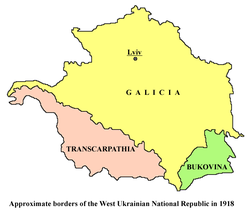
Hungarian Democratic Republic
The Hungarian People's Republic was an independent republic proclaimed after the collapse of Austria-Hungary in 1918...
, with a short period of West Ukrainian control.
On November 8, 1918, the first National Council (the Lubovňa Council, which was later reconvened as the Prešov
Prešov
Prešov Historically, the city has been known in German as Eperies , Eperjes in Hungarian, Fragopolis in Latin, Preszów in Polish, Peryeshis in Romany, Пряшев in Russian and Пряшів in Rusyn and Ukrainian.-Characteristics:The city is a showcase of Baroque, Rococo and Gothic...
Council) was held in western Ruthenia. The first of many councils, it simply stated the desire of its members to separate from newly formed Hungarian state, but did not specify a particular alternative — only that it must involve the right to self-determination.
Over the next months, councils met every few weeks, calling for various solutions. Some wanted to remain part of Hungarian state but with greater autonomy; the most notable of these, the Uzhhorod
Uzhhorod
Uzhhorod or Uzhgorod is a city located in western Ukraine, at the border with Slovakia and near the border with Hungary. It is the administrative center of the Zakarpattia Oblast , as well as the administrative center of the surrounding Uzhhorodskyi Raion within the oblast...
Council (November 9, 1918), declared itself the representative of the Rusyn people and began negotiations with Hungarian authorities, resulting in the adoption of Law no. 10, making four of the Rusyn counties autonomous. Other councils, such as the Carpatho-Ruthenian National Council meetings in Khust
Khust
Khust is a city located on the Khustets River in the Zakarpattia oblast in western Ukraine. It is near the confluence of the Tisza and Rika Rivers...
(November 1918), called for unification with a Ukrainian
Ukraine
Ukraine is a country in Eastern Europe. It has an area of 603,628 km², making it the second largest contiguous country on the European continent, after Russia...
state. It was only in early January 1919 that the first calls were heard in Ruthenia for union with Czechoslovakia
Czechoslovakia
Czechoslovakia or Czecho-Slovakia was a sovereign state in Central Europe which existed from October 1918, when it declared its independence from the Austro-Hungarian Empire, until 1992...
.
Prior to this, in July 1918, Rusyn
Rusyns
Carpatho-Rusyns are a primarily diasporic ethnic group who speak an Eastern Slavic language, or Ukrainian dialect, known as Rusyn. Carpatho-Rusyns descend from a minority of Ruthenians who did not adopt the use of the ethnonym "Ukrainian" in the early twentieth century...
immigrants in the United States had convened and called for complete independence
Independence
Independence is a condition of a nation, country, or state in which its residents and population, or some portion thereof, exercise self-government, and usually sovereignty, over its territory....
. Failing that, they would try to unite with Galicia and Bukovyna; and failing that, they would demand autonomy, though they did not specify under which state. They approached the American government and were told that the only viable option was unification with Czechoslovakia
Czechoslovakia
Czechoslovakia or Czecho-Slovakia was a sovereign state in Central Europe which existed from October 1918, when it declared its independence from the Austro-Hungarian Empire, until 1992...
. Their leader, Gregory Zatkovich
Gregory Zatkovich
Gregory Ignatius Zhatkovich was an American lawyer and political activist for Rusyns in the United States and Europe....
, then signed the "Philadelphia Agreement" with Czech President Tomáš Masaryk
Tomáš Masaryk
Tomáš Garrigue Masaryk , sometimes called Thomas Masaryk in English, was an Austro-Hungarian and Czechoslovak politician, sociologist and philosopher, who as an eager advocate of Czechoslovak independence during World War I became the founder and first President of Czechoslovakia, also was...
, guaranteeing Rusyn autonomy upon unification with Czechoslovakia. A referendum was held among American Rusyn parishes, with a resulting 67% in favor. Another 28% voted for union with Ukraine
Ukraine
Ukraine is a country in Eastern Europe. It has an area of 603,628 km², making it the second largest contiguous country on the European continent, after Russia...
, and less than one percent each for Galicia, Hungary and Russia. Less than 2% desired complete independence.
In April 1919, Czechoslovak control on the ground was established, when Czechoslovak troops acting in concert with Romanian forces arriving from the east - both acting under French auspices - entered the area. In a series of battles they defeated and crushed the local militias of the newly formed Hungarian Soviet Republic
Hungarian Soviet Republic
The Hungarian Soviet Republic or Soviet Republic of Hungary was a short-lived Communist state established in Hungary in the aftermath of World War I....
, whose proclaimed aim was to "unite the Hungarian, Rusyn and Jewish toilers against the exploiters of the same nationalities". Communist sympathizers accused the Czechoslovaks and Romanians of atrocities, such as public hangings and the clubbing to death of wounded prisoners.
This fighting had a strategic significance as the Soviet aid for whose coming the Hungarian Communists hoped (in vain, as the Bolsheviks were too busy with their own civil war) would have had to pass thorough this region.
Transcarpathia, as well as a broader region, was occupied by Romania
Romania
Romania is a country located at the crossroads of Central and Southeastern Europe, on the Lower Danube, within and outside the Carpathian arch, bordering on the Black Sea...
from April 1919 until July or August 1919, and then was again occupied by Hungarian state
Hungary
Hungary , officially the Republic of Hungary , is a landlocked country in Central Europe. It is situated in the Carpathian Basin and is bordered by Slovakia to the north, Ukraine and Romania to the east, Serbia and Croatia to the south, Slovenia to the southwest and Austria to the west. The...
.
In May 1919, a Central National Council convened in the US under Zatkovich and voted unanimously to accept the Czechoslovak solution. Back in Ruthenia, on May 8, 1919, a general meeting of representatives from all the previous councils was held, and declared that "The Central Russian National Council... completely endorse the decision of the American Uhro-Rusin Council to unite with the Czech-Slovak nation on the basis of full national autonomy."
The Hungarian left-wing writer Béla Illés
Béla Illés (writer)
Béla Illés Was a Hungarian left-wing writer and journalist, who spent much of his life in exile at the Soviet Union.-Publications:...
claimed that the meeting was little more than a farce, with various "notables" fetched from their homes by police, formed into a "National Assembly" without any semblance of a democratic process, and effectively ordered to endorse incorporation into Czechoslovakia. He further asserts that Clemenceau
Clemenceau
Clemenceau may refer to:* Georges Clemenceau , French physician, journalist and statesman* Clemenceau , a French aircraft carrier* Mount Clemenceau, a mountain in the Canadian Rockies...
had personally instructed the French general on the spot to get the area incorporated into Czechoslovakia "at all costs", so as to create a buffer separating Soviet Ukraina from Hungary, as part of the French anti-Communist "Cordon sanitaire
Cordon sanitaire
Cordon sanitaire — or quarantine line — is a French phrase that, literally translated, means "sanitary cordon". Though in French it originally denoted a barrier implemented to stop the spread of disease, it has often been used in English in a metaphorical sense to refer to attempts to prevent the...
" policy, and that it was the French rather than the Czechoslovaks who made the effective decisions.
The Treaty of St. Germain (September 10, 1919) granted the Carpathian Rusyns autonomy, which was later upheld to some extent by the Czechoslovak constitution. Some rights were, however, withheld by Prague, which justified its actions by claiming that the process was to be a gradual one; and Rusyn representation in the national sphere was less than that hoped for.
After the Paris Peace Conference
Paris Peace Conference
Paris Peace Conference may refer to:* Paris Peace Conference, 1919, negotiated the treaties ending World War I* Paris Peace Conference, 1946 July 29 to October 15, 1946See also...
, Transcarpathia became part of Czechoslovakia
Czechoslovakia
Czechoslovakia or Czecho-Slovakia was a sovereign state in Central Europe which existed from October 1918, when it declared its independence from the Austro-Hungarian Empire, until 1992...
. Whether this was widely popular among the mainly peasant population, is debatable; clearly, however, what mattered most to Ruthenians was not which country they would join, but that they be granted autonomy within it. After their experience of Magyarization
Magyarization
Magyarization is a kind of assimilation or acculturation, a process by which non-Magyar elements came to adopt Magyar culture and language due to social pressure .Defiance or appeals to the Nationalities Law, met...
, few Carpathian Rusyns were eager to remain under Hungarian rule, and they desired to ensure self-determination.
In 1920, the area was used as a conduit for arms and ammunition for the anti-Soviet Poles fighting in the Polish-Soviet War
Polish-Soviet War
The Polish–Soviet War was an armed conflict between Soviet Russia and Soviet Ukraine and the Second Polish Republic and the Ukrainian People's Republic—four states in post–World War I Europe...
directly to the north, while local Communists sabotaged the trains and tried to help the Soviet side.
Zatkovich was appointed governor of the province by Masaryk on April 20, 1920 and resigned almost a year later, on April 17, 1921, to return to his law practice in Pittsburgh, Pennsylvania
Pennsylvania
The Commonwealth of Pennsylvania is a U.S. state that is located in the Northeastern and Mid-Atlantic regions of the United States. The state borders Delaware and Maryland to the south, West Virginia to the southwest, Ohio to the west, New York and Ontario, Canada, to the north, and New Jersey to...
, USA. The reason for his resignation was dissatisfaction with the borders with Slovakia. His tenure is a historical anomaly as the only American citizen ever acting as governor of a province that later became a part of the USSR.
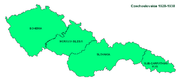
Czechoslovakia
Czechoslovakia or Czecho-Slovakia was a sovereign state in Central Europe which existed from October 1918, when it declared its independence from the Austro-Hungarian Empire, until 1992...
. Thousands of Czech teachers, policemen, clerks and businessmen went to the region. The Czechoslovak government used a lot of money to build thousands of kilometres of railways, roads, airports, hundreds of schools and residential buildings.
While it was the Rusyns themselves who had arrived at the decision to join the Czechoslovak state, it is debatable whether their decision had any influence on the outcome. At the Paris Peace Conference
Paris Peace Conference, 1919
The Paris Peace Conference was the meeting of the Allied victors following the end of World War I to set the peace terms for the defeated Central Powers following the armistices of 1918. It took place in Paris in 1919 and involved diplomats from more than 32 countries and nationalities...
, several other countries (including Hungary, Ukraine and Russia) laid claim to Carpathian Rus. The Allies, however, had few alternatives to choosing Czechoslovakia. Hungary had lost the war and therefore gave up its claims; Ukraine was seen as politically unviable; and Russia was in the midst of a civil war. Thus the Rusyns' decision to become part of Czechoslovakia can only have been important in creating, at least initially, good relations between the leaders of Carpathian Rus and Czechoslovakia. The Ukrainian language
Ukrainian language
Ukrainian is a language of the East Slavic subgroup of the Slavic languages. It is the official state language of Ukraine. Written Ukrainian uses a variant of the Cyrillic alphabet....
was not actively persecuted in Czechoslovakia during the interwar period
Interwar period
Interwar period can refer to any period between two wars. The Interbellum is understood to be the period between the end of the Great War or First World War and the beginning of the Second World War in Europe....
unlike in the three other countries with a large Ukrainian population (Soviet Union, Poland and Romania). Nevertheless, 73 percent of local parents voted against Ukrainian language education for their children in a referendum conducted in Sub-Carpathian Rus in 1937.
1938–1945
In November 1938, under the First Vienna AwardVienna Awards
The Vienna Awards are two arbitral awards by which arbiters of Nazi Germany and Fascist Italy sought to enforce peacefully the claims of Hungary on territory it had lost in 1920 when it signed the Treaty of Trianon...
—which was a result of the Munich Agreement
Munich Agreement
The Munich Pact was an agreement permitting the Nazi German annexation of Czechoslovakia's Sudetenland. The Sudetenland were areas along Czech borders, mainly inhabited by ethnic Germans. The agreement was negotiated at a conference held in Munich, Germany, among the major powers of Europe without...
—Czechoslovakia, and later Slovakia, were forced by Germany and Italy to cede the southern third of Slovakia
Slovakia
The Slovak Republic is a landlocked state in Central Europe. It has a population of over five million and an area of about . Slovakia is bordered by the Czech Republic and Austria to the west, Poland to the north, Ukraine to the east and Hungary to the south...
and southern Carpathian Rus to Hungary
Hungary
Hungary , officially the Republic of Hungary , is a landlocked country in Central Europe. It is situated in the Carpathian Basin and is bordered by Slovakia to the north, Ukraine and Romania to the east, Serbia and Croatia to the south, Slovenia to the southwest and Austria to the west. The...
. The remainder of Carpathian Rus received autonomy, with Avhustyn Voloshyn
Avhustyn Voloshyn
Avgustyn Ivanovych Voloshyn was a Ukrainian politician, teacher, and essayist. He was president of the independent Carpatho-Ukraine, which existed for one day on March 15, 1939....
as the prime minister
Prime minister
A prime minister is the most senior minister of cabinet in the executive branch of government in a parliamentary system. In many systems, the prime minister selects and may dismiss other members of the cabinet, and allocates posts to members within the government. In most systems, the prime...
of the autonomous government.
Following the Slovak proclamation of independence on March 14, 1939 and the Nazis' seizure of the Czech lands
German occupation of Czechoslovakia
German occupation of Czechoslovakia began with the Nazi annexation of Czechoslovakia's northern and western border regions, known collectively as the Sudetenland, under terms outlined by the Munich Agreement. Nazi leader Adolf Hitler's pretext for this effort was the alleged privations suffered by...
on March 15, Carpatho-Rus declared its independence as the Republic of Carpatho-Ukraine, with Avhustyn Voloshyn
Avhustyn Voloshyn
Avgustyn Ivanovych Voloshyn was a Ukrainian politician, teacher, and essayist. He was president of the independent Carpatho-Ukraine, which existed for one day on March 15, 1939....
as head of state, and was immediately invaded and annexed by Hungary
Hungary
Hungary , officially the Republic of Hungary , is a landlocked country in Central Europe. It is situated in the Carpathian Basin and is bordered by Slovakia to the north, Ukraine and Romania to the east, Serbia and Croatia to the south, Slovenia to the southwest and Austria to the west. The...
. On March 23 Hungary annexed further parts of eastern Slovakia bordering with the west of Carpatho-Rus.
In the fall of 1944 when the north and eastern parts of Carpatho-Rus were captured by the Red Army
Red Army
The Workers' and Peasants' Red Army started out as the Soviet Union's revolutionary communist combat groups during the Russian Civil War of 1918-1922. It grew into the national army of the Soviet Union. By the 1930s the Red Army was among the largest armies in history.The "Red Army" name refers to...
, the Czechoslovak government delegation led by minister František Němec arrived in Khust
Khust
Khust is a city located on the Khustets River in the Zakarpattia oblast in western Ukraine. It is near the confluence of the Tisza and Rika Rivers...
to establish the provisional Czechoslovak administration, according to the treaties between the Soviet
Soviet Union
The Soviet Union , officially the Union of Soviet Socialist Republics , was a constitutionally socialist state that existed in Eurasia between 1922 and 1991....
and Czechoslovak governments
Czechoslovak government-in-exile
The Czechoslovak government-in-exile was an informal title conferred upon the Czechoslovak National Liberation Committee, initially by British diplomatic recognition. The name came to be used by other World War II Allies as they subsequently recognized it...
from the same year. However, after a few weeks, the Red Army and NKVD
NKVD
The People's Commissariat for Internal Affairs was the public and secret police organization of the Soviet Union that directly executed the rule of power of the Soviets, including political repression, during the era of Joseph Stalin....
started to obstruct the delegation's work and the "National committee of Transcarpatho-Ukraine" was set up in Mukachevo under the protection of the Red Army. On November 26 this committee, led by Ivan Turyanitsa (a Rusyn who deserted
Desertion
In military terminology, desertion is the abandonment of a "duty" or post without permission and is done with the intention of not returning...
from the Czechoslovak army
I Corps (Czechoslovakia)
I Czechoslovak Army Corps was a unit of the Czechoslovak army in exile on the Eastern Front fighting alongside the Soviet Red Army, which was created on the April 10, 1944 at Chernivtsi and moved to Krosno area soon after....
) proclaimed the will of Ukrainian people to separate from Czechoslovakia and join the Soviet Ukraine. After two months of conflicts and negotiations the Czechoslovak government delegation departed Khust on February 1, 1945, leaving the Carpathian Rus under Soviet control.
After World War II, on June 29, 1945, a treaty was signed between Czechoslovakia and the Soviet Union, ceding Carpatho-Rus officially to the Soviet Union. In 1946, Rus was incorporated into the Ukrainian Soviet Socialist Republic.
Recent history
The latter in 1991 became the independent state of UkraineUkraine
Ukraine is a country in Eastern Europe. It has an area of 603,628 km², making it the second largest contiguous country on the European continent, after Russia...
, with Carpatho-Rus as an integral part. Currently, the region is a province within Ukraine, officially known as Zakarpattia Oblast
Zakarpattia Oblast
The Zakarpattia Oblast is an administrative oblast located in southwestern Ukraine. Its administrative center is the city of Uzhhorod...
.
(See Zakarpattia Oblast
Zakarpattia Oblast
The Zakarpattia Oblast is an administrative oblast located in southwestern Ukraine. Its administrative center is the city of Uzhhorod...
for history past that time.)
On October 25, 2008, 100 delegates to the Congress Of Carpathian Ruthenians declared the formation of the Republic of Carpathian Ruthenia. The Ukrainian nationalist Svoboda Party responded by releasing the following statement: "Zakarpattian separatists led by Moscow Patriarchate priest Sidor are issuing an ultimatum to the Ukrainian authorities today. Tomorrow, armed with Russian passport
Russian passport
Russian passports are of two types: domestic passports issued to citizens of Russia for the purpose of certifying identity, international passports are issued for the purpose of international travel.- Internal passport :...
s and money from the Kremlin
Kremlin
A kremlin , same root as in kremen is a major fortified central complex found in historic Russian cities. This word is often used to refer to the best-known one, the Moscow Kremlin, or metonymically to the government that is based there...
, they will implement the ‘Georgian scenario’ in Ukraine." The party called on President
President of Ukraine
Prior to the formation of the modern Ukrainian presidency, the previous Ukrainian head of state office was officially established in exile by Andriy Livytskyi. At first the de facto leader of nation was the president of the Central Rada at early years of the Ukrainian People's Republic, while the...
Viktor Yuschenko and Prime Minister
Prime Minister of Ukraine
The Prime Minister of Ukraine is Ukraine's head of government presiding over the Cabinet of Ministers of Ukraine, which is the highest body of the executive branch of the Ukrainian government....
Yulia Tymoshenko
Yulia Tymoshenko
Yulia Volodymyrivna Tymoshenko , née Grigyan , born 27 November 1960, is a Ukrainian politician. She was the Prime Minister of Ukraine from 24 January to 8 September 2005, and again from 18 December 2007 to 4 March 2010. She placed third in Forbes Magazine's List of The World's 100 Most Powerful...
to issue a political assessment of the actions in Zakarpattia and Crimea
Crimea
Crimea , or the Autonomous Republic of Crimea , is a sub-national unit, an autonomous republic, of Ukraine. It is located on the northern coast of the Black Sea, occupying a peninsula of the same name...
, called on the National Security and Defense Council to draft a plan to restrict separatist actions, and called on the Foreign Affairs Ministry
Ministry of Foreign Affairs (Ukraine)
The Ministry of Foreign Affairs of Ukraine is the Ukrainian government ministry which oversees the foreign relations of Ukraine.-Historical overlook:...
to declare all the citizens that participated in the October 25 congress as persona non grata
Persona non grata
Persona non grata , literally meaning "an unwelcome person", is a legal term used in diplomacy that indicates a proscription against a person entering the country...
in Ukraine. The prosecutor’s office of Zakarpattia region has filed a case against priest Dymytrii Sydor and Yevhen Zhupan, an Our Ukraine
Our Ukraine
The Our Ukraine–People's Self-Defense Bloc is an electoral alliance active in Ukraine, associated with former President Viktor Yushchenko. Since 2005, the bloc has been dominated by a core consisting of the People's Union "Our Ukraine" party and five smaller partner parties.The Our Ukraine Bloc is...
deputy of the Zakarpattia regional council and chairman of the People’s Council of Ruthenians, on charges of encroaching on the territorial integrity and inviolability of Ukraine. On May 1, 2009 National Union Svoboda blocked the holding of the third European congress of the Carpathian Ruthenians.
Ethnonational censuses in Carpathian Ruthenia
! Ukrainians
Ukrainians
Ukrainians are an East Slavic ethnic group native to Ukraine, which is the sixth-largest nation in Europe. The Constitution of Ukraine applies the term 'Ukrainians' to all its citizens...
and Rusyns
Rusyns
Carpatho-Rusyns are a primarily diasporic ethnic group who speak an Eastern Slavic language, or Ukrainian dialect, known as Rusyn. Carpatho-Rusyns descend from a minority of Ruthenians who did not adopt the use of the ethnonym "Ukrainian" in the early twentieth century...
! "Czechoslovaks"
(Czechs and Slovaks)
! Germans
! Hungarians
! Jews
History of the Jews in Czechoslovakia
-Demography:table 1. Jewish population by religion in CzechoslovakiaTable 2. Declared Nationality of Jews in Czechoslovakia-Holocaust:For the Czechs of the Protectorate Bohemia and Moravia, German occupation was a period of brutal oppression. The Jewish population of Bohemia and Moravia was...
! Romanians
! others
! Total population>
|
|
|
|
|
|
|
|
|-
| 1921
|
|
|
|
|
|
|
|
|
|
|
|
|
|
|
|
|
|
Slovaks
The Slovaks, Slovak people, or Slovakians are a West Slavic people that primarily inhabit Slovakia and speak the Slovak language, which is closely related to the Czech language.Most Slovaks today live within the borders of the independent Slovakia...
(0.6%)
|
|
|
|
|
49,456 (4.0%)
Roma
(1.0%)
|
Ukrainians and Rusyns
Carpathian Ruthenia is inhabited mainly by Ruthenian-speakers (RusynsRusyns
Carpatho-Rusyns are a primarily diasporic ethnic group who speak an Eastern Slavic language, or Ukrainian dialect, known as Rusyn. Carpatho-Rusyns descend from a minority of Ruthenians who did not adopt the use of the ethnonym "Ukrainian" in the early twentieth century...
, Lemkos
Lemkos
Lemkos , one of several quantitatively and territorially small ethnic groups who also call themselves Rusyns , are one of the ethnic groups inhabiting the Carpathian Mountains...
and Ukrainians
Ukrainians
Ukrainians are an East Slavic ethnic group native to Ukraine, which is the sixth-largest nation in Europe. The Constitution of Ukraine applies the term 'Ukrainians' to all its citizens...
who may refer to themselves and their language as Rusnak or Lemko). Places inhabited by Rusyns
Places inhabited by Rusyns
The contemporary administrative entities roughly corresponding the traditional territory of settlement of the Rusyns. Following areas have been included which still are or up to the World War II were inhabited by each of the Rusyn sub-ethnicities mentioned below: Dolinyans:* Ukraine: Zakarpattia...
also span adjacent regions of the Carpathian Mountains
Carpathian Mountains
The Carpathian Mountains or Carpathians are a range of mountains forming an arc roughly long across Central and Eastern Europe, making them the second-longest mountain range in Europe...
, including regions of present day Poland
Poland
Poland , officially the Republic of Poland , is a country in Central Europe bordered by Germany to the west; the Czech Republic and Slovakia to the south; Ukraine, Belarus and Lithuania to the east; and the Baltic Sea and Kaliningrad Oblast, a Russian exclave, to the north...
, Slovakia
Slovakia
The Slovak Republic is a landlocked state in Central Europe. It has a population of over five million and an area of about . Slovakia is bordered by the Czech Republic and Austria to the west, Poland to the north, Ukraine to the east and Hungary to the south...
, Hungary
Hungary
Hungary , officially the Republic of Hungary , is a landlocked country in Central Europe. It is situated in the Carpathian Basin and is bordered by Slovakia to the north, Ukraine and Romania to the east, Serbia and Croatia to the south, Slovenia to the southwest and Austria to the west. The...
, and Romania
Romania
Romania is a country located at the crossroads of Central and Southeastern Europe, on the Lower Danube, within and outside the Carpathian arch, bordering on the Black Sea...
. Ruthenian settlements exist in the Balkans
Balkans
The Balkans is a geopolitical and cultural region of southeastern Europe...
as well.
The area of present-day Transcarpathia was probably settled by Slavic tribes in the 4th century. There is no information whether local population was distinct from the population of the areas north of the Carpathian Mountains
Carpathian Mountains
The Carpathian Mountains or Carpathians are a range of mountains forming an arc roughly long across Central and Eastern Europe, making them the second-longest mountain range in Europe...
.
Between the 12th and 15th centuries, the area was colonized by Eastern Orthodox groups of Vlach highlanders with accompanying Ruthenian
Ruthenians
The name Ruthenian |Rus']]) is a culturally loaded term and has different meanings according to the context in which it is used. Initially, it was the ethnonym used for the East Slavic peoples who lived in Rus'. Later it was used predominantly for Ukrainians...
populations. All the groups, including local Slavic
Slavic peoples
The Slavic people are an Indo-European panethnicity living in Eastern Europe, Southeast Europe, North Asia and Central Asia. The term Slavic represents a broad ethno-linguistic group of people, who speak languages belonging to the Slavic language family and share, to varying degrees, certain...
population, blended together creating distinctive culture from main Ruthenian
Ruthenians
The name Ruthenian |Rus']]) is a culturally loaded term and has different meanings according to the context in which it is used. Initially, it was the ethnonym used for the East Slavic peoples who lived in Rus'. Later it was used predominantly for Ukrainians...
-speaking areas.
Over the time, because of geographical and political isolation from the main Ruthenian-speaking territory, the inhabitants developed distinctive features.
In the 19th and 20th centuries, Transcarpathia was an area of continuous struggle between pro-Ukrainian and pro-Russian activists. The former asserted that the Carpatho-Ruthenians were part of the Ukrainian nation, while the latter claimed them to be a separate ethnicity and nationality from the Ukrainians, a part of the Russian ethnos.
In the 19th century and the first part of the 20th, the inhabitants of Transcarpathia continued to call themselves "Ruthenians" ("Rusyny"). After Soviet annexation the ethnonym "Ukrainian", which had replaced "Ruthenian" in eastern Ukraine at the turn of the century, was also applied to Ruthenians/Rusyns of Transcarpathia. Most present-day inhabitants consider themselves ethnically Ukrainians
Ukrainians
Ukrainians are an East Slavic ethnic group native to Ukraine, which is the sixth-largest nation in Europe. The Constitution of Ukraine applies the term 'Ukrainians' to all its citizens...
, although in the most recent census 10,100 people (0.8%) identified themselves as ethnically Rusyn
Rusyns
Carpatho-Rusyns are a primarily diasporic ethnic group who speak an Eastern Slavic language, or Ukrainian dialect, known as Rusyn. Carpatho-Rusyns descend from a minority of Ruthenians who did not adopt the use of the ethnonym "Ukrainian" in the early twentieth century...
.
On 7 March 2007, the Zakarpattia Oblast Council recognized the Rusyn ethnicity.
Hungarians
Transcarpathia was a part of the medieval Kingdom of HungaryKingdom of Hungary
The Kingdom of Hungary comprised present-day Hungary, Slovakia and Croatia , Transylvania , Carpatho Ruthenia , Vojvodina , Burgenland , and other smaller territories surrounding present-day Hungary's borders...
from the 11th century. From 1526, the region was divided between the Habsburg
Habsburg Monarchy
The Habsburg Monarchy covered the territories ruled by the junior Austrian branch of the House of Habsburg , and then by the successor House of Habsburg-Lorraine , between 1526 and 1867/1918. The Imperial capital was Vienna, except from 1583 to 1611, when it was moved to Prague...
Kingdom of Hungary and Eastern Hungarian Kingdom
Eastern Hungarian Kingdom
The Eastern Hungarian Kingdom was the name of the area under the rule of King John I of Hungary. John I of Hungary was the former voivode of Transylvania and the wealthiest and the most powerful landlord after Mohács, secured the eastern part of the kingdom with the help of the Ottomans...
, while from 1570, it was divided between the Habsburg Kingdom of Hungary and the Principality of Transylvania
Transylvania
Transylvania is a historical region in the central part of Romania. Bounded on the east and south by the Carpathian mountain range, historical Transylvania extended in the west to the Apuseni Mountains; however, the term sometimes encompasses not only Transylvania proper, but also the historical...
under Ottoman
Ottoman Empire
The Ottoman EmpireIt was usually referred to as the "Ottoman Empire", the "Turkish Empire", the "Ottoman Caliphate" or more commonly "Turkey" by its contemporaries...
suzerainty. In the 17th century (until 1648) the entire region was part of Transylvania, and between 1682 and 1685, its north-western part was administered by the vassal Ottoman Principality of Upper Hungary of the prince Imre Thököly
Imre Thököly
Count Imre Thököly de Késmárk was a Hungarian statesman, leader of an anti-Habsburg uprising, Prince of Transylvania, and vassal king of Upper Hungary.- Early life :Imre Thököly was born at Késmárk, Royal Hungary Count Imre Thököly de Késmárk (Thököly/Tököly/Tökölli Imre in Hungarian, Mirko...
, while south-eastern parts were administered by Transylvania. Since 1699, the entire region was part of the Habsburg Monarchy and was divided between the Habsburg Kingdom of Hungary and the Habsburg Principality of Transylvania. Later, the entire region was included into the Habsburg Kingdom of Hungary. After 1867, the region was administratively included into Transleithania or Hungarian part of Austria-Hungary.
At the beginning of the 20th century, the nobility
Nobility
Nobility is a social class which possesses more acknowledged privileges or eminence than members of most other classes in a society, membership therein typically being hereditary. The privileges associated with nobility may constitute substantial advantages over or relative to non-nobles, or may be...
and middle class
Middle class
The middle class is any class of people in the middle of a societal hierarchy. In Weberian socio-economic terms, the middle class is the broad group of people in contemporary society who fall socio-economically between the working class and upper class....
in the region was mostly Hungarian
Hungarian language
Hungarian is a Uralic language, part of the Ugric group. With some 14 million speakers, it is one of the most widely spoken non-Indo-European languages in Europe....
-speaking. After World War I, the Austro-Hungarian Monarchy was dissolved and Transcarpathia was included into Czechoslovakia; the 1910 Austro-Hungarian census shows 185,433 speakers of Hungarian language, while the Czechoslovak census of 1921 shows 111,052 ethnic Hungarians and 80,132 ethnic Jews, many of whom were speakers of Hungarian language. Much of the difference in these censuses reflects differences in methodology and definitions rather than a decline in the region's ethnic Hungarian (Magyar) or Hungarian-speaking population. According to the 1921 census, Hungarians constituted about 17.9% of the region's total population.
On the eve of World War II, the First Vienna Award
First Vienna Award
The First Vienna Award was the result of the First Vienna Arbitration, which took place at Vienna's Belvedere Palace on November 2, 1938. The Arbitration and Award were direct consequences of the Munich Agreement...
allowed Hungary to annex Transcarpathia. The pro-Nazi policies of the Hungarian government subsequently resulted in extermination and emigration of Hungarian-speaking Jews, and other groups living in the territory were decimated by war. The end of the war had a significant impact on the ethnic Hungarian population of the area: 10,000 fled before the arrival of Soviet
Soviet Union
The Soviet Union , officially the Union of Soviet Socialist Republics , was a constitutionally socialist state that existed in Eurasia between 1922 and 1991....
forces. Many of the remaining adult men (25,000) were deported to the Soviet Union; about 30% of them died in Soviet labor camp
Labor camp
A labor camp is a simplified detention facility where inmates are forced to engage in penal labor. Labor camps have many common aspects with slavery and with prisons...
s. As a result of this development since 1938, the Hungarian and Hungarian-speaking population of Transcarpathia was recorded differently in various censuses and estimations from that time: 1930 census recorded 116,548 ethnic Hungarians, while the contested Hungarian census from 1941 shows as much as 233,840 speakers of Hungarian language in the region. Subsequent estimations are showing 66,000 ethnic Hungarians in 1946 and 139,700 in 1950, while the Soviet census from 1959 recorded 146,247 Hungarians.
, about 170,000 (12-13%) inhabitants of Transcarpathia declare Hungarian as their mother tongue. Homeland Hungarians refer to Hungarians in Ukraine as kárpátaljaiak.
Jews
Memoirs and historical studies provide much evidence that in the nineteenth and early twentieth centuries Rusyn-Jewish relations were generally peaceful. In 1939, census records showed that 80,000 Jews lived in the autonomous province of Ruthenia. Jews made up approximately 14% of the prewar population, however this population was concentrated in the larger towns, especially Mukachevo, where they constituted 43% of the prewar population.During the Holocaust, 17 main ghettos were set up in cities in Carpathian Ruthenia, from which all Jews were taken to Auschwitz for extermination. Ruthenian ghettos were set up in May 1944 and liquidated by June 1944. Most of the Jews of Transcarpathia were killed, though a number survived, either because they were hidden by their neighbours, or were forced into labour battalion
Labour battalion
Labour battalions have been a form of alternative service or unfree labour in various countries in lieu of or resembling regular military service...
s, which often guaranteed food and shelter.
Germans
See History of Germans in Russia and the Soviet UnionHistory of Germans in Russia and the Soviet Union
The German minority in Russia and the Soviet Union was created from several sources and in several waves. The 1914 census puts the number of Germans living in Russian Empire at 2,416,290. In 1989, the German population of the Soviet Union was roughly 2 million. In the 2002 Russian census, 597,212...
for information about Carpathian-German (mainly German-speaking Bohemian
Bohemian
A Bohemian is a resident of the former Kingdom of Bohemia, either in a narrow sense as the region of Bohemia proper or in a wider meaning as the whole country, now known as the Czech Republic. The word "Bohemian" was used to denote the Czech people as well as the Czech language before the word...
, Moravia
Moravia
Moravia is a historical region in Central Europe in the east of the Czech Republic, and one of the former Czech lands, together with Bohemia and Silesia. It takes its name from the Morava River which rises in the northwest of the region...
n German and Saxon
Lower Saxony
Lower Saxony is a German state situated in north-western Germany and is second in area and fourth in population among the sixteen states of Germany...
/Low German
Low German
Low German or Low Saxon is an Ingvaeonic West Germanic language spoken mainly in northern Germany and the eastern part of the Netherlands...
from middle and eastern Germany) settlement in the 16th to 18th centuries. to be written
Czechs
Czechs in Carpathian Ruthenia are ethnoculturally distinct from other West SlavicWest Slavic
West Slavic can refer to:* West Slavic languages* West Slavic peoples...
groups like the Slovaks, as they originated from Czech-speaking groups from Bohemia
Bohemia
Bohemia is a historical region in central Europe, occupying the western two-thirds of the traditional Czech Lands. It is located in the contemporary Czech Republic with its capital in Prague...
and Moravia
Moravia
Moravia is a historical region in Central Europe in the east of the Czech Republic, and one of the former Czech lands, together with Bohemia and Silesia. It takes its name from the Morava River which rises in the northwest of the region...
instead of Slovakia. to be written
Roma
There are approximately 25,000 ethnic Roma in present-day Transcarpathia. Some estimates point to a number as high as 50,000 but a true count is hard to obtain as many Roma will claim to be Hungarian or Romanian when interviewed by Ukrainian authorities.They are by far the poorest and least-represented ethnic group in the region and face intense prejudice. The years since the fall of the USSR have not been kind to the Roma of the region, as they have been particularly hard hit by the economic problems faced by peoples all over the former USSR. Some Roma in western Ukraine live in major cities such as Uzhhorod
Uzhhorod
Uzhhorod or Uzhgorod is a city located in western Ukraine, at the border with Slovakia and near the border with Hungary. It is the administrative center of the Zakarpattia Oblast , as well as the administrative center of the surrounding Uzhhorodskyi Raion within the oblast...
and Mukachevo, but most live in encampments on the outskirts of cities. These encampments are known as "taberi" and can house up to 300 families. These encampments tend to be fairly primitive with no running water or electricity.
For further information, see http://www.romaniyag.uz.ua/en/
Romanians
Some 30,000 Romanians live in this region, mostly around the southern towns of RakhivRakhiv
Rakhiv is a city located in the Zakarpattia Oblast in western Ukraine. It is the administrative center of the Rakhiv Raion .- Demographics :As of 2001, the city population was 15,241 inhabitants which included: * 83.8% Ukrainians...
and Tiachiv
Tiachiv
Tyachiv is a city located on the Tisza River in the Zakarpattia Oblast in western Ukraine. It is the administrative center of the Tiachiv Raion .- History and name :...
and close to the border with Romania.
Armenians
Descendants of ArmeniansArmenians
Armenian people or Armenians are a nation and ethnic group native to the Armenian Highland.The largest concentration is in Armenia having a nearly-homogeneous population with 97.9% or 3,145,354 being ethnic Armenian....
who came and settled in the region in the 15th to 18th centuries. to be written
Western views
For urban European readers in the 19th century, Ruthenia was one origin of the 19th century's imaginary "RuritaniaRuritania
Ruritania is a fictional country in central Europe which forms the setting for three books by Anthony Hope: The Prisoner of Zenda , The Heart of Princess Osra , and Rupert of Hentzau...
" the most rural, most rustic and deeply provincial tiny province lost in forested mountains that could be imagined. Conceived sometimes as a kingdom of central Europe, Ruritania was the setting of several novels by Anthony Hope
Anthony Hope
Sir Anthony Hope Hawkins, better known as Anthony Hope , was an English novelist and playwright. Although he was a prolific writer, especially of adventure novels, he is remembered best for only two books: The Prisoner of Zenda and its sequel Rupert of Hentzau...
, especially The Prisoner of Zenda
The Prisoner of Zenda
The Prisoner of Zenda is an adventure novel by Anthony Hope, published in 1894. The king of the fictional country of Ruritania is drugged on the eve of his coronation and thus unable to attend his own coronation. Political forces are such that in order for the king to retain his crown his...
(1894).
Recently Vesna Goldsworthy, in Inventing Ruritania: the imperialism of the imagination (1998) has explored the origins of the ideas that underpin Western perceptions of the "Wild East" of Europe, especially of Ruthenian and other rural Slavs in the upper Balkans, but ideas that are highly applicable to Transcarpathia, all in all "an innocent process: a cultural great power seizes and exploits the resources of an area, while imposing new frontiers on its mind-map and creating ideas which, reflected back, have the ability to reshape reality."
See also
- Black RutheniaBlack RutheniaBlack Ruthenia, Black Rus or Black Russia are variant conventional terms used for a region around Navahrudak , in the western part of contemporary Belarus on the upper reaches of the Neman River for the time period between the 13th and 14th centuries...
- Red RutheniaRed RutheniaRed Ruthenia is the name used since medieval times to refer to the area known as Eastern Galicia prior to World War I; first mentioned in Polish historic chronicles in the 1321, as Ruthenia Rubra or Ruthenian Voivodeship .Ethnographers explain that the term was applied from the...
- White Ruthenia
- RutheniaRutheniaRuthenia is the Latin word used onwards from the 13th century, describing lands of the Ancient Rus in European manuscripts. Its geographic and culturo-ethnic name at that time was applied to the parts of Eastern Europe. Essentially, the word is a false Latin rendering of the ancient place name Rus...
- Carpatho-UkraineCarpatho-UkraineCarpatho-Ukraine was an autonomous region within Czechoslovakia from late 1938 to March 15, 1939. It declared itself an independent republic on March 15, 1939, but was occupied by Hungary between March 15 and March 18, 1939, remaining under Hungarian control until the Nazi occupation of Hungary in...
- Military history of Carpathian Ruthenia during World War IIMilitary history of Carpathian Ruthenia during World War IIMilitary history of Carpathian Ruthenia during World War II. Carpathian Ruthenia was a region in the easternmost part of Czechoslovakia that became autonomous within that country in September 1938, declared its independence as the "Republic of Carpatho-Ukraine”in March 1939, was immediately...
- RusynsRusynsCarpatho-Rusyns are a primarily diasporic ethnic group who speak an Eastern Slavic language, or Ukrainian dialect, known as Rusyn. Carpatho-Rusyns descend from a minority of Ruthenians who did not adopt the use of the ethnonym "Ukrainian" in the early twentieth century...
- Ruthenians and Ukrainians in Czechoslovakia (1918-1938)Ruthenians and Ukrainians in Czechoslovakia (1918-1938)Subcarpathian Ruthenia was economically Czechoslovakia’s poorest region. In 1914 the region was referred to by one historian as "little more than a Magyar deer park." Its people were wretchedly poor, having for centuries supplemented the meagre living the mountainous area afforded with seasonal...
- Oleksandr DukhnovychOleksandr DukhnovychAlexander Vasilyevich Dukhnovich was a priest, poet, writer, pedagogue, and social activist of the Slavic peoples of the Carpathians. He is considered as the awakerner of the Rusyns.-Life:...
- Ukrainian dialectsUkrainian dialectsA dialect is a territorial, professional or social variant of a standard literary language.In the Ukrainian language there are 3 major dialectical groups according to territory: the south-western group, the south-eastern group and the northern group of dialects....
- Zakarpattia OblastZakarpattia OblastThe Zakarpattia Oblast is an administrative oblast located in southwestern Ukraine. Its administrative center is the city of Uzhhorod...
- Ruthenian Catholic ChurchRuthenian Catholic ChurchThe Ruthenian Catholic Church is a sui iuris Eastern Catholic Church , which uses the Divine Liturgy of the Constantinopolitan Byzantine Eastern Rite. Its roots are among the Rusyns who lived in the region called Carpathian Ruthenia, in and around the Carpathian Mountains...
External links
- The Carpatho-Rusyn knowledge base
- Paul R. Magocsi, Carpatho-Rusyns, brochure published by The Carpatho-Rusyn Research Center, 1995
- Carpatho-Ukraine (Encyclopedia of Ukraine)
- Diet of Carpatho-Ukraine (Encyclopedia of Ukraine)
- Trans-Carpathia in UkrStor.com (the web library of historical documents & publicism about Malorussia/Ukraine)
- Rusyn History in Carpathian Ruthenia
- Villagers reunited by Slovak-Ukraine border crossing, ReutersReutersReuters is a news agency headquartered in New York City. Until 2008 the Reuters news agency formed part of a British independent company, Reuters Group plc, which was also a provider of financial market data...
, 24 December 2005 - Ethnic structure of the population on the present territory of Transcarpathia (1880-1989)/ Mykola Vehesh, The greatness and the tragedy of Carpathian Ukraine, Zerkalo NedeliZerkalo NedeliZerkalo Nedeli , usually referred to in English as the Mirror Weekly, is one of Ukraine’s most influential analytical newspapers published weekly in Kiev, the nation's capital. It was founded in 1994, and as of 2006 its print circulation was 57,000. It offers political analysis, original...
, 10(485), 13–19 March 2004 in Russian and in Ukrainian - Zakarpattia.ru Kárpátinfo
- Carpathian Ruthenia - photographs and information
- "Ruthenia - Spearhead Toward the West", by Senator Charles J. Hokky, Former Member ot the Czechoslovakian Parliament (Book representing a Hungarian nationalist position)