


World Bank

Encyclopedia
The World Bank is an international financial institution that provides loans to developing countries for capital programmes
.
The World Bank's official goal is the reduction of poverty
. By law, all of its decisions must be guided by a commitment to promote foreign investment, international trade
and facilitate capital
investment.
The World Bank differs from the World Bank Group
, in that the World Bank comprises only two institutions: the International Bank for Reconstruction and Development
(IBRD) and the International Development Association
(IDA), whereas the latter incorporates these two in addition to three more: International Finance Corporation
(IFC), Multilateral Investment Guarantee Agency
(MIGA), and International Centre for Settlement of Investment Disputes
(ICSID).
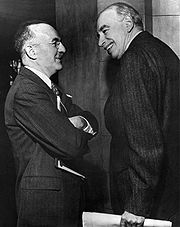 The World Bank is one of five institutions created at the Bretton Woods Conference in 1944. The International Monetary Fund
, a related institution, is the second. Delegates from many countries attended the Bretton Woods Conference. The most powerful countries in attendance were the United States
and United Kingdom
, which dominated negotiations.
Although both are based in Washington, D.C.
, the World Bank is, by custom, headed by an American, while the IMF is led by a European.
and careful screening of loan applications was common. Bank staff attempted to balance the priorities of providing loans for reconstruction and development with the need to instill confidence in the bank.
Bank president John McCloy
selected France to be first recipient of World Bank aid; two other applications from Poland and Chile were rejected. The loan was for US$250 million, half the amount requested and came with strict conditions. Staff from the World Bank monitored the use of the funds, ensuring that the French government would present a balanced budget and give priority of debt repayment to the World Bank over other governments. The United States State Department told the French government that communist
elements within the Cabinet needed to be removed. The French Government complied with this diktat and removed the Communist coalition government
. Within hours the loan to France was approved.
The Marshall Plan
of 1947 caused lending by the bank to change as many European countries received aid that competed with World Bank loans. Emphasis was shifted to non-European countries and until 1968, loans were earmarked for projects that would enable a borrower country to repay loans (such projects as ports, highway systems, and power plants).
These changes can be attributed to Robert McNamara
who was appointed to the presidency in 1968 by Lyndon B. Johnson
. McNamara imported a technocratic managerial style to the Bank that he had used as United States Secretary of Defense and President of the Ford Motor Company
. McNamara shifted bank policy toward measures such as building schools and hospitals, improving literacy
and agricultural reform. McNamara created a new system of gathering information from potential borrower nations that enabled the bank to process loan applications much faster. To finance more loans, McNamara told bank treasurer Eugene Rotberg to seek out new sources of capital outside of the northern banks that had been the primary sources of bank funding. Rotberg used the global bond market to increase the capital available to the bank. One consequence of the period of poverty alleviation lending was the rapid rise of third world debt
. From 1976 to 1980 developing world debt rose at an average annual rate of 20%.
In 1980, the World Bank Administrative Tribunal was established to decide on disputes between the World Bank Group and its staff where allegation of non-observance of contracts of employment or terms of appointment had not been honoured.
. Clausen replaced a large number of bank staffers from the McNamara era and instituted a new ideological focus in the bank. The replacement of Chief Economist Hollis B. Chenery
by Anne Krueger in 1982 marked a notable policy shift at the bank. Krueger was known for her criticism of development funding, as well as of third world governments as rent-seeking states.
Lending to service third world debt marked the period of 1980–1989. Structural adjustment
policies aimed at streamlining the economies of developing nations were also a large part of World Bank policy during this period. UNICEF reported in the late 1980s that the structural adjustment programs of the World Bank were responsible for the "reduced health, nutritional and educational levels for tens of millions of children in Asia, Latin America, and Africa".

The Executive Directors, representing the Bank's member countries, make up the Board of Directors, usually meeting twice a week to oversee activities such as the approval of loans and guarantees, new policies, the administrative budget, country assistance strategies and borrowing and financing decisions.
The Vice Presidents of the Bank are its principal managers, in charge of regions, sectors, networks and functions. There are 24 Vice-Presidents, three Senior Vice Presidents and two Executive Vice Presidents.
(IBRD) has 187 member countries, while the International Development Association
(IDA) has 171 members. Each member state of IBRD should be also a member of the International Monetary Fund
(IMF) and only members of IBRD are allowed to join other institutions within the Bank (such as IDA).
. The countries with most voting power are now the United States
(15.85%), Japan
(6.84%), China
(4.42%), Germany
(4.00%), the United Kingdom
(3.75%), France
(3.75%), and India
(2.91%). Under the changes, known as 'Voice Reform - Phase 2', countries other than China that saw significant gains included South Korea
, Turkey
, Mexico
, Singapore
, Greece
, Brazil
, India
, and Spain
. Most developed countries' voting power was reduced, along with a few poor countries such as Nigeria
. United States
', Russia
's and Saudi Arabia
's voting power was unchanged.
The changes were brought about with the goal of making voting more universal in regards to standards, rule-based with objective indicators, and transparent among other things. Now, developing countries have an increased voice in the "Pool Model," backed especially by Europe. Additionally, voting power is based on economic size in addition to International Development Association contributions.
in the world, the bank's assistance plans are based on poverty reduction strategies
; by combining a cross-section of local groups with an extensive analysis of the country's financial and economic situation the World Bank develops a strategy pertaining uniquely to the country in question. The government then identifies the country's priorities and targets for the reduction of poverty, and the World Bank aligns its aid efforts correspondingly.
Forty-five countries pledged US$25.1 billion
in "aid for the world's poorest countries", aid that goes to the World Bank International Development Association
(IDA) which distributes the loans to eighty poorer countries. While wealthier nations sometimes fund their own aid projects, including those for diseases, and although IDA is the recipient of criticism, Robert B. Zoellick, the president of the World Bank, said when the loans were announced on December 15, 2007, that IDA money "is the core funding that the poorest developing countries rely on".
cost-competitive with coal-fired power as quickly as possible, but this may not continue after UN's Copenhagen climate change conference in December, 2009, because of the Bank's continued investment in coal-fired power plants.
s.
and the World Bank in 1981, Development Business
became the official source for World Bank Procurement Notices, Contract Awards, and Project Approvals.
In 1998, the agreement was re-negotiated, and included in this agreement was a joint venture to create an electronic version of the publication via the World Wide Web. Today, Development Business is the primary publication for all major multilateral development banks, United Nations agencies, and several national governments, many of whom have made the publication of their tenders and contracts in Development Business a mandatory requirement. Currently, the subscription to "online version only" is not free, but costs US$ 550.
The World Bank or the World Bank Group
is also a sitting observer in the United Nations Development Group.
s, such as the indigenous rights group Survival International
, and academics, including its former Chief Economist Joseph Stiglitz who is equally critical of the International Monetary Fund
, the US Treasury Department, US and other developed country trade negotiators. Critics argue that the so-called free market
reform policies which the Bank advocates are often harmful to economic development
if implemented badly, too quickly ("shock therapy
"), in the wrong sequence or in weak, uncompetitive economies.
In Masters of Illusion: The World Bank and the Poverty of Nations (1996), Catherine Caufield argued that the assumptions and structure of the World Bank harms southern nations. Caufield criticized its formulaic recipes of "development". To the World Bank, different nations and regions are indistinguishable and ready to receive the "uniform remedy of development". She argued that to attain even modest success, Western practices are adopted and traditional economic structures and values abandoned. A second assumption is that poor countries cannot modernize without money and advice from abroad.
A number of intellectuals in developing countries have argued that the World Bank is deeply implicated in contemporary modes of donor and NGO imperialism
, and that its intellectual contributions function to blame the poor for their condition.
One of the strongest criticisms of the World Bank has been the way in which it is governed. While the World Bank represents 186 countries, it is run by a small number of economically powerful countries. These countries choose the leadership and senior management of the World Bank, and so their interests dominate the bank.
The World Bank has dual roles that are contradictory: that of a political organization and that of a practical organization. As a political organization, the World Bank must meet the demands of donor and borrowing governments, private capital markets, and other international organizations. As an action-oriented organization, it must be neutral, specializing in development aid, technical assistance, and loans. The World Bank's obligations to donor countries and private capital markets have caused it to adopt policies which dictate that poverty is best alleviated by the implementation of "market" policies.
In the 1990s, the World Bank and the IMF forged the Washington Consensus
, policies which included deregulation
and liberalization of markets, privatization
and the downscaling of government
. Though the Washington Consensus was conceived as a policy that would best promote development, it was criticized for ignoring equity, employment and how reforms like privatization were carried out. Many now agree that the Washington Consensus placed too much emphasis on the growth of GDP, and not enough on the permanence of growth or on whether growth contributed to better living standards.
Some analysis shows that the World Bank has increased poverty and been detrimental to the environment
, public health
and cultural diversity
. Some critics also claim that the World Bank has consistently pushed a neoliberal
agenda, imposing policies on developing countries which have been damaging, destructive and anti-developmental.
It has also been suggested that the World Bank is an instrument for the promotion of US or Western interests in certain regions of the world. South American nations have even established the Bank of the South in order to reduce US influence in the region. One criticism of the bank is that the President is always a citizen of the United States, nominated by the President of the United States (though subject to the "approval" of the other member countries). There have been accusations that the decision-making structure is undemocratic as the US has a veto on some constitutional decisions with just over 16% of the shares in the bank; Decisions can only be passed with votes from countries whose shares total more than 85% of the bank's shares. A further criticism concerns internal management and the manner in which the World Bank is said to lack accountability.
Criticism of the World Bank often takes the form of protesting as seen in recent events such as the World Bank Oslo 2002 Protests
, the October Rebellion
, and the Battle of Seattle. Such demonstrations have occurred all over the world, even amongst the Brazil
ian Kayapo people
.
In 2008, a World Bank report which found that biofuels had driven food prices up 75% was not published. Officials confided that they believed it was suppressed to avoid embarrassing the then-President of the United States, George W. Bush.
policies on poor countries has been one of the most significant criticisms of the World Bank. The 1979 energy crisis
plunged many countries into economic crises. The World Bank responded with structural adjustment loans which distributed aid to struggling countries while enforcing policy changes in order to reduce inflation and fiscal imbalance. Some of these policies included encouraging production, investment and labour-intensive manufacturing, changing real exchange rates and altering the distribution of government resources. Structural adjustment policies were most effective in countries with an institutional framework that allowed these policies to be implemented easily. For some countries, particularly in Sub-Saharan Africa
, economic growth regressed and inflation worsened. The alleviation of poverty was not a goal of structural adjustment loans, and the circumstances of the poor often worsened, due to a reduction in social spending and an increase in the price of food, as subsidies were lifted.
By the late 1980s, international organizations began to admit that structural adjustment policies were worsening life for the world's poor. The World Bank changed structural adjustment loans, allowing for social spending to be maintained, and encouraging a slower change to policies such as transfer of subsidies and price rises. In 1999, the World Bank and the IMF introduced the Poverty Reduction Strategy Paper approach to replace structural adjustment loans. The Poverty Reduction Strategy Paper approach has been interpreted as an extension of structural adjustment policies as it continues to reinforce and legitimize global inequities. Neither approach has addressed the inherent flaws within the global economy that contribute to economic and social inequities within developing countries. By reinforcing the relationship between lending and client states, many believe that the World Bank has usurped indebted countries' power to determine their own economic policy.
policy as a precondition". The Bank is utilizing "the 'Washington Consensus
' model of "development" to promote water privatization. Following this model, the World Bank is forcing many countries to commodify their water resources, rather than using their expertise in the public sector to acknowledge water as a universal human right and an essential public service". The push for water privatization development plays upon "the shocking tragedy that much of the world lacks affordable clean water". This image creates "new opportunities in development, though it may have little to do with ultimately quenching" the needs of impoverished countries. "The problem of water scarcity for the world's poor has been analyzed by the World Bank as one in which the public sector has failed to deliver, and has therefore prevented development from "taking off", and the economy from modernizing. If the state cannot deliver something as basic as water and sanitation, the argument goes, it is a strong indication of a general failure of public-sector capacity". However, "with the sale or lease of a public good comes more than simply a privatized service; alongside it comes a wide set of postcolonial institutional forces that intervene in state-citizen relations and North-South dynamics". One notable example is the privatization of water forced upon Bolivians
by the World Bank which led to multiple protests including the 2000 Cochabamba protests
.
from countries it deals with. Sovereign immunity waives a holder from all legal liability for their actions. It is proposed that this immunity from responsibility is a "shield which [The World Bank] wants resort to, for escaping accountability and security by the people." As the United States
has veto power, it can prevent the World Bank from taking action against its interests.
Environmentalists are urging the Bank to stop worldwide support for the development of coal plants and other large emitters of greenhouse gas and operations that are proven to pollute or damage the environment. For instance, protesters in South Africa
and abroad have criticized the 2010 decision of the World Bank's approval for a US$3.75 billion loan to build the world's 4th largest coal-fired power plant in South Africa. The plant will greatly increase the demand for coal mining and corresponding harmful environmental effects of coal
.
Infrastructure
Infrastructure is basic physical and organizational structures needed for the operation of a society or enterprise, or the services and facilities necessary for an economy to function...
.
The World Bank's official goal is the reduction of poverty
Poverty
Poverty is the lack of a certain amount of material possessions or money. Absolute poverty or destitution is inability to afford basic human needs, which commonly includes clean and fresh water, nutrition, health care, education, clothing and shelter. About 1.7 billion people are estimated to live...
. By law, all of its decisions must be guided by a commitment to promote foreign investment, international trade
International trade
International trade is the exchange of capital, goods, and services across international borders or territories. In most countries, such trade represents a significant share of gross domestic product...
and facilitate capital
Capital (economics)
In economics, capital, capital goods, or real capital refers to already-produced durable goods used in production of goods or services. The capital goods are not significantly consumed, though they may depreciate in the production process...
investment.
The World Bank differs from the World Bank Group
World Bank Group
The World Bank Group is a family of five international organizations that makes leveraged loans, generally to poor countries.The Bank came into formal existence on 27 December 1945 following international ratification of the Bretton Woods agreements, which emerged from the United Nations Monetary...
, in that the World Bank comprises only two institutions: the International Bank for Reconstruction and Development
International Bank for Reconstruction and Development
The International Bank for Reconstruction and Development is one of five institutions that compose the World Bank Group. The IBRD is an international organization whose original mission was to finance the reconstruction of nations devastated by World War II. Now, its mission has expanded to fight...
(IBRD) and the International Development Association
International Development Association
The International Development Association , is the part of the World Bank that helps the world’s poorest countries. It complements the World Bank's other lending arm — the International Bank for Reconstruction and Development — which serves middle-income countries with capital investment and...
(IDA), whereas the latter incorporates these two in addition to three more: International Finance Corporation
International Finance Corporation
The International Finance Corporation promotes sustainable private sector investment in developing countries.IFC is a member of the World Bank Group and is headquartered in Washington, D.C., United States....
(IFC), Multilateral Investment Guarantee Agency
Multilateral Investment Guarantee Agency
The Multilateral Investment Guarantee Agency is a member organization of the World Bank Group that offers political risk insurance. It was established to promote foreign direct investment into developing countries. MIGA was founded in 1988 with a capital base of $1 billion and is headquartered in...
(MIGA), and International Centre for Settlement of Investment Disputes
International Centre for Settlement of Investment Disputes
The International Centre for Settlement of Investment Disputes , an institution of the World Bank Group based in Washington, D.C., was established in 1966 pursuant to the Convention on the Settlement of Investment Disputes between States and Nationals of Other States...
(ICSID).
History
International Monetary Fund
The International Monetary Fund is an organization of 187 countries, working to foster global monetary cooperation, secure financial stability, facilitate international trade, promote high employment and sustainable economic growth, and reduce poverty around the world...
, a related institution, is the second. Delegates from many countries attended the Bretton Woods Conference. The most powerful countries in attendance were the United States
United States
The United States of America is a federal constitutional republic comprising fifty states and a federal district...
and United Kingdom
United Kingdom
The United Kingdom of Great Britain and Northern IrelandIn the United Kingdom and Dependencies, other languages have been officially recognised as legitimate autochthonous languages under the European Charter for Regional or Minority Languages...
, which dominated negotiations.
Although both are based in Washington, D.C.
Washington, D.C.
Washington, D.C., formally the District of Columbia and commonly referred to as Washington, "the District", or simply D.C., is the capital of the United States. On July 16, 1790, the United States Congress approved the creation of a permanent national capital as permitted by the U.S. Constitution....
, the World Bank is, by custom, headed by an American, while the IMF is led by a European.
1945–1968
From its conception until 1967 the bank undertook a relatively low level of lending. Fiscal conservatismFiscal conservatism
Fiscal conservatism is a political term used to describe a fiscal policy that advocates avoiding deficit spending. Fiscal conservatives often consider reduction of overall government spending and national debt as well as ensuring balanced budget of paramount importance...
and careful screening of loan applications was common. Bank staff attempted to balance the priorities of providing loans for reconstruction and development with the need to instill confidence in the bank.
Bank president John McCloy
John J. McCloy
John Jay McCloy was a lawyer and banker who served as Assistant Secretary of War during World War II, president of the World Bank and U.S. High Commissioner for Germany...
selected France to be first recipient of World Bank aid; two other applications from Poland and Chile were rejected. The loan was for US$250 million, half the amount requested and came with strict conditions. Staff from the World Bank monitored the use of the funds, ensuring that the French government would present a balanced budget and give priority of debt repayment to the World Bank over other governments. The United States State Department told the French government that communist
Communism
Communism is a social, political and economic ideology that aims at the establishment of a classless, moneyless, revolutionary and stateless socialist society structured upon common ownership of the means of production...
elements within the Cabinet needed to be removed. The French Government complied with this diktat and removed the Communist coalition government
Coalition government
A coalition government is a cabinet of a parliamentary government in which several political parties cooperate. The usual reason given for this arrangement is that no party on its own can achieve a majority in the parliament...
. Within hours the loan to France was approved.
The Marshall Plan
Marshall Plan
The Marshall Plan was the large-scale American program to aid Europe where the United States gave monetary support to help rebuild European economies after the end of World War II in order to combat the spread of Soviet communism. The plan was in operation for four years beginning in April 1948...
of 1947 caused lending by the bank to change as many European countries received aid that competed with World Bank loans. Emphasis was shifted to non-European countries and until 1968, loans were earmarked for projects that would enable a borrower country to repay loans (such projects as ports, highway systems, and power plants).
1968–1980
From 1968 to 1980, the bank concentrated on meeting the basic needs of people in the developing world. The size and number of loans to borrowers was greatly increased as loan targets expanded from infrastructure into social services and other sectors.These changes can be attributed to Robert McNamara
Robert McNamara
Robert Strange McNamara was an American business executive and the eighth Secretary of Defense, serving under Presidents John F. Kennedy and Lyndon B. Johnson from 1961 to 1968, during which time he played a large role in escalating the United States involvement in the Vietnam War...
who was appointed to the presidency in 1968 by Lyndon B. Johnson
Lyndon B. Johnson
Lyndon Baines Johnson , often referred to as LBJ, was the 36th President of the United States after his service as the 37th Vice President of the United States...
. McNamara imported a technocratic managerial style to the Bank that he had used as United States Secretary of Defense and President of the Ford Motor Company
Ford Motor Company
Ford Motor Company is an American multinational automaker based in Dearborn, Michigan, a suburb of Detroit. The automaker was founded by Henry Ford and incorporated on June 16, 1903. In addition to the Ford and Lincoln brands, Ford also owns a small stake in Mazda in Japan and Aston Martin in the UK...
. McNamara shifted bank policy toward measures such as building schools and hospitals, improving literacy
Literacy
Literacy has traditionally been described as the ability to read for knowledge, write coherently and think critically about printed material.Literacy represents the lifelong, intellectual process of gaining meaning from print...
and agricultural reform. McNamara created a new system of gathering information from potential borrower nations that enabled the bank to process loan applications much faster. To finance more loans, McNamara told bank treasurer Eugene Rotberg to seek out new sources of capital outside of the northern banks that had been the primary sources of bank funding. Rotberg used the global bond market to increase the capital available to the bank. One consequence of the period of poverty alleviation lending was the rapid rise of third world debt
Developing countries' debt
The debt of developing countries is external debt incurred by governments of developing countries, generally in quantities beyond the governments' political ability to repay...
. From 1976 to 1980 developing world debt rose at an average annual rate of 20%.
In 1980, the World Bank Administrative Tribunal was established to decide on disputes between the World Bank Group and its staff where allegation of non-observance of contracts of employment or terms of appointment had not been honoured.
1980–1989
In 1980, A.W. Clausen replaced McNamara after being nominated by US President Jimmy CarterJimmy Carter
James Earl "Jimmy" Carter, Jr. is an American politician who served as the 39th President of the United States and was the recipient of the 2002 Nobel Peace Prize, the only U.S. President to have received the Prize after leaving office...
. Clausen replaced a large number of bank staffers from the McNamara era and instituted a new ideological focus in the bank. The replacement of Chief Economist Hollis B. Chenery
Hollis B. Chenery
Hollis Burnley Chenery was an American economist well known for his pioneering contribution in the field of development economics.-Early life:...
by Anne Krueger in 1982 marked a notable policy shift at the bank. Krueger was known for her criticism of development funding, as well as of third world governments as rent-seeking states.
Lending to service third world debt marked the period of 1980–1989. Structural adjustment
Structural adjustment
Structural adjustments are the policies implemented by the International Monetary Fund and the World Bank in developing countries. These policy changes are conditions for getting new loans from the International Monetary Fund or World Bank, or for obtaining lower interest rates on existing loans...
policies aimed at streamlining the economies of developing nations were also a large part of World Bank policy during this period. UNICEF reported in the late 1980s that the structural adjustment programs of the World Bank were responsible for the "reduced health, nutritional and educational levels for tens of millions of children in Asia, Latin America, and Africa".
1989–present
From 1989, World Bank policy changed in response to criticism from many groups. Environmental groups and NGOs were incorporated in the lending of the bank in order to mitigate the effects of the past that prompted such harsh criticism.Leadership
The President of the Bank, currently Robert B. Zoellick, is responsible for chairing the meetings of the Boards of Directors and for overall management of the Bank. Traditionally, the Bank President has always been a US citizen nominated by the United States, the largest shareholder in the bank. The nominee is subject to confirmation by the Board of Executive Directors, to serve for a five-year, renewable term.The Executive Directors, representing the Bank's member countries, make up the Board of Directors, usually meeting twice a week to oversee activities such as the approval of loans and guarantees, new policies, the administrative budget, country assistance strategies and borrowing and financing decisions.
The Vice Presidents of the Bank are its principal managers, in charge of regions, sectors, networks and functions. There are 24 Vice-Presidents, three Senior Vice Presidents and two Executive Vice Presidents.
List of Presidents
Not all World Bank Presidents have banking experience with some as political appointments.| Name | Dates | Nationality | Field |
|---|---|---|---|
| Eugene Meyer Eugene Meyer Eugene Isaac Meyer was an American financier, public official, publisher of the Washington Post newspaper. He served as Chairman of the Federal Reserve from 1930 to 1933. He was the father of publisher Katharine Graham.-Biography:Born in Los Angeles, California, he was one of eight children of... |
1946–1946 |  United States United States |
Newspaper publisher |
| John J. McCloy John J. McCloy John Jay McCloy was a lawyer and banker who served as Assistant Secretary of War during World War II, president of the World Bank and U.S. High Commissioner for Germany... |
1947–1949 | United States |
Lawyer and US Assistant Secretary of War |
| Eugene R. Black, Sr. Eugene R. Black, Sr. Eugene "Gene" Robert Black, Sr. was President of the World Bank from 1949 to 1963. His father, a 1930s Chairman of the Federal Reserve, also named Eugene Robert Black, did not use the "Sr." suffix; Gene's son became Eugene Robert Black, Jr.Black was born in Atlanta, Georgia in 1898... |
1949–1963 | United States |
Bank executive with Chase Chase Manhattan Bank JPMorgan Chase Bank, N.A., doing business as Chase, is a national bank that constitutes the consumer and commercial banking subsidiary of financial services firm JPMorgan Chase. The bank was known as Chase Manhattan Bank until it merged with J.P. Morgan & Co. in 2000... and executive director with the World Bank |
| George Woods George David Woods George David Woods was a U.S. banker. He served as President of World Bank from January 1963 to March 1968.-Biography:George Woods was born in Boston, Massachusetts in 1901. After completing high school he was employed as an office boy at Harris, Forbes & Co., an underwriting firm... |
1963–1968 | United States |
Bank executive with First Boston Corporation |
| Robert McNamara Robert McNamara Robert Strange McNamara was an American business executive and the eighth Secretary of Defense, serving under Presidents John F. Kennedy and Lyndon B. Johnson from 1961 to 1968, during which time he played a large role in escalating the United States involvement in the Vietnam War... |
1968–1981 | United States |
US Defense Secretary, business executive with Ford Motor Company Ford Motor Company Ford Motor Company is an American multinational automaker based in Dearborn, Michigan, a suburb of Detroit. The automaker was founded by Henry Ford and incorporated on June 16, 1903. In addition to the Ford and Lincoln brands, Ford also owns a small stake in Mazda in Japan and Aston Martin in the UK... |
| Alden W. Clausen Alden W. Clausen Alden Winship "Tom" Clausen is a former President of the World Bank.-Education:He was born in Hamilton, Illinois to a family of Norwegian ancestry and graduated from Carthage College in 1944 with a B.A., again in 1970 with a LL.D.; from the University of Minnesota Law School in 1949 with a LL.B.;... |
1981–1986 | United States |
Lawyer, bank executive with Bank of America Bank of America Bank of America Corporation, an American multinational banking and financial services corporation, is the second largest bank holding company in the United States by assets, and the fourth largest bank in the U.S. by market capitalization. The bank is headquartered in Charlotte, North Carolina... |
| Barber Conable Barber Conable Barber Benjamin Conable, Jr. was a U.S. Congressman from New York and president of the World Bank.-Biography:... |
1986–1991 | United States |
New York State Senator and US Congressman |
| Lewis T. Preston Lewis Thompson Preston Lewis Thompson Preston was a U.S. banker. He was President of the World Bank from September 1991 until his death in May 1995.-External links:*... |
1991–1995 | United States |
Bank executive with J.P. Morgan |
| Sir James Wolfensohn James Wolfensohn Sir James David Wolfensohn AO KBE FKC was the ninth president of the World Bank Group.-Early life:James Wolfensohn was born in Sydney, Australia, on 1 December 1933... |
1995–2005 | United States AustraliaThe World Bank President is traditionally an American citizen. Wolfensohn was a naturalised American citizen before taking office. AustraliaThe World Bank President is traditionally an American citizen. Wolfensohn was a naturalised American citizen before taking office. |
Corporate lawyer and banker |
| Paul Wolfowitz Paul Wolfowitz Paul Dundes Wolfowitz is a former United States Ambassador to Indonesia, U.S. Deputy Secretary of Defense, President of the World Bank, and former dean of the Paul H. Nitze School of Advanced International Studies at Johns Hopkins University... |
2005–2007 | United States |
Various cabinet and government positions; US Ambassador to Indonesia, US Deputy Secretary of Defense |
| Robert B. Zoellick | 2007–present | United States |
Bank executive with Goldman Sachs Goldman Sachs The Goldman Sachs Group, Inc. is an American multinational bulge bracket investment banking and securities firm that engages in global investment banking, securities, investment management, and other financial services primarily with institutional clients... , Deputy Secretary of State and US Trade Representative |
List of chief economists
- Hollis B. CheneryHollis B. CheneryHollis Burnley Chenery was an American economist well known for his pioneering contribution in the field of development economics.-Early life:...
(1972–1982) - Anne Osborn KruegerAnne Osborn KruegerAnne Osborn Krueger is an American economist and was the former World Bank Chief Economist from 1982 to 1986 and the First Deputy Managing Director of the International Monetary Fund from 2001 to 2006.-Education:...
(1982–1986) - Stanley FischerStanley FischerStanley "Stan" Fischer is an American-Israeli economist and the current Governor of the Bank of Israel. He previously served as Chief Economist at the World Bank.-Biography:...
(1988–1990) - Lawrence SummersLawrence SummersLawrence Henry Summers is an American economist. He served as the 71st United States Secretary of the Treasury from 1999 to 2001 under President Bill Clinton. He was Director of the White House United States National Economic Council for President Barack Obama until November 2010.Summers is the...
(1991–1993) - Michael BrunoMichael BrunoMichael Peter Bruno was an Israeli economist. He was a governor of Israel's central bank and a former World Bank Chief Economist.-Biography:...
(1993–1996) - Joseph E. Stiglitz (1997–2000)
- Nicholas Stern (2000–2003)
- François BourguignonFrançois BourguignonFrançois Bourguignon is the former Chief Economist of the World Bank. He is the Director of the Paris School of Economics, and was formerly a professor of economics at the École des Hautes Études en Sciences Sociales in Paris....
(2003–2007) - Justin Yifu LinJustin Yifu LinJustin Yifu Lin , born as Zhengyi Lin, on October 15, 1952, in Yilan, Taiwan, is a Chinese economist and Chief Economist and Senior Vice President of the World Bank.-Career and education:...
(June 2008– )
Members
The International Bank for Reconstruction and DevelopmentInternational Bank for Reconstruction and Development
The International Bank for Reconstruction and Development is one of five institutions that compose the World Bank Group. The IBRD is an international organization whose original mission was to finance the reconstruction of nations devastated by World War II. Now, its mission has expanded to fight...
(IBRD) has 187 member countries, while the International Development Association
International Development Association
The International Development Association , is the part of the World Bank that helps the world’s poorest countries. It complements the World Bank's other lending arm — the International Bank for Reconstruction and Development — which serves middle-income countries with capital investment and...
(IDA) has 171 members. Each member state of IBRD should be also a member of the International Monetary Fund
International Monetary Fund
The International Monetary Fund is an organization of 187 countries, working to foster global monetary cooperation, secure financial stability, facilitate international trade, promote high employment and sustainable economic growth, and reduce poverty around the world...
(IMF) and only members of IBRD are allowed to join other institutions within the Bank (such as IDA).
Voting power
In 2010, voting powers at the World Bank were revised to increase the voice of developing countries, notably ChinaChina
Chinese civilization may refer to:* China for more general discussion of the country.* Chinese culture* Greater China, the transnational community of ethnic Chinese.* History of China* Sinosphere, the area historically affected by Chinese culture...
. The countries with most voting power are now the United States
United States
The United States of America is a federal constitutional republic comprising fifty states and a federal district...
(15.85%), Japan
Japan
Japan is an island nation in East Asia. Located in the Pacific Ocean, it lies to the east of the Sea of Japan, China, North Korea, South Korea and Russia, stretching from the Sea of Okhotsk in the north to the East China Sea and Taiwan in the south...
(6.84%), China
People's Republic of China
China , officially the People's Republic of China , is the most populous country in the world, with over 1.3 billion citizens. Located in East Asia, the country covers approximately 9.6 million square kilometres...
(4.42%), Germany
Germany
Germany , officially the Federal Republic of Germany , is a federal parliamentary republic in Europe. The country consists of 16 states while the capital and largest city is Berlin. Germany covers an area of 357,021 km2 and has a largely temperate seasonal climate...
(4.00%), the United Kingdom
United Kingdom
The United Kingdom of Great Britain and Northern IrelandIn the United Kingdom and Dependencies, other languages have been officially recognised as legitimate autochthonous languages under the European Charter for Regional or Minority Languages...
(3.75%), France
France
The French Republic , The French Republic , The French Republic , (commonly known as France , is a unitary semi-presidential republic in Western Europe with several overseas territories and islands located on other continents and in the Indian, Pacific, and Atlantic oceans. Metropolitan France...
(3.75%), and India
India
India , officially the Republic of India , is a country in South Asia. It is the seventh-largest country by geographical area, the second-most populous country with over 1.2 billion people, and the most populous democracy in the world...
(2.91%). Under the changes, known as 'Voice Reform - Phase 2', countries other than China that saw significant gains included South Korea
South Korea
The Republic of Korea , , is a sovereign state in East Asia, located on the southern portion of the Korean Peninsula. It is neighbored by the People's Republic of China to the west, Japan to the east, North Korea to the north, and the East China Sea and Republic of China to the south...
, Turkey
Turkey
Turkey , known officially as the Republic of Turkey , is a Eurasian country located in Western Asia and in East Thrace in Southeastern Europe...
, Mexico
Mexico
The United Mexican States , commonly known as Mexico , is a federal constitutional republic in North America. It is bordered on the north by the United States; on the south and west by the Pacific Ocean; on the southeast by Guatemala, Belize, and the Caribbean Sea; and on the east by the Gulf of...
, Singapore
Singapore
Singapore , officially the Republic of Singapore, is a Southeast Asian city-state off the southern tip of the Malay Peninsula, north of the equator. An island country made up of 63 islands, it is separated from Malaysia by the Straits of Johor to its north and from Indonesia's Riau Islands by the...
, Greece
Greece
Greece , officially the Hellenic Republic , and historically Hellas or the Republic of Greece in English, is a country in southeastern Europe....
, Brazil
Brazil
Brazil , officially the Federative Republic of Brazil , is the largest country in South America. It is the world's fifth largest country, both by geographical area and by population with over 192 million people...
, India
India
India , officially the Republic of India , is a country in South Asia. It is the seventh-largest country by geographical area, the second-most populous country with over 1.2 billion people, and the most populous democracy in the world...
, and Spain
Spain
Spain , officially the Kingdom of Spain languages]] under the European Charter for Regional or Minority Languages. In each of these, Spain's official name is as follows:;;;;;;), is a country and member state of the European Union located in southwestern Europe on the Iberian Peninsula...
. Most developed countries' voting power was reduced, along with a few poor countries such as Nigeria
Nigeria
Nigeria , officially the Federal Republic of Nigeria, is a federal constitutional republic comprising 36 states and its Federal Capital Territory, Abuja. The country is located in West Africa and shares land borders with the Republic of Benin in the west, Chad and Cameroon in the east, and Niger in...
. United States
United States
The United States of America is a federal constitutional republic comprising fifty states and a federal district...
', Russia
Russia
Russia or , officially known as both Russia and the Russian Federation , is a country in northern Eurasia. It is a federal semi-presidential republic, comprising 83 federal subjects...
's and Saudi Arabia
Saudi Arabia
The Kingdom of Saudi Arabia , commonly known in British English as Saudi Arabia and in Arabic as as-Sa‘ūdiyyah , is the largest state in Western Asia by land area, constituting the bulk of the Arabian Peninsula, and the second-largest in the Arab World...
's voting power was unchanged.
The changes were brought about with the goal of making voting more universal in regards to standards, rule-based with objective indicators, and transparent among other things. Now, developing countries have an increased voice in the "Pool Model," backed especially by Europe. Additionally, voting power is based on economic size in addition to International Development Association contributions.
Poverty reduction strategies
For the poorest developing countriesDeveloping country
A developing country, also known as a less-developed country, is a nation with a low level of material well-being. Since no single definition of the term developing country is recognized internationally, the levels of development may vary widely within so-called developing countries...
in the world, the bank's assistance plans are based on poverty reduction strategies
Poverty Reduction Strategy Paper
Poverty Reduction Strategy Papers are documents required by the International Monetary Fund and World Bank before a country can be considered for debt relief within the Heavily Indebted Poor Countries initiative. PRSPs are also required before low-income countries can receive aid from most major...
; by combining a cross-section of local groups with an extensive analysis of the country's financial and economic situation the World Bank develops a strategy pertaining uniquely to the country in question. The government then identifies the country's priorities and targets for the reduction of poverty, and the World Bank aligns its aid efforts correspondingly.
Forty-five countries pledged US$25.1 billion
1000000000 (number)
1,000,000,000 is the natural number following 999,999,999 and preceding 1,000,000,001.In scientific notation, it is written as 109....
in "aid for the world's poorest countries", aid that goes to the World Bank International Development Association
International Development Association
The International Development Association , is the part of the World Bank that helps the world’s poorest countries. It complements the World Bank's other lending arm — the International Bank for Reconstruction and Development — which serves middle-income countries with capital investment and...
(IDA) which distributes the loans to eighty poorer countries. While wealthier nations sometimes fund their own aid projects, including those for diseases, and although IDA is the recipient of criticism, Robert B. Zoellick, the president of the World Bank, said when the loans were announced on December 15, 2007, that IDA money "is the core funding that the poorest developing countries rely on".
Clean Technology Fund management
The World Bank has been assigned temporary management responsibility of the Clean Technology Fund (CTF), focused on making renewable energyRenewable energy
Renewable energy is energy which comes from natural resources such as sunlight, wind, rain, tides, and geothermal heat, which are renewable . About 16% of global final energy consumption comes from renewables, with 10% coming from traditional biomass, which is mainly used for heating, and 3.4% from...
cost-competitive with coal-fired power as quickly as possible, but this may not continue after UN's Copenhagen climate change conference in December, 2009, because of the Bank's continued investment in coal-fired power plants.
Clean Air Initiative
Clean Air Initiative (CAI) is a World Bank initiative to advance innovative ways to improve air quality in cities through partnerships in selected regions of the world by sharing knowledge and experiences. It includes electric vehicleElectric vehicle
An electric vehicle , also referred to as an electric drive vehicle, uses one or more electric motors or traction motors for propulsion...
s.
United Nations Development Business
Based on an agreement between the United NationsUnited Nations
The United Nations is an international organization whose stated aims are facilitating cooperation in international law, international security, economic development, social progress, human rights, and achievement of world peace...
and the World Bank in 1981, Development Business
Development Business
Development Business, also known as "United Nations Development Business", "UN Development Business", "UNDB" or "DB" is an online and print publication issued by the United Nations Department of Public Information...
became the official source for World Bank Procurement Notices, Contract Awards, and Project Approvals.
In 1998, the agreement was re-negotiated, and included in this agreement was a joint venture to create an electronic version of the publication via the World Wide Web. Today, Development Business is the primary publication for all major multilateral development banks, United Nations agencies, and several national governments, many of whom have made the publication of their tenders and contracts in Development Business a mandatory requirement. Currently, the subscription to "online version only" is not free, but costs US$ 550.
The World Bank or the World Bank Group
World Bank Group
The World Bank Group is a family of five international organizations that makes leveraged loans, generally to poor countries.The Bank came into formal existence on 27 December 1945 following international ratification of the Bretton Woods agreements, which emerged from the United Nations Monetary...
is also a sitting observer in the United Nations Development Group.
Criticisms
The World Bank has long been criticized by non-governmental organizationNon-governmental organization
A non-governmental organization is a legally constituted organization created by natural or legal persons that operates independently from any government. The term originated from the United Nations , and is normally used to refer to organizations that do not form part of the government and are...
s, such as the indigenous rights group Survival International
Survival International
Survival International is a human rights organisation formed in 1969 that campaigns for the rights of indigenous tribal peoples and uncontacted peoples, seeking to help them to determine their own future. Their campaigns generally focus on tribal peoples' fight to keep their ancestral lands,...
, and academics, including its former Chief Economist Joseph Stiglitz who is equally critical of the International Monetary Fund
International Monetary Fund
The International Monetary Fund is an organization of 187 countries, working to foster global monetary cooperation, secure financial stability, facilitate international trade, promote high employment and sustainable economic growth, and reduce poverty around the world...
, the US Treasury Department, US and other developed country trade negotiators. Critics argue that the so-called free market
Free market
A free market is a competitive market where prices are determined by supply and demand. However, the term is also commonly used for markets in which economic intervention and regulation by the state is limited to tax collection, and enforcement of private ownership and contracts...
reform policies which the Bank advocates are often harmful to economic development
Economic development
Economic development generally refers to the sustained, concerted actions of policymakers and communities that promote the standard of living and economic health of a specific area...
if implemented badly, too quickly ("shock therapy
Shock therapy (economics)
In economics, shock therapy refers to the sudden release of price and currency controls, withdrawal of state subsidies, and immediate trade liberalization within a country, usually also including large scale privatization of previously public owned assets....
"), in the wrong sequence or in weak, uncompetitive economies.
In Masters of Illusion: The World Bank and the Poverty of Nations (1996), Catherine Caufield argued that the assumptions and structure of the World Bank harms southern nations. Caufield criticized its formulaic recipes of "development". To the World Bank, different nations and regions are indistinguishable and ready to receive the "uniform remedy of development". She argued that to attain even modest success, Western practices are adopted and traditional economic structures and values abandoned. A second assumption is that poor countries cannot modernize without money and advice from abroad.
A number of intellectuals in developing countries have argued that the World Bank is deeply implicated in contemporary modes of donor and NGO imperialism
Imperialism
Imperialism, as defined by Dictionary of Human Geography, is "the creation and/or maintenance of an unequal economic, cultural, and territorial relationships, usually between states and often in the form of an empire, based on domination and subordination." The imperialism of the last 500 years,...
, and that its intellectual contributions function to blame the poor for their condition.
One of the strongest criticisms of the World Bank has been the way in which it is governed. While the World Bank represents 186 countries, it is run by a small number of economically powerful countries. These countries choose the leadership and senior management of the World Bank, and so their interests dominate the bank.
The World Bank has dual roles that are contradictory: that of a political organization and that of a practical organization. As a political organization, the World Bank must meet the demands of donor and borrowing governments, private capital markets, and other international organizations. As an action-oriented organization, it must be neutral, specializing in development aid, technical assistance, and loans. The World Bank's obligations to donor countries and private capital markets have caused it to adopt policies which dictate that poverty is best alleviated by the implementation of "market" policies.
In the 1990s, the World Bank and the IMF forged the Washington Consensus
Washington Consensus
The term Washington Consensus was coined in 1989 by the economist John Williamson to describe a set of ten relatively specific economic policy prescriptions that he considered constituted the "standard" reform package promoted for crisis-wracked developing countries...
, policies which included deregulation
Deregulation
Deregulation is the removal or simplification of government rules and regulations that constrain the operation of market forces.Deregulation is the removal or simplification of government rules and regulations that constrain the operation of market forces.Deregulation is the removal or...
and liberalization of markets, privatization
Privatization
Privatization is the incidence or process of transferring ownership of a business, enterprise, agency or public service from the public sector to the private sector or to private non-profit organizations...
and the downscaling of government
Civil service reform in developing countries
Civil service reform is a deliberate action to improve the efficiency, effectiveness, professionalism, representativity and democratic character of a civil service, with a view to promoting better delivery of public goods and services, with increased accountability...
. Though the Washington Consensus was conceived as a policy that would best promote development, it was criticized for ignoring equity, employment and how reforms like privatization were carried out. Many now agree that the Washington Consensus placed too much emphasis on the growth of GDP, and not enough on the permanence of growth or on whether growth contributed to better living standards.
Some analysis shows that the World Bank has increased poverty and been detrimental to the environment
Environment (biophysical)
The biophysical environment is the combined modeling of the physical environment and the biological life forms within the environment, and includes all variables, parameters as well as conditions and modes inside the Earth's biosphere. The biophysical environment can be divided into two categories:...
, public health
Public health
Public health is "the science and art of preventing disease, prolonging life and promoting health through the organized efforts and informed choices of society, organizations, public and private, communities and individuals" . It is concerned with threats to health based on population health...
and cultural diversity
Cultural diversity
Cultural diversity is having different cultures respect each other's differences. It could also mean the variety of human societies or cultures in a specific region, or in the world as a whole...
. Some critics also claim that the World Bank has consistently pushed a neoliberal
Neoliberalism
Neoliberalism is a market-driven approach to economic and social policy based on neoclassical theories of economics that emphasizes the efficiency of private enterprise, liberalized trade and relatively open markets, and therefore seeks to maximize the role of the private sector in determining the...
agenda, imposing policies on developing countries which have been damaging, destructive and anti-developmental.
It has also been suggested that the World Bank is an instrument for the promotion of US or Western interests in certain regions of the world. South American nations have even established the Bank of the South in order to reduce US influence in the region. One criticism of the bank is that the President is always a citizen of the United States, nominated by the President of the United States (though subject to the "approval" of the other member countries). There have been accusations that the decision-making structure is undemocratic as the US has a veto on some constitutional decisions with just over 16% of the shares in the bank; Decisions can only be passed with votes from countries whose shares total more than 85% of the bank's shares. A further criticism concerns internal management and the manner in which the World Bank is said to lack accountability.
Criticism of the World Bank often takes the form of protesting as seen in recent events such as the World Bank Oslo 2002 Protests
World Bank Oslo 2002 Protests
During the World Bank Annual Bank Conference on Development Economics in Oslo, Norway in 2002 large globalization-critical protests were held. A coalition of many organizations organized an alternative conference and a demonstration with more than 10 000 participants, thus making it the largest...
, the October Rebellion
October Rebellion
October Rebellion was the collective name for the series of protest events surrounding the fall 2007 meetings of the World Bank and International Monetary Fund on October 19 – 20, 2007, in Washington, D.C., United States. The events were organized by the October Coalition...
, and the Battle of Seattle. Such demonstrations have occurred all over the world, even amongst the Brazil
Brazil
Brazil , officially the Federative Republic of Brazil , is the largest country in South America. It is the world's fifth largest country, both by geographical area and by population with over 192 million people...
ian Kayapo people
Kayapo people
The Kayapo people are the Gê-speaking native peoples of the plain lands of the Mato Grosso and Pará in Brazil, south of the Amazon Basin and along Rio Xingu and its tributaries.In 2003, their population was 7,096....
.
In 2008, a World Bank report which found that biofuels had driven food prices up 75% was not published. Officials confided that they believed it was suppressed to avoid embarrassing the then-President of the United States, George W. Bush.
Knowledge production
The World Bank has been criticized for the manner in which it engages in "the production, accumulation, circulation and functioning" of knowledge. The Bank's production of knowledge has become integral to the funding and justification of large capital projects. The Bank relies on "a growing network of translocal scientists, technocrats, NGOs, and empowered citizens to help generate data and construct discursive strategies". Its capacity to produce authoritative knowledge is a response to intense scrutiny of Bank projects resulting from the successes of growing anti-Bank and alternative-development movements. "Development has relied exclusively on one knowledge system, namely, the modern Western one. The dominance of this knowledge system has dictated the marginalization and disqualification of non-Western knowledge systems". It has been remarked that in these alternative knowledge systems, researchers and activists might find alternative rationales to guide interventionist action away from Western (Bank-produced) ways of thinking. Knowledge production has become an asset to the Bank, and "it is generated and used in highly strategic ways" to provide justifications for development.Structural adjustment
The effect of structural adjustmentStructural adjustment
Structural adjustments are the policies implemented by the International Monetary Fund and the World Bank in developing countries. These policy changes are conditions for getting new loans from the International Monetary Fund or World Bank, or for obtaining lower interest rates on existing loans...
policies on poor countries has been one of the most significant criticisms of the World Bank. The 1979 energy crisis
1979 energy crisis
The 1979 oil crisis in the United States occurred in the wake of the Iranian Revolution. Amid massive protests, the Shah of Iran, Mohammad Reza Pahlavi, fled his country in early 1979 and the Ayatollah Khomeini soon became the new leader of Iran. Protests severely disrupted the Iranian oil...
plunged many countries into economic crises. The World Bank responded with structural adjustment loans which distributed aid to struggling countries while enforcing policy changes in order to reduce inflation and fiscal imbalance. Some of these policies included encouraging production, investment and labour-intensive manufacturing, changing real exchange rates and altering the distribution of government resources. Structural adjustment policies were most effective in countries with an institutional framework that allowed these policies to be implemented easily. For some countries, particularly in Sub-Saharan Africa
Sub-Saharan Africa
Sub-Saharan Africa as a geographical term refers to the area of the African continent which lies south of the Sahara. A political definition of Sub-Saharan Africa, instead, covers all African countries which are fully or partially located south of the Sahara...
, economic growth regressed and inflation worsened. The alleviation of poverty was not a goal of structural adjustment loans, and the circumstances of the poor often worsened, due to a reduction in social spending and an increase in the price of food, as subsidies were lifted.
By the late 1980s, international organizations began to admit that structural adjustment policies were worsening life for the world's poor. The World Bank changed structural adjustment loans, allowing for social spending to be maintained, and encouraging a slower change to policies such as transfer of subsidies and price rises. In 1999, the World Bank and the IMF introduced the Poverty Reduction Strategy Paper approach to replace structural adjustment loans. The Poverty Reduction Strategy Paper approach has been interpreted as an extension of structural adjustment policies as it continues to reinforce and legitimize global inequities. Neither approach has addressed the inherent flaws within the global economy that contribute to economic and social inequities within developing countries. By reinforcing the relationship between lending and client states, many believe that the World Bank has usurped indebted countries' power to determine their own economic policy.
Water privatization
Sociologist Michael Goldman has argued that "Industry analysts predict that private water will soon be a capitalized market as precious, and as war-provoking, as oil". Goldman says "These days, an indebted country cannot borrow capital from the World Bank or IMF without a domestic water privatizationWater privatization
Water privatization is a short-hand for private sector participation in the provision of water services and sanitation, although sometimes it refers to privatization and sale of water resources themselves . As water services are seen as such a key public service, water privatization is often...
policy as a precondition". The Bank is utilizing "the 'Washington Consensus
Washington Consensus
The term Washington Consensus was coined in 1989 by the economist John Williamson to describe a set of ten relatively specific economic policy prescriptions that he considered constituted the "standard" reform package promoted for crisis-wracked developing countries...
' model of "development" to promote water privatization. Following this model, the World Bank is forcing many countries to commodify their water resources, rather than using their expertise in the public sector to acknowledge water as a universal human right and an essential public service". The push for water privatization development plays upon "the shocking tragedy that much of the world lacks affordable clean water". This image creates "new opportunities in development, though it may have little to do with ultimately quenching" the needs of impoverished countries. "The problem of water scarcity for the world's poor has been analyzed by the World Bank as one in which the public sector has failed to deliver, and has therefore prevented development from "taking off", and the economy from modernizing. If the state cannot deliver something as basic as water and sanitation, the argument goes, it is a strong indication of a general failure of public-sector capacity". However, "with the sale or lease of a public good comes more than simply a privatized service; alongside it comes a wide set of postcolonial institutional forces that intervene in state-citizen relations and North-South dynamics". One notable example is the privatization of water forced upon Bolivians
Water privatization in Bolivia
The privatization of water supply and sanitation in Bolivia took place during the second mandate of Bolivian President Hugo Banzer in the form of two major private concessions: One in La Paz/El Alto to Aguas de Illimani S.A...
by the World Bank which led to multiple protests including the 2000 Cochabamba protests
2000 Cochabamba protests
The Cochabamba protests of 2000, also known as the "Cochabamba Water Wars", were a series of protests that took place in Cochabamba, Bolivia's third largest city, between January 1999 and April 2000 in response to multinational participation in the infrastructure and management of the city's...
.
Sovereign immunity
Despite claiming goals of "good governance and anti-corruption″ the World Bank requires sovereign immunitySovereign immunity
Sovereign immunity, or crown immunity, is a legal doctrine by which the sovereign or state cannot commit a legal wrong and is immune from civil suit or criminal prosecution....
from countries it deals with. Sovereign immunity waives a holder from all legal liability for their actions. It is proposed that this immunity from responsibility is a "shield which [The World Bank] wants resort to, for escaping accountability and security by the people." As the United States
United States
The United States of America is a federal constitutional republic comprising fifty states and a federal district...
has veto power, it can prevent the World Bank from taking action against its interests.
Environmental strategy
The World Bank's ongoing work to develop a strategy on climate change and environmental threats has been criticized for (i) lacking of a proper overall vision and purpose, (ii) having a limited focus on its own role in global and regional governance, and (iii) having limited recognition of specific regional issues, e.g. issues of rights to food and land, and sustainable land use. Critics have also commented that only 1% of the World Bank's lending goes to the environmental sector, narrowly defined.Environmentalists are urging the Bank to stop worldwide support for the development of coal plants and other large emitters of greenhouse gas and operations that are proven to pollute or damage the environment. For instance, protesters in South Africa
South Africa
The Republic of South Africa is a country in southern Africa. Located at the southern tip of Africa, it is divided into nine provinces, with of coastline on the Atlantic and Indian oceans...
and abroad have criticized the 2010 decision of the World Bank's approval for a US$3.75 billion loan to build the world's 4th largest coal-fired power plant in South Africa. The plant will greatly increase the demand for coal mining and corresponding harmful environmental effects of coal
Environmental effects of coal
The environmental impact of coal mining and burning is diverse. Legislation passed by the U.S. Congress in 1990 required the United States Environmental Protection Agency to issue a plan to alleviate toxic pollution from coal-fired power plants. After delay and litigation, the EPA now has a...
.