
See Also

United States Senate

he United States Senate is one of the two chambers of the Congress of the United States United States Congress

The United States Congress is the legislature [i] of the United States federal government [i]. ... 

, the other being the House of Representatives United States House of Representatives

The United States House of Representatives is one of the two chambers [i] of the United States Congress [i] ... 

. In the Senate, each state U.S. state

A state of the United States is any one of the fifty subnational entities referred to as a state [i] ... 

 is equally represented by two members; as a result, the total membership of the body is currently 100. Senators serve for six-year terms that are staggered so elections are held for approximately one-third of the seats every second year. The Vice President of the United States Vice President of the United States

The Vice President of the United States is the second-highest executive official of the United States government [i] ... 

 is the President of the Senate and serves as its presiding officer, but is not a Senator and does not vote except to break ties.

Discussions

  Discussion Features

   Ask a question about 'United States Senate'

   Start a new discussion about 'United States Senate'

   Answer questions about 'United States Senate'

   'United States Senate' discussion forum

Timeline

1794   1st session of the United States Senate is open to the publi

1804   The Jeffersonian Republican Democratic-Republican Party (United States)

The Democratic-Republican Party, was one of the two major political parties [i] in the First Party System [i] ... 

-controlled United States Senate begin an impeachment Impeachment

In the constitution [i]s of several countries, impeachment is the first of two stages in a specific proc ... 

 trial against Federalist Federalist Party (United States)

The Federalist Party was a United States [i] political party [i] in the period 1792 to 1816, with remnan ... 

-partisan Supreme Court of the United States Supreme Court of the United States

The Supreme Court of the United States is the highest judicial body [i] in the United States [i] ... 

 Justice Justice

Justice is the ideal, morally correct state of things and persons.... 

 Samuel Chase Samuel Chase

Samuel Chase, was an Associate Justice of the United States Supreme Court [i] and a signer of the United States Declaration of Independence [i] ... 

 (he was charged with political bias but was acquitted by the Senate of all charges on March 1, 1805).

1841   The first ongoing filibuster in the United States Senate begins and lasts until March 11.

1848   The Treaty of Guadalupe Hidalgo Treaty of Guadalupe Hidalgo

The Treaty of Guadalupe Hidalgo was the peace treaty [i] that ended the Mexican-American War [i]. ... 

, ending the Mexican-American War Mexican–American War

The MexicanAmerican War was a military conflict fought between the United States [i] and ... 

, is ratified by the United States Senate. (cf. February 2, above.)

1850   United States Senator United States Senate

he United States Senate is one of the two chambers of the Congress of the United States [i], the other b ... 

 Daniel Webster Daniel Webster

Daniel Webster was a leading American [i] statesman during the nation's antebellum [i] er ... 

 gives his "Seventh of March" speech in which he endorses the Compromise of 1850 Compromise of 1850

The Compromise of 1850 was a series of Congressional [i] legislative actions to ... 

 in order to prevent a possible civil war.

1856   Congressman United States House of Representatives

The United States House of Representatives is one of the two chambers [i] of the United States Congress [i] ... 

 Preston Brooks Preston Brooks

Preston Smith Brooks was a Congressman [i] from South Carolina [i], known notoriously for brutally assault [i] ... 

 of South Carolina South Carolina

South Carolina is a state [i] in the Southern [i] region of the United States [i] ... 

 beats Senator United States Senate

he United States Senate is one of the two chambers of the Congress of the United States [i], the other b ... 

 Charles Sumner Charles Sumner

Charles Sumner was an American politician [i] and statesman from Massachusetts [i]. ... 

 with a cane in the hall of the United States Senate for a speech Sumner had made attacking Southerners who sympathized with the pro-slavery Slavery

Slavery is the social and legal designation of specific person [i]s as property [i] or chattel, for the ... 

 violence in Kansas Kansas

Kansas is a Midwestern [i] state [i] in the Central [i] United States [i] ... 

 ("Bleeding Kansas Bleeding Kansas

Bleeding Kansas, sometimes referred to in history [i] as Bloody Kansas or the ... 

"). Sumner was unable to return to duty for three years while he recovered. Brooks became a hero across the South.

1856   Congressman United States House of Representatives

The United States House of Representatives is one of the two chambers [i] of the United States Congress [i] ... 

 Preston Brooks Preston Brooks

Preston Smith Brooks was a Congressman [i] from South Carolina [i], known notoriously for brutally assault [i] ... 

 of South Carolina South Carolina

South Carolina is a state [i] in the Southern [i] region of the United States [i] ... 

 beats Senator United States Senate

he United States Senate is one of the two chambers of the Congress of the United States [i], the other b ... 

 Charles Sumner Charles Sumner

Charles Sumner was an American politician [i] and statesman from Massachusetts [i]. ... 

 with a cane in the hall of the United States Senate for a speech Sumner had made attacking Southerners who sympathized with the pro-slavery Slavery

Slavery is the social and legal designation of specific person [i]s as property [i] or chattel, for the ... 

 violence in Kansas Kansas

Kansas is a Midwestern [i] state [i] in the Central [i] United States [i] ... 

 ("Bleeding Kansas Bleeding Kansas

Bleeding Kansas, sometimes referred to in history [i] as Bloody Kansas or the ... 

"). Sumner was unable to return to duty for three years while he recovered. Brooks became a hero across the South.

1861   American Civil War American Civil War

The American Civil War was a sectional conflict in the United States of America [i] between the federal ... 

: Jefferson Davis Jefferson Davis

Jefferson Davis was an American [i] statesman and advocate for slavery [i] and, until he ... 

 resigns from the United States Senate

1868   After Andrew Johnson Andrew Johnson

Andrew Johnson was the seventeenth President of the United States [i] , succeeding to the presidency up ... 

 tried to dismiss United States Secretary of War Edwin M. Stanton Edwin M. Stanton

Edwin McMasters Stanton, was an American [i] lawyer, politician, United States Attorney General [i] ... 

, he becomes the first President of the United States President of the United States

The President of the United States of America is the head of state [i] of the United States [i]. ... 

 to be impeached Impeachment

In the constitution [i]s of several countries, impeachment is the first of two stages in a specific proc ... 

 by the United States House of Representatives United States House of Representatives

The United States House of Representatives is one of the two chambers [i] of the United States Congress [i] ... 

. Johnson would later be acquitted by the United States Senate.

1868   A court of impeachment Impeachment

In the constitution [i]s of several countries, impeachment is the first of two stages in a specific proc ... 

 is organized in the United States Senate to hear charges against President Andrew Johnson Andrew Johnson

Andrew Johnson was the seventeenth President of the United States [i] , succeeding to the presidency up ... 

.

   More Events >>


Encyclopedia

The United States Senate is one of the two chambers of the Congress of the United States United States Congress

The United States Congress is the legislature [i] of the United States federal government [i]. ... 

, the other being the House of Representatives United States House of Representatives

The United States House of Representatives is one of the two chambers [i] of the United States Congress [i] ... 

. In the Senate, each state U.S. state

A state of the United States is any one of the fifty subnational entities referred to as a state [i] ... 

 is equally represented by two members; as a result, the total membership of the body is currently 100. Senators serve for six-year terms that are staggered so elections are held for approximately one-third of the seats every second year.

The Vice President of the United States Vice President of the United States

The Vice President of the United States is the second-highest executive official of the United States government [i] ... 

 is the President of the Senate and serves as its presiding officer, but is not a Senator and does not vote except to break ties. The Vice President rarely acts as President of the Senate unless casting a tie-breaking vote or during ceremonial occasions, so the duty of presiding usually falls to the President Pro Tempore President pro tempore of the United States Senate

The President pro tempore of the United States Senate is the second-highest-ranking official of the ... 

, customarily the most senior senator of the majority party. Most often, the President Pro Tempore will designate a member from his party to serve as presiding officer for the day.

The Senate is regarded as a more deliberative body than the House of Representatives; the Senate is smaller and its members serve longer terms, allowing for a more collegial and less partisan atmosphere that is somewhat more insulated from public opinion than the House. The Senate has several exclusive powers enumerated in Article One Article One of the United States Constitution

Article One of the United States Constitution [i] establishes the legislative branch [i] of ... 

 of the Constitution United States Constitution

The United States Constitution is the supreme law [i] of the United States of America [i]. ... 

 not granted to the House; most significantly, the President President of the United States

The President of the United States of America is the head of state [i] of the United States [i]. ... 

 cannot ratify treaties or make important appointments without the advice and consent Advice and consent

"Advice and consent" is a power of the United States Senate [i] to be consulted on and approve treaties ... 

 of the Senate.

The Framers of the Constitution created a bicameral Congress out of a desire to have two houses to check each other. One house was intended to be a "people's house" that would be very sensitive to public opinion. The other house was intended to be a more reserved, more deliberate forum of elite wisdom that represented the state legislatures. The Constitution provides that the approval of both chambers is necessary for the passage of legislation. The exclusive powers enumerated to the Senate in the Constitution are regarded as more important than those exclusively enumerated to the House. As a result, the responsibilities of the Senate are more extensive than those of the House of Representatives .

The Senate of the United States was named after the ancient Roman Senate Roman Senate

The Roman Senate was the main governing council of both the Roman Republic [i], which started in 510 BC [i] ... 

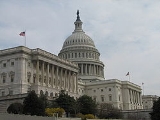
. The chamber of the United States Senate is located in the north wing of the Capitol United States Capitol

The United States Capitol is the US capitol building [i], that serves as home for Congress [i] ... 

 building, in Washington, D.C. Washington, D.C.

Washington, D.C. is the capital [i] city [i] of the United States of America [i]. ... 

, the national capital. The House of Representatives convenes in the south wing of the same building.

Members and elections


Article One of the Constitution states that each state may elect two senators. The Constitution further stipulates that no constitutional amendment may deprive a state of its equal suffrage in the Senate without the consent of the state concerned. The District of Columbia Washington, D.C.

Washington, D.C. is the capital [i] city [i] of the United States of America [i]. ... 

 and territories are not entitled to any representation. As there are presently 50 states, the Senate has 100 members. The senator from each state with the longer tenure is known as the "senior senator," and their counterpart is the "junior senator"; this convention, however, does not have any official significance.

Senators serve for terms of six years each; the terms are staggered so that approximately one-third of the Senate seats are up for election every two years. The staggering of the terms is arranged such that both seats from a given state are never contested in the same general election. Senate elections are held on the first Tuesday after the first Monday in November, Election Day, and coincide with elections for the House of Representatives United States House of Representatives

The United States House of Representatives is one of the two chambers [i] of the United States Congress [i] ... 

. Each senator is elected by his or her state as a whole. Generally, the Republican and Democratic parties choose their candidates in primary elections, which are typically held several months before the general elections. Ballot access rules for independent and third party candidates vary from state to state. For the general election, almost all states use the first-past-the-post Plurality voting system

The plurality voting system is a system used to elect members of a parliament which is based on single m... 

 system, under which the candidate with a plurality of votes wins. Exceptions include Georgia Georgia

Georgia may mean:
  • Georgia [i], a sovereign state in the Caucasus region of Eurasia: **Formerly ... 

     and Louisiana Louisiana

    cellpadding="2" cellspacing="2">

... 

, which use runoff voting.

Once elected, a senator continues to serve until the expiry of his or her term, death, or resignation. Furthermore, the Constitution permits the Senate to expel any member; with a two-thirds majority vote required to do so. Fifteen members have been expelled in the history of the Senate; 14 of them were removed in 1861 and 1862 for supporting the Confederate Confederate States of America

The Confederate States of America was the government formed by eleven southern states of the USA [i]... 

 secession, which led to the American Civil War American Civil War

The American Civil War was a sectional conflict in the United States of America [i] between the federal ... 

. No senator has been expelled since; however, many have chosen to resign when faced with expulsion proceedings . The Senate has also passed several resolutions censuring members; censure requires only a simple majority and does not remove a senator from office.

The Seventeenth Amendment Seventeenth Amendment to the United States Constitution

Amendment XVII of the United States Constitution [i] proposed on May 13 [i], 1912 [i] and ratified on April 8 [i] ... 

 provides that vacancies in the Senate, however they arise, may be filled by special elections. A special election for a Senate seat need not be held immediately after the vacancy arises; instead, it is typically conducted at the same time as the next biennial congressional election. If a special election for one seat happens to coincide with a general election for the state's other seat, then the two elections are not combined, but are instead contested separately. A senator elected in a special election serves until the original six-year term expires, and not for a full term of his own. Furthermore, the Seventeenth Amendment provides that any state legislature may empower the Governor to temporarily fill vacancies. The interim appointee remains in office until the special election can be held. All states, with the sole exception of Arizona Arizona

Arizona is a U.S. state [i] located in the Southwestern United States [i]. ... 

, have passed laws authorizing the Governor to make temporary appointments.

Senators are entitled to prefix "The Honorable" to their names. The annual salary of each senator, as of 2006, was $165,200; the President pro tempore and party leaders receive larger amounts. Analysis of financial disclosure forms by CNN CNN

The Cable News Network, commonly known as CNN, is a major cable television network [i] founded in ... 

 in June 2003 revealed that at least 40 of the then senators were millionaires. In general, senators are regarded as more important political figures than members of the House of Representatives because there are fewer of them, and because they serve for longer terms, represent larger constituencies , sit on more committees, and have more staffers. The prestige commonly associated with the Senate is reflected by the background of presidents and presidential candidates; far more sitting senators have been nominees for the presidency than sitting representatives.

Qualifications


Article I, Section 3 of the Constitution sets forth three qualifications for senators: each senator must be at least 30 years old, must have been a citizen of the United States for at least the past nine years, and must be an inhabitant of the state they seek to represent. The age and citizenship qualifications for senators are more stringent than those for representatives. In Federalist No. 62 Federalist No. 62

Federalist No. 62 is an essay by James Madison [i], the sixty-second of the Federalist Papers [i]. ... 

, James Madison James Madison

James Madison was the fourth President of the United States [i].... 

 justified this arrangement by arguing that the "senatorial trust" called for a "greater extent of information and stability of character."

Furthermore, under the Fourteenth Amendment, any federal or state officer who takes the requisite oath to support the Constitution, but later engages in rebellion or aids the enemies of the United States, is disqualified from becoming a senator. This provision, which came into force soon after the end of the Civil War, was intended to prevent those who sided with the Confederacy from serving. The Amendment, however, provides that a disqualified individual may still serve if two-thirds of both Houses of Congress vote to remove the disability.

Under the Constitution, the Senate is empowered to judge if an individual is qualified to serve. During its early years, however, the Senate did not closely scrutinize the qualifications of members. As a result, three individuals that were Constitutionally disqualified due to age were admitted to the Senate: twenty-nine-year-old Henry Clay Henry Clay

Henry Clay was a leading American [i] statesman and orator [i] who served in both the House of Representatives [i] ... 

 , and twenty-eight-year-olds Armistead Mason Armistead Thomson Mason

Armistead Thomson Mason, the son of Stevens Thomson Mason [i], was a U.S. Senator [i] ... 

  and John Eaton John Eaton

John Henry Eaton was an American [i] politician [i] from Tennessee [i]. ... 

 . Such an occurrence, however, has not been repeated since. In 1934, Rush Holt Rush D. Holt Sr.

Rush Dew Holt, Sr. was an American [i] politician who was a United States Senator [i] ... 

 was elected to the Senate at the age of twenty-nine; he waited until he turned thirty to take the oath of office. Likewise, Joseph Biden Joe Biden

Joseph Robinette "Joe" Biden, Jr. is an American [i] lawyer [i] and politician [i] from Wilmington [i]... 

 was elected to the Senate shortly before his 30th birthday in 1972; he had passed his 30th birthday by the time the Senate conducted its swearing-in ceremony for that year's electees in January, 1973.

Officers

The party Political party

A political party is an organization that seeks to attain political [i] power within a government [i] ... 

 with a majority of seats is known as the majority party; if two or more parties in opposition are tied, the Vice President's affiliation determines which is the majority party. The next-largest party is known as the minority party. The President pro tempore, committee chairmen, and some other officials are generally from the majority party; they have counterparts in the minority party. Independents and members of third parties are not considered in determining the majority party.

The Constitution provides that the Vice President of the United States serves as the President of the Senate and holds a vote which can only be cast to break a tie. By convention, the Vice President presides over very few Senate debates, attending only on important ceremonial occasions or at times when his vote may be needed to break a tie. The Constitution also authorizes the Senate to elect a President pro tempore President pro tempore of the United States Senate

The President pro tempore of the United States Senate is the second-highest-ranking official of the ... 

  to preside in the Vice President's absence; the most senior senator of the majority party is customarily chosen to serve in this position. The President pro tempore is currently Senator Ted Stevens Ted Stevens

Theodore Fulton Stevens is a United States [i] Senator [i] from Alaska [i]. ... 

  of Alaska Alaska

Alaska is a U.S. state [i], located on the northwest tier [i] of North America [i] ... 

. Like the Vice President, the President pro tempore does not normally preside over the Senate. Instead, he typically delegates the responsibility of presiding to junior senators of the majority party. Frequently, freshmen senators are allowed to preside so that they may become accustomed to the rules and procedures of the body.

The presiding officer sits in a chair in the front of the Senate chamber. The powers of the presiding officer are extremely limited; he primarily acts as the Senate's mouthpiece, performing duties such as announcing the results of votes. The Senate's presiding officer controls debates by calling on members to speak; the rules of the Senate, however, compel him to recognize the first senator who rises. The presiding officer may rule on any "point of order" , but the decision is subject to appeal to the whole house. Thus, the powers of the presiding officer of the senate are far less extensive than those of the Speaker of the House Speaker of the United States House of Representatives

The Speaker [i] of the United States House of Representatives is the presiding officer of the lower house [i] ... 

.

Each party elects a senator to serve as floor leader, a position which entails acting as the party's chief spokesperson. The Senate Majority Leader is, furthermore, responsible for controlling the agenda of the Senate; for example, he schedules debates and votes. Each party also elects a whip Whip

A whip is a tapered flexible length of either a single cord or plaited leather or other material, common... 

 to assist the leader. A whip works to ensure that his party's senators vote as the party leadership desires.

The Senate is also served by several officials who are not members. The Senate's chief administrative officer is the Secretary of the Senate, who maintains public records, disburses salaries, monitors the acquisition of stationery and supplies, and oversees clerks. The Secretary is aided in his work by the Assistant Secretary of the Senate. Another official is the Sergeant-at-Arms, who, as the Senate's chief law enforcement officer, maintains order and security on the Senate premises. The Capitol Police handles routine police work, with the Sergeant-at-Arms primarily responsible for general oversight. Other employees include the Chaplain and Pages.

Procedure


Like the House of Representatives United States House of Representatives

The United States House of Representatives is one of the two chambers [i] of the United States Congress [i] ... 

, the Senate meets in the United States Capitol United States Capitol

The United States Capitol is the US capitol building [i], that serves as home for Congress [i] ... 

 in Washington, D.C. Washington, D.C.

Washington, D.C. is the capital [i] city [i] of the United States of America [i]. ... 

 At one end of the Chamber of the Senate is a dais from which the Presiding Officer presides. The lower tier of the dais is used by clerks and other officials. One hundred desks are arranged in the Chamber in a semicircular pattern; the desks are divided by a wide central aisle. By tradition, Democrats sit on the right of the center aisle, while Republicans sit on the left, as viewed from the presiding officer's chair. Each senator chooses a desk on the basis of seniority within his party; by custom, the leader of each party sits in the front row. Sittings are normally held on weekdays; meetings on Saturdays and Sundays are rare. Sittings of the Senate are generally open to the public and are broadcast live on television by C-SPAN 2 C-SPAN

C-SPAN is an American [i] cable television [i] network [i] dedicated to ... 

.

Senate procedure depends not only on the rules, but also on a variety of customs and traditions. In many cases, the Senate waives some of its stricter rules by unanimous consent. Unanimous consent agreements are typically negotiated beforehand by party leaders. Any senator may block such an agreement, but, in practice, objections are rare. The presiding officer enforces the rules of the Senate, and may warn members who deviate from them. The presiding officer often uses the gavel Gavel

A gavel is a small ceremonial mallet [i] commonly made of hardwood [i], typically fashioned with a handl ... 

 of the Senate to maintain order.

The Constitution provides that a majority of the Senate constitutes a quorum to do business. Under the rules and customs of the Senate, a quorum is always assumed to be present unless a quorum call explicitly demonstrates otherwise. Any senator may request a quorum call by "suggesting the absence of a quorum"; a clerk then calls the roll of the Senate and notes which members are present. In practice, senators almost always request quorum calls not to establish the presence of a quorum, but to temporarily delay proceedings. Such a delay may serve one of many purposes; often, it allows Senate leaders to negotiate compromises off the floor. Once the need for a delay has ended, any senator may request unanimous consent to rescind the Quorum Call.

During debates, senators may only speak if called upon by the presiding officer. The presiding officer is, however, required to recognize the first senator who rises to speak. Thus, the presiding officer has little control over the course of debate. Customarily, the Majority Leader and Minority Leader are accorded priority during debates, even if another senator rises first. All speeches must be addressed to the presiding officer, using the words "Mr. President" or "Madam President." Only the presiding officer may be directly addressed in speeches; other Members must be referred to in the third person. In most cases, senators do not refer to each other by name, but by state, using forms such as "the senior senator from Virginia" or "the junior senator from California."

There are very few restrictions on the content of speeches; there is no requirement that speeches be germane to the matter before the Senate.

The rules of the Senate provide that no senator may make more than two speeches on a motion or bill on the same legislative day. The length of these speeches is not limited by the rules; thus, in most cases, senators may speak for as long as they please. Often, the Senate adopts unanimous consent agreements imposing time limits. In other cases , limits are imposed by statute. In general, however, the right to unlimited debate is preserved.

The filibuster is a tactic used to defeat bills and motions by prolonging debate indefinitely. A filibuster may entail long speeches, dilatory motions, and an extensive series of proposed amendments. The longest filibuster speech in the history of the Senate was delivered by Strom Thurmond Strom Thurmond

James Strom Thurmond represented South Carolina [i] in the United States Senate [i] from 1954 to April ... 

, who spoke for over twenty-four hours in an unsuccessful attempt to block the passage of the Civil Rights Act of 1957. The Senate may end a filibuster by invoking cloture. In most cases, cloture requires the support of three-fifths of the Senate; however, if the matter before the Senate involves changing the rules of the body, a two-thirds majority is required. Cloture is invoked very rarely, particularly because bipartisan support is usually necessary to obtain the required supermajority. If the Senate does invoke cloture, debate does not end immediately; instead, further debate is limited to thirty additional hours unless increased by another three-fifths vote.

When debate concludes, the motion in question is put to a vote. In many cases, the Senate votes by voice vote; the presiding officer puts the question, and Members respond either "Yea" or "No" . The presiding officer then announces the result of the voice vote. Any senator, however, may challenge the presiding officer's assessment and request a recorded vote. The request may be granted only if it is seconded by one-fifth of the senators present. In practice, however, senators second requests for recorded votes as a matter of courtesy. When a recorded vote is held, the clerk calls the roll of the Senate in alphabetical order; each senator responds when his or her name is called. Senators who miss the roll call may still cast a vote as long as the recorded vote remains open. The vote is closed at the discretion of the presiding officer, but must remain open for a minimum of 15 minutes. If the vote is tied, the Vice President, if present, is entitled to a tie-breaking vote. If the Vice President is not present, however, the motion fails.

On occasion, the Senate may go into what is called a secret, or closed session. During a closed session, the chamber doors are closed, and the galleries are completely cleared of anyone not sworn to secrecy, not instructed in the rules of the closed session, or not essential to the session. Closed sessions are quite rare, and usually held only under very certain circumstances where the senate is discussing sensitive subject-matter such as information critical to national security, private communications from the President, or even to discuss Senate deliberations during impeachment trials. Any Senator may call a closed session as long as the motion is seconded by at least one other member.

Budget bills are governed under a special rule process called "Reconciliation Reconciliation

Reconciliation may mean the following:
... 

" that disallows filibusters. Reconciliation was devised in 1974 but came into use in the early 1980s.

Committees


See List of United States Senate committees List of United States Senate committees

This is a complete list of U.S. Congressional committee [i]s that are currently operating in the United States Senate [i] ... 

 for the full list.


The Senate uses committees for a variety of purposes, including the review of bills and the oversight of the executive branch. The appointment of committee members is formally made by the whole Senate, but the choice of members is actually made by the political parties. Generally, each party honors the preferences of individual senators, giving priority on the basis of seniority. Each party is allocated seats on committees in proportion to its overall strength.

Most committee work is performed by sixteen standing committees, each of which has jurisdiction over a specific field such as Finance or Foreign Relations. Each standing committee may consider, amend, and report bills that fall under its jurisdiction. Furthermore, each standing committee considers presidential nominations to offices related to its jurisdiction. Committees have extensive powers with regard to bills and nominees; they may block nominees and impede bills from reaching the floor of the Senate. Finally, standing committees also oversee the departments and agencies of the executive branch. In discharging their duties, standing committees have the power to hold hearings and to subpoena witnesses and evidence.

The Senate also has several committees that are not considered standing committees. Such bodies are generally known as select committees or special committees; examples include the Select Committee on Ethics and the Special Committee on Aging. Legislation is referred to some of these committees, though the bulk of legislative work is performed by the standing committees. Committees may be established on an ad hoc basis for specific purposes; for instance, the Senate Watergate Committee was a special committee created to investigate the Watergate scandal Watergate scandal

The term "Watergate" refers to a series of events, spanning from 1972 [i] to 1975 [i], that got its name ... 

. Such temporary committees cease to exist after fulfilling their tasks.

Finally, the Congress includes joint committees, which include members of both the Senate and the House of Representatives. Some joint committees oversee independent government bodies; for instance, the Joint Committee on the Library oversees the Library of Congress Library of Congress

The Library of Congress is the de facto [i] national library [i] of the United States [i] and the re ... 

. Other joint committees serve to make advisory reports; for example, there exists a Joint Committee on Taxation. Bills and nominees are not referred to joint committees. Hence, the power of joint committees is considerably lower than those of standing committees.

Each Senate committee and subcommittee is led by a chairman . Formerly, committee chairmanship was determined purely by seniority; as a result, several elderly senators continued to serve as chairmen despite severe physical infirmity or even senility. Now, committee chairmen are in theory elected, but in practice, seniority is very rarely bypassed. The chairman's powers are extensive; he controls the committee's agenda, and may prevent the committee from approving a bill or presidential nomination. Modern committee chairmen are typically not forceful in exerting their influence, although there have been some exceptions. The second-highest member, the spokesperson on the committee for the minority party, is known in most cases as the Ranking Member. In the Select Committee on Intelligence and the Select Committee on Ethics, however, the senior minority member is known as the Vice Chairman.

Legislative functions

Most bills may be introduced in either House of Congress. However, the Constitution provides that "All bills for raising Revenue shall originate in the House of Representatives." As a result, the Senate does not have the power to initiate bills imposing taxes. Furthermore, the House of Representatives holds that the Senate does not have the power to originate appropriation bills, or bills authorizing the expenditure of federal funds. Historically, the Senate has disputed the interpretation advocated by the House. However, whenever the Senate originates an appropriations bill, the House simply refuses to consider it, thereby settling the dispute in practice. The constitutional provision barring the Senate from introducing revenue bills is based on the practice of the British Parliament Parliament of the United Kingdom

The Parliament of the United Kingdom of Great Britain and Northern Ireland is the supreme legislative body [i] ... 

, in which only the House of Commons British House of Commons

|align=left|
  • Parliament [i]

... 

 may originate such measures.

Although the Constitution gave the House the power to initiate revenue bills, in practice the Senate is equal to the House in the respects of taxation and spending. As Woodrow Wilson Woodrow Wilson

Thomas Woodrow Wilson was the 28th President of the United States [i] . ... 

 wrote:

The approval of both the Senate and the House of Representatives is required for any bill, including a revenue bill, to become law. Both Houses must pass the exact same version of the bill; if there are differences, they may be resolved by a conference committee, which includes members of both bodies.

Checks and balances

The Constitution provides that the President can make certain appointments only with the "advice and consent" of the Senate. Officials whose appointments require the Senate's approval include members of the Cabinet, heads of federal executive agencies, ambassadors, Justices of the Supreme Court, and other federal judges. However, Congress may pass legislation to authorize the appointment of less important officials without the Senate's consent. Typically, a nominee is first subject to a hearing before a Senate committee. Committees may block nominees, but do so relatively infrequently. Thereafter, the nomination is considered by the full Senate. In a majority of the cases, nominees are confirmed; rejections of Cabinet nominees are especially rare .

The powers of the Senate with respect to nominations are, however, subject to some constraints. For instance, the Constitution provides that the President may make an appointment during a congressional recess Recess

Recess is a general term for a period of time in which a group of people is temporarily dismissed from i... 

 without the Senate's advice and consent. The recess appointment remains valid only temporarily; the office becomes vacant again at the end of the next congressional session. Nevertheless, Presidents have frequently used recess appointments to circumvent the possibility that the Senate may reject the nominee. Furthermore, as the Supreme Court held in Myers v. United States, although the Senate's advice and consent is required for the appointment of certain executive branch officials, it is not necessary for their removal.

The Senate also has a role in the process of ratifying treaties. The Constitution provides that the President may only ratify a treaty if two-thirds of the senators vote to grant advice and consent. However, not all international agreements are considered treaties, and therefore do not require the Senate's approval. Congress has passed laws authorizing the President to conclude executive agreements without action by the Senate. Similarly, the President may make congressional-executive agreements with the approval of a simple majority in each House of Congress, rather than a two-thirds majority in the Senate. Neither executive agreements nor congressional-executive agreements are mentioned in the Constitution, leading some to suggest that they unconstitutionally circumvent the treaty-ratification process. However, the validity of such agreements has been upheld by the courts.


The Constitution empowers the House of Representatives to impeach Impeachment

In the constitution [i]s of several countries, impeachment is the first of two stages in a specific proc ... 

 federal officials for "Treason, Bribery, or other high Crimes and Misdemeanors" and empowers the Senate to try such impeachments. If the sitting President of the United States is being tried, the Chief Justice of the United States Chief Justice of the United States

The Chief Justice of the United States is the head of the judicial branch [i] of the government [i] ... 

 must preside over the trial. During any impeachment trial, senators are constitutionally required to sit on oath or affirmation. Conviction requires a two-thirds majority of the senators present. A convicted official is automatically removed from office; in addition, the Senate may stipulate that the defendant be banned from holding office in the future. No further punishment is permitted during the impeachment proceedings; however, the party may face criminal penalties in a normal court of law.

In the history of the United States, the House of Representatives has impeached sixteen officials, of whom seven were convicted. Only two Presidents of the United States have ever been impeached: Andrew Johnson Andrew Johnson

Andrew Johnson was the seventeenth President of the United States [i] , succeeding to the presidency up ... 

 in 1868 and Bill Clinton Bill Clinton

William Jefferson "Bill" Clinton was the 42nd President of the United States [i], serving from 1993 to ... 

 in 1999. Both trials ended in acquittal; in Johnson's case, the Senate fell one vote short of the two-thirds majority required for conviction.

Under the Twelfth Amendment Twelfth Amendment to the United States Constitution

The Twelfth Amendment to the United States Constitution [i] altered Article II [i]... 

, the Senate has the power to elect the Vice President if no vice presidential candidate receives a majority of votes in the electoral college United States Electoral College

The United States Electoral College is the unofficial name of the group of Presidential Electors who are... 

. The Twelfth Amendment requires the Senate to choose from the two candidates with the highest numbers of electoral votes. Electoral college deadlocks are very rare; in the history of the United States, the Senate has only had to break a deadlock once, in 1837, when it elected Richard Mentor Johnson Richard Mentor Johnson

Richard Mentor Johnson was the ninth Vice President of the United States [i], serving in the administrat ... 

. The power to elect the President in the case of an electoral college deadlock belongs to the House of Representatives.

Latest election


Current composition

For the 109th United States Congress 109th United States Congress

The 109th United States Congress [i] is the current meeting of the United States [i] legislature, compri ... 

, current as of February 17, 2006:

>
Affiliation Members Note
Republican Party 55 
Democratic Party 44 
Independent 1 Caucuses with the Democrats
Total 100


See also: List of U.S. Senators by seniority

External links