

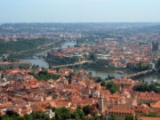
Vltava

Encyclopedia
The Vltava is the longest river
in the Czech Republic
, running north from its source in Šumava
through Český Krumlov
, České Budějovice
, and Prague
, merging with the Elbe
at Mělník
. It is 430 km long and drains about 28,090 km2; at their confluence the Vltava actually has more water than the Elbe, but joins the Elbe at a right angle to its flow so that it appears a mere tributary. The river is crossed by 18 bridges and runs through Prague over 31 km. Several dam
s were built on it in the 1950s, the biggest being Lipno Dam
in Šumava.
In August 2002 a flood of the Vltava
killed several people and caused massive damage and disruption along its length.
The best-known of the classical Czech composer
Bedřich Smetana
's set of six symphonic poem
s Má vlast
("My Motherland") is called Vltava (or The Moldau), and is a musical depiction of the river's course through Bohemia.
aqua).
2123 Vltava
discovered in 1973 by Soviet
astronomer Nikolai Stepanovich Chernykh
is named after the river.
River
A river is a natural watercourse, usually freshwater, flowing towards an ocean, a lake, a sea, or another river. In a few cases, a river simply flows into the ground or dries up completely before reaching another body of water. Small rivers may also be called by several other names, including...
in the Czech Republic
Czech Republic
The Czech Republic is a landlocked country in Central Europe. The country is bordered by Poland to the northeast, Slovakia to the east, Austria to the south, and Germany to the west and northwest....
, running north from its source in Šumava
Bohemian Forest
The Bohemian Forest, also known in Czech as Šumava , is a low mountain range in Central Europe. Geographically, the mountains extend from South Bohemia in the Czech Republic to Austria and Bavaria in Germany...
through Český Krumlov
Český Krumlov
Český Krumlov is a small city in the South Bohemian Region of the Czech Republic, best known for the fine architecture and art of the historic old town and Český Krumlov Castle...
, České Budějovice
Ceské Budejovice
České Budějovice is a city in the Czech Republic. It is the largest city in the South Bohemian Region and is the political and commercial capital of the region and centre of the Roman Catholic Diocese of České Budějovice and of the University of South Bohemia and the Academy of Sciences...
, and Prague
Prague
Prague is the capital and largest city of the Czech Republic. Situated in the north-west of the country on the Vltava river, the city is home to about 1.3 million people, while its metropolitan area is estimated to have a population of over 2.3 million...
, merging with the Elbe
Elbe
The Elbe is one of the major rivers of Central Europe. It rises in the Krkonoše Mountains of the northwestern Czech Republic before traversing much of Bohemia , then Germany and flowing into the North Sea at Cuxhaven, 110 km northwest of Hamburg...
at Mělník
Melnik
-Places:Bulgaria* Melnik, Bulgaria, a town in Bulgaria* Shiroka Melnishka Losa, a Bulgarian wine grape also known as MelnikCzech Republic* Mělník, a townUnited States* Melnik, Wisconsin, an unincorporated community...
. It is 430 km long and drains about 28,090 km2; at their confluence the Vltava actually has more water than the Elbe, but joins the Elbe at a right angle to its flow so that it appears a mere tributary. The river is crossed by 18 bridges and runs through Prague over 31 km. Several dam
Dam
A dam is a barrier that impounds water or underground streams. Dams generally serve the primary purpose of retaining water, while other structures such as floodgates or levees are used to manage or prevent water flow into specific land regions. Hydropower and pumped-storage hydroelectricity are...
s were built on it in the 1950s, the biggest being Lipno Dam
Lipno Dam
The Lipno Dam is a dam with hydroelectric plant constructed along the Vltava River in the Czech Republic.- History :Due to frequent flooding and subsequent damage, the Vltava River in Southern Bohemia had been problematic for the Český Krumlov and other settlements, through which it flowed...
in Šumava.
In August 2002 a flood of the Vltava
2002 European floods
In August 2002 a 100-year flood caused by over a week of continuous heavy rains ravaged Europe, killing dozens, dispossessing thousands, and causing damage of billions of euros in the Czech Republic, Austria, Germany, Slovakia, Poland, Hungary, Romania and Croatia....
killed several people and caused massive damage and disruption along its length.
The best-known of the classical Czech composer
Composer
A composer is a person who creates music, either by musical notation or oral tradition, for interpretation and performance, or through direct manipulation of sonic material through electronic media...
Bedřich Smetana
Bedrich Smetana
Bedřich Smetana was a Czech composer who pioneered the development of a musical style which became closely identified with his country's aspirations to independent statehood. He is thus widely regarded in his homeland as the father of Czech music...
's set of six symphonic poem
Symphonic poem
A symphonic poem or tone poem is a piece of orchestral music in a single continuous section in which the content of a poem, a story or novel, a painting, a landscape or another source is illustrated or evoked. The term was first applied by Hungarian composer Franz Liszt to his 13 works in this vein...
s Má vlast
Má vlast
Má vlast is a set of six symphonic poems composed between 1874 and 1879 by the Czech composer Bedřich Smetana. While it is often presented as a single work in six movements and – with the exception of Vltava– is almost always recorded that way, the six pieces were conceived as individual works...
("My Motherland") is called Vltava (or The Moldau), and is a musical depiction of the river's course through Bohemia.
Physical description
The height difference from source to mouth is about 1016 m and the largest stream at the source is named Černý Potok (Black Brook).Etymology
Both the Czech name Vltava and the German name Moldau are believed to originate from the old Germanic words *wilt ahwa ("wild water") (cf. LatinLatin
Latin is an Italic language originally spoken in Latium and Ancient Rome. It, along with most European languages, is a descendant of the ancient Proto-Indo-European language. Although it is considered a dead language, a number of scholars and members of the Christian clergy speak it fluently, and...
aqua).
Honors
A minor planetMinor planet
An asteroid group or minor-planet group is a population of minor planets that have a share broadly similar orbits. Members are generally unrelated to each other, unlike in an asteroid family, which often results from the break-up of a single asteroid...
2123 Vltava
2123 Vltava
2123 Vltava is a main belt asteroid with an orbital period of 1767.2267794 days .The asteroid was discovered on September 22, 1973.-References:...
discovered in 1973 by Soviet
Soviet Union
The Soviet Union , officially the Union of Soviet Socialist Republics , was a constitutionally socialist state that existed in Eurasia between 1922 and 1991....
astronomer Nikolai Stepanovich Chernykh
Nikolai Stepanovich Chernykh
Nikolay Stepanovich Chernykh was a Soviet and Russian astronomer.Chernykh was born in the city of Usman' in Voronezh Oblast...
is named after the river.