

Dissolution of Czechoslovakia

Encyclopedia
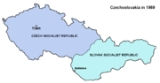
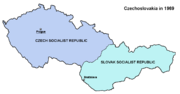
The dissolution of Czechoslovakia, which took effect on 1 January 1993, was an event that saw the self-determined separation of the federal
state of Czechoslovakia
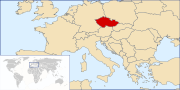
. The Czech Republic
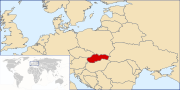
and Slovakia
, entities which had arisen in 1969 within the framework of Czechoslovak federalisation, became immediate subjects of the international law in 1993. It is sometimes known as the Velvet Divorce, a reference to the bloodless Velvet Revolution
of 1989 that led to the end of the rule of the Communist Party of Czechoslovakia
and the formation of a democratic government.
 Czechoslovakia
was created with the dissolution of Austria-Hungary
at the end of World War I. In 1917, a meeting took place in Pittsburgh, Pennsylvania
, where the future Czechoslovak president Tomáš Masaryk
and other Czech and Slovak representatives signed the Pittsburgh Agreement
which promised a common state consisting of two equal nations, Slovakia and Czechia. Soon after, the philosophy of Edvard Beneš
pushed for greater unity and a single nation.
Many Slovaks were not in favour of this change, and in March 1939, with the approval from Hitler and a majority of Slovaks, the First Slovak Republic was created. Occupation by the Soviet Union
after World War II oversaw their reunification into the Czechoslovak Socialist Republic
.
In 1968, the Constitutional Law of Federation
reinstated an official federal structure (of the 1917 type), but during the "Normalization period"
in the 1970s, Gustáv Husák
(although a Slovak himself) returned most of the control to Prague. This approach encouraged a regrowth of separatism after the fall of communism.
s from the Czech budget to Slovakia, which had been the rule in the past, were stopped in January 1991.
Many Czechs and Slovaks desired the continued existence of a federal
Czechoslovakia. Some major Slovak parties, however, advocated a looser form of co-existence and the Slovak National Party complete independence and sovereignty
. In the next years, political parties re-emerged, but Czech parties had little or no presence in Slovakia, and vice versa. In order to have a functional state, the government demanded continued control from Prague, while Slovaks continued to ask for decentralization.
In 1992, the Czech public elected
Václav Klaus
and others who demanded either an even tighter federation ("viable federation") or two independent states. Vladimír Mečiar
and other leading Slovak politicians of the day wanted a kind of confederation
. The two sides opened frequent and intense negotiations in June. On 17 July, the Slovak parliament adopted the Declaration of independence of the Slovak nation
. Six days later, Klaus and Meciar agreed to dissolve Czechoslovakia at a meeting in Bratislava
. Czechoslovak president Václav Havel
resigned rather than oversee the dissolution which he had opposed; in a September 1992 poll, only 37% of Slovaks and 36% of Czechs favored dissolution.
The goal of negotiations switched to achieving a peaceful division. On 13 November, the Federal Assembly passed Constitution Act 541 which settled the division of property between the Czech lands and Slovakia. With Constitution Act 542, passed on 25 November, they agreed to the dissolution of Czechoslovakia as of 31 December 1992.
The separation occurred without violence, and was thus said to be "velvet
", much like the "Velvet revolution
" which preceded it, which was accomplished through massive peaceful demonstrations and actions. In contrast, other post-communist break-ups (such as the Soviet Union
and Yugoslavia) involved violent conflict.
The people who argue inevitability point to the stereotypes between the two nations, problems with the shared state during communism, the failure of the communist state in Czech lands and its success in the Slovak lands, and the 1968 constitution that had a minority veto.
The people who argue events between 1989 and 1992 point to international factors such as the situation the breakaway of the Soviet satellite nations, the lack of unified media between the Czech and Slovak republic, and most importantly the actions of the political leaders of the two nations.
It is also important to note that Czech and Slovak histories only converge in the period 1918–1993. Since early medieval times when states first arose in what are now the Czech and Slovak republics, those states had little to nothing in common. Between the early 10th century and 1918, the two states were joined only under the dominion of Austria-Hungary, and even then the Czech lands were much closer to Austria and the Slovak lands to Hungary than they were to each other. The 1918 federation can be seen as mostly forced by necessity (as well as ideas of Slavic unity), as neither state was seen as strong enough to become independent from Austria-Hungary alone. Later under communist rule after World War II, there was little choice in the matter (forced unions were maintained by communists elsewhere as well – Yugoslavia is a prime example). The lack of common historical ground was likely an important determinant of the post-1989 federation's lack of internal cohesion, even though it was ultimately contemporary circumstances that led to its dissolution.
was a composition of historic geographic areas forming the country, each republic simply kept its own symbol – the Czechs the lion and the Slovaks the double cross. The same principle was applied to the two-part bilingual Czechoslovak national anthem that comprized two separate pieces of music, the Czech stanza Kde domov můj? and the Slovak stanza Nad Tatrou sa blýska
. Disputes occurred only with respect to the Czechoslovak national flag. During the 1992 negotiations about the details of dissolution of Czechoslovakia, on demand made by Vladimír Mečiar
and Václav Klaus
, a clause forbidding use of state symbols of Czechoslovakia by successor states was inserted into the Constitutional Law about the Dissolution of Czechoslovakia. From 1990 to 1992, the red and white Flag of Bohemia
(differing from the Polish flag
only by proportion of the colours) officially served as the flag of the Czech Republic. Eventually, after a search for new symbology the Czech Republic unilaterally decided to ignore the constitutional law on dissolution of Czechoslovakia (article 3 of law 542/1992 says the "Czech republic and Slovak republic shall not use national symbols of Czech and Slovak Federative republic after its dissolution.") and to keep the Czechoslovak flag with an altered meaning.
Area, after which the borders became less significant.
, was still used in both countries. Fears of economic loss on the Czech side caused the two states to adopt two national currencies as early as 8 February 1993. At the beginning, the currencies had an equal exchange rate, but later on, for most of the time, the value of the Slovak koruna
was lower than that of the Czech koruna
(up to ca. 30%, in 2004 around 25–27%). On 1 January 2009 Slovakia adopted the euro as its currency, and €2 commemorative coin for 2009
, Slovakia's first one, featured 20th anniversary of the Velvet Revolution in remembrance of the common struggle of the Czechoslovakian people for democracy. By the virtue of fate, the welcoming speech on the behalf of the European Union on the occasion of Slovakia's entry to the Eurozone
was delivered by Mirek Topolánek
, the prime minister of the then EU presiding country, the Czech Republic, naturally in his native language while other guest speakers used English. The Czech Republic continues to use the Czech koruna, or crown.
where the Russian Federation was recognized as successor state to the USSR. Therefore, Czechoslovakia's membership in the UN ceased upon dissolution of the country, but on 19 January 1993 the Czech and Slovak Republics were admitted to the UN as new and separate states.
With respect to other international treaties the Czechs and Slovaks agreed to honor the treaty obligations of Czechoslovakia. The Slovaks transmitted a letter to the Secretary General of the United Nations on 19 May 1993 expressing their intent to remain a party to all treaties signed and ratified by Czechoslovakia, and to ratify those treaties signed but not ratified before dissolution of Czechoslovakia. This letter acknowledged that under international law
all treaties signed and ratified by Czechoslovakia would remain in force. For example, both countries are recognized as signatories of the Antarctic Treaty from the date Czechoslovakia signed the agreement back in 1962.
Both the Czech and Slovak Republics have ratified the Vienna Convention on Succession of States in respect of Treaties
. However, it was not a factor in the dissolution of Czechoslovakia since it did not enter into force until 1996.
Many Czechs hoped that dissolution would quickly start an era of high economic growth in the Czech Republic (without the need to "sponsor the less developed Slovakia"). Similarly others looked forward to a stand-alone, unexploited Slovakia which might become a new "economic tiger". The Czech state is markedly more prosperous than the Slovak and the Slovak GDP level is still lower than that of the Czech Republic. The growth of the Slovak GDP, however, has been consistently higher than the Czech one since 1994 and the margin between the two states is closing. Furthermore, Slovakia has overtaken the Czech Republic in terms of economic reforms aimed at approaching the economic conditions of the West. One of the outcomes so far has been the acceptance of Slovakia into the Euro Area in 2009, which the Czech Republic still does not fully qualify for (on account of the missing reforms, some of which are required for accession). While the wealth of the Czech Rep. remains higher than that of Slovakia in many respects, Czech development is continually hindered by what may be described as a lack of resolve towards mending the persisting shortcomings of the domestic economy (in addition to the discussed reforms, this includes e.g. long-term fiscal irresponsibility or a failure to take steps to improve the low domestic labour productivity).
People of both countries were allowed to cross the border without a passport and were allowed to work anywhere without the need to obtain an official permit. Border checks were completely removed on 21 December 2007 when both countries joined the Schengen Agreement
.
Under the current European regulations, citizens of either country are entitled to the diplomatic protection of any other EU country and, therefore, the Czech and Slovak Republics have been considering merging their embassies together with nations of the Visegrád Group
in order to reduce costs.
The Slovak government did not want to grant citizenship to non-residents. Significant numbers of Roma living in Czech orphanage
s did not have their legal status clarified, and were released from care as adult non-citizens without any right to work or live in the Czech Republic. Under pressure from the European Union, the Czech government made amendments to its nationality law in 1999 and 2003 which effectively solved the problem; compensation, however, has not been provided to those rendered stateless in 1992.
) was a federal one and the Czech
and Slovak language
s were used in equal ratios in the TV news there, although foreign films and TV series were almost exclusively dubbed into Czech, for example. This (and the fact that both languages are very similar) made almost all people of both nations passively bilingual
, i.e., they were able to understand but not necessarily speak the other language. After the dissolution in 1990s the new TV channels in the Czech Republic practically stopped using Slovak, and young Czech people now have a much lower understanding of the Slovak language. Also, the number of Slovak-language books and newspapers sold in the Czech Republic dropped drastically. The Czech TV news, however, recently started to reintroduce Slovak-language coverage from Slovakia and Slovak TV (STV2) is re-transmitting Czech news Události ČT ("Czech Television - Events") each day ten minutes after the midnight.
In the Slovak state TV, STV, it is common to have daily at least one coverage from the Czech Republic in the prime time news. Further, for economic reasons, many TV programmes on Slovak TV channels are still dubbed into Czech, some films in cinemas are subtitled in Czech and there are far more Czech-language books and periodicals on the market than before the dissolution. The major boost for the language interchange has come recently from private TV channel providers like CS Link (Czech Republic) and Sky Link (Slovakia) that offer Slovak Channels in the Czech Republic and, vice versa. Additionally, several channels, regardless of their national origin, offer programs both in Czech and Slovak (CSFilm, TV Barrandov) or even mix like TV Nova's NOVA SPORT coverage of the English Premier League. New impulses to mutual contacts coming via TV are also common shows like the Intelligence Test of Nations, Czechoslovakia's Got Talent, hosted by PRIMA and TV JOJ, and Czecho-Slovak SuperStar, the latter being the first international edition of the Pop Idol
song contest hosted by TV Nova and Markíza. Also, the New Year's Eve Program for 2009 was prepared and broadcast jointly by the state televisions ČT and STV and that for 2010 by the Czech TV PRIMA and the Slovak TV JOJ, this time even including the singing of the Czechoslovak national anthem.
Young Slovak people still have the same knowledge (if not better) of the Czech language as their predecessors. Even today, in Slovakia, Czech may be used automatically in all judicial proceedings, plus all documents written in Czech are acknowledged by Slovak authorities, and vice versa. Further, the Slovak Official Language Act passed in 2009 did reconfirm the right of Czechs to use their language in all official communication when dealing with Slovak authorities (however, the Act explicitely limited the use of Czech in Slovakia only to persons with Czech as their mother tongue). The same is true about using the Slovak language
in the Czech Republic owing to the Administration Procedure Act of 2004. Gustáv Slamečka
, the Czech transport minister of Slovak origin, uses the Slovak language exclusively in his official communication.
The upward trend in the language contacts demonstrates that Czechs and Slovaks do not regard each other as foreigners. The interview surveys from 2010 showed that majority of the population of Prague (Czechs) still considers the division of the country as a mistake; similarly, the general representative survey in Slovakia (from 2008) showed that society is still divided in opinion on the dissolution: 47% favoring the dissolution, while 44% considering it as a mistake.
For the language comparison see differences between Slovak and Czech languages
.
, Sweden, the ski jumping team competed as a combined Czech Republic-Slovakia team in the team large hill event, winning a silver. The team had been selected prior to the dissolution. Jaroslav Sakala
won two medals in the individual hill events for the Czech Republic at those games along with his silver in the team event.
The official break-up occurred right in the middle of the 1993 World Junior Ice Hockey Championships
, which also took place in Sweden. The team representing Czechoslovakia was called "Czech-Slovak" starting on 1 January.
In their qualifying section for the 1994 FIFA World Cup
, the Czechoslovakia national football team
competed under the name RCS which stood for "Representation of Czechs and Slovaks". It was after this that the teams were then officially split up into Czech Republic
and Slovakia
. The team failed to qualify after they could only draw their final match against Belgium, a match they needed to win to qualify.
The mutual encounters between national teams especially in ice hockey, traditionally the successful sport, and soccer, where Czechs and Slovaks compete against each other regularly in the World and European Championship Qualifications is followed by the majority of the population, and the number of players and coaches active in the other republic is endless. Several sports did or do feature a common league, and the discussions about having a common soccer or ice hockey league continue. For example, Martin Lipták, a Slovak handball coach led successfully the Czech national team in EHF 2010 Handball European Championship in Austria. A Slovak Team under his coaching, Tatran Prešov, won the Czech national league in 2008 and 2009.
No movement to re-unite Czechoslovakia has appeared and no political party advocates it in its programme. Political influences between the countries are minimal, but social democrats tend to cooperate very closely on regional and European topics in recent years. Furthermore, it has become customary that the elected presidents pay their first and last official "foreign" visits during their term to the other republic of the former Czechoslovakia
. Appointed foreign ministers tend to follow this unwritten rule. Also, peace keeping troops stationed in the former Czechoslovakia were put under a joint command on several occasions. Trade relationships were re-established and stabilized, and the Czech Republic continues to be Slovakia's most important business partner. After a short interruption, Slovakia's resorts in the Carpathian mountains
are again the target of a growing number of Czech tourists.
Federation
A federation , also known as a federal state, is a type of sovereign state characterized by a union of partially self-governing states or regions united by a central government...
state of Czechoslovakia
Czechoslovakia
Czechoslovakia or Czecho-Slovakia was a sovereign state in Central Europe which existed from October 1918, when it declared its independence from the Austro-Hungarian Empire, until 1992...
. The Czech Republic
Czech Republic
The Czech Republic is a landlocked country in Central Europe. The country is bordered by Poland to the northeast, Slovakia to the east, Austria to the south, and Germany to the west and northwest....
and Slovakia
Slovakia
The Slovak Republic is a landlocked state in Central Europe. It has a population of over five million and an area of about . Slovakia is bordered by the Czech Republic and Austria to the west, Poland to the north, Ukraine to the east and Hungary to the south...
, entities which had arisen in 1969 within the framework of Czechoslovak federalisation, became immediate subjects of the international law in 1993. It is sometimes known as the Velvet Divorce, a reference to the bloodless Velvet Revolution
Velvet Revolution
The Velvet Revolution or Gentle Revolution was a non-violent revolution in Czechoslovakia that took place from November 17 – December 29, 1989...
of 1989 that led to the end of the rule of the Communist Party of Czechoslovakia
Communist Party of Czechoslovakia
The Communist Party of Czechoslovakia, in Czech and in Slovak: Komunistická strana Československa was a Communist and Marxist-Leninist political party in Czechoslovakia that existed between 1921 and 1992....
and the formation of a democratic government.
Background
Czechoslovakia
Czechoslovakia or Czecho-Slovakia was a sovereign state in Central Europe which existed from October 1918, when it declared its independence from the Austro-Hungarian Empire, until 1992...
was created with the dissolution of Austria-Hungary
Austria-Hungary
Austria-Hungary , more formally known as the Kingdoms and Lands Represented in the Imperial Council and the Lands of the Holy Hungarian Crown of Saint Stephen, was a constitutional monarchic union between the crowns of the Austrian Empire and the Kingdom of Hungary in...
at the end of World War I. In 1917, a meeting took place in Pittsburgh, Pennsylvania
Pittsburgh, Pennsylvania
Pittsburgh is the second-largest city in the US Commonwealth of Pennsylvania and the county seat of Allegheny County. Regionally, it anchors the largest urban area of Appalachia and the Ohio River Valley, and nationally, it is the 22nd-largest urban area in the United States...
, where the future Czechoslovak president Tomáš Masaryk
Tomáš Masaryk
Tomáš Garrigue Masaryk , sometimes called Thomas Masaryk in English, was an Austro-Hungarian and Czechoslovak politician, sociologist and philosopher, who as an eager advocate of Czechoslovak independence during World War I became the founder and first President of Czechoslovakia, also was...
and other Czech and Slovak representatives signed the Pittsburgh Agreement
Pittsburgh Agreement
The Pittsburgh Agreement paved the way for the creation of the state of Czechoslovakia and was signed by a group of 20 Czechs, Slovaks, and Rusyns on May 31, 1918...
which promised a common state consisting of two equal nations, Slovakia and Czechia. Soon after, the philosophy of Edvard Beneš
Edvard Beneš
Edvard Beneš was a leader of the Czechoslovak independence movement, Minister of Foreign Affairs and the second President of Czechoslovakia. He was known to be a skilled diplomat.- Youth :...
pushed for greater unity and a single nation.
Many Slovaks were not in favour of this change, and in March 1939, with the approval from Hitler and a majority of Slovaks, the First Slovak Republic was created. Occupation by the Soviet Union
Soviet Union
The Soviet Union , officially the Union of Soviet Socialist Republics , was a constitutionally socialist state that existed in Eurasia between 1922 and 1991....
after World War II oversaw their reunification into the Czechoslovak Socialist Republic
Czechoslovak Socialist Republic
The Czechoslovak Socialist Republic was the official name of Czechoslovakia from 1960 until end of 1989 , a Soviet satellite state of the Eastern Bloc....
.
In 1968, the Constitutional Law of Federation
Constitutional Law of Federation
The Constitutional Law of Federation was a constitutional law in Czechoslovakia adopted on 27 October 1968 and in force from 1969 – 1992, by which the unitary Czechoslovak state was turned into a federation.-Federation:...
reinstated an official federal structure (of the 1917 type), but during the "Normalization period"
Normalization (Czechoslovakia)
In the history of Czechoslovakia, normalization is a name commonly given to the period 1969 to about 1987. It was characterized by initial restoration of the conditions prevailing before the reform period led by Alexander Dubček , first of all, the firm rule of the Communist Party of...
in the 1970s, Gustáv Husák
Gustáv Husák
Gustáv Husák was a Slovak politician, president of Czechoslovakia and a long-term Communist leader of Czechoslovakia and of the Communist Party of Czechoslovakia...
(although a Slovak himself) returned most of the control to Prague. This approach encouraged a regrowth of separatism after the fall of communism.
Separation
By the 1990s, the Czech Republic's GDP per capita was some 20% higher than Slovakia's, but its long-run GDP growth was lower. Transfer paymentTransfer payment
In economics, a transfer payment is a redistribution of income in the market system. These payments are considered to be exhaustive because they do not directly absorb resources or create output...
s from the Czech budget to Slovakia, which had been the rule in the past, were stopped in January 1991.
Many Czechs and Slovaks desired the continued existence of a federal
Federation
A federation , also known as a federal state, is a type of sovereign state characterized by a union of partially self-governing states or regions united by a central government...
Czechoslovakia. Some major Slovak parties, however, advocated a looser form of co-existence and the Slovak National Party complete independence and sovereignty
Sovereignty
Sovereignty is the quality of having supreme, independent authority over a geographic area, such as a territory. It can be found in a power to rule and make law that rests on a political fact for which no purely legal explanation can be provided...
. In the next years, political parties re-emerged, but Czech parties had little or no presence in Slovakia, and vice versa. In order to have a functional state, the government demanded continued control from Prague, while Slovaks continued to ask for decentralization.
In 1992, the Czech public elected
Czech legislative election, 1992
National Council elections were held in the Czech part of Czechoslovakia on 5 and 6 June 1992, alongside federal elections. The result was a victory for the Civic Democratic Party-Christian Democratic Party alliance, which won 76 of the 200 seats. Voter turnout was 85.0%. When the Czech Republic...
Václav Klaus
Václav Klaus
Václav Klaus is the second President of the Czech Republic and a former Prime Minister .An economist, he is co-founder of the Civic Democratic Party, the Czech Republic's largest center-right political party. Klaus is a eurosceptic, but he reluctantly endorsed the Lisbon treaty as president of...
and others who demanded either an even tighter federation ("viable federation") or two independent states. Vladimír Mečiar
Vladimír Meciar
Vladimír Mečiar is a Slovak politician who was Prime Minister of Slovakia from 1990 to 1991, from 1992 to 1994, and from 1994 to 1998. He is the leader of the People's Party - Movement for a Democratic Slovakia...
and other leading Slovak politicians of the day wanted a kind of confederation
Confederation
A confederation in modern political terms is a permanent union of political units for common action in relation to other units. Usually created by treaty but often later adopting a common constitution, confederations tend to be established for dealing with critical issues such as defense, foreign...
. The two sides opened frequent and intense negotiations in June. On 17 July, the Slovak parliament adopted the Declaration of independence of the Slovak nation
Slovak National Council's Declaration of Independence of the Slovak Nation
The Slovak National Council's Declaration of Independence of the Slovak Nation was a resolution of the Slovak National Council on 17 July 1992, by which members of the Council demanded Slovakia's independence...
. Six days later, Klaus and Meciar agreed to dissolve Czechoslovakia at a meeting in Bratislava
Bratislava
Bratislava is the capital of Slovakia and, with a population of about 431,000, also the country's largest city. Bratislava is in southwestern Slovakia on both banks of the Danube River. Bordering Austria and Hungary, it is the only national capital that borders two independent countries.Bratislava...
. Czechoslovak president Václav Havel
Václav Havel
Václav Havel is a Czech playwright, essayist, poet, dissident and politician. He was the tenth and last President of Czechoslovakia and the first President of the Czech Republic . He has written over twenty plays and numerous non-fiction works, translated internationally...
resigned rather than oversee the dissolution which he had opposed; in a September 1992 poll, only 37% of Slovaks and 36% of Czechs favored dissolution.
The goal of negotiations switched to achieving a peaceful division. On 13 November, the Federal Assembly passed Constitution Act 541 which settled the division of property between the Czech lands and Slovakia. With Constitution Act 542, passed on 25 November, they agreed to the dissolution of Czechoslovakia as of 31 December 1992.
The separation occurred without violence, and was thus said to be "velvet
Velvet
Velvet is a type of woven tufted fabric in which the cut threads are evenly distributed,with a short dense pile, giving it a distinctive feel.The word 'velvety' is used as an adjective to mean -"smooth like velvet".-Composition:...
", much like the "Velvet revolution
Velvet Revolution
The Velvet Revolution or Gentle Revolution was a non-violent revolution in Czechoslovakia that took place from November 17 – December 29, 1989...
" which preceded it, which was accomplished through massive peaceful demonstrations and actions. In contrast, other post-communist break-ups (such as the Soviet Union
Soviet Union
The Soviet Union , officially the Union of Soviet Socialist Republics , was a constitutionally socialist state that existed in Eurasia between 1922 and 1991....
and Yugoslavia) involved violent conflict.
Reasons for the division
Many different reasons are given for the split of Czechoslovakia, but debates around the reason for the dissolution of Czechoslovakia center around inevitability versus events that occurred between the Velvet Revolution of 1989 and the end of the joined state in 1992.The people who argue inevitability point to the stereotypes between the two nations, problems with the shared state during communism, the failure of the communist state in Czech lands and its success in the Slovak lands, and the 1968 constitution that had a minority veto.
The people who argue events between 1989 and 1992 point to international factors such as the situation the breakaway of the Soviet satellite nations, the lack of unified media between the Czech and Slovak republic, and most importantly the actions of the political leaders of the two nations.
It is also important to note that Czech and Slovak histories only converge in the period 1918–1993. Since early medieval times when states first arose in what are now the Czech and Slovak republics, those states had little to nothing in common. Between the early 10th century and 1918, the two states were joined only under the dominion of Austria-Hungary, and even then the Czech lands were much closer to Austria and the Slovak lands to Hungary than they were to each other. The 1918 federation can be seen as mostly forced by necessity (as well as ideas of Slavic unity), as neither state was seen as strong enough to become independent from Austria-Hungary alone. Later under communist rule after World War II, there was little choice in the matter (forced unions were maintained by communists elsewhere as well – Yugoslavia is a prime example). The lack of common historical ground was likely an important determinant of the post-1989 federation's lack of internal cohesion, even though it was ultimately contemporary circumstances that led to its dissolution.
National symbols
Since the Coat of arms of CzechoslovakiaCoat of arms of Czechoslovakia
Several coats of arms were used during Czechoslovakia’s history, some alongside each other.-References:* *...
was a composition of historic geographic areas forming the country, each republic simply kept its own symbol – the Czechs the lion and the Slovaks the double cross. The same principle was applied to the two-part bilingual Czechoslovak national anthem that comprized two separate pieces of music, the Czech stanza Kde domov můj? and the Slovak stanza Nad Tatrou sa blýska
Nad Tatrou sa blýska
Nad Tatrou sa blýska is the national anthem of Slovakia. The origins of the anthem are in the Central European activism of the 19th century. Its main themes are a storm over the Tatra mountains that symbolized danger to the Slovaks, and a desire for a resolution of the threat...
. Disputes occurred only with respect to the Czechoslovak national flag. During the 1992 negotiations about the details of dissolution of Czechoslovakia, on demand made by Vladimír Mečiar
Vladimír Meciar
Vladimír Mečiar is a Slovak politician who was Prime Minister of Slovakia from 1990 to 1991, from 1992 to 1994, and from 1994 to 1998. He is the leader of the People's Party - Movement for a Democratic Slovakia...
and Václav Klaus
Václav Klaus
Václav Klaus is the second President of the Czech Republic and a former Prime Minister .An economist, he is co-founder of the Civic Democratic Party, the Czech Republic's largest center-right political party. Klaus is a eurosceptic, but he reluctantly endorsed the Lisbon treaty as president of...
, a clause forbidding use of state symbols of Czechoslovakia by successor states was inserted into the Constitutional Law about the Dissolution of Czechoslovakia. From 1990 to 1992, the red and white Flag of Bohemia
Flag of Bohemia
The Flag of Bohemia is a historic flag, which now forms part of the design in the modern flag of the Czech Republic. The flag itself, a horizontal bicolour, was based on the colours of the former monarchs of Bohemia.-Use and history:...
(differing from the Polish flag
Flag of Poland
The flag of Poland consists of two horizontal stripes of equal width, the upper one white and the lower one red. The two colors are defined in the Polish constitution as the national colors. A variant of the flag with the national coat of arms in the middle of the white stripe is legally reserved...
only by proportion of the colours) officially served as the flag of the Czech Republic. Eventually, after a search for new symbology the Czech Republic unilaterally decided to ignore the constitutional law on dissolution of Czechoslovakia (article 3 of law 542/1992 says the "Czech republic and Slovak republic shall not use national symbols of Czech and Slovak Federative republic after its dissolution.") and to keep the Czechoslovak flag with an altered meaning.
Territory
The national territory was divided along the existing internal borders. Nevertheless, the border was not clearly defined at some points and, in some areas, the border cut across streets, access roads and communities that had co-existed for centuries. The most serious issues occurred around area ‘U Sabotů’ and ‘Sidonia’, but the newly born countries were able to solve the difficulties via mutual negotiations, financial compensation and, finally, an international treaty covering the border modifications. People living or owning property in the border area, however, did not stop experiencing practical problems until both new countries entered the Schengen AgreementSchengen Agreement
The Schengen Agreement is a treaty signed on 14 June 1985 near the town of Schengen in Luxembourg, between five of the ten member states of the European Economic Community. It was supplemented by the Convention implementing the Schengen Agreement 5 years later...
Area, after which the borders became less significant.
Division of national property
Most federal assets were divided in a ratio of 2 to 1 (the approximate ratio between the Czech and Slovak population within Czechoslovakia), including army equipment, rail and airliner infrastructure. Some minor disputes (e.g. about gold reserves stored in Prague, federal know-how valuation) lasted for a few years after dissolution.Currency division
Initially the old Czechoslovak currency, the Czechoslovak korunaCzechoslovak koruna
The Czechoslovak koruna was the currency of Czechoslovakia from April 10, 1919 to March 14, 1939 and from November 1, 1945 to February 7, 1993...
, was still used in both countries. Fears of economic loss on the Czech side caused the two states to adopt two national currencies as early as 8 February 1993. At the beginning, the currencies had an equal exchange rate, but later on, for most of the time, the value of the Slovak koruna
Slovak koruna
In 1993, coins were introduced in denominations of 10, 20 and 50 haliers, 1, 2, 5 and 10 korunas. The 10 and 20 halier coins were taken out of circulation on 31 December 2003....
was lower than that of the Czech koruna
Czech koruna
The Czech koruna or Czech crown has been the currency of the Czech Republic since 8 February 1993 when, together with its Slovak counterpart, it replaced the Czechoslovak koruna at par....
(up to ca. 30%, in 2004 around 25–27%). On 1 January 2009 Slovakia adopted the euro as its currency, and €2 commemorative coin for 2009
€2 commemorative coins
€2 commemorative coins are special euro coins minted and issued by member states of the eurozone since 2004 as legal tender in all eurozone member states. The coins typically commemorate the anniversaries of historical events or draw attention to current events of special importance...
, Slovakia's first one, featured 20th anniversary of the Velvet Revolution in remembrance of the common struggle of the Czechoslovakian people for democracy. By the virtue of fate, the welcoming speech on the behalf of the European Union on the occasion of Slovakia's entry to the Eurozone
Eurozone
The eurozone , officially called the euro area, is an economic and monetary union of seventeen European Union member states that have adopted the euro as their common currency and sole legal tender...
was delivered by Mirek Topolánek
Mirek Topolánek
Mirek Topolánek is a former prime minister of the Czech Republic and former President of the European Council. A member of the Civic Democratic Party, he was chairman of the center-right party between November 2002 and March 2010, succeeding Václav Klaus, who was elected President in 2003.On 24...
, the prime minister of the then EU presiding country, the Czech Republic, naturally in his native language while other guest speakers used English. The Czech Republic continues to use the Czech koruna, or crown.
International law
Neither the Czech Republic nor Slovakia sought recognition as the sole successor state to Czechoslovakia. This can be contrasted to the dissolution of the Soviet UnionDissolution of the Soviet Union
The dissolution of the Soviet Union was the disintegration of the federal political structures and central government of the Union of Soviet Socialist Republics , resulting in the independence of all fifteen republics of the Soviet Union between March 11, 1990 and December 25, 1991...
where the Russian Federation was recognized as successor state to the USSR. Therefore, Czechoslovakia's membership in the UN ceased upon dissolution of the country, but on 19 January 1993 the Czech and Slovak Republics were admitted to the UN as new and separate states.
With respect to other international treaties the Czechs and Slovaks agreed to honor the treaty obligations of Czechoslovakia. The Slovaks transmitted a letter to the Secretary General of the United Nations on 19 May 1993 expressing their intent to remain a party to all treaties signed and ratified by Czechoslovakia, and to ratify those treaties signed but not ratified before dissolution of Czechoslovakia. This letter acknowledged that under international law
International law
Public international law concerns the structure and conduct of sovereign states; analogous entities, such as the Holy See; and intergovernmental organizations. To a lesser degree, international law also may affect multinational corporations and individuals, an impact increasingly evolving beyond...
all treaties signed and ratified by Czechoslovakia would remain in force. For example, both countries are recognized as signatories of the Antarctic Treaty from the date Czechoslovakia signed the agreement back in 1962.
Both the Czech and Slovak Republics have ratified the Vienna Convention on Succession of States in respect of Treaties
Vienna Convention on Succession of States in respect of Treaties
The Vienna Convention on Succession of States in respect of Treaties is an international treaty promulgated in 1978 to set rules on succession of states...
. However, it was not a factor in the dissolution of Czechoslovakia since it did not enter into force until 1996.
Economy
The dissolution had some negative impact on the two economies, especially in 1993, as traditional links needed to accommodate the bureaucracy of international trade were severed, but the impact was considerably less than expected by many people.Many Czechs hoped that dissolution would quickly start an era of high economic growth in the Czech Republic (without the need to "sponsor the less developed Slovakia"). Similarly others looked forward to a stand-alone, unexploited Slovakia which might become a new "economic tiger". The Czech state is markedly more prosperous than the Slovak and the Slovak GDP level is still lower than that of the Czech Republic. The growth of the Slovak GDP, however, has been consistently higher than the Czech one since 1994 and the margin between the two states is closing. Furthermore, Slovakia has overtaken the Czech Republic in terms of economic reforms aimed at approaching the economic conditions of the West. One of the outcomes so far has been the acceptance of Slovakia into the Euro Area in 2009, which the Czech Republic still does not fully qualify for (on account of the missing reforms, some of which are required for accession). While the wealth of the Czech Rep. remains higher than that of Slovakia in many respects, Czech development is continually hindered by what may be described as a lack of resolve towards mending the persisting shortcomings of the domestic economy (in addition to the discussed reforms, this includes e.g. long-term fiscal irresponsibility or a failure to take steps to improve the low domestic labour productivity).
Citizenship
Dual citizenship between the two states was originally not allowed; only years later did courts make it possible. Only a handful of people have exercised this right; however, the significance of this is lessened by both nations' membership in the EU as the freedom of movement for workers policy guarantees EU citizens the right to work and live anywhere in the Union. In the case of movement between the Czech Republic and Slovakia, this policy took effect from 2004.People of both countries were allowed to cross the border without a passport and were allowed to work anywhere without the need to obtain an official permit. Border checks were completely removed on 21 December 2007 when both countries joined the Schengen Agreement
Schengen Agreement
The Schengen Agreement is a treaty signed on 14 June 1985 near the town of Schengen in Luxembourg, between five of the ten member states of the European Economic Community. It was supplemented by the Convention implementing the Schengen Agreement 5 years later...
.
Under the current European regulations, citizens of either country are entitled to the diplomatic protection of any other EU country and, therefore, the Czech and Slovak Republics have been considering merging their embassies together with nations of the Visegrád Group
Visegrád Group
The Visegrád Group, also called the Visegrád Four or V4, is an alliance of four Central European states – Czech Republic, Hungary, Poland and Slovakia – for the purposes of cooperation and furthering their European integration...
in order to reduce costs.
Roma people
One of the problems not solved during dissolution was the question of a large number of Roma living in the Czech Republic, who were born and officially registered in today's Slovakia. Most of them did not re-register their official place of stay during the months before dissolution, and so the question of their citizenship was left open. The 1992 Czech Nationality Act allowed a grant of automatic citizenship only to those born on Czech territory. For others, the right to citizenship required proof of a five-year period of residence, an "unobjectionable" criminal record, significant fees and a complicated bureaucratic process; this reportedly excluded a rather large percentage of Roma.The Slovak government did not want to grant citizenship to non-residents. Significant numbers of Roma living in Czech orphanage
Orphanage
An orphanage is a residential institution devoted to the care of orphans – children whose parents are deceased or otherwise unable or unwilling to care for them...
s did not have their legal status clarified, and were released from care as adult non-citizens without any right to work or live in the Czech Republic. Under pressure from the European Union, the Czech government made amendments to its nationality law in 1999 and 2003 which effectively solved the problem; compensation, however, has not been provided to those rendered stateless in 1992.
Language contacts
In the former Czechoslovakia, the first television channel (see Mass media in Communist CzechoslovakiaMass media in Communist Czechoslovakia
The mass media in Communist Czechoslovakia was controlled by the Communist Party of Czechoslovakia . Private ownership of any publication or agency of the mass media was generally forbidden, although churches and other organizations published small periodicals and newspapers...
) was a federal one and the Czech
Czech language
Czech is a West Slavic language with about 12 million native speakers; it is the majority language in the Czech Republic and spoken by Czechs worldwide. The language was known as Bohemian in English until the late 19th century...
and Slovak language
Slovak language
Slovak , is an Indo-European language that belongs to the West Slavic languages .Slovak is the official language of Slovakia, where it is spoken by 5 million people...
s were used in equal ratios in the TV news there, although foreign films and TV series were almost exclusively dubbed into Czech, for example. This (and the fact that both languages are very similar) made almost all people of both nations passively bilingual
Passive speakers (language)
A passive speaker is someone who has had enough exposure to a language in childhood to have a native-like comprehension of it, but has little or no active command of it....
, i.e., they were able to understand but not necessarily speak the other language. After the dissolution in 1990s the new TV channels in the Czech Republic practically stopped using Slovak, and young Czech people now have a much lower understanding of the Slovak language. Also, the number of Slovak-language books and newspapers sold in the Czech Republic dropped drastically. The Czech TV news, however, recently started to reintroduce Slovak-language coverage from Slovakia and Slovak TV (STV2) is re-transmitting Czech news Události ČT ("Czech Television - Events") each day ten minutes after the midnight.
In the Slovak state TV, STV, it is common to have daily at least one coverage from the Czech Republic in the prime time news. Further, for economic reasons, many TV programmes on Slovak TV channels are still dubbed into Czech, some films in cinemas are subtitled in Czech and there are far more Czech-language books and periodicals on the market than before the dissolution. The major boost for the language interchange has come recently from private TV channel providers like CS Link (Czech Republic) and Sky Link (Slovakia) that offer Slovak Channels in the Czech Republic and, vice versa. Additionally, several channels, regardless of their national origin, offer programs both in Czech and Slovak (CSFilm, TV Barrandov) or even mix like TV Nova's NOVA SPORT coverage of the English Premier League. New impulses to mutual contacts coming via TV are also common shows like the Intelligence Test of Nations, Czechoslovakia's Got Talent, hosted by PRIMA and TV JOJ, and Czecho-Slovak SuperStar, the latter being the first international edition of the Pop Idol
Pop Idol
Pop Idol is a British television series which debuted on ITV on 6 October 2001. The show was a talent contest to decide the best new young pop singer in the United Kingdom, based on viewer voting and participation. Two series were broadcast - one in 2001-02 and a second in 2003...
song contest hosted by TV Nova and Markíza. Also, the New Year's Eve Program for 2009 was prepared and broadcast jointly by the state televisions ČT and STV and that for 2010 by the Czech TV PRIMA and the Slovak TV JOJ, this time even including the singing of the Czechoslovak national anthem.
Young Slovak people still have the same knowledge (if not better) of the Czech language as their predecessors. Even today, in Slovakia, Czech may be used automatically in all judicial proceedings, plus all documents written in Czech are acknowledged by Slovak authorities, and vice versa. Further, the Slovak Official Language Act passed in 2009 did reconfirm the right of Czechs to use their language in all official communication when dealing with Slovak authorities (however, the Act explicitely limited the use of Czech in Slovakia only to persons with Czech as their mother tongue). The same is true about using the Slovak language
Slovak language
Slovak , is an Indo-European language that belongs to the West Slavic languages .Slovak is the official language of Slovakia, where it is spoken by 5 million people...
in the Czech Republic owing to the Administration Procedure Act of 2004. Gustáv Slamečka
Gustáv Slamečka
Gustáv Slamečka is a Czech politician of Slovak origin. He was the Minister of Transport in the caretaker government of Jan Fischer....
, the Czech transport minister of Slovak origin, uses the Slovak language exclusively in his official communication.
The upward trend in the language contacts demonstrates that Czechs and Slovaks do not regard each other as foreigners. The interview surveys from 2010 showed that majority of the population of Prague (Czechs) still considers the division of the country as a mistake; similarly, the general representative survey in Slovakia (from 2008) showed that society is still divided in opinion on the dissolution: 47% favoring the dissolution, while 44% considering it as a mistake.
For the language comparison see differences between Slovak and Czech languages
Differences between Slovak and Czech languages
Linguistically, the Czech and Slovak languages form a language continuum, eastern Slovak dialects then blend into the Rusyn language. Czech exists in two forms : literary Czech and colloquial Czech. The standard Slovak language is closer to literary Czech, especially in phonology and morphology...
.
Sport
At the FIS Nordic World Ski Championships 1993 in FalunFalun
Falun is a city and the seat of Falun Municipality in Dalarna County, Sweden, with 36,447 inhabitants in 2005. It is also the capital of Dalarna County...
, Sweden, the ski jumping team competed as a combined Czech Republic-Slovakia team in the team large hill event, winning a silver. The team had been selected prior to the dissolution. Jaroslav Sakala
Jaroslav Sakala
Jaroslav Sakala is a Czechoslovak-Czech ski jumper who competed from 1989 to 2002. He entered his first Ski jumping World Cup competition on January 15, 1989 in Harrachov. His first big success was at the 1992 Winter Olympics in Albertville with a bronze medal in the team large hill...
won two medals in the individual hill events for the Czech Republic at those games along with his silver in the team event.
The official break-up occurred right in the middle of the 1993 World Junior Ice Hockey Championships
1993 World Junior Ice Hockey Championships
The 1993 World Junior Ice Hockey Championships was the 17th edition of the World Junior Ice Hockey Championships and was held in Gävle, Sweden. Canada won the gold medal, its sixth championship, while Sweden won silver, and the combined team of the Czech and Slovak Republics won bronze...
, which also took place in Sweden. The team representing Czechoslovakia was called "Czech-Slovak" starting on 1 January.
In their qualifying section for the 1994 FIFA World Cup
1994 FIFA World Cup
The 1994 FIFA World Cup, the 15th staging of the FIFA World Cup, was held in nine cities across the United States from June 17 to July 17, 1994. The United States was chosen as the host by FIFA on July 4, 1988...
, the Czechoslovakia national football team
Czechoslovakia national football team
The Czechoslovakia national football team was the national association football team of Czechoslovakia from 1922 to 1993. At the dissolution of Czechoslovakia at the end of 1992, the team was participating in UEFA qualifying Group 4 for the 1994 World Cup; it completed this campaign under the name...
competed under the name RCS which stood for "Representation of Czechs and Slovaks". It was after this that the teams were then officially split up into Czech Republic
Czech Republic national football team
The Czech Republic national football team represents the Czech Republic in association football and is controlled by the Football Association of the Czech Republic, the governing body for football in the Czech Republic. Their current head coach is Michal Bílek...
and Slovakia
Slovakia national football team
The Slovakia national football team represents Slovakia in association football and is controlled by the Slovak Football Association , the governing body for football in Slovakia. Slovakia's home stadium is Štadión Pasienky and their head coach is Vladimír Weiss...
. The team failed to qualify after they could only draw their final match against Belgium, a match they needed to win to qualify.
The mutual encounters between national teams especially in ice hockey, traditionally the successful sport, and soccer, where Czechs and Slovaks compete against each other regularly in the World and European Championship Qualifications is followed by the majority of the population, and the number of players and coaches active in the other republic is endless. Several sports did or do feature a common league, and the discussions about having a common soccer or ice hockey league continue. For example, Martin Lipták, a Slovak handball coach led successfully the Czech national team in EHF 2010 Handball European Championship in Austria. A Slovak Team under his coaching, Tatran Prešov, won the Czech national league in 2008 and 2009.
Telecommunications
The two successor states continued to use the country code +42 until 28 February 1997, when this was replaced by two separate codes: +420 for the Czech Republic and +421 for Slovakia. Since then, telephone calls between the two countries have required international dialing.Legacy
After a transition period of roughly four years, during which the relations between the states could be characterized as a "post-divorce trauma", the present relations between Czechs and Slovaks, as many people point out, are probably better than they have ever been.No movement to re-unite Czechoslovakia has appeared and no political party advocates it in its programme. Political influences between the countries are minimal, but social democrats tend to cooperate very closely on regional and European topics in recent years. Furthermore, it has become customary that the elected presidents pay their first and last official "foreign" visits during their term to the other republic of the former Czechoslovakia
Czechoslovakia
Czechoslovakia or Czecho-Slovakia was a sovereign state in Central Europe which existed from October 1918, when it declared its independence from the Austro-Hungarian Empire, until 1992...
. Appointed foreign ministers tend to follow this unwritten rule. Also, peace keeping troops stationed in the former Czechoslovakia were put under a joint command on several occasions. Trade relationships were re-established and stabilized, and the Czech Republic continues to be Slovakia's most important business partner. After a short interruption, Slovakia's resorts in the Carpathian mountains
Carpathian Mountains
The Carpathian Mountains or Carpathians are a range of mountains forming an arc roughly long across Central and Eastern Europe, making them the second-longest mountain range in Europe...
are again the target of a growing number of Czech tourists.
External links
Constitutional changes from Velvet revolution until dissolution, detailed overview- Krejčí, Oskar: "Geopolitics of the Central European Region. The view from Prague and Bratislava" Bratislava: Veda, 2005. 494 p. (Free download)