
See Also

Jan Hus

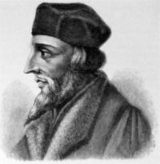
Jan Hus , also known as John Huss was a Czech Czech people

Czechs are a western Slavic [i] people of Central Europe [i], living predominantly in the Czech Republic [i]... 

  religious thinker, philosopher, and reformer, master at Charles University Charles University in Prague

name=Charles University in Prague ... 

 in Prague Prague

Prague is the capital [i] and largest city of the Czech Republic [i]. ... 

. His followers became known as Hussites. The Roman Catholic Church Roman Catholic Church

The Roman Catholic Church or Catholic Church is the Christian [i] Church [i] ... 

 considered his teachings heretical, and Hus was excommunicated in 1411, condemned by the Council of Constance Council of Constance

The Council of Constance was an ecumenical council [i] of the Roman Catholic Church [i], called by the ... 

, and burned at the stake Execution by burning

Execution [i] by burning [i] has a long history as a method of punishment [i] fo ... 

 on July 6, 1415, in Konstanz Konstanz

Konstanz is a university [i] town of around 80,000 inhabitants at the western end ... 

 , Germany Germany

Germany , officially the Federal Republic of Germany , is a country [i] in central Europe [i]. ... 

. Hus was a precursor to the Protestant movement. His extensive writings earn him a prominent place in Czech literary history.

Discussions

  Discussion Features

   Ask a question about 'Jan Hus'

   Start a new discussion about 'Jan Hus'

   Answer questions about 'Jan Hus'

   'Jan Hus' discussion forum

Timeline

1369   Born

1403   Jan Hus begins preaching Wycliffite John Wycliffe

John Wycliffe was an English [i] theologian [i] and early proponent of reform in the Roman Catholic Church [i] ... 

 ideas in Bohemia Bohemia

Bohemia is a historical region in central Europe [i], occupying th ... 

1410   Jan Hus is excommunicated by the Archbishop of Prague.

1415   Jan Hus travels to the Council of Constance Council of Constance

The Council of Constance was an ecumenical council [i] of the Roman Catholic Church [i], called by the ... 

 to propose reforms for the church

1415   the Council of Constance condemns the writings of John Wycliffe John Wycliffe

John Wycliffe was an English [i] theologian [i] and early proponent of reform in the Roman Catholic Church [i] ... 

 and asks Jan Hus to recant in public his heresy; after his denial, he is tried for heresy, excommunicated then sentenced to be burned at the stake

1415   Jan Hus burned at the stake Execution by burning

Execution [i] by burning [i] has a long history as a method of punishment [i] fo ... 

 in Konstanz Konstanz

Konstanz is a university [i] town of around 80,000 inhabitants at the western end ... 

1415   Died


Quotations

O sancta simplicitas!

Translation: O holy simplicity!, Said to have been spoken by Hus as he was being burned at the stake and saw an elderly peasant adding wood to the fire

       More Quotes >>


Encyclopedia


Jan Hus , also known as John Huss was a Czech Czech people

Czechs are a western Slavic [i] people of Central Europe [i], living predominantly in the Czech Republic [i]... 

  religious thinker, philosopher, and reformer, master at Charles University Charles University in Prague

name=Charles University in Prague
... 

 in Prague Prague

Prague is the capital [i] and largest city of the Czech Republic [i]. ... 

. His followers became known as Hussites. The Roman Catholic Church Roman Catholic Church

The Roman Catholic Church or Catholic Church is the Christian [i] Church [i] ... 

 considered his teachings heretical, and Hus was excommunicated in 1411, condemned by the Council of Constance Council of Constance

The Council of Constance was an ecumenical council [i] of the Roman Catholic Church [i], called by the ... 

, and burned at the stake Execution by burning

Execution [i] by burning [i] has a long history as a method of punishment [i] fo ... 

 on July 6, 1415, in Konstanz Konstanz

Konstanz is a university [i] town of around 80,000 inhabitants at the western end ... 

 , Germany Germany

Germany , officially the Federal Republic of Germany , is a country [i] in central Europe [i]. ... 

.

Hus was a precursor to the Protestant movement. His extensive writings earn him a prominent place in Czech literary history. He is also responsible for introducing the use of diacritics into Czech spelling in order to represent each sound by a single symbol. Today, a statue Statue

A statue is a sculpture [i] depicting a specific entity [i], usually a person [i], event, animal [i] or ... 

 of Jan Hus can be seen at the Prague Prague

Prague is the capital [i] and largest city of the Czech Republic [i]. ... 

 Old Town Square Old Town Square (Prague)

Old Town Square is a historic square in the Old Town [i] quarter of Prague [i] in the Czech Republic [i] ... 

 .

Jan Hus Day on July 6, the anniversary of the execution Capital punishment

Capital punishment, or the death penalty, is the execution [i] of a convicted criminal by the ... 

 of Jan Hus, is one of the public holidays in the Czech Republic.

Early life and studies

John Hus was born at Husinec  in or around the year of 1369.

Papal schism

The University of Prague around 1408 was being torn apart by the ongoing papal schism Western Schism

The Western Schism or Papal Schism was a split within the Catholic church [i] in 1378 [i]. ... 

, in which Pope Gregory XII Pope Gregory XII

Pope Gregory XII , born Angelo Correr or Corraro, Pope [i] from 1406 [i] to 1415 [i], su ... 

 and Avignon Pope Benedict XIII both laid claim to the papacy.

King Wenceslaus Wenceslaus, King of the Romans

Wenceslaus , of the House of Luxembourg [i], was king [i] of Bohemia [i] from... 

 felt Pope Gregory XII might interfere with his plans to be crowned Holy Roman Emperor Holy Roman Emperor

The Holy Roman Emperor was ruler of the Holy Roman Empire [i], a predecessor of numerous countries mainl ... 

; thus, he renounced Gregory and ordered his prelates to observe a strict neutrality toward both pope Pope

The Pope is the Bishop of Rome [i], and, as Successor [i] of Saint Peter [i], is t ... 

s, and said he expected the same of the university. Archbishop Zbynek Zajíc remained faithful to Gregory, however, and at the university it was only the "Bohemian nation" , with Hus as its leader and spokesman, which avowed neutrality.

Kutná Hora

In response, Wenceslaus Wenceslaus, King of the Romans

Wenceslaus , of the House of Luxembourg [i], was king [i] of Bohemia [i] from... 

, at the instigation of Hus and other Bohemian leaders, issued in Kutná Hora Kutná Hora

colspan="2" align="center" bgcolor="#E0922E">Statistics [i] ... 

 a decree that the Bohemian nation should now have three votes in all affairs of the university, while the foreign nations, principally Germany Germany

Germany , officially the Federal Republic of Germany , is a country [i] in central Europe [i]. ... 

, should have only one vote. As a consequence somewhere between five and twenty thousand German doctors, masters, and students left the university in 1409, going on to found the University of Leipzig, among others. Thus Prague lost its international importance and became a Czech school, though the emigrants spread news of the Bohemian heresies throughout the rest of Europe.

The archbishop became isolated and Hus was at the height of his fame. He became the first rector of the Czech university, and enjoyed the favor of the court Court

A court is an official, public forum which a sovereign [i] establishes by lawful authority t ... 

. In the meantime, the doctrinal views of the English theologian John Wycliffe John Wycliffe

John Wycliffe was an English [i] theologian [i] and early proponent of reform in the Roman Catholic Church [i]... 

 had spread throughout Bohemia.

Alexander V becomes Pope

In 1409, in an attempt to end the papal schism, the Council of Pisa met to elect a new pope who would usurp the other two. This did not succeed, and the pope they elected, Alexander V, did not end loyalty to the other two; he is now considered an antipope. However, Hus and his followers, in addition to King Wenceslaus Wenceslaus, King of the Romans

Wenceslaus , of the House of Luxembourg [i], was king [i] of Bohemia [i] from... 

, transferred their allegiance to Alexander V. Under pressure from Wenceslaus Wenceslaus, King of the Romans

Wenceslaus , of the House of Luxembourg [i], was king [i] of Bohemia [i] from... 

, archbishop Zbynek eventually did the same. The archbishop then brought his complaints before Alexander V's papal see, accusing the Wyclifites of ecclesiastical disturbances.

Excommunication of Hus

Alexander V issued his papal bull Papal bull

A Papal bull is a special kind of patent [i] or charter issued by a pope [i] and named fo ... 

 of December 20, 1409, which empowered the Archbishop to proceed against Wyclifism — all books of Wycliffe were to be given up, his doctrines revoked, and free preaching discontinued. After the publication of the bull in 1410, Hus appealed before Alexander V, but in vain; all books and valuable manuscripts of Wycliffe were burned, and Alexander V excommunicated Hus and his adherents. Riots ensued in parts of Bohemia.

The government took the side of Hus, and the power of his adherents increased from day to day. He continued to preach in the Bethlehem Chapel , and became bolder and bolder in his accusations against the Church. The churches of the city were put under the ban, and the interdict was pronounced against Prague Prague

Prague is the capital [i] and largest city of the Czech Republic [i]. ... 

, but without result.

Indulgences

Archbishop Zbynek Zajíc died in 1411, and with his death the religious movement in Bohemia entered a new phase — the disputes concerning indulgences arose.

Crusade Against Naples

In 1411, antipope John XXIII Antipope John XXIII

Antipope John XXIII, antipope [i] of the Pisa [i]n party , , was born as Baldassare Cossa.
... 

, who had become Alexander V's successor a year earlier, after Alexander's death, issued a crusade Crusades

The Crusades were a series of military campaigns waged in the name of Christendom [i] This term refers t ... 

 against King Ladislaus of Naples Ladislas of Naples

King Ladislas of Naples, the Magnanimous, was King of Naples [i] and titular King of Jerusalem [i] ... 

, the protector of Gregory XII Pope Gregory XII

Pope Gregory XII , born Angelo Correr or Corraro, Pope [i] from 1406 [i] to 1415 [i], su ... 

. This crusade was preached in Prague as well, and preachers of indulgences urged people to crowd the churches and give their offerings, developing a traffic in indulgences.

Condemnation of Indulgences and Crusade

Hus, following the example of Wycliffe, spoke out against indulgences and wrote his famous crusade. But he could not carry with him the men of the university. In 1412 a dispute took place, on which occasion Hus delivered his Quaestio magistri Johannis Hus de indulgentiis. It was taken literally from the last chapter of Wycliffe's book, De ecclesia, and his treatise, De absolutione a pena et culpa. The pamphlet stated that no pope Pope

The Pope is the Bishop of Rome [i], and, as Successor [i] of Saint Peter [i], is t ... 

 or bishop Bishop

A bishop is an ordained [i] member of the Christian clergy [i] who, in certain Christian [i]... 

 had the right to take up the sword Sword

Sword is a term for a long edged weapon, used by various civilizations throughout Eurasia [i] and North Africa [i]... 

 in the name of the Church; he should pray for his enemies and bless those that curse him; man obtains forgiveness of sins by real repentance, not through money Money

Economics [i] offers various definitions for money, though it is now commonly considered to be any good ... 

.

The doctors of the theological faculty replied, but without success. A few days afterward some of Hus's followers, led by Vok Voksa z Valdštejna, burnt the papal bulls; Hus, they said, should be obeyed rather than the Church, which they considered a fraudulent mob of adulterer Adultery

Adultery is generally defined as consensual sexual intercourse [i] by a married [i] person with ... 

s and Simonists.
Response
In response, three men from the lower classes who openly contradicted the preachers during their sermons and called indulgences a fraud were beheaded; they were later considered the first martyrs of the Hussite Church. The theological Theology

Theology is reasoned discourse [i] concerning religion [i], spirituality [i] and God [i]. ... 

 faculty asked Hus to present his speeches and doctrines to the dean for an examination, but he refused.

In the meantime, the faculty had condemned the forty-five articles anew and added several other heretical theses which had originated with Hus. The king forbade the teaching of these articles, but neither Hus nor the university complied with the ruling, requesting that the un-scriptural nature of the articles should be first proven.

Further dissentions


The tumults at Prague had stirred up a sensation, unpleasant for the Roman party; papal legates and Archbishop Albik tried to persuade Hus to give up his opposition to the papal bulls, and the king made an unsuccessful attempt to reconcile the two parties.

Call for arrest of Hus

In the meantime the clergy of Prague, through Michael de Causis, had brought their complaints before the Pope, and he ordered the Cardinal of St. Angelo to proceed against Hus without mercy. The cardinal put him under the great church ban. He was to be seized and delivered to the archbishop, and his chapel was to be destroyed. This was followed by stricter measures against Hus and his adherents, and in turn counter-measures of the Hussites, including an appeal by Hus that Jesus Christ Jesus

Jesus,Some of the historians and Biblical scholars who place the birth and death of Jesus within this ra... 

, and not the Pope, was the supreme judge. This intensified the excitement among the people, and Wenceslaus Wenceslaus, King of the Romans

Wenceslaus , of the House of Luxembourg [i], was king [i] of Bohemia [i] from... 

 forced Hus to leave Prague, but his departure did little to quell the ongoing excitement.

Attempted reconciliation

The king made great efforts to harmonize the opposing parties. In 1412 he convoked the heads of his kingdom for a consultation, and at their suggestion ordered a synod to be held at Ceský Brod on February 2, 1412. It did not take place there, but in the palace of the archbishops at Prague, in order to exclude Hus from participation.

Propositions were made to restore peace in the Church, with Hus requiring that Bohemia Bohemia

Bohemia is a historical region in central Europe [i], occupying th ... 

 should have the same freedom in regard to ecclesiastical affairs as other countries and that approbation and condemnation should therefore be announced only with the permission of the state power. This is wholly the doctrine of Wycliffe . There followed treatises from both parties, but no harmony was obtained. "Even if I should stand before the stake which has been prepared for me", Hus wrote at the time, "I would never accept the recommendation of the theological faculty." The synod did not produce any results, but the King ordered a commission to continue the work of reconciliation.

The doctors of the university required from Hus and his adherents an approval of their conception of the Church, according to which the Pope is the head, the Cardinals are the body of the Church, and that all regulations of this Church must be obeyed.

Hus protested vigorously against this conception since it made Pope and cardinals alone the Church. Nevertheless the Hussite party seems to have made a great effort toward reconciliation. To the article that the Roman Church must be obeyed, they added only "so far as every pious Christian is bound". Stanislav ze Znojma and Štepán Pálec protested against this addition and left the convention. The king exiled them, along with two other spokesmen.
Writings of Hus and Wycliffe
Of the writings occasioned by these controversies, that of Hus on the Church has been most frequently quoted and admired or criticized, and yet it is in the first ten chapters but a meagre epitome of Wycliffe's work of the same title, and in the following chapters an abstract of a work by the same author on the power of the pope, Wycliffe had written his book to oppose the common view that the Church consisted only of the clergy, and Hus now found himself in a similar condition. He wrote his work at the castle of one of his protectors in Kozí Hrádek , and sent it to Prague, where it was publicly read in the Bethlehem chapel. It was answered by Stanislav ze Znojma and Pálec with treatises of the same title.

After the most vehement opponents of Hus had left Prague, his adherents occupied the whole ground. Hus wrote his treatises and preached in the neighborhood of Kozí Hrádek. Bohemian Wyclifism was carried into Poland Poland

Poland , officially the Republic of Poland , is a country located in Central Europe [i]. ... 

, Hungary Hungary

Hungary , officially the Republic of Hungary , is a landlocked [i] country in Central Europe [i], ... 

, Croatia Croatia

Croatia , officially the Republic of Croatia , is a country in Europe [i], at the crossroads of th ... 

, and Austria Austria

Austria is a landlocked [i] country in central Europe [i]. ... 

; but at the same time the papal court was not inactive. In January of 1413, a general council assembled in Rome Rome

Rome is the capital [i] of Italy [i] and of its region, called Latium [i]. ... 

 which condemned the writings of Wycliffe and ordered them to be burned.

Council of Constance


To put an end to the papal schism and to take up the long desired reform of the Church, a general council was convened for November 1, 1414, at Constance . The Emperor Sigismund of Luxemburg Sigismund, Holy Roman Emperor

Sigismund was Holy Roman Emperor [i] from 1410 [i] to 1437 [i]. ... 

, brother of Wenceslaus, and heir to the Bohemian crown, was anxious to clear the country from the blemish of heresy. Hus likewise was willing to make an end of all dissensions, and gladly followed the request of Sigismund to go to Constance.

From the sermons which he took along, it is evident that he purposed to convert the assembled fathers to his own principal doctrines. Sigismund promised him safe-conduct, guaranteeing his safety for the duration of his journey; as a secular ruler he would not have been able to make any guarantees for the safety of Hus in a Papal court, a fact that Hus would have been aware of. However Hus was probably reckoning that a guarantee of safe conduct was also a sign of patronage by the king and that therefore he could rely on royal support during the proceedings.

Imprisonment and preparations for trial

It is unknown whether Hus knew what his fate would be; he assembled testimonies to show the council as to his orthodoxy, but nevertheless made his will before setting out. He started on his journey on October 11, 1414; on November 3, 1414, he arrived at Constance, and on the following day the bulletins on the church doors announced that Michal z Nemeckého Brodu would be the opponent of Hus, "the heretic."

In the beginning Hus was at liberty, living at the house of a widow, but after a few weeks his opponents succeeded in imprisoning him, on the strength of a rumor that he intended to flee. He was first brought into the residence of a canon, and then, on December 8, 1414, into the dungeon Dungeon

A dungeon, in its original medieval [i] usage, was the keep [i], the main tower of a castle [i] which fo ... 

 of the Dominican monastery. Sigismund was greatly angered, having previously guaranteed safe-conduct, and threatened the prelates with dismissal, but when it was hinted that in such a case the council would be dissolved, he gave in.

On December 4, 1414, the Pope had entrusted a committee of three bishops with a preliminary investigation against him. The witnesses for the prosecution were heard, but Hus was refused an advocate for his defense. His situation became worse after the catastrophe of John XXIII Antipope John XXIII

Antipope John XXIII, antipope [i] of the Pisa [i]n party , , was born as Baldassare Cossa.
... 

, who had left Constance to evade the necessity of abdicating. So far Hus had been the captive of the pope and in constant intercourse with his friends, but now he was delivered to the archbishop of Constance and brought to his castle, Gottlieben on the Rhine. Here he remained for seventy-three days, separated from his friends, chained day and night, poorly fed, and tortured by disease.

Trial

On June 5, 1415, he was tried for the first time, and for that purpose was transferred to a Franciscan monastery, where he spent the last weeks of his life.

He acknowledged the writings on the Church against Znojma Znojmo

colspan="2" align="center" bgcolor="#E0922E">Statistics [i] ... 

, Pálec, as well as Stanislaus of Znaim as his own, and declared himself willing to recant if his errors should be proven to him.

Hus conceded his veneration of Wycliffe, and said that he could only wish his soul might some time attain unto that place where Wycliffe's was. On the other hand, he denied having defended Wycliffe's doctrine of The Lord's Supper Eucharist

The Eucharist or Communion or The Lord's Supper, is the rite [i] that Christians [i] ... 

 or the forty-five articles; he had only opposed their summary condemnation.

King Wenceslaus Wenceslaus, King of the Romans

Wenceslaus , of the House of Luxembourg [i], was king [i] of Bohemia [i] from... 

 admonished him to deliver himself up to the mercy of the Council, as he did not desire to protect a heretic. At the last trial, on June 8, 1415, there were read to him thirty-nine sentences, twenty-six of which had been excerpted from his book on the Church, seven from his treatise against Pálec, and six from that against Stanislav ze Znojma. The danger of some of these doctrines as regards worldly power was explained to the emperor Emperor

An emperor is a monarch [i], usually the sovereign [i] ruler of an empire [i] or another type o... 

 to incite him against Hus.

Hus again declared himself willing to submit if he could be convinced of errors. He desired only a fairer trial and more time to explain the reasons for his views. If his reasons and Bible Bible

The Bible , is the name used by Jews [i] and Christians [i] for their differing canons [i]... 

 texts did not suffice, he would be glad to be instructed. This declaration was considered an unconditional surrender, and he was asked to confess:

  1. that he had erred in the theses which he had hitherto maintained;
  2. that he renounced them for the future;
  3. that he recanted them; and
  4. that he declared the opposite of these sentences.


He asked to be exempted from recanting doctrines which he had never taught; others, which the assembly considered erroneous, he was willing to revoke; to act differently would be against his conscience. These words found no favorable reception. After the trial on June 8, several other attempts were made to induce him to recant, but he resisted all of them.

The attitude of Sigismund was due to political considerations — he looked upon the return of Hus to his country as dangerous, and thought the terror of execution might improve the situation. Hus no longer hoped to live, and he may in some way have looked forward to becoming a martyr Martyr

In the classical Christian view, a martyr is an innocent Christian who, without seeking death , is murde... 

.

Condemnation and execution


The condemnation took place on July 6, 1415, in the presence of the solemn assembly of the Council in the Cathedral. Each voting member stood up and delivered his own, often moving speech which ended with a vote as to whether Hus should live or die. A sizable minority voted to save Hus's life, but the majority ruled.

If the beginning of the day could be called solemn, the scene after the voting was one of scuffles and chairs being thrown. .

After the performance of High Mass and Liturgy, Hus was led into the church. The Bishop of Lodi delivered an oration on the duty of eradicating heresy; then some theses of Hus and Wycliffe and a report of his trial were read.

Refusals to recant

An Italian prelate pronounced the sentence of condemnation upon Hus and his writings. Again he protested loudly, saying that even at this hour he did not wish anything but to be convinced from Holy Scripture. He fell upon his knees and asked God with a low voice to forgive all his enemies.

Then followed his degradation — he was enrobed in priestly vestments and again asked to recant; again he refused. With curses his ornaments were taken from him, his priestly tonsure Tonsure

Tonsure is the practice of some Christian [i] churches and Hindu [i] temples of cutting the ... 

 was destroyed, and the sentence was pronounced that the Church had deprived him of all rights and delivered him to the secular powers. Then a high paper hat was put upon his head, with the inscription "Haeresiarcha" . Hus was led away to the stake under a strong guard of armed men.

At the place of execution he knelt down, spread out his hands, and prayed aloud. Some of the people asked that a confessor should be given him, but one priest exclaimed that a heretic should neither be heard nor given a confessor. The executioners undressed Hus and tied his hands behind his back with ropes, and his neck with a chain to a stake around which wood and straw had been piled up so that it covered him to the neck.

At the last moment, the imperial marshal, Von Pappenheim, in the presence of the Count Palatine, asked him to recant and thus save his life, but Hus declined with the words "God is my witness that I have never taught that of which I have by false witnesses been accused. In the truth of the Gospel which I have written, taught, and preached, I will die today with gladness."

Burning at the stake


As the fire was kindled, Hus sang, "Christ, Son of the living God, have mercy upon me". When he started this for a third time and continued "...who is born of Mary the Virgin Mary (mother of Jesus)

According to the New Testament [i], Mary, was the mother of Jesus of Nazareth [i], who at the time ... 

", the wind blew the flame into his face; he still moved lips and head, and then died of suffocation Asphyxia

Asphyxia is a condition of severely deficient supply of oxygen [i] to the body that arises from being un ... 

. His clothes were thrown into the fire, his ashes gathered and cast into the nearby Rhine. Some sources report him as saying "O sancta simplicitas!" when he stood upon the stake and saw a woman adding more wood to it.

On December 18, 1999, Pope John Paul II Pope John Paul II

Pope John Paul II , , born Karol Jzef Wojtyla reigned as Pope [i] of the Catholic Church [i] fro ... 

 apologized for the execution of Jan Hus, but has refused to pardon him despite having adopted many of his then controversial teachings.

Hus' scholarship and teachings

The Czechs, who in his lifetime had loved Hus as their prophet and apostle, now adored him as their saint and martyr Martyr

In the classical Christian view, a martyr is an innocent Christian who, without seeking death , is murde... 

. Nevertheless, his scholarship is open to criticism. His learning was not of a universal range.

He left only a few reformatory writings in the proper sense of the word, most of his works being polemical treatises against Stanislav ze Znojma and Štepán Pálec. It is doubtful whether he knew all the works of Wycliffe.

He translated the Trialogus, and was very familiar with his works on the body of the Lord, on the Church, on the power of the pope, and especially with his sermons. What he says in his sermons on the corruption of the Church, clergy, and monks, on the duties of secular powers, etc, he has taken almost literally from Wycliffe.

His three great sermons, De sufficientia legis Christi, De fidei suae elucidatione, and De pace, with which he thought to carry away the whole council at Constance, are exact reproductions of Wycliffe's sermons. He claims not to have shared Wycliffe's views regarding the sacraments Sacrament

A sacrament is a Christian [i] rite [i] that mediates divine grace [i]—a holy Mystery [i] ... 

, but this is not certain.

There are reasons to suppose that Wycliffe's doctrine of the Lord's Supper had spread to Prague as early as 1399. It gained an even wider circulation after it had been prohibited in 1403, and Hus preached and taught it, although it is possible that he simply repeated it without advocating it. But the doctrine was seized eagerly by the radical party, the Taborites, who made it the central point of their system.

The book on the Church and on the power of the pope contains the essence of the doctrine of Hus. According to it, the Church is not that hierarchy which is generally designated as Church; the Church is the entire body of those who from eternity have been predestined for salvation. Christ, not the pope, is its head. It is no article of faith that one must obey the pope to be saved. Neither external membership in the Church nor churchly offices and dignities are a surety that the persons in question are members of the true Church.

But it seems clear that Hus’s efforts were predominantly designed to rid the Church of its ethical abuses, rather than a campaign of sweeping theological change. In explaining the plight of the average Christian in Bohemia, Hus wrote, “One pays for confession, for mass, for the sacrament, for indulgences, for churching a woman, for a blessing, for burials, for funeral services and prayers. The very last penny which an old woman has hidden in her bundle for fear of thieves or robbery will not be saved. The villainous priest will grab it.”

After Hus's death, his followers, then known as Hussites, split off into Utraquists, and later Taborites.

Source of his influence


The great success of Hus in his native country was due mainly to his unsurpassed pastoral activity, which far excelled that of the famous old preachers of Bohemia. Hus himself put the highest value on the sermon and knew how to awaken the enthusiasm of the masses. His sermons were often inflammatory as regards their content; he introduces his quarrels with his spiritual superiors, criticizes contemporaneous events, or appeals to his congregation as witness or judge. It was this bearing which multiplied his adherents, and thus he became the true apostle of his English master without being himself a theorist in theological questions.

Other historians would attribute his success to his and his listeners' deep belief in the holy word and the corruption of the Catholic Church. During Hus's trial, he never made claims to originality, but instead advocated a return to the word of the Bible. He continued to repeat that if it could be shown in the Bible that he had erred, that he would gladly recant and be corrected. His single-minded pursuit of the truth was liberating to Europe and was perhaps his greatest legacy.

Hus' friend and devoted follower, Jerome of Prague Jerome of Prague

Jerome of Prague was one of the chief followers and most devoted friends of Jan Hus [i]. ... 

, shared his fate, although he did not suffer death till nearly a year later, in 1416.

References

  • Schaff Philip Schaff

    Philip Schaff, was a Swiss [i]-born, German [i]-educated theologian [i] and a historian ... 

    -Herzog: Encyclopedia of Religion
  • with Martin Luther's Preface, by Jan Hus, François Paul Émile Boisnormand de Bonnechose, tr. Campbell Mackenzie, Edinburgh, William Whyte & Co., 1846. - Google Books Google Book Search

    Google Book Search is a tool from Google [i] that searches the full text of books that Google scans and ... 

    .

External links

  • written on July 1, 1415


  • Macek, Joseph. The Hussite Movement in Bohemia. Prague: Orbis, 1958.