

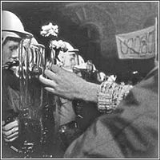
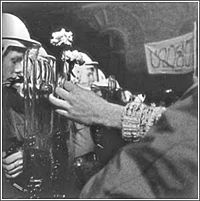
Velvet Revolution

Encyclopedia
Nonviolent revolution
A nonviolent revolution is a revolution using mostly campaigns of civil resistance, including various forms of nonviolent protest, to bring about the departure of governments seen as entrenched and authoritarian...
in Czechoslovakia
Czechoslovakia
Czechoslovakia or Czecho-Slovakia was a sovereign state in Central Europe which existed from October 1918, when it declared its independence from the Austro-Hungarian Empire, until 1992...
that took place from November 17 – December 29, 1989. Dominated by student and other popular demonstrations against the one-party government of the Communist Party of Czechoslovakia
Communist Party of Czechoslovakia
The Communist Party of Czechoslovakia, in Czech and in Slovak: Komunistická strana Československa was a Communist and Marxist-Leninist political party in Czechoslovakia that existed between 1921 and 1992....
, it saw to the collapse of the party's control of the country, and the subsequent conversion from Czech stalinism
Stalinism
Stalinism refers to the ideology that Joseph Stalin conceived and implemented in the Soviet Union, and is generally considered a branch of Marxist–Leninist ideology but considered by some historians to be a significant deviation from this philosophy...
to capitalism
Capitalism
Capitalism is an economic system that became dominant in the Western world following the demise of feudalism. There is no consensus on the precise definition nor on how the term should be used as a historical category...
.
On November 17, 1989, a Friday, riot police suppressed a peaceful student demonstration
Student activism
Student activism is work done by students to effect political, environmental, economic, or social change. It has often focused on making changes in schools, such as increasing student influence over curriculum or improving educational funding...
in Prague
Prague
Prague is the capital and largest city of the Czech Republic. Situated in the north-west of the country on the Vltava river, the city is home to about 1.3 million people, while its metropolitan area is estimated to have a population of over 2.3 million...
. That event sparked a series of popular demonstrations from November 19 to late December. By November 20 the number of peaceful protest
Protest
A protest is an expression of objection, by words or by actions, to particular events, policies or situations. Protests can take many different forms, from individual statements to mass demonstrations...
ers assembled in Prague had swollen from 200,000 the previous day to an estimated half-million. A two-hour general strike
General strike
A general strike is a strike action by a critical mass of the labour force in a city, region, or country. While a general strike can be for political goals, economic goals, or both, it tends to gain its momentum from the ideological or class sympathies of the participants...
, involving all citizens of Czechoslovakia, was held on November 27.
With the collapse of other Warsaw Pact
Warsaw Pact
The Warsaw Treaty Organization of Friendship, Cooperation, and Mutual Assistance , or more commonly referred to as the Warsaw Pact, was a mutual defense treaty subscribed to by eight communist states in Eastern Europe...
governments and increasing street protests, the Communist Party of Czechoslovakia announced on November 28 that it would relinquish power and dismantle the single-party state
Single-party state
A single-party state, one-party system or single-party system is a type of party system government in which a single political party forms the government and no other parties are permitted to run candidates for election...
. Barbed wire
Barbed wire
Barbed wire, also known as barb wire , is a type of fencing wire constructed with sharp edges or points arranged at intervals along the strand. It is used to construct inexpensive fences and is used atop walls surrounding secured property...
and other obstructions were removed from the border with West Germany and Austria in early December. On December 10, President Gustáv Husák
Gustáv Husák
Gustáv Husák was a Slovak politician, president of Czechoslovakia and a long-term Communist leader of Czechoslovakia and of the Communist Party of Czechoslovakia...
appointed the first largely non-communist government in Czechoslovakia since 1948, and resigned. Alexander Dubček
Alexander Dubcek
Alexander Dubček , also known as Dikita, was a Slovak politician and briefly leader of Czechoslovakia , famous for his attempt to reform the communist regime during the Prague Spring...
was elected speaker of the federal parliament on December 28 and Václav Havel
Václav Havel
Václav Havel is a Czech playwright, essayist, poet, dissident and politician. He was the tenth and last President of Czechoslovakia and the first President of the Czech Republic . He has written over twenty plays and numerous non-fiction works, translated internationally...
the President of Czechoslovakia on December 29, 1989.
In June 1990, Czechoslovakia held its first democratic
Democracy
Democracy is generally defined as a form of government in which all adult citizens have an equal say in the decisions that affect their lives. Ideally, this includes equal participation in the proposal, development and passage of legislation into law...
election
Election
An election is a formal decision-making process by which a population chooses an individual to hold public office. Elections have been the usual mechanism by which modern representative democracy operates since the 17th century. Elections may fill offices in the legislature, sometimes in the...
s since 1946.
The term Velvet Revolution was coined by Rita Klímová
Rita Klímová
Rita Klímová, née Rita Budinova was a Czech economist and politician. She was Czechoslovakia's last ambassador to the United States before that country's breakup in 1992.-Early life:...
, the dissidents' English translator who later became the new non-Communist regime's ambassador to the United States. The term was used internationally to describe the revolution, although the Czech side also used the term internally. After the dissolution of Czechoslovakia
Dissolution of Czechoslovakia
The dissolution of Czechoslovakia, which took effect on 1 January 1993, was an event that saw the self-determined separation of the federal state of Czechoslovakia. The Czech Republic and Slovakia, entities which had arisen in 1969 within the framework of Czechoslovak federalisation, became...
in 1993, Slovakia
Slovakia
The Slovak Republic is a landlocked state in Central Europe. It has a population of over five million and an area of about . Slovakia is bordered by the Czech Republic and Austria to the west, Poland to the north, Ukraine to the east and Hungary to the south...
used the term Gentle Revolution, the term that Slovaks used for the revolution from the beginning. The Czech Republic
Czech Republic
The Czech Republic is a landlocked country in Central Europe. The country is bordered by Poland to the northeast, Slovakia to the east, Austria to the south, and Germany to the west and northwest....
continues to refer to the event as the Velvet Revolution.
Political situation prior to the revolution
The Communist Party of CzechoslovakiaCommunist Party of Czechoslovakia
The Communist Party of Czechoslovakia, in Czech and in Slovak: Komunistická strana Československa was a Communist and Marxist-Leninist political party in Czechoslovakia that existed between 1921 and 1992....
began its rule on February 25, 1948. No official opposition parties operated within the government during the party's rule. Dissident
Dissident
A dissident, broadly defined, is a person who actively challenges an established doctrine, policy, or institution. When dissidents unite for a common cause they often effect a dissident movement....
s (notably Charter 77
Charter 77
Charter 77 was an informal civic initiative in communist Czechoslovakia from 1976 to 1992, named after the document Charter 77 from January 1977. Founding members and architects were Václav Havel, Jan Patočka, Zdeněk Mlynář, Jiří Hájek, and Pavel Kohout. Spreading the text of the document was...
) published home-made periodicals (samizdat
Samizdat
Samizdat was a key form of dissident activity across the Soviet bloc in which individuals reproduced censored publications by hand and passed the documents from reader to reader...
), but they faced persecution by the secret police
Secret police
Secret police are a police agency which operates in secrecy and beyond the law to protect the political power of an individual dictator or an authoritarian political regime....
. Thus, the general public was afraid to openly support the dissidents for fear of dismissal from work or school. A writer or film maker could have his/her books or films banned for a "negative attitude towards the socialist regime." This blacklisting also included categories such as being a child of a former entrepreneur or non-Communist politician, having family members living in the West, having supported Alexander Dubček
Alexander Dubcek
Alexander Dubček , also known as Dikita, was a Slovak politician and briefly leader of Czechoslovakia , famous for his attempt to reform the communist regime during the Prague Spring...
during the Prague Spring
Prague Spring
The Prague Spring was a period of political liberalization in Czechoslovakia during the era of its domination by the Soviet Union after World War II...
, opposing Soviet military occupation
Military occupation
Military occupation occurs when the control and authority over a territory passes to a hostile army. The territory then becomes occupied territory.-Military occupation and the laws of war:...
, promoting religion, boycotting rigged parliamentary elections or signing the Charter 77 or associating with those who did. These rules were easy to enforce, as all schools, media and businesses belonged to the state. They were under direct supervision and often were used as accusatory weapons against political and social rivals.
The nature of blacklisting changed gradually after the introduction of Mikhail Gorbachev
Mikhail Gorbachev
Mikhail Sergeyevich Gorbachev is a former Soviet statesman, having served as General Secretary of the Communist Party of the Soviet Union from 1985 until 1991, and as the last head of state of the USSR, having served from 1988 until its dissolution in 1991...
's policies of Glasnost
Glasnost
Glasnost was the policy of maximal publicity, openness, and transparency in the activities of all government institutions in the Soviet Union, together with freedom of information, introduced by Mikhail Gorbachev in the second half of the 1980s...
(openness) and Perestroika
Perestroika
Perestroika was a political movement within the Communist Party of the Soviet Union during 1980s, widely associated with the Soviet leader Mikhail Gorbachev...
(restructuring) in 1985. The Czechoslovak Communist leadership verbally supported Perestroika, but did little to institute real changes. Speaking about the Prague Spring of 1968 was still taboo. The first anti-government demonstrations occurred in 1988 (the Candle Demonstration, for example) and 1989, but these were dispersed and participants were repressed by the police.
By the late 1980s, discontent with living standards and economic inadequacy gave way to popular support for economic reform. Czech and Slovak citizens began to challenge the governmental system more openly. By 1989, citizens who had been complacent in their official or professional capacities were now willing to openly express their discontent with the regime. Numerous important figures as well as common workers signed petitions in support of Vaclav Havel
Václav Havel
Václav Havel is a Czech playwright, essayist, poet, dissident and politician. He was the tenth and last President of Czechoslovakia and the first President of the Czech Republic . He has written over twenty plays and numerous non-fiction works, translated internationally...
during his 1989 imprisonment. Reform-minded attitudes were also reflected by the many individuals who signed a petition that circulated in the summer of 1989 calling for the end of censorship and the beginning of drastic political reform.
The actual impetus for the revolution came not only from the developments in neighbouring countries but also in the Czechoslovakian capital. Since August East German citizens had occupied the West German Embassy in Prague and demanded exile to West Germany
West Germany
West Germany is the common English, but not official, name for the Federal Republic of Germany or FRG in the period between its creation in May 1949 to German reunification on 3 October 1990....
. In the days following November 3, thousands of East Germans left Prague by a train to West Germany. On November 9, the Berlin Wall
Berlin Wall
The Berlin Wall was a barrier constructed by the German Democratic Republic starting on 13 August 1961, that completely cut off West Berlin from surrounding East Germany and from East Berlin...
fell, removing the need for the detour.
By November 16, many of Czechoslovakia's neighbours were beginning to shed authoritarian rule. The citizens of Czechoslovakia watched these events daily on TV through both foreign and domestic signals. The Soviet Union also supported a change in the ruling elite of Czechoslovakia, although it did not anticipate the overthrow of the Communist regime.
Thursday, November 16, 1989
On the eve of International Students Day (the 50th anniversary of death of Jan OpletalJan Opletal
Jan Opletal was a student of the Medical Faculty of the Charles University in Prague, who was killed in an anti-Nazi demonstration during the German occupation of Czechoslovakia....
, a Czech student murdered by the German occupiers during World War II
World War II
World War II, or the Second World War , was a global conflict lasting from 1939 to 1945, involving most of the world's nations—including all of the great powers—eventually forming two opposing military alliances: the Allies and the Axis...
), Slovak high school and university students organized a peaceful demonstration in the center of Bratislava
Bratislava
Bratislava is the capital of Slovakia and, with a population of about 431,000, also the country's largest city. Bratislava is in southwestern Slovakia on both banks of the Danube River. Bordering Austria and Hungary, it is the only national capital that borders two independent countries.Bratislava...
. The Communist Party of Slovakia
Communist Party of Slovakia (1939)
The Communist Party of Slovakia was a communist party in Slovakia. It was formed in March 1939, when the Slovak Republic was created, as the Slovak branches of the Communist Party of Czechoslovakia were separated from the mother party...
had expected trouble and the mere fact that there was a demonstration was a problem in Communist countries. Armed forces were put on alert before the demonstration. In the end, however, the students moved through the city peacefully and finally sent a delegation to the Slovak Ministry of Education to discuss their demands.
Friday, November 17, 1989
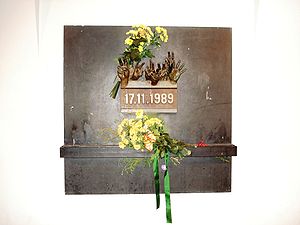
The Socialist Union of Youth (SSM/SZM, proxy of Communist Party of Czechoslovakia
Communist Party of Czechoslovakia
The Communist Party of Czechoslovakia, in Czech and in Slovak: Komunistická strana Československa was a Communist and Marxist-Leninist political party in Czechoslovakia that existed between 1921 and 1992....
) organized a mass demonstration to commemorate International Students Day, and the fiftieth anniversary of the murder of students by the Nazi government.
Most members of SSM had privately been in opposition to the Communist leadership, but had been afraid of speaking up for fear of persecution. This demonstration gave average students an opportunity to join others and express their opinions without fear. By 16:00, about 15,000 people had joined the demonstration. They walked to grave of Karel Hynek Mácha
Karel Hynek Mácha
Karel Hynek Mácha was a Czech romantic poet.- Biography :Mácha grew up in Prague, the son of a foreman at a mill. He learned Latin and German in school...
at Vyšehrad Cemetery and - after the official end of the march - continued into downtown Prague (map), carrying banners and chanting anti-Communist slogans. At about 19:30, the demonstrators were stopped by a cordon of riot police at Národní Street. They had blocked all escape routes and beat the students. Once all the protesters were dispersed, one of the participants - secret police
State Security (Czechoslovakia)
In former Czechoslovakia, State Security or StB / ŠtB, was a plainclothes secret police force from 1945 to its dissolution in 1990...
agent Ludvík Zifčák - kept lying on the street, posing as dead, and was later taken away. It is not clear why he did it, but the rumor of the "dead student" was perhaps critical for the shape of further events. That same evening, students and theatre actors agreed to go on strike.
Saturday, November 18
Two students visited Prime Minister Ladislav AdamecLadislav Adamec
Ladislav Adamec was a Czechoslovak Communist political figure. Upon the retirement of Prime Minister Lubomír Štrougal in October 1988, Adamec assumed the role, thus serving as the last Communist leader of Czechoslovakia. He served from October 12, 1988 to December 7, 1989...
at his private residence and described to him what (really) happened at Národní Street. The declaration of the strike at the Realistic Theatre in Prague occurred, and other theatres quickly followed. The theatres opened their stages only for public discussions. At the initiative of students from the Academy of Performing Arts in Prague
Academy of Performing Arts in Prague
The Academy of Performing Arts in Prague is a university level school of music, dance, drama, film, TV and multi-media studies.- Faculties :*Film and TV School - FAMU*Music Faculty - HAMU*Theatre Faculty - DAMU-Notable alumni:...
, the students in Prague began a strike. Gradually, this strike was joined by university students throughout Czechoslovakia. The students were supported by the theatre employees and actors in Prague, all of whom had also gone on strike. Instead of playing, actors read a proclamation by the students and artists to the audience, that called for a general strike on November 27. Home-made posters and proclamations were posted in public places. As all media (radio, TV, newspapers) were strictly controlled by the Communist Party (see Mass media in Communist Czechoslovakia
Mass media in Communist Czechoslovakia
The mass media in Communist Czechoslovakia was controlled by the Communist Party of Czechoslovakia . Private ownership of any publication or agency of the mass media was generally forbidden, although churches and other organizations published small periodicals and newspapers...
), this was the only way to spread the message. In the evening, Radio Free Europe
Radio Free Europe
Radio Free Europe/Radio Liberty is a broadcaster funded by the U.S. Congress that provides news, information, and analysis to countries in Eastern Europe, Central Asia, and the Middle East "where the free flow of information is either banned by government authorities or not fully developed"...
reported that a student (named as Martin Šmíd
Martin Šmíd
Martin Šmíd was a fictitious Czechoslovak university student, who was supposedly killed in the police attack on the November 17, 1989 student demonstration in Prague that launched Czechoslovakia's Velvet Revolution. The rumor of Šmíd's death was spread by Drahomíra Dražská, a porter at a student...
) was killed by the police during the previous day's demonstration. Although the report was false, it heightened the feeling of crisis, and persuaded some hesitant citizens to overcome their fear and join the protests.
Sunday, November 19
Theatres in BratislavaBratislava
Bratislava is the capital of Slovakia and, with a population of about 431,000, also the country's largest city. Bratislava is in southwestern Slovakia on both banks of the Danube River. Bordering Austria and Hungary, it is the only national capital that borders two independent countries.Bratislava...
, Brno
Brno
Brno by population and area is the second largest city in the Czech Republic, the largest Moravian city, and the historical capital city of the Margraviate of Moravia. Brno is the administrative centre of the South Moravian Region where it forms a separate district Brno-City District...
, Ostrava
Ostrava
Ostrava is the third largest city in the Czech Republic and the second largest urban agglomeration after Prague. Located close to the Polish border, it is also the administrative center of the Moravian-Silesian Region and of the Municipality with Extended Competence. Ostrava was candidate for the...
and other towns also went on strike, following the example of their colleagues from Prague. Members of artistic and literary associations as well as organizations and institutions joined the strikes. Members of a civic initiative met with the Prime Minister, who told them that he had been prohibited twice from resigning his post, and that if they wanted to achieve changes, there would have to be mass demonstrations like those in East Germany (some 250,000 students). He also asked them to keep the number of "casualties" during the expected changes to a minimum. About 500 Slovak artists, scientists and leaders met at the Art Forum (Umelecká beseda) in Bratislava at 17:00. They denounced the attack against the students in Prague on November 17 and formed the Public Against Violence
Public Against Violence
The Public Against Violence was a political movement that was established in Bratislava, Slovakia on 20 November 1989. It was the Slovak counterpart of the Czech Civic Forum ....
, which would become the leading force behind the opposition movement in Slovakia. Its founding members included Milan Kňažko
Milan Knažko
Milan Kňažko is a Slovakian actor and ex-politician. He was one of the leading personalities of the movement Public against Violence in November 1989 and one of the most popular faces of the Velvet Revolution in Slovakia.-Acting:...
, Ján Budaj and others.
Actors and members of the audience in a Prague theatre, together with Václav Havel
Václav Havel
Václav Havel is a Czech playwright, essayist, poet, dissident and politician. He was the tenth and last President of Czechoslovakia and the first President of the Czech Republic . He has written over twenty plays and numerous non-fiction works, translated internationally...
and other prominent members of Charter 77
Charter 77
Charter 77 was an informal civic initiative in communist Czechoslovakia from 1976 to 1992, named after the document Charter 77 from January 1977. Founding members and architects were Václav Havel, Jan Patočka, Zdeněk Mlynář, Jiří Hájek, and Pavel Kohout. Spreading the text of the document was...
and other dissident organizations, established the Civic Forum
Civic Forum
The Civic Forum was a political movement in the Czech part of Czechoslovakia, established during the Velvet Revolution in 1989...
(Občanské fórum – an equivalent of the Slovak Public Against Violence for the territory of the Czech Republic) as a mass popular movement for reforms, at 22:00. They called for the dismissal of top officials responsible for the violence, and an independent investigation of the incident and the release of all political prisoner
Political prisoner
According to the Longman Dictionary of Contemporary English, a political prisoner is ‘someone who is in prison because they have opposed or criticized the government of their own country’....
s. College students announced a strike. On television, government officials called for peace and a return to the city's normal business. The television aired an interview with Martin Šmíd to persuade the public that nobody had been killed; the quality of the recording was low and rumors continued. It would take several more days to confirm that nobody had been killed and, by then, the revolution had gained further momentum.
The leaders of the Democratic Initiative presented several demands: 1) the resignation of the government, effective November 25; 2) the formation of a temporary government composed of noncompromised members of the current government.
Monday, November 20
Tuesday, November 21
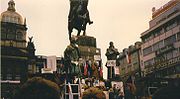
The first official meeting of the Civic Forum with the Prime Minister took place. The Prime Minister said he would personally guarantee that no violence would be used against the people; however he would "protect socialism, about which no discussion is possible". An organized mass demonstration took place in Wenceslas SquareWenceslas Square
Wenceslas Square is one of the main city squares and the centre of the business and cultural communities in the New Town of Prague, Czech Republic. Many historical events occurred there, and it is a traditional setting for demonstrations, celebrations, and other public gatherings...
in central Prague (demonstrations were held there throughout the following days). Actors and students travelled to factories inside and outside Prague to gain support for their colleagues in other cities.
A mass demonstration took place in Hviezdoslav Square
Hviezdoslavovo námestie (Bratislava)
Hviezdoslavovo námestie is one of the best-known squares in Bratislava. It is located in the Old Town, between the New Bridge and the Slovak National Theatre.The square is named after Pavol Országh Hviezdoslav.-History:...
in downtown Bratislava (in the following days, it moved to the Square of the Slovak National Uprising). The students presented various demands and asked the people to participate in the general strike planned for Monday, November 27. A separate demonstration demanding the release of the political prisoner Ján Čarnogurský
Ján Carnogurský
Ján Čarnogurský is a former Slovak politician, a former Prime Minister of Slovakia and the former chairman of the Christian Democratic Movement .He is married and has 4 children.- Before 1989 :...
(the later Prime Minister of Slovakia) took place in front of the Palace of Justice. Alexander Dubček delivered an address at this demonstration – his first appearance during the Velvet Revolution. As a result, Čarnogurský was released on November 23. Further demonstrations followed in all major cities of Czechoslovakia.
Cardinal
Cardinal (Catholicism)
A cardinal is a senior ecclesiastical official, usually an ordained bishop, and ecclesiastical prince of the Catholic Church. They are collectively known as the College of Cardinals, which as a body elects a new pope. The duties of the cardinals include attending the meetings of the College and...
František Tomášek
František Tomášek
František Tomášek was a cardinal of the Roman Catholic Church in Bohemia, the 34th Archbishop of Prague, and a Roman Catholic theologian...
, the Catholic
Roman Catholic Church
The Catholic Church, also known as the Roman Catholic Church, is the world's largest Christian church, with over a billion members. Led by the Pope, it defines its mission as spreading the gospel of Jesus Christ, administering the sacraments and exercising charity...
primate of the Bohemian lands, declared his support for the students, and issued a declaration in which he criticized the current government's policies and their effect on all of Czechoslovakia. For the first time during the Velvet Revolution, the "radical" demand to abolish the article of the Constitution establishing the "leading role" of the Communist Party was expressed by Ľubomír Feldek
Lubomír Feldek
Ľubomír Feldek is a Slovak poet, writer, playwright, and translator. He is married to Oľga Feldeková....
at a meeting of Public Against Violence.
In the evening, Miloš Jakeš, the chairman of the Communist Party of Czechoslovakia, held a special address on Federal Television. He said that order had to be preserved, that socialism was the only alternative for Czechoslovakia and criticized groups that stood behind the development in Czechoslovakia. Government officials, especially the Head of the Communist Party Miloš Jakeš, kept their hard-line position and seemed increasingly out of touch. During the night, they had summoned 4,000 members of the "People's Militias
People's Militias (Czechoslovakia)
People's Militias was a militia organisation of Communist Party of Czechoslovakia during between 1948 and 1989.- History :...
" (Lidové milice, a paramilitary organization subordinated directly to the Communist Party) to Prague to crush the protests, but they were called off at the last moment.
Wednesday, November 22
Civic Forum announced a two-hour general strike for Monday November 27. The first live reports from the demonstration in Wenceslas Square appeared on Federal Television (they were quickly cut off, after one of the participants denounced the present government in favor of Alexander Dubček). Striking students forced the representatives of the Slovak government and of the Communist Party of Slovakia to participate in a dialogue, in which the official representatives were immediately put on the defensive. Employees of the Slovak section of the Federal Television required the leaders of the Federal Television to provide true information on the events in the country; otherwise they would initiate a strike of TV employees. Uncensored live reports from demonstrations in Bratislava followed.Thursday, November 23
Evening news showed factory workers heckling Miroslav Štěpán, the Prague Communist Secretary, who was popularly viewed as the most loathed politician in the country. The military informed the Communist leadership of its readiness to act (ultimately, it was never used against demonstrators). The military and the Ministry of Defense were preparing for actions against the opposition. Immediately after the meeting, however, the Minister of Defense delivered a TV address, in which he said the army would never undertake action against the Czechoslovak people and called for an end of the demonstrations.Friday, November 24
The entire Presidum, including General Secretary Miloš Jakeš, resigned. Karel UrbánekKarel Urbánek
Karel Urbánek was the last Communist leader of Czechoslovakia during the Velvet Revolution, between November and December 1989....
, a considerably more moderate Communist, was named the new General Secretary. Federal Television showed pictures from November 17 for the first time and the first television address of Václav Havel, dealing mostly with the planned general strike. Czechoslovak TV and Radio announced that they would join the general strike. A discussion with representatives of the opposition was broadcast by the Slovak section of the Federal Television. It was the first free discussion on Czechoslovak television since its beginnings. As a result, the editorial staff of Slovak newspapers started to join the opposition.
Saturday, November 25
The new Communist leadership held a press conference. It immediately lost credibility by keeping Miroslav Štěpán, leaving Ladislav Adamec out and not addressing any of the demands. Later that day, Štěpán resigned from his position as the Prague Secretary. The number of participants in the regular anti-government demonstration in Prague-Letná reached an estimated 800,000 people. Demonstrations in Bratislava reached their highest number of participants at around 100,000.Sunday, November 26
Prime Minister Ladislav Adamec met with Václav Havel for the first time. The editorial staff of Slovakia's PravdaPravda (Slovakia)
Pravda is a major newspaper in Slovakia. It is owned by Northcliffe International, part of British media group, the Daily Mail and General Trust.- Communist Pravda :...
, the central newspaper of the Communist Party of Slovakia, joined the opposition.
Monday, November 27
A successful two-hour general strike led by the civic movements strengthened what were at first a moderate set of demands into cries for a new government. It took place throughout the country between 12:00 and 14:00, supported by a reported 75% of population. The Ministry of Culture released anti-Communist literature for public checkouts in libraries, which effectively ended censorshipCensorship
thumb|[[Book burning]] following the [[1973 Chilean coup d'état|1973 coup]] that installed the [[Military government of Chile |Pinochet regime]] in Chile...
. Civic Forum demonstrated its capacity to disrupt the political order and thereby establish itself as the legitimate voice of the nation in negotiations with the state. The civic movements were successful in mobilizing support for the general strike because their anti-political claims offered another option to the political experiences of Czechs and Slovaks under Communist rule, while their claim to represent citizens against an illegitimate state could incorporate challengers.
Wednesday, November 29
Federal Assembly abolished the constitutional article about leading role of the Communist Party.Sunday, December 10
President Gustáv HusákGustáv Husák
Gustáv Husák was a Slovak politician, president of Czechoslovakia and a long-term Communist leader of Czechoslovakia and of the Communist Party of Czechoslovakia...
swore in the first government in 41 years that was not dominated by the Communist Party. He resigned shortly afterward.
Shortly After
The victory of the revolution was topped off by the election of rebel playwright and human rights activist, Vaclav Havel, as President of the republic (December 29th). Free elections held in June 1990 legitimized this government and set the stage for the changes needed to deal with the remnants of the Communist party’s power and the legacy of the Communist period on popular values and expectations. The new government also had to deal with the accumulated social, environmental and other problems that were the result of Communist rule for forty years. Changes were needed to strengthen democratic government, restructure the economy and rebuild the country’s external economic and political relations. The main threat to political stability and the success of Czechoslovakia’s shift to democracy was likely to come from ethnic conflicts between the Czechs and the Slovaks, which resurfaced in the post-Communist period. However, there was a general consensus to move toward a market economy, so in early 1990, the President and his top economic advisors decided to move ahead quickly to liberalize prices, push demonopolization, and privatize the economy. The outcome of the transition to democracy and a market economy would depend on the extent to which developments outside the country facilitated or hindered the process of change.Open questions
Not all the events of the Velvet Revolution have been explained completely. For over a decade conspiracy theoristsConspiracy theory
A conspiracy theory explains an event as being the result of an alleged plot by a covert group or organization or, more broadly, the idea that important political, social or economic events are the products of secret plots that are largely unknown to the general public.-Usage:The term "conspiracy...
tried to portray it as the result of a plot by the StB
STB
STB is an acronym that can mean:* Sacrae Theologiae Baccalaureus – Bachelor of Sacred Theology* Set-top box – a television device that converts signals to viewable images* Simpson Thacher & Bartlett LLP -- a law firm...
, KGB
KGB
The KGB was the commonly used acronym for the . It was the national security agency of the Soviet Union from 1954 until 1991, and was the premier internal security, intelligence, and secret police organization during that time.The State Security Agency of the Republic of Belarus currently uses the...
, reformists among party members, or Mikhail Gorbachev
Mikhail Gorbachev
Mikhail Sergeyevich Gorbachev is a former Soviet statesman, having served as General Secretary of the Communist Party of the Soviet Union from 1985 until 1991, and as the last head of state of the USSR, having served from 1988 until its dissolution in 1991...
. According to these theories, the Communist Party only transformed its power into other, less visible forms and still controls society. Belief in such theories has decreased, but well-known individuals such as KGB
KGB
The KGB was the commonly used acronym for the . It was the national security agency of the Soviet Union from 1954 until 1991, and was the premier internal security, intelligence, and secret police organization during that time.The State Security Agency of the Republic of Belarus currently uses the...
defector Anatoliy Golitsyn
Anatoliy Golitsyn
Anatoliy Mikhaylovich Golitsyn CBE is a Soviet KGB defector and author of two books about the long-term deception strategy of the KGB leadership. He was born in Piryatin, Ukrainian SSR...
and Czech dissident (and former friend of Václav Havel
Václav Havel
Václav Havel is a Czech playwright, essayist, poet, dissident and politician. He was the tenth and last President of Czechoslovakia and the first President of the Czech Republic . He has written over twenty plays and numerous non-fiction works, translated internationally...
) Petr Cibulka
Petr Cibulka
Petr Cibulka is a Czech politician and former dissident.As one of signatories of Charter 77 Cibulka was repeatedly imprisoned for various fabricated offenses and spent a total of 5 years in prison before the Velvet revolution in 1989...
still contend that the 1989 Velvet Revolution in Czechoslovakia was staged by the Communist StB secret police.
The most contentious points were:
- It is not clear to what extent events were spontaneous or orchestrated by the secret police. For example, the incident with the "dead student" was staged by secret police provocateur Ludvík Zifčák and assisted by other secret agents (those who took him to the hospital and initially disseminated the rumor). Zifčák is currently a chairman of the "Communist Party of Czechoslovakia", a non-parliamentary group aiming to restore a Communist regime, with popular support below 1%, and rejects all inquiries relating to his role in the revolution.
- The Army and People's Militia were ready to attack the demonstrators, but did not receive orders to do so.
- Secret police carried out surveillance on all the leaders of the revolution and had the ability to arrest them. However, they did not do so and let the revolution progress.
- A Soviet military advisor was present in the control center of the police force, which beat the demonstrators on November 17. Supposedly, he did not intervene, but his role is unclear.
It is assumed that there was a split between different factions of the Communist leadership (namely, reform Communists anxious to replace those afraid of any change) and some of them tried to use the popular unrest to promote their agendas – ultimately ending Communist rule. Another likely factor is that with communism crumbling everywhere abroad, the Czech communists didn't see their position as tenable, as the days when a significant part of the populace actually sympathised with them were long gone. Most importantly, it was always the military power of the Soviet Union that was holding the Eastern Bloc communist governments in power (as evidenced by the suppressed attempts at revolution in many communist states in the 50s and 60s), and by 1989 it was clear that that power is gone in all but name (the Soviet Union wasn't formally dissolved until 1991).
Summary of the Revolution
The events of November 1989 confirmed that outside factors were significant catalysts for the downfall of Communism in Czechoslovakia. Therefore, the transformations in Poland and Hungary and the collapse of the regime in East Germany, both of which could be traced to the new attitude of the Soviets toward East Europe, encouraged Czechs and Slovaks to take to the streets to win their freedom. However, national factors, including the economic and political crisis and the actions of groups and individuals working towards a transformation, destabilized support for the system. The state’s reaction to the strikes triggered by the suppression of student protests demonstrated that while global isolation produced pressures for political, social, and economic change, the events that followed could not be determined. Hardly anyone thought that the fearsome state could collapse so quickly. Striking students and theaters did not seem to intimidate a state that was able to repress any sort of demonstration. The state seemed to overpower any possible opponent with its control over the army and police and national network of party structures. This concluded the "popular" phase of the revolution, with many public demonstrations. The following victories, were made possible by the Civic Forum’s successful mobilization for the general strike on November 27, 1989, which established its authority to speak for the nation in negotiations with the state. The mass demonstrations that followed on November 17 led to the resignation of the conservative Communist party leadership of Milos Jakes, the removal of the party from its leading role and the creation of the country’s first non-Communist government in 41 years. Since the fall of Communism took only a few weeks in Czechoslovakia, supporters of the revolution had to take instant responsibility for running the government, in addition to establishing essential reforms in political organization and values, economic structure and policies, and foreign policy.Symbolism
One symbolic element of the demonstrations of the Velvet Revolution was the jingling of keys. The practice had a double meaning--it not only symbolized the unlocking of doors, but was the demonstrators' way of telling the Communists, "Goodbye, it's time to go home."A commemorative 2 Euro coin was issued by Slovakia on 17 November 2009, to mark the twentieth anniversary of the Velvet Revolution. The coin depicts a bell with a key adjoining the clapper, reflecting the symbolic role of keys in the revolution. Ursula LeGuin wrote a short story, "Unlocking the Air," in which the jingling of keys played a central role in the liberation of a fictional country, Orsinia
Orsinian Tales
Orsinian Tales is a collection of eleven short stories by American writer Ursula K. Le Guin, set in the imaginary country of Orsinia.-Themes:...
.
See also
- Civic ForumCivic ForumThe Civic Forum was a political movement in the Czech part of Czechoslovakia, established during the Velvet Revolution in 1989...
and Public Against ViolencePublic Against ViolenceThe Public Against Violence was a political movement that was established in Bratislava, Slovakia on 20 November 1989. It was the Slovak counterpart of the Czech Civic Forum ....
(political movements that played major role in the revolution) - Civil resistanceCivil resistanceThe term civil resistance, alongside the term nonviolent resistance, is used to describe political action that relies on the use of non-violent methods by civil groups to challenge a particular power, force, policy or regime. Civil resistance operates through appeals to the adversary, pressure and...
- Revolutions of 1989Revolutions of 1989The Revolutions of 1989 were the revolutions which overthrew the communist regimes in various Central and Eastern European countries.The events began in Poland in 1989, and continued in Hungary, East Germany, Bulgaria, Czechoslovakia and...
- Dissolution of CzechoslovakiaDissolution of CzechoslovakiaThe dissolution of Czechoslovakia, which took effect on 1 January 1993, was an event that saw the self-determined separation of the federal state of Czechoslovakia. The Czech Republic and Slovakia, entities which had arisen in 1969 within the framework of Czechoslovak federalisation, became...
(peaceful dissolution of Czechoslovakia few years later) - Eastern Bloc emigration and defectionEastern Bloc emigration and defectionEastern Bloc emigration and defection was a point of controversy during the Cold War. After World War II, emigration restrictions were imposed by countries in the Eastern Bloc, which consisted of the Soviet Union and its satellite states in Eastern and Central Europe...
- Orange RevolutionOrange RevolutionThe Orange Revolution was a series of protests and political events that took place in Ukraine from late November 2004 to January 2005, in the immediate aftermath of the run-off vote of the 2004 Ukrainian presidential election which was claimed to be marred by massive corruption, voter...
Further reading
- Kukral, Michael Andrew. Prague 1989: Theater of Revolution. New York: Columbia University Press. 1997. ISBN 0-88033-369-3.
- Tauchen, Jaromír - Schelle, Karel etc.: The Process of Democratization of Law in the Czech Republic (1989–2009). Rincon (USA), The American Institute for Central European Legal Studies 2009. 204 pp. ISBN 978-0-615-31580-5.
- Williams, Kieran, 'Civil Resistance in Czechoslovakia: From Soviet Invasion to "Velvet Revolution", 1968-89,' in Adam RobertsAdam Roberts (scholar)Sir Adam Roberts, KCMG, FBA is President of the British Academy , the UK's national academy for the humanities and social sciences...
and Timothy Garton AshTimothy Garton AshTimothy Garton Ash is a British historian, author and commentator. He is currently serving as Professor of European Studies at Oxford University. Much of his work has been concerned with the late modern and contemporary history of Central and Eastern Europe...
(eds.), Civil Resistance and Power Politics: The Experience of Non-violent Action from Gandhi to the Present. Oxford & New York: Oxford University Press, 2009. ISBN 978-0-19-955201-6.
External links
- Velvet Revolution on web project of Institute of Contemporary History, Prague Detailed documentation, textual and visual, of the Velvet Revolution partly in English.
- The Velvet Philosophical Revolution, City Journal, Winter 2010
- Velvet Revolution on totalita.cz Detailed day-to-day history with key documents quoted (in Czech language only). Shortened version was used as a source for Chronology above.
- Velvet Revolution on Prague-life A shortened version of the Velvet Revolution.
- In the footsteps of November 17 - Czech.cz
- After the Velvet, the Existential Revolution? dialogue between Václav Havel and Adam Michnik, English, salon.eu.sk, November 2008
- The Velvet Oratorio An oratorio based on the events of the Velvet Revolution
- Velvet Revolution Diary English translation of an authentic diary of a student participating in the revolution plus scans of US articles from that time