

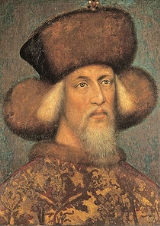
Sigismund, Holy Roman Emperor

Encyclopedia
Sigismund of Luxemburg KG
(Hungarian
: Zsigmond, Croatian
: Žigmund, Czech
: Zikmund) (14 February 1368 – 9 December 1437) was King of Hungary
, of Croatia
from 1387 to 1437, of Bohemia from 1419, and Holy Roman Emperor
for four years from 1433 until 1437, the last Emperor of the House of Luxemburg. He was also King of Italy from 1431, and of Germany from 1411. Sigismund was one of the driving forces behind the Council of Constance
that ended the Papal Schism
, but which in the end also led to the Hussite Wars
that dominated the later period of Sigismund's life. He was buried in Nagyvárad (now called Oradea, in Romania
) next to the tomb of the King Saint Ladislaus I of Hungary.
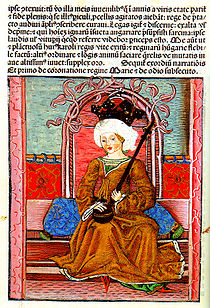 Born in Nuremberg
, Sigismund was the son of the Holy Roman Emperor
Charles IV
and of his fourth wife Elizabeth of Pomerania
, the granddaughter of King Casimir III of Poland
. King Louis the Great of Hungary and Poland always had a good and close relationship with Emperor Charles IV. Young Sigismund was sent to the Hungarian court, and soon learnt the Hungarian language and Hungarian way of life, and became entirely devoted to his adopted country. King Louis appointed Sigismund to succeed him as King of Hungary
; Louis named him his heir, and arranged the marriage with his eldest daughter Mary of Hungary. Accordingly, Sigismund was betrothed to Mary in 1374, who intended Mary to succeed him in the Kingdom of Poland with her future husband as was the custom of the time. Sigismund became Margrave of Brandenburg on his father's death in 1378.
In 1381, the then 13-year-old Sigismund was sent to Kraków
by his eldest brother and guardian Wenceslaus, King of the Romans
, to learn Polish
and to become acquainted with the land and its people. King Wenceslaus also gave him Neumark
to facilitate communication between Brandenburg and Poland.
The disagreement between Polish landlords of Lesser Poland
on one side and landlords of Greater Poland
on the other, regarding the choice of the future King of Poland finally ended in choosing the Lithuanian side and the support of the lords of Greater Poland was not enough to give Prince Sigismund the Crown. Instead, landlords of Lesser Poland gave it to Mary's younger sister Jadwiga I of Poland, who married Jogaila
of Lithuania.
). However she was captured, together with her mother who had acted as the Regent of Hungary, in the following year by the rebellious Horvathys, Bishop Paul of Machva, his brother Ivanish and younger brother Ladislaus. This followed an elaborate plan by the 17-year-old Sigismund himself, and his mother-in-law was strangled (allegedly by Sigismund's men) in January 1387. Mary was only rescued in June 1387 through the aid of the Venetians
(her first cousin once removed, King Stjepan Tvrtko I of Bosnia
, then became an honorary Venetian citizen) and she was apparently reconciled with the Horvathys. Mary never forgave Sigismund for the death of her beloved mother, despite his claim to have punished the murderers, and they subsequently lived separate lives and had separate households. She died in 1395 in a suspicious horse accident while heavily pregnant.
Having secured the support of the nobility, Sigismund was crowned King of Hungary
at Székesfehérvár
on 31 March 1387. Having raised money by pledging Brandenburg
to his cousin Jobst, margrave of Moravia
(1388), he was engaged for the next nine years in a ceaseless struggle for the possession of this unstable throne. It was not for entirely selfless reasons that one of the leagues of barons helped him to power: Sigismund had to pay for the support of the lords by transferring a sizeable part of the royal properties. (For some years, the baron's council governed the country in the name of the Holy Crown). The restoration of the authority of the central administration took decades of work. The bulk of the nation headed by the great Garai family was with him; but in the southern provinces between the Sava and the Drava
, the Horvathys with the support of King Tvrtko I of Bosnia
, Mary's maternal uncle, proclaimed as their king Ladislaus, king of Naples, son of the murdered Charles II of Hungary. Not until 1395 did Nicholas II Garay
succeed in suppressing them. To ease the pressure from Hungarian nobles, Sigismud tried to employ foreign advisors which was not popular and he had to promise to not give land and nominations to other than Hungarian nobles. However, this was not applied on Stibor of Stiboricz
that was Sigismunds closest friend and advisor. On a number of occasions, Sigismund was imprisoned by nobles, but with help of the armies of Garai and Stibor of Stiboricz, he could regain the power.
In 1396 Sigismund led the combined armies of Christendom against the Turks, who had taken advantage of the temporary helplessness of Hungary to extend their dominion to the banks of the Danube
. This crusade, preached by Pope Boniface IX
, was very popular in Hungary. The nobles flocked in thousands to the royal standard, and were reinforced by volunteers from nearly every part of Europe, the most important contingent being that of the French
led by John the Fearless, son of Philip II, Duke of Burgundy
. Sigismund set out with 90,000 men and a flotilla of 70 galleys. After capturing Vidin
, he camped with his Hungarian armies before the fortress of Nicopolis. Sultan Bayezid I
raised the siege of Constantinople and, at the head of 140,000 men, completely defeated the Christian
forces in the Battle of Nicopolis
fought between 25 and 28 September 1396. He returned across the sea and through the realm of Zeta
, where he ordained a local Serb lord Đurađ II with the islands of Hvar
and Korčula
for resistance against the Turks, which were returned to Sigismund after his death in April 1403.
The disaster in Nicopolis angered several Hungarian lords, which led to instability in the kingdom. Deprived of his authority in Hungary, Sigismund then turned his attention to securing the succession in Germany
and Bohemia
, and was recognized by his childless half-brother Wenceslaus IV
as Vicar-General of the whole Empire. However, he was unable to support Wenceslaus when he was deposed in 1400 and Rupert of Germany
, Elector Palatine, was elected German king in his stead.
On his return to Hungary in 1401, Sigismund, he was once imprisoned and twice deposed. In 1401 Sigismund assisted a rising against Wenceslaus, during the course of which the Bohemia
n king was made a prisoner, and Sigismund ruled Bohemia for nineteen months. He released Wenceslaus in 1403. In the meantime, a group of Hungarian noblemen swore loyalty the last Anjou monarch, Ladislaus of Naples, putting their hands over the relic of Saint Ladislas of Hungary in Nagyvárad. Ladislaus was the son of the murdered Charles II of Hungary, and thus a distant relative of the long dead King Louis I of Hungary. Ladislaus captured Zadar
in 1403, but soon stopped any military advance. This struggle in turn led to a war with the Republic of Venice
, as Ladislaus had sold the Dalmatia
n cities to the Venetians for 100,000 ducats before departing to his own land. In the following years Sigismund acted indirectly to thwart Ladislaus' attempts to conquer central Italy, by allying with the Italian cities resisting him and by putting diplomatic pressure against him.
In 1404 he introduced the Placetum Regium. According to this decree, Papal bull
s could not be pronounced in Hungary without the consent of the king.
In about 1406 he married Mary's cousin Barbara of Celje
(Barbara Celjska, nicknamed the "Messalina
of Germany"), daughter of Count Hermann II of Celje
. Hermann's mother Katarina Kotromanić (of the House of Kotromanic) and Mary's mother Queen Elizabeta (Elisabeth of Bosnia
) were sisters, or cousins who were adopted sisters. Tvrtko I was their first cousin and adopted brother, and perhaps even became heir apparent to Queen Mary. Tvrtko may have been murdered in 1391 on Sigismund's order.
He founded his personal order of knighthood, the Order of the Dragon
, after this victory. Members of the order were mostly his political allies and supporters. The most important European monarchs became members of the order. He encouraged international trade by abolishing internal duties, regulating tariffs on foreign goods and standardising weights and measures throughout the country. Due to his frequent absences attending to business in the other countries over which he ruled, he was obliged to consult Diets in Hungary with more frequency than his predecessors and institute the office of Palatine as chief administrator while he was away. During his long reign royal castle of Buda became probably the largest Gothic palace of the late Middle Ages.
he managed to establish control. He did not hesitate to use violent methods (see Bloody Sabor of Križevci
) but from the river Sava to the south his control was weak. Sigismund personally led an army of almost 50,000 "crusaders" against the Croats
and Bosnians
, which culminated in 1408 with the Battle of Dobor, and a massacre of about 200 noble
families, many of them victors of numerous battles against the Ottomans.
in 1410, Sigismund – ignoring the claims of his half-brother Wenceslaus – was elected as successor by three of the elector
s on 10 September 1410, but he was opposed by his cousin Jobst of Moravia
, who had been elected by four electors in a different election on 1 October. Jobst's death 18 January 1411 removed this conflict and Sigismund was again elected King on 21 July 1411. His coronation
was deferred until 8 November 1414, when it took place at Aachen
.
against Wladyslaw Jagiello of Poland. In return for 300.000 ducats he would attack Poland
from the south after the truce on St. John's Day, 24 June expired. Sigismund gave his most loyal friend Stibor of Stiboricz
order to set up the attack on Poland. Stibor of Stiboricz was of polish origin and from the main line of the powerful Clan of Ostoja
that also was against of choosing Jogaila as King of Poland in the beginning. With the support of Sigismund, Stibor become one of the most influential men in late medieval Europe, holding titles as Duke
of Transylvania
and owning about 25% of Slovakia
of today including 31 castles of which 15 were situated around the 406 km long Váh
river with surrounding land that was given to him by Sigismund. In the diplomatic struggle to prevent war between Poland-Lithiania, which was supported by the Russians, and the Teutonic Knights, Sigismund used Stibors fine diplomacy to gain financially. The Polish side appointed several negotiators and most of them were also from the Clan of Ostoja, being distantly related to the Stibors. However, those "family meetings" could not prevent the war and an alliance of twenty-two western states formed an army against Poland in the Battle of Grünwald
in July 1410. Stibor attacked then Nowy Sącz
and burned it down to the ground but after that, he returned with his army back home at the Beckov Castle
. After Polish victory in the Battle of Grunwald
, Teutonic knights had to pay huge sum of silver to Poland as reparation and again, through diplomacy of his friend Stibor, Sigismund could borrow all this silver from King Jogaila of Poland on good conditions. In the light of facts about the diplomatic work of Stibor and the Clan of Ostoja that was following the politics of King Sigismund, one can question if Sigismund really joined the anti-Polish alliance in reality.
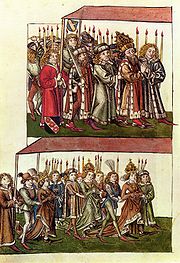
. The king took advantage of the difficulties of Antipope John XXIII
to obtain a promise that a council
should be called in Constance
in 1414 to settle the Western Schism
. He took a leading part in the deliberations of this assembly, and during the sittings made a journey to France
, England
and Burgundy
in a vain attempt to secure the abdication of the three rival popes. The council ended in 1418, solving the Schism and — of great consequence to Sigismund's future career — having the Czech
religious reformer, Jan Hus
, burned at the stake
for heresy
in July 1415. The complicity of Sigismund in the death of Hus is a matter of controversy. He had granted him a safe-conduct and protested against his imprisonment; and the reformer was burned during his absence.
It was also at this Council that a cardinal ventured to correct Sigismund's Latin
(he had construed the word schisma as feminine rather than neuter). To this Sigismund replied:
An alliance with England against France, and a failed attempt, owing to the hostility of the princes, to secure peace in Germany
by a league of the towns, were his main acts during these years. Also, Sigismund granted control of the Margraviate of Brandenburg
(which he had received back after Jobst's death) to Frederick I
of Hohenzollern, burgrave of Nuremberg
(1415). This step made the Hohenzollern family one of the most important in Germany.
Sigismund, Holy Roman Emperor began to shift his alliance from France to England after the French defeat at the Battle of Agincourt
. The Treaty of Canterbury (August 15, 1416) culminated diplomatic efforts between Henry V of England
and Sigismund and resulted in a defensive and offensive alliance against France. This, in turn, led the way to the resolution of the papal schism
.
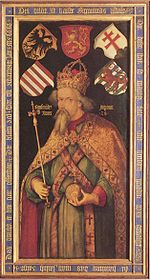
left Sigismund titular King of Bohemia, but he had to wait for seventeen years before the Czechs would acknowledge him. Although the two dignities of King of the Romans and King of Bohemia added considerably to his importance, and indeed made him the nominal temporal head of Christendom
, they conferred no increase of power and financially embarrassed him. It was only as King of Hungary
that he had succeeded in establishing his authority and in doing anything for the order and good government of the land. Entrusting the government of Bohemia
to Sofia of Bavaria
, the widow of Wenceslaus, he hastened into Hungary
.
The Bohemians, who distrusted him as the betrayer of Hus
, were soon in arms; and the flame was fanned when Sigismund declared his intention of prosecuting the war against heretics. Three campaigns against the Hussites ended in disaster although the army of his most loyal ally Stibor of Stiboricz
and later his son Stibor of Beckov could hold the hussite side away from the borders of the Kingdom. The Turks were again attacking Hungary. The king, unable to obtain support from the German
princes, was powerless in Bohemia
. His attempts at the diet of Nuremberg
in 1422 to raise a mercenary army were foiled by the resistance of the towns; and in 1424 the electors, among whom was Sigismund's former ally, Frederick I of Hohenzollern
, sought to strengthen their own authority at the expense of the king. Although the scheme failed, the danger to Germany from the Hussites led to the Union of Bingen, which virtually deprived Sigismund of the leadership of the war and the headship of Germany.
In 1428 he led another campaign against the Turks, but again with few results. In 1431 he went to Milan
where on 25 November he received the Iron Crown
; after which he remained for some time at Siena
, negotiating for his coronation
as emperor and for the recognition of the Council of Basel by Pope Eugenius IV. He was crowned emperor in Rome
on 31 May 1433, and after obtaining his demands from the Pope returned to Bohemia, where he was recognized as king in 1436, though his power was little more than nominal.
He died in 9 December 1437 at Znojmo
, Moravia
(now Czech Republic
), and as ordered in life, he was buried at Nagyvárad, Hungary
(today Oradea
, Romania
), next to the tomb of the king Saint Ladislaus I of Hungary, who was the ideal of the perfect monarch, warrior and Christian for that time and was deeply venerated by Sigismund. By his second wife, Barbara of Celje
, he left an only daughter, Elisabeth of Luxembourg, who was married to Albert V, duke of Austria
(later German king as Albert II) whom Sigismund named as his successor. As he left no sons his line of the House of Luxembourg
became extinct on his death.
child, probably a son, was born prematurely as a result of a horse riding accident suffered by Queen Mary of Hungary
when she was well advanced in pregnancy. Mother and child both died shortly after the birth in the hills of Buda
on 17 May 1395. This caused a deep succession crisis because Sigismund ruled over Hungary
by right of his wife, and although he managed to keep his power, the crisis lasted until his second marriage to Barbara of Celje
. Barbara's only child, born in the purple
on 7 October 1409, probably in the castle of Visegrád
, was Elisabeth of Luxembourg, the future queen consort
of Hungary, Germany and Bohemia. Queen Barbara was unable to give birth to any further issue. Elisabeth of Bohemia was thus the only surviving legitimate offspring of Sigismund.
, wore Hungarian style royal clothes and even grew his beard as the Hungarians.
He also spent huge amounts of money during his reign to rebuild the Gothic castles of Buda
and Visegrád
in the Kingdom of Hungary, ordering the transportation of materials from Austria and Bohemia.
His many affairs with maidens led to the birth of several legend
s, as the one that existed decades later during the reign of the King Matthias Corvinus of Hungary. According to this, John Hunyadi
was Sigismund's illegitimate son. Sigismund gave a ring to the boy's mother when he was born, but one day in the forest a raven stole it from her, and the ring was only recovered after the bird was hunted down. It is said that this incident inspired the coat of arms of the Hunyadi
s, and later also appeared in the coat of arms of Matthias "Corvinus".
Sigismund adopted the Hungarian reverence for Saint Ladislaus I of Hungary, who was considered to be an ideal Christian knight at that time. He went on pilgrimage several times to his tomb in Nagyvárad. Before Sigismund died, he ordered to be buried next to the king saint.
Order of the Garter
The Most Noble Order of the Garter, founded in 1348, is the highest order of chivalry, or knighthood, existing in England. The order is dedicated to the image and arms of St...
(Hungarian
Hungarian language
Hungarian is a Uralic language, part of the Ugric group. With some 14 million speakers, it is one of the most widely spoken non-Indo-European languages in Europe....
: Zsigmond, Croatian
Croatian language
Croatian is the collective name for the standard language and dialects spoken by Croats, principally in Croatia, Bosnia and Herzegovina, the Serbian province of Vojvodina and other neighbouring countries...
: Žigmund, Czech
Czech language
Czech is a West Slavic language with about 12 million native speakers; it is the majority language in the Czech Republic and spoken by Czechs worldwide. The language was known as Bohemian in English until the late 19th century...
: Zikmund) (14 February 1368 – 9 December 1437) was King of Hungary
King of Hungary
The King of Hungary was the head of state of the Kingdom of Hungary from 1000 to 1918.The style of title "Apostolic King" was confirmed by Pope Clement XIII in 1758 and used afterwards by all the Kings of Hungary, so after this date the kings are referred to as "Apostolic King of...
, of Croatia
Kingdom of Croatia (medieval)
The Kingdom of Croatia , also known as the Kingdom of the Croats , was a medieval kingdom covering most of what is today Croatia and Bosnia and Herzegovina in the Balkans.Established in 925, it ruled as a sovereign state for almost two centuries...
from 1387 to 1437, of Bohemia from 1419, and Holy Roman Emperor
Holy Roman Emperor
The Holy Roman Emperor is a term used by historians to denote a medieval ruler who, as German King, had also received the title of "Emperor of the Romans" from the Pope...
for four years from 1433 until 1437, the last Emperor of the House of Luxemburg. He was also King of Italy from 1431, and of Germany from 1411. Sigismund was one of the driving forces behind the Council of Constance
Council of Constance
The Council of Constance is the 15th ecumenical council recognized by the Roman Catholic Church, held from 1414 to 1418. The council ended the Three-Popes Controversy, by deposing or accepting the resignation of the remaining Papal claimants and electing Pope Martin V.The Council also condemned and...
that ended the Papal Schism
Western Schism
The Western Schism or Papal Schism was a split within the Catholic Church from 1378 to 1417. Two men simultaneously claimed to be the true pope. Driven by politics rather than any theological disagreement, the schism was ended by the Council of Constance . The simultaneous claims to the papal chair...
, but which in the end also led to the Hussite Wars
Hussite Wars
The Hussite Wars, also called the Bohemian Wars involved the military actions against and amongst the followers of Jan Hus in Bohemia in the period 1419 to circa 1434. The Hussite Wars were notable for the extensive use of early hand-held gunpowder weapons such as hand cannons...
that dominated the later period of Sigismund's life. He was buried in Nagyvárad (now called Oradea, in Romania
Romania
Romania is a country located at the crossroads of Central and Southeastern Europe, on the Lower Danube, within and outside the Carpathian arch, bordering on the Black Sea...
) next to the tomb of the King Saint Ladislaus I of Hungary.
Early life
Nuremberg
Nuremberg[p] is a city in the German state of Bavaria, in the administrative region of Middle Franconia. Situated on the Pegnitz river and the Rhine–Main–Danube Canal, it is located about north of Munich and is Franconia's largest city. The population is 505,664...
, Sigismund was the son of the Holy Roman Emperor
Holy Roman Emperor
The Holy Roman Emperor is a term used by historians to denote a medieval ruler who, as German King, had also received the title of "Emperor of the Romans" from the Pope...
Charles IV
Charles IV, Holy Roman Emperor
Charles IV , born Wenceslaus , was the second king of Bohemia from the House of Luxembourg, and the first king of Bohemia to also become Holy Roman Emperor....
and of his fourth wife Elizabeth of Pomerania
Elizabeth of Pomerania
Elizabeth of Pomerania was the fourth and final wife of Charles IV, Holy Roman Emperor and king of Bohemia. Her parents were Bogislaw V, Duke of Pomerania and Elizabeth of Poland,...
, the granddaughter of King Casimir III of Poland
Casimir III of Poland
Casimir III the Great , last King of Poland from the Piast dynasty , was the son of King Władysław I the Elbow-high and Hedwig of Kalisz.-Biography:...
. King Louis the Great of Hungary and Poland always had a good and close relationship with Emperor Charles IV. Young Sigismund was sent to the Hungarian court, and soon learnt the Hungarian language and Hungarian way of life, and became entirely devoted to his adopted country. King Louis appointed Sigismund to succeed him as King of Hungary
King of Hungary
The King of Hungary was the head of state of the Kingdom of Hungary from 1000 to 1918.The style of title "Apostolic King" was confirmed by Pope Clement XIII in 1758 and used afterwards by all the Kings of Hungary, so after this date the kings are referred to as "Apostolic King of...
; Louis named him his heir, and arranged the marriage with his eldest daughter Mary of Hungary. Accordingly, Sigismund was betrothed to Mary in 1374, who intended Mary to succeed him in the Kingdom of Poland with her future husband as was the custom of the time. Sigismund became Margrave of Brandenburg on his father's death in 1378.
In 1381, the then 13-year-old Sigismund was sent to Kraków
Kraków
Kraków also Krakow, or Cracow , is the second largest and one of the oldest cities in Poland. Situated on the Vistula River in the Lesser Poland region, the city dates back to the 7th century. Kraków has traditionally been one of the leading centres of Polish academic, cultural, and artistic life...
by his eldest brother and guardian Wenceslaus, King of the Romans
Wenceslaus, King of the Romans
Wenceslaus ) was, by election, German King from 1376 and, by inheritance, King of Bohemia from 1378. He was the third Bohemian and second German monarch of the Luxembourg dynasty...
, to learn Polish
Polish language
Polish is a language of the Lechitic subgroup of West Slavic languages, used throughout Poland and by Polish minorities in other countries...
and to become acquainted with the land and its people. King Wenceslaus also gave him Neumark
Neumark
Neumark comprised a region of the Prussian province of Brandenburg, Germany.Neumark may also refer to:* Neumark, Thuringia* Neumark, Saxony* Neumark * Nowe Miasto Lubawskie or Neumark, a town in Poland, situated at river Drwęca...
to facilitate communication between Brandenburg and Poland.
The disagreement between Polish landlords of Lesser Poland
Lesser Poland
Lesser Poland is one of the historical regions of Poland, with its capital in the city of Kraków. It forms the southeastern corner of the country, and should not be confused with the modern Lesser Poland Voivodeship, which covers only a small, southern part of Lesser Poland...
on one side and landlords of Greater Poland
Greater Poland
Greater Poland or Great Poland, often known by its Polish name Wielkopolska is a historical region of west-central Poland. Its chief city is Poznań.The boundaries of Greater Poland have varied somewhat throughout history...
on the other, regarding the choice of the future King of Poland finally ended in choosing the Lithuanian side and the support of the lords of Greater Poland was not enough to give Prince Sigismund the Crown. Instead, landlords of Lesser Poland gave it to Mary's younger sister Jadwiga I of Poland, who married Jogaila
Jogaila
Jogaila, later 'He is known under a number of names: ; ; . See also: Jogaila : names and titles. was Grand Duke of Lithuania , king consort of Kingdom of Poland , and sole King of Poland . He ruled in Lithuania from 1377, at first with his uncle Kęstutis...
of Lithuania.
King of Hungary
On the death of her father in 1382, his betrothed, Mary, became the Queen of Hungary and Sigismund married her in 1385 in Zólyom (today ZvolenZvolen
Zvolen |Slatina]] rivers, close to Banská Bystrica. With its ancient castle, the town has a historical center, which represents the seat of an okres .-History:...
). However she was captured, together with her mother who had acted as the Regent of Hungary, in the following year by the rebellious Horvathys, Bishop Paul of Machva, his brother Ivanish and younger brother Ladislaus. This followed an elaborate plan by the 17-year-old Sigismund himself, and his mother-in-law was strangled (allegedly by Sigismund's men) in January 1387. Mary was only rescued in June 1387 through the aid of the Venetians
Republic of Venice
The Republic of Venice or Venetian Republic was a state originating from the city of Venice in Northeastern Italy. It existed for over a millennium, from the late 7th century until 1797. It was formally known as the Most Serene Republic of Venice and is often referred to as La Serenissima, in...
(her first cousin once removed, King Stjepan Tvrtko I of Bosnia
Tvrtko I of Bosnia
Stjepan Tvrtko I was a ruler of medieval Bosnia. He ruled in 1353–1366 and again in 1367–1377 as Ban and in 1377–1391 as the first Bosnian King....
, then became an honorary Venetian citizen) and she was apparently reconciled with the Horvathys. Mary never forgave Sigismund for the death of her beloved mother, despite his claim to have punished the murderers, and they subsequently lived separate lives and had separate households. She died in 1395 in a suspicious horse accident while heavily pregnant.
Having secured the support of the nobility, Sigismund was crowned King of Hungary
King of Hungary
The King of Hungary was the head of state of the Kingdom of Hungary from 1000 to 1918.The style of title "Apostolic King" was confirmed by Pope Clement XIII in 1758 and used afterwards by all the Kings of Hungary, so after this date the kings are referred to as "Apostolic King of...
at Székesfehérvár
Székesfehérvár
Székesfehérvár is a city in central Hungary and is the 9th largest in the country. Located around southwest of Budapest. It is inhabited by 101,973 people , with 136,995 in the Székesfehérvár Subregion. The city is the centre of Fejér county and the regional centre of Central Transdanubia...
on 31 March 1387. Having raised money by pledging Brandenburg
Brandenburg
Brandenburg is one of the sixteen federal-states of Germany. It lies in the east of the country and is one of the new federal states that were re-created in 1990 upon the reunification of the former West Germany and East Germany. The capital is Potsdam...
to his cousin Jobst, margrave of Moravia
Jobst of Moravia
Jobst of Moravia, Jobst von Mähren from the House of Luxembourg was the eldest son of Margrave John Henry of Moravia, the younger brother of Emperor Charles IV....
(1388), he was engaged for the next nine years in a ceaseless struggle for the possession of this unstable throne. It was not for entirely selfless reasons that one of the leagues of barons helped him to power: Sigismund had to pay for the support of the lords by transferring a sizeable part of the royal properties. (For some years, the baron's council governed the country in the name of the Holy Crown). The restoration of the authority of the central administration took decades of work. The bulk of the nation headed by the great Garai family was with him; but in the southern provinces between the Sava and the Drava
Drava
Drava or Drave is a river in southern Central Europe, a tributary of the Danube. It sources in Toblach/Dobbiaco, Italy, and flows east through East Tirol and Carinthia in Austria, into Slovenia , and then southeast, passing through Croatia and forming most of the border between Croatia and...
, the Horvathys with the support of King Tvrtko I of Bosnia
Tvrtko I of Bosnia
Stjepan Tvrtko I was a ruler of medieval Bosnia. He ruled in 1353–1366 and again in 1367–1377 as Ban and in 1377–1391 as the first Bosnian King....
, Mary's maternal uncle, proclaimed as their king Ladislaus, king of Naples, son of the murdered Charles II of Hungary. Not until 1395 did Nicholas II Garay
Nicholas II Garay
Nicholas II Garay was the ban of Mačva, Usora, Soli , Slavonia, Croatia, and Dalmatia. He also ruled Braničevo, Syrmia, Bačka, Banat and Baranya regions through vassals. In 1416 Sigismund extended their armorial bearings showing the Order of the Dragon and the Order of the Scarf...
succeed in suppressing them. To ease the pressure from Hungarian nobles, Sigismud tried to employ foreign advisors which was not popular and he had to promise to not give land and nominations to other than Hungarian nobles. However, this was not applied on Stibor of Stiboricz
Stibor of Stiboricz
Stibor of Stiboricz of Ostoja coat of arms was an aristocrat of Polish origin in the Kingdom of Hungary. He was a close friend of King Sigismund of Hungary who appointed him to several offices during his reign. For instance, between 1395 and 1401, then from 1409 to 1414 he was the voivode of...
that was Sigismunds closest friend and advisor. On a number of occasions, Sigismund was imprisoned by nobles, but with help of the armies of Garai and Stibor of Stiboricz, he could regain the power.
In 1396 Sigismund led the combined armies of Christendom against the Turks, who had taken advantage of the temporary helplessness of Hungary to extend their dominion to the banks of the Danube
Danube
The Danube is a river in the Central Europe and the Europe's second longest river after the Volga. It is classified as an international waterway....
. This crusade, preached by Pope Boniface IX
Pope Boniface IX
Pope Boniface IX , born Piero Tomacelli, was the second Roman Pope of the Western Schism from November 2, 1389, until October 1, 1404...
, was very popular in Hungary. The nobles flocked in thousands to the royal standard, and were reinforced by volunteers from nearly every part of Europe, the most important contingent being that of the French
France
The French Republic , The French Republic , The French Republic , (commonly known as France , is a unitary semi-presidential republic in Western Europe with several overseas territories and islands located on other continents and in the Indian, Pacific, and Atlantic oceans. Metropolitan France...
led by John the Fearless, son of Philip II, Duke of Burgundy
Philip II, Duke of Burgundy
Philip the Bold , also Philip II, Duke of Burgundy , was the fourth and youngest son of King John II of France and his wife, Bonne of Luxembourg. By his marriage to Margaret III, Countess of Flanders, he also became Count Philip II of Flanders, Count Philip IV of Artois and Count-Palatine Philip IV...
. Sigismund set out with 90,000 men and a flotilla of 70 galleys. After capturing Vidin
Vidin
Vidin is a port town on the southern bank of the Danube in northwestern Bulgaria. It is close to the borders with Serbia and Romania, and is also the administrative centre of Vidin Province, as well as of the Metropolitan of Vidin...
, he camped with his Hungarian armies before the fortress of Nicopolis. Sultan Bayezid I
Bayezid I
Bayezid I was the Sultan of the Ottoman Empire, from 1389 to 1402. He was the son of Murad I and Valide Sultan Gülçiçek Hatun.-Biography:Bayezid was born in Edirne and spent his youth in Bursa, where he received a high-level education...
raised the siege of Constantinople and, at the head of 140,000 men, completely defeated the Christian
Christianity
Christianity is a monotheistic religion based on the life and teachings of Jesus as presented in canonical gospels and other New Testament writings...
forces in the Battle of Nicopolis
Battle of Nicopolis
The Battle of Nicopolis took place on 25 September 1396 and resulted in the rout of an allied army of Hungarian, Wallachian, French, Burgundian, German and assorted troops at the hands of an Ottoman force, raising of the siege of the Danubian fortress of Nicopolis and leading to the end of the...
fought between 25 and 28 September 1396. He returned across the sea and through the realm of Zeta
Principality of Zeta
Zeta was a medieval state, which territory encompassed parts of present-day Montenegro and Northernwestern Albania. From 1360. to 1421. Zeta was independent state administered by local noble family Balšić. From 1185. to 1360. and from 1421. - 1451, Zeta was province of medieval Serbia...
, where he ordained a local Serb lord Đurađ II with the islands of Hvar
Hvar
- Climate :The climate of Hvar is characterized by mild winters and warm summers. The yearly average air temperature is , 686 mm of precipitation fall on the town of Hvar on average every year and the town has a total of 2800 sunshine hours per year. For comparison Hvar has an average of 7.7...
and Korčula
Korcula
Korčula is an island in the Adriatic Sea, in the Dubrovnik-Neretva County of Croatia. The island has an area of ; long and on average wide — and lies just off the Dalmatian coast. Its 16,182 inhabitants make it the second most populous Adriatic island after Krk...
for resistance against the Turks, which were returned to Sigismund after his death in April 1403.
The disaster in Nicopolis angered several Hungarian lords, which led to instability in the kingdom. Deprived of his authority in Hungary, Sigismund then turned his attention to securing the succession in Germany
Germany
Germany , officially the Federal Republic of Germany , is a federal parliamentary republic in Europe. The country consists of 16 states while the capital and largest city is Berlin. Germany covers an area of 357,021 km2 and has a largely temperate seasonal climate...
and Bohemia
Bohemia
Bohemia is a historical region in central Europe, occupying the western two-thirds of the traditional Czech Lands. It is located in the contemporary Czech Republic with its capital in Prague...
, and was recognized by his childless half-brother Wenceslaus IV
Wenceslaus, King of the Romans
Wenceslaus ) was, by election, German King from 1376 and, by inheritance, King of Bohemia from 1378. He was the third Bohemian and second German monarch of the Luxembourg dynasty...
as Vicar-General of the whole Empire. However, he was unable to support Wenceslaus when he was deposed in 1400 and Rupert of Germany
Rupert of Germany
Rupert of Germany from the House of Wittelsbach was Elector Palatine from 1398 and German King from 1400 until his death...
, Elector Palatine, was elected German king in his stead.
On his return to Hungary in 1401, Sigismund, he was once imprisoned and twice deposed. In 1401 Sigismund assisted a rising against Wenceslaus, during the course of which the Bohemia
Bohemia
Bohemia is a historical region in central Europe, occupying the western two-thirds of the traditional Czech Lands. It is located in the contemporary Czech Republic with its capital in Prague...
n king was made a prisoner, and Sigismund ruled Bohemia for nineteen months. He released Wenceslaus in 1403. In the meantime, a group of Hungarian noblemen swore loyalty the last Anjou monarch, Ladislaus of Naples, putting their hands over the relic of Saint Ladislas of Hungary in Nagyvárad. Ladislaus was the son of the murdered Charles II of Hungary, and thus a distant relative of the long dead King Louis I of Hungary. Ladislaus captured Zadar
Zadar
Zadar is a city in Croatia on the Adriatic Sea. It is the centre of Zadar county and the wider northern Dalmatian region. Population of the city is 75,082 citizens...
in 1403, but soon stopped any military advance. This struggle in turn led to a war with the Republic of Venice
Republic of Venice
The Republic of Venice or Venetian Republic was a state originating from the city of Venice in Northeastern Italy. It existed for over a millennium, from the late 7th century until 1797. It was formally known as the Most Serene Republic of Venice and is often referred to as La Serenissima, in...
, as Ladislaus had sold the Dalmatia
Dalmatia
Dalmatia is a historical region on the eastern coast of the Adriatic Sea. It stretches from the island of Rab in the northwest to the Bay of Kotor in the southeast. The hinterland, the Dalmatian Zagora, ranges from fifty kilometers in width in the north to just a few kilometers in the south....
n cities to the Venetians for 100,000 ducats before departing to his own land. In the following years Sigismund acted indirectly to thwart Ladislaus' attempts to conquer central Italy, by allying with the Italian cities resisting him and by putting diplomatic pressure against him.
In 1404 he introduced the Placetum Regium. According to this decree, Papal bull
Papal bull
A Papal bull is a particular type of letters patent or charter issued by a Pope of the Catholic Church. It is named after the bulla that was appended to the end in order to authenticate it....
s could not be pronounced in Hungary without the consent of the king.
In about 1406 he married Mary's cousin Barbara of Celje
Barbara of Celje
Barbara of Cilli was the spouse of Holy Roman Emperor Sigismund and as such Holy Roman Empress. She was by marriage also Queen of Hungary and Bohemia and also Holy Roman Empress. She received the sobriquet "Messalina of Germany" for her political intrigues, and was instrumental in creating the...
(Barbara Celjska, nicknamed the "Messalina
Messalina
Valeria Messalina, sometimes spelled Messallina, was a Roman empress as the third wife of the Emperor Claudius. She was also a paternal cousin of the Emperor Nero, second cousin of the Emperor Caligula, and great-grandniece of the Emperor Augustus...
of Germany"), daughter of Count Hermann II of Celje
Hermann II of Celje
Hermann II was a Count of Celje and Ban of Croatia, Slavonia and Dalmatia. Hermann was the son of Hermann I, Count of Cilli and his wife Katherine of Bosnia.Hermann II married Countess Anna of Schaunberg in c...
. Hermann's mother Katarina Kotromanić (of the House of Kotromanic) and Mary's mother Queen Elizabeta (Elisabeth of Bosnia
Elisabeth of Bosnia
Elizabeth of Bosnia was Queen of Hungary from 1353 until 1382 and Queen of Poland from 1370 until 1382 as the second wife of King Louis the Great. After her tenure as queen consort, Elizabeth served as regent for her daughter Mary.As queen consort, Elizabeth was overshadowed by her domineering...
) were sisters, or cousins who were adopted sisters. Tvrtko I was their first cousin and adopted brother, and perhaps even became heir apparent to Queen Mary. Tvrtko may have been murdered in 1391 on Sigismund's order.
He founded his personal order of knighthood, the Order of the Dragon
Order of the Dragon
The Order of the Dragon was a monarchical chivalric order for selected nobility,founded in 1408 by Sigismund, King of Hungary and later Holy Roman Emperor The Order of the Dragon (Latin Societas Draconistrarum) was a monarchical chivalric order for selected nobility,founded in 1408 by Sigismund,...
, after this victory. Members of the order were mostly his political allies and supporters. The most important European monarchs became members of the order. He encouraged international trade by abolishing internal duties, regulating tariffs on foreign goods and standardising weights and measures throughout the country. Due to his frequent absences attending to business in the other countries over which he ruled, he was obliged to consult Diets in Hungary with more frequency than his predecessors and institute the office of Palatine as chief administrator while he was away. During his long reign royal castle of Buda became probably the largest Gothic palace of the late Middle Ages.
King of Croatia
In SlavoniaSlavonia
Slavonia is a geographical and historical region in eastern Croatia...
he managed to establish control. He did not hesitate to use violent methods (see Bloody Sabor of Križevci
Bloody Sabor of Križevci
Bloody Sabor of Križevci or Bloody Parliament Session or Križevci Bloody Assembly was organised killing of the Croatian ban Stjepan Lacković and his followers by King Sigismund, in Križevci, Croatia on 27 February 1397.-The Prelude:...
) but from the river Sava to the south his control was weak. Sigismund personally led an army of almost 50,000 "crusaders" against the Croats
Croats
Croats are a South Slavic ethnic group mostly living in Croatia, Bosnia and Herzegovina and nearby countries. There are around 4 million Croats living inside Croatia and up to 4.5 million throughout the rest of the world. Responding to political, social and economic pressure, many Croats have...
and Bosnians
Bosnians
Bosnians are people who reside in, or come from, Bosnia and Herzegovina. By the modern state definition a Bosnian can be anyone who holds citizenship of the state. This includes, but is not limited to, members of the constituent ethnic groups of Bosnia and Herzegovina: Bosniaks, Bosnian Serbs and...
, which culminated in 1408 with the Battle of Dobor, and a massacre of about 200 noble
Nobility
Nobility is a social class which possesses more acknowledged privileges or eminence than members of most other classes in a society, membership therein typically being hereditary. The privileges associated with nobility may constitute substantial advantages over or relative to non-nobles, or may be...
families, many of them victors of numerous battles against the Ottomans.
King of the Romans
After the death of King Rupert of GermanyRupert of Germany
Rupert of Germany from the House of Wittelsbach was Elector Palatine from 1398 and German King from 1400 until his death...
in 1410, Sigismund – ignoring the claims of his half-brother Wenceslaus – was elected as successor by three of the elector
Prince-elector
The Prince-electors of the Holy Roman Empire were the members of the electoral college of the Holy Roman Empire, having the function of electing the Roman king or, from the middle of the 16th century onwards, directly the Holy Roman Emperor.The heir-apparent to a prince-elector was known as an...
s on 10 September 1410, but he was opposed by his cousin Jobst of Moravia
Jobst of Moravia
Jobst of Moravia, Jobst von Mähren from the House of Luxembourg was the eldest son of Margrave John Henry of Moravia, the younger brother of Emperor Charles IV....
, who had been elected by four electors in a different election on 1 October. Jobst's death 18 January 1411 removed this conflict and Sigismund was again elected King on 21 July 1411. His coronation
Coronation
A coronation is a ceremony marking the formal investiture of a monarch and/or their consort with regal power, usually involving the placement of a crown upon their head and the presentation of other items of regalia...
was deferred until 8 November 1414, when it took place at Aachen
Aachen
Aachen has historically been a spa town in North Rhine-Westphalia, Germany. Aachen was a favoured residence of Charlemagne, and the place of coronation of the Kings of Germany. Geographically, Aachen is the westernmost town of Germany, located along its borders with Belgium and the Netherlands, ...
.
Anti-Polish alliances
On a number of occasions, and in 1410 in particular, Sigismund allied himself with the Teutonic KnightsTeutonic Knights
The Order of Brothers of the German House of Saint Mary in Jerusalem , commonly the Teutonic Order , is a German medieval military order, in modern times a purely religious Catholic order...
against Wladyslaw Jagiello of Poland. In return for 300.000 ducats he would attack Poland
Poland
Poland , officially the Republic of Poland , is a country in Central Europe bordered by Germany to the west; the Czech Republic and Slovakia to the south; Ukraine, Belarus and Lithuania to the east; and the Baltic Sea and Kaliningrad Oblast, a Russian exclave, to the north...
from the south after the truce on St. John's Day, 24 June expired. Sigismund gave his most loyal friend Stibor of Stiboricz
Stibor of Stiboricz
Stibor of Stiboricz of Ostoja coat of arms was an aristocrat of Polish origin in the Kingdom of Hungary. He was a close friend of King Sigismund of Hungary who appointed him to several offices during his reign. For instance, between 1395 and 1401, then from 1409 to 1414 he was the voivode of...
order to set up the attack on Poland. Stibor of Stiboricz was of polish origin and from the main line of the powerful Clan of Ostoja
Clan of Ostoja
The Clan of Ostoja was a powerful group of Knights and Lords in late medieval Europe. The clan encompassed several families in the Polish-Lithuanian Commonwealth, Upper Hungary , Hungary, Transylvania, Belorus, Ukraine and Prussia....
that also was against of choosing Jogaila as King of Poland in the beginning. With the support of Sigismund, Stibor become one of the most influential men in late medieval Europe, holding titles as Duke
Duke
A duke or duchess is a member of the nobility, historically of highest rank below the monarch, and historically controlling a duchy...
of Transylvania
Transylvania
Transylvania is a historical region in the central part of Romania. Bounded on the east and south by the Carpathian mountain range, historical Transylvania extended in the west to the Apuseni Mountains; however, the term sometimes encompasses not only Transylvania proper, but also the historical...
and owning about 25% of Slovakia
Slovakia
The Slovak Republic is a landlocked state in Central Europe. It has a population of over five million and an area of about . Slovakia is bordered by the Czech Republic and Austria to the west, Poland to the north, Ukraine to the east and Hungary to the south...
of today including 31 castles of which 15 were situated around the 406 km long Váh
Váh
The Váh is the longest river in entire Slovakia. A left tributary of the Danube river, the Váh is 406 km long, including its Čierny Váh branch...
river with surrounding land that was given to him by Sigismund. In the diplomatic struggle to prevent war between Poland-Lithiania, which was supported by the Russians, and the Teutonic Knights, Sigismund used Stibors fine diplomacy to gain financially. The Polish side appointed several negotiators and most of them were also from the Clan of Ostoja, being distantly related to the Stibors. However, those "family meetings" could not prevent the war and an alliance of twenty-two western states formed an army against Poland in the Battle of Grünwald
Battle of Grunwald
The Battle of Grunwald or 1st Battle of Tannenberg was fought on 15 July 1410, during the Polish–Lithuanian–Teutonic War. The alliance of the Kingdom of Poland and the Grand Duchy of Lithuania, led respectively by King Jogaila and Grand Duke Vytautas , decisively defeated the Teutonic Knights, led...
in July 1410. Stibor attacked then Nowy Sącz
Nowy Sacz
Nowy Sącz is a town in the Lesser Poland Voivodeship in southern Poland. It is the district capital of Nowy Sącz County, but is not included within the powiat.-Names:...
and burned it down to the ground but after that, he returned with his army back home at the Beckov Castle
Beckov Castle
Beckov Castle is a castle in ruins located near the village of Beckov in Nové Mesto nad Váhom District, Trenčín Region, western Slovakia.It is a natural cultural monument and its present appearance is the result of renovations in the last quarter of the 20th century and since 2002.-Great...
. After Polish victory in the Battle of Grunwald
Battle of Grunwald
The Battle of Grunwald or 1st Battle of Tannenberg was fought on 15 July 1410, during the Polish–Lithuanian–Teutonic War. The alliance of the Kingdom of Poland and the Grand Duchy of Lithuania, led respectively by King Jogaila and Grand Duke Vytautas , decisively defeated the Teutonic Knights, led...
, Teutonic knights had to pay huge sum of silver to Poland as reparation and again, through diplomacy of his friend Stibor, Sigismund could borrow all this silver from King Jogaila of Poland on good conditions. In the light of facts about the diplomatic work of Stibor and the Clan of Ostoja that was following the politics of King Sigismund, one can question if Sigismund really joined the anti-Polish alliance in reality.
Council of Constance
In 1412 – 23 he campaigned against the Venetians in ItalyItaly
Italy , officially the Italian Republic languages]] under the European Charter for Regional or Minority Languages. In each of these, Italy's official name is as follows:;;;;;;;;), is a unitary parliamentary republic in South-Central Europe. To the north it borders France, Switzerland, Austria and...
. The king took advantage of the difficulties of Antipope John XXIII
Antipope John XXIII
Baldassarre Cossa was Pope John XXIII during the Western Schism. The Catholic Church regards him as an antipope.-Biography:...
to obtain a promise that a council
Council of Constance
The Council of Constance is the 15th ecumenical council recognized by the Roman Catholic Church, held from 1414 to 1418. The council ended the Three-Popes Controversy, by deposing or accepting the resignation of the remaining Papal claimants and electing Pope Martin V.The Council also condemned and...
should be called in Constance
Constance
Constance is a female given name that derives from Latin and means "constant." Variations of the name include Connie, Constancia, Constanze, Constanza, Stanzy, and Konstanze.Constance may refer to:-People:*Constance Bennett , American actress...
in 1414 to settle the Western Schism
Western Schism
The Western Schism or Papal Schism was a split within the Catholic Church from 1378 to 1417. Two men simultaneously claimed to be the true pope. Driven by politics rather than any theological disagreement, the schism was ended by the Council of Constance . The simultaneous claims to the papal chair...
. He took a leading part in the deliberations of this assembly, and during the sittings made a journey to France
France
The French Republic , The French Republic , The French Republic , (commonly known as France , is a unitary semi-presidential republic in Western Europe with several overseas territories and islands located on other continents and in the Indian, Pacific, and Atlantic oceans. Metropolitan France...
, England
England
England is a country that is part of the United Kingdom. It shares land borders with Scotland to the north and Wales to the west; the Irish Sea is to the north west, the Celtic Sea to the south west, with the North Sea to the east and the English Channel to the south separating it from continental...
and Burgundy
Kingdom of Burgundy
Burgundy is a historic region in Western Europe that has existed as a political entity in a number of forms with very different boundaries. Two of these entities - the first around the 6th century, the second around the 11th century - have been called the Kingdom of Burgundy; a third was very...
in a vain attempt to secure the abdication of the three rival popes. The council ended in 1418, solving the Schism and — of great consequence to Sigismund's future career — having the Czech
Czech people
Czechs, or Czech people are a western Slavic people of Central Europe, living predominantly in the Czech Republic. Small populations of Czechs also live in Slovakia, Austria, the United States, the United Kingdom, Chile, Argentina, Canada, Germany, Russia and other countries...
religious reformer, Jan Hus
Jan Hus
Jan Hus , often referred to in English as John Hus or John Huss, was a Czech priest, philosopher, reformer, and master at Charles University in Prague...
, burned at the stake
Execution by burning
Death by burning is death brought about by combustion. As a form of capital punishment, burning has a long history as a method in crimes such as treason, heresy, and witchcraft....
for heresy
Heresy
Heresy is a controversial or novel change to a system of beliefs, especially a religion, that conflicts with established dogma. It is distinct from apostasy, which is the formal denunciation of one's religion, principles or cause, and blasphemy, which is irreverence toward religion...
in July 1415. The complicity of Sigismund in the death of Hus is a matter of controversy. He had granted him a safe-conduct and protested against his imprisonment; and the reformer was burned during his absence.
It was also at this Council that a cardinal ventured to correct Sigismund's Latin
Latin
Latin is an Italic language originally spoken in Latium and Ancient Rome. It, along with most European languages, is a descendant of the ancient Proto-Indo-European language. Although it is considered a dead language, a number of scholars and members of the Christian clergy speak it fluently, and...
(he had construed the word schisma as feminine rather than neuter). To this Sigismund replied:
An alliance with England against France, and a failed attempt, owing to the hostility of the princes, to secure peace in Germany
Germany
Germany , officially the Federal Republic of Germany , is a federal parliamentary republic in Europe. The country consists of 16 states while the capital and largest city is Berlin. Germany covers an area of 357,021 km2 and has a largely temperate seasonal climate...
by a league of the towns, were his main acts during these years. Also, Sigismund granted control of the Margraviate of Brandenburg
Margraviate of Brandenburg
The Margraviate of Brandenburg was a major principality of the Holy Roman Empire from 1157 to 1806. Also known as the March of Brandenburg , it played a pivotal role in the history of Germany and Central Europe....
(which he had received back after Jobst's death) to Frederick I
Frederick I, Elector of Brandenburg
Frederick was Burgrave of Nuremberg as Frederick VI and Elector of Brandenburg as Frederick I. He was a son of Burgrave Frederick V of Nuremberg and Elisabeth of Meissen, and was the first member of the House of Hohenzollern to rule the Margraviate of Brandenburg.- Biography :Frederick entered...
of Hohenzollern, burgrave of Nuremberg
Nuremberg
Nuremberg[p] is a city in the German state of Bavaria, in the administrative region of Middle Franconia. Situated on the Pegnitz river and the Rhine–Main–Danube Canal, it is located about north of Munich and is Franconia's largest city. The population is 505,664...
(1415). This step made the Hohenzollern family one of the most important in Germany.
Sigismund, Holy Roman Emperor began to shift his alliance from France to England after the French defeat at the Battle of Agincourt
Battle of Agincourt
The Battle of Agincourt was a major English victory against a numerically superior French army in the Hundred Years' War. The battle occurred on Friday, 25 October 1415 , near modern-day Azincourt, in northern France...
. The Treaty of Canterbury (August 15, 1416) culminated diplomatic efforts between Henry V of England
Henry V of England
Henry V was King of England from 1413 until his death at the age of 35 in 1422. He was the second monarch belonging to the House of Lancaster....
and Sigismund and resulted in a defensive and offensive alliance against France. This, in turn, led the way to the resolution of the papal schism
Western Schism
The Western Schism or Papal Schism was a split within the Catholic Church from 1378 to 1417. Two men simultaneously claimed to be the true pope. Driven by politics rather than any theological disagreement, the schism was ended by the Council of Constance . The simultaneous claims to the papal chair...
.
Hussite Wars
In 1419, the death of Wenceslaus IVWenceslaus, King of the Romans
Wenceslaus ) was, by election, German King from 1376 and, by inheritance, King of Bohemia from 1378. He was the third Bohemian and second German monarch of the Luxembourg dynasty...
left Sigismund titular King of Bohemia, but he had to wait for seventeen years before the Czechs would acknowledge him. Although the two dignities of King of the Romans and King of Bohemia added considerably to his importance, and indeed made him the nominal temporal head of Christendom
Christianity
Christianity is a monotheistic religion based on the life and teachings of Jesus as presented in canonical gospels and other New Testament writings...
, they conferred no increase of power and financially embarrassed him. It was only as King of Hungary
King of Hungary
The King of Hungary was the head of state of the Kingdom of Hungary from 1000 to 1918.The style of title "Apostolic King" was confirmed by Pope Clement XIII in 1758 and used afterwards by all the Kings of Hungary, so after this date the kings are referred to as "Apostolic King of...
that he had succeeded in establishing his authority and in doing anything for the order and good government of the land. Entrusting the government of Bohemia
Bohemia
Bohemia is a historical region in central Europe, occupying the western two-thirds of the traditional Czech Lands. It is located in the contemporary Czech Republic with its capital in Prague...
to Sofia of Bavaria
Sofia of Bavaria
Sophia of Bavaria was a Queen of Bohemia and the spouse of Wenceslaus, King of Bohemia and King of the Romans. She was briefly regent of Bohemia after the death of Wenceslaus.- Family and early life:...
, the widow of Wenceslaus, he hastened into Hungary
Kingdom of Hungary
The Kingdom of Hungary comprised present-day Hungary, Slovakia and Croatia , Transylvania , Carpatho Ruthenia , Vojvodina , Burgenland , and other smaller territories surrounding present-day Hungary's borders...
.
The Bohemians, who distrusted him as the betrayer of Hus
Jan Hus
Jan Hus , often referred to in English as John Hus or John Huss, was a Czech priest, philosopher, reformer, and master at Charles University in Prague...
, were soon in arms; and the flame was fanned when Sigismund declared his intention of prosecuting the war against heretics. Three campaigns against the Hussites ended in disaster although the army of his most loyal ally Stibor of Stiboricz
Stibor of Stiboricz
Stibor of Stiboricz of Ostoja coat of arms was an aristocrat of Polish origin in the Kingdom of Hungary. He was a close friend of King Sigismund of Hungary who appointed him to several offices during his reign. For instance, between 1395 and 1401, then from 1409 to 1414 he was the voivode of...
and later his son Stibor of Beckov could hold the hussite side away from the borders of the Kingdom. The Turks were again attacking Hungary. The king, unable to obtain support from the German
Germany
Germany , officially the Federal Republic of Germany , is a federal parliamentary republic in Europe. The country consists of 16 states while the capital and largest city is Berlin. Germany covers an area of 357,021 km2 and has a largely temperate seasonal climate...
princes, was powerless in Bohemia
Bohemia
Bohemia is a historical region in central Europe, occupying the western two-thirds of the traditional Czech Lands. It is located in the contemporary Czech Republic with its capital in Prague...
. His attempts at the diet of Nuremberg
Nuremberg
Nuremberg[p] is a city in the German state of Bavaria, in the administrative region of Middle Franconia. Situated on the Pegnitz river and the Rhine–Main–Danube Canal, it is located about north of Munich and is Franconia's largest city. The population is 505,664...
in 1422 to raise a mercenary army were foiled by the resistance of the towns; and in 1424 the electors, among whom was Sigismund's former ally, Frederick I of Hohenzollern
Frederick I, Elector of Brandenburg
Frederick was Burgrave of Nuremberg as Frederick VI and Elector of Brandenburg as Frederick I. He was a son of Burgrave Frederick V of Nuremberg and Elisabeth of Meissen, and was the first member of the House of Hohenzollern to rule the Margraviate of Brandenburg.- Biography :Frederick entered...
, sought to strengthen their own authority at the expense of the king. Although the scheme failed, the danger to Germany from the Hussites led to the Union of Bingen, which virtually deprived Sigismund of the leadership of the war and the headship of Germany.
In 1428 he led another campaign against the Turks, but again with few results. In 1431 he went to Milan
Milan
Milan is the second-largest city in Italy and the capital city of the region of Lombardy and of the province of Milan. The city proper has a population of about 1.3 million, while its urban area, roughly coinciding with its administrative province and the bordering Province of Monza and Brianza ,...
where on 25 November he received the Iron Crown
Iron Crown of Lombardy
The Iron Crown of Lombardy is both a reliquary and one of the most ancient royal insignia of Europe. The crown became one of the symbols of the Kingdom of Lombards and later of the medieval Kingdom of Italy...
; after which he remained for some time at Siena
Siena
Siena is a city in Tuscany, Italy. It is the capital of the province of Siena.The historic centre of Siena has been declared by UNESCO a World Heritage Site. It is one of the nation's most visited tourist attractions, with over 163,000 international arrivals in 2008...
, negotiating for his coronation
Coronation
A coronation is a ceremony marking the formal investiture of a monarch and/or their consort with regal power, usually involving the placement of a crown upon their head and the presentation of other items of regalia...
as emperor and for the recognition of the Council of Basel by Pope Eugenius IV. He was crowned emperor in Rome
Rome
Rome is the capital of Italy and the country's largest and most populated city and comune, with over 2.7 million residents in . The city is located in the central-western portion of the Italian Peninsula, on the Tiber River within the Lazio region of Italy.Rome's history spans two and a half...
on 31 May 1433, and after obtaining his demands from the Pope returned to Bohemia, where he was recognized as king in 1436, though his power was little more than nominal.
He died in 9 December 1437 at Znojmo
Znojmo
Znojmo is a city in the South Moravian Region of the Czech Republic, near the border with Lower Austria, connected to Vienna by railway and road . The royal city of Znojmo was founded shortly before 1226 by King Ottokar I on the plains in front of Znojmo Castle...
, Moravia
Moravia
Moravia is a historical region in Central Europe in the east of the Czech Republic, and one of the former Czech lands, together with Bohemia and Silesia. It takes its name from the Morava River which rises in the northwest of the region...
(now Czech Republic
Czech Republic
The Czech Republic is a landlocked country in Central Europe. The country is bordered by Poland to the northeast, Slovakia to the east, Austria to the south, and Germany to the west and northwest....
), and as ordered in life, he was buried at Nagyvárad, Hungary
Kingdom of Hungary
The Kingdom of Hungary comprised present-day Hungary, Slovakia and Croatia , Transylvania , Carpatho Ruthenia , Vojvodina , Burgenland , and other smaller territories surrounding present-day Hungary's borders...
(today Oradea
Oradea
Oradea is the capital city of Bihor County, in the Crișana region of north-western Romania. The city has a population of 204,477, according to the 2009 estimates. The wider Oradea metropolitan area has a total population of 245,832.-Geography:...
, Romania
Romania
Romania is a country located at the crossroads of Central and Southeastern Europe, on the Lower Danube, within and outside the Carpathian arch, bordering on the Black Sea...
), next to the tomb of the king Saint Ladislaus I of Hungary, who was the ideal of the perfect monarch, warrior and Christian for that time and was deeply venerated by Sigismund. By his second wife, Barbara of Celje
Barbara of Celje
Barbara of Cilli was the spouse of Holy Roman Emperor Sigismund and as such Holy Roman Empress. She was by marriage also Queen of Hungary and Bohemia and also Holy Roman Empress. She received the sobriquet "Messalina of Germany" for her political intrigues, and was instrumental in creating the...
, he left an only daughter, Elisabeth of Luxembourg, who was married to Albert V, duke of Austria
Albert II of Germany
Albert the Magnanimous KG was King of Hungary from 1438 until his death. He was also King of Bohemia, elected King of Germany as Albert II, duke of Luxembourg and, as Albert V, archduke of Austria from 1404.-Biography:Albert was born in Vienna as the son of Albert IV, Duke of Austria, and Johanna...
(later German king as Albert II) whom Sigismund named as his successor. As he left no sons his line of the House of Luxembourg
House of Luxembourg
The House of Luxembourg was a late medieval German dynasty, which between 1308 and 1437 ruled the Holy Roman Empire, twice interrupted by the rivaling House of Wittelsbach.-History:...
became extinct on his death.
Family and Issue
Sigismund married twice but had little luck in securing the succession to his crowns. Each of his two marriages resulted in the birth of one child. His first-bornChildbirth
Childbirth is the culmination of a human pregnancy or gestation period with the birth of one or more newborn infants from a woman's uterus...
child, probably a son, was born prematurely as a result of a horse riding accident suffered by Queen Mary of Hungary
Mary of Hungary
Mary of Anjou was queen regnant of Hungary from 1382 until her death in 1395.-Childhood:...
when she was well advanced in pregnancy. Mother and child both died shortly after the birth in the hills of Buda
Buda
For detailed information see: History of Buda CastleBuda is the western part of the Hungarian capital Budapest on the west bank of the Danube. The name Buda takes its name from the name of Bleda the Hun ruler, whose name is also Buda in Hungarian.Buda comprises about one-third of Budapest's...
on 17 May 1395. This caused a deep succession crisis because Sigismund ruled over Hungary
Kingdom of Hungary
The Kingdom of Hungary comprised present-day Hungary, Slovakia and Croatia , Transylvania , Carpatho Ruthenia , Vojvodina , Burgenland , and other smaller territories surrounding present-day Hungary's borders...
by right of his wife, and although he managed to keep his power, the crisis lasted until his second marriage to Barbara of Celje
Barbara of Celje
Barbara of Cilli was the spouse of Holy Roman Emperor Sigismund and as such Holy Roman Empress. She was by marriage also Queen of Hungary and Bohemia and also Holy Roman Empress. She received the sobriquet "Messalina of Germany" for her political intrigues, and was instrumental in creating the...
. Barbara's only child, born in the purple
Born in the purple
Traditionally, born in the purple was a term used to describe members of royal families although the term was later expanded to include all children born of prominent or high ranking parents. The parents must be prominent at the time of the child's birth so that the child is always in the spotlight...
on 7 October 1409, probably in the castle of Visegrád
Visegrád
Visegrád is a small castle town in Pest County, Hungary.Situated north of Budapest on the right bank of the Danube in the Danube Bend, Visegrád has a population 1,654 as of 2001...
, was Elisabeth of Luxembourg, the future queen consort
Queen consort
A queen consort is the wife of a reigning king. A queen consort usually shares her husband's rank and holds the feminine equivalent of the king's monarchical titles. Historically, queens consort do not share the king regnant's political and military powers. Most queens in history were queens consort...
of Hungary, Germany and Bohemia. Queen Barbara was unable to give birth to any further issue. Elisabeth of Bohemia was thus the only surviving legitimate offspring of Sigismund.
Hungarian affiliations
Sigismund was known to speak fluent HungarianHungarian language
Hungarian is a Uralic language, part of the Ugric group. With some 14 million speakers, it is one of the most widely spoken non-Indo-European languages in Europe....
, wore Hungarian style royal clothes and even grew his beard as the Hungarians.
He also spent huge amounts of money during his reign to rebuild the Gothic castles of Buda
Buda Castle
Buda Castle is the historical castle and palace complex of the Hungarian kings in Budapest, first completed in 1265. In the past, it was also called Royal Palace and Royal Castle ....
and Visegrád
Visegrád
Visegrád is a small castle town in Pest County, Hungary.Situated north of Budapest on the right bank of the Danube in the Danube Bend, Visegrád has a population 1,654 as of 2001...
in the Kingdom of Hungary, ordering the transportation of materials from Austria and Bohemia.
His many affairs with maidens led to the birth of several legend
Legend
A legend is a narrative of human actions that are perceived both by teller and listeners to take place within human history and to possess certain qualities that give the tale verisimilitude...
s, as the one that existed decades later during the reign of the King Matthias Corvinus of Hungary. According to this, John Hunyadi
John Hunyadi
John Hunyadi John Hunyadi (Hungarian: Hunyadi János , Medieval Latin: Ioannes Corvinus or Ioannes de Hunyad, Romanian: Iancu (Ioan) de Hunedoara, Croatian: Janko Hunjadi, Serbian: Сибињанин Јанко / Sibinjanin Janko, Slovak: Ján Huňady) John Hunyadi (Hungarian: Hunyadi János , Medieval Latin: ...
was Sigismund's illegitimate son. Sigismund gave a ring to the boy's mother when he was born, but one day in the forest a raven stole it from her, and the ring was only recovered after the bird was hunted down. It is said that this incident inspired the coat of arms of the Hunyadi
Hunyadi family
The Hunyadi family was a Hungarian noble family strongest in the Late Middle Ages. Their probable Romanian origins are claimed by medieval authors and by many modern historians....
s, and later also appeared in the coat of arms of Matthias "Corvinus".
Sigismund adopted the Hungarian reverence for Saint Ladislaus I of Hungary, who was considered to be an ideal Christian knight at that time. He went on pilgrimage several times to his tomb in Nagyvárad. Before Sigismund died, he ordered to be buried next to the king saint.
Ancestors
Titles
Holy Roman Emperor; King of the Romans, Hungary, Bohemia, Italy, Dalmatia, Croatia, Rama, Serbia, Galicia, Lodomeria, Cumania and Bulgaria; Prince of Silesia and Luxembourg; Margrave of Moravia, Lusatia and Brandenburg.See also
- Kings of Germany family tree.
- St. Nicholas’ Deanery Church, Znojmo
- Stibor of StiboriczStibor of StiboriczStibor of Stiboricz of Ostoja coat of arms was an aristocrat of Polish origin in the Kingdom of Hungary. He was a close friend of King Sigismund of Hungary who appointed him to several offices during his reign. For instance, between 1395 and 1401, then from 1409 to 1414 he was the voivode of...
- Clan of OstojaClan of OstojaThe Clan of Ostoja was a powerful group of Knights and Lords in late medieval Europe. The clan encompassed several families in the Polish-Lithuanian Commonwealth, Upper Hungary , Hungary, Transylvania, Belorus, Ukraine and Prussia....
In popular culture
Sigismund has been portrayed in several films by different actors.- MirceaMircea (film)Mircea is a 1989 film about Mircea I of Wallachia, the Christian king of Wallachia who repelled the attempts at conquest made by the Ottoman Empire in the late 1300s and early 1400s...
(19891989 in film-Events:* Batman is released on June 23, and goes on to gross over $410 million worldwide.* Actress Kim Basinger and her brother Mick purchase Braselton, Georgia, for $20 million...
) - John Hus (19771977 in filmThe year 1977 in film involved some significant events.-Events:*In the Academy Awards, Peter Finch, Faye Dunaway and Beatrice Straight win Best Actor and Actress and Supporting Actress awards for Network....
) - The WhoreThe Whore (2010 film)The Whore is a 2010 television film adaptation of a novel by the same name. The film is set in Konstanz, Germany in the years 1414 and 1415.The novel was written by Iny Lorentz...
(20102010 in filmThe year 2010 saw many new films released worldwide. 2010 saw a dramatic increase and prominence in the use of 3D-technology in filmmaking and film releases after the success of Avatar in the format, with releases such as Alice in Wonderland, Clash of the Titans, Jackass 3D, all animated films and...
), played by Götz OttoGötz OttoGötz Otto is a German actor known for his very tall stature. He is 198 cm tall and is often characterised by bleached blonde hair in his films....