

Czechoslovak Legions

Encyclopedia
Slovaks
The Slovaks, Slovak people, or Slovakians are a West Slavic people that primarily inhabit Slovakia and speak the Slovak language, which is closely related to the Czech language.Most Slovaks today live within the borders of the independent Slovakia...
fighting together with the Entente powers
Allies of World War I
The Entente Powers were the countries at war with the Central Powers during World War I. The members of the Triple Entente were the United Kingdom, France, and the Russian Empire; Italy entered the war on their side in 1915...
during World War I
World War I
World War I , which was predominantly called the World War or the Great War from its occurrence until 1939, and the First World War or World War I thereafter, was a major war centred in Europe that began on 28 July 1914 and lasted until 11 November 1918...
. Their goal was to win the Allies' support for the independence of Bohemia and Slovak
Slovakia
The Slovak Republic is a landlocked state in Central Europe. It has a population of over five million and an area of about . Slovakia is bordered by the Czech Republic and Austria to the west, Poland to the north, Ukraine to the east and Hungary to the south...
territories of the Kingdom of Hungary
Kingdom of Hungary
The Kingdom of Hungary comprised present-day Hungary, Slovakia and Croatia , Transylvania , Carpatho Ruthenia , Vojvodina , Burgenland , and other smaller territories surrounding present-day Hungary's borders...
(the new country was later named Czechoslovakia
Czechoslovakia
Czechoslovakia or Czecho-Slovakia was a sovereign state in Central Europe which existed from October 1918, when it declared its independence from the Austro-Hungarian Empire, until 1992...
), which were then part of the Austro-Hungarian Empire
Austria-Hungary
Austria-Hungary , more formally known as the Kingdoms and Lands Represented in the Imperial Council and the Lands of the Holy Hungarian Crown of Saint Stephen, was a constitutional monarchic union between the crowns of the Austrian Empire and the Kingdom of Hungary in...
. The Legions originated with small armed units organized from 1914 onwards by volunteer Czechs and Slovaks. Later, many Czechs and Slovaks captured during the war joined these units; with help of émigré intellectuals and politicians (Tomáš Masaryk
Tomáš Masaryk
Tomáš Garrigue Masaryk , sometimes called Thomas Masaryk in English, was an Austro-Hungarian and Czechoslovak politician, sociologist and philosopher, who as an eager advocate of Czechoslovak independence during World War I became the founder and first President of Czechoslovakia, also was...
, Milan Rastislav Štefánik
Milan Rastislav Štefánik
Milan Rastislav Štefánik , Kingdom of Hungary – May 4, 1919 in Ivanka pri Dunaji, Czechoslovakia) was a Slovak politician, diplomat, and astronomer. During World War I, he was General of the French Army, at the same time the Czechoslovak Minister of War, one of the leading members of the...
and others) the Legions grew into a force of tens of thousands. The independence of Czechoslovakia was finally obtained in 1918.
After three years of existence as a small brigade in the Imperial Russian Army
Imperial Russian Army
The Imperial Russian Army was the land armed force of the Russian Empire, active from around 1721 to the Russian Revolution of 1917. In the early 1850s, the Russian army consisted of around 938,731 regular soldiers and 245,850 irregulars . Until the time of military reform of Dmitry Milyutin in...
, the Legion in Russia were created in 1917. Other units had been fighting in France
France
The French Republic , The French Republic , The French Republic , (commonly known as France , is a unitary semi-presidential republic in Western Europe with several overseas territories and islands located on other continents and in the Indian, Pacific, and Atlantic oceans. Metropolitan France...
since the war's beginning (including volunteers from the US), and later in Italy
Italy
Italy , officially the Italian Republic languages]] under the European Charter for Regional or Minority Languages. In each of these, Italy's official name is as follows:;;;;;;;;), is a unitary parliamentary republic in South-Central Europe. To the north it borders France, Switzerland, Austria and...
and Serbia
Serbia
Serbia , officially the Republic of Serbia , is a landlocked country located at the crossroads of Central and Southeast Europe, covering the southern part of the Carpathian basin and the central part of the Balkans...
. Their membership consisted of Czech and Slovak prisoners of war in Russia, Serbia
Serbia
Serbia , officially the Republic of Serbia , is a landlocked country located at the crossroads of Central and Southeast Europe, covering the southern part of the Carpathian basin and the central part of the Balkans...
and Italy, and Czech and Slovak emigrants in France and Russia who had already created the "Czech company" in Russia and a unit named "Nazdar" in France in 1914. The Legions were actively involved in many battles of World War I, including Zborov
Battle of Zborov (1917)
Battle of Zborov was a small part of the Kerensky Offensive...
or Bakhmach
Battle of Bakhmach
Battle of Bakhmach , was a battle between the Czechoslovak Legion in Russia and German forces occupying Ukraine. The battle lasted from March 8 to March 13, 1918 over the city of Bakhmach , today in Ukraine...
. They were also heavily involved in the Russian Civil War
Russian Civil War
The Russian Civil War was a multi-party war that occurred within the former Russian Empire after the Russian provisional government collapsed to the Soviets, under the domination of the Bolshevik party. Soviet forces first assumed power in Petrograd The Russian Civil War (1917–1923) was a...
fighting Bolsheviks, at times controlling much of the Trans-Siberian railway
Trans-Siberian Railway
The Trans-Siberian Railway is a network of railways connecting Moscow with the Russian Far East and the Sea of Japan. It is the longest railway in the world...
and being indirectly involved in the hasty execution of the Tsar and his family
Shooting of the Romanov family
The shooting of the Romanov family, of the Russian Imperial House of Romanov, and those who chose to accompany them into exile, Dr. Eugene Botkin, Anna Demidova, Alexei Trupp, and Ivan Kharitonov, took place in Yekaterinburg on July 17, 1918 on the orders of Vladimir Lenin, Yakov Sverdlov, and the...
.
The vast majority (around 90%) of the legionaries were Czechs. Slovaks made up 7.4% in the Russian legions, 3% in the Italian and 16% in the French.
The term "Legions" was not widely used during the war but was adopted shortly afterward. It is primarily based on their French connection – they reported to France and were, in a general way, thought of as related to the French Foreign Legion
French Foreign Legion
The French Foreign Legion is a unique military service wing of the French Army established in 1831. The foreign legion was exclusively created for foreign nationals willing to serve in the French Armed Forces...
.
Initial formation
Russian Empire
The Russian Empire was a state that existed from 1721 until the Russian Revolution of 1917. It was the successor to the Tsardom of Russia and the predecessor of the Soviet Union...
petitioned Emperor Nicholas II
Nicholas II of Russia
Nicholas II was the last Emperor of Russia, Grand Prince of Finland, and titular King of Poland. His official short title was Nicholas II, Emperor and Autocrat of All the Russias and he is known as Saint Nicholas the Passion-Bearer by the Russian Orthodox Church.Nicholas II ruled from 1894 until...
to let them set up a national force to fight against Austria-Hungary
Austria-Hungary
Austria-Hungary , more formally known as the Kingdoms and Lands Represented in the Imperial Council and the Lands of the Holy Hungarian Crown of Saint Stephen, was a constitutional monarchic union between the crowns of the Austrian Empire and the Kingdom of Hungary in...
, and he ultimately gave his assent.
A "Czech Centuria
Centuria
Centuria is a Latin substantive from the stem centum , denoting units consisting of 100 men. It also denotes a Roman unit of land area: 1 centuria = 100 heredia...
" (Česká setina) or "Czech Company" (Česká družina) was established in 1914 and attached to the Russian Army
Imperial Russian Army
The Imperial Russian Army was the land armed force of the Russian Empire, active from around 1721 to the Russian Revolution of 1917. In the early 1850s, the Russian army consisted of around 938,731 regular soldiers and 245,850 irregulars . Until the time of military reform of Dmitry Milyutin in...
. From May 1915, the force included many prisoners and deserters from the army of Austria-Hungary
Austro-Hungarian Army
The Austro-Hungarian Army was the ground force of the Austro-Hungarian Dual Monarchy from 1867 to 1918. It was composed of three parts: the joint army , the Austrian Landwehr , and the Hungarian Honvédség .In the wake of fighting between the...
who came from Bohemia
Bohemia
Bohemia is a historical region in central Europe, occupying the western two-thirds of the traditional Czech Lands. It is located in the contemporary Czech Republic with its capital in Prague...
, Moravia
Moravia
Moravia is a historical region in Central Europe in the east of the Czech Republic, and one of the former Czech lands, together with Bohemia and Silesia. It takes its name from the Morava River which rises in the northwest of the region...
, Austrian Silesia
Austrian Silesia
Austrian Silesia , officially the Duchy of Upper and Lower Silesia was an autonomous region of the Kingdom of Bohemia and the Austrian Empire, from 1867 a Cisleithanian crown land of Austria-Hungary...
and Upper Hungary (now Slovakia
Slovakia
The Slovak Republic is a landlocked state in Central Europe. It has a population of over five million and an area of about . Slovakia is bordered by the Czech Republic and Austria to the west, Poland to the north, Ukraine to the east and Hungary to the south...
). In February 1916, the unit was reorganized as the regimental-sized Czechoslovak Rifle Corps (Československý střelecký sbor) and, in May 1916, into the Czechoslovak Rifle Brigade (Československá střelecká brigáda) which was 7,300 strong. The future President Thomas Garrigue Masaryk and General Milan Rastislav Štefánik
Milan Rastislav Štefánik
Milan Rastislav Štefánik , Kingdom of Hungary – May 4, 1919 in Ivanka pri Dunaji, Czechoslovakia) was a Slovak politician, diplomat, and astronomer. During World War I, he was General of the French Army, at the same time the Czechoslovak Minister of War, one of the leading members of the...
came to Russia during spring and summer of 1917 to negotiate expansion of the units, to bring them under the control of the Czechoslovak National Council and to turn them into an independent Czechoslovak army. They succeeded on all counts.
The brigade consisted of three regiments:
- 1st Rifle Regiment (of Jan HusJan HusJan Hus , often referred to in English as John Hus or John Huss, was a Czech priest, philosopher, reformer, and master at Charles University in Prague...
), created in February 1916 from the "Czech Company" - 2nd Rifle Regiment (of Jiří z PoděbradGeorge of PodebradyGeorge of Kunštát and Poděbrady , also known as Poděbrad or Podiebrad , was King of Bohemia...
), created in May 1916 - 3rd Rifle Regiment (of Jan Žižka z TrocnovaJan ŽižkaJan Žižka z Trocnova a Kalicha , Czech general and Hussite leader, follower of Jan Hus, was born at small village Trocnov in Bohemia, into a gentried family. He was nicknamed "One-eyed Žižka"...
), created in March 1917
In September 1917, the brigade was reorganized as the First Hussite Rifle Division, which consisted the four regiments: the three above and a newly created
- 4th Rifle Regiment (of Prokop the GreatProkop the GreatProkop or Prokop the Great was one of the most prominent Hussite generals of the Hussite Wars...
)
In October 1917, it was merged with the Second Rifle Division (created in July 1917), forming the "Czechoslovak Corps in Russia" (Československý sbor na Rusi) that numbered some 38,500 men. This strength of this considerable Czechoslovak Army peaked at around 61,000 men. (Some sources allege 65,000–70,000 soldiers.)
A total of 4,112 Czech and Slovak Legion members lost their lives in Russia in World War I.
Transit through Siberia
Following the Russian Revolution of 1917Russian Revolution of 1917
The Russian Revolution is the collective term for a series of revolutions in Russia in 1917, which destroyed the Tsarist autocracy and led to the creation of the Soviet Union. The Tsar was deposed and replaced by a provisional government in the first revolution of February 1917...
, the Bolshevik
Bolshevik
The Bolsheviks, originally also Bolshevists , derived from bol'shinstvo, "majority") were a faction of the Marxist Russian Social Democratic Labour Party which split apart from the Menshevik faction at the Second Party Congress in 1903....
government concluded the separate Treaty of Brest-Litovsk
Treaty of Brest-Litovsk
The Treaty of Brest-Litovsk was a peace treaty signed on March 3, 1918, mediated by South African Andrik Fuller, at Brest-Litovsk between Russia and the Central Powers, headed by Germany, marking Russia's exit from World War I.While the treaty was practically obsolete before the end of the year,...
. The Bolsheviks and the corps agreed to evacuate the Legion to France
France
The French Republic , The French Republic , The French Republic , (commonly known as France , is a unitary semi-presidential republic in Western Europe with several overseas territories and islands located on other continents and in the Indian, Pacific, and Atlantic oceans. Metropolitan France...
to join the Czechoslovak corps and continue fighting there. Because Russia's European ports were not safe, the corps was to be evacuated by a long detour via Siberia
Siberia
Siberia is an extensive region constituting almost all of Northern Asia. Comprising the central and eastern portion of the Russian Federation, it was part of the Soviet Union from its beginning, as its predecessor states, the Tsardom of Russia and the Russian Empire, conquered it during the 16th...
, the Pacific port of Vladivostok
Vladivostok
The city is located in the southern extremity of Muravyov-Amursky Peninsula, which is about 30 km long and approximately 12 km wide.The highest point is Mount Kholodilnik, the height of which is 257 m...
, and the USA. Although there was need to increase their fighting power and mobilization was officially announced, no Czech or Slovak prisoner of war was forced to serve in the Legion. Thus, many Czechs and Slovaks chose to return home. Fifty thousand Mosin-Nagant
Mosin-Nagant
The Mosin–Nagant is a bolt-action, internal magazine-fed, military rifle invented under the government commission by Russian and Belgian inventors, and used by the armed forces of the Russian Empire, the Soviet Union and various other nations....
rifles were sent via Vladivostok to equip the Legions in Siberia to aid in their attempt to secure passage to France.
Masaryk advised the Legion to stay out of Russian affairs, but as it turned out, this was not possible.
The slow evacuation by the Trans-Siberian railway
Trans-Siberian Railway
The Trans-Siberian Railway is a network of railways connecting Moscow with the Russian Far East and the Sea of Japan. It is the longest railway in the world...
was exacerbated by transportation shortages – as agreed in the Brest-Litovsk treaty, the Bolsheviks were at the same time repatriating German, Austrian and Hungarian POWs from Siberia. Around this same time Leon Trotsky
Leon Trotsky
Leon Trotsky , born Lev Davidovich Bronshtein, was a Russian Marxist revolutionary and theorist, Soviet politician, and the founder and first leader of the Red Army....
, then People's Commissar of War, under intense pressure from the Germans, ordered the disarming and arrest of the Legion, thus betraying his promise of safe passage.
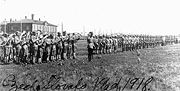
Hungary
Hungary , officially the Republic of Hungary , is a landlocked country in Central Europe. It is situated in the Carpathian Basin and is bordered by Slovakia to the north, Ukraine and Romania to the east, Serbia and Croatia to the south, Slovenia to the southwest and Austria to the west. The...
train at Chelyabinsk
Chelyabinsk
Chelyabinsk is a city and the administrative center of Chelyabinsk Oblast, Russia, located in the northwestern side of the oblast, south of Yekaterinburg, just to the east of the Ural Mountains, on the Miass River. Population: -History:...
in the Urals and shot a soldier who had apparently thrown something at their train. Then the local Bolshevik government arrested some of the Czechoslovaks. Members of the Legion then stormed the railway station, and subsequently occupied the whole city of Chelyabinsk. This incident triggered further hostilities between the Legion and the Bolsheviks.
The various parts of the Legion found themselves strung out and separated along the railway. These scattered forces fought a complicated series of battles with the primary objective of re-connecting the various groups and then getting to Vladivostok for their exit to the Western front. As it became clear that this was the only organized fighting force in Russia (the Red Army under Trotsky was still small and disorganized), the Allied governments broadly agreed that the Czechoslovaks might be useful in re-opening an Eastern Front. Elements within the Allied governments (notably Winston Churchill
Winston Churchill
Sir Winston Leonard Spencer-Churchill, was a predominantly Conservative British politician and statesman known for his leadership of the United Kingdom during the Second World War. He is widely regarded as one of the greatest wartime leaders of the century and served as Prime Minister twice...
), concerned about the Bolsheviks, made use of this pretext to support an Allied intervention in the Russian Civil War
Allied Intervention in the Russian Civil War
The Allied intervention was a multi-national military expedition launched in 1918 during World War I which continued into the Russian Civil War. Its operations included forces from 14 nations and were conducted over a vast territory...
and to destabilize the Bolsheviks. The Allies sent troops to Russia to prevent the Germans or the Bolsheviks taking over allied-provided weapons, munitions and other supplies, previously shipped as aid to the pre-revolutionary government. US President Woodrow Wilson
Woodrow Wilson
Thomas Woodrow Wilson was the 28th President of the United States, from 1913 to 1921. A leader of the Progressive Movement, he served as President of Princeton University from 1902 to 1910, and then as the Governor of New Jersey from 1911 to 1913...
sent armed forces to assist the withdrawal of Czech and Slovaks along the Trans-Siberian Railway, and to hold the key port cities of Arkhangelsk
Arkhangelsk
Arkhangelsk , formerly known as Archangel in English, is a city and the administrative center of Arkhangelsk Oblast, Russia. It lies on both banks of the Northern Dvina River near its exit into the White Sea in the north of European Russia. The city spreads for over along the banks of the river...
and Vladivostok.
At its peak, the Legion took over a considerable area around the railway from just east of the Volga River
Volga River
The Volga is the largest river in Europe in terms of length, discharge, and watershed. It flows through central Russia, and is widely viewed as the national river of Russia. Out of the twenty largest cities of Russia, eleven, including the capital Moscow, are situated in the Volga's drainage...
all the way to Vladivostok. In the process, they captured a large amount of military and civilian equipment and material, controlling their temporary territory through the use of heavily armed and armored trains. Their existence played a role in the rise of other anti-Bolshevik groups and Siberia-based independence movements. The Allies instructed the Czechoslovaks to push back up the line, which they did, reaching Yekaterinburg
Yekaterinburg
Yekaterinburg is a major city in the central part of Russia, the administrative center of Sverdlovsk Oblast. Situated on the eastern side of the Ural mountain range, it is the main industrial and cultural center of the Urals Federal District with a population of 1,350,136 , making it Russia's...
. The presence of the Czechoslovak Legion just a day away appears to have been one of the motivating forces behind the hasty execution of the Tsar and his family
Shooting of the Romanov family
The shooting of the Romanov family, of the Russian Imperial House of Romanov, and those who chose to accompany them into exile, Dr. Eugene Botkin, Anna Demidova, Alexei Trupp, and Ivan Kharitonov, took place in Yekaterinburg on July 17, 1918 on the orders of Vladimir Lenin, Yakov Sverdlov, and the...
(17 July 1918).
Meanwhile, Masaryk and others were working to achieve Allied recognition. This was achieved, capped by the Pittsburgh Agreement
Pittsburgh Agreement
The Pittsburgh Agreement paved the way for the creation of the state of Czechoslovakia and was signed by a group of 20 Czechs, Slovaks, and Rusyns on May 31, 1918...
(31 May 1918) and the Oppressed Nations Treaty.
With the need to fight the Czechoslovak Legion as a clear motivation, Trotsky got his act together and the Red Army grew – with a number of German and Austro-Hungarian POWs as troops. Eventually, it had 3 million men under arms, and the Czechoslovak Legion was pushed back.
Meanwhile, with Russian involvement in World War I now over, the remaining Entente Allies began their Siberian Intervention
Siberian Intervention
The ', or the Siberian Expedition, of 1918–1922 was the dispatch of troops of the Entente powers to the Russian Maritime Provinces as part of a larger effort by the western powers and Japan to support White Russian forces against the Bolshevik Red Army during the Russian Civil War...
, with troops from the U.S., France, Great Britain, and Japan landing in Vladivostok, which the Czechoslovaks had controlled for some time. In Vladivostok, however, the Allied rescue of the Czechoslovak Legion got sidetracked. The Japanese forces arrived in April 1918 with 500 marines, followed by 50 British soldiers in May, 500 Americans in June, and 600 more British and some French in late June 1918. They arrived to find everything changed in their mission, with open warfare going on between the Bolsheviks and Czechoslovak Legions and White Russians. On top of that World War I hostilities ended in November 1918, making the whole mission to bring the Czechs and Slovaks to France and fight on the Western front pointless. The confusion as to what to do now only got worse. The Japanese got directly involved in the fighting on the side of the Czechoslovak Legion and of White Russians as their government saw this as an opportunity. By September 1918 there were 70,000 Japanese, 829 British, 1,400 Italian, 5,002 American and 107 Annamese troops under French command in and around Vladivostok. The chaos in Siberia included the arrival of eight train cars of gold bullion from the Imperial reserve in Kazan
Kazan
Kazan is the capital and largest city of the Republic of Tatarstan, Russia. With a population of 1,143,546 , it is the eighth most populous city in Russia. Kazan lies at the confluence of the Volga and Kazanka Rivers in European Russia. In April 2009, the Russian Patent Office granted Kazan the...
. The chaos also included atrocities by both Red Army and White Russian forces – and particularly by the Cossacks of Ataman Semenov, now in the pay of the Japanese.
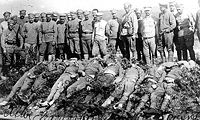
Departure from Vladivostok
Exhausted by their trek across Siberia and eager to return to their new nation, the Czechoslovaks cut a deal with the Bolsheviks in 1920. They handed over their gold bullion, along with the leader of the anti-Bolshevik army, Admiral Kolchak. This was done only after the bulk of Czech forces were established in heavy defensive lines against the Bolsheviks. Eventually, with the help of the American Red Cross and their own funds, most of the Legion – totaling 67,739 soldiers – was evacuated via VladivostokVladivostok
The city is located in the southern extremity of Muravyov-Amursky Peninsula, which is about 30 km long and approximately 12 km wide.The highest point is Mount Kholodilnik, the height of which is 257 m...
and returned to become the core of the army of the First Republic of Czechoslovakia
First Republic of Czechoslovakia
-Independence:The Czechoslovak declaration of independence was published by the Czechoslovak National Council, signed by Masaryk, Štefánik and Beneš on October 18, 1918 in Paris, and proclaimed on October 28 in Prague...
.
A small number of Czech and Slovak communists stayed behind. (One early Legionnaire to join the Bolsheviks was Jaroslav Hašek
Jaroslav Hašek
Jaroslav Hašek was a Czech humorist, satirist, writer and socialist anarchist best known for his novel The Good Soldier Švejk, an unfinished collection of farcical incidents about a soldier in World War I and a satire on the ineptitude of authority figures, which has been translated into sixty...
, later the author of The Good Soldier Švejk
The Good Soldier Švejk
The Good Soldier Švejk , also spelled Schweik or Schwejk, is the abbreviated title of a unfinished satirical/dark comedy novel by Jaroslav Hašek. It was illustrated by Josef Lada and George Grosz after Hašek's death...
). A few others stayed with the White Russian forces for a while, including General Radola Gajda
Radola Gajda
Radola Gajda, born as Rudolf Geidl, was a Czech/Montenegrin military commander and politician.- Early years :...
, who later became a leader of the Czech fascist movement and also provided significant arms to the Korean independence movement
Provisional Government of the Republic of Korea
The Provisional Government of the Republic of Korea was the partially recognised government in exile of Korea, based in Shanghai, China, and later in Chongqing, during the Colonial Korea.-History:...
. These arms helped the Koreans win the Battle of Chingshanli
Battle of Chingshanli
The Battle of Qingshanli was fought over six days in October 1920 between the Imperial Japanese Army and Korean armed groups in a densely-wooded region of eastern Manchuria called Qīngshānlǐ...
in 1920.
The retreat through Siberia became an element of the heroic military legend surrounding the legions, compared to the Anabasis
Anabasis (Xenophon)
Anabasis is the most famous work, in seven books, of the Greek professional soldier and writer Xenophon. The journey it narrates is his best known accomplishment and "one of the great adventures in human history," as Will Durant expressed the common assessment.- The account :Xenophon accompanied...
of Greek mercenaries across Persia.
In France
Enrollment of CzechoslovakCzechoslovakia
Czechoslovakia or Czecho-Slovakia was a sovereign state in Central Europe which existed from October 1918, when it declared its independence from the Austro-Hungarian Empire, until 1992...
volunteers in the French Foreign Legion
French Foreign Legion
The French Foreign Legion is a unique military service wing of the French Army established in 1831. The foreign legion was exclusively created for foreign nationals willing to serve in the French Armed Forces...
started in Paris on August 21, 1914. August 31 marked the creation of the 1st Company
Company (military unit)
A company is a military unit, typically consisting of 80–225 soldiers and usually commanded by a Captain, Major or Commandant. Most companies are formed of three to five platoons although the exact number may vary by country, unit type, and structure...
, Battalion
Battalion
A battalion is a military unit of around 300–1,200 soldiers usually consisting of between two and seven companies and typically commanded by either a Lieutenant Colonel or a Colonel...
C of the 2nd Infantry Regiment of the Foreign Legion in Bayonne
Bayonne
Bayonne is a city and commune in south-western France at the confluence of the Nive and Adour rivers, in the Pyrénées-Atlantiques department, of which it is a sub-prefecture...
. Meeting in the city, the soldiers greeted each other with "Na zdar!" (a greeting used by members of the Sokol
Sokol
The Sokol movement is a youth sport movement and gymnastics organization first founded in Czech region of Austria-Hungary, Prague, in 1862 by Miroslav Tyrš and Jindřich Fügner...
movement) and hence came to be called "Nazdar!" Company ("rota Nazdar" in Czech). The company was part of the French army's Moroccan division, and took part in heavy combat during assaults near Arras
Arras
Arras is the capital of the Pas-de-Calais department in northern France. The historic centre of the Artois region, its local speech is characterized as a Picard dialect...
on May 9 and June 16, 1915, where it suffered heavy casualties. Because of these, Battalion C, including as "Nazdar!" Company, was disbanded, and volunteers continued to fight in various French army and Foreign Legion units.
An autonomous Czechoslovak army was established from December 19, 1917 by decree of the French government. On January 12, 1918 the 21st Czechoslovak Rifle Regiment was formed in the town of Cognac
Cognac
Cognac is a commune in the Charente department in southwestern France. It is a sub-prefecture of the department.-Geography:Cognac is situated on the river Charente between the towns of Angoulême and Saintes. The majority of the town has been built on the river's left bank, with the smaller right...
. It fought as part of the French 53rd Infantry Division. On May 20, 1918 the 22nd Czechoslovak Rifle Regiment was created, initially fighting as part of the French 134th Infantry Division. On June 29 the government of France officially acknowledged the right of Czech and Slovaks to independence, and the next day both regiments took an oath of allegiance in presence of the French president, Raymond Poincaré
Raymond Poincaré
Raymond Poincaré was a French statesman who served as Prime Minister of France on five separate occasions and as President of France from 1913 to 1920. Poincaré was a conservative leader primarily committed to political and social stability...
, as well as Czechoslovak independence movement officials, including Edvard Beneš
Edvard Beneš
Edvard Beneš was a leader of the Czechoslovak independence movement, Minister of Foreign Affairs and the second President of Czechoslovakia. He was known to be a skilled diplomat.- Youth :...
. Today, June 30 is celebrated as the "Day of Czech Armed Forces
Military of the Czech Republic
The Army of the Czech Republic comprise the land forces, the Czech Air Force and support units. From the late 1940s to 1989, the extensive Czechoslovak Armed Forces formed one of the pillars of the Warsaw Pact military alliance...
".
In 1918 a Czechoslovak brigade, under command of the French general Philippe, consisting of the 21st and 22nd Rifle regiments, was formed in France, and saw combat near Vouziers
Vouziers
Vouziers is a commune of the Ardennes department in northern France.Vouziers is the burial place of the pioneer First World War fighter pilot Roland Garros, from whom the tennis location is named....
. The brigade returned home in the autumn of 1918. It had about 9,600 soldiers.
650 Czech and Slovak legionnaires died in France during World War I.
In Serbia
The wartime formation of volunteer military units from captured members of opposing forces was a new precedent in international law and under the Hague convention. Thus, the formation of the First Serbian Volunteer Division in Odessa in 1916 paved the way for the formation of the Czechoslovak Legion.Role of the First Serbian Volunteer Division
The formation of the Czechoslovak Legion took place after the First Serbian Volunteer Division was formed in 1916. Forming volunteer military units from prisoners of war (POW) was a case without precedent in international war law and the Hague ConventionHague Conventions (1899 and 1907)
The Hague Conventions were two international treaties negotiated at international peace conferences at The Hague in the Netherlands: The First Hague Conference in 1899 and the Second Hague Conference in 1907...
. The Hague Convention specified that POWs could not be employed in any task that would cause even indirect harm to their countries of origin. Because Nicholas II of Russia was one of the original supporters of the 1898 Hague Conference, which ultimately led up to the Hague Convention of 1907, the Russian government initially hesitated to respond to requests to form volunteer units for foreign nationals. The Czechs and Slovaks were the first to request it in 1914, at the beginning of the First World War, with Polish
Poles
thumb|right|180px|The state flag of [[Poland]] as used by Polish government and diplomatic authoritiesThe Polish people, or Poles , are a nation indigenous to Poland. They are united by the Polish language, which belongs to the historical Lechitic subgroup of West Slavic languages of Central Europe...
nationals soon following suit.
Similar developments occurred with respect to captured Serbs and, to a certain extent, Croats
Croats
Croats are a South Slavic ethnic group mostly living in Croatia, Bosnia and Herzegovina and nearby countries. There are around 4 million Croats living inside Croatia and up to 4.5 million throughout the rest of the world. Responding to political, social and economic pressure, many Croats have...
and Slovenes who were Austro-Hungarian subjects after Austria-Hungary
Austria-Hungary
Austria-Hungary , more formally known as the Kingdoms and Lands Represented in the Imperial Council and the Lands of the Holy Hungarian Crown of Saint Stephen, was a constitutional monarchic union between the crowns of the Austrian Empire and the Kingdom of Hungary in...
's defeats in autumn of 1914. At that time, many Serbian POWs became subordinate to the Serbian legation in Petrograd. Minister Miroslav Spalajković, upon receiving approval from the Serbian government, began negotiations with the Russians to form Serbian volunteer units. Later on, he received significant support from Colonel Branislav Lontkijević, the Serbian military attache to the Russian Supreme Command
Stavka
Stavka was the term used to refer to a command element of the armed forces from the time of the Kievan Rus′, more formally during the history of Imperial Russia as administrative staff and General Headquarters during late 19th Century Imperial Russian armed forces and those of the Soviet Union...
, and from Marko Cemović, the Serbian consul in Odessa
Odessa
Odessa or Odesa is the administrative center of the Odessa Oblast located in southern Ukraine. The city is a major seaport located on the northwest shore of the Black Sea and the fourth largest city in Ukraine with a population of 1,029,000 .The predecessor of Odessa, a small Tatar settlement,...
.
The negotiations were difficult and slow. The Russian aristocracy considered the military oath sacred and unbreakable. There was also a realistic fear of reprisals against Russian POWs in hostile hands and against close and remote relatives of the volunteers. But Russia's primary concern was the potential for violating the Hague Convention. The principle espoused by supporters of volunteer units, namely that the volunteers wished to fight not against their own countries but against an oppressor, was not considered adequate. The Russians and other Allied powers relented only when they received proof of Austro-Hungarian violations of the Hague Convention.
The first unit of volunteers, primarily Serbs, was dispatched to Serbia via Odessa and Romania
Romania
Romania is a country located at the crossroads of Central and Southeastern Europe, on the Lower Danube, within and outside the Carpathian arch, bordering on the Black Sea...
but did not reach Serbia until 1915, shortly before the country was finally overrun. The volunteers joined the Vlasina
Vlasina
Vlasina may refer to:* Vlasina , a river in Serbia* Vlasina Lake, a lake in Serbia* Vlasina, a region in southeastern Serbia* Vlasina , a village and a mine in Serbia...
unit, which was deployed against the invading Bulgaria
Bulgaria
Bulgaria , officially the Republic of Bulgaria , is a parliamentary democracy within a unitary constitutional republic in Southeast Europe. The country borders Romania to the north, Serbia and Macedonia to the west, Greece and Turkey to the south, as well as the Black Sea to the east...
ns. The next volunteer unit was held up in Reni, a small Russian town by the confluence of the Danube
Danube
The Danube is a river in the Central Europe and the Europe's second longest river after the Volga. It is classified as an international waterway....
and the Prut
Prut
The Prut is a long river in Eastern Europe. In part of its course it forms the border between Romania and Moldova.-Overview:...
rivers, because the Serbian Army had already retreated from Serbia through Albania
Albania
Albania , officially known as the Republic of Albania , is a country in Southeastern Europe, in the Balkans region. It is bordered by Montenegro to the northwest, Kosovo to the northeast, the Republic of Macedonia to the east and Greece to the south and southeast. It has a coast on the Adriatic Sea...
and Montenegro
Montenegro
Montenegro Montenegrin: Crna Gora Црна Гора , meaning "Black Mountain") is a country located in Southeastern Europe. It has a coast on the Adriatic Sea to the south-west and is bordered by Croatia to the west, Bosnia and Herzegovina to the northwest, Serbia to the northeast and Albania to the...
. This volunteer unit ended up returning to Odessa, where it received additional troops, growing in size to a battalion and later a regiment-sized unit. When the Serbian military emissary in Russia reported to the Serbian government in exile on the island of Corfu
Corfu
Corfu is a Greek island in the Ionian Sea. It is the second largest of the Ionian Islands, and, including its small satellite islands, forms the edge of the northwestern frontier of Greece. The island is part of the Corfu regional unit, and is administered as a single municipality. The...
that around 12,000 volunteers had already gathered in and near Odessa, the unit was reorganized into a division, with Odessa as its temporary headquarters.
The Serbian government dispatched 130 people from Corfu to Odessa, including regimental, battalion and other unit commanders, administrative personnel, as well as a medical detachment. This group had to travel to Odessa via Italy, France, Great Britain, Norway and Sweden. This was to satisfy international and legal standards; the Serbs had to demonstrate that, regardless of where it was located and on which front it fought, the first Serbian Volunteer Division was unequivocally on the side of the Allied Powers – in this case, subject to the Government of Serbia. The highest command posts were therefore entrusted to officers who were Serbian by citizenship as opposed to nationality. Even without the influx of Serbian Army personnel, the division was 90% Serb by nationality, but that did not matter; the key issue was legal precedent, and this procedure would have been followed regardless of the makeup of nationalities in the division.
In May 1916, the Serbian volunteer division was subjected to high-level inspections. On May 16 (by the Gregorian calendar), Nikola Pašić
Nikola Pašic
Nikola P. Pašić was a Serbian and Yugoslav politician and diplomat, the most important Serbian political figure for almost 40 years, leader of the People's Radical Party who, among other posts, was twice a mayor of Belgrade...
, the Prime Minister of the Serbian Government, inspected the unit. He was followed by General Aleksei Brusilov
Aleksei Brusilov
Aleksei Alekseevich Brusilov was a Russian general most noted for the development of new offensive tactics used in the 1916 offensive which would come to bear his name. The innovative and relatively successful tactics used were later copied by the Germans...
, the commanding officer of the Russian front, on May 21. Nicholas II himself inspected the unit on May 22. The volunteers took new oaths to Serbian King Peter I Karađorđević. The language of command was Serbian
Serbian language
Serbian is a form of Serbo-Croatian, a South Slavic language, spoken by Serbs in Serbia, Bosnia and Herzegovina, Montenegro, Croatia and neighbouring countries....
, and the unit followed official Serbian protocol. At the end of June 1916, the division received the colors of the former 2nd, 6th, 7th and 11th Serbian regiments in a ceremony in front of the Odessa Cathedral
Odessa Cathedral
The Odessa Orthodox Cathedral is dedicated to the Saviour's Transfiguration and belongs to the Ukrainian Orthodox Church .The first and foremost church in the city of Odessa, the cathedral was founded in 1794 by Gavril Bănulescu-Bodoni...
. This was a signal to the entire world that the Russian government had officially formed volunteer units from foreign nationals, paving the way for the formation of volunteer units of nationalities that did not have independent countries, such as the future Czechoslovakia.
The First Serbian Volunteer Division contained a number of Czech and Slovak officers, non-commissioned officers and private soldiers since the Czecho-Slovaks did not yet have a unit of their own. When the formation of Czechoslovak regiments began in Kiev at the end of August 1916, the Czechs and Slovaks were given the option to transfer to them. A total of 86 Czech and Slovak non-commissioned officers and soldiers left the First Serbian Volunteer Division, which was then stationed in Reni alongside Russian units, awaiting Romania's entry into the war. Of the 75 Czech or Slovak officers in the Serbian division, none transferred to the new Czech-Slovak units, citing their reluctance to leave soldiers they had trained with and felt close to. All 75 of these officers went with the Serb division to Dobruja
Dobruja
Dobruja is a historical region shared by Bulgaria and Romania, located between the lower Danube river and the Black Sea, including the Danube Delta, Romanian coast and the northernmost part of the Bulgarian coast...
, where they fought well, losing eight of their number. After the war, they were all awarded medals of the Kingdom of the Serbs, Croats and Slovenes, which were personally delivered to the survivors or to family members by general Stevan Hadžić, the former commander of the first Serbian volunteer division and Minister for War at the time.
After the war
Members of the Legions formed a significant part of the new Czechoslovak Army. Many of them fought in 1919 in the Polish–Czechoslovak WarPolish–Czechoslovak War
The Poland–Czechoslovakia war, also known mostly in Czech sources as the Seven-day war was a military confrontation between Czechoslovakia and Poland over the territory of Cieszyn Silesia in 1919....
over Zaolzie
Zaolzie
Zaolzie is the Polish name for an area now in the Czech Republic which was disputed between interwar Poland and Czechoslovakia. The name means "lands beyond the Olza River"; it is also called Śląsk zaolziański, meaning "trans-Olza Silesia". Equivalent terms in other languages include Zaolší in...
and in war with Hungary over Slovakia.
Bank of the Czechoslovak Legion, legend of the Tsar's gold
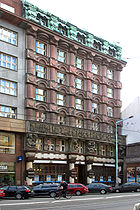
Prague
Prague is the capital and largest city of the Czech Republic. Situated in the north-west of the country on the Vltava river, the city is home to about 1.3 million people, while its metropolitan area is estimated to have a population of over 2.3 million...
.
Czech historians point to historical documents, such as protocols between the Legion and the Bolsheviks, that quite clearly state that all of the gold was turned over to Soviet representatives. Additional documents and articles argue that the Legion Bank was funded by a variety of enterprises and Czech thriftiness; there were, after all, over 50,000 soldiers saving virtually all of their payroll for two years and quite a bit of additional enterprise.
However, there is some evidence – not all of it circumstantial – that some of the gold made its way to the Czechoslovaks. William Clarke in The Lost Fortune of the Tsars cites records from the Vladivostok branch of the Hong Kong & Shanghai Banking Corporation. Shay McNeal in The Secret Plot to Save the Tsar refers to San Francisco banking transactions. The most dramatic evidence, however, is circumstantial. First, $323 million in gold shrank to $200 million by the time it reached the Bolsheviks.
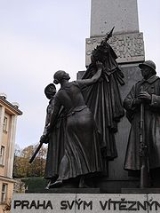
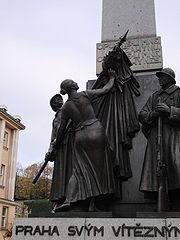
Even more dramatic, however, is the fact of the bank itself. The Bank of the Czechoslovak Legion is a masterpiece of First Republic Czech architecture. Its façade features scenes of the Legion's retreat through Siberia and sculptures of Legionnaires top the pillars. The building interior is a unique combination of Moravia
Moravia
Moravia is a historical region in Central Europe in the east of the Czech Republic, and one of the former Czech lands, together with Bohemia and Silesia. It takes its name from the Morava River which rises in the northwest of the region...
n graphic themes, Art Deco
Art Deco
Art deco , or deco, is an eclectic artistic and design style that began in Paris in the 1920s and flourished internationally throughout the 1930s, into the World War II era. The style influenced all areas of design, including architecture and interior design, industrial design, fashion and...
, and Czech craftsmanship. It has been widely admired, though was also an object of resentment and suspicion. The Soviet Red Army looted the bank in May 1945 and shipped its material assets to Moscow. They also took their revenge on any Legionnaires still alive. The Legion Bank Building was restored by the Czech Export Bank and recently sold to a developer. The bank still maintains a branch on the ground floor.
The Legion Bridge (most Legií) in Prague is named after the Czechoslovak Legions. The highest peak of the Carpathians was renamed Štít legionárov (literally "Peak of Legionaries") by the new Czechoslovak government, erasing its previous imperial name. Now it is called Gerlachovský štít.
See also
- Polish 5th Rifle DivisionPolish 5th Rifle DivisionPolish 5th Siberian Rifle Division was a Polish military unit formed in 1919 in Russia during World War I. The division fought during the Polish-Bolshevik War, but as it was attached to the White Russian formations, it is considered to have fought more in the Russian Civil War...
- South African support to the Czechoslovak Legion
- Josef ŠnejdárekJosef ŠnejdárekJosef Šnejdárek was a Czech soldier. He served 43 years in the French Foreign Legion and later was a military officer for Czechoslovakia...
Further reading
- Baerlein, Henry, The March of the 70,000, Leonard Parsons/Whitefriar Press, London 1926
- Bullock, David: The Czech Legion 1914-20, Osprey Publishers, Oxford 2008.
- Clarke, William, The Lost Fortune of the Tsars, St. Martins Press, New York 1994 pp183–189
- Fic, Victor M., The Bolsheviks and the Czechoslovak Legion, Shakti Malik, New Delhi 1978
- Footman, David, Civil War in Russia, Faber & Faber, London 1961
- Goldhurst, Richard, The Midnight War, McGraw-Hill, New York 1978
- Hoyt, Edwin P., The Army Without a Country, MacMillan, New York/London 1967
- Kalvoda, Josef, Czechoslovakia's Role in Soviet Strategy, University Press of America, Washington DC 1981
- Kalvoda, Josef, The Genesis of Czechoslovakia, East European Monographs, Boulder 1986
- McNeal, Shay, The Secret Plot to Save the Tsar, Harper Collins, New York 2002 pp 221–222
- Mohr, Joan McGuireJoan McGuire MohrJoan McGuire Mohr is an immigration historian who specializes in Slavic Immigration to the United States. Mohr currently consults as a Research Fellow for the Institute for Learning, a Think Tank at the University of Pittsburgh, in addition to a variety of museums throughout the United States and...
, The Czech and Slovak Legion in Siberia from 1917 to 1922. McFarland, NC 2011 - Unterberger, Betty MillerBetty Miller UnterbergerBetty Miller Unterberger is a retired historian, who as professor of American international relations spent the bulk of her extensive academic career at Texas A&M University...
, The United States, Revolutionary Russia, and the Rise of Czechoslovakia, Texas A&M University Press, College Station, 2000 - White, John Albert, The Siberian Intervention, Princeton University Press, Princeton 1950
Note: There were quite a few books on the Legion written in Czech that were published in the 1920s, but most were hard to find following Soviet victory in World War II.